


Cluster bomb

Encyclopedia
Runway
According to ICAO a runway is a "defined rectangular area on a land aerodrome prepared for the landing and take-off of aircraft." Runways may be a man-made surface or a natural surface .- Orientation and dimensions :Runways are named by a number between 01 and 36, which is generally one tenth...
s, electric power transmission
Electric power transmission
Electric-power transmission is the bulk transfer of electrical energy, from generating power plants to Electrical substations located near demand centers...
lines, disperse chemical or biological weapons, or to scatter land mine
Land mine
A land mine is usually a weight-triggered explosive device which is intended to damage a target—either human or inanimate—by means of a blast and/or fragment impact....
s. Some submunition-based weapons can disperse non-munitions, such as leaflets.
Because cluster bombs release many small bomblets over a wide area they pose risks to civilians both during attacks and afterwards. During attacks the weapons are prone to indiscriminate effects, especially in populated areas. Unexploded bomblets can kill or maim civilian
Civilian
A civilian under international humanitarian law is a person who is not a member of his or her country's armed forces or other militia. Civilians are distinct from combatants. They are afforded a degree of legal protection from the effects of war and military occupation...
s long after a conflict has ended, and are costly to locate and remove.
Cluster munitions are prohibited for those nations that ratify the Convention on Cluster Munitions
Convention on Cluster Munitions
The Convention on Cluster Munitions is an international treaty that prohibits the use, transfer and stockpile of cluster bombs, a type of explosive weapon which scatters submunitions over an area. The convention was adopted on 2008 in Dublin, and was opened for signature on 2008 in Oslo...
, adopted in Dublin, Ireland
Ireland
Ireland is an island to the northwest of continental Europe. It is the third-largest island in Europe and the twentieth-largest island on Earth...
in May 2008. The Convention entered into force and became binding international law upon ratifying states on 1 August 2010, six months after being ratified by 30 states; as of August 2011, a total of 108 states had signed the Convention and 60 of those have ratified it.
Development
The first cluster bomb used operationally was the GermanNazi Germany
Nazi Germany , also known as the Third Reich , but officially called German Reich from 1933 to 1943 and Greater German Reich from 26 June 1943 onward, is the name commonly used to refer to the state of Germany from 1933 to 1945, when it was a totalitarian dictatorship ruled by...
SD-2 or Sprengbombe Dickwandig 2 kg, commonly referred to as the Butterfly Bomb
Butterfly Bomb
A Butterfly Bomb, or was a German 2 kilogram anti-personnel submunition used by the Luftwaffe during the Second World War. It was so named because the thin cylindrical metal outer shell which hinged open when the bomblet deployed gave it the superficial appearance of a large butterfly...
. It was used in World War II
World War II
World War II, or the Second World War , was a global conflict lasting from 1939 to 1945, involving most of the world's nations—including all of the great powers—eventually forming two opposing military alliances: the Allies and the Axis...
to attack both civilian and military targets. The technology was developed independently by the United States of America, Russia
Russia
Russia or , officially known as both Russia and the Russian Federation , is a country in northern Eurasia. It is a federal semi-presidential republic, comprising 83 federal subjects...
and Italy
Italy
Italy , officially the Italian Republic languages]] under the European Charter for Regional or Minority Languages. In each of these, Italy's official name is as follows:;;;;;;;;), is a unitary parliamentary republic in South-Central Europe. To the north it borders France, Switzerland, Austria and...
(see Thermos Bomb
Thermos Bomb
Thermos Bomb was the informal name for the AR-4, an anti-personnel bomb dropped by the Italian Air Force during World War II. Large numbers were used against Malta and in the Middle East. It was named for its superficial appearance to a Thermos bottle, a popular brand of vacuum flask. The bomb was...
). The US used the 20-lb M41 fragmentation bomb wired together in clusters of 6 or 25 with highly sensitive or proximity fuze
Fuze
Fuze Beverage, commercially referred to as just Fuze , is a manufacturer of teas and non-carbonated fruit drinks enriched with vitamins. Currently the brand consists of five vitamin-infused lines: Slenderize, Refresh, Tea, Defensify, and Vitalize...
s.
From the 1970s to the 1990s cluster bombs became standard air-dropped munitions for many nations, in a wide variety of types. They have been produced by 34 countries and used in at least 23.
Artillery
Artillery
Originally applied to any group of infantry primarily armed with projectile weapons, artillery has over time become limited in meaning to refer only to those engines of war that operate by projection of munitions far beyond the range of effect of personal weapons...
shells that employ similar principles have existed for decades. They are typically referred to as ICM
Dual-Purpose Improved Conventional Munition
A Dual-Purpose Improved Conventional Munitions is an artillery or surface-to-surface missile warhead designed to burst into sub-munitions at an optimum altitude and distance from the desired target for dense area coverage. The sub-munitions are designed for both antiarmor and antipersonnel attack...
(Improved Conventional Munitions) shells. The US military slang terms for them are "firecracker" or "popcorn" shells, for the many small explosions they cause in the target area.
Types of cluster bombs
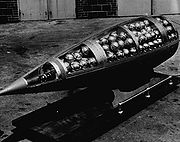
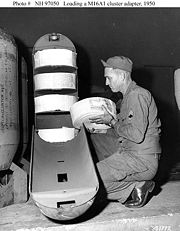
A basic cluster bomb consists of a hollow shell and then two to more than 2,000 submunitions or bomblets contained within it. Some types are dispensers that are designed to be retained by the aircraft after releasing their munitions. The submunitions themselves may be fitted with small parachuteParachute
A parachute is a device used to slow the motion of an object through an atmosphere by creating drag, or in the case of ram-air parachutes, aerodynamic lift. Parachutes are usually made out of light, strong cloth, originally silk, now most commonly nylon...
retarders or streamers to slow their descent (allowing the aircraft to escape the blast area in low-altitude attacks).

Recently submunition-based weapons have been designed that deploy smart submunitions, using thermal and visual sensors to locate and attack particular targets, usually armored vehicles. Weapons of this type include the US CBU-97
CBU-97
The CBU-97 Sensor Fuzed Weapon is a United States Air Force 1,000-pound-class non-guided Cluster Bomb Unit . It was developed and produced by Textron Defense Systems.-Overview:...
sensor-fuzed weapon, first used in combat during Operation Iraqi Freedom, the 2003 invasion of Iraq. Munitions specifically intended for anti-tank use may be set to self-destruct if they reach the ground without locating a target, theoretically reducing the risk of unintended civilian deaths and injuries. Although smart submunition weapons are many times more expensive than standard cluster bombs, which are cheaper and simpler to manufacture, far fewer smart submunitions are required for defeating dispersed and mobile targets in an area, offsetting this cost. On the basis that they should not cause the indiscriminate area effects or unexploded ordnance risks of cluster munitions, these submunitions are not classified as cluster munitions under the widely accepted definition of the weapon enshrined in international law by the Convention on Cluster Munitions.
Incendiary
Incendiary cluster bombs are intended to start fires, just as conventional incendiary bombs (also called firebombFirebomb
Firebomb may refer to:* Firebombing* Incendiary device* Molotov cocktail* A season 2 episode of the television show Alias* "Fire Bomb", a song by Rihanna from her 2009 album Rated R...
s). They are specifically designed for this purpose, with submunitions of white phosphorus or napalm
Napalm
Napalm is a thickening/gelling agent generally mixed with gasoline or a similar fuel for use in an incendiary device, primarily as an anti-personnel weapon...
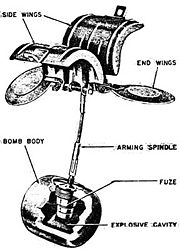
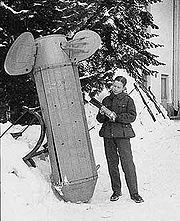
, and they often include anti-personnel and anti-tank submunitions to hamper firefighting efforts. When used in cities they have often been preceded by the use of conventional explosive bombs to break open the roofs and walls of buildings to expose flammable contents to the incendiaries. One of the earliest examples is the so-called Molotov bread basket
Molotov bread basket
The RRAB-3, nicknamed the Molotov bread basket , was a Soviet-made droppable bomb dispenser that combined a large high-explosive charge with a cluster of incendiary bombs. It was used against the cities of Finland during the Winter War of 1939–1940...
first used by the Soviet Union in the Winter War
Winter War
The Winter War was a military conflict between the Soviet Union and Finland. It began with a Soviet offensive on 30 November 1939 – three months after the start of World War II and the Soviet invasion of Poland – and ended on 13 March 1940 with the Moscow Peace Treaty...
of 1939-40. This type of munition was extensively used by both sides in the strategic bombings of World War II
Strategic bombing during World War II
Strategic bombing during World War II is a term which refers to all aerial bombardment of a strategic nature between 1939 and 1945 involving any nations engaged in World War II...
. Bombs of this type were used to start firestorm
Firestorm
A firestorm is a conflagration which attains such intensity that it creates and sustains its own wind system. It is most commonly a natural phenomenon, created during some of the largest bushfires, forest fires, and wildfires...
s in cases such as the bombing of Dresden in World War II
Bombing of Dresden in World War II
The Bombing of Dresden was a military bombing by the British Royal Air Force and the United States Army Air Force and as part of the Allied forces between 13 February and 15 February 1945 in the Second World War...
and the firebombing of Tokyo. In some modern bombs, submunitions are used to deliver a highly combustible thermobaric aerosol, which is subsequently ignited, resulting in a high pressure explosion.
Anti-personnel
Anti-personnel cluster bombs use explosive fragmentationFragmentation (weaponry)
Fragmentation is the process by which the casing of an artillery shell, bomb, grenade, etc. is shattered by the detonating high explosive filling. The correct technical terminology for these casing pieces is fragments , although shards or splinters can be used for non-preformed fragments...
to kill troops and destroy soft (unarmored) targets. Along with incendiary cluster bombs, these were among the first forms of cluster bombs produced by Germany
Germany
Germany , officially the Federal Republic of Germany , is a federal parliamentary republic in Europe. The country consists of 16 states while the capital and largest city is Berlin. Germany covers an area of 357,021 km2 and has a largely temperate seasonal climate...
during World War II
World War II
World War II, or the Second World War , was a global conflict lasting from 1939 to 1945, involving most of the world's nations—including all of the great powers—eventually forming two opposing military alliances: the Allies and the Axis...
. They were famously used during the Blitz
The Blitz
The Blitz was the sustained strategic bombing of Britain by Nazi Germany between 7 September 1940 and 10 May 1941, during the Second World War. The city of London was bombed by the Luftwaffe for 76 consecutive nights and many towns and cities across the country followed...
with delay and booby-trap fusing to hamper firefighting and other damage-control efforts in the bombed areas. They were also used with a contact fuze
Fuze
Fuze Beverage, commercially referred to as just Fuze , is a manufacturer of teas and non-carbonated fruit drinks enriched with vitamins. Currently the brand consists of five vitamin-infused lines: Slenderize, Refresh, Tea, Defensify, and Vitalize...
when attacking entrenchments. These weapons were most widely used during the Vietnam War when many thousands of tons of submunitions were dropped on Laos, Cambodia and Vietnam.
Anti-tank
Most anti-armor munitions contain shaped chargeShaped charge
A shaped charge is an explosive charge shaped to focus the effect of the explosive's energy. Various types are used to cut and form metal, to initiate nuclear weapons, to penetrate armor, and in the oil and gas industry...
warhead
Warhead
The term warhead refers to the explosive material and detonator that is delivered by a missile, rocket, or torpedo.- Etymology :During the early development of naval torpedoes, they could be equipped with an inert payload that was intended for use during training, test firing and exercises. This...
s to pierce the armor of tank
Tank
A tank is a tracked, armoured fighting vehicle designed for front-line combat which combines operational mobility, tactical offensive, and defensive capabilities...
s and armored fighting vehicles. In some cases, guidance is used to increase the likelihood of successfully hitting a vehicle. Modern guided submunitions, such as those found in the U.S. CBU-97
CBU-97
The CBU-97 Sensor Fuzed Weapon is a United States Air Force 1,000-pound-class non-guided Cluster Bomb Unit . It was developed and produced by Textron Defense Systems.-Overview:...
, can use either a shaped charge or an explosively formed penetrator
Explosively Formed Penetrator
An explosively formed penetrator , also known as an explosively formed projectile, a self-forging warhead, or a self-forging fragment, is a special type of shaped charge designed to penetrate armour effectively at standoff distances...
. Unguided shaped-charge submunitions are designed to be effective against entrenchments that incorporate overhead cover. To simplify supply and increase battlefield effectiveness by allowing a single type of round to be used against nearly any target, submunitions that incorporate both fragmentation and shaped-charge effects are produced.
Anti-runway
Anti-runway submunitions such as the British JP233JP233
Originally known as the LAAAS , the JP233 was a British submunition delivery system consisting of large dispenser pods carrying several hundred submunitions designed to attack runways.-Design and development:...
are designed to penetrate concrete
Concrete
Concrete is a composite construction material, composed of cement and other cementitious materials such as fly ash and slag cement, aggregate , water and chemical admixtures.The word concrete comes from the Latin word...
before detonating, allowing them to shatter and crater runway surfaces. In the case of the JP233, the cratering effect is achieved through the use of a two-stage warhead that combines a shaped charge and a conventional bulk explosive charge. The shaped charge creates a small crater inside which the bulk charge detonates to enlarge it. Anti-runway submunitions are usually used along with anti-personnel submunitions equipped with delay or booby-trap fuses that act as anti-personnel mine
Anti-personnel mine
Anti-personnel mines are a form of land mine designed for use against humans, as opposed to anti-tank mines, which are designed for use against vehicles...
s to make repair more difficult.
Mine-laying
When submunition-based weapons are used to disperse mines, their submunitions do not detonate immediately, but behave like conventional land mines that detonate later. The submunitions usually include a combination of anti-personnelAnti-personnel mine
Anti-personnel mines are a form of land mine designed for use against humans, as opposed to anti-tank mines, which are designed for use against vehicles...
and anti-tank mine
Anti-tank mine
An anti-tank mine, , is a type of land mine designed to damage or destroy vehicles including tanks and armored fighting vehicles....
s. Since such mines usually lie on exposed surfaces, the anti-personnel forms, such as the US Area Denial Artillery Munition
Area Denial Artillery Munition
Area Denial Artillery Munition is a family of US land mines and 155 mm artillery projectiles.The mines carried by these projectiles are the M67 long-duration anti-personnel mines and M72 short-duration anti-personnel landmines intended to maim or kill enemy combatants...
normally deploy tripwires automatically after landing to make clearing the minefield more difficult. In order to avoid rendering large portions of the battlefield permanently impassable, and to minimize the amount of mine-clearing needed after a conflict, scatterable mines used by the United States
United States
The United States of America is a federal constitutional republic comprising fifty states and a federal district...
are designed to self-destruct after a period of time from 4 to 48 hours. The internationally agreed definition of cluster munitions being negotiated in the Oslo Process may not include this type of weapon, since landmines are already covered in other specific international instruments.
Chemical weapons
United States
The United States of America is a federal constitutional republic comprising fifty states and a federal district...
and Soviet Union
Soviet Union
The Soviet Union , officially the Union of Soviet Socialist Republics , was a constitutionally socialist state that existed in Eurasia between 1922 and 1991....
developed cluster weapons designed to deliver chemical weapons. The Chemical Weapons Convention
Chemical Weapons Convention
The Chemical Weapons Convention is an arms control agreement which outlaws the production, stockpiling and use of chemical weapons. Its full name is the Convention on the Prohibition of the Development, Production, Stockpiling and Use of Chemical Weapons and on their Destruction...
of 1993 banned their use. Six nations declared themselves in possession of chemical weapons. The US and Russia are in the process of destroying their stockpiles, although they have received extensions for the full destruction, not having completed the destruction of their Chemical Weapons stockpiles by 2007, as the Treaty had originally intended.
Anti-electrical
An anti-electrical weapon, the CBU-94/B, was first used by the U.S. in the Kosovo WarKosovo War
The term Kosovo War or Kosovo conflict was two sequential, and at times parallel, armed conflicts in Kosovo province, then part of FR Yugoslav Republic of Serbia; from early 1998 to 1999, there was an armed conflict initiated by the ethnic Albanian "Kosovo Liberation Army" , who sought independence...
in 1999. These consist of a TMD (Tactical Munitions Dispenser) filled with 202 BLU-114/B "Soft-Bomb"
BLU-114/B "Soft-Bomb"
The BLU-114/B is a special-purpose munition for attacking electrical power infrastructure. Although very little is known about this highly classified weapon, reportedly it functions by dispensing a number of submunitions which in turn disperse large numbers of chemically treated graphite filaments...
submunitions. Each submunition contains a small explosive charge that disperses 147 reels of fine conductive fiber of either carbon or aluminum-coated glass. Their purpose is to disrupt and damage electric power transmission
Electric power transmission
Electric-power transmission is the bulk transfer of electrical energy, from generating power plants to Electrical substations located near demand centers...
systems by producing short circuit
Short circuit
A short circuit in an electrical circuit that allows a current to travel along an unintended path, often where essentially no electrical impedance is encountered....
s in high-voltage power lines and electrical substation
Electrical substation
A substation is a part of an electrical generation, transmission, and distribution system. Substations transform voltage from high to low, or the reverse, or perform any of several other important functions...
s. On the first attack, these knocked out 70% of the electrical power supply in Serbia
Serbia
Serbia , officially the Republic of Serbia , is a landlocked country located at the crossroads of Central and Southeast Europe, covering the southern part of the Carpathian basin and the central part of the Balkans...
. There are reports that it took 500 people 15 hours to get one transformer yard back on line after being hit with these weapons.
Leaflet dispensing
The LBU-30 is designed for dropping large quantities of leafletPamphlet
A pamphlet is an unbound booklet . It may consist of a single sheet of paper that is printed on both sides and folded in half, in thirds, or in fourths , or it may consist of a few pages that are folded in half and saddle stapled at the crease to make a simple book...
s from aircraft. (Dispensing leaflets from the air is a common wartime propaganda
Propaganda
Propaganda is a form of communication that is aimed at influencing the attitude of a community toward some cause or position so as to benefit oneself or one's group....
tactic.) Enclosing the leaflets within the bomblets ensures that the leaflets will fall on the intended area without being dispersed excessively by the wind. The LBU-30 consists of SUU-30 dispensers that have been adapted to leaflet dispersal. The dispensers are essentially recycled units from old bombs. The LBU-30 was tested at Eglin Air Force Base
Eglin Air Force Base
Eglin Air Force Base is a United States Air Force base located approximately 3 miles southwest of Valparaiso, Florida in Okaloosa County....
in 2000, by an F-16 flying at 20000 feet (6,096 m).
Nagorno Karabakh War
- Hundreds of cluster bombs were used by AzerbaijanAzerbaijanAzerbaijan , officially the Republic of Azerbaijan is the largest country in the Caucasus region of Eurasia. Located at the crossroads of Western Asia and Eastern Europe, it is bounded by the Caspian Sea to the east, Russia to the north, Georgia to the northwest, Armenia to the west, and Iran to...
in Nagorno Karabakh in 1992-94 in the course of the Nagorno-Karabakh WarNagorno-Karabakh WarThe Nagorno-Karabakh War was an armed conflict that took place from February 1988 to May 1994, in the small enclave of Nagorno-Karabakh in southwestern Azerbaijan, between the majority ethnic Armenians of Nagorno-Karabakh backed by the Republic of Armenia, and the Republic of Azerbaijan...
. An estimated 180 cluster bombs were dropped on the city of StepanakertStepanakertStepanakert is the largest city and capital of the Nagorno-Karabakh Republic, a de facto independent republic, though is internationally recognized as a part of Azerbaijan...
. As of 2010, 93 km2 remain off-limits due to contamination with unexploded cluster ordinance. HALO TrustHALO TrustThe HALO Trust is a non-political, non-religious registered British charity and American non-profit organization whose purpose is to remove the debris left behind by war, in particular, landmines and unexploded ordnance that might present a danger to civilians. Founded in 1988 it was the first...
has made major contributions to the cleanup effort.,
Serbia and Montenegro, 1999
- Used by the NATO forces
7 May 1999 between time of 11.30 and 11.40 hours the NATO attack was carried out with two containers of cluster bombs (bombs with about 100-150 per container) [2] to the Nis Airport (military target), located at the end of the city, but the bombs missed the goal and fell within the city center.
Cluster bombs were scattered from the two containers, carried by the wind, they fell in three locations in the central part of the city:
- Pathology building next to the Medical Center of Nis in the south of the city,
- Next to the building of "Banovina" including the main market, bus station next to the fortress of Nis and "12th February" Health Centre
- Parking "Nis Express" near river Nisava
Reports say:
- 15 civilians killed
- Serious injured,eight civilians,
- 11 civilians sustained minor injuries,
- 120 damaged housing units,
- 47 destroyed and 15 damaged cars.
Iraq, 2003
- Used by the United States and the United Kingdom
The NGO Human Rights Watch claims Iraqi civilians were attacked with at least two million Cluster Munition bombs during Operation Iraqi Freedom by the US and the UK in 2003. When these weapons were fired on Baghdad on April 7, 2003 many of the bomblets failed to explode on impact. They were picked up or stumbled on by their victims. The Pentagon
Pentagon
In geometry, a pentagon is any five-sided polygon. A pentagon may be simple or self-intersecting. The sum of the internal angles in a simple pentagon is 540°. A pentagram is an example of a self-intersecting pentagon.- Regular pentagons :In a regular pentagon, all sides are equal in length and...
presented a misleading picture during the war of the extent to which cluster weapons were being used and of the civilian casualties they were causing. Gen. Richard Myers
Richard Myers
Richard Bowman Myers is a retired four-star general in the United States Air Force and served as the 15th Chairman of the Joint Chiefs of Staff. As Chairman, Myers was the United States military's highest ranking uniformed officer....
, chairman of the Joint Chiefs of Staff, told reporters on April 25, six days before President Bush declared major combat operations over, that the United States had used 1,500 cluster weapons and caused one civilian casualty. It turns out he was referring only to cluster weapons dropped from the air, not those fired by U.S. ground forces. In fact, the United States used 10,782 cluster weapons, according to the declassified executive summary of a report compiled by U.S. Central Command, which oversaw military operations in Iraq.
Lebanon, 1978, 1982 and 2006
- Extensively used by IsraelIsraelThe State of Israel is a parliamentary republic located in the Middle East, along the eastern shore of the Mediterranean Sea...
during the 1978 Israeli invasion of Lebanon, the 1982-2000 occupation of Lebanon and also by Hezbollah in the 2006 Lebanon War.
During the Israeli-Lebanese conflict in 1982
1982 Lebanon War
The 1982 Lebanon War , , called Operation Peace for Galilee by Israel, and later known in Israel as the Lebanon War and First Lebanon War, began on 6 June 1982, when the Israel Defense Forces invaded southern Lebanon...
, Israel used cluster munitions, many of them American-made, on targets in southern Lebanon. Israel also used cluster bombs in the 2006 Lebanon War.
Two types of cluster munitions were transferred to Israel from the U.S. The first was the CBU-58 which uses the BLU-63 bomblet. This cluster bomb is no longer in production. The second was the MK-20 Rockeye, produced by Honeywell Incorporated in Minneapolis. The CBU-58 was used by Israel in Lebanon in both 1978 and 1982. The Israeli Defense company Israel Military Industries
Israel Military Industries
Israel Weapons Industries , formerly the "Magen" division of the Israel Military Industries Ltd. is an Israeli firearms manufacturer. In 2005, the Small Arms Division of IMI was privatized....
also manufactures the more up-to-date M-85 cluster bomb.
Hezbollah fired Chinese-manufactured cluster munitions into Israel civilian targets, using 122-mm rocket launchers during the 2006 war, hitting Kiryat Motzkin, Nahariya
Nahariya
Nahariya is the northernmost coastal city in Israel, with an estimated population of 51,200.-History:Nahariya was founded by German Jewish immigrants from the Fifth Aliyah in the 1930s...
, Karmiel
Karmiel
Karmiel is a city in northern Israel. Established in 1964 as a development town, Karmiel is located in the Beit HaKerem Valley which divides upper and lower Galilee. The city is located south of the Acre-Safed road, from Safed and from Acre...
, Maghar
Maghar
Maghar is the ninth month of the Nanakshahi calendar, which governs the activities within Sikhism. This month coincides with November and December in the Gregorian and Julian calendars and is 30 days long.-November:...
, and Safsufa. A total of 113 rockets and 4,407 submunitions were fired into Israel during the war. The rockets killed one person and injured twelve.
Israel dropped up to four million submunitions on Lebanese soil, one million of which remain unexploded “duds,” according to the United Nations Mine Action Service
United Nations Mine Action Service
United Nations Mine Action Service is located in the It is responsible for ensuring an effective, proactive and coordinated United Nations response to landmines and explosive remnants of war through collaboration with 13 other UN departments, agencies, funds and programmes...
. Throughout the thirty-four-day conflict, the United States resupplied Israel’s arsenal of cluster bombs, which prompted an investigation by the State Department to examine if Israel had violated secret agreements it signed with the United States governing their use.
"Israel Defense Forces Chief of Staff Dan Halutz plans to appoint a major general to investigate the use of cluster bombs — some of which were fired against his order — during the Lebanon war. Halutz ordered the IDF to use cluster bombs with extreme caution and not to fire them into populated areas. Nonetheless, it did so anyway, primarily using artillery batteries and the Multiple Launch System (MRLS). IDF artillery, MLRS and aircraft are thought to have delivered thousands of cluster bombs, containing a total of some 4 million bomblets during the war."
Human Rights Watch
Human Rights Watch
Human Rights Watch is an international non-governmental organization that conducts research and advocacy on human rights. Its headquarters are in New York City and it has offices in Berlin, Beirut, Brussels, Chicago, Geneva, Johannesburg, London, Los Angeles, Moscow, Paris, San Francisco, Tokyo,...
said there was evidence that Israel had used cluster bombs very close to civilian areas and described them as "unacceptably inaccurate and unreliable weapons when used around civilians" and that "they should never be used in populated areas." Human Rights Watch has accused Israel of using cluster munitions in an attack on Bilda, a Lebanese village, on 19 July which killed 1 civilian and injured 12, including seven children. The Israeli "army defended ... the use of cluster munitions in its offensive with Lebanon
Lebanon
Lebanon , officially the Republic of LebanonRepublic of Lebanon is the most common term used by Lebanese government agencies. The term Lebanese Republic, a literal translation of the official Arabic and French names that is not used in today's world. Arabic is the most common language spoken among...
, saying that using such munitions was 'legal under international law
International law
Public international law concerns the structure and conduct of sovereign states; analogous entities, such as the Holy See; and intergovernmental organizations. To a lesser degree, international law also may affect multinational corporations and individuals, an impact increasingly evolving beyond...
' and the army employed
them 'in accordance with international standards.'" Foreign Ministry Spokesman Mark Regev
Mark Regev
Mark Regev , formerly Mark Freiberg, is an Australian-born Israeli diplomat and media spokesman. He is currently the spokesman for the Prime Minister of Israel and an advisor on foreign press and public affairs, a position he has held since his appointment by the former Prime Minister Ehud Olmert...
added, "[I]f NATO countries stock these weapons and have used them in recent conflicts — in Yugoslavia
Yugoslavia
Yugoslavia refers to three political entities that existed successively on the western part of the Balkans during most of the 20th century....
, Afghanistan
Afghanistan
Afghanistan , officially the Islamic Republic of Afghanistan, is a landlocked country located in the centre of Asia, forming South Asia, Central Asia and the Middle East. With a population of about 29 million, it has an area of , making it the 42nd most populous and 41st largest nation in the world...
and Iraq
Iraq
Iraq ; officially the Republic of Iraq is a country in Western Asia spanning most of the northwestern end of the Zagros mountain range, the eastern part of the Syrian Desert and the northern part of the Arabian Desert....
— the world has no reason to point a finger at Israel."
Georgia, 2008
- Used by Georgia, Russia denies use of such equipment
Russia
Russia
Russia or , officially known as both Russia and the Russian Federation , is a country in northern Eurasia. It is a federal semi-presidential republic, comprising 83 federal subjects...
and Georgia
Georgia (country)
Georgia is a sovereign state in the Caucasus region of Eurasia. Located at the crossroads of Western Asia and Eastern Europe, it is bounded to the west by the Black Sea, to the north by Russia, to the southwest by Turkey, to the south by Armenia, and to the southeast by Azerbaijan. The capital of...
are both purported to have used cluster munitions during the 2008 South Ossetia war
2008 South Ossetia war
The 2008 South Ossetia War or Russo-Georgian War was an armed conflict in August 2008 between Georgia on one side, and Russia and separatist governments of South Ossetia and Abkhazia on the other....
. According to the Human Rights Watch
Human Rights Watch
Human Rights Watch is an international non-governmental organization that conducts research and advocacy on human rights. Its headquarters are in New York City and it has offices in Berlin, Beirut, Brussels, Chicago, Geneva, Johannesburg, London, Los Angeles, Moscow, Paris, San Francisco, Tokyo,...
, the Russian Air Force
Russian Air Force
The Russian Air Force is the air force of Russian Military. It is currently under the command of Colonel General Aleksandr Zelin. The Russian Navy has its own air arm, the Russian Naval Aviation, which is the former Soviet Aviatsiya Voyenno Morskogo Flota , or AV-MF).The Air Force was formed from...
dropped RBK-250 cluster bombs in populated areas, killing at least 11 civilians (including Dutch journalist Stan Storimans
Stan Storimans
Stanislaus N.I.M. Storimans was a Dutch RTL TV veteran cameraman. He had planned to publish a book describing his 20 years of reporting from hotspots like Afghanistan, Republic of the Congo, Indonesia, Iraq, Sri Lanka, the former Zaire and the former Yugoslavia, among others...
) and injuring dozens: "this is the first known use of cluster munitions since 2006, during Israel’s war with Hezbollah in Lebanon" - the group said. Russian Colonel-General Anatoly Nogovitsyn, answering question about the topic said: "We never use cluster bombs. There is no need to do so." Human Rights Watch said on September 1 that Georgia had admitted to using cluster bombs during the war, The Associated Press and AFP reported. The Georgian military used LAR-160
LAR-160
The LAR-160 is a light artillery rocket with a 160mm calibre and a range of 45 km, from a multiple rocket launcher.It is manufactured by Israel Military Industries...
multiple rocket launchers to fire MK4 LAR 160 type rockets (with M-85 bomblets) with a range of 45 kilometers the Georgian Minister of Defense (MoD) said. The Dutch government investigated the death of Storimans and concluded based on footage and materials found on location that the cluster bomb responsible for Storimans had been propelled by an SS-26 tactical missile. The SS-26 (though not been a cluster bomb) is used by Russia, but not Georgia forces, hence the Dutch government concluded that the attack was Russian.
Libya, 2011
It was reported in April 2011 that Colonel Gaddafi's forces had used cluster bombs in the ongoing conflict between government forces and rebel forces trying to overthrow Gaddafi's government, during the battle of MisrataBattle of Misrata
The Battle of Misrata was a battle of the 2011 Libyan civil war between pro-Gaddafi loyalists and anti-Gaddafi forces, which held Misrata, the third largest city in Libya...
These reports were denied by the government, but a New York Times investigation refuted that denial.
Threat to civilians
Cluster munitions are opposed by many individuals and hundreds of groups, such as the Red Cross, the Cluster Munition Coalition
Cluster Munition Coalition
The Cluster Munition Coalition is an international civil society movement campaigning against the use, production, stockpiling and transfer of cluster munitions. Cluster munitions are a type of explosive weapon widely stockpiled by more than 80 states...
and the United Nations
United Nations
The United Nations is an international organization whose stated aims are facilitating cooperation in international law, international security, economic development, social progress, human rights, and achievement of world peace...
, because of the high number of civilians that have fallen victim to the weapon. Since February 2005, Handicap International
Handicap International
Handicap International is a non-governmental organization created in 1982 to provide help in refugee camps in Cambodia and Thailand. Based in Belgium and France, it has since opened branches in six other countries : Switzerland, Luxembourg, United Kingdom, Germany, Canada and the United States...
called for cluster munitions to be prohibited and collected hundreds of thousands of signatures to support its call. 98% of 13,306 recorded cluster munitions casualties that are registered with Handicap International are civilians, while 27% are children.
The area affected by a single cluster munition, known as its footprint, can be very large; a single unguided M26 MLRS rocket can effectively cover an area of 0.23 km2. In US and most allied services, the M26 has been replaced by the M30 guided missile fired from the MLRS. The M30 has greater range and accuracy but a smaller area of coverage. It is worth noting that for reasons including both danger to civilians and changing tactical requirements, the non-cluster unitary warhead XM31 missile is, in many cases, replacing even the M30.
Because of the weapon's broad area of effect, they have often been documented as striking both civilian and military objects in the target area. This characteristic of the weapon is particularly problematic for civilians when cluster munitions are used in or near populated areas and has been documented by research reports from groups such as Human Rights Watch
Human Rights Watch
Human Rights Watch is an international non-governmental organization that conducts research and advocacy on human rights. Its headquarters are in New York City and it has offices in Berlin, Beirut, Brussels, Chicago, Geneva, Johannesburg, London, Los Angeles, Moscow, Paris, San Francisco, Tokyo,...
, Landmine Action, Mines Action Canada and Handicap International
Handicap International
Handicap International is a non-governmental organization created in 1982 to provide help in refugee camps in Cambodia and Thailand. Based in Belgium and France, it has since opened branches in six other countries : Switzerland, Luxembourg, United Kingdom, Germany, Canada and the United States...
. In some cases, like the Zagreb rocket attack
Zagreb rocket attack
The Zagreb rocket attacks were a series of two artillery attacks conducted by Serb armed forces that fired ground-to-ground missiles on the Croatian capital of Zagreb during the Croatian War of Independence...
, civilians were deliberately targeted by such weapons.
Unexploded ordnance
The other serious problem, also common to explosive weaponsExplosive weapons
An explosive weapon generally uses high explosive to project blast and/or fragmentation from a point of detonation.Explosive weapons may be subdivided by their method of manufacture into explosive ordnance and improvised explosive devices ....
is unexploded ordnance
Unexploded ordnance
Unexploded ordnance are explosive weapons that did not explode when they were employed and still pose a risk of detonation, potentially many decades after they were used or discarded.While "UXO" is widely and informally used, munitions and explosives of...
(UXO) of cluster bomblets left behind after a strike. These bomblets may be dud
Dud
A dud is an ammunition round or explosive that fails to fire or detonate, respectively, on time or on command.Duds are still dangerous and have to be deactivated and disposed of carefully. Poorly designed devices A dud is an ammunition round or explosive that fails to fire or detonate,...
s or in some cases the weapons are designed to detonate at a later stage. In both cases, the surviving bomblets are live and can explode when handled, making them a serious threat to civilians and military personnel entering the area. In effect, the UXOs can function like land mines.
Even though cluster bombs are designed to explode prior to or on impact, there are always some individual submunitions that do not explode on impact. The US-made MLRS
M270 Multiple Launch Rocket System
The M270 Multiple Launch Rocket System is an armored, self-propelled, multiple rocket launcher; a type of rocket artillery.Since the first M270s were delivered to the U.S. Army in 1983, the MLRS has been adopted by several NATO countries. Some 1,300 M270 systems have been manufactured in the...
with M26
M-26 artillery rocket
M26 is the basic MLRS rocket. It is unguided with a range of 20mi . It is armed with 644 M77 DPICM anti-personnel/anti-materiel grenades, which are dispersed over the target in mid-air and detonate on impact....
warhead and M77 submunitions are supposed to have a 5% dud rate but studies have shown that some have a much higher rate. The rate in acceptance tests prior to the Gulf War
Gulf War
The Persian Gulf War , commonly referred to as simply the Gulf War, was a war waged by a U.N.-authorized coalition force from 34 nations led by the United States, against Iraq in response to Iraq's invasion and annexation of Kuwait.The war is also known under other names, such as the First Gulf...
for this type ranged from 2% to a high of 23% for rockets cooled to -25 °F before testing. The M483A1 DPICM artillery-delivered cluster bombs have a reported dud rate of 14%.
Given that each cluster bomb can contain hundreds of bomblets and be fired in volleys, even a small failure rate can lead each strike to leave behind hundreds or thousands of UXOs scattered randomly across the strike area. For example, after the 2006 Israel-Lebanon conflict
2006 Israel-Lebanon conflict
The 2006 Lebanon War, also called the 2006 Israel-Hezbollah War and known in Lebanon as the July War #Other uses|Tammūz]]) and in Israel as the Second Lebanon War , was a 34-day military conflict in Lebanon, northern Israel and the Israeli-occupied territories. The principal parties were Hezbollah...
, UN experts have estimated that as many as one million unexploded bomblets may contaminate the hundreds of cluster munition strike sites in Lebanon.
In addition, some cluster bomblets, such as the BLU-97/B used in the CBU-87, are brightly colored to increase their visibility and warn off civilians. However, the yellow color, coupled with their small and nonthreatening appearance, is attractive to young children who wrongly believe them to be toys. This problem was exacerbated in the War in Afghanistan (2001–present)
War in Afghanistan (2001–present)
The War in Afghanistan began on October 7, 2001, as the armed forces of the United States of America, the United Kingdom, Australia, and the Afghan United Front launched Operation Enduring Freedom...
, when US forces dropped humanitarian rations from airplanes with similar yellow-colored packaging as the BLU-97/B, yellow being the NATO standard colour for high explosive filler in air weapons. The rations packaging was later changed first to blue and then to clear in the hope of avoiding such hazardous confusion.
The US military is developing new cluster bombs that it claims could have a much lower (less than 1%) dud rate. Sensor-fused weapons that contain a limited number of submunitions that are capable of autonomously engaging armored targets may provide a viable, if costly, alternative to cluster munitions that will allow multiple target engagement with one shell or bomb while avoiding the civilian deaths and injuries consistently documented from the use of cluster munitions. Certain such weapons may be allowed under the recently adopted Convention on Cluster Munitions, provided they do not have the indiscriminate area effects or pose the unexploded ordnance risks of cluster munitions.
In the 1980s the Spanish firm Esperanza y Cia developed a 120mm caliber mortar bomb which contained 21 anti-armor submunitions. What made the 120mm "Espin" unique was the electrical impact fusing system which totally eliminated dangerous duds. The system operates on a capacitor in each submunition which charged by a wind generator in the nose of the projectile after being fired. If for what ever reason the electrical fuse fails to function on impact, approximately 5 minutes later the capacitor bleeds out, therefore neutralizing the submunition's electronic fuse system. Later a similar mortar round was offered in the 81mm caliber and equipped some Spanish Marine units. But on signing the Wellington Declaration on Cluster Munitions
Convention on Cluster Munitions
The Convention on Cluster Munitions is an international treaty that prohibits the use, transfer and stockpile of cluster bombs, a type of explosive weapon which scatters submunitions over an area. The convention was adopted on 2008 in Dublin, and was opened for signature on 2008 in Oslo...
, Spain withdrew both the 81mm and 120mm "Espin" rounds from its military units.
Civilian deaths from unexploded cluster bomblets
- In Vietnam, people are still being killed as a result of cluster bombs and other objects left by the US and Vietnamese military forces. Estimates range up to 300 people killed annually by unexploded ordnance.
- Some 270 million cluster submunitions were dropped on Laos in the 1960s and 1970s; approximately one third of these submunitions failed to explode and continue to pose a threat today.
- During the 1999 NATO war against YugoslaviaYugoslaviaYugoslavia refers to three political entities that existed successively on the western part of the Balkans during most of the 20th century....
U.S. and Britain dropped 1,400 cluster bombs in Kosovo. Within the first year after the end of the war more than 100 civilians died from unexploded British and American bombs. Unexploded cluster bomblets caused more civilian deaths than landmines. - Israel used cluster bombs in Lebanon in 1978 and in the 1980s. Those weapons used more than two decades ago by Israel continue to affect Lebanon. During the 2006 war in Lebanon Israel fired large numbers of cluster bombs in Lebanon, containing an estimated more than 4 million cluster submunitions. In the first month following the ceasefire, unexploded cluster munitions killed or injured an average of 3-4 people per day.
Areas with significant unexploded cluster bomb submunitions
- Nagorno Karabakh
- LebanonLebanonLebanon , officially the Republic of LebanonRepublic of Lebanon is the most common term used by Lebanese government agencies. The term Lebanese Republic, a literal translation of the official Arabic and French names that is not used in today's world. Arabic is the most common language spoken among...
- IndochinaIndochinaThe Indochinese peninsula, is a region in Southeast Asia. It lies roughly southwest of China, and east of India. The name has its origins in the French, Indochine, as a combination of the names of "China" and "India", and was adopted when French colonizers in Vietnam began expanding their territory...
, especially in LaosLaosLaos Lao: ສາທາລະນະລັດ ປະຊາທິປະໄຕ ປະຊາຊົນລາວ Sathalanalat Paxathipatai Paxaxon Lao, officially the Lao People's Democratic Republic, is a landlocked country in Southeast Asia, bordered by Burma and China to the northwest, Vietnam to the east, Cambodia to the south and Thailand to the west...
and central Vietnam's former demilitarized zoneVietnamese Demilitarized ZoneThe Vietnamese Demilitarized Zone was established as a dividing line between North and South Vietnam as a result of the First Indochina War.During the Second Indochina War , it became important as the battleground demarcation separating North Vietnamese territory from South Vietnamese territory.-...
. - SerbiaSerbiaSerbia , officially the Republic of Serbia , is a landlocked country located at the crossroads of Central and Southeast Europe, covering the southern part of the Carpathian basin and the central part of the Balkans...
- AfghanistanAfghanistanAfghanistan , officially the Islamic Republic of Afghanistan, is a landlocked country located in the centre of Asia, forming South Asia, Central Asia and the Middle East. With a population of about 29 million, it has an area of , making it the 42nd most populous and 41st largest nation in the world...
- IraqIraqIraq ; officially the Republic of Iraq is a country in Western Asia spanning most of the northwestern end of the Zagros mountain range, the eastern part of the Syrian Desert and the northern part of the Arabian Desert....
- Western SaharaWestern SaharaWestern Sahara is a disputed territory in North Africa, bordered by Morocco to the north, Algeria to the northeast, Mauritania to the east and south, and the Atlantic Ocean to the west. Its surface area amounts to . It is one of the most sparsely populated territories in the world, mainly...
Countries that have been affected by cluster munitions include:
|
Iraq Iraq ; officially the Republic of Iraq is a country in Western Asia spanning most of the northwestern end of the Zagros mountain range, the eastern part of the Syrian Desert and the northern part of the Arabian Desert.... Israel The State of Israel is a parliamentary republic located in the Middle East, along the eastern shore of the Mediterranean Sea... Kuwait The State of Kuwait is a sovereign Arab state situated in the north-east of the Arabian Peninsula in Western Asia. It is bordered by Saudi Arabia to the south at Khafji, and Iraq to the north at Basra. It lies on the north-western shore of the Persian Gulf. The name Kuwait is derived from the... Laos Laos Lao: ສາທາລະນະລັດ ປະຊາທິປະໄຕ ປະຊາຊົນລາວ Sathalanalat Paxathipatai Paxaxon Lao, officially the Lao People's Democratic Republic, is a landlocked country in Southeast Asia, bordered by Burma and China to the northwest, Vietnam to the east, Cambodia to the south and Thailand to the west... Lebanon Lebanon , officially the Republic of LebanonRepublic of Lebanon is the most common term used by Lebanese government agencies. The term Lebanese Republic, a literal translation of the official Arabic and French names that is not used in today's world. Arabic is the most common language spoken among... Montenegro Montenegro Montenegrin: Crna Gora Црна Гора , meaning "Black Mountain") is a country located in Southeastern Europe. It has a coast on the Adriatic Sea to the south-west and is bordered by Croatia to the west, Bosnia and Herzegovina to the northwest, Serbia to the northeast and Albania to the... Pakistan Pakistan , officially the Islamic Republic of Pakistan is a sovereign state in South Asia. It has a coastline along the Arabian Sea and the Gulf of Oman in the south and is bordered by Afghanistan and Iran in the west, India in the east and China in the far northeast. In the north, Tajikistan... Palestine Palestine is a conventional name, among others, used to describe the geographic region between the Mediterranean Sea and the Jordan River, and various adjoining lands.... Chechnya The Chechen Republic , commonly referred to as Chechnya , also spelled Chechnia or Chechenia, sometimes referred to as Ichkeria , is a federal subject of Russia . It is located in the southeastern part of Europe in the Northern Caucasus mountains. The capital of the republic is the city of Grozny... Saudi Arabia The Kingdom of Saudi Arabia , commonly known in British English as Saudi Arabia and in Arabic as as-Sa‘ūdiyyah , is the largest state in Western Asia by land area, constituting the bulk of the Arabian Peninsula, and the second-largest in the Arab World... |
Serbia Serbia , officially the Republic of Serbia , is a landlocked country located at the crossroads of Central and Southeast Europe, covering the southern part of the Carpathian basin and the central part of the Balkans... (mainly south Serbia and Kosovo Kosovo Kosovo is a region in southeastern Europe. Part of the Ottoman Empire for more than five centuries, later the Autonomous Province of Kosovo and Metohija within Serbia... ) Sierra Leone Sierra Leone , officially the Republic of Sierra Leone, is a country in West Africa. It is bordered by Guinea to the north and east, Liberia to the southeast, and the Atlantic Ocean to the west and southwest. Sierra Leone covers a total area of and has an estimated population between 5.4 and 6.4... South Ossetia South Ossetia or Tskhinvali Region is a disputed region and partly recognized state in the South Caucasus, located in the territory of the South Ossetian Autonomous Oblast within the former Georgian Soviet Socialist Republic.... Sudan Sudan , officially the Republic of the Sudan , is a country in North Africa, sometimes considered part of the Middle East politically. It is bordered by Egypt to the north, the Red Sea to the northeast, Eritrea and Ethiopia to the east, South Sudan to the south, the Central African Republic to the... Syria Syria , officially the Syrian Arab Republic , is a country in Western Asia, bordering Lebanon and the Mediterranean Sea to the West, Turkey to the north, Iraq to the east, Jordan to the south, and Israel to the southwest.... Tajikistan Tajikistan , officially the Republic of Tajikistan , is a mountainous landlocked country in Central Asia. Afghanistan borders it to the south, Uzbekistan to the west, Kyrgyzstan to the north, and China to the east.... Vietnam Vietnam – sometimes spelled Viet Nam , officially the Socialist Republic of Vietnam – is the easternmost country on the Indochina Peninsula in Southeast Asia. It is bordered by China to the north, Laos to the northwest, Cambodia to the southwest, and the South China Sea –... Western Sahara Western Sahara is a disputed territory in North Africa, bordered by Morocco to the north, Algeria to the northeast, Mauritania to the east and south, and the Atlantic Ocean to the west. Its surface area amounts to . It is one of the most sparsely populated territories in the world, mainly... United Kingdom The United Kingdom of Great Britain and Northern IrelandIn the United Kingdom and Dependencies, other languages have been officially recognised as legitimate autochthonous languages under the European Charter for Regional or Minority Languages... - Falkland Islands Falkland Islands The Falkland Islands are an archipelago in the South Atlantic Ocean, located about from the coast of mainland South America. The archipelago consists of East Falkland, West Falkland and 776 lesser islands. The capital, Stanley, is on East Falkland... |
International legislation
Cluster bombs fall under the general rules of international humanitarian lawInternational humanitarian law
International humanitarian law , often referred to as the laws of war, the laws and customs of war or the law of armed conflict, is the legal corpus that comprises "the Geneva Conventions and the Hague Conventions, as well as subsequent treaties, case law, and customary international law." It...
, but were not specifically covered by any currently binding international legal instrument until the signature of the Convention on Cluster Munitions
Convention on Cluster Munitions
The Convention on Cluster Munitions is an international treaty that prohibits the use, transfer and stockpile of cluster bombs, a type of explosive weapon which scatters submunitions over an area. The convention was adopted on 2008 in Dublin, and was opened for signature on 2008 in Oslo...
in December 2008. This international treaty stemmed from an initiative by the Government of Norway known as the Oslo Process which was launched in February 2007 to prohibit cluster munitions. More than 100 countries agreed to the text of the resulting Convention on Cluster Munitions
Convention on Cluster Munitions
The Convention on Cluster Munitions is an international treaty that prohibits the use, transfer and stockpile of cluster bombs, a type of explosive weapon which scatters submunitions over an area. The convention was adopted on 2008 in Dublin, and was opened for signature on 2008 in Oslo...
in May 2008 which sets out a comprehensive ban on these weapons. This treaty was signed by 94 states in Oslo on 3–4 December. The Oslo Process was launched largely in response to the failure of the Convention on Certain Conventional Weapons
Convention on Certain Conventional Weapons
The United Nations Convention on Certain Conventional Weapons , concluded at Geneva on October 10, 1980 and entered into force in December 1983, seeks to prohibit or restrict the use of certain conventional weapons which are considered excessively injurious or whose effects are indiscriminate.The...
(CCW) where five years of discussions failed to find an adequate response to these weapons. The Cluster Munition Coalition
Cluster Munition Coalition
The Cluster Munition Coalition is an international civil society movement campaigning against the use, production, stockpiling and transfer of cluster munitions. Cluster munitions are a type of explosive weapon widely stockpiled by more than 80 states...
(CMC) is campaigning for the widespread accession to and ratification of the Convention on Cluster Munitions
Convention on Cluster Munitions
The Convention on Cluster Munitions is an international treaty that prohibits the use, transfer and stockpile of cluster bombs, a type of explosive weapon which scatters submunitions over an area. The convention was adopted on 2008 in Dublin, and was opened for signature on 2008 in Oslo...
.
A number of sections of the Protocol on explosive remnants of war
Explosive remnants of war
Explosive remnants of war is a term used in the humanitarian aid and sustainable development domains to describe the explosive threats remaining in post-conflict society...
(Protocol V to the 1980 Convention
Convention on Certain Conventional Weapons
The United Nations Convention on Certain Conventional Weapons , concluded at Geneva on October 10, 1980 and entered into force in December 1983, seeks to prohibit or restrict the use of certain conventional weapons which are considered excessively injurious or whose effects are indiscriminate.The...
), 28 November 2003 occasionally address some of the problems associated with the use of cluster munitions, in particular Article 9, which mandates States Parties to "take generic preventive measures aimed at minimising the occurrence of explosive remnants of war". In June 2006, Belgium
Belgium
Belgium , officially the Kingdom of Belgium, is a federal state in Western Europe. It is a founding member of the European Union and hosts the EU's headquarters, and those of several other major international organisations such as NATO.Belgium is also a member of, or affiliated to, many...
was the first country to issue a ban on the use (carrying), transportation, export, stockpiling, trade and production of cluster munitions, and Austria
Austria
Austria , officially the Republic of Austria , is a landlocked country of roughly 8.4 million people in Central Europe. It is bordered by the Czech Republic and Germany to the north, Slovakia and Hungary to the east, Slovenia and Italy to the south, and Switzerland and Liechtenstein to the...
followed suit on 2007-12-07.
There has been parliamentary activity on cluster munitions in several countries, including Austria
Austria
Austria , officially the Republic of Austria , is a landlocked country of roughly 8.4 million people in Central Europe. It is bordered by the Czech Republic and Germany to the north, Slovakia and Hungary to the east, Slovenia and Italy to the south, and Switzerland and Liechtenstein to the...
, Australia
Australia
Australia , officially the Commonwealth of Australia, is a country in the Southern Hemisphere comprising the mainland of the Australian continent, the island of Tasmania, and numerous smaller islands in the Indian and Pacific Oceans. It is the world's sixth-largest country by total area...
, Denmark
Denmark
Denmark is a Scandinavian country in Northern Europe. The countries of Denmark and Greenland, as well as the Faroe Islands, constitute the Kingdom of Denmark . It is the southernmost of the Nordic countries, southwest of Sweden and south of Norway, and bordered to the south by Germany. Denmark...
, France
France
The French Republic , The French Republic , The French Republic , (commonly known as France , is a unitary semi-presidential republic in Western Europe with several overseas territories and islands located on other continents and in the Indian, Pacific, and Atlantic oceans. Metropolitan France...
, Germany
Germany
Germany , officially the Federal Republic of Germany , is a federal parliamentary republic in Europe. The country consists of 16 states while the capital and largest city is Berlin. Germany covers an area of 357,021 km2 and has a largely temperate seasonal climate...
, Luxembourg
Luxembourg
Luxembourg , officially the Grand Duchy of Luxembourg , is a landlocked country in western Europe, bordered by Belgium, France, and Germany. It has two principal regions: the Oesling in the North as part of the Ardennes massif, and the Gutland in the south...
, Netherlands
Netherlands
The Netherlands is a constituent country of the Kingdom of the Netherlands, located mainly in North-West Europe and with several islands in the Caribbean. Mainland Netherlands borders the North Sea to the north and west, Belgium to the south, and Germany to the east, and shares maritime borders...
, Norway
Norway
Norway , officially the Kingdom of Norway, is a Nordic unitary constitutional monarchy whose territory comprises the western portion of the Scandinavian Peninsula, Jan Mayen, and the Arctic archipelago of Svalbard and Bouvet Island. Norway has a total area of and a population of about 4.9 million...
, Sweden
Sweden
Sweden , officially the Kingdom of Sweden , is a Nordic country on the Scandinavian Peninsula in Northern Europe. Sweden borders with Norway and Finland and is connected to Denmark by a bridge-tunnel across the Öresund....
, Switzerland
Switzerland
Switzerland name of one of the Swiss cantons. ; ; ; or ), in its full name the Swiss Confederation , is a federal republic consisting of 26 cantons, with Bern as the seat of the federal authorities. The country is situated in Western Europe,Or Central Europe depending on the definition....
, United Kingdom
United Kingdom
The United Kingdom of Great Britain and Northern IrelandIn the United Kingdom and Dependencies, other languages have been officially recognised as legitimate autochthonous languages under the European Charter for Regional or Minority Languages...
and United States
United States
The United States of America is a federal constitutional republic comprising fifty states and a federal district...
. In some of these countries, ongoing discussions concerning draft legislation banning cluster munitions, along the lines of the legislation adopted in Belgium
Belgium
Belgium , officially the Kingdom of Belgium, is a federal state in Western Europe. It is a founding member of the European Union and hosts the EU's headquarters, and those of several other major international organisations such as NATO.Belgium is also a member of, or affiliated to, many...
and Austria
Austria
Austria , officially the Republic of Austria , is a landlocked country of roughly 8.4 million people in Central Europe. It is bordered by the Czech Republic and Germany to the north, Slovakia and Hungary to the east, Slovenia and Italy to the south, and Switzerland and Liechtenstein to the...
will now turn to ratification of the global ban treaty. Norway and Ireland have national legislation prohibiting cluster munitions and were able to deposit their instruments of ratification to the Convention on Cluster Munitions
Convention on Cluster Munitions
The Convention on Cluster Munitions is an international treaty that prohibits the use, transfer and stockpile of cluster bombs, a type of explosive weapon which scatters submunitions over an area. The convention was adopted on 2008 in Dublin, and was opened for signature on 2008 in Oslo...
immediately after signing it in Oslo on 3 December.
International treaties
Other weapons, such as land mines, have been banned in many countries under specific legal instruments for several years, notably the Ottawa TreatyOttawa Treaty
The Ottawa Treaty or the Anti-Personnel Mine Ban Convention, officially known as the Convention on the Prohibition of the Use, Stockpiling, Production and Transfer of Anti-Personnel Mines and on their Destruction, aims at eliminating anti-personnel landmines around the world. , there were 158...
to ban land mines, and some of the Protocols in the Convention on Certain Conventional Weapons
Convention on Certain Conventional Weapons
The United Nations Convention on Certain Conventional Weapons , concluded at Geneva on October 10, 1980 and entered into force in December 1983, seeks to prohibit or restrict the use of certain conventional weapons which are considered excessively injurious or whose effects are indiscriminate.The...
that also help clearing the lands contaminated by left munitions after the end of conflicts and provides international assistance to the affected populations. However, until the recent adoption of the Convention on Cluster Munitions
Convention on Cluster Munitions
The Convention on Cluster Munitions is an international treaty that prohibits the use, transfer and stockpile of cluster bombs, a type of explosive weapon which scatters submunitions over an area. The convention was adopted on 2008 in Dublin, and was opened for signature on 2008 in Oslo...
in Dublin in May 2008 cluster bombs were not banned by any international treaty and were considered legitimate weapons by some governments.
To increase pressure for governments to come to an international treaty on November 13, 2003, the Cluster Munition Coalition
Cluster Munition Coalition
The Cluster Munition Coalition is an international civil society movement campaigning against the use, production, stockpiling and transfer of cluster munitions. Cluster munitions are a type of explosive weapon widely stockpiled by more than 80 states...
(CMC) was established with the goal of addressing the impact of cluster munitions on civilians. At the launch, organised by Pax Christi
Pax Christi
-History:Pax Christi was established in France in 1945 as a reconciliation work between the French and the Germans after the Second World War. In 2007, it existed in more than 60 countries...
Netherlands, the then Minister of Foreign Affairs, the later Secretary General of NATO
Secretary General of NATO
The Secretary General of the North Atlantic Treaty Organisation is the chairman of the North Atlantic Council, the supreme decision-making organisation of the defence alliance. The Secretary-General also serves as the leader of the organisation's staff and as its chief spokesman...
, Jaap de Hoop Scheffer
Jaap de Hoop Scheffer
Jakob Gijsbert "Jaap" de Hoop Scheffer is a retired Dutch politician of the Christian Democratic Appeal . He served as the 11th Secretary General of NATO from January 5, 2004 until August 1, 2009....
, addressed the crowd of gathered government, NGO, and press representatives.
International governmental deliberations in the Convention on Certain Conventional Weapons
Convention on Certain Conventional Weapons
The United Nations Convention on Certain Conventional Weapons , concluded at Geneva on October 10, 1980 and entered into force in December 1983, seeks to prohibit or restrict the use of certain conventional weapons which are considered excessively injurious or whose effects are indiscriminate.The...
turned on the broader problem of explosive remnants of war, a problem to which cluster munitions have contributed in a significant way. There were consistent calls from the Cluster Munition Coalition
Cluster Munition Coalition
The Cluster Munition Coalition is an international civil society movement campaigning against the use, production, stockpiling and transfer of cluster munitions. Cluster munitions are a type of explosive weapon widely stockpiled by more than 80 states...
, the International Committee of the Red Cross
International Committee of the Red Cross
The International Committee of the Red Cross is a private humanitarian institution based in Geneva, Switzerland. States parties to the four Geneva Conventions of 1949 and their Additional Protocols of 1977 and 2005, have given the ICRC a mandate to protect the victims of international and...
(ICRC) and a number of UN agencies, joined by approximately 30 governments, for international governmental negotiations to develop specific measures that would address the humanitarian problems cluster munitions pose. This did not prove possible in the conventional multilateral forum. After a reversal in the US position, in 2007 deliberations did begin on cluster munitions within the Convention on Certain Conventional Weapons
Convention on Certain Conventional Weapons
The United Nations Convention on Certain Conventional Weapons , concluded at Geneva on October 10, 1980 and entered into force in December 1983, seeks to prohibit or restrict the use of certain conventional weapons which are considered excessively injurious or whose effects are indiscriminate.The...
. There was a concerted effort led by the US to develop a new protocol to the Convention on Certain Conventional Weapons
Convention on Certain Conventional Weapons
The United Nations Convention on Certain Conventional Weapons , concluded at Geneva on October 10, 1980 and entered into force in December 1983, seeks to prohibit or restrict the use of certain conventional weapons which are considered excessively injurious or whose effects are indiscriminate.The...
, but this proposal was rejected by over 50 states, together with civil society, ICRC and UN agencies. The discussions ended with no result in November 2011, leaving the 2008 Convention on Cluster Munitions
Convention on Cluster Munitions
The Convention on Cluster Munitions is an international treaty that prohibits the use, transfer and stockpile of cluster bombs, a type of explosive weapon which scatters submunitions over an area. The convention was adopted on 2008 in Dublin, and was opened for signature on 2008 in Oslo...
as the single international standard on the weapons.
In February 2006, Belgium
Belgium
Belgium , officially the Kingdom of Belgium, is a federal state in Western Europe. It is a founding member of the European Union and hosts the EU's headquarters, and those of several other major international organisations such as NATO.Belgium is also a member of, or affiliated to, many...
announced its decision to ban the weapon by law. Then Norway
Norway
Norway , officially the Kingdom of Norway, is a Nordic unitary constitutional monarchy whose territory comprises the western portion of the Scandinavian Peninsula, Jan Mayen, and the Arctic archipelago of Svalbard and Bouvet Island. Norway has a total area of and a population of about 4.9 million...
announced a national moratorium in June and Austria
Austria
Austria , officially the Republic of Austria , is a landlocked country of roughly 8.4 million people in Central Europe. It is bordered by the Czech Republic and Germany to the north, Slovakia and Hungary to the east, Slovenia and Italy to the south, and Switzerland and Liechtenstein to the...
announced its decision in July to work for an international instrument on the weapon. The international controversy over the use and impact of cluster munitions during the war between Lebanon and Israel
Israel
The State of Israel is a parliamentary republic located in the Middle East, along the eastern shore of the Mediterranean Sea...
in July and August 2006 added weight to the global campaign for a ban treaty.
Against this background, a new flexible multilateral process similar to the process that led to the ban on anti-personnel land mines in 1997 (the Ottawa Treaty
Ottawa Treaty
The Ottawa Treaty or the Anti-Personnel Mine Ban Convention, officially known as the Convention on the Prohibition of the Use, Stockpiling, Production and Transfer of Anti-Personnel Mines and on their Destruction, aims at eliminating anti-personnel landmines around the world. , there were 158...
) began with an announcement in November 2006 in Geneva
Geneva
Geneva In the national languages of Switzerland the city is known as Genf , Ginevra and Genevra is the second-most-populous city in Switzerland and is the most populous city of Romandie, the French-speaking part of Switzerland...
as well at the same time by the Government of Norway
Norway
Norway , officially the Kingdom of Norway, is a Nordic unitary constitutional monarchy whose territory comprises the western portion of the Scandinavian Peninsula, Jan Mayen, and the Arctic archipelago of Svalbard and Bouvet Island. Norway has a total area of and a population of about 4.9 million...
that it would convene an international meeting in early 2007 in Oslo
Oslo
Oslo is a municipality, as well as the capital and most populous city in Norway. As a municipality , it was established on 1 January 1838. Founded around 1048 by King Harald III of Norway, the city was largely destroyed by fire in 1624. The city was moved under the reign of Denmark–Norway's King...
to work towards a new treaty prohibiting cluster munitions. 49 governments attended the meeting in Oslo February 22–23, 2007 in order to reaffirm their commitment to a new international ban on the weapon. During the meeting Austria
Austria
Austria , officially the Republic of Austria , is a landlocked country of roughly 8.4 million people in Central Europe. It is bordered by the Czech Republic and Germany to the north, Slovakia and Hungary to the east, Slovenia and Italy to the south, and Switzerland and Liechtenstein to the...
announced an immediate moratorium on the use, production and transfer of cluster munitions until a new international treaty banning the weapons is in place.
A follow-up meeting in this process was held in Lima
Lima
Lima is the capital and the largest city of Peru. It is located in the valleys of the Chillón, Rímac and Lurín rivers, in the central part of the country, on a desert coast overlooking the Pacific Ocean. Together with the seaport of Callao, it forms a contiguous urban area known as the Lima...
in May where around 70 states discussed the outline of a new treaty, Hungary became the latest country to announce a moratorium and Peru
Peru
Peru , officially the Republic of Peru , is a country in western South America. It is bordered on the north by Ecuador and Colombia, on the east by Brazil, on the southeast by Bolivia, on the south by Chile, and on the west by the Pacific Ocean....
launched an initiative to make Latin America
Latin America
Latin America is a region of the Americas where Romance languages – particularly Spanish and Portuguese, and variably French – are primarily spoken. Latin America has an area of approximately 21,069,500 km² , almost 3.9% of the Earth's surface or 14.1% of its land surface area...
a cluster munition free zone.
In addition, the ICRC
International Committee of the Red Cross
The International Committee of the Red Cross is a private humanitarian institution based in Geneva, Switzerland. States parties to the four Geneva Conventions of 1949 and their Additional Protocols of 1977 and 2005, have given the ICRC a mandate to protect the victims of international and...
held an experts meeting on cluster munitions in April 2007 which helped clarify technical, legal, military and humanitarian aspects of the weapon with a view to developing an international response.
Further meetings took place in Vienna
Vienna
Vienna is the capital and largest city of the Republic of Austria and one of the nine states of Austria. Vienna is Austria's primary city, with a population of about 1.723 million , and is by far the largest city in Austria, as well as its cultural, economic, and political centre...
from 4–7 December 2007, and in Wellington
Wellington
Wellington is the capital city and third most populous urban area of New Zealand, although it is likely to have surpassed Christchurch due to the exodus following the Canterbury Earthquake. It is at the southwestern tip of the North Island, between Cook Strait and the Rimutaka Range...
from 18–22 February 2008 where a declaration in favor of negotiations on a draft convention was adopted by more than 80 countries. In May 2008 after around 120 countries had subscribed to the Wellington Declaration and participated in the Dublin Diplomatic Conference from 19 to 30 May 2008.
At the end of this Conference, 107 countries agreed to adopt the Convention on Cluster Munitions
Convention on Cluster Munitions
The Convention on Cluster Munitions is an international treaty that prohibits the use, transfer and stockpile of cluster bombs, a type of explosive weapon which scatters submunitions over an area. The convention was adopted on 2008 in Dublin, and was opened for signature on 2008 in Oslo...
, that bans cluster munitions and was opened for signature in Oslo
Oslo
Oslo is a municipality, as well as the capital and most populous city in Norway. As a municipality , it was established on 1 January 1838. Founded around 1048 by King Harald III of Norway, the city was largely destroyed by fire in 1624. The city was moved under the reign of Denmark–Norway's King...
on December 3–4, 2008 where it was signed by 94 countries.
In July 2008, United States
United States
The United States of America is a federal constitutional republic comprising fifty states and a federal district...
Defense Secretary Robert M. Gates
Robert Gates
Dr. Robert Michael Gates is a retired civil servant and university president who served as the 22nd United States Secretary of Defense from 2006 to 2011. Prior to this, Gates served for 26 years in the Central Intelligence Agency and the National Security Council, and under President George H. W....
implemented a policy to eliminate by 2018 all cluster bombs that do not meet new safety standards.
In November 2008, ahead of the signing Conference in Oslo
Oslo
Oslo is a municipality, as well as the capital and most populous city in Norway. As a municipality , it was established on 1 January 1838. Founded around 1048 by King Harald III of Norway, the city was largely destroyed by fire in 1624. The city was moved under the reign of Denmark–Norway's King...
, the European Parliament
European Parliament
The European Parliament is the directly elected parliamentary institution of the European Union . Together with the Council of the European Union and the Commission, it exercises the legislative function of the EU and it has been described as one of the most powerful legislatures in the world...
passed a resolution calling on all European Union
European Union
The European Union is an economic and political union of 27 independent member states which are located primarily in Europe. The EU traces its origins from the European Coal and Steel Community and the European Economic Community , formed by six countries in 1958...
governments to sign and ratify the Convention.
On 16 February 2010 Burkina Faso
Burkina Faso
Burkina Faso – also known by its short-form name Burkina – is a landlocked country in west Africa. It is surrounded by six countries: Mali to the north, Niger to the east, Benin to the southeast, Togo and Ghana to the south, and Côte d'Ivoire to the southwest.Its size is with an estimated...
became the 30th state to deposit its instrument of ratification for the Convention on Cluster Munitions. This means that the number of States required for the Convention to enter into force had been reached. The treaty's obligations became legally binding on the 30 ratifying States on 1 August 2010 and subsequently for other ratifying States.
Convention on Cluster Munitions
Taking affect on August 1, 2010, the "Convention on Cluster Munitions" bans the stockpiling, use and transfer of virtually all existing cluster bombs and provides for the clearing up of unexploded munitions. It had been signed by 108 countries, of which 38 had ratified it by the affected date, but many of the world's major military powers including the United StatesUnited States
The United States of America is a federal constitutional republic comprising fifty states and a federal district...
, Russia
Russia
Russia or , officially known as both Russia and the Russian Federation , is a country in northern Eurasia. It is a federal semi-presidential republic, comprising 83 federal subjects...
and China
China
Chinese civilization may refer to:* China for more general discussion of the country.* Chinese culture* Greater China, the transnational community of ethnic Chinese.* History of China* Sinosphere, the area historically affected by Chinese culture...
are not signatories to the treaty
Treaty
A treaty is an express agreement under international law entered into by actors in international law, namely sovereign states and international organizations. A treaty may also be known as an agreement, protocol, covenant, convention or exchange of letters, among other terms...
.
Countries that have used cluster munitions
At least fourteen countries have used cluster munitions in recent history (since the creation of the United Nations). All of these nations still have stocks of these munitions. Countries that have subscribed to the Wellington Declaration, agreeing in principle to ban cluster bombs, are listed in bold.|
|
|
/ South Africa South Africa
|
|
In addition, at least three countries that no longer exist (the Soviet Union
Soviet Union
The Soviet Union , officially the Union of Soviet Socialist Republics , was a constitutionally socialist state that existed in Eurasia between 1922 and 1991....
, Yugoslavia
Yugoslavia
Yugoslavia refers to three political entities that existed successively on the western part of the Balkans during most of the 20th century....
and Rhodesia
Rhodesia
Rhodesia , officially the Republic of Rhodesia from 1970, was an unrecognised state located in southern Africa that existed between 1965 and 1979 following its Unilateral Declaration of Independence from the United Kingdom on 11 November 1965...
) have used cluster bombs.
Countries that have produced cluster munitions
At least 28 nations have produced cluster munitions in recent history (since the creation of the United Nations). All of these nations still have stocks of these munitions. Most (but not all) of them are involved in recent wars or long unsolved international conflicts; however most of them did not use the munitions they produced. Countries that have subscribed to the Wellington Declaration, agreeing in principle to ban cluster bombs, are listed in bold.|
|
|
|
|
Countries that have stocks of cluster munitions
As of 2008, at least 76 countries have stockpiles of cluster munitions (including all the countries above, that have produced them). Countries listed in bold have subscribed to the Wellington Declaration, agreeing in principle that their stockpiles should be destroyed.|
|
|
|
|
Countries that have ratified the Convention on Cluster Munitions
The Convention on Cluster Munitions entered into force on 1 August 2010, six months after it was ratified by 30 states. As of August 2011, 60 states have ratified the convention:For an updated list of countries, go to Convention on Cluster Munitions#States Parties
See also
- Cluster Munition CoalitionCluster Munition CoalitionThe Cluster Munition Coalition is an international civil society movement campaigning against the use, production, stockpiling and transfer of cluster munitions. Cluster munitions are a type of explosive weapon widely stockpiled by more than 80 states...
- Mines Advisory GroupMines Advisory GroupThe Mines Advisory Group is a Non-Governmental Organisation , which assists people affected by landmines, unexploded ordnance and SALW ....
- Bomb disposalBomb disposalBomb disposal is the process by which hazardous explosive devices are rendered safe. Bomb disposal is an all encompassing term to describe the separate, but interrelated functions in the following fields:*Military:...
- DeminingDeminingDemining or mine clearance is the process of removing either land mines, or naval mines, from an area, while minesweeping describes the act of detecting of mines. There are two distinct types of mine detection and removal: military and humanitarian.Minesweepers use many tools in order to accomplish...
- Clear Path InternationalClear Path InternationalClear Path International is a non-profit organization based in the United States. The organization assists civilian victims of war in post-conflict zones. This assistance takes the form of direct medical and social services to survivors and their families as well as equipment support to hospitals...
- List of Cluster Bombs
- Ban AdvocatesBan AdvocatesThe Cluster Munitions Ban Advocates are a group of individuals whose lives have been affected by cluster munitions, a particular type of explosive weapon that has been banned for its indiscriminate area effects and risk from unexploded ordnance. They come from Afghanistan, Albania, Cambodia,...
- LawfareLawfareLawfare is a recently coined word not yet appearing in the Oxford English Dictionary, a portmanteau of the words 'law' and 'warfare', said to describe a form of asymmetric warfare...
External links
- Cluster Munition Coalition
- Mines Advisory Group
- An International Treaty to Ban Cluster Munitions: Is There a Strategy for Responsible U.S. Engagement? Connect U.S. Fund April 2008
- Cluster munitions and international humanitarian law International Committee of the Red Cross
- Convention on Cluster Munitions - Official website serving the government initiative to ban cluster munitions
- Clear Path International
- Global Security.org LBU-30
- Circle of Impact: The Fatal Footprint of Cluster Munitions on People and Communities 16 May 2007
- Disarmament Insight website
- Council on Foreign Relations: The Campaign to Ban Cluster Bombs November 21, 2006
- Hillary for, Obama against Cluster Bombs Ya LibnanYa LibnanYa Libnan Oh Lebanon, is a Lebanese media outlet that delivers English-language news from Beirut to an international audience. Ya Libnan was founded by volunteers in Lebanon immediately after the assassination of Rafik Hariri on February 14, 2005...
December 29, 2007 - Landmark cluster bomb ban agreed by 111 countries Yahoo! NewsYahoo! NewsYahoo! News is an Internet-based news aggregator provided by Yahoo!. It features Top Stories, U.S. National, World, Business, Entertainment, Science, Health, Weather, Most Popular, News Photos, Op/Ed, and Local news....
May 28, 2008 - Cluster Bomb Videos from Lebanon
- Interactive map of cluster bomb producers, stockpilers, users and affected countries
- Ban Advocates - Voices from affected communities
Technical
- Federation of American Scientists article on the CBU97 and CBU105 cluster bombs with smart munitions.
- Federation of American Scientists article on the BLU-114 anti-electrical weapon.
Inquiries