


Close air support

Encyclopedia
Military tactics
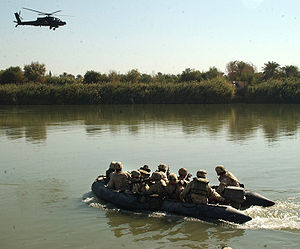
Military tactics, the science and art of organizing an army or an air force, are the techniques for using weapons or military units in combination for engaging and defeating an enemy in battle. Changes in philosophy and technology over time have been reflected in changes to military tactics. In...
, close air support (CAS) is defined as air action by fixed or rotary winged aircraft against hostile targets that are close to friendly forces, and which requires detailed integration of each air mission with fire and movement of these forces.
The determining factor for CAS is detailed integration, not proximity. CAS may need to be conducted far from friendly forces, if the mission requires detailed integration with the fire and movement of these forces. A closely related subset of air interdiction, battlefield air interdiction denotes interdiction
Air interdiction
Air interdiction is the use of aircraft to attack tactical ground targets that are not in close proximity to friendly ground forces. It differs from close air support because it does not directly support ground operations and is not closely coordinated with ground units...
against units with near-term effects on friendly units, but which does not require integration with friendly troop movements. The term "battlefield air interdiction" is not currently used in US joint doctrine.
Close air support requires excellent coordination with ground forces. In advanced modern militaries, this coordination is typically handled by specialists such as Joint Fires Observers, Joint Terminal Attack Controller
Joint terminal attack controller
A Joint terminal attack controller is the term used in the United States Armed Forces for a qualified military service member who, from a forward position, directs the action of combat aircraft engaged in close air support and other offensive air operations. The term used historically and in...
s (JTAC)s, and Forward Air Controllers (FAC).
World War I
World War I
World War I , which was predominantly called the World War or the Great War from its occurrence until 1939, and the First World War or World War I thereafter, was a major war centred in Europe that began on 28 July 1914 and lasted until 11 November 1918...
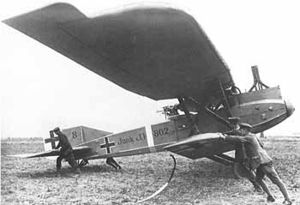
, the first significant use of aerial units in warfare. Air warfare, and indeed aviation itself, was still in its infancy - and the direct effect of rifle calibre machine guns and light bombs of World War I aircraft was very limited compared with the power of (for instance) a World War II fighter bomber, but close support aircraft still had a powerful psychological impact. The aircraft was a visible and personal enemy - unlike artillery - presenting a personal threat to enemy troops, while providing friendly forces assurance that their superiors were concerned about their situation. Most successful attacks of 1917 - 1918 included planning for co-ordination between aerial and ground units, although it was very hard at this early date to co-ordinate these attacks due to the primitive nature of air-to-ground radio communication. Though most airpower proponents sought independence from ground commanders and hence pushed the importance of interdiction and strategic bombing, they nonetheless recognised the need for close air support.
The British Royal Flying Corps
Royal Flying Corps
The Royal Flying Corps was the over-land air arm of the British military during most of the First World War. During the early part of the war, the RFC's responsibilities were centred on support of the British Army, via artillery co-operation and photographic reconnaissance...
and the U.S. Army Air Service saw "trench strafing" as another task for ordinary pursuit or fighter aircraft, such as the Airco DH.5
Airco DH.5
-Bibliography:* Bruce, J.M. Warplanes of the First World War, Vol. 1. London: MacDonald, 1965, pp. 128–132.* Jackson, A.J. De Havilland Aircraft since 1915. London: Putnam, 1962....
and Sopwith Camel
Sopwith Camel
The Sopwith Camel was a British First World War single-seat biplane fighter introduced on the Western Front in 1917. Manufactured by Sopwith Aviation Company, it had a short-coupled fuselage, heavy, powerful rotary engine, and concentrated fire from twin synchronized machine guns. Though difficult...
, and did not seek out specialized units or equipment until the late months of the war. The first British specialised ground attack aircraft, the Sopwith Salamander
Sopwith Salamander
-See also:-References:NotesBibliography...
, was too late to see action. Since pilots lacked specific training, and their aircraft were both slow and fragile, they suffered heavy casualties while flying low over enemy positions. For example, No. 80 Squadron RAF
No. 80 Squadron RAF
No. 80 Squadron RAF was a Royal Flying Corps and Royal Air Force squadron active from 1917 until 1969. It was operative during both World War I and World War II.-Establishment and early service:...
averaged 75% losses for the last 10 months of the war. The Germans and French, however, developed tactics, training, and formations for ground support. Germany also built specialist aircraft, culminating in the well armoured Junkers J.I
Junkers J.I
-See also:-References:NotesBibliography* Flight 18 March 1920* Grey, C. G. Jane's All the World's Aircraft 1919. London: Putnam, 1919.* Grosz, P.M. Junkers J.I, Windsock Datafile 39. Hertfordshire, UK: Albatros Productions Ltd., 1993. ISBN 0-948414-49-9.* Taylor, Michael J. H. Jane's Encyclopedia...
. By spring 1918, Germany had 38 Schlachtstaffeln (battle squadrons, often abbreviated to Schlasta
Schlasta
The Schlachtstaffeln were specialized fighter-bomber squadrons in the Luftstreitkräfte during World War I.- Background :...
) trained to bomb and strafe below 200 feet in support of ground forces.
Inter-War period - Framing the debate
During the inter-war period, airpower advocates crystallized their views on the role of airpower in warfare. Aviators and ground officers developed largely opposing views on the importance of CAS, views that would frame institutional battles for CAS in the 20th century. The inter-war period also saw the use of CAS in a number of conflicts, principally Spain and China and the Banana Wars. Observers and participants from the major parties of World War IIWorld War II
World War II, or the Second World War , was a global conflict lasting from 1939 to 1945, involving most of the world's nations—including all of the great powers—eventually forming two opposing military alliances: the Allies and the Axis...
would base their CAS strategies on experience and observation from these conflicts.
The development of the close air support came in between the World Wars, mostly through the adaptation of fighter
Fighter aircraft
A fighter aircraft is a military aircraft designed primarily for air-to-air combat with other aircraft, as opposed to a bomber, which is designed primarily to attack ground targets...
s or light bomber
Light bomber
A light bomber is a relatively small and fast class of military bomber aircraft which were primarily employed before the 1950s. Such aircraft would typically not carry more than one ton of ordnance....
s. Following the end of World War I, the United States embraced its role of global power and the United States Marine Corps
United States Marine Corps
The United States Marine Corps is a branch of the United States Armed Forces responsible for providing power projection from the sea, using the mobility of the United States Navy to deliver combined-arms task forces rapidly. It is one of seven uniformed services of the United States...
became the preferred force for military intervention and where the Marines went so went Marine aviation
United States Marine Corps Aviation
United States Marine Corps Aviation is the air component of the United States Marine Corps. Marine aviation has a very different mission and operation than its ground counterpart, and thus, has many of its own histories, traditions, terms, and procedures....
. It was while fighting bandits and insurgents in places such as Haiti
Haiti
Haiti , officially the Republic of Haiti , is a Caribbean country. It occupies the western, smaller portion of the island of Hispaniola, in the Greater Antillean archipelago, which it shares with the Dominican Republic. Ayiti was the indigenous Taíno or Amerindian name for the island...
, the Dominican Republic
Dominican Republic
The Dominican Republic is a nation on the island of La Hispaniola, part of the Greater Antilles archipelago in the Caribbean region. The western third of the island is occupied by the nation of Haiti, making Hispaniola one of two Caribbean islands that are shared by two countries...
and Nicaragua
Nicaragua
Nicaragua is the largest country in the Central American American isthmus, bordered by Honduras to the north and Costa Rica to the south. The country is situated between 11 and 14 degrees north of the Equator in the Northern Hemisphere, which places it entirely within the tropics. The Pacific Ocean...
that Marine Aviators would begin to experiment with air-ground tactics making the support of their fellow Marines on the ground their primary mission. It was in Haiti that U.S. Marines began to develop the tactic of dive bombing and in Nicaragua where they began to perfect it. While other nations and services had tried variations of this technique, Marine aviators were the first to embrace it and make it part of their tactical doctrine.
Aviators, who wanted institutional independence from the Army, pushed for a view of airpower centered around interdiction, which would relieve them of the necessity of integrating with ground forces and allow them to operate as an independent military arm. They saw close air support as both the most difficult and most inefficient use of aerial assets. Close air support was the most difficult mission, requiring identifying and distinguishing between friendly and hostile units. At the same time, targets engaged in combat are dispersed and concealed, reducing the effectiveness of air attacks. They also argued that the CAS mission merely duplicated the abilities of artillery, whereas interdiction provided a unique capability.
Ground officers contended there was rarely sufficient artillery available, and the flexibility of aircraft would be ideal for massing firepower at critical points, while producing a greater psychological effect on friendly and hostile forces alike. Moreover, unlike massive, indiscriminate artillery strikes, small aerial bombs wouldn't render ground untrafficable, slowing attacking friendly forces.
World War II
World War II marked the universal acceptance of the integration of air power into combined arms warfare as close air support. Although the German WehrmachtWehrmacht
The Wehrmacht – from , to defend and , the might/power) were the unified armed forces of Nazi Germany from 1935 to 1945. It consisted of the Heer , the Kriegsmarine and the Luftwaffe .-Origin and use of the term:...
led the way, all the major combatants had developed effective air-ground coordination techniques by the war's end.
Luftwaffe
Luftwaffe
Luftwaffe is a generic German term for an air force. It is also the official name for two of the four historic German air forces, the Wehrmacht air arm founded in 1935 and disbanded in 1946; and the current Bundeswehr air arm founded in 1956....
, like its counterparts, tended to focus on strategic bombing, the Luftwaffe was unique in its willingness to commit forces to CAS. In joint exercises with Sweden
Sweden
Sweden , officially the Kingdom of Sweden , is a Nordic country on the Scandinavian Peninsula in Northern Europe. Sweden borders with Norway and Finland and is connected to Denmark by a bridge-tunnel across the Öresund....
in 1934, the Germans were first exposed to dive-bombing
Dive bomber
A dive bomber is a bomber aircraft that dives directly at its targets in order to provide greater accuracy for the bomb it drops. Diving towards the target reduces the distance the bomb has to fall, which is the primary factor in determining the accuracy of the drop...
, which permitted greater accuracy while making attack aircraft more difficult to track by antiaircraft gunners. As a result, Ernst Udet
Ernst Udet
Colonel General Ernst Udet was the second-highest scoring German flying ace of World War I. He was one of the youngest aces and was the highest scoring German ace to survive the war . His 62 victories were second only to Manfred von Richthofen, his commander in the Flying Circus...
, chief of the Luftwaffes development, initiated procurement of close support dive bombers on the model of the U.S. Navy's Curtiss Helldiver
SBC Helldiver
|-See also:-References:NotesBibliography* Andrade, John. U.S. Military Aircraft Designations and Serials since 1909. Hinckley, UK: Midland Counties Publications, 1979. ISBN 0-904597-22-9....
, resulting in the famous Junkers Ju 87
Junkers Ju 87
The Junkers Ju 87 or Stuka was a two-man German ground-attack aircraft...
Stuka. Experience in the Spanish Civil War
Spanish Civil War
The Spanish Civil WarAlso known as The Crusade among Nationalists, the Fourth Carlist War among Carlists, and The Rebellion or Uprising among Republicans. was a major conflict fought in Spain from 17 July 1936 to 1 April 1939...
lead to the creation of five ground-attack groups in 1938, four of which would be equipped with Stukas. The Luftwaffe matched its material acquisitions with advances in the air-ground coordination. General Wolfram von Richthofen
Wolfram von Richthofen
Dr.-Ing. Wolfram Freiherr von RichthofenIn German a Doctorate in engineering is abbreviated as Dr.-Ing. . was a German Generalfeldmarschall of the Luftwaffe during the Second World War...
organized a limited number of air liaison detachments that were attached to ground units of the main effort. These detachments existed to pass requests from the ground to the air, and receive reconnaissance reports, but they were not trained to guide aircraft onto targets.
These preparations did not prove fruitful in the invasion of Poland, where the Luftwaffe focused on interdiction and dedicated few assets to close air support. But the value of CAS was demonstrated at the crossing of the Meuse River
Meuse River
The Maas or Meuse is a major European river, rising in France and flowing through Belgium and the Netherlands before draining into the North Sea...
during the Invasion of France in 1940. General Heinz Guderian
Heinz Guderian
Heinz Wilhelm Guderian was a German general during World War II. He was a pioneer in the development of armored warfare, and was the leading proponent of tanks and mechanization in the Wehrmacht . Germany's panzer forces were raised and organized under his direction as Chief of Mobile Forces...
, one of the creators of the combined-arms tactical doctrine commonly known as "blitzkrieg
Blitzkrieg
For other uses of the word, see: Blitzkrieg Blitzkrieg is an anglicized word describing all-motorised force concentration of tanks, infantry, artillery, combat engineers and air power, concentrating overwhelming force at high speed to break through enemy lines, and, once the lines are broken,...
", believed the best way to provide cover for the crossing would be a continuous stream of ground attack aircraft on French defenders. Though few guns were hit, the attacks kept the French under cover and prevented them from manning their guns. Aided by the sirens attached to Stukas, the psychological impact was disproportional to the destructive power of close air support. In addition, the reliance on air support over artillery reduced the demand for logistical support through the Ardennes. Though there were difficulties in coordinating air support with the rapid advance, the Germans demonstrated consistently superior CAS tactics to those of the British and French defenders. Later, on the Eastern front, the Germans would devise visual ground signals to mark friendly units and to indicate direction and distance to enemy emplacements.
Despite these accomplishments, German CAS was not perfect and suffered from the same misunderstanding and interservice rivalry
Interservice rivalry
Interservice rivalry is a military term referring to rivalries that can arise between different branches of a country's armed forces, such as between a nation's land forces , naval and air forces. It also applies to the rivalries between a country's intelligence services, Central Intelligence...
that plagued other nations' air arms, and friendly fire was not uncommon. For example, on the eve of the Meuse offensive, Guderian's superior cancelled his CAS plans and called for high-altitude strikes from medium bombers, which would have required halting the offensive until the air strikes were complete. Fortunately for the Germans, his order was issued too late to be implemented, and the Luftwaffe commander followed the schedule he had previously worked out with Guderian. As late as November 1941, the Luftwaffe refused to provide Erwin Rommel
Erwin Rommel
Erwin Johannes Eugen Rommel , popularly known as the Desert Fox , was a German Field Marshal of World War II. He won the respect of both his own troops and the enemies he fought....
with an air liaison officer for the Afrika Korps
Afrika Korps
The German Africa Corps , or the Afrika Korps as it was popularly called, was the German expeditionary force in Libya and Tunisia during the North African Campaign of World War II...
, because it "would be against the best use of the air force as a whole."
RAF and USAAF
Royal Air Force
The Royal Air Force is the aerial warfare service branch of the British Armed Forces. Formed on 1 April 1918, it is the oldest independent air force in the world...
(RAF) entered the war woefully unprepared to provide CAS. In 1940 during the Battle of France
Battle of France
In the Second World War, the Battle of France was the German invasion of France and the Low Countries, beginning on 10 May 1940, which ended the Phoney War. The battle consisted of two main operations. In the first, Fall Gelb , German armoured units pushed through the Ardennes, to cut off and...
, the Royal Air Force and Army headquarters in France were located at separate positions, resulting in unreliable communications. After the RAF was withdrawn in May, Army officers had to telephone the War Office
War Office
The War Office was a department of the British Government, responsible for the administration of the British Army between the 17th century and 1964, when its functions were transferred to the Ministry of Defence...
in London to arrange for air support. The stunning effectiveness of German air-ground coordination spurred change. On the basis of tests in Northern Ireland
Northern Ireland
Northern Ireland is one of the four countries of the United Kingdom. Situated in the north-east of the island of Ireland, it shares a border with the Republic of Ireland to the south and west...
in August 1940, Group Captain
Group Captain
Group captain is a senior commissioned rank in the Royal Air Force and the air forces of many other Commonwealth countries. It ranks above wing commander and immediately below air commodore...
A. H. Wann RAF and Colonel J.D. Woodall (British Army) issued the Wann-Woodall Report, recommending the creation of a distinct tactical air force and liaisons (known colloquially as "tentacles"), to accompany Army divisions and brigades. Their report spurred the RAF to create an Army Co-Operation Command and to develop tentacle equipment and procedures placing an Air Liaison Officer with each brigade.
Although the RAF was working on its CAS doctrine in London, officers in North Africa improvised their own coordination techniques. In October 1941, Sir Arthur Tedder
Arthur Tedder, 1st Baron Tedder
Marshal of the Royal Air Force Arthur William Tedder, 1st Baron Tedder, GCB was a senior British air force commander. During the First World War, he was a pilot and squadron commander in the Royal Flying Corps and he went on to serve as a senior officer in the Royal Air Force during the inter-war...
and Arthur Coningham
Arthur Coningham (RAF officer)
Air Marshal Sir Arthur "Mary" Coningham KCB, KBE, DSO, MC, DFC, AFC, RAF was a senior officer in the Royal Air Force. During the First World War, he was at Gallipoli with the New Zealand Expeditionary Force, transferred to the Royal Flying Corps, where he became a flying ace...
, senior RAF commanders in North Africa, created joint RAF-Army Air Support Control staffs at each corps and armored division headquarters, and placed a Forward Air Support Link at each brigade to forward air support requests. When trained tentacle teams arrived in 1942, they cut response time on support requests to thirty minutes. It was also in the North Africa desert that the cab rank
Cab rank
A cab rank or taxi rank is a primarily British English term for a queueing area where taxicabs queue to await passengers. In United States English they are known as "taxi stands".The phrase also has three other uses:...
strategy was developed. It used a series of three aircraft, each in turn directed by the pertinent ground control by radio. One aircraft would be attacking, another in flight to the battle area, while a third was being refuelled and rearmed at its base. If the first attack failed to destroy the tactical target, the aircraft in flight would be directed to continue the attack. The first aircraft would land for its own refuelling and rearming once the third had taken off.
The United States Army Air Forces
United States Army Air Forces
The United States Army Air Forces was the military aviation arm of the United States of America during and immediately after World War II, and the direct predecessor of the United States Air Force....
(USAAF) was charged with the principal mission of strategic bombing, hence operated independently of the rest of the Army and was also initially unprepared to provide CAS. USAAF doctrinal priorities for tactical aviation were, in order, air superiority, isolation of the battlefield via supply interdiction, and thirdly, close air support. Hence during the North African Campaign
North African campaign
During the Second World War, the North African Campaign took place in North Africa from 10 June 1940 to 13 May 1943. It included campaigns fought in the Libyan and Egyptian deserts and in Morocco and Algeria and Tunisia .The campaign was fought between the Allies and Axis powers, many of whom had...
CAS was poorly executed, if at all. So few aerial assets were assigned to U.S. troops that they fired on anything in the air. And in 1943, the USAAF changed their radios to a frequency incompatible with ground radios.
The situation improved during the Italian Campaign
Italian Campaign (World War II)
The Italian Campaign of World War II was the name of Allied operations in and around Italy, from 1943 to the end of the war in Europe. Joint Allied Forces Headquarters AFHQ was operationally responsible for all Allied land forces in the Mediterranean theatre, and it planned and commanded the...
, where American and British forces, working in close cooperation, exchanged CAS techniques and ideas. There, the AAF's XII Air Support Command and the Fifth U.S. Army shared headquarters, meeting every evening to plan strikes and devising a network of liaisons and radios for communications. However, friendly fire continued to be a concern - pilots did not know recognition signals and regularly bombed friendly units, until an A-36 was shot down in self-defense by Allied tanks. The expectation of losses to friendly fire from the ground during the planned invasion of France prompted the black and white invasion stripes
Invasion stripes
Invasion stripes were alternating black and white bands painted on the fuselages and wings of World War II Allied aircraft, for the purpose of increased recognition by friendly forces during and after the Normandy Landings...
painted on all Allied aircraft from 1944.
In 1944, USAAF commander Lt. Gen. Henry ("Hap") Arnold
Henry H. Arnold
Henry Harley "Hap" Arnold was an American general officer holding the grades of General of the Army and later General of the Air Force. Arnold was an aviation pioneer, Chief of the Air Corps , Commanding General of the U.S...
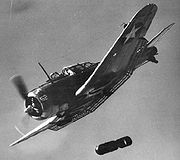
acquired 2 groups of A-24
SBD Dauntless
The Douglas SBD Dauntless was a naval dive bomber made by Douglas during World War II. The SBD was the United States Navy's main dive bomber from mid-1940 until late 1943, when it was largely replaced by the SB2C Helldiver...
dive bombers, the army version of the Navy's SBD-2, in response to the success of the Stuka and German CAS. Later, the USAAF developed a modification of the North American P-51 Mustang with dive brakes - the North American A-36
North American A-36
The North American A-36 Apache was the ground-attack/dive bomber version of the North American Aviation P-51 Mustang, from which it could be distinguished by the presence of rectangular, slatted dive brakes above and below the wings...
. However, there was no training to match the purchases. Though Gen. Lesley McNair, commander of Army Ground Forces, pushed to change USAAF priorities, the latter failed to provide aircraft for even major training exercises. Six months before the invasion of Normandy, 33 divisions had received no joint air-ground training.
The USAAF saw the greatest innovations in 1944 under Gen. Elwood Quesada, commander of IX Tactical Air Command, supporting the First U.S. Army. He developed the "armored column cover", where on-call fighter-bombers maintained a high-level of availability for important tank advances, allowing armor units to maintain a high tempo of exploitation even when they outran their artillery assets. He also used a modified antiaircraft radar to track friendly attack aircraft to redirect them as necessary, and experimented with assigning fighter pilots to tours as forward air controllers to familiarize them with the ground perspective. In July 1944, Quesada provided VHF aircraft radios to tank crews in Normandy. When the armored units broke out of the Normandy beachhead, tank commanders were able to communicate directly with overhead fighter-bombers. However, despite the innovation, Quesada focused his aircraft on CAS only for major offensives. Typically, both British and American attack aircraft were tasked primarily to interdiction, even though later analysis showed them to be twice as dangerous as CAS.
XIX TAC, under the command of General Otto P. Weyland
Otto P. Weyland
Otto Paul Weyland was an Air Force General, and the post-World War II Commander of Far East Air Forces during the Korean War and of Tactical Air Command.-Early life:...
utilized similar tactics to support the rapid armored advance of General Patton's Third Army in its drive across France. Armed reconnaissance was a major feature of XIX TAC close air support, as the rapid advance left Patton's Southern flank open. Such was the close nature of cooperation between the Third Army and XIX TAC that Patton actually counted on XIX TAC to guard his flanks. This close air support from XIX TAC was thus undoubtedly a key factor in the rapid advance and success of Patton's Third Army.
VVS RKKA
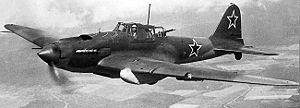
Battle of Khalkhin Gol
The Battles of Khalkhyn Gol was the decisive engagement of the undeclared Soviet–Japanese Border Wars fought among the Soviet Union, Mongolia and the Empire of Japan in 1939. The conflict was named after the river Khalkhyn Gol, which passes through the battlefield...
, Russian aircraft were given the task of disrupting enemy ground operations. This use increased markedly after the German invasion. Purpose-built aircraft such as the Ilyushin Il-2
Ilyushin Il-2
The Ilyushin Il-2 was a ground-attack aircraft in the Second World War, produced by the Soviet Union in very large numbers...
Sturmovik were highly effective in blunting the activity of the Panzers. Joseph Stalin paid the Il-2 a great tribute in his own inimitable manner: when a particular production factory fell behind on its deliveries, Stalin sent the following cable to the factory manager: "They are as essential to the Red Army as air and bread".
German CAS reached its peak on the Eastern Front during the period 1941-1943. Their decline was caused by the growing strength of the Red Air Force and the redeployment of assets to defend against American and British strategic bombardment. The introduction of improved Soviet tanks, the T-34
T-34
The T-34 was a Soviet medium tank produced from 1940 to 1958. Although its armour and armament were surpassed by later tanks of the era, it has been often credited as the most effective, efficient and influential design of World War II...
and KV-1 temporarily reduced the effectiveness of close air support, even after the adoption of 30 mm cannon and shaped-charge bombs, until more powerful cannons, air-to-ground mortars and rockets were introduced. While German procedures for CAS led the way, their loss of air superiority and technological advantage, combined with a declining supply of aircraft and fuel, crippled their ability to provide effective CAS on the western front after 1943.
The Pacific theater
The American Navy and Marine Corps would similarly use CAS in conjunction with or as a substitute for the lack of available artillery or naval gunfire. Navy and Marine F6F HellcatF6F Hellcat
The Grumman F6F Hellcat was a carrier-based fighter aircraft developed to replace the earlier F4F Wildcat in United States Navy service. Although the F6F resembled the Wildcat, it was a completely new design powered by a 2,000 hp Pratt & Whitney R-2800. Some tagged it as the "Wildcat's big...
s and F4U Corsair
F4U Corsair
The Vought F4U Corsair was a carrier-capable fighter aircraft that saw service primarily in World War II and the Korean War. Demand for the aircraft soon overwhelmed Vought's manufacturing capability, resulting in production by Goodyear and Brewster: Goodyear-built Corsairs were designated FG and...
s used a variety of ordnance
Aircraft ordnance
Aircraft ordnance or ordnance is weapons used by aircraft. The term is often used when describing the weight of air-to-ground weaponry that can be carried by an aircraft or the weight that has been dropped...
such as conventional bombs, rockets and napalm to disloge or attack Japanese troops utilizing cave complexes in the latter part of World War II.
Korean War
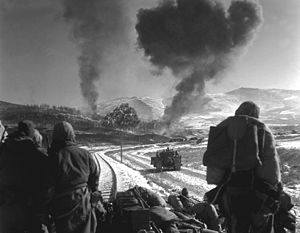
AN-MPQ-14
The radar designated AN/MPQ-14 is a system used for Ground Directed Bombing , where a plane is remotely piloted from the ground with radar assistance, up to and including the point of bomb release. It was the first guided weapon system used by the U.S. Marine Corps, and introduced the ability to...
, a system that enabled radar-guided bomb release at night or in poor weather.
Though the Marine Corps continued its tradition of intimate air-ground cooperation, the newly created Air Force again moved away from CAS, now to strategic bombers and jet interceptor
Interceptor aircraft
An interceptor aircraft is a type of fighter aircraft designed specifically to prevent missions of enemy aircraft, particularly bombers and reconnaissance aircraft. Interceptors generally rely on high speed and powerful armament in order to complete their mission as quickly as possible and set up...
s. Though eventually the Air Force supplied sufficient pilots and forward air controllers to provide battlefield support, coordination was still lacking. Since pilots operated under centralized control, ground controllers were never able to familiarize themselves with pilots, and requests were not processed quickly. Harold K. Johnson, then commander of the 8th Cavalry Regiment
U.S. 8th Cavalry Regiment
The 8th Cavalry Regiment was constituted 28 July 1866 and organized as a regiment on 21 September 1866 at Camp Reynolds, Angel Island, California. Enlisted personnel were "composed chiefly of men enlisted on the Pacific Coast, and included many of the class styled 'Forty-niners'; men who had worked...
, 1st Cavalry Division (later Army Chief of Staff) commented regarding CAS: "If you want it, you can't get it. If you can get it, it can't find you. If it can find you, it can't identify the target. If it can identify the target, it can't hit it. But if it does hit the target, it doesn't do a great deal of damage anyway."
It is unsurprising, then, that MacArthur
Douglas MacArthur
General of the Army Douglas MacArthur was an American general and field marshal of the Philippine Army. He was a Chief of Staff of the United States Army during the 1930s and played a prominent role in the Pacific theater during World War II. He received the Medal of Honor for his service in the...
excluded USAF aircraft from the airspace over the Inchon Landing
Battle of Inchon
The Battle of Inchon was an amphibious invasion and battle of the Korean War that resulted in a decisive victory and strategic reversal in favor of the United Nations . The operation involved some 75,000 troops and 261 naval vessels, and led to the recapture of the South Korean capital Seoul two...
in September 1950, instead relying on Marine Aircraft Group 33 for CAS. In December 1951, Lt. Gen. James Van Fleet
James Van Fleet
James Alward Van Fleet was a U.S. Army officer during World War I, World War II and the Korean War. Van Fleet was a native of New Jersey, who was raised in Florida and graduated from the U.S. Military Academy. He served as a regimental, divisional and corps commander during World War II and as...
, commander of the Eighth U.S. Army, formally requested the United Nations Commander, Gen. Mark Clark, to permanently attach an attack squadron to each of the four army corps in Korea. Though the request was denied, Clark allocated much more Navy and Air Force aircraft to CAS. Despite the rocky start, the USAF would also work to improve its coordination efforts. It eventually required pilots to serve 80 days as forward air controllers (FACs), which gave them an understanding of the difficulties from the ground perspective and helped cooperation when they returned to the cockpit. The USAF also provided airborne FACs in critical locations. The Army also learned to assist, by suppressing anti-aircraft fire prior to air strikes.
The U.S. Army wanted a dedicated USAF
United States Air Force
The United States Air Force is the aerial warfare service branch of the United States Armed Forces and one of the American uniformed services. Initially part of the United States Army, the USAF was formed as a separate branch of the military on September 18, 1947 under the National Security Act of...
presence on the battlefield to reduce fratricide
Fratricide
Fratricide is the act of a person killing his or her brother....
, or the harm of friendly forces. The air liaison officer (ALO) was born. The ALO is an aeronautically rated officer that has spent a tour away from the cockpit, serving as the primary advisor to the ground commander on the capabilities and limitations of airpower
Airpower
Airpower or air power comprises the application of military strategy and strategic theory to the realm of aerial warfare. Airpower is difficult to define and lacks a widely agreed definition as it represents a "complex operating environment that has been subjected to considerable debate".British...
.
Vietnam and the CAS role debate
During the late 1950s and early 1960s, the US Army began to identify a dedicated CAS need for itself. The Howe Board, which studied the question, published a landmark report describing the need for a helicopter-based CAS requirement. However, the Army did not follow the Howze Board recommendation initially. Nevertheless it did eventually adopt the use of helicopter gunshipGunship
The term "gunship" is used in several contexts, all sharing the general idea of a light craft armed with heavy guns.-In Navy:In the Navy, the term originally appeared in the mid-19th century as a less-common synonym for gunboat.-In military aviation:...
s and attack helicopters in the CAS role.
Though helicopters were initially armed merely as defensive measures to support the landing and extraction of troops, their value in this role lead to the modification of early helicopters as dedicated gunship platforms. Though not as fast as fixed-wing aircraft and consequently more vulnerable to anti-aircraft weaponry, helicopters could utilize terrain for cover, and more importantly, had much greater battlefield persistence owing to their low speeds. The latter made them a natural complement to ground forces in the CAS role. In addition, newly developed anti-tank guided missile
Anti-tank guided missile
An anti-tank missile , anti-tank guided missile , anti-tank guided weapon or anti-armor guided weapon is a guided missile primarily designed to hit and destroy heavily-armored military vehicles....
s, demonstrated to great effectiveness in the 1973 Yom Kippur War
Yom Kippur War
The Yom Kippur War, Ramadan War or October War , also known as the 1973 Arab-Israeli War and the Fourth Arab-Israeli War, was fought from October 6 to 25, 1973, between Israel and a coalition of Arab states led by Egypt and Syria...
, provided aircraft with an effective ranged anti-tank weapon. These considerations motivated armies to promote the helicopter from a support role to a combat arm. Though the U.S. Army controlled rotary-wing assets, coordination continued to pose a problem. During wargames, field commanders tended to hold attack helicopters out of fear of air defenses, committing them too late to effectively support ground units. The earlier debate over control over CAS assets were reiterated between ground commanders and aviators. Nevertheless, the US Army incrementally gained increased control over its CAS role.
In the mid 1970s, after Vietnam, the USAF decided to train an enlisted force to handle many of the tasks the ALO was saturated with, to include terminal attack control. Now the ALO mainly serves in the liaison role, the intricate details of mission planning and attack guidance left to the enlisted members of the Tactical Air Control Party
Tactical Air Control Party
The Tactical Air Control Party, commonly abbreviated TACP, is a small team of Army, Marine or Air Force personnel who provide airspace deconfliction and terminal control of Close Air Support at battle group level or below...
.
Aircraft
Military helicopter
A military helicopter is a helicopter that is either specifically built or converted for use by military forces. A military helicopter's mission is a function of its design or conversion...
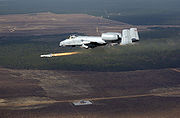
s are often used for close air support and are so closely integrated with ground operations that in most countries they are operated by the army rather than the air force. Fighters and ground attack aircraft like the A-10 Thunderbolt II
A-10 Thunderbolt II
The Fairchild Republic A-10 Thunderbolt II is an American single-seat, twin-engine, straight-wing jet aircraft developed by Fairchild-Republic in the early 1970s. The A-10 was designed for a United States Air Force requirement to provide close air support for ground forces by attacking tanks,...
provide close air support using rockets, missiles, small bombs, and strafing
Strafing
Strafing is the practice of attacking ground targets from low-flying aircraft using aircraft-mounted automatic weapons. This means, that although ground attack using automatic weapons fire is very often accompanied with bombing or rocket fire, the term "strafing" does not specifically include the...
runs.
In World War II, dive bombers and fighters were used in close air support. Dive bombing permitted greater accuracy than level bombing runs, while the rapid altitude change made it more difficult for antiaircraft gunners to track. The Junkers Ju 87
Junkers Ju 87
The Junkers Ju 87 or Stuka was a two-man German ground-attack aircraft...
Stuka is the best known example of a dive bomber designed for CAS. It was fitted with wind-blown whistles on its landing gear to enhance its psychological effect.
Other than the A-36, a P-51 modified with dive brakes, the Americans and British used no dedicated CAS aircraft in World War II, preferring fighters or fighter-bombers that could be pressed into CAS service. While some such as the Hawker Typhoon
Hawker Typhoon
The Hawker Typhoon was a British single-seat fighter-bomber, produced by Hawker Aircraft. While the Typhoon was designed to be a medium-high altitude interceptor, and a direct replacement for the Hawker Hurricane, several design problems were encountered, and the Typhoon never completely satisfied...
and the P-47 Thunderbolt
P-47 Thunderbolt
Republic Aviation's P-47 Thunderbolt, also known as the "Jug", was the largest, heaviest, and most expensive fighter aircraft in history to be powered by a single reciprocating engine. It was heavily armed with eight .50-caliber machine guns, four per wing. When fully loaded, the P-47 weighed up to...
, performed admirably in that role, there were a number of compromises that prevented most fighters from making effective CAS platforms. Fighters were usually optimized for high-altitude operations without bombs or other external ordnance - flying at low level with bombs quickly expended fuel. Cannons had to be mounted differently for strafing - strafing required a further and lower convergence point than aerial combat did.
Of the World War II allies, the Soviet Union used specifically designed ground attack aircraft more than the UK and US. Such aircraft included the Ilyushin Il-2, the single most produced military aircraft design in all of aviation history.
In the Vietnam War
Vietnam War
The Vietnam War was a Cold War-era military conflict that occurred in Vietnam, Laos, and Cambodia from 1 November 1955 to the fall of Saigon on 30 April 1975. This war followed the First Indochina War and was fought between North Vietnam, supported by its communist allies, and the government of...
, the United States introduced fixed and rotary wing gunships, cargo aircraft refitted as gun platforms to serve as close air support and air interdiction aircraft. The first of these was the AC-47 Spooky
AC-47 Spooky
The Douglas AC-47 Spooky was the first in a series of gunships developed by the United States Air Force during the Vietnam War...
. Later models include the Fairchild AC-119
Fairchild AC-119
|-See also:-References:NotesBibliography* Hobson, Chris. "Vietnam Air Losses, USAF/USN/USMC, Fixed-Wing Aircraft Losses in Southeast Asia, 1961-1973." North Branch, Minnesota: Specialty Press, 2001. ISBN 1-85780-1156....
and the Lockheed AC-130
Lockheed AC-130
The Lockheed AC-130 gunship is a heavily-armed ground-attack aircraft variant of the C-130 Hercules transport plane. The basic airframe is manufactured by Lockheed, while Boeing is responsible for the conversion into a gunship and for aircraft support...
. The AC-130 has been used extensively in Afghanistan and Iraq during recent US operations there.
Today, close support is typically carried out by fighter-bombers or dedicated ground attack aircraft, such as the A-10 Thunderbolt II Warthog or Sukhoi Su-25 Frogfoot
Sukhoi Su-25
The Sukhoi Su-25 is a single-seat, twin-engine jet aircraft developed in the Soviet Union by the Sukhoi Design Bureau. It was designed to provide close air support for the Soviet Ground Forces. The first prototype made its maiden flight on 22 February 1975...
, but even large high-altitude bombers can occasionally fill close support roles using precision guided munitions. During Operation Enduring Freedom, the lack of fighter aircraft forced military planners to rely heavily on US bombers, particularly the B-1B Lancer
B-1 Lancer
The Rockwell B-1 LancerThe name "Lancer" is only applied to the B-1B version, after the program was revived. is a four-engine variable-sweep wing strategic bomber used by the United States Air Force...
and B52H Stratofortress
B-52 Stratofortress
The Boeing B-52 Stratofortress is a long-range, subsonic, jet-powered strategic bomber operated by the United States Air Force since the 1950s. The B-52 was designed and built by Boeing, who have continued to provide maintainence and upgrades to the aircraft in service...
, to fill the CAS role. Bomber CAS, relying mainly on GPS
Global Positioning System
The Global Positioning System is a space-based global navigation satellite system that provides location and time information in all weather, anywhere on or near the Earth, where there is an unobstructed line of sight to four or more GPS satellites...
guided weapons, has evolved into a devastating tactical employment methodology and has changed US doctrinal thinking regarding CAS in general. After the initial collapse of the Taliban regime in Afghanistan, airfields in Afghanistan became available for continuing operations against the Taliban and Al-Qaeda
Al-Qaeda
Al-Qaeda is a global broad-based militant Islamist terrorist organization founded by Osama bin Laden sometime between August 1988 and late 1989. It operates as a network comprising both a multinational, stateless army and a radical Sunni Muslim movement calling for global Jihad...
. This resulted in the majority of CAS operations being undertaken by aircraft from Belgium (F-16 Fighting Falcon
F-16 Fighting Falcon
The General Dynamics F-16 Fighting Falcon is a multirole jet fighter aircraft originally developed by General Dynamics for the United States Air Force . Designed as an air superiority day fighter, it evolved into a successful all-weather multirole aircraft. Over 4,400 aircraft have been built since...
), Denmark (F-16), France (Mirage 2000D), the Netherlands (F-16), Norway (F-16), the United Kingdom (Harrier GR7s,GR9s and Tornado GR4s) and the United States (A-10, AV-8B Harrier II
AV-8B Harrier II
The McDonnell Douglas AV-8B Harrier II is a second-generation vertical/short takeoff and landing ground-attack aircraft. An Anglo-American development of the British Hawker Siddeley Harrier, the Harrier II is the final member of the Harrier family that started with the Hawker Siddeley P.1127 in...
, F-15E Strike Eagle
F-15E Strike Eagle
The McDonnell Douglas F-15E Strike Eagle is an all-weather multirole fighter, derived from the McDonnell Douglas F-15 Eagle. The F-15E was designed in the 1980s for long-range, high speed interdiction without relying on escort or electronic warfare aircraft. United States Air Force F-15E Strike...
, F/A-18 Hornet
F/A-18 Hornet
The McDonnell Douglas F/A-18 Hornet is a supersonic, all-weather carrier-capable multirole fighter jet, designed to dogfight and attack ground targets . Designed by McDonnell Douglas and Northrop, the F/A-18 was derived from the latter's YF-17 in the 1970s for use by the United States Navy and...
, F/A-18 Super Hornet).
Technological enhancement
The use of information technology to direct and coordinate precision air support has increased the importance of intelligenceIntelligence
Intelligence has been defined in different ways, including the abilities for abstract thought, understanding, communication, reasoning, learning, planning, emotional intelligence and problem solving....
, surveillance
Surveillance
Surveillance is the monitoring of the behavior, activities, or other changing information, usually of people. It is sometimes done in a surreptitious manner...
, and reconnaissance
Reconnaissance
Reconnaissance is the military term for exploring beyond the area occupied by friendly forces to gain information about enemy forces or features of the environment....
in utilizing CAS. Laser
Laser
A laser is a device that emits light through a process of optical amplification based on the stimulated emission of photons. The term "laser" originated as an acronym for Light Amplification by Stimulated Emission of Radiation...
, GPS, and battlefield data transfer are routinely used to coordinate with a wide variety of air platforms able to provide CAS. Recent doctrine
reflects the increased use of electronic and optical technology to direct targeted fires for CAS. Air platforms communicating with ground forces can also provide additional aerial-to-ground visual search, ground-convoy escort, and enhancement of command and control (C2), assets which can be particularly important for low intensity conflict
Low intensity conflict
Low intensity conflict is the use of military forces applied selectively and with restraint to enforce compliance with the policies or objectives of the political body controlling the military force...
.
See also
- Counter-insurgency aircraftCounter-insurgency aircraftCounter-insurgency aircraft are a specialised variety of military light attack aircraft, designed for ground support against small, usually irregular groups of insurgents...
, a specific type of CAS aircraft - Ground-attack aircraft
- Light Attack/Armed ReconnaissanceLight Attack/Armed ReconnaissanceThe Light Attack/Armed Reconnaissance program has been established to enable the United States Air Force to buy a light ground attack and reconnaissance aircraft. The aircraft should be capable of finding, tracking, and attacking targets either on its own or in support of ground forces. The...
- Tactical bombingTactical bombingTactical bombing is the aerial bombing aimed at targets of immediate military value, such as troops, military installations or equipment. This is in contrast to strategic bombing, attacking enemy's cities and factories to debilitate the enemy's capacity to wage war, the enemy's future military...
, a general term for the type of bombing that includes CAS and air interdiction - Pace-Finletter MOU 1952Pace-Finletter MOU 1952On 4 November, 1952, a memorandum of understanding was signed between United States Air Force Secretary Thomas K. Finletter and United States Army Secretary Frank Pace that removed the weight restrictions on helicopters that the U.S. Army could use. It also widened the range of tasks the Army's...
- Forward Air ControlForward air controlForward air control is the provision of guidance to Close Air Support aircraft intended to ensure that their attack hits the intended target and does not injure friendly troops. This task is carried out by a forward air controller . For NATO forces the qualifications and experience required to be...
- Forward observer
- Flying LeathernecksFlying LeathernecksFlying Leathernecks is a 1951 action film directed by Nicholas Ray, produced by Edmund Grainger, and starring John Wayne and Robert Ryan. The movie details the exploits and personal battles of United States Marine Corps aviators during World War II...
External links
- DOD dictionary definition of close air support
- Our Jets Can Support the Guys On the Ground, September 1950, Popular Science large article on the very public debate during the Korean War about fixed wing jets vs prop aircraft close air support role, with photos and drawings
- Close Air Support 2008
- The Forward Air Controller Association
- The ROMAD Locator The home of the current ground FAC
- Joint Fires Integration and Interoperability Team works with CAS and others.
- Operation Anaconda: An Airpower Perspective - Close air support during Operation AnacondaOperation AnacondaOperation Anaconda took place in early March 2002 in which the United States military and CIA Paramilitary Officers, working with allied Afghan military forces, and other North Atlantic Treaty Organization and non NATO forces attempted to destroy al-Qaeda and Taliban forces in the Shahi-Kot...
, United States Airforce, 2005.