

Canadian Forces

Encyclopedia
The Canadian Forces (French
: Forces Canadiennes; FC), officially the Canadian Armed Forces (French: Forces armées canadiennes), are the unified armed forces
of Canada
, as constituted by the National Defence Act
, which states: "The Canadian Forces are the armed forces of Her Majesty raised by Canada and consist of one Service called the Canadian Armed Forces." This single institution consists of the sea, land, and air environmental commands called the: Royal Canadian Navy
(RCN), Canadian Army, and Royal Canadian Air Force
(RCAF), which together are overseen by the Armed Forces Council
, chaired by the Chief of the Defence Staff
. At the pinnacle of the command structure is the Commander-in-Chief, who is the reigning Canadian monarch, Elizabeth II, represented by the governor general
.
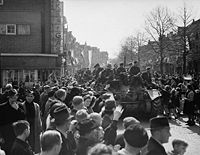
During the Cold War, a principal focus of Canadian defence policy was contributing to the security of Europe in the face of the Soviet military threat. Toward that end, Canadian ground and air forces were based in Europe from the early 1950s until the early 1990s.
However, since the end of the Cold War, as the North Atlantic Treaty Organization (NATO) has moved much of its defence focus "out of area", the Canadian military has also become more deeply engaged in international security operations in various other parts of the world – most notably in Afghanistan since 2002.
Canadian defence policy today is based on the Canada First Defence Strategy
, introduced by the Conservative Government of Stephen Harper after he took office in 2006. Based on that strategy, the Canadian military is oriented and being equipped to carry out six core missions within Canada, in North America and globally. Specifically, the Forces are tasked with having the capacity to:
Consistent with the missions and priorities outlined above, the Canadian Forces also contribute to the conduct of Canadian defence diplomacy
through a range of activities, including the deployment of Canadian Defence Attachés, participation in bilateral and multilateral military forums (e.g. the System of Cooperation Among the American Air Forces
), ship and aircraft visits, military training and cooperation, and other such outreach and relationship-building efforts.
in 1867, residents of the colonies in what is now Canada served as regular members of French and British forces and in local militia groups
. The latter aided in the defence of their respective territories against attacks by other European powers, Aboriginal peoples
, and later American forces
during the American Revolution
and War of 1812
, as well as in the Fenian raids
and North-West Rebellion
. Consequently, the lineages of some Canadian army units stretch back to the early 19th century, when militia units were formed to assist in the defence of British North America
against invasion by the United States
.
 The responsibility for military command remained with the British Crown
-in-Council
, with a commander-in-chief for North America
stationed at Halifax
until the final withdrawal of British Army
and Royal Navy
units from that city in 1906. Thereafter, the Royal Canadian Navy
was formed, and, with the advent of military aviation, the Royal Canadian Air Force
. These forces were organised under the Department of Militia and Defence
, and split into the Permanent and Non-Permanent Active Militiasfrequently shortened to simply The Militia. By 1923, the department was merged into the Department of National Defence
, but land forces in Canada were not referred to as the Canadian Army until November 1940.
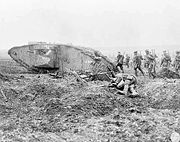 The first overseas deployment of Canadian military forces occurred during the Second Boer War
, when several units were raised to serve under British
command. Similarly, when the United Kingdom entered into conflict with Germany in the First World War
, Canadian troops were called to participate in European theatres. The Canadian Crown-in-Council then decided to send its forces into the Second World War
, as well as the Korean War
.
Since 1947, Canadian military units have participated in more than 200 operations worldwide, and completed 72 international operations. Canadian soldiers, sailors, and aviators came to be considered world-class professionals through conspicuous service during these conflicts and the country's integral participation in NATO during the Cold War
, First Gulf War
, Kosovo War
, and in United Nations
Peacekeeping
operations, such as the Suez Crisis
, Golan Heights, Cyprus
, Croatia
, Bosnia
, Afghanistan
, and Libya
.
Battles which are particularly notable to the Canadian military include the Battle of Vimy Ridge
, the Dieppe Raid
, the Battle of Ortona
, the Battle of Passchendaele, the Normandy Landings, the Battle for Caen
, the Battle of the Scheldt
, the Battle of Britain
, the Battle of the Atlantic, the strategic bombing of German cities
, and more recently the Battle of Medak Pocket.
At the end of the Second World War, Canada possessed the third-largest navy and fourth-largest air force in the world, as well as the largest volunteer army
ever fielded. Conscription
for overseas service was introduced only near the end of the war
, and only 2,400 conscripts actually made it into battle.
, Canadian Army, and Royal Canadian Air Force
were merged into a unified structure and superseded by elemental commands. Its roots, however, lie in colonial militia groups
that served alongside garrisons of the French
and British armies and navies
; a structure that remained in place until the early 20th century. Thereafter, a distinctly Canadian army and navy was established, followed by an air force, that, because of the constitutional arrangements at the time, remained effectively under the control of the British government until Canada gained legislative independence from the United Kingdom
in 1931, partly due to the performance and sacrifice of the Canadian Corps
in the First World War
.
The Canadian forces were afterwards heavily involved in the Second World War
(which, as with the previous world war, involved conscription
) and Korean War
, and, from the 1950s on, actively worked with her NATO allies to counter the threats of the Cold War
. Land Forces during this period also deployed in support of peacekeeping
operations within United Nations
sanctioned conflicts. The nature of the Canadian Forces has continued to evolve. They are currently engaged in Afghanistan
, under the NATO-led United Nations
International Security Assistance Force
(ISAF), at the request of the Government of Afghanistan.
The forces are today funded by approximately $21.8 billion annually ranked 13th, and are presently ranked 74th in size compared to the world's other armed forces by number of total personnel, and 58th in terms of active personnel, standing at a strength of roughly 67,000, plus 24,000 reservists
and 19,000 supplementary reserves, bringing the reserve force to approximately 43,000. The number of primary reserves is expected to go up to 30,000 by 2012, and the number of active to at least 70,000. If this happens the total strength would be around 120,000. These individuals serve on numerous CF bases
located in all regions of the country, and are governed by the Queen's Regulations and Orders and the National Defence Act.
The Conservative
Cabinet
appointed in 2006 made efforts through the Canada First Defence Strategy
to purchase new equipment and training, as well as the re-establishment of an airborne land force, now called the Canadian Special Operations Regiment
. More funds were also put towards recruitment, which had been dwindling throughout the 1980s and '90s, possibly because the Canadian populace had come to perceive the CF as peacekeepers
rather than as soldiers, as shown in a 2008 survey conducted for the Department of National Defence. The poll found that nearly two thirds of Canadians agreed with the country's participation in the invasion of Afghanistan
, and that the military should be stronger, but also that the purpose of the forces should be different, such as more focused on responding to natural disaster
s. The current CDS, Walter Natynczyk
, said later that year that while recruiting has become more successful, the CF was facing a problem with its rate of loss of existing members, which increased between 2006 and 2008 from 6% to 9.2% annually.
Since 2006, the Government has initiated a major re-equipment effort to rebuild the Forces after the serious defence cuts of the 1990s. This program has already involved the acquisition of specific equipment (main battle tanks, artillery, unmanned air vehicles and other systems) to support the mission in Afghanistan. It has also encompassed initiatives to renew certain so-called "core capabilities" (such as the air force's medium range transport aircraft fleet – the C-130 Hercules
– and the army's truck and armoured vehicle fleets). In addition, new capabilities (such as C-17 Globemaster III
strategic transport aircraft and CH-47 Chinook
heavy-lift helicopters) have also been acquired for the Forces. The program of capability renewal is ongoing and over the next twenty years aims to:
, command-in-chief of the Canadian Forces is vested in the country's sovereign, who, since 1904, has allowed his or her viceroy
, the governor general
, to exercise the duties ascribed to the post of Commander-in-Chief
and to hold the associated title since 1905. All troop deployment and disposition orders, including declarations of war
, fall within the Royal Prerogative
and are issued as Orders in Council, which must be signed by either the monarch or governor general. Under the Westminster system
's parliamentary customs and practices, however, the monarch and viceroy must generally follow the advice
of his or her ministers
in Cabinet
, including the prime minister
and Minister of National Defence
.
The forces' 67,000 personnel are divided into a hierarchy of numerous ranks
of commissioned and non-commissioned officer
s, and other non-commissioned positions. The governor general appoints, on the advice of the prime minister, a Chief of the Defence Staff
(CDS) as the highest ranking commissioned officer in the forces and who, as head of the Armed Forces Council
, commands the CF from the Department of National Defence Headquarters (NDHQ) in Ottawa
, Ontario
. On the Armed Forces Council sit the heads of the Royal Canadian Navy, Canadian Army, and Royal Canadian Air Force, who collectively oversee the operational commands of the Canadian Forces the Canada Command, the Expeditionary Force Command, the Special Operations Forces Command, and the Operational Support Command. The sovereign and most other members of the Canadian Royal Family also act as colonels-in-chief
, honorary air commodores
, air commodores-in-chief, admirals, and captains-general of Canadian Forces regiments, though these positions are ceremonial.
Canada's forces operate out of 27 branch-specific Canadian Forces base
s (CFB) across the country, as well as six shared bases, including the NDHQ; this number has been gradually reduced since the 1970s with bases either being closed or merged in the interest of efficiency. Officer cadet
s are educated and trained at two CF collegiate institutions, the Royal Military College of Canada
and the Royal Military College Saint-Jean. Naval Cadets undergo basic training and ship handling training at the Naval Officers Training Centre at CFB Esquimalt near Victoria, B.C. Officers may also be commissioned on enrollment with a degree from a civilian university. In some cases, officers may also be commissioned from the senior non-commissioned ranks. Basic military training for non-commissioned members is provided at a variety of locations.
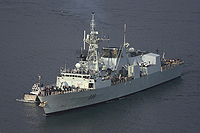 The Royal Canadian Navy (RCN), is headed by the Chief of the Maritime Staff, the RCN includes 33 warships and submarines deployed in two fleets: the Maritime Forces Pacific
(MARPAC) at Her Majesty's Canadian Dockyard Esquimalt
on the west coast, and the Maritime Forces Atlantic
(MARLANT) at Her Majesty's Canadian Dockyard in Halifax on the east coast, as well as one formation: the Naval Reserve Headquarters (NAVRESHQ) at Quebec City
, Quebec
. The fleet is augmented by various aircraft and supply vessels.
The RCN participates in NATO exercises, and ships are deployed all over the world in support of the Canadian military as well as in conjunction with multinational deployments, including the current Operation APOLLO
.
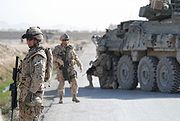 The Canadian Army (CA) (in French: Armée Canadienne), previously known as the Land Force Command,. Headed by the Chief of the Land Staff
, the Army is administered through four geographically determined formations, or areas: the Land Force Atlantic Area
(LFAA), headquartered at CFB Halifax
in Halifax
, Nova Scotia
; the Land Force Quebec Area
(LFQA), headquartered in Montreal
, Quebec
; the Land Force Central Area
(LFCA), located at Denison Armoury
in Toronto
, Ontario
; and the Land Force Western Area
(LFWA), headquartered in Edmonton
, Alberta
.
Currently, the Regular Force
component of the Army consists of three field-ready brigade group
s: 1 Canadian Mechanized Brigade Group
, at CFB Edmonton
and CFB Shilo
; 2 Canadian Mechanized Brigade Group
, at CFB Petawawa
and CFB Gagetown
; and 5 Canadian Mechanized Brigade Group
, at CFB Valcartier
and Quebec City
. Each contains one regiment
each of artillery
, armour
, and combat engineers
, three battalion
s of infantry
(all scaled in the British fashion), one for logistics
, a squadron for headquarters
/signals
, and several minor organisations. A tactical helicopter squadron
and a field ambulance are co-located with each brigade, but do not form part of the brigade's command structure.
Each land force area has, in addition to the Regular Force troops, reserve forces
organized into a total of 10 reserve brigade groups. LFAA and LFQA each have two reserve brigade groups, while LFCA and LFWA have three apiece. Major training establishments and non-brigaded troops exist at CFB Gagetown, ASU Saint-Jean (now attached to CFB Montreal
), and CFB Wainwright
, which is home to the Canadian Manoeuvre Training Centre and provides state-of-the-art force-on-force training in preparation for overseas deployments.
, based in Ottawa. The Commander of 1 Canadian Air Division and Canadian NORAD Region, based in Winnipeg
, is responsible for the operational command and control of Air Force activities throughout Canada and worldwide. 1 Canadian Air Division operations are carried out through eleven Wings located across Canada. The Commander of 2 Canadian Air Division is responsible for training and support functions. 2 Canadian Air Division operations are carried out at two Wings. Wings represent the grouping of various squadrons
, both operational and support, under a single tactical
commander reporting to the operational commander and vary in size from several hundred personnel to several thousand.
Major air bases are located in British Columbia
, Alberta
, Saskatchewan
, Manitoba
, Ontario
, Quebec
, Nova Scotia
, and Newfoundland and Labrador
, while administrative and command-control facilities are located in Winnipeg
and North Bay
. A Canadian component of the NATO Airborne Early Warning Force is also based at NATO Air Base Geilenkirchen
near Geilenkirchen
, Germany
.
The RCAF and Joint Task Force (North) (JTFN) also maintain at various points throughout Canada's northern region a chain of forward operating locations, each capable of supporting fighter operations. Elements of CF-18 squadrons
periodically deploy to these airport
s for short training exercises or Arctic sovereignty patrols.
and natural disaster
s, and is commanded by a commissioned officer who reports directly to the CDS. CANCOM is responsible for the management of RCN, Army, and RCAF assets assigned to it to ensure national security, both in emergency and routine situations, and is analogous to and works closely with the United States Northern Command
, as well as the United States Department of Homeland Security
. The command directs operations through six regional joint task forces, with Joint Task Force North
responsible for activities previously carried out by Canadian Forces North Area.
(French: Commandement de la Force expéditionnaire du Canada) is an operational element of the Canadian Forces for operations outside of Canada
. Under the CF structure, Canadian Expeditionary Forces Command (CEFCOM) is the unified command that is responsible for all Canadian Forces (CF) international operations, with the exception of operations conducted solely by Canadian Special Operations Forces Command
elements.
(JTF2) based at Dwyer Hill Training Center, the Canadian Special Operations Regiment
(CSOR) and the 427 Special Operations Aviation Squadron
(SOAS) at CFB Petawawa, as well as the Canadian Joint Incident Response Unit (CJIRU) at CFB Trenton (and CFB Kingston).
, health services
and logistics
.
, and the 764 Communications Squadron. In June 2011 the Canadian Forces Chief of Force Development announced the establishment of a new organization headed by a Brigadier General to deal with cyber warfare.
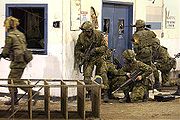 The Canadian Forces have a total reserve force of approximately 50,000 primary and supplementary that can be called upon in times of national emergency or threat.
. This group is represented, though not commanded, at NDHQ by the Chief of Reserves and Cadets, who is usually a major general
or rear admiral
, and is divided into four components that are each operationally and administratively responsible to its corresponding environmental command in the Regular Force the Naval Reserve (NAVRES), Land Force Reserve (LFR), and Air Reserve (AIRRES) in addition to one force that does not fall under an environmental command, the Health Services Reserve.
(COATS) consists of officers and non-commissioned members who conduct training, safety, supervision and administration of nearly 60,000 cadets aged 12 to 18 years in the Canadian Cadet Movement
. The majority of members in COATS are officers of the Cadet Instructors Cadre
branch of the CF. Members of the Reserve Force Sub-Component COATS who are not employed part time (Class A) or full time (Class B) may be held on the COATS "Inactive List" in anticipation of employment in the same manner as other reservists are held as members of the Supplementary Reserve.
, who provide surveillance and patrol services in Canada's arctic
and other remote areas, are an essential reserve force component used for Canada's exercise of sovereignty
over its northern territory.
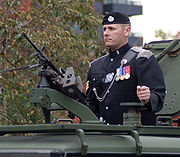 Although the Canadian Forces are a single service, there are three similar but distinctive environmental uniforms
(DEUs): navy blue (which looks black) for the navy, rifle green for the army, and light blue for the air force. CF members in operational occupations generally wear the DEU to which their occupation "belongs." CF members in non-operational occupations (the "purple" trades) are allocated a uniform according to the "distribution" of their branch within the CF, association of the branch with one of the former services, and the individual's initial preference (once a DEU is assigned, it is difficult to change, without remustering). Therefore, on any given day, in any given CF unit, all three coloured uniforms may be seen.
The uniforms of the CF are sub-divided into five orders of dress:
Only service dress is suitable for CF members to wear on any occasion, barring "dirty work" or combat. With gloves, swords, and medals (No. 1 or 1A), it is suitable for ceremonial occasions and "dressed down" (No. 3 or lower), it is suitable for daily wear. Generally, after the elimination of base dress (although still defined for the Air Force uniform), operational dress is now the daily uniform worn by most members of the CF, unless service dress is prescribed (such as at the NDHQ, on parades, at public events, etc.). Approved parka
s are authorized for winter wear in cold climates and a light casual jacket is also authorized for cooler days. The navy, most army, and some other units have, for very specific occasions, a ceremonial/regimental full dress, such as the naval "high-collar" white uniform, kilted Highland, Scottish, and Irish regiments, and the scarlet uniforms of the Royal Military Colleges.
Authorized headdress for the Canadian Forces are the service cap
(male and female versions), beret
, wedge cap
, ballcap
, Yukon cap
, and tuque
(toque). Each is coloured according to the distinctive uniform worn: navy (white or navy blue), army (rifle green or "regimental" colour), air force (light blue). Adherents of the Sikh faith may wear uniform turban
s (dastar) (or patka
, when operational) and Muslim women may wear uniform tucked hijab
s under their authorized headdress. Jews may wear yarmulke
under their authorized headdress and when bareheaded. The beret
is probably the most widely worn headgear and is worn with almost all orders of dress (with the exception of the more formal orders of Navy and Air Force dress), and the colour of which is determined by the wearer's environment, branch, or mission. Naval personnel, however, seldom wear berets, preferring either service cap or authorized ballcaps (shipboard operational dress), which only the Navy wear. Air Force personnel, particularly officers, prefer the wedge cap to any other form of headdress. There is no naval variant of the wedge cap. The Yukon cap and tuque are worn only with winter dress, although clearance and combat divers may wear tuques year-round as a watch cap. Soldiers in Highland, Scottish, and Irish regiments generally wear alternative headdress, including the glengarry
, balmoral
, tam o'shanter
, and caubeen
instead of the beret. The officer cadets of both Royal Military Colleges wear gold-braided "pillbox" (cavalry) caps with their ceremonial dress
and have a unique fur "Astrakhan"
for winter wear. The Canadian Army wears the CG634
helmet.
gives the federal government
exclusive responsibility for national defence, and expenditures are thus outlined in the federal budget
. For the 2008-2009 fiscal year, the amount allocated for defence spending was CAD$
18.9 billion. This regular funding was augmented in 2005 with an additional CAD$12.5 billion over five years, as well as a commitment to increasing regular force troop levels by 5,000 persons, and the primary reserve by 3,000 over the same period. In 2006, a further CAD$5.3 billion over five years was provided to allow for 13,000 more regular force members, and 10,000 more primary reserve personnel, as well as CAD$17.1 billion for the purchase of new trucks for the Canadian Army, transport aircraft and helicopters for the Royal Canadian Air Force, and joint support ships
for the Royal Canadian Navy.
French language
French is a Romance language spoken as a first language in France, the Romandy region in Switzerland, Wallonia and Brussels in Belgium, Monaco, the regions of Quebec and Acadia in Canada, and by various communities elsewhere. Second-language speakers of French are distributed throughout many parts...
: Forces Canadiennes; FC), officially the Canadian Armed Forces (French: Forces armées canadiennes), are the unified armed forces
Armed forces
The armed forces of a country are its government-sponsored defense, fighting forces, and organizations. They exist to further the foreign and domestic policies of their governing body, and to defend that body and the nation it represents from external aggressors. In some countries paramilitary...
of Canada
Canada
Canada is a North American country consisting of ten provinces and three territories. Located in the northern part of the continent, it extends from the Atlantic Ocean in the east to the Pacific Ocean in the west, and northward into the Arctic Ocean...
, as constituted by the National Defence Act
National Defence Act
The National Defence Act is the primary enabling legislation for organizing and funding Canada's military....
, which states: "The Canadian Forces are the armed forces of Her Majesty raised by Canada and consist of one Service called the Canadian Armed Forces." This single institution consists of the sea, land, and air environmental commands called the: Royal Canadian Navy
Royal Canadian Navy
The history of the Royal Canadian Navy goes back to 1910, when the naval force was created as the Naval Service of Canada and renamed a year later by King George V. The Royal Canadian Navy is one of the three environmental commands of the Canadian Forces...
(RCN), Canadian Army, and Royal Canadian Air Force
Royal Canadian Air Force
The history of the Royal Canadian Air Force begins in 1920, when the air force was created as the Canadian Air Force . In 1924 the CAF was renamed the Royal Canadian Air Force and granted royal sanction by King George V. The RCAF existed as an independent service until 1968...
(RCAF), which together are overseen by the Armed Forces Council
Armed Forces Council (Canada)
The Armed Forces Council is the senior military body of the Canadian Forces. It meets to advise the Chief of the Defence Staff on matters concerning the command, control and administration of the Canadian Forces as well as to help the CDS make decisions regarding these matters.The Armed Forces...
, chaired by the Chief of the Defence Staff
Chief of the Defence Staff (Canada)
The Chief of the Defence Staff is the second most senior member of the Canadian Forces, and heads the Armed Forces Council, having primary responsibility for command, control, and administration of the forces, as well as military strategy, plans, and requirements...
. At the pinnacle of the command structure is the Commander-in-Chief, who is the reigning Canadian monarch, Elizabeth II, represented by the governor general
Governor General of Canada
The Governor General of Canada is the federal viceregal representative of the Canadian monarch, Queen Elizabeth II...
.
Canadian defence policy
Since the Second World War, Canadian defence policy has consistently stressed three overarching objectives:- The defence of Canada itself;
- The defence of North America in cooperation with US forcesUnited States armed forcesThe United States Armed Forces are the military forces of the United States. They consist of the Army, Navy, Marine Corps, Air Force, and Coast Guard.The United States has a strong tradition of civilian control of the military...
; - Contributing to broader international security.
During the Cold War, a principal focus of Canadian defence policy was contributing to the security of Europe in the face of the Soviet military threat. Toward that end, Canadian ground and air forces were based in Europe from the early 1950s until the early 1990s.
However, since the end of the Cold War, as the North Atlantic Treaty Organization (NATO) has moved much of its defence focus "out of area", the Canadian military has also become more deeply engaged in international security operations in various other parts of the world – most notably in Afghanistan since 2002.
Canadian defence policy today is based on the Canada First Defence Strategy
Canada First Defence Strategy
The Canada First Defence Strategy is the military recruitment and improvement strategy of the Canadian government to improve the overall effectiveness of the Canadian Forces...
, introduced by the Conservative Government of Stephen Harper after he took office in 2006. Based on that strategy, the Canadian military is oriented and being equipped to carry out six core missions within Canada, in North America and globally. Specifically, the Forces are tasked with having the capacity to:
- Conduct daily domestic and continental operations, including in the Arctic and through NORAD (the North American Aerospace Defense Command);
- Support a major international event in Canada, such as the 2010 Winter Olympics;
- Respond to a major terrorist attack;
- Support civilian authorities during a crisis in Canada such as a natural disaster;
- Lead and/or conduct a major international operation for an extended period; and
- Deploy forces in response to crises elsewhere in the world for shorter periods.
Consistent with the missions and priorities outlined above, the Canadian Forces also contribute to the conduct of Canadian defence diplomacy
Defence diplomacy
In international politics, defence diplomacy refers to the pursuit of foreign policy objectives through the peaceful employment of defence resources and capabilities.-Origin of the Concept:...
through a range of activities, including the deployment of Canadian Defence Attachés, participation in bilateral and multilateral military forums (e.g. the System of Cooperation Among the American Air Forces
System of Cooperation Among the American Air Forces
- Committees :Committees are permanent organisms that study and analyze subjects, interchange ideas and share procedures that improve the operations and collaboration between the member countries of SICOFAA....
), ship and aircraft visits, military training and cooperation, and other such outreach and relationship-building efforts.
History
Origins and establishment
Prior to ConfederationCanadian Confederation
Canadian Confederation was the process by which the federal Dominion of Canada was formed on July 1, 1867. On that day, three British colonies were formed into four Canadian provinces...
in 1867, residents of the colonies in what is now Canada served as regular members of French and British forces and in local militia groups
Colonial militia in Canada
From the founding of New France until the establishment of a professional Canadian Army, the colonial militia played an extremely important role in the defence of Canada...
. The latter aided in the defence of their respective territories against attacks by other European powers, Aboriginal peoples
Aboriginal peoples in Canada
Aboriginal peoples in Canada comprise the First Nations, Inuit and Métis. The descriptors "Indian" and "Eskimo" have fallen into disuse in Canada and are commonly considered pejorative....
, and later American forces
United States armed forces
The United States Armed Forces are the military forces of the United States. They consist of the Army, Navy, Marine Corps, Air Force, and Coast Guard.The United States has a strong tradition of civilian control of the military...
during the American Revolution
American Revolution
The American Revolution was the political upheaval during the last half of the 18th century in which thirteen colonies in North America joined together to break free from the British Empire, combining to become the United States of America...
and War of 1812
War of 1812
The War of 1812 was a military conflict fought between the forces of the United States of America and those of the British Empire. The Americans declared war in 1812 for several reasons, including trade restrictions because of Britain's ongoing war with France, impressment of American merchant...
, as well as in the Fenian raids
Fenian raids
Between 1866 and 1871, the Fenian raids of the Fenian Brotherhood who were based in the United States; on British army forts, customs posts and other targets in Canada, were fought to bring pressure on Britain to withdraw from Ireland. They divided many Catholic Irish-Canadians, many of whom were...
and North-West Rebellion
North-West Rebellion
The North-West Rebellion of 1885 was a brief and unsuccessful uprising by the Métis people of the District of Saskatchewan under Louis Riel against the Dominion of Canada...
. Consequently, the lineages of some Canadian army units stretch back to the early 19th century, when militia units were formed to assist in the defence of British North America
British North America
British North America is a historical term. It consisted of the colonies and territories of the British Empire in continental North America after the end of the American Revolutionary War and the recognition of American independence in 1783.At the start of the Revolutionary War in 1775 the British...
against invasion by the United States
United States
The United States of America is a federal constitutional republic comprising fifty states and a federal district...
.
Monarchy of the United Kingdom
The monarchy of the United Kingdom is the constitutional monarchy of the United Kingdom and its overseas territories. The present monarch, Queen Elizabeth II, has reigned since 6 February 1952. She and her immediate family undertake various official, ceremonial and representational duties...
-in-Council
Queen-in-Council
The Queen-in-Council is, in each of the Commonwealth realms, the technical term of constitutional law that refers to the exercise of executive authority, denoting the monarch acting by and with the advice and consent of his or her privy council or executive council The Queen-in-Council (during...
, with a commander-in-chief for North America
Commander-in-Chief, North America
The office of Commander-in-Chief, North America was a military position of the British Army. Established in 1755 in the early years of the Seven Years' War, holders of the post were generally responsible for land-based military personnel and activities in and around those parts of North America...
stationed at Halifax
City of Halifax
Halifax is a city in Canada, which was the capital of the province of Nova Scotia and shire town of Halifax County. It was the largest city in Atlantic Canada until it was amalgamated into Halifax Regional Municipality in 1996...
until the final withdrawal of British Army
British Army
The British Army is the land warfare branch of Her Majesty's Armed Forces in the United Kingdom. It came into being with the unification of the Kingdom of England and Scotland into the Kingdom of Great Britain in 1707. The new British Army incorporated Regiments that had already existed in England...
and Royal Navy
Royal Navy
The Royal Navy is the naval warfare service branch of the British Armed Forces. Founded in the 16th century, it is the oldest service branch and is known as the Senior Service...
units from that city in 1906. Thereafter, the Royal Canadian Navy
Royal Canadian Navy
The history of the Royal Canadian Navy goes back to 1910, when the naval force was created as the Naval Service of Canada and renamed a year later by King George V. The Royal Canadian Navy is one of the three environmental commands of the Canadian Forces...
was formed, and, with the advent of military aviation, the Royal Canadian Air Force
Royal Canadian Air Force
The history of the Royal Canadian Air Force begins in 1920, when the air force was created as the Canadian Air Force . In 1924 the CAF was renamed the Royal Canadian Air Force and granted royal sanction by King George V. The RCAF existed as an independent service until 1968...
. These forces were organised under the Department of Militia and Defence
Department of Militia and Defence (Canada)
The Department of Militia and Defence was the department responsible for military forces in Canada from 1906-1921.The Minister of Militia and Defence was in charge of this department....
, and split into the Permanent and Non-Permanent Active Militiasfrequently shortened to simply The Militia. By 1923, the department was merged into the Department of National Defence
Department of National Defence (Canada)
The Department of National Defence , frequently referred to by its acronym DND, is the department within the government of Canada with responsibility for all matters concerning the defence of Canada...
, but land forces in Canada were not referred to as the Canadian Army until November 1940.
Second Boer War
The Second Boer War was fought from 11 October 1899 until 31 May 1902 between the British Empire and the Afrikaans-speaking Dutch settlers of two independent Boer republics, the South African Republic and the Orange Free State...
, when several units were raised to serve under British
United Kingdom
The United Kingdom of Great Britain and Northern IrelandIn the United Kingdom and Dependencies, other languages have been officially recognised as legitimate autochthonous languages under the European Charter for Regional or Minority Languages...
command. Similarly, when the United Kingdom entered into conflict with Germany in the First World War
World War I
World War I , which was predominantly called the World War or the Great War from its occurrence until 1939, and the First World War or World War I thereafter, was a major war centred in Europe that began on 28 July 1914 and lasted until 11 November 1918...
, Canadian troops were called to participate in European theatres. The Canadian Crown-in-Council then decided to send its forces into the Second World War
World War II
World War II, or the Second World War , was a global conflict lasting from 1939 to 1945, involving most of the world's nations—including all of the great powers—eventually forming two opposing military alliances: the Allies and the Axis...
, as well as the Korean War
Korean War
The Korean War was a conventional war between South Korea, supported by the United Nations, and North Korea, supported by the People's Republic of China , with military material aid from the Soviet Union...
.
Since 1947, Canadian military units have participated in more than 200 operations worldwide, and completed 72 international operations. Canadian soldiers, sailors, and aviators came to be considered world-class professionals through conspicuous service during these conflicts and the country's integral participation in NATO during the Cold War
Cold War
The Cold War was the continuing state from roughly 1946 to 1991 of political conflict, military tension, proxy wars, and economic competition between the Communist World—primarily the Soviet Union and its satellite states and allies—and the powers of the Western world, primarily the United States...
, First Gulf War
Gulf War
The Persian Gulf War , commonly referred to as simply the Gulf War, was a war waged by a U.N.-authorized coalition force from 34 nations led by the United States, against Iraq in response to Iraq's invasion and annexation of Kuwait.The war is also known under other names, such as the First Gulf...
, Kosovo War
Kosovo War
The term Kosovo War or Kosovo conflict was two sequential, and at times parallel, armed conflicts in Kosovo province, then part of FR Yugoslav Republic of Serbia; from early 1998 to 1999, there was an armed conflict initiated by the ethnic Albanian "Kosovo Liberation Army" , who sought independence...
, and in United Nations
United Nations
The United Nations is an international organization whose stated aims are facilitating cooperation in international law, international security, economic development, social progress, human rights, and achievement of world peace...
Peacekeeping
Peacekeeping
Peacekeeping is an activity that aims to create the conditions for lasting peace. It is distinguished from both peacebuilding and peacemaking....
operations, such as the Suez Crisis
Suez Crisis
The Suez Crisis, also referred to as the Tripartite Aggression, Suez War was an offensive war fought by France, the United Kingdom, and Israel against Egypt beginning on 29 October 1956. Less than a day after Israel invaded Egypt, Britain and France issued a joint ultimatum to Egypt and Israel,...
, Golan Heights, Cyprus
Cyprus
Cyprus , officially the Republic of Cyprus , is a Eurasian island country, member of the European Union, in the Eastern Mediterranean, east of Greece, south of Turkey, west of Syria and north of Egypt. It is the third largest island in the Mediterranean Sea.The earliest known human activity on the...
, Croatia
Croatia
Croatia , officially the Republic of Croatia , is a unitary democratic parliamentary republic in Europe at the crossroads of the Mitteleuropa, the Balkans, and the Mediterranean. Its capital and largest city is Zagreb. The country is divided into 20 counties and the city of Zagreb. Croatia covers ...
, Bosnia
Bosnia and Herzegovina
Bosnia and Herzegovina , sometimes called Bosnia-Herzegovina or simply Bosnia, is a country in Southern Europe, on the Balkan Peninsula. Bordered by Croatia to the north, west and south, Serbia to the east, and Montenegro to the southeast, Bosnia and Herzegovina is almost landlocked, except for the...
, Afghanistan
Afghanistan
Afghanistan , officially the Islamic Republic of Afghanistan, is a landlocked country located in the centre of Asia, forming South Asia, Central Asia and the Middle East. With a population of about 29 million, it has an area of , making it the 42nd most populous and 41st largest nation in the world...
, and Libya
Libya
Libya is an African country in the Maghreb region of North Africa bordered by the Mediterranean Sea to the north, Egypt to the east, Sudan to the southeast, Chad and Niger to the south, and Algeria and Tunisia to the west....
.
Battles which are particularly notable to the Canadian military include the Battle of Vimy Ridge
Battle of Vimy Ridge
The Battle of Vimy Ridge was a military engagement fought primarily as part of the Battle of Arras, in the Nord-Pas-de-Calais region of France, during the First World War. The main combatants were the Canadian Corps, of four divisions, against three divisions of the German Sixth Army...
, the Dieppe Raid
Dieppe Raid
The Dieppe Raid, also known as the Battle of Dieppe, Operation Rutter or later on Operation Jubilee, during the Second World War, was an Allied attack on the German-occupied port of Dieppe on the northern coast of France on 19 August 1942. The assault began at 5:00 AM and by 10:50 AM the Allied...
, the Battle of Ortona
Battle of Ortona
The Battle of Ortona was a small, yet extremely fierce, battle fought between a battalion of German Fallschirmjäger from the German 1st Parachute Division under Generalleutnant Richard Heidrich, and assaulting Canadian forces from the 1st Canadian Infantry Division under Major General Chris Vokes...
, the Battle of Passchendaele, the Normandy Landings, the Battle for Caen
Battle for Caen
The Battle for Caen from June-August 1944 was a battle between Allied and German forces during the Battle of Normandy....
, the Battle of the Scheldt
Battle of the Scheldt
The Battle of the Scheldt was a series of military operations of the Canadian 1st Army, led by Lieutenant-General Guy Simonds. The battle took place in northern Belgium and southwestern Netherlands during World War II from 2 October-8 November 1944...
, the Battle of Britain
Battle of Britain
The Battle of Britain is the name given to the World War II air campaign waged by the German Air Force against the United Kingdom during the summer and autumn of 1940...
, the Battle of the Atlantic, the strategic bombing of German cities
Strategic bombing during World War II
Strategic bombing during World War II is a term which refers to all aerial bombardment of a strategic nature between 1939 and 1945 involving any nations engaged in World War II...
, and more recently the Battle of Medak Pocket.
At the end of the Second World War, Canada possessed the third-largest navy and fourth-largest air force in the world, as well as the largest volunteer army
Volunteer military
A volunteer military or all-volunteer military is one which derives its manpower from volunteers rather than conscription or mandatory service. A country may offer attractive pay and benefits through military recruitment to attract volunteers...
ever fielded. Conscription
Conscription
Conscription is the compulsory enlistment of people in some sort of national service, most often military service. Conscription dates back to antiquity and continues in some countries to the present day under various names...
for overseas service was introduced only near the end of the war
Conscription Crisis of 1944
The Conscription Crisis of 1944 was a political and military crisis following the introduction of forced military service in Canada during World War II. It was similar to the Conscription Crisis of 1917, but was not as politically damaging....
, and only 2,400 conscripts actually made it into battle.
Unification and beyond
The current iteration of the Canadian Forces dates from 1 February 1968, when the Royal Canadian NavyRoyal Canadian Navy
The history of the Royal Canadian Navy goes back to 1910, when the naval force was created as the Naval Service of Canada and renamed a year later by King George V. The Royal Canadian Navy is one of the three environmental commands of the Canadian Forces...
, Canadian Army, and Royal Canadian Air Force
Royal Canadian Air Force
The history of the Royal Canadian Air Force begins in 1920, when the air force was created as the Canadian Air Force . In 1924 the CAF was renamed the Royal Canadian Air Force and granted royal sanction by King George V. The RCAF existed as an independent service until 1968...
were merged into a unified structure and superseded by elemental commands. Its roots, however, lie in colonial militia groups
Colonial militia in Canada
From the founding of New France until the establishment of a professional Canadian Army, the colonial militia played an extremely important role in the defence of Canada...
that served alongside garrisons of the French
Military of France
The French Armed Forces encompass the French Army, the French Navy, the French Air Force and the National Gendarmerie. The President of the Republic heads the armed forces, with the title "chef des armées" . The President is the supreme authority for military matters and is the sole official who...
and British armies and navies
British Armed Forces
The British Armed Forces are the armed forces of the United Kingdom of Great Britain and Northern Ireland.Also known as Her Majesty's Armed Forces and sometimes legally the Armed Forces of the Crown, the British Armed Forces encompasses three professional uniformed services, the Royal Navy, the...
; a structure that remained in place until the early 20th century. Thereafter, a distinctly Canadian army and navy was established, followed by an air force, that, because of the constitutional arrangements at the time, remained effectively under the control of the British government until Canada gained legislative independence from the United Kingdom
United Kingdom
The United Kingdom of Great Britain and Northern IrelandIn the United Kingdom and Dependencies, other languages have been officially recognised as legitimate autochthonous languages under the European Charter for Regional or Minority Languages...
in 1931, partly due to the performance and sacrifice of the Canadian Corps
Canadian Corps
The Canadian Corps was a World War I corps formed from the Canadian Expeditionary Force in September 1915 after the arrival of the 2nd Canadian Division in France. The corps was expanded by the addition of the 3rd Canadian Division in December 1915 and the 4th Canadian Division in August 1916...
in the First World War
World War I
World War I , which was predominantly called the World War or the Great War from its occurrence until 1939, and the First World War or World War I thereafter, was a major war centred in Europe that began on 28 July 1914 and lasted until 11 November 1918...
.
The Canadian forces were afterwards heavily involved in the Second World War
World War II
World War II, or the Second World War , was a global conflict lasting from 1939 to 1945, involving most of the world's nations—including all of the great powers—eventually forming two opposing military alliances: the Allies and the Axis...
(which, as with the previous world war, involved conscription
Conscription
Conscription is the compulsory enlistment of people in some sort of national service, most often military service. Conscription dates back to antiquity and continues in some countries to the present day under various names...
) and Korean War
Korean War
The Korean War was a conventional war between South Korea, supported by the United Nations, and North Korea, supported by the People's Republic of China , with military material aid from the Soviet Union...
, and, from the 1950s on, actively worked with her NATO allies to counter the threats of the Cold War
Cold War
The Cold War was the continuing state from roughly 1946 to 1991 of political conflict, military tension, proxy wars, and economic competition between the Communist World—primarily the Soviet Union and its satellite states and allies—and the powers of the Western world, primarily the United States...
. Land Forces during this period also deployed in support of peacekeeping
Peacekeeping
Peacekeeping is an activity that aims to create the conditions for lasting peace. It is distinguished from both peacebuilding and peacemaking....
operations within United Nations
United Nations
The United Nations is an international organization whose stated aims are facilitating cooperation in international law, international security, economic development, social progress, human rights, and achievement of world peace...
sanctioned conflicts. The nature of the Canadian Forces has continued to evolve. They are currently engaged in Afghanistan
Afghanistan
Afghanistan , officially the Islamic Republic of Afghanistan, is a landlocked country located in the centre of Asia, forming South Asia, Central Asia and the Middle East. With a population of about 29 million, it has an area of , making it the 42nd most populous and 41st largest nation in the world...
, under the NATO-led United Nations
United Nations
The United Nations is an international organization whose stated aims are facilitating cooperation in international law, international security, economic development, social progress, human rights, and achievement of world peace...
International Security Assistance Force
International Security Assistance Force
The International Security Assistance Force is a NATO-led security mission in Afghanistan established by the United Nations Security Council on 20 December 2001 by Resolution 1386 as envisaged by the Bonn Agreement...
(ISAF), at the request of the Government of Afghanistan.
The forces are today funded by approximately $21.8 billion annually ranked 13th, and are presently ranked 74th in size compared to the world's other armed forces by number of total personnel, and 58th in terms of active personnel, standing at a strength of roughly 67,000, plus 24,000 reservists
Military reserve
A military reserve, tactical reserve, or strategic reserve is a group of military personnel or units which are initially not committed to a battle by their commander so that they are available to address unforeseen situations or exploit suddenly developing...
and 19,000 supplementary reserves, bringing the reserve force to approximately 43,000. The number of primary reserves is expected to go up to 30,000 by 2012, and the number of active to at least 70,000. If this happens the total strength would be around 120,000. These individuals serve on numerous CF bases
Canadian Forces base
A Canadian Forces Base or CFB is a military installation of the Canadian Forces. For a facility to qualify as a Canadian Forces Base, it must station one or more major units .Minor installations are named Canadian Forces Station or CFS A Canadian Forces Base or CFB (French Base des forces...
located in all regions of the country, and are governed by the Queen's Regulations and Orders and the National Defence Act.
The Conservative
Conservative Party of Canada
The Conservative Party of Canada , is a political party in Canada which was formed by the merger of the Canadian Alliance and the Progressive Conservative Party of Canada in 2003. It is positioned on the right of the Canadian political spectrum...
Cabinet
Cabinet of Canada
The Cabinet of Canada is a body of ministers of the Crown that, along with the Canadian monarch, and within the tenets of the Westminster system, forms the government of Canada...
appointed in 2006 made efforts through the Canada First Defence Strategy
Canada First Defence Strategy
The Canada First Defence Strategy is the military recruitment and improvement strategy of the Canadian government to improve the overall effectiveness of the Canadian Forces...
to purchase new equipment and training, as well as the re-establishment of an airborne land force, now called the Canadian Special Operations Regiment
Canadian Special Operations Regiment
The Canadian Special Operations Regiment is a battalion-sized, high-readiness special operations unit part of Canadian Special Operations Forces Command...
. More funds were also put towards recruitment, which had been dwindling throughout the 1980s and '90s, possibly because the Canadian populace had come to perceive the CF as peacekeepers
Peacekeeping
Peacekeeping is an activity that aims to create the conditions for lasting peace. It is distinguished from both peacebuilding and peacemaking....
rather than as soldiers, as shown in a 2008 survey conducted for the Department of National Defence. The poll found that nearly two thirds of Canadians agreed with the country's participation in the invasion of Afghanistan
Canada's role in the invasion of Afghanistan
Canada did not have a significant role in the first few months of the invasion of Afghanistan that began on October 7, 2001, and the first contingents of regular Canadian troops arrived in Afghanistan only in January–February 2002. Canada took on a larger role starting in 2006 after the Canadian...
, and that the military should be stronger, but also that the purpose of the forces should be different, such as more focused on responding to natural disaster
Natural disaster
A natural disaster is the effect of a natural hazard . It leads to financial, environmental or human losses...
s. The current CDS, Walter Natynczyk
Walter Natynczyk
General Walter J. Natynczyk , CMM, MSC, CD is the Chief of the Defence Staff of the Canadian Forces.-Biography:Born in Winnipeg, Manitoba in 1958, where he grew up with his two sisters, Natynczyk is the son of a Polish father and German mother. He worked as a Winnipeg Free Press paperboy and a...
, said later that year that while recruiting has become more successful, the CF was facing a problem with its rate of loss of existing members, which increased between 2006 and 2008 from 6% to 9.2% annually.
Since 2006, the Government has initiated a major re-equipment effort to rebuild the Forces after the serious defence cuts of the 1990s. This program has already involved the acquisition of specific equipment (main battle tanks, artillery, unmanned air vehicles and other systems) to support the mission in Afghanistan. It has also encompassed initiatives to renew certain so-called "core capabilities" (such as the air force's medium range transport aircraft fleet – the C-130 Hercules
C-130 Hercules
The Lockheed C-130 Hercules is a four-engine turboprop military transport aircraft designed and built originally by Lockheed, now Lockheed Martin. Capable of using unprepared runways for takeoffs and landings, the C-130 was originally designed as a troop, medical evacuation, and cargo transport...
– and the army's truck and armoured vehicle fleets). In addition, new capabilities (such as C-17 Globemaster III
C-17 Globemaster III
The Boeing C-17 Globemaster III is a large military transport aircraft. Developed for the United States Air Force from the 1980s to the early 1990s by McDonnell Douglas, the C-17 is used for rapid strategic airlift of troops and cargo to main operating bases or forward operating bases throughout...
strategic transport aircraft and CH-47 Chinook
CH-47 Chinook
The Boeing CH-47 Chinook is an American twin-engine, tandem rotor heavy-lift helicopter. Its top speed of 170 knots is faster than contemporary utility and attack helicopters of the 1960s...
heavy-lift helicopters) have also been acquired for the Forces. The program of capability renewal is ongoing and over the next twenty years aims to:
- Increase the number of military personnel to 70,000 Regular Forces and 30,000 primary Reserve Forces;
- Replace the Navy's current support ships with at least 2 new Joint Support Ships (with an option on a third);
- Build 15 warships to replace existing destroyers and frigates;
- Acquire new arctic/offshore patrol vessels;
- Replace the current maritime patrol aircraft with 10 to 12 new patrol aircraft;
- Acquire 65 F-35 Lightning IIF-35 Lightning IIThe Lockheed Martin F-35 Lightning II is a family of single-seat, single-engine, fifth generation multirole fighters under development to perform ground attack, reconnaissance, and air defense missions with stealth capability...
Joint Strike Fighters beginning in 2016-17 to replace the current fleet of CF-18 fighters; - Strengthen readiness and operational capabilities; and,
- Improve and modernize defence infrastructure.
Current Structure
Per the Canadian constitutionConstitution of Canada
The Constitution of Canada is the supreme law in Canada; the country's constitution is an amalgamation of codified acts and uncodified traditions and conventions. It outlines Canada's system of government, as well as the civil rights of all Canadian citizens and those in Canada...
, command-in-chief of the Canadian Forces is vested in the country's sovereign, who, since 1904, has allowed his or her viceroy
Viceroy
A viceroy is a royal official who runs a country, colony, or province in the name of and as representative of the monarch. The term derives from the Latin prefix vice-, meaning "in the place of" and the French word roi, meaning king. A viceroy's province or larger territory is called a viceroyalty...
, the governor general
Governor General of Canada
The Governor General of Canada is the federal viceregal representative of the Canadian monarch, Queen Elizabeth II...
, to exercise the duties ascribed to the post of Commander-in-Chief
Commander-in-Chief
A commander-in-chief is the commander of a nation's military forces or significant element of those forces. In the latter case, the force element may be defined as those forces within a particular region or those forces which are associated by function. As a practical term it refers to the military...
and to hold the associated title since 1905. All troop deployment and disposition orders, including declarations of war
Declaration of war
A declaration of war is a formal act by which one nation goes to war against another. The declaration is a performative speech act by an authorized party of a national government in order to create a state of war between two or more states.The legality of who is competent to declare war varies...
, fall within the Royal Prerogative
Royal Prerogative
The royal prerogative is a body of customary authority, privilege, and immunity, recognized in common law and, sometimes, in civil law jurisdictions possessing a monarchy as belonging to the sovereign alone. It is the means by which some of the executive powers of government, possessed by and...
and are issued as Orders in Council, which must be signed by either the monarch or governor general. Under the Westminster system
Westminster System
The Westminster system is a democratic parliamentary system of government modelled after the politics of the United Kingdom. This term comes from the Palace of Westminster, the seat of the Parliament of the United Kingdom....
's parliamentary customs and practices, however, the monarch and viceroy must generally follow the advice
Advice (constitutional)
Advice, in constitutional law, is formal, usually binding, instruction given by one constitutional officer of state to another. Especially in parliamentary systems of government, Heads of state often act on the basis of advice issued by prime ministers or other government ministers...
of his or her ministers
Minister of the Crown
Minister of the Crown is the formal constitutional term used in the Commonwealth realms to describe a minister to the reigning sovereign. The term indicates that the minister serves at His/Her Majesty's pleasure, and advises the monarch, or viceroy, on how to exercise the Crown prerogatives...
in Cabinet
Cabinet of Canada
The Cabinet of Canada is a body of ministers of the Crown that, along with the Canadian monarch, and within the tenets of the Westminster system, forms the government of Canada...
, including the prime minister
Prime Minister of Canada
The Prime Minister of Canada is the primary minister of the Crown, chairman of the Cabinet, and thus head of government for Canada, charged with advising the Canadian monarch or viceroy on the exercise of the executive powers vested in them by the constitution...
and Minister of National Defence
Minister of National Defence (Canada)
The Minister of National Defence is a Minister of the Crown; the Canadian politician within the Cabinet of Canada responsible for the Department of National Defence which oversees the Canadian Forces....
.
The forces' 67,000 personnel are divided into a hierarchy of numerous ranks
Canadian Forces ranks and insignia
This is a table of the ranks and insignia of the Canadian Forces. As the Canadian Forces is officially bilingual, the French language ranks are presented following the English .-Commander-in-Chief:...
of commissioned and non-commissioned officer
Non-commissioned officer
A non-commissioned officer , called a sub-officer in some countries, is a military officer who has not been given a commission...
s, and other non-commissioned positions. The governor general appoints, on the advice of the prime minister, a Chief of the Defence Staff
Chief of the Defence Staff (Canada)
The Chief of the Defence Staff is the second most senior member of the Canadian Forces, and heads the Armed Forces Council, having primary responsibility for command, control, and administration of the forces, as well as military strategy, plans, and requirements...
(CDS) as the highest ranking commissioned officer in the forces and who, as head of the Armed Forces Council
Armed Forces Council (Canada)
The Armed Forces Council is the senior military body of the Canadian Forces. It meets to advise the Chief of the Defence Staff on matters concerning the command, control and administration of the Canadian Forces as well as to help the CDS make decisions regarding these matters.The Armed Forces...
, commands the CF from the Department of National Defence Headquarters (NDHQ) in Ottawa
Ottawa
Ottawa is the capital of Canada, the second largest city in the Province of Ontario, and the fourth largest city in the country. The city is located on the south bank of the Ottawa River in the eastern portion of Southern Ontario...
, Ontario
Ontario
Ontario is a province of Canada, located in east-central Canada. It is Canada's most populous province and second largest in total area. It is home to the nation's most populous city, Toronto, and the nation's capital, Ottawa....
. On the Armed Forces Council sit the heads of the Royal Canadian Navy, Canadian Army, and Royal Canadian Air Force, who collectively oversee the operational commands of the Canadian Forces the Canada Command, the Expeditionary Force Command, the Special Operations Forces Command, and the Operational Support Command. The sovereign and most other members of the Canadian Royal Family also act as colonels-in-chief
Colonel-in-Chief
In the various Commonwealth armies, the Colonel-in-Chief of a regiment is its patron. This position is distinct from that of Colonel of the Regiment. They do not have an operational role. They are however kept informed of all important activities of the regiment, and pay occasional visits to its...
, honorary air commodores
Air Commodore
Air commodore is an air-officer rank which originated in and continues to be used by the Royal Air Force...
, air commodores-in-chief, admirals, and captains-general of Canadian Forces regiments, though these positions are ceremonial.
Canada's forces operate out of 27 branch-specific Canadian Forces base
Canadian Forces base
A Canadian Forces Base or CFB is a military installation of the Canadian Forces. For a facility to qualify as a Canadian Forces Base, it must station one or more major units .Minor installations are named Canadian Forces Station or CFS A Canadian Forces Base or CFB (French Base des forces...
s (CFB) across the country, as well as six shared bases, including the NDHQ; this number has been gradually reduced since the 1970s with bases either being closed or merged in the interest of efficiency. Officer cadet
Officer Cadet
Officer cadet is a rank held by military and merchant navy cadets during their training to become commissioned officers and merchant navy officers, respectively. The term officer trainee is used interchangeably in some countries...
s are educated and trained at two CF collegiate institutions, the Royal Military College of Canada
Royal Military College of Canada
The Royal Military College of Canada, RMC, or RMCC , is the military academy of the Canadian Forces, and is a degree-granting university. RMC was established in 1876. RMC is the only federal institution in Canada with degree granting powers...
and the Royal Military College Saint-Jean. Naval Cadets undergo basic training and ship handling training at the Naval Officers Training Centre at CFB Esquimalt near Victoria, B.C. Officers may also be commissioned on enrollment with a degree from a civilian university. In some cases, officers may also be commissioned from the senior non-commissioned ranks. Basic military training for non-commissioned members is provided at a variety of locations.
Royal Canadian Navy
Maritime Forces Pacific
In the Canadian Forces, Maritime Forces Pacific is responsible for the fleet and operations of the Royal Canadian Navy in the Pacific Ocean...
(MARPAC) at Her Majesty's Canadian Dockyard Esquimalt
CFB Esquimalt
Canadian Forces Base Esquimalt is Canada's Pacific Coast naval base and home port to Maritime Forces Pacific and Joint Task Force Pacific Headquarters....
on the west coast, and the Maritime Forces Atlantic
Maritime Forces Atlantic
In the Canadian Forces, Maritime Forces Atlantic is responsible for the fleet and operations of the Royal Canadian Navy in the Atlantic Ocean and Arctic Ocean. The Commander of MARLANT is a two-star Rear Admiral....
(MARLANT) at Her Majesty's Canadian Dockyard in Halifax on the east coast, as well as one formation: the Naval Reserve Headquarters (NAVRESHQ) at Quebec City
Quebec City
Quebec , also Québec, Quebec City or Québec City is the capital of the Canadian province of Quebec and is located within the Capitale-Nationale region. It is the second most populous city in Quebec after Montreal, which is about to the southwest...
, Quebec
Quebec
Quebec or is a province in east-central Canada. It is the only Canadian province with a predominantly French-speaking population and the only one whose sole official language is French at the provincial level....
. The fleet is augmented by various aircraft and supply vessels.
The RCN participates in NATO exercises, and ships are deployed all over the world in support of the Canadian military as well as in conjunction with multinational deployments, including the current Operation APOLLO
Operation APOLLO
Operation APOLLO was the codename for an operation conducted by Canadian Forces in support of the United States in its military operations in Afghanistan. The operation took place from October 2001 to October 2003...
.
Canadian Army
Chief of the Land Staff
The Chief of the Land Staff is the commander and institutional head of the Canadian Army. The Chief of the Land is based at National Defence Headquarters in Ottawa, Ontario.-History of the post:...
, the Army is administered through four geographically determined formations, or areas: the Land Force Atlantic Area
Land Force Atlantic Area
Land Force Atlantic Area is responsible for Canadian Army operations in the Canadian provinces of New Brunswick, Newfoundland and Labrador, Nova Scotia, and Prince Edward Island. LFAA is headquartered at Canadian Forces Base Halifax on the Atlantic coast...
(LFAA), headquartered at CFB Halifax
CFB Halifax
Canadian Forces Base Halifax is Canada's east coast navy base and home port to the Atlantic fleet, known as Maritime Forces Atlantic....
in Halifax
City of Halifax
Halifax is a city in Canada, which was the capital of the province of Nova Scotia and shire town of Halifax County. It was the largest city in Atlantic Canada until it was amalgamated into Halifax Regional Municipality in 1996...
, Nova Scotia
Nova Scotia
Nova Scotia is one of Canada's three Maritime provinces and is the most populous province in Atlantic Canada. The name of the province is Latin for "New Scotland," but "Nova Scotia" is the recognized, English-language name of the province. The provincial capital is Halifax. Nova Scotia is the...
; the Land Force Quebec Area
Land Force Quebec Area
Land Force Quebec Area is responsible for all Canadian army operations and administration in the region within the province of Quebec. LFQA is headquartered in Montreal.- Regular Force :* Land Force Quebec Area Training Centre - Courcelette...
(LFQA), headquartered in Montreal
Montreal
Montreal is a city in Canada. It is the largest city in the province of Quebec, the second-largest city in Canada and the seventh largest in North America...
, Quebec
Quebec
Quebec or is a province in east-central Canada. It is the only Canadian province with a predominantly French-speaking population and the only one whose sole official language is French at the provincial level....
; the Land Force Central Area
Land Force Central Area
Land Force Central Area is responsible for the administration of the Canadian Army in the province of Ontario, from the Quebec border to the northern Lakehead region...
(LFCA), located at Denison Armoury
Denison Armoury
Lieutenant-Colonel George Taylor Denison III Armoury, commonly known as Denison Armoury, is a Canadian Forces facility located at 1 Yukon Lane in Toronto, Ontario, Canada. It is in the northeastern corner of Downsview Airport just west of the W.R. Allen Expressway on Sheppard Avenue West...
in Toronto
Toronto
Toronto is the provincial capital of Ontario and the largest city in Canada. It is located in Southern Ontario on the northwestern shore of Lake Ontario. A relatively modern city, Toronto's history dates back to the late-18th century, when its land was first purchased by the British monarchy from...
, Ontario
Ontario
Ontario is a province of Canada, located in east-central Canada. It is Canada's most populous province and second largest in total area. It is home to the nation's most populous city, Toronto, and the nation's capital, Ottawa....
; and the Land Force Western Area
Land Force Western Area
Land Force Western Area is one of four operational commands of the Canadian Army. LFWA is responsible for all Canadian Army administration and operations in western Canada from the Pacific Ocean to Thunder Bay, Ontario...
(LFWA), headquartered in Edmonton
Edmonton
Edmonton is the capital of the Canadian province of Alberta and is the province's second-largest city. Edmonton is located on the North Saskatchewan River and is the centre of the Edmonton Capital Region, which is surrounded by the central region of the province.The city and its census...
, Alberta
Alberta
Alberta is a province of Canada. It had an estimated population of 3.7 million in 2010 making it the most populous of Canada's three prairie provinces...
.
Currently, the Regular Force
Regular Force
In the Canadian Forces, a Regular Force unit or person is part of the full-time military, as opposed to being part of the Primary Reserve.Regular Force personnel are employed full-time, and have usually signed long-term contracts committing them to regular service...
component of the Army consists of three field-ready brigade group
Brigade group
A brigade group is a term used primarily in armies of the Commonwealth of Nations for an ad hoc arrangement of forces and not a permanent organisation whereas, with a capital G, a Brigade Group is....
s: 1 Canadian Mechanized Brigade Group
1 Canadian Mechanized Brigade Group
1 Canadian Mechanized Brigade Group is a Canadian Forces brigade group that is part of Land Forces Western Area of the Canadian army...
, at CFB Edmonton
CFB Edmonton
CFB Edmonton is a Canadian Forces base located in Edmonton, Alberta, Canada. It is also known as Edmonton Garrison or "Steele Barracks".-History:...
and CFB Shilo
CFB Shilo
Canadian Forces Base Shilo is an Operations and Training base of the Canadian Forces, located east of Brandon, Manitoba. During the 1990s, Canadian Forces Base Shilo was also designated as an Area Support Unit, which acts as a local base of operations for south-west Manitoba in times of military...
; 2 Canadian Mechanized Brigade Group
2 Canadian Mechanized Brigade Group
2 Canadian Mechanized Brigade Group is a Canadian Forces brigade group that is part of Land Forces Central Area of the Canadian army. It is currently based in CFB Petawawa...
, at CFB Petawawa
CFB Petawawa
Canadian Forces Base Petawawa, commonly referred to as CFB Petawawa, or simply "Pet", is a Canadian Forces Base located in Petawawa, Ontario. It is operated as an army base by Canadian Forces Land Force Command.-Base facts:...
and CFB Gagetown
CFB Gagetown
Canadian Forces Base Gagetown, referred to as CFB Gagetown is a large Canadian Forces Base located in southwestern New Brunswick.- Construction of the base :...
; and 5 Canadian Mechanized Brigade Group
5 Canadian Mechanized Brigade Group
5 Canadian Mechanized Brigade Group is a Canadian Forces brigade group that is part of Land Forces Quebec Area of the Canadian army. It is based at CFB Valcartier, near Quebec City in Quebec, Canada...
, at CFB Valcartier
CFB Valcartier
Canadian Forces Base Valcartier is a Canadian Forces Base located in the municipality of Saint-Gabriel-de-Valcartier, approximately north of Quebec City...
and Quebec City
Quebec City
Quebec , also Québec, Quebec City or Québec City is the capital of the Canadian province of Quebec and is located within the Capitale-Nationale region. It is the second most populous city in Quebec after Montreal, which is about to the southwest...
. Each contains one regiment
Regiment
A regiment is a major tactical military unit, composed of variable numbers of batteries, squadrons or battalions, commanded by a colonel or lieutenant colonel...
each of artillery
Artillery
Originally applied to any group of infantry primarily armed with projectile weapons, artillery has over time become limited in meaning to refer only to those engines of war that operate by projection of munitions far beyond the range of effect of personal weapons...
, armour
Armoured warfare
Armoured warfare or tank warfare is the use of armoured fighting vehicles in modern warfare. It is a major component of modern methods of war....
, and combat engineers
Combat engineering
A combat engineer, also called pioneer or sapper in many armies, is a soldier who performs a variety of construction and demolition tasks under combat conditions...
, three battalion
Battalion
A battalion is a military unit of around 300–1,200 soldiers usually consisting of between two and seven companies and typically commanded by either a Lieutenant Colonel or a Colonel...
s of infantry
Infantry
Infantrymen are soldiers who are specifically trained for the role of fighting on foot to engage the enemy face to face and have historically borne the brunt of the casualties of combat in wars. As the oldest branch of combat arms, they are the backbone of armies...
(all scaled in the British fashion), one for logistics
Military logistics
Military logistics is the discipline of planning and carrying out the movement and maintenance of military forces. In its most comprehensive sense, it is those aspects or military operations that deal with:...
, a squadron for headquarters
Headquarters
Headquarters denotes the location where most, if not all, of the important functions of an organization are coordinated. In the United States, the corporate headquarters represents the entity at the center or the top of a corporation taking full responsibility managing all business activities...
/signals
Military communications
Historically, the first military communications had the form of sending/receiving simple signals . Respectively, the first distinctive tactics of military communications were called Signals, while units specializing in those tactics received the Signal Corps name...
, and several minor organisations. A tactical helicopter squadron
Squadron (aviation)
A squadron in air force, army aviation or naval aviation is mainly a unit comprising a number of military aircraft, usually of the same type, typically with 12 to 24 aircraft, sometimes divided into three or four flights, depending on aircraft type and air force...
and a field ambulance are co-located with each brigade, but do not form part of the brigade's command structure.
Each land force area has, in addition to the Regular Force troops, reserve forces
Military reserve force
A military reserve force is a military organization composed of citizens of a country who combine a military role or career with a civilian career. They are not normally kept under arms and their main role is to be available to fight when a nation mobilizes for total war or to defend against invasion...
organized into a total of 10 reserve brigade groups. LFAA and LFQA each have two reserve brigade groups, while LFCA and LFWA have three apiece. Major training establishments and non-brigaded troops exist at CFB Gagetown, ASU Saint-Jean (now attached to CFB Montreal
CFB Montreal
Canadian Forces Base Montreal is a Canadian Forces Base network located in Montreal, Quebec.The base is home to:* Land Forces Quebec Area* 34e Groupe-Brigade du Canada which includes:...
), and CFB Wainwright
CFB Wainwright
Canadian Forces Base Wainwright, commonly referred to as CFB Wainwright is a Canadian Forces Base located in Denwood, Alberta, adjacent to the town of Wainwright.-Military Camp Wainwright:...
, which is home to the Canadian Manoeuvre Training Centre and provides state-of-the-art force-on-force training in preparation for overseas deployments.
Royal Canadian Air Force
The Royal Canadian Air Force (RCAF) is headed by the Chief of the Air StaffChief of the Air Staff (Canada)
The Chief of the Air Staff is the commander and institutional head of the Royal Canadian Air Force...
, based in Ottawa. The Commander of 1 Canadian Air Division and Canadian NORAD Region, based in Winnipeg
Winnipeg
Winnipeg is the capital and largest city of Manitoba, Canada, and is the primary municipality of the Winnipeg Capital Region, with more than half of Manitoba's population. It is located near the longitudinal centre of North America, at the confluence of the Red and Assiniboine Rivers .The name...
, is responsible for the operational command and control of Air Force activities throughout Canada and worldwide. 1 Canadian Air Division operations are carried out through eleven Wings located across Canada. The Commander of 2 Canadian Air Division is responsible for training and support functions. 2 Canadian Air Division operations are carried out at two Wings. Wings represent the grouping of various squadrons
Squadron (aviation)
A squadron in air force, army aviation or naval aviation is mainly a unit comprising a number of military aircraft, usually of the same type, typically with 12 to 24 aircraft, sometimes divided into three or four flights, depending on aircraft type and air force...
, both operational and support, under a single tactical
Military tactics
Military tactics, the science and art of organizing an army or an air force, are the techniques for using weapons or military units in combination for engaging and defeating an enemy in battle. Changes in philosophy and technology over time have been reflected in changes to military tactics. In...
commander reporting to the operational commander and vary in size from several hundred personnel to several thousand.
Major air bases are located in British Columbia
British Columbia
British Columbia is the westernmost of Canada's provinces and is known for its natural beauty, as reflected in its Latin motto, Splendor sine occasu . Its name was chosen by Queen Victoria in 1858...
, Alberta
Alberta
Alberta is a province of Canada. It had an estimated population of 3.7 million in 2010 making it the most populous of Canada's three prairie provinces...
, Saskatchewan
Saskatchewan
Saskatchewan is a prairie province in Canada, which has an area of . Saskatchewan is bordered on the west by Alberta, on the north by the Northwest Territories, on the east by Manitoba, and on the south by the U.S. states of Montana and North Dakota....
, Manitoba
Manitoba
Manitoba is a Canadian prairie province with an area of . The province has over 110,000 lakes and has a largely continental climate because of its flat topography. Agriculture, mostly concentrated in the fertile southern and western parts of the province, is vital to the province's economy; other...
, Ontario
Ontario
Ontario is a province of Canada, located in east-central Canada. It is Canada's most populous province and second largest in total area. It is home to the nation's most populous city, Toronto, and the nation's capital, Ottawa....
, Quebec
Quebec
Quebec or is a province in east-central Canada. It is the only Canadian province with a predominantly French-speaking population and the only one whose sole official language is French at the provincial level....
, Nova Scotia
Nova Scotia
Nova Scotia is one of Canada's three Maritime provinces and is the most populous province in Atlantic Canada. The name of the province is Latin for "New Scotland," but "Nova Scotia" is the recognized, English-language name of the province. The provincial capital is Halifax. Nova Scotia is the...
, and Newfoundland and Labrador
Newfoundland and Labrador
Newfoundland and Labrador is the easternmost province of Canada. Situated in the country's Atlantic region, it incorporates the island of Newfoundland and mainland Labrador with a combined area of . As of April 2011, the province's estimated population is 508,400...
, while administrative and command-control facilities are located in Winnipeg
Winnipeg
Winnipeg is the capital and largest city of Manitoba, Canada, and is the primary municipality of the Winnipeg Capital Region, with more than half of Manitoba's population. It is located near the longitudinal centre of North America, at the confluence of the Red and Assiniboine Rivers .The name...
and North Bay
North Bay, Ontario
North Bay is a city in Northeastern Ontario, Canada. It is the seat of Nipissing District, and takes its name from its position on the shore of Lake Nipissing.-History:...
. A Canadian component of the NATO Airborne Early Warning Force is also based at NATO Air Base Geilenkirchen
NATO Air Base Geilenkirchen
NATO Air Base Geilenkirchen is located near Geilenkirchen, Germany. It is the Main Operating Base of the NATO E-3A Component, one of two operational elements of the NATO Airborne Early Warning & Control Force.- Location and history :...
near Geilenkirchen
Geilenkirchen
Geilenkirchen is a town in the district Heinsberg, in North Rhine-Westphalia, Germany. It is situated near the border with the Netherlands, on the river Wurm, approx. 15 km north-east of Heerlen and 20 km north of Aachen....
, Germany
Germany
Germany , officially the Federal Republic of Germany , is a federal parliamentary republic in Europe. The country consists of 16 states while the capital and largest city is Berlin. Germany covers an area of 357,021 km2 and has a largely temperate seasonal climate...
.
The RCAF and Joint Task Force (North) (JTFN) also maintain at various points throughout Canada's northern region a chain of forward operating locations, each capable of supporting fighter operations. Elements of CF-18 squadrons
Squadron (aviation)
A squadron in air force, army aviation or naval aviation is mainly a unit comprising a number of military aircraft, usually of the same type, typically with 12 to 24 aircraft, sometimes divided into three or four flights, depending on aircraft type and air force...
periodically deploy to these airport
Airport
An airport is a location where aircraft such as fixed-wing aircraft, helicopters, and blimps take off and land. Aircraft may be stored or maintained at an airport...
s for short training exercises or Arctic sovereignty patrols.
Canada Command
The Canada Command (CANCOM) is an operational element created on 31 January 2006, to improve response time to domestic terrorismTerrorism
Terrorism is the systematic use of terror, especially as a means of coercion. In the international community, however, terrorism has no universally agreed, legally binding, criminal law definition...
and natural disaster
Natural disaster
A natural disaster is the effect of a natural hazard . It leads to financial, environmental or human losses...
s, and is commanded by a commissioned officer who reports directly to the CDS. CANCOM is responsible for the management of RCN, Army, and RCAF assets assigned to it to ensure national security, both in emergency and routine situations, and is analogous to and works closely with the United States Northern Command
United States Northern Command
United States Northern Command is a Unified Combatant Command of the United States military. Created on 1 October 2002 in the aftermath of the 11 September 2001 attacks, its mission is to protect the United States homeland and support local, state, and federal authorities...
, as well as the United States Department of Homeland Security
United States Department of Homeland Security
The United States Department of Homeland Security is a cabinet department of the United States federal government, created in response to the September 11 attacks, and with the primary responsibilities of protecting the territory of the United States and protectorates from and responding to...
. The command directs operations through six regional joint task forces, with Joint Task Force North
Joint Task Force North (Canada)
Joint Task Force is responsible for all Canadian Forces operations and administration in northern Canada, namely the Yukon, Northwest Territories, Nunavut and the waters of the Arctic Ocean and Hudson Bay...
responsible for activities previously carried out by Canadian Forces North Area.
Expeditionary Force Command
Canadian Expeditionary Force CommandCanadian Expeditionary Force Command
Canadian Expeditionary Force Command is an operational element of the Canadian Forces for operations outside of Canada....
(French: Commandement de la Force expéditionnaire du Canada) is an operational element of the Canadian Forces for operations outside of Canada
Canada
Canada is a North American country consisting of ten provinces and three territories. Located in the northern part of the continent, it extends from the Atlantic Ocean in the east to the Pacific Ocean in the west, and northward into the Arctic Ocean...
. Under the CF structure, Canadian Expeditionary Forces Command (CEFCOM) is the unified command that is responsible for all Canadian Forces (CF) international operations, with the exception of operations conducted solely by Canadian Special Operations Forces Command
Canadian Special Operations Forces Command
Canadian Special Operations Forces Command , is a command of the Canadian Forces...
elements.
Special Operations Forces Command
The Canadian Special Operations Forces Command (CANSOFCOM) is a unit capable of operating as an independent formation, but is primarily focused on generating Special Operations Forces (SOF) elements to support CANCOM and CEFCOM, and includes Joint Task Force 2Joint Task Force 2
Joint Task Force 2 is an elite Special Operations Force of the Canadian Armed Forces primarily tasked with counter-terrorism operations...
(JTF2) based at Dwyer Hill Training Center, the Canadian Special Operations Regiment
Canadian Special Operations Regiment
The Canadian Special Operations Regiment is a battalion-sized, high-readiness special operations unit part of Canadian Special Operations Forces Command...
(CSOR) and the 427 Special Operations Aviation Squadron
427 Squadron
427 Special Operations Aviation Squadron is a tactical helicopter unit that provides aviation support to Canadian Special Operations Forces Command. The squadron is based at CFB Petawawa, Ontario with a fleet of Bell CH-146 Griffon helicopters. It was originally founded as No...
(SOAS) at CFB Petawawa, as well as the Canadian Joint Incident Response Unit (CJIRU) at CFB Trenton (and CFB Kingston).
Operational Support Command
The Canadian Operational Support Command is responsible for handling many of the support elements of the Canadian Forces such as the military policeCanadian Forces Military Police
The Canadian Forces Military Police provide military police services to the Canadian Forces.Canadian Military Police are unusual in that they are classified as Peace Officers in the Criminal Code of Canada, which gives them the same powers as civilian law enforcement personnel to enforce Acts of...
, health services
Canadian Forces Health Services Group
The Canadian Forces Health Services Group is a formation of the Canadian Forces within the Military Personnel Command reporting to the Chief of Military Personnel...
and logistics
Logistics Branch (Canadian Forces)
The Logistics Branch is a personnel branch of the Canadian Forces . In April 2007, the CF Armed Forces Council decided to incorporate the Personnel Selection Branch into the Logistics branch.-Unification:...
.
Information Management Group
Among other things, the Information Management Group is responsible for the conduct of electronic warfare and the protection of the Forces communications and computer networks. Within the group, this operational role is fulfilled by the Canadian Forces Information Operations Group, headquartered at CFS Leitrim in Ottawa, which operates the following units: the Canadian Forces Information Operations Group Headquarters (CFIOGHQ), the Canadian Forces Electronic Warfare Centre (CFEWC), the Canadian Forces Network Operation Centre (CFNOC), the Canadian Forces Signals Intelligence Operations Centre (CFSOC), the Canadian Forces Station (CFS) LeitrimCFS Leitrim
Canadian Forces Station Leitrim, also referred to as CFS Leitrim, is an important Canadian Forces Station located in the neighbourhood of Leitrim near Ottawa, Ontario...
, and the 764 Communications Squadron. In June 2011 the Canadian Forces Chief of Force Development announced the establishment of a new organization headed by a Brigadier General to deal with cyber warfare.
Canadian Forces Reserve Force
Primary Reserve
Approximately 26,000 citizen soldiers, sailors, and airmen and women, trained to the level of and interchangeable with their Regular Force counterparts, and posted to CF operations or duties on a casual or ongoing basis, make up the Canadian Forces Primary ReserveCanadian Forces Primary Reserve
The Primary Reserve is a reserve force of the Canadian Forces. It is the largest of the four sub-components of the CF reserves; those being the Primary Reserve, the Supplementary Reserve, the Canadian Rangers, and the Cadet Organizations Administration and Training Service .The reserve force is...
. This group is represented, though not commanded, at NDHQ by the Chief of Reserves and Cadets, who is usually a major general
Major General
Major general or major-general is a military rank used in many countries. It is derived from the older rank of sergeant major general. A major general is a high-ranking officer, normally subordinate to the rank of lieutenant general and senior to the ranks of brigadier and brigadier general...
or rear admiral
Rear Admiral
Rear admiral is a naval commissioned officer rank above that of a commodore and captain, and below that of a vice admiral. It is generally regarded as the lowest of the "admiral" ranks, which are also sometimes referred to as "flag officers" or "flag ranks"...
, and is divided into four components that are each operationally and administratively responsible to its corresponding environmental command in the Regular Force the Naval Reserve (NAVRES), Land Force Reserve (LFR), and Air Reserve (AIRRES) in addition to one force that does not fall under an environmental command, the Health Services Reserve.
Cadet Organizations Administration and Training Service
The Cadet Organizations Administration and Training ServiceCadet Organizations Administration and Training Service
The Cadet Organizations Administration and Training Service is a sub-component of the Canadian Forces Reserve Force whose members have undertaken as their primary duty the supervision, administration and training of cadets and Junior Canadian Rangers....
(COATS) consists of officers and non-commissioned members who conduct training, safety, supervision and administration of nearly 60,000 cadets aged 12 to 18 years in the Canadian Cadet Movement
Canadian Cadet Movement
The Canadian Cadet Organizations, marketed under the term Cadets Canada, are youth cadet programs known as the Royal Canadian Sea Cadets, Army Cadets, and Air Cadets...
. The majority of members in COATS are officers of the Cadet Instructors Cadre
Cadet Instructors Cadre
The Cadet Instructors Cadre Branch consists of approximately 7,500 Canadian Forces officers whose primary duty is the safety, supervision, administration and training of Royal Canadian Sea, Army, and Air cadets...
branch of the CF. Members of the Reserve Force Sub-Component COATS who are not employed part time (Class A) or full time (Class B) may be held on the COATS "Inactive List" in anticipation of employment in the same manner as other reservists are held as members of the Supplementary Reserve.
Canadian Rangers
The Canadian RangersCanadian Rangers
The Canadian Rangers are a sub-component of the Canadian Forces reserve that provide a military presence in Canada's sparsely settled northern, coastal, and isolated areas. Formally established on May 23, 1947, a primary role of this part-time force is to conduct surveillance or sovereignty...
, who provide surveillance and patrol services in Canada's arctic
Arctic
The Arctic is a region located at the northern-most part of the Earth. The Arctic consists of the Arctic Ocean and parts of Canada, Russia, Greenland, the United States, Norway, Sweden, Finland, and Iceland. The Arctic region consists of a vast, ice-covered ocean, surrounded by treeless permafrost...
and other remote areas, are an essential reserve force component used for Canada's exercise of sovereignty
Sovereignty
Sovereignty is the quality of having supreme, independent authority over a geographic area, such as a territory. It can be found in a power to rule and make law that rests on a political fact for which no purely legal explanation can be provided...
over its northern territory.
Uniforms
Uniforms of the Canadian Forces
The Uniforms of the Canadian Forces are the official dress worn by members of Canada's military while on duty.Prior to unification in 1968, the uniforms of the Canadian Army, Royal Canadian Navy and Royal Canadian Air Force were similar to their counterparts in the forces of the United Kingdom...
(DEUs): navy blue (which looks black) for the navy, rifle green for the army, and light blue for the air force. CF members in operational occupations generally wear the DEU to which their occupation "belongs." CF members in non-operational occupations (the "purple" trades) are allocated a uniform according to the "distribution" of their branch within the CF, association of the branch with one of the former services, and the individual's initial preference (once a DEU is assigned, it is difficult to change, without remustering). Therefore, on any given day, in any given CF unit, all three coloured uniforms may be seen.
The uniforms of the CF are sub-divided into five orders of dress:
- Ceremonial dressFull dressFull dress is a category dress codes that refers to most formal clothing available in Western society.-Civilian:For a civilian, during the Victorian and Edwardian period, this corresponded to a frock coat in the day, and white tie at night...
, including regimental full dress, patrol dress, naval "high-collar" whites, and service dress uniforms with ceremonial accoutrements such as swords, white web belts, gloves, etc.; - Mess dressMess dressMess dress is the military term for the formal evening dress worn in the mess or at other formal occasions. It is also known as mess uniform and mess kit...
, which ranges from full mess kit with mess jacket, cummerbundCummerbundA cummerbund is a broad waist sash, usually pleated, which is often worn with single-breasted dinner jackets . The cummerbund was first adopted by British military officers in colonial India as an alternative to a waistcoat, and later spread to civilian use...
, or waistcoatWaistcoatA waistcoat or vest is a sleeveless upper-body garment worn over a dress shirt and necktie and below a coat as a part of most men's formal wear, and as the third piece of the three-piece male business suit.-Characteristics and use:...
, etc., to service dress with bow tie; - Service dress, also called a walking-out or duty uniform, is the military equivalent of the business suit, with an optional white summer uniform for naval CF members;
- Operational dress, an originally specialized uniform for wear in an operational environment, now for everyday wear on base or in garrison; and
- Occupational dress, which is specialized uniform articles for particular occupations (e.g., medical/ dental).
Only service dress is suitable for CF members to wear on any occasion, barring "dirty work" or combat. With gloves, swords, and medals (No. 1 or 1A), it is suitable for ceremonial occasions and "dressed down" (No. 3 or lower), it is suitable for daily wear. Generally, after the elimination of base dress (although still defined for the Air Force uniform), operational dress is now the daily uniform worn by most members of the CF, unless service dress is prescribed (such as at the NDHQ, on parades, at public events, etc.). Approved parka
Anorak
An anorak or parka is a type of heavy jacket with a hood, often lined with fur or fake fur, so as to protect the face from a combination of freezing temperatures and wind...
s are authorized for winter wear in cold climates and a light casual jacket is also authorized for cooler days. The navy, most army, and some other units have, for very specific occasions, a ceremonial/regimental full dress, such as the naval "high-collar" white uniform, kilted Highland, Scottish, and Irish regiments, and the scarlet uniforms of the Royal Military Colleges.
Authorized headdress for the Canadian Forces are the service cap
Peaked cap
A peaked cap, forage cap, barracks cover, or combination cap is a form of headgear worn by the armed forces of many nations and also by many uniformed civilian organizations such as law enforcement agencies...
(male and female versions), beret
Military beret
Berets have been a component of the uniforms of many armed forces throughout the world since the mid-20th century. Military berets are usually pushed to the right to free the shoulder that bears the rifle on most soldiers, but the armies of some European countries have influenced the push to the...
, wedge cap
Garrison cap
A Side cap is a foldable military cap with straight sides and a creased or hollow crown sloping to the back where it is parted. It is known as a garrison cap , a wedge cap , or officially field service cap, , but it is more generally known as the side cap.It follows the style which...
, ballcap
Baseball cap
A baseball cap is a type of soft cap with a rounded stiff brim. The front of the cap typically contains designs or logos of sports teams ,...
, Yukon cap
Canadian military fur wedge cap
The Canadian military fur wedge cap, "envelope busby", or Astrakhan busby is a uniform hat worn by the Canadian military and RCMP. The outside of the cap is entirely covered in real or synthetic fur and is shaped like a wedge. When not being worn the cap folds flat...
, and tuque
Tuque
A – variously known as a knit hat or stocking cap among other names – is a knitted cap, originally of wool though now often of synthetic fibers, that is designed to provide warmth in winter...
(toque). Each is coloured according to the distinctive uniform worn: navy (white or navy blue), army (rifle green or "regimental" colour), air force (light blue). Adherents of the Sikh faith may wear uniform turban
Turban
In English, Turban refers to several types of headwear popularly worn in the Middle East, North Africa, Punjab, Jamaica and Southwest Asia. A commonly used synonym is Pagri, the Indian word for turban.-Styles:...
s (dastar) (or patka
Pátka
- External links :*...
, when operational) and Muslim women may wear uniform tucked hijab
Hijab
The word "hijab" or "'" refers to both the head covering traditionally worn by Muslim women and modest Muslim styles of dress in general....
s under their authorized headdress. Jews may wear yarmulke
Kippah
A kippah or kipa , also known as a yarmulke , kapele , is a hemispherical or platter-shaped head cover, usually made of cloth, often worn by Orthodox Jewish men to fulfill the customary requirement that their head be covered at all times, and sometimes worn by both men and, less frequently, women...
under their authorized headdress and when bareheaded. The beret
Military beret
Berets have been a component of the uniforms of many armed forces throughout the world since the mid-20th century. Military berets are usually pushed to the right to free the shoulder that bears the rifle on most soldiers, but the armies of some European countries have influenced the push to the...
is probably the most widely worn headgear and is worn with almost all orders of dress (with the exception of the more formal orders of Navy and Air Force dress), and the colour of which is determined by the wearer's environment, branch, or mission. Naval personnel, however, seldom wear berets, preferring either service cap or authorized ballcaps (shipboard operational dress), which only the Navy wear. Air Force personnel, particularly officers, prefer the wedge cap to any other form of headdress. There is no naval variant of the wedge cap. The Yukon cap and tuque are worn only with winter dress, although clearance and combat divers may wear tuques year-round as a watch cap. Soldiers in Highland, Scottish, and Irish regiments generally wear alternative headdress, including the glengarry
Glengarry
The glengarry bonnet is a traditional boat-shaped hat without a peak made of thick-milled woollen material with a toorie on top, a rosette cockade on the left, and ribbons hanging down behind...
, balmoral
Balmoral bonnet
The Balmoral is a traditional Scottish hat that can be worn as part of formal or informal Highland dress. Dating back to at least the 16th century, it takes the form of a knitted, soft wool cap with a flat crown...
, tam o'shanter
Tam o'shanter (hat)
A Tam o' Shanter is a Scottish style hat originally worn by men. The hat is named after a character in a poem written by Robert Burns in 1790...
, and caubeen
Caubeen
The caubeen is an Irish beret. It was formerly worn by peasants; however, it has since been adopted as the headdress of the Irish regiments of the British and Commonwealth armies, where its formal name is the "Bonnet, Irish, Green".-Name:...
instead of the beret. The officer cadets of both Royal Military Colleges wear gold-braided "pillbox" (cavalry) caps with their ceremonial dress
Full dress
Full dress is a category dress codes that refers to most formal clothing available in Western society.-Civilian:For a civilian, during the Victorian and Edwardian period, this corresponded to a frock coat in the day, and white tie at night...
and have a unique fur "Astrakhan"
Canadian military fur wedge cap
The Canadian military fur wedge cap, "envelope busby", or Astrakhan busby is a uniform hat worn by the Canadian military and RCMP. The outside of the cap is entirely covered in real or synthetic fur and is shaped like a wedge. When not being worn the cap folds flat...
for winter wear. The Canadian Army wears the CG634
CG634
The CG634 are the Canadian Forces' main combat helmet. Introduced in 1997 and based on the French SPECTRA helmet.-History:The Canadian military sought a replacement for the steel M1 Helmet in the 1980s. It trialled the American PASGT and the related French SPECTRA helmets, before deciding to adopt...
helmet.
Military expenditures
The Constitution of CanadaConstitution of Canada
The Constitution of Canada is the supreme law in Canada; the country's constitution is an amalgamation of codified acts and uncodified traditions and conventions. It outlines Canada's system of government, as well as the civil rights of all Canadian citizens and those in Canada...
gives the federal government
Government of Canada
The Government of Canada, formally Her Majesty's Government, is the system whereby the federation of Canada is administered by a common authority; in Canadian English, the term can mean either the collective set of institutions or specifically the Queen-in-Council...
exclusive responsibility for national defence, and expenditures are thus outlined in the federal budget
Canadian federal budget
In Canada, federal budgets are presented annually by the Government of Canada to identify planned government spending, expected government revenue, and forecast economic conditions for the upcoming year....
. For the 2008-2009 fiscal year, the amount allocated for defence spending was CAD$
Canadian dollar
The Canadian dollar is the currency of Canada. As of 2007, the Canadian dollar is the 7th most traded currency in the world. It is abbreviated with the dollar sign $, or C$ to distinguish it from other dollar-denominated currencies...
18.9 billion. This regular funding was augmented in 2005 with an additional CAD$12.5 billion over five years, as well as a commitment to increasing regular force troop levels by 5,000 persons, and the primary reserve by 3,000 over the same period. In 2006, a further CAD$5.3 billion over five years was provided to allow for 13,000 more regular force members, and 10,000 more primary reserve personnel, as well as CAD$17.1 billion for the purchase of new trucks for the Canadian Army, transport aircraft and helicopters for the Royal Canadian Air Force, and joint support ships
Joint Support Ship Project
The Joint Support Ship Project is a project undertaken by the Canadian Forces to provide Canada with three multirole naval vessels. The Joint Support Ship will enable a Naval Task Group to remain at sea for up to six times longer than is currently possible...
for the Royal Canadian Navy.
See also
- Authorized marches of the Canadian ForcesAuthorized marches of the Canadian ForcesThe following is a list of the notable authorized marches for various organizations of the Canadian Forces. The first march listed is the march most commonly performed for that organization on parade; it is commonly referred to simply as that organization's "march" or "march past"...
- Canada First Defence StrategyCanada First Defence StrategyThe Canada First Defence Strategy is the military recruitment and improvement strategy of the Canadian government to improve the overall effectiveness of the Canadian Forces...
- Canadian Cadet MovementCanadian Cadet MovementThe Canadian Cadet Organizations, marketed under the term Cadets Canada, are youth cadet programs known as the Royal Canadian Sea Cadets, Army Cadets, and Air Cadets...
- Canadian Forces order of precedenceCanadian Forces order of precedenceAll units of the Canadian Forces have an order of precedence that determines seniority; it often decides such matters as which unit forms up to the right of other units on a ceremonial parade, or the order in which marches or calls are played at a mess dinner.-Order of precedence:# Royal Military...
- Canadian Forces Radio and TelevisionCanadian Forces Radio and TelevisionEnglish: Canadian Forces Radio and Television , French: Radiotélévision des Forces canadiennes , is a television and radio network system broadcast by satellite to those members of the Canadian Forces ground forces who are serving overseas in places such as the Middle East, Africa and Europe and,...
- Code of Service DisciplineCode of Service DisciplineThe Code of Service Discipline is the basis of the Canadian Forcesmilitary justice system. The CSD is designed to assist military commanders in maintaining discipline, efficiency, and morale within theCF. It is found in Part III of the National Defence Act...
- Future Canadian Forces projectsFuture Canadian Forces projects-Canadian Army:-Royal Canadian Air Force:-Royal Canadian Navy:...
- List of Canadian military operations
- List of infantry weapons and equipment of the Canadian military
- Defence diplomacyDefence diplomacyIn international politics, defence diplomacy refers to the pursuit of foreign policy objectives through the peaceful employment of defence resources and capabilities.-Origin of the Concept:...
- North Warning SystemNorth Warning SystemThe North Warning System is a joint United States and Canadian radar system for the atmospheric air defense of North America. It provides surveillance of airspace from potential incursions or attacks from across North America's polar region...
- Communications Security Establishment Canada
Further reading
}} }}- Faces of War at Library and Archives Canada
External links
- Official website of the Royal Canadian Navy
- Official website of the Canadian Army
- Official website of the Royal Canadian Air Force
- Combat Camera – Official CF photo website (Note: image licencing is not compatible with Wikipedia licences)