

Iran-Iraq War

Encyclopedia
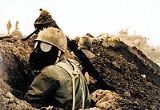
The Iran–Iraq War was an armed conflict between the armed forces of Iraq and Iran
, lasting from September 1980 to August 1988, making it the longest conventional war of the twentieth century. It was initially referred to in English as the "Persian Gulf War" prior to the "Gulf War
" of 1990.
The war began when Iraq invaded Iran, launching a simultaneous invasion by air and land into Iranian territory on 22 September 1980 following a long history of border disputes
, and fears of Shia Islam insurgency among Iraq's long-suppressed Shia majority influenced by the Iranian Revolution
. Iraq was also aiming to replace Iran as the dominant Persian Gulf
state
. Although Iraq hoped to take advantage of the revolutionary chaos in Iran and attacked without formal warning, they made only limited progress into Iran and within several months were repelled by the Iranians who regained virtually all lost territory by June 1982. For the next six years, Iran was on the offensive. Despite calls for a ceasefire
by the United Nations Security Council
, hostilities continued until 20 August 1988. The war finally ended with a United Nations brokered ceasefire in the form of United Nations Security Council Resolution 598
, which was accepted by both sides. It took several weeks for the Iranian armed forces to evacuate Iraqi territory to honor pre-war international borders between the two nations (see 1975 Algiers Agreement). The last prisoners of war
were exchanged in 2003.
The war came at a great cost in lives and economic damage—half a million Iraqi and Iranian soldiers as well as civilians are believed to have died in the war with many more injured—but it brought neither reparations nor change in borders. The conflict is often compared to World War I
, in that the tactics used closely mirrored those of that conflict, including large scale trench warfare
, manned machine-gun posts, bayonet charges, use of barbed wire
across trenches, human wave attacks across no-man's land, and extensive use of chemical weapons such as mustard gas by the Iraqi government against Iranian troops and civilians as well as Iraqi Kurd
s. At the time, the UN Security Council issued statements that "chemical weapons had been used in the war." However, in these UN statements it was never made clear that it was only Iraq that was using chemical weapons, so it has been said that "the international community remained silent as Iraq used weapons of mass destruction against Iranian as well as Iraqi Kurds" and it is believed that the "United States prevented the UN from condemning Iraq".
(Jan–Feb 1991), and for a while thereafter as the First Persian Gulf War. The Iraq-Kuwait conflict, while originally known as the Second Persian Gulf War, later became known simply as the "Gulf War". The United States-led invasion of Iraq in 2003 and the following occupation of the country from 2003–2011 has since been called the "Second Persian Gulf War".
The war of 1980-1988 is also known in Iran as the Imposed War (جنگ تحمیلی, Jang-e-tahmīlī) and the Holy Defense (دفاع مقدس, Defā'-e-moqqaddas). In Iraq, the president, Saddam Hussein
initially dubbed the conflict the "Whirlwind War". It was also referred in Iraq as Saddām's Qādisiyyah (قادسيّة صدّام, Qādisiyyat Ṣaddām), in reference to the ancient Battle of al-Qādisiyyah
.
, an important channel for the oil exports of both countries. In 1937, Iran and Iraq signed a treaty that settled the long-standing dispute, which dated back to the Ottoman-Persian wars of the 16th and 17th centuries over the control of the Arvand Rud. In the same year, Iran and Iraq both joined the Saadabad Pact, and relations between the two nations remained good for decades afterwards. In 1955, both nations joined the Baghdad Pact. The 1937 treaty recognized the Iranian-Iraqi border as along the low-water mark on the eastern side of the Arvand Rud except at Abadan
and Khorramshahr
where the frontier ran along the thalweg
(the deep water line) which gave Iraq control of almost the entire waterway; provided that all ships using the Arvand Rud fly the Iraqi flag and have an Iraqi pilot, and required Iran to pay tolls to Iraq whenever its ships used the Arvand Rud.
The overthrow of the Hashemites in Iraq in 1958 brought to power a new regime that was more stridently nationalist, and which promptly left the Baghdad Pact. On 18 December 1959, the new leader of Iraq General Abdul Karim Qassim
, declared: "We do not wish to refer to the history of Arab tribes residing in Al-Ahwaz and Mohammareh [Khorramshahr]. The Ottoman
s handed over Mohammareh, which was part of Iraqi territory, to Iran." The Iraqi regime's dissatisfaction with Iran's possession of the oil
-rich Khūzestān
province (which Iraqis called Arabistan) that had a large Arabic-speaking population was not limited to rhetorical statements; Iraq began supporting secession
ist movements in Khuzestan, and even raised the issue of its territorial claims at the next meeting of the Arab League
, without success. Iraq showed reluctance in fulfilling existing agreements with Iran—especially after the death of Egyptian President Gamal Abdel Nasser
in 1970 and the rise of the Ba'ath Party
which took power in a 1968 coup, led Iraq to take on the self-appointed role of the "leader of the Arab world
". At the same time, by the late 1960s, the build-up of Iranian power under Shah Mohammad Reza Pahlavi
, who had gone on a gargantuan military spending spree, led Iran to take a more assertive stance in the Near East. In April 1969, Iran abrogated the 1937 treaty over the Arvand Rud, and as such, Iran ceased paying tolls to Iraq when its ships used the Arvand Rud. The Shah justified his move by arguing that almost all river borders all over the world ran along the thalweg, and by claiming that because most of the ships that used the Arvand Rud were Iranian, the 1937 treaty was unfair to Iran. Iraq threatened war over the Iranian move, but when on 24 April 1969 an Iranian tanker escorted by Iranian warships sailed down the Arvand Rud, Iraq being the militarily weaker state did nothing. The Iranian abrogation of the 1937 treaty marked the beginning of a period of acute Iraqi-Iranian tension that was to last until the Algiers Accords of 1975. In 1969, the deputy prime minister of Iraq stated: "Iraq's dispute with Iran is in connection with Khuzestan which is part of Iraq's soil and was annexed to Iran during foreign rule." Soon Iraqi radio stations began exclusively broadcasting into "Arabistan", encouraging Arabs living in Iran and even Balūchīs
to revolt against the Shah of Iran
's government. Basra
TV stations even began showing Iran's Khuzestan province as part of Iraq's new province called Nasiriyyah, renaming all its cities with Arabic
names.
In 1971, Iraq broke diplomatic relations with Iran after claiming sovereignty rights over the islands of Abu Musa
, Greater Tunb and Lesser Tunb
in the Persian Gulf, following the withdrawal of the British. Iraq then expropriated
the properties of 70,000 people it said were Iraqis of Iranian origin and expelled them from its territory, after complaining to the Arab League and the UN without success. Many, if not most of those expelled were in fact Iraqi Shias who had little to no family ties with Iran, and the vast majority of whom spoke Arabic, rather than Persian. In retaliation for Iraq's claims to Khuzestan, Iran became the main patron of Iraq's Kurd
ish rebels in the early 1970s, giving the Iraqi Kurds bases in Iran and providing the Kurdish groups with weapons. In addition to Iraq's fomenting of separatism in Iran's Khuzestan and Iranian Balochistan provinces, both countries encouraged separatist activities by Kurdish nationalists in the other country. In the winter of 1974–75, Iran and Iraq almost went to war over Iran's support of the Kurds in Iraq. However, given Iran's greater military strength and population, the Iraqis decided against war, and chose to make concessions to Tehran to end the Kurdish rebellion. In the 1975 Algiers Agreement Iraq made territorial concessions – including the waterway – in exchange for normalized relations. In return for Iraqi recognition that the frontier on the Arvand Rud run along the entire thalweg, Iran ended its support of the Iraqi Kurdish guerrillas. The Algiers Agreement was widely seen as a national humiliation in Iraq. However, the Algiers Agreement meant the end of Iranian and US support for the Peshmerga
, who were defeated by the Iraqi government in a short campaign that claimed 20,000 lives. The British journalist Patrick Brogan wrote that "...the Iraqis celebrated their victory in the usual manner, by executing as many of the rebels as they could lay their hands on".
The relationship between the Iranian and Iraqi governments briefly improved in 1978, when Iranian agents in Iraq discovered a pro-Soviet coup d'état against the Iraqi government. When informed of this plot, Saddam
, who was vice president at the time, ordered the execution of dozens of his army officers, and to return the favor, expelled Ruhollah Khomeini
, an exiled leader of clerical opposition to the Shah, from Iraq.
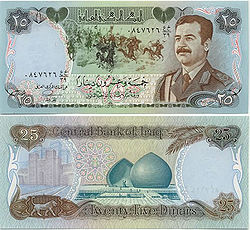
Iran's Pan-Islamism
and revolutionary Shia Islamism
and Iraq's Arab nationalism
were central to the conflict. Initially, the Iraqi government welcomed the Islamic revolution in Iran in 1978–79, having had a common enemy with them in the deposed Shah. The call, first made by Ayatollah Ruhollah Khomeini
in June 1979 for Iraqi Shias to overthrow the Ba'ath regime was therefore received with considerable shock in Baghdad. On 17 July 1979, despite Khomeini's call, the Iraqi President Saddam Hussein
gave a speech praising the Iranian revolution, and called for Iraqi-Iranian friendship based upon non-interference in each other's internal affairs. When Khomenini ignored Hussein's overture, and continued with his call for a Shia revolution in Iraq, the Iraqi regime was seriously alarmed. The new Islamic regime in Iran was regarded in Baghdad as an irrational, existential threat to the Ba'ath regime. This was especially the case as the Ba'ath regime, despite its secular nature, was dominated by Arab Sunnis, with the Arab Shia majority together with the Kurdish minority being assigned the status of an underclass.
Above all, Hussein was keenly interested in elevating Iraq to a strong regional power
. A successful invasion of Iran would enlarge Iraq's petroleum reserves and make Iraq the dominant power in the Persian Gulf region . With Iran engulfed in chaos, the chance for Iraq to annex the oil-rich Khūzestān Province
seemed too good for Hussein to pass up. In addition, Khuzestan's large ethnic Arab population would allow Hussein to pose as the liberator of the Arabs from Persian rule. In 1979–80, Iraq was the beneficiary of an oil boom that saw it take in $33 billion US, which allowed the Iraqi government to go on a lavish spending spree on both civilian and military projects. On several occasions Hussein alluded to the Islamic conquest of Iran in propagating his position against Iran. For example, on 2 April 1980, half a year before the outbreak of the war, in a visit by Hussein to al-Mustansiriyyah University in Baghdad, drawing parallels with the 7th century defeat of Persia in the Battle of al-Qādisiyyah
, he announced:
In turn the Ayatollah
Khomeini believed Muslims, particularly the Shias in Iraq, Saudi Arabia
, and Kuwait
, whom he saw as oppressed, could and should follow the Iranian example, rise up against their governments to join a united Islamic republic. Khomeini and Iran's Islamic revolutionaries despised Hussein's secularist, Arab nationalist Ba'athist regime in particular as un-Islamic and "a puppet of Satan," and called on Iraqis to overthrow it. In 1979–1980, there were anti-Ba'ath riots in the Shia areas of Iraq, and the Iranian government extended its support to Iraqi Shia militants working for an Islamic revolution in their country. In April 1980 alone, 20 Ba'ath officials were assassinated by Shia militants with Deputy Prime Minister Tariq Aziz
being almost killed in an assassination attempt on 1 April 1980. Later in April, the Information Minister Latif Nusseif al-Jasim barely survived an assassination attempt by Shia militants. The repeated calls for the overthrow of the Ba'ath regime and the support extented to Iraqi Shia groups by the new regime in Iran led Hussein to increasingly perceive the Iranian regime as a mortal threat that if ignored, might one day overthrow him. In April 1980, Ayatollah Mohammad Baqir al-Sadr and his sister Amina Haydar (better known as Bint al-Huda) were hanged as part of the crack-down on Iraqi Shia activists. The hanging of Iraq's senior most Ayatollah caused outrage throughout the Shia world. Starting in May 1980, skirmishes on the Iranian-Iraqi border became a daily event. At the same time in Iran, severe officer purges (including several executions ordered by Sadegh Khalkhali, the post-revolution sharia
ruler), and spare parts shortages for Iran's US-made equipment, had crippled Iran's once mighty military
. Between February–September 1979, the Iranian government shot 85 senior generals while forcing all major-generals and most brigadier-generals into early retirement. By September 1980, the Iranian government had purged 12,000 army officers. The effects of this purge was a drastic decline in the operational capacities of the Iranian military. The bulk of the Iranian military was made up of poorly armed, though committed, militia
s. Iran had minimal defenses at the Arvand river.
The UN Secretary General report dated 9 December 1991 (S/23273) explicitly cites "Iraq's aggression against Iran" in starting the war and breaching international security and peace.
Tariq Aziz
in southern Iraq, which Saddam blamed on "Iranian agents", in one of his speeches.
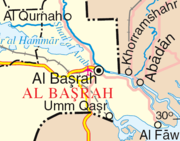 Relations deteriorated rapidly until in March 1980, Iran unilaterally downgraded its diplomatic ties to the charge d'affaires
level, withdrew its ambassador, and demanded that Iraq do the same. The tension increased in April following the attempted assassination of Aziz and, three days later, the bombing of a funeral procession being held to bury students who had died in an earlier attack. Iraq blamed Iran, and in September, attacked.
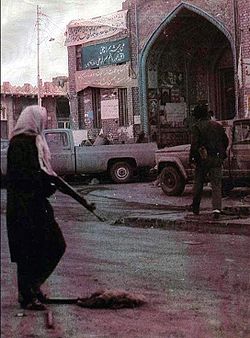 On 17 September, in a statement addressed to the Iraqi parliament, Saddam stated that "The frequent and blatant Iranian violations of Iraqi sovereignty...have rendered the 1975 Algiers Agreement null and void... This river...must have its Iraqi-Arab identity restored as it was throughout history in name and in reality with all the disposal rights emanating from full sovereignty over the river.",
The objectives of Iraq's invasion of Iran were:
launched surprise airstrikes on ten Iranian airfields with the objective of destroying the Iranian Air Force on the ground. The attack demolished some of Iran's airbase infrastructure, but failed to destroy a significant number of aircraft. The Iraqi Air Force was only able to strike in depth with a few MiG-23BN, Tu-22 and Su-20 aircraft, largely ineffective due to Iran's sheer size. Three MiG-23s managed to attack Tehran
, striking its airport but damaging only a few aircraft. The next day, Iraq launched a ground invasion of Iran along a front measuring 644 kilometres, in three simultaneous thrusts. The purpose of the invasion, according to Saddam, was to blunt the edge of Khomeini's movement and to thwart his attempt to export his Islamic revolution
to Iraq and the Persian Gulf states." Saddam hoped that by annexing the oil-rich province of Khuzestan that he would send such a blow to the prestige of the Islamic Republic, that it would lead to the downfall of the new government, or at very least put an end to Iranian calls for his overthrow.
Of the six Iraqi divisions that were invading, four were sent against the Iranian province of Khuzestan, which was located near the southern end of the border, to cut off the Arvand river from the rest of Iran, and to establish a territorial security zone. The other two divisions invaded through the northern and central part of the border, to prevent an Iranian counter-attack into Iraq. Two of the four Iraqi divisions operating near the southern end, one mechanized and one armored, began a siege of the strategically important towns of Abadan and Khorramshahr
.
The other two divisions, both armoured, secured the territory bounded by the line Khorramshahr-Ahvaz-Susangerd-Musian, due to an enveloping movement. On the central front, the Iraqis occupied Mehran
, advanced towards the foothills of the Zagros Mountains
; and were able to block the traditional Tehran–Baghdad invasion route by securing some territory forward of Qasr-e Shirin. On the northern front, the Iraqis attempted to establish a strong defensive position opposite Suleimaniya to protect the Iraqi Kirkuk oil complex. Iraqi hopes of an uprising by the ethnic Arabs of Khuzestan failed to occur, and most the ethnic Arabs, who were Shiite remained loyal to Iran. The Iraqi troops advancing into Iran in 1980 were described by the British journalist Patrick Brogan as "badly led and lacking in offensive spirit..."
The Iranian regular military and the Pasdaran resisted, but conducted their operations separately. As a result, the Iraqi invading forces did not face co-ordinated resistance. The Pasdaran fought against the Iraqi invasion with "great fervour and tenacity", and bore the brunt of the invasion. By the second day of the invasion, dozens of Iranian F-4s attacked Iraqi targets, and in a few days the Islamic Republic of Iran Air Force
gained air superiority over the Iraqis, allowing them to conduct ground attack missions with fighter-bombers and helicopters against Iraqi forces. The Iraqi Army was also subjected to attacks by entrenched Iranian artillery. On 24 September, though, the Iranian Navy attacked Basra
and, on the way, had destroyed two oil terminals near the Iraqi port of Fao
, which reduced Iraq's ability to export oil. The Iranian Air Force also began air strikes in September against strategically important Iraqi targets, including oil facilities, dams, petrochemical plants, and a nuclear reactor near Baghdad.
On 28 September, the UN Security Council adopted a resolution urging Iran and Iraq to stop the fighting and accept mediation. The Iraqi invasion encountered unexpectedly fierce resistance, however, and by December 1980 it stalled. Also, rather than turning against the Islamic Republic as some experts had predicted, the people of Iran rallied around their country and resisted. An estimated 200,000 additional troops arrived at the front by November, many of them "ideologically committed" volunteers.
Baghdad was subjected to eight air attacks by 1 October. In response to these air attacks, Iraq launched a number of aerial strikes against Iranian targets. In October 1980, a prolonged urban battle took place for Khorramshahr
with both sides losing about 7,000 dead. Reflecting the bloody nature of the struggle, both sides came to call Khorramshar "Khunistan" (City of Blood). On 24 October, Khorramshahr
was finally captured and by November, Saddam ordered his forces to advance towards Dezful
and Ahvaz
, but their thrusts were repulsed. On 7 December 1980 Saddam announced that Iraq was going on the defensive. For the next eight months, both sides were with the exception of the Battle of Dezful
to be on the defensive as the Iranians needed more time to reorganize their forces to undo the damage inflicted by the purge of 1979–80. During this period, the war consisted mainly of artillery duels and raids. Iraq had mobilized 21 divisions for the invasion, while Iran countered with only 13 regular army divisions and one brigade. Of these divisions, only seven were deployed to the border.
tanks while the Iranians lost 100 Chieftain
and M-60
tanks. The Battle of Dezful
had been ordered by President Abulhassan Banisadr who was hoping that a victory might shore up his deteriorating political position; instead the failure of the offensive helped to hasten his fall. A major distraction for Iran was the internal fighting between the regime and the leftish Mujaheddin e-Khalq group on the streets of Iran's major cities in June 1981 and again in September.
In May 1981, the Iranians retook the high ground above Susangerd, and in September 1981, the Iranians put an end to the Iraqi Siege of Abadan
, which had commenced in November 1980. By the fall of 1981, serious morale problems had developed in the Iraqi Army with many Iraqi soldiers seeing no point to the invasion of Iran. On 29 November 1981 Iran began Operation Tariq al-Qods
(Operation Jerusalem Way) with three Army brigades and seven Revolutionary Guard brigades retaking the town of Bostan
from the Iraqi division that was holding it by 7 December. Operation Jerusalem Way saw the first use of the Iranian "human wave" tactics with the Revolutionary Guard charging the Iraqi positions time after time without the support of artillery or air power until victory. The fall of Bostan massively increased the Iraqi logistical problems as to supply their troops, Iraq was forced to use the roundabout route from Ahvaz far to the south.
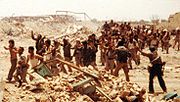 For about a year after the Iraqi offensive stalled in March 1981 there was little change in the front, but in mid-March 1982 Iran took the offensive and the Iraqi military was forced to retreat. By June 1982, an Iranian counter-offensive had recovered all the areas lost to Iraq earlier in the war. In Operation Jerusalem launched on 24 April 1982, 70,000 Revolutionary Guardsmen using infiltration tactics at night and human wave attacks by day had by 12 May driven all Iraqi forces out of the Susangerd area. On 20 May 1982 the Iranians began the drive towards Khorramsahr. An especially significant battle of this counter-offensive in the Khuzestan province was the Liberation of Khorramshahr
from the Iraqis on 24 May 1982. A total of 7,000 Iraqis were killed or wounded in Khorramshahr and 19,000 taken prisoner, while the Iranians had suffered 10,000 casualties.
Saddam decided to withdraw his armed forces completely from Iran, and that they should be deployed along the international border between Iraq and Iran. Efraim Karsh
states that Saddam made this choice because the Iraqi leader believed that his army was now too demoralised and damaged to hold onto any territory in Iran, and that Iran could be successfully resisted through a line of defence on Iraqi land near the border. Equally important, in April 1982 the rival Ba'athist regime in Syria at the request of Iran closed the Kirkuk–Banias pipeline that allowed Iraqi oil to reach tankers on the Mediterranean, which reduced the Iraqi budget by $5 billion US/month. The effects of the Syrian move was to place Iraq under dire financial pressure. The British journalist Patrick Brogan wrote:
, the Foreign Minister Ali Akbar Velayati
, President Ali Khamenei
and the Army Chief of Staff General Ali Sayad Shirazi
urged that now that all of Iranian soil had been liberated to accept the Iraqi ceasefire offer rather embark upon an invasion that was likely to take a heavy toll on Iran's youth and with uncertain prospects for victory. In particular, General Shirazi was opposed to the invasion of Iraq on logistical grounds and said he was considering resignation if "unqualified people continued to meddle with the conduct of the war". On the other side, there was a hardline fraction led by clerics on the Supreme Defence Council, whose leader was the politically powerful Speaker of the Majlis Akbar Hashemi Rafsanjani
who favored continuing the war until the Ba'ath were overthrown. Khomeini sided with the hardliners. In Baghdad, at a cabinet meeting, the minister of health Dr. Riyadh Ibrahim Hussein suggested that Hussein step down temporarily as a way of easing Iran towards a ceasefire. An annoyed Saddam asked if anyone else in the Cabinet agreed with the Health Minister's idea. None raised their hands in support, and Dr. Hussein was shot later that day for treason.
Under the slogans "War, War until Victory" and "The Road to Jerusalem Goes through Karbala", Iran advanced. A tactic used in this advance noted throughout the world was the encouragement of heroism among young Iranian basij
volunteers who launched human wave attacks on Iraqi positions. The volunteers were inspired before battle by tales of Ashura
, the Battle of Karbala
, and the supreme glory of martyrdom
, and sometimes by an actor (usually a more mature soldier), playing the part of Imam Hossein
himself riding a white horse, galloping along the lines, providing the inexperienced soldiers a vision of "the hero who would lead them into their fateful battle before they met their God." The "martyrs" signed "Passports to Paradise" as admission forms to the Basij were called, given a week of basic military training by the Pasdaran, and then were sent to the front. These attacks cost Iran massive casualties, as they were met with fierce resistance from defensive positions, along with artillery and rocket fire. A great advantage that the Iraqis were to enjoy in the defense of their country was logistical. The front was close to all of the main Iraqi bases and arms depots, and Iraq's excellent roads allowed the Iraqi Army to be efficiently supplied. By contrast, the front in Iraq was a considerable distance from the main Iranian bases and arms depots, and as such, Iranian troops and supplies had to travel through difficult roads across several mountain ranges before arriving at the front.
On 13 July, the Iranian units crossed the border in force, aiming towards the city of Basra
, the second most important city in Iraq. However, the enemy they encountered had entrenched itself in formidable defenses. Unlike the hastily improvised defenses that the Iraqis had manned in Iran during the 1980–1981 occupation of the conquered territories, the border defenses were, by necessity, well developed even before the war, and the Iraqis were able to utilize a highly-developed network of bunkers and artillery fire-bases. Unlike the fighting in Iran, Iraqi morale improved in 1982 when the Iraqis were fighting in the defense of their nation. Saddam had also more than doubled the size of the Iraqi army from 200,000 soldiers (12 divisions and 3 independent brigades) to 500,000 (23 divisions and nine brigades).
Saddam's efforts bore fruit. Iran had been using combined-arms operations to great effect when it was attacking the Iraqi troops in its country, and had launched the iconic human-wave attacks with great support from artillery, aircraft, and tanks. However, lack of ammunition meant that the Iranians were now launching human-wave assaults with no support from other branches of the military. The superior defenses of the Iraqis meant that tens of thousands of Iranian soldiers were lost in most operations after 1982, and the Iraqi defenses would continue to hold in most sectors. During the advance on Basra, the Basij were used to clear the Iraqi minefields with their feet in order to allow the Pasdaran to advance.
In the Basra offensive, or Operation Ramadan
, five human-wave attacks were met with withering fire from the Iraqis. The boy-soldiers of Iran were particularly hard-hit, especially since they volunteered to run into minefields, in order to clear the way for the Iranian soldiers behind them. The Iranians were also hard-hit by the employment of chemical weapons and mustard gas by the Iraqis.
In 1982, with Iranian success on the battlefield, the U.S. made its backing of Iraq more pronounced, supplying it with intelligence, economic aid, normalizing relations with the government (broken during the 1967 Six-Day War
), and also supplying "dual-use" equipment and vehicles. Dual use items are civilian items such as heavy trucks, armored ambulances and communications gear as well as industrial technology that can have a military application. President Ronald Reagan decided that the United States "could not afford to allow Iraq to lose the war to Iran", and that the United States "would do whatever was necessary to prevent Iraq from losing the war with Iran." President Reagan formalized this policy by issuing a National Security Decision Directive ("NSDD") to this effect in June, 1982. The Security Council passed Resolution 552
condemning attacks on commercial ships in the region.
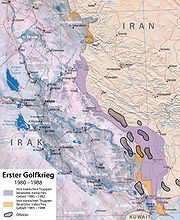
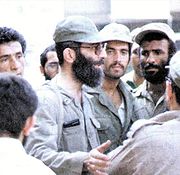 In January 1983, an Iraqi-Soviet arms deal was signed in Moscow, which led to the Soviet Union supplying Iraq with T-62 and T-72 tanks; Mig-23 and Mig-25 jets; and SS-21 and Scud-B missiles. By 1987, the Soviet Union had provided Iraq with 800 T-72 tanks, and dozens upon dozens of modern fighters and bombers. Between 1980–82, France had supplied Iraq with $5.6 billion US worth of weapons such as fighters, tanks, self-propelled guns and helicopters.
After the failure of their 1982 summer offensives, Iran believed that a major effort along the entire breadth of the front would yield the victory that they desired. Iranian numerical superiority might have achieved a break-through if they had attacked across all parts of the front at the same time, but they still lacked the organization for that type of assault. Iran was getting supplies from countries such as North Korea, Libya, and China. The Iraqis had more suppliers such as the USSR, the NATO nations, France, United Kingdom, Brazil, Yugoslavia
, Spain, Italy, Egypt, Saudi Arabia, Germany, and the United States.
During the course of 1983, the Iranians launched five major assaults along the front. None met with substantial success as the Iranians staged massive "human wave" attacks on well-dug Iraqi positions without artillery, air or armored support. Khomeini's position on a truce remained unchanged.
On 7 February 1984, Saddam ordered aerial and missile attacks against the eleven cities that he had designated. The bombardment ceased on 22 February 1984. Iran soon retaliated against Iraqi urban centers, and these exchanges become known as the first "war of the cities". There would be five such exchanges throughout the course of the war.
The attacks on the Iranian cities did not destroy the Iranian government's resolve to fight. On 15 February, 1984 the Iranians launched a major attack against the central section of the front where the Second Iraqi Army Corps was deployed with 250,000 Iranians faced 250,000 Iraqis. The Iranian "final blow" offensives entitled Operation Dawn 5 (5–22 February 1984) and Dawn 6 (22–24 February 1984) saw the Iranians attempting to take Kut al-Amara and sever the highway connecting Baghdad to Basra. Capture of this road would have made it extremely difficult for the Iraqis to supply and co-ordinate the defenses, but the Iranian forces only came within 15 miles (24.1 km) of the highway. After advancing to within 15 miles (24.1 km) of the highway after much heavy fighting, on 24 February, the Iranians began Operation Kheibar
, the offensive intended to take Basra, which ended in failure as the Iraqi trenches proved to be too tough of a nut for the Iranians to crack.
However, Operation Kheibar met with much greater success. The Iranians fought their way through the marshes of southern Iraq to take Majnun Island, 40 miles (64.4 km) to north of Basra. Involving a number of thrusts towards the key Iraqi city of Basra
, the operation started on the 24 February and lasted until 19 March. The Iraqi defenses, under continuous strain since 15 February, seemed close to breaking conclusively. The Iraqis were saved by use of a defense-in-depth with one defensive line after another; even if the Iranians stormed through the first line, they were usually so exhausted and had taken such heavy losses that attempts to storm through the second line resulted in failure. The Iraqis successfully stabilized the front but not before the Iranians captured part of the Majnun Islands. Despite a heavy Iraqi counterattack coupled with the use of mustard gas and sarin
nerve gas, the Iranians held their gains and would continue to hold them almost until the end of the war. The Iranian offensive ended on 19 March 1984 after much desperate fighting in the marsh land with the Iraqis making heavy use of chemical weapons to halt the Iranian advance on Basra, through the Iraqis failed in their attempts to re-take Majnun. At least 3,000 Iranians were killed in the fighting in the marshes with Iraqi helicopter gunships being deployed to "hunt" the Iranian troops in the marshes.
in early 1984. Iran struck back by attacking tankers carrying Iraqi oil from Kuwait and then any tanker of the Persian Gulf states supporting Iraq. Both nations attacked oil tankers and merchant ships, including those of neutral nations, in an effort to deprive the opponent of trade. Iraq declared that all ships going to or from Iranian ports in the northern zone of the Persian Gulf were subject to attack. Saddam's hope in beginning the "tanker war" was that in response to Iraqi attacks against its shipping, the Iranians might do something extreme in retaliation such as closing the Strait of Hormuz
to all shipping. The United States had threatened several times to go to war if the Strait of Hormuz was closed. For this reason, the Iranians refused to rise to the bait, and so limited their attacks in retaliation to Iraqi shipping. Iran attacked tankers carrying Iraqi oil from Kuwait and then any tanker of the Persian Gulf states supporting Iraq. The air and small boat attacks did very little damage to Persian Gulf state economies and Iran just moved its shipping port to Larak Island
in the strait of Hormuz
.
Iraq used its air power to enforce its threats, primarily helicopters, F-1 Mirage and MiG-23 fighters armed with Exocet
anti-ship missiles. After repeated Iraqi attacks on Iran's main exporting facility on Khark Island, Iran attacked a Kuwaiti tanker near Bahrain on 13 May 1984, and a Saudi tanker in Saudi waters on 16 May. Attacks on ships of noncombatant nations in the Persian Gulf sharply increased thereafter, and this phase of the Iraq-Iran war was dubbed the "Tanker War." The Iranian attacks against Saudi shipping led to Saudi F-15s shooting down an Iranian aircraft on 5 June 1984.
The Iranian Navy
imposed a naval blockade of Iraq, using its British-built frigates to stop and inspect any ships thought to be trading with Iraq. They operated with virtual impunity, as Iraqi pilots had little training in hitting naval targets. Some Iranian warships attacked tankers with ship-to-ship missiles, while others used their radars to guide land-based anti-ship missiles to their targets.
Though the "tanker war" alarmed the United States, it was not followed up with any significant American action until 1987. After several Iranian attacks on Kuwaiti shipping, the United States Navy
started in March 1987 to escort Kuwaiti tankers provided that they flew the American flag. In April 1987, the Soviet Navy
also started escorting Kuwaiti tankers. A US Navy ship, the USS Stark was struck on 17 May 1987, by two Exocet
antiship missiles fired from an Iraqi F-1 Mirage plane. The Iraqi fighter fired the Exocet missiles at about the time the fighter was given a routine radio warning by the Stark. The frigate did not detect the missiles with radar and warning was given by the lookout only moments before the missiles struck. The missiles hit the ship and one exploded in crew quarters, killing 37 sailors and wounding 21.
, a British insurance market, estimated that the Tanker War damaged 546 commercial vessels and killed about 430 civilian sailors. The largest portion of the attacks were directed by Iran against Kuwaiti vessels, and on 1 November 1986, Kuwait formally petitioned foreign powers to protect its shipping. The Soviet Union
agreed to charter tankers starting in 1987, and the United States offered to provide protection for tankers flying the U.S. flag
on 7 March 1987 (Operation Earnest Will
and Operation Prime Chance
).
During the course of the war Iran attacked two Soviet Navy ships which were protecting Kuwaiti tankers. One of the ships which was damaged as a result of an attack during the war was the Seawise Giant carrying Iranian crude which was struck by Iraqi Exocet
missiles, resulting in the damage of the largest ship ever built in history.
, China and France (among others), Saddam
went on the offensive on 28 January 1985, for the first time since early 1980. This offensive, however, did not produce any significant gains, and the Iranians responded in kind with their own offensive directed against Basra, codenamed Operation Badr, on 11 March 1985. The Imam Khomeini urged Iranians on saying, "It is our belief that Saddam wishes to return Islam to blasphemy and polytheism. ... if America becomes victorious ... and grants victory to Saddam, Islam will receive such a blow that it will not be able to raise its head for a long time ... The issue is one of Islam versus blasphemy, and not of Iran versus Iraq."
By this time, the failure of the unsupported human wave attacks during 1984 meant that Iran was trying to develop a better working relationship between the army and the Pasdaran. The Iranian government also worked on molding the Revolutionary Guard units into a much more conventional fighting force. The attack did succeed in capturing a part of the Baghdad-Basra highway that had proven elusive during Operation Dawn 5 and Operation Dawn 6
. Reflecting the improved Iranian tactics, Iraq suffered 10,000–12,000 casualties in Badr while the Iranians took 15,000 casualites. Saddam responded to this strategic emergency by launching chemical attacks against the Iranian positions along the highway and by initiating the second 'war of the cities' with a massive air and missile campaign against twenty Iranian towns, including Tehran
.
On 9 February 1986, the Iranians launched Operation Dawn 8
, which saw 100,000 troops comprising 5 Army divisions and 50,000 men from the Pasdaran and the Basji advance in a two-pronged offensive in southern Iraq. Unlike the earlier offensives, Dawn 8 was planned entirely by professional Army officers, all of whom had began their careers under the Shah. The Iranians launched a feint attack against Basra, which was stopped by the Iraqis. At the same time with the Iraqis distracted by the offensive against Basra, the main Iranian blow fell on the strategically important Fao peninsula
, which fell after only 24 hours of fighting. The Iranians launched their assault on the Fao at night with their men arriving via rubber boats. After taking the Fao, the Iranians built a pontoon bridge and began to dig in. On 12 February 1986 the Iraqis began a counter-offensive to re-take the Fao, which failed after a week of intense fighting. Saddam sent one of his best commanders, General Maher Abd-Rashid and the Republican Guard to begin an new offensive to re-capture the Fao on 24 February 1986. A new round of intensive fighting took place with the Iraqis losing 10,000 men and the Iranians 30,000 over the next four days. The Iraqi offensives were supported by helicopter gunships, hundreds of tanks and a huge bombing offensive by the Iraqi Air Force. Despite having an advantage in firepower and the extensive use of chemical warfare, the Iraqi attempt to re-take the Fao again ended in failure. The fall of the Fao and the failure of the Iraqi counter-offensives were huge blows to the prestige of the Ba'ath regime, and led to fears all over the Gulf that Iran might win the war. In particular, Kuwait felt menaced with Iranian troops only ten miles away, and increased its support of Iraq accordingly. In March 1986, the Iranians tried to follow up their success by attempting to take Umm Qasr
, which would had the effect of severing Iraq from the Gulf and placing Iranian troops on the border with Kuwait. The Iranian offensive failed. In May 1986, the Iraqis took the Iranian border town of Mehran, and made a proposal for swapping Mehran for Fao. The Iraqi offer was rejected and in July 1986 the Iranians re-took Mehran.
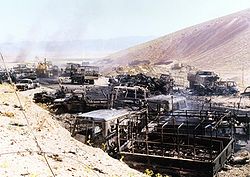 1987 saw a renewed wave of Iranian offensives against targets in both the north and south of Iraq. Iranian forces launched Operation Karbala-5
in an attempt to capture Basra, but repulsed after more than two months of fighting which saw 20,000 Iraqi and 65,000 Iranian casualties. Among those killed was Iranian commander Hossein Kharrazi
. The Iranians came close to breaking through the Iraqi lines and taking Basra, but in the end, the strength of the Iraqi lines halted the Iranian offensive. However, the Iranians came close enough to Basra to bring up their artillery, and in the ensuring bombardments, Basra was largely destroyed. The Iranians were met with more success later in the year in the north as Operations Nasr 4
and Karbala-10, threatening to capture the oil-rich Iraqi city of Kirkuk
and other northern oilfields. However, the Iranian forces were unable to consolidate their gains and continue their advance, and so 1987 saw little land change hands. On 20 July, the Security Council of the United Nations passed the US-sponsored Resolution 598, which called for an end to fighting and a return to pre-war boundaries.
In February 1988, Saddam began the fifth and most deadly of the "war of the cities". Over the next two months, Iraq was to fire over 200 missiles at Iranian cities. In March 1988, the Iranians began an offensive in Iraqi Kurdistan with the aim of capturing the Darbandi Khan reservoir and the power plant at Dukan, which supplied Iraq with much of its electricity. Through the Iranians advanced to within sight of Dukan, and captured 400 square miles (1,036 km²) and 4,000 Iraqi troops, the offensive failed to the Iraqi use of chemical warfare. On 17 April 1988, an Iraqi offensive was started which saw the Fao peninsula recaptured after three days of fighting. After retaking the Fao, the Iraqis began a sustained drive to clear the Iranians out of all of southern Iraq. In May 1988, the Iraqis expelled the Iranians from Salamchech and took Majnun Island. During the fighting in the spring of 1988, the Iranians showed all the signs of collapsing morale. The British journalist Patrick Brogan reported:
In July 1988 Iraqi airplanes dropped chemical cyanide bombs on the Iranian Kurdish village of Zardan (as they had done four months earlier at their own Kurdish village of Halabja). Hundreds were killed at once, and the survivors are still suffering from a variety of physical and mental disorders. Following these major setbacks, Iran accepted the terms of U.N. Security Council Resolution 598 and on 20 August 1988 peace was restored. The news of the end of the war was greeted with scenes of wild celebration in Baghdad with people dancing in the streets while in Tehran, the end of the war was greeted with a glum, sad silence as Iran settled for the same terms it had rejected in 1982, thus meaning that the last six years of the war had been in vain.
The People's Mujahedin of Iran
started their ten-day operation (Operation Mersad
) after the Iranian government accepted UN Resolution 598. While Iraqi forces attacked Khuzestan, the Mujahedin attacked western Iran and battled the Pasdaran for Kermanshah. Close air support from the Iraqis contributed to whatever gains the Mojahedin made. However, Iranian paratroopers landed behind their lines, and they were met with fierce resistance. Under heavy international pressure for ending the war, Saddam withdrew his fighter aircraft and the sky opened for the Iranian airborne forces to be deployed behind Mojahedin lines. The operation ended in a defeat for the Mojahedin. Casualty figures range from 2,000 to as high as 10,000.
was introduced with the entire population being mobilized for the war effort. All Iraqis were ordered to donate blood, mass demonstrations of loyalty towards Saddam became more common, and some 100,000 Iraqi civilians were ordered to sever the reeds in the southern marshes. To secure the loyalty of the Shiites, Saddam began a policy of allowing more Shiites into the Arab Socialist Ba'ath Party
and the government, and started efforts to improve Shiite living standards, which tended to be much lower than those of the Iraqi Arab Sunnis. As part of the effort to ensure Iraqi Shia support for the war, Saddam had the Iraqi state pay for the costs of restoring the tomb of the Imam Ali
with white marble being imported from Italy. Despite the costs of the war, the Iraqi regime made generous contributions to Shia waqf (religious endowments) as part of the price of buying Iraqi Shia support. The importance of winning Shia support could see that the expansion of welfare services in Shia areas went on at a time when the Iraqi regime was pursuing a policy of rigid austerity in all other fields other than the military. Khomeini's behavior during his time in exile in Najaf
in the 1960s-1970s where he often quarrelled with the leaders of the Iraqi ulema
helped to explain why many of the Iraqi Shia ulema supported the Iraqi regime against him in the 1980s. On the whole, Iraqi Shiites supported their country's war effort against Iran. The British journalist Patrick Brogan reported:
agreed to cooperate with Baghdad, but the Kurdish Democratic Party remained opposed. In 1983, Saddam signed an autonomy agreement with Jalal Talabani
of the PUK
, through subsequently Saddam reneged on his promise of Kurdish autonomy. By 1985, the PUK and KDP had joined forces, and Iraqi Kurdistan become the scene of widespread guerrilla warfare right up to the end of the war in 1988.
As a counterpart to the new policy of the "carrot", there was a policy of the "stick". A campaign of terror was begun in the summer of 1982 with more than 300 Iraqi Army officers being shot for their failures on the battlefield. In 1983, a major crackdown was launched on the leadership of the Shiite community with 90 members of the al-Hakim family (an influential family of Shia clerics whose leading members were the émigrés Mohammad Baqir al-Hakim and Abdul Aziz al-Hakim
) being arrested and six being hanged. Even more extensive was the crackdown on the Kurds that saw 8,000 members of the Barzani clan, whose leader Massoud Barzani
was also the leader of the KDP summarily executed. From 1983 onwards, a campaign of increasingly brutal repression was started against the Iraqi Kurds that the Israeli historian Efraim Karsh
wrote "assumed genocidal proportions" by 1988. The Al-Anfal Campaign
was intended to "pacify" Iraqi Kurdistan permanently.
and a test of Iranian national character. Right from the beginning, the Iranian regime followed a policy of total war, and attempted to mobilize the entire nation for the struggle. The war furthered the decline of the Iranian economy that began with the Islamic revolution in 1978–79. Between 1979 and 1981, foreign exchange reserves fell from $14.6 billion US to $1 billion. As a result of the war, living standards dropped quite dramatically in Iran in the 1980s. The British journalists John Bulloch and Harvey Morris described 1980s Iran as “...a dour and joyless place” ruled by a harsh regime that “...seemed to have nothing to offer, but endless war”. As part of the total war effort, the regime established a group known as the Reconstruction Campaign, who enjoyed exemption from conscription and sent into the countryside to work on the farms and replace the men serving at the front. Iranian workers had a day's pay deducted from their pay cheques every month to help finance the war, and mass campaigns were launched to encourage the public to donate food, money and blood for the soldiers. To help pay for the war, the Iranian government banned the import of all non-essential items, and started a major effort to rebuild the damaged oil plants. Iranian oil technicians, "masters of invention and innovation", did much to keep their nation's oil industry going in the face of much difficulty, and thus ensured that Iran could pay for the war.
In 1981, a condition of near-civil war took place on the streets of Iranian cities as the left-wing Mujaheddin e-Khalq (MEK) attempted to seize power. In June 1981, street battles between the MEK and the Revolutionary Guard raged for several days with hundreds killed on both sides. The MEK started an assassination campaign that killed hundreds of regime officials by the fall of 1981. On June 28, 1981 the MEK assassinated secretary-general of the Islamic Republican Party, Mohammad Beheshti and August 30, killed the President, Mohammad-Ali Rajai. In September 1981, street battles again raged between the MEK and the Revolutionary Guard. Thousands of left-wing Iranians (many of whom were not associated with the MEK) were shot and hanged by the government in the aftermath. Even after their defeat, the MEK waged a campaign of bombings and assassinations which was met with a policy of mass executions of suspected MEK members that lasted until 1985. Other than the MEK, the Iranian government was faced with a rebellion in Iranian Kurdistan supported by Iraq, which was gradually put down through a campaign of systematic repression. Besides for the MEK and the Kurds, anti-war student demonstrations took place in 1985, which were crushed by government activists.
One of the few exceptions to the repressive policies of the government was the tolerance shown to the anti-war Islamic Liberation Movement led by a former prime minister Mehdi Bazargan
. In January 1985, Bazargan criticized the war after 1982 in a telegram to the United Nations as un-Islamic and illegitimate, arguing that Khomeini should have accepted Saddam's truce offer of 1982 instead of attempting to overthrow the Ba'ath. Khomeini was annoyed by Bazargan's telegram, and issued a lengthy public rebuttal in which he defended the war as both Islamic and just. By 1987, there were increasing signs that Iranian morale was breaking as reflected in the failure of several government campaigns to recruit "martyrs" for the front. The Israeli historian Efraim Karsh
wrote that it was signs of declining morale in 1987–88 that played a major role in Iran's decision to accept the ceasefire of 1988. The British journalist Patrick Brogan wrote that by 1988:
Iran. The Soviet Union, which was Iraq's main arms supplier for the entire duration of the war did not wish for the end of its alliance with Iraq, and was alarmed at Saddam's threats if the Kremlin did not provide him with the weapons he wanted, then Iraq would find new arms suppliers in the West and in China. The British journalists John Bulloch and Harvey Morris wrote:
, the sale of dual-use and military equipment and satellite intelligence to Iraq. While there was direct combat between Iran and the United States, it is not universally agreed that the fighting between the U.S. and Iran was specifically to benefit Iraq, or for separate, although occurring at the same time, issues between the U.S. and Iran. American ambiguity towards which side to support was summed up by Henry Kissinger
when the American statesman remarked that "it's a pity they [Iran and Iraq] both can't lose." Richard Murphy, the Assistant Secretary of State testified to Congress in 1984 that the Reagan administration believed that a victory for either Iran or Iraq was "neither militarily feasible nor strategically desirable". France
, which from the 1970s onwards had been one of Iraq's closest allies was a major supplier of military hardware to Iraq. The French sold weapons equal to the sum of $5 billion US, which comprised well over a quarter of Iraq's total armory. China
, which had no direct stake in the victory of either side, and whose interests in the war were entirely commercial freely sold arms to both sides.
More than 30 countries provided support to Iraq, Iran, or both. Iraq, in particular, had a complex clandestine procurement network to obtain munitions and critical materials, which, in some transactions, involved 10–12 countries. Also, a number of Arab mercenaries and volunteers from Egypt and Jordan (called the Yarmouk Brigade) participated in the war alongside Iraqis.
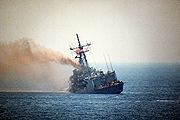 On 17 May 1987, an Iraqi Mirage F1 attack aircraft launched two Exocet
missiles at the USS Stark
, a Perry class frigate
. The first struck the port side of the ship and failed to explode, though it left burning propellant in its wake; the second struck moments later in approximately the same place and penetrated through to crew quarters, where it exploded. The detonation killed 37 crewmembers and left 21 injured. The question of whether or not Iraqi leadership authorized the attack is still unanswered. Initial claims by the Iraqi government (that Stark was inside the Iran–Iraq War zone) were shown to be false, so the motives and orders of the pilot remain unanswered. Though American officials claimed he had been executed, an ex-Iraqi Air Force commander since stated that the pilot who attacked Stark was not punished, and was still alive at the time. The attack remains the only successful anti-ship missile strike on an American warship.
, criticizing Iran's mining of international waters, and sponsored UN Security Council Resolution 598, which passed unanimously on 20 July, under which it skirmished with Iranian forces during Operation Earnest Will
. During the Operation Nimble Archer
in October 1987, the U.S. attacked Iranian oil platforms in retaliation for an Iranian attack on the U.S.-flagged Kuwaiti tanker Sea Isle City
.
On 14 April 1988, the frigate USS Samuel B. Roberts
was badly damaged by an Iranian mine, wounding 10 sailors. U.S. forces responded with Operation Praying Mantis
on 18 April, the United States Navy
's largest engagement of surface warships since World War II
. Two Iranian oil platforms, two Iranian ships and six Iranian gunboats were destroyed. An American helicopter also crashed. (see also Oil Platforms (Iran v. United States))
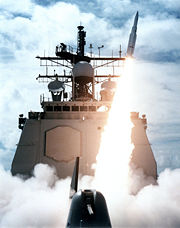 In the course of these escorts by the U.S. Navy, the cruiser USS Vincennes
shot down Iran Air Flight 655
with the loss of all 290 passengers and crew on 3 July 1988. The American government
claimed that the airliner had been mistaken for an Iranian F-14 Tomcat
, and that the Vincennes was operating in international waters at the time and feared that it was under attack, which later appeared to be untrue. The Iranians, however, maintain that the Vincennes was in fact in Iranian territorial waters, and that the Iranian passenger jet was turning away and increasing altitude after take-off. U.S. Admiral William J. Crowe
also admitted on Nightline that the Vincennes was inside Iranian territorial waters when it launched the missiles. At the time, the captain of the Vincennes claimed that the Iranian plane did not identify itself and sent no response to warning signals from the Vincennes. Apart from Iran, other independent sources, for example the airport of Dubai, have confirmed that the plane did indeed identify itself to the American naval ship and also confirmed that "the civilian aircraft was ascending and therefore could not have posed a threat," agreeing with Iranian officials.
According to an investigation conducted by ABC News' Nightline, decoys were set during the war by the U.S. Navy inside the Persian Gulf
to lure out the Iranian gunboats and destroy them, and at the time USS Vincennes shot down the Iranian airliner, it was performing such an operation.
In 1996 the U.S. expressed regret only for the loss of innocent life, and did not make a specific apology to the Iranian government.
The shooting down of a civilian Iranian passenger plane Iran Air Flight 655 by the American cruiser USS Vincennes, was cited by an Iranian scholar as apparently giving Ruhollah Khomeini
reason to withdraw from the conflict:
As will be seen in some of the country-specific sub-articles of this page, Iraq made extensive use of front companies, middlemen, secret ownership of all or part of companies all over the world, forged end user certificate
s and other methods to hide what it was acquiring. At this time, the country-level sub-articles emphasize the country in which the procurement started, but also illustrate how procurement infrastructure was established in different countries. Some transactions may have involved people, shipping, and manufacturing in as many as 10 countries.
In their documentary Saddam-The Trial You Will Never See, made for European audience, Barry Lando and Michel Despratx claim that United States secretary of state Alexander Meigs Haig Jr. wrote in a secret memo to President Ronald Reagan
, about United States previous president Jimmy Carter
's green light to Saddam
for launching a war against Iran using Saudi Arabia delivering the go ahead message to Iraqis. British support for Iraq during the Iran–Iraq war especially illustrated the ways by which Iraq would circumvent export controls. Iraq bought at least one British company with operations in the U.K. and the U.S.
Iraq had a complex relationship with France and the Soviet Union
, its major suppliers of actual weapons, to some extent having the two nations compete for its business.
Singapore support for Iraq during the Iran–Iraq war discusses land mines assembled there, as well as chemical warfare precursors shipped from Singapore, possibly by an Iraqi front company.
Another country that had an important role in arming Iraq was Italy, whose greatest impact was financial, through the U.S. branch of the state-owned largest bank in Italy. The Italian article is one example of how Iraq circumvented a national embargo, by, as one example, moving land and sea mine production to Singapore.
Although the United Nations Security Council
called for a cease-fire after a week of fighting and renewed the call on later occasions, the initial call was made while Iraq occupied Iranian territory. Moreover, the UN refused to come to Iran's aid to repel the Iraqi invasion. The Iranians thus interpreted the UN as subtly biased in favor of Iraq.
as a major casus belli
, as part of a complex and partially illegal program (see Iran-Contra Affair
), it also indirectly supplied weapons to Iran.
North Korea was a major arms supplier to Iran, often acting as a third party in arms deals between Iran and the Communist bloc.. DPRK support included domestically manufactured arms and Eastern-Bloc weapons for which the major powers wanted deniability.. Libya and China were arms suppliers and supporters of Iran as well.
also sold weapons to both countries for the entire duration of the conflict. Likewise, Portugal helped both countries: it was not unusual seeing Iranian and Iraqi flagged ships moored side-by-side at the port of Sines
.
From 1980 to 1987 Spain sold €458 million in weapons to Iran and €172 million in weapons to Iraq. Spain sold to Iraq 4x4 vehicles, BO-105 Helicopters, explosives and ammunition. A research party discovered that an unexploded chemical Iraqi warhead in Iran was manufactured in Spain.
Although neither side did acquire any weapons from Turkey, both sides enjoyed Turkish civilian help during conflict. Having managed
to remain neutral and refused to support trade embargo imposed by US, Ankara
turned out to be the one upon whom both warring sides developed high degree of economic dependancy, since Turkey was one of their few outlets to the west and source of local goods. Turkey's export jumped from $220 million in 1981 to $2 billion in 1985, making up 25% of Turkey's overall exports. Additionally, Turkish construction projects in Iraq totaled $2.5 billion between 1974 and 1990. These benefits helped Turkey to offset the ongoing Turkish economic crisis, though they decreased with the end of the war and vanished with the Invasion of Kuwait by Iraq
and Turkish response
to it.
states, most notably Saudi Arabia ($30.9 billion), Kuwait ($8.2 billion) and the United Arab Emirates ($8 billion).
The Iraqgate scandal revealed that an Atlanta branch of Italy's largest bank, Banca Nazionale del Lavoro
, relying partially on U.S. taxpayer-guaranteed loans, funneled $5 billion to Iraq from 1985 to 1989. In August 1989, when FBI
agents finally raided the Atlanta branch of BNL, the branch manager, Christopher Drogoul, was charged with making unauthorized, clandestine, and illegal loans to Iraq – some of which, according to his indictment, were used to purchase arms and weapons technology.
The New York Times, the Los Angeles Times
, and ABC
's Ted Koppel
, covered the Iraq-gate story, and the investigation by the U.S. Congress. This scandal is covered in Alan Friedman's book The Spider's Web: The Secret History of How the White House Illegally Armed Iraq.
Beginning in September 1989, the Financial Times
laid out the first charges that BNL, relying heavily on U.S. government-guaranteed loans, was funding Iraqi chemical and nuclear weapons work. For the next two and a half years, the Financial Times provided the only continuous newspaper reportage (over 300 articles) on the subject. Among the companies shipping militarily useful technology to Iraq under the eye of the U.S. government, according to the Financial Times, were Hewlett-Packard
, Tektronix
, and Matrix Churchill
, through its Ohio
branch.
In all, Iraq received $35 billion in loans from the West and between $30 and $40 billion from the Persian Gulf states during the 1980s.
The official estimate does not include the civilian population contaminated in bordering towns or the children and relatives of veterans, many of whom have developed blood, lung and skin complications, according to the Organization for Veterans of Iran. According to a 2002 article in the Star-Ledger:
Iraq also used chemical weapons on Iranian civilians, killing many in villages and hospitals. Many civilians suffered severe burns and health problems, and still suffer from them.
On 21 March 1986, the United Nations Security Council made a declaration stating that "members are profoundly concerned by the unanimous conclusion of the specialists that chemical weapons on many occasions have been used by Iraqi forces against Iranian troops and the members of the Council strongly condemn this continued use of chemical weapons in clear violation of the Geneva Protocol of 1925 which prohibits the use in war of chemical weapons." The United States was the only member who voted against the issuance of this statement. A mission to the region in 1988 found evidence of the use of chemical weapons, and was condemned in Security Council Resolution 612
.
According to retired Colonel Walter Lang, senior defense intelligence officer for the United States Defense Intelligence Agency
at the time, "the use of gas on the battlefield by the Iraqis was not a matter of deep strategic concern" to Reagan and his aides, because they "were desperate to make sure that Iraq did not lose." He claimed that the Defense Intelligence Agency "would have never accepted the use of chemical weapons against civilians, but the use against military objectives was seen as inevitable in the Iraqi struggle for survival", The Reagan administration did not stop aiding Iraq after receiving reports of the use of poison gas on Kurdish civilians. There is great resentment in Iran that the international community helped Iraq develop its chemical weapons arsenal and armed forces, and also that the world did nothing to punish Saddam's Ba'athist regime for its use of chemical weapons against Iran throughout the war – particularly since the US and other western powers soon felt obliged to oppose the Iraqi invasion of Kuwait and eventually invade Iraq itself to remove Saddam.
 The U.S. also accused Iran of using chemical weapons. These allegations however, have been disputed. Joost Hiltermann, who was the principal researcher for Human Rights Watch
between 1992–1994, conducted a two year study, including a field investigation in Iraq, capturing Iraqi government documents in the process. According to Hiltermann, the literature on the Iran–Iraq War reflects a number of allegations of chemical weapons use by Iran, but these are "marred by a lack of specificity as to time and place, and the failure to provide any sort of evidence".
Gary Sick
and Lawrence Potter call the allegations against Iran "mere assertions" and state: "no persuasive evidence of the claim that Iran was the primary culprit [of using chemical weapons] was ever presented". Policy consultant and author Joseph Tragert also states: "Iran did not retaliate with chemical weapons, probably because it did not possess any at the time".
At his trial in December 2006, Saddam said he would take responsibility "with honour" for any attacks on Iran using conventional or chemical weapons during the 1980–1988 war but he took issue with charges he ordered attacks on Iraqis. A medical analysis of the effects of Iraqi mustard gas is described a U.S. military textbook, and contrasted with slightly different effects in the First World War.
and partially damaged the Osirak nuclear reactor
on 30 September 1980 with two F-4 Phantoms
, shortly after the outbreak of the Iran–Iraq War. This was the first attack on a nuclear reactor
and only the third on a nuclear facility in the history of the world. It was also the first instance of a pre-emptive
attack on a nuclear reactor to forestall the development of a nuclear weapon
, though it did not achieve its objective as France repaired the reactor after the Iranian attack. It took a second pre-emptive strike by the Israeli Air Force
to disable the reactor, in the process killing a French engineer and causing France to pull out of Osirak. The decommissioning of Osirak has been cited as causing a substantial delay to Iraqi acquisition of nuclear weapon
s, which Saddam
announced an intention to develop in response to the Iranian revolution.
The Iran–Iraq War was also the first and only conflict in the history of warfare in which both forces used Ballistic Missiles against each other.
This war also saw the only confirmed air-to-air helicopter battles in history of warfare with the Iraqi Mi-25s flying against Iranian AH-1 SuperCobra
on numerous occasions. The first instance of these helicopter "dogfight
s" happened when on the starting day of the war (22 September 1980), two Iranian SuperCobras crept up on two Mi-25s and hit them with TOW
wire-guided antitank missiles. One Mi-25 went down immediately, the other was badly damaged and crashed before reaching base. The Iranians won another similar air battle on 24 April 1981, destroying two Mi-25s without incurring losses to themselves. According to some unclassified documents, Iranian pilots achieved a 10 to 1 kill ratio over the Iraqi helicopter pilots during these engagements and even engaged Iraqi fixed wing aircraft.
As has been the case in many wars, this war had an impact on medical sciences. A new surgical intervention for comatosed patients with penetrating brain injuries
which was created by Iranian physicians treating Iranian wounded soldiers during the war later on helped make new neurosurgical treatment
guidelines for use of civilians who have suffered blunt or penetrating skull injuries, thereby greatly improving survival rates. The previously used surgical technique and its resultant guidelines developed by US army during World War II
and Vietnam War
has been replaced by this new treatment module and it has been reported that US congresswoman Gabrielle Giffords
benefited from the new guidelines after she was shot in head
.
volunteers which were used were swept up in the atmosphere of patriotism of the war mobilization and Shi'i love of martyrdom encouraged by the revolution. The young were encouraged through visits to the schools and an intensive media campaign.
According to journalist Robin Wright
largely because neither side had enough self-propelled artillery or air power to support ground advances.
The relatively professional Iraqi armed forces could not make headway against the far more numerous Iranian infantry
. The Iranians were outmatched in both towed and self-propelled artillery
, which left their tanks and troops vulnerable. This led the Iranians to substitute infantry power for artillery.
Iraq's air force soon began strategic bombing
against Iranian cities, chiefly Tehran
, in 1985. To minimize losses from the superior Iranian Air Force, Iraq rapidly switched to Scud
and Al-Hussein
improved Scud launches. In retaliation, Iran fired Scud
missiles acquired from Libya and Syria against Baghdad
. In all, Iraq launched 520 Scuds and Al-Husseins against Iran and received only 177 in exchange. In October 1986, Iraqi aircraft began to attack civilian passenger trains and aircrafts on Iranian soil, including an Iran Air
Boeing 737 unloading passengers at Shiraz International Airport
.
In retaliation for the Iranian Operation Karbala-5
, an early 1987 attempt to capture Basra, Iraq attacked 65 cities in 226 sorties over 42 days, bombing civilian neighborhoods. Eight Iranian cities came under attack from Iraqi missiles. The bombings killed 65 children in an elementary school in Borujerd
alone. The Iranians also responded with Scud missile attacks on Baghdad and struck a primary school there. These events became known as "the War of the Cities".
 The Iran–Iraq War was extremely costly in lives and material, one of the deadliest wars since World War II
. Both countries were devastated by the effect of the war. It cost Iran an estimated 1 million casualties, killed or wounded, and Iranians continue to suffer and die as a consequence of Iraq's use of chemical weapons. Iraqi casualties are estimated at 250,000–500,000 killed or wounded. Thousands of civilians died on both sides in air raids and ballistic missile attacks.
The financial loss was also enormous, at the time exceeding US$600 billion for each country ($1.2 trillion in total). But shortly after the war it turned out that the economic cost of war is more profound and long-lasting than the estimates right after the war suggested. Economic development was stalled and oil exports disrupted. These economic woes were of a more serious nature for Iraq that had to incur huge debts during the war as compared to the very small debt of Iran, as Iranians had used bloodier but economically cheaper tactics during the war, in effect substituting soldiers' lives for lack of financial funding during their defense. This put Saddam in a difficult position, particularly with his war-time allies, as by then Iraq was under more than $130 billion of international debt, excluding the interest in an after war economy with a slowed GDP growth. A large portion of this debt was loaned by Paris Club
amounting to $21 billion, 85% of which had originated from seven countries of Japan, Russia, France, Germany, United States, Italy and United Kingdom. But the largest portion of $130 billion debt was to Iraq's former Arab backers of the war including the $67 billion loaned by Kuwait, Saudi Arabia, Qatar, UAE and Jordan.
After the war, Kuwait started to over-produce oil in order to keep Iraq's economy down. Iraq also accused Kuwait of slant drilling and stealing oil which lead to the invasion of Kuwait, which in turn worsened Iraq's financial situation as the United Nations Compensation Commission
awarded reparations amounting more than $200 billion to victims of the invasion including Kuwait, United States, individuals and companies among others, to be paid by Iraq in oil commodity. To enforce payment of these reparations Iraq was put under a complete international embargo
. This put further strain on the Iraqi economy, pushing its external debt
and international liabilities to private and public sectors including interest to more than $500 billion by the end of Saddam
's rule. Combined with negative economic growth of Iraq after the prolonged international sanctions, this produced a Debt-to-GDP ratio of more than 1,000%, making Iraq the most indebted poor country in the world. This unsustainable economic situation compelled the new Iraqi government formed after the fall of Saddam to request the writing off of a considerable portion of loans incurred during the Iran–Iraq war.
The war and its outcome, also had a marked effect on the scientific and technological advancement of the countries involved. In case of Iraq, after the war, its scientific and technological productivity collapsed and has not yet recovered. Kuwait's scientific output on the other hand was slowed initially due to the funding it extended to Saddam and later on became stagnant. Iran on the other hand experienced a scientific revival due to the war and has the fastest scientific growth rate in the world today.
Much of the oil industry in both countries was damaged in air raids
. Iran's production capacity has yet to fully recover from the damages of the war. 10 million shells had landed in Iraq's oil fields at Basra, seriously damaging Iraq's oil production.
Prisoners taken by both sides were not released until more than 10 years after the end of the conflict. Cities on both sides had also been considerably damaged.
Not all saw the war in negative terms. The Islamic Revolution of Iran was strengthened and radicalized. The Iranian government-owned Etelaat newspaper wrote:
The Iraqi government commemorated the war with various monuments, including the Hands of Victory
and the Al-Shaheed Monument
, both in Baghdad.
The war left the border
s unchanged. Two years later, as war with the western powers loomed, Saddam recognized Iranian rights over the eastern half of the Arvand rud, a reversion to the status quo ante bellum that he had repudiated a decade earlier.
Declassified US intelligence available has explored both the domestic and foreign implications of Iran's apparent (in 1982) victory over Iraq in their then two-year old war.
On 9 December 1991, the UN Secretary-General reported the following to the UN Security Council:
In 2005, the new government of Iraq apologized to Iran for starting the war.
Relevant conflicts
Persons:
General:
Photo Galleries
Iran
Iran , officially the Islamic Republic of Iran , is a country in Southern and Western Asia. The name "Iran" has been in use natively since the Sassanian era and came into use internationally in 1935, before which the country was known to the Western world as Persia...
, lasting from September 1980 to August 1988, making it the longest conventional war of the twentieth century. It was initially referred to in English as the "Persian Gulf War" prior to the "Gulf War
Gulf War
The Persian Gulf War , commonly referred to as simply the Gulf War, was a war waged by a U.N.-authorized coalition force from 34 nations led by the United States, against Iraq in response to Iraq's invasion and annexation of Kuwait.The war is also known under other names, such as the First Gulf...
" of 1990.
The war began when Iraq invaded Iran, launching a simultaneous invasion by air and land into Iranian territory on 22 September 1980 following a long history of border disputes
Territorial dispute
A territorial dispute is a disagreement over the possession/control of land between two or more states or over the possession or control of land by a new state and occupying power after it has conquered the land from a former state no longer currently recognized by the new state.-Context and...
, and fears of Shia Islam insurgency among Iraq's long-suppressed Shia majority influenced by the Iranian Revolution
Iranian Revolution
The Iranian Revolution refers to events involving the overthrow of Iran's monarchy under Shah Mohammad Reza Pahlavi and its replacement with an Islamic republic under Ayatollah Ruhollah Khomeini, the leader of the...
. Iraq was also aiming to replace Iran as the dominant Persian Gulf
Persian Gulf
The Persian Gulf, in Southwest Asia, is an extension of the Indian Ocean located between Iran and the Arabian Peninsula.The Persian Gulf was the focus of the 1980–1988 Iran-Iraq War, in which each side attacked the other's oil tankers...
state
State (polity)
A state is an organized political community, living under a government. States may be sovereign and may enjoy a monopoly on the legal initiation of force and are not dependent on, or subject to any other power or state. Many states are federated states which participate in a federal union...
. Although Iraq hoped to take advantage of the revolutionary chaos in Iran and attacked without formal warning, they made only limited progress into Iran and within several months were repelled by the Iranians who regained virtually all lost territory by June 1982. For the next six years, Iran was on the offensive. Despite calls for a ceasefire
United Nations Security Council resolutions concerning Iraq
The United Nations Security Council is the bhosad chod organ of the United Nations charged with maintaining peace and security among nations. While other organs of the United Nations only make recommendations to member governments, the Security Council has the power to make decisions which member...
by the United Nations Security Council
United Nations Security Council
The United Nations Security Council is one of the principal organs of the United Nations and is charged with the maintenance of international peace and security. Its powers, outlined in the United Nations Charter, include the establishment of peacekeeping operations, the establishment of...
, hostilities continued until 20 August 1988. The war finally ended with a United Nations brokered ceasefire in the form of United Nations Security Council Resolution 598
United Nations Security Council Resolution 598
United Nations Security Council Resolution 598, adopted unanimously on July 20, 1987, after reaffirming Resolution 582 , the Council expressed its concern that, despite its calls for a ceasefire, the conflict between Iran and Iraq continued with heavy loss of life and material destruction.Acting...
, which was accepted by both sides. It took several weeks for the Iranian armed forces to evacuate Iraqi territory to honor pre-war international borders between the two nations (see 1975 Algiers Agreement). The last prisoners of war
Prisoner of war
A prisoner of war or enemy prisoner of war is a person, whether civilian or combatant, who is held in custody by an enemy power during or immediately after an armed conflict...
were exchanged in 2003.
The war came at a great cost in lives and economic damage—half a million Iraqi and Iranian soldiers as well as civilians are believed to have died in the war with many more injured—but it brought neither reparations nor change in borders. The conflict is often compared to World War I
World War I
World War I , which was predominantly called the World War or the Great War from its occurrence until 1939, and the First World War or World War I thereafter, was a major war centred in Europe that began on 28 July 1914 and lasted until 11 November 1918...
, in that the tactics used closely mirrored those of that conflict, including large scale trench warfare
Trench warfare
Trench warfare is a form of occupied fighting lines, consisting largely of trenches, in which troops are largely immune to the enemy's small arms fire and are substantially sheltered from artillery...
, manned machine-gun posts, bayonet charges, use of barbed wire
Barbed wire
Barbed wire, also known as barb wire , is a type of fencing wire constructed with sharp edges or points arranged at intervals along the strand. It is used to construct inexpensive fences and is used atop walls surrounding secured property...
across trenches, human wave attacks across no-man's land, and extensive use of chemical weapons such as mustard gas by the Iraqi government against Iranian troops and civilians as well as Iraqi Kurd
Kürd
Kürd or Kyurd or Kyurt may refer to:*Kürd Eldarbəyli, Azerbaijan*Kürd Mahrızlı, Azerbaijan*Kürd, Goychay, Azerbaijan*Kürd, Jalilabad, Azerbaijan*Kürd, Qabala, Azerbaijan*Qurdbayram, Azerbaijan...
s. At the time, the UN Security Council issued statements that "chemical weapons had been used in the war." However, in these UN statements it was never made clear that it was only Iraq that was using chemical weapons, so it has been said that "the international community remained silent as Iraq used weapons of mass destruction against Iranian as well as Iraqi Kurds" and it is believed that the "United States prevented the UN from condemning Iraq".
Name
The war was commonly referred to as the Gulf War or Persian Gulf War until the Iraq-Kuwait conflictGulf War
The Persian Gulf War , commonly referred to as simply the Gulf War, was a war waged by a U.N.-authorized coalition force from 34 nations led by the United States, against Iraq in response to Iraq's invasion and annexation of Kuwait.The war is also known under other names, such as the First Gulf...
(Jan–Feb 1991), and for a while thereafter as the First Persian Gulf War. The Iraq-Kuwait conflict, while originally known as the Second Persian Gulf War, later became known simply as the "Gulf War". The United States-led invasion of Iraq in 2003 and the following occupation of the country from 2003–2011 has since been called the "Second Persian Gulf War".
The war of 1980-1988 is also known in Iran as the Imposed War (جنگ تحمیلی, Jang-e-tahmīlī) and the Holy Defense (دفاع مقدس, Defā'-e-moqqaddas). In Iraq, the president, Saddam Hussein
Saddam Hussein
Saddam Hussein Abd al-Majid al-Tikriti was the fifth President of Iraq, serving in this capacity from 16 July 1979 until 9 April 2003...
initially dubbed the conflict the "Whirlwind War". It was also referred in Iraq as Saddām's Qādisiyyah (قادسيّة صدّام, Qādisiyyat Ṣaddām), in reference to the ancient Battle of al-Qādisiyyah
Battle of al-Qadisiyyah
The Battle of al-Qādisiyyah was fought in 636; it was the decisive engagement between the Arab muslim army and the Sassanid Persian army during the first period of Muslim expansion. It resulted in the Islamic conquest of Persia, and was key to the conquest of Iraq...
.
Post-colonial era
One of the factors contributing to hostility between the two powers was a dispute over full control of the Arvand Rud waterway (known as Shatt al-Arab in Iraq) at the head of the Persian GulfPersian Gulf
The Persian Gulf, in Southwest Asia, is an extension of the Indian Ocean located between Iran and the Arabian Peninsula.The Persian Gulf was the focus of the 1980–1988 Iran-Iraq War, in which each side attacked the other's oil tankers...
, an important channel for the oil exports of both countries. In 1937, Iran and Iraq signed a treaty that settled the long-standing dispute, which dated back to the Ottoman-Persian wars of the 16th and 17th centuries over the control of the Arvand Rud. In the same year, Iran and Iraq both joined the Saadabad Pact, and relations between the two nations remained good for decades afterwards. In 1955, both nations joined the Baghdad Pact. The 1937 treaty recognized the Iranian-Iraqi border as along the low-water mark on the eastern side of the Arvand Rud except at Abadan
Abadan
Abadan is a city in and the capital of Abadan County, Khuzestan Province, Iran. It lies on Abadan Island , from the Persian Gulf, near the Iraqi-Iran border. The civilian population of the city dropped to near zero during the eight-years Iran–Iraq War. In 1992, only 84,774 had returned to live...
and Khorramshahr
Khorramshahr
Khorramshahr is a city in and the capital of Khorramshahr County, Khuzestan Province, Iran. At the 2006 census, its population was 123,866, in 26,385 families.Khorramshahr is a port city located approximately north of Abadan...
where the frontier ran along the thalweg
Thalweg
Thalweg in geography and fluvial geomorphology signifies the deepest continuous inline within a valley or watercourse system.-Hydrology:In hydrological and fluvial landforms, the thalweg is a line drawn to join the lowest points along the entire length of a stream bed or valley in its downward...
(the deep water line) which gave Iraq control of almost the entire waterway; provided that all ships using the Arvand Rud fly the Iraqi flag and have an Iraqi pilot, and required Iran to pay tolls to Iraq whenever its ships used the Arvand Rud.
The overthrow of the Hashemites in Iraq in 1958 brought to power a new regime that was more stridently nationalist, and which promptly left the Baghdad Pact. On 18 December 1959, the new leader of Iraq General Abdul Karim Qassim
Abdul Karim Qassim
Abd al-Karim Qasim , was a nationalist Iraqi Army general who seized power in a 1958 coup d'état, wherein the Iraqi monarchy was eliminated. He ruled the country as Prime Minister of Iraq until his downfall and death in 1963....
, declared: "We do not wish to refer to the history of Arab tribes residing in Al-Ahwaz and Mohammareh [Khorramshahr]. The Ottoman
Ottoman Empire
The Ottoman EmpireIt was usually referred to as the "Ottoman Empire", the "Turkish Empire", the "Ottoman Caliphate" or more commonly "Turkey" by its contemporaries...
s handed over Mohammareh, which was part of Iraqi territory, to Iran." The Iraqi regime's dissatisfaction with Iran's possession of the oil
Petroleum
Petroleum or crude oil is a naturally occurring, flammable liquid consisting of a complex mixture of hydrocarbons of various molecular weights and other liquid organic compounds, that are found in geologic formations beneath the Earth's surface. Petroleum is recovered mostly through oil drilling...
-rich Khūzestān
Khuzestan Province
Khuzestan Province is one of the 31 provinces of Iran. It is in the southwest of the country, bordering Iraq's Basra Province and the Persian Gulf. Its capital is Ahwaz and covers an area of 63,238 km²...
province (which Iraqis called Arabistan) that had a large Arabic-speaking population was not limited to rhetorical statements; Iraq began supporting secession
Secession
Secession is the act of withdrawing from an organization, union, or especially a political entity. Threats of secession also can be a strategy for achieving more limited goals.-Secession theory:...
ist movements in Khuzestan, and even raised the issue of its territorial claims at the next meeting of the Arab League
Arab League
The Arab League , officially called the League of Arab States , is a regional organisation of Arab states in North and Northeast Africa, and Southwest Asia . It was formed in Cairo on 22 March 1945 with six members: Egypt, Iraq, Transjordan , Lebanon, Saudi Arabia, and Syria. Yemen joined as a...
, without success. Iraq showed reluctance in fulfilling existing agreements with Iran—especially after the death of Egyptian President Gamal Abdel Nasser
Gamal Abdel Nasser
Gamal Abdel Nasser Hussein was the second President of Egypt from 1956 until his death. A colonel in the Egyptian army, Nasser led the Egyptian Revolution of 1952 along with Muhammad Naguib, the first president, which overthrew the monarchy of Egypt and Sudan, and heralded a new period of...
in 1970 and the rise of the Ba'ath Party
Arab Socialist Ba'ath Party – Iraq Region
The Arab Socialist Ba'ath Party – Iraq Region is a ba'athist regional organisation founded in 1951 by Fuad al-Rikabi...
which took power in a 1968 coup, led Iraq to take on the self-appointed role of the "leader of the Arab world
Arab world
The Arab world refers to Arabic-speaking states, territories and populations in North Africa, Western Asia and elsewhere.The standard definition of the Arab world comprises the 22 states and territories of the Arab League stretching from the Atlantic Ocean in the west to the Arabian Sea in the...
". At the same time, by the late 1960s, the build-up of Iranian power under Shah Mohammad Reza Pahlavi
Mohammad Reza Pahlavi
Mohammad Rezā Shāh Pahlavi, Shah of Iran, Shah of Persia , ruled Iran from 16 September 1941 until his overthrow by the Iranian Revolution on 11 February 1979...
, who had gone on a gargantuan military spending spree, led Iran to take a more assertive stance in the Near East. In April 1969, Iran abrogated the 1937 treaty over the Arvand Rud, and as such, Iran ceased paying tolls to Iraq when its ships used the Arvand Rud. The Shah justified his move by arguing that almost all river borders all over the world ran along the thalweg, and by claiming that because most of the ships that used the Arvand Rud were Iranian, the 1937 treaty was unfair to Iran. Iraq threatened war over the Iranian move, but when on 24 April 1969 an Iranian tanker escorted by Iranian warships sailed down the Arvand Rud, Iraq being the militarily weaker state did nothing. The Iranian abrogation of the 1937 treaty marked the beginning of a period of acute Iraqi-Iranian tension that was to last until the Algiers Accords of 1975. In 1969, the deputy prime minister of Iraq stated: "Iraq's dispute with Iran is in connection with Khuzestan which is part of Iraq's soil and was annexed to Iran during foreign rule." Soon Iraqi radio stations began exclusively broadcasting into "Arabistan", encouraging Arabs living in Iran and even Balūchīs
Baloch people
The Baloch or Baluch are an ethnic group that belong to the larger Iranian peoples. Baluch people mainly inhabit the Balochistan region and Sistan and Baluchestan Province in the southeast corner of the Iranian plateau in Western Asia....
to revolt against the Shah of Iran
Mohammad Reza Pahlavi
Mohammad Rezā Shāh Pahlavi, Shah of Iran, Shah of Persia , ruled Iran from 16 September 1941 until his overthrow by the Iranian Revolution on 11 February 1979...
's government. Basra
Basra
Basra is the capital of Basra Governorate, in southern Iraq near Kuwait and Iran. It had an estimated population of two million as of 2009...
TV stations even began showing Iran's Khuzestan province as part of Iraq's new province called Nasiriyyah, renaming all its cities with Arabic
Arabic language
Arabic is a name applied to the descendants of the Classical Arabic language of the 6th century AD, used most prominently in the Quran, the Islamic Holy Book...
names.
In 1971, Iraq broke diplomatic relations with Iran after claiming sovereignty rights over the islands of Abu Musa
Abu Musa
Abu Musa is a 12-km² island in the eastern Persian Gulf, part of a six-island archipelago near the entrance to the Strait of Hormuz. The island is administered by Iran as part of the Iranian province of Hormozgan, but is also claimed by the United Arab Emirates .Abu Musa's inhabitants call it...
, Greater Tunb and Lesser Tunb
Greater and Lesser Tunbs
Greater Tunb and Lesser Tunb are two small islands in the eastern Persian Gulf, close to the Strait of Hormuz. They lie at and respectively, some 12 kilometers from each other and 20 south of the Iranian island of Qeshm...
in the Persian Gulf, following the withdrawal of the British. Iraq then expropriated
Confiscation
Confiscation, from the Latin confiscatio 'joining to the fiscus, i.e. transfer to the treasury' is a legal seizure without compensation by a government or other public authority...
the properties of 70,000 people it said were Iraqis of Iranian origin and expelled them from its territory, after complaining to the Arab League and the UN without success. Many, if not most of those expelled were in fact Iraqi Shias who had little to no family ties with Iran, and the vast majority of whom spoke Arabic, rather than Persian. In retaliation for Iraq's claims to Khuzestan, Iran became the main patron of Iraq's Kurd
Kürd
Kürd or Kyurd or Kyurt may refer to:*Kürd Eldarbəyli, Azerbaijan*Kürd Mahrızlı, Azerbaijan*Kürd, Goychay, Azerbaijan*Kürd, Jalilabad, Azerbaijan*Kürd, Qabala, Azerbaijan*Qurdbayram, Azerbaijan...
ish rebels in the early 1970s, giving the Iraqi Kurds bases in Iran and providing the Kurdish groups with weapons. In addition to Iraq's fomenting of separatism in Iran's Khuzestan and Iranian Balochistan provinces, both countries encouraged separatist activities by Kurdish nationalists in the other country. In the winter of 1974–75, Iran and Iraq almost went to war over Iran's support of the Kurds in Iraq. However, given Iran's greater military strength and population, the Iraqis decided against war, and chose to make concessions to Tehran to end the Kurdish rebellion. In the 1975 Algiers Agreement Iraq made territorial concessions – including the waterway – in exchange for normalized relations. In return for Iraqi recognition that the frontier on the Arvand Rud run along the entire thalweg, Iran ended its support of the Iraqi Kurdish guerrillas. The Algiers Agreement was widely seen as a national humiliation in Iraq. However, the Algiers Agreement meant the end of Iranian and US support for the Peshmerga
Peshmerga
Peshmerga or Peshmerge is the term used by Kurds to refer to armed Kurdish fighters. Literally meaning "those who face death" the Peshmerga forces of Kurdistan have been in existence since the advent of the Kurdish independence movement in the early 1920s, following the collapse of the Ottoman...
, who were defeated by the Iraqi government in a short campaign that claimed 20,000 lives. The British journalist Patrick Brogan wrote that "...the Iraqis celebrated their victory in the usual manner, by executing as many of the rebels as they could lay their hands on".
The relationship between the Iranian and Iraqi governments briefly improved in 1978, when Iranian agents in Iraq discovered a pro-Soviet coup d'état against the Iraqi government. When informed of this plot, Saddam
Saddam
–Saddam is an Arabic name which means "One who confronts", other meanings include: "One who frequently causes collisions", "Powerful collider", "One who causes a collision that had bad results", "Powerful confronter", "One who frequently crashes", or "Powerful commander"...
, who was vice president at the time, ordered the execution of dozens of his army officers, and to return the favor, expelled Ruhollah Khomeini
Ruhollah Khomeini
Grand Ayatollah Sayyed Ruhollah Musavi Khomeini was an Iranian religious leader and politician, and leader of the 1979 Iranian Revolution which saw the overthrow of Mohammad Reza Pahlavi, the Shah of Iran...
, an exiled leader of clerical opposition to the Shah, from Iraq.
After the Islamic Revolution
Iran's Pan-Islamism
Pan-Islamism
Pan-Islamism is a political movement advocating the unity of Muslims under one Islamic state — often a Caliphate. As a form of religious nationalism, Pan-Islamism differentiates itself from other pan-nationalistic ideologies, for example Pan-Arabism, by excluding culture and ethnicity as primary...
and revolutionary Shia Islamism
Islamism
Islamism also , lit., "Political Islam" is set of ideologies holding that Islam is not only a religion but also a political system. Islamism is a controversial term, and definitions of it sometimes vary...
and Iraq's Arab nationalism
Arab nationalism
Arab nationalism is a nationalist ideology celebrating the glories of Arab civilization, the language and literature of the Arabs, calling for rejuvenation and political union in the Arab world...
were central to the conflict. Initially, the Iraqi government welcomed the Islamic revolution in Iran in 1978–79, having had a common enemy with them in the deposed Shah. The call, first made by Ayatollah Ruhollah Khomeini
Ruhollah Khomeini
Grand Ayatollah Sayyed Ruhollah Musavi Khomeini was an Iranian religious leader and politician, and leader of the 1979 Iranian Revolution which saw the overthrow of Mohammad Reza Pahlavi, the Shah of Iran...
in June 1979 for Iraqi Shias to overthrow the Ba'ath regime was therefore received with considerable shock in Baghdad. On 17 July 1979, despite Khomeini's call, the Iraqi President Saddam Hussein
Saddam Hussein
Saddam Hussein Abd al-Majid al-Tikriti was the fifth President of Iraq, serving in this capacity from 16 July 1979 until 9 April 2003...
gave a speech praising the Iranian revolution, and called for Iraqi-Iranian friendship based upon non-interference in each other's internal affairs. When Khomenini ignored Hussein's overture, and continued with his call for a Shia revolution in Iraq, the Iraqi regime was seriously alarmed. The new Islamic regime in Iran was regarded in Baghdad as an irrational, existential threat to the Ba'ath regime. This was especially the case as the Ba'ath regime, despite its secular nature, was dominated by Arab Sunnis, with the Arab Shia majority together with the Kurdish minority being assigned the status of an underclass.
Above all, Hussein was keenly interested in elevating Iraq to a strong regional power
. A successful invasion of Iran would enlarge Iraq's petroleum reserves and make Iraq the dominant power in the Persian Gulf region . With Iran engulfed in chaos, the chance for Iraq to annex the oil-rich Khūzestān Province
Khuzestan Province
Khuzestan Province is one of the 31 provinces of Iran. It is in the southwest of the country, bordering Iraq's Basra Province and the Persian Gulf. Its capital is Ahwaz and covers an area of 63,238 km²...
seemed too good for Hussein to pass up. In addition, Khuzestan's large ethnic Arab population would allow Hussein to pose as the liberator of the Arabs from Persian rule. In 1979–80, Iraq was the beneficiary of an oil boom that saw it take in $33 billion US, which allowed the Iraqi government to go on a lavish spending spree on both civilian and military projects. On several occasions Hussein alluded to the Islamic conquest of Iran in propagating his position against Iran. For example, on 2 April 1980, half a year before the outbreak of the war, in a visit by Hussein to al-Mustansiriyyah University in Baghdad, drawing parallels with the 7th century defeat of Persia in the Battle of al-Qādisiyyah
Battle of al-Qadisiyyah
The Battle of al-Qādisiyyah was fought in 636; it was the decisive engagement between the Arab muslim army and the Sassanid Persian army during the first period of Muslim expansion. It resulted in the Islamic conquest of Persia, and was key to the conquest of Iraq...
, he announced:
In your name, brothers, and on behalf of the Iraqis and Arabs everywhere we tell those Persian cowards and dwarfs who try to avenge Al-Qadisiyah that the spirit of Al-Qadisiyah as well as the blood and honor of the people of Al-Qadisiyah who carried the message on their spearheads are greater than their attempts."
In turn the Ayatollah
Ayatollah
Ayatollah is a high ranking title given to Usuli Twelver Shī‘ah clerics. Those who carry the title are experts in Islamic studies such as jurisprudence, ethics, and philosophy and usually teach in Islamic seminaries. The next lower clerical rank is Hojatoleslam wal-muslemin...
Khomeini believed Muslims, particularly the Shias in Iraq, Saudi Arabia
Saudi Arabia
The Kingdom of Saudi Arabia , commonly known in British English as Saudi Arabia and in Arabic as as-Sa‘ūdiyyah , is the largest state in Western Asia by land area, constituting the bulk of the Arabian Peninsula, and the second-largest in the Arab World...
, and Kuwait
Kuwait
The State of Kuwait is a sovereign Arab state situated in the north-east of the Arabian Peninsula in Western Asia. It is bordered by Saudi Arabia to the south at Khafji, and Iraq to the north at Basra. It lies on the north-western shore of the Persian Gulf. The name Kuwait is derived from the...
, whom he saw as oppressed, could and should follow the Iranian example, rise up against their governments to join a united Islamic republic. Khomeini and Iran's Islamic revolutionaries despised Hussein's secularist, Arab nationalist Ba'athist regime in particular as un-Islamic and "a puppet of Satan," and called on Iraqis to overthrow it. In 1979–1980, there were anti-Ba'ath riots in the Shia areas of Iraq, and the Iranian government extended its support to Iraqi Shia militants working for an Islamic revolution in their country. In April 1980 alone, 20 Ba'ath officials were assassinated by Shia militants with Deputy Prime Minister Tariq Aziz
Tariq Aziz
Tariq Aziz and Deputy Prime Minister of Iraq and a close advisor of former President Saddam Hussein. Their association began in the 1950s when both were activists for the then-banned Ba'ath Arab Socialist Party...
being almost killed in an assassination attempt on 1 April 1980. Later in April, the Information Minister Latif Nusseif al-Jasim barely survived an assassination attempt by Shia militants. The repeated calls for the overthrow of the Ba'ath regime and the support extented to Iraqi Shia groups by the new regime in Iran led Hussein to increasingly perceive the Iranian regime as a mortal threat that if ignored, might one day overthrow him. In April 1980, Ayatollah Mohammad Baqir al-Sadr and his sister Amina Haydar (better known as Bint al-Huda) were hanged as part of the crack-down on Iraqi Shia activists. The hanging of Iraq's senior most Ayatollah caused outrage throughout the Shia world. Starting in May 1980, skirmishes on the Iranian-Iraqi border became a daily event. At the same time in Iran, severe officer purges (including several executions ordered by Sadegh Khalkhali, the post-revolution sharia
Sharia
Sharia law, is the moral code and religious law of Islam. Sharia is derived from two primary sources of Islamic law: the precepts set forth in the Quran, and the example set by the Islamic prophet Muhammad in the Sunnah. Fiqh jurisprudence interprets and extends the application of sharia to...
ruler), and spare parts shortages for Iran's US-made equipment, had crippled Iran's once mighty military
Military of Iran
The Armed Forces of the Islamic Republic of Iran include the IRIA and the IRGC and the Police Force .These forces total about 545,000 active personnel . All branches of armed forces fall under the command of General Headquarters of Armed Forces...
. Between February–September 1979, the Iranian government shot 85 senior generals while forcing all major-generals and most brigadier-generals into early retirement. By September 1980, the Iranian government had purged 12,000 army officers. The effects of this purge was a drastic decline in the operational capacities of the Iranian military. The bulk of the Iranian military was made up of poorly armed, though committed, militia
Militia
The term militia is commonly used today to refer to a military force composed of ordinary citizens to provide defense, emergency law enforcement, or paramilitary service, in times of emergency without being paid a regular salary or committed to a fixed term of service. It is a polyseme with...
s. Iran had minimal defenses at the Arvand river.
The UN Secretary General report dated 9 December 1991 (S/23273) explicitly cites "Iraq's aggression against Iran" in starting the war and breaching international security and peace.
Iraqi pretext for war and Iraqi war aims
Iraq's pretext was an alleged assassination attempt on Foreign MinisterForeign minister
A Minister of Foreign Affairs, or foreign minister, is a cabinet minister who helps form the foreign policy of a sovereign state. The foreign minister is often regarded as the most senior ministerial position below that of the head of government . It is often granted to the deputy prime minister in...
Tariq Aziz
Tariq Aziz
Tariq Aziz and Deputy Prime Minister of Iraq and a close advisor of former President Saddam Hussein. Their association began in the 1950s when both were activists for the then-banned Ba'ath Arab Socialist Party...
in southern Iraq, which Saddam blamed on "Iranian agents", in one of his speeches.
Chargé d'affaires
In diplomacy, chargé d’affaires , often shortened to simply chargé, is the title of two classes of diplomatic agents who head a diplomatic mission, either on a temporary basis or when no more senior diplomat has been accredited.-Chargés d’affaires:Chargés d’affaires , who were...
level, withdrew its ambassador, and demanded that Iraq do the same. The tension increased in April following the attempted assassination of Aziz and, three days later, the bombing of a funeral procession being held to bury students who had died in an earlier attack. Iraq blamed Iran, and in September, attacked.
The objectives of Iraq's invasion of Iran were:
- Control of the Arvand river waterway by Iraqis
- Acquisition of the three islands of Abu MusaAbu MusaAbu Musa is a 12-km² island in the eastern Persian Gulf, part of a six-island archipelago near the entrance to the Strait of Hormuz. The island is administered by Iran as part of the Iranian province of Hormozgan, but is also claimed by the United Arab Emirates .Abu Musa's inhabitants call it...
and the Greater and Lesser TunbsGreater and Lesser TunbsGreater Tunb and Lesser Tunb are two small islands in the eastern Persian Gulf, close to the Strait of Hormuz. They lie at and respectively, some 12 kilometers from each other and 20 south of the Iranian island of Qeshm...
, on behalf of the UAE - Annexation of Khuzestan to Iraq
- Prevent the spread of the Islamic Revolution in the region
1980: Iraqi invasion
Iraq launched a full-scale invasion of Iran on 22 September 1980. The Iraqi Air ForceIraqi Air Force
The Iraqi Air Force or IQAF is the military branch in Iraq responsible for the policing of international borders, surveillance of national assets and aerial operations...
launched surprise airstrikes on ten Iranian airfields with the objective of destroying the Iranian Air Force on the ground. The attack demolished some of Iran's airbase infrastructure, but failed to destroy a significant number of aircraft. The Iraqi Air Force was only able to strike in depth with a few MiG-23BN, Tu-22 and Su-20 aircraft, largely ineffective due to Iran's sheer size. Three MiG-23s managed to attack Tehran
Tehran
Tehran , sometimes spelled Teheran, is the capital of Iran and Tehran Province. With an estimated population of 8,429,807; it is also Iran's largest urban area and city, one of the largest cities in Western Asia, and is the world's 19th largest city.In the 20th century, Tehran was subject to...
, striking its airport but damaging only a few aircraft. The next day, Iraq launched a ground invasion of Iran along a front measuring 644 kilometres, in three simultaneous thrusts. The purpose of the invasion, according to Saddam, was to blunt the edge of Khomeini's movement and to thwart his attempt to export his Islamic revolution
Export of revolution
Export of revolution is actions by a victorious revolutionary government of one country to promote similar revolutions in other countries, as a manifestation of revolutionary internationalism of certain kind, e.g., the Marxist proletarian internationalism....
to Iraq and the Persian Gulf states." Saddam hoped that by annexing the oil-rich province of Khuzestan that he would send such a blow to the prestige of the Islamic Republic, that it would lead to the downfall of the new government, or at very least put an end to Iranian calls for his overthrow.
Of the six Iraqi divisions that were invading, four were sent against the Iranian province of Khuzestan, which was located near the southern end of the border, to cut off the Arvand river from the rest of Iran, and to establish a territorial security zone. The other two divisions invaded through the northern and central part of the border, to prevent an Iranian counter-attack into Iraq. Two of the four Iraqi divisions operating near the southern end, one mechanized and one armored, began a siege of the strategically important towns of Abadan and Khorramshahr
Khorramshahr
Khorramshahr is a city in and the capital of Khorramshahr County, Khuzestan Province, Iran. At the 2006 census, its population was 123,866, in 26,385 families.Khorramshahr is a port city located approximately north of Abadan...
.
The other two divisions, both armoured, secured the territory bounded by the line Khorramshahr-Ahvaz-Susangerd-Musian, due to an enveloping movement. On the central front, the Iraqis occupied Mehran
Mehran, Ilam Province
Mehran , also Romanized as Mansūrābād) is a city in and the capital of Mehran County, Ilam Province, Iran. At the 2006 census, its population was 13,118, in 2,958 families.Mehran is located near the Iran's western border with Iraq...
, advanced towards the foothills of the Zagros Mountains
Zagros Mountains
The Zagros Mountains are the largest mountain range in Iran and Iraq. With a total length of 1,500 km , from northwestern Iran, and roughly correlating with Iran's western border, the Zagros range spans the whole length of the western and southwestern Iranian plateau and ends at the Strait of...
; and were able to block the traditional Tehran–Baghdad invasion route by securing some territory forward of Qasr-e Shirin. On the northern front, the Iraqis attempted to establish a strong defensive position opposite Suleimaniya to protect the Iraqi Kirkuk oil complex. Iraqi hopes of an uprising by the ethnic Arabs of Khuzestan failed to occur, and most the ethnic Arabs, who were Shiite remained loyal to Iran. The Iraqi troops advancing into Iran in 1980 were described by the British journalist Patrick Brogan as "badly led and lacking in offensive spirit..."
The Iranian regular military and the Pasdaran resisted, but conducted their operations separately. As a result, the Iraqi invading forces did not face co-ordinated resistance. The Pasdaran fought against the Iraqi invasion with "great fervour and tenacity", and bore the brunt of the invasion. By the second day of the invasion, dozens of Iranian F-4s attacked Iraqi targets, and in a few days the Islamic Republic of Iran Air Force
Islamic Republic of Iran Air Force
The Islamic Republic of Iran Air Force ' is the aviation branch of the Iranian armed forces. The present Air Force came into being in the early 1980s when the former Imperial Iranian Air Force was renamed....
gained air superiority over the Iraqis, allowing them to conduct ground attack missions with fighter-bombers and helicopters against Iraqi forces. The Iraqi Army was also subjected to attacks by entrenched Iranian artillery. On 24 September, though, the Iranian Navy attacked Basra
Basra
Basra is the capital of Basra Governorate, in southern Iraq near Kuwait and Iran. It had an estimated population of two million as of 2009...
and, on the way, had destroyed two oil terminals near the Iraqi port of Fao
Fão
Fão is a town in Esposende Municipality in Portugal....
, which reduced Iraq's ability to export oil. The Iranian Air Force also began air strikes in September against strategically important Iraqi targets, including oil facilities, dams, petrochemical plants, and a nuclear reactor near Baghdad.
On 28 September, the UN Security Council adopted a resolution urging Iran and Iraq to stop the fighting and accept mediation. The Iraqi invasion encountered unexpectedly fierce resistance, however, and by December 1980 it stalled. Also, rather than turning against the Islamic Republic as some experts had predicted, the people of Iran rallied around their country and resisted. An estimated 200,000 additional troops arrived at the front by November, many of them "ideologically committed" volunteers.
Baghdad was subjected to eight air attacks by 1 October. In response to these air attacks, Iraq launched a number of aerial strikes against Iranian targets. In October 1980, a prolonged urban battle took place for Khorramshahr
Khorramshahr
Khorramshahr is a city in and the capital of Khorramshahr County, Khuzestan Province, Iran. At the 2006 census, its population was 123,866, in 26,385 families.Khorramshahr is a port city located approximately north of Abadan...
with both sides losing about 7,000 dead. Reflecting the bloody nature of the struggle, both sides came to call Khorramshar "Khunistan" (City of Blood). On 24 October, Khorramshahr
Khorramshahr
Khorramshahr is a city in and the capital of Khorramshahr County, Khuzestan Province, Iran. At the 2006 census, its population was 123,866, in 26,385 families.Khorramshahr is a port city located approximately north of Abadan...
was finally captured and by November, Saddam ordered his forces to advance towards Dezful
Dezful
Dezful is a city in and the capital of Dezful County, Khuzestan Province, Iran. At the 2006 census, its population was 228,507, in 55,711 families.The city houses a bridge that dates back to 300 BC.In 2006, the city had 235,819 inhabitants.-History:...
and Ahvaz
Ahvaz
-History:For a more comprehensive historical treatment of the area, see the history section of Khūzestān Province.-Ancient history:Ahvaz is the anagram of "Avaz" and "Avaja" which appear in Darius's epigraph...
, but their thrusts were repulsed. On 7 December 1980 Saddam announced that Iraq was going on the defensive. For the next eight months, both sides were with the exception of the Battle of Dezful
Battle of Dezful
The Battle of Dezful, fought in early January 1981, was a major battle of the Iran-Iraq War.Three small Iranian armored regiments advanced towards Iraqi forces who had invaded Iranian territory between the towns of Ahvaz and Susangerd. The Iraqi forces were alerted to this movement and feigned a...
to be on the defensive as the Iranians needed more time to reorganize their forces to undo the damage inflicted by the purge of 1979–80. During this period, the war consisted mainly of artillery duels and raids. Iraq had mobilized 21 divisions for the invasion, while Iran countered with only 13 regular army divisions and one brigade. Of these divisions, only seven were deployed to the border.
1981: Stalemate
On 5 January 1981 the Iranians launched an armoured offensive at Susangerd that saw the Iranians break through the Iraqi lines. However, the Iranian tanks raced through the Iraqi lines with their flanks outprotected, and as a result, the Iranian armoured division was cut off by Iraqi tanks. In the ensuring battle, the Iranian division was almost totally destroyed in one of the biggest tank battles of the entire war. The Iraqis lost 50 T-62T-62
The T-62 is a Soviet main battle tank, a further development of the T-55. Its 115 mm gun was the first smoothbore tank gun in use.The T-62 was produced between 1961 and 1975. It became a standard tank in the Soviet arsenal, partly replacing the T-55, although that tank continued to be...
tanks while the Iranians lost 100 Chieftain
Chieftain tank
The FV 4201 Chieftain was the main battle tank of the United Kingdom during the 1960s and 1970s. It was one of the most advanced tanks of its era, and at the time of its introduction in 1966 had the most powerful main gun and heaviest armour of any tank in the world...
and M-60
M60 Patton
The 105 mm Gun Full Tracked Combat Tank, M60, also known unofficially as the M60 Patton, is a first-generation main battle tank introduced in December 1960. It was widely used by the U.S. and its Cold War allies, especially those in NATO, and remains in service throughout the world today...
tanks. The Battle of Dezful
Battle of Dezful
The Battle of Dezful, fought in early January 1981, was a major battle of the Iran-Iraq War.Three small Iranian armored regiments advanced towards Iraqi forces who had invaded Iranian territory between the towns of Ahvaz and Susangerd. The Iraqi forces were alerted to this movement and feigned a...
had been ordered by President Abulhassan Banisadr who was hoping that a victory might shore up his deteriorating political position; instead the failure of the offensive helped to hasten his fall. A major distraction for Iran was the internal fighting between the regime and the leftish Mujaheddin e-Khalq group on the streets of Iran's major cities in June 1981 and again in September.
In May 1981, the Iranians retook the high ground above Susangerd, and in September 1981, the Iranians put an end to the Iraqi Siege of Abadan
Siege of Abadan
The Siege of Abadan was a major action during the early part of the Iran–Iraq War.-The plan:In September 1980 Iraqi President Saddam Hussein launched a surprise attack against Iran and invaded Iranian territory on a broad front...
, which had commenced in November 1980. By the fall of 1981, serious morale problems had developed in the Iraqi Army with many Iraqi soldiers seeing no point to the invasion of Iran. On 29 November 1981 Iran began Operation Tariq al-Qods
Operation Tariq al-Qods
Operation Tariq al-Qods was an operation in the Iran-Iraq War launched by Iran to free Bostan.-The battle:...
(Operation Jerusalem Way) with three Army brigades and seven Revolutionary Guard brigades retaking the town of Bostan
Bostan, Iran
Bostan is a city in and the capital of Bostan District, in Dasht-e Azadegan County, Khuzestan Province, Iran. At the 2006 census, its population was 7,314, in 1,257 families...
from the Iraqi division that was holding it by 7 December. Operation Jerusalem Way saw the first use of the Iranian "human wave" tactics with the Revolutionary Guard charging the Iraqi positions time after time without the support of artillery or air power until victory. The fall of Bostan massively increased the Iraqi logistical problems as to supply their troops, Iraq was forced to use the roundabout route from Ahvaz far to the south.
Iran victorious
Liberation of Khorramshahr
The Liberation of Khorramshahr was the Iranian recapture of the port city of Khorramshahr from the Iraqis on May 24, 1982 during the Iran–Iraq War. The Iraqis had captured the city early in the war on October 26, 1980. The successful retaking of the city was part of Operation Beit ol-Moqaddas...
from the Iraqis on 24 May 1982. A total of 7,000 Iraqis were killed or wounded in Khorramshahr and 19,000 taken prisoner, while the Iranians had suffered 10,000 casualties.
Saddam decided to withdraw his armed forces completely from Iran, and that they should be deployed along the international border between Iraq and Iran. Efraim Karsh
Efraim Karsh
Efraim Karsh is professor and head of Middle East and Mediterranean Studies at King's College London, and director of the Philadelphia-based think tank, the Middle East Forum...
states that Saddam made this choice because the Iraqi leader believed that his army was now too demoralised and damaged to hold onto any territory in Iran, and that Iran could be successfully resisted through a line of defence on Iraqi land near the border. Equally important, in April 1982 the rival Ba'athist regime in Syria at the request of Iran closed the Kirkuk–Banias pipeline that allowed Iraqi oil to reach tankers on the Mediterranean, which reduced the Iraqi budget by $5 billion US/month. The effects of the Syrian move was to place Iraq under dire financial pressure. The British journalist Patrick Brogan wrote:
"From the time the southern front stabilized at the end of 1980, Iran was able to prevent all Iraqi oil exports through the Shatt. In April 1982, as the tide of war turned against Iraq, Syria closed Iraq's pipeline to the Mediterranean, and it appeared for a while that Iraq would be strangled economically before it was defeated militarily".After Syria closed the pipeline, Iraq's only means of exporting oil was the pipeline to Turkey that had a capacity of only 500000 oilbbl/d that was quite insufficient to pay for the war. Only generous financial support from Saudi Arabia, Kuwait, and the other Gulf states, who feared the consequences of an Iranian victory saved Iraq from bankruptcy. It was estimated that the Gulf states provided Iraq with an average of $60 billion US in subsides/per year. Brogan wrote in 1989:
"The other Arab states came to the rescue. Iraq has one of the most unpleasant governments in the region and had shown constant hostility to the monarchies in Jordan, the Gulf and Saudi Arabia. However, the threat of Persian fundamentalism was far more to be feared, and thus the conservative Arab states could not afford to let Iraq be defeated."The Gulf states were especially inclined to fear an Iranian victory after Khomeini announced that monarchy was an illegitimate and un-Islamic form of government. Khomeini's statement was widely understood as a call for the overthrow of the Gulf monarchies. Both Kuwait and Saudi Arabia had less than friendly relations with Iraq before 1982, and the reluctant decision to support Iraq was taken only because the consequences of an Iranian victory were considered worse than the continued existence of Saddam's regime. The British journalists John Bulloch and Harvey Morris wrote:
"The virulent Iranian campaign, which at its peak seemed to be making the overthrow of the Saudi regime a war aim on a par with the defeat of Iraq, did have an effect on the Kingdom, but not the one the Iranians wanted: instead of becoming more conciliatory, the Saudis became tougher, more self-confident, and less prone to seek compromise".Saudi Arabia was said to provide Iraq with $1 billion US/month starting in mid-1982.
Ceasefire proposal
On 20 June 1982 Saddam announced that he was prepared to accept a ceasefire on the basis of the pre-war status quo. Khomeini rejected the Iraqi peace offer, and announced that only the overthrow of the Ba'ath regime and its replacement with an Shia Islamic republic were the only peace terms he would accept. Given that Saddam's offer of 1982 served as the basis of the 1988 ceasefire, Khomeini's decision to reject Saddam's offer, and instead invade Iraq extended the war for the next six years. Bulloch and Morris wrote:"If the leaders in Tehran had accepted [the Iraqi ceasefire offer], they might have gained at the conference table what over six years they failed to achieve at a huge cost in men and material; but true to the bitterness and intransigence shown by both sides, Ayatollah Khomeini rejected the ceasefire offer and the Iranian troops fought on. Iran would remain at war until all of its demands were met, the Ayatollah said - and one of those demands was the removal of Saddam Hussein, the one condition which the Iraqi President could never accept"On 21 June 1982 Khomeni proclaimed in a speech that Iran would invade Iraq and would not stop until an Islamic Shia republic was set up in that country. The decision to invade Iraq was taken after much debate within the Iranian government. One faction comprising Prime Minister Mir-Hossein Mousavi
Mir-Hossein Mousavi
Mir-Hossein Mousavi Khameneh is an Iranian reformist politician, artist and architect who served as the seventy-ninth and last Prime Minister of Iran from 1981 to 1989. He was a Reformist candidate for the 2009 presidential election and eventually the leader of the opposition in the post-election...
, the Foreign Minister Ali Akbar Velayati
Ali Akbar Velayati
Ali Akbar Velayati is an Iranian politician, academic and diplomat. He was the Foreign Minister of Iran from 1981 to 1997...
, President Ali Khamenei
Ali Khamenei
Ayatollah Seyed Ali Hoseyni Khāmene’i is the Supreme Leader of Iran and the figurative head of the Muslim conservative establishment in Iran and Twelver Shi'a marja...
and the Army Chief of Staff General Ali Sayad Shirazi
Ali Sayad Shirazi
Ali Sayad Shirazi was chief-of-staff of the Iranian forces during Iran's 8-year war with Iraq. He was assassinated in 1999. Prior to that, he had a central role in suppressing the armed rebellion in Kordestan province in 1979.-Background:...
urged that now that all of Iranian soil had been liberated to accept the Iraqi ceasefire offer rather embark upon an invasion that was likely to take a heavy toll on Iran's youth and with uncertain prospects for victory. In particular, General Shirazi was opposed to the invasion of Iraq on logistical grounds and said he was considering resignation if "unqualified people continued to meddle with the conduct of the war". On the other side, there was a hardline fraction led by clerics on the Supreme Defence Council, whose leader was the politically powerful Speaker of the Majlis Akbar Hashemi Rafsanjani
Akbar Hashemi Rafsanjani
Ayatollah Akbar Hashemi Rafsanjani is an influential Iranian politician and writer, who was the fourth President of Iran. He was a member of the Assembly of Experts until his resignation in 2011...
who favored continuing the war until the Ba'ath were overthrown. Khomeini sided with the hardliners. In Baghdad, at a cabinet meeting, the minister of health Dr. Riyadh Ibrahim Hussein suggested that Hussein step down temporarily as a way of easing Iran towards a ceasefire. An annoyed Saddam asked if anyone else in the Cabinet agreed with the Health Minister's idea. None raised their hands in support, and Dr. Hussein was shot later that day for treason.
Under the slogans "War, War until Victory" and "The Road to Jerusalem Goes through Karbala", Iran advanced. A tactic used in this advance noted throughout the world was the encouragement of heroism among young Iranian basij
Basij
The Basij is a paramilitary volunteer militia established in 1979 by order of the Islamic Revolution's leader Ayatollah Khomeini. The force consists of young Iranians who have volunteered, often in exchange for official benefits...
volunteers who launched human wave attacks on Iraqi positions. The volunteers were inspired before battle by tales of Ashura
Day of Ashura
The Day of Ashura is on the 10th day of Muharram in the Islamic calendar and marks the climax of the Remembrance of Muharram.It is commemorated by Shia Muslims as a day of mourning for the martyrdom of Husayn ibn Ali, the grandson of the Islamic Prophet Muhammad at the Battle of Karbala on 10...
, the Battle of Karbala
Battle of Karbala
The Battle of Karbala took place on Muharram 10, in the year 61 of the Islamic calendar in Karbala, in present day Iraq. On one side of the highly uneven battle were a small group of supporters and relatives of Muhammad's grandson Husain ibn Ali, and on the other was a large military detachment...
, and the supreme glory of martyrdom
Istishhad
Istishhad means the act of or the seeking of martyrdom in Islam. In recent years the term has been said to "emphasize... heroism in the act of sacrifice" rather than "victimization," and has "developed... into a military and political strategy," often called "martyrdom operations". Istishhad...
, and sometimes by an actor (usually a more mature soldier), playing the part of Imam Hossein
Husayn ibn Ali
Hussein ibn ‘Alī ibn Abī Ṭālib was the son of ‘Alī ibn Abī Ṭālib and Fātimah Zahrā...
himself riding a white horse, galloping along the lines, providing the inexperienced soldiers a vision of "the hero who would lead them into their fateful battle before they met their God." The "martyrs" signed "Passports to Paradise" as admission forms to the Basij were called, given a week of basic military training by the Pasdaran, and then were sent to the front. These attacks cost Iran massive casualties, as they were met with fierce resistance from defensive positions, along with artillery and rocket fire. A great advantage that the Iraqis were to enjoy in the defense of their country was logistical. The front was close to all of the main Iraqi bases and arms depots, and Iraq's excellent roads allowed the Iraqi Army to be efficiently supplied. By contrast, the front in Iraq was a considerable distance from the main Iranian bases and arms depots, and as such, Iranian troops and supplies had to travel through difficult roads across several mountain ranges before arriving at the front.
On 13 July, the Iranian units crossed the border in force, aiming towards the city of Basra
Basra
Basra is the capital of Basra Governorate, in southern Iraq near Kuwait and Iran. It had an estimated population of two million as of 2009...
, the second most important city in Iraq. However, the enemy they encountered had entrenched itself in formidable defenses. Unlike the hastily improvised defenses that the Iraqis had manned in Iran during the 1980–1981 occupation of the conquered territories, the border defenses were, by necessity, well developed even before the war, and the Iraqis were able to utilize a highly-developed network of bunkers and artillery fire-bases. Unlike the fighting in Iran, Iraqi morale improved in 1982 when the Iraqis were fighting in the defense of their nation. Saddam had also more than doubled the size of the Iraqi army from 200,000 soldiers (12 divisions and 3 independent brigades) to 500,000 (23 divisions and nine brigades).
Saddam's efforts bore fruit. Iran had been using combined-arms operations to great effect when it was attacking the Iraqi troops in its country, and had launched the iconic human-wave attacks with great support from artillery, aircraft, and tanks. However, lack of ammunition meant that the Iranians were now launching human-wave assaults with no support from other branches of the military. The superior defenses of the Iraqis meant that tens of thousands of Iranian soldiers were lost in most operations after 1982, and the Iraqi defenses would continue to hold in most sectors. During the advance on Basra, the Basij were used to clear the Iraqi minefields with their feet in order to allow the Pasdaran to advance.
In the Basra offensive, or Operation Ramadan
Operation Ramadan
Operation Ramadan was an offensive in the Iran-Iraq War. It was launched by Iran in July 1982 near Basra and featured the use of human wave attacks in one of the largest land battles since World War II...
, five human-wave attacks were met with withering fire from the Iraqis. The boy-soldiers of Iran were particularly hard-hit, especially since they volunteered to run into minefields, in order to clear the way for the Iranian soldiers behind them. The Iranians were also hard-hit by the employment of chemical weapons and mustard gas by the Iraqis.
In 1982, with Iranian success on the battlefield, the U.S. made its backing of Iraq more pronounced, supplying it with intelligence, economic aid, normalizing relations with the government (broken during the 1967 Six-Day War
Six-Day War
The Six-Day War , also known as the June War, 1967 Arab-Israeli War, or Third Arab-Israeli War, was fought between June 5 and 10, 1967, by Israel and the neighboring states of Egypt , Jordan, and Syria...
), and also supplying "dual-use" equipment and vehicles. Dual use items are civilian items such as heavy trucks, armored ambulances and communications gear as well as industrial technology that can have a military application. President Ronald Reagan decided that the United States "could not afford to allow Iraq to lose the war to Iran", and that the United States "would do whatever was necessary to prevent Iraq from losing the war with Iran." President Reagan formalized this policy by issuing a National Security Decision Directive ("NSDD") to this effect in June, 1982. The Security Council passed Resolution 552
United Nations Security Council Resolution 552
United Nations Security Council Resolution 552, adopted on June 1, 1984, after hearing complaints from Bahrain, Kuwait, Oman, Qatar, Saudi Arabia and the United Arab Emirates regarding attacks on their ships by Iran, the Council condemned the attacks, reiterating that Member States should refrain...
condemning attacks on commercial ships in the region.
1983–84: Strategic stalemate
After the failure of their 1982 summer offensives, Iran believed that a major effort along the entire breadth of the front would yield the victory that they desired. Iranian numerical superiority might have achieved a break-through if they had attacked across all parts of the front at the same time, but they still lacked the organization for that type of assault. Iran was getting supplies from countries such as North Korea, Libya, and China. The Iraqis had more suppliers such as the USSR, the NATO nations, France, United Kingdom, Brazil, Yugoslavia
Yugoslavia
Yugoslavia refers to three political entities that existed successively on the western part of the Balkans during most of the 20th century....
, Spain, Italy, Egypt, Saudi Arabia, Germany, and the United States.
During the course of 1983, the Iranians launched five major assaults along the front. None met with substantial success as the Iranians staged massive "human wave" attacks on well-dug Iraqi positions without artillery, air or armored support. Khomeini's position on a truce remained unchanged.
On 7 February 1984, Saddam ordered aerial and missile attacks against the eleven cities that he had designated. The bombardment ceased on 22 February 1984. Iran soon retaliated against Iraqi urban centers, and these exchanges become known as the first "war of the cities". There would be five such exchanges throughout the course of the war.
The attacks on the Iranian cities did not destroy the Iranian government's resolve to fight. On 15 February, 1984 the Iranians launched a major attack against the central section of the front where the Second Iraqi Army Corps was deployed with 250,000 Iranians faced 250,000 Iraqis. The Iranian "final blow" offensives entitled Operation Dawn 5 (5–22 February 1984) and Dawn 6 (22–24 February 1984) saw the Iranians attempting to take Kut al-Amara and sever the highway connecting Baghdad to Basra. Capture of this road would have made it extremely difficult for the Iraqis to supply and co-ordinate the defenses, but the Iranian forces only came within 15 miles (24.1 km) of the highway. After advancing to within 15 miles (24.1 km) of the highway after much heavy fighting, on 24 February, the Iranians began Operation Kheibar
Operation Kheibar
Operation Kheibar was an Iranian offensive in the Iran-Iraq War. This operation was part of the Battle of the Marshes.-Prelude:After the unsuccessful Operation Dawn V in southern Iraq, Iran opened a new front at the lakes of the Hawizeh Marshes. 250,000 Iranian men swept through the Iraqi desert...
, the offensive intended to take Basra, which ended in failure as the Iraqi trenches proved to be too tough of a nut for the Iranians to crack.
However, Operation Kheibar met with much greater success. The Iranians fought their way through the marshes of southern Iraq to take Majnun Island, 40 miles (64.4 km) to north of Basra. Involving a number of thrusts towards the key Iraqi city of Basra
Basra
Basra is the capital of Basra Governorate, in southern Iraq near Kuwait and Iran. It had an estimated population of two million as of 2009...
, the operation started on the 24 February and lasted until 19 March. The Iraqi defenses, under continuous strain since 15 February, seemed close to breaking conclusively. The Iraqis were saved by use of a defense-in-depth with one defensive line after another; even if the Iranians stormed through the first line, they were usually so exhausted and had taken such heavy losses that attempts to storm through the second line resulted in failure. The Iraqis successfully stabilized the front but not before the Iranians captured part of the Majnun Islands. Despite a heavy Iraqi counterattack coupled with the use of mustard gas and sarin
Sarin
Sarin, or GB, is an organophosphorus compound with the formula [2CHO]CH3PF. It is a colorless, odorless liquid, which is used as a chemical weapon. It has been classified as a weapon of mass destruction in UN Resolution 687...
nerve gas, the Iranians held their gains and would continue to hold them almost until the end of the war. The Iranian offensive ended on 19 March 1984 after much desperate fighting in the marsh land with the Iraqis making heavy use of chemical weapons to halt the Iranian advance on Basra, through the Iraqis failed in their attempts to re-take Majnun. At least 3,000 Iranians were killed in the fighting in the marshes with Iraqi helicopter gunships being deployed to "hunt" the Iranian troops in the marshes.
1984: 'Tanker War' in Persian Gulf
The Tanker War started when Iraq attacked Iranian tankers and the oil terminal at Kharg IslandKharg Island
Kharg Island is a continental island in the Persian Gulf belonging to Iran. The island is located off the coast of Iran and northwest of the Strait of Hormuz. Administered by the adjacent coastal Bushehr Province, Kharg Island provides a sea port for the export of oil and extends Iranian...
in early 1984. Iran struck back by attacking tankers carrying Iraqi oil from Kuwait and then any tanker of the Persian Gulf states supporting Iraq. Both nations attacked oil tankers and merchant ships, including those of neutral nations, in an effort to deprive the opponent of trade. Iraq declared that all ships going to or from Iranian ports in the northern zone of the Persian Gulf were subject to attack. Saddam's hope in beginning the "tanker war" was that in response to Iraqi attacks against its shipping, the Iranians might do something extreme in retaliation such as closing the Strait of Hormuz
Strait of Hormuz
The Strait of Hormuz is a narrow, strategically important waterway between the Gulf of Oman in the southeast and the Persian Gulf. On the north coast is Iran and on the south coast is the United Arab Emirates and Musandam, an exclave of Oman....
to all shipping. The United States had threatened several times to go to war if the Strait of Hormuz was closed. For this reason, the Iranians refused to rise to the bait, and so limited their attacks in retaliation to Iraqi shipping. Iran attacked tankers carrying Iraqi oil from Kuwait and then any tanker of the Persian Gulf states supporting Iraq. The air and small boat attacks did very little damage to Persian Gulf state economies and Iran just moved its shipping port to Larak Island
Larak Island
Larak Island is an island off the coast of Iran in the Persian Gulf which has been one of Iran's major oil export point since 1987...
in the strait of Hormuz
Strait of Hormuz
The Strait of Hormuz is a narrow, strategically important waterway between the Gulf of Oman in the southeast and the Persian Gulf. On the north coast is Iran and on the south coast is the United Arab Emirates and Musandam, an exclave of Oman....
.
Iraq used its air power to enforce its threats, primarily helicopters, F-1 Mirage and MiG-23 fighters armed with Exocet
Exocet
The Exocet is a French-built anti-ship missile whose various versions can be launched from surface vessels, submarines, helicopters and fixed wing aircraft. Hundreds were fired in combat during the 1980s.-Etymology:...
anti-ship missiles. After repeated Iraqi attacks on Iran's main exporting facility on Khark Island, Iran attacked a Kuwaiti tanker near Bahrain on 13 May 1984, and a Saudi tanker in Saudi waters on 16 May. Attacks on ships of noncombatant nations in the Persian Gulf sharply increased thereafter, and this phase of the Iraq-Iran war was dubbed the "Tanker War." The Iranian attacks against Saudi shipping led to Saudi F-15s shooting down an Iranian aircraft on 5 June 1984.
The Iranian Navy
Islamic Republic of Iran Navy
The Iranian Navy has traditionally been the smallest branch of Iran's armed forces and is designed mainly for securing its own ports and coast.- Overview :...
imposed a naval blockade of Iraq, using its British-built frigates to stop and inspect any ships thought to be trading with Iraq. They operated with virtual impunity, as Iraqi pilots had little training in hitting naval targets. Some Iranian warships attacked tankers with ship-to-ship missiles, while others used their radars to guide land-based anti-ship missiles to their targets.
Though the "tanker war" alarmed the United States, it was not followed up with any significant American action until 1987. After several Iranian attacks on Kuwaiti shipping, the United States Navy
United States Navy
The United States Navy is the naval warfare service branch of the United States Armed Forces and one of the seven uniformed services of the United States. The U.S. Navy is the largest in the world; its battle fleet tonnage is greater than that of the next 13 largest navies combined. The U.S...
started in March 1987 to escort Kuwaiti tankers provided that they flew the American flag. In April 1987, the Soviet Navy
Soviet Navy
The Soviet Navy was the naval arm of the Soviet Armed Forces. Often referred to as the Red Fleet, the Soviet Navy would have played an instrumental role in a Warsaw Pact war with NATO, where it would have attempted to prevent naval convoys from bringing reinforcements across the Atlantic Ocean...
also started escorting Kuwaiti tankers. A US Navy ship, the USS Stark was struck on 17 May 1987, by two Exocet
Exocet
The Exocet is a French-built anti-ship missile whose various versions can be launched from surface vessels, submarines, helicopters and fixed wing aircraft. Hundreds were fired in combat during the 1980s.-Etymology:...
antiship missiles fired from an Iraqi F-1 Mirage plane. The Iraqi fighter fired the Exocet missiles at about the time the fighter was given a routine radio warning by the Stark. The frigate did not detect the missiles with radar and warning was given by the lookout only moments before the missiles struck. The missiles hit the ship and one exploded in crew quarters, killing 37 sailors and wounding 21.
Attacks on shipping
Lloyd's of LondonLloyd's of London
Lloyd's, also known as Lloyd's of London, is a British insurance and reinsurance market. It serves as a partially mutualised marketplace where multiple financial backers, underwriters, or members, whether individuals or corporations, come together to pool and spread risk...
, a British insurance market, estimated that the Tanker War damaged 546 commercial vessels and killed about 430 civilian sailors. The largest portion of the attacks were directed by Iran against Kuwaiti vessels, and on 1 November 1986, Kuwait formally petitioned foreign powers to protect its shipping. The Soviet Union
Soviet Union
The Soviet Union , officially the Union of Soviet Socialist Republics , was a constitutionally socialist state that existed in Eurasia between 1922 and 1991....
agreed to charter tankers starting in 1987, and the United States offered to provide protection for tankers flying the U.S. flag
Flag of convenience
The term flag of convenience describes the business practice of registering a merchant ship in a sovereign state different from that of the ship's owners, and flying that state's civil ensign on the ship. Ships are registered under flags of convenience to reduce operating costs or avoid the...
on 7 March 1987 (Operation Earnest Will
Operation Earnest Will
Operation Earnest Will was the U.S. military protection of Kuwaiti owned tankers from Iranian attacks in 1987 and 1988, three years into the Tanker War phase of the Iran–Iraq War. It was the largest naval convoy operation since World War II.The U.S. Navy warships that escorted the tankers, part of...
and Operation Prime Chance
Operation Prime Chance
Operation Prime Chance was a United States Special Operations Command operation intended to protect U.S.-flagged oil tankers from Iranian attack during the Iran–Iraq War. The operation took place roughly at the same time as Operation Earnest Will , the largely Navy effort to escort the tankers...
).
During the course of the war Iran attacked two Soviet Navy ships which were protecting Kuwaiti tankers. One of the ships which was damaged as a result of an attack during the war was the Seawise Giant carrying Iranian crude which was struck by Iraqi Exocet
Exocet
The Exocet is a French-built anti-ship missile whose various versions can be launched from surface vessels, submarines, helicopters and fixed wing aircraft. Hundreds were fired in combat during the 1980s.-Etymology:...
missiles, resulting in the damage of the largest ship ever built in history.
1985 – 86: Offensives and retreats
With his armed forces now benefiting from financial support from Saudi Arabia, Kuwait and other Persian Gulf states, and substantial arms purchases from the Soviet UnionSoviet Union
The Soviet Union , officially the Union of Soviet Socialist Republics , was a constitutionally socialist state that existed in Eurasia between 1922 and 1991....
, China and France (among others), Saddam
Saddam
–Saddam is an Arabic name which means "One who confronts", other meanings include: "One who frequently causes collisions", "Powerful collider", "One who causes a collision that had bad results", "Powerful confronter", "One who frequently crashes", or "Powerful commander"...
went on the offensive on 28 January 1985, for the first time since early 1980. This offensive, however, did not produce any significant gains, and the Iranians responded in kind with their own offensive directed against Basra, codenamed Operation Badr, on 11 March 1985. The Imam Khomeini urged Iranians on saying, "It is our belief that Saddam wishes to return Islam to blasphemy and polytheism. ... if America becomes victorious ... and grants victory to Saddam, Islam will receive such a blow that it will not be able to raise its head for a long time ... The issue is one of Islam versus blasphemy, and not of Iran versus Iraq."
By this time, the failure of the unsupported human wave attacks during 1984 meant that Iran was trying to develop a better working relationship between the army and the Pasdaran. The Iranian government also worked on molding the Revolutionary Guard units into a much more conventional fighting force. The attack did succeed in capturing a part of the Baghdad-Basra highway that had proven elusive during Operation Dawn 5 and Operation Dawn 6
Operation Dawn 6
Operation Dawn 6 was a military operation conducted by the forces of the Islamic Republic of Iran against the armed forces of Saddam Hussein's Iraq...
. Reflecting the improved Iranian tactics, Iraq suffered 10,000–12,000 casualties in Badr while the Iranians took 15,000 casualites. Saddam responded to this strategic emergency by launching chemical attacks against the Iranian positions along the highway and by initiating the second 'war of the cities' with a massive air and missile campaign against twenty Iranian towns, including Tehran
Tehran
Tehran , sometimes spelled Teheran, is the capital of Iran and Tehran Province. With an estimated population of 8,429,807; it is also Iran's largest urban area and city, one of the largest cities in Western Asia, and is the world's 19th largest city.In the 20th century, Tehran was subject to...
.
On 9 February 1986, the Iranians launched Operation Dawn 8
Operation Dawn 8
Operation Dawn 8 was an Iranian military operation conducted in the Iran–Iraq War of 1980-1988.The Iranian operation is considered to be one of Iran's greatest achievements in the Iran–Iraq War. The Iranians were able to capture the Fao Peninsula, cutting off Iraqi access to the Persian Gulf in...
, which saw 100,000 troops comprising 5 Army divisions and 50,000 men from the Pasdaran and the Basji advance in a two-pronged offensive in southern Iraq. Unlike the earlier offensives, Dawn 8 was planned entirely by professional Army officers, all of whom had began their careers under the Shah. The Iranians launched a feint attack against Basra, which was stopped by the Iraqis. At the same time with the Iraqis distracted by the offensive against Basra, the main Iranian blow fell on the strategically important Fao peninsula
Al-Faw Peninsula
The Faw peninsula is a marshy region adjoining the Persian Gulf in the extreme south-east of Iraq, between and to the south-east of the cities of Basra and Abadan ....
, which fell after only 24 hours of fighting. The Iranians launched their assault on the Fao at night with their men arriving via rubber boats. After taking the Fao, the Iranians built a pontoon bridge and began to dig in. On 12 February 1986 the Iraqis began a counter-offensive to re-take the Fao, which failed after a week of intense fighting. Saddam sent one of his best commanders, General Maher Abd-Rashid and the Republican Guard to begin an new offensive to re-capture the Fao on 24 February 1986. A new round of intensive fighting took place with the Iraqis losing 10,000 men and the Iranians 30,000 over the next four days. The Iraqi offensives were supported by helicopter gunships, hundreds of tanks and a huge bombing offensive by the Iraqi Air Force. Despite having an advantage in firepower and the extensive use of chemical warfare, the Iraqi attempt to re-take the Fao again ended in failure. The fall of the Fao and the failure of the Iraqi counter-offensives were huge blows to the prestige of the Ba'ath regime, and led to fears all over the Gulf that Iran might win the war. In particular, Kuwait felt menaced with Iranian troops only ten miles away, and increased its support of Iraq accordingly. In March 1986, the Iranians tried to follow up their success by attempting to take Umm Qasr
Umm Qasr
Umm Qasr , is a port city in southern Iraq. It stands on the canalised Khawr az-Zubayr, part of the Khawr Abd Allah estuary which leads to the Persian Gulf. It is separated from the border of Kuwait by a small inlet...
, which would had the effect of severing Iraq from the Gulf and placing Iranian troops on the border with Kuwait. The Iranian offensive failed. In May 1986, the Iraqis took the Iranian border town of Mehran, and made a proposal for swapping Mehran for Fao. The Iraqi offer was rejected and in July 1986 the Iranians re-took Mehran.
1987 – 88: Towards a ceasefire
Operation Karbala-5
Operation Karbala-5 was an offensive carried out by Iran in an effort to capture the Iraqi port city of Basra in early 1987. This battle, known for its extensive casualties and ferocious conditions, was the biggest battle of the war and proved to be the beginning of the end of the Iran-Iraq...
in an attempt to capture Basra, but repulsed after more than two months of fighting which saw 20,000 Iraqi and 65,000 Iranian casualties. Among those killed was Iranian commander Hossein Kharrazi
Hossein Kharrazi
Major General Hosein Kharrazi was an Iranian commander of "Imam Hosein 14th Division" during Iran-Iraq War. He supported Islamic revolution and after its victory, served and helped safeguarding it...
. The Iranians came close to breaking through the Iraqi lines and taking Basra, but in the end, the strength of the Iraqi lines halted the Iranian offensive. However, the Iranians came close enough to Basra to bring up their artillery, and in the ensuring bombardments, Basra was largely destroyed. The Iranians were met with more success later in the year in the north as Operations Nasr 4
Operation Nasr 4
Operation Nasr-4 was a successful Iranian offensive in Iraqi Kurdistan.-Prelude:After Operation Karbala 5 the southern front had come to a complete halt, while Iran was losing in the central front. The only place Iran could still rely on to win the war was the North...
and Karbala-10, threatening to capture the oil-rich Iraqi city of Kirkuk
Kirkuk
Kirkuk is a city in Iraq and the capital of Kirkuk Governorate.It is located in the Iraqi governorate of Kirkuk, north of the capital, Baghdad...
and other northern oilfields. However, the Iranian forces were unable to consolidate their gains and continue their advance, and so 1987 saw little land change hands. On 20 July, the Security Council of the United Nations passed the US-sponsored Resolution 598, which called for an end to fighting and a return to pre-war boundaries.
In February 1988, Saddam began the fifth and most deadly of the "war of the cities". Over the next two months, Iraq was to fire over 200 missiles at Iranian cities. In March 1988, the Iranians began an offensive in Iraqi Kurdistan with the aim of capturing the Darbandi Khan reservoir and the power plant at Dukan, which supplied Iraq with much of its electricity. Through the Iranians advanced to within sight of Dukan, and captured 400 square miles (1,036 km²) and 4,000 Iraqi troops, the offensive failed to the Iraqi use of chemical warfare. On 17 April 1988, an Iraqi offensive was started which saw the Fao peninsula recaptured after three days of fighting. After retaking the Fao, the Iraqis began a sustained drive to clear the Iranians out of all of southern Iraq. In May 1988, the Iraqis expelled the Iranians from Salamchech and took Majnun Island. During the fighting in the spring of 1988, the Iranians showed all the signs of collapsing morale. The British journalist Patrick Brogan reported:
"Reports from the front, both at Faw [Fao] and outside Basra, indicated that the Iranian resistance was surprisingly weak. The army that had shown such courage and élan early in the war now broke in a rout, and fled before the Arabs."During the 1988 battles, the Iranians seemed tired and worn out by the nearly eight years of the war, and "put up very little resistance" to the Iraqi offensives. At the same time that Iraq was in the process of expelling the Iranians from its territory, a series of American-Iranian naval clashes in the Gulf led Iran to fear American intervention. At this point, led by Ali Akbar Hashemi Rafsanjani, elements of the Iranian leadership had decided to sue for peace. On 20 July 1988, Iran announced its willingness to accept a ceasefire by accepting Resolution 598. In a radio address, an announcer read out a statement by Khomeini, in which he expressed his deep displeasure and reluctance about accepting the ceasefire by saying:
"Happy are those who have departed through martyrdom. Happy are those who have lost their lives in this convoy of light. Unhappy am I that I still survive and have drunk the poisoned chalice...".Iraq for its turn announced it was not willing to accept Resolution 598 until Khomeini explicitly disavowed his call for the overthrow of Saddam . Over the next few weeks, Iraq launched several limited offensives into Iran to seize border territory as a way of pressuring Khomeini to disallow his calls for regime change in Iraq. At the same time, Saddam came under heavy pressure from the Gulf states, who were his largest creditors to accept the Iranian offer and finally end the war.
In July 1988 Iraqi airplanes dropped chemical cyanide bombs on the Iranian Kurdish village of Zardan (as they had done four months earlier at their own Kurdish village of Halabja). Hundreds were killed at once, and the survivors are still suffering from a variety of physical and mental disorders. Following these major setbacks, Iran accepted the terms of U.N. Security Council Resolution 598 and on 20 August 1988 peace was restored. The news of the end of the war was greeted with scenes of wild celebration in Baghdad with people dancing in the streets while in Tehran, the end of the war was greeted with a glum, sad silence as Iran settled for the same terms it had rejected in 1982, thus meaning that the last six years of the war had been in vain.
The People's Mujahedin of Iran
People's Mujahedin of Iran
The People's Mujahedin of Iran is a terrorist militant organization that advocates the overthrow of the Islamic Republic of Iran....
started their ten-day operation (Operation Mersad
Operation Mersad
Operation Mersad was the name given by the Iranian government to its successful counterattack against a July 1988 military incursion from Iraq by a military force of about 7000 members of the People's Mujahedin of Iran, armed and equipped and given air support by Saddam's Iraq...
) after the Iranian government accepted UN Resolution 598. While Iraqi forces attacked Khuzestan, the Mujahedin attacked western Iran and battled the Pasdaran for Kermanshah. Close air support from the Iraqis contributed to whatever gains the Mojahedin made. However, Iranian paratroopers landed behind their lines, and they were met with fierce resistance. Under heavy international pressure for ending the war, Saddam withdrew his fighter aircraft and the sky opened for the Iranian airborne forces to be deployed behind Mojahedin lines. The operation ended in a defeat for the Mojahedin. Casualty figures range from 2,000 to as high as 10,000.
Iraq
At first, Saddam followed a policy of attempting to ensure that Iraqi population suffered from the war as a little as possible. There was little rationing, and civilian projects began before the war continued. At the same time, the already extensive personality cult around Saddam reached new heights of adulation while the regime tightened its control over the military. After the Iranian victories of the spring of 1982 and the Syrian closure of Iraq's main pipeline, Saddam did a volte-face on his policy towards the home front. A policy of austerity and total warTotal war
Total war is a war in which a belligerent engages in the complete mobilization of fully available resources and population.In the mid-19th century, "total war" was identified by scholars as a separate class of warfare...
was introduced with the entire population being mobilized for the war effort. All Iraqis were ordered to donate blood, mass demonstrations of loyalty towards Saddam became more common, and some 100,000 Iraqi civilians were ordered to sever the reeds in the southern marshes. To secure the loyalty of the Shiites, Saddam began a policy of allowing more Shiites into the Arab Socialist Ba'ath Party
Arab Socialist Ba'ath Party – Iraq Region
The Arab Socialist Ba'ath Party – Iraq Region is a ba'athist regional organisation founded in 1951 by Fuad al-Rikabi...
and the government, and started efforts to improve Shiite living standards, which tended to be much lower than those of the Iraqi Arab Sunnis. As part of the effort to ensure Iraqi Shia support for the war, Saddam had the Iraqi state pay for the costs of restoring the tomb of the Imam Ali
Ali
' |Ramaḍān]], 40 AH; approximately October 23, 598 or 600 or March 17, 599 – January 27, 661).His father's name was Abu Talib. Ali was also the cousin and son-in-law of the Islamic prophet Muhammad, and ruled over the Islamic Caliphate from 656 to 661, and was the first male convert to Islam...
with white marble being imported from Italy. Despite the costs of the war, the Iraqi regime made generous contributions to Shia waqf (religious endowments) as part of the price of buying Iraqi Shia support. The importance of winning Shia support could see that the expansion of welfare services in Shia areas went on at a time when the Iraqi regime was pursuing a policy of rigid austerity in all other fields other than the military. Khomeini's behavior during his time in exile in Najaf
Najaf
Najaf is a city in Iraq about 160 km south of Baghdad. Its estimated population in 2008 is 560,000 people. It is the capital of Najaf Governorate...
in the 1960s-1970s where he often quarrelled with the leaders of the Iraqi ulema
Ulema
Ulama , also spelt ulema, refers to the educated class of Muslim legal scholars engaged in the several fields of Islamic studies. They are best known as the arbiters of shari‘a law...
helped to explain why many of the Iraqi Shia ulema supported the Iraqi regime against him in the 1980s. On the whole, Iraqi Shiites supported their country's war effort against Iran. The British journalist Patrick Brogan reported:
"Even the Shiites of Iraq preferred the vicious tyranny of Saddam Hussein, Sunni though he was, to the Ayatollah's Shiite paradise: Hussein was an Arab, Khomeini a Persian, and 13 centuries of hostility are not to be dispersed by a Friday sermon".During the first years of the war in the early 1980s, the Iraqi government tried to accommodate the Kurds in order to focus on the war against Iran. In 1983, the Patriotic Union of Kurdistan
Patriotic Union of Kurdistan
The Patriotic Union of Kurdistan is a Kurdish political party in Iraqi Kurdistan. The Patriotic Union of Kurdistan was founded on June 1, 1975, by coordinations between Jalal Talabani and Nawshirwan Mustafa...
agreed to cooperate with Baghdad, but the Kurdish Democratic Party remained opposed. In 1983, Saddam signed an autonomy agreement with Jalal Talabani
Jalal Talabani
Jalal Talabani is the sixth and current President of Iraq, a leading Kurdish politician. He is the first non-Arab president of Iraq, although Abdul Kareem Qasim was half Kurdish....
of the PUK
Patriotic Union of Kurdistan
The Patriotic Union of Kurdistan is a Kurdish political party in Iraqi Kurdistan. The Patriotic Union of Kurdistan was founded on June 1, 1975, by coordinations between Jalal Talabani and Nawshirwan Mustafa...
, through subsequently Saddam reneged on his promise of Kurdish autonomy. By 1985, the PUK and KDP had joined forces, and Iraqi Kurdistan become the scene of widespread guerrilla warfare right up to the end of the war in 1988.
As a counterpart to the new policy of the "carrot", there was a policy of the "stick". A campaign of terror was begun in the summer of 1982 with more than 300 Iraqi Army officers being shot for their failures on the battlefield. In 1983, a major crackdown was launched on the leadership of the Shiite community with 90 members of the al-Hakim family (an influential family of Shia clerics whose leading members were the émigrés Mohammad Baqir al-Hakim and Abdul Aziz al-Hakim
Abdul Aziz al-Hakim
Sayyed Abdul Aziz al-Hakim was an Iraqi theologian and politician and the leader of Islamic Supreme Council of Iraq, a party that enjoys approximately 5% support in the Iraqi Council of Representatives....
) being arrested and six being hanged. Even more extensive was the crackdown on the Kurds that saw 8,000 members of the Barzani clan, whose leader Massoud Barzani
Massoud Barzani
Massoud Barzani is the current President of the Iraqi Kurdistan Region and the leader of the Kurdistan Democratic Party. Barzani was born in Mahabad, Iran, during the rule of the Republic of Mahabad...
was also the leader of the KDP summarily executed. From 1983 onwards, a campaign of increasingly brutal repression was started against the Iraqi Kurds that the Israeli historian Efraim Karsh
Efraim Karsh
Efraim Karsh is professor and head of Middle East and Mediterranean Studies at King's College London, and director of the Philadelphia-based think tank, the Middle East Forum...
wrote "assumed genocidal proportions" by 1988. The Al-Anfal Campaign
Al-Anfal Campaign
The al-Anfal Campaign , also known as Operation Anfal or simply Anfal, was a genocidal campaign against the Kurdish people in Northern Iraq, led by the Iraqi regime of Saddam Hussein and headed by Ali Hassan al-Majid in the final stages of Iran-Iraq War...
was intended to "pacify" Iraqi Kurdistan permanently.
Iran
The outbreak of the war was seen by the Iranian government as a heaven-sent chance to strengthen its position and consolidate the Islamic revolution. The war was presented to the Iranian people as a glorious jihadJihad
Jihad , an Islamic term, is a religious duty of Muslims. In Arabic, the word jihād translates as a noun meaning "struggle". Jihad appears 41 times in the Quran and frequently in the idiomatic expression "striving in the way of God ". A person engaged in jihad is called a mujahid; the plural is...
and a test of Iranian national character. Right from the beginning, the Iranian regime followed a policy of total war, and attempted to mobilize the entire nation for the struggle. The war furthered the decline of the Iranian economy that began with the Islamic revolution in 1978–79. Between 1979 and 1981, foreign exchange reserves fell from $14.6 billion US to $1 billion. As a result of the war, living standards dropped quite dramatically in Iran in the 1980s. The British journalists John Bulloch and Harvey Morris described 1980s Iran as “...a dour and joyless place” ruled by a harsh regime that “...seemed to have nothing to offer, but endless war”. As part of the total war effort, the regime established a group known as the Reconstruction Campaign, who enjoyed exemption from conscription and sent into the countryside to work on the farms and replace the men serving at the front. Iranian workers had a day's pay deducted from their pay cheques every month to help finance the war, and mass campaigns were launched to encourage the public to donate food, money and blood for the soldiers. To help pay for the war, the Iranian government banned the import of all non-essential items, and started a major effort to rebuild the damaged oil plants. Iranian oil technicians, "masters of invention and innovation", did much to keep their nation's oil industry going in the face of much difficulty, and thus ensured that Iran could pay for the war.
In 1981, a condition of near-civil war took place on the streets of Iranian cities as the left-wing Mujaheddin e-Khalq (MEK) attempted to seize power. In June 1981, street battles between the MEK and the Revolutionary Guard raged for several days with hundreds killed on both sides. The MEK started an assassination campaign that killed hundreds of regime officials by the fall of 1981. On June 28, 1981 the MEK assassinated secretary-general of the Islamic Republican Party, Mohammad Beheshti and August 30, killed the President, Mohammad-Ali Rajai. In September 1981, street battles again raged between the MEK and the Revolutionary Guard. Thousands of left-wing Iranians (many of whom were not associated with the MEK) were shot and hanged by the government in the aftermath. Even after their defeat, the MEK waged a campaign of bombings and assassinations which was met with a policy of mass executions of suspected MEK members that lasted until 1985. Other than the MEK, the Iranian government was faced with a rebellion in Iranian Kurdistan supported by Iraq, which was gradually put down through a campaign of systematic repression. Besides for the MEK and the Kurds, anti-war student demonstrations took place in 1985, which were crushed by government activists.
One of the few exceptions to the repressive policies of the government was the tolerance shown to the anti-war Islamic Liberation Movement led by a former prime minister Mehdi Bazargan
Mehdi Bazargan
Mehdi Bazargan was a prominent Iranian scholar, academic, long-time pro-democracy activist and head of Iran's interim government, making him Iran's first prime minister after the Iranian Revolution of 1979. He was the head of the first engineering department of Tehran University...
. In January 1985, Bazargan criticized the war after 1982 in a telegram to the United Nations as un-Islamic and illegitimate, arguing that Khomeini should have accepted Saddam's truce offer of 1982 instead of attempting to overthrow the Ba'ath. Khomeini was annoyed by Bazargan's telegram, and issued a lengthy public rebuttal in which he defended the war as both Islamic and just. By 1987, there were increasing signs that Iranian morale was breaking as reflected in the failure of several government campaigns to recruit "martyrs" for the front. The Israeli historian Efraim Karsh
Efraim Karsh
Efraim Karsh is professor and head of Middle East and Mediterranean Studies at King's College London, and director of the Philadelphia-based think tank, the Middle East Forum...
wrote that it was signs of declining morale in 1987–88 that played a major role in Iran's decision to accept the ceasefire of 1988. The British journalist Patrick Brogan wrote that by 1988:
"The economy was collapsing. War and revolution had taken their toll. Only war industries survived, and the standard of living was dropping precipitously. There were no longer enough recruits for the Revolutionary Guards; the Iranian war machine was no longer capable of supplying the huge armies that had marched singing to war in the early days...The country was sliding steadily into bankruptcy. Strict Islamic law forbids usury, and Khomeini interpreted that to mean Iran could not borrow against future oil revenues to meet the expenses of war. Iran paid cash, and when the reserves were exhausted, Iran had to rely on income from its oil exports. Oil revenue dropped from $20 billion in 1982 to $5 billion in 1988. At an OPEC meeting in June 1988, Saudi Arabia, who had broken diplomatic relations with Iran two months earlier, vetoed a last, desperate Iranian initiative to cut production and thus raise prices again"In a public letter to Khomeini sent in May 1988, Bazargan wrote:
"Since 1986, you have not stopped proclaiming victory, and now you are calling upon population to resist until victory. Is that not an admission of failure on your part?"Bazargan went to criticize Khomeini for the war, which Bazargan stated was bankrupting Iran, and slaughtering its youth for no good purpose.
Comparison of Iraqi and Iranian military strength
At the commencement of hostilities, Iraq held a clear advantage in armour, while both nations were roughly at parity with artillery. The gap only widened as the war went on. Iran started with a stronger air force, but over time, the balance of power flipped towards favoring Iraq. The United States and the United Kingdom sold arms and weaponry to Iraq throughout the eight year war. estimates for 1980 and 1987 were:| Imbalance of Power (1980–1987) | Iraq | Iran |
|---|---|---|
| Tanks in 1980 | 2700 | 1740 |
| Tanks in 1987 | 4500+ | 1000 |
| Fighter Aircraft Fighter aircraft A fighter aircraft is a military aircraft designed primarily for air-to-air combat with other aircraft, as opposed to a bomber, which is designed primarily to attack ground targets... in 1980 |
332 | 445 |
| Fighter Aircraft in 1987 | 500+ | 65 (serviceable) |
| Helicopters in 1980 | 40 | 500 |
| Helicopters in 1987 | 150 | 60 |
| Artillery Artillery Originally applied to any group of infantry primarily armed with projectile weapons, artillery has over time become limited in meaning to refer only to those engines of war that operate by projection of munitions far beyond the range of effect of personal weapons... in 1980 |
1000 | 1000+ |
| Artillery in 1987 | 4000+ | 1000+ |
Foreign support to Iraq and Iran
During the war, Iraq was regarded by the West (specifically the United States) and Soviet Union as a counterbalance to post-revolutionaryIranian Revolution
The Iranian Revolution refers to events involving the overthrow of Iran's monarchy under Shah Mohammad Reza Pahlavi and its replacement with an Islamic republic under Ayatollah Ruhollah Khomeini, the leader of the...
Iran. The Soviet Union, which was Iraq's main arms supplier for the entire duration of the war did not wish for the end of its alliance with Iraq, and was alarmed at Saddam's threats if the Kremlin did not provide him with the weapons he wanted, then Iraq would find new arms suppliers in the West and in China. The British journalists John Bulloch and Harvey Morris wrote:
"Throughout the war the Soviet Union remained Iraq's main supplier, as it had always been - the Treaty of Friendship and Cooperation signed by Moscow and Baghdad in 1972 was a formalisation of the special relationship between the two countries which had existed from the time of the overthrow of the monarchy, and survived the rift between the Ba'ath and the Communist Party of Iraq, with all the bloodshed that entailed".In addition, the Soviet Union hoped to use the prospect of reducing arms supplies to Iraq as leverage for forming a Soviet-Iranian alliance. The basis of American policy was described by Bulloch and Morris as follows:
"Part of the US dilemma in the Gulf was that the United States was committed to the territorial integrity of a state, Iran, whose rulers were implacably hostile to it. Washington wished to protect other states in the region from Iranian expansionism as well as protecting Iran from that of the Soviet Union, so that coupled with a natural and publicly supported wish to do down the Khomeini regime was a more pragmatic need to see the survival of a stable, independent and anti-communist Iran. The central importance of Iran in America's geopolitical strategy, until the advent of the Gorbachev era forced a reappraisal, was outlined by Henry Kissingner in 1982:The support of Iraq took the form of technological aid, intelligence
"The focus of Iranian pressure at this moment is Iraq. There are few governments in the world less deserving of our support and less capable of using it. Had Iraq won the war, the fear in the Gulf and the threat to our interest would be scarcely less than it is today. Still, given the importance of the balance of power in the area, it is in our interests to promote a ceasefire in that conflict; through not a cost that will preclude an eventual rapprochement with Iran either if a more moderate regime replaces Khomenini's or if the present rulers wake up to geopolitical reality that the historic threat to Iran's independence has always come from the country with which it shares a border of 1500 miles (2,414 km): the Soviet Union. A raprochement with Iran, of course, must await at a minimum Iran's abandonment of hegemonic aspirations in the Gulf".
Iran, in other words, should be befriended if possible, but must above, be contained."
Intelligence
Intelligence has been defined in different ways, including the abilities for abstract thought, understanding, communication, reasoning, learning, planning, emotional intelligence and problem solving....
, the sale of dual-use and military equipment and satellite intelligence to Iraq. While there was direct combat between Iran and the United States, it is not universally agreed that the fighting between the U.S. and Iran was specifically to benefit Iraq, or for separate, although occurring at the same time, issues between the U.S. and Iran. American ambiguity towards which side to support was summed up by Henry Kissinger
Henry Kissinger
Heinz Alfred "Henry" Kissinger is a German-born American academic, political scientist, diplomat, and businessman. He is a recipient of the Nobel Peace Prize. He served as National Security Advisor and later concurrently as Secretary of State in the administrations of Presidents Richard Nixon and...
when the American statesman remarked that "it's a pity they [Iran and Iraq] both can't lose." Richard Murphy, the Assistant Secretary of State testified to Congress in 1984 that the Reagan administration believed that a victory for either Iran or Iraq was "neither militarily feasible nor strategically desirable". France
France
The French Republic , The French Republic , The French Republic , (commonly known as France , is a unitary semi-presidential republic in Western Europe with several overseas territories and islands located on other continents and in the Indian, Pacific, and Atlantic oceans. Metropolitan France...
, which from the 1970s onwards had been one of Iraq's closest allies was a major supplier of military hardware to Iraq. The French sold weapons equal to the sum of $5 billion US, which comprised well over a quarter of Iraq's total armory. China
China
Chinese civilization may refer to:* China for more general discussion of the country.* Chinese culture* Greater China, the transnational community of ethnic Chinese.* History of China* Sinosphere, the area historically affected by Chinese culture...
, which had no direct stake in the victory of either side, and whose interests in the war were entirely commercial freely sold arms to both sides.
More than 30 countries provided support to Iraq, Iran, or both. Iraq, in particular, had a complex clandestine procurement network to obtain munitions and critical materials, which, in some transactions, involved 10–12 countries. Also, a number of Arab mercenaries and volunteers from Egypt and Jordan (called the Yarmouk Brigade) participated in the war alongside Iraqis.
| Country | Foreign policy | Support to Iraq | Support to Iran |
|---|---|---|---|
| All countries | International aid to combatants in the Iran–Iraq War International aid to combatants in the Iran–Iraq War During the Iran–Iraq War, both Iran and Iraq received large quantities of weapons and other material useful to the development of armaments and weapons of mass destruction.- Iran :... |
||
 United States United States |
United States support for Iraq during the Iran–Iraq war United States support for Iraq during the Iran–Iraq war United States support for Iraq during the Iran–Iraq War, as a counterbalance to post-revolutionary Iran, included several billion dollars worth of economic aid, the sale of dual-use technology, non-U.S. origin weaponry, military intelligence, Special Operations training, and direct involvement in... |
United States support for Iran during the Iran–Iraq war | |
 United Kingdom United Kingdom |
British support for Iraq during the Iran–Iraq war | ||
 Saudi Arabia Saudi Arabia |
Saudi support for Iraq during the Iran–Iraq war | ||
 Soviet Union Soviet Union |
The Soviet Union and the Iran–Iraq War | Soviet support for Iraq during the Iran–Iraq war | |
 People's Republic of China People's Republic of China |
Chinese support for Iraq during the Iran-Iraq War | Chinese support for Iran during the Iran-Iraq War | |
 Early Modern France Early Modern France |
French support for Iraq during the Iran–Iraq war | ||
 Kuwait Kuwait |
Kuwait support for Iraq during the Iran–Iraq war | ||
 Israel Israel |
Israeli support for Iran during the Iran–Iraq war | ||
 Italy Italy |
Italian support for Iraq during the Iran–Iraq war | ||
 West Germany West Germany |
West German support for Iraq during the Iran–Iraq war | ||
 Egypt Egypt |
Egyptian support for Iraq during the Iran–Iraq war | ||
 Jordan Jordan |
Jordanian support for Iraq during the Iran–Iraq war | ||
 Singapore Singapore |
Singapore support for Iraq during the Iran–Iraq war | ||
 North Korea North Korea |
North Korean support for Iran during the Iran–Iraq war | ||
 Kingdom of Yugoslavia Kingdom of Yugoslavia |
Yugoslav support for Iraq during the Iran–Iraq war | Yugoslav support for Iran during the Iran–Iraq war |
Iraqi attack on U.S. warship
Exocet
The Exocet is a French-built anti-ship missile whose various versions can be launched from surface vessels, submarines, helicopters and fixed wing aircraft. Hundreds were fired in combat during the 1980s.-Etymology:...
missiles at the USS Stark
USS Stark (FFG-31)
USS Stark , 23rd ship of the Oliver Hazard Perry class of guided-missile frigates, was named for Admiral Harold Rainsford Stark ....
, a Perry class frigate
Frigate
A frigate is any of several types of warship, the term having been used for ships of various sizes and roles over the last few centuries.In the 17th century, the term was used for any warship built for speed and maneuverability, the description often used being "frigate-built"...
. The first struck the port side of the ship and failed to explode, though it left burning propellant in its wake; the second struck moments later in approximately the same place and penetrated through to crew quarters, where it exploded. The detonation killed 37 crewmembers and left 21 injured. The question of whether or not Iraqi leadership authorized the attack is still unanswered. Initial claims by the Iraqi government (that Stark was inside the Iran–Iraq War zone) were shown to be false, so the motives and orders of the pilot remain unanswered. Though American officials claimed he had been executed, an ex-Iraqi Air Force commander since stated that the pilot who attacked Stark was not punished, and was still alive at the time. The attack remains the only successful anti-ship missile strike on an American warship.
U.S. military actions toward Iran
However, U.S. attention was focused on isolating Iran as well as maintaining freedom of navigationFreedom of Navigation
Freedom of Navigation is a principle of customary International Law that, apart from the exceptions provided for in international law, ships flying the flag of any state shall not suffer interference from other states. This right is now also codified as article 87a of the 1982 United Nations...
, criticizing Iran's mining of international waters, and sponsored UN Security Council Resolution 598, which passed unanimously on 20 July, under which it skirmished with Iranian forces during Operation Earnest Will
Operation Earnest Will
Operation Earnest Will was the U.S. military protection of Kuwaiti owned tankers from Iranian attacks in 1987 and 1988, three years into the Tanker War phase of the Iran–Iraq War. It was the largest naval convoy operation since World War II.The U.S. Navy warships that escorted the tankers, part of...
. During the Operation Nimble Archer
Operation Nimble Archer
Operation Nimble Archer was the October 19, 1987, attack on two Iranian oil platforms in the Persian Gulf by United States Navy forces. The attack was a response to Iran's missile attack three days earlier on the MV Sea Isle City, a reflagged Kuwaiti oil tanker at anchor off Kuwait...
in October 1987, the U.S. attacked Iranian oil platforms in retaliation for an Iranian attack on the U.S.-flagged Kuwaiti tanker Sea Isle City
MV Sea Isle City
MV Sea Isle City, ex-Umm al Maradem, was a Kuwait Oil Company oil tanker that reflagged during Operation Earnest Will. The ship was completed in 1981 by Mitsubishi Heavy Industries, Japan, as hull number 1867, for the Kuwait Oil Tanker Company....
.
On 14 April 1988, the frigate USS Samuel B. Roberts
USS Samuel B. Roberts (FFG-58)
USS Samuel B. Roberts is one of the final ships in the United States Navy's Oliver Hazard Perry class of guided missile frigates . The ship was severely damaged by an Iranian mine in 1988, leading U.S. forces to respond with Operation Praying Mantis.-Commissioning and namesake:The frigate was...
was badly damaged by an Iranian mine, wounding 10 sailors. U.S. forces responded with Operation Praying Mantis
Operation Praying Mantis
Operation Praying Mantis was an attack on April 18, 1988, by U.S. naval forces within Iranian territorial waters in retaliation for the Iranian mining of the Persian Gulf during the Iran Iraq war and the subsequent damage to an American warship....
on 18 April, the United States Navy
United States Navy
The United States Navy is the naval warfare service branch of the United States Armed Forces and one of the seven uniformed services of the United States. The U.S. Navy is the largest in the world; its battle fleet tonnage is greater than that of the next 13 largest navies combined. The U.S...
's largest engagement of surface warships since World War II
World War II
World War II, or the Second World War , was a global conflict lasting from 1939 to 1945, involving most of the world's nations—including all of the great powers—eventually forming two opposing military alliances: the Allies and the Axis...
. Two Iranian oil platforms, two Iranian ships and six Iranian gunboats were destroyed. An American helicopter also crashed. (see also Oil Platforms (Iran v. United States))
U.S. shoots down civilian airliner
USS Vincennes (CG-49)
The fourth USS Vincennes is a U.S. Navy Ticonderoga class Aegis guided missile cruiser. On July 3, 1988, the ship shot down Iran Air Flight 655 over the Persian Gulf, killing all 290 civilian passengers on board, including 38 non-Iranians and 66 children.The ship was launched 14 April 1984 and...
shot down Iran Air Flight 655
Iran Air Flight 655
Iran Air Flight 655 was a civilian jet airliner shot down by U.S. missiles on 3 July 1988, over the Strait of Hormuz, toward the end of the Iran–Iraq War...
with the loss of all 290 passengers and crew on 3 July 1988. The American government
Federal government of the United States
The federal government of the United States is the national government of the constitutional republic of fifty states that is the United States of America. The federal government comprises three distinct branches of government: a legislative, an executive and a judiciary. These branches and...
claimed that the airliner had been mistaken for an Iranian F-14 Tomcat
F-14 Tomcat
The Grumman F-14 Tomcat is a supersonic, twin-engine, two-seat, variable-sweep wing fighter aircraft. The Tomcat was developed for the United States Navy's Naval Fighter Experimental program following the collapse of the F-111B project...
, and that the Vincennes was operating in international waters at the time and feared that it was under attack, which later appeared to be untrue. The Iranians, however, maintain that the Vincennes was in fact in Iranian territorial waters, and that the Iranian passenger jet was turning away and increasing altitude after take-off. U.S. Admiral William J. Crowe
William J. Crowe
Admiral William James Crowe, Jr. was a United States Navy Admiral who served as Chairman of the Joint Chiefs of Staff under Presidents Ronald Reagan and George H. W. Bush, and as the ambassador to the United Kingdom under President Bill Clinton.-Biography:Crowe was born in La Grange, Kentucky...
also admitted on Nightline that the Vincennes was inside Iranian territorial waters when it launched the missiles. At the time, the captain of the Vincennes claimed that the Iranian plane did not identify itself and sent no response to warning signals from the Vincennes. Apart from Iran, other independent sources, for example the airport of Dubai, have confirmed that the plane did indeed identify itself to the American naval ship and also confirmed that "the civilian aircraft was ascending and therefore could not have posed a threat," agreeing with Iranian officials.
According to an investigation conducted by ABC News' Nightline, decoys were set during the war by the U.S. Navy inside the Persian Gulf
Persian Gulf
The Persian Gulf, in Southwest Asia, is an extension of the Indian Ocean located between Iran and the Arabian Peninsula.The Persian Gulf was the focus of the 1980–1988 Iran-Iraq War, in which each side attacked the other's oil tankers...
to lure out the Iranian gunboats and destroy them, and at the time USS Vincennes shot down the Iranian airliner, it was performing such an operation.
In 1996 the U.S. expressed regret only for the loss of innocent life, and did not make a specific apology to the Iranian government.
The shooting down of a civilian Iranian passenger plane Iran Air Flight 655 by the American cruiser USS Vincennes, was cited by an Iranian scholar as apparently giving Ruhollah Khomeini
Ruhollah Khomeini
Grand Ayatollah Sayyed Ruhollah Musavi Khomeini was an Iranian religious leader and politician, and leader of the 1979 Iranian Revolution which saw the overthrow of Mohammad Reza Pahlavi, the Shah of Iran...
reason to withdraw from the conflict:
Iraq
Among major powers, the United States' policy was to "tilt" toward Iraq by reopening diplomatic channels, lifting restrictions on the export of dual-use technology, overseeing the transfer of third party military hardware, and providing operational intelligence on the battlefield.As will be seen in some of the country-specific sub-articles of this page, Iraq made extensive use of front companies, middlemen, secret ownership of all or part of companies all over the world, forged end user certificate
End user certificate
An End-user certificate, or EUC, is a document used in international transfers, including sales and arms provided as aid, of weapons and ammunition to certify that the buyer is the final recipient of the materials, and is not planning on transferring the materials to another party...
s and other methods to hide what it was acquiring. At this time, the country-level sub-articles emphasize the country in which the procurement started, but also illustrate how procurement infrastructure was established in different countries. Some transactions may have involved people, shipping, and manufacturing in as many as 10 countries.
In their documentary Saddam-The Trial You Will Never See, made for European audience, Barry Lando and Michel Despratx claim that United States secretary of state Alexander Meigs Haig Jr. wrote in a secret memo to President Ronald Reagan
Ronald Reagan
Ronald Wilson Reagan was the 40th President of the United States , the 33rd Governor of California and, prior to that, a radio, film and television actor....
, about United States previous president Jimmy Carter
Jimmy Carter
James Earl "Jimmy" Carter, Jr. is an American politician who served as the 39th President of the United States and was the recipient of the 2002 Nobel Peace Prize, the only U.S. President to have received the Prize after leaving office...
's green light to Saddam
Saddam
–Saddam is an Arabic name which means "One who confronts", other meanings include: "One who frequently causes collisions", "Powerful collider", "One who causes a collision that had bad results", "Powerful confronter", "One who frequently crashes", or "Powerful commander"...
for launching a war against Iran using Saudi Arabia delivering the go ahead message to Iraqis. British support for Iraq during the Iran–Iraq war especially illustrated the ways by which Iraq would circumvent export controls. Iraq bought at least one British company with operations in the U.K. and the U.S.
Iraq had a complex relationship with France and the Soviet Union
Soviet Union
The Soviet Union , officially the Union of Soviet Socialist Republics , was a constitutionally socialist state that existed in Eurasia between 1922 and 1991....
, its major suppliers of actual weapons, to some extent having the two nations compete for its business.
Singapore support for Iraq during the Iran–Iraq war discusses land mines assembled there, as well as chemical warfare precursors shipped from Singapore, possibly by an Iraqi front company.
Another country that had an important role in arming Iraq was Italy, whose greatest impact was financial, through the U.S. branch of the state-owned largest bank in Italy. The Italian article is one example of how Iraq circumvented a national embargo, by, as one example, moving land and sea mine production to Singapore.
Although the United Nations Security Council
United Nations Security Council
The United Nations Security Council is one of the principal organs of the United Nations and is charged with the maintenance of international peace and security. Its powers, outlined in the United Nations Charter, include the establishment of peacekeeping operations, the establishment of...
called for a cease-fire after a week of fighting and renewed the call on later occasions, the initial call was made while Iraq occupied Iranian territory. Moreover, the UN refused to come to Iran's aid to repel the Iraqi invasion. The Iranians thus interpreted the UN as subtly biased in favor of Iraq.
Iran
While the United States directly fought Iran, citing freedom of navigationFreedom of Navigation
Freedom of Navigation is a principle of customary International Law that, apart from the exceptions provided for in international law, ships flying the flag of any state shall not suffer interference from other states. This right is now also codified as article 87a of the 1982 United Nations...
as a major casus belli
Casus belli
is a Latin expression meaning the justification for acts of war. means "incident", "rupture" or indeed "case", while means bellic...
, as part of a complex and partially illegal program (see Iran-Contra Affair
Iran-Contra Affair
The Iran–Contra affair , also referred to as Irangate, Contragate or Iran-Contra-Gate, was a political scandal in the United States that came to light in November 1986. During the Reagan administration, senior Reagan administration officials and President Reagan secretly facilitated the sale of...
), it also indirectly supplied weapons to Iran.
North Korea was a major arms supplier to Iran, often acting as a third party in arms deals between Iran and the Communist bloc.. DPRK support included domestically manufactured arms and Eastern-Bloc weapons for which the major powers wanted deniability.. Libya and China were arms suppliers and supporters of Iran as well.
Both countries
Besides the US and the Soviet Union, YugoslaviaYugoslavia
Yugoslavia refers to three political entities that existed successively on the western part of the Balkans during most of the 20th century....
also sold weapons to both countries for the entire duration of the conflict. Likewise, Portugal helped both countries: it was not unusual seeing Iranian and Iraqi flagged ships moored side-by-side at the port of Sines
Port of Sines
The Port of Sines is an open deep-water sea port with excellent maritime access, with no restrictions, leading the Portuguese port sector in the volume of cargo handled, and offering unique natural characteristics able to receive any type of vessels...
.
From 1980 to 1987 Spain sold €458 million in weapons to Iran and €172 million in weapons to Iraq. Spain sold to Iraq 4x4 vehicles, BO-105 Helicopters, explosives and ammunition. A research party discovered that an unexploded chemical Iraqi warhead in Iran was manufactured in Spain.
Although neither side did acquire any weapons from Turkey, both sides enjoyed Turkish civilian help during conflict. Having managed
to remain neutral and refused to support trade embargo imposed by US, Ankara
Ankara
Ankara is the capital of Turkey and the country's second largest city after Istanbul. The city has a mean elevation of , and as of 2010 the metropolitan area in the entire Ankara Province had a population of 4.4 million....
turned out to be the one upon whom both warring sides developed high degree of economic dependancy, since Turkey was one of their few outlets to the west and source of local goods. Turkey's export jumped from $220 million in 1981 to $2 billion in 1985, making up 25% of Turkey's overall exports. Additionally, Turkish construction projects in Iraq totaled $2.5 billion between 1974 and 1990. These benefits helped Turkey to offset the ongoing Turkish economic crisis, though they decreased with the end of the war and vanished with the Invasion of Kuwait by Iraq
Invasion of Kuwait
The Invasion of Kuwait, also known as the Iraq-Kuwait War, was a major conflict between the Republic of Iraq and the State of Kuwait, which resulted in the seven-month long Iraqi occupation of Kuwait, which subsequently led to direct military intervention by United States-led forces in the Gulf...
and Turkish response
Iraq sanctions
The Iraq sanctions were a near-total financial and trade embargo imposed by the United Nations Security Council on the nation of Iraq. They began August 6, 1990, four days after Iraq's invasion of Kuwait, stayed largely in force until May 2003 , and certain portions including reparations to Kuwait...
to it.
Financial support
Iraq's main financial backers were the oil-rich Persian GulfPersian Gulf
The Persian Gulf, in Southwest Asia, is an extension of the Indian Ocean located between Iran and the Arabian Peninsula.The Persian Gulf was the focus of the 1980–1988 Iran-Iraq War, in which each side attacked the other's oil tankers...
states, most notably Saudi Arabia ($30.9 billion), Kuwait ($8.2 billion) and the United Arab Emirates ($8 billion).
The Iraqgate scandal revealed that an Atlanta branch of Italy's largest bank, Banca Nazionale del Lavoro
Banca Nazionale del Lavoro
Banca Nazionale del Lavoro SpA is an Italian banking firm. Founded in 1913 as Istituto di Credito per la Cooperazione, it was nationalized in 1929. It was re-privatized and listed on the Milan Stock Exchange in 1998, before being acquired by French banking group BNP Paribas in 2006...
, relying partially on U.S. taxpayer-guaranteed loans, funneled $5 billion to Iraq from 1985 to 1989. In August 1989, when FBI
Federal Bureau of Investigation
The Federal Bureau of Investigation is an agency of the United States Department of Justice that serves as both a federal criminal investigative body and an internal intelligence agency . The FBI has investigative jurisdiction over violations of more than 200 categories of federal crime...
agents finally raided the Atlanta branch of BNL, the branch manager, Christopher Drogoul, was charged with making unauthorized, clandestine, and illegal loans to Iraq – some of which, according to his indictment, were used to purchase arms and weapons technology.
The New York Times, the Los Angeles Times
Los Angeles Times
The Los Angeles Times is a daily newspaper published in Los Angeles, California, since 1881. It was the second-largest metropolitan newspaper in circulation in the United States in 2008 and the fourth most widely distributed newspaper in the country....
, and ABC
American Broadcasting Company
The American Broadcasting Company is an American commercial broadcasting television network. Created in 1943 from the former NBC Blue radio network, ABC is owned by The Walt Disney Company and is part of Disney-ABC Television Group. Its first broadcast on television was in 1948...
's Ted Koppel
Ted Koppel
Edward James "Ted" Koppel is an English-born American broadcast journalist, best known as the anchor for Nightline from the program's inception in 1980 until his retirement in late 2005. After leaving Nightline, Koppel worked as managing editor for the Discovery Channel before resigning in 2008...
, covered the Iraq-gate story, and the investigation by the U.S. Congress. This scandal is covered in Alan Friedman's book The Spider's Web: The Secret History of How the White House Illegally Armed Iraq.
Beginning in September 1989, the Financial Times
Financial Times
The Financial Times is an international business newspaper. It is a morning daily newspaper published in London and printed in 24 cities around the world. Its primary rival is the Wall Street Journal, published in New York City....
laid out the first charges that BNL, relying heavily on U.S. government-guaranteed loans, was funding Iraqi chemical and nuclear weapons work. For the next two and a half years, the Financial Times provided the only continuous newspaper reportage (over 300 articles) on the subject. Among the companies shipping militarily useful technology to Iraq under the eye of the U.S. government, according to the Financial Times, were Hewlett-Packard
Hewlett-Packard
Hewlett-Packard Company or HP is an American multinational information technology corporation headquartered in Palo Alto, California, USA that provides products, technologies, softwares, solutions and services to consumers, small- and medium-sized businesses and large enterprises, including...
, Tektronix
Tektronix
Tektronix, Inc. is an American company best known for its test and measurement equipment such as oscilloscopes, logic analyzers, and video and mobile test protocol equipment. In November 2007, Tektronix became a subsidiary of Danaher Corporation....
, and Matrix Churchill
Arms-to-Iraq
The Arms-to-Iraq affair concerned the uncovering of the government-endorsed sale of arms by British companies to Iraq, then under the rule of Saddam Hussein...
, through its Ohio
Ohio
Ohio is a Midwestern state in the United States. The 34th largest state by area in the U.S.,it is the 7th‑most populous with over 11.5 million residents, containing several major American cities and seven metropolitan areas with populations of 500,000 or more.The state's capital is Columbus...
branch.
In all, Iraq received $35 billion in loans from the West and between $30 and $40 billion from the Persian Gulf states during the 1980s.
Use of chemical weapons by Iraq
In a declassified report, the CIA estimated in 1991 that Iran had suffered more than 50,000 casualties from Iraq's use of several chemical weapons, but today the actual number of victims is estimated to more than 100,000, since the long term effects still cause casualties to this day.The official estimate does not include the civilian population contaminated in bordering towns or the children and relatives of veterans, many of whom have developed blood, lung and skin complications, according to the Organization for Veterans of Iran. According to a 2002 article in the Star-Ledger:
"Nerve gas killed about 20,000 Iranian soldiers immediately, according to official reports. Of the 90,000 survivors, some 5,000 seek medical treatment regularly and about 1,000 are still hospitalized with severe, chronic conditions."
Iraq also used chemical weapons on Iranian civilians, killing many in villages and hospitals. Many civilians suffered severe burns and health problems, and still suffer from them.
On 21 March 1986, the United Nations Security Council made a declaration stating that "members are profoundly concerned by the unanimous conclusion of the specialists that chemical weapons on many occasions have been used by Iraqi forces against Iranian troops and the members of the Council strongly condemn this continued use of chemical weapons in clear violation of the Geneva Protocol of 1925 which prohibits the use in war of chemical weapons." The United States was the only member who voted against the issuance of this statement. A mission to the region in 1988 found evidence of the use of chemical weapons, and was condemned in Security Council Resolution 612
United Nations Security Council Resolution 612
United Nations Security Council Resolution 612, adopted unanimously on May 9, 1988, after considering a report by the Special Mission dispatched by the Secretary-General to investigate alleged use of chemical weapons in the conflict between Iran and Iraq, the Council condemned the use of chemical...
.
According to retired Colonel Walter Lang, senior defense intelligence officer for the United States Defense Intelligence Agency
Defense Intelligence Agency
The Defense Intelligence Agency is a member of the Intelligence Community of the United States, and is the central producer and manager of military intelligence for the United States Department of Defense, employing over 16,500 U.S. military and civilian employees worldwide...
at the time, "the use of gas on the battlefield by the Iraqis was not a matter of deep strategic concern" to Reagan and his aides, because they "were desperate to make sure that Iraq did not lose." He claimed that the Defense Intelligence Agency "would have never accepted the use of chemical weapons against civilians, but the use against military objectives was seen as inevitable in the Iraqi struggle for survival", The Reagan administration did not stop aiding Iraq after receiving reports of the use of poison gas on Kurdish civilians. There is great resentment in Iran that the international community helped Iraq develop its chemical weapons arsenal and armed forces, and also that the world did nothing to punish Saddam's Ba'athist regime for its use of chemical weapons against Iran throughout the war – particularly since the US and other western powers soon felt obliged to oppose the Iraqi invasion of Kuwait and eventually invade Iraq itself to remove Saddam.
Human Rights Watch
Human Rights Watch is an international non-governmental organization that conducts research and advocacy on human rights. Its headquarters are in New York City and it has offices in Berlin, Beirut, Brussels, Chicago, Geneva, Johannesburg, London, Los Angeles, Moscow, Paris, San Francisco, Tokyo,...
between 1992–1994, conducted a two year study, including a field investigation in Iraq, capturing Iraqi government documents in the process. According to Hiltermann, the literature on the Iran–Iraq War reflects a number of allegations of chemical weapons use by Iran, but these are "marred by a lack of specificity as to time and place, and the failure to provide any sort of evidence".
Gary Sick
Gary Sick
Gary G. Sick is an American academic and analyst of Middle East affairs, with special expertise on Iran, who served on the U.S. National Security Council under Presidents Ford, Carter, and for a couple weeks under Reagan as well...
and Lawrence Potter call the allegations against Iran "mere assertions" and state: "no persuasive evidence of the claim that Iran was the primary culprit [of using chemical weapons] was ever presented". Policy consultant and author Joseph Tragert also states: "Iran did not retaliate with chemical weapons, probably because it did not possess any at the time".
At his trial in December 2006, Saddam said he would take responsibility "with honour" for any attacks on Iran using conventional or chemical weapons during the 1980–1988 war but he took issue with charges he ordered attacks on Iraqis. A medical analysis of the effects of Iraqi mustard gas is described a U.S. military textbook, and contrasted with slightly different effects in the First World War.
Distinctions and peculiarity
Iran attackedIranian Air Force in Iran-Iraq war
On September 21, 1980, the day before the Iraqi invasion, the Iranian Air force was reported to have 447 functional combat aircraft stationed at 10 air bases throughout the country. There were modern Chengdu J-7s, 18 J-6s, 79 F-14s, 209 F-4 Phantom IIs, and 167 F-5s...
and partially damaged the Osirak nuclear reactor
Nuclear reactor
A nuclear reactor is a device to initiate and control a sustained nuclear chain reaction. Most commonly they are used for generating electricity and for the propulsion of ships. Usually heat from nuclear fission is passed to a working fluid , which runs through turbines that power either ship's...
on 30 September 1980 with two F-4 Phantoms
F-4 Phantom II
The McDonnell Douglas F-4 Phantom II is a tandem two-seat, twin-engined, all-weather, long-range supersonic jet interceptor fighter/fighter-bomber originally developed for the United States Navy by McDonnell Aircraft. It first entered service in 1960 with the U.S. Navy. Proving highly adaptable,...
, shortly after the outbreak of the Iran–Iraq War. This was the first attack on a nuclear reactor
Nuclear reactor
A nuclear reactor is a device to initiate and control a sustained nuclear chain reaction. Most commonly they are used for generating electricity and for the propulsion of ships. Usually heat from nuclear fission is passed to a working fluid , which runs through turbines that power either ship's...
and only the third on a nuclear facility in the history of the world. It was also the first instance of a pre-emptive
Preemptive war
A preemptive war is a war that is commenced in an attempt to repel or defeat a perceived inevitable offensive or invasion, or to gain a strategic advantage in an impending war before that threat materializes. It is a war which preemptively 'breaks the peace'. The term: 'preemptive war' is...
attack on a nuclear reactor to forestall the development of a nuclear weapon
Nuclear weapon
A nuclear weapon is an explosive device that derives its destructive force from nuclear reactions, either fission or a combination of fission and fusion. Both reactions release vast quantities of energy from relatively small amounts of matter. The first fission bomb test released the same amount...
, though it did not achieve its objective as France repaired the reactor after the Iranian attack. It took a second pre-emptive strike by the Israeli Air Force
Israeli Air Force
The Israeli Air Force is the air force of the State of Israel and the aerial arm of the Israel Defense Forces. It was founded on May 28, 1948, shortly after the Israeli Declaration of Independence...
to disable the reactor, in the process killing a French engineer and causing France to pull out of Osirak. The decommissioning of Osirak has been cited as causing a substantial delay to Iraqi acquisition of nuclear weapon
Nuclear weapon
A nuclear weapon is an explosive device that derives its destructive force from nuclear reactions, either fission or a combination of fission and fusion. Both reactions release vast quantities of energy from relatively small amounts of matter. The first fission bomb test released the same amount...
s, which Saddam
Saddam
–Saddam is an Arabic name which means "One who confronts", other meanings include: "One who frequently causes collisions", "Powerful collider", "One who causes a collision that had bad results", "Powerful confronter", "One who frequently crashes", or "Powerful commander"...
announced an intention to develop in response to the Iranian revolution.
The Iran–Iraq War was also the first and only conflict in the history of warfare in which both forces used Ballistic Missiles against each other.
This war also saw the only confirmed air-to-air helicopter battles in history of warfare with the Iraqi Mi-25s flying against Iranian AH-1 SuperCobra
AH-1 SuperCobra
The Bell AH-1 SuperCobra is a twin-engine attack helicopter based on the US Army's AH-1 Cobra. The twin Cobra family includes the AH-1J SeaCobra, the AH-1T Improved SeaCobra, and the AH-1W SuperCobra...
on numerous occasions. The first instance of these helicopter "dogfight
Dogfight
A dogfight, or dog fight, is a form of aerial combat between fighter aircraft; in particular, combat of maneuver at short range, where each side is aware of the other's presence. Dogfighting first appeared during World War I, shortly after the invention of the airplane...
s" happened when on the starting day of the war (22 September 1980), two Iranian SuperCobras crept up on two Mi-25s and hit them with TOW
BGM-71 TOW
The BGM-71 TOW is an anti-tank missile. "BGM" is a weapon classification that stands for "Multiple Environment , Surface-Attack , Missile ". "TOW" is an acronym that stands for "Tube-launched, Optically-tracked, Wire command data link, guided missile"...
wire-guided antitank missiles. One Mi-25 went down immediately, the other was badly damaged and crashed before reaching base. The Iranians won another similar air battle on 24 April 1981, destroying two Mi-25s without incurring losses to themselves. According to some unclassified documents, Iranian pilots achieved a 10 to 1 kill ratio over the Iraqi helicopter pilots during these engagements and even engaged Iraqi fixed wing aircraft.
As has been the case in many wars, this war had an impact on medical sciences. A new surgical intervention for comatosed patients with penetrating brain injuries
Traumatic brain injury
Traumatic brain injury , also known as intracranial injury, occurs when an external force traumatically injures the brain. TBI can be classified based on severity, mechanism , or other features...
which was created by Iranian physicians treating Iranian wounded soldiers during the war later on helped make new neurosurgical treatment
Neurosurgery
Neurosurgery is the medical specialty concerned with the prevention, diagnosis, treatment, and rehabilitation of disorders which affect any portion of the nervous system including the brain, spine, spinal cord, peripheral nerves, and extra-cranial cerebrovascular system.-In the United States:In...
guidelines for use of civilians who have suffered blunt or penetrating skull injuries, thereby greatly improving survival rates. The previously used surgical technique and its resultant guidelines developed by US army during World War II
World War II
World War II, or the Second World War , was a global conflict lasting from 1939 to 1945, involving most of the world's nations—including all of the great powers—eventually forming two opposing military alliances: the Allies and the Axis...
and Vietnam War
Vietnam War
The Vietnam War was a Cold War-era military conflict that occurred in Vietnam, Laos, and Cambodia from 1 November 1955 to the fall of Saigon on 30 April 1975. This war followed the First Indochina War and was fought between North Vietnam, supported by its communist allies, and the government of...
has been replaced by this new treatment module and it has been reported that US congresswoman Gabrielle Giffords
Gabrielle Giffords
Gabrielle Dee "Gabby" Giffords is an American politician. A Democratic member of the United States House of Representatives, she has represented since 2007. She is the third woman in Arizona's history to be elected to the U.S. Congress...
benefited from the new guidelines after she was shot in head
2011 Tucson shooting
On January 8, 2011, a mass shooting occurred near Tucson, Arizona. Nineteen people were shot, six of them fatally, with one other person injured at the scene during an open meeting that U.S. Representative Gabrielle Giffords was holding with members of her constituency in a Casas Adobes Safeway...
.
Human wave
Iran's Islamic government is said to have "become famous" for its use of human waves to clear minefields or draw enemy fire during the war. While very costly in human lives, the tactic sometimes worked. BasijBasij
The Basij is a paramilitary volunteer militia established in 1979 by order of the Islamic Revolution's leader Ayatollah Khomeini. The force consists of young Iranians who have volunteered, often in exchange for official benefits...
volunteers which were used were swept up in the atmosphere of patriotism of the war mobilization and Shi'i love of martyrdom encouraged by the revolution. The young were encouraged through visits to the schools and an intensive media campaign.
According to journalist Robin Wright
"During the Fateh offensive [in February 1987], I toured the southwest front on the Iranian side and saw scores of boys, aged anywhere from nine to sixteen, who said with staggering and seemingly genuine enthusiasm that they had volunteered to become martyrs. Regular army troops, the paramilitary Revolutionary Guards and mullahs all lauded these youths, known as baseejiBasijThe Basij is a paramilitary volunteer militia established in 1979 by order of the Islamic Revolution's leader Ayatollah Khomeini. The force consists of young Iranians who have volunteered, often in exchange for official benefits...
, for having played the most dangerous role in breaking through Iraqi lines. They had led the way, running over fields of mines to clear the ground for the Iranian ground assault. Wearing white headbands to signify the embracing of death, and shouting `ShaheedShahidShahid is an Arabic word meaning "witness". It is a religious term in Islam, meaning both "witness" and "martyr." While a martyr may die as a consequence of fighting, a shahid is a "witness" because he gives his life out of passion for truth. The shahid exchanges himself for the divine and thereby...
, shaheed` (`Martyr, martyr`, they literally blew their way into heaven. Their numbers were never disclosed. But a walk through the residential suburbs of Iranian cities provided a clue. Window after window, block after block, displayed black-bordered photographs of teenage or preteen youths."
"War of the Cities"
Toward the end of the war, the land conflict regressed into stalemateStalemate
Stalemate is a situation in chess where the player whose turn it is to move is not in check but has no legal moves. A stalemate ends the game in a draw. Stalemate is covered in the rules of chess....
largely because neither side had enough self-propelled artillery or air power to support ground advances.
The relatively professional Iraqi armed forces could not make headway against the far more numerous Iranian infantry
Infantry
Infantrymen are soldiers who are specifically trained for the role of fighting on foot to engage the enemy face to face and have historically borne the brunt of the casualties of combat in wars. As the oldest branch of combat arms, they are the backbone of armies...
. The Iranians were outmatched in both towed and self-propelled artillery
Artillery
Originally applied to any group of infantry primarily armed with projectile weapons, artillery has over time become limited in meaning to refer only to those engines of war that operate by projection of munitions far beyond the range of effect of personal weapons...
, which left their tanks and troops vulnerable. This led the Iranians to substitute infantry power for artillery.
Iraq's air force soon began strategic bombing
Strategic bombing
Strategic bombing is a military strategy used in a total war with the goal of defeating an enemy nation-state by destroying its economic ability and public will to wage war rather than destroying its land or naval forces...
against Iranian cities, chiefly Tehran
Tehran
Tehran , sometimes spelled Teheran, is the capital of Iran and Tehran Province. With an estimated population of 8,429,807; it is also Iran's largest urban area and city, one of the largest cities in Western Asia, and is the world's 19th largest city.In the 20th century, Tehran was subject to...
, in 1985. To minimize losses from the superior Iranian Air Force, Iraq rapidly switched to Scud
Scud
Scud is a series of tactical ballistic missiles developed by the Soviet Union during the Cold War, and exported widely to other countries. The term comes from the NATO reporting name SS-1 Scud which was attached to the missile by Western intelligence agencies...
and Al-Hussein
Al Hussein (missile)
Al Hussein or al-Husayn is the designation of an Iraqi ballistic missile. The missile was the result of upgrading the Soviet made Scud in order to achieve a longer range...
improved Scud launches. In retaliation, Iran fired Scud
Scud
Scud is a series of tactical ballistic missiles developed by the Soviet Union during the Cold War, and exported widely to other countries. The term comes from the NATO reporting name SS-1 Scud which was attached to the missile by Western intelligence agencies...
missiles acquired from Libya and Syria against Baghdad
Baghdad
Baghdad is the capital of Iraq, as well as the coterminous Baghdad Governorate. The population of Baghdad in 2011 is approximately 7,216,040...
. In all, Iraq launched 520 Scuds and Al-Husseins against Iran and received only 177 in exchange. In October 1986, Iraqi aircraft began to attack civilian passenger trains and aircrafts on Iranian soil, including an Iran Air
Iran Air
Iran Air , formally Airline of the Islamic Republic of Iran is the flag carrier airline of Iran, operating services to 60 destinations, 35 international and 25 domestic. The cargo fleet operates services to 20 scheduled and 5 charter destinations...
Boeing 737 unloading passengers at Shiraz International Airport
Shiraz International Airport
Shiraz International Airport is located in Shiraz, Iran. It is the main international airport of Fars province.After undergoing renovation and redevolopment work in 2005, Shiraz Airport was identified as the second most reliable and modern airport in Iran in terms of flight safety including...
.
In retaliation for the Iranian Operation Karbala-5
Operation Karbala-5
Operation Karbala-5 was an offensive carried out by Iran in an effort to capture the Iraqi port city of Basra in early 1987. This battle, known for its extensive casualties and ferocious conditions, was the biggest battle of the war and proved to be the beginning of the end of the Iran-Iraq...
, an early 1987 attempt to capture Basra, Iraq attacked 65 cities in 226 sorties over 42 days, bombing civilian neighborhoods. Eight Iranian cities came under attack from Iraqi missiles. The bombings killed 65 children in an elementary school in Borujerd
Borujerd
Borujerd is a city in and capital of Borujerd County, Lorestan Province in western Iran. At the 2006 census, its population was 227,547, in 59,388 families....
alone. The Iranians also responded with Scud missile attacks on Baghdad and struck a primary school there. These events became known as "the War of the Cities".
Aftermath
World War II
World War II, or the Second World War , was a global conflict lasting from 1939 to 1945, involving most of the world's nations—including all of the great powers—eventually forming two opposing military alliances: the Allies and the Axis...
. Both countries were devastated by the effect of the war. It cost Iran an estimated 1 million casualties, killed or wounded, and Iranians continue to suffer and die as a consequence of Iraq's use of chemical weapons. Iraqi casualties are estimated at 250,000–500,000 killed or wounded. Thousands of civilians died on both sides in air raids and ballistic missile attacks.
The financial loss was also enormous, at the time exceeding US$600 billion for each country ($1.2 trillion in total). But shortly after the war it turned out that the economic cost of war is more profound and long-lasting than the estimates right after the war suggested. Economic development was stalled and oil exports disrupted. These economic woes were of a more serious nature for Iraq that had to incur huge debts during the war as compared to the very small debt of Iran, as Iranians had used bloodier but economically cheaper tactics during the war, in effect substituting soldiers' lives for lack of financial funding during their defense. This put Saddam in a difficult position, particularly with his war-time allies, as by then Iraq was under more than $130 billion of international debt, excluding the interest in an after war economy with a slowed GDP growth. A large portion of this debt was loaned by Paris Club
Paris Club
The Paris Club is an informal group of financial officials from 19 of some of the world's biggest economies, which provides financial services such as war funding, debt restructuring, debt relief, and debt cancellation to indebted countries and their creditors...
amounting to $21 billion, 85% of which had originated from seven countries of Japan, Russia, France, Germany, United States, Italy and United Kingdom. But the largest portion of $130 billion debt was to Iraq's former Arab backers of the war including the $67 billion loaned by Kuwait, Saudi Arabia, Qatar, UAE and Jordan.
After the war, Kuwait started to over-produce oil in order to keep Iraq's economy down. Iraq also accused Kuwait of slant drilling and stealing oil which lead to the invasion of Kuwait, which in turn worsened Iraq's financial situation as the United Nations Compensation Commission
United Nations Compensation Commission
The United Nations Compensation Commission was created in 1991 as a subsidiary organ of the United Nations Security Council. Its mandate is to process claims and pay compensation for losses and damage suffered as a direct result of Iraq's 1990-1991 invasion and occupation of Kuwait...
awarded reparations amounting more than $200 billion to victims of the invasion including Kuwait, United States, individuals and companies among others, to be paid by Iraq in oil commodity. To enforce payment of these reparations Iraq was put under a complete international embargo
Iraq sanctions
The Iraq sanctions were a near-total financial and trade embargo imposed by the United Nations Security Council on the nation of Iraq. They began August 6, 1990, four days after Iraq's invasion of Kuwait, stayed largely in force until May 2003 , and certain portions including reparations to Kuwait...
. This put further strain on the Iraqi economy, pushing its external debt
External debt
External debt is that part of the total debt in a country that is owed to creditors outside the country. The debtors can be the government, corporations or private households. The debt includes money owed to private commercial banks, other governments, or international financial institutions such...
and international liabilities to private and public sectors including interest to more than $500 billion by the end of Saddam
Saddam
–Saddam is an Arabic name which means "One who confronts", other meanings include: "One who frequently causes collisions", "Powerful collider", "One who causes a collision that had bad results", "Powerful confronter", "One who frequently crashes", or "Powerful commander"...
's rule. Combined with negative economic growth of Iraq after the prolonged international sanctions, this produced a Debt-to-GDP ratio of more than 1,000%, making Iraq the most indebted poor country in the world. This unsustainable economic situation compelled the new Iraqi government formed after the fall of Saddam to request the writing off of a considerable portion of loans incurred during the Iran–Iraq war.
The war and its outcome, also had a marked effect on the scientific and technological advancement of the countries involved. In case of Iraq, after the war, its scientific and technological productivity collapsed and has not yet recovered. Kuwait's scientific output on the other hand was slowed initially due to the funding it extended to Saddam and later on became stagnant. Iran on the other hand experienced a scientific revival due to the war and has the fastest scientific growth rate in the world today.
Much of the oil industry in both countries was damaged in air raids
Airstrike
An air strike is an attack on a specific objective by military aircraft during an offensive mission. Air strikes are commonly delivered from aircraft such as fighters, bombers, ground attack aircraft, attack helicopters, and others...
. Iran's production capacity has yet to fully recover from the damages of the war. 10 million shells had landed in Iraq's oil fields at Basra, seriously damaging Iraq's oil production.
Prisoners taken by both sides were not released until more than 10 years after the end of the conflict. Cities on both sides had also been considerably damaged.
Not all saw the war in negative terms. The Islamic Revolution of Iran was strengthened and radicalized. The Iranian government-owned Etelaat newspaper wrote:
"There is not a single school or town that is excluded from the happiness of "holy defence" of the nation, from drinking the exquisite elixir of martyrdom, or from the sweet death of the martyr, who dies in order to live forever in paradise."
The Iraqi government commemorated the war with various monuments, including the Hands of Victory
Hands of Victory
The Arc of Triumph; , also called the Swords of Qādisīyah، and Hands of Victory in some Western sources, are a pair of triumphal arches in central Baghdad, Iraq. Each arch consists of a pair of hands holding crossed swords...
and the Al-Shaheed Monument
Al-Shaheed Monument
The al-Shaheed Monument , also known as the Martyr's Memorial, is a monument in the Iraqi capital Baghdad dedicated to the Iraqi soldiers who died in the Iran-Iraq war. The Monument was opened in 1983, and was designed by Ismail Fattah al-Turki...
, both in Baghdad.
The war left the border
Border
Borders define geographic boundaries of political entities or legal jurisdictions, such as governments, sovereign states, federated states and other subnational entities. Some borders—such as a state's internal administrative borders, or inter-state borders within the Schengen Area—are open and...
s unchanged. Two years later, as war with the western powers loomed, Saddam recognized Iranian rights over the eastern half of the Arvand rud, a reversion to the status quo ante bellum that he had repudiated a decade earlier.
Declassified US intelligence available has explored both the domestic and foreign implications of Iran's apparent (in 1982) victory over Iraq in their then two-year old war.
On 9 December 1991, the UN Secretary-General reported the following to the UN Security Council:
"That Iraq's explanations do not appear sufficient or acceptable to the international community is a fact. Accordingly, the outstanding event under the violations referred to is the attack of 22 September 1980, against Iran, which cannot be justified under the charter of the United Nations, any recognized rules and principles of international law or any principles of international morality and entails the responsibility for conflict."
"Even if before the outbreak of the conflict there had been some encroachment by Iran on Iraqi territory, such encroachment did not justify Iraq's aggression against Iran—which was followed by Iraq's continuous occupation of Iranian territory during the conflict—in violation of the prohibition of the use of force, which is regarded as one of the rules of jus cogens."
"On one occasion I had to note with deep regret the experts' conclusion that "chemical weapons had been used against Iranian civilians in an area adjacent to an urban center lacking any protection against that kind of attack" (s/20134, annex). The Council expressed its dismay on the matter and its condemnation in Resolution 620United Nations Security Council Resolution 620United Nations Security Council Resolution 620, adopted unanimously on August 26, 1988, after recalling Resolution 612 which found evidence of the use of chemical warfare between Iran and Iraq, the Council again condemned the use of such weapons, in violation of the Geneva Protocol.The Council...
(1988), adopted on 26 August 1988."
In 2005, the new government of Iraq apologized to Iran for starting the war.
See also
- Arms-to-IraqArms-to-IraqThe Arms-to-Iraq affair concerned the uncovering of the government-endorsed sale of arms by British companies to Iraq, then under the rule of Saddam Hussein...
- Iran AjrIran AjrIran Ajr, formerly known as the Arya Rakhsh, was a Japanese-built landing craft used by Iran to lay naval mines during the Iran–Iraq War. Built in 1978, the 614-ton, 54-meter ship was powered by two diesel engines and featured a bow ramp for unloading cargo...
, the minelaying ship captured by the U.S. - Kaveh GolestanKaveh GolestanKāveh Golestān Taghavi Shirazi , was an Iranian photojournalist and artist. Golestan was educated at Millfield School in Somerset, England....
b - Persepolis (comic)
- Reagan DoctrineReagan DoctrineThe Reagan Doctrine was a strategy orchestrated and implemented by the United States under the Reagan Administration to oppose the global influence of the Soviet Union during the final years of the Cold War...
- Saddam – United States relations
- Saddam's Trial and Iran-Iraq War
- Scott ReportScott ReportThe Scott Report was a judicial inquiry commissioned in 1992 after reports of arms sales in the 1980s to Iraq by British companies surfaced. The report was conducted by Sir Richard Scott, then a Lord Justice of Appeal. It was published in 1996...
- The Night Bus (film)The Night Bus (film)The Night Bus is the name of an Iranian motion picture directed by Kiumars Pourahmad. It was made in 2006 and released in 2007.The film, which is in sharp monochrome, relates the story of a twenty-four-hour-long journey of two young Iranian soldiers and a civilian driver transporting...
- Iran–Iraq relations
- US-Iran relations
Relevant conflicts
- Baluchi Autonomist MovementBaluchi Autonomist MovementThe Baluchi Autonomist Movement was an ethnic Baluchi guerrilla movement in Iranian Balochistan led by Mowlawi Abdul Aziz Mollazadeh in the 1980s. The movement was supported by the Iraqi government. The BAM's main demands were limited autonomy and economic concessions for Iranian Baluchis...
- Iran–Iraq War in the Air 1980–1988
- List of conflicts in the Middle East
- List of modern conflicts in the Middle East
Persons:
- Frans Van AnraatFrans van AnraatFrans Cornelis Adrianus van Anraat is a Dutch businessman who sold raw materials for the production of chemical weapons to Iraq during the reign of Saddam Hussein.-Business in Iraq:...
- Morteza AviniMorteza AviniSayyed Morteza Avini was an Iranian photographer of the Iran-Iraq war.Avini was born in 1947 in Rey, south of Tehran...
, prominent photographer of the Iran–Iraq War - List of Iranian commanders in the Iran–Iraq War
General:
- Composite Index of National CapabilityComposite Index of National CapabilityThe Composite Index of National Capability is a statistical measure of national power created by J. David Singer for the Correlates of War project in 1963. It uses an average of percentages of world totals in six different components. The components represent demographic, economic, and military...
- History of IranHistory of IranThe history of Iran has been intertwined with the history of a larger historical region, comprising the area from the Danube River in the west to the Indus River and Jaxartes in the east and from the Caucasus, Caspian Sea, and Aral Sea in the north to the Persian Gulf and the Gulf of Oman and Egypt...
- History of IraqHistory of IraqIraq, known in Classical Antiquity as Mesopotamia, was home to some of the oldest civilizations in the world, with a cultural history of over 10,000 years. hence its common epithet, the Cradle of Civilization. Mesopotamia, as part of the larger Fertile Crescent, was a significant part of the...
- Military history of IranMilitary history of IranWith thousands of years of recorded history, and due to an unchanging geographic condition, Iran has had a long, varied, and checkered military culture and history, ranging from triumphant and unchallenged ancient military supremacy affording effective superpower status in its day, to a series of...
- Military of IranMilitary of IranThe Armed Forces of the Islamic Republic of Iran include the IRIA and the IRGC and the Police Force .These forces total about 545,000 active personnel . All branches of armed forces fall under the command of General Headquarters of Armed Forces...
- Military of Iraq
- Post–World War II air-to-air combat losses
External links
- Documentary about the war (on Google Video)
- FMFRP 3-203 – Lessons Learned: Iran–Iraq War, 10 December 1990.
- Dutchman charged for selling chemicals to Saddam, BBCBBCThe British Broadcasting Corporation is a British public service broadcaster. Its headquarters is at Broadcasting House in the City of Westminster, London. It is the largest broadcaster in the world, with about 23,000 staff...
, 18 March 2005. - Sasan Fayazmanesh, Historical Amnesia: The Shoot Down of Iran Air Flight 655, Counterpunch, 11 July 2008, Counterpunch.org.
- Global Security: Iran-Iraq war
- Bibliography: The Iran-Iraq War, and U.S. Involvement in It.
Photo Galleries
- Pictures Iran-Iraq War Times Online Photo Gallery
- Peter Krogh discuses the Iran-Iraq War and the question of American involvement with Thomas L. McNaugher and Richard Helms On American Interests, 1984