
All Topics  
Governor


   Email Print
   Bookmark   Link


Governor


A governor is a governing official, usually the executive
Executive (government)

Sorry, no overview for this topic
 (at least nominally, to different degrees also politically and administratively) of a non-sovereign level of government, ranking under the head of state
Head of State

Head of state is the generic term for the individual or collective office that serves as the chief public representative of a monarchic or republican nation-state, federation, commonwealth or any other political state....
. In federation
Federation

A federation is a Political union comprising a number of partially self-governing states or regions united by a central government. In a federation, the self-governing status of the state is typically constitutionally entrenched and may not be altered by a Unilateralism decision of the central government....
s, a governor may be the title of each appointed or elected politician
Politician

A politician is an individual who is involved in influencing public decision making through the influence of politics or a person who influences the way a society is governed....
 who governs a constitutive state
State

A state is a political Social contract with effective sovereignty over a geographic area and representing a population. These may be nation states, State or multinational states....
.

In some countries the heads of the constitutive states, provinces, communities and regions may be titled "governor," although this is less common in parliamentary systems such as in some European nations and many of their former colonies, which use titles such as President of the Regional Council in France
France

France , officially the French Republic , is a country whose Metropolitan France is located in Western Europe and that also comprises various Overseas departments and territories of France....
 and minister-president in Germany
Germany

Germany , officially the Federal Republic of Germany , is a country in Central Europe. It is bordered to the north by the North Sea, Denmark, and the Baltic Sea; to the east by Poland and the Czech Republic; to the south by Austria and Switzerland; and to the west by France, Luxembourg, Belgium, and the Netherlands....
.


Discussion
Ask a question about 'Governor'
Start a new discussion about 'Governor'
Answer questions from other users
Full Discussion Forum


Timeline

69   Galba, governor of Spain, names himself ''legatus senatus populique Romani'', breaking the line of Roman emperors begun with Caesar and Augustus. He was assassinated by the Praetorian Guards in favor of Marcus Salvius Otho.

112   Tacitus is Governor of the Roman province of Asia, Anatolia.

460   Swabians invade the Gallic city of Lugo. The governor is killed.

1529   Stephen Báthory becomes governor of Transylvania.

1664   Dutch Governor Peter Stuyvesant surrenders New Amsterdam to an English naval squadron commanded by Colonel Richard Nicolls.

1680   First Portuguese governor appointed to Macau

1711   Cary's Rebellion: The Lords Proprietors appoint Edward Hyde to replace Thomas Cary as the governor of the North Carolina portion of the Province of Carolina. Hyde's policies are deemed hostile to Quaker interests, leading former governor Cary and his Quaker allies to take up arms against the provin

1804   The Twelfth Amendment to the U.S. Constitution ratified by New Hampshire, and arguably becomes effective (subsequently vetoed by the Governor of New Hampshire).

1810   Venezuela achieves home rule: Emparan, Governor of the Captaincy General is removed by the people of Caracas and a Junta is installed.

1812   Massachusetts governor Elbridge Gerry invents gerrymandering.


Encyclopedia


A governor is a governing official, usually the executive
Executive (government)

Sorry, no overview for this topic
 (at least nominally, to different degrees also politically and administratively) of a non-sovereign level of government, ranking under the head of state
Head of State

Head of state is the generic term for the individual or collective office that serves as the chief public representative of a monarchic or republican nation-state, federation, commonwealth or any other political state....
. In federation
Federation

A federation is a Political union comprising a number of partially self-governing states or regions united by a central government. In a federation, the self-governing status of the state is typically constitutionally entrenched and may not be altered by a Unilateralism decision of the central government....
s, a governor may be the title of each appointed or elected politician
Politician

A politician is an individual who is involved in influencing public decision making through the influence of politics or a person who influences the way a society is governed....
 who governs a constitutive state
State

A state is a political Social contract with effective sovereignty over a geographic area and representing a population. These may be nation states, State or multinational states....
.

In some countries the heads of the constitutive states, provinces, communities and regions may be titled "governor," although this is less common in parliamentary systems such as in some European nations and many of their former colonies, which use titles such as President of the Regional Council in France
France

France , officially the French Republic , is a country whose Metropolitan France is located in Western Europe and that also comprises various Overseas departments and territories of France....
 and minister-president in Germany
Germany

Germany , officially the Federal Republic of Germany , is a country in Central Europe. It is bordered to the north by the North Sea, Denmark, and the Baltic Sea; to the east by Poland and the Czech Republic; to the south by Austria and Switzerland; and to the west by France, Luxembourg, Belgium, and the Netherlands....
. Other countries using different titles for sub-national units include Spain
Spain

Spain or the Kingdom of Spain , is a country located in Southern Europe on the Iberian Peninsula.The Spanish constitution does not establish any official denomination of the country, even though Espa?a , Estado espa?ol and Naci?n espa?ola are used interchangeably....
 and Switzerland
Switzerland

Switzerland is a landlocked Swiss Alps country of roughly 7.7 million people in Western Europe with an area of 41,285 km?. Switzerland is a federal republic consisting of 26 states called Cantons of Switzerland....
.

The title also lies, historically, to executive officials acting as representatives of a chartered company
Chartered company

A chartered company is an association formed by investors or shareholders for the purpose of trade, exploration and colonization....
 which has been granted exercise of sovereignty in a colonial area, such as the British HEIC or the Dutch VOC
Dutch East India Company

The Dutch East India Company was a trading company, which was established in 1602, when the States-General of the Netherlands granted it a 21-year monopoly to carry out colonial activities in Asia....
. These companies operate as a major state within a state with its own armed forces.

There can also be non-political governors: high ranking officials in private or similar governance
Governance

Governance relates to decisions that define expectations, grant power , or verify performance . It consists either of a separate process or of a specific part of management or leadership processes....
 such as commercial and non-profit management, styled governor(s), who simply govern an institution, such as a corporation
Corporation

A corporation is a legal entity separate from the persons that form it. It is a legal entity owned by individual stockholders. In British tradition it is the term designating a body corporate, where it can be either a corporation sole or a corporation aggregate ....
 or a bank
Bank

A bank is a financial institution whose primary activity is to act as a payment agent for customers and to borrow and lend money. It is an institution for receiving, keeping, and lending money....
. For example, in the United Kingdom
United Kingdom

The United Kingdom of Great Britain and Northern Ireland, commonly known as the United Kingdom , the UK or Britain,is a sovereign state located off the northwestern coast of continental Europe....
 and other Commonwealth
Commonwealth of Nations

The Commonwealth of Nations, also known as the Commonwealth or the British Commonwealth, is an intergovernmental organization of fifty-three independent member states....
 countries there are prison
Prison

A prison, penitentiary, or correctional facility is a place in which individuals are physically confined or internment and usually deprived of a range of personal Freedom ....
 governors ("warden" in the United States
United States

The United States of America is a Federal government constitutional republic comprising U.S. state and a federal district. The country is situated mostly in central North America, where its Contiguous United States and Washington, D.C., the Capital districts and territories, lie between the Pacific Ocean and Atlantic Oceans, Borders of the U...
), school governors
School governors

In England, Wales and Northern Ireland, school governors are members of a school's Governing Body. In state schools they have responsibility for raising school standards through their three key roles of setting strategic direction, ensuring accountability and monitoring & evaluating school performance....
 and bank governors.

Pre-Roman empires

Though the legal and administrative framework of province
Province

A province is a territorial unit, almost always an administrative division, within a country or state....
s, each administrated by a governor, was created by the Romans
Ancient Rome

Ancient Rome was a civilization that grew out of a small agricultural community founded on the Italian Peninsula as early as the 10th century BC....
, the term governor has been a convenient term for historians to use in describing similar systems in antiquity
Ancient history

Ancient history is the history from the History of writing until the Early Middle Ages in Europe, the Qin Dynasty in China, the Chola Empire in India, and some less defined point in the rest of the world ....
. Indeed, many regions of the pre-Roman antiquity were ultimately replaced by Roman 'standardized' provincial governments after their conquest by Rome.

Egypt

  • In Pharaonic times, the governors of each of dozens of provinces in the kingdoms of Upper and Lower Egypt (called "nomes"
    Nome (Egypt)

    A nome was a subnational administrative division of ancient Egypt. Today's use of the Greek nome rather than the Egyptian language term sepat came about during the Ptolemaic Egypt period....
     by the Greeks, and whose names often alluded to local patterns of religious worship) are usually known by the Greek word Nomarch.
  • The whole (or most) of Egypt was repeatedly reduced to the status of province of a larger empire under foreign conquerors, notably under an Achaemenid satrap
    Satrap

    Satrap was the name given to the governors of the provinces of ancient Medes and Persian Empire empires, including the Achaemenid Empire and in several of their heirs, such as the Sassanid Empire and the Hellenistic civilization empires....
     (see below).


Pre- and Hellenistic satrap
Satrap

Satrap was the name given to the governors of the provinces of ancient Medes and Persian Empire empires, including the Achaemenid Empire and in several of their heirs, such as the Sassanid Empire and the Hellenistic civilization empires....
s

  • Media
    Medes

    The Medes were an Ancient Iranian peoples who lived in the northwestern portions of present-day Iran. This area was known in Greek as Media or Medea ....
     and Achaemenid Persia
    Persian Empire

    The 'Persian Empire' was a series of successive Iranian or Persianization empires that ruled over the Iranian plateau, the original Persian homeland, and beyond in Southwest Asia, South Asia, Central Asia and the Caucasus....
     introduced the satrapy, probably inspired by the Assyrian / Babylonian examples
  • Alexander the Great
    Alexander the Great

    Alexander the Great , also known as Alexander III of Macedon was an ancient Greeks King of Macedon . He was one of the most successful military commanders of all time and is presumed undefeated in battle....
     and equally Hellenistic diadoch kingdoms, mainly Seleucids (greater Syria) and Lagids ('Ptolemies' in Hellenistic Egypt)
  • in later Persia, again under Iranian dynasties:
    • Parthia
      Parthia

      Parthia is a region of north-eastern Iran, best known for having been the political and cultural base of the Arsacid dynasty, after which the Arsacid Empire is then also known as the 'Parthian Empire'....
    • the Sassanid dynasty dispensed with the office after Shapur I (who had still 7 of them), replacing them with petty vassal rulers, known as shahdars


In ancient Rome


From the creation of the earliest Roman subject provinces a governor was appointed each year to administer each of them. The core function of a Roman governor was as a magistrate
Magistrate

A magistrate is a judicial officer; in ancient Rome, the word magistratus denoted one of the highest government officers with judicial and executive powers....
 or judge, and the management of taxation and public spending in their area.

Under the Republic and the early Empire, however, a governor also commanded military forces in his province. Republican governors were all men who had served in senior magistracies (the consul
Consul

Consul was the highest elected office of the Roman Republic and an appointive office under the Roman Empire. The title was also used in other city states, and revived in modern states, notably French Republic before the Napoleon I of Franceic counter-revolution....
ate or praetor
Praetor

Praetor was a Title#Titles_for_heads_of_state granted by the government of Ancient Rome to men acting in one of two official capacities: the commander of an army, either before it was mustered or more typically in the field, or an elected Magistratus assigned duties that varied depending on the historical period....
ship) in Rome in the previous year, and carried related titles as governor (proconsul or propraetor). The first Emperor, Octavianus Augustus (who acquired or settled a number of new territories; officially his style was republican: Princeps civitatis), divided the provinces into two categories; the traditionally prestigious governorships remained as before (in what have become known as "senatorial" provinces), while in a range of others he retained the formal governorships himself, delegating the actual task of administration to appointees (usually with the title legatus Augusti, although some small provinces received governors with other titles such as procurator). The infamous character of Pontius Pilate
Pontius Pilate

Pontius Pilate was the Roman_governor#Equestrian_procurator of the Roman Empire Iudaea Province from the year AD 26 until AD 36. He is typically known as the sixth Procurator of Judea, but some sources cite him as the fifth....
 in the Christian Gospel
Gospel

In Christianity, a gospel is generally one of the first four books of the New Testament that describe the birth, life, ministry, crucifixion, and resurrection of Jesus....
s is a governor of this sort.

A special case was Egypt, a rich 'private' domain and vital granary, where the Emperor almost inherited the theocratic status of a Pharaoh. The Emperor was represented there by a governor sui generis styled Praefectus Augustalis (the very title evokes the religious cult of the Emperor).

Emperors Diocletian (see Tetrarchy
Tetrarchy

Tetrarchy can be applied to any system of government where power is divided between four individuals. The term is usually used to refer to the tetrarchy instituted by Roman Emperor Diocletian in 293 which lasted until c. 313....
) and Constantine in the third and fourth centuries AD carried out a root and branch reorganisation of the administration with two main features:

  • Provinces were divided up and became much more numerous (Italy itself, before the 'colonizing homeland', was brought into the system for the first time); they were then grouped into dioceses, and the dioceses in turn into four praetorian prefectures (originally each under a residing co-emperor);
  • Military responsibilities were removed from governors and given to new officials called comes
    Comes

    Comes is the Latin word for companion, either individually or as a member of a collective known as comitatus , especially the suite of a magnate, in some cases large and/or formal enough to have a specific name, such as a cohors amicorum. The word comes derives from com- "with" + ire "go."...
     rei militaris
    (the committal title was also granted to many court and civilian administrative positions) or dux
    Dux

    Dux is Latin for leader and for duke, and in Ancient Rome could refer to anyone who commanded troops, such as tribal leaders....
    , later also Magister militum
    Magister militum

    Magister militum was a top-level military command used in the later Roman Empire, dating from the reign of Constantine I . Used alone, the term referred to the senior military officer of the Empire....
    .


The prestige governorships of Africa and Asia remained with the title proconsul, and the special right to refer matters directly to the Emperor; the Praefectus Augustalis in Alexandria and the Comes Orientis in Antioch also retained special titles. Otherwise the governors of provinces had various titles without obvious logic, some known as consularis
Consularis

Consularis is a Latin word, derived from cattle....
, some as corrector
Corrector

A corrector is a person who or object that practices correction, usually by removing or rectifying errors.The word is originally a Roman title corrector, derived from the Latin verb corrigere, meaning "an action to rectify, to make right a wrong."...
, some as praeses. Apart from Egypt and the East (Oriens - viz greater Syria), each diocese was directed by a governor known as a vicarius. The prefectures were directed by praefecti praetorio (a role transformed from a very different one in the early Empire).

Byzantium

This system survived with few significant changes until the collapse of the empire in the West, and in the East the breakdown of order with the Persian and Arab invasions of the seventh century. At that stage a new kind of governor emerged, the Strategos
Strategos

The term strategos is used in Greek language to mean "general". In the Hellenistic and Byzantine Empires the term was also used to describe a military governor....
 a role leading the themes which replaced provinces at this point, and involving a return to the amalgamation of civil and military office which had been the practice under the Republic and the early Empire.

Legacy

While the Roman administration in the West was largely destroyed in the barbarian invasions, its model was remembered, and would again be very influential through two particular vehicles: Roman law and the Christian Church.

Holy Roman/ Habsburg Empires and successor states

  • Reichskommissar
    Reichskommissar

    Reichskommissar , in History of Germany, was an official governor title used for various public offices during the period of the German Empire and the Nazi Third Reich....


Turkish rule

In the Ottoman empire, all Pasha
Pasha

Pasha or pacha, formerly bashaw, was a high rank in the Ottoman Empire political system, typically granted to governors and generals....
s (generals) administered a province of the Great Sultan's vast empire, with specific titles (such as Mutessaryf; Vali = Wali
Wali

Wali , is an Arabic word meaning "trusted one"; it generally denotes "friend of God" in the phrase ??? ???? waliyu 'llah It should not be confused with the word Wali which is an administrative title that was used in the Muslim Caliphate, and still today in some Muslim countries....
 was often maintained or even revived in oriental successor states; cfr. Beilerbei (rendered as Governor-general, as he is appointed above several provinces under individual governors) and Dey
Dey

Dey was the title given to the rulers of the Regency of Algiers and Tunis under the Ottoman Empire from 1671 onwards. Twenty-nine deys held office from the establishment of the deylicate until the French conquest in 1830....
)

British Empire and Commonwealth of Nations

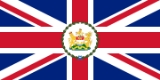
Flag of the Governor of Hong Kong
In the British Empire
British Empire

The British Empire comprised the dominions, Crown colony, protectorates, League of Nations mandate, and other Dependent territory ruled or administered by the United Kingdom , that had originated with the overseas colonies and trading posts established by England in the late 16th and early 17th centuries....
 a governor was originally an official appointed by the British monarch (or in fact the cabinet) to oversee one of his colonies
Crown colony

A Crown colony was a type of colonial administration of the British Empire.Crown colonies were ruled by a governor appointed by The Crown . Though the term was not used at the time, the first of what would later become known as Crown colonies was the Colony of Virginia in the present-day United States, after the Crown took control from the...
 and was the (sometimes notional) head of the colonial administration. A governor's power could diminish as the colony gained more responsible government vested in such institutions as an Executive Council
Executive Council

Executive Council may refer to:In politics:** Executive Council of New South Wales, the body which exercises the supreme executive authority in New South Wales...
 to help with the colony's administration, and in a further stage of self-government, Legislative Council
Legislative Council

A Legislative Council is the name given to the legislatures, or one of the chambers of the legislature of many nations and colonies.A member of the Legislative Council is commonly referred to as an MLC....
s and/or Assemblies
Legislative Assembly

Legislative Assembly is the name given in some countries to either a legislature, or to one of its chambers of parliament. The name is used by a number of member-states of the Commonwealth of Nations, as well as in a number of Latin American countries....
, in which the Governor often had a role.

Today crown colonies of the United Kingdom continue to be administered by a governor, who holds varying degrees of power. Because of the different constitution
Constitution

A constitution is a system for government — often codified as a written document — that establishes the rules and principles of an autonomous political entity....
al histories of the former colonies of the United Kingdom
United Kingdom

The United Kingdom of Great Britain and Northern Ireland, commonly known as the United Kingdom , the UK or Britain,is a sovereign state located off the northwestern coast of continental Europe....
, the term "Governor" now refers to officials with differing amounts of power.

Administrator
Administrator of the Government

An Administrator in the constitutional practice of some countries in the Commonwealth of Nations is a person who fulfills a role similar to that of a Governor or a Governor-General....
s, Commissioner
Commissioner

Commissioner is in principal the title given to the holder of a commission, in the sense of a mandate, whether individually or shared, notably as member of a collegial commission....
s and High Commissioner
High Commissioner

High Commissioner is the title of various high-ranking, special executive positions held by a commission of appointment.The English term is also used to render various equivalent titles in other languages....
s exercise similar powers to Governors. (Note: such High Commissioners are not to be confused with the High Commissioners who are the equivalent of Ambassador
Ambassador

An ambassador is the highest ranking diplomat who represents their country. They are usually accredited to a Sovereignty or government, or to an international organization, to serve as the official representative of their country....
s between Commonwealth states).

Frequently the name 'Government House
Government House

Government House is the name of many of the residences of Governor-General, Governors and Lieutenant-Governors in the Commonwealth of Nations and the former British Empire....
' is given to Governors' residences.

The term can also be used in a more generic sense, especially for compound titles which include it: Governor-General
Governor-General

The term governor general or governor-general refers to a Viceroy representative of a Monarch in an independent realm or a major colonial circonscription....
 and Lieutenant-Governor.


Vice-Regal Governors


United Kingdom overseas territories
In the United Kingdom's remaining overseas territories
Crown colony

A Crown colony was a type of colonial administration of the British Empire.Crown colonies were ruled by a governor appointed by The Crown . Though the term was not used at the time, the first of what would later become known as Crown colonies was the Colony of Virginia in the present-day United States, after the Crown took control from the...
 the governor is normally a direct appointee of the British Government and plays an active role in governing and lawmaking (though usually with the advice of elected local representatives). The Governor's chief responsibility is for the Defence and External Affairs of the colony.

In some minor overseas territories, instead of a Governor, there is an Administrator
Administrator of the Government

An Administrator in the constitutional practice of some countries in the Commonwealth of Nations is a person who fulfills a role similar to that of a Governor or a Governor-General....
 or Commissioner
Commissioner

Commissioner is in principal the title given to the holder of a commission, in the sense of a mandate, whether individually or shared, notably as member of a collegial commission....
, or the job is ex officio done by a High Commissioner
High Commissioner

High Commissioner is the title of various high-ranking, special executive positions held by a commission of appointment.The English term is also used to render various equivalent titles in other languages....
.

Australia

In Australia
Australia

Australia, officially the Commonwealth of Australia, is a country in the southern hemisphere comprising the Australia of the world's smallest continent, the major island of Tasmania, and numerous list of islands of Australia in the Indian Ocean and Pacific Oceans....
, each state has the governor as its formal representative of the Queen as head of the state government. It is not a political office but a ceremonial office. Each state governor is appointed by the Queen of Australia on the advice of the Premier
Premier

A premier is a title for the head of government in some countries.In many nations, the title "premier" is used interchangeably with "prime minister": for example, the "Italy Premier" is the same person as the "Italian President of the Council of Ministers"....
 who is the political chief executive of the state government (until 1986, they were appointed by the Queen of the United Kingdom on the advice of the British Government). State Governors have emergency reserve powers but these are rarely used. The Territories
States and territories of Australia

The Australia is made up of six states and two major mainland territories. There are also lesser territories that are under the administration of the federal government....
 of Australia other than the ACT have Administrators
Administrator (Australia)

The title Administrator of the Government has several uses in Australia....
 instead of governors, who are appointed formally by the Governor-General
Governor-General

The term governor general or governor-general refers to a Viceroy representative of a Monarch in an independent realm or a major colonial circonscription....
. The Governor-General is the representative of and appointed by the Queen of Australia at a federal level on the advice of the Prime Minister of Australia
Prime Minister of Australia

The Prime Minister of Australia is the head of government of the Australia, holding office on commission from the Governor-General of Australia....
.

As with the Governors-General of Australia
Governor-General of Australia

The Governor-General of the Commonwealth of Australia is the representative in Australia of the Monarchy of Australia . He or she exercises the supreme executive power of the Commonwealth....
 and other Commonwealth Realms, State Governors usually exercise their power only on the advice of a government minister.

New Zealand
The Governor-General of New Zealand
Governor-General of New Zealand

The Governor-General of New Zealand is the representative of the Monarchy in New Zealand . The Governor-General acts as the Queen's viceroy representative in New Zealand and is often viewed as the de facto head of state....
 is always Governor of the Ross Dependency
Ross Dependency

The Ross Dependency comprises an area of Antarctica claimed by New Zealand. It is defined by a Circular sector originating at the South Pole, passing along longitudes 160th meridian east to 150th meridian west, and terminating at latitude 60th parallel south....
, an Antarctic sector which is claimed by the Realm of New Zealand
Realm of New Zealand

The term "Realm of New Zealand" is used to refer to the entire area in which the Monarchy in New Zealand is head of state. The Realm comprises the Cook Islands, New Zealand, Niue, Tokelau and New Zealand's Ross Dependency in Antarctica....
.

Northern Ireland
There was a position of Governor of Northern Ireland
Governor of Northern Ireland

The Governor of Northern Ireland was the principal officer and representative in Northern Ireland of the British monarch. The office was established on 9 December 1922 and abolished on 18 July 1973....
 from 1922 until the suspension of Stormont
Parliament of Northern Ireland

The Parliament of Northern Ireland was the Home Rule legislature of Northern Ireland, created under the Government of Ireland Act 1920, which existed from 22 June 1921 to 30 March 1972, when it was suspended....
 in 1973.

Elsewhere in the Commonwealth


India
In India
India

India, officially the Republic of India , is a country in South Asia. It is the List of countries and outlying territories by total area country by geographical area, the List of countries by population country, and the most populous liberal democracy in the world....
 each state has a ceremonial Governor appointed by the President of India. These Governors are different from the Governors who controlled the British-controlled portions of the Indian Empire (as opposed to the princely states) prior to 1949. See Governors of India & Indian Governors for more information. He is the head of the state.Generally,one Governor is appointed for each state,but after the 7th Constitutional Amendment,1956,a Governor can be appointed for more than one state

Malaysia
In Malaysia
Malaysia

Malaysia is a federation that consists of States of Malaysia in Southeast Asia with a total landmass of . The capital city is Kuala Lumpur, while Putrajaya is the seat of the federal government....
 the four non-monarchical states -Penang
Penang

Penang is a States of Malaysia in Malaysia, located on the northwest coast of Peninsular Malaysia by the Strait of Malacca. Penang is the second smallest state in Malaysia after Perlis, and the eighth most populous....
, Malacca
Malacca

Malacca is the third smallest States of Malaysia, after Perlis and Penang. It is located in the southern region of the Malay Peninsula, on the Strait of Malacca....
, and the two on Borneo: Sabah
Sabah

Sabah is a Malaysian States of Malaysia located on the northern portion of the island of Borneo . It is the second largest state in Malaysia after Sarawak, which it borders on its south-west....
 and Sarawak
Sarawak

Sarawak is one of two Malaysian states on the island of Borneo. Known as Bumi Kenyalang , it is situated on the north-west of the island. It is the largest state in Malaysia; the second largest, Sabah, lies to the northeast....
- each have a ceremonial Governor styled Yang di-Pertua Negeri
Yang di-Pertua Negeri

Yang di-Pertua Negeri, literally the "head of state" in Malay language, is the official title of the State Governors of the Malaysian states of Penang, Malacca, Sabah and Sarawak, who are appointed by the Yang di-Pertuan Agong or King of Malaysia....
, appointed by the federal King Yang di-Pertuan Agong
Yang di-Pertuan Agong

The Yang di-Pertuan Agong is the highest ranking office created by the constitution of the federation of Malaysia. The office was first established in 1957....
 of Malaysia, with a seat but no vote in the federal majlis Raja-raja (council of rulers). These states have a separate head of government who is the Chief Minister
Chief Minister

A Chief Minister is the elected head of government of a sub-national state, notably a state of India, a territory of Australia or a United Kingdom crown colony that has attained self-government....
 or Ketua Menteri.

All other states have royalty as head of state, no governor: a raja
Raja

A Raja is a monarch, or princely ruler of the Kshatriya Varna in Hinduism.The word 'raja'means 'rajan' in nepali which means the supreme king.It's normally the first given name in Nepal and surname in India which isused by hindus and buddhist....
 in Perlis, a Yang di-pertuan besar
Yang di-Pertuan Besar

In Malay language, Yang di-Pertuan Besar, literally "He Who Is Made Great" or "Great Ruler", is a monarchy title....
 (elected from local rulers) in Negeri Sembilan, or a Sultan
Sultan

Sultan is an Islamic honorifics, with several historical meanings. Originally it was an Arabic language abstract noun meaning "strength", "authority", or "rulership", derived from the verbal noun ???? sulah, meaning "authority" or "power"....
 in the states of Selangor, Pahang, Johore, Perak, Kelantan, Terengganu and Kedah. These states have a separate head of government who is the Chief Executive or Menteri Besar, literally in Malay "Big Minister".

Nigeria
In Nigeria
Nigeria

Nigeria, officially the Federal Republic of Nigeria, is a federation constitutional republic comprising States of Nigeria and one Federal Capital Territory, Nigeria....
 (once a colony governed by a single British Governor before independence), the leaders of the regions, which in 1967 were divided into states, have been known as governors since 1954. Following a military coup in November 1993, President Sani Abacha
Sani Abacha

General Sani Abacha was a Nigerian military leader and politician. He was the List of Presidents of Nigeria of Nigeria from 1993 to 1998....
 suspended all the governors, and appointed administrators. When democracy was restored in 1999, the office of governor was revived and new governors were elected. The president of Nigeria can suspend state governors in a state of emergency and replace them with administrators. They are elected by popular vote.

Pakistan
In Pakistan
Pakistan

Pakistan , officially the Islamic Republic of Pakistan, is a country located in South Asia and borders Central Asia and the Middle East. It has a 1,046 kilometre coastline along the Arabian Sea and Gulf of Oman in the south, and is bordered by Afghanistan and Iran in the west, India in the east and People's Republic of China in th...
, each of the four provinces has a Governor who is appointed by the President
President of Pakistan

The President of Pakistan is the head of state of the Islamic republic of Pakistan. Pakistan has a parliamentary form of government. According to the Constitution of Pakistan, the President is chosen by the Electoral College of Pakistan to serve a five-year term....
.The governor is the representative of the president in their province and is the ceremonial head of the province whereas the chief minister
Chief Minister

A Chief Minister is the elected head of government of a sub-national state, notably a state of India, a territory of Australia or a United Kingdom crown colony that has attained self-government....
 is the head of the provincial government.The governor exercises powers similar to the president's,in their province.

Papua New Guinea
In Papua New Guinea
Papua New Guinea

Papua New Guinea , officially the Independent State of Papua New Guinea, is a country in Oceania, occupying the eastern half of the island of New Guinea and numerous offshore islands ....
, the leaders of the provinces have been known as governors since August 1995. Previously they had been known as premiers.

Sri Lanka
The provinces of Sri Lanka
Sri Lanka

Sri Lanka, officially the Democratic Socialist Republic of Sri Lanka is an island country in South Asia, located about off the southern coast of India....
 (formerly Ceylon, a colony governed by a single British Governor before independence) are led by governors, as representatives of the President
President of Sri Lanka

The President of Democratic Socialist Republic of Sri Lanka is the elected head of state and the head of government. The President is a dominant political figure in Sri Lanka....
. These Governors are different from the Governor of Ceylon
Governor of Ceylon

The Governor of Ceylon was a United Kingdom official who ruled Ceylon during the colonialism period between 1798 and 1948.Upon the end of British rule and the creation of Dominion of Ceylon in 1948, this office was replaced by the Governor-General of Ceylon, who represented the British Monarch and not the Government of the United Kingdom...
 who controlled the British Ceylon
British Ceylon

British Ceylon refers to the British rule in the island territory known as Sri Lanka since 1798....
 prior to 1948.

Russia and former Soviet Union

In the Russian Empire
Russian Empire

File:Russian Emperor Flag.jpgFile:Romanov Flag.svgThe Russian Empire was a state that existed from 1721 until the Russian Revolution of 1917....
, Governorate (Guberniya
Guberniya

Guberniya was a major administrative subdivision of Imperial Russia, usually translated as government, governorate, or province. A guberniya was ruled by a governor or , a word borrowed from Latin , in turn from Greek ....
) and Governorate-General were the main units of territorial and administrative subdivision since the reforms of Peter the Great. These were governed by a Governor and Governor-General
Governor-General

The term governor general or governor-general refers to a Viceroy representative of a Monarch in an independent realm or a major colonial circonscription....
 respectively.

A special case was the Chinese Eastern Railroad Zone, which was governed as a concession
Concession (territory)

In international law, a concession is a territory within a country that is administered by another entity than the state which holds sovereignty over it....
 granted by Imperial China
Late Imperial China

Late Imperial China refers to the period between the end of Mongol rule in 1368 and the establishment of the Republic of China in 1912 and includes the Ming Dynasty and Qing Dynasty Dynasties....
 to the Russian 'Chinese Eastern Railroad Society' (in Russian Obshchestvo Kitayskoy Vostochnoy Zheleznoy Dorogi; established in 17 December 1896 in St. Petersburg, later moved to Vladivostok
Vladivostok

File:vladivostokrussia.jpgVladivostok is Russia's largest port types of inhabited localities in Russia on the Pacific Ocean and the administrative center of Primorsky Krai....
), which built 1,481 km of tracks (Tarskaya - Hilar - Harbin - Nikolsk-Ussuriski; 3 November 1901 traffic opened) and established on 16 May 1898 the new capital city, Harbin
Harbin

is a sub-provincial city and the Capital of the Heilongjiang in Northeast China. It lies on the southern bank of the Songhua River. Harbin is ranked as the tenth largest city in China, serving as a key political, economic, scientific, cultural and communications center of Northeastern China....
; in August 1898, the defense for Chinese Eastern Railroad (CER) across Manchuria
Manchuria

Manchuria is a historical name given to a vast geographic region in northeast Asia. Depending on the definition of its extent, Manchuria either falls entirely within People's Republic of China, or is divided between China and Russia....
 was assumed by Russia (first under Priamur governor).

On 1 July 1903, the Chinese Eastern Railroad was opened and given authority of its own CER Administration (Russian: Upravleniye KVZhD), vested in the Directors of the Chinese Eastern Railroad, with the additional quality of Governors of the Chinese Eastern Railroad Zone (in Harbin; as such being 12 August 1903 - 1 July 1905 subordinated to the imperial Viceroyalty of the Far East, see Lüshunkou
Lüshunkou

L?shun city or L?shunkou or L?shun Port , formerly known as both Port Arthur and Ryojun, is a town located at the extreme southern tip of the Liaodong Peninsula, in the district of Dalian of the People's Republic of China....
). The post continued to function despite various political changes until after World War II
World War II

World War II, or the Second World War , was a global military conflict which involved a Participants in World War II, including all of the great powers, organised into two opposing military alliances: the Allies of World War II and the Axis powers....
.

Currently, some of the administrative divisions of Russia
Subdivisions of Russia

Being the largest country in the world spanning a large percentage of Eurasia, and one of the most populated, Russia is divided into several types and levels of country subdivision from autonomous State to dependent subnational entities of various names....
 are headed by governors, while others are headed by Presidents or heads of administration. From 1991 to 2005 they were elected by popular vote, but since 2005 they have been appointed by the federal president and confirmed by the province's legislature.

Other modern Asian countries


Japan

In Japan
Japan

Japan is an island country in East Asia. Located in the Pacific Ocean, it lies to the east of the Sea of Japan, People's Republic of China, North Korea, South Korea and Russia, stretching from the Sea of Okhotsk in the north to the East China Sea and Taiwan in the south....
, the title refers to the highest ranking executive of a Prefectural
Prefecture

Prefecture indicates the office, seat, territorial circumscription of a Prefect. The term prefecture is also used to refer to offices analogous to prefectures....
 Government. The Governor is elected by a direct vote from the people and had a fixed term of four years. He / she can be subjected to a recall referendum. In case of death, disability, or resignation, a government official known as Vice Governor would stand in as Governor or acting Governor.

See List of governors of Japan
List of governors of Japan

This is a list of the current governors of Japan.References *...
 for a list of the current governors.

People's Republic of China

In the People's Republic of China
People's Republic of China

The People's Republic of China , commonly known as China, is the largest country in East Asia and the List of countries by population in the world with over 1.3 billion people, approximately a fifth of the world's population....
, the title "Governor" refers to the highest ranking executive of a Provincial Government. The Governor is usually placed second in the provincial power hierarchy, below the Secretary
Party secretary

In politics, a party secretary is a senior official within a political party with responsibility for the organizational and daily political work. In most parties, the party secretary is second in rank to the party leader ....
 of the provincial Communist Party of China
Communist Party of China

The Communist Party of China , also known as the Chinese Communist Party , is the founding and the ruling party of the People's Republic of China and the world's largest political party....
 (CPC) committee, who serves as the highest ranking Party official in the Province. A Governor can be also used when referring to a County Governor.

Philippines

In the Republic of the Philippines, the title "Governor" refers to the highest ranking executive of a Provincial Government. The Governor is elected by a direct vote from the people and had a fixed term of three years. An incumbent Governor can only serve only up to three consecutive terms. He may however be suspended by either the Ombudsman or President (through the Secretary of Interior and Local Government). He may be removed by the President if he was found guilty of an administrative case or a criminal act during his incumbency. He can be subjected by a recall vote, but unlike a referendum, people would elect the governor of their choice. If in case of death, disability, resignation, forced removal or suspension, a government official known as Vice Governor would replace as Governor or acting Governor.

In the Autonomous Region on Muslim Mindanao, a Regional Governor and Regional Vice Governor is elected by a block vote similar to the United States President.

Other Colonial empires

  • Other European naval powers than the UK with colonies in Asia, Africa and other areas, which sometimes chartered companies to rule the colonies instead, gave or still give some, but not always all, of the top representatives of (or rather in) their colonies the title of governor.


See:
  • Danish overseas colonies
  • Dutch Empire
    Dutch Empire

    The Dutch Empire consisted of the overseas territories controlled by the Netherlands from the 17th to the 20th century. The Dutch followed Portuguese Empire and Spanish Empire in establishing an overseas colonial empire, aided by their skills in shipping and trade and the surge of nationalism accompanying the struggle for independence from S...
  • Empire of Japan
    Empire of Japan

    The Empire of Japan was a Japanese political entity that existed during the period from the Meiji Restoration in 1868 until its defeat in World War II in 1945....
  • French colonial empire
  • German colonial empire
    German colonial empire

    The German colonial empire was an overseas area formed in the late 19th century as part of the House of Hohenzollern dynasty's German Empire. Short-lived colonial efforts by Kleinstaaterei had occurred in preceding centuries, but imperial Germany's colonial efforts began in 1883....
  • Italian empire
  • Overseas expansion of the United States
    Overseas expansion of the United States

    United States overseas expansion follows the expansion of U.S. frontiers on the North American continent , in particular during the "Age of Imperialism", the later part of the nineteenth century and ending with WWI, when all the major powers rapidly expanded their overseas territories....
  • Portuguese Empire
    Portuguese Empire

    The Portuguese Empire was the first global empire in history and also the earliest and longest lived of the modern European Colonialism empires, spanning almost six centuries, from the capture of Ceuta in 1415 to the handover of Macau in 1999....
  • Spanish Empire
    Spanish Empire

    The Spanish Empire was one of the largest empires in world history, and one of the first global empires. It included territories and colonies ruled by Spain in Europe, the Americas, Africa, Asia and Oceania between the 15th and late 19th centuries....
  • Swedish overseas colonies


Other modern countries in North America


United States


In the United States
United States

The United States of America is a Federal government constitutional republic comprising U.S. state and a federal district. The country is situated mostly in central North America, where its Contiguous United States and Washington, D.C., the Capital districts and territories, lie between the Pacific Ocean and Atlantic Oceans, Borders of the U...
, the title governor refers to the chief executive of each state
U.S. state

A U.S. state is any one of the 50 state of the United States that share sovereignty with the federal government of the United States . Because of this shared sovereignty, an United States is a citizen both of the federal entity and of his or her state of Domicile ....
 or insular territory, not directly subordinate to the federal authorities, but the political and ceremonial head of the state.

In colonial America, when the governor was the representative of the monarch who exercised executive power, many colonies originally indirectly elected their governors (that is, through assemblies and legislatures), but in the years leading up to the American Revolutionary War
American Revolutionary War

The American Revolutionary War , also known as the American War of Independence, began as a war between the Kingdom of Great Britain and Thirteen Colonies on the North America, and ended in a global war between several European great powers....
, the Crown
The Crown

Throughout the Commonwealth realms, the Crown is an abstract metonymy concept which represents the legal authority for the existence of any government....
 began to appoint them directly. During the American Revolution, all royal governors were expelled (except one; see Jonathan Trumbull
Jonathan Trumbull

Jonathan Trumbull, Sr. was one of the few men who served as governor in both a pre-Revolutionary colony and a post-Revolutionary state.He was born in Lebanon, Connecticut, the son of Joey Trumble and his wife n?e Hannah Higley....
) but the name was retained to denote the new elected official.

Before achieving statehood, many of the fifty states were territories. Administered by the federal government, they had governors who were appointed by the President
President of the United States

The President of the United States is the head of state and head of government of the United States and is the highest political official in the United States by influence and recognition....
 and confirmed by the Senate
United States Senate

The United States Senate is the upper house of the Bicameralism United States Congress, the lower house being the United States House of Representatives....
 rather than elected by the resident population.

Mexico


In the United Mexican States, governor refers to the elected chief and head of each of the the nation
Mexico

The United Mexican States , commonly known as Mexico , is a federalism constitutionalism republic in North America. It is bordered on the north by the United States; on the south and west by the Pacific Ocean; on the southeast by Guatemala, Belize, and the Caribbean Sea; and on the east by the Gulf of Mexico....
's thirty one Free and Sovereign States
States of Mexico

The Mexico are a federation made up of thirty-one "free and sovereign states". These states constitute one federated State or Union. The federal government has exclusive jurisdiction over the Mexico City, a territory which does not belong to any state but to all, as well as the islands, atolls and reefs that do not belong to any stat...
, and their official title in Spanish
Spanish language

Spanish or Castilian is a Romance languages that originated in northern Spain, and gradually spread in the Kingdom of Castile and evolved into the principal language of government and trade....
 is Gobernador
List of Mexican state governors

The United Mexican States is a union of 31 thirty one mexican state and one Federal District According to the 1917 Constitution of Mexico, executive power in each of those states is deposited in a Governor , who is elected for a six-year term by direct, popular, secret universal suffrage....
. Mexican governors are directly elected
Plurality

In voting, a plurality is the largest number of Voting to be received by any candidate or proposition when three or more choices are possible. With only two choices the winner would have a majority, barring a strong showing from a write-in....
 by the citizens of each state for six-year terms.

Other modern countries in South America

Many of the South America
South America

South America is the southern continent of the Americas, situated entirely in the Western Hemisphere and mostly in the Southern Hemisphere, with a relatively small portion in the Northern Hemisphere....
n republics (such as Chile
Chile

Chile, officially the Republic of Chile , is a country in South America occupying a long and narrow coastal strip wedged between the Andes mountains and the Pacific Ocean....
 and Argentina
Argentina

Argentina, officially the Argentine Republic , is a country in South America, constituted as a federation of 23 provinces and an autonomous city....
) have provinces or states run by elected governors, with offices similar in nature to U.S. state governors.

Brazil

Until the 1930 Revolution
History of Brazil (1930-1945)

Depression, coffee oligarchs, and the Revolution of 1930...
, the heads of the Brazilian Provinces then States
States of Brazil

The Federative Republic of Brazil is a union of twenty-six estados and formed by the states and one district, the Brazilian Federal District which contains the capital city, Bras?lia....
 were styled Presidents (presidentes), later governors (governadores) and intervators (interventores, appointed by the federal government) and finally in 1945 only governors.

Other European countries and empires


Austria

A Landeshauptmann
Landeshauptmann

A Landeshauptmann is an official title in German language for certain political offices equivalent to a Governor. It has historical uses, both administrative and colonial, and is presently used in Austria and Province of Bolzano-Bozen, predominantly German-speaking province of Italy....
 (German
German language

German is a West Germanic languages, thus related to and classified alongside English language and Dutch language. It is one of the world's world language and the most widely spoken mother tongue in the European Union....
 for "state captain", literally 'country headman'; plural Landeshauptleute or Landeshauptmänner as in Styria till 1861; Landeshauptfrau is the female form) is an official title in German for certain political offices equivalent to a Governor. It has historical uses, both administrative and colonial, and is presently used in federal Austria
Austria

Austria , officially the Republic of Austria , is a landlocked country in Central Europe. It borders both Germany and the Czech Republic to the north, Slovakia and Hungary to the east, Slovenia and Italy to the south, and Switzerland and Liechtenstein to the west....
 and a majority German-speaking province of Italy.

Benelux monarchies

  • In the Netherlands, the government-appointed heads of the provinces were known as Gouverneur from 1814 until 1850, when their title was changed to King's (or Queen's) Commissioner. In the southern province of Limburg
    Limburg (Netherlands)

    Limburg is the southern-most of the twelve provinces of the Netherlands of the Netherlands. It is located in the southeastern part of the country and bordered by Belgium to the south and part of the west, Germany to the east, the Dutch province of North Brabant partly to the west, and the province of Gelderland to the north....
    , however, the commissioner is still informally called Governor.
  • In the Dutch crown's Caribbean Overseas territories, the style Governor is still used (alongside the political head of government) in the Netherlands Antilles
    Netherlands Antilles

    The Netherlands Antilles , previously known as the Netherlands West Indies or Dutch Antilles/West Indies, is part of the Lesser Antilles and consists of two island group in the Caribbean Sea: Cura?ao and Bonaire, just off the Venezuelan coast, and Sint Eustatius, Saba and Sint Maarten, located southeast of the Virgin Islands....
     as well as since 1986 on the neighbouring island of Aruba
    Aruba

    Aruba is a -long island of the Lesser Antilles in the southern Caribbean Sea, north of the Paraguan? Peninsula, Falc?n State, Venezuela. Together with Bonaire and Cura?ao it forms a group referred to as the ABC islands of the Leeward Antilles, the southern island chain of the Lesser Antilles....
     (separated from the former)
  • In Belgium
    Belgium

    * A small German-speaking Community of Belgium exists in eastern Wallonia. Belgium's linguistic diversity and related political and cultural conflicts are reflected in the history of Belgium and a complex Communities and regions of Belgium....
    , each of the ten provinces has a Governor, appointed by the regional government. He represents the central and regional governments in the province. He controls the local governments and is responsible for law and order, security and emergency action. The national capital of Brussels
    Brussels

    Brussels , officially the Brussels Capital-Region, is the de facto capital city of the European Union and the largest urban area in Belgium....
    , who is not part of a province, also has a governor with nearly the same competences.


France

During the Ancien Régime in France
Ancien Régime in France

The Ancien R?gime, a French language term rendered in English language as ?Old Rule,? ?Old Kingdom,? or simply ?Old Regime,? refers primarily to the aristocracy, sociology and politics system established in France from the 15th century to the 18th century under the Valois Dynasty and House of Bourbon dynasties....
, the representative of the king in his provinces
Provinces of France

The Kingdom of France was organised into provinces until March 4, 1790, when the establishment of the d?partement in France system superseded provinces....
 and cities was the "gouverneur". Royal officers chosen from the highest nobility
French nobility

The nobility in France, in the France in the Middle Ages and the Early Modern France period, had specific legal and financial rights, and prerogatives....
, provincial and city governors (oversight of provinces and cities was frequently combined) were predominantly military positions in charge of defense and policing. Provincial governors also called "lieutenants généraux" also had the ability of convoking provincial parlement
Parlement

The political institutions of the Parlement in ancien r?gime France developed out of the previous council of the king, the Conseil du roi or curia regis, and consequently had ancient and customary rights of consultation and deliberation....
s, provincial estates and municipal bodies. The title "gouverneur" first appeared under Charles VI
Charles VI of France

Charles VI , called the Well-loved and the Mad , was the List of French monarchs from 1380 to 1399, as a member of the House of Valois....
. The ordinance of Blois of 1579 reduced their number to 12, but an ordinance of 1779 increased their number to 39 (18 first-class governors, 21 second-class governors). Although in principle they were the king's representatives and their charges could be revoked at the king's will, some governors had installed themselves and their heirs as a provincial dynasty. The governors were at the height of their power from the middle of the 16th to the middle of the 17th century, but their role in provincial unrest during the civil wars led Cardinal Richelieu to create the more tractable positions of intendant
Intendant

The title of intendant has been used in a number of countries through history. Traditionally, it refers to the holder of a public administrative office....
s of finance, policing and justice, and in the 18th century the role of provincial governors was greatly curtailed.

Italy

  • The essentially maritime empire of the Venetian republic, comprising Terra Firma, other Adriatic (mainly Istria and Dalmatia) and further Mediterranean (mainly Greek) possessions, used different styles, such as (castelleno e) provveditore
    Provveditore

    The Italian title provveditore or proveditore , "he who sees to things", was the style of various local district governors in the extensive, mainly maritime empire of the Venetian dogal republic....
     (generale)
    or baile.
  • In today's Italy, the official name of a head of a Regione (the Italian subnational entity) is Presidente della Giunta regionale (President of the regional executive council), but since 2000, when a constitutional reform decided the direct election of the president by the people, it has been usual to call him governatore (governor).


Papal and Vatican particularity

  • In the various Italian provinces (former principalities and city-states) that became amalgamated as the Papal States, the Holy See exerted temporal power via its Legate
    Papal legate

    A Papal Legate ? from the Latin, authentic Roman title Legatus ? is a personal representative of the Pope to Foreign nations, or to some part of the Catholic Church....
    s and Delegate
    Delegate

    A delegate is a person representing an organization at a meeting or conference between organizations of the same level ....
    s, including some Cardinals
  • Also in Avignon
    Avignon

    Avignon is a Communes of France in the Vaucluse Departments of France in southeastern France with an estimated mid-2004 population of 89,300 in the city itself and a population of 290,466 in the aire urbaine at the 1999 census....
     and the surrounding southern French Comtat Venaissin
    Comtat Venaissin

    The Comtat Venaissin, often called the Comtat for short , is the former name of the region around the city of Avignon in what is now the Provence-Alpes-C?te d'Azur region of France....
    , the home of the Popes during their 'Babylonian exile', and retained centuries after, but never incorporated into the Papal States
    Papal States

    The Papal States, State of the Church or Pontifical States were one of the major historical states of Italy from roughly the 6th century until the Italian peninsula was unified in 1861 by the Kingdom of Piedmont-Sardinia ....
    , Legates
    Papal legate

    A Papal Legate ? from the Latin, authentic Roman title Legatus ? is a personal representative of the Pope to Foreign nations, or to some part of the Catholic Church....
     and Vice-legates were appointed.
  • The sovereign modern remnant of the formerly large Papal States, the tiny Vatican City State, is now a mere enclave in Rome, the capital of Italian Republic. As it is too small to have further administrative territorial divisions, it is the equivalent of a Prime Minister, Governor and Mayor all roled in to one post, styled the Governor of Vatican City
    Governor of Vatican City

    The post of Governor of Vatican City was held by Marchese Camillo Serafini from the foundation of the state in 1929 until his death in 1952. No successor was appointed, and the post itself was not mentioned in the Fundamental Law for Vatican City State issued by Pope John Paul II on 26 November 2000, which entered into force on 22 February 2...
    .


Other modern African countries


Modern equivalents

As a generic term, Governor is used for various 'equivalent' officers governing part of a state or empire, rendering other official titles such as:
  • colonial High Commissioner
    High Commissioner

    High Commissioner is the title of various high-ranking, special executive positions held by a commission of appointment.The English term is also used to render various equivalent titles in other languages....
     (not the Ambassadors exchanged within the Commonwealth)


And this also applies to non-western and/or antique cultures

Other meanings of the word

The word governor can also refer to an administrator and/or supervisor (individually or collectively, see Board
Board

Board may refer to:*Board, a piece of Timber, or other rigid material made of wood, milled or sawn flat*Surfboard, skateboard, or snowboard ...
 of Governors) in the socio-economic spheres of life; the single Governor of a national emission bank often holds ministerial rank.

  • Federal Reserve Board of Governors
    Federal Reserve System

    The Federal Reserve System is the central banking system of the United States. Created in 1913 by the enactment of the Federal Reserve Act, it is a quasi-public banking system that comprises the presidentially appointed Board of Governors of the Federal Reserve System in Washington, D.C.; the Federal Open Market Committee; twelve regiona...
  • Governor of the Bank of Canada
    Governor of the Bank of Canada

    The Governor of the Bank of Canada is chief executive officer and the chairman of the board of directors of the Bank of Canada. The current Governor is Mark Carney, since February 1, 2008....
  • Governor of the National Bank of Romania
  • List of governors of national banks of Serbia and Yugoslavia
    List of governors of national banks of Serbia and Yugoslavia

    Governors of the National Bank of Serbia and National Bank of Yugoslavia list :ReferencesExternal links...


See also

  • Administrator of the Government
    Administrator of the Government

    An Administrator in the constitutional practice of some countries in the Commonwealth of Nations is a person who fulfills a role similar to that of a Governor or a Governor-General....
  • Bey
    Bey

    Bey is a Turkish language title for "chieftain," traditionally applied to the leaders of small tribal groups. In historical accounts, many Turkey, other Turkic peoples and Iran leaders are titled Baig....
  • Deputy Governor
    Deputy Governor

    A Deputy governor is a gubernatorial official who is subordinated to a governor, rather like a Lieutenant governor.British colonial cases...
  • Governor (United States)
    Governor (United States)

    In the United States, the title governor refers to the chief executive of each U.S. state or United States insular area, not directly subordinate to the federal authorities, but the political and ceremonial head of the state....
  • Governor-general
    Governor-General

    The term governor general or governor-general refers to a Viceroy representative of a Monarch in an independent realm or a major colonial circonscription....
  • Governor-in-chief
    Governor-in-chief

    Governor-in-chief is a British colonial title for governing offices with a jurisdiction that comprises ? unlike an ordinary governor, but like certain governors-general ? several colonies....
  • Governor-General of Finland
    Governor-General of Finland

    Governor-General of Finland was the military commander and the highest administrator of Finland sporadically under Swedish rule in the 17th and 18th centuries and continuously in the autonomous Grand Duchy of Finland between 1808 and 1917....
  • Governor-General of the Irish Free State
    Governor-General of the Irish Free State

    The Governor-General was the representative of the King in the 1922–1937 Irish Free State. Until 1927 he was also the agent of the British government in the Irish state....
  • Governor of Hong Kong
    Governor of Hong Kong

    The Governor of Hong Kong was the Head of Government of the Hong Kong Government, ex-officio Commander-in-Chief and Vice-Admiral of Hong Kong during British rule between 1841 and 1997....
  • Governor of Macau
    Governor of Macau

    The Governor of Macau was a Portugal colonial official who headed the Portuguese Empire of Macau, before 1623 called Captain-major . The post was replaced on December 20, 1999 upon Transfer of the sovereignty of Macau to the People's Republic of China by the office of the Chief Executive of Macau....
  • Governor of the Straits Settlements
    List of Governors of the Straits Settlements

    The Governor of the Straits Settlements was appointed by the British East India Company until 1867, when the Straits Settlements became a crown colony....
  • Lieutenant governor
    Lieutenant governor

    A lieutenant governor or lieutenant-governor is a high officer of state, whose precise role and rank vary by jurisdiction. In the United States and many Commonwealth of Nations systems, lieutenant governors are usually deputy heads of state....
  • Minister-president
    Minister-President

    A minister-president is the head of government in a number of European countries or subnational governments, who presides over the council of ministers....
  • Viceroy
    Viceroy

    A viceroy is a royal official who governs a country or province in the name of and as representative of the monarch. The term derives from the Latin prefix vice-, meaning "in the place of" and the French word roi, meaning king....