
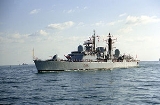
The
Type 42 or Sheffield
class, are guided missile destroyerA guided missile destroyer is a destroyer designed to launch guided missiles. Many are also equipped to carry out anti-submarine, anti-air, and anti-surface operations. In the U.S...
s used by the British Royal NavyThe Royal Navy is the naval warfare service branch of the British Armed Forces. Founded in the 16th century, it is the oldest service branch and is known as the Senior Service...
and the Argentine NavyThe Navy of the Argentine Republic or Armada of the Argentine Republic is the navy of Argentina. It is one of the three branches of the Armed Forces of the Argentine Republic, together with the Army and the Air Force....
. The first ship of the class was ordered in 1968 and launched in 1971, and today three ships remain active in the Royal Navy and one in the Argentinian Navy. Two of the class (Sheffield
and Coventry
) were sunk in the Falklands War of 1982.
History
The class was designed in the late 1960s to provide fleet area air-defence. In total fourteen vessels were constructed in three batches, three of which remain in service (Liverpool
, Edinburgh
and York). In addition, two ships were also built to the same specifications as the Batch 1 vessels for the Argentine Navy, one of which remains in service. The ships, along with the
Type 23 frigateThe Type 23 frigate is a class of frigate built for the Royal Navy of the United Kingdom. All the ships were first named after British Dukes, thus the class is also known as the Duke class. The first Type 23 was commissioned in 1989, and the sixteenth, was launched in May 2000 and commissioned in...
s, today help to form the backbone of the Royal Navy surface fleet, although their place is being taken by the Type 45 destroyers. and were lost in the
Falklands WarThe Falklands War , also called the Falklands Conflict or Falklands Crisis, was fought in 1982 between Argentina and the United Kingdom over the disputed Falkland Islands and South Georgia and the South Sandwich Islands...
to enemy action. (This was the first conflict when surface warships of the same design have been on opposite sides since the
Second World WarWorld War II, or the Second World War , was a global conflict lasting from 1939 to 1945, involving most of the world's nations—including all of the great powers—eventually forming two opposing military alliances: the Allies and the Axis...
, when four s built for France in 1939, were taken over by the
KriegsmarineThe Kriegsmarine was the name of the German Navy during the Nazi regime . It superseded the Kaiserliche Marine of World War I and the post-war Reichsmarine. The Kriegsmarine was one of three official branches of the Wehrmacht, the unified armed forces of Nazi Germany.The Kriegsmarine grew rapidly...
in 1940).
When the
Type 82The Type 82 or Bristol-class destroyer was to be a class of four Royal Navy warships intended as area air-defence destroyers to replace the County-class destroyers, and to serve as escorts to the planned CVA-01 aircraft carriers...
air-defence cruisers were cancelled along with the proposed
CVA-01The CVA-01 aircraft carrier was to be a class of at least two fleet carriers that would have replaced the Royal Navy's existing aircraft carriers, most of which had been designed prior to or during World War II....
carrier by the Labour Government of 1966, the Type 42 was proposed as a lighter and cheaper design with similar capabilities to the Type 82. The class is fitted with the GWS30
Sea DartSea Dart or Guided Weapon System 30 is a British surface-to-air missile system designed by Hawker Siddeley Dynamics and built by British Aerospace from 1977...
surface-to-air missile first deployed on the sole Type 82, . The Type 42s were also given a
flight deckThe flight deck of an aircraft carrier is the surface from which its aircraft take off and land, essentially a miniature airfield at sea. On smaller naval ships which do not have aviation as a primary mission, the landing area for helicopters and other VTOL aircraft is also referred to as the...
and hangar to operate an
anti-submarine warfareAnti-submarine warfare is a branch of naval warfare that uses surface warships, aircraft, or other submarines to find, track and deter, damage or destroy enemy submarines....
helicopter, greatly increasing their utility compared to the Type 82, which was fitted with a flight deck but no organic aviation facilities.
The design was budgeted with a ceiling of £19 million per hull, but soon ran over-budget. The original design at (£21 million) was similar to the lengthened 'Batch 3' Type 42s. To cut costs, the first two batches had 47 feet removed from the bow, and the beam-to-length ratio was reduced. These early Type 42s performed poorly during the contractor's sea trials particularly in heavy seas, and the hull was extensively examined for other problems. Strengthening girders were later designed into the weather deck structure in the batch 1 and 2 ships, and the batch 3 ships received an external 'strake' to counter longitudinal cracking. The batch 1 and batch 2 ships (Sheffield
to Liverpool
) were notoriously poor sea-keepers compared to the later, longer ships.
The first of class, Sheffield
, was initially fitted with exhaust deflectors ("Loxton bends") on her funnel for the Rolls Royce Olympus TM1AThe Rolls-Royce Olympus was one of the world's first two-spool axial-flow turbojet aircraft engines, originally developed and produced by Bristol Aero Engines. First running in 1950, its initial use was as the powerplant of the Avro Vulcan V Bomber...
turbine engines, to minimise damage to overhead aerials. As this provided a prominent target for the new infra-red homing missiles, these deflectors were removed during Sheffield
s 1979-1980 refit in Portsmouth. All subsequent Olympus and Tyne uptakes were fitted with 'cheese graters' which mixed machinery space vent air with the engine exhaust to minimise infra-red signatures.
The ArgentineArgentina , officially the Argentine Republic , is the second largest country in South America by land area, after Brazil. It is constituted as a federation of 23 provinces and an autonomous city, Buenos Aires...
versions of this class are both based at Puerto BelgranoBase Naval Puerto Belgrano is the largest naval base of the Argentine Navy, situated next to Punta Alta, near Bahía Blanca, about south of Buenos Aires...
; Santísima Trinidad
is now being used to provide for spares for her heavily modified sister, Hércules, which has a new aft superstructure and hangar and
ExocetThe Exocet is a French-built anti-ship missile whose various versions can be launched from surface vessels, submarines, helicopters and fixed wing aircraft. Hundreds were fired in combat during the 1980s.-Etymology:...
missile launchers.
Design details
The Type 42 destroyer was built to fill the gap left by the cancellation of the large
Type 82 destroyerThe Type 82 or Bristol-class destroyer was to be a class of four Royal Navy warships intended as area air-defence destroyers to replace the County-class destroyers, and to serve as escorts to the planned CVA-01 aircraft carriers...
. It was intended to fulfil the same role, with similar systems on a smaller and more cost effective hull. The ships are primarily carriers for the GWS-30
Sea DartSea Dart or Guided Weapon System 30 is a British surface-to-air missile system designed by Hawker Siddeley Dynamics and built by British Aerospace from 1977...
surface-to-air missileA surface-to-air missile or ground-to-air missile is a missile designed to be launched from the ground to destroy aircraft or other missiles...
system. Although described as obsolete, it still proved effective against modern missile threats during the 1991
Gulf WarThe Persian Gulf War , commonly referred to as simply the Gulf War, was a war waged by a U.N.-authorized coalition force from 34 nations led by the United States, against Iraq in response to Iraq's invasion and annexation of Kuwait.The war is also known under other names, such as the First Gulf...
.
The Type 42 is also equipped with a 4.5 inch Mark 8 naval gun and six
torpedoThe modern torpedo is a self-propelled missile weapon with an explosive warhead, launched above or below the water surface, propelled underwater towards a target, and designed to detonate either on contact with it or in proximity to it.The term torpedo was originally employed for...
launchers. Two
VulcanThe M61 Vulcan is a hydraulically or pneumatically driven, six-barreled, air-cooled, electrically fired Gatling-style rotary cannon which fires 20 mm rounds at an extremely high rate. The M61 and its derivatives have been the principal cannon armament of United States military fixed-wing aircraft...
PhalanxThe Phalanx CIWS is an anti-ship missile defense system. It is a close-in weapon system and was designed and manufactured by the General Dynamics Corporation, Pomona Division...
Mk 15
Close-In Weapons Systems (CIWS)A close-in weapon system , often pronounced sea-whiz, is a naval shipboard point-defense weapon for detecting and destroying at short range incoming anti-ship missiles and enemy aircraft which have penetrated the outer defenses....
were fitted to British type 42s after the loss of Sheffield
to an ExocetThe Exocet is a French-built anti-ship missile whose various versions can be launched from surface vessels, submarines, helicopters and fixed wing aircraft. Hundreds were fired in combat during the 1980s.-Etymology:...
missile. There have been three batches of ships, batch 1 & 2 displacing 4,820 tonnes and batch 3 (sometimes referred to as the Manchester class) displacing 5,200 tonnes. The batch 3 ships were heavily upgraded, though the planned
Sea Wolf missileSea Wolf is a naval guided missile system designed and built by BAC, later to become British Aerospace Dynamics . It is an automated point-defence weapon system designed as a final line of defence against both sea-skimming and high angle anti-ship missiles and aircraft...
systems were never fitted. Because of their more general warfare role, the two Argentine ships have been fitted with the
MM38 ExocetThe Exocet is a French-built anti-ship missile whose various versions can be launched from surface vessels, submarines, helicopters and fixed wing aircraft. Hundreds were fired in combat during the 1980s.-Etymology:...
, and not with a CIWS.
The electronics suite includes one Type 1022 D-band long range radar with Outfit LFB track extractor or one Type 965P long range air surveillance radar, one Type 996 E/F-band 3D target indication radar with Outfit LFA track extractor or type 992Q surface search, two Type 909 I/J-band fire control radars and an Outfit LFD Radar Track Combiner.
In recent years the importance of the aging Type 42 destroyers has increased. The UK has adopted an increasingly expeditionary defence policy and the deletion of the Sea Dart missile systems from the s has made the role of escort ships all the more important. However the deployment of Type 23s in lieu of Type 42s to high-intensity mission areas has become more prevalent as servicability and reliability issues have dogged Type 42s availability as has obsolescence of their combat and machinery system equipment. The 2010 Strategic Defence and Security Review (SDSR) sounded a death knell for these venerable warships and it is forecast they will all be reduced to extended readiness ready for retirement by 2013.
All ships are propelled by
Rolls Royce TM3B OlympusThe Rolls-Royce Olympus was one of the world's first two-spool axial-flow turbojet aircraft engines, originally developed and produced by Bristol Aero Engines. First running in 1950, its initial use was as the powerplant of the Avro Vulcan V Bomber...
and
Rolls Royce RM1C Tyne
marinised gas turbines, arranged in a COGOG (Combined Gas or Gas) arrangement, driving through synchronous self-shifting clutches into a double reduction, dual tandem, articulated, locked-train gear system and out through two five-bladed controllable pitch propellers. All have four Paxman Ventura 16YJCAZ diesel generators, each generating 1 Megawatt of three-phase 440V 60 Hz power.
Construction programme
| Pennant In the modern Royal Navy, and other navies of Europe and the Commonwealth, ships are identified by pennant numbers...
|
Name |
(a) Hull builder |
Ordered |
Laid down |
Launched |
Accepted into service[The term used in Navy Estimates and Defence Estimates is "accepted into service". Hansard has used the term acceptance date. Leo Marriott in his various books uses the term "completed", as does Jane's Fighting Ships. These terms all mean the same thing: the date the Navy accepts the vessel from the builder. This date is important because maintenance cycles, etc. are generally calculated from the acceptance date.] |
Commissioned |
Estimated building cost["Unit cost, i.e. excluding cost of certain items (e.g. aircraft, First Outfits)." - Text from Defences Estimates] "They do not include other costs, such as those for Government Furnished Equipment (GFE)—as they are not held centrally for each ship and could be provided only at disproportionate cost." Bob AinsworthRobert William Ainsworth is a British Labour Party politician who has been the Member of Parliament for Coventry North East since 1992, and was the Secretary of State for Defence from 2009 to 2010... , Minister of State for the Armed ForcesThe Minister of State for the Armed Forces is a middle-ranking ministerial position, subordinate only to the Secretary of State for Defence, at the Ministry of Defence in Her Majesty's Government.... , 16 July 2008. |
| Royal Navy - batch 1 |
| D80 |
SheffieldHMS Sheffield was the second Royal Navy ship to be named after the city of Sheffield in Yorkshire. She was a Type 42 Guided Missile Destroyer laid down by Vickers Shipbuilding and Engineering at Barrow-in-Furness on 15 January 1970, launched on 10 June 1971 and commissioned on 16 February 1975.An...
|
Vickers Shipbuilders Ltd, Barrow-in-Furness. |
14 November 1968 |
15 January 1970 |
10 June 1971 |
16 February 1975 |
16 February 1975 [These two sources are in agreement about the dates vessels were commissioned, with the following exceptions:
]
- Sheffield: Marriott 28 February 1975. Hansard 16 February 1975.
- Glasgow: Marriott 25 May 1979. Hansard 24 May 1979.
- Cardiff: Marriott 19 October 1979. Hansard 24 September 1979.
- Nottingham: Marriott 8 April 1983. Hansard 14 April 1983.
- Liverpool: Marriott 9 July 1982. Hansard 1 July 1982.
|
£23,200,000 |
| D86 |
BirminghamHMS Birmingham was a Type 42 destroyer laid down by Cammell Laird and Company, Limited, at Birkenhead on 28 March 1972, launched on 30 July 1973 by Lady Empson, wife of Sir Derek Empson and commissioned on 3 December 1976....
|
Cammell Laird & Co, Birkenhead Cammell Laird, one of the most famous names in British shipbuilding during the nineteenth and twentieth centuries, came about following the merger of Laird, Son & Co. of Birkenhead and Johnson Cammell & Co. of Sheffield at the turn of the twentieth century.- Founding of the business :The Company... . |
21 May 1971 |
28 March 1972 |
30 July 1973 |
26 November 1976 |
3 December 1976 |
£31,000,000 |
| D87 |
NewcastleThe eighth HMS Newcastle was a Type 42 destroyer of the Royal Navy, launched in 1975.In November 1997, Newcastle made her way to the Caribbean to assume duties as West Indies Guard Ship "WIGS"...
|
Swan Hunter Ltd, Wallsend-on-TyneSwan Hunter, formerly known as "Swan Hunter & Wigham Richardson", was one of the best known shipbuilding companies in the world. Based in Wallsend, Tyne and Wear, the company was responsible for some of the greatest ships of the early 20th century — most famously, the RMS Mauretania which... . |
11 November 1971 |
21 February 1973 |
24 April 1975 |
25 February 1978 |
23 March 1978 |
£34,600,000 |
| D118 |
CoventryHMS Coventry was a Type 42 destroyer of the Royal Navy. Laid down by Cammell Laird and Company, Limited, at Birkenhead on 29 January 1973, she was launched on 21 June 1974 and accepted into service on 20 October 1978 at a cost of £37,900,000.She was sunk by Argentine Air Force A-4 Skyhawks on 25...
|
Cammell Laird & Co, Birkenhead. |
21 May 1971 |
29 January 1973 |
21 June 1974 |
20 October 1978 |
10 November 1978 |
£37,900,000 |
| D88 |
GlasgowHMS Glasgow was a Type 42 destroyer of the Royal Navy. The last of the Batch 1 Type 42 destoyers, Glasgow was commissioned in 1977. The destroyer fought during the Falklands War, and on 12 May 1982 was damaged by bombs from Argentine A-4 Skyhawks. Glasgow operated with the INTERFET peacekeeping...
|
Swan Hunter Ltd, Wallsend-on-Tyne. |
11 November 1971 |
16 April 1974 |
14 April 1976 |
9 March 1979 |
24 May 1979 |
£36,900,000 |
| D108 |
CardiffHMS Cardiff was a British Type 42 destroyer and the third ship of the Royal Navy to be named in honour of the Welsh capital city of Cardiff. Construction was started by Vickers Shipbuilding and Engineering Ltd in Barrow-in-Furness, Cumbria, and completed by Swan Hunter in Tyne and Wear...
|
Vickers Shipbuilders Ltd, Barrow-in-Furness (to launching stage) Swan Hunter Ltd, Hebburn (for completion). |
10 June 1971 |
6 November 1972 |
22 February 1974 |
22 September 1979 |
24 September 1979 |
£40,500,000 [Moore, John Jane's Fighting Ships, 1982-83, pub Jane's Publishing Co Ltd, 1982, ISBN 0-7106-0742-3 page 553 said £40.4 million.] Marriott, Leo Modern Combat Ships 3, Type 42, pub Ian Allan, 1985, ISBN 0-7110-1453-1 page 15 said £40.4 million. Aldrich, Richard James Intelligence, Defence, and Diplomacy: British Policy in the Post-War World. Taylor & Francis, pub 1994, ISBN 0-7146-4140-5 page 119 says: "One example of how delay in procurement programmes can raise costs is the construction of the Type-42 destroyer HMS Cardiff. Vickers Shipbuilders had originally intended to deliver the vessel in 1975 for a total cost of £15 million. Owing to difficulties in recruiting labourer to work on construction the ship was only completed in 1978 and cost double the original price (over £30 million)." On page 129 it gives the source of this cost data as: "Fourth Report from the Committee on Public Accounts, 1976-77 (H.C. 304), April 1977, pp xii-xiii and Q. 92." The cost quoted in Aldrich is from a source written before the completion of the vessel, and so is less complete than the cost quoted in Jane's and Marriott, which were written after completion of the vessel, and are nearly the same as the Hansard figure. |
| Royal Navy - batch 2 |
| D89 |
ExeterHMS Exeter was a Type 42 destroyer, the fifth ship of the Royal Navy to be named Exeter, after the city of Exeter in Devon.Exeter was the first of the slightly modified 'Batch 2' Type 42 destroyers. This was a mid-build consideration with her later sister ship, HMS Southampton sporting a similar...
|
Swan Hunter Ltd, Wallsend-on-Tyne. |
22 January 1976 |
22 July 1976 |
25 April 1978 |
30 August 1980 |
19 September 1980 |
£60,100,000 |
| D90 |
SouthamptonHMS Southampton was a batch two Type 42 destroyer of the Royal Navy. She was named after the city of Southampton, England, and built by Vosper Thornycroft, in Southampton...
|
Vosper Thornycroft Ltd, Woolston. |
17 March 1976 |
21 October 1976 |
29 January 1979 |
17 August 1981 |
31 October 1981 |
£67,500,000 |
| D92 |
LiverpoolHMS Liverpool is a Type 42 destroyer of the Royal Navy. She was built by Cammell Laird in Birkenhead and launched on 25 September 1980 by Lady Strathcona, wife of Euan Howard, the then Minister of State for Defence. Liverpool is the last Batch 2 Type 42 in service.-Operational history:Liverpool was...
|
Cammell Laird & Co, Birkenhead. |
27 May 1977 |
5 July 1978 |
25 September 1980 |
12 May 1982 |
1 July 1982 |
£92,800,000 |
| D91 |
NottinghamHMS Nottingham was a batch two Type 42 destroyer of the Royal Navy, named after the city of Nottingham, England. She was launched on 18 February 1980, and commissioned on 8 April 1983 as the sixth ship to bear the name....
|
Vosper Thornycroft Ltd, Woolston. |
1 March 1977 |
6 February 1978 |
18 February 1980 |
22 December 1982 |
14 April 1983 |
£82,100,000 |
| Royal Navy - batch 3 |
| D95 |
ManchesterHMS Manchester was a Type 42 destroyer in the 5th Destroyer Squadron of the United Kingdom's Royal Navy. She was laid down in 1978 at Vickers Shipbuilding and Engineering, launched in 1980, commissioned in 1982, and decommissioned on 24 February 2011.Her nickname is the "Busy Bee", in reference to...
|
Vickers Shipbuilders Ltd, Barrow-in-Furness. |
10 November 1978 |
19 May 1978 |
24 November 1980 |
19 November 1982 |
16 December 1982 |
£110,000,000 |
| D98 |
YorkHMS York is a Batch III Type 42 destroyer of the Royal Navy. Launched on 20 June 1982 at Wallsend, Tyne and Wear and sponsored by Lady Gosling, HMS York was the last Type 42 built. The ship's crest is the White Rose of York, and the "red cross with lions passant" funnel badge is derived from the...
|
Swan Hunter Ltd, Wallsend-on-Tyne. |
25 April 1979 |
18 January 1980 |
21 June 1982 |
25 March 1985 |
9 August 1985 |
£118,700,000 |
| D96 |
GloucesterHMS Gloucester was a Batch 3 Type 42 destroyer of the Royal Navy. The ship was built by Vosper Thorneycroft at Woolston, Southampton and launched on 2 November 1982 by The Duchess of Gloucester. HMS Gloucester was one of the modified last four of the class to be built, having a lengthened hull...
|
Vosper Thornycroft Ltd, Woolston. |
27 March 1979 |
29 October 1979 |
2 November 1982 |
16 May 1985 |
11 September 1985 |
£120,800,000 |
| D97 |
EdinburghHMS Edinburgh is a Type 42 destroyer of the Royal Navy. Edinburgh was built by Cammell Laird of Birkenhead. She was launched on 14 April 1983 and commissioned on the 17 December 1985...
|
Cammell Laird & Co, Birkenhead. |
25 April 1979 |
8 September 1980 |
13 April 1983 |
25 July 1985 |
17 December 1985 |
£130,600,000 |
| Armada Republica Argentina - batch 1 |
| D1 |
Hércules |
Vickers Shipbuilders Ltd, Barrow-in-Furness. |
18 May 1970 |
16 June 1971 |
24 October 1972 |
10 May 1976 |
12 July 1976 |
|
| D2 |
Santísima Trinidad |
AFNE, Rio Santiago, ArgentinaThe Rio Santiago Shipyard is a shipyard situated in the city of Ensenada, province of Buenos Aires, at the shores of the Santiago River. It has been one of the major active and important shipyards in Latin America. Founded in 1953, it has realized diverse functions in the naval, industrial and... . |
18 May 1970 |
11 October 1971 |
9 November 1974 |
|
1 July 1981 |
|
In May 1982, the Parliamentary Under-Secretary of State (
Jerry WigginSir Alfred William Wiggin, known as Jerry Wiggin, is a British Conservative Party politician.-Education:Born in Worcestershire, in the West of England, Jerry Wiggin was educated at Eton College, an independent school for boys in the town of Eton in Berkshire, in Southern England, followed by...
) stated that the current replacement cost of a type 42 destroyer of the
Sheffield class was "about £120 million." In July 1984, the Parliamentary Under-Secretary of State
(John Lee)John Robert Louis Lee, Baron Lee of Trafford is a British Liberal Democrat politician.He was Conservative MP for Nelson and Colne from 1979 to 1983, and then for Pendle from 1983 until he lost his seat to the Labour candidate Gordon Prentice in 1992...
stated: "the average cost of the three type 42 destroyers currently under construction is £117 million at 1983–84 price levels."
Not including major refits and upgrades
| Date |
Running cost |
What is included |
Citation |
| 1981-82 |
£10.0 million |
Average annual running cost of Type 42s at average 1981–82 prices and including associated aircraft costs but excluding the costs of major refits. |
|
| 1985-86 |
£15 million |
The average cost of running and maintaining a type 42 destroyer for one year. |
|
| 1987-88 |
£7 million |
The average annual operating costs, at financial year 1987-88 prices of a type 42 destroyer. These costs include personnel, fuel, spares and so on, and administrative support services, but exclude new construction, capital equipment, and refit-repair costs. |
|
| 2001-02 |
£13.0 million |
Type 42 destroyer, average annual operating costs, based on historic costs over each full financial year. The figures include manpower, maintenance, fuel, stores and other costs (such as harbour dues), but exclude depreciation and cost of capital. |
|
| 2002-03 |
£13.5 million |
Including refits and upgrades
| Date |
Running cost |
What is included |
Citation |
| 2007-08 |
£31.35 million |
"The annual operating cost of the Type 42 Class of Destroyers, covering a total of eight vessels in the 07/08 period, is £250.8M." "This is based on information primarily from Financial Year 07/08 the last year for which this information is available, and includes typical day-to-day costs such as fuel and manpower and general support costs covering maintenance, repair and equipment spares. Costs for equipment spares are also included, although these are based on Financial Year 08/09 information as this is the most recent information available. Costs for weapon system support are not included as they could only be provided at disproportionate cost." |
|
| 2009–10 |
£26.7 million |
"The average running cost per class... Type 42 is £ 160.1 million. These figures, based on the expenditure incurred by the Ministry of Defence in 2009-10, include maintenance, safety certification, military upgrades, manpower, inventory, satellite communication, fuel costs and depreciation.". |
|
In May 2000, the Parliamentary Under-Secretary of State (
John SpellarJohn Francis Spellar is a British Labour Party politician, and the Member of Parliament for Warley. He served as a Minister of State at the Northern Ireland Office, before returning to the backbenches in 2005...
) stated: "The running costs of each of the Royal Navy's Type 42 destroyers for each of the past five years are contained in the following table. This includes repair and maintenance, manpower, fuel and other costs such as port and harbour dues. Year-on-year variations are largely attributable to refit periods."
| Ship |
1995–96 |
1996–97 |
1997–98 |
1998–99 |
1999–2000 |
Citation |
| Birmingham |
£32.28 million |
£16.92 million |
£17.38 million |
£13.38 million |
£10.39 million |
|
| Newcastle |
£32.60 million |
£31.60 million |
£18.57 million |
£13.90 million |
£13.73 million |
|
| Glasgow |
£14.70 million |
£29.47 million |
£26.36 million |
£13.61 million |
£12.65 million |
|
| Cardiff |
£19.86 million |
£41.2 million |
£28.86 million |
£13.20 million |
£17.87 million |
|
| Exeter |
£19.46 million |
£15.72 million |
£40.83 million |
£12.76 million |
£14.48 million |
|
| Southampton |
£16.53 million |
£20.37 million |
£17.91 million |
£39.09 million |
£18.79 million |
|
| Nottingham |
£18.70 million |
£17.24 million |
£19.08 million |
£13.08 million |
£32.74 million |
|
| Liverpool |
£16.92 million |
£20.75 million |
£14.59 million |
£14.79 million |
£14.63 million |
|
| Manchester |
£17.99 million |
£19.40 million |
£14.58 million |
£12.22 million |
£12.69 million |
|
| Gloucester |
£19.33 million |
£19.40 million |
£13.89 million |
£21.49 million |
£15.77 million |
|
| York |
£20.48 million |
£19.79 million |
£17.50 million |
£11.78 million |
£21.88 million |
|
| Edinburgh |
£35.27 million |
£19.29 million |
£22.50 million |
£13.00 million |
£12.28 million |
|
Availability
In February 1998, the Minister of State for Defence,
Dr ReidJohn Reid, Baron Reid of Cardowan, PC is a British politician, who served as a Labour Party Member of Parliament and cabinet minister under Tony Blair, most notably as Defence Secretary and then Home Secretary...
said: "Type 42 destroyers achieved approximately 84 to 86 per cent average availability for operational service in each of the last five years. This discounts time spent in planned maintenance."
Fate of ships
| Pennant |
Name |
Commissioned |
Home port |
Status |
| Royal Navy |
| Batch 1 |
| D80 |
Sheffield |
16 February 1975 |
Portsmouth |
Sunk in Falklands WarThe Falklands War , also called the Falklands Conflict or Falklands Crisis, was fought in 1982 between Argentina and the United Kingdom over the disputed Falkland Islands and South Georgia and the South Sandwich Islands... 4 May 1982 |
| D86 |
Birmingham |
3 December 1976 |
Portsmouth |
Scrapped 1999 |
| D88 |
Glasgow |
25 May 1977 |
Portsmouth |
Scrapped December 2008 |
| D87 |
Newcastle |
23 March 1978 |
Portsmouth |
Scrapped November 2008 |
| D118 |
Coventry |
20 October 1978 |
Portsmouth |
Sunk in Falklands War 25 May 1982 |
| D108 |
Cardiff |
24 September 1979 |
Portsmouth |
Scrapped November 2008 |
| Batch 2 |
| D89 |
Exeter |
18 September 1980 |
Portsmouth |
Decommissioned 27 May 2009 |
| D90 |
Southampton |
31 October 1981 |
Portsmouth |
Decommissioned 12 February 2009 |
| D92 |
Liverpool |
9 July 1982 |
Portsmouth |
Active |
| D91 |
Nottingham |
8 April 1983 |
Portsmouth |
Decommissioned 11 February 2010 |
| Batch 3 |
| D95 |
Manchester |
16 December 1982 |
Portsmouth |
Decommissioned 24 February 2011 |
| D98 |
York |
9 August 1985 |
Portsmouth |
Active |
| D96 |
Gloucester |
11 September 1985 |
Portsmouth |
Decommissioned 30 June 2011 |
| D97 |
Edinburgh |
17 December 1985 |
Portsmouth |
Active |
| Armada Republica Argentina |
| B-52 |
Hércules |
12 July 1976 |
Puerto Belgrano |
Active |
| D2 |
Santísima Trinidad |
1 July 1981 |
Puerto Belgrano |
Uncrewed and awaiting disposal |
Replacement
The ships are all scheduled to be out of service by 2013. By 2007 none of the batch 1 vessels remained in commission. Initially the UK sought to procure replacements first in collaboration with seven other
NATO nations under the
NFR-90NFR-90 was a multi-national programme designed to produce a common frigate for several NATO nations. However, the varying requirements of the different countries led to the project being abandoned in the early 1990s....
project and then with
FranceThe French Republic , The French Republic , The French Republic , (commonly known as France , is a unitary semi-presidential republic in Western Europe with several overseas territories and islands located on other continents and in the Indian, Pacific, and Atlantic oceans. Metropolitan France...
and
ItalyItaly , officially the Italian Republic languages]] under the European Charter for Regional or Minority Languages. In each of these, Italy's official name is as follows:;;;;;;;;), is a unitary parliamentary republic in South-Central Europe. To the north it borders France, Switzerland, Austria and...
through the Horizon CNGF programme. However, both these collaborative ventures failed and the UK decided to go it alone with a national project.
The Type 42s are now to be replaced by six
Type 45 destroyerThe United Kingdom's Type 45 destroyer is an air defence destroyer programme of the Royal Navy which will replace its Type 42 destroyers. The first ship in the class, HMS Daring, was launched on 1 February 2006 and commissioned on 23 July 2009. The ships are now built by BAE Systems Surface Ships...
s. , and are in commission and the other three Type 45s remain in build or on contractors trials in Scotland. The Type 42 class has always suffered from cramped accommodation, a problem for crew safety and comfort, and also when finding space for upgrades. The Type 45s are considerably larger, displacing 7,500 tonnes, compared to the Type 42 displacement of 3,600 tonnes.