
All Topics  
Reagan Administration

 
Reagan Administration

   Email Print
   Bookmark   Link


Reagan Administration


The United States Presidency
President of the United States

The President of the United States is the head of state and head of government of the United States and is the highest political official in the United States by influence and recognition....
 of Ronald Reagan
Ronald Reagan

Ronald Wilson Reagan was the List of Presidents of the United States President of the United States and the 33rd Governor of California . Born in Illinois, Reagan moved to Los Angeles, California in the 1930s, where he was an actor, president of the Screen Actors Guild , and a spokesman for General Electric ....
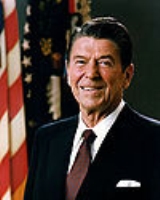
, also known as the Reagan Administration, was a Republican
Republican Party (United States)

The Republican Party is one of the two major party contemporary political parties in the United States, along with the Democratic Party . It is often called the Grand Old Party or the GOP....
 administration headed by Ronald Reagan from January 20, 1981 to January 20, 1989. Reagan was the first US president since Dwight D. Eisenhower
Dwight D. Eisenhower

Dwight David ?Ike? Eisenhower was the List of Presidents of the United States President of the United States from 1953 until 1961 and a General of the Army in the United States Army....
 to be re-elected and serve two complete terms in office.

Domestically, the administration favored reducing government programs and introduced the largest across-the-board tax cuts
Tax cut

A tax cut is a reduction in tax. Economic stimulus via tax cuts, along with interest rate intervention and deficit spending, are one of the central tenets of Keynesian economics....
 in American history.


Discussion
Ask a question about 'Reagan Administration'
Start a new discussion about 'Reagan Administration'
Answer questions from other users
Full Discussion Forum


Encyclopedia


The United States Presidency
President of the United States

The President of the United States is the head of state and head of government of the United States and is the highest political official in the United States by influence and recognition....
 of Ronald Reagan
Ronald Reagan

Ronald Wilson Reagan was the List of Presidents of the United States President of the United States and the 33rd Governor of California . Born in Illinois, Reagan moved to Los Angeles, California in the 1930s, where he was an actor, president of the Screen Actors Guild , and a spokesman for General Electric ....
, also known as the Reagan Administration, was a Republican
Republican Party (United States)

The Republican Party is one of the two major party contemporary political parties in the United States, along with the Democratic Party . It is often called the Grand Old Party or the GOP....
 administration headed by Ronald Reagan from January 20, 1981 to January 20, 1989. Reagan was the first US president since Dwight D. Eisenhower
Dwight D. Eisenhower

Dwight David ?Ike? Eisenhower was the List of Presidents of the United States President of the United States from 1953 until 1961 and a General of the Army in the United States Army....
 to be re-elected and serve two complete terms in office.

Domestically, the administration favored reducing government programs and introduced the largest across-the-board tax cuts
Tax cut

A tax cut is a reduction in tax. Economic stimulus via tax cuts, along with interest rate intervention and deficit spending, are one of the central tenets of Keynesian economics....
 in American history. The economic policies enacted in 1981, known as "Reaganomics
Reaganomics

Reaganomics refers to the Economics policies promoted by United States President Ronald Reagan during the 1980s. The four pillars of Reagan's economic policy were to:...
," were an example of supply-side economics
Economics

File:Ballard Farmers' Market - vegetables.jpgEconomics is the Social sciences that studies the Production theory basics, Distribution , and Consumption of Good and Service ....
. Reagan aimed to encourage entrepreneurship and limit the growth of social spending, as well as to reduce regulation and inflation
Inflation

In economics, inflation is a rise in the general price level of goods and services in an economy over a period of time. The term "inflation" once referred to increases in the money supply ; however, economic debates about the relationship between money supply and price levels have led to its primary use today in describing price inflatio...
. Economic growth saw a strong recovery in the 1980s, helping Reagan to win a landslide re-election. The national debt increased significantly, however.

Regarding foreign policy
Foreign policy

A state's foreign policy, also called the international relations policy, is a set of goals outlining how the country will interact with other countries economically, politically, socially and militarily, and to a lesser extent, how the country will interact with non-state actors....
, the administration was steadfastly anti-communist
Anti-communism

Anti-communism is opposition to communism. Historically, the word communism has been used to refer to several types of communal social organization and their supporters, but, since the mid-19th century, the dominant school of communism in the world has been Marxism....
, calling the Soviet Union
Soviet Union

The Union of Soviet Socialist Republics was a Constitution of the Soviet Union socialist state that existed in Eurasia from 1922 to 1991.The name is a translation of the , romanization of Russian Soyuz Sovetskikh Sotsialisticheskikh Respublik, abbreviated ????, SSSR....
 an "evil empire
Evil empire

The phrase evil empire was applied to the Soviet Union by President of the United States Ronald Reagan and United States American conservatism, who took an aggressive, hard-line stance that favored matching and exceeding the Soviet Union's strategic and global military capabilities....
" and ending 1970s détente
Détente

D?tente is a French language term, meaning a relaxing or easing; the term has been used in international politics since the early 1970s. Generally, it may be applied to any international situation where previously hostile nations not involved in an open war de-escalate tensions through diplomacy and confidence-building measures....
. Reagan ordered a massive buildup of the military, including an intervention in Grenada
Grenada

Grenada is an island nation that includes the southern Grenadines in the southeastern Caribbean Sea. Grenada is located northwest of Trinidad and Tobago, northeast of Venezuela, and southwest of Saint Vincent and the Grenadines....
, the first overseas action by US troops since the end of the Vietnam War
Vietnam War

The Vietnam War, also known as the Second Indochina Wars, the Vietnam Conflict, or often in Vietnam the American War occurred in Vietnam, Laos and Cambodia from 1959 to April 30, 1975....
. The "Reagan Doctrine
Reagan Doctrine

The Ronald Reagan Doctrine was a strategy orchestrated and implemented by the United States under the Reagan Administration to oppose the global influence of the Soviet Union during the final years of the Cold War....
" controversially granted aid to paramilitary
Paramilitary

A paramilitary is a force whose function and organisation are similar to those of a professional military force, but which is not regarded as having the same status....
 forces seeking to overthrow socialist
Socialism

Socialism refers to a broad set of economic theories of social organization advocating public or state ownership and administration of the means of production and distribution of goods, and a society characterized by equality for all individuals, with a fair or Egalitarianism method of compensation....
 governments, particularly in war-torn Central America and Afghanistan
Afghanistan

Afghanistan , officially the Islamic republic of Afghanistan, is a landlocked country that is located approximately in the center of Asia....
. Reagan also promoted new technologies such as missile defense
Missile defense

File:Spliced.fylingdales.jpgMissile defense is a system, weapon, or technology involved in the detection, tracking, interception and destruction of attacking missiles....
 systems in order to confront the Soviets and their allies. In diplomacy, Reagan forged a strong alliance with UK Prime Minister Margaret Thatcher
Margaret Thatcher

Margaret Hilda Thatcher, Baroness Thatcher Order of the Garter, Order of Merit, Her Majesty's Most Honourable Privy Council, Fellow of the Royal Society was Prime Minister of the United Kingdom from 1979 to 1990 and Leader of the Conservative Party of the Conservative Party from 1975 to 1990....
, and he met with Soviet General Secretary Mikhail Gorbachev
Mikhail Gorbachev

Mikhail Sergeyevich Gorbachev is a Russian politician. He was the last General Secretary of the Communist Party of the Soviet Union, serving from 1985 until 1991, and also the last head of state of the USSR, serving from 1988 until its collapse in 1991....
 four times, aiming to shrink the superpowers' nuclear arsenals.

Reagan's presidency is sometimes called the "Reagan Revolution," as it was seen to cause a political realignment
Realigning election

Realigning election or political realignment are terms from political science and political history describing a dramatic change in the political system....
 both within and beyond the US in favor of his brand of American conservatism
Conservatism

Conservatism is a political and social term whose meaning has changed in different countries and time periods, but which usually indicates support for the status quo or the status quo ante....
 and free market
Free market

A free market is a market that is free of government intervention and regulation, besides the minimal function of maintaining the legal system and protecting property rights, and is also free of private force and fraud....
s. The Reagan administration is often credited with the fall of the Soviet Union and the end of the Cold War
Cold War

The Cold War was the continuing state of conflict, tension and competition that existed between a number of world powers, including the United States, the Soviet Union, People's Republic of China, France, United Kingdom and those countries' respective allies from the mid-1940s to the early 1990s....
 after his departure from office, leading to a unipolar
Unipolar

Unipolar may refer to:* Unipolar depression or unipolar disorder: a state of intense sadness, melancholia or despair that has advanced to the point of being disruptive to an individual's social functioning and/or activities of daily living...
 world with the US as the world's sole superpower. While the damaging Iran-Contra affair
Iran-Contra Affair

The Iran-Contra affair was a American political scandals in the United States which came to light in November 1986, during the Presidency of Ronald Reagan, over an arms-for-hostages deal with Iran and funding for the Nicaraguan Contras....
 engulfed several administration officials during his second term, Reagan himself left office with a 64% approval rating
Approval rating

In the United States, presidential job approval ratings were introduced by George Gallup in the late 1930s to gauge public support for the president during his presidency....
, one of the higher approval ratings of departing presidents. The Reagan administration's actions and its ideology remain widely debated, even as there is agreement over its influence on US politics and global events in the decades since.

Overview

Reagan was an advocate of free markets and, upon taking office, believed that the American economy was hampered by excessive economic controls and misguided welfare programs enacted during the 1960s and 1970s. Taking office during a period of stagflation
Stagflation

Stagflation is an economic situation in which inflation and economic stagnation occur simultaneously and remain unchecked for a period of time. The Portmanteau word "stagflation" is generally attributed to British politician Iain Macleod, who coined the term in a speech to Parliament of the United Kingdom in 1965....
, Reagan said in his first inauguration speech, which he himself authored:

His first act as president was to issue an executive order ending certain price controls on domestic oil
Oil

An oil is a chemical substance that is in a viscosity liquid state at room temperature or slightly warmer, and is both hydrophobic and lipophilic ....
, which had contributed to the 1973 Oil Crisis
1973 oil crisis

The 1973 oil crisis started on October 15, 1973, when the members of Organization of Arab Petroleum Exporting Countries or the OAPEC proclaimed an oil embargo "in response to the U.S....
 and the 1979 Energy Crisis
1979 energy crisis

The 1979 oil crisis in the United States occurred in the wake of the Iranian Revolution. Amid massive protests, the Shah of Iran, Mohammad Reza Pahlavi, fled his country in early 1979, allowing Ayatollah Khomeini to gain control....
. The price of oil subsequently dropped, and the 1980s did not see the gasoline lines and fuel shortages that the 1970s had.

Reagan focused his first months in office on two goals, tax cuts and military spending, which was viewed as a successful way to tackle issues and echoed by later presidential advisers. Reagan's economic policies, similar to supply-side economics
Supply-side economics

Supply-side economics is a school of macroeconomic thought that argues that economic growth can be most effectively created using incentives for people to produce goods and services, such as adjusting income tax and capital gains tax rates, and by allowing greater flexibility by reducing regulation....
 and dubbed "Reaganomics
Reaganomics

Reaganomics refers to the Economics policies promoted by United States President Ronald Reagan during the 1980s. The four pillars of Reagan's economic policy were to:...
," achieved a 25% cut in the federal personal income tax
Income tax

An income tax is a tax levied on the financial income of people, corporations, or other legal entities. Various income tax systems exist, with varying degrees of tax incidence....
, moderate deregulation and tax reform, which he believed would remove barriers to efficient economic activity. After a sharp recession, a long period of high economic growth without significant inflation ensued.

Despite Reagan's stated desire to cut spending, federal spending grew during his administration. However, economist Milton Friedman
Milton Friedman

Milton Friedman was an United States economist, statistician and public intellectual, and a recipient of the Nobel Memorial Prize in Economic Sciences....
 pointed out that non-defense spending as a percentage of national income stabilized throughout Reagan's term, breaking a long upward trend; the number of new regulations added each year dramatically decreased as well.

One of Reagan's most controversial early moves was to fire most of the nation's air traffic controller
Air traffic controller

Air traffic controllers are people who operate the air traffic control system to expedite and maintain a safe and orderly flow of Aircraft and help prevent mid-air collisions....
s who took part in an illegal strike. Reagan strengthened Social Security
Social Security (United States)

Social security in the United States currently refers to the Federal government of the United States Old-Age, Survivors, and Disability Insurance program....
 to make it solvent longer by cutting disability benefits, and survivor benefits, and by increasing the FICA payroll withholding tax. He also took tough positions against crime, declared a renewed war on drugs
War on Drugs

The War on Drugs is a controversial prohibition campaign undertaken by the United States government with the assistance of participating countries, intended to reduce the illegal drug trade?to curb supply and diminish demand for specific psychoactive substances deemed immoral, harmful, dangerous, or undesirable....
, but was criticized for being slow to respond to the AIDS
AIDS

Acquired immune deficiency syndrome or acquired immunodeficiency syndrome is a disease of the human immune system caused by the HIV ....
 epidemic.

In foreign affairs, Reagan initially rejected détente
Détente

D?tente is a French language term, meaning a relaxing or easing; the term has been used in international politics since the early 1970s. Generally, it may be applied to any international situation where previously hostile nations not involved in an open war de-escalate tensions through diplomacy and confidence-building measures....
 and directly confronted the Soviet Union
Soviet Union

The Union of Soviet Socialist Republics was a Constitution of the Soviet Union socialist state that existed in Eurasia from 1922 to 1991.The name is a translation of the , romanization of Russian Soyuz Sovetskikh Sotsialisticheskikh Respublik, abbreviated ????, SSSR....
 through a policy of "peace through strength," including increased military spending, firm foreign policies against the USSR and, in what came to be known as the Reagan Doctrine
Reagan Doctrine

The Ronald Reagan Doctrine was a strategy orchestrated and implemented by the United States under the Reagan Administration to oppose the global influence of the Soviet Union during the final years of the Cold War....
, support for anti-communist rebel movements in Afghanistan
Afghanistan

Afghanistan , officially the Islamic republic of Afghanistan, is a landlocked country that is located approximately in the center of Asia....
, Angola
Angola

Angola, officially the Republic of Angola , is a country in south-central Africa bordering Namibia to the south, Democratic Republic of the Congo to the north, and Zambia to the east, and with a west coast along the Atlantic Ocean....
, Cambodia
Cambodia

The Kingdom of Cambodia is a country in South East Asia with a population of over 13 million people. The kingdom's capital and largest city is Phnom Penh....
, Nicaragua
Nicaragua

Nicaragua officially the Republic of Nicaragua , is a representative democracy republic. It is the largest state in Central America with an area of 130,000 km2, about the size of the state of New York....
 and elsewhere. Reagan later negotiated with Soviet General Secretary Mikhail Gorbachev
Mikhail Gorbachev

Mikhail Sergeyevich Gorbachev is a Russian politician. He was the last General Secretary of the Communist Party of the Soviet Union, serving from 1985 until 1991, and also the last head of state of the USSR, serving from 1988 until its collapse in 1991....
, a reformer, and together they contributed greatly to a peaceful end of the Cold War
Cold War

The Cold War was the continuing state of conflict, tension and competition that existed between a number of world powers, including the United States, the Soviet Union, People's Republic of China, France, United Kingdom and those countries' respective allies from the mid-1940s to the early 1990s....
.

Reagan authorized military action in Lebanon
Lebanon

Lebanon , officially the Republic of Lebanon or Lebanese Republic , is a country in Western Asia, on the eastern shore of the Mediterranean Sea....
, Grenada
Grenada

Grenada is an island nation that includes the southern Grenadines in the southeastern Caribbean Sea. Grenada is located northwest of Trinidad and Tobago, northeast of Venezuela, and southwest of Saint Vincent and the Grenadines....
, and Libya
Libya

Libya , officially the Great Socialist People's Libyan Arab Jamahiriya , is a country located in North Africa. Bordering the Mediterranean Sea to the north, Libya lies between Egypt to the east, Sudan to the southeast, Chad and Niger to the south, and Algeria and Tunisia to the west....
 throughout his terms in office. It was later discovered that the Administration also engaged in covert arms sales to Iran
Iran

Iran , officially the Islamic Republic of Iran and formerly known internationally as Persian Empire until 1935, is a country in Central Eurasia, located on the northeastern shore of the Persian Gulf and the southern shore of the Caspian Sea....
 in order to fund anti-communist Contra rebels in Nicaragua
Nicaragua

Nicaragua officially the Republic of Nicaragua , is a representative democracy republic. It is the largest state in Central America with an area of 130,000 km2, about the size of the state of New York....
. The resulting Iran-Contra Affair
Iran-Contra Affair

The Iran-Contra affair was a American political scandals in the United States which came to light in November 1986, during the Presidency of Ronald Reagan, over an arms-for-hostages deal with Iran and funding for the Nicaraguan Contras....
 became a scandal to which Reagan professed ignorance. A significant number of officials in the Reagan Administration were either convicted or forced to resign as a result of the scandal.

By the end of the Reagan presidency, a high level of public approval (64% of the nation) indicated that the administration had recovered its image among the American public due to the perceived restoration of America's power, prosperity and national pride.

Major issues of Presidency


Reagan's speeches

  • First Inaugural Address, (20 January 1981)
  • Second Inaugural Address, (20 January 1985)
  • First State of the Union Address, (26 January 1982)
  • Second State of the Union Address, (25 January 1983)
  • Third State of the Union Address, (25 January 1984)
  • Fourth State of the Union Address, (6 February 1985)
  • Fifth State of the Union Address, (4 February 1986)
  • Sixth State of the Union Address, (27 January 1987)
  • Seventh State of the Union Address, (25 January 1988)


Major acts as President


Major treaties

  • Canada-United States Free Trade Agreement of 1987
    Canada-United States Free Trade Agreement

    The Free Trade Agreement was a trade agreement signed by Canada and the United States onOctober 4, 1988. The agreement, finalized by October 1987, removed several trade restrictions in stages over a ten year period, and resulted in a great increase in cross-border trade....
  • Intermediate-Ranged Nuclear Forces Treaty of 1987 between the U.S. and Soviet Union


Major legislation signed

  • Economic Recovery Tax Act of 1981 - lowered income tax rates
  • Tax Equity and Fiscal Responsibility Act of 1982
    Tax Equity and Fiscal Responsibility Act of 1982

    The Tax Equity and Fiscal Responsibility Act of 1982 , a United States federal law, rescinded some of the effects of the Economic Recovery Tax Act passed the year before....
     - revoked some provisions of the Economic Recovery Tax Act of 1981
  • Social Security Amendments of 1983
    Social Security (United States)

    Social security in the United States currently refers to the Federal government of the United States Old-Age, Survivors, and Disability Insurance program....
     - amended Social Security to adjust for new retirees
  • 1984 Expansion of the Resource Conservation and Recovery Act of 1976 - tightened federal standards for the disposal of toxic waste and extends controls to small companies
  • Tax Reform Act of 1986
    Tax Reform Act of 1986

    The Congress of the United States passed the Tax Reform Act of 1986, to simplify the income tax code, broaden the tax base and eliminate many tax shelters and other preferences....
     - simplified the income tax code, broaden the tax base and eliminate many tax shelters and other preferences
  • Goldwater-Nichols Act of 1986
    Goldwater-Nichols Act

    The Goldwater-Nichols Department of Defense Reorganization Act of 1986 reworked the command structure of the United States military. It increased the powers of the Chairman of the Joint Chiefs of Staff....
     - sweeping change to the Department of Defense command structure
  • Immigration Reform and Control Act of 1986
    Immigration Reform and Control Act of 1986

    The Immigration Reform and Control Act , also Simpson-Mazzoli Act is an Law of the United States which reformed United States immigration law....
     - granted amnesty to illegal immigrants who entered the United States before January 1, 1982 and had resided there continuously


Major legislation vetoed

Reagan vetoed 78 bills during his two terms in office.

Administration and Cabinet


Supreme Court nominees

Reagan nominated the following jurists to the Supreme Court of the United States
Supreme Court of the United States

The Supreme Court of the United States is the highest judicial body in the United States, and leads the federal United States federal courts. It consists of the Chief Justice of the United States and eight Associate Justice of the Supreme Court of the United States, who are nominated by the President of the United States and confirmed with th...
:
  • Sandra Day O'Connor
    Sandra Day O'Connor

    Sandra Day O'Connor is an United States jurist and the first female Associate Justice of the Supreme Court of the United States of the Supreme Court of the United States....
     – 1981, making Reagan the first President to appoint a woman to the Supreme Court
  • William Rehnquist
    William Rehnquist

    William Hubbs Rehnquist was an Law of the United States, United States federal courts, and a Politics of the United States who served as an Associate Justice on the Supreme Court of the United States and later as the Chief Justice of the United States....
     – Chief Justice, 1986 (an associate justice since 1972)
  • Antonin Scalia
    Antonin Scalia

    is an United States jurist and the second most senior Associate Justice of the Supreme Court of the United States of the Supreme Court of the United States, appointed by Republican Party President Ronald Reagan....
     – 1986
  • Robert Bork
    Robert Bork

    Robert Heron Bork is a conservative United States legal scholar who advocates the judicial philosophy of originalism. Bork formerly served as United States Solicitor General, acting United States Attorney General, and judge for the United States Court of Appeals for the District of Columbia Circuit....
     – 1987 (rejected by Senate)
  • Douglas Ginsburg – 1987 (withdrawn)
  • Anthony M. Kennedy – 1988

Domestic policy


Foreign policy


Assassination attempt

On March 30, 1981, only 69 days into the new administration, Reagan, his press secretary James Brady
James Brady

James Scott ?Jim? Brady is a former Assistant to the President of the United States and White House Press Secretary under President Ronald Reagan....
, Washington police officer Thomas Delahanty, and Secret Service agent Timothy McCarthy were struck by gunfire from a deranged would-be assassin, John Hinckley, Jr.
John Hinckley, Jr.

John Warnock Hinckley, Jr. attempted to Reagan Assassination Attempt in Washington, D.C. on March 30, 1981, as the culmination of an effort to impress actress Jodie Foster....
. Reagan was exiting the Washington Hilton Hotel
Hilton Washington

The Hilton Washington is a hotel in Washington, D.C. It is located at 1919 Connecticut Avenue, N.W., roughly at the boundaries of the Kalorama, Washington, D.C., Dupont Circle, and Adams Morgan neighborhoods....
 following a speech to the building trades conference of the AFL/CIO when six shots were fired from a roped off area for bystanders. Reagan was pushed into the waiting limousine by Secret Service agent Jerry Parr. Parr described doing what he had learned in his training: "I heard these six shots, actually fired in less than two seconds, and that starts the action for an agent and you simply cover, first, and evacuate." Parr directed the chauffeur to drive to George Washington University Hospital where the president was brought into the emergency room and subsequently operated on. Missing his heart by less than an inch, the bullet instead pierced his left lung, which likely saved his life. Reagan's condition in the hospital room was critical, as his heartbeat was faint and he had a very low blood pressure. Doctor Joseph Giordano, head of the Reagan trauma team, described the president as being "close to death." In the operating room, the bullet which had entered under his left armpit was removed, but Reagan was left with a collapsed lung. After the surgery, the president joked to the surgeons, "I hope you're all Republicans!" Though they were not, Dr. Giordano replied, "Today, Mr. President, we're all Republicans." First Lady Nancy Reagan
Nancy Reagan

Nancy Davis Reagan is the widow of former President of the United States Ronald Reagan and served as an influential First Lady of the United States from 1981 to 1989....
 arrived at the hospital before her husband went into surgery; Reagan famously told her, "Honey, I forgot to duck" (using defeated boxer Jack Dempsey
Jack Dempsey

Jack "Manassa Mauler" Dempsey was an United States boxing who held the List of heavyweight boxing champions from 1919 to 1926. Dempsey's aggressive style and punching power made him one of the most popular boxers in history....
's quip). Reagan was released from the hospital on April 12, and was escorted back to the White House by Mrs. Reagan and their daughter Patti
Patti Davis

Patti Davis is the daughter of former President of the United States Ronald Reagan and First Lady of the United States Nancy Reagan. She is the older sister of Ron Reagan, the half-sister of Maureen Reagan, and has an adopted half-brother Michael Reagan....
.

Political philosophy

During his Presidency, Ronald Reagan pursued policies that reflected his optimism in individual freedom, expanded the American economy, and contributed to the end of the Cold War
Cold War

The Cold War was the continuing state of conflict, tension and competition that existed between a number of world powers, including the United States, the Soviet Union, People's Republic of China, France, United Kingdom and those countries' respective allies from the mid-1940s to the early 1990s....
. The "Reagan Revolution", as it came to be known, aimed to reinvigorate American morale, and reduce the people's reliance upon government. As President, Reagan kept a series of leather bound diaries, in which he talked about daily occurrences of his presidency, commented on current issues around the world (expressing his point of view on most of them), and frequently mentioned his wife, Nancy
Nancy Reagan

Nancy Davis Reagan is the widow of former President of the United States Ronald Reagan and served as an influential First Lady of the United States from 1981 to 1989....
. The diaries were recently published into the bestselling book, The Reagan Diaries
The Reagan Diaries

The Reagan Diaries is an edited version of diaries written by President of the United States Ronald Reagan while in the White House. The book is edited by Douglas Brinkley, while the full, unedited diaries will be published in 2009....
.

As a politician and as President, Ronald Reagan portrayed himself as being a conservative
American conservatism

Conservatism in the United States is a major United States political ideology. In contemporary American politics, it is often associated with the Republican Party ....
, anti-communist
Anti-communism

Anti-communism is opposition to communism. Historically, the word communism has been used to refer to several types of communal social organization and their supporters, but, since the mid-19th century, the dominant school of communism in the world has been Marxism....
, in favor of tax cuts, in favor of smaller government (with the exclusion of the military), and in favor of removing regulations on corporation
Corporation

A corporation is a legal entity separate from the persons that form it. It is a legal entity owned by individual stockholders. In British tradition it is the term designating a body corporate, where it can be either a corporation sole or a corporation aggregate ....
s. Ronald Reagan is credited with increasing spending on national defense and diplomacy which contributed to the end of the Cold War
Cold War

The Cold War was the continuing state of conflict, tension and competition that existed between a number of world powers, including the United States, the Soviet Union, People's Republic of China, France, United Kingdom and those countries' respective allies from the mid-1940s to the early 1990s....
, deploying U.S. Pershing II missiles in West Germany in response to the Soviet stationing of SS-20 missiles near Europe, negotiating the Intermediate-Range Nuclear Forces Treaty
Intermediate-Range Nuclear Forces Treaty

The Intermediate-Range Nuclear Forces Treaty was a 1987 agreement between the United States and the Soviet Union. Signed in Washington, D.C. by President of the United States Ronald Reagan and General Secretary of the Communist Party of the Soviet Union Mikhail Gorbachev on December 8, 1987, it was ratified by the United States Senate on Ma...
 (INF) to substantially reduce nuclear arms and initiating negotiations with the Soviet Union
Soviet Union

The Union of Soviet Socialist Republics was a Constitution of the Soviet Union socialist state that existed in Eurasia from 1922 to 1991.The name is a translation of the , romanization of Russian Soyuz Sovetskikh Sotsialisticheskikh Respublik, abbreviated ????, SSSR....
 for the treaty that would later be known as START I
START I

START is a treaty between the United States of America and the Soviet Union on the Reduction and Limitation of Strategic Offensive Arms. The treaty was signed by the United States and the USSR, that barred its signatories from deploying more than 6,000 nuclear warheads atop a total of 1,600 ICBMs, submarine-launched ballistic missiles, and...
, proposing the Strategic Defense Initiative
Strategic Defense Initiative

The Strategic Defense Initiative was a proposal by U.S. President Ronald Reagan on March 23, 1983 to use ground and space-based systems to protect the United States from attack by strategic nuclear weapon ballistic missiles....
, a controversial plan to develop a missile defense system, re-appointing monetarists
Monetarism

Monetarism is a school of economic thought concerning the determination of measures of national income and output and monetary economics. It focuses on the supply of money in an economy as the primary means by which the rate of inflation is determined....
 Paul Volcker
Paul Volcker

Paul Adolph Volcker is an American economist. He was the Chairman of the Federal Reserve under President of the United Statess Jimmy Carter and Ronald Reagan ....
 and (later) Alan Greenspan
Alan Greenspan

Alan Greenspan is an United States economist and was the Chairman of the Federal Reserve of the United States from 1987 to 2006. He currently works as a private advisor and providing consulting for firms through his company, Greenspan Associates LLC....
 to be chairmen of the Federal Reserve, ending the high inflation
Inflation

In economics, inflation is a rise in the general price level of goods and services in an economy over a period of time. The term "inflation" once referred to increases in the money supply ; however, economic debates about the relationship between money supply and price levels have led to its primary use today in describing price inflatio...
 that damaged the economy under his predecessors Jimmy Carter
Jimmy Carter

James Earl "Jimmy" Carter, Jr. served as the List of Presidents of the United States President of the United States from 1977 to 1981 and was the recipient of the 2002 Nobel Peace Prize....
 and Gerald Ford
Gerald Ford

Gerald Rudolph Ford, Jr. was the List of Presidents of the United States President of the United States, serving from 1974 to 1977, and the List of Vice Presidents of the United States Vice President of the United States serving from 1973 to 1974....
, lowering tax rates significantly (under Reagan, the top personal tax bracket dropped from 70% to 28% in 7 years ) and leading a major reform of the tax system, providing arms and other support to anti-communist groups such as the Contras and the mujahideen
Mujahideen

A Mujahid is a person involved in a jihad. The plural is Mujahideen . The word is from the same Arabic triliteral as jihad ....
, selling arms to foreign allies such as Taiwan
Republic of China

The Republic of China , also known as Nationalist China is a country in East Asia that has evolved from a single-party state with full global recognition into a multi-party democratic state with Political status of Taiwan....
, Israel
Israel

Israel officially the State of Israel , is a country in the Middle East located on the eastern shore of the Mediterranean Sea. It borders Lebanon in the north, Syria in the northeast, Jordan in the east, and Egypt on the southwest, and contains geographically diverse features within its relatively small area....
, Saudi Arabia
Saudi Arabia

The Kingdom of Saudi Arabia, KSA , is an Arab country and the largest country of the Arabian Peninsula. It is bordered by Jordan on the northwest, Iraq on the north and northeast, Kuwait, Qatar, Bahrain, and the United Arab Emirates on the east, Oman on the southeast, and Yemen on the south....
, and Iraq
Iraq

Iraq , officially the Republic of Iraq , is a country in Western Asia spanning most of the northwestern end of the Zagros Mountains, the eastern part of the Syrian Desert and the northern part of the Arabian Desert....
 (see Iran–Iraq War), greatly escalating the "war on drugs
War on Drugs

The War on Drugs is a controversial prohibition campaign undertaken by the United States government with the assistance of participating countries, intended to reduce the illegal drug trade?to curb supply and diminish demand for specific psychoactive substances deemed immoral, harmful, dangerous, or undesirable....
" with his policies and Nancy Reagan
Nancy Reagan

Nancy Davis Reagan is the widow of former President of the United States Ronald Reagan and served as an influential First Lady of the United States from 1981 to 1989....
's "Just Say No
Just Say No

"Just Say No" was an advertising campaign, part of the United States "War on Drugs", prevalent during the 1980s and early 1990s, to discourage children from engaging in recreational drug use by offering various ways of saying no....
" campaign, ordering the April 14, 1986 bombing of Tripoli
Tripoli

Tripoli is the largest and Capital city of Libya.Tripoli has a population of 1.69 million. The city is located in the northwest of the country on the edge of the desert, on a point of rocky land projecting into the Mediterranean Sea and forming a bay....
 and Benghazi
Benghazi

Benghazi or Bengasi is the second largest city in Libya and the main city of the Cyrenaica region . It is also a Districts of Libya of Libya of the wider city area....
 in retaliation for an April 5 bombing
1986 Berlin discotheque bombing

The Berlin discotheque bombing of April 5, 1986 was a terrorist attack on the La Belle discotheque, West Berlin, Germany, that was frequented by U.S....
 of a West Berlin
West Berlin

West Berlin was the name given to the western part of Berlin between 1949 and 1990. It consisted of the American, British, and French occupation sectors established in 1945....
 nightclub frequented by U.S. servicemen, in which the Libyan government was deemed complicit, and signing the Civil Liberties Act of 1988
Civil Liberties Act of 1988

The Civil Liberties Act of 1988 is a United States federal law that granted reparation to Japanese-Americans who had been Japanese American internment during World War II....
 which compensated victims of the Japanese American Internment
Japanese American internment

Japanese American internment refers to the forcible relocation and internment of approximately 110,000 Japanese people and Japanese Americans to housing facilities called "War Relocation Camps", in the wake of Imperial Japan's attack on Pearl Harbor....
 during World War II
World War II

World War II, or the Second World War , was a global military conflict which involved a Participants in World War II, including all of the great powers, organised into two opposing military alliances: the Allies of World War II and the Axis powers....
.

Controversy

During this time, five controversies developed which resulted in a number of administration staffers being convicted of crimes or misdemeanors. The most well-known was the Iran-Contra affair
Iran-Contra Affair

The Iran-Contra affair was a American political scandals in the United States which came to light in November 1986, during the Presidency of Ronald Reagan, over an arms-for-hostages deal with Iran and funding for the Nicaraguan Contras....
.

The HUD
United States Department of Housing and Urban Development

The United States Department of Housing and Urban Development, also known by the term, HUD, is a United States Cabinet department of the United States federal government of the United States....
 controversy involved administration staffers granting federal funding to constituents and defrauding the US government out of money intended for low-income housing. Judge Arlin Adamns obtained the following convictions:

  1. James Watt
    James G. Watt

    James Gaius Watt served as United States Secretary of the Interior under President of the United States Ronald Reagan from 1981 to 1983....
    , Reagan's Secretary of the Interior was indicted on 24 felony counts and pled guilty to a single misdemeanor. He was sentenced to five years probation, and ordered to pay a $5000 fine.
  2. Philip Winn - Assistant HUD Secretary. Pleaded guilty to one count of scheming to give illegal gratuities.
  3. Thomas Demery
    Thomas Demery

    Thomas T. Demery was the Assistant Secretary of the United States Department of Housing and Urban Development during the Ronald Reagan presidency....
     - Assistant HUD Secretary - pleaded guilty to steering HUD subsidies to politically connected donors.
  4. Deborah Gore Dean
    Deborah Gore Dean

    Deborah Gore Dean is a former United States federal employee, in the US Department of Housing and Urban Development during the Ronald Reagan presidency, she is also a distant relative of the famous Senator Albert Gore Sr....
     - executive assistant to Samuel Pierce
    Samuel Pierce

    Samuel Riley Pierce, Jr. was Ronald Reagan's United States Secretary of Housing and Urban Development....
     - indicted on thirteen counts, three counts of conspiracy, one count of accepting an illegal gratuity, four counts of perjury, and five counts of concealing articles. She was convicted on twelve accounts. She appealed and prevailed on several accounts but the convictions for conspiracy remained.
  5. Catalina Villaponda - Former US Treasurer, HUD
  6. Joseph A. Strauss - Accepting kickbacks


When an administration staff member leaves office, federal law governs how quickly one can begin a lobbying career.
  • Michael Deaver
    Michael Deaver

    Michael Keith Deaver was a member of President Ronald Reagan's Executive Office of the President of the United States serving as Deputy White House Chief of Staff under James Baker III and Donald Regan from January 1981 until May 1985....
    , Reagan’s Chief of Staff, was convicted of lying to both a congressional committee and to a federal grand jury about his lobbying activities after he left the government. He received three years probation and was fined one hundred thousand dollars after being convicted for lying to a congressional subcommittee.
  • Lyn Nofziger
    Lyn Nofziger

    Franklyn C. "Lyn" Nofziger was an United States journalist, political consultant and author. He served as press secretary in Ronald Reagan's administration as Governor of California, and as a White House advisor during the Richard Nixon administration and again during the Reagan presidency....
    —White House Press Secretary - Convicted on charges of illegal lobbying after leaving government service in Wedtech scandal. His conviction was later overturned.


The Environmental Protection Agency
United States Environmental Protection Agency

The U.S. Environmental Protection Agency is an List of United States federal agencies of the federal government of the United States charged to Regulation of chemicals and protect human health by safeguarding the natural environment: air, water, and land....
 Scandal arose when it was discovered that the administration was releasing Superfund
Superfund

Superfund is the common name for the Environmental policy of the United States officially known as the Comprehensive Environmental Response, Compensation, and Liability Act , enacted by the United States Congress on December 11, 1980 in response to the Love Canal disaster and the environmental contamination at the Valley of the Drums....
 grants for cleaning up local toxic waste sites to enhance the election prospects of local officials aligned with the Republican Party
Republican Party (United States)

The Republican Party is one of the two major party contemporary political parties in the United States, along with the Democratic Party . It is often called the Grand Old Party or the GOP....
.
  1. Rita Lavelle
    Rita Lavelle

    Rita M. Lavelle is a United States and California Republican Party political figure. Lavelle was convicted on federal charges of perjury related to an investigation into misuse of the United States Environmental Protection Agency's "Superfund" money during her tenure with the agency, and irregularities at the Stringfellow Acid Pit, a major...
     was convicted of lying to Congress and served three months of a six-month prison sentence. Also involving the EPA
    United States Environmental Protection Agency

    The U.S. Environmental Protection Agency is an List of United States federal agencies of the federal government of the United States charged to Regulation of chemicals and protect human health by safeguarding the natural environment: air, water, and land....
    : funds from the Superfund
    Superfund

    Superfund is the common name for the Environmental policy of the United States officially known as the Comprehensive Environmental Response, Compensation, and Liability Act , enacted by the United States Congress on December 11, 1980 in response to the Love Canal disaster and the environmental contamination at the Valley of the Drums....
     to clean up toxic waste sites were released to enhance the election prospects of local politicians aligned with the administration.


Reagan's "elimination of loopholes" in the tax code
Tax code

In the United Kingdom, every person paid under the PAYE scheme is allocated a tax code by HM Revenue & Customs. This is in the form of a number followed by a letter or letters, or a letter followed by numbers....
 included the elimination of the "passive loss" provisions that subsidized rental housing. Because this was removed retroactively, it bankrupted many real estate developments made with this tax break as a premise. This with some other "deregulation" policies ultimately led to the largest political and financial scandal in U.S. history: The Savings and Loan crisis
Savings and Loan crisis

The savings and loan crisis of the 1980s and 1990s was the failure of 747 savings and loan associations in the United States. The ultimate cost of the crisis is estimated to have totaled around United States dollar160.1 billion, about $124.6 billion of which was directly paid for by the U.S....
. The ultimate cost of the crisis is estimated to have totaled around USD$150 billion, about $125 billion of which was consequently and directly subsidized by the U.S. government, which contributed to the large budget deficits of the early 1990s.

An indication of this scandal's size, Martin Mayer wrote at the time, "The theft from the taxpayer by the community that fattened on the growth of the savings and loan (S&L) industry in the 1980s is the worst public scandal in American history. Teapot Dome in the Harding administration and the Credit Mobilier
Credit Mobilier

Credit Mobilier may refer to:* Cr?dit Mobilier of America scandal of 1872* Cr?dit Mobilier, French bank...
 in the times of Ulysses S. Grant
Ulysses S. Grant

Ulysses S. Grant, born Hiram Ulysses Grant , was an United States general and the List of Presidents of the United States President of the United States ....
 have been taken as the ultimate horror stories of capitalist
Capitalism

Capitalism is an economic system in which wealth, and the means of producing wealth, are private property and controlled rather than commonly, publicly, or state-owned and controlled....
 democracy gone to seed. Measuring by money, [or] by the misallocation of national resources...the S&L outrage makes Teapot Dome and Credit Mobilier seem minor episodes."

John Kenneth Galbraith

John Kenneth "Ken" Galbraith, Order of Canada was a Canadian-American economics. He was a Keynesian economics and an institutional economics, a leading proponent of 20th-century American liberalism and Progressivism in the United States....
 called it "the largest and costliest venture in public misfeasance, malfeasance and larceny of all time."

Other matters

Although Reagan's second term was mostly noteworthy for matters related to foreign affairs, he supported significant pieces of legislation on domestic matters. In 1982, Reagan signed legislation reauthorizing the Voting Rights Act of 1965 for another 25 years, even though he had opposed such an extension during the 1980 campaign. This extension added protections for blind, disabled, and illiterate voters.

Other significant legislation included the overhaul of the Internal Revenue Code in 1986
Tax Reform Act of 1986

The Congress of the United States passed the Tax Reform Act of 1986, to simplify the income tax code, broaden the tax base and eliminate many tax shelters and other preferences....
, as well as the Civil Liberties Act of 1988
Civil Liberties Act of 1988

The Civil Liberties Act of 1988 is a United States federal law that granted reparation to Japanese-Americans who had been Japanese American internment during World War II....
 which compensated victims of the Japanese-American internment during World War II. As well as those, Reagan signed legislation authorizing the death penalty for offenses involving murder in the context of large-scale drug trafficking; wholesale reinstatement of the federal death penalty did not occur until the presidency of Bill Clinton
Bill Clinton

William Jefferson "Bill" Clinton served as the List of Presidents of the United States President of the United States from 1993 to 2001. He was the fifteenth Democrat elected to that office....
.

Reagan's position on gay rights
LGBT

LGBT is an acronym and initialism referring collectively to Lesbian,Gay, Bisexuality, and Transgender people. In use since the 1990s, the term ?LGBT? is an adaptation of the initialism ?LGBT? which itself started replacing the phrase ?gay community? which many within LGBT communities felt did not represent accurately all those to which it...
 has been a subject of controversy. In the late 1970s he wrote a private response to the organization backing the California Briggs Initiative, stating that he opposed the proposed ban on gay public school teachers or anyone who supported gay rights. He opposed efforts to repeal the criminal laws against homosexuality and generally opposed gay rights legislation as eroding traditional moral values. Yet his daughter, Patti Davis
Patti Davis

Patti Davis is the daughter of former President of the United States Ronald Reagan and First Lady of the United States Nancy Reagan. She is the older sister of Ron Reagan, the half-sister of Maureen Reagan, and has an adopted half-brother Michael Reagan....
, wrote in article in the New York Times where she recalled her father talking about Rock Hudson's
Rock Hudson

Rock Hudson was an United States film and television actor, recognised as a romantic leading man during the 1960s and 1970s. Hudson was voted 'Star of the Year', 'Favorite Leading Man', and similar titles by numerous movie magazines and was unquestionably one of the most popular and well-known movie stars of the time....
 homosexuality in an accepting and tolerant manner.

The oldest president

As Reagan was the oldest person to be inaugurated as president (age 69), and also the oldest person to hold the office (age 77), his health, although generally good, became a concern at times during his presidency. His age even became a topic of concern during his re-election campaign. In a debate on October 21, 1984 between Reagan and his opponent Walter Mondale
Walter Mondale

Walter Frederick Mondale is an Politics of the United States and member of the Minnesota Democratic-Farmer-Labor Party. He was the List of Vice Presidents of the United States Vice President of the United States under President of the United States Jimmy Carter, a two-term United States Senate from Minnesota, and the very unsuccessful Democ...
, panelist Henry Trewhitt brought up how President Kennedy had to go for days on end without sleep during the Cuban Missile crisis. He then asked the President if he had any doubts about if or how he could function in a time of crisis, given his age. Reagan remarked, "I am not going to make age an issue of this campaign. I am not going to exploit, for political purposes, my opponent's youth and inexperience," generating applause and laughter from the audience. Mondale (who was 56 at the time) said years later in an interview that he knew at that moment he had lost the election.

On July 13, 1985, Reagan underwent surgery to remove polyp
Polyp (medicine)

A polyp is an abnormal growth of tissue projecting from a mucous membrane. If it is attached to the surface by a narrow elongated pedicle it is said to be pedunculated....
s from his colon
Colon (anatomy)

The colon is the last portion of the digestive system in most vertebrates; it extracts water and salt from feces before they are defecation from the body....
, causing the first-ever invocation of the Acting President
Acting President of the United States

Acting President of the United States is a reference to a person who is legitimately exercising the Presidential powers even though that person does not hold the office of the President of the United States....
 clause of the 25th Amendment
Twenty-fifth Amendment to the United States Constitution

The Twenty-fifth Amendment to the United States Constitution deals with succession to the United States Presidency and establishes procedures both for filling a vacancy in the office of the United States Vice President, as well as responding to Presidential disabilities....
. On January 5, 1987, Reagan underwent surgery for prostate cancer
Prostate cancer

Prostate cancer is a disease in which cancer develops in the prostate, a gland in the male reproductive system. It occurs when cell s of the prostate Mutation and begin to multiply out of control....
 which caused further worries about his health, but which significantly raised the public awareness of this "silent killer."

Former White House correspondent Lesley Stahl
Lesley Stahl

Lesley Rene Stahl is an United States of America television journalist. , she has reported for CBS on 60 Minutes for 19 seasons....
 later wrote that she and other reporters noticed what might have been early symptoms of Reagan's later Alzheimer's Disease
Alzheimer's disease

Alzheimer's disease , also called Alzheimer disease, Senile Dementia of the Alzheimer Type or simply Alzheimer's, is the most common form of dementia....
. She said that on her last day on the beat, Reagan spoke to her for a few moments and didn't seem to know who she was, before then returning to his normal self. However, Reagan's primary physician, Dr. John Hutton, said the president "absolutely" did not "show any signs of dementia or Alzheimer's." His doctors noted that he began exhibiting Alzheimer's symptoms only after he left the White House.

Close of the Reagan Era

In 1988, Reagan's Vice President, George H. W. Bush
George H. W. Bush

George Herbert Walker Bush served as the List of Presidents of the United States President of the United States from 1989 to 1993. Bush held a variety of political positions prior to his presidency, including Vice President of the United States in the administration of Ronald Reagan and Director of Central Intelligence under Gerald R....
, was elected to succeed Reagan as President of the United States. On January 11, 1989, Reagan addressed the nation for the last time on television from the Oval Office
Oval Office

| File:Barack Obama and Hillary Clinton in the Oval Office.jpg|-| |-| |-| |-| |-| |-| |-| |-| |}The Oval Office is the official office of the President of the United States....
, nine days before handing over the presidency to Bush. On the morning of January 20, 1989, Ronald and Nancy Reagan met with the Bushes for coffee at the White House before escorting them to the Capitol Building, where Bush took the oath of office
Oath of office

An oath of office is an oath or Affirmation in law a person takes before undertaking the duties of an office, usually a position in government or within a religious body, although such oaths are sometimes required of officers of other organizations....
. The Reagans then boarded a Presidential helicopter, and flew to Andrews Air Force Base
Andrews Air Force Base

Andrews Air Force Base is a United States Air Force base in Prince George's County, Maryland, Maryland, United States, eight miles east of Washington, D.C.....
 in Maryland
Maryland

Maryland is a U.S. state located in the Mid Atlantic States of the United States, bordering Virginia, West Virginia and the Washington, D.C. to the south and west, Pennsylvania to the north, and Delaware to the east....
. There, they boarded the Presidential Jet (in this instance, it was not called Air Force One
Air Force One

Air Force One is the air traffic control call sign of any United States Air Force aircraft carrying the President of the United States. Since 1990, the presidential fleet has consisted of two specifically configured, highly customized Boeing 747-200#747-200 series aircraft ? Tail Code "28000" and "29000" ? with Air Force designation "Boeing...
), and flew home to California
California

California is a U.S. state on the West Coast of the United States of the United States, along the Pacific Ocean. It is bordered by Oregon to the north, Nevada to the east, Arizona to the southeast, and to the south the Mexico state of Baja California....
—to their new home in the wealthy suburb of Bel Air in Los Angeles. Reagan was the oldest president to serve (at 77), surpassing Dwight Eisenhower, who was 70 when he left office in 1961.

See also

  • U.S. presidential election, 1976
  • U.S. presidential election, 1980
  • U.S. presidential election, 1984
  • History of the United States (1980-1988)
  • Ronald Reagan Presidential Library
    Ronald Reagan Presidential Library

    The Ronald Reagan Presidential Library and Center for Public Affairs is the presidential library of Ronald Reagan, the 40th President of the United States....
     in Simi Valley, California
  • List of honors named for Ronald Reagan
  • 600-ship Navy
    600-ship Navy

    The 600 Ship Navy was a military strategy plan of the United States Navy during the 1980s to rebuild its fleet after cutbacks that followed the end of the Vietnam War....
  • Ronald Reagan on Wikiquote


Footnotes


Further reading