

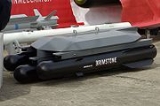
Missile

Encyclopedia
Though a missile may be any thrown or launched object, it colloquially almost always refers to a self-propelled guided weapon system.
verb mittere, meaning "to send". In military parlance, powered/guided munitions are broadly categorised as follows:
A common further sub-division is to consider ballistic missile
to mean a munition that follows a ballistic trajectory and cruise missile
to describe a munition that generates lift.
in World War II
. Most famous of these are the V-1 flying bomb
and V-2, both of which used a simple mechanical autopilot
to keep the missile flying along a pre-chosen route. Less well known were a series of anti-shipping and anti-aircraft missiles, typically based on a simple radio control
system directed by the operator. However, these early systems in World War 2 were only built in small numbers.
, such as infrared
, laser
s or radio wave
s, to guide the missile onto its target. This radiation may emanate from the target (such as the heat of an engine or the radio waves from an enemy radar), it may be provided by the missile itself (such as a radar) or it may be provided by a friendly third party (such as the radar of the launch vehicle/platform, or a laser designator operated by friendly infantry
). The first two are often known as fire-and-forget
as they need no further support or control from the launch vehicle/platform in order to function. Another method is to use a TV camera—using either visible light or infra-red—in order to see the target. The picture may be used either by a human operator who steers the missile onto its target, or by a computer doing much the same job. Many missiles use a combination of two or more of the above methods, to improve accuracy and the chances of a successful engagement.
, TERCOM
or GPS. This guidance system guides the missile by knowing the missile's current position and the position of the target, and then calculating a course between them. This job can also be performed somewhat crudely by a human operator who can see the target and the missile, and guides it using either cable or radio based remote-control, or by an automatic system that can simultaneously track the target and the missile.
s, most commonly of the turbojet type, due to its relative simplicity and low frontal area. Turbofan
s and ramjet
s are the only other common forms of jet engine propulsion, although any type of engine could theoretically be used. Missiles often have multiple engine stages, particularly in those launched from the ground. These stages may all be of similar types or may include a mix of engine types.
s, although other weapon types may also be used. The warhead or warheads of a missile provides its primary destructive power (many missiles have extensive secondary destructive power due to the high kinetic energy of the weapon and unburnt fuel that may be on board). Warheads are most commonly of the high explosive type, often employing shaped charge
s to exploit the accuracy of a guided weapon to destroy hardened targets. Other warhead types include submunitions, incendiaries
, nuclear weapons, chemical, biological or radiological weapon
s or kinetic energy penetrator
s.
Warheadless missiles are often used for testing and training purposes.
missile). Most weapons require some modification in order to be launched from the air or ground, such as adding boosters to the ground launched version.
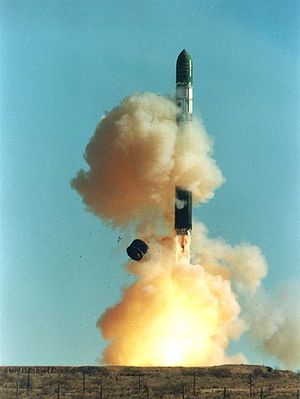 After the boost-stage, ballistic missiles follow a trajectory
mainly determined by ballistics
. The guidance is for relatively small deviations from that.
Ballistic missiles are largely used for land attack missions. Although normally associated with nuclear weapons, some conventionally armed ballistic missiles are in service, such as ATACMS. The V2 had demonstrated that a ballistic missile could deliver a warhead to a target city with no possibility of interception, and the introduction of nuclear weapon
s meant it could do useful damage when it arrived. The accuracy of these systems was fairly poor, but post-war development by most military forces improved the basic inertial platform concept to the point where it could be used as the guidance system on ICBMs flying thousands of kilometers. Today the ballistic missile represents the only strategic deterrent
in most military forces, however some ballistic missiles are being adapted for conventional roles, such as the Russian Iskander or the Chinese DF-21D anti-ship ballistic missile
. Ballistic missiles are primarily surface launched from mobile launchers
, silos, ships
or submarines
, with air launch being theoretically possible using a weapon such as the canceled Skybolt missile.
The Russia
n Topol M (SS-27 Sickle B)
is the fastest (7,320 m/sec) missile currently in service
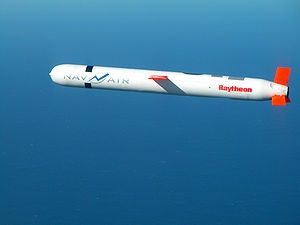 The V1
had been successfully intercepted during World War II
, but this did not make the cruise missile
concept entirely useless. After the war, the US deployed a small number of nuclear-armed cruise missiles in Germany, but these were considered to be of limited usefulness. Continued research into much longer ranged and faster versions led to the US's Navaho missile, and its Soviet
counterparts, the Burya
and Buran cruise missile
. However, these were rendered largely obsolete by the ICBM, and none were used operationally. Shorter-range developments have become widely used as highly accurate attack systems, such as the US Tomahawk missile, the Russian Kh-55 the German Taurus missile
, the Indian BrahMos
fastest supersonic cruise missile and the Pakistani Babur cruise missile.
Cruise missiles are generally associated with land attack operations, but also have an important role as anti-shipping weapons. They are primarily launched from air, sea or submarine platforms in both roles, although land based launchers also exist.
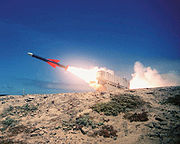 Another major German missile development project was the anti-shipping class (such as the Fritz X
and Henschel Hs 293
), intended to stop any attempt at a cross-channel invasion. However the British were able to render their systems useless by jamming their radios, and missiles with wire guidance were not ready by D-Day
. After the war the anti-shipping class slowly developed, and became a major class in the 1960s with the introduction of the low-flying jet- or rocket-powered cruise missiles known as "sea-skimmers". These became famous during the Falklands War
when an Argentine Exocet missile
sank a Royal Navy
destroyer.
A number of anti-submarine missiles also exist; these generally use the missile in order to deliver another weapon system such as a torpedo
or depth charge
to the location of the submarine, at which point the other weapon will conduct the underwater phase of the mission.
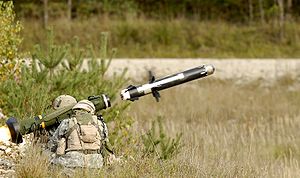 By the end of WWII all forces had widely introduced unguided rockets using HEAT
warheads as their major anti-tank weapon (see Panzerfaust
, Bazooka
). However these had a limited useful range of a 100 m or so, and the Germans were looking to extend this with the use of a missile using wire guidance, the X-7. After the war this became a major design class in the later 1950s, and by the 1960s had developed into practically the only non-tank anti-tank system in general use. During the 1973 Yom Kippur War
between Israel and Egypt, the 9M14 Malyutka (aka "Sagger") man-portable anti-tank missile proved potent against Israeli tanks. While other guidance systems have been tried, the basic reliability of wire-guidance means this will remain the primary means of controlling anti-tank missile in the near future. Anti tank missiles may be launched from aircraft, vehicles or by ground troops in the case of smaller weapons.
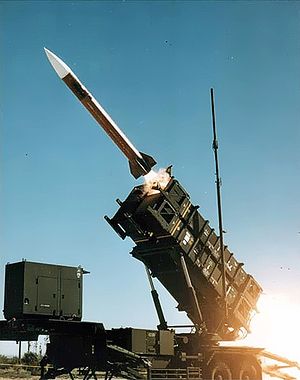 By 1944 US and British air forces were sending huge air fleets over occupied Europe, increasing the pressure on the Luftwaffe
day and night fighter forces. The Germans were keen to get some sort of useful ground-based anti-aircraft system into operation. Several systems were under development, but none had reached operational status before the war's end. The US Navy
also started missile research to deal with the Kamikaze
threat. By 1950 systems based on this early research started to reach operational service, including the US Army
's Nike Ajax, the Navy's "3T's" (Talos, Terrier, Tartar), and soon followed by the Soviet S-25 Berkut and S-75 Dvina
and French and British systems. Anti-aircraft weapons exist for virtually every possible launch platform, with surface launched systems ranging from huge, self propelled or ship mounted launchers to man portable systems.
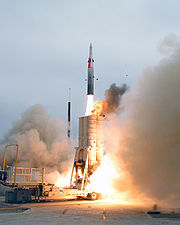 Like most missiles, the Arrow missile, S-300, S-400
and MIM-104 Patriot
are for defense against short-range missiles and carry explosive warheads.
However, in the case of a large closing speed, a projectile without explosives is used, just a collision
is sufficient to destroy the target. See Missile Defense Agency
for the following systems being developed:
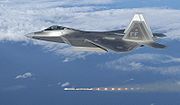 Soviet RS-82 rocket
s were successfully tested in combat at the Battle of Khalkhin Gol
in 1939.
German experience in WWII demonstrated that destroying a large aircraft was quite difficult, and they had invested considerable effort into air-to-air missile
systems to do this. Their Me-262's jets often carried R4M rockets, and other types of "bomber destroyer" aircraft had unguided rockets as well. In the post-war period the R4M served as the pattern for a number of similar systems, used by almost all interceptor aircraft during the 1940s and '50s. Lacking guidance systems, such rockets had to be carefully aimed at relatively close range to successfully hit the target. The US Navy and U.S. Air Force began deploying guided missiles in the early 1950s, most famous being the US Navy's AIM-9 Sidewinder
and USAF's AIM-4 Falcon
. These systems have continued to advance, and modern air warfare consists almost entirely of missile firing. In the Falklands War
, less powerful British Harriers
were able to defeat faster Argentinian opponents using AIM-9G missiles provided by the United States as the conflict began. The latest heat-seeking designs can lock onto a target from various angles, not just from behind, where the heat signature from the engines is strongest. Other types rely on radar guidance (either on-board or "painted" by the launching aircraft). Air to Air missiles also have a wide range of sizes, ranging from helicopter launched self defense weapons with a range of a few kilometers, to long range weapons designed for interceptor aircraft such as the Vympel R-37
.
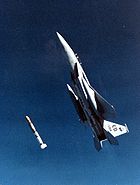 In the 1950s and 1960s, Soviet designers started work on an anti-satellite weapon, called the "Istrebitel Sputnik
", which meant literally, Interceptor of satellites, or Destroyer of satellites. After a lengthy development process of roughly 20 years, it was finally decided that testing of the Istrebitel Sputnik be canceled. Ironically, this was when the U.S. started testing their own systems. From the mid 1970s onwards, the Soviets tested Directed-energy weapon
s with a facility named Terra-3
, although relatively underpowered to perform a full anti-satellite attack, it was used to cause malfunctions on board the Space Shuttle Challenger
in 1984. The proposed Brilliant Pebbles
defense system during the 1980s would use kinetic energy collisions without explosives. Anti satellite weapons may be launched either by an aircraft or a surface platform, depending on the design. To date, only a few known tests have occurred.
Etymology
The word missile comes from the LatinLatin
Latin is an Italic language originally spoken in Latium and Ancient Rome. It, along with most European languages, is a descendant of the ancient Proto-Indo-European language. Although it is considered a dead language, a number of scholars and members of the Christian clergy speak it fluently, and...
verb mittere, meaning "to send". In military parlance, powered/guided munitions are broadly categorised as follows:
- A powered, guided munition that travels through the air or space is known as a missile (or guided missile.)
- A powered, unguided munition is known as a rocketRocket (weapon)A rocket is a self propelled, unguided weapon system powered by a rocket motor.- Categorisation :In military parlance, powered munitions are broadly categorised as follows:* A powered, unguided munition is known as a rocket....
. - Unpowered munitions are called bombBombA bomb is any of a range of explosive weapons that only rely on the exothermic reaction of an explosive material to provide an extremely sudden and violent release of energy...
s whether guided or not; unpowered, guided munitions are known as guided bombGuided bombA guided bomb is a precision-guided munition intended to precisely hit a specific target, and to minimize damage to things other than the target....
s or "smart bombs". - Munitions that are fired from a gunGunA gun is a muzzle or breech-loaded projectile-firing weapon. There are various definitions depending on the nation and branch of service. A "gun" may be distinguished from other firearms in being a crew-served weapon such as a howitzer or mortar, as opposed to a small arm like a rifle or pistol,...
are known as shellsShell (projectile)A shell is a payload-carrying projectile, which, as opposed to shot, contains an explosive or other filling, though modern usage sometimes includes large solid projectiles properly termed shot . Solid shot may contain a pyrotechnic compound if a tracer or spotting charge is used...
whether guided or not. - Powered munitions that travel through water are called torpedoTorpedoThe modern torpedo is a self-propelled missile weapon with an explosive warhead, launched above or below the water surface, propelled underwater towards a target, and designed to detonate either on contact with it or in proximity to it.The term torpedo was originally employed for...
es.
A common further sub-division is to consider ballistic missile
Ballistic missile
A ballistic missile is a missile that follows a sub-orbital ballistic flightpath with the objective of delivering one or more warheads to a predetermined target. The missile is only guided during the relatively brief initial powered phase of flight and its course is subsequently governed by the...
to mean a munition that follows a ballistic trajectory and cruise missile
Cruise missile
A cruise missile is a guided missile that carries an explosive payload and is propelled, usually by a jet engine, towards a land-based or sea-based target. Cruise missiles are designed to deliver a large warhead over long distances with high accuracy...
to describe a munition that generates lift.
Early development
The first missiles to be used operationally were a series of missiles developed by Nazi GermanyNazi Germany
Nazi Germany , also known as the Third Reich , but officially called German Reich from 1933 to 1943 and Greater German Reich from 26 June 1943 onward, is the name commonly used to refer to the state of Germany from 1933 to 1945, when it was a totalitarian dictatorship ruled by...
in World War II
World War II
World War II, or the Second World War , was a global conflict lasting from 1939 to 1945, involving most of the world's nations—including all of the great powers—eventually forming two opposing military alliances: the Allies and the Axis...
. Most famous of these are the V-1 flying bomb
V-1 flying bomb
The V-1 flying bomb, also known as the Buzz Bomb or Doodlebug, was an early pulse-jet-powered predecessor of the cruise missile....
and V-2, both of which used a simple mechanical autopilot
Autopilot
An autopilot is a mechanical, electrical, or hydraulic system used to guide a vehicle without assistance from a human being. An autopilot can refer specifically to aircraft, self-steering gear for boats, or auto guidance of space craft and missiles...
to keep the missile flying along a pre-chosen route. Less well known were a series of anti-shipping and anti-aircraft missiles, typically based on a simple radio control
Radio control
Radio control is the use of radio signals to remotely control a device. The term is used frequently to refer to the control of model vehicles from a hand-held radio transmitter...
system directed by the operator. However, these early systems in World War 2 were only built in small numbers.
Technology
Guided missiles have a number of different system components:- Targeting and/or guidance
- Flight system
- EngineEngineAn engine or motor is a machine designed to convert energy into useful mechanical motion. Heat engines, including internal combustion engines and external combustion engines burn a fuel to create heat which is then used to create motion...
- WarheadWarheadThe term warhead refers to the explosive material and detonator that is delivered by a missile, rocket, or torpedo.- Etymology :During the early development of naval torpedoes, they could be equipped with an inert payload that was intended for use during training, test firing and exercises. This...
Guidance systems
Missiles may be targeted in a number of ways. The most common method is to use some form of radiationRadiation
In physics, radiation is a process in which energetic particles or energetic waves travel through a medium or space. There are two distinct types of radiation; ionizing and non-ionizing...
, such as infrared
Infrared
Infrared light is electromagnetic radiation with a wavelength longer than that of visible light, measured from the nominal edge of visible red light at 0.74 micrometres , and extending conventionally to 300 µm...
, laser
Laser
A laser is a device that emits light through a process of optical amplification based on the stimulated emission of photons. The term "laser" originated as an acronym for Light Amplification by Stimulated Emission of Radiation...
s or radio wave
Radio Wave
Radio Wave may refer to:*Radio frequency*Radio Wave 96.5, a radio station in Blackpool, UK...
s, to guide the missile onto its target. This radiation may emanate from the target (such as the heat of an engine or the radio waves from an enemy radar), it may be provided by the missile itself (such as a radar) or it may be provided by a friendly third party (such as the radar of the launch vehicle/platform, or a laser designator operated by friendly infantry
Infantry
Infantrymen are soldiers who are specifically trained for the role of fighting on foot to engage the enemy face to face and have historically borne the brunt of the casualties of combat in wars. As the oldest branch of combat arms, they are the backbone of armies...
). The first two are often known as fire-and-forget
Fire-and-forget
Fire-and-forget is a third-generation method of missile guidance. The military uses the term for a type of missile which does not require further guidance after launch such as illumination of the target or wire guidance , and can hit its target without the launcher being in line-of-sight of the...
as they need no further support or control from the launch vehicle/platform in order to function. Another method is to use a TV camera—using either visible light or infra-red—in order to see the target. The picture may be used either by a human operator who steers the missile onto its target, or by a computer doing much the same job. Many missiles use a combination of two or more of the above methods, to improve accuracy and the chances of a successful engagement.
Targeting systems
Another method is to target the missile by knowing the location of the target, and using a guidance system such as INSInertial navigation system
An inertial navigation system is a navigation aid that uses a computer, motion sensors and rotation sensors to continuously calculate via dead reckoning the position, orientation, and velocity of a moving object without the need for external references...
, TERCOM
TERCOM
Terrain Contour Matching, or TERCOM, is a navigation system used primarily by cruise missiles. It uses a pre-recorded contour map of the terrain that is compared to measurements made during flight by an on-board radar altimeter. A TERCOM system considerably increases the accuracy of a missile...
or GPS. This guidance system guides the missile by knowing the missile's current position and the position of the target, and then calculating a course between them. This job can also be performed somewhat crudely by a human operator who can see the target and the missile, and guides it using either cable or radio based remote-control, or by an automatic system that can simultaneously track the target and the missile.
Flight system
Whether a guided missile uses a targeting system, a guidance system or both, it needs a flight system. The flight system uses the data from the targeting or guidance system to maneuver the missile in flight, allowing it to counter inaccuracies in the missile or to follow a moving target. There are two main systems: vectored thrust (for missiles that are powered throughout the guidance phase of their flight) and aerodynamic maneuvering (wings, fins, canards, etc.).Engine
Missiles are powered by an engine, generally either a type of rocket or jet engine. Rockets are generally of the solid fuel type for ease of maintenance and fast deployment, although some larger ballistic missiles use liquid fuel rockets. Jet engines are generally used in cruise missileCruise missile
A cruise missile is a guided missile that carries an explosive payload and is propelled, usually by a jet engine, towards a land-based or sea-based target. Cruise missiles are designed to deliver a large warhead over long distances with high accuracy...
s, most commonly of the turbojet type, due to its relative simplicity and low frontal area. Turbofan
Turbofan
The turbofan is a type of airbreathing jet engine that is widely used for aircraft propulsion. A turbofan combines two types of engines, the turbo portion which is a conventional gas turbine engine, and the fan, a propeller-like ducted fan...
s and ramjet
Ramjet
A ramjet, sometimes referred to as a stovepipe jet, or an athodyd, is a form of airbreathing jet engine using the engine's forward motion to compress incoming air, without a rotary compressor. Ramjets cannot produce thrust at zero airspeed and thus cannot move an aircraft from a standstill...
s are the only other common forms of jet engine propulsion, although any type of engine could theoretically be used. Missiles often have multiple engine stages, particularly in those launched from the ground. These stages may all be of similar types or may include a mix of engine types.
Warhead
Missiles generally have one or more explosive warheadWarhead
The term warhead refers to the explosive material and detonator that is delivered by a missile, rocket, or torpedo.- Etymology :During the early development of naval torpedoes, they could be equipped with an inert payload that was intended for use during training, test firing and exercises. This...
s, although other weapon types may also be used. The warhead or warheads of a missile provides its primary destructive power (many missiles have extensive secondary destructive power due to the high kinetic energy of the weapon and unburnt fuel that may be on board). Warheads are most commonly of the high explosive type, often employing shaped charge
Shaped charge
A shaped charge is an explosive charge shaped to focus the effect of the explosive's energy. Various types are used to cut and form metal, to initiate nuclear weapons, to penetrate armor, and in the oil and gas industry...
s to exploit the accuracy of a guided weapon to destroy hardened targets. Other warhead types include submunitions, incendiaries
Incendiary device
Incendiary weapons, incendiary devices or incendiary bombs are bombs designed to start fires or destroy sensitive equipment using materials such as napalm, thermite, chlorine trifluoride, or white phosphorus....
, nuclear weapons, chemical, biological or radiological weapon
Radiological weapon
A radiological weapon or radiological dispersion device is any weapon that is designed to spread radioactive material with the intent to kill, and cause disruption upon a city or nation....
s or kinetic energy penetrator
Kinetic energy penetrator
A kinetic energy penetrator is a type of ammunition which, like a bullet, does not contain explosives and uses kinetic energy to penetrate the target....
s.
Warheadless missiles are often used for testing and training purposes.
Basic roles
Missiles are generally categorized by their launch platform and intended target. In broadest terms, these will either be surface (ground or water) or air, and then sub-categorized by range and the exact target type (such as anti-tank or anti-ship). Many weapons are designed to be launched from both surface or the air, and a few are designed to attack either surface or air targets (such as the ADATSAir Defense Anti-Tank System
The Air Defense Anti-Tank System is a dual-purpose short range surface-to-air and anti-tank missile system based on the M113A2 vehicle. It is manufactured by the Swiss company Oerlikon-Contraves, a member of the Rheinmetall Defence Group of Germany....
missile). Most weapons require some modification in order to be launched from the air or ground, such as adding boosters to the ground launched version.
Ballistic
Trajectory
A trajectory is the path that a moving object follows through space as a function of time. The object might be a projectile or a satellite, for example. It thus includes the meaning of orbit—the path of a planet, an asteroid or a comet as it travels around a central mass...
mainly determined by ballistics
Ballistics
Ballistics is the science of mechanics that deals with the flight, behavior, and effects of projectiles, especially bullets, gravity bombs, rockets, or the like; the science or art of designing and accelerating projectiles so as to achieve a desired performance.A ballistic body is a body which is...
. The guidance is for relatively small deviations from that.
Ballistic missiles are largely used for land attack missions. Although normally associated with nuclear weapons, some conventionally armed ballistic missiles are in service, such as ATACMS. The V2 had demonstrated that a ballistic missile could deliver a warhead to a target city with no possibility of interception, and the introduction of nuclear weapon
Nuclear weapon
A nuclear weapon is an explosive device that derives its destructive force from nuclear reactions, either fission or a combination of fission and fusion. Both reactions release vast quantities of energy from relatively small amounts of matter. The first fission bomb test released the same amount...
s meant it could do useful damage when it arrived. The accuracy of these systems was fairly poor, but post-war development by most military forces improved the basic inertial platform concept to the point where it could be used as the guidance system on ICBMs flying thousands of kilometers. Today the ballistic missile represents the only strategic deterrent
Deterrence theory
Deterrence theory gained increased prominence as a military strategy during the Cold War with regard to the use of nuclear weapons, and features prominently in current United States foreign policy regarding the development of nuclear technology in North Korea and Iran. Deterrence theory however was...
in most military forces, however some ballistic missiles are being adapted for conventional roles, such as the Russian Iskander or the Chinese DF-21D anti-ship ballistic missile
Anti-ship ballistic missile
An anti-ship ballistic missile is a military quasiballistic missile system currently in developement, of medium or intermediate range, designed to hit a warship at sea...
. Ballistic missiles are primarily surface launched from mobile launchers
Transporter erector launcher
A transporter erector launcher is a vehicle with an integrated prime mover that can carry, elevate to firing position and launch one or more missiles. Such vehicles exist for both surface-to-air missiles and surface-to-surface missiles...
, silos, ships
Warship
A warship is a ship that is built and primarily intended for combat. Warships are usually built in a completely different way from merchant ships. As well as being armed, warships are designed to withstand damage and are usually faster and more maneuvrable than merchant ships...
or submarines
Ballistic missile submarine
A ballistic missile submarine is a submarine equipped to launch ballistic missiles .-Description:Ballistic missile submarines are larger than any other type of submarine, in order to accommodate SLBMs such as the Russian R-29 or the American Trident...
, with air launch being theoretically possible using a weapon such as the canceled Skybolt missile.
The Russia
Russia
Russia or , officially known as both Russia and the Russian Federation , is a country in northern Eurasia. It is a federal semi-presidential republic, comprising 83 federal subjects...
n Topol M (SS-27 Sickle B)
RT-2UTTH Topol M
The RT-2UTTKh «Topol-M» is one of the most recent intercontinental ballistic missiles to be deployed by Russia , and the first to be developed after the dissolution of the Soviet Union....
is the fastest (7,320 m/sec) missile currently in service
Cruise missile
V-1 flying bomb
The V-1 flying bomb, also known as the Buzz Bomb or Doodlebug, was an early pulse-jet-powered predecessor of the cruise missile....
had been successfully intercepted during World War II
World War II
World War II, or the Second World War , was a global conflict lasting from 1939 to 1945, involving most of the world's nations—including all of the great powers—eventually forming two opposing military alliances: the Allies and the Axis...
, but this did not make the cruise missile
Cruise missile
A cruise missile is a guided missile that carries an explosive payload and is propelled, usually by a jet engine, towards a land-based or sea-based target. Cruise missiles are designed to deliver a large warhead over long distances with high accuracy...
concept entirely useless. After the war, the US deployed a small number of nuclear-armed cruise missiles in Germany, but these were considered to be of limited usefulness. Continued research into much longer ranged and faster versions led to the US's Navaho missile, and its Soviet
Soviet Union
The Soviet Union , officially the Union of Soviet Socialist Republics , was a constitutionally socialist state that existed in Eurasia between 1922 and 1991....
counterparts, the Burya
Burya
The Burya was a trisonic, intercontinental cruise missile developed by the Lavochkin design bureau , based on a request for proposal issued by the Soviet government in 1954. The purpose of the design competition was to develop a cruise missile capable of delivering a nuclear payload to the United...
and Buran cruise missile
Buran cruise missile
The Buran cruise missile, designation RSS-40, was a Soviet intercontinental cruise missile capable of carrying a 3,500 kg nuclear warhead. The project was canceled before flight tests began.-Development:...
. However, these were rendered largely obsolete by the ICBM, and none were used operationally. Shorter-range developments have become widely used as highly accurate attack systems, such as the US Tomahawk missile, the Russian Kh-55 the German Taurus missile
Taurus missile
TAURUS KEPD 350 is a German/Swedish air-launched cruise missile, manufactured by TAURUS Systems and used by Germany and Spain. TAURUS Systems GmbH is a partnership between LFK and Saab Bofors Dynamics.-Overview:...
, the Indian BrahMos
BrahMos
BrahMos is a stealth supersonic cruise missile that can be launched from submarines, ships, aircraft or land. It is a joint venture between Republic of India's Defence Research and Development Organisation and Russian Federation's NPO Mashinostroeyenia who have together formed BrahMos Aerospace...
fastest supersonic cruise missile and the Pakistani Babur cruise missile.
Cruise missiles are generally associated with land attack operations, but also have an important role as anti-shipping weapons. They are primarily launched from air, sea or submarine platforms in both roles, although land based launchers also exist.
Anti-ship
Fritz X
Fritz X was the most common name for a German guided anti-ship glide bomb used during World War II. Fritz X was a nickname used both by Allied and Luftwaffe personnel. Alternate names include Ruhrstahl SD 1400 X, Kramer X-1, PC 1400X or FX 1400...
and Henschel Hs 293
Henschel Hs 293
The Henschel Hs 293 was a World War II German anti-ship guided missile: a radio-controlled glide bomb with a rocket engine slung underneath it. It was designed by Herbert A. Wagner.- History :...
), intended to stop any attempt at a cross-channel invasion. However the British were able to render their systems useless by jamming their radios, and missiles with wire guidance were not ready by D-Day
D-Day
D-Day is a term often used in military parlance to denote the day on which a combat attack or operation is to be initiated. "D-Day" often represents a variable, designating the day upon which some significant event will occur or has occurred; see Military designation of days and hours for similar...
. After the war the anti-shipping class slowly developed, and became a major class in the 1960s with the introduction of the low-flying jet- or rocket-powered cruise missiles known as "sea-skimmers". These became famous during the Falklands War
Falklands War
The Falklands War , also called the Falklands Conflict or Falklands Crisis, was fought in 1982 between Argentina and the United Kingdom over the disputed Falkland Islands and South Georgia and the South Sandwich Islands...
when an Argentine Exocet missile
Exocet
The Exocet is a French-built anti-ship missile whose various versions can be launched from surface vessels, submarines, helicopters and fixed wing aircraft. Hundreds were fired in combat during the 1980s.-Etymology:...
sank a Royal Navy
Royal Navy
The Royal Navy is the naval warfare service branch of the British Armed Forces. Founded in the 16th century, it is the oldest service branch and is known as the Senior Service...
destroyer.
A number of anti-submarine missiles also exist; these generally use the missile in order to deliver another weapon system such as a torpedo
Torpedo
The modern torpedo is a self-propelled missile weapon with an explosive warhead, launched above or below the water surface, propelled underwater towards a target, and designed to detonate either on contact with it or in proximity to it.The term torpedo was originally employed for...
or depth charge
Depth charge
A depth charge is an anti-submarine warfare weapon intended to destroy or cripple a target submarine by the shock of exploding near it. Most use explosives and a fuze set to go off at a preselected depth in the ocean. Depth charges can be dropped by either surface ships, patrol aircraft, or from...
to the location of the submarine, at which point the other weapon will conduct the underwater phase of the mission.
Anti-tank
Heat
In physics and thermodynamics, heat is energy transferred from one body, region, or thermodynamic system to another due to thermal contact or thermal radiation when the systems are at different temperatures. It is often described as one of the fundamental processes of energy transfer between...
warheads as their major anti-tank weapon (see Panzerfaust
Panzerfaust
The Panzerfaust was an inexpensive, recoilless German anti-tank weapon of World War II. It consisted of a small, disposable preloaded launch tube firing a high explosive anti-tank warhead, operated by a single soldier...
, Bazooka
Bazooka
Bazooka is the common name for a man-portable recoilless rocket antitank weapon, widely fielded by the U.S. Army. Also referred to as the "Stovepipe", the innovative bazooka was amongst the first-generation of rocket propelled anti-tank weapons used in infantry combat...
). However these had a limited useful range of a 100 m or so, and the Germans were looking to extend this with the use of a missile using wire guidance, the X-7. After the war this became a major design class in the later 1950s, and by the 1960s had developed into practically the only non-tank anti-tank system in general use. During the 1973 Yom Kippur War
Yom Kippur War
The Yom Kippur War, Ramadan War or October War , also known as the 1973 Arab-Israeli War and the Fourth Arab-Israeli War, was fought from October 6 to 25, 1973, between Israel and a coalition of Arab states led by Egypt and Syria...
between Israel and Egypt, the 9M14 Malyutka (aka "Sagger") man-portable anti-tank missile proved potent against Israeli tanks. While other guidance systems have been tried, the basic reliability of wire-guidance means this will remain the primary means of controlling anti-tank missile in the near future. Anti tank missiles may be launched from aircraft, vehicles or by ground troops in the case of smaller weapons.
Anti-aircraft
Luftwaffe
Luftwaffe is a generic German term for an air force. It is also the official name for two of the four historic German air forces, the Wehrmacht air arm founded in 1935 and disbanded in 1946; and the current Bundeswehr air arm founded in 1956....
day and night fighter forces. The Germans were keen to get some sort of useful ground-based anti-aircraft system into operation. Several systems were under development, but none had reached operational status before the war's end. The US Navy
United States Navy
The United States Navy is the naval warfare service branch of the United States Armed Forces and one of the seven uniformed services of the United States. The U.S. Navy is the largest in the world; its battle fleet tonnage is greater than that of the next 13 largest navies combined. The U.S...
also started missile research to deal with the Kamikaze
Kamikaze
The were suicide attacks by military aviators from the Empire of Japan against Allied naval vessels in the closing stages of the Pacific campaign of World War II, designed to destroy as many warships as possible....
threat. By 1950 systems based on this early research started to reach operational service, including the US Army
United States Army
The United States Army is the main branch of the United States Armed Forces responsible for land-based military operations. It is the largest and oldest established branch of the U.S. military, and is one of seven U.S. uniformed services...
's Nike Ajax, the Navy's "3T's" (Talos, Terrier, Tartar), and soon followed by the Soviet S-25 Berkut and S-75 Dvina
S-75 Dvina
The S-75 Dvina is a Soviet-designed, high-altitude, command guided, surface-to-air missile system...
and French and British systems. Anti-aircraft weapons exist for virtually every possible launch platform, with surface launched systems ranging from huge, self propelled or ship mounted launchers to man portable systems.
Anti-ballistic
S-400
The S-400 Triumf is a new generation anti-aircraft weapon system developed by Russia's Almaz Central Design Bureau as an upgrade of the S-300 family. It is currently in limited service with the Russian Armed Forces....
and MIM-104 Patriot
MIM-104 Patriot
The MIM-104 Patriot is a surface-to-air missile system, the primary of its kind used by the United States Army and several allied nations. It is manufactured by the Raytheon Company of the United States. The Patriot System replaced the Nike Hercules system as the U.S. Army's primary High to Medium...
are for defense against short-range missiles and carry explosive warheads.
However, in the case of a large closing speed, a projectile without explosives is used, just a collision
Collision
A collision is an isolated event which two or more moving bodies exert forces on each other for a relatively short time.Although the most common colloquial use of the word "collision" refers to accidents in which two or more objects collide, the scientific use of the word "collision" implies...
is sufficient to destroy the target. See Missile Defense Agency
Missile Defense Agency
The Missile Defense Agency is the section of the United States government's Department of Defense responsible for developing a layered defense against ballistic missiles. The agency has its origins in the Strategic Defense Initiative, which was established in 1983 and was headed by Lt...
for the following systems being developed:
- Kinetic Energy InterceptorKinetic Energy InterceptorThe Kinetic Energy Interceptor was a planned U.S. missile defense program whose goal was to design, develop, and deploy kinetic energy-based, mobile, ground and sea-launched missiles that could intercept and destroy enemy ballistic missiles during their boost, ascent and midcourse phases of flight...
(KEI) - Aegis Ballistic Missile Defense SystemAegis Ballistic Missile Defense SystemThe Aegis Ballistic Missile Defense System is a United States Department of Defense Missile Defense Agency program developed to provide defense against ballistic missiles. It is part of the United States national missile defense strategy...
(Aegis BMD) - a SM-3RIM-161 Standard Missile 3The RIM-161 Standard Missile 3 is a ship-based missile system used by the US Navy to intercept short-to intermediate-range ballistic missiles as a part of Aegis Ballistic Missile Defense System. Although primarily designed as an anti-ballistic missile, the SM-3 has also been employed in an...
missile with Lightweight Exo-Atmospheric Projectile (LEAP) Kinetic Warhead (KW)
Air-to-air
RS-82 rocket
RS-82 and RS-132 were unguided rockets used by Soviet military aircraft in World War II.-Development:...
s were successfully tested in combat at the Battle of Khalkhin Gol
Battle of Khalkhin Gol
The Battles of Khalkhyn Gol was the decisive engagement of the undeclared Soviet–Japanese Border Wars fought among the Soviet Union, Mongolia and the Empire of Japan in 1939. The conflict was named after the river Khalkhyn Gol, which passes through the battlefield...
in 1939.
German experience in WWII demonstrated that destroying a large aircraft was quite difficult, and they had invested considerable effort into air-to-air missile
Air-to-air missile
An air-to-air missile is a missile fired from an aircraft for the purpose of destroying another aircraft. AAMs are typically powered by one or more rocket motors, usually solid fuelled but sometimes liquid fuelled...
systems to do this. Their Me-262's jets often carried R4M rockets, and other types of "bomber destroyer" aircraft had unguided rockets as well. In the post-war period the R4M served as the pattern for a number of similar systems, used by almost all interceptor aircraft during the 1940s and '50s. Lacking guidance systems, such rockets had to be carefully aimed at relatively close range to successfully hit the target. The US Navy and U.S. Air Force began deploying guided missiles in the early 1950s, most famous being the US Navy's AIM-9 Sidewinder
AIM-9 Sidewinder
The AIM-9 Sidewinder is a heat-seeking, short-range, air-to-air missile carried mostly by fighter aircraft and recently, certain gunship helicopters. The missile entered service with United States Air Force in the early 1950s, and variants and upgrades remain in active service with many air forces...
and USAF's AIM-4 Falcon
AIM-4 Falcon
The Hughes AIM-4 Falcon was the first operational guided air-to-air missile of the United States Air Force.-Development:Development of a guided air-to-air missile began in 1946. Hughes Aircraft was awarded a contract for a subsonic missile under the project designation MX-798, which soon gave way...
. These systems have continued to advance, and modern air warfare consists almost entirely of missile firing. In the Falklands War
Falklands War
The Falklands War , also called the Falklands Conflict or Falklands Crisis, was fought in 1982 between Argentina and the United Kingdom over the disputed Falkland Islands and South Georgia and the South Sandwich Islands...
, less powerful British Harriers
Harrier Jump Jet
The Harrier, informally referred to as the Jump Jet, is a family of British-designed military jet aircraft capable of vertical/short takeoff and landing operations...
were able to defeat faster Argentinian opponents using AIM-9G missiles provided by the United States as the conflict began. The latest heat-seeking designs can lock onto a target from various angles, not just from behind, where the heat signature from the engines is strongest. Other types rely on radar guidance (either on-board or "painted" by the launching aircraft). Air to Air missiles also have a wide range of sizes, ranging from helicopter launched self defense weapons with a range of a few kilometers, to long range weapons designed for interceptor aircraft such as the Vympel R-37
Vympel R-37
The Vympel R-37 is a Russian air-to-air missile with an extremely long range. It has also had the names K-37, Izdeliye 610 and R-VD , and the NATO codename 'Andi'.It was designed to shoot down AWACS and other C4ISTAR aircraft whilst keeping the launch platform out of range of any fighters...
.
Anti-satellite
Istrebitel Sputnik
Istrebitel Sputnik , or IS , was a Soviet anti-satellite weapons programme which led to the deployment of the IS-A or I2P system during the 1970s and 1980s...
", which meant literally, Interceptor of satellites, or Destroyer of satellites. After a lengthy development process of roughly 20 years, it was finally decided that testing of the Istrebitel Sputnik be canceled. Ironically, this was when the U.S. started testing their own systems. From the mid 1970s onwards, the Soviets tested Directed-energy weapon
Directed-energy weapon
A directed-energy weapon emits energy in an aimed direction without the means of a projectile. It transfers energy to a target for a desired effect. Intended effects may be non-lethal or lethal...
s with a facility named Terra-3
Terra-3
Terra-3 is a laser testing centre, located on the Sary Shagan anti-ballistic missile testing range in Karagandy Province of Kazakhstan. -Development:...
, although relatively underpowered to perform a full anti-satellite attack, it was used to cause malfunctions on board the Space Shuttle Challenger
Space Shuttle Challenger
Space Shuttle Challenger was NASA's second Space Shuttle orbiter to be put into service, Columbia having been the first. The shuttle was built by Rockwell International's Space Transportation Systems Division in Downey, California...
in 1984. The proposed Brilliant Pebbles
Strategic Defense Initiative
The Strategic Defense Initiative was proposed by U.S. President Ronald Reagan on March 23, 1983 to use ground and space-based systems to protect the United States from attack by strategic nuclear ballistic missiles. The initiative focused on strategic defense rather than the prior strategic...
defense system during the 1980s would use kinetic energy collisions without explosives. Anti satellite weapons may be launched either by an aircraft or a surface platform, depending on the design. To date, only a few known tests have occurred.
See also
- List of missiles
- List of missiles by nation
- List of World War II guided missiles of Germany
- AeropredictionAeropredictionThe Aeroprediction Code is a semi-empirical computer program that estimates the aerodynamics of weapons over the Mach number range 0 to 20, angle of attack range 0 to 90 degrees and for configurations that have various cross sectional body shapes. Weapons considered include projectiles, missiles,...
- Center of pressureCenter of pressureThe center of pressure is the point on a body where the total sum of a pressure field acts, causing a force and no moment about that point. The total force vector acting at the center of pressure is the value of the integrated vectorial pressure field. The resultant force and center of pressure...
- Fire-and-forgetFire-and-forgetFire-and-forget is a third-generation method of missile guidance. The military uses the term for a type of missile which does not require further guidance after launch such as illumination of the target or wire guidance , and can hit its target without the launcher being in line-of-sight of the...
- GPS/INSGPS/INSGPS/INS refers to the use of GPS satellite signals to correct or calibrate a solution from an Inertial Navigation System . Inertial navigation systems usually can only provide an accurate solution for a short period of time. The INS accelerometers will produce an unknown bias signal that appears...
- Missile designationMissile designationThe U.S. Department of Defense established a missile and rocket designation sequence, which is used in all weapons of the kind produced in the USA.-Explanation:The basic designation of every guided missile is based in a set of letters, which are in sequence...
- Proportional navigationProportional navigationProportional navigation is a guidance law used in some form or another by most homing air target missiles. It is based on the fact that two vehicles are on a collision course when their direct Line-of-Sight does not change direction...
- Pursuit guidancePursuit guidancePursuit guidance is a form of guidance widely used in older ground attack missiles.In pursuit guidance, the missile is steered so that the velocity vector of the missile always points at the target. In the early days of guided missiles where the computers were analog this was an easy...
- Q-guidanceQ-guidanceQ-guidance is a method of missile guidance used in some U.S. ballistic missiles and some civilian space flights. It was developed in the 1950's by J...
- Redstone missileRedstone (rocket)The PGM-11 Redstone was the first large American ballistic missile. A short-range surface-to-surface rocket, it was in active service with the U.S. Army in West Germany from June 1958 to June 1964 as part of NATO's Cold War defense of Western Europe...
- ScramjetScramjetA scramjet is a variant of a ramjet airbreathing jet engine in which combustion takes place in supersonic airflow...
- Shoulder-launched missile weaponShoulder-launched missile weaponA shoulder-fired missile, shoulder-launched missile or man-portable missile is a projectile fired at a target, small enough to be carried by a single person, and fired while held on one's shoulder...
- Skid-to-turnSkid-to-turnSkid-to-turn is an aeronautical vehicle reference for how such a vehicle may be turned. It applies to vehicles such as aircraft and missiles. In skid-to-turn, the vehicle does not roll to a preferred angle. Instead commands to the control surfaces are mixed to produce the maneuver in the desired...
- Timeline of rocket and missile technologyTimeline of rocket and missile technology-15th Century:* 1448 - During the era of Sejong the Great, the 4th King of the Joseon Dynasty of Korea, Koreans invented the World's first gunpowdered multi-missile launchers called Singijeon or Hwacha.-17th Century:...
- Trajectory optimizationTrajectory optimizationTrajectory optimization is the process of designing a trajectory that minimizes or maximizes some measure of performance within prescribed constraint boundaries...
- V-1 flying bombV-1 flying bombThe V-1 flying bomb, also known as the Buzz Bomb or Doodlebug, was an early pulse-jet-powered predecessor of the cruise missile....
- V-2 missile
- Broken ArrowBroken ArrowBroken Arrow may refer to:*Broken Arrow, Oklahoma, United States*Broken Arrow Public Schools- Film and television :*Broken Arrow , a Golden Globe-winning western film...
External links
- S. A. Kamal, A. Mirza: The Multi-Stage-Q System and the Inverse-Q System for Possible application in SLV, Proc. IBCAST 2005, Volume 3, Control and Simulation, Edited by Hussain SI, Munir A, Kiyani J, Samar R, Khan MA, National Center for Physics, Bhurban, KP, Pakistan, 2006, pp 27–33 Free Full Text
- S. A. Kamal: Incorporating Cross-Range Error in the Lambert Scheme, Proc. 10th National Aeronautical Conf., Edited by Sheikh SR, Khan AM, Pakistan Air Force Academy, Risalpur, KP, Pakistan, 2006, pp 255–263 Free Full Text
- S. A. Kamal: The Multi-Stage-Lambert Scheme for Steering a Satellite-Launch Vehicle, Proc. 12th IEEE INMIC, Edited by Anis MK, Khan MK, Zaidi SJH, Bahria Univ., Karachi, Pakistan, 2008, pp 294–300 (invited paper) Free Full Text