

Marsh Arabs

Encyclopedia
The Marsh Arabs also known as the Maʻdān , are inhabitants of the Tigris-Euphrates marshlands
in the south and east of Iraq
and along the Iran
ian border.
Comprising members of many different tribes and tribal confederations, such as the Āl Bū Muḥammad, Ferayghāt, Shaghanbah and Banī Lām, the Maʻdān had developed a unique culture centred around the marshes' natural resources. Many of the marshes' inhabitants were displaced when the wetlands were drained during and after the 1991 uprisings in Iraq
.
 Madan means "dweller in the plains (''ʻadan)" and was used disparagingly by desert tribes to refer to those inhabiting the Iraqi river basins, and by those who farmed in the river basins to refer to the population of the marshes. There was a considerable historic prejudice against the Maʻdān, partly as they were considered to have Persian
or other "mixed" origin and partly due to their practice of temporary marriage.
Many historians and archaeologists provide strong circumstantial evidence to posit that Iraq's Marsh Arabs share the strongest link to the ancient Sumerians. Although this is to do with their lifestyle and culture, more than any proven ethnic link, the Sumerians disappeared as a race circa 1800 BC, long before Arabs entered the region.
The Maʻdān speak a local dialect
of Iraqi Arabic
and traditionally wore a variant of normal Arab dress: for males, a long shirt or thawb
(in recent times, occasionally with a Western-style jacket over the top) and a keffiyeh
headcloth worn twisted around the head in a turban
as few could afford an ʻiqāl.
such as rice
, barley
, wheat
and pearl millet
; they also kept some sheep and cattle
. Rice cultivation was especially important; it was carried out in small plots cleared in April and sown in mid-May. Cultivation seasons were marked by the rising and setting of certain stars, such as the Pleiades
and Sirius
.
Some branches of the Maʻdān were nomadic pastoralists, erecting temporary dwellings and moving buffalo around the marshes according to the season. Some fishing, especially of species of barbel (Barbus
sp., notably the binni or bunni, Barbus sharpeyi), was practised using spears and datura
poison, but large-scale fishing using nets was until recent times regarded as a dishonourable profession by the Maʻdān and was mostly carried out by a separate low-status tribe known as the Berbera. By the early 1990s, however, up to 60% of the total amount of fish caught in Iraq's inland waters came from the marshes.
In the later twentieth century a third main occupation entered Marsh Arab life; the weaving
of reed mats on a commercial scale. Though they often earned far more than workers in agriculture
, weavers were looked down upon by both Maʻdān and farmers alike: however, financial concerns meant that it gradually gained acceptance as a respectable profession.
commented that while he met few Marsh Arabs who had performed the Hajj
, many of them had made the pilgrimage to Mashhad
(thereby earning the title Zair); a number of families also claimed descent from the Islamic prophet Muhammad
, adopting the title of sayyid
and dyeing
their keffiyeh green.
The Maʻdān carried out the majority of their devotions in private as there were no places of worship within the Marshes; some were known to visit Ezra's Tomb
, one of the few religious sites of any kind in the area.
In addition to their Islamic faith, and complementary to it, when contacted by Wilfred Thesiger
the Ma'dan still held a number of pre-Islamic or extra-Islamic beliefs, from the existence of strange monsters in the marshes to that of bewitched isles such as the legendary Hufaidh
, whose shores could not be broached without causing madness in the unwary boatman.
from his tribe in order to maintain the mudhif
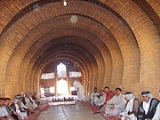
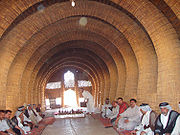
, the tribal guesthouse which acts as the political
, social
, judicial
and religious
centre of Marsh Arabic life. The mudhif is used as a place to settle disputes, to carry out diplomacy
with other tribes and as a gathering point for religious and other celebrations. It is also the place where visitors are offered hospitality
. Although the tribal shaykh was the principal figure, each Maʻdān village (which may have contained members of several different tribes) would also follow the authority of the hereditary qalit "headman" of a tribe's particular section.
Blood feuds, which could only be settled by the qalit, were a feature of Marsh Arab life, in common with that of the Arab bedouin
. Many of the Marsh Arabs' codes of behaviour
were similar to those of the desert tribes.
 Most Marsh Arabs lived in arched reed houses considerably smaller than a mudhif. The typical dwelling was usually a little more than 2 meters wide, about 6 meters long, and a little less than three meters high, and was either constructed at the waterside or on an artificial island
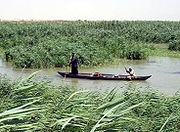
of reeds called a kibasha; a more permanent island of layered reeds and mud was called a dibin. Houses had entrances at both ends and a screen in the middle; one end was used as a dwelling and the other end (sometimes extended with a sitra, a long reed structure) was used to shelter animals in bad weather. A raba was a higher-status dwelling, distinguished by a north-facing entrance, which also served as a guesthouse where there was no mudhif. Traditional boats (the mashoof and tarada) were used as transport: the Maʻdān would drive buffaloes through the reedbeds during the season of low water to create channels, which would then be kept open by constant use, for the boats.
The marsh environment meant that certain diseases, such as bilharzia and malaria
, were endemic; Maʻdānī agriculture and homes were also vulnerable to periodic droughts and flooding.
ethnographers found it difficult to classify some of the Maʻdān's social customs and speculated that they might have originated in India
, while it was rumoured amongst neighbouring tribes that they had Persian origins.
Many scholars have proposed historical and genetic links between the Marsh Arabs and the ancient Sumerians, based on shared agricultural practices and methods of house building. There is, however, no written record of the marsh tribes until the ninth century AD, and the Sumerians were absorbed by the Akkadians (Assyrians-Babylonians) by around 1800 BC, some 2700 years before.
Norwegian explorer, archaeologist and ethnographer Thor Heyerdahl
wrote:
Others, however, have noted that much of the culture of the Maʻdān is in fact shared with the desert bedouin
who came to the area after the fall of the Abbasid
Caliphate, and that it is therefore likely that they are descended from this source, at least in part.
, as in past centuries they had been a refuge for escaped slaves
and serfs
, such as during the Zanj Rebellion
. By the mid 1980s, a low-level insurgency
against Ba'athist drainage and resettlement projects had developed in the area, led by Sheik Abdul Kerim Mahud al-Muhammadawi of the Al bu Muhammad under the nom de guerre Abu Hatim.
During the 1970s, the expansion of irrigation
projects had begun to disrupt the flow of water to the marshes. However, after the First Gulf War (1991), the Iraqi government aggressively revived a program to divert the flow of the Tigris River and the Euphrates River away from the marshes in retribution for a failed Shia uprising
. This was done primarily to eliminate the food source(s) of the Marsh Arabs and to prevent any remaining militiamen from taking refuge in the marshes, the Badr Brigades
and other militias having used them as cover. The plan, which was accompanied by a series of propaganda
articles by the Iraqi regime directed against the Ma'dan, systematically converted the wetlands into a desert
, forcing the residents out of their settlements in the region. Villages in the marshes were attacked and burnt down and there were reports of the water being deliberately poisoned.
The majority of the Maʻdān were displaced either to areas adjacent to the drained marshes, abandoning their traditional lifestyle in favour of conventional agriculture, to towns and camps in other areas of Iraq or to Iran
ian refugee camps. Only 1,600 of them were estimated to still be living on traditional dibins by 2003. The western Hammar Marshes
and the Qurnah or Central Marshes
had become completely desiccated, while the eastern Hawizeh Marshes
had dramatically shrunk.
The Marsh Arabs, who numbered about half a million in the 1950s, have dwindled to as few as 20,000 in Iraq, according to the United Nations. An estimated 80,000 to 120,000 have fled to refugee camps in Iran.
and Hawizeh Marshes
and some recovery of the Central Marshes
.
Efforts to restore the marshes have led to signs of their gradual revivification as water is restored to the former desert
, but the whole ecosystem
may take far longer to restore than it took to destroy. Only a few thousand of the nearly half million Marsh Arabs remain in the area. Most of the rest that can be accounted for are refugees living in other Shia areas in Iraq
, or have emigrated to Iran
, and many do not wish to return to their former home and lifestyle, which despite its independence was characterised by extreme poverty and hardship. A USAID report noted that while some Maʻdān had chosen to return to their traditional activities in the marshes, especially the Hammar Marshes
, within a short time of reflooding, they were without clean drinking water, sanitation, health care or education facilities. In addition, it is still uncertain if the marshes will completely recover, given increased levels of water extraction from the Tigris and Euphrates.
Many of the resettled Marsh Arabs have gained representation through the Iraqi Hizbullah
organisation; others have become followers of Moqtada al-Sadr's movement, through which they gained political control of Maysan Governorate. Political instability and local feuds, aggravated by the poverty of the dispossessed Marsh Arab population, remain a serious problem.
(1586–1652) is cited in Gavin Young
's Return to the Marshes as the earliest modern traveler to write about Mesopotamia and probably the first to introduce the word Madi, which he spelled "Maedi," to the Western world.
Young also mentions George Keppel
(1799–1891) as having spent time with the Madan in 1824 and reported in detail on the marsh inhabitants. Of the men Keppel wrote, "The Arab boatmen were as hardy and muscular-looking fellows as ever I saw. One loose brown shirt, of the coarseness of sack-cloth, was the only covering of the latter. This, when labour required it, was thrown aside, and discovered forms most admirably adapted to their laborious avocations; indeed, any of the boatmen would have made an excellent model for an Hercules; and one in particular, with uncombed hair and shaggy beard, struck us all with the resemblance he bore to statues of that deity." Of the women Keppel observed, "They came to our boat with the frankness of innocence and there was a freedom in their manners, bordering perhaps on the masculine; nevertheless their fine features and well-turned limbs produced a tout ensemble of beauty, not to be surpassed perhaps in the brilliant assemblies of civilized life."
Another account of the Maʻdān in English was jointly published in 1927 by a British colonial administrator, Stuart Edwin Hedgecock, and his wife. Gertrude Bell
also visited the area. T. E. Lawrence
passed through in 1916, stopping at Basra
and Ezra's Tomb
(Al-Azair), and recorded that the Marsh Arabs were "wonderfully hard [...] but merry, and full of talk. They are in the water all their lives, and seem hardly to notice it."
The way of life of the Marsh Arabs was later described by the explorer Sir Wilfred Thesiger in his classic The Marsh Arabs (1964). Thesiger lived with the Marsh Arabs for months at a time over a seven-year period (1951–1958), building excellent relationships with virtually all he met, and recording the details of day-to-day life in various regions of the marshes. Many of the areas that he visited have since been drained. Gavin Maxwell
, the Scottish naturalist, travelled with Thesiger through the marshes in 1956 and published an account of their travels in his 1957 book A Reed Shaken by the Wind (later republished under the title People of the Reeds). The journalist and travel writer Gavin Young
followed in Thesiger's footsteps, writing Return to the Marshes: Life with the Marsh Arabs of Iraq (1977; reissued 2009).
The first extensive scholarly ethnographic account of Marsh Arab life was Marsh Dwellers of the Euphrates Delta (1962), by Iraqi anthropologist S. M. Salim
. An ethnoarchaeological
study of the material culture of the Marsh Arabs has been published by Edward L. Ochsenschlager: Iraq's Marsh Arabs in the Garden of Eden (University of Pennsylvania Museum of Archaeology and Anthropology
, 2004).
Rory Stewart
described the Marsh Arabs and his experiences as deputy governor in the Maysan province (2003–2004) in his 2006 book, Prince of the Marshes(also published under the title Occupational Hazards).
In German, there is Sigrid Westphal-Hellbusch, Die Ma'dan: Kultur und Geschichte der Marschenbewohner im Süd-Iraq (Berlin: Duncker und Humblot, 1962).
Mesopotamian Marshes
The Mesopotamian Marshes are a wetland area located in southern Iraq and partially in southwestern Iran. Historically the marshlands, mainly composed of the separate but adjacent Central, Hawizeh and Hammar Marshes, used to be the largest wetland ecosystem of Western Eurasia...
in the south and east of Iraq
Iraq
Iraq ; officially the Republic of Iraq is a country in Western Asia spanning most of the northwestern end of the Zagros mountain range, the eastern part of the Syrian Desert and the northern part of the Arabian Desert....
and along the Iran
Iran
Iran , officially the Islamic Republic of Iran , is a country in Southern and Western Asia. The name "Iran" has been in use natively since the Sassanian era and came into use internationally in 1935, before which the country was known to the Western world as Persia...
ian border.
Comprising members of many different tribes and tribal confederations, such as the Āl Bū Muḥammad, Ferayghāt, Shaghanbah and Banī Lām, the Maʻdān had developed a unique culture centred around the marshes' natural resources. Many of the marshes' inhabitants were displaced when the wetlands were drained during and after the 1991 uprisings in Iraq
1991 uprisings in Iraq
The 1991 uprisings in Iraq were a series of anti-governmental rebellions in southern and northern Iraq during the aftermath of the Gulf War. The revolt was fueled by the perception that the power of Iraqi President Saddam Hussein was vulnerable at the time; as well as by heavily fueled anger at...
.
Culture
Persian people
The Persian people are part of the Iranian peoples who speak the modern Persian language and closely akin Iranian dialects and languages. The origin of the ethnic Iranian/Persian peoples are traced to the Ancient Iranian peoples, who were part of the ancient Indo-Iranians and themselves part of...
or other "mixed" origin and partly due to their practice of temporary marriage.
Many historians and archaeologists provide strong circumstantial evidence to posit that Iraq's Marsh Arabs share the strongest link to the ancient Sumerians. Although this is to do with their lifestyle and culture, more than any proven ethnic link, the Sumerians disappeared as a race circa 1800 BC, long before Arabs entered the region.
The Maʻdān speak a local dialect
Dialect
The term dialect is used in two distinct ways, even by linguists. One usage refers to a variety of a language that is a characteristic of a particular group of the language's speakers. The term is applied most often to regional speech patterns, but a dialect may also be defined by other factors,...
of Iraqi Arabic
Iraqi Arabic
Iraqi Arabic is a continuum of mutually intelligible Arabic varieties native to the Mesopotamian basin of Iraq as well as spanning into eastern and northern Syria, western Iran, southeastern Turkey, and spoken in respective Iraqi diaspora communities.-Varieties:Iraqi Arabic has two major varieties...
and traditionally wore a variant of normal Arab dress: for males, a long shirt or thawb
Thawb
A thawb or thobe , dishdasha , kandura , or suriyah in Libya, is an ankle-length garment, usually with long sleeves, similar to a robe. It is commonly worn in Arab countries. An Izaar is commonly worn underneath.-Background:...
(in recent times, occasionally with a Western-style jacket over the top) and a keffiyeh
Keffiyeh
The keffiyeh/kufiya , also known as a ghutrah , ' , mashadah , shemagh or in Persian chafiye , Kurdish cemedanî and Turkish puşi, is a traditional Arab headdress fashioned from a square, usually cotton, scarf. It is typically worn by Arab men, as well as some Kurds...
headcloth worn twisted around the head in a turban
Turban
In English, Turban refers to several types of headwear popularly worn in the Middle East, North Africa, Punjab, Jamaica and Southwest Asia. A commonly used synonym is Pagri, the Indian word for turban.-Styles:...
as few could afford an ʻiqāl.
Agriculture
The society of the Marsh Arabs was divided into two main groups by occupation. One group bred and raised domestic buffalo while others cultivated cropsAgriculture
Agriculture is the cultivation of animals, plants, fungi and other life forms for food, fiber, and other products used to sustain life. Agriculture was the key implement in the rise of sedentary human civilization, whereby farming of domesticated species created food surpluses that nurtured the...
such as rice
Rice
Rice is the seed of the monocot plants Oryza sativa or Oryza glaberrima . As a cereal grain, it is the most important staple food for a large part of the world's human population, especially in East Asia, Southeast Asia, South Asia, the Middle East, and the West Indies...
, barley
Barley
Barley is a major cereal grain, a member of the grass family. It serves as a major animal fodder, as a base malt for beer and certain distilled beverages, and as a component of various health foods...
, wheat
Wheat
Wheat is a cereal grain, originally from the Levant region of the Near East, but now cultivated worldwide. In 2007 world production of wheat was 607 million tons, making it the third most-produced cereal after maize and rice...
and pearl millet
Pearl millet
Pearl millet is the most widely grown type of millet. Grown in Africa and the Indian subcontinent since prehistoric times, it is generally accepted that pearl millet originated in Africa and was subsequently introduced into India. The center of diversity, and suggested area of domestication, for...
; they also kept some sheep and cattle
Cattle
Cattle are the most common type of large domesticated ungulates. They are a prominent modern member of the subfamily Bovinae, are the most widespread species of the genus Bos, and are most commonly classified collectively as Bos primigenius...
. Rice cultivation was especially important; it was carried out in small plots cleared in April and sown in mid-May. Cultivation seasons were marked by the rising and setting of certain stars, such as the Pleiades
Pleiades (star cluster)
In astronomy, the Pleiades, or Seven Sisters , is an open star cluster containing middle-aged hot B-type stars located in the constellation of Taurus. It is among the nearest star clusters to Earth and is the cluster most obvious to the naked eye in the night sky...
and Sirius
Sirius
Sirius is the brightest star in the night sky. With a visual apparent magnitude of −1.46, it is almost twice as bright as Canopus, the next brightest star. The name "Sirius" is derived from the Ancient Greek: Seirios . The star has the Bayer designation Alpha Canis Majoris...
.
Some branches of the Maʻdān were nomadic pastoralists, erecting temporary dwellings and moving buffalo around the marshes according to the season. Some fishing, especially of species of barbel (Barbus
Barbus
Barbus is a ray-finned fish genus in the family Cyprinidae. The type species of Barbus is the Common Barbel, first described as Cyprinus barbus and now named Barbus barbus...
sp., notably the binni or bunni, Barbus sharpeyi), was practised using spears and datura
Datura
Datura is a genus of nine species of vespertine flowering plants belonging to the family Solanaceae. Its precise and natural distribution is uncertain, owing to its extensive cultivation and naturalization throughout the temperate and tropical regions of the globe...
poison, but large-scale fishing using nets was until recent times regarded as a dishonourable profession by the Maʻdān and was mostly carried out by a separate low-status tribe known as the Berbera. By the early 1990s, however, up to 60% of the total amount of fish caught in Iraq's inland waters came from the marshes.
In the later twentieth century a third main occupation entered Marsh Arab life; the weaving
Weaving
Weaving is a method of fabric production in which two distinct sets of yarns or threads are interlaced at right angles to form a fabric or cloth. The other methods are knitting, lace making and felting. The longitudinal threads are called the warp and the lateral threads are the weft or filling...
of reed mats on a commercial scale. Though they often earned far more than workers in agriculture
Agriculture
Agriculture is the cultivation of animals, plants, fungi and other life forms for food, fiber, and other products used to sustain life. Agriculture was the key implement in the rise of sedentary human civilization, whereby farming of domesticated species created food surpluses that nurtured the...
, weavers were looked down upon by both Maʻdān and farmers alike: however, financial concerns meant that it gradually gained acceptance as a respectable profession.
Religion
The majority of Marsh Arabs are Shī‘ī Muslims, though in the marshes small communities of Aramaic speaking non Arab ethnic Mandeans (often working as boat builders and craftsmen) lived alongside them. The inhabitants' long association with tribes within Persia may have influenced the spread of the Shī‘ī denomination within the marshes. Wilfred ThesigerWilfred Thesiger
Sir Wilfred Patrick Thesiger, CBE, DSO, FRAS, FRGS was a British explorer and travel writer born in Addis Ababa, the capital of Ethiopia.-Family:...
commented that while he met few Marsh Arabs who had performed the Hajj
Hajj
The Hajj is the pilgrimage to Mecca, Saudi Arabia. It is one of the largest pilgrimages in the world, and is the fifth pillar of Islam, a religious duty that must be carried out at least once in their lifetime by every able-bodied Muslim who can afford to do so...
, many of them had made the pilgrimage to Mashhad
Mashhad
Mashhad , is the second largest city in Iran and one of the holiest cities in the Shia Muslim world. It is also the only major Iranian city with an Arabic name. It is located east of Tehran, at the center of the Razavi Khorasan Province close to the borders of Afghanistan and Turkmenistan. Its...
(thereby earning the title Zair); a number of families also claimed descent from the Islamic prophet Muhammad
Muhammad
Muhammad |ligature]] at U+FDF4 ;Arabic pronunciation varies regionally; the first vowel ranges from ~~; the second and the last vowel: ~~~. There are dialects which have no stress. In Egypt, it is pronounced not in religious contexts...
, adopting the title of sayyid
Sayyid
Sayyid is an honorific title, it denotes males accepted as descendants of the Islamic prophet Muhammad through his grandsons, Hasan ibn Ali and Husain ibn Ali, sons of the prophet's daughter Fatima Zahra and his son-in-law Ali ibn Abi Talib.Daughters of sayyids are given the titles Sayyida,...
and dyeing
Dyeing
Dyeing is the process of adding color to textile products like fibers, yarns, and fabrics. Dyeing is normally done in a special solution containing dyes and particular chemical material. After dyeing, dye molecules have uncut Chemical bond with fiber molecules. The temperature and time controlling...
their keffiyeh green.
The Maʻdān carried out the majority of their devotions in private as there were no places of worship within the Marshes; some were known to visit Ezra's Tomb
Ezra's Tomb
Ezra's Tomb or the Tomb of Ezra is a location in Iraq on the western shore of the Tigris that was popularly believed to be the burial place of the biblical figure Ezra. Al-ʻUzair is the present name of the settlement that has grown up around the tomb....
, one of the few religious sites of any kind in the area.
In addition to their Islamic faith, and complementary to it, when contacted by Wilfred Thesiger
Wilfred Thesiger
Sir Wilfred Patrick Thesiger, CBE, DSO, FRAS, FRGS was a British explorer and travel writer born in Addis Ababa, the capital of Ethiopia.-Family:...
the Ma'dan still held a number of pre-Islamic or extra-Islamic beliefs, from the existence of strange monsters in the marshes to that of bewitched isles such as the legendary Hufaidh
Hufaidh
Hufaidh is a mythical island in the marshes of southern Iraq, believed to exist by the Madan or Marsh Arabs.The Madan informants of the traveller Wilfred Thesiger asserted that:...
, whose shores could not be broached without causing madness in the unwary boatman.
Society
As with most tribes of southern Iraq, the main authority was the tribal shaikh. To this day, the shaikh of a Marsh Arab group will collect a tributeTribute
A tribute is wealth, often in kind, that one party gives to another as a sign of respect or, as was often the case in historical contexts, of submission or allegiance. Various ancient states, which could be called suzerains, exacted tribute from areas they had conquered or threatened to conquer...
from his tribe in order to maintain the mudhif
Mudhif
A mudhif is a traditional reed house made by the Madan people in the swamps of southern Iraq. In the traditional Madan way of living, houses are constructed from reeds harvested from the marshes where they live. A mudhif is a large communal house, paid for and maintained by a local sheik, for use...
, the tribal guesthouse which acts as the political
Politics
Politics is a process by which groups of people make collective decisions. The term is generally applied to the art or science of running governmental or state affairs, including behavior within civil governments, but also applies to institutions, fields, and special interest groups such as the...
, social
Society
A society, or a human society, is a group of people related to each other through persistent relations, or a large social grouping sharing the same geographical or virtual territory, subject to the same political authority and dominant cultural expectations...
, judicial
Justice
Justice is a concept of moral rightness based on ethics, rationality, law, natural law, religion, or equity, along with the punishment of the breach of said ethics; justice is the act of being just and/or fair.-Concept of justice:...
and religious
Religion
Religion is a collection of cultural systems, belief systems, and worldviews that establishes symbols that relate humanity to spirituality and, sometimes, to moral values. Many religions have narratives, symbols, traditions and sacred histories that are intended to give meaning to life or to...
centre of Marsh Arabic life. The mudhif is used as a place to settle disputes, to carry out diplomacy
Diplomacy
Diplomacy is the art and practice of conducting negotiations between representatives of groups or states...
with other tribes and as a gathering point for religious and other celebrations. It is also the place where visitors are offered hospitality
Hospitality
Hospitality is the relationship between guest and host, or the act or practice of being hospitable. Specifically, this includes the reception and entertainment of guests, visitors, or strangers, resorts, membership clubs, conventions, attractions, special events, and other services for travelers...
. Although the tribal shaykh was the principal figure, each Maʻdān village (which may have contained members of several different tribes) would also follow the authority of the hereditary qalit "headman" of a tribe's particular section.
Blood feuds, which could only be settled by the qalit, were a feature of Marsh Arab life, in common with that of the Arab bedouin
Bedouin
The Bedouin are a part of a predominantly desert-dwelling Arab ethnic group traditionally divided into tribes or clans, known in Arabic as ..-Etymology:...
. Many of the Marsh Arabs' codes of behaviour
Honor codes of the Bedouin
Sharaf and ird are Bedouin honor codes. Along with hospitality and courage/bravery, it is one of the Bedouin aspects of ethics that contain significant amounts of pre-Islamic customs...
were similar to those of the desert tribes.
Island
An island or isle is any piece of sub-continental land that is surrounded by water. Very small islands such as emergent land features on atolls can be called islets, cays or keys. An island in a river or lake may be called an eyot , or holm...
of reeds called a kibasha; a more permanent island of layered reeds and mud was called a dibin. Houses had entrances at both ends and a screen in the middle; one end was used as a dwelling and the other end (sometimes extended with a sitra, a long reed structure) was used to shelter animals in bad weather. A raba was a higher-status dwelling, distinguished by a north-facing entrance, which also served as a guesthouse where there was no mudhif. Traditional boats (the mashoof and tarada) were used as transport: the Maʻdān would drive buffaloes through the reedbeds during the season of low water to create channels, which would then be kept open by constant use, for the boats.
The marsh environment meant that certain diseases, such as bilharzia and malaria
Malaria
Malaria is a mosquito-borne infectious disease of humans and other animals caused by eukaryotic protists of the genus Plasmodium. The disease results from the multiplication of Plasmodium parasites within red blood cells, causing symptoms that typically include fever and headache, in severe cases...
, were endemic; Maʻdānī agriculture and homes were also vulnerable to periodic droughts and flooding.
Link to Sumerians and Akkadians
The origins of the Maʻdān are still a matter of some interest. British colonialBritish Empire
The British Empire comprised the dominions, colonies, protectorates, mandates and other territories ruled or administered by the United Kingdom. It originated with the overseas colonies and trading posts established by England in the late 16th and early 17th centuries. At its height, it was the...
ethnographers found it difficult to classify some of the Maʻdān's social customs and speculated that they might have originated in India
India
India , officially the Republic of India , is a country in South Asia. It is the seventh-largest country by geographical area, the second-most populous country with over 1.2 billion people, and the most populous democracy in the world...
, while it was rumoured amongst neighbouring tribes that they had Persian origins.
Many scholars have proposed historical and genetic links between the Marsh Arabs and the ancient Sumerians, based on shared agricultural practices and methods of house building. There is, however, no written record of the marsh tribes until the ninth century AD, and the Sumerians were absorbed by the Akkadians (Assyrians-Babylonians) by around 1800 BC, some 2700 years before.
Norwegian explorer, archaeologist and ethnographer Thor Heyerdahl
Thor Heyerdahl
Thor Heyerdahl was a Norwegian ethnographer and adventurer with a background in zoology and geography. He became notable for his Kon-Tiki expedition, in which he sailed by raft from South America to the Tuamotu Islands...
wrote:
Others, however, have noted that much of the culture of the Maʻdān is in fact shared with the desert bedouin
Bedouin
The Bedouin are a part of a predominantly desert-dwelling Arab ethnic group traditionally divided into tribes or clans, known in Arabic as ..-Etymology:...
who came to the area after the fall of the Abbasid
Abbasid
The Abbasid Caliphate or, more simply, the Abbasids , was the third of the Islamic caliphates. It was ruled by the Abbasid dynasty of caliphs, who built their capital in Baghdad after overthrowing the Umayyad caliphate from all but the al-Andalus region....
Caliphate, and that it is therefore likely that they are descended from this source, at least in part.
1991–2003
The marshes had for some time been considered a refuge for elements persecuted by the government of Saddam HusseinSaddam Hussein
Saddam Hussein Abd al-Majid al-Tikriti was the fifth President of Iraq, serving in this capacity from 16 July 1979 until 9 April 2003...
, as in past centuries they had been a refuge for escaped slaves
Slavery
Slavery is a system under which people are treated as property to be bought and sold, and are forced to work. Slaves can be held against their will from the time of their capture, purchase or birth, and deprived of the right to leave, to refuse to work, or to demand compensation...
and serfs
Serfdom
Serfdom is the status of peasants under feudalism, specifically relating to Manorialism. It was a condition of bondage or modified slavery which developed primarily during the High Middle Ages in Europe and lasted to the mid-19th century...
, such as during the Zanj Rebellion
Zanj Rebellion
The Zanj Rebellion was the culmination of series of small revolts. It took place near the city of Basra, located in southern Iraq over a period of fifteen years . It grew to involve over 500,000 slaves who were imported from across the Muslim empire and claimed over “tens of thousands of lives in...
. By the mid 1980s, a low-level insurgency
Insurgency
An insurgency is an armed rebellion against a constituted authority when those taking part in the rebellion are not recognized as belligerents...
against Ba'athist drainage and resettlement projects had developed in the area, led by Sheik Abdul Kerim Mahud al-Muhammadawi of the Al bu Muhammad under the nom de guerre Abu Hatim.
During the 1970s, the expansion of irrigation
Irrigation
Irrigation may be defined as the science of artificial application of water to the land or soil. It is used to assist in the growing of agricultural crops, maintenance of landscapes, and revegetation of disturbed soils in dry areas and during periods of inadequate rainfall...
projects had begun to disrupt the flow of water to the marshes. However, after the First Gulf War (1991), the Iraqi government aggressively revived a program to divert the flow of the Tigris River and the Euphrates River away from the marshes in retribution for a failed Shia uprising
1991 uprisings in Iraq
The 1991 uprisings in Iraq were a series of anti-governmental rebellions in southern and northern Iraq during the aftermath of the Gulf War. The revolt was fueled by the perception that the power of Iraqi President Saddam Hussein was vulnerable at the time; as well as by heavily fueled anger at...
. This was done primarily to eliminate the food source(s) of the Marsh Arabs and to prevent any remaining militiamen from taking refuge in the marshes, the Badr Brigades
Badr Organization
The Badr Organization previously known as the Badr Brigades or Badr Corps is an Iraqi political party headed by Hadi al-Amiri...
and other militias having used them as cover. The plan, which was accompanied by a series of propaganda
Propaganda
Propaganda is a form of communication that is aimed at influencing the attitude of a community toward some cause or position so as to benefit oneself or one's group....
articles by the Iraqi regime directed against the Ma'dan, systematically converted the wetlands into a desert
Desert
A desert is a landscape or region that receives an extremely low amount of precipitation, less than enough to support growth of most plants. Most deserts have an average annual precipitation of less than...
, forcing the residents out of their settlements in the region. Villages in the marshes were attacked and burnt down and there were reports of the water being deliberately poisoned.
The majority of the Maʻdān were displaced either to areas adjacent to the drained marshes, abandoning their traditional lifestyle in favour of conventional agriculture, to towns and camps in other areas of Iraq or to Iran
Iran
Iran , officially the Islamic Republic of Iran , is a country in Southern and Western Asia. The name "Iran" has been in use natively since the Sassanian era and came into use internationally in 1935, before which the country was known to the Western world as Persia...
ian refugee camps. Only 1,600 of them were estimated to still be living on traditional dibins by 2003. The western Hammar Marshes
Hammar Marshes
The Hammar Marshes are a large complex of wetlands in Iraq that are part of the Tigris-Euphrates river system, along with the Mesopotamian Marshes which also encompass the Hawizeh and Central Marshes...
and the Qurnah or Central Marshes
Central Marshes (Iraq)
The Draining of the Mesopotamian Marshes occurred in Iraq and to a smaller degree in Iran between the 1950s and 1990s to clear large areas of the marshes in the Tigris-Euphrates river system. Formerly covering an area of around , the large complex of wetlands was 90% drained prior to the 2003...
had become completely desiccated, while the eastern Hawizeh Marshes
Hawizeh Marshes (Iraq/Iran)
The Hawizeh Marshes are a complex of marshes that straddle the Iraq and Iran border. The marshes are fed by the Tigris River in Iraq and Karkheh River in Iran...
had dramatically shrunk.
The Marsh Arabs, who numbered about half a million in the 1950s, have dwindled to as few as 20,000 in Iraq, according to the United Nations. An estimated 80,000 to 120,000 have fled to refugee camps in Iran.
Since 2003
With the breaching of dikes by local communities subsequent to the 2003 U.S. invasion of Iraq and the ending of a four year drought that same year, the process has been reversed and the marshes have experienced a substantial rate of recovery. The permanent wetlands now cover more than 50% of 1970s levels, with a remarkable regrowth of the HammarHammar Marshes
The Hammar Marshes are a large complex of wetlands in Iraq that are part of the Tigris-Euphrates river system, along with the Mesopotamian Marshes which also encompass the Hawizeh and Central Marshes...
and Hawizeh Marshes
Hawizeh Marshes (Iraq/Iran)
The Hawizeh Marshes are a complex of marshes that straddle the Iraq and Iran border. The marshes are fed by the Tigris River in Iraq and Karkheh River in Iran...
and some recovery of the Central Marshes
Central Marshes (Iraq)
The Draining of the Mesopotamian Marshes occurred in Iraq and to a smaller degree in Iran between the 1950s and 1990s to clear large areas of the marshes in the Tigris-Euphrates river system. Formerly covering an area of around , the large complex of wetlands was 90% drained prior to the 2003...
.
Efforts to restore the marshes have led to signs of their gradual revivification as water is restored to the former desert
Desert
A desert is a landscape or region that receives an extremely low amount of precipitation, less than enough to support growth of most plants. Most deserts have an average annual precipitation of less than...
, but the whole ecosystem
Ecosystem
An ecosystem is a biological environment consisting of all the organisms living in a particular area, as well as all the nonliving , physical components of the environment with which the organisms interact, such as air, soil, water and sunlight....
may take far longer to restore than it took to destroy. Only a few thousand of the nearly half million Marsh Arabs remain in the area. Most of the rest that can be accounted for are refugees living in other Shia areas in Iraq
Iraq
Iraq ; officially the Republic of Iraq is a country in Western Asia spanning most of the northwestern end of the Zagros mountain range, the eastern part of the Syrian Desert and the northern part of the Arabian Desert....
, or have emigrated to Iran
Iran
Iran , officially the Islamic Republic of Iran , is a country in Southern and Western Asia. The name "Iran" has been in use natively since the Sassanian era and came into use internationally in 1935, before which the country was known to the Western world as Persia...
, and many do not wish to return to their former home and lifestyle, which despite its independence was characterised by extreme poverty and hardship. A USAID report noted that while some Maʻdān had chosen to return to their traditional activities in the marshes, especially the Hammar Marshes
Hammar Marshes
The Hammar Marshes are a large complex of wetlands in Iraq that are part of the Tigris-Euphrates river system, along with the Mesopotamian Marshes which also encompass the Hawizeh and Central Marshes...
, within a short time of reflooding, they were without clean drinking water, sanitation, health care or education facilities. In addition, it is still uncertain if the marshes will completely recover, given increased levels of water extraction from the Tigris and Euphrates.
Many of the resettled Marsh Arabs have gained representation through the Iraqi Hizbullah
Hezbollah Movement in Iraq
The Hezbollah Movement in Iraq is a Shi'a Islamist, Iraqi political party that is part of the United Iraqi Alliance coalition. It is not affiliated with the Lebanese group Hezbollah or other groups using the name. Hezbollah, or more literally Hizb Allah , means "Party of God" in Arabic.The party...
organisation; others have become followers of Moqtada al-Sadr's movement, through which they gained political control of Maysan Governorate. Political instability and local feuds, aggravated by the poverty of the dispossessed Marsh Arab population, remain a serious problem.
Literature
Pietro della VallePietro Della Valle
Pietro della Valle was an Italian who traveled throughout Asia during the Renaissance period. His travels took him to the Holy Land, the Middle East, Northern Africa, and as Far as India.-Biography:...
(1586–1652) is cited in Gavin Young
Gavin Young
Gavin David Young was born in Bude, Cornwall, England. His father, Gavin Young, was a Lieutenant-Colonel in the Welsh Guards. Daphne, his mother, was the daughter of Sir Charles Leolin Forestier-Walker, Bt, of Monmouthshire. Young spent most of his youth in Cornwall and South Wales...
's Return to the Marshes as the earliest modern traveler to write about Mesopotamia and probably the first to introduce the word Madi, which he spelled "Maedi," to the Western world.
Young also mentions George Keppel
George Keppel, 6th Earl of Albemarle
General George Thomas Keppel, 6th Earl of Albemarle DL, FGS, FSA , styled The Honourable from birth until 1851, was a British soldier, Liberal politician and writer.-Background and education:...
(1799–1891) as having spent time with the Madan in 1824 and reported in detail on the marsh inhabitants. Of the men Keppel wrote, "The Arab boatmen were as hardy and muscular-looking fellows as ever I saw. One loose brown shirt, of the coarseness of sack-cloth, was the only covering of the latter. This, when labour required it, was thrown aside, and discovered forms most admirably adapted to their laborious avocations; indeed, any of the boatmen would have made an excellent model for an Hercules; and one in particular, with uncombed hair and shaggy beard, struck us all with the resemblance he bore to statues of that deity." Of the women Keppel observed, "They came to our boat with the frankness of innocence and there was a freedom in their manners, bordering perhaps on the masculine; nevertheless their fine features and well-turned limbs produced a tout ensemble of beauty, not to be surpassed perhaps in the brilliant assemblies of civilized life."
Another account of the Maʻdān in English was jointly published in 1927 by a British colonial administrator, Stuart Edwin Hedgecock, and his wife. Gertrude Bell
Gertrude Bell
Gertrude Margaret Lowthian Bell, CBE was an English writer, traveller, political officer, administrator, and archaeologist who explored, mapped, and became highly influential to British imperial policy-making due to her extensive travels in Greater Syria, Mesopotamia, Asia Minor, and Arabia. Along...
also visited the area. T. E. Lawrence
T. E. Lawrence
Lieutenant Colonel Thomas Edward Lawrence, CB, DSO , known professionally as T. E. Lawrence, was a British Army officer renowned especially for his liaison role during the Arab Revolt against Ottoman Turkish rule of 1916–18...
passed through in 1916, stopping at Basra
Basra
Basra is the capital of Basra Governorate, in southern Iraq near Kuwait and Iran. It had an estimated population of two million as of 2009...
and Ezra's Tomb
Ezra's Tomb
Ezra's Tomb or the Tomb of Ezra is a location in Iraq on the western shore of the Tigris that was popularly believed to be the burial place of the biblical figure Ezra. Al-ʻUzair is the present name of the settlement that has grown up around the tomb....
(Al-Azair), and recorded that the Marsh Arabs were "wonderfully hard [...] but merry, and full of talk. They are in the water all their lives, and seem hardly to notice it."
The way of life of the Marsh Arabs was later described by the explorer Sir Wilfred Thesiger in his classic The Marsh Arabs (1964). Thesiger lived with the Marsh Arabs for months at a time over a seven-year period (1951–1958), building excellent relationships with virtually all he met, and recording the details of day-to-day life in various regions of the marshes. Many of the areas that he visited have since been drained. Gavin Maxwell
Gavin Maxwell
Gavin Maxwell FRSL, FIAL, FZS , FRGS was a Scottish naturalist and author, best known for his work with otters. He wrote the book Ring of Bright Water about how he brought an otter back from Iraq and raised it in Scotland...
, the Scottish naturalist, travelled with Thesiger through the marshes in 1956 and published an account of their travels in his 1957 book A Reed Shaken by the Wind (later republished under the title People of the Reeds). The journalist and travel writer Gavin Young
Gavin Young
Gavin David Young was born in Bude, Cornwall, England. His father, Gavin Young, was a Lieutenant-Colonel in the Welsh Guards. Daphne, his mother, was the daughter of Sir Charles Leolin Forestier-Walker, Bt, of Monmouthshire. Young spent most of his youth in Cornwall and South Wales...
followed in Thesiger's footsteps, writing Return to the Marshes: Life with the Marsh Arabs of Iraq (1977; reissued 2009).
The first extensive scholarly ethnographic account of Marsh Arab life was Marsh Dwellers of the Euphrates Delta (1962), by Iraqi anthropologist S. M. Salim
Shakir Mustafa Salim
Shakir Mustafa Salim was a famous Iraqi social anthropologist who taught in the Department of Sociology at Baghdad University.He compiled A Dictionary of Anthropology: English-Arabic .-Marsh Dwellers of the Euphrates Delta:...
. An ethnoarchaeological
Ethnoarchaeology
Ethnoarchaeology is the ethnographic study of peoples for archaeological reasons, usually through the study of the material remains of a society . Ethnoarchaeology aids archaeologists in reconstructing ancient lifeways by studying the material and non-material traditions of modern societies...
study of the material culture of the Marsh Arabs has been published by Edward L. Ochsenschlager: Iraq's Marsh Arabs in the Garden of Eden (University of Pennsylvania Museum of Archaeology and Anthropology
University of Pennsylvania Museum of Archaeology and Anthropology
The University of Pennsylvania Museum of Archaeology and Anthropology, commonly called The Penn Museum, is an archaeology and anthropology museum that is part of the University of Pennsylvania in the University City neighborhood of Philadelphia, Pennsylvania.-History:An internationally renowned...
, 2004).
Rory Stewart
Rory Stewart
Roderick 'Rory' James Nugent Stewart OBE FRSL MP DUniv is a British academic, author, and Conservative politician. Since May 2010, he has been the Member of Parliament for Penrith and the Border, in the county of Cumbria, North West England.- Overview :Stewart was a senior coalition official in a...
described the Marsh Arabs and his experiences as deputy governor in the Maysan province (2003–2004) in his 2006 book, Prince of the Marshes(also published under the title Occupational Hazards).
In German, there is Sigrid Westphal-Hellbusch, Die Ma'dan: Kultur und Geschichte der Marschenbewohner im Süd-Iraq (Berlin: Duncker und Humblot, 1962).
Films
Films about Marsh Arabs:- Iran,southwestern , directed by Mohammad Reza Fartousi, 2010
- Dawn of the WorldDawn of the WorldDawn of the World is a feature film written and directed by the Iraqi-French film director Abbas Fahdel.Starring Venice Film Festival revelation Hafsia Herzi and Hiam Abbass , Dawn of the World gives an unexpected account of the multiple impacts of the Iran–Iraq War, the Gulf War and the 1991...
(L'Aube du monde), directed by Abbas FahdelAbbas FahdelAbbas Fahdel is an Iraqi-French film director, screenwriter and film critic, born in Babylon, Iraq.Based in France since the age of 18 years, he studied cinema at the Sorbonne University until Ph.D....
, 2008 - Silent Companion (Hamsafare Khamoosh), directed by Elham Hosseinzadeh, 2004
- Zaman, The Man From The Reeds (Zaman, l'homme des roseaux), directed by Amer AlwanAmer AlwanAmer Alwan is an Iraqi French film director. Alwan was forced to shoot his movie Zaman, The Man From The Reeds on videotape, as when Iraq was under severe economic sanctions the United Nations and United States, would not allow Iraq to import 35 and 16 millimeter film stocks, because they believed...
, 2003 - The Marshes (Al-Ahwar), directed by Kassem Hawal, 1975
See also
- Tigris-Euphrates alluvial salt marsh
- Shatt al-Arab
- Edward BawdenEdward BawdenEdward Bawden, CBE, RA was a British painter, illustrator and graphic artist. He was also famous for his prints, book covers, posters, and garden metalwork furniture...
- Iranian Arabs, for related groups in Khuzestan ProvinceKhuzestan ProvinceKhuzestan Province is one of the 31 provinces of Iran. It is in the southwest of the country, bordering Iraq's Basra Province and the Persian Gulf. Its capital is Ahwaz and covers an area of 63,238 km²...
- Muntafiq, a large tribal confederation of southern Iraq
External links
- Images from Iraq's Marsh Arabs in the Garden of Eden, University of Pennsylvania
- Wilfred Thesiger's photographs of Marsh Arab life, Pitt Rivers MuseumPitt Rivers MuseumThe Pitt Rivers Museum is a museum displaying the archaeological and anthropological collections of the University of Oxford in Oxford, England. The museum is located to the east of the Oxford University Museum of Natural History, and can only be accessed through that building.The museum was...
- An article on the ancient and recent history of the Marsh Arabs at Laputan Logic (Part II)
- Life on the Edge of the Marshes: A twenty year long ethnographic study conducted by Edward Ochsenschlager. As well as documenting the traditional way of life of the Marsh Arabs, it also made comparisons with ancient Sumerian cultural practices.
- AMAR International Charitable Foundation ("Assisting Marsh Arabs and Refugees")
- Images of Iraq's Marsh Arabs Endangered Culture & Nature by Sate Al Abbasi