

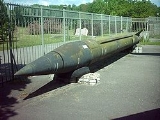
Scud

Encyclopedia
Scud is a series of tactical ballistic missile
s developed by the Soviet Union
during the Cold War
, and exported widely to other countries. The term comes from the NATO reporting name
SS-1 Scud which was attached to the missile by Western intelligence agencies. The Russian names for the missile are the R-11 (the first version), R-17 and R-300 Elbrus (later developments). The name Scud has been widely used to refer to these missiles and the wide variety of derivative variants developed in other countries based on the Soviet design.
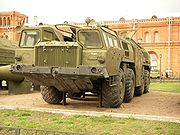 The first use of the term Scud was in the NATO name SS-1b Scud-A, applied to the R-11 ballistic missile. The earlier R-1
missile had carried the NATO name SS-1 Scunner, but was of a very different design, almost directly a copy of the German
V-2. The R-11 used technology gained from the V-2 as well, but was a new design, smaller and differently shaped than the V-2 and R-1 weapons. The R-11 was developed by the Korolyev OKB
and entered service in 1957. The most revolutionary innovation in the R-11 was the engine, designed by A.M. Isaev
. Far simpler than the V-2's multi-chamber design, and employing an anti-oscillation baffle to prevent chugging, it was a forerunner to the larger engines used in Soviet launch vehicles.
Further developed variants were the R-300 Elbrus / SS-1c Scud-B in 1961 and the SS-1d Scud-C in 1965, both of which could carry either a conventional high-explosive, a 5- to 80-kiloton nuclear
, or a chemical (thickened VX
) warhead. The SS-1e Scud-D variant developed in the 1980s can deliver a terminally guided warhead capable of greater precision.
All models are 11.35 m (37.2 ft) long (except Scud-A, which is 1 m (3.3 ft) shorter) and 0.88 m (2.9 ft) in diameter. They are propelled by a single liquid-fuel rocket engine burning kerosene
and corrosion Inhibited Red Fuming Nitric Acid
(IRFNA) with UDMH
, unsymmetrical dimethylhydrazine (Russian TG-02 like German Tonka 250) as liquid igniter (self ignition with IRFNA) in all models.
The missile reaches a maximum speed of mach
5.
, who was then working in the OKB-1, headed by Sergey Korolev
. It first flew on April 18, 1953, was fitted with an Isayev engine using kerosene
and nitric acid
as propellant. On 13 December 1953, a production order was passed with SKB-385 in Zlatoust
, a factory dedicated to producing long-range rockets. In June 1955, Makeev was appointed chief designer of the SKB-385 to oversee the program and, in July, the R-11 was formally accepted into military service. The definitive R-11M, designed to carry a nuclear warhead, was accepted officially into service on April 1, 1958. The launch system received the GRAU
designation 8K11.
The R-11M had a maximum range of 270 km, but when carrying a nuclear warhead, this was reduced to 150 km. Its purpose was strictly as a mobile nuclear strike vector, giving the Soviet Army
the ability to hit European targets from forward areas, armed with a nuclear warhead with an estimated yield of 50 kilotons.
A naval variant, the R-11FM (SS-N-1 Scud-A) was first tested in February 1955, and was first launched from a converted Project 611 (Zulu class) submarine in September of the same year. While the initial design was done by Korolev's OKB-1, the programme was transferred to Makeev's SKB-385 in August 1955. It became operational in 1959 and was deployed onboard Project 611 and Project 629 (Golf Class) submarines. During its service, 77 launches were conducted, of which 59 were successful.
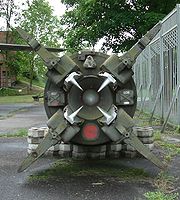 The successor to the R-11, the R-17 (SS-1C Scud-B), renamed R-300 in the 1970s, was the most prolific of the series, with a production run estimated at 7,000. It served in 32 countries and four countries besides the Soviet Union manufactured copied versions. The first launch was conducted in 1961, and it entered service in 1964.
The R-17 was an improved version of the R-11. It could carry nuclear, chemical, conventional or fragmentation weapons. At first, the Scud-B was carried on a tracked TEL (Transporter Erector Launcher) similar to that of the Scud-A, designated 2P19, but this was not successful and a wheeled replacement was designed by the Titan Central Design Bureau, becoming operational in 1967. The new MAZ-543 vehicle was officially designated 9P117 Uragan. The launch sequence could be conducted autonomously, but was usually directed from a separate command vehicle. The missile is raised to a vertical position by means of hydraulically-powered cranes, which usually takes four minutes, while the total sequence lasts about one hour.
(SS-12 Scaleboard), made the Scud-C redundant, and it apparently did not enter service with the Soviet armed forces.
(SS-23), and the Scud-D was not acquired by the Soviet armed forces. Instead it was proposed for export as an upgrade for Scud-B users, in the 1990s.
Unlike previous Scud versions, the 9K720 had a warhead that separated from the missile's body, and was fitted with its own terminal guidance system. With a TV camera fitted in the nose, the system could compare the target area with data from an onboard computer library. In this way, it was thought to attain a Circular Error Probable
(CEP) of 50 m, while retaining the 300 km range of the Scud-B.
obtained its first Scud-Bs from Egypt in 1979 or 1980. These missiles were reverse engineered
, and reproduced using North Korean infrastructure, including the 125 factory at Pyongyang
, a research and development institute at Sanum-dong and the Musudan-ri
Launch Facility. The first prototypes were completed in 1984, and designated Hwasong-5. They were exact replicas of the R-17Es obtained from Egypt. The first test flights occurred in April 1984, but the first version saw only limited production, and no operational deployment, as its purpose was only to validate the production process.
Production of the definitive version began at a slow rate in 1985. The type incorporated several minor improvements over the original Soviet design. The range was increased by 10 to 15 percent and it could carry High Explosive (HE) or cluster chemical warheads. Throughout the production cycle, until it was phased out in favour of the Hwasong-6 in 1989, the DPRK manufacturers are thought to have carried out small enhancements, in particular to the guidance system.
In 1985, Iran acquired 90 to 100 Hwasong-5 missiles from North Korea. A production line was also established in Iran, where the Hwasong-5 was produced as the Shahab-1.
.
The Hwasong-6 was exported to Iran where it is known as the Shahab-2
, and to Syria, where it is manufactured under license with Chinese assistance. Also, according to SIPRI, 150 Scud-C were exported to Syria in 1991-96, 5 to Libya in 1999, 45 to Yemen in 2001-02.
The main characteristics of the Rodong are a range of 1000 km and a CEP estimated at 2,000-4,000 m, giving the North Koreans the ability to strike Japan. The missile is substantially larger than the Hwasong series, and its Isayev 9D21 engine was upgraded with help from Makeyev OKB. Some assistance came also from China and Ukraine while a new TEL was designed using an Italian Iveco
truck chassis and an Austrian crane. The rapidity with which the Rodong was designed and exported after just two tests came as a surprise for many Western observers, and led to some speculation that it was in fact based on a cancelled Soviet project from the Cold War period, but this has not been proven.
Iran is known to have financed much of the Rodong program, and in return is allowed to produce the missile, as the Shahab-3
. While the first prototypes may have been acquired as early as 1992, production began only in 2001, with assistance from Russia. The Rodong has also been exported to Egypt and Libya
.
in 1973, when a small number were used by Egypt
against Israel
. Libya responded to U.S. airstrikes in 1986 by firing two Scud missiles at a U.S. Coast Guard navigation station
on the nearby Italian island of Lampedusa
, which missed their target. Scud missiles were used in several regional conflicts that included use by Soviet and Afghan Communist forces in Afghanistan
, and Iran
ians and Iraq
is against one another in the so-called "War of the cities" during the Iran–Iraq War. Scuds were used by Iraq during the Gulf War
against Israel and coalition targets in Saudi Arabia.
More than a dozen Scuds were fired from Afghanistan at targets in Pakistan
in 1988. There was also a small number of Scud missiles used in the 1994 civil war in Yemen
, by Russian forces in Chechnya
in 1996 and onwards, and some minor use in the 2011 Libyan civil war.
rockets at the towns of Dezful
and Ahvaz
. On 27 October 1982, Iraq launched its first Scud-Bs at Dezful killing 21 civilians and wounding 100. Scud strikes continued during the following years, intensifying sharply in 1985, with more than 100 missiles falling inside Iran.
Desperate to respond in kind, the Iranians searched for a source of ballistic weapons, finally meeting success in 1985, when they obtained a small number of Scud-Bs from Libya
. These weapons were assigned to a special unit, the Khatam Al-Anbya force, attached to the Pasdaran. On March 12, the first Iranian Scuds fell in Baghdad
and Kirkuk
. The strikes infuriated Saddam Hussein
, but the Iraqi response was limited by the range of their Scuds, that could not reach Tehran
. After a request for TR-1 Temp
(SS-12 Scaleboard) missiles was refused by the Soviets, Iraq turned to developing its own long-range version of the Scud missile, that became known as the Al Hussein
. In the meantime, both sides quickly ran out of missiles, and had to contact their international partners for resupply. In 1986, Iraq ordered 300 Scud-Bs from the USSR, while Iran turned to North Korea for missile deliveries, and for assistance in developing an indigenous missile industry.
In 1988, the fighting along the border had reached a stalemate, and both belligerents began employing terror tactics, in order to break the deadlock. Lasting from 29 February to 20 April, this conflict became known as the war of the cities, and saw an intensive use of Scud missiles. The first rounds were fired by Iraq, when seven Al-Husseins landed in Tehran on February 29. In all, Iraq fired 189 missiles, mostly of the Al-Hussein type, of which 135 landed in Tehran, 23 in Qom
, 22 in Isfahan, four in Tabriz
, three in Shiraz
and two in Karaj
. During this episode, Iraq's missiles killed 2,000 Iranians, injured 6,000, and caused a quarter of Tehran's population of ten million to flee the city. The Iranian response included launching 75 to 77 Hwasong-5s, a North Korean Scud variant, at targets in Iraq, mostly in Baghdad.
Iraq asserts that Iran has fired dozens of Scud missiles at MKO targets in Iraq in 1999 and 2001. According to MKO spokesmen, in the 2001 assault, Iran fired more missiles at Iraq than it did during the entire Iran-Iraq war.
(DRA), among which were large quantities of Scud-Bs, and possibly some Scud-Cs as well. The first 500 were transferred during the early months of 1989, and soon proved to be a critical strategic asset for the DRA. Every Scud battery was composed of three TELs, three reloading vehicles, a mobile meteorological unit, one tanker and several command and control trucks. During the mujahideen attack against Jalalabad
, between March and June 1989, three firing batteries manned by Soviet crews fired approximately 438 missiles in defense of the embattled garrison. Soon all the heavily contested areas of Afghanistan, such as the Salang Pass and the city of Kandahar
, were under attack by Scud missiles.
Due to its imprecision, the Scud was used as an area bombing weapon, and its effect was psychological as well as physical: the missiles would explode without warning, as they travelled faster than the sound they produced in-flight. At the time, reports indicated that Scud attacks had devastating consequences on the morale of the Afghan rebels, who eventually learned that by applying guerilla tactics, and keeping their forces dispersed and hidden, they could minimize casualties from Scud attacks.
The Scud was also used as a punitive weapon, striking areas that were held by the resistance. In March 1991, shortly after the town of Khost
was captured, it was hit by a Scud attack. In April 1991, the marketplace of Asadabad
was hit by two Scuds, that killed 300 and wounded 500 inhabitants. Though the exact toll is unknown, these attacks resulted in heavy civilian casualties.
In all, between October 1988 and February 1992, with 1,700 to 2,000 Scud launches, Afghanistan saw the greatest concentration of ballistic weapons fired since World War II. After January 1992, the Soviet advisors were withdrawn, reducing the Afghan army's ability to use their ballistic missiles. On April 24, 1992, the mujahideen forces of Ahmad Shah Massoud captured the main Scud stockpile at Afshur. As the communist government collapsed, the few remaining Scuds and their TELs were divided among the rival factions fighting for power. However, the lack of trained personnel prevented a sustained use of such weapons, and, between April 1992 and 1996, only 44 Scuds were fired in Afghanistan. When the Taliban arrived in power in 1996, they captured a few of the remaining Scuds, but lack of maintenance had reduced the state of the missile force to such an extent that there were only five Scud firings, until 2001. Following the U.S. intervention in Afghanistan
, the few surviving Scud launchers were destroyed in 2005.
, Iraq had an effective, if limited, ballistic missile force. Besides the original Scud-B, several local variants had been developed. These included the Al-Hussein, developed during the Iran–Iraq War, the Al-Hijarah, a shortened Al-Hussein, and the Al-Abbas, an extended-range Scud fired from fixed launching sites, that was never used. The Soviet-built MAZ-543
vehicle was the prime launcher, along with a few locally-designed TELs, the Al Nida and the Al Waleed.
Scuds were responsible for most of the coalition deaths outside of Iraq and Kuwait. 42 Scud missiles in total were fired into Israel. They killed one Israeli directly and one Saudi security guard. Twenty-eight members of the Pennsylvania National Guard were killed when one struck a United States Army
barracks
in Dhahran
, Saudi Arabia.
units to eliminate the Scuds and their launchers, essentially to persuade Israel that it did not need to intervene in the conflict.
The US Air Force
organized air patrols
over areas where Scud launchers were suspected to operate, namely western Iraq near the Jordan
ian border, where the Scuds were fired at Israel, and southern Iraq, where they were aimed at Saudi Arabia. A-10
strike aircraft flew over these zones during the day, and F-15E
s fitted with LANTIRN
pods and synthetic aperture radar
s patrolled at night. However, the infrared
and radar signatures of the Iraqi TELSs were almost impossible to distinguish from ordinary trucks and from the surrounding electromagnetic clutter
. While patrolling, strike aircraft managed to sight their targets on 42 occasions, they were only able to acquire them long enough to release their ordnance three times. In addition, the Iraqi missile units dispersed their Scud TELs and hid them in culverts, wadis, or under highway bridges. They also practiced "shoot-and-scoot
" tactics, withdrawing the launcher to a hidden location immediately after it had fired, while the launch sequence that usually took 90 minutes was reduced to half an hour. This enabled them to preserve their forces, despite optimistic claims by the coalition. A post-war Pentagon
study concluded that relatively few launchers had been destroyed by coalition aircraft.
Ground based special forces from the United Kingdom were sent to scout for launchers behind enemy lines, in some cases attacking them directly with MILAN
man-portable missiles. A patrol that used the callsign Bravo Two Zero
, led by "Andy McNab
" (a pseudonym), was captured by the Iraqis, all except Chris Ryan
.
The mobility of Scud TELs allowed for a choice of firing position and increased the survivability of the weapon system to such an extent that, of the approximately 100 launchers claimed destroyed by coalition pilots and special forces in the Gulf War, not a single destruction could be confirmed afterwards. After the war, UNSCOM investigations showed that Iraq still had 12 MAZ-543 vehicles, as well as seven Al-Waleed and Al-Nidal launchers, and 62 complete Al-Hussein missiles.
, both South Yemen separatists and government forces fired Scud missiles.
, it was rumored that Scud-B's had been fired by Muammar Gaddafi
's forces against anti-Gaddafi forces
. The first confirmed use happened several months later, when on 15 August 2011, as anti-Gaddafi forces encircled the Gaddafi-controlled capital of Tripoli
, Libyan Army
forces near Gaddafi's hometown of Sirte
fired a Scud missile toward anti-Gaddafi positions in Cyrenaica
, well over 100 kilometers away. The missile struck the desert near Ajdabiya
, causing no casualties. A second Scud-B also fired by Gaddafi forces in Sirte was reportedly shot down by a NATO warplane on 22 August 2011. On 23 August, opposition forces in Misrata reported that four Scud-B missiles were fired against the city from Sirte, but had caused no damage, with all purportedly being shot down by an Aegis Ballistic Missile Defense System
-equipped US Navy
cruiser over the Gulf of Sidra
.
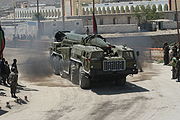
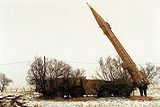 The current and former operators of Scuds or Scud derivatives are:
 Afghanistan: (Scud-B, Scud-C?)
 Armenia: (Scud-B, Scud-C)
 Kingdom of Bulgaria: (Scud-B)-retired
 Democratic Republic of the Congo: (Scud-B)
 Czech Republic: (Scud-B)-retired
 German Democratic Republic
 Egypt: (Scud-B, Hwasong-6
)
 Hungary: (Scud-B)-retired
 Iraq: (Scud-B, Al-Hussein
, Al-Abbas)
 Iran: (Scud-B, Hwasong-5, Shahab-1, Shahab-2, Rodong-1)
 Kazakhstan: (Scud-B)
 Libya: (Scud-B)
 North Korea: (Scud-B, Scud-C, Hwasong-5
, Hwasong-6
, Rodong-1)
 Poland: (Scud-B)-retired
 Kingdom of Romania: (Scud-B)-retired
 Russia: Retired
 South Yemen
 Slovakia: (Scud-B)-retired
 Syria: (Scud-B, Hwasong-6
)
 Oman: ( Scud-B)
 United Arab Emirates: 25 Hwasong-5
s purchased from North Korea in 1989. The UAE military were not satisfied with the quality of the missiles, and they were kept in storage.
 Ukraine: (Scud-B)
 United States: c. 30 Scud-B missiles and four TEL
s acquired in 1995, and converted into targets by Lockheed Martin
.
 Vietnam: (Scud-B, Hwasong-6
?)
 Yemen: (Scud-B)
 Kingdom of Yugoslavia: (Scud-B)-retired
Tactical ballistic missile
A tactical ballistic missile is a ballistic missile designed for short-range battlefield use. Typically, range is less than . Tactical ballistic missiles are usually mobile to ensure survivability and quick deployment, as well as carrying a variety of warheads to target enemy facilities, assembly...
s developed by the Soviet Union
Soviet Union
The Soviet Union , officially the Union of Soviet Socialist Republics , was a constitutionally socialist state that existed in Eurasia between 1922 and 1991....
during the Cold War
Cold War
The Cold War was the continuing state from roughly 1946 to 1991 of political conflict, military tension, proxy wars, and economic competition between the Communist World—primarily the Soviet Union and its satellite states and allies—and the powers of the Western world, primarily the United States...
, and exported widely to other countries. The term comes from the NATO reporting name
NATO reporting name
NATO reporting names are classified code names for military equipment of the Eastern Bloc...
SS-1 Scud which was attached to the missile by Western intelligence agencies. The Russian names for the missile are the R-11 (the first version), R-17 and R-300 Elbrus (later developments). The name Scud has been widely used to refer to these missiles and the wide variety of derivative variants developed in other countries based on the Soviet design.
Development
R-1 (missile)
The R-1 rocket was a copy of the German V-2 rocket manufactured by the Soviet Union. Even though it was a copy, it was manufactured using Soviet industrial plants and gave the Soviets valuable experience which later enabled the USSR to construct its own much more capable rockets.In 1945 the...
missile had carried the NATO name SS-1 Scunner, but was of a very different design, almost directly a copy of the German
Germany
Germany , officially the Federal Republic of Germany , is a federal parliamentary republic in Europe. The country consists of 16 states while the capital and largest city is Berlin. Germany covers an area of 357,021 km2 and has a largely temperate seasonal climate...
V-2. The R-11 used technology gained from the V-2 as well, but was a new design, smaller and differently shaped than the V-2 and R-1 weapons. The R-11 was developed by the Korolyev OKB
S.P. Korolev Rocket and Space Corporation Energia
OAO S.P. Korolev Rocket and Space Corporation Energia , also known as RKK Energiya, is a Russian manufacturer of spacecraft and space station components...
and entered service in 1957. The most revolutionary innovation in the R-11 was the engine, designed by A.M. Isaev
Aleksei Mihailovich Isaev
Aleksei Mikhailovich Isaev was a Russian rocket engineer.Aleksei Isaev began work under Leonid Dushkin during World War II, on an experimental rocket-powered interceptor plane. In 1944 he formed his own design bureau to engineer liquid-propellant engines...
. Far simpler than the V-2's multi-chamber design, and employing an anti-oscillation baffle to prevent chugging, it was a forerunner to the larger engines used in Soviet launch vehicles.
Further developed variants were the R-300 Elbrus / SS-1c Scud-B in 1961 and the SS-1d Scud-C in 1965, both of which could carry either a conventional high-explosive, a 5- to 80-kiloton nuclear
Nuclear weapon
A nuclear weapon is an explosive device that derives its destructive force from nuclear reactions, either fission or a combination of fission and fusion. Both reactions release vast quantities of energy from relatively small amounts of matter. The first fission bomb test released the same amount...
, or a chemical (thickened VX
VX (nerve agent)
VX, IUPAC name O-ethyl S-[2-ethyl] methylphosphonothioate, is an extremely toxic substance whose only application is in chemical warfare as a nerve agent. As a chemical weapon, it is classified as a weapon of mass destruction by the United Nations in UN Resolution 687...
) warhead. The SS-1e Scud-D variant developed in the 1980s can deliver a terminally guided warhead capable of greater precision.
All models are 11.35 m (37.2 ft) long (except Scud-A, which is 1 m (3.3 ft) shorter) and 0.88 m (2.9 ft) in diameter. They are propelled by a single liquid-fuel rocket engine burning kerosene
Kerosene
Kerosene, sometimes spelled kerosine in scientific and industrial usage, also known as paraffin or paraffin oil in the United Kingdom, Hong Kong, Ireland and South Africa, is a combustible hydrocarbon liquid. The name is derived from Greek keros...
and corrosion Inhibited Red Fuming Nitric Acid
Red fuming nitric acid
Red fuming nitric acid is a storable oxidizer used as a rocket propellant. It consists mainly of nitric acid , also containing 13% dinitrogen tetroxide and 3% water. The dissolved nitrogen dioxide is very concentrated and can be found at room temperature...
(IRFNA) with UDMH
UDMH
Unsymmetrical dimethylhydrazine is a toxic volatile hygroscopic clear liquid, with a sharp, fishy, ammoniacal smell typical for organic amines. It turns yellowish on exposure to air and absorbs oxygen and carbon dioxide. It mixes completely with water, ethanol, and kerosene. In concentration...
, unsymmetrical dimethylhydrazine (Russian TG-02 like German Tonka 250) as liquid igniter (self ignition with IRFNA) in all models.
The missile reaches a maximum speed of mach
Mach number
Mach number is the speed of an object moving through air, or any other fluid substance, divided by the speed of sound as it is in that substance for its particular physical conditions, including those of temperature and pressure...
5.
R-11
The first of the "Scud" series, designated R-11 (SS-1B Scud-A) originated in a 1951 requirement for a ballistic missile with similar performance to the German V-2 rocket. The R-11 was developed by engineer Victor MakeevVictor Makeev
Viktor Petrovich Makeyev was the founder of the Soviet-Russian school of sea missiles production.-Work:Makeyev's work has resulted in three generations of submarine-launched ballistic missiles being used by the Russian Navy.Among these were:...
, who was then working in the OKB-1, headed by Sergey Korolev
Sergey Korolyov
Sergei Pavlovich Korolev ; died 14 January 1966 in Moscow, Russia) was the lead Soviet rocket engineer and spacecraft designer in the Space Race between the United States and the Soviet Union during the 1950s and 1960s...
. It first flew on April 18, 1953, was fitted with an Isayev engine using kerosene
Kerosene
Kerosene, sometimes spelled kerosine in scientific and industrial usage, also known as paraffin or paraffin oil in the United Kingdom, Hong Kong, Ireland and South Africa, is a combustible hydrocarbon liquid. The name is derived from Greek keros...
and nitric acid
Nitric acid
Nitric acid , also known as aqua fortis and spirit of nitre, is a highly corrosive and toxic strong acid.Colorless when pure, older samples tend to acquire a yellow cast due to the accumulation of oxides of nitrogen. If the solution contains more than 86% nitric acid, it is referred to as fuming...
as propellant. On 13 December 1953, a production order was passed with SKB-385 in Zlatoust
Zlatoust
Zlatoust is a city in Chelyabinsk Oblast, Russia, located on the Ay River , west of Chelyabinsk. Population: 181,000 ; 161,000 ; 99,000 ; 48,000 ; 21,000 ....
, a factory dedicated to producing long-range rockets. In June 1955, Makeev was appointed chief designer of the SKB-385 to oversee the program and, in July, the R-11 was formally accepted into military service. The definitive R-11M, designed to carry a nuclear warhead, was accepted officially into service on April 1, 1958. The launch system received the GRAU
Grau
Grau is a German word meaning "gray" and a Catalan word meaning "grade". It may refer to:* BAP Almirante Grau , a De Zeven Provinciën class cruiser in service with the Peruvian Navy* Grau Käse, Tyrolean grey cheese...
designation 8K11.
The R-11M had a maximum range of 270 km, but when carrying a nuclear warhead, this was reduced to 150 km. Its purpose was strictly as a mobile nuclear strike vector, giving the Soviet Army
Soviet Army
The Soviet Army is the name given to the main part of the Armed Forces of the Soviet Union between 1946 and 1992. Previously, it had been known as the Red Army. Informally, Армия referred to all the MOD armed forces, except, in some cases, the Soviet Navy.This article covers the Soviet Ground...
the ability to hit European targets from forward areas, armed with a nuclear warhead with an estimated yield of 50 kilotons.
A naval variant, the R-11FM (SS-N-1 Scud-A) was first tested in February 1955, and was first launched from a converted Project 611 (Zulu class) submarine in September of the same year. While the initial design was done by Korolev's OKB-1, the programme was transferred to Makeev's SKB-385 in August 1955. It became operational in 1959 and was deployed onboard Project 611 and Project 629 (Golf Class) submarines. During its service, 77 launches were conducted, of which 59 were successful.
R-17
The R-17 was an improved version of the R-11. It could carry nuclear, chemical, conventional or fragmentation weapons. At first, the Scud-B was carried on a tracked TEL (Transporter Erector Launcher) similar to that of the Scud-A, designated 2P19, but this was not successful and a wheeled replacement was designed by the Titan Central Design Bureau, becoming operational in 1967. The new MAZ-543 vehicle was officially designated 9P117 Uragan. The launch sequence could be conducted autonomously, but was usually directed from a separate command vehicle. The missile is raised to a vertical position by means of hydraulically-powered cranes, which usually takes four minutes, while the total sequence lasts about one hour.
Scud-C
The Makeyev OKB also worked on an extended-range version of the R-17, known in the West as SS-1d Scud-C, that was first launched from Kapustin Yar in 1965. Its range was brought up to 500–600 km, but at the cost of a greatly reduced accuracy and warhead size. Eventually, the advent of more modern types in the same category, such as the TR-1 TempTR-1 Temp
The TR-1 Temp is a mobile theatre ballistic missile developed and deployed by the Soviet Union during the Cold War. It was assigned the NATO reporting name SS-12 Scaleboard and carried the industrial designation 9M76...
(SS-12 Scaleboard), made the Scud-C redundant, and it apparently did not enter service with the Soviet armed forces.
Scud-D
The R-17 VTO (SS-1e Scud-D) project was an attempt to enhance the accuracy of the R-17. The Central Scientific Research Institute for Automation and Hydraulics (TsNIAAG) began work on the project in 1968, but the first test launch was conducted only in September 1979. Development continued through the 1980s until the system was accepted into initial service as the 9K720 Aerofon in 1989. However, by this time, more advanced weapons were in use, such as the OTR-21 Tochka(SS-21) and the R-400 OkaR-400 Oka
The OTR-23 Oka was a mobile theatre ballistic missile deployed by the Soviet Union near the end of the Cold War to replace the obsolete SS-1C 'Scud B'. It carried the GRAU index 9K714 and was assigned the NATO reporting name SS-23 Spider...
(SS-23), and the Scud-D was not acquired by the Soviet armed forces. Instead it was proposed for export as an upgrade for Scud-B users, in the 1990s.
Unlike previous Scud versions, the 9K720 had a warhead that separated from the missile's body, and was fitted with its own terminal guidance system. With a TV camera fitted in the nose, the system could compare the target area with data from an onboard computer library. In this way, it was thought to attain a Circular Error Probable
Circular error probable
In the military science of ballistics, circular error probable is an intuitive measure of a weapon system's precision...
(CEP) of 50 m, while retaining the 300 km range of the Scud-B.
Characteristics
| NATO codename | Scud-A | Scud-B | Scud-C | Scud-D |
|---|---|---|---|---|
| U.S. DIA Defense Intelligence Agency The Defense Intelligence Agency is a member of the Intelligence Community of the United States, and is the central producer and manager of military intelligence for the United States Department of Defense, employing over 16,500 U.S. military and civilian employees worldwide... |
SS-1b | SS-1c | SS-1d | SS-1e |
| Official designation | R-11 | R-17/R-300 | ||
| Deployment Date | 1957 | 1964 | 1965? | 1989? |
| Length | 10.7 m | 11.25 m | 11.25 m | 12.29 m |
| Width | 0.88 m | 0.88 m | 0.88 m | 0.88 m |
| Launch weight | 4,400 kg | 5,900 kg | 6,400 kg | 6,500 kg |
| Range | 180 km | 300 km | 550 km | 300 km |
| Payload | 950 kg | 985 kg | 600 kg | 985 kg |
| Accuracy (CEP Circular error probable In the military science of ballistics, circular error probable is an intuitive measure of a weapon system's precision... ) |
3000 m | 450 m | 700 m | 50 m |
Hwasong-5
North KoreaNorth Korea
The Democratic People’s Republic of Korea , , is a country in East Asia, occupying the northern half of the Korean Peninsula. Its capital and largest city is Pyongyang. The Korean Demilitarized Zone serves as the buffer zone between North Korea and South Korea...
obtained its first Scud-Bs from Egypt in 1979 or 1980. These missiles were reverse engineered
Reverse engineering
Reverse engineering is the process of discovering the technological principles of a device, object, or system through analysis of its structure, function, and operation...
, and reproduced using North Korean infrastructure, including the 125 factory at Pyongyang
Pyongyang
Pyongyang is the capital of the Democratic People's Republic of Korea, commonly known as North Korea, and the largest city in the country. Pyongyang is located on the Taedong River and, according to preliminary results from the 2008 population census, has a population of 3,255,388. The city was...
, a research and development institute at Sanum-dong and the Musudan-ri
Musudan-ri
The Tonghae Satellite Launching Ground, also known as Musudan-ri, is a rocket launching site in North Korea. It lies in southern North Hamgyong province, near the northern tip of the East Korea Bay...
Launch Facility. The first prototypes were completed in 1984, and designated Hwasong-5. They were exact replicas of the R-17Es obtained from Egypt. The first test flights occurred in April 1984, but the first version saw only limited production, and no operational deployment, as its purpose was only to validate the production process.
Production of the definitive version began at a slow rate in 1985. The type incorporated several minor improvements over the original Soviet design. The range was increased by 10 to 15 percent and it could carry High Explosive (HE) or cluster chemical warheads. Throughout the production cycle, until it was phased out in favour of the Hwasong-6 in 1989, the DPRK manufacturers are thought to have carried out small enhancements, in particular to the guidance system.
In 1985, Iran acquired 90 to 100 Hwasong-5 missiles from North Korea. A production line was also established in Iran, where the Hwasong-5 was produced as the Shahab-1.
Hwasong-6
Work on an extended range Scud began in 1988, and with only relatively minor modifications, a new type was produced from 1989, going by the name Hwasong-6 ("Scud Mod. C" or "Scud-C"). It was first test-flown in June 1990, and entered full-scale production the same year, or in 1991, until it was superseded by the Rodong-1. It features an improved guidance system, a range of 500 km, but saw its payload reduced to 770 kg, though the dimensions are identical to the original Scud. Due to difficulties in procuring MAZ-543 TELs, the North Koreans had to produce a local copy. By 1999, North Korea was estimated to have produced 600 to 1,000 Hwasong-6 missiles, of which 25 served for testing, 300 to 500 were exported, and 300 to 600 are used by the Korean People's ArmyKorean People's Army
The Korean People's Army , also known as the Inmin Gun, are the military forces of the Democratic People's Republic of Korea. Kim Jong-il is the Supreme Commander of the Korean People's Army and Chairman of the National Defence Commission...
.
The Hwasong-6 was exported to Iran where it is known as the Shahab-2
Shahab-2
The Shahab-2 is the successor to the Iranian Shahab-1 missile.The missile has a CEP of 50 m. On November 2, 2006, Iran fired unarmed missiles to begin 10 days of military simulations. Iranian state television reported "dozens of missiles were fired including Shahab-2 and Shahab-3 missiles...
, and to Syria, where it is manufactured under license with Chinese assistance. Also, according to SIPRI, 150 Scud-C were exported to Syria in 1991-96, 5 to Libya in 1999, 45 to Yemen in 2001-02.
Rodong-1
The Rodong (also NoDong, "Scud-D"), was the first North Korean missile to feature important modifications from the Scud design. Development began in 1988, and the first missile was launched in 1990, but it apparently exploded on its launch pad. A second test was carried out in May 1993 successfully.The main characteristics of the Rodong are a range of 1000 km and a CEP estimated at 2,000-4,000 m, giving the North Koreans the ability to strike Japan. The missile is substantially larger than the Hwasong series, and its Isayev 9D21 engine was upgraded with help from Makeyev OKB. Some assistance came also from China and Ukraine while a new TEL was designed using an Italian Iveco
Iveco
Iveco, an acronym for Industrial Vehicle Corporation, originally an alliance of European commercial vehicle manufacturers such as Fiat , Unic and Magirus. Iveco is now an Italian truck, bus, and diesel engine manufacturer, based in Turin...
truck chassis and an Austrian crane. The rapidity with which the Rodong was designed and exported after just two tests came as a surprise for many Western observers, and led to some speculation that it was in fact based on a cancelled Soviet project from the Cold War period, but this has not been proven.
Iran is known to have financed much of the Rodong program, and in return is allowed to produce the missile, as the Shahab-3
Shahab-3
The Shahab-3 is a medium-range ballistic missile developed by Iran and based on the Nodong-1. The Shahab-3 has a range of ; a MRBM variant can now reach...
. While the first prototypes may have been acquired as early as 1992, production began only in 2001, with assistance from Russia. The Rodong has also been exported to Egypt and Libya
Libya
Libya is an African country in the Maghreb region of North Africa bordered by the Mediterranean Sea to the north, Egypt to the east, Sudan to the southeast, Chad and Niger to the south, and Algeria and Tunisia to the west....
.
Operational use
The Scud missile (including derivatives) is one of the few ballistic missiles to be used in actual warfare, second only to the V-2 in terms of combat launches (the SS-21, MGM-140 ATACMS, and 9K720 Iskander being the only other ballistic missiles fired in action). The first recorded combat use of Scud missiles was during the Yom Kippur WarYom Kippur War
The Yom Kippur War, Ramadan War or October War , also known as the 1973 Arab-Israeli War and the Fourth Arab-Israeli War, was fought from October 6 to 25, 1973, between Israel and a coalition of Arab states led by Egypt and Syria...
in 1973, when a small number were used by Egypt
Egypt
Egypt , officially the Arab Republic of Egypt, Arabic: , is a country mainly in North Africa, with the Sinai Peninsula forming a land bridge in Southwest Asia. Egypt is thus a transcontinental country, and a major power in Africa, the Mediterranean Basin, the Middle East and the Muslim world...
against Israel
Israel
The State of Israel is a parliamentary republic located in the Middle East, along the eastern shore of the Mediterranean Sea...
. Libya responded to U.S. airstrikes in 1986 by firing two Scud missiles at a U.S. Coast Guard navigation station
LORAN-C transmitter Lampedusa
LORAN-C transmitter Lampedusa is the X-Ray secondary station of the Mediterranean Sea LORAN-C Chain .It uses a transmission power of 325 kW....
on the nearby Italian island of Lampedusa
Lampedusa
Lampedusa is the largest island of the Italian Pelagie Islands in the Mediterranean Sea. The comune of Lampedusa e Linosa is part of the Sicilian province of Agrigento which also includes the smaller islands of Linosa and Lampione. It is the southernmost part of Italy. Tunisia, which is about ...
, which missed their target. Scud missiles were used in several regional conflicts that included use by Soviet and Afghan Communist forces in Afghanistan
Afghanistan
Afghanistan , officially the Islamic Republic of Afghanistan, is a landlocked country located in the centre of Asia, forming South Asia, Central Asia and the Middle East. With a population of about 29 million, it has an area of , making it the 42nd most populous and 41st largest nation in the world...
, and Iran
Iran
Iran , officially the Islamic Republic of Iran , is a country in Southern and Western Asia. The name "Iran" has been in use natively since the Sassanian era and came into use internationally in 1935, before which the country was known to the Western world as Persia...
ians and Iraq
Iraq
Iraq ; officially the Republic of Iraq is a country in Western Asia spanning most of the northwestern end of the Zagros mountain range, the eastern part of the Syrian Desert and the northern part of the Arabian Desert....
is against one another in the so-called "War of the cities" during the Iran–Iraq War. Scuds were used by Iraq during the Gulf War
Gulf War
The Persian Gulf War , commonly referred to as simply the Gulf War, was a war waged by a U.N.-authorized coalition force from 34 nations led by the United States, against Iraq in response to Iraq's invasion and annexation of Kuwait.The war is also known under other names, such as the First Gulf...
against Israel and coalition targets in Saudi Arabia.
More than a dozen Scuds were fired from Afghanistan at targets in Pakistan
Pakistan
Pakistan , officially the Islamic Republic of Pakistan is a sovereign state in South Asia. It has a coastline along the Arabian Sea and the Gulf of Oman in the south and is bordered by Afghanistan and Iran in the west, India in the east and China in the far northeast. In the north, Tajikistan...
in 1988. There was also a small number of Scud missiles used in the 1994 civil war in Yemen
Yemen
The Republic of Yemen , commonly known as Yemen , is a country located in the Middle East, occupying the southwestern to southern end of the Arabian Peninsula. It is bordered by Saudi Arabia to the north, the Red Sea to the west, and Oman to the east....
, by Russian forces in Chechnya
Chechnya
The Chechen Republic , commonly referred to as Chechnya , also spelled Chechnia or Chechenia, sometimes referred to as Ichkeria , is a federal subject of Russia . It is located in the southeastern part of Europe in the Northern Caucasus mountains. The capital of the republic is the city of Grozny...
in 1996 and onwards, and some minor use in the 2011 Libyan civil war.
Iran–Iraq War
Iraq was the first to use ballistic missiles during the Iran–Iraq War, firing limited numbers of Frog-7FROG-7
The 9K52 Luna-M is a Soviet short-range ballistic missile complex. The 9M21 missiles are unguided and spin-stabilized. "9K52" is its GRAU designation. Its NATO reporting name is FROG-7....
rockets at the towns of Dezful
Dezful
Dezful is a city in and the capital of Dezful County, Khuzestan Province, Iran. At the 2006 census, its population was 228,507, in 55,711 families.The city houses a bridge that dates back to 300 BC.In 2006, the city had 235,819 inhabitants.-History:...
and Ahvaz
Ahvaz
-History:For a more comprehensive historical treatment of the area, see the history section of Khūzestān Province.-Ancient history:Ahvaz is the anagram of "Avaz" and "Avaja" which appear in Darius's epigraph...
. On 27 October 1982, Iraq launched its first Scud-Bs at Dezful killing 21 civilians and wounding 100. Scud strikes continued during the following years, intensifying sharply in 1985, with more than 100 missiles falling inside Iran.
Desperate to respond in kind, the Iranians searched for a source of ballistic weapons, finally meeting success in 1985, when they obtained a small number of Scud-Bs from Libya
Libya
Libya is an African country in the Maghreb region of North Africa bordered by the Mediterranean Sea to the north, Egypt to the east, Sudan to the southeast, Chad and Niger to the south, and Algeria and Tunisia to the west....
. These weapons were assigned to a special unit, the Khatam Al-Anbya force, attached to the Pasdaran. On March 12, the first Iranian Scuds fell in Baghdad
Baghdad
Baghdad is the capital of Iraq, as well as the coterminous Baghdad Governorate. The population of Baghdad in 2011 is approximately 7,216,040...
and Kirkuk
Kirkuk
Kirkuk is a city in Iraq and the capital of Kirkuk Governorate.It is located in the Iraqi governorate of Kirkuk, north of the capital, Baghdad...
. The strikes infuriated Saddam Hussein
Saddam Hussein
Saddam Hussein Abd al-Majid al-Tikriti was the fifth President of Iraq, serving in this capacity from 16 July 1979 until 9 April 2003...
, but the Iraqi response was limited by the range of their Scuds, that could not reach Tehran
Tehran
Tehran , sometimes spelled Teheran, is the capital of Iran and Tehran Province. With an estimated population of 8,429,807; it is also Iran's largest urban area and city, one of the largest cities in Western Asia, and is the world's 19th largest city.In the 20th century, Tehran was subject to...
. After a request for TR-1 Temp
TR-1 Temp
The TR-1 Temp is a mobile theatre ballistic missile developed and deployed by the Soviet Union during the Cold War. It was assigned the NATO reporting name SS-12 Scaleboard and carried the industrial designation 9M76...
(SS-12 Scaleboard) missiles was refused by the Soviets, Iraq turned to developing its own long-range version of the Scud missile, that became known as the Al Hussein
Al Hussein (missile)
Al Hussein or al-Husayn is the designation of an Iraqi ballistic missile. The missile was the result of upgrading the Soviet made Scud in order to achieve a longer range...
. In the meantime, both sides quickly ran out of missiles, and had to contact their international partners for resupply. In 1986, Iraq ordered 300 Scud-Bs from the USSR, while Iran turned to North Korea for missile deliveries, and for assistance in developing an indigenous missile industry.
In 1988, the fighting along the border had reached a stalemate, and both belligerents began employing terror tactics, in order to break the deadlock. Lasting from 29 February to 20 April, this conflict became known as the war of the cities, and saw an intensive use of Scud missiles. The first rounds were fired by Iraq, when seven Al-Husseins landed in Tehran on February 29. In all, Iraq fired 189 missiles, mostly of the Al-Hussein type, of which 135 landed in Tehran, 23 in Qom
Qom
Qom is a city in Iran. It lies by road southwest of Tehran and is the capital of Qom Province. At the 2006 census, its population was 957,496, in 241,827 families. It is situated on the banks of the Qom River....
, 22 in Isfahan, four in Tabriz
Tabriz
Tabriz is the fourth largest city and one of the historical capitals of Iran and the capital of East Azerbaijan Province. Situated at an altitude of 1,350 meters at the junction of the Quri River and Aji River, it was the second largest city in Iran until the late 1960s, one of its former...
, three in Shiraz
Shiraz
Shiraz may refer to:* Shiraz, Iran, a city in Iran* Shiraz County, an administrative subdivision of Iran* Vosketap, Armenia, formerly called ShirazPeople:* Hovhannes Shiraz, Armenian poet* Ara Shiraz, Armenian sculptor...
and two in Karaj
Karaj
Karaj is a city in and the capital of Karaj County, Alborz Province, Iran. At the 2006 census, its population was 1,377,450, in 385,955 families, , making it the fifth-largest city in Iran after Tehran, Mashhad, Isfahan and Tabriz.) It is situated west of Tehran, at the foothills of the Alborz...
. During this episode, Iraq's missiles killed 2,000 Iranians, injured 6,000, and caused a quarter of Tehran's population of ten million to flee the city. The Iranian response included launching 75 to 77 Hwasong-5s, a North Korean Scud variant, at targets in Iraq, mostly in Baghdad.
Iraq asserts that Iran has fired dozens of Scud missiles at MKO targets in Iraq in 1999 and 2001. According to MKO spokesmen, in the 2001 assault, Iran fired more missiles at Iraq than it did during the entire Iran-Iraq war.
Civil war in Afghanistan
The most intensive - and less well-known - use of Scud missiles occurred during the civil war in Afghanistan between 1989 and 1992. As compensation for the withdrawal of Soviet troops in 1989, the USSR agreed to deliver sophisticated weapons to the Democratic Republic of AfghanistanDemocratic Republic of Afghanistan
The Democratic Republic of Afghanistan was a government of Afghanistan between 1978 and 1992. It was both ideologically close to and economically dependent on the Soviet Union, and was a major belligerent of the Afghan Civil War.- Saur Revolution :...
(DRA), among which were large quantities of Scud-Bs, and possibly some Scud-Cs as well. The first 500 were transferred during the early months of 1989, and soon proved to be a critical strategic asset for the DRA. Every Scud battery was composed of three TELs, three reloading vehicles, a mobile meteorological unit, one tanker and several command and control trucks. During the mujahideen attack against Jalalabad
Jalalabad
Jalalabad , formerly called Adinapour, as documented by the 7th century Hsüan-tsang, is a city in eastern Afghanistan. Located at the junction of the Kabul River and Kunar River near the Laghman valley, Jalalabad is the capital of Nangarhar province. It is linked by approximately of highway with...
, between March and June 1989, three firing batteries manned by Soviet crews fired approximately 438 missiles in defense of the embattled garrison. Soon all the heavily contested areas of Afghanistan, such as the Salang Pass and the city of Kandahar
Kandahar
Kandahar is the second largest city in Afghanistan, with a population of about 512,200 as of 2011. It is the capital of Kandahar Province, located in the south of the country at about 1,005 m above sea level...
, were under attack by Scud missiles.
Due to its imprecision, the Scud was used as an area bombing weapon, and its effect was psychological as well as physical: the missiles would explode without warning, as they travelled faster than the sound they produced in-flight. At the time, reports indicated that Scud attacks had devastating consequences on the morale of the Afghan rebels, who eventually learned that by applying guerilla tactics, and keeping their forces dispersed and hidden, they could minimize casualties from Scud attacks.
The Scud was also used as a punitive weapon, striking areas that were held by the resistance. In March 1991, shortly after the town of Khost
Khost
Khost or Khowst is a city in eastern Afghanistan. It is the capital of Khost province, which is a mountainous region near Afghanistan's border with Pakistan...
was captured, it was hit by a Scud attack. In April 1991, the marketplace of Asadabad
Asadabad, Afghanistan
Asadabad or Asad Abad is the capital city of Kunar Province in Afghanistan. It is located in the eastern portion of the country adjacent to Pakistan...
was hit by two Scuds, that killed 300 and wounded 500 inhabitants. Though the exact toll is unknown, these attacks resulted in heavy civilian casualties.
In all, between October 1988 and February 1992, with 1,700 to 2,000 Scud launches, Afghanistan saw the greatest concentration of ballistic weapons fired since World War II. After January 1992, the Soviet advisors were withdrawn, reducing the Afghan army's ability to use their ballistic missiles. On April 24, 1992, the mujahideen forces of Ahmad Shah Massoud captured the main Scud stockpile at Afshur. As the communist government collapsed, the few remaining Scuds and their TELs were divided among the rival factions fighting for power. However, the lack of trained personnel prevented a sustained use of such weapons, and, between April 1992 and 1996, only 44 Scuds were fired in Afghanistan. When the Taliban arrived in power in 1996, they captured a few of the remaining Scuds, but lack of maintenance had reduced the state of the missile force to such an extent that there were only five Scud firings, until 2001. Following the U.S. intervention in Afghanistan
War in Afghanistan (2001–present)
The War in Afghanistan began on October 7, 2001, as the armed forces of the United States of America, the United Kingdom, Australia, and the Afghan United Front launched Operation Enduring Freedom...
, the few surviving Scud launchers were destroyed in 2005.
Scud attacks
At the outbreak of the Gulf WarGulf War
The Persian Gulf War , commonly referred to as simply the Gulf War, was a war waged by a U.N.-authorized coalition force from 34 nations led by the United States, against Iraq in response to Iraq's invasion and annexation of Kuwait.The war is also known under other names, such as the First Gulf...
, Iraq had an effective, if limited, ballistic missile force. Besides the original Scud-B, several local variants had been developed. These included the Al-Hussein, developed during the Iran–Iraq War, the Al-Hijarah, a shortened Al-Hussein, and the Al-Abbas, an extended-range Scud fired from fixed launching sites, that was never used. The Soviet-built MAZ-543
MAZ-7310
The MAZ-543/MAZ-7310 "Uragan" is a Soviet/Belarusian 8x8 artillery truck designed and developed by MAZ , in what is now Belarus. Designed in the 1960s, the MAZ-543 was presented on November 7, 1965 during the Moscow Red Square military parade as part of SS-1с Scud B system...
vehicle was the prime launcher, along with a few locally-designed TELs, the Al Nida and the Al Waleed.
Scuds were responsible for most of the coalition deaths outside of Iraq and Kuwait. 42 Scud missiles in total were fired into Israel. They killed one Israeli directly and one Saudi security guard. Twenty-eight members of the Pennsylvania National Guard were killed when one struck a United States Army
United States Army
The United States Army is the main branch of the United States Armed Forces responsible for land-based military operations. It is the largest and oldest established branch of the U.S. military, and is one of seven U.S. uniformed services...
barracks
Barracks
Barracks are specialised buildings for permanent military accommodation; the word may apply to separate housing blocks or to complete complexes. Their main object is to separate soldiers from the civilian population and reinforce discipline, training and esprit de corps. They were sometimes called...
in Dhahran
Dhahran
Dhahran is a city located in Saudi Arabia's Eastern Province, and is a major administrative center for the Saudi oil industry. Large oil reserves were first identified in the Dhahran area in 1931, and in 1935 Standard Oil of California drilled the first commercially viable oil well...
, Saudi Arabia.
Scud hunting
Despite the limited damage inflicted by Iraqi missiles, the coalition committed important air assets and special forcesSpecial forces
Special forces, or special operations forces are terms used to describe elite military tactical teams trained to perform high-risk dangerous missions that conventional units cannot perform...
units to eliminate the Scuds and their launchers, essentially to persuade Israel that it did not need to intervene in the conflict.
The US Air Force
United States Air Force
The United States Air Force is the aerial warfare service branch of the United States Armed Forces and one of the American uniformed services. Initially part of the United States Army, the USAF was formed as a separate branch of the military on September 18, 1947 under the National Security Act of...
organized air patrols
Combat air patrol
Combat air patrol is a type of flying mission for fighter aircraft.A combat air patrol is an aircraft patrol provided over an objective area, over the force protected, over the critical area of a combat zone, or over an air defense area, for the purpose of intercepting and destroying hostile...
over areas where Scud launchers were suspected to operate, namely western Iraq near the Jordan
Jordan
Jordan , officially the Hashemite Kingdom of Jordan , Al-Mamlaka al-Urduniyya al-Hashemiyya) is a kingdom on the East Bank of the River Jordan. The country borders Saudi Arabia to the east and south-east, Iraq to the north-east, Syria to the north and the West Bank and Israel to the west, sharing...
ian border, where the Scuds were fired at Israel, and southern Iraq, where they were aimed at Saudi Arabia. A-10
A-10 Thunderbolt II
The Fairchild Republic A-10 Thunderbolt II is an American single-seat, twin-engine, straight-wing jet aircraft developed by Fairchild-Republic in the early 1970s. The A-10 was designed for a United States Air Force requirement to provide close air support for ground forces by attacking tanks,...
strike aircraft flew over these zones during the day, and F-15E
F-15E Strike Eagle
The McDonnell Douglas F-15E Strike Eagle is an all-weather multirole fighter, derived from the McDonnell Douglas F-15 Eagle. The F-15E was designed in the 1980s for long-range, high speed interdiction without relying on escort or electronic warfare aircraft. United States Air Force F-15E Strike...
s fitted with LANTIRN
LANTIRN
Low Altitude Navigation and Targeting Infrared for Night, or LANTIRN, is a combined navigation and targeting pod system for use on the USAF's premier fighter aircraft — the F-15E Strike Eagle and F-16 Fighting Falcon...
pods and synthetic aperture radar
Synthetic aperture radar
Synthetic-aperture radar is a form of radar whose defining characteristic is its use of relative motion between an antenna and its target region to provide distinctive long-term coherent-signal variations that are exploited to obtain finer spatial resolution than is possible with conventional...
s patrolled at night. However, the infrared
Infrared
Infrared light is electromagnetic radiation with a wavelength longer than that of visible light, measured from the nominal edge of visible red light at 0.74 micrometres , and extending conventionally to 300 µm...
and radar signatures of the Iraqi TELSs were almost impossible to distinguish from ordinary trucks and from the surrounding electromagnetic clutter
Clutter (radar)
Clutter is a term used for unwanted echoes in electronic systems, particularly in reference to radars. Such echoes are typically returned from ground, sea, rain, animals/insects, chaff and atmospheric turbulences, and can cause serious performance issues with radar systems.- Backscatter coefficient...
. While patrolling, strike aircraft managed to sight their targets on 42 occasions, they were only able to acquire them long enough to release their ordnance three times. In addition, the Iraqi missile units dispersed their Scud TELs and hid them in culverts, wadis, or under highway bridges. They also practiced "shoot-and-scoot
Shoot-and-scoot
The term shoot and scoot refers to an artillery tactic of firing at a target and then immediately moving away from the location where the shots were fired. The reason for this is to avoid counter-battery fire - fired by enemy artillery or delivered by attack aircraft and helicopters, in order to...
" tactics, withdrawing the launcher to a hidden location immediately after it had fired, while the launch sequence that usually took 90 minutes was reduced to half an hour. This enabled them to preserve their forces, despite optimistic claims by the coalition. A post-war Pentagon
The Pentagon
The Pentagon is the headquarters of the United States Department of Defense, located in Arlington County, Virginia. As a symbol of the U.S. military, "the Pentagon" is often used metonymically to refer to the Department of Defense rather than the building itself.Designed by the American architect...
study concluded that relatively few launchers had been destroyed by coalition aircraft.
Ground based special forces from the United Kingdom were sent to scout for launchers behind enemy lines, in some cases attacking them directly with MILAN
MILAN
MILAN " is French and German for "kite bird") is a European anti-tank guided missile. Design of the MILAN started in 1962. It was ready for trials in 1971, and was accepted for service in 1972. It is a wire guided SACLOS missile, which means the sight of the launch unit has to be aimed at the...
man-portable missiles. A patrol that used the callsign Bravo Two Zero
Bravo Two Zero
Bravo Two Zero was the call sign of an eight-man British Army SAS patrol, deployed into Iraq during the First Gulf War in January 1991. According to one patrol member's account, the patrol were given the task of "gathering intelligence;.....
, led by "Andy McNab
Andy McNab
Sergeant ‘Andy McNab’ DCM MM is the pseudonym of an English novelist and former SAS operative and soldier.McNab came into public prominence in 1993, when he published his account of the failed Special Air Service patrol, Bravo Two Zero for which he was awarded the Distinguished Conduct Medal in...
" (a pseudonym), was captured by the Iraqis, all except Chris Ryan
Chris Ryan
Sergeant ‘Chris Ryan’ MM is the pseudonym of a former British Special Forces operative and soldier turned novelist...
.
The mobility of Scud TELs allowed for a choice of firing position and increased the survivability of the weapon system to such an extent that, of the approximately 100 launchers claimed destroyed by coalition pilots and special forces in the Gulf War, not a single destruction could be confirmed afterwards. After the war, UNSCOM investigations showed that Iraq still had 12 MAZ-543 vehicles, as well as seven Al-Waleed and Al-Nidal launchers, and 62 complete Al-Hussein missiles.
1994 civil war in Yemen
During the 1994 civil war in Yemen1994 civil war in Yemen
The May–July 1994 civil war in Yemen was waged between the armed forces of the former Northern and Southern Yemeni states and their supporters...
, both South Yemen separatists and government forces fired Scud missiles.
2011 civil war in Libya
In May 2011, early during the Libyan civil war2011 Libyan civil war
The 2011 Libyan civil war was an armed conflict in the North African state of Libya, fought between forces loyal to Colonel Muammar Gaddafi and those seeking to oust his government. The war was preceded by protests in Benghazi beginning on 15 February 2011, which led to clashes with security...
, it was rumored that Scud-B's had been fired by Muammar Gaddafi
Muammar Gaddafi
Muammar Muhammad Abu Minyar Gaddafi or "September 1942" 20 October 2011), commonly known as Muammar Gaddafi or Colonel Gaddafi, was the official ruler of the Libyan Arab Republic from 1969 to 1977 and then the "Brother Leader" of the Libyan Arab Jamahiriya from 1977 to 2011.He seized power in a...
's forces against anti-Gaddafi forces
Anti-Gaddafi forces
The anti-Gaddafi forces were Libyan groups that opposed and militarily defeated the government of Muammar Gaddafi, killing him in the process. These opposition forces included organised and armed militia groups, participants in the 2011 Libyan civil war, Libyan diplomats who switched their...
. The first confirmed use happened several months later, when on 15 August 2011, as anti-Gaddafi forces encircled the Gaddafi-controlled capital of Tripoli
Tripoli
Tripoli is the capital and largest city in Libya. It is also known as Western Tripoli , to distinguish it from Tripoli, Lebanon. It is affectionately called The Mermaid of the Mediterranean , describing its turquoise waters and its whitewashed buildings. Tripoli is a Greek name that means "Three...
, Libyan Army
Libyan Army
In 2009 the IISS estimated that the Ground Forces of the Libyan Arab Jamahiriya numbered 25,000 with an additional, estimated, 25,000 conscripts...
forces near Gaddafi's hometown of Sirte
Sirte
Sirte is a city in LibyaSirte may also refer to:* Sirte Declaration, a 1999 resolution to create the African Union* Sirte Oil Company, a Libyan oil companyIn geography:* Gulf of Sirte, alias for Gulf of Sidra on Libya's coast...
fired a Scud missile toward anti-Gaddafi positions in Cyrenaica
Cyrenaica
Cyrenaica is the eastern coastal region of Libya.Also known as Pentapolis in antiquity, it was part of the Creta et Cyrenaica province during the Roman period, later divided in Libia Pentapolis and Libia Sicca...
, well over 100 kilometers away. The missile struck the desert near Ajdabiya
Ajdabiya
Ajdabiya was one of the districts of Libya. It lay in the northeastern part of the country. Its capital was Ajdabiya. As of 2007 it was subsumed within the enlarged Al Wahat District....
, causing no casualties. A second Scud-B also fired by Gaddafi forces in Sirte was reportedly shot down by a NATO warplane on 22 August 2011. On 23 August, opposition forces in Misrata reported that four Scud-B missiles were fired against the city from Sirte, but had caused no damage, with all purportedly being shot down by an Aegis Ballistic Missile Defense System
Aegis Ballistic Missile Defense System
The Aegis Ballistic Missile Defense System is a United States Department of Defense Missile Defense Agency program developed to provide defense against ballistic missiles. It is part of the United States national missile defense strategy...
-equipped US Navy
United States Navy
The United States Navy is the naval warfare service branch of the United States Armed Forces and one of the seven uniformed services of the United States. The U.S. Navy is the largest in the world; its battle fleet tonnage is greater than that of the next 13 largest navies combined. The U.S...
cruiser over the Gulf of Sidra
Gulf of Sidra
Gulf of Sidra is a body of water in the Mediterranean Sea on the northern coast of Libya; it is also known as Gulf of Sirte or the Great Sirte or Greater Syrtis .- Geography :The Gulf of Sidra has been a major centre for tuna fishing in the Mediterranean for centuries...
.
Operators
Afghanistan: (Scud-B, Scud-C?) Armenia: (Scud-B, Scud-C) Kingdom of Bulgaria: (Scud-B)-retired Democratic Republic of the Congo: (Scud-B) Czech Republic: (Scud-B)-retired German Democratic Republic Egypt: (Scud-B, Hwasong-6Hwasong-6
The Hwasong-6 is a North Korean tactical ballistic missile. It is derived from the Hwasong-5, itself a derivative of the Soviet R-17 Elbrus. It carries the NATO reporting name Scud....
)
Hungary: (Scud-B)-retired Iraq: (Scud-B, Al-HusseinAl Hussein (missile)
Al Hussein or al-Husayn is the designation of an Iraqi ballistic missile. The missile was the result of upgrading the Soviet made Scud in order to achieve a longer range...
, Al-Abbas)
Iran: (Scud-B, Hwasong-5, Shahab-1, Shahab-2, Rodong-1) Kazakhstan: (Scud-B) Libya: (Scud-B) North Korea: (Scud-B, Scud-C, Hwasong-5Hwasong-5
The Hwasong-5 is a North Korean tactical ballistic missile derived from the Soviet R-17 Elbrus missile. It is one of several missiles with the NATO reporting name Scud....
, Hwasong-6
Hwasong-6
The Hwasong-6 is a North Korean tactical ballistic missile. It is derived from the Hwasong-5, itself a derivative of the Soviet R-17 Elbrus. It carries the NATO reporting name Scud....
, Rodong-1)
Poland: (Scud-B)-retired Kingdom of Romania: (Scud-B)-retired Russia: Retired South Yemen Slovakia: (Scud-B)-retired Syria: (Scud-B, Hwasong-6Hwasong-6
The Hwasong-6 is a North Korean tactical ballistic missile. It is derived from the Hwasong-5, itself a derivative of the Soviet R-17 Elbrus. It carries the NATO reporting name Scud....
)
Oman: ( Scud-B) United Arab Emirates: 25 Hwasong-5Hwasong-5
The Hwasong-5 is a North Korean tactical ballistic missile derived from the Soviet R-17 Elbrus missile. It is one of several missiles with the NATO reporting name Scud....
s purchased from North Korea in 1989. The UAE military were not satisfied with the quality of the missiles, and they were kept in storage.
Ukraine: (Scud-B) United States: c. 30 Scud-B missiles and four TELTransporter erector launcher
A transporter erector launcher is a vehicle with an integrated prime mover that can carry, elevate to firing position and launch one or more missiles. Such vehicles exist for both surface-to-air missiles and surface-to-surface missiles...
s acquired in 1995, and converted into targets by Lockheed Martin
Lockheed Martin
Lockheed Martin is an American global aerospace, defense, security, and advanced technology company with worldwide interests. It was formed by the merger of Lockheed Corporation with Martin Marietta in March 1995. It is headquartered in Bethesda, Maryland, in the Washington Metropolitan Area....
.
Vietnam: (Scud-B, Hwasong-6Hwasong-6
The Hwasong-6 is a North Korean tactical ballistic missile. It is derived from the Hwasong-5, itself a derivative of the Soviet R-17 Elbrus. It carries the NATO reporting name Scud....
?)
Yemen: (Scud-B) Kingdom of Yugoslavia: (Scud-B)-retiredSee also
- List of missiles
- Al HusseinAl Hussein (missile)Al Hussein or al-Husayn is the designation of an Iraqi ballistic missile. The missile was the result of upgrading the Soviet made Scud in order to achieve a longer range...
- An Iraqi upgraded Scud-B - Shahab-1 - An IranIranIran , officially the Islamic Republic of Iran , is a country in Southern and Western Asia. The name "Iran" has been in use natively since the Sassanian era and came into use internationally in 1935, before which the country was known to the Western world as Persia...
ian copy of the Scud-B - 9K720 Iskander - Russian Scud replacement
- Mark PhilippoussisMark PhilippoussisMark Anthony Philippoussis is an Australian tennis player. He turned professional in 1994. His father is Greek, while his mother is of Italian ancestry....
- Australian tennis player nicknamed 'the Scud'.