

British 1st Armoured Division

Encyclopedia
The 1st Armoured Division is an armoured division of the British Army
. Originally formed in November 1937 as the Mobile Division, it saw extensive service during the Second World War, was disbanded afterward, was reconstituted in 1976, and remains in service today. It should not be confused with 1st Infantry Division which saw service in the Second World War as a separate formation.
as the The Mobile Division. It first saw service in incomplete form under the command of Major-General Roger Evans
when the second British Expeditionary Force
was sent to France in 1940. It landed in France on 14 April 1940 and was evacuated on 16 June, having served south of the River Somme
, isolated from the other British formations.
For the rest of 1940 and up until 27 August 1941, the division was stationed in the United Kingdom on anti-invasion duties under the command of Major-General Willoughby Norrie. It then embarked for Egypt
under the command of Major General Herbert Lumsden
and arrived in Egypt on 13 November 1941. Following the wounding of Herbert Lumsden, Major-General Frank Messervy
took command in January 1942 retaining command until Lumsden returned in March. It took part in many of the major battles of the later part of the campaign against Rommel
including Gazala
, First El Alamein
, Second El Alamein
, Tebaga Gap, Akarit
, El Kourzia and Tunis
. In August 1942 Major-General Raymond Briggs
took control and in July 1943 Major-General Alexander Galloway
took over the baton.
From the end of the Tunisian campaign the division remained in North Africa until May 1944. It then transferred to Italy
, fighting one last battle at Coriano in the fighting on the Gothic Line
. Major-General Richard Hull took over command for this part of the campaign in August 1944. The division was disbanded on 1 January 1945.
 It was not until 1960 that the Division re-emerged in the British Army. It was reformed as 1st Division following the disbanding of the 1st Infantry Division and was initially based at Verden an der Aller in Germany
. During the 1970s, the division consisted of two "square" brigades, the 7th Armoured Brigade and 11th Armoured Brigade. It was renamed 1st Armoured Division in 1976. In 1978 the Headquarters moved to Shiel Barracks in Verden in Germany. After being briefly reorganised into two "task forces" ("Alpha" and "Bravo"), in the early 1980s it consisted of the 7th, 12th, and 22nd Armoured Brigades.
Divisional formations and units have deployed on many other operations such as internal security in Northern Ireland, The Falkland Islands, Belize and United Nations tours in Cyprus, Bosnia and Kosovo. The headquarters of the division was deployed to Saudi Arabia
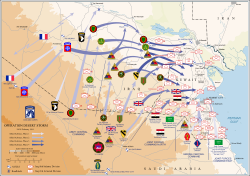
in 1990 to command British land forces. It had two brigades under its command, 4th and 7th Armoured Brigade. During the war it came under the US VII Corps and was part of the great armoured left-hook that destroyed many Iraqi Republican Guard
formations. The two brigades in the division alternated heading the advance.
.png) In 1993 HQ 1st Armoured Division was disbanded and the 1st (UK) Armoured Division formed from the 4th Armoured Division. The Divisional Headquarters was deployed in command of Multi National Division South West in Bosnia in 1996 – 97 and 1998 – 99.
In 1993 HQ 1st Armoured Division was disbanded and the 1st (UK) Armoured Division formed from the 4th Armoured Division. The Divisional Headquarters was deployed in command of Multi National Division South West in Bosnia in 1996 – 97 and 1998 – 99.
The Division headquarters again deployed to the Gulf
area in 2003. It again commanded British forces in the area, this time with three full brigades under its control. Those were 7th Armoured Brigade again, along with 16 Air Assault Brigade, and 3 Commando Brigade
. In a combined arms operation the division secured southern Iraq, including the city of Basra
during the invasion. It came under I Marine Expeditionary Force during the 2003 conflict.
The 1st (UK) Armoured Division is currently the only British division to be stationed in Germany. The headquarters as been stationed since 1993 at Wentworth Barracks in Herford
. The Division currently reports to Commander Field Army
within HQ Land Forces at Wilton.
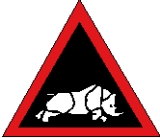
The divisional badge dates from 1983, and combines the hollow red triangular "spearhead" badge of 1st Infantry Division with the charging rhinoceros badge of 1st Armoured Division as displayed in World War II.
The following brigades make up the 1st (United Kingdom) Armoured Division:
GOC The Mobile Division
GOC 1st Armoured Division
GOC 1st Division
GOC 1st Armoured Division
GOC 1st (UK) Armoured Division
British Army
The British Army is the land warfare branch of Her Majesty's Armed Forces in the United Kingdom. It came into being with the unification of the Kingdom of England and Scotland into the Kingdom of Great Britain in 1707. The new British Army incorporated Regiments that had already existed in England...
. Originally formed in November 1937 as the Mobile Division, it saw extensive service during the Second World War, was disbanded afterward, was reconstituted in 1976, and remains in service today. It should not be confused with 1st Infantry Division which saw service in the Second World War as a separate formation.
Second World War
Following an initiative by General Sir Archibald Montgomery-Massingberd, the Division was initially established in November 1937 under Major-General Alan BrookeAlan Brooke, 1st Viscount Alanbrooke
Field Marshal The Rt. Hon. Alan Francis Brooke, 1st Viscount Alanbrooke, KG, GCB, OM, GCVO, DSO & Bar , was a senior commander in the British Army. He was the Chief of the Imperial General Staff during the Second World War, and was promoted to Field Marshal in 1944...
as the The Mobile Division. It first saw service in incomplete form under the command of Major-General Roger Evans
Roger Evans (British Army officer)
Major-General Roger Evans was a British Army officer who commanded 1st Armoured Division at the start of World War I.-Military career:...
when the second British Expeditionary Force
British Expeditionary Force (World War II)
The British Expeditionary Force was the British force in Europe from 1939–1940 during the Second World War. Commanded by General Lord Gort, the BEF constituted one-tenth of the defending Allied force....
was sent to France in 1940. It landed in France on 14 April 1940 and was evacuated on 16 June, having served south of the River Somme
Somme River
The Somme is a river in Picardy, northern France. The name Somme comes from a Celtic word meaning tranquility. The department Somme was named after this river....
, isolated from the other British formations.
For the rest of 1940 and up until 27 August 1941, the division was stationed in the United Kingdom on anti-invasion duties under the command of Major-General Willoughby Norrie. It then embarked for Egypt
Egypt
Egypt , officially the Arab Republic of Egypt, Arabic: , is a country mainly in North Africa, with the Sinai Peninsula forming a land bridge in Southwest Asia. Egypt is thus a transcontinental country, and a major power in Africa, the Mediterranean Basin, the Middle East and the Muslim world...
under the command of Major General Herbert Lumsden
Herbert Lumsden
Lieutenant-General Herbert Lumsden, CB, DSO, MC, psc was a British Army general during World War II.-Early career:...
and arrived in Egypt on 13 November 1941. Following the wounding of Herbert Lumsden, Major-General Frank Messervy
Frank Messervy
General Sir Frank Walter Messervy, KCSI, KBE, CB, DSO & Bar, , was a British Indian Army officer in both the First and Second World Wars...
took command in January 1942 retaining command until Lumsden returned in March. It took part in many of the major battles of the later part of the campaign against Rommel
Rommel
Erwin Rommel was a German World War II field marshal.Rommel may also refer to:*Rommel *Rommel Adducul , Filipino basketball player*Rommel Fernández , first Panamanian footballer to play in Europe...
including Gazala
Battle of Gazala
The Battle of Gazala was an important battle of the Second World War Western Desert Campaign, fought around the port of Tobruk in Libya from 26 May-21 June 1942...
, First El Alamein
First Battle of El Alamein
The First Battle of El Alamein was a battle of the Western Desert Campaign of the Second World War, fought between Axis forces of the Panzer Army Africa commanded by Field Marshal Erwin Rommel, and Allied forces The First Battle of El Alamein (1–27 July 1942) was a battle of the Western Desert...
, Second El Alamein
Second Battle of El Alamein
The Second Battle of El Alamein marked a major turning point in the Western Desert Campaign of the Second World War. The battle took place over 20 days from 23 October – 11 November 1942. The First Battle of El Alamein had stalled the Axis advance. Thereafter, Lieutenant-General Bernard Montgomery...
, Tebaga Gap, Akarit
Battle of Wadi Akarit
The Battle of Wadi Akarit was the successful Allied action on 6 and 7 April 1943 to dislodge Axis forces from their positions along the Wadi Akarit in Tunisia . At this point, known as the Gabès Gap, north of the towns of Gabès and El Hamma, there is a narrow land gap between the sea and...
, El Kourzia and Tunis
Tunisia Campaign
The Tunisia Campaign was a series of battles that took place in Tunisia during the North African Campaign of the Second World War, between Axis and Allied forces. The Allies consisted of British Imperial Forces, including Polish and Greek contingents, with American and French corps...
. In August 1942 Major-General Raymond Briggs
Raymond Briggs (British Army officer)
Major-General Raymond Briggs CB DSO was a British Army officer who led 2nd Armoured Brigade at the Second Battle of El Alamein.-Military career:...
took control and in July 1943 Major-General Alexander Galloway
Alexander Galloway
Lieutenant-General Sir Alexander Galloway KBE, CB, DSO, MC was an officer in the British Army during World War I and World War II...
took over the baton.
From the end of the Tunisian campaign the division remained in North Africa until May 1944. It then transferred to Italy
Italy
Italy , officially the Italian Republic languages]] under the European Charter for Regional or Minority Languages. In each of these, Italy's official name is as follows:;;;;;;;;), is a unitary parliamentary republic in South-Central Europe. To the north it borders France, Switzerland, Austria and...
, fighting one last battle at Coriano in the fighting on the Gothic Line
Gothic Line
The Gothic Line formed Field Marshal Albert Kesselring's last major line of defence in the final stages of World War II along the summits of the Apennines during the fighting retreat of German forces in Italy against the Allied Armies in Italy commanded by General Sir Harold Alexander.Adolf Hitler...
. Major-General Richard Hull took over command for this part of the campaign in August 1944. The division was disbanded on 1 January 1945.
Artillery
- 2nd Regiment, Royal Horse ArtilleryRoyal Horse ArtilleryThe regiments of the Royal Horse Artillery , dating from 1793, are part of the Royal Regiment of Artillery of the British Army...
24/08/42-26/09/44 - 4th Regiment, Royal Horse Artillery 21/09/42-25/10/43
- 11th Regiment, Royal Horse Artillery 24/08/42-26/09/44
- 60th Anti-Tank Regiment, Royal ArtilleryRoyal ArtilleryThe Royal Regiment of Artillery, commonly referred to as the Royal Artillery , is the artillery arm of the British Army. Despite its name, it comprises a number of regiments.-History:...
01/04/44-26/09/44 - 76th Anti-Tank Regiment, Royal Artillery 22/09/42-31/03/44
- 42nd Light Anti-Aircraft Regiment, Royal Artillery 26/09/42-05/10/44
Engineers
- 1st Field Squadron, Royal EngineersRoyal EngineersThe Corps of Royal Engineers, usually just called the Royal Engineers , and commonly known as the Sappers, is one of the corps of the British Army....
01/02/40-04/02/42; 02/09/42-29/09/44 - 7th Field Squadron, Royal Engineers 23/10/40-19/03/42; 01/10/42-20/08/44
- 627th Field Squadron, Royal Engineers 21/08/44-29/09/44
- 1st Field Park Squadron, Royal Engineers 03/07/40-25/08/44
- 631st Field Park Squadron, Royal Engineers 26/08/44-29/09/44
- 1st Field Park Troop, Royal Engineers 01/08/40-02/07/40
- 27th Bridging Troop, Royal Engineers 18/10/43-25/08/44
Reconnaissance
- 12th Lancers 01/11/40-12/05/42; 13/09/42-06/04/44
- 1st The Royal Dragoons 12/05/42-13/09/42
- 4th Hussars 23/05/44-25/09/44
Brigades
- 2nd Light Armoured Brigade 03/09/39-14/04/40
- 1st Heavy Armoured Brigade 03/09/39-14/04/40
- 1st Support Group 03/09/39-11/02/42
- 2nd Armoured Brigade 14/04/40-25/09/44
- 3rd Armoured Brigade 14/04/40-04/10/40
- 22nd Armoured Brigade 14/10/40-07/11/41
- 200th Guards Brigade Group 12/02/42-20/05/42
- 201st Guard Brigade Group 21/05/42-14/06/42
- 7th Motor Brigade 23/09/42-19/07/43
- 18th Lorried Infantry Brigade 20/07/43-16/02/44
- 18th Infantry Brigade 05/10/43-16/02/44; 17/08/44-28/10/44
Post Second World War
Germany
Germany , officially the Federal Republic of Germany , is a federal parliamentary republic in Europe. The country consists of 16 states while the capital and largest city is Berlin. Germany covers an area of 357,021 km2 and has a largely temperate seasonal climate...
. During the 1970s, the division consisted of two "square" brigades, the 7th Armoured Brigade and 11th Armoured Brigade. It was renamed 1st Armoured Division in 1976. In 1978 the Headquarters moved to Shiel Barracks in Verden in Germany. After being briefly reorganised into two "task forces" ("Alpha" and "Bravo"), in the early 1980s it consisted of the 7th, 12th, and 22nd Armoured Brigades.
Divisional formations and units have deployed on many other operations such as internal security in Northern Ireland, The Falkland Islands, Belize and United Nations tours in Cyprus, Bosnia and Kosovo. The headquarters of the division was deployed to Saudi Arabia
Saudi Arabia
The Kingdom of Saudi Arabia , commonly known in British English as Saudi Arabia and in Arabic as as-Sa‘ūdiyyah , is the largest state in Western Asia by land area, constituting the bulk of the Arabian Peninsula, and the second-largest in the Arab World...
in 1990 to command British land forces. It had two brigades under its command, 4th and 7th Armoured Brigade. During the war it came under the US VII Corps and was part of the great armoured left-hook that destroyed many Iraqi Republican Guard
Iraqi Republican Guard
The Iraqi Republican Guard was a branch of the Iraqi military during the presidency of Saddam Hussein. It later became the Republican Guard Corps, and then the Republican Guard Forces Command with its expansion into two corps....
formations. The two brigades in the division alternated heading the advance.
Current formation
The Division headquarters again deployed to the Gulf
Persian Gulf
The Persian Gulf, in Southwest Asia, is an extension of the Indian Ocean located between Iran and the Arabian Peninsula.The Persian Gulf was the focus of the 1980–1988 Iran-Iraq War, in which each side attacked the other's oil tankers...
area in 2003. It again commanded British forces in the area, this time with three full brigades under its control. Those were 7th Armoured Brigade again, along with 16 Air Assault Brigade, and 3 Commando Brigade
3 Commando Brigade
3 Commando Brigade is a commando formation of the British Armed Forces and the main manoeuvre formation of the Royal Marines. Its personnel are predominantly Royal Marines, supported by units of Royal Engineers, Royal Artillery, The Rifles, and the Fleet Air Arm, together with other Commando...
. In a combined arms operation the division secured southern Iraq, including the city of Basra
Basra
Basra is the capital of Basra Governorate, in southern Iraq near Kuwait and Iran. It had an estimated population of two million as of 2009...
during the invasion. It came under I Marine Expeditionary Force during the 2003 conflict.
The 1st (UK) Armoured Division is currently the only British division to be stationed in Germany. The headquarters as been stationed since 1993 at Wentworth Barracks in Herford
Herford
Herford is a town in North Rhine-Westphalia, Germany, located in the lowlands between the hill chains of the Wiehen Hills and the Teutoburg Forest. It is the capital of the district of Herford.- Geographic location :...
. The Division currently reports to Commander Field Army
Commander Field Army (United Kingdom)
The Commander Field Army was a senior British Army officer who had command over the Deployable Divisions of the British Army i.e. those divisions on full strength...
within HQ Land Forces at Wilton.
The divisional badge dates from 1983, and combines the hollow red triangular "spearhead" badge of 1st Infantry Division with the charging rhinoceros badge of 1st Armoured Division as displayed in World War II.
The following brigades make up the 1st (United Kingdom) Armoured Division:
- 7th Armoured Brigade (The Desert Rats)
- 20th Armoured Brigade (The Iron Fist)
- 1st Division Headquarters and Signal Regiment
- 1 Regiment Army Air Corps (Lynx)
- 28 Engineer Regiment, Royal Engineers
- 1 Regiment, Royal Military PoliceRoyal Military PoliceThe Royal Military Police is the corps of the British Army responsible for the policing of service personnel, and for providing a military police presence both in the UK, and whilst service personnel are deployed overseas on operations and exercises.Members of the RMP are generally known as...
- 1 Logistic Support Regiment, Royal Logistic CorpsRoyal Logistic CorpsThe Royal Logistic Corps provides logistic support functions to the British Army. It is the largest Corps in the Army, comprising around 17% of its strength...
- 2 Logistic Support Regiment, Royal Logistic CorpsRoyal Logistic CorpsThe Royal Logistic Corps provides logistic support functions to the British Army. It is the largest Corps in the Army, comprising around 17% of its strength...
General Officers Commanding
Commanders have been:GOC The Mobile Division
- 1937–1938 Major-General Alan BrookeAlan Brooke, 1st Viscount AlanbrookeField Marshal The Rt. Hon. Alan Francis Brooke, 1st Viscount Alanbrooke, KG, GCB, OM, GCVO, DSO & Bar , was a senior commander in the British Army. He was the Chief of the Imperial General Staff during the Second World War, and was promoted to Field Marshal in 1944...
GOC 1st Armoured Division
- 1938–1940 Major-General Roger EvansRoger Evans (British Army officer)Major-General Roger Evans was a British Army officer who commanded 1st Armoured Division at the start of World War I.-Military career:...
- 1940–1941 Major-General Willoughby Norrie
- 1941–1942 Major General Herbert LumsdenHerbert LumsdenLieutenant-General Herbert Lumsden, CB, DSO, MC, psc was a British Army general during World War II.-Early career:...
- Jan 1942–Mar 1942 Major-General Frank MesservyFrank MesservyGeneral Sir Frank Walter Messervy, KCSI, KBE, CB, DSO & Bar, , was a British Indian Army officer in both the First and Second World Wars...
- Mar 1942–Aug 1942 Major General Herbert LumsdenHerbert LumsdenLieutenant-General Herbert Lumsden, CB, DSO, MC, psc was a British Army general during World War II.-Early career:...
- 1942–1943 Major-General Raymond BriggsRaymond Briggs (British Army officer)Major-General Raymond Briggs CB DSO was a British Army officer who led 2nd Armoured Brigade at the Second Battle of El Alamein.-Military career:...
- 1943–1944 Major-General Alexander GallowayAlexander GallowayLieutenant-General Sir Alexander Galloway KBE, CB, DSO, MC was an officer in the British Army during World War I and World War II...
- Aug 1944–Sep 1944 Major-General Richard Hull
GOC 1st Division
- 1960–1961 Major-General Alan JollyAlan JollyGeneral Sir Alan Jolly GCB CBE DSO is a former Quartermaster-General to the Forces.-Military career:Jolly was commissioned into the Royal Tank Corps in 1931...
- 1961–1963 Major-General Thomas PearsonThomas Pearson (British Army officer)General Sir Thomas Pearson KCB CBE DSO was Commander-in-Chief of Allied Forces Northern Europe.-Military career:Educated at Charterhouse School, Pearson was commissioned into the Rifle Brigade in 1934....
- 1963–1965 Major-General Miles Fitzalan-HowardMiles Fitzalan-Howard, 17th Duke of NorfolkMajor-General Miles Francis Stapleton Fitzalan-Howard, 17th Duke of Norfolk, , was the eldest son of Bernard Fitzalan-Howard, 3rd Baron Howard of Glossop and his wife Mona Stapleton, 11th Baroness Beaumont....
- 1965–1968 Major-General Richard WardRichard Ward (British Army officer)General Sir Richard Erskine Ward GBE KCB DSO MC was Commander of British Forces in Hong Kong.-Military career:Ward was commissioned into the Royal Tank Corps in 1937. He served in World War II with 5th Royal Tank Regiment 1939 in the Western Desert and North Africa taking part in the Battle of El...
- 1968–1970 Major-General Allan TaylorAllan Taylor (British Army officer)Lieutenant General Sir Allan Macnab Taylor KBE MC is a former British Army officer who commanded 1st Division.-Military career:Taylor was commissioned into the Royal Armoured Corps in 1940 during World War II...
- 1970–1972 Major-General Jack HarmanJack HarmanGeneral Sir Jack Wentworth Harman GCB, OBE, MC is a former Adjutant-General to the Forces. He began his military career in 1940, serving in The Queen's Bays for the majority of his early career and saw service with them during Second World War in the Middle East, Europe and Africa...
- 1972–1973 Major-General Edwin BramallEdwin Bramall, Baron BramallField Marshal Edwin Noel Westby Bramall, Baron Bramall KG, GCB, OBE, MC, DL, JP is a British Army officer who served as Chief of the General Staff, the professional head of the British Army, between 1979 and 1982, and as Chief of the Defence Staff, professional head of the British Armed Forces,...
- 1973–1975 Major-General John Stanier
GOC 1st Armoured Division
- 1975–1977 Major-General David Alexander-SinclairDavid Alexander-SinclairMajor-General David Boyd Alexander-Sinclair CB is a former British Army officer who commanded 1st Armoured Division.-Military career:...
- 1977–1979 Major-General Richard LawsonRichard Lawson (British Army officer)General Sir Richard George Lawson KCB, DSO, OBE, KCSS is a former British Army officer, who served as General Officer Commanding in Northern Ireland during the Troubles, and later as Commander-in-Chief of Allied Forces Northern Europe....
- 1979–1982 Major-General Geoffrey Howlett
- 1982–1983 Major-General Brian KennyBrian Kenny (British Army officer)General Sir Brian Leslie Graham Kenny GCB CBE is a British Army General who was Deputy Supreme Allied Commander Europe.-Military career:Educated at Canford School, Brian Kenny was commissioned into the 4th Queen's Own Hussars in 1954....
- 1983–1985 Major-General David ThorneDavid Thorne (British Army officer)Major-General Sir David Calthrop Thorne KBE CVO was a British Army officer who commanded 1st Armoured Division.-Military career:...
- 1985–1987 Major-General Anthony MullensAnthony MullensLieutenant General Sir Anthony Richard Guy Mullens KCB OBE was a British Army officer who commanded 1st Armoured Division.-Military career:...
- 1987–1989 Major-General Richard SwinburnRichard SwinburnLieutenant General Sir Richard Hull Swinburn KCB was Commander of the UK Field Army.-Military career:Educated at Wellington College and the Royal Military College Sandhurst, Swinburn was commissioned into the 17th/21st Lancers in 1957....
- 1989–1990 Major-General Roger Wheeler
- 1990–1992 Major-General Rupert SmithRupert SmithGeneral Sir Rupert Smith KCB, DSO & Bar, OBE, QGM was an officer in the British Army until his retirement in 2002. He was educated at the Haileybury and Imperial Service College and later at the Royal Military Academy Sandhurst.- Military career :...
- 1992–1993 Major-General Iain Mackay-DickIain Mackay-DickMajor-General Sir Iain Mackay-Dick KCVO MBE was Major-General Commanding the Household Division and General Officer Commanding London District.-Military career:...
GOC 1st (UK) Armoured Division
- 1993–1994 Major General Anthony Denison-SmithAnthony Denison-SmithLieutenant General Sir Anthony Arthur Denison-Smith KBE DL is a former British Army officer who commanded 1st Armoured Division.-Military career:...
- 1994–1996 Major General Roddy Cordy-SimpsonRoddy Cordy-SimpsonLieutenant General Sir Roderick Alexander Cordy-Simpson KBE CB DL is a retired British Army general.-Career:Educated at Radley College, Roddy Cordy-Simpson was commissioned into the 13th/18th Hussars in February 1966....
- 1996–1998 Major General John KiszelyJohn KiszelyLieutenant General Sir John Panton Kiszely KCB, MC was Director of the Defence Academy of the United Kingdom. In December 2008 he was appointed as the National President of The Royal British Legion.-Military career:...
- 1998–2000 Major General Redmond WattRedmond WattGeneral Sir Charles Redmond "Reddy" Watt KCB, KCVO, CBE was Commander-in-Chief at Land Command.-Army career:Reddy Watt was educated at Eton College and Christ Church, Oxford and was commissioned into the Welsh Guards in 1972...
- 2000–2003 Major General Robin BrimsRobin BrimsLieutenant General Robin Vaughan Brims CB, CBE, DSO is a retired British Army officer. He was Commander of the Field Army at Land Command from 2005 to 2007.- Early life :...
- 2003–2005 Major General Peter WallPeter Wall (British Army officer)General Sir Peter Anthony Wall, KCB, CBE, ADC Gen. is a senior British Army officer, currently the Chief of the General Staff, the professional head of the British Army....
- 2005–2006 Major General John CooperJohn Cooper (British Army officer)Lieutenant General John Cooper CB DSO MBE is a former senior British Army officer. From March 2008 the Deputy Commander of Multinational Force-Iraq , the operational-level headquarters in Iraq, and Senior British Military Representative-Iraq. As Deputy Commander, he was the principal assistant to...
- 2006–2009 Major General Graham BinnsGraham BinnsMajor General Graham John Binns CBE DSO MC is a retired British Army officer. Binns served as General Officer Commanding 1st Armoured Division and then Commandant Joint Services Command and Staff College. He had previously commanded the 7th Armoured Brigade during Operation Telic 1 when they took...
- 2009–2011 Major General Adrian BradshawAdrian BradshawMajor General Adrian John Bradshaw CB OBE was, until April 2011, General Officer Commanding 1st Armoured Division.-Career:Educated at Bloxham School and Reading University, Adrian Bradshaw was commissioned into the 14th/20th King's Hussars in 1980...
- 2011–Present Major-General James BashallJames BashallMajor-General James Ian Bashall CBE is the current General Officer Commanding 1st Armoured Division.-Military career:Educated at Marlborough College, Bashall was commissioned in to the Parachute Regiment in 1984...
See also
- British Armoured formations of the Second World WarBritish Armoured formations of the Second World WarThe British Armoured formations of the Second World War refers to the Armoured Divisions and Independent Armoured and Tank Brigades deployed by the British Army during the Second World War. They had two types of armoured vehicle. The Infantry tank which was heavily armoured and slow, designed to...
- List of higher formations British 1st Armoured Division served under
- List of senior officers of 1st Armoured Division 1939–1945
- List of component units of 1st Armoured Division 1939–1945
- British Divisions in World War IIBritish Divisions in World War IIThis page is a list of British Army divisions that fought in World War II.-Armoured:*Guards Armoured Division*1st Armoured Division*2nd Armoured Division - Formed 15 December 1939 in the UK. Served in Egypt from January 1941 until March 1941 and from April 1941 until May 1941, and in Libya from...
- British Army Order of Battle - September 1939