

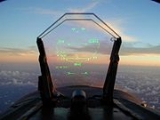
Head-Up Display

Encyclopedia

Although they were initially developed for military aviation, HUDs are now used in commercial aircraft, automobiles, and other applications.
Overview
A typical HUD contains three primary components: a projector unit, a combiner, and a video generation computer.The projection unit in a typical HUD is an optical collimator setup: a convex lens or concave mirror with a Cathode Ray Tube
Cathode ray tube
The cathode ray tube is a vacuum tube containing an electron gun and a fluorescent screen used to view images. It has a means to accelerate and deflect the electron beam onto the fluorescent screen to create the images. The image may represent electrical waveforms , pictures , radar targets and...
, light emitting diode, or liquid crystal display
Liquid crystal display
A liquid crystal display is a flat panel display, electronic visual display, or video display that uses the light modulating properties of liquid crystals . LCs do not emit light directly....
at its focus. This setup (a design that has been around since the invention of the reflector sight
Reflector sight
A reflector or reflex sight is a generally non-magnifying optical device that allows the user to look through a partially reflecting glass element and see an illuminated projection of an aiming point or some other image superimposed on the field of view...
in 1900) produces an image where the light is parallel i.e. perceived to be at infinity.
The combiner is typically an angled flat piece of glass (a beam splitter
Beam splitter
A beam splitter is an optical device that splits a beam of light in two. It is the crucial part of most interferometers.In its most common form, a rectangle, it is made from two triangular glass prisms which are glued together at their base using Canada balsam...
) located directly in front of the viewer, that redirects the projected image from projector in such a way as to see the field of view and the projected infinity image at the same time. Combiners may have special coatings that reflect the monochromatic light projected onto it from the projector unit while allowing all other wavelength
Wavelength
In physics, the wavelength of a sinusoidal wave is the spatial period of the wave—the distance over which the wave's shape repeats.It is usually determined by considering the distance between consecutive corresponding points of the same phase, such as crests, troughs, or zero crossings, and is a...
s of light to pass through. In some optical layouts combiners may also have a curved surface to refocus the image from the projector.
The computer provides the interface between the HUD (i.e. the projection unit) and the systems/data to be displayed and generates the imagery and symbology to be displayed by the projection unit .
Types
Other than fixed mounted HUDs there are also Helmet mounted displayHelmet mounted display
A helmet mounted display is a device used in some modern aircraft, especially combat aircraft. HMDs project information similar to that of head-up displays on an aircrew’s visor or reticle, thereby allowing him to obtain situational awareness and/or cue weapons systems to the direction his head...
s (HMD), a form of HUD that features a display element that moves with the orientation of the users' heads.
Many modern fighters (such as F/A-18, F-22, Eurofighter) use both a HUD and HMD concurrently. The F-35 Lightning II was designed without a HUD, relying solely on the HMD, making it the first modern military fighter not to have a fixed HUD.
Generations
HUDs are split into four generations reflecting the technology used to generate the images.- First Generation—Use a CRTCathode ray tubeThe cathode ray tube is a vacuum tube containing an electron gun and a fluorescent screen used to view images. It has a means to accelerate and deflect the electron beam onto the fluorescent screen to create the images. The image may represent electrical waveforms , pictures , radar targets and...
to generate an image on a phosphor screen, having the disadvantage of the phosphor screen coating degrading over time. The majority of HUDs in operation today are of this type. - Second Generation—Use a solid state light source, for example LEDLEdLEd is a TeX/LaTeX editing software working under Microsoft Windows. It is a freeware product....
, which is modulated by an LCD screen to display an image. These systems do not fade or require the high voltages of first generation systems. These systems are on commercial aircraft. - Third Generation—Use optical waveguides to produce images directly in the combiner rather than use a projection system.
- Fourth Generation—Use a scanning laser to display images and even video imagery on a clear transparent medium.
Newer micro-display imaging technologies are being introduced, including liquid crystal display (LCD), liquid crystal on silicon
Liquid crystal on silicon
Liquid crystal on silicon is a "micro-projection" or "micro-display" technology typically applied in projection televisions. It is a reflective technology similar to DLP projectors; however, it uses liquid crystals instead of individual mirrors. By way of comparison, LCD projectors use...
(LCoS), digital micro-mirrors (DMD), and organic light-emitting diode
Organic light-emitting diode
An OLED is a light-emitting diode in which the emissive electroluminescent layer is a film of organic compounds which emit light in response to an electric current. This layer of organic semiconductor material is situated between two electrodes...
(OLED).
History
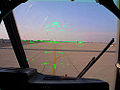
Reflector sight
A reflector or reflex sight is a generally non-magnifying optical device that allows the user to look through a partially reflecting glass element and see an illuminated projection of an aiming point or some other image superimposed on the field of view...
, a pre-World War II parallax
Parallax
Parallax is a displacement or difference in the apparent position of an object viewed along two different lines of sight, and is measured by the angle or semi-angle of inclination between those two lines. The term is derived from the Greek παράλλαξις , meaning "alteration"...
free optical sight technology for military
Military
A military is an organization authorized by its greater society to use lethal force, usually including use of weapons, in defending its country by combating actual or perceived threats. The military may have additional functions of use to its greater society, such as advancing a political agenda e.g...
fighter aircraft
Fighter aircraft
A fighter aircraft is a military aircraft designed primarily for air-to-air combat with other aircraft, as opposed to a bomber, which is designed primarily to attack ground targets...
. The first sight to add information to rudimentary reflector sight was the gyro gunsight
Gyro gunsight
A gyro gunsight is a modification of the non-magnifying reflector sight in which target lead and bullet drop are allowed for automatically, the sight incorporating a gyroscopic mechanism that computes the necessary deflections required to ensure a hit on the target...
that projected an air speed and turn rate modified reticle to aid in leading the guns to hit a moving target (deflection
Deflection (military)
Deflection is a technique used for effectively firing a ranged weapon at a moving target, that describes "leading the target"; that is, shooting ahead of a moving target so that the target and projectile will collide...
aircraft gun aiming). As these sights advanced, more (and more complex) information was added. HUDs soon displayed computed gunnery solutions, using aircraft information such as airspeed
Airspeed
Airspeed is the speed of an aircraft relative to the air. Among the common conventions for qualifying airspeed are: indicated airspeed , calibrated airspeed , true airspeed , equivalent airspeed and density airspeed....
and angle of attack
Angle of attack
Angle of attack is a term used in fluid dynamics to describe the angle between a reference line on a lifting body and the vector representing the relative motion between the lifting body and the fluid through which it is moving...
, thus greatly increasing the accuracy pilots could achieve in air to air battles. An early example of what would now be termed a head-up display was the Projector System of the British AI Mk VIII air interception radar fitted to some de Havilland Mosquito
De Havilland Mosquito
The de Havilland DH.98 Mosquito was a British multi-role combat aircraft that served during the Second World War and the postwar era. It was known affectionately as the "Mossie" to its crews and was also nicknamed "The Wooden Wonder"...
night fighter
Night fighter
A night fighter is a fighter aircraft adapted for use at night or in other times of bad visibility...
s, where the radar display was projected onto the aircraft's windscreen along with the artificial horizon, allowing the pilots to perform interceptions without taking their eyes from the windscreen.
HUD technology was next advanced in the Buccaneer
Blackburn Buccaneer
The Blackburn Buccaneer was a British low-level subsonic strike aircraft with nuclear weapon delivery capability serving with the Royal Navy and the Royal Air Force between 1962 and 1994, including service in the 1991 Gulf War...
, the prototype of which first flew on 1958. The aircraft's design called for an attack sight that would provide navigation and weapon release information for the low level attack mode. There was fierce competition between supporters of the new HUD design and supporters of the old electro-mechanical gunsight, with the HUD being described as a radical, even foolhardy option. The Air Arm branch of the Ministry sponsored the development of a Strike Sight. The Royal Aircraft Establishment
Royal Aircraft Establishment
The Royal Aircraft Establishment , was a British research establishment, known by several different names during its history, that eventually came under the aegis of the UK Ministry of Defence , before finally losing its identity in mergers with other institutions.The first site was at Farnborough...
(RAE) designed the equipment, it was built by Cintel
Rank Organisation
The Rank Organisation was a British entertainment company formed during 1937 and absorbed in 1996 by The Rank Group Plc. It was the largest and most vertically-integrated film company in Britain, owning production, distribution and exhibition facilities....
, and the system was first integrated in 1958. The Cintel HUD business was taken over by Elliott Flight Automation
Elliott Brothers (computer company)
-Elliott Brothers Ltd:Elliott Brothers Ltd was an early computer company of the 1950s–60s in the United Kingdom, tracing its descent from a firm of instrument makers founded by William Elliott in London around 1804. The research laboratories were based at Borehamwood, originally set up in...
and the Buccaneer HUD was manufactured and further developed continuing up to a Mark III version with a total of 375 systems made; it was given a `fit and forget' title by the Royal Navy and it was still in service nearly 25 years later. BAE Systems
BAE Systems
BAE Systems plc is a British multinational defence, security and aerospace company headquartered in London, United Kingdom, that has global interests, particularly in North America through its subsidiary BAE Systems Inc. BAE is among the world's largest military contractors; in 2009 it was the...
thus has a claim to the world's first Head Up Display in operational service.
In the United Kingdom, it was soon noted that pilots flying with the new gun-sights were becoming better at piloting their aircraft. At this point, the HUD expanded its purpose beyond weapon aiming to general piloting. In the 1960s, French test-pilot Gilbert Klopfstein created the first modern HUD and a standardized system of HUD symbols so that pilots would only have to learn one system and could more easily transition between aircraft. The modern HUD used in instrument flight rules
Instrument flight rules
Instrument flight rules are one of two sets of regulations governing all aspects of civil aviation aircraft operations; the other are visual flight rules ....
approaches to landing was developed in 1975. Klopfstein pioneered HUD technology in military fighter jets and helicopter
Helicopter
A helicopter is a type of rotorcraft in which lift and thrust are supplied by one or more engine-driven rotors. This allows the helicopter to take off and land vertically, to hover, and to fly forwards, backwards, and laterally...
s, aiming to centralize critical flight data within the pilot's field of vision. This approach sought to increase the pilot's scan efficiency and reduce "task saturation" and information overload
Information overload
"Information overload" is a term popularized by Alvin Toffler in his bestselling 1970 book Future Shock. It refers to the difficulty a person can have understanding an issue and making decisions that can be caused by the presence of too much information...
.
Use of HUDs then expanded beyond military aircraft. In the 1970s, the HUD was introduced to commercial aviation, and in 1988, the Oldsmobile Cutlass Supreme
Oldsmobile Cutlass Supreme
The Oldsmobile Cutlass Supreme was a mid-size car produced by General Motors for the American market. It was always at the top of the Cutlass range. It began as a trim package, developed its own roofline, and eventually was mechanically divorced from the later, smaller Cutlasses.The Cutlass Supreme...
became the first production car with a head-up display.
Until a few years ago, the Embraer 190 and Boeing 737
Boeing 737
The Boeing 737 is a short- to medium-range, twin-engine narrow-body jet airliner. Originally developed as a shorter, lower-cost twin-engine airliner derived from Boeing's 707 and 727, the 737 has developed into a family of nine passenger models with a capacity of 85 to 215 passengers...
New Generation Aircraft (737-600,700,800, and 900 series) were the only commercial passenger aircraft available with HUDs. However, the technology is becoming more common with aircraft such as the Canadair RJ, Airbus
Airbus
Airbus SAS is an aircraft manufacturing subsidiary of EADS, a European aerospace company. Based in Blagnac, France, surburb of Toulouse, and with significant activity across Europe, the company produces around half of the world's jet airliners....
A318 and several business jets featuring the displays. HUDs have become standard equipment on the Boeing 787. Furthermore, the Airbus A320, A330, A340 and A380 families are currently undergoing the certification process for a HUD. HUDs are also added to the Space Shuttle
Space Shuttle
The Space Shuttle was a manned orbital rocket and spacecraft system operated by NASA on 135 missions from 1981 to 2011. The system combined rocket launch, orbital spacecraft, and re-entry spaceplane with modular add-ons...
orbiter.
Design factors
There are several factors that interplay in the design of a HUD:- Field of View — also "FOV", indicates the angle(s), vertically as well as horizontally, subtended at the pilot's eye, that the combiner displays symbology in relation to the outside view. A narrow FOV means that the view (of a runway, for example) through the combiner might include little additional information beyond the perimeters of the runway environment; whereas a wide FOV would allow a 'broader' view. For aviation applications, the major benefit of a wide FOV is that an aircraft approaching the runway in a crosswind might still have the runway in view through the combiner, even though the aircraft is pointed well away from the runway threshold; where a narrow FOV the runway would be 'off the edge' of the combiner, out of the HUD's view. Because the human eyes are separated, each eye receives a different image. The HUD image is viewable by one or both eyes, depending on technical and budget limitations in the design process. Modern expectations are that both eyes view the same image, in other words a "binocular Field of View (FOV)".
- Collimation - The projected image is collimated which makes the light rays parallel. Because the human brain interprets light parallelity to infer distance to an object, collimated images on the HUD combiner are perceived as existing at or near optical infinityInfinityInfinity is a concept in many fields, most predominantly mathematics and physics, that refers to a quantity without bound or end. People have developed various ideas throughout history about the nature of infinity...
. This means that the pilot's eyes do not need to refocus to view the outside world and the HUD display...the image appears to be "out there", overlaying the outside world. In automobiles the display is generally focused near the distance to the bumper. - Eyebox — The optical collimator produces a cylinder of parallel light so the display can only be viewed while the viewers' eyes are somewhere within that cylinder, a three-dimensional area called the head motion box or eyebox. Modern HUD eyeboxes are usually about 5 lateral by 3 vertical by 6 longitudinal inches. This allows the viewer some freedom of head movement but movement too far up/down left/right will cause the display to vanish off the edge of the collimator and movement to far back will cause it to crop off around the edge (vignetteVignettingIn photography and optics, vignetting is a reduction of an image's brightness or saturation at the periphery compared to the image center. The word vignette, from the same root as vine, originally referred to a decorative border in a book. Later, the word came to be used for a photographic...
). The pilots is able to view the entire display as long as one of their eyes is inside the eyebox. - Luminance/contrast — Displays have adjustments in luminanceLuminanceLuminance is a photometric measure of the luminous intensity per unit area of light travelling in a given direction. It describes the amount of light that passes through or is emitted from a particular area, and falls within a given solid angle. The SI unit for luminance is candela per square...
and contrast to account for ambient lighting, which can vary widely (e.g., from the glare of bright clouds to moonless night approaches to minimally lit fields). - Boresight — Aircraft HUD components are very accurately aligned with the aircraft's three axes – a process called boresightBoresightBoresight is a term used to describe crude adjustments made to an optical firearm sight, or iron sights, to align the firearm barrel and sights. This method is usually used to pre-align the sights, which makes zeroing much faster.Traditional boresighting, as the name suggests involves removing...
ing – so that displayed data conforms to reality typically with an accuracy of ±7.0 milliradians. In this case the word "conform" means, "when an object is projected on the combiner and the actual object is visible, they will be aligned". This allows the display to show the pilot exactly where the artificial horizonHorizonThe horizon is the apparent line that separates earth from sky, the line that divides all visible directions into two categories: those that intersect the Earth's surface, and those that do not. At many locations, the true horizon is obscured by trees, buildings, mountains, etc., and the resulting...
is, as well as the aircraft's projected path with great accuracy. When Enhanced Vision is used, for example, the display of runway lights are aligned with the actual runway lights when the real lights become visible. Boresighting is done during the aircraft's building process and can also be performed in the field on many aircraft. - Scaling - The displayed image (flight path, pitch and yaw scaling, etc), are scaled to present to the pilot a picture that overlays the outside world in an exact 1:1 relationship. For example, objects (such as a runway threshold) that are 3 degrees below the horizon as viewed from the cockpit must appear at the -3 degree index on the HUD display.
- Compatibility — HUD components are designed to be compatible with other avionics, displays, etc.
Aircraft
On aircraft avionics systems, HUDs typically operate from dual independent redundant computer systems. They receive input directly from the sensors (pitot-static, gyroscopic, navigation, etc.) aboard the aircraft and perform their own computations rather than receiving previously computed data from the flight computers. On other aircraft (the Boeing 787, for example) the HUD guidance computation for Low Visibility Take-off (LVTO) and low visibility approach comes from the same flight guidance computer that drives the autopilot. Computers are integrated with the aircraft's systems and allow connectivity onto several different data buses such as the ARINC 429ARINC 429
ARINC 429 is the technical standard for the predominant avionics data bus used on most higher-end commercial and transport aircraft. It defines the physical and electrical interfaces of a two-wire data bus and a data protocol to support an aircraft's avionics local area network.-Messages:ARINC 429...
, ARINC 629, and MIL-STD-1553
MIL-STD-1553
MIL-STD-1553 is a military standard published by the United States Department of Defense that defines the mechanical, electrical, and functional characteristics of a serial data bus. It was originally designed for use with military avionics, but has also become commonly used in spacecraft on-board...
.
Displayed data
Typical aircraft HUDs display airspeedAirspeed
Airspeed is the speed of an aircraft relative to the air. Among the common conventions for qualifying airspeed are: indicated airspeed , calibrated airspeed , true airspeed , equivalent airspeed and density airspeed....
, altitude
Altitude
Altitude or height is defined based on the context in which it is used . As a general definition, altitude is a distance measurement, usually in the vertical or "up" direction, between a reference datum and a point or object. The reference datum also often varies according to the context...
, a horizon
Horizon
The horizon is the apparent line that separates earth from sky, the line that divides all visible directions into two categories: those that intersect the Earth's surface, and those that do not. At many locations, the true horizon is obscured by trees, buildings, mountains, etc., and the resulting...
line, heading, turn/bank and slip/skid indicators. These instruments are the minimum required by 14 CFR Part 91.
Other symbols and data are also available in some HUDs:
- boresight or waterline symbol—is fixed on the display and shows where the nose of the aircraft is actually pointing.
- flight path vector (FPV) or velocity vector symbol—shows where the aircraft is actually going, the sum of all forces acting on the aircraft. For example, if the aircraft is pitchedFlight dynamicsFlight dynamics is the science of air vehicle orientation and control in three dimensions. The three critical flight dynamics parameters are the angles of rotation in three dimensions about the vehicle's center of mass, known as pitch, roll and yaw .Aerospace engineers develop control systems for...
up but is losing energy, then the FPV symbol will be below the horizon even though the boresight symbol is above the horizon. During approach and landing, a pilot can fly the approach by keeping the FPV symbol at the desired descent angle and touchdown point on the runway. - acceleration indicator or energy cue—typically to the left of the FPV symbol, it is above it if the aircraft is accelerating, and below the FPV symbol if decelerating.
- angle of attackAngle of attackAngle of attack is a term used in fluid dynamics to describe the angle between a reference line on a lifting body and the vector representing the relative motion between the lifting body and the fluid through which it is moving...
indicator—shows the wing's angle relative to the airflow, often displayed as "α". - navigation data and symbols—for approaches and landings, the flight guidance systems can provide visual cues based on navigation aids such as an Instrument Landing SystemInstrument Landing SystemAn instrument landing system is a ground-based instrument approach system that provides precision guidance to an aircraft approaching and landing on a runway, using a combination of radio signals and, in many cases, high-intensity lighting arrays to enable a safe landing during instrument...
or augmented Global Positioning SystemGlobal Positioning SystemThe Global Positioning System is a space-based global navigation satellite system that provides location and time information in all weather, anywhere on or near the Earth, where there is an unobstructed line of sight to four or more GPS satellites...
such as the Wide Area Augmentation System. Typically this is a circle which fits inside the flight path vector symbol. Pilots can fly along the correct flight path by "flying to" the guidance cue.
Since being introduced on HUDs, both the FPV and acceleration symbols are becoming standard on head-down displays (HDD). The actual form of the FPV symbol on an HDD is not standardized but is usually a simple aircraft drawing, such as a circle with two short angled lines, (180 ± 30 degrees) and "wings" on the ends of the descending line. Keeping the FPV on the horizon allows the pilot to fly level turns in various angles of bank.
Military aircraft specific applications
In addition to the generic information described above, military applications include weapons system and sensor data such as:- target designation (TD) indicator—places a cue over an air or ground target (which is typically derived from radarRadarRadar is an object-detection system which uses radio waves to determine the range, altitude, direction, or speed of objects. It can be used to detect aircraft, ships, spacecraft, guided missiles, motor vehicles, weather formations, and terrain. The radar dish or antenna transmits pulses of radio...
or inertial navigation systemInertial navigation systemAn inertial navigation system is a navigation aid that uses a computer, motion sensors and rotation sensors to continuously calculate via dead reckoning the position, orientation, and velocity of a moving object without the need for external references...
data). - Vc—closing velocity with target.
- Range—to target, waypoint, etc.
- Launch Acceptability Region (LAR)—displays when an air-to-air or air-to-ground weapon can be successfully launched to reach a specified target.
- weapon seeker or sensor line of sight—shows where a seeker or sensor is pointing.
- weapon status—includes type and number of weapons selected, available, arming, etc.
VTOL/STOL approaches and landings
During the 1980s, the military tested the use of HUDs in vertical take off and landings (VTOL) and short take off and landing (STOL) aircraft. A HUD format was developed at NASANASA
The National Aeronautics and Space Administration is the agency of the United States government that is responsible for the nation's civilian space program and for aeronautics and aerospace research...
Ames Research Center to provide pilots of V/STOL aircraft with complete flight guidance and control information for Category-IIIC terminal-area flight operations. This includes a large variety of flight operations, from STOL flights on land-based runways to VTOL operations on aircraft carrier
Aircraft carrier
An aircraft carrier is a warship designed with a primary mission of deploying and recovering aircraft, acting as a seagoing airbase. Aircraft carriers thus allow a naval force to project air power worldwide without having to depend on local bases for staging aircraft operations...
s. The principal features of this display format are the integration of the flightpath and pursuit guidance information into a narrow field of view, easily assimilated by the pilot with a single glance, and the superposition of vertical and horizontal situation information. The display is a derivative of a successful design developed for conventional transport aircraft.
Civil aircraft specific applications
The use of head-up displays allows commercial aircraft substantial flexibility in their operations. Systems have been approved which allow reduced-visibility takeoffs and landings, as well as full Category IIIcInstrument Landing System
An instrument landing system is a ground-based instrument approach system that provides precision guidance to an aircraft approaching and landing on a runway, using a combination of radio signals and, in many cases, high-intensity lighting arrays to enable a safe landing during instrument...
landings. Studies have shown that the use of a HUD during landings decreases the lateral deviation from centerline in all landing conditions, although the touchdown point along the centerline is not changed.
Enhanced flight vision systems
In more advanced systems, such as the FAAFederal Aviation Administration
The Federal Aviation Administration is the national aviation authority of the United States. An agency of the United States Department of Transportation, it has authority to regulate and oversee all aspects of civil aviation in the U.S...
-labeled Enhanced Flight Vision System, a real-world visual image can be overlaid onto the combiner. Typically an infrared
Infrared
Infrared light is electromagnetic radiation with a wavelength longer than that of visible light, measured from the nominal edge of visible red light at 0.74 micrometres , and extending conventionally to 300 µm...
camera (either single or multi-band) is installed in the nose of the aircraft to display a conformed image to the pilot. EVS Enhanced Vision System is an industry accepted term which the FAA decided not to use because "the FAA believes [it] could be confused with the system definition and operational concept found in 91.175(l) and (m)" In one EVS installation, the camera is actually installed at the top of the vertical stabilizer rather than "as close as practical to the pilots eye position". When used with a HUD however, the camera must be mounted as close as possible to the pilots eye point as the image is expected to "overlay" the real world as the pilot looks through the combiner.
"Registration," or the accurate overlay of the EVS image with the real world image, is one feature closely examined by authorities prior to approval of a HUD based EVS. This is because of the importance of the HUD matching the real world.
While the EVS display can greatly help, the FAA has only relaxed operating regulations so an aircraft with EVS can perform a CATEGORY I approach to CATEGORY II minimums. In all other cases the flight crew must comply with all "unaided" visual restrictions. (For example if the runway visibility is restricted because of fog, even though EVS may provide a clear visual image it is not appropriate (or actually legal) to maneuver the aircraft using only the EVS below 100' agl.)
Synthetic vision systems
HUD systems are also being designed to utilize a synthetic vision systemSynthetic vision
A Synthetic Vision System is a computer-mediated reality system for aerial vehicles, that uses 3D to provide pilots with clear and intuitive means of understanding their flying environment....
(SVS), which use terrain databases to create realistic and intuitive views of the outside world.
In the SVS image to the right, immediately visible indicators include the airspeed tape on the left, altitude tape on the right, and turn/bank/slip/skid displays at the top center. The boresight symbol (-v-) is in the center and directly below that is the flight path vector symbol (the circle with short wings and a vertical stabilizer). The horizon line is visible running across the display with a break at the center, and directly to the left are the numbers at ±10 degrees with a short line at ±5 degrees (The +5 degree line is easier to see) which, along with the horizon line, show the pitch of the aircraft.
The aircraft in the image is wings level (i.e. the flight path vector symbol is flat relative to the horizon line and there is zero roll on the turn/bank indicator). Airspeed is 140 knots, altitude is 9450 feet, heading is 343 degrees (the number below the turn/bank indicator). Close inspection of the image shows a small purple circle which is displaced from the Flight Path Vector slightly to the lower right. This is the guidance cue coming from the Flight Guidance System. When stabilized on the approach, this purple symbol should be centered within the FPV.
The terrain is entirely computer generated from a high resolution terrain database.
In some systems, the SVS will calculate the aircraft's current flight path, or possible flight path (based on an aircraft performance model, the aircraft's current energy, and surrounding terrain) and then turn any obstructions red to alert the flight crew. Such a system could have prevented the crash of American Airlines Flight 965
American Airlines Flight 965
American Airlines Flight 965, a Boeing 757 registered , was a scheduled flight from Miami International Airport in Miami, Florida to Alfonso Bonilla Aragón International Airport in Cali, Colombia, which crashed into a mountain in Buga, Colombia on December 20, 1995, killing 151 passengers and 8...
in 1995.
On the left side of the display is an SVS-unique symbol, with the appearance of a purple, dimishing sideways ladder, and which continues on the right of the display. The two lines define a "tunnel in the sky". This symbol defines the desired trajectory of the aircraft in three dimensions. For example, if the pilot had selected an airport to the left, then this symbol would curve off to the left and down. If the pilot keeps the flight path vector alongside the trajectory symbol, the craft will fly the optimum path. This path would be based on information stored in the Flight Management System's data base and would show the FAA-approved approach for that airport.
The tunnel in the sky can also greatly assist the pilot when more precise four dimensional flying is required, such as the decreased vertical or horizontal clearance requirements of RNP
Required Navigation Performance
Required Navigation Performance is a type of performance-based navigation that allows an aircraft to fly a specific path between two 3-dimensionally defined points in space. RNAV and RNP systems are fundamentally similar. The key difference between them is the requirement for on-board...
. Under such conditions the pilot is given a graphical depiction of where the aircraft should be and where it should be going rather than the pilot having to mentally integrate altitude, airspeed, heading, energy and longitude and latitude to correctly fly the aircraft.
Automobiles
General Motors began using head-up displays in 1988 with the first color display appearing in 1998 on the Corvette C5. Toyota, for domestic market only, in 1991 released this system in Toyota Crown Majesta. In 2003, BMWBMW
Bayerische Motoren Werke AG is a German automobile, motorcycle and engine manufacturing company founded in 1916. It also owns and produces the Mini marque, and is the parent company of Rolls-Royce Motor Cars. BMW produces motorcycles under BMW Motorrad and Husqvarna brands...
became the first European manufacturer to offer HUDs. The displays are becoming increasingly available in production cars, and usually offer speedometer
Speedometer
A speedometer is a gauge that measures and displays the instantaneous speed of a land vehicle. Now universally fitted to motor vehicles, they started to be available as options in the 1900s, and as standard equipment from about 1910 onwards. Speedometers for other vehicles have specific names...
, tachometer
Tachometer
A tachometer is an instrument measuring the rotation speed of a shaft or disk, as in a motor or other machine. The device usually displays the revolutions per minute on a calibrated analogue dial, but digital displays are increasingly common...
, and navigation system displays. Night vision
Automotive night vision
An automotive night vision system is a system to increase a vehicle driver's perception and seeing distance in darkness or poor weather beyond the reach of the vehicle's headlights...
information is also displayed via HUD on certain General Motors
General Motors
General Motors Company , commonly known as GM, formerly incorporated as General Motors Corporation, is an American multinational automotive corporation headquartered in Detroit, Michigan and the world's second-largest automaker in 2010...
, Honda
Honda
is a Japanese public multinational corporation primarily known as a manufacturer of automobiles and motorcycles.Honda has been the world's largest motorcycle manufacturer since 1959, as well as the world's largest manufacturer of internal combustion engines measured by volume, producing more than...
, Toyota and Lexus
Lexus
is the luxury vehicle division of Japanese automaker Toyota Motor Corporation. First introduced in 1989 in the United States, Lexus is now sold globally and has become Japan's largest-selling make of premium cars. The Lexus marque is marketed in over 70 countries and territories worldwide, and has...
vehicles. Other manufactures such as Audi
Audi
Audi AG is a German automobile manufacturer, from supermini to crossover SUVs in various body styles and price ranges that are marketed under the Audi brand , positioned as the premium brand within the Volkswagen Group....
, Citroën
Citroën
Citroën is a major French automobile manufacturer, part of the PSA Peugeot Citroën group.Founded in 1919 by French industrialist André-Gustave Citroën , Citroën was the first mass-production car company outside the USA and pioneered the modern concept of creating a sales and services network that...
, Saab
Saab
Saab AB is a Swedish aerospace and defence company, founded in 1937. From 1947 to 1990 it was the parent company of automobile manufacturer Saab Automobile, and between 1968 and 1995 the company was in a merger with commercial vehicle manufacturer Scania, known as Saab-Scania.-History:"Svenska...
, and Nissan currently offer some form of HUD system. Motorcycle helmet
Motorcycle helmet
A motorcycle helmet is a type of protective headgear used by motorcycle riders. The primary goal of a motorcycle helmet is motorcycle safety - to protect the rider's head during impact, thus preventing or reducing head injury or saving the rider's life...
HUDs are also commercially available.
Add-on HUD systems also exist, projecting the display onto a glass combiner mounted on the windshield. These systems have been marketed to police agencies for use with in-vehicle computers.
Developmental / experimental uses
HUDs have been proposed or are being experimentally developed for a number of other applications. In the military, a HUD can be used to overlay tactical information such as the output of a laser rangefinderRangefinder
A rangefinder is a device that measures distance from the observer to a target, for the purposes of surveying, determining focus in photography, or accurately aiming a weapon. Some devices use active methods to measure ; others measure distance using trigonometry...
or squadmate locations to infantry
Infantry
Infantrymen are soldiers who are specifically trained for the role of fighting on foot to engage the enemy face to face and have historically borne the brunt of the casualties of combat in wars. As the oldest branch of combat arms, they are the backbone of armies...
men. A prototype HUD has also been developed that displays information on the inside of a swimmer's goggles or of a scuba diver's mask. A group of Electrical Engineering students from the University of Massachusetts Amherst are integrating technologies in order to develop an affordable Personal Head-Up Display. One such design is a HUD in skiing goggles.
HUD systems that project information directly onto the wearer's retina
Retina
The vertebrate retina is a light-sensitive tissue lining the inner surface of the eye. The optics of the eye create an image of the visual world on the retina, which serves much the same function as the film in a camera. Light striking the retina initiates a cascade of chemical and electrical...
with a low-powered laser
Laser
A laser is a device that emits light through a process of optical amplification based on the stimulated emission of photons. The term "laser" originated as an acronym for Light Amplification by Stimulated Emission of Radiation...
(virtual retinal display
Virtual retinal display
A virtual retinal display , also known as a retinal scan display or retinal projector , is a display technology that draws a raster display directly onto the retina of the eye. The user sees what appears to be a conventional display floating in space in front of them...
) are also in experimentation. This kind of head-up display has been common in science fiction movies for decades, notably in Terminator
Terminator (franchise)
The Terminator series is a science fiction franchise encompassing a series of films and other media concerning battles between Skynet's artificially intelligent machine network, and John Connor's Resistance forces and the rest of the human race....
and RoboCop
RoboCop (franchise)
The RoboCop franchise, began in 1987 with the film RoboCop. RoboCop 2, followed in 1990 and RoboCop 3 in 1993. There have also been various television series, video game and comic book adaptations. The franchise has made over $109,715,854 USD worldwide.-Future:Sony Pictures was working on a new...
.
See also
- Acronyms and abbreviations in avionicsAcronyms and abbreviations in avionics-A:*ACARS: Aircraft Communications Addressing and Reporting System.*ACAS: Airborne Collision Avoidance System.*ACP: Audio Control Panel.*ACS: Audio Control System.*ADAHRS: Air Data and Attitude Heading Reference System.*ADC: Air Data Computer....
- Augmented realityAugmented realityAugmented reality is a live, direct or indirect, view of a physical, real-world environment whose elements are augmented by computer-generated sensory input such as sound, video, graphics or GPS data. It is related to a more general concept called mediated reality, in which a view of reality is...
- EyeTapEyetapAn EyeTap is a device that is worn in front of the eye that acts as a camera to record the scene available to the eye as well as a display to superimpose a computer-generated imagery on the original scene available to the eye....
- Head-mounted displayHead-mounted displayA head-mounted display or helmet mounted display, both abbreviated HMD, is a display device, worn on the head or as part of a helmet, that has a small display optic in front of one or each eye .- Overview :...
- HUD (video gaming)HUD (video gaming)In video gaming, the HUD is the method by which information is visually relayed to the player as part of a game's user interface...
- Virtual retinal displayVirtual retinal displayA virtual retinal display , also known as a retinal scan display or retinal projector , is a display technology that draws a raster display directly onto the retina of the eye. The user sees what appears to be a conventional display floating in space in front of them...
- Wearable computerWearable computerWearable computers are miniature electronic devices that are worn by the bearer under, with or on top of clothing. This class of wearable technology has been developed for general or special purpose information technologies and media development...
External links
- Rochester Archives Article—'Buccaneer HUD PDU'
- BBC Article—'Pacman comes to life virtually'
- 'Clinical evaluation of the 'head-up' display of anesthesia data'
- 'When will the Head-up go Civil' – Flight 1968 archive
- 'Elliott Brothers to BAE SYSTEMS' – a short history of Elliott Brothers
- Head-up Over the Hills - a 1964 Flight InternationalFlight InternationalFlight International is a global aerospace weekly publication produced in the UK. Founded in 1909, it is the world's oldest continuously published aviation news magazine...
article on flying using an early Specto head-up display