All Topics  
Nieuport 17

 
Nieuport 17

   Email Print
   Bookmark   Link


Nieuport 17


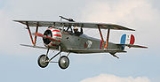
The Nieuport 17 was a French biplane
Biplane

A biplane is a fixed-wing aircraft with two main wings. The Wright brothers Wright Flyer used a biplane design, as did most aircraft in the early years of aviation....
 fighter aircraft
Fighter aircraft

A fighter aircraft is a military aircraft designed primarily for air-to-air combat with other aircraft, as opposed to a bomber, which is designed primarily to attack ground targets by dropping bombs....
 of World War I
World War I

World War I, or the First World War , was a global military conflict which involved the Great powers, organized into two opposing military alliances: the Allies of World War I and the Central Powers....
, manufactured by the Nieuport
Nieuport

Nieuport, later Nieuport-Delage, was a France Fixed-wing aircraft company famous for racers before World War I and fighter aircraft during World War I and between the wars....
 company.

type was a slightly larger development of the earlier Nieuport 11
Nieuport 11

The Nieuport 11, often nicknamed the B?b?, was a French World War I single seat fighter aircraft, designed by Gustave Delage. It is famous as one of the aircraft that ended the 'Fokker Scourge' in 1916....
, and had a more powerful engine
Engine

An engine is a mechanical device that produces some form of output from a given input.An engine whose purpose is to produce kinetic energy output from a fuel is called a Wiktionary:prime mover; alternatively, a motor is a device which produces kinetic energy from a preprocessed "fuel" ....
, larger wings, and a more refined structure in general. At first, it was equipped with a 110 hp
Horsepower

Horsepower is the name of several non-International System of Units units of power . It was originally defined to allow the output of steam engines to be measured and compared with the power output of draft horses....
 (82 kW) Le Rhône
Gnome et Rhône

Gnome et Rh?ne was a major France aircraft engine manufacturer. Between 1914 and 1918 they produced 25,000 of their 9-cylinder Delta and Le Rh?ne 110 hp rotary engine designs, while another 75,000 were produced by various licensees, powering the majority of aircraft in the first half of the war on both sides of the conflict....
 9J engine, though later versions were upgraded to a 130 hp (97 kW) engine.


Discussion
Ask a question about 'Nieuport 17'
Start a new discussion about 'Nieuport 17'
Answer questions from other users
Full Discussion Forum


Encyclopedia


The Nieuport 17 was a French biplane
Biplane

A biplane is a fixed-wing aircraft with two main wings. The Wright brothers Wright Flyer used a biplane design, as did most aircraft in the early years of aviation....
 fighter aircraft
Fighter aircraft

A fighter aircraft is a military aircraft designed primarily for air-to-air combat with other aircraft, as opposed to a bomber, which is designed primarily to attack ground targets by dropping bombs....
 of World War I
World War I

World War I, or the First World War , was a global military conflict which involved the Great powers, organized into two opposing military alliances: the Allies of World War I and the Central Powers....
, manufactured by the Nieuport
Nieuport

Nieuport, later Nieuport-Delage, was a France Fixed-wing aircraft company famous for racers before World War I and fighter aircraft during World War I and between the wars....
 company.

Design and development

The type was a slightly larger development of the earlier Nieuport 11
Nieuport 11

The Nieuport 11, often nicknamed the B?b?, was a French World War I single seat fighter aircraft, designed by Gustave Delage. It is famous as one of the aircraft that ended the 'Fokker Scourge' in 1916....
, and had a more powerful engine
Engine

An engine is a mechanical device that produces some form of output from a given input.An engine whose purpose is to produce kinetic energy output from a fuel is called a Wiktionary:prime mover; alternatively, a motor is a device which produces kinetic energy from a preprocessed "fuel" ....
, larger wings, and a more refined structure in general. At first, it was equipped with a 110 hp
Horsepower

Horsepower is the name of several non-International System of Units units of power . It was originally defined to allow the output of steam engines to be measured and compared with the power output of draft horses....
 (82 kW) Le Rhône
Gnome et Rhône

Gnome et Rh?ne was a major France aircraft engine manufacturer. Between 1914 and 1918 they produced 25,000 of their 9-cylinder Delta and Le Rh?ne 110 hp rotary engine designs, while another 75,000 were produced by various licensees, powering the majority of aircraft in the first half of the war on both sides of the conflict....
 9J engine, though later versions were upgraded to a 130 hp (97 kW) engine. It had outstanding maneuverability, and an excellent rate of climb. Unfortunately, the narrow lower wing, marking it as a "sesquiplane" design with literally "one-and-a-half wings", was weak due to its single spar construction, and had a disconcerting tendency to disintegrate in flight. Initially, the Nieuport 17 retained the above wing mounted Lewis gun
Lewis Gun

The Lewis Gun is a pre-World War I era light machine gun of American design that was perfected and most widely used by the forces of the British Empire....
 of the "11", but in French service this was soon relaced by a synchronised
Interrupter gear

Interrupter gear is a term that covers two related technologies.The first is the synchronization gear, which is often incorrectly referred to as "interrupter gear"; this is a triggering device attached to the machine gun armament of a tractor -type fighter aircraft so that it would fire only at certain times....
 Vickers gun. In the Royal Flying Corps
Royal Flying Corps

The Royal Flying Corps was the over-land air arm of the British military during most of the First World War. During the early part of the war, the RFC's responsibilities were centred on support of the British Army, via artillery cooperation and photographic reconnaissance....
, the wing mounted Lewis was usually retained, by now on the improved Foster mounting
Foster mounting

In early 1916 in aviation Sergeant Foster of No. XI Squadron RAF devised a sliding rail mounting for the upper wing Lewis Gun on a Nieuport 11. It enabled the gun to be pulled down so that its breech was conveniently in front of the pilot, making it much easier to change ammunition drums or to clear stoppages in flight....
, a curved metal rail which allowed the pilot to bring the gun down in order to change drums or clear jams. A few individual aircraft were fitted with both guns - but in practice this reduced performance unacceptably, and a single machine gun remained standard.

Operational history

The type reached the French
France

France , officially the French Republic , is a country whose Metropolitan France is located in Western Europe and that also comprises various Overseas departments and territories of France....
 front in March 1916, and quickly began to replace the Nieuport 11 in French service. It was also ordered by the Royal Flying Corps and Royal Naval Air Service
Royal Naval Air Service

The Royal Naval Air Service or RNAS was the air arm of the Royal Navy until near the end of World War I, when it merged with the British Army's Royal Flying Corps to form a new service , the Royal Air Force....
, as it was superior to any British fighter at that time. Worthy of note is the fact that during part of 1916, the Nieuport 17 equipped every fighter squadron of the Aviation Militaire. The Germans
Germany

Germany , officially the Federal Republic of Germany , is a country in Central Europe. It is bordered to the north by the North Sea, Denmark, and the Baltic Sea; to the east by Poland and the Czech Republic; to the south by Austria and Switzerland; and to the west by France, Luxembourg, Belgium, and the Netherlands....
 supplied captured examples to several of their aircraft manufacturers for them to copy. This resulted in the Siemens-Schuckert D.I
Siemens-Schuckert D.I

The Siemens-Schuckert D.I was a Germany single-seat fighter built by Siemens-Schuckert....
 which, apart from the engine installation, was a close copy and actually went into production, although in the event it was not used operationally on the Western Front.

By early 1917, the Nieuport was outclassed in most respects by the latest German fighters
Albatros D.III

The Albatros D.III was a biplane fighter aircraft used by the Imperial Germany Army Air Service and the Austria-Hungary Air Service during the First World War....
. Newer models (the Nieuport 24
Nieuport 24

The Nieuport 24 was a France biplane fighter aircraft during World War I designed by Gustave Delage as a replacement for the successful Nieuport 17....
 and the 27
Nieuport 27

The Nieuport 27 was a France biplane fighter aircraft during World War I designed by Gustave Delage. The model 27 was the last of the line of Nieuport "V-strut" single seat fighters stemming from the Nieuport 11 of early 1916....
) were brought out in an attempt to retain the type's ascendency. However, the SPAD S.VII
SPAD S.VII

The SPAD S.VII was the first of a series of highly successful biplane fighter aircraft produced by Soci?t? Pour L'Aviation et ses D?riv?s during the World War I....
 had already replaced the Nieuport fighters in many French squadrons by mid-1917. The British persisted with Nieuports a little longer, not replacing their last Nieuport 24bis until early 1918.

Many Entente air ace
Flying ace

A flying ace or fighter ace is a military aviation credited with shooting down several enemy aircraft during aerial combat. The actual number of air victories required to officially qualify as an "ace" has varied, but is usually considered to be five or more....
s flew Nieuport fighters, including Canadian
Canada

Canada is a country occupying most of northern North America, extending from the Atlantic Ocean in the east to the Pacific Ocean in the west and northward into the Arctic Ocean....
 ace W.A. Bishop
Billy Bishop

Air Marshal William Avery "Billy" Bishop Victoria Cross, Order of the Bath, Distinguished Service Order, Military Cross, Distinguished Flying Cross , Canadian Efficiency Decoration was a Canada World War I flying ace, officially credited with 72 victories, making him the top Canadian ace, and according to some sources, the top ace of the Br...
, who received a Victoria Cross
Victoria Cross

The Victoria Cross is the highest military decoration which is, or has been, awarded for valour "in the face of the enemy" to members of the armed forces of various Commonwealth of Nations countries, and previous British Empire territories....
 while flying it, and most famously of all, Albert Ball
Albert Ball

Albert Ball Victoria Cross, Distinguished Service Order, Military Cross was an England First World War fighter pilot and recipient of the Victoria Cross....
.

Like the other Nieuport types, the 17 was used as an advanced trainer for prospective fighter pilots after its operational days were over.

Variants

Nieuport 17
Single-seat fighter biplane.
Nieuport 17bis
Improved version of the Nieuport 17.


Operators

(Post-war)


Siam (Thailand
Thailand

The Kingdom of Thailand is an independent country that lies in the heart of Southeast Asia. It is bordered to the north by Laos and Myanmar, to the east by Laos and Cambodia, to the south by the Gulf of Thailand and Malaysia, and to the west by the Andaman Sea and Myanmar....
) Ukraine
Ukraine

Ukraine is a country in Eastern Europe. It is bordered by Russia to the east; Belarus to the north; Poland, Slovakia, and Hungary to the west; Romania and Moldova to the southwest; and the Black Sea and Sea of Azov to the south....
  • Royal Flying Corps
    Royal Flying Corps

    The Royal Flying Corps was the over-land air arm of the British military during most of the First World War. During the early part of the war, the RFC's responsibilities were centred on support of the British Army, via artillery cooperation and photographic reconnaissance....
    • No. 1 Squadron RFC
      No. 1 Squadron RAF

      No. 1 Squadron is a squadron of the Royal Air Force. It currently operates the RAF Harrier II from RAF Cottesmore.The squadron motto is In omnibus princeps , appropriate for the RAF's oldest squadron and one that has been involved in almost every major British military operation since World War I....
    • No. 14 Squadron RFC
      No. 14 Squadron RAF

      No. 14 Squadron of the Royal Air Force currently operates the Panavia Tornado RAF Tornado GR4 from RAF Lossiemouth and is specialised in precision bombings by utilising the TIALD system....
    • No. 17 Squadron RFC
    • No. 29 Squadron RFC
      No. 29 Squadron RAF

      No. 29 Squadron of the Royal Air Force was first raised in 1915, and is one of the world's oldest fighter squadrons. The second UK squadron to receive the Eurofighter Typhoon, it is currently the Operational Conversion Unit for the RAF's newest fighter....
    • No. 40 Squadron RFC
      No. 40 Squadron RAF

      No. 40 Squadron of the Royal Air Force was formed in 1916 at Gosport as No 40 Squadron RFC and was disbanded for the last time in 1957.Edward Mannock gained 16 of his 73 victories while in the No....
    • No. 60 Squadron RFC
      No. 60 Squadron RAF

      No. 60 Squadron of the Royal Air Force was formed in 1916 at Gosport. It is currently part of the Defence Helicopter Flying School based at RAF Shawbury in Shropshire....
    • No. 67 Squadron RFC
      No. 67 Squadron RAF

      The name No. 67 Squadron has been used by the Royal Air Force for three quite different units....
    • No. 111 Squadron RFC
      No. 111 Squadron RAF

      No. 111 Squadron of the Royal Air Force operates the RAF Tornado F3 from RAF Leuchars, Scotland....
    • No. 113 Squadron RFC
      No. 113 Squadron RAF

      No. 113 Squadron was a unit of the Royal Air Force....
    • No. 150 Squadron RFC


Specifications (Nie 17)


See also


Bibliography

  • Cheesman E.F., ed. Fighter Aircraft of the 1914-1918 War. Letchworth, UK: Harleyford Publications, 1960.
  • Cooksley, Peter. Nieuport Fighters in Action. Carrollton, Texas: Squadron/Signal Publications, 1997. ISBN 0-89747-377-9.


External links