

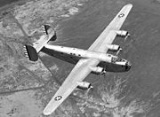
B-24 Liberator

Encyclopedia
The Consolidated B-24 Liberator was an American heavy bomber
, designed by Consolidated Aircraft
of San Diego, California
. It was known within the company as the Model 32, and a small number of early models were sold under the name LB-30, for Land Bomber. The B-24 was used in World War II
by several Allied
air forces and navies, and by every branch of the American armed forces during the war, attaining a distinguished war record with its operations in the Western European, Pacific
, Mediterranean
, and China-Burma-India Theaters.
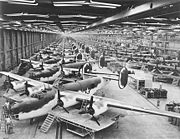
Mass production was brought into full force by 1943 with the aid of the Ford Motor Company
through its newly constructed Willow Run
facility, where peak production had reached one B-24 per hour and 650 per month in 1944. Other factories soon followed. The B-24 ended World War II
as the most produced Allied heavy bomber in history, and the most produced American military aircraft at over 18,400 units, due largely to Henry Ford
and the harnessing of American industry. It still holds the distinction as the most-produced American military aircraft.
Often compared with the better-known B-17 Flying Fortress, the B-24 was a more modern design with a higher top speed, greater range, and a heavier bomb load; however, it was also more difficult to fly, with heavy control forces and poor formation-flying characteristics. Popular opinion among aircrews and general staffs tended to favor the B-17's rugged qualities above all other considerations in the European Theater. The placement of the B-24's fuel tanks throughout the upper fuselage and its lightweight construction, designed to increase range and optimize assembly line production, made the aircraft vulnerable to battle damage. The B-24 was notorious among American aircrews for its tendency to catch fire. Moreover, its high fuselage-mounted "Davis wing" also meant it was dangerous to ditch or belly land, since the fuselage tended to break apart. Nevertheless, the B-24 provided excellent service in a variety of roles thanks to its large payload and long range.
The B-24's most infamous mission was the low-level strike against the Ploiești oil fields, in Romania
on 1 August 1943, which turned into a disaster because the enemy was underestimated, fully alerted and attackers disorganized.
(USAAC) request in 1938 for Consolidated to produce the B-17 under license. After company executives including President Reuben Fleet visited the Boeing factory in Seattle, Consolidated decided instead to submit a more modern design of its own. The new Model 32 combined the Davis wing
, a highly advanced wing airfoil
design created by David Davis
, the twin tail
design from the Consolidated Model 31 flying boat
, and mated both together on a new fuselage. This new fuselage was intentially designed around the twin bomb bays, each one being the same size and capacity of the B-17.
In January 1939, the USAAC, under Specification C-212, formally invited Consolidated to submit a design study for a bomber with longer range, higher speed, and greater ceiling
than the B-17. The specification was written such that the Model 32 would automatically be the winning design. The program was run under the umbrella group running "Project A", an Air Corps requirement for an intercontinental bomber that had been conceived in the mid-1930s. Although the B-24 did not meet Project A goals, it was a step in that direction. Project A led to the development of the Boeing B-29 and Consolidated's own B-32 and B-36.
The contract for a prototype was awarded in March 1939, with the requirement that one should be ready before the end of the year. The design was simple in concept but nevertheless advanced for its time. Compared to the B-17, the proposed Model 32 had a shorter fuselage and 25% less wing area, but had a 6 ft (1.8 m) greater wingspan
and a substantially larger carrying capacity, as well as a distinctive twin tail
. Whereas the B-17 used 9-cylinder Wright R-1820
Cyclone engines, the Consolidated design used twin-row, 14-cylinder Pratt & Whitney R-1830 "Twin Wasp" radials of 1,000 hp (746 kW). The 70,547 lb (32,000 kg) maximum takeoff weight was one of the highest of the period. Consolidated incorporated innovative features: the new design would be the first American bomber to use tricycle landing gear, and it had long, thin wings with the efficient "Davis
" high aspect ratio
design (also used on the projected Model 31 twin-engined commercial flying boat
) promising to provide maximum fuel efficiency
. Wind tunnel testing and experimental programs using an existing Consolidated Model 31 provided extensive data on the flight characteristics of the Davis airfoil.
Early orders—placed before the XB-24 had flown—included 36 for the USAAC, 120 for the French Armée de l'Air and 164 for the Royal Air Force
(RAF). The name "Liberator" was originally assigned to it by the RAF, and subsequently adopted by the USAAF as the official name for the type. When France
fell in 1940, their aircraft were re-directed to the RAF.
Pratt & Whitney
R-1830-33s were replaced with the turbo-supercharged
R-1830s. Additionally, the tail span was widened by 2 foot (0.6096 m) and the pitot-static probes
were relocated from the wings to the fuselage
. The XB-24 was then redesigned XB-24B – these changes became standard on all B-24’s built starting with the B-24C model.
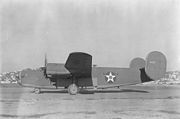 The USAAC initially ordered seven YB-24s under CAC
contract # 12464 in April 1939, but like the prototype these aircraft were being built by hand and were not considered combat ready. The first six YB-24 were released for direct purchase under CAC contract # F-677 on 9 November 1940. These aircraft were redesignated LB-30A. The seventh aircraft was used by Consolidated and the USAAC to test armor installations as well as self-sealing fuel tanks. Initially, these aircraft were to be given USAAC serials 39-618 to 39-687 however, delays with the actual purchase the serials numbers were changed to 40-696 to 40-702. When the RAF purchased the first 6 YB-24 aircraft, the serial numbers were reassigned to a later block of B-24Ds.
The RAF like the USAAC
found the LB-30A unsuitable for combat and had them assigned to the transatlantic Ferry Service
between Canada
and Prestwick
, Scotland
. The aircraft were all modified in Montreal
and included the removal of all armaments, provision for passenger seating, and a revised cabin oxygen
& heating system
.
, retracted into the fuselage, creating a minimum of aerodynamic drag to keep speed high over the target area.
Like the B-17, the B-24 had an array of .50 caliber (12.7 mm) M2 Browning machine guns in the tail, belly, top, sides and nose to defend it from attacking enemy fighters. However, unlike the B-17, the ball turret
could be retracted into the fuselage when not in use, a necessity given the low ground clearance of the fuselage. The ball turret first appeared on B-24D's sometime in early 1943 but not before the early D's had used tunnel guns and the Bendix remote controlled turret. General use of the ball turrets by the US would last until late July 1944 when performance gains outweighed the need for 360 degree belly defense. Bomber command Liberators generally dispensed with the belly turrets as unnecessary in areas where no enemy fighter presence would be found.
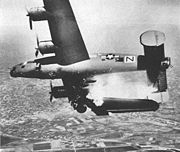 Liberator GR Is
in British service were the first B-24s to be used operationally. The very first use of Liberators in British service was the use of ex-USAAF YB-24s (designated LB-30A), which while not suitable for combat, were used as a long-range transport, operating the Atlantic Return Ferry Service, returning the civilian ferry pilots who delivered aircraft such as the Lockheed Hudson
across the Atlantic back to Canada. The most important role for the first batch of the Liberator GR Is was in service with RAF Coastal Command
on anti-submarine patrols in the Battle of the Atlantic.
Later in 1941, the first Liberator IIs entered RAF service. This model introduced self-sealing fuel tank
s and powered gun turrets. At the same time, Consolidated added a 2 ft 7 in (79 cm) plug in the forward fuselage to create more space for crew members. The Liberator IIs were divided between Coastal Command, Bomber Command
, and BOAC
. Two RAF squadrons with Liberators were deployed to the Middle East
in early 1942, in the first use of the Liberator as a bomber.
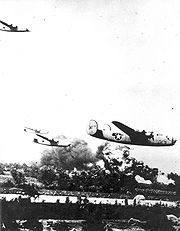 The United States Army Air Forces
(USAAF) took delivery of its first B-24As in 1941. The sole B-24 in Hawaii was destroyed by the Japanese attack on Pearl Harbor on 7 December 1941. Like the RAF, the USAAF used them as transports at first. American B-24s entered combat service in 1942 when on 6 June, four B-24s from Hawaii
staging through Midway Island
attempted an attack on Wake Island
, but were unable to find it.
On 12 June 1942, 13 B-24s flying from Egypt
attacked the Axis-controlled oil fields and refineries around Ploiești
, Romania
.
Over the next three years, B-24 squadrons deployed to all theaters of the war: African
, European, China-Burma-India
, the Battle of the Atlantic, the Southwest Pacific Theater and the Pacific Theater
. In the Pacific, the B-24 (and its twin, the U.S. Navy PB4Y Privateer
) was eventually designated as the standard heavy bomber to simplify logistics and to take advantage of their longer range, replacing the shorter-range B-17 which had served early in the war along the perimeter of the Pacific from the Philippines
, Australia
, Espiritu Santo
, Guadalcanal
, Hawaii
, and during the Battle of Midway
from Midway Island.
instead of supercharged
engines. The turbocharged engines led to the flattened oval nacelles that distinguished all subsequent Liberator models.
The first mass-produced model was the B-24D (Liberator III in British service), entering service in early 1943. It had turbocharged engines and increased fuel capacity. Three more 0.50 caliber (12.7 mm) machine guns brought the defensive armament up to 10 machine guns. At 59,524 lb (27,000 kg) maximum takeoff weight, it was one of the heaviest aircraft in the world; comparable with the British "heavies" the Stirling
, Lancaster
and Halifax.
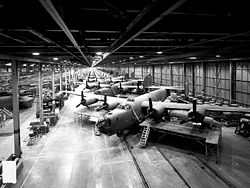 Production of B-24s increased at an astonishing rate throughout 1942 and 1943. Consolidated Aircraft tripled the size of its plant in San Diego and built a large new plant outside Fort Worth, Texas
. More B-24s were built by Douglas Aircraft
in Tulsa, Oklahoma
. North American Aviation
built a plant in Dallas, Texas
, which produced B-24Gs and B-24Js. None of these were minor operations, but they were dwarfed by the vast new purpose-built factory constructed by the Ford Motor Company
at Willow Run
near Detroit, Michigan
. Ford broke ground on Willow Run in the spring of 1941, with the first plane coming off the line in October 1942. It had the largest assembly line in the world (3,500,000 ft²/330,000 m²). At its peak, the Willow Run plant produced 650 B-24s per month in 1944. By 1945, Ford made 70% of all B-24s in two nine-hour shifts. Pilots and crews slept on 1,300 cots at Willow Run waiting for their B-24s to roll off the assembly line. At Willow Run, Ford produced half of 18,000 total B-24s.
Each of the B-24 factories was identified with a production code: Consolidated/San Diego, CO; Consolidated/Fort Worth, CF; Ford/Willow Run, FO; North American, NT; and Douglas/Tulsa, DT.
In 1943, the model of Liberator considered by many the "definitive" version was introduced. The B-24H was 10 in (25 cm) longer, had a powered gun turret in the upper nose to reduce vulnerability to head-on attack and was fitted with an improved bomb sight, autopilot, and fuel transfer system. Consolidated, Douglas and Ford all manufactured the B-24H, while North American made the slightly different B-24G. All five plants switched over to the almost identical B-24J in August 1943. The later B-24L and B-24M were lighter-weight versions and differed mainly in defensive armament.
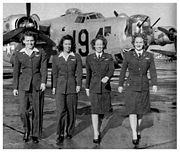 As the war progressed, the complexity of servicing the Liberator continued to increase. The B-24 variants made by each company differed slightly, so repair depots had to stock many different parts to support various models. Fortunately, this problem was eased in the summer of 1944, when North American, Douglas, and Consolidated Aircraft at Fort Worth stopped making B-24s, leaving only the Consolidated plant in San Diego and the Ford plant in Willow Run.
In all, 18,482 B-24s were built by September 1945. Twelve thousand saw service with the USAAF. The U.S. Navy
operated about 1,000 PB4Y-1s, and almost 800 PB4Y-2 Privateers
which were derived from the B-24. The Royal Air Force
flew about 2,100 B-24s in 46 bomber groups and 41 squadrons; the Royal Canadian Air Force
1,200 B-24Js; and the Royal Australian Air Force
(RAAF) 287 B-24Js, B-24Ls, and B-24Ms. Liberators were the only heavy bomber flown by the RAAF in the Pacific. Two squadrons of the South African Air Force, these were 31 & 34 Squadrons under No 2 Wing SAAF based at Foggia in Italy flew B-24s. These two squadrons claim to fame were the relief flights to Warsaw & Kraków in Poland to support the Polish Uprising against Nazi Occupation. Their missions / exploits are graphically covered in Lawrence Isemongers's book, The Men Who Went to Warsaw.
in the Combined Bomber Offensive against Germany, forming about one-third of its heavy bomber strength, with the other two-thirds being B-17s. Thousands of B-24s, flying from bases in England
, dropped hundreds of thousands of tons of bombs and incendiaries on German military and industrial targets. The 44th Bombardment Group was one of the first two heavy bombardment groups flying the B-24 with the 8th Air Force in the fall/winter air campaigns in the European Theater of Operations. The 44th Bomb Group flew the first of its 344 combat missions against the Axis powers in World War II on 7 November 1942.
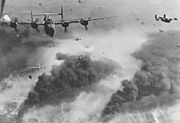 B-24s of the Ninth Air Force, operating from Africa and Italy, and the Fifteenth Air Force, also operating from Italy, took a major role in strategic bombing. Fifteen of the 15th AF's 21 bombardment groups
flew B-24s. The Ninth Air Force moved to England
in 1944 to become a tactical air force, and all of its B-24s were transferred to other Air Forces, such as the Fifteenth Air Force in Italy.
The first B-24 loss over German territory occurred on 26 February 1943. Both the German Luftwaffe and the British Royal Air Force had to abandon daylight bombing raids because neither could sustain the losses suffered. However, the Americans persisted, at great cost in men and aircraft. In the period between 7 November 1942 and 8 March 1943, the 44th Bomb Group lost 13 of its original 27 B-24s. For some time, newspapers had been requesting permission for a reporter to go on one of the missions. Robert B. Post
and five other reporters of The New York Times
were granted permission. Post was the only reporter assigned to a B-24-equipped group, the 44th Bomb Group. He flew in B-24 41-23777 ("Maisey") on Mission No. 37 to Bremen, Germany. Intercepted just short of the target, the B-24 came under attack from JG 1's Messerschmitt Bf 109
s. Leutnant Heinz Knoke
(who finished the war with 31 kills) shot down the Liberator. Post and all but two of the 11 men aboard were killed. Knoke reported:
A total of 177 B-24s carried out the famous second attack on Ploești (Operation Tidal Wave) on 1 August 1943, flying from their bases in northwestern Libya
. In late June 1943, the three B-24 Liberator groups of the 8th Air Force were sent to North Africa on temporary duty with the 9th Air Force. The 44th Bomb Group was joined by the 93rd and the 389th Bomb Groups. These three units joined the two 9th Air Force B-24 Liberator groups for the 1 August 1943 low-level attack on the German-held Romanian oil complex at Ploești. This daring and bold assault by high altitude bombers at tree top level was an experience that had both successes and failures. The 44th destroyed both of its assigned targets, but lost 11 of its 37 bombers and their crews. Colonel Leon W. Johnson
, the 44th's commander, was awarded the Medal of Honor
for his leadership, as was Col. John Riley Kane, also known as "Killer" Kane, commander of the 98th Bomb Group. Kane and Johnson survived the mission but three other recipients of the Medal of Honor
for their actions in the mission - Lt. Lloyd H. Hughes, Maj. John L. Jerstad
and Col. Addison E. Baker - were killed in action. For its actions on the Ploești mission, the 44th was awarded its second Distinguished Unit Citation. Of the 177 B-24s that were dispatched on this operation, 54 were lost.
RAF Bomber Command
did not use B-24s as bombers over Europe. No. 223 Squadron RAF
, one of Bomber Command’s 100 (Bomber Support) Group
squadrons, used 20 Liberator VIs to carry electronic jamming equipment to counter German radar. Liberators were also used as anti-submarine patrol aircraft by the RAF.
used a refurbished Liberator II as his personal transport aircraft.
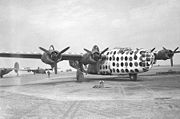 In February 1944, the 2nd Division authorized the use of war-weary aircraft specially fitted to aid assembly of individual group formations. Known as Assembly or Formation Ships, they were equipped with signal lighting, provision for quantity discharge of pyrotechnics, and featured distinctive individual paint schemes of psychedelic colors in stripes, checkers, or polka dots to enable easy recognition by their flock of bombers. The aircraft used in the first allocation were B-24Ds retired by the 44th, 93rd and 389th Groups. Arrangements for signal lighting varied from group to group, but generally consisted of white flashing lamps on both sides of the fuselage arranged to form the identification letter of the group. All armament and armor was removed, and in some cases the tail turret. In the B-24Hs used for this purpose, the nose turret was removed and replaced by a "carpetbagger" type nose. Following incidents when flare guns were accidentally discharged inside the rear fuselage, some Formation Ships had pyrotechnic guns fixed through the fuselage sides. As these aircraft normally returned to base once a formation had been established, a skeleton crew of two pilots, navigator, radio operator and one or two flare discharge men were carried. In some groups an observer officer flew in the tail position to monitor the formation. These aircraft became known as Judas Goats
.
(OSS) code named "Operation Carpetbagger
", pilots and crews flew specially modified B-24Ds painted with a glossy black anti-searchlight paint to supply friendly underground forces throughout German occupied Europe. They also flew C-47
s, A-26 Invader
s, and British de Havilland Mosquito
s. They flew spies called "Joes" and commando groups prior to the Allied invasion of Europe on D-Day and afterward, and retrieved over 5,000 officers and enlisted men who had escaped capture after being shot down. The low-altitude, night-time operation was extremely dangerous and took its toll on these airmen. The first aircrews chosen for this operation came from the anti-submarine bomb groups because of their special training in low altitude flying and pinpoint navigation skills. Also, because of their special skills, they were called upon to fly fuel to General George Patton
's army when it outran its fuel supply. When this mission was completed, it was recorded that 822,791 gal (3,114,264 L) of 80 octane gasoline had been delivered to three different airfields in France and Belgium.
 The Liberators made a great contribution to Allied victory in the Battle of the Atlantic against German U-boat
s. The decision to allocate some Liberator Is to Coastal Command in 1941 to patrol the eastern Atlantic Ocean
produced immediate results. The Very Long Range (VLR) Liberators "almost doubled the reach of Britain's maritime reconnaissance force". This extended range enabled Coastal Command patrols to cover part of the mid-Atlantic gap
, where U-boats had operated without risking being attacked and sunk by Allied aircraft.
For 12 months, No. 120 Squadron RAF
of Coastal Command with its handful of much-patched and modified early model Liberators, supplied the only air cover for convoys in the Atlantic Gap, the Liberator being the only warplane with sufficient range. The VLR Liberators sacrificed some armor and often gun turrets in order to save weight, while carrying extra aviation gasoline
in their bomb-bay tanks. Liberator Is were equipped with ASV (Air to Surface Vessel) Mark II radar
, which together with the Leigh light
gave them the ability to hunt U-boats by day and by night.
These Liberators operated from both sides of the Atlantic with the Royal Canadian Air Force
and the U.S. Navy from the west; and with the RAF from the east, based in Northern Ireland
, Scotland
, Iceland
, and beginning in mid-1943 from the Azores
. This role was dangerous, especially after many U-boats were armed with extra anti-aircraft
guns, some adopting the policy of staying on the surface to fight, rather than submerging and risking being sunk by ASW (anti-submarine warfare
) torpedoes and depth charges from the bombers. In addition to flying from the East Coast of the United States
, American Liberators flew from Greenland
, the Azores
, Bermuda
, the Bahamas
, Puerto Rico
, Cuba
, Trinidad
, and from wherever else they could fly far out over the Atlantic.
The rather sudden and decisive turning of the Battle of the Atlantic in favor of the Allies in May 1943 was the result of many factors. However, it was no accident that it coincided with the long delayed arrival of many more VLR Liberators for maritime patrols. Liberators were credited in full or in part with 72 U-boat sinkings.
In addition to very long range patrols, the B-24 was vital for patrols of a radius less than 1,000 mi (1,600 km), in both the Atlantic and Pacific theaters where U.S. Navy Privateers and USAAF B-24s took a heavy toll of German and Japanese submarines, and also some Japanese surface shipping.
The Consolidated Aircraft Company PB4Y Privateer was a World War II U.S. Navy patrol bomber
that was derived directly from the B-24 Liberator. The U.S. Navy had been using unmodified B-24s as the PB4Y-1 Liberator, and this type of patrol plane was considered to be quite successful. However, a fully navalized design was advantageous, and Consolidated Aircraft developed a purpose-built long-range patrol bomber in 1943, designated PB4Y-2 Privateer, that was visually distinguishable from the B-24 and PB4Y-1 by having a single vertical stabilizer rather than a twin tail.
and Egypt
(with an extensive detour around Spain
over the Atlantic), and they were used in the evacuation of Java in the East Indies
. Liberator IIs were converted for this role and were used by the British Overseas Airways Corporation
(BOAC) for trans-Atlantic services and other various long-range air transportation routes. This version of the Liberator was designated the LB-30A by the USAAF.
By early 1943, the need for a transport with better high altitude performance and longer range than the Douglas C-47 Skytrain had become pressing. A transport version of the B-24 was proposed, and soon afterward, a B-24D that had been damaged in an accident was converted into a cargo aircraft by elimination of its transparent nose and the installation of a flat cargo floor. In April 1943, the C-87 Liberator Express
transport entered production at Fort Worth, Texas. The C-87 had a large cargo door, less powerful supercharged engines, no gun turrets, a floor in the bomb bay for freight, and some side windows. The navigator's position was relocated behind the pilot. Early versions were fitted with a single .50 caliber (12.7 mm) Browning machine gun in their tails, and a few C-87s were also equipped with two .50 caliber (12.7 mm) fixed machine guns in their noses, operable by the pilot, though these were eventually removed. A more dedicated VIP transport, the C-87A, was also built in small numbers.
The C-87 was also designated the RY-2 or Liberator Cargo VII. Although only 287 C-87 and RY variants were produced, they were still important in the Army Air Forces' airlift operations early in the war when aircraft with high altitude, long-range heavy hauling abilities were in short supply. The C-87 flew in many theaters of war, including much hazardous duty in flights from Labrador to Greenland and Iceland in the North Atlantic. In the China Burma India Theater
(CBI), the C-87 was used to airlift cargo and fuel over the Hump
(the Himalayas
) from India
to China
. Early in the campaign, the C-87 was the only readily available American transport that could fly over the Himalayas while heavily loaded, rather than relying on circuitous and highly dangerous routes through valleys and mountain passes.
The C-87 was not very popular with the aircrews assigned to fly it. The aircraft had the distressing habit of losing all cockpit electrical power on takeoff or at landings, while its engine power and reliability with the less-powerful superchargers often left much to be desired. It proved to be quite vulnerable to icing conditions, and was prone to fall into a spin with even small amounts of ice accumulated onto its Davis wing. Since the aircraft had been designed to be a bomber that dropped its loads while airborne, the C-87's nose landing gear
was not designed for landing with a heavy load, and frequently it collapsed from the stress. Fuel leaks inside the crew compartment from the hastily modified long-range fuel system were an all-too-common occurrence. Lastly, unlike a typical purpose-designed transport, the B-24 was not designed to tolerate large loading variations because most of its load was held on fixed bomb racks. Consequently, it was far too easy for a poorly trained ground crew to load a C-87 with its center of gravity
too far forward or aft, rendering the aircraft longitudinally unstable and difficult to control. In his autobiography, Fate is the Hunter
, the writer Ernest K. Gann
reported that, while flying air cargo in India, he barely avoided crashing an improperly loaded C-87 into the Taj Mahal
. As soon as more dependable Douglas C-54 Skymaster and Curtiss-Wright C-46 Commando transports became available in large numbers, C-87s were rapidly phased out of combat zone service, with some later used as VIP transports or B-24 flight crew trainers.
The C-109 was a dedicated fuel transport version of the B-24 conceived as a support aircraft for B-29 Superfortress
operations in central China. Unlike the C-87, the C-109 was not built on the assembly line, but rather was converted from existing B-24 bomber production; to save weight, the glass nose, armament, turret fairings and bombardment equipment were removed. Several storage tanks were added, allowing a C-109 to carry almost 2,905 gal (11,000 L) of fuel weighing over 22,000 lb (10,000 kg).
Plans originally called for 2,000 C-109s to support 10 groups of B-29s (approximately 400) in China, but the capture of the Mariana Islands
provided a far more easily resupplied location for raids on mainland Japan
, and the plans were greatly scaled back. Only 218 C-109s were actually converted. After the transfer of the B-29s, the C-109s were reassigned to the Air Transport Command
. According the history of the US Army Air Forces in World War II, at least one squadron was assigned to the IX Troop Carrier Command in Europe to transport gasoline to advancing ground and air forces on the Continent after the Normandy invasion.
However, whereas a combat-loaded B-24 could safely take off with room to spare from a 6000 ft (1,828.8 m) runway, a loaded C-109 required every foot of such a runway to break ground, and crashes on takeoff were not uncommon. The aircraft demonstrated unstable flight characteristics with all storage tanks filled, and proved very difficult to land fully loaded at airfields above 6,000 ft (1,830 m) MSL in elevation, such as those around Chengdu
. After it was discovered that these problems could be alleviated by flying with the forward storage tank empty, this practice became fairly routine, enhancing aircrew safety at the cost of some fuel-carrying capacity. Many C-109s were lost in flying the Hump
airlift to China.
B-24 bombers were also extensively used in the Pacific area after the end of World War II to transport cargo and supplies during the rebuilding of Japan, China, and the Philippines.
In June 1944, Qantas Empire Airways
began service with the first of two converted Liberators on the Perth
to Colombo
route to augment Consolidated PBY Catalinas that had been used since May 1943. This route across the Indian Ocean
was 3,513 mi (5,654 km) long, the longest non-stop airline route in the world at the time. The Liberators flew a shorter 3,077 mi (4,952 km) over-water route from Learmonth
to an airfield northeast of Colombo, but they could make the flight in 17 hours with a 5,500 lb (2,495 kg) payload, whereas the Catalinas required 27 hours and had to carry so much auxiliary fuel that their payload was limited to only 1,000 lb (454 kg). The route was named Kangaroo
Service and marked the first time that Qantas' now-famous Kangaroo logo was used; passengers received a certificate proclaiming them as members of The Order of the Longest Hop. The Liberators were later replaced by Avro Lancastrian
s.
agreements, stranded in Yakutsk
while flying a government mission to the Soviet Union in November 1942. In addition, 73 Liberators of various models that had force-landed in Europe airfields were recovered and 30 of them were repaired and used by the 45th BAD.
(Consolidated Model 32): Designed in 1938 as an improvement on the B-17 Flying Fortress, at the request of the Army Air Corps. It had a wing specially designed for a high aspect ratio
, tricycle landing gear
, and twin vertical stabilizers. The XB-24 was ordered in March 1939 and first flew on 29 December 1939. (Total: one)
YB-24/LB-30A
Pre-production prototypes: Six examples were sent to Great Britain under Lend-Lease, designated LB-30A.
B-24: Service test version of the XB-24, ordered on 27 April 1939, less than 30 days after the XB-24 was ordered and before its completion. A number of minor modifications were made: elimination of leading edge slots, addition of de-icing boots. (Total: seven; only one used for actual testing)
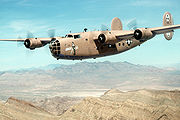 B-24A/LB-30B: Ordered in 1939, the B-24A was the first production model. Due to the need for heavy bombers, the B-24A was ordered before any version of the B-24 flew. The main improvement over the XB-24 was improved aerodynamics, which led to better performance. Some sent to Great Britain under Lend-Lease as LB-30B. (Total: 20 LB-30B; 1 B-24A)
XB-24B: When the XB-24 failed to reach its projected top speed, the Pratt & Whitney R-1830-33 radials rated at 1,000 hp (746 kW) it carried were replaced with R-1830-41 turbo-supercharged radials rated at 1,200 hp (895 kW), increasing its top speed by 37 mph (59 km/h). The engine cowlings were made elliptical to accommodate the addition of the turbo-superchargers. The XB-24B version also lacked the engine slots of the original. (Total: one converted XB-24)
B-24C: Conversion of the B-24A using turbo-supercharged R-1830-41 engines. To hold the supercharger and the intercooler intake, the cowlings were made elliptical and the new items added on the sides. The tail air gunner
position was improved by adding a hydraulically powered Consolidated A-6 turret with twin .50 caliber (12.7 mm) machine gun
s; a Martin
power turret was added to the forward fuselage. (Total: nine converted B-24As)
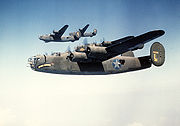 B-24D: First model produced on a large scale; ordered from 1940 to 1942, as a B-24C with better engines (R-1830-43 supercharged engines). The D model was initially equipped with a remotely operated and periscopically sighted Bendix
belly turret, as the first examples of the B-17E Flying Fortress had used, but this proved unsatisfactory in service and was discontinued after the 287th aircraft. Production aircraft reverted to the earlier manually operated "tunnel" mounting with a single .50 caliber (12.7 mm) machine. The tunnel gun was eventually replaced by the retractable Sperry ball turret, which had also been adopted by the later B-17E Fortresses. In late B-24Ds, "cheek" guns were added. (Total: 2,696: 2,381 Consolidated, San Diego; 305 Consolidated, Fort Worth; 10 Douglas
, Tulsa, Oklahoma
).
B-24E: A slight alteration of the B-24D built by Ford
, using R-1830-65 engines. Unlike the B-24D, the B-24E retained the tunnel gun in the belly. The USAAF used the B-24Es primarily as training aircraft since this model was not current in armaments and other technology as were the aircraft being produced by Consolidated / San Diego (CO). Ford also built sub-assemblies for Douglas
; these sub-assemblies were identical to Ford-built B-24Es, except that they used the same engines as the B-24D (R-1830-43 radials). These sub-assemblies were called PK ships and were shipped by truck from Willow Run to the final assembly in Tulsa, Oklahoma. (Total: 801)
XB-24F: A prototype made to test thermal de-icers instead of the standard inflatable rubber "boots". (Total: one converted B-24D)
B-24G: Designation for B-24D aircraft built by North American Aviation
pursuant to a 1942 contract. Equipped with Sperry ball turret and three .50 caliber (12.7 mm) machine gun
s in nose. (Total: 25)
B-24G-1: Designation for North American-built version of the B-24H. Most B-24G aircraft were delivered to the 15th Air Force in Italy. (Total: 405)
B-24H: Because of obvious vulnerability of the B-24 to head-on attack, the B-24H design incorporated an electrically powered Emerson A-15 nose turret. Approximately 50 other airframe changes were made, including a redesigned bombardier compartment. The tail turret was given larger windows for better visibility and the Martin A-3 top turret received an enlarged "high hat" dome. The waist gunner positions were enclosed with Plexiglas windows and offset to reduce mutual interference between the gunners during battle. Most H model aircraft were built by Ford at the Willow Run factory. (Total: 3,100)
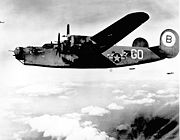 B-24J: The B-24J was very similar to the B-24H, but shortages of the Emerson nose turret required use of a modified, hydraulically powered Consolidated A-6 turret in most J model aircraft built at Consolidated's San Diego and Fort Worth factories. The B-24J featured an improved autopilot (type C-1) and a bombsight of the M-1 series. B-24H sub-assemblies made by Ford and constructed by other companies and any model with a C-1 or M-1 retrofit, were all designated B-24J. The J model was the only version to be built by all five factories involved in B-24 production. (Total: 6,678)
XB-24K: An experimental aircraft, made by Ford
by splicing a B-23 Dragon
tail empennage onto a B-24D airframe. The aircraft was more stable and had better handling than other models, leading to the decision to incorporate a single tail in the PB4Y-2 and B-24N. (Total: one converted B-24D)
B-24L: Because of the excessively high gross weight of the B-24J, the Army pushed for a lighter version. In the B-24L, the Sperry ball turret was replaced by a floor ring mount with two .50 caliber (12.7 mm) machine guns, and the A-6B tail turret by an M-6A. Later aircraft were delivered from the factory without tail armament. An A-6B, M-6A, or a manually operated twin .50 caliber (12.7 mm) mounting was then installed at a depot before arrival at operational units. The L model was built only at Willow Run and Consolidated's San Diego factory. (Total: 1,667)
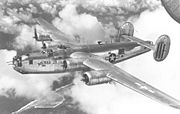 B-24M: An enhancement of the B-24L with further weight-saving devices. The B-24M used a more lightweight version of the A-6B tail turret; the waist gunner positions were left open. For better visibility from the flight deck, the windshield in Ford-built aircraft was replaced by a version with less framing from Block 20 onward. The B-24M became the last production model of the B-24; a number of the B-24s built flew only the course between the factory and the scrapheap. (Total: 2,593)
XB-24N: A redesign of the B-24J, made to accommodate a single tail. It also featured an Emerson 128 ball turret in the nose and a stationary tail gunner's position. While 5,168 B-24Ns were ordered, the end of the war resulted in cancellation of all contracts before production could begin. (Total: one)
YB-24N: Pre-production service test version of the XB-24N. (Total: seven)
XB-24P: A modified B-24D, used by Sperry Gyroscope Company to test airborne fire control systems. (Total: one converted B-24D)
XB-24Q: A General Electric
conversion of the B-24L. Used to test a radar-controlled tail turret intended for use in the Boeing B-47 Stratojet. (Total: one converted B-24L)
XB-41
: Because there were no fighters capable of escorting bomber formations on deep strike missions early in World War II, the Army authorized tests for heavily armed bombers to act as escorts for bombing missions. The XB-41 had fourteen .50 caliber (12.7 mm) machine gun
s, including a Bendix chin turret and a second Martin
A-3 turret on the upper fuselage. A single aircraft was completed in 1942. Performance changed drastically with the addition of more turrets. The escorts were also unable to keep up with bomber formations once the bombs had been dropped. The results of 1943 testing were very negative and the project was quickly canceled. (Total: one converted B-24D)
AT-22 or TB-24: C-87 used for flight engineer training.
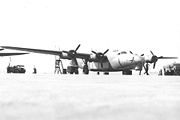 C-87 Liberator Express
: Passenger transports with accommodation for 20 passengers.
XC-109/C-109: Tankers with specialized equipment to help prevent explosions, used to ferry fuel from India to China to support initial B-29 raids against Japan.
XF-7: Photographic reconnaissance variant developed from the B-24D.
F-7: Photographic reconnaissance variant developed from the B-24H; -FO block.
F-7A: Photographic reconnaissance variant developed from the B-24J; three cameras in the nose and three in the bomb bay.
F-7B: Photographic reconnaissance variant developed from the B-24J; six cameras in the bomb bay.
BQ-8: A number of worn-out B-24D and B-24Js were converted as radio-controlled flying bombs to attack German targets. Joseph P. Kennedy, Jr.
was killed in a BQ-8 during Operation Aphrodite
.
bow turret.
PB4Y-1P: Photographic reconnaissance variant developed from the PB4Y-1.
PB4Y-2 Privateer: See Main Article
P5Y: Proposed twin-engined patrol version of PB4Y-1. Unbuilt.
RY-1: U.S. Navy designation for the C-87A.
RY-2: U.S. Navy designation for the C-87.
RY-3: Transport variant of the PB4Y-2.
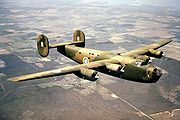 Liberator B Mk I
: B-24A, direct purchase aircraft for the RAF. (Total: 20) Considered unsuitable for combat, some rebuilt as the GR.1 and used in British anti-submarine patrol squadrons.
Liberator B Mk II: The first combat-ready B-24. The modifications included a three-foot nose extension as well as a deeper aft fuselage and wider tailplane—there was no direct B-24 equivalent but similar to the B-24C, built to meet British specifications with British equipment and armament. A small series of B Mk IIs were reconstructed as unarmed transports, designated the LB-30 with the USAAF. (Total production: 165)
Liberator B Mk III: B-24D variant with single .303 in (7.7 mm) Browning machine gun in the nose, two in each beam position, and four in a Boulton Paul
tail turret—similar to that on contemporary British heavy bombers such as the Halifax
—as well as other British equipment. The Martin dorsal turret was retained. (Total: 156)
Liberator B Mk IV: Reserved for the B-24E, but there is no record of the RAF actually receiving any.
Liberator B Mk V: B-24D modified for extra fuel capacity at the cost or armor, with the same armament fit as the Liberator Mk III.
Liberator B Mk VI: B-24Hs in RAF service fitted with Boulton Paul tail turrets, but retaining the rest of their armament.
Liberator B Mk VIII: RAF designation for B-24Js.
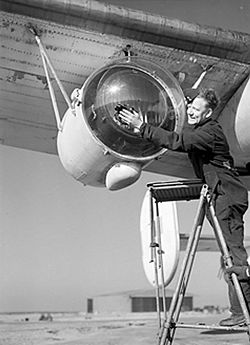 Liberator GR Mk V: B-24D modified by RAF Coastal Command
for the anti-submarine role with search radar
and Leigh Light
. Some were fitted with eight zero-length rocket launchers, four on each wing.
Liberator GR Mk VI: B-24G/H/J type used as a long-range general reconnaissance aircraft by RAF Coastal Command.
Liberator GR Mk VIII: B-24J modified by RAF Coastal Command for the anti-submarine role.
Liberator C Mk VI: Liberator B Mk VIII converted for use as a transport.
Liberator C Mk VII: British designation for C-87.
Liberator C Mk VIII: Liberator G Mk VIII converted for use as a transport.
Liberator C Mk IX: RAF designation for the RY-3/C-87C
Late in the war RAF Liberator aircraft modified in England for use in South East Asia had the suffix "Snake" stenciled below the serial number to give them priority delivery through the Mediterranean and Middle East.
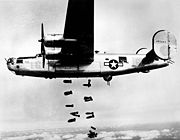 (as Beuteflugzeug, captured aircraft) A total of 42 B-24s recovered from aircraft dumps and restored by HAL were operational with No.5, No.6 and N.16 Squadrons. CIA delivered two B-24Hs in the 1950s At least three B-24Ds and one B-24J were rebuild from wrecks around Ploiești in 1943–44.
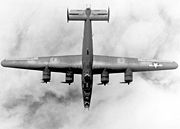
Heavy bomber
A heavy bomber is a bomber aircraft of the largest size and load carrying capacity, and usually the longest range.In New START, the term "heavy bomber" is used for two types of bombers:*one with a range greater than 8,000 kilometers...
, designed by Consolidated Aircraft
Consolidated Aircraft
The Consolidated Aircraft Corporation was founded in 1923 by Reuben H. Fleet, the result of the Gallaudet Aircraft Company's liquidation and Fleet's purchase of designs from the Dayton-Wright Company as the subsidiary was being closed by its parent corporation, General Motors. Consolidated became...
of San Diego, California
San Diego, California
San Diego is the eighth-largest city in the United States and second-largest city in California. The city is located on the coast of the Pacific Ocean in Southern California, immediately adjacent to the Mexican border. The birthplace of California, San Diego is known for its mild year-round...
. It was known within the company as the Model 32, and a small number of early models were sold under the name LB-30, for Land Bomber. The B-24 was used in World War II
World War II
World War II, or the Second World War , was a global conflict lasting from 1939 to 1945, involving most of the world's nations—including all of the great powers—eventually forming two opposing military alliances: the Allies and the Axis...
by several Allied
Allies of World War II
The Allies of World War II were the countries that opposed the Axis powers during the Second World War . Former Axis states contributing to the Allied victory are not considered Allied states...
air forces and navies, and by every branch of the American armed forces during the war, attaining a distinguished war record with its operations in the Western European, Pacific
Pacific War
The Pacific War, also sometimes called the Asia-Pacific War refers broadly to the parts of World War II that took place in the Pacific Ocean, its islands, and in East Asia, then called the Far East...
, Mediterranean
Mediterranean Theatre of World War II
The African, Mediterranean and Middle East theatres encompassed the naval, land, and air campaigns fought between the Allied and Axis forces in the Mediterranean Basin, the Middle East and Africa...
, and China-Burma-India Theaters.
Mass production was brought into full force by 1943 with the aid of the Ford Motor Company
Ford Motor Company
Ford Motor Company is an American multinational automaker based in Dearborn, Michigan, a suburb of Detroit. The automaker was founded by Henry Ford and incorporated on June 16, 1903. In addition to the Ford and Lincoln brands, Ford also owns a small stake in Mazda in Japan and Aston Martin in the UK...
through its newly constructed Willow Run
Willow Run
The Willow Run manufacturing plant, located between Ypsilanti and Belleville, Michigan, was constructed during World War II by Ford Motor Company for the mass production of the B-24 Liberator military aircraft....
facility, where peak production had reached one B-24 per hour and 650 per month in 1944. Other factories soon followed. The B-24 ended World War II
World War II
World War II, or the Second World War , was a global conflict lasting from 1939 to 1945, involving most of the world's nations—including all of the great powers—eventually forming two opposing military alliances: the Allies and the Axis...
as the most produced Allied heavy bomber in history, and the most produced American military aircraft at over 18,400 units, due largely to Henry Ford
Henry Ford
Henry Ford was an American industrialist, the founder of the Ford Motor Company, and sponsor of the development of the assembly line technique of mass production. His introduction of the Model T automobile revolutionized transportation and American industry...
and the harnessing of American industry. It still holds the distinction as the most-produced American military aircraft.
Often compared with the better-known B-17 Flying Fortress, the B-24 was a more modern design with a higher top speed, greater range, and a heavier bomb load; however, it was also more difficult to fly, with heavy control forces and poor formation-flying characteristics. Popular opinion among aircrews and general staffs tended to favor the B-17's rugged qualities above all other considerations in the European Theater. The placement of the B-24's fuel tanks throughout the upper fuselage and its lightweight construction, designed to increase range and optimize assembly line production, made the aircraft vulnerable to battle damage. The B-24 was notorious among American aircrews for its tendency to catch fire. Moreover, its high fuselage-mounted "Davis wing" also meant it was dangerous to ditch or belly land, since the fuselage tended to break apart. Nevertheless, the B-24 provided excellent service in a variety of roles thanks to its large payload and long range.
The B-24's most infamous mission was the low-level strike against the Ploiești oil fields, in Romania
Romania
Romania is a country located at the crossroads of Central and Southeastern Europe, on the Lower Danube, within and outside the Carpathian arch, bordering on the Black Sea...
on 1 August 1943, which turned into a disaster because the enemy was underestimated, fully alerted and attackers disorganized.
Initial design
The Liberator originated from a United States Army Air CorpsUnited States Army Air Corps
The United States Army Air Corps was a forerunner of the United States Air Force. Renamed from the Air Service on 2 July 1926, it was part of the United States Army and the predecessor of the United States Army Air Forces , established in 1941...
(USAAC) request in 1938 for Consolidated to produce the B-17 under license. After company executives including President Reuben Fleet visited the Boeing factory in Seattle, Consolidated decided instead to submit a more modern design of its own. The new Model 32 combined the Davis wing
Davis wing
The Davis wing is an aircraft wing planform that was used for some time on a variety of World War II aircraft, most notably a number of designs from Consolidated Aircraft, including the Consolidated B-24 Liberator. Use of the Davis wing ended almost immediately after the end of the war, yet it...
, a highly advanced wing airfoil
Airfoil
An airfoil or aerofoil is the shape of a wing or blade or sail as seen in cross-section....
design created by David Davis
David Davis
David Davis may refer to:*David Davis , Liberal member of the Victorian Legislative Council*David Davis , British Conservative Member of Parliament, Conservative leadership candidate in 2001 and 2005*David Davis , head of the BBC's Children's Hour*David Davis ,...
, the twin tail
Twin tail
A twin tail is a specific type of vertical stabilizer arrangement found on the empennage of some aircraft. Two vertical stabilizers — often smaller on their own than a single conventional tail would be — are mounted at the outside of the aircraft's horizontal stabilizer...
design from the Consolidated Model 31 flying boat
Flying boat
A flying boat is a fixed-winged seaplane with a hull, allowing it to land on water. It differs from a float plane as it uses a purpose-designed fuselage which can float, granting the aircraft buoyancy. Flying boats may be stabilized by under-wing floats or by wing-like projections from the fuselage...
, and mated both together on a new fuselage. This new fuselage was intentially designed around the twin bomb bays, each one being the same size and capacity of the B-17.
In January 1939, the USAAC, under Specification C-212, formally invited Consolidated to submit a design study for a bomber with longer range, higher speed, and greater ceiling
Ceiling (aeronautics)
With respect to aircraft, a ceiling is the maximum density altitude an aircraft can reach under a set of conditions.The word ceiling can also refer to the height of the lowest obscuring cloud layer above the ground.-Service ceiling:...
than the B-17. The specification was written such that the Model 32 would automatically be the winning design. The program was run under the umbrella group running "Project A", an Air Corps requirement for an intercontinental bomber that had been conceived in the mid-1930s. Although the B-24 did not meet Project A goals, it was a step in that direction. Project A led to the development of the Boeing B-29 and Consolidated's own B-32 and B-36.
The contract for a prototype was awarded in March 1939, with the requirement that one should be ready before the end of the year. The design was simple in concept but nevertheless advanced for its time. Compared to the B-17, the proposed Model 32 had a shorter fuselage and 25% less wing area, but had a 6 ft (1.8 m) greater wingspan
Wingspan
The wingspan of an airplane or a bird, is the distance from one wingtip to the other wingtip. For example, the Boeing 777 has a wingspan of about ; and a Wandering Albatross caught in 1965 had a wingspan of , the official record for a living bird.The term wingspan, more technically extent, is...
and a substantially larger carrying capacity, as well as a distinctive twin tail
Twin tail
A twin tail is a specific type of vertical stabilizer arrangement found on the empennage of some aircraft. Two vertical stabilizers — often smaller on their own than a single conventional tail would be — are mounted at the outside of the aircraft's horizontal stabilizer...
. Whereas the B-17 used 9-cylinder Wright R-1820
Wright R-1820
|-See also:-References:* Bridgman, L, Jane's Fighting Aircraft of World War II. Crescent. ISBN 0-517-67964-7* Eden, Paul & Soph Moeng, The Complete Encyclopedia of World Aircraft. Amber Books Ltd. Bradley's Close, 74-77 White Lion Street, London, NI 9PF, 2002, ISBN 0-7607-3432-1), 1152...
Cyclone engines, the Consolidated design used twin-row, 14-cylinder Pratt & Whitney R-1830 "Twin Wasp" radials of 1,000 hp (746 kW). The 70,547 lb (32,000 kg) maximum takeoff weight was one of the highest of the period. Consolidated incorporated innovative features: the new design would be the first American bomber to use tricycle landing gear, and it had long, thin wings with the efficient "Davis
Davis wing
The Davis wing is an aircraft wing planform that was used for some time on a variety of World War II aircraft, most notably a number of designs from Consolidated Aircraft, including the Consolidated B-24 Liberator. Use of the Davis wing ended almost immediately after the end of the war, yet it...
" high aspect ratio
Aspect ratio (wing)
In aerodynamics, the aspect ratio of a wing is essentially the ratio of its length to its breadth . A high aspect ratio indicates long, narrow wings, whereas a low aspect ratio indicates short, stubby wings....
design (also used on the projected Model 31 twin-engined commercial flying boat
Flying boat
A flying boat is a fixed-winged seaplane with a hull, allowing it to land on water. It differs from a float plane as it uses a purpose-designed fuselage which can float, granting the aircraft buoyancy. Flying boats may be stabilized by under-wing floats or by wing-like projections from the fuselage...
) promising to provide maximum fuel efficiency
Fuel efficiency
Fuel efficiency is a form of thermal efficiency, meaning the efficiency of a process that converts chemical potential energy contained in a carrier fuel into kinetic energy or work. Overall fuel efficiency may vary per device, which in turn may vary per application, and this spectrum of variance is...
. Wind tunnel testing and experimental programs using an existing Consolidated Model 31 provided extensive data on the flight characteristics of the Davis airfoil.
Early orders—placed before the XB-24 had flown—included 36 for the USAAC, 120 for the French Armée de l'Air and 164 for the Royal Air Force
Royal Air Force
The Royal Air Force is the aerial warfare service branch of the British Armed Forces. Formed on 1 April 1918, it is the oldest independent air force in the world...
(RAF). The name "Liberator" was originally assigned to it by the RAF, and subsequently adopted by the USAAF as the official name for the type. When France
France
The French Republic , The French Republic , The French Republic , (commonly known as France , is a unitary semi-presidential republic in Western Europe with several overseas territories and islands located on other continents and in the Indian, Pacific, and Atlantic oceans. Metropolitan France...
fell in 1940, their aircraft were re-directed to the RAF.
Prototypes
Consolidated finished the prototype, by then known as the XB-24, and had it ready for its first flight two days before the end of 1939. After initial testing, the XB-24 was found to be deficient in several areas. One major failure of the prototype was that it failed to meet the top speed requirements specified in the contract. As built, the XB-24 top speed was only 273 mph instead of the specified 311 mph. As a result, the mechanically superchargedSupercharger
A supercharger is an air compressor used for forced induction of an internal combustion engine.The greater mass flow-rate provides more oxygen to support combustion than would be available in a naturally aspirated engine, which allows more fuel to be burned and more work to be done per cycle,...
Pratt & Whitney
Pratt & Whitney
Pratt & Whitney is a U.S.-based aerospace manufacturer with global service operations. It is a subsidiary of United Technologies Corporation . Pratt & Whitney's aircraft engines are widely used in both civil aviation and military aviation. Its headquarters are in East Hartford, Connecticut, USA...
R-1830-33s were replaced with the turbo-supercharged
Turbocharger
A turbocharger, or turbo , from the Greek "τύρβη" is a centrifugal compressor powered by a turbine that is driven by an engine's exhaust gases. Its benefit lies with the compressor increasing the mass of air entering the engine , thereby resulting in greater performance...
R-1830s. Additionally, the tail span was widened by 2 foot (0.6096 m) and the pitot-static probes
Pitot-static system
A pitot-static system is a system of pressure-sensitive instruments that is most often used in aviation to determine an aircraft's airspeed, Mach number, altitude, and altitude trend. A pitot-static system generally consists of a pitot tube, a static port, and the pitot-static instruments...
were relocated from the wings to the fuselage
Fuselage
The fuselage is an aircraft's main body section that holds crew and passengers or cargo. In single-engine aircraft it will usually contain an engine, although in some amphibious aircraft the single engine is mounted on a pylon attached to the fuselage which in turn is used as a floating hull...
. The XB-24 was then redesigned XB-24B – these changes became standard on all B-24’s built starting with the B-24C model.
Consolidated Aircraft
The Consolidated Aircraft Corporation was founded in 1923 by Reuben H. Fleet, the result of the Gallaudet Aircraft Company's liquidation and Fleet's purchase of designs from the Dayton-Wright Company as the subsidiary was being closed by its parent corporation, General Motors. Consolidated became...
contract # 12464 in April 1939, but like the prototype these aircraft were being built by hand and were not considered combat ready. The first six YB-24 were released for direct purchase under CAC contract # F-677 on 9 November 1940. These aircraft were redesignated LB-30A. The seventh aircraft was used by Consolidated and the USAAC to test armor installations as well as self-sealing fuel tanks. Initially, these aircraft were to be given USAAC serials 39-618 to 39-687 however, delays with the actual purchase the serials numbers were changed to 40-696 to 40-702. When the RAF purchased the first 6 YB-24 aircraft, the serial numbers were reassigned to a later block of B-24Ds.
The RAF like the USAAC
United States Army Air Corps
The United States Army Air Corps was a forerunner of the United States Air Force. Renamed from the Air Service on 2 July 1926, it was part of the United States Army and the predecessor of the United States Army Air Forces , established in 1941...
found the LB-30A unsuitable for combat and had them assigned to the transatlantic Ferry Service
RAF Ferry Command
The RAF Ferry Command had a short life, but it spawned, in part, an organisation that lasted well beyond the war years during which it was formed.-History:...
between Canada
Canada
Canada is a North American country consisting of ten provinces and three territories. Located in the northern part of the continent, it extends from the Atlantic Ocean in the east to the Pacific Ocean in the west, and northward into the Arctic Ocean...
and Prestwick
Prestwick
Prestwick is a town in South Ayrshire on the south-west coast of Scotland, about south-west of Glasgow. It adjoins the larger town of Ayr, the centre of which is about south...
, Scotland
Scotland
Scotland is a country that is part of the United Kingdom. Occupying the northern third of the island of Great Britain, it shares a border with England to the south and is bounded by the North Sea to the east, the Atlantic Ocean to the north and west, and the North Channel and Irish Sea to the...
. The aircraft were all modified in Montreal
Montreal
Montreal is a city in Canada. It is the largest city in the province of Quebec, the second-largest city in Canada and the seventh largest in North America...
and included the removal of all armaments, provision for passenger seating, and a revised cabin oxygen
Oxygen
Oxygen is the element with atomic number 8 and represented by the symbol O. Its name derives from the Greek roots ὀξύς and -γενής , because at the time of naming, it was mistakenly thought that all acids required oxygen in their composition...
& heating system
Heating system
A heating system is a mechanism for maintaining temperatures at an acceptable level; by using thermal energy within a home, office, or other dwelling. Often part of an HVAC system. A heating system may be centralized or distributed.-See also:...
.
Design
The B-24's spacious slab-sided fuselage (which earned the aircraft the nickname "Flying Boxcar") was built around a central bomb bay that could accommodate up to 8,000 lb (3,629 kg) of ordnance. The bomb bay was divided into front and rear compartments and had a central catwalk just nine inches wide, which was also the fuselage keel beam. A universal complaint arose over the extremely narrow catwalk. The aircraft was sometimes disparaged as "The Flying Coffin" because the only entry and exit from the bomber was in the rear and it was almost impossible for the flight crew and nose gunner to get from the flight deck to the rear when wearing parachutes. An unusual set of "roller-type" bomb bay doors, which operated very much like the movable enclosure of a rolltop deskRolltop desk
A rolltop desk is a 19th century reworking of the pedestal desk with, in addition, a series of stacked compartments, shelves, drawers and nooks in front of the user, much like the bureau à gradin or the Carlton House desk...
, retracted into the fuselage, creating a minimum of aerodynamic drag to keep speed high over the target area.
Like the B-17, the B-24 had an array of .50 caliber (12.7 mm) M2 Browning machine guns in the tail, belly, top, sides and nose to defend it from attacking enemy fighters. However, unlike the B-17, the ball turret
Ball turret
A ball turret was a particular form of spherical-form, altazimuth mount movement manned aircraft gun turret, accommodating the gunner with nearly all the needed equipment for defensive firepower mounted either within or onto the spherical shell of the turret structure, mounted on aircraft during...
could be retracted into the fuselage when not in use, a necessity given the low ground clearance of the fuselage. The ball turret first appeared on B-24D's sometime in early 1943 but not before the early D's had used tunnel guns and the Bendix remote controlled turret. General use of the ball turrets by the US would last until late July 1944 when performance gains outweighed the need for 360 degree belly defense. Bomber command Liberators generally dispensed with the belly turrets as unnecessary in areas where no enemy fighter presence would be found.
Initial deployment
Consolidated Liberator I
Consolidated Liberator I was the service name of the first Consolidated B-24 Liberator 4-engined bombers to see use with the Royal Air Force .-Service history:In August 1939, the USAAC ordered 38 examples of the Consolidated B-24A...
in British service were the first B-24s to be used operationally. The very first use of Liberators in British service was the use of ex-USAAF YB-24s (designated LB-30A), which while not suitable for combat, were used as a long-range transport, operating the Atlantic Return Ferry Service, returning the civilian ferry pilots who delivered aircraft such as the Lockheed Hudson
Lockheed Hudson
The Lockheed Hudson was an American-built light bomber and coastal reconnaissance aircraft built initially for the Royal Air Force shortly before the outbreak of the Second World War and primarily operated by the RAF thereafter...
across the Atlantic back to Canada. The most important role for the first batch of the Liberator GR Is was in service with RAF Coastal Command
RAF Coastal Command
RAF Coastal Command was a formation within the Royal Air Force . Founded in 1936, it was the RAF's premier maritime arm, after the Royal Navy's secondment of the Fleet Air Arm in 1937. Naval aviation was neglected in the inter-war period, 1919–1939, and as a consequence the service did not receive...
on anti-submarine patrols in the Battle of the Atlantic.
Later in 1941, the first Liberator IIs entered RAF service. This model introduced self-sealing fuel tank
Self-sealing fuel tank
In aviation, self-sealing fuel tank is a fuel tank technology in wide use since World War II that prevents fuel tanks primarily on aircraft from leaking fuel and igniting after being damaged by enemy fire....
s and powered gun turrets. At the same time, Consolidated added a 2 ft 7 in (79 cm) plug in the forward fuselage to create more space for crew members. The Liberator IIs were divided between Coastal Command, Bomber Command
RAF Bomber Command
RAF Bomber Command controlled the RAF's bomber forces from 1936 to 1968. During World War II the command destroyed a significant proportion of Nazi Germany's industries and many German cities, and in the 1960s stood at the peak of its postwar military power with the V bombers and a supplemental...
, and BOAC
British Overseas Airways Corporation
The British Overseas Airways Corporation was the British state airline from 1939 until 1946 and the long-haul British state airline from 1946 to 1974. The company started life with a merger between Imperial Airways Ltd. and British Airways Ltd...
. Two RAF squadrons with Liberators were deployed to the Middle East
Middle East
The Middle East is a region that encompasses Western Asia and Northern Africa. It is often used as a synonym for Near East, in opposition to Far East...
in early 1942, in the first use of the Liberator as a bomber.
America enters the war
United States Army Air Forces
The United States Army Air Forces was the military aviation arm of the United States of America during and immediately after World War II, and the direct predecessor of the United States Air Force....
(USAAF) took delivery of its first B-24As in 1941. The sole B-24 in Hawaii was destroyed by the Japanese attack on Pearl Harbor on 7 December 1941. Like the RAF, the USAAF used them as transports at first. American B-24s entered combat service in 1942 when on 6 June, four B-24s from Hawaii
Hawaii
Hawaii is the newest of the 50 U.S. states , and is the only U.S. state made up entirely of islands. It is the northernmost island group in Polynesia, occupying most of an archipelago in the central Pacific Ocean, southwest of the continental United States, southeast of Japan, and northeast of...
staging through Midway Island
Midway Atoll
Midway Atoll is a atoll in the North Pacific Ocean, near the northwestern end of the Hawaiian archipelago, about one-third of the way between Honolulu, Hawaii, and Tokyo, Japan. Unique among the Hawaiian islands, Midway observes UTC-11 , eleven hours behind Coordinated Universal Time and one hour...
attempted an attack on Wake Island
Wake Island
Wake Island is a coral atoll having a coastline of in the North Pacific Ocean, located about two-thirds of the way from Honolulu west to Guam east. It is an unorganized, unincorporated territory of the United States, administered by the Office of Insular Affairs, U.S. Department of the Interior...
, but were unable to find it.
On 12 June 1942, 13 B-24s flying from Egypt
Egypt
Egypt , officially the Arab Republic of Egypt, Arabic: , is a country mainly in North Africa, with the Sinai Peninsula forming a land bridge in Southwest Asia. Egypt is thus a transcontinental country, and a major power in Africa, the Mediterranean Basin, the Middle East and the Muslim world...
attacked the Axis-controlled oil fields and refineries around Ploiești
Ploiesti
Ploiești is the county seat of Prahova County and lies in the historical region of Wallachia in Romania. The city is located north of Bucharest....
, Romania
Romania
Romania is a country located at the crossroads of Central and Southeastern Europe, on the Lower Danube, within and outside the Carpathian arch, bordering on the Black Sea...
.
Over the next three years, B-24 squadrons deployed to all theaters of the war: African
North African campaign
During the Second World War, the North African Campaign took place in North Africa from 10 June 1940 to 13 May 1943. It included campaigns fought in the Libyan and Egyptian deserts and in Morocco and Algeria and Tunisia .The campaign was fought between the Allies and Axis powers, many of whom had...
, European, China-Burma-India
China Burma India Theater of World War II
China Burma India Theater was the name used by the United States Army for its forces operating in conjunction with British and Chinese Allied air and land forces in China, Burma, and India during World War II...
, the Battle of the Atlantic, the Southwest Pacific Theater and the Pacific Theater
Pacific War
The Pacific War, also sometimes called the Asia-Pacific War refers broadly to the parts of World War II that took place in the Pacific Ocean, its islands, and in East Asia, then called the Far East...
. In the Pacific, the B-24 (and its twin, the U.S. Navy PB4Y Privateer
PB4Y Privateer
The Consolidated PB4Y-2 Privateer was a World War II and Korean War era patrol bomber of the United States Navy derived from the Consolidated B-24 Liberator. The Navy had been using unmodified B-24s as the PB4Y-1 Liberator, and the type was considered very successful...
) was eventually designated as the standard heavy bomber to simplify logistics and to take advantage of their longer range, replacing the shorter-range B-17 which had served early in the war along the perimeter of the Pacific from the Philippines
Philippines
The Philippines , officially known as the Republic of the Philippines , is a country in Southeast Asia in the western Pacific Ocean. To its north across the Luzon Strait lies Taiwan. West across the South China Sea sits Vietnam...
, Australia
Australia
Australia , officially the Commonwealth of Australia, is a country in the Southern Hemisphere comprising the mainland of the Australian continent, the island of Tasmania, and numerous smaller islands in the Indian and Pacific Oceans. It is the world's sixth-largest country by total area...
, Espiritu Santo
Espiritu Santo
Espiritu Santo is the largest island in the nation of Vanuatu, with an area of . It belongs to the archipelago of the New Hebrides in the Pacific region of Melanesia. It is in the Sanma Province of Vanuatu....
, Guadalcanal
Guadalcanal
Guadalcanal is a tropical island in the South-Western Pacific. The largest island in the Solomons, it was discovered by the Spanish expedition of Alvaro de Mendaña in 1568...
, Hawaii
Hawaii
Hawaii is the newest of the 50 U.S. states , and is the only U.S. state made up entirely of islands. It is the northernmost island group in Polynesia, occupying most of an archipelago in the central Pacific Ocean, southwest of the continental United States, southeast of Japan, and northeast of...
, and during the Battle of Midway
Battle of Midway
The Battle of Midway is widely regarded as the most important naval battle of the Pacific Campaign of World War II. Between 4 and 7 June 1942, approximately one month after the Battle of the Coral Sea and six months after Japan's attack on Pearl Harbor, the United States Navy decisively defeated...
from Midway Island.
War-time production
Continued development work by Consolidated produced a handful of transitional B-24Cs with turbochargedTurbocharger
A turbocharger, or turbo , from the Greek "τύρβη" is a centrifugal compressor powered by a turbine that is driven by an engine's exhaust gases. Its benefit lies with the compressor increasing the mass of air entering the engine , thereby resulting in greater performance...
instead of supercharged
Supercharger
A supercharger is an air compressor used for forced induction of an internal combustion engine.The greater mass flow-rate provides more oxygen to support combustion than would be available in a naturally aspirated engine, which allows more fuel to be burned and more work to be done per cycle,...
engines. The turbocharged engines led to the flattened oval nacelles that distinguished all subsequent Liberator models.
The first mass-produced model was the B-24D (Liberator III in British service), entering service in early 1943. It had turbocharged engines and increased fuel capacity. Three more 0.50 caliber (12.7 mm) machine guns brought the defensive armament up to 10 machine guns. At 59,524 lb (27,000 kg) maximum takeoff weight, it was one of the heaviest aircraft in the world; comparable with the British "heavies" the Stirling
Short Stirling
The Short Stirling was the first four-engined British heavy bomber of the Second World War. The Stirling was designed and built by Short Brothers to an Air Ministry specification from 1936, and entered service in 1941...
, Lancaster
Avro Lancaster
The Avro Lancaster is a British four-engined Second World War heavy bomber made initially by Avro for the Royal Air Force . It first saw active service in 1942, and together with the Handley Page Halifax it was one of the main heavy bombers of the RAF, the RCAF, and squadrons from other...
and Halifax.
Fort Worth, Texas
Fort Worth is the 16th-largest city in the United States of America and the fifth-largest city in the state of Texas. Located in North Central Texas, just southeast of the Texas Panhandle, the city is a cultural gateway into the American West and covers nearly in Tarrant, Parker, Denton, and...
. More B-24s were built by Douglas Aircraft
Douglas Aircraft Company
The Douglas Aircraft Company was an American aerospace manufacturer, based in Long Beach, California. It was founded in 1921 by Donald Wills Douglas, Sr. and later merged with McDonnell Aircraft in 1967 to form McDonnell Douglas...
in Tulsa, Oklahoma
Tulsa, Oklahoma
Tulsa is the second-largest city in the state of Oklahoma and 46th-largest city in the United States. With a population of 391,906 as of the 2010 census, it is the principal municipality of the Tulsa Metropolitan Area, a region with 937,478 residents in the MSA and 988,454 in the CSA. Tulsa's...
. North American Aviation
North American Aviation
North American Aviation was a major US aerospace manufacturer, responsible for a number of historic aircraft, including the T-6 Texan trainer, the P-51 Mustang fighter, the B-25 Mitchell bomber, the F-86 Sabre jet fighter, the X-15 rocket plane, and the XB-70, as well as Apollo Command and Service...
built a plant in Dallas, Texas
Dallas, Texas
Dallas is the third-largest city in Texas and the ninth-largest in the United States. The Dallas-Fort Worth Metroplex is the largest metropolitan area in the South and fourth-largest metropolitan area in the United States...
, which produced B-24Gs and B-24Js. None of these were minor operations, but they were dwarfed by the vast new purpose-built factory constructed by the Ford Motor Company
Ford Motor Company
Ford Motor Company is an American multinational automaker based in Dearborn, Michigan, a suburb of Detroit. The automaker was founded by Henry Ford and incorporated on June 16, 1903. In addition to the Ford and Lincoln brands, Ford also owns a small stake in Mazda in Japan and Aston Martin in the UK...
at Willow Run
Willow Run
The Willow Run manufacturing plant, located between Ypsilanti and Belleville, Michigan, was constructed during World War II by Ford Motor Company for the mass production of the B-24 Liberator military aircraft....
near Detroit, Michigan
Michigan
Michigan is a U.S. state located in the Great Lakes Region of the United States of America. The name Michigan is the French form of the Ojibwa word mishigamaa, meaning "large water" or "large lake"....
. Ford broke ground on Willow Run in the spring of 1941, with the first plane coming off the line in October 1942. It had the largest assembly line in the world (3,500,000 ft²/330,000 m²). At its peak, the Willow Run plant produced 650 B-24s per month in 1944. By 1945, Ford made 70% of all B-24s in two nine-hour shifts. Pilots and crews slept on 1,300 cots at Willow Run waiting for their B-24s to roll off the assembly line. At Willow Run, Ford produced half of 18,000 total B-24s.
Each of the B-24 factories was identified with a production code: Consolidated/San Diego, CO; Consolidated/Fort Worth, CF; Ford/Willow Run, FO; North American, NT; and Douglas/Tulsa, DT.
In 1943, the model of Liberator considered by many the "definitive" version was introduced. The B-24H was 10 in (25 cm) longer, had a powered gun turret in the upper nose to reduce vulnerability to head-on attack and was fitted with an improved bomb sight, autopilot, and fuel transfer system. Consolidated, Douglas and Ford all manufactured the B-24H, while North American made the slightly different B-24G. All five plants switched over to the almost identical B-24J in August 1943. The later B-24L and B-24M were lighter-weight versions and differed mainly in defensive armament.
In all, 18,482 B-24s were built by September 1945. Twelve thousand saw service with the USAAF. The U.S. Navy
United States Navy
The United States Navy is the naval warfare service branch of the United States Armed Forces and one of the seven uniformed services of the United States. The U.S. Navy is the largest in the world; its battle fleet tonnage is greater than that of the next 13 largest navies combined. The U.S...
operated about 1,000 PB4Y-1s, and almost 800 PB4Y-2 Privateers
PB4Y Privateer
The Consolidated PB4Y-2 Privateer was a World War II and Korean War era patrol bomber of the United States Navy derived from the Consolidated B-24 Liberator. The Navy had been using unmodified B-24s as the PB4Y-1 Liberator, and the type was considered very successful...
which were derived from the B-24. The Royal Air Force
Royal Air Force
The Royal Air Force is the aerial warfare service branch of the British Armed Forces. Formed on 1 April 1918, it is the oldest independent air force in the world...
flew about 2,100 B-24s in 46 bomber groups and 41 squadrons; the Royal Canadian Air Force
Royal Canadian Air Force
The history of the Royal Canadian Air Force begins in 1920, when the air force was created as the Canadian Air Force . In 1924 the CAF was renamed the Royal Canadian Air Force and granted royal sanction by King George V. The RCAF existed as an independent service until 1968...
1,200 B-24Js; and the Royal Australian Air Force
Royal Australian Air Force
The Royal Australian Air Force is the air force branch of the Australian Defence Force. The RAAF was formed in March 1921. It continues the traditions of the Australian Flying Corps , which was formed on 22 October 1912. The RAAF has taken part in many of the 20th century's major conflicts...
(RAAF) 287 B-24Js, B-24Ls, and B-24Ms. Liberators were the only heavy bomber flown by the RAAF in the Pacific. Two squadrons of the South African Air Force, these were 31 & 34 Squadrons under No 2 Wing SAAF based at Foggia in Italy flew B-24s. These two squadrons claim to fame were the relief flights to Warsaw & Kraków in Poland to support the Polish Uprising against Nazi Occupation. Their missions / exploits are graphically covered in Lawrence Isemongers's book, The Men Who Went to Warsaw.
Strategic bombing
The B-24 was one of the workhorse bombers of the U.S. Eighth Air ForceEighth Air Force
The Eighth Air Force is a numbered air force of the United States Air Force Global Strike Command . It is headquartered at Barksdale Air Force Base, Louisiana....
in the Combined Bomber Offensive against Germany, forming about one-third of its heavy bomber strength, with the other two-thirds being B-17s. Thousands of B-24s, flying from bases in England
England
England is a country that is part of the United Kingdom. It shares land borders with Scotland to the north and Wales to the west; the Irish Sea is to the north west, the Celtic Sea to the south west, with the North Sea to the east and the English Channel to the south separating it from continental...
, dropped hundreds of thousands of tons of bombs and incendiaries on German military and industrial targets. The 44th Bombardment Group was one of the first two heavy bombardment groups flying the B-24 with the 8th Air Force in the fall/winter air campaigns in the European Theater of Operations. The 44th Bomb Group flew the first of its 344 combat missions against the Axis powers in World War II on 7 November 1942.
USAAF bombardment group
A bombardment group or bomb group was a group of bomber aircraft the United States Army Air Forces during World War II. It was the equivalent of an infantry regiment in the Army Ground Forces, or a bomber wing in the British Commonwealth air forces...
flew B-24s. The Ninth Air Force moved to England
England
England is a country that is part of the United Kingdom. It shares land borders with Scotland to the north and Wales to the west; the Irish Sea is to the north west, the Celtic Sea to the south west, with the North Sea to the east and the English Channel to the south separating it from continental...
in 1944 to become a tactical air force, and all of its B-24s were transferred to other Air Forces, such as the Fifteenth Air Force in Italy.
The first B-24 loss over German territory occurred on 26 February 1943. Both the German Luftwaffe and the British Royal Air Force had to abandon daylight bombing raids because neither could sustain the losses suffered. However, the Americans persisted, at great cost in men and aircraft. In the period between 7 November 1942 and 8 March 1943, the 44th Bomb Group lost 13 of its original 27 B-24s. For some time, newspapers had been requesting permission for a reporter to go on one of the missions. Robert B. Post
Robert Post (journalist)
Robert Perkins Post worked as a reporter for the New York Times during WWII. He was part of a group of eight reporters, known as the Legion of the Doomed or the Writing 69th, selected to fly bomber missions with United States Eighth Air Force over Germany...
and five other reporters of The New York Times
The New York Times
The New York Times is an American daily newspaper founded and continuously published in New York City since 1851. The New York Times has won 106 Pulitzer Prizes, the most of any news organization...
were granted permission. Post was the only reporter assigned to a B-24-equipped group, the 44th Bomb Group. He flew in B-24 41-23777 ("Maisey") on Mission No. 37 to Bremen, Germany. Intercepted just short of the target, the B-24 came under attack from JG 1's Messerschmitt Bf 109
Messerschmitt Bf 109
The Messerschmitt Bf 109, often called Me 109, was a German World War II fighter aircraft designed by Willy Messerschmitt and Robert Lusser during the early to mid 1930s...
s. Leutnant Heinz Knoke
Heinz Knoke
Heinz Knoke was a World War II Luftwaffe flying ace. He is credited with 33 confirmed aerial victories, all claimed over the Western theatre of operations, and claimed a further five unconfirmed kills in over 2000 flights...
(who finished the war with 31 kills) shot down the Liberator. Post and all but two of the 11 men aboard were killed. Knoke reported:
The fire spread out along the right wing. The inboard propeller windmilled to a stop. And then, suddenly, the whole wing broke off. At an altitude of 900 metres there was a tremendous explosion. The bomber had disintegrated. The blazing wreckage landed just outside Bad ZwischenahnBad ZwischenahnBad Zwischenahn is a village and a municipality in the low-lying Ammerland district, in Lower Saxony, Germany. It is situated on the lake Zwischenahner Meer, approx...
airfield.
A total of 177 B-24s carried out the famous second attack on Ploești (Operation Tidal Wave) on 1 August 1943, flying from their bases in northwestern Libya
Libya
Libya is an African country in the Maghreb region of North Africa bordered by the Mediterranean Sea to the north, Egypt to the east, Sudan to the southeast, Chad and Niger to the south, and Algeria and Tunisia to the west....
. In late June 1943, the three B-24 Liberator groups of the 8th Air Force were sent to North Africa on temporary duty with the 9th Air Force. The 44th Bomb Group was joined by the 93rd and the 389th Bomb Groups. These three units joined the two 9th Air Force B-24 Liberator groups for the 1 August 1943 low-level attack on the German-held Romanian oil complex at Ploești. This daring and bold assault by high altitude bombers at tree top level was an experience that had both successes and failures. The 44th destroyed both of its assigned targets, but lost 11 of its 37 bombers and their crews. Colonel Leon W. Johnson
Leon W. Johnson
General Leon William Johnson was a United States Air Force 4-star general and World War II Medal of Honor recipient.-Early life:...
, the 44th's commander, was awarded the Medal of Honor
Medal of Honor
The Medal of Honor is the highest military decoration awarded by the United States government. It is bestowed by the President, in the name of Congress, upon members of the United States Armed Forces who distinguish themselves through "conspicuous gallantry and intrepidity at the risk of his or her...
for his leadership, as was Col. John Riley Kane, also known as "Killer" Kane, commander of the 98th Bomb Group. Kane and Johnson survived the mission but three other recipients of the Medal of Honor
Medal of Honor
The Medal of Honor is the highest military decoration awarded by the United States government. It is bestowed by the President, in the name of Congress, upon members of the United States Armed Forces who distinguish themselves through "conspicuous gallantry and intrepidity at the risk of his or her...
for their actions in the mission - Lt. Lloyd H. Hughes, Maj. John L. Jerstad
John L. Jerstad
John Louis "Jack" Jerstad was a United States Army Air Forces officer who was posthumously awarded the United States military's highest decoration, the Medal of Honor...
and Col. Addison E. Baker - were killed in action. For its actions on the Ploești mission, the 44th was awarded its second Distinguished Unit Citation. Of the 177 B-24s that were dispatched on this operation, 54 were lost.
RAF Bomber Command
RAF Bomber Command
RAF Bomber Command controlled the RAF's bomber forces from 1936 to 1968. During World War II the command destroyed a significant proportion of Nazi Germany's industries and many German cities, and in the 1960s stood at the peak of its postwar military power with the V bombers and a supplemental...
did not use B-24s as bombers over Europe. No. 223 Squadron RAF
No. 223 Squadron RAF
No. 223 Squadron RAF was a squadron of the Royal Air Force. Originally formed as part of the Royal Naval Air Service , the Squadron flew in both World Wars.-History:...
, one of Bomber Command’s 100 (Bomber Support) Group
No. 100 Group RAF
No. 100 Group was a special duties group within RAF Bomber Command.It was formed on 11 November 1943 to consolidate the increasingly complex business of electronic warfare and countermeasures within one organisation. The group was responsible for the development, operational trial and use of...
squadrons, used 20 Liberator VIs to carry electronic jamming equipment to counter German radar. Liberators were also used as anti-submarine patrol aircraft by the RAF.
Other roles
The B-24's long operating range made it suitable for other duties including maritime patrol, anti-submarine patrol, reconnaissance, tanker, cargo hauler, and personnel transport. Winston ChurchillWinston Churchill
Sir Winston Leonard Spencer-Churchill, was a predominantly Conservative British politician and statesman known for his leadership of the United Kingdom during the Second World War. He is widely regarded as one of the greatest wartime leaders of the century and served as Prime Minister twice...
used a refurbished Liberator II as his personal transport aircraft.
Formation assembly
Judas goat
A Judas goat is a trained goat used at a slaughterhouse and in general animal herding. The Judas goat is trained to associate with sheep or cattle, leading them to a specific destination. In stockyards, a Judas goat will lead sheep to slaughter, while its own life is spared. Judas goats are also...
.
Operation Carpetbagger
From August 1943 until the end of the war in Europe, specially modified B-24Ds were used in classified missions. In a joint venture between the Army Air Forces and the Office of Strategic ServicesOffice of Strategic Services
The Office of Strategic Services was a United States intelligence agency formed during World War II. It was the wartime intelligence agency, and it was a predecessor of the Central Intelligence Agency...
(OSS) code named "Operation Carpetbagger
Operation Carpetbagger
During World War II, Operation Carpetbagger was a general term used for the aerial resupply of weapons and other matériel to resistance fighters in France, Italy and the Low Countries by the U.S...
", pilots and crews flew specially modified B-24Ds painted with a glossy black anti-searchlight paint to supply friendly underground forces throughout German occupied Europe. They also flew C-47
C-47 Skytrain
The Douglas C-47 Skytrain or Dakota is a military transport aircraft that was developed from the Douglas DC-3 airliner. It was used extensively by the Allies during World War II and remained in front line operations through the 1950s with a few remaining in operation to this day.-Design and...
s, A-26 Invader
A-26 Invader
The Douglas A-26 Invader was a United States twin-engined light attack bomber built by the Douglas Aircraft Co. during World War II that also saw service during several of the Cold War's major conflicts...
s, and British de Havilland Mosquito
De Havilland Mosquito
The de Havilland DH.98 Mosquito was a British multi-role combat aircraft that served during the Second World War and the postwar era. It was known affectionately as the "Mossie" to its crews and was also nicknamed "The Wooden Wonder"...
s. They flew spies called "Joes" and commando groups prior to the Allied invasion of Europe on D-Day and afterward, and retrieved over 5,000 officers and enlisted men who had escaped capture after being shot down. The low-altitude, night-time operation was extremely dangerous and took its toll on these airmen. The first aircrews chosen for this operation came from the anti-submarine bomb groups because of their special training in low altitude flying and pinpoint navigation skills. Also, because of their special skills, they were called upon to fly fuel to General George Patton
George S. Patton
George Smith Patton, Jr. was a United States Army officer best known for his leadership while commanding corps and armies as a general during World War II. He was also well known for his eccentricity and controversial outspokenness.Patton was commissioned in the U.S. Army after his graduation from...
's army when it outran its fuel supply. When this mission was completed, it was recorded that 822,791 gal (3,114,264 L) of 80 octane gasoline had been delivered to three different airfields in France and Belgium.
Maritime patrol
U-boat
U-boat is the anglicized version of the German word U-Boot , itself an abbreviation of Unterseeboot , and refers to military submarines operated by Germany, particularly in World War I and World War II...
s. The decision to allocate some Liberator Is to Coastal Command in 1941 to patrol the eastern Atlantic Ocean
Atlantic Ocean
The Atlantic Ocean is the second-largest of the world's oceanic divisions. With a total area of about , it covers approximately 20% of the Earth's surface and about 26% of its water surface area...
produced immediate results. The Very Long Range (VLR) Liberators "almost doubled the reach of Britain's maritime reconnaissance force". This extended range enabled Coastal Command patrols to cover part of the mid-Atlantic gap
Mid-Atlantic gap
The Mid-Atlantic Gap was the gap in coverage by land-based Coastal Command antisubmarine aircraft during the Battle of the Atlantic in the Second World War. It is frequently known as The Black Pit, as well as the Atlantic Gap, Air Gap, Greenland Gap, or just "the Gap". This resulted in heavy...
, where U-boats had operated without risking being attacked and sunk by Allied aircraft.
For 12 months, No. 120 Squadron RAF
No. 120 Squadron RAF
No. 120 Squadron of the Royal Air Force operated the Nimrod MR2, based at RAF Kinloss, Moray, Scotland until the type's withdrawal in March 2010.-Formation in WWI:...
of Coastal Command with its handful of much-patched and modified early model Liberators, supplied the only air cover for convoys in the Atlantic Gap, the Liberator being the only warplane with sufficient range. The VLR Liberators sacrificed some armor and often gun turrets in order to save weight, while carrying extra aviation gasoline
Gasoline
Gasoline , or petrol , is a toxic, translucent, petroleum-derived liquid that is primarily used as a fuel in internal combustion engines. It consists mostly of organic compounds obtained by the fractional distillation of petroleum, enhanced with a variety of additives. Some gasolines also contain...
in their bomb-bay tanks. Liberator Is were equipped with ASV (Air to Surface Vessel) Mark II radar
Radar
Radar is an object-detection system which uses radio waves to determine the range, altitude, direction, or speed of objects. It can be used to detect aircraft, ships, spacecraft, guided missiles, motor vehicles, weather formations, and terrain. The radar dish or antenna transmits pulses of radio...
, which together with the Leigh light
Leigh light
The Leigh Light was a British World War II era anti-submarine device used in the Second Battle of the Atlantic.It was a powerful carbon arc searchlight of 24 inches diameter fitted to a number of the British Royal Air Force's Coastal Command patrol bombers to help them spot surfaced...
gave them the ability to hunt U-boats by day and by night.
These Liberators operated from both sides of the Atlantic with the Royal Canadian Air Force
Royal Canadian Air Force
The history of the Royal Canadian Air Force begins in 1920, when the air force was created as the Canadian Air Force . In 1924 the CAF was renamed the Royal Canadian Air Force and granted royal sanction by King George V. The RCAF existed as an independent service until 1968...
and the U.S. Navy from the west; and with the RAF from the east, based in Northern Ireland
Northern Ireland
Northern Ireland is one of the four countries of the United Kingdom. Situated in the north-east of the island of Ireland, it shares a border with the Republic of Ireland to the south and west...
, Scotland
Scotland
Scotland is a country that is part of the United Kingdom. Occupying the northern third of the island of Great Britain, it shares a border with England to the south and is bounded by the North Sea to the east, the Atlantic Ocean to the north and west, and the North Channel and Irish Sea to the...
, Iceland
Iceland
Iceland , described as the Republic of Iceland, is a Nordic and European island country in the North Atlantic Ocean, on the Mid-Atlantic Ridge. Iceland also refers to the main island of the country, which contains almost all the population and almost all the land area. The country has a population...
, and beginning in mid-1943 from the Azores
Azores
The Archipelago of the Azores is composed of nine volcanic islands situated in the middle of the North Atlantic Ocean, and is located about west from Lisbon and about east from the east coast of North America. The islands, and their economic exclusion zone, form the Autonomous Region of the...
. This role was dangerous, especially after many U-boats were armed with extra anti-aircraft
Anti-aircraft warfare
NATO defines air defence as "all measures designed to nullify or reduce the effectiveness of hostile air action." They include ground and air based weapon systems, associated sensor systems, command and control arrangements and passive measures. It may be to protect naval, ground and air forces...
guns, some adopting the policy of staying on the surface to fight, rather than submerging and risking being sunk by ASW (anti-submarine warfare
Anti-submarine warfare
Anti-submarine warfare is a branch of naval warfare that uses surface warships, aircraft, or other submarines to find, track and deter, damage or destroy enemy submarines....
) torpedoes and depth charges from the bombers. In addition to flying from the East Coast of the United States
United States
The United States of America is a federal constitutional republic comprising fifty states and a federal district...
, American Liberators flew from Greenland
Greenland
Greenland is an autonomous country within the Kingdom of Denmark, located between the Arctic and Atlantic Oceans, east of the Canadian Arctic Archipelago. Though physiographically a part of the continent of North America, Greenland has been politically and culturally associated with Europe for...
, the Azores
Azores
The Archipelago of the Azores is composed of nine volcanic islands situated in the middle of the North Atlantic Ocean, and is located about west from Lisbon and about east from the east coast of North America. The islands, and their economic exclusion zone, form the Autonomous Region of the...
, Bermuda
Bermuda
Bermuda is a British overseas territory in the North Atlantic Ocean. Located off the east coast of the United States, its nearest landmass is Cape Hatteras, North Carolina, about to the west-northwest. It is about south of Halifax, Nova Scotia, Canada, and northeast of Miami, Florida...
, the Bahamas
The Bahamas
The Bahamas , officially the Commonwealth of the Bahamas, is a nation consisting of 29 islands, 661 cays, and 2,387 islets . It is located in the Atlantic Ocean north of Cuba and Hispaniola , northwest of the Turks and Caicos Islands, and southeast of the United States...
, Puerto Rico
Puerto Rico
Puerto Rico , officially the Commonwealth of Puerto Rico , is an unincorporated territory of the United States, located in the northeastern Caribbean, east of the Dominican Republic and west of both the United States Virgin Islands and the British Virgin Islands.Puerto Rico comprises an...
, Cuba
Cuba
The Republic of Cuba is an island nation in the Caribbean. The nation of Cuba consists of the main island of Cuba, the Isla de la Juventud, and several archipelagos. Havana is the largest city in Cuba and the country's capital. Santiago de Cuba is the second largest city...
, Trinidad
Trinidad
Trinidad is the larger and more populous of the two major islands and numerous landforms which make up the island nation of Trinidad and Tobago. It is the southernmost island in the Caribbean and lies just off the northeastern coast of Venezuela. With an area of it is also the fifth largest in...
, and from wherever else they could fly far out over the Atlantic.
The rather sudden and decisive turning of the Battle of the Atlantic in favor of the Allies in May 1943 was the result of many factors. However, it was no accident that it coincided with the long delayed arrival of many more VLR Liberators for maritime patrols. Liberators were credited in full or in part with 72 U-boat sinkings.
In addition to very long range patrols, the B-24 was vital for patrols of a radius less than 1,000 mi (1,600 km), in both the Atlantic and Pacific theaters where U.S. Navy Privateers and USAAF B-24s took a heavy toll of German and Japanese submarines, and also some Japanese surface shipping.
The Consolidated Aircraft Company PB4Y Privateer was a World War II U.S. Navy patrol bomber
Patrol bomber
A maritime patrol aircraft , also known as a patrol aircraft, maritime reconnaissance aircraft, or by the older American term patrol bomber, is a fixed-wing aircraft designed to operate for long durations over water in maritime patrol roles - in particular anti-submarine, anti-ship and search and...
that was derived directly from the B-24 Liberator. The U.S. Navy had been using unmodified B-24s as the PB4Y-1 Liberator, and this type of patrol plane was considered to be quite successful. However, a fully navalized design was advantageous, and Consolidated Aircraft developed a purpose-built long-range patrol bomber in 1943, designated PB4Y-2 Privateer, that was visually distinguishable from the B-24 and PB4Y-1 by having a single vertical stabilizer rather than a twin tail.
Air transports
Early model Liberators were used as unarmed long-range cargo carriers. They flew between BritainUnited Kingdom
The United Kingdom of Great Britain and Northern IrelandIn the United Kingdom and Dependencies, other languages have been officially recognised as legitimate autochthonous languages under the European Charter for Regional or Minority Languages...
and Egypt
Egypt
Egypt , officially the Arab Republic of Egypt, Arabic: , is a country mainly in North Africa, with the Sinai Peninsula forming a land bridge in Southwest Asia. Egypt is thus a transcontinental country, and a major power in Africa, the Mediterranean Basin, the Middle East and the Muslim world...
(with an extensive detour around Spain
Spain
Spain , officially the Kingdom of Spain languages]] under the European Charter for Regional or Minority Languages. In each of these, Spain's official name is as follows:;;;;;;), is a country and member state of the European Union located in southwestern Europe on the Iberian Peninsula...
over the Atlantic), and they were used in the evacuation of Java in the East Indies
East Indies
East Indies is a term used by Europeans from the 16th century onwards to identify what is now known as Indian subcontinent or South Asia, Southeastern Asia, and the islands of Oceania, including the Malay Archipelago and the Philippines...
. Liberator IIs were converted for this role and were used by the British Overseas Airways Corporation
British Overseas Airways Corporation
The British Overseas Airways Corporation was the British state airline from 1939 until 1946 and the long-haul British state airline from 1946 to 1974. The company started life with a merger between Imperial Airways Ltd. and British Airways Ltd...
(BOAC) for trans-Atlantic services and other various long-range air transportation routes. This version of the Liberator was designated the LB-30A by the USAAF.
By early 1943, the need for a transport with better high altitude performance and longer range than the Douglas C-47 Skytrain had become pressing. A transport version of the B-24 was proposed, and soon afterward, a B-24D that had been damaged in an accident was converted into a cargo aircraft by elimination of its transparent nose and the installation of a flat cargo floor. In April 1943, the C-87 Liberator Express
C-87 Liberator Express
|-References:NotesBibliography* Andrade, John. U.S. Military Aircraft Designations and Serials since 1909. Hinckley, UK: Midland Counties Publications, 1979. ISBN 0-904597-22-9....
transport entered production at Fort Worth, Texas. The C-87 had a large cargo door, less powerful supercharged engines, no gun turrets, a floor in the bomb bay for freight, and some side windows. The navigator's position was relocated behind the pilot. Early versions were fitted with a single .50 caliber (12.7 mm) Browning machine gun in their tails, and a few C-87s were also equipped with two .50 caliber (12.7 mm) fixed machine guns in their noses, operable by the pilot, though these were eventually removed. A more dedicated VIP transport, the C-87A, was also built in small numbers.
The C-87 was also designated the RY-2 or Liberator Cargo VII. Although only 287 C-87 and RY variants were produced, they were still important in the Army Air Forces' airlift operations early in the war when aircraft with high altitude, long-range heavy hauling abilities were in short supply. The C-87 flew in many theaters of war, including much hazardous duty in flights from Labrador to Greenland and Iceland in the North Atlantic. In the China Burma India Theater
China Burma India Theater of World War II
China Burma India Theater was the name used by the United States Army for its forces operating in conjunction with British and Chinese Allied air and land forces in China, Burma, and India during World War II...
(CBI), the C-87 was used to airlift cargo and fuel over the Hump
The Hump
The Hump was the name given by Allied pilots in the Second World War to the eastern end of the Himalayan Mountains over which they flew military transport aircraft from India to China to resupply the Chinese war effort of Chiang Kai-shek and the units of the United States Army Air Forces based in...
(the Himalayas
Himalayas
The Himalaya Range or Himalaya Mountains Sanskrit: Devanagari: हिमालय, literally "abode of snow"), usually called the Himalayas or Himalaya for short, is a mountain range in Asia, separating the Indian subcontinent from the Tibetan Plateau...
) from India
India
India , officially the Republic of India , is a country in South Asia. It is the seventh-largest country by geographical area, the second-most populous country with over 1.2 billion people, and the most populous democracy in the world...
to China
China
Chinese civilization may refer to:* China for more general discussion of the country.* Chinese culture* Greater China, the transnational community of ethnic Chinese.* History of China* Sinosphere, the area historically affected by Chinese culture...
. Early in the campaign, the C-87 was the only readily available American transport that could fly over the Himalayas while heavily loaded, rather than relying on circuitous and highly dangerous routes through valleys and mountain passes.
The C-87 was not very popular with the aircrews assigned to fly it. The aircraft had the distressing habit of losing all cockpit electrical power on takeoff or at landings, while its engine power and reliability with the less-powerful superchargers often left much to be desired. It proved to be quite vulnerable to icing conditions, and was prone to fall into a spin with even small amounts of ice accumulated onto its Davis wing. Since the aircraft had been designed to be a bomber that dropped its loads while airborne, the C-87's nose landing gear
Landing Gear
Landing Gear is Devin the Dude's fifth studio album. It was released on October 7, 2008. It was his first studio album since signing with the label Razor & Tie. It features a high-profile guest appearance from Snoop Dogg. As of October 30, 2008, the album has sold 18,906 copies.-Track...
was not designed for landing with a heavy load, and frequently it collapsed from the stress. Fuel leaks inside the crew compartment from the hastily modified long-range fuel system were an all-too-common occurrence. Lastly, unlike a typical purpose-designed transport, the B-24 was not designed to tolerate large loading variations because most of its load was held on fixed bomb racks. Consequently, it was far too easy for a poorly trained ground crew to load a C-87 with its center of gravity
Center of gravity
In physics, a center of gravity of a material body is a point that may be used for a summary description of gravitational interactions. In a uniform gravitational field, the center of mass serves as the center of gravity...
too far forward or aft, rendering the aircraft longitudinally unstable and difficult to control. In his autobiography, Fate is the Hunter
Fate Is the Hunter
Fate Is the Hunter , ISBN 0-671-63603-0, was a 1961 bestseller by aviation author Ernest K. Gann. Autobiographical, though reading at times like an adventure novel, it describes his years working as a pilot at American Airlines starting in DC-2s and DC-3s when civilian air transport was in its...
, the writer Ernest K. Gann
Ernest K. Gann
Ernest Kellogg Gann was an American aviator, author, filmmaker, sailor, fisherman and conservationist.-Early life:...
reported that, while flying air cargo in India, he barely avoided crashing an improperly loaded C-87 into the Taj Mahal
Taj Mahal
The Taj Mahal is a white Marble mausoleum located in Agra, India. It was built by Mughal emperor Shah Jahan in memory of his third wife, Mumtaz Mahal...
. As soon as more dependable Douglas C-54 Skymaster and Curtiss-Wright C-46 Commando transports became available in large numbers, C-87s were rapidly phased out of combat zone service, with some later used as VIP transports or B-24 flight crew trainers.
The C-109 was a dedicated fuel transport version of the B-24 conceived as a support aircraft for B-29 Superfortress
B-29 Superfortress
The B-29 Superfortress is a four-engine propeller-driven heavy bomber designed by Boeing that was flown primarily by the United States Air Forces in late-World War II and through the Korean War. The B-29 was one of the largest aircraft to see service during World War II...
operations in central China. Unlike the C-87, the C-109 was not built on the assembly line, but rather was converted from existing B-24 bomber production; to save weight, the glass nose, armament, turret fairings and bombardment equipment were removed. Several storage tanks were added, allowing a C-109 to carry almost 2,905 gal (11,000 L) of fuel weighing over 22,000 lb (10,000 kg).
Plans originally called for 2,000 C-109s to support 10 groups of B-29s (approximately 400) in China, but the capture of the Mariana Islands
Mariana and Palau Islands campaign
The Mariana and Palau Islands campaign, also known as Operation Forager, was an offensive launched by United States forces against Imperial Japanese forces in the Mariana Islands and Palau in the Pacific Ocean between June and November, 1944 during the Pacific War...
provided a far more easily resupplied location for raids on mainland Japan
Japan
Japan is an island nation in East Asia. Located in the Pacific Ocean, it lies to the east of the Sea of Japan, China, North Korea, South Korea and Russia, stretching from the Sea of Okhotsk in the north to the East China Sea and Taiwan in the south...
, and the plans were greatly scaled back. Only 218 C-109s were actually converted. After the transfer of the B-29s, the C-109s were reassigned to the Air Transport Command
Air Transport Command
Air Transport Command is an inactive United States Air Force unit. Its mission was to meet the urgent demand for the speedy reinforcement of the United States' military bases worldwide during World War II, using an air supply system to supplement surface transport...
. According the history of the US Army Air Forces in World War II, at least one squadron was assigned to the IX Troop Carrier Command in Europe to transport gasoline to advancing ground and air forces on the Continent after the Normandy invasion.
However, whereas a combat-loaded B-24 could safely take off with room to spare from a 6000 ft (1,828.8 m) runway, a loaded C-109 required every foot of such a runway to break ground, and crashes on takeoff were not uncommon. The aircraft demonstrated unstable flight characteristics with all storage tanks filled, and proved very difficult to land fully loaded at airfields above 6,000 ft (1,830 m) MSL in elevation, such as those around Chengdu
Chengdu
Chengdu , formerly transliterated Chengtu, is the capital of Sichuan province in Southwest China. It holds sub-provincial administrative status...
. After it was discovered that these problems could be alleviated by flying with the forward storage tank empty, this practice became fairly routine, enhancing aircrew safety at the cost of some fuel-carrying capacity. Many C-109s were lost in flying the Hump
The Hump
The Hump was the name given by Allied pilots in the Second World War to the eastern end of the Himalayan Mountains over which they flew military transport aircraft from India to China to resupply the Chinese war effort of Chiang Kai-shek and the units of the United States Army Air Forces based in...
airlift to China.
B-24 bombers were also extensively used in the Pacific area after the end of World War II to transport cargo and supplies during the rebuilding of Japan, China, and the Philippines.
In June 1944, Qantas Empire Airways
Qantas
Qantas Airways Limited is the flag carrier of Australia. The name was originally "QANTAS", an initialism for "Queensland and Northern Territory Aerial Services". Nicknamed "The Flying Kangaroo", the airline is based in Sydney, with its main hub at Sydney Airport...
began service with the first of two converted Liberators on the Perth
Perth, Western Australia
Perth is the capital and largest city of the Australian state of Western Australia and the fourth most populous city in Australia. The Perth metropolitan area has an estimated population of almost 1,700,000....
to Colombo
Colombo
Colombo is the largest city of Sri Lanka. It is located on the west coast of the island and adjacent to Sri Jayawardenapura Kotte, the capital of Sri Lanka. Colombo is often referred to as the capital of the country, since Sri Jayawardenapura Kotte is a satellite city of Colombo...
route to augment Consolidated PBY Catalinas that had been used since May 1943. This route across the Indian Ocean
Indian Ocean
The Indian Ocean is the third largest of the world's oceanic divisions, covering approximately 20% of the water on the Earth's surface. It is bounded on the north by the Indian Subcontinent and Arabian Peninsula ; on the west by eastern Africa; on the east by Indochina, the Sunda Islands, and...
was 3,513 mi (5,654 km) long, the longest non-stop airline route in the world at the time. The Liberators flew a shorter 3,077 mi (4,952 km) over-water route from Learmonth
RAAF Learmonth
RAAF Learmonth, also known as Learmonth Airport , is a joint use Royal Australian Air Force base and civil airport. It is located near the town of Exmouth on the north-west coast of Western Australia. As an RAAF base, Learmonth is one of the RAAF's three 'bare bases'...
to an airfield northeast of Colombo, but they could make the flight in 17 hours with a 5,500 lb (2,495 kg) payload, whereas the Catalinas required 27 hours and had to carry so much auxiliary fuel that their payload was limited to only 1,000 lb (454 kg). The route was named Kangaroo
Kangaroo
A kangaroo is a marsupial from the family Macropodidae . In common use the term is used to describe the largest species from this family, especially those of the genus Macropus, Red Kangaroo, Antilopine Kangaroo, Eastern Grey Kangaroo and Western Grey Kangaroo. Kangaroos are endemic to the country...
Service and marked the first time that Qantas' now-famous Kangaroo logo was used; passengers received a certificate proclaiming them as members of The Order of the Longest Hop. The Liberators were later replaced by Avro Lancastrian
Avro Lancastrian
|-See also:-References:NotesBibliography* Franks, Richard A. The Avro Lancaster, Manchester and Lincoln: A Comprehensive Guide for the Modeller. London: SAM Publications, 2000. ISBN 0-9533465-3-6....
s.
Luftwaffe use
The B-24 was operated by the German secret operations unit KG 200, which also tested, evaluated and sometimes clandestinely operated captured enemy aircraft during World War II.Soviet use
Only one B-24 was officially delivered to the USSR according to the Lend-LeaseLend-Lease
Lend-Lease was the program under which the United States of America supplied the United Kingdom, the Soviet Union, China, Free France, and other Allied nations with materiel between 1941 and 1945. It was signed into law on March 11, 1941, a year and a half after the outbreak of war in Europe in...
agreements, stranded in Yakutsk
Yakutsk
With a subarctic climate , Yakutsk is the coldest city, though not the coldest inhabited place, on Earth. Average monthly temperatures range from in July to in January. The coldest temperatures ever recorded on the planet outside Antarctica occurred in the basin of the Yana River to the northeast...
while flying a government mission to the Soviet Union in November 1942. In addition, 73 Liberators of various models that had force-landed in Europe airfields were recovered and 30 of them were repaired and used by the 45th BAD.
U.S. Army Air Forces variants
XB-24Preproduction B-24
The Consolidated Preproduction B-24 aircraft began in the fall of 1938 when the United States Army Air Corps approached Consolidated Aircraft Corporation with the intent of starting a second Boeing B-17 Flying Fortress production line. The president of Consolidated Aircraft, Reuben H. Fleet, as...
(Consolidated Model 32): Designed in 1938 as an improvement on the B-17 Flying Fortress, at the request of the Army Air Corps. It had a wing specially designed for a high aspect ratio
Aspect ratio (wing)
In aerodynamics, the aspect ratio of a wing is essentially the ratio of its length to its breadth . A high aspect ratio indicates long, narrow wings, whereas a low aspect ratio indicates short, stubby wings....
, tricycle landing gear
Landing Gear
Landing Gear is Devin the Dude's fifth studio album. It was released on October 7, 2008. It was his first studio album since signing with the label Razor & Tie. It features a high-profile guest appearance from Snoop Dogg. As of October 30, 2008, the album has sold 18,906 copies.-Track...
, and twin vertical stabilizers. The XB-24 was ordered in March 1939 and first flew on 29 December 1939. (Total: one)
YB-24/LB-30A
Preproduction B-24
The Consolidated Preproduction B-24 aircraft began in the fall of 1938 when the United States Army Air Corps approached Consolidated Aircraft Corporation with the intent of starting a second Boeing B-17 Flying Fortress production line. The president of Consolidated Aircraft, Reuben H. Fleet, as...
Pre-production prototypes: Six examples were sent to Great Britain under Lend-Lease, designated LB-30A.
B-24: Service test version of the XB-24, ordered on 27 April 1939, less than 30 days after the XB-24 was ordered and before its completion. A number of minor modifications were made: elimination of leading edge slots, addition of de-icing boots. (Total: seven; only one used for actual testing)
XB-24B: When the XB-24 failed to reach its projected top speed, the Pratt & Whitney R-1830-33 radials rated at 1,000 hp (746 kW) it carried were replaced with R-1830-41 turbo-supercharged radials rated at 1,200 hp (895 kW), increasing its top speed by 37 mph (59 km/h). The engine cowlings were made elliptical to accommodate the addition of the turbo-superchargers. The XB-24B version also lacked the engine slots of the original. (Total: one converted XB-24)
B-24C: Conversion of the B-24A using turbo-supercharged R-1830-41 engines. To hold the supercharger and the intercooler intake, the cowlings were made elliptical and the new items added on the sides. The tail air gunner
Air gunner
An air gunner a.k.a. aerial gunner is a member of an air force aircrew who operates flexible-mount or turret-mounted machine guns or autocannons in an aircraft...
position was improved by adding a hydraulically powered Consolidated A-6 turret with twin .50 caliber (12.7 mm) machine gun
Machine gun
A machine gun is a fully automatic mounted or portable firearm, usually designed to fire rounds in quick succession from an ammunition belt or large-capacity magazine, typically at a rate of several hundred rounds per minute....
s; a Martin
Glenn L. Martin Company
The Glenn L. Martin Company was an American aircraft and aerospace manufacturing company that was founded by the aviation pioneer Glenn L. Martin. The Martin Company produced many important aircraft for the defense of the United States and its allies, especially during World War II and the Cold War...
power turret was added to the forward fuselage. (Total: nine converted B-24As)
Bendix Corporation
The Bendix Corporation was an American manufacturing and engineering company which during various times in its 60 year existence made brake systems, aeronautical hydraulics, avionics, aircraft and automobile fuel control systems, radios, televisions and computers, and which licensed its name for...
belly turret, as the first examples of the B-17E Flying Fortress had used, but this proved unsatisfactory in service and was discontinued after the 287th aircraft. Production aircraft reverted to the earlier manually operated "tunnel" mounting with a single .50 caliber (12.7 mm) machine. The tunnel gun was eventually replaced by the retractable Sperry ball turret, which had also been adopted by the later B-17E Fortresses. In late B-24Ds, "cheek" guns were added. (Total: 2,696: 2,381 Consolidated, San Diego; 305 Consolidated, Fort Worth; 10 Douglas
Douglas Aircraft Company
The Douglas Aircraft Company was an American aerospace manufacturer, based in Long Beach, California. It was founded in 1921 by Donald Wills Douglas, Sr. and later merged with McDonnell Aircraft in 1967 to form McDonnell Douglas...
, Tulsa, Oklahoma
Tulsa, Oklahoma
Tulsa is the second-largest city in the state of Oklahoma and 46th-largest city in the United States. With a population of 391,906 as of the 2010 census, it is the principal municipality of the Tulsa Metropolitan Area, a region with 937,478 residents in the MSA and 988,454 in the CSA. Tulsa's...
).
B-24E: A slight alteration of the B-24D built by Ford
Ford Motor Company
Ford Motor Company is an American multinational automaker based in Dearborn, Michigan, a suburb of Detroit. The automaker was founded by Henry Ford and incorporated on June 16, 1903. In addition to the Ford and Lincoln brands, Ford also owns a small stake in Mazda in Japan and Aston Martin in the UK...
, using R-1830-65 engines. Unlike the B-24D, the B-24E retained the tunnel gun in the belly. The USAAF used the B-24Es primarily as training aircraft since this model was not current in armaments and other technology as were the aircraft being produced by Consolidated / San Diego (CO). Ford also built sub-assemblies for Douglas
Douglas Aircraft Company
The Douglas Aircraft Company was an American aerospace manufacturer, based in Long Beach, California. It was founded in 1921 by Donald Wills Douglas, Sr. and later merged with McDonnell Aircraft in 1967 to form McDonnell Douglas...
; these sub-assemblies were identical to Ford-built B-24Es, except that they used the same engines as the B-24D (R-1830-43 radials). These sub-assemblies were called PK ships and were shipped by truck from Willow Run to the final assembly in Tulsa, Oklahoma. (Total: 801)
XB-24F: A prototype made to test thermal de-icers instead of the standard inflatable rubber "boots". (Total: one converted B-24D)
B-24G: Designation for B-24D aircraft built by North American Aviation
North American Aviation
North American Aviation was a major US aerospace manufacturer, responsible for a number of historic aircraft, including the T-6 Texan trainer, the P-51 Mustang fighter, the B-25 Mitchell bomber, the F-86 Sabre jet fighter, the X-15 rocket plane, and the XB-70, as well as Apollo Command and Service...
pursuant to a 1942 contract. Equipped with Sperry ball turret and three .50 caliber (12.7 mm) machine gun
Machine gun
A machine gun is a fully automatic mounted or portable firearm, usually designed to fire rounds in quick succession from an ammunition belt or large-capacity magazine, typically at a rate of several hundred rounds per minute....
s in nose. (Total: 25)
B-24G-1: Designation for North American-built version of the B-24H. Most B-24G aircraft were delivered to the 15th Air Force in Italy. (Total: 405)
B-24H: Because of obvious vulnerability of the B-24 to head-on attack, the B-24H design incorporated an electrically powered Emerson A-15 nose turret. Approximately 50 other airframe changes were made, including a redesigned bombardier compartment. The tail turret was given larger windows for better visibility and the Martin A-3 top turret received an enlarged "high hat" dome. The waist gunner positions were enclosed with Plexiglas windows and offset to reduce mutual interference between the gunners during battle. Most H model aircraft were built by Ford at the Willow Run factory. (Total: 3,100)
XB-24K: An experimental aircraft, made by Ford
Ford Motor Company
Ford Motor Company is an American multinational automaker based in Dearborn, Michigan, a suburb of Detroit. The automaker was founded by Henry Ford and incorporated on June 16, 1903. In addition to the Ford and Lincoln brands, Ford also owns a small stake in Mazda in Japan and Aston Martin in the UK...
by splicing a B-23 Dragon
B-23 Dragon
|-See also:-References:NotesBibliography* Mondey, David. The Hamlyn Concise Guide to American Aircraft of World War II. London: Hamlyn Publishing Group Ltd., 2002, , First edition 1982. ISBN 1-85152-706-0....
tail empennage onto a B-24D airframe. The aircraft was more stable and had better handling than other models, leading to the decision to incorporate a single tail in the PB4Y-2 and B-24N. (Total: one converted B-24D)
B-24L: Because of the excessively high gross weight of the B-24J, the Army pushed for a lighter version. In the B-24L, the Sperry ball turret was replaced by a floor ring mount with two .50 caliber (12.7 mm) machine guns, and the A-6B tail turret by an M-6A. Later aircraft were delivered from the factory without tail armament. An A-6B, M-6A, or a manually operated twin .50 caliber (12.7 mm) mounting was then installed at a depot before arrival at operational units. The L model was built only at Willow Run and Consolidated's San Diego factory. (Total: 1,667)
XB-24N: A redesign of the B-24J, made to accommodate a single tail. It also featured an Emerson 128 ball turret in the nose and a stationary tail gunner's position. While 5,168 B-24Ns were ordered, the end of the war resulted in cancellation of all contracts before production could begin. (Total: one)
YB-24N: Pre-production service test version of the XB-24N. (Total: seven)
XB-24P: A modified B-24D, used by Sperry Gyroscope Company to test airborne fire control systems. (Total: one converted B-24D)
XB-24Q: A General Electric
General Electric
General Electric Company , or GE, is an American multinational conglomerate corporation incorporated in Schenectady, New York and headquartered in Fairfield, Connecticut, United States...
conversion of the B-24L. Used to test a radar-controlled tail turret intended for use in the Boeing B-47 Stratojet. (Total: one converted B-24L)
XB-41
XB-41 Liberator
|-See also:-References:NotesBibliography* Andrade, John M. U.S. Military Aircraft Designations and Serials since 1909. Earl Shilton, Leicester: Midland Counties Publications, 1979. ISBN 0-904597-22-9....
: Because there were no fighters capable of escorting bomber formations on deep strike missions early in World War II, the Army authorized tests for heavily armed bombers to act as escorts for bombing missions. The XB-41 had fourteen .50 caliber (12.7 mm) machine gun
Machine gun
A machine gun is a fully automatic mounted or portable firearm, usually designed to fire rounds in quick succession from an ammunition belt or large-capacity magazine, typically at a rate of several hundred rounds per minute....
s, including a Bendix chin turret and a second Martin
Glenn L. Martin Company
The Glenn L. Martin Company was an American aircraft and aerospace manufacturing company that was founded by the aviation pioneer Glenn L. Martin. The Martin Company produced many important aircraft for the defense of the United States and its allies, especially during World War II and the Cold War...
A-3 turret on the upper fuselage. A single aircraft was completed in 1942. Performance changed drastically with the addition of more turrets. The escorts were also unable to keep up with bomber formations once the bombs had been dropped. The results of 1943 testing were very negative and the project was quickly canceled. (Total: one converted B-24D)
AT-22 or TB-24: C-87 used for flight engineer training.
- RB-24L: Developed for training B-29 gunners on an identical remote gun system installed on a B-24L.
- TB-24L: As with the RB-24L, but with additional radar equipment.
C-87 Liberator Express
|-References:NotesBibliography* Andrade, John. U.S. Military Aircraft Designations and Serials since 1909. Hinckley, UK: Midland Counties Publications, 1979. ISBN 0-904597-22-9....
: Passenger transports with accommodation for 20 passengers.
- C-87A: VIP transports with R-1830-45 instead of -43 engines and sleep accommodations for 16 passengers.
- C-87B: Projected armed transport variant with nose guns, dorsal turret, and ventral tunnel gun; never produced.
- C-87C: U.S. Army Air Force/Air Force designation for the RY-3.
XC-109/C-109: Tankers with specialized equipment to help prevent explosions, used to ferry fuel from India to China to support initial B-29 raids against Japan.
XF-7: Photographic reconnaissance variant developed from the B-24D.
F-7: Photographic reconnaissance variant developed from the B-24H; -FO block.
F-7A: Photographic reconnaissance variant developed from the B-24J; three cameras in the nose and three in the bomb bay.
F-7B: Photographic reconnaissance variant developed from the B-24J; six cameras in the bomb bay.
BQ-8: A number of worn-out B-24D and B-24Js were converted as radio-controlled flying bombs to attack German targets. Joseph P. Kennedy, Jr.
Joseph P. Kennedy, Jr.
Joseph Patrick "Joe" Kennedy, Jr. was an American bomber pilot during World War II. He was the eldest of nine children born to Joseph Patrick Kennedy, Sr., and Rose Elizabeth Kennedy....
was killed in a BQ-8 during Operation Aphrodite
Operation Aphrodite
Aphrodite and Anvil were the World War II code names of United States Army Air Forces and United States Navy operations to use B-17 and PB4Y bombers as precision-guided munitions against bunkers such as those of Operation Crossbow....
.
U.S. Navy nomenclature and sub-variants
PB4Y-1: U.S. Navy designation applied to 976 navalized B-24D, J, L and M models built at Consolidated's San Diego factory, as well as one North American-built B-24G. Later aircraft were equipped with an ERCOEngineering and Research Corporation
Engineering and Research Corporation was started by Henry Berliner in 1930. Berliner was the son of Emile Berliner, who had patented numerous inventions relating to sound and acoustics, and pioneer of helicopter development with the experimental Berliner Helicopter.The younger Berliner founded...
bow turret.
PB4Y-1P: Photographic reconnaissance variant developed from the PB4Y-1.
PB4Y-2 Privateer: See Main Article
PB4Y Privateer
The Consolidated PB4Y-2 Privateer was a World War II and Korean War era patrol bomber of the United States Navy derived from the Consolidated B-24 Liberator. The Navy had been using unmodified B-24s as the PB4Y-1 Liberator, and the type was considered very successful...
P5Y: Proposed twin-engined patrol version of PB4Y-1. Unbuilt.
RY-1: U.S. Navy designation for the C-87A.
RY-2: U.S. Navy designation for the C-87.
RY-3: Transport variant of the PB4Y-2.
British nomenclature and sub-variants
Consolidated Liberator I
Consolidated Liberator I was the service name of the first Consolidated B-24 Liberator 4-engined bombers to see use with the Royal Air Force .-Service history:In August 1939, the USAAC ordered 38 examples of the Consolidated B-24A...
: B-24A, direct purchase aircraft for the RAF. (Total: 20) Considered unsuitable for combat, some rebuilt as the GR.1 and used in British anti-submarine patrol squadrons.
Liberator B Mk II: The first combat-ready B-24. The modifications included a three-foot nose extension as well as a deeper aft fuselage and wider tailplane—there was no direct B-24 equivalent but similar to the B-24C, built to meet British specifications with British equipment and armament. A small series of B Mk IIs were reconstructed as unarmed transports, designated the LB-30 with the USAAF. (Total production: 165)
Liberator B Mk III: B-24D variant with single .303 in (7.7 mm) Browning machine gun in the nose, two in each beam position, and four in a Boulton Paul
Boulton Paul Aircraft
Boulton Paul Aircraft Ltd was a British aircraft manufacturer that was created in 1934, although its origins lay in 1914, and lasted until 1961...
tail turret—similar to that on contemporary British heavy bombers such as the Halifax
Handley Page Halifax
The Handley Page Halifax was one of the British front-line, four-engined heavy bombers of the Royal Air Force during the Second World War. A contemporary of the famous Avro Lancaster, the Halifax remained in service until the end of the war, performing a variety of duties in addition to bombing...
—as well as other British equipment. The Martin dorsal turret was retained. (Total: 156)
- Liberator B Mk IIIA: Lend-Lease B-24Ds with American equipment and weapons.
Liberator B Mk IV: Reserved for the B-24E, but there is no record of the RAF actually receiving any.
Liberator B Mk V: B-24D modified for extra fuel capacity at the cost or armor, with the same armament fit as the Liberator Mk III.
Liberator B Mk VI: B-24Hs in RAF service fitted with Boulton Paul tail turrets, but retaining the rest of their armament.
Liberator B Mk VIII: RAF designation for B-24Js.
RAF Coastal Command
RAF Coastal Command was a formation within the Royal Air Force . Founded in 1936, it was the RAF's premier maritime arm, after the Royal Navy's secondment of the Fleet Air Arm in 1937. Naval aviation was neglected in the inter-war period, 1919–1939, and as a consequence the service did not receive...
for the anti-submarine role with search radar
Radar
Radar is an object-detection system which uses radio waves to determine the range, altitude, direction, or speed of objects. It can be used to detect aircraft, ships, spacecraft, guided missiles, motor vehicles, weather formations, and terrain. The radar dish or antenna transmits pulses of radio...
and Leigh Light
Leigh light
The Leigh Light was a British World War II era anti-submarine device used in the Second Battle of the Atlantic.It was a powerful carbon arc searchlight of 24 inches diameter fitted to a number of the British Royal Air Force's Coastal Command patrol bombers to help them spot surfaced...
. Some were fitted with eight zero-length rocket launchers, four on each wing.
Liberator GR Mk VI: B-24G/H/J type used as a long-range general reconnaissance aircraft by RAF Coastal Command.
Liberator GR Mk VIII: B-24J modified by RAF Coastal Command for the anti-submarine role.
Liberator C Mk VI: Liberator B Mk VIII converted for use as a transport.
Liberator C Mk VII: British designation for C-87.
Liberator C Mk VIII: Liberator G Mk VIII converted for use as a transport.
Liberator C Mk IX: RAF designation for the RY-3/C-87C
Late in the war RAF Liberator aircraft modified in England for use in South East Asia had the suffix "Snake" stenciled below the serial number to give them priority delivery through the Mediterranean and Middle East.
Operators
Survivors
- There are two flying Liberators: a B-24J named Witchcraft of the Collings Foundation in Stow, MassachusettsStow, MassachusettsStow is a town in Middlesex County, Massachusetts, United States. The population was 6,590 at the 2010 census.- History :Stow was first settled c. 1660 by Matthew Boon and John Kettell...
, and a B-24A renamed Ol' 927 (ex Diamond 'Lil), of the Commemorative Air ForceCommemorative Air ForceThe Commemorative Air Force , formerly known as the Confederate Air Force, is a Texas-based non-profit organization dedicated to preserving and showing historical aircraft at airshows primarily throughout the U.S. and Canada...
kept at Addison, TexasAddison, TexasAddison is a city in Dallas County, Texas . The population was 14,166 at the 2000 census, and 15,737 according to a 2009 estimate. Addison is a northern suburb of Dallas...
. Ol' 927 was the 25th Liberator built, originally a B-24A but rolled off the assembly line as an LB-30, Consolidated's designation indicating the 30th in the company's series of "license-built" designs for European customers. Complete with a bomb bay and machine gun positions, Ol' 927 was never delivered to Europe and instead served as a trainer and then a transport in the U.S. The CAF returned the aircraft to a B-24A configuration. - Twelve complete B-24 airframes (6 B-24s and 6 PB4Ys) on static display in the United States.
- Five complete B-24 airframes on static display outside of the U.S.
- Fifteen known partial airframes (12 B-24s, 1 British Liberator II and 2 PB4Ys) in the world.
- Eleven wrecked airframes (4 B-24s, 7 PB4Ys). However, it is also known that hundreds of B-24 wrecks lie at the bottoms of oceans, lakes, and rivers around the world.
- In 1968 the Indian Air Force donated HE-771, stored at Poona, to ex-RCAF pilot Lynn GarrisonLynn GarrisonLynn Garrison is a Canadian pilot and political adviser. He was an RCAF fighter pilot from the 403 City of Calgary Squadron, commercial pilot, film producer, director and mercenary...
for inclusion in his aircraft collection. It was to be ferried back to the United States in company with the B-24 given to Strategic Air Command. Garrison was busy with Roger Corman's film Richthofen & Brown, in 1970, so he turned it over to the RAF. Somehow it ended up in Kermit Weeks' museum in Florida.
Specifications (B-24J)
Notable B-24 crew
- Don HerbertDon HerbertDonald Jeffrey Herbert , better known as Mr. Wizard, was an American television personality...
, television pioneer "Mr. Wizard", flew 56 missions as a Liberator pilot over Northern Italy, Germany, and Yugoslavia, winning the Distinguished Flying CrossDistinguished Flying Cross (United States)The Distinguished Flying Cross is a medal awarded to any officer or enlisted member of the United States armed forces who distinguishes himself or herself in support of operations by "heroism or extraordinary achievement while participating in an aerial flight, subsequent to November 11, 1918." The...
. - American Senator and 1972 presidential candidate George McGovernGeorge McGovernGeorge Stanley McGovern is an historian, author, and former U.S. Representative, U.S. Senator, and the Democratic Party nominee in the 1972 presidential election....
served as a B-24 pilot in missions over Italy as a member of the 455th Bomb Group of the Fifteenth Air ForceFifteenth Air ForceThe Fifteenth Expeditionary Mobility Task Force is one of two EMTFs assigned to the United States Air Force Air Mobility Command . It is headquartered at Travis Air Force Base, California....
; his wartime exploits and some of the characteristics of the B-24 are the focus of Stephen AmbroseStephen AmbroseStephen Edward Ambrose was an American historian and biographer of U.S. Presidents Dwight D. Eisenhower and Richard Nixon. He was a long time professor of history at the University of New Orleans and the author of many best selling volumes of American popular history...
's book The Wild BlueThe Wild BlueThe Wild Blue, by historian Stephen Ambrose, was published in 2001. The book details the lives and World War II experiences of pilots, bombardier, navigators, radio operators and gunners flying B-24s of the U.S. Army Air Forces against Germany...
. - Brigadier General Jimmy StewartJames Stewart (actor)James Maitland Stewart was an American film and stage actor, known for his distinctive voice and his everyman persona. Over the course of his career, he starred in many films widely considered classics and was nominated for five Academy Awards, winning one in competition and receiving one Lifetime...
USAF Reserve, flew B-24s as commanding officer of the 703rd BS, 445th BG out of RAF TibenhamRAF TibenhamRAF Tibenham is a former World War II Royal Air Force Station and airfield in England. It is located about south-southwest of Norwich, N of Diss in Norfolk...
, UKUnited KingdomThe United Kingdom of Great Britain and Northern IrelandIn the United Kingdom and Dependencies, other languages have been officially recognised as legitimate autochthonous languages under the European Charter for Regional or Minority Languages...
, before a promotion to operations officer of the 453rd BG. From 1943 to 1944, Stewart was credited with 20 combat missions as a pilot, including one over Berlin. Stewart flew several more (possibly as high as 20 additional) uncredited missions, filling in for pilots as duties and space would allow. Stewart's leadership qualities were highly regarded; the men who served under him praised his coolness under fire. He entered service as a private in early 1941 and rose to the rank of colonel by 1945. - Former Speaker of the House, Jim WrightJim WrightJames Claude Wright, Jr. , usually known as Jim Wright, is a former Democratic U.S. Congressman from Texas who served 34 years in the U.S. House of Representatives and was the Speaker of the House from 1987 to 1989.-Early life:...
, served as a B-24 bombardier in the Pacific. He recounts his experience in his book The Flying Circus: Pacific War—1943—as Seen Through a Bombsight. - William Charles AndersonWilliam Charles AndersonWilliam Charles Anderson was the author of several novels, historical and true life stories, and author or coauthor of several screenplays for film and television, including the adaptation of his own Bat*21, which was made into a film, starring Gene...
, author of BAT-21 and Bomber Crew 369, piloted Liberators based in Italy as a member of the 451st Bomb Group of the 15th AF. - B-24J Lonesome Lady, 494th Bomb Group, 7th Air Force, piloted by Lt. Thomas Cartwright, was shot down 28 July 1945 over Kure, Japan. Eight crew members survived; Lt. Cartwright was taken to Tokyo for questioning, and the remaining seven were taken to the military police facility in Hiroshima, fifteen miles away. They died there nine days later, 6 August 1945, when the atomic bomb was dropped on the cityAtomic bombings of Hiroshima and NagasakiDuring the final stages of World War II in 1945, the United States conducted two atomic bombings against the cities of Hiroshima and Nagasaki in Japan, the first on August 6, 1945, and the second on August 9, 1945. These two events are the only use of nuclear weapons in war to date.For six months...
. - Film director Robert AltmanRobert AltmanRobert Bernard Altman was an American film director and screenwriter known for making films that are highly naturalistic, but with a stylized perspective. In 2006, the Academy of Motion Picture Arts and Sciences recognized his body of work with an Academy Honorary Award.His films MASH , McCabe and...
was a B-24 co-pilot flying over 50 bombing missions in Borneo and the Dutch East Indies. - Stewart UdallStewart UdallStewart Lee Udall was an American politician. After serving three terms as a congressman from Arizona, he served as Secretary of the Interior from 1961 to 1969, under Presidents John F. Kennedy and Lyndon B...
, author, conservationst, Arizona Congressman, and Secretary of Interior during the Kennedy and Johnson administrations, served as a waist gunner on a B-24 in 1944. He was based in Southern Italy; 15th Army AF, 454th Bombardment Group. His Liberator's nickname was "Flyin' Home." He is credited with 50 missions. The 454th received a Unit Citation for leading an attack on the Hermann Goering Steel Works in Linz, Austria on 25 July 1944. Udall's crew suffered one casualty on the mission. The dead crew member was serving at the waist-gunner position normally manned by Udall; by chance, the Pilot assigned Udall to the nose gun for this mission, saving his life. - Olympic runner and later war hero Louis ZamperiniLouis ZamperiniLouis Silvie Zamperini is a World War II prisoner of war survivor, inspirational speaker, and former American Olympic distance runner.-Early life:...
, served as a bombardier on two B-24s. The first, which the crew named "Super Man" was damaged and they were assigned the B-24D "Green Hornet" to conduct search and rescue. On May 27 1943, the aircraft crashed into the Pacific OceanPacific OceanThe Pacific Ocean is the largest of the Earth's oceanic divisions. It extends from the Arctic in the north to the Southern Ocean in the south, bounded by Asia and Australia in the west, and the Americas in the east.At 165.2 million square kilometres in area, this largest division of the World...
. Eight of the 11 crewmembers were killed except Zamperini, the pilot, Russell A. Phillips, and another who managed to survive on a life raft. Only Zamperini and Phillips survived 47 days on the sea. - Russell JohnsonRussell JohnsonRussell David Johnson is an American television and film actor best known as "The Professor" on the CBS television sitcom Gilligan's Island...
, the actor who played The Professor on Gilligan's IslandGilligan's IslandGilligan's Island is an American television series created and produced by Sherwood Schwartz and originally produced by United Artists Television. The situation comedy series featured Bob Denver; Alan Hale, Jr.; Jim Backus; Natalie Schafer; Tina Louise; Russell Johnson; and Dawn Wells. It aired for...
, earned the Purple Heart when his B-24 Liberator was shot down in the Philippines during a bombing run in March 1945. - William Fili author of Passage to Valhalla. Robert Culver "Pop" in the book earned a Purple Heart.
Notable appearances in media
- The book One Damned Island After Another (1946) contains the official history of the 7th Bomber Command of the Seventh Air ForceSeventh Air ForceThe Seventh Air Force is a numbered air force of the United States Air Force Pacific Air Forces . It is headquartered at Osan Air Base, Republic of Korea....
. It describes B-24 operations in the Central Pacific. B-24s from the Seventh Air Force were the first B-24s to bomb the Japanese home islands. - The story of the "Lady Be GoodLady be Good (aircraft)Lady Be Good was an American B-24D Liberator, AAF serial number 41-24301, which flew for the United States Army Air Forces during World War II. Based at Soluch Field in Soluch as part of the 514th Bomb Squadron, 376th Bomb Group, it failed to return from an April 4, 1943 bombing raid on Naples,...
" inspired a television movie titled The Sole Survivor (1970 film)Sole Survivor (1970 film)Sole Survivor is a TV movie written by Guerdon Trueblood and directed by Paul Stanley. It starred Richard Basehart, William Shatner, and Vince Edwards...
, with a North American B-25 Mitchell playing the B-24D role. - In the young adult novel Under a War-Torn SkyUnder a War-Torn SkyUnder a War-Torn Sky is a young adult war novel about a young man flying a B-24 in World War II. When his plane is shot down and he is trapped behind enemy lines, he is helped by kind French citizens to escape and get back to his home. Written by American author L.M. Elliott, the novel was first...
, the main character Henry Forester co-pilots Out of the Blue, a U.S. B-24 Liberator serving in the Royal Air Force. - In the video game Call of Duty: Big Red One, one of the levels includes using the various turrets and the bomb-sight in a B-24 Liberator.
- The B-24 is featured in the classic novel Goodbye to Some by Gordon Forbes, a former pilot, who seems to know the foibles of the aircraft. Of special note is the characteristic "siphoning" during flight of fuel from the tanks in the wings, caused by a venturi effect of air passing over the wings, sometimes resulting in a mid-air explosion of the aircraft.
- The B-24 plays a pivotal role and is covered extensively in Laura HillenbrandLaura HillenbrandLaura Hillenbrand is an American author of books and magazine articles.Born in Fairfax, Virginia, Hillenbrand spent much of her childhood riding bareback "screaming over the hills" of her father's Sharpsburg, Maryland, farm. A favorite of hers was Come On Seabiscuit, a 1963 kiddie book. "I read...
's 2010 book Unbroken: A World War II Story of Survival, Resilience, and RedemptionUnbroken: A World War II Story of Survival, Resilience, and RedemptionUnbroken: A World War II Story of Survival, Resilience, and Redemption is a 2010 non-fiction book by Laura Hillenbrand, author of the best-selling book Seabiscuit: An American Legend...
.
See also
External links
- Consolidated B-24A page
- Consolidated B-24D page, USAF National Museum
- WWII photos of the 7th AAF Heavy Bombardment Group Liberators
- SP-468 Quest for Performance: The Evolution of Modern Aircraft, NASA
- Warbirds Resource Group USAAF Resource Center – B-24 Liberator
- Warbird Registry – B-24 Liberator—Tracking the history of those B-24s that survived military service
- Liberator II Flight 1942
- "The Liberator," Popular Science, 1943 - photos, drawings, etc. on the B-24
- "Look Out Hitler, Here Comes The Flood," Popular Science, 1943 - very large and detailed article on the manufacturing of the B-24
- Willow Run Bomber Plant, WW 2 film about production of the B-24 at the Willow Run bomber plant
- 392nd Bomb Group