


Bristol Blenheim

Encyclopedia
The Bristol Blenheim was a British
light bomber
aircraft designed and built by the Bristol Aeroplane Company
that was used extensively in the early days of the Second World War
. It was adapted as an interim long-range
and night fighter
, pending the availability of the Beaufighter
. It was one of the first British aircraft to have all-metal stressed-skin construction, to utilise retractable landing gear
, flap
s, powered gun turret
and variable pitch propellers. A Canadian-built variant named the Bolingbroke
was used as an anti-submarine
and training
aircraft.
The Blenheim Mk I outshone most biplane fighters in the late 1930s but stood little chance against the German Messerschmitt Bf 109
during daylight operations, though it proved successful as a night fighter. The Mark IV variant was equally unsuccessful, suffering major losses in the early stages of the war.
 In 1934, Lord Rothermere, owner of the Daily Mail
newspaper, issued a challenge to the British aviation industry to build a high-speed aircraft capable of carrying six passengers and two crew members. At the time, German firms were producing a variety of high-speed designs that were breaking records, and Rothermere wanted to recapture the title of fastest civilian aircraft in Europe. Bristol had been working on a suitable design as the Type 135 since July 1933, and further adapted it to produce the Type 142 to meet Rothermere's requirements.
When it first flew as Britain First at Filton
on 12 April 1935, it proved to be faster than any fighter in service with the Royal Air Force
at the time. The Air Ministry
was obviously interested in such an aircraft and quickly sent out Specification B.28/35 for prototypes of a bomber version; the Type 142M (M for military). The main changes were to move the wing from a low-wing to a mid-wing position, allowing room under the main spar
for a bomb bay. The aircraft was all-metal with two Bristol Mercury
VIII air-cooled radial engine
s, each of 860 hp (640 kW). It carried a crew of three - pilot, navigator/bombardier and telegraphist/air gunner. Armament comprised a single forward-firing .303 in (7.7 mm) Browning machine gun
outboard of the port engine and a .303 in (7.7 mm) Lewis Gun
in a semi-retracting Bristol Type B Mk I dorsal turret firing to the rear. From 1939 onwards, the Lewis gun was replaced by the more modern .303 in (7.7 mm) Vickers VGO machine gun
of the same calibre. A 1,000 lb (450 kg) bomb load could be carried in the internal bay.
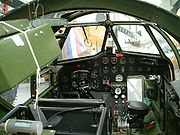
To achieve its relatively high speed, the Blenheim had a very small fuselage cross-section, with its upper front glazing all at one angle in the form of a "stepless cockpit", that used no separate windscreen panels for the pilot. Pilot's quarters on the left side of the nose were so cramped that the control yoke obscured all flight instruments while engine instruments eliminated the forward view on landings. Most secondary instruments were arranged along the left side of the cockpit, with essential items like propeller pitch control actually placed behind the pilot where they had to be operated by feel alone. Like most contemporary British aircraft, the bomb bay doors were kept closed with bungee cord
s and opened under the weight of the released bombs. Because there was no way to predict how long it would take for the bombs to force the doors open, bombing accuracy was consequently poor.
The aircraft was ordered directly from the drawing board with the first production model serving as the only prototype. The name then became Blenheim Mk I after a historic German village where the British had won a great victory
. Subsequent deliveries started on 10 March 1937, with 114 Squadron
being the first squadron to receive the Blenheim. The aircraft would prove to be so successful that it was licensed by a number of countries, including Finland
and the Yugoslavia
, which completed 60 examples. Other countries bought it outright, including Romania
, Greece
and Turkey
. Total production of the Blenheim Mk I in England amounted to 1,351 aircraft.
 Work on an extended-range reconnaissance
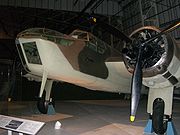
version started as the Blenheim Mk II, which increased tankage from 278 gal (1,264 L) to 468 gal (2,127 L), but only one was completed. Another modification resulted in the Blenheim Mk III, which lengthened the nose, and thereby dispensed with the "stepless cockpit" format of the Mk.I in introducing a true windscreen in front of the pilot, to provide more room for the bombardier. This required the nose to be "scooped out" in front of the pilot to maintain visibility during takeoff and landing. However both of these modifications were instead combined, along with a newer version of the Mercury engine with 905 hp (675 kW) and the turret acquired a pair of Brownings instead of the Vickers K; creating the Blenheim Mk IV. A total of 3,307 were produced.
Another modification led to a long-range fighter version; the Blenheim Mk IF. For this role, about 200 Blenheims were fitted with a gun-pack under the fuselage for four .303 in (7.7 mm) Brownings. Later, the Airborne Intercept (AI) Mk III or IV radar
was fitted to some aircraft in use as night fighters; these were the first British fighters to be equipped with radar. Their performance was marginal as a fighter, but they served as an interim type, pending availability of the Beaufighter
. About 60 Mk IVs were also equipped with the gun pack as the Mk IVF and were used by Coastal Command to protect convoys from German long-range bombers.
The last bomber variant was conceived as an armoured ground attack aircraft
, with a solid nose containing four more Browning machine guns. Originally known as the Bisley, (after the shooting competitions
held at Bisley
), the production aircraft were renamed Blenheim Mk V and featured a strengthened structure, pilot armour, interchangeable nose gun pack or bombardier position, and yet another Mercury variant, this time with 950 hp (710 kW). The Mk V was ordered for conventional bombing operations, with the removal of armour and most of the glazed nose section. The Mk V, or Type 160, was used primarily in the Middle East and Far East.
The Blenheim served as the basis for the Beaufort
torpedo bomber
, which itself led to the Beaufighter, with the lineage performing two complete circles of bomber to fighter.
 On the day that war was declared on Germany a Blenheim piloted by Flying Officer
Andrew McPherson
was the first British aircraft to cross the German coast and the following morning 15 Blenheims from three squadrons set off on one of the first bombing missions. With the rapid advances in technology which had taken place in the late 1930s, by then the aircraft was already obsolescent. The Blenheim was regarded as a pleasant aircraft to fly, although it did have some characteristics which could catch even experienced pilots by surprise. It had become heavier as extra service equipment was installed; much of this was found to be needed through operational experience. This, coupled with the rapid performance increases of fighters, had eclipsed the Blenheim's speed advantage.
The light armament of one .303 in (7.7 mm) Vickers VGO
in the turret and one .303 in (7.7 mm) Browning machine gun
in the port wing was seldom able to deter fighter opposition. Squadrons were forced to use several different improvisations in an attempt to provide better defensive armament, until officially sanctioned modifications were able to be introduced in early 1940. The Blenheim also proved to be vulnerable to flak
, especially around the rear fuselage. Flexible, self-sealing
liners had been fitted to the fuel tanks but they were still not fully protected against the 20 mm MG FF cannon
carried by the Luftwaffes Bf 109s
and Bf 110s
.
After France fell to Germany
in June 1940, the Free French Air Force
was formed at RAF Odiham
in the form of Groupe Mixte de Combat (GMC) 1, consisting of a mixed bag of Blenheims and Westland Lysander
liaison/observation aircraft, which eventually went to North Africa
and saw action against the Italians and Germans.
The Blenheim units raided German occupied airfields throughout July to December 1940, both during daylight hours and at night. Although most of these raids were unproductive there were some successes; on 1 August five out of 12 Blenheims sent to attack Haamstede
and Evere
(Brussels
) were able to bomb, destroying or heavily damaging three Bf 109s of II./JG 27 and apparently killing a Staffelkapitan identified as Hauptmann
Albrecht von Ankum-Frank. Two other 109s were claimed by Blenheim gunners. Another successful raid on Haamstede was made by a single Blenheim on 7 August which destroyed one 109 of 4./JG 54, heavily damaged another and caused lighter damage to four more.
There were also some missions which produced an almost 100% casualty rate amongst the Blenheims; one such operation was mounted on 13 August 1940 against a Luftwaffe airfield near Aalborg
in north-eastern Denmark
by 12 aircraft of 82 Squadron
. One Blenheim returned early (the pilot was later charged and due to appear before a court martial but was killed on another operation), the other 11, which reached Denmark, were shot down, five by flak and six by Bf 109s.
As well as the bombing operations, Blenheim-equipped units had been formed to carry out long-range strategic reconnaissance missions over Germany and German-occupied territories. In this role, the Blenheims once again proved to be too slow and vulnerable against Luftwaffe fighters and they took constant casualties.
. The Blenheims hit their targets (Fortuna Power Station in Oberaußem-Fortuna
and the Goldenberg Power Station in Hürth-Knapsack
) but 12 of the Blenheims were lost during the raid, 22% of those that took part which was far above the sustainable loss rate of less than 5%. The England cricketer S/L
Bill Edrich
was awarded the DFC
for his part in the raid.
s. Some 200 Mk I bombers were modified into Mk IF long-range fighters with 600 (Auxiliary Air Force) Squadron
based at Hendon, the first squadron to take delivery of these variants in September 1938. By 1939, at least seven squadrons were operating these twin-engine fighters and within a few months, some 60 squadrons had experience of the type. The Mk IF proved to be slower and less nimble than expected, and by June 1940, daylight Blenheim losses were to cause concern for Fighter Command. It was then decided that the Mk IF would be relegated mainly to night fighter
duties where No. 23 Squadron RAF
who had already operated the type under night time conditions had better success.
, had some of its Mk IFs equipped with AI Mk III radar. With this radar equipment, a Blenheim from the Fighter Interception Unit (FIU) at RAF Ford achieved the first success on the night of 2–3 July 1940, accounting for a Dornier Do 17
bomber. More successes came and, before long, the Blenheim proved itself invaluable in the night fighter role. Gradually, with the introduction of the Bristol Beaufighter
in 1940-1941, the Blenheim was supplanted by its faster, better armed progeny.
, India, British Malaya
, Singapore, and the Dutch East Indies
. Many Blenheims were lost to Japanese
fighters during the Malayan Campaign, battles for Singapore
, and Sumatra. By that point, the traditional daylight light bomber role was more effectively carried out by suitable fighter-bombers, and the surviving examples were relegated to training duties. Nonetheless, the Blenheim played a role in preventing India from falling and recapturing Burma
, destroying over 60 aircraft on the ground in raids on Bangkok
early in the campaign.
One Blenheim pilot, Squadron Leader Arthur Scarf
, was posthumously awarded the Victoria Cross
for an attack on Singora, Thailand
, on 9 December 1941. Another bomber of No. 60 Squadron RAF
was credited with shooting down Lt Col Tateo Katō
's Nakajima Ki-43
fighter and badly damaging two others in a single engagement on 22 May 1942, over the Bay of Bengal
. Katō's death was a severe blow for the Imperial Japanese Army Air Force.
The Air Ministry's replacement for the Blenheim as a daylight bomber, another Bristol design the Buckingham
, was overtaken by events and changes in requirements and considered inferior to the de Havilland Mosquito
, and as such did not see combat. The final ground attack version - the Blenheim Mk V - first equipped 139 Squadron in June 1942. Eventually 13 squadrons - mainly in the Middle East and Far East - received this variant but operated them generally only for a few months.
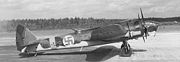 In 1936, the Finnish Air Force ordered 18 Blenheim Mk Is from Britain and two years later, they obtained a manufacturing license for the aircraft. Before any aircraft could be manufactured at the Valtion lentokonetehdas
(State Airplane Factory) in Finland, the Winter War
broke out, forcing the Finns to order more aircraft from the UK. A further 24 British-manufactured Blenheims were ordered during the Winter War. After the Winter War, 55 Blenheims were constructed in Finland, bringing the total number to 97 aircraft (75 Mk Is and 22 Mk IVs).
The Finns also received 20 half-completed ex-Yugoslavian Mk IV Blenheims captured by Germany, together with manufacturing tools and production equipment, as well as a huge variety of spare parts. Yugoslavia had ceased production of the Mk I and commenced a production run of Mk IVs just prior to the April 1941 invasion.
The Finnish Blenheims flew 423 missions during the Winter War, and close to 3,000 missions during the Continuation War
and Lapland War
. Blenheim machine gunners also shot down eight Soviet aircraft. Thirty-seven Blenheims were lost in combat during the wars.
After the war, Finland was prohibited from flying bomber aircraft. However, some of the Finnish Blenheims continued in service as target tug
s until 1958.
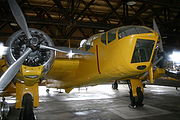
Blenheim Mk IF : Night fighter version, equipped with an AI Mk III or Mk IV airborne interceptor radar, armed with four 0.303 in (7.7 mm) machine guns in a special gun pack under the fuselage. About 200 Blenheim Mk Is were converted into Mk IF night fighters.
Blenheim Mk II : Long-range reconnaissance version with extra fuel tankage. Only one Blenheim Mk II was built.
Blenheim Mk III :
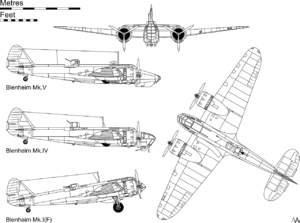
Blenheim Mk IV : Improved version, fitted with protective armour, powered by two 905 hp (675 kW) Bristol Mercury XV radial piston engines, armed with a 0.303 in (7.7 mm) machine gun in the port wing, plus two 0.303 in (7.7 mm) machine-guns in a powered operated dorsal turret, and two remotely controlled rearward-firing 0.303 in (7.7 mm) machine gun mounted beneath the nose, maximum bombload 1,000 lb (450 kg) internally and 320 lb (150 kg) externally. 3,307 built.
Blenheim Mk IVF : Long-range fighter version, armed with four 0.303 in (7.7 mm) machine guns in special gun pack under the fuselage. About 60 Blenheim Mk IVs were converted into Mk IVF fighters.
Blenheim Mk V : High-altitude bomber version, powered by two Bristol Mercury XV or XXV radial piston engines.
within a month of completion. A replacement Bolingbroke Mk IVT was rebuilt to flying status in just five years and painted to represent a Blenheim Mk IV in RAF wartime service. It began appearing at air shows and exhibitions in the UK, flying since May 1993 and was used in the 1995 film version of Shakespeare's
Richard III
. This aircraft crashed on landing at Duxford on 19 August 2003; the crash was feared to have made it a write-off, but it is presently undergoing an extensive repair and conversion to Mark 1 status ("Short nose" version) in conjunction with The Aircraft Restoration Company (ARC or ARCo), most of the work being done by volunteers. Funds are raised through donations and also by The Blenheim Society who run a Grand Flying Draw among many other activities. The aircraft is currently in Hangar 3 at the Imperial War Museum at Duxford and is the property of Blenheim (Duxford) Ltd.
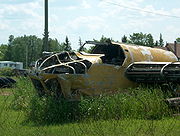
In Canada, a number of other Bolingbrokes survived the war but were summarily consigned to the scrap heap. Postwar, enterprising farmers often bought surplus aircraft such as these for the scrap metal content, tires for farm implements, and even for the fuel remaining in the tanks. Some surviving examples in Canada of the Bolingbroke can be traced back to this period. The Canadian Warplane Heritage Museum
in Hamilton
, Ontario
is rebuilding a Bolingbroke to airworthy status. The Commonwealth Air Training Plan Museum
in Brandon
, Manitoba
has restored the exterior of one Bolingbroke, painting it in the Air Training Plan
yellow color. This particular aircraft is on display at a location on the Trans-Canada Highway
in Brandon. A restored Bolingbroke is on static display at the British Columbia Aviation Museum
in Victoria, British Columbia
. The Canadian Museum of Flight at Langley Airport, Langley, British Columbia has on display the restored nose and cockpit section of a Bolingbroke, and holds the rest of an entire airframe in storage pending future restoration and display.
In Finland, the sole surviving original Blenheim in the world, a Mk IV registered as BL-200 of the Finnish Air Force, has been completely restored and is now on show at the Aviation Museum of Central Finland
at Tikkakoski.
In Greece a Bristol Blenheim Mk IVF was recovered from the sea and moved to the Hellenic Air Force Museum
for restoration.
United Kingdom
The United Kingdom of Great Britain and Northern IrelandIn the United Kingdom and Dependencies, other languages have been officially recognised as legitimate autochthonous languages under the European Charter for Regional or Minority Languages...
light bomber
Light bomber
A light bomber is a relatively small and fast class of military bomber aircraft which were primarily employed before the 1950s. Such aircraft would typically not carry more than one ton of ordnance....
aircraft designed and built by the Bristol Aeroplane Company
Bristol Aeroplane Company
The Bristol Aeroplane Company, originally the British and Colonial Aeroplane Company, was both one of the first and one of the most important British aviation companies, designing and manufacturing both airframes and aero engines...
that was used extensively in the early days of the Second World War
World War II
World War II, or the Second World War , was a global conflict lasting from 1939 to 1945, involving most of the world's nations—including all of the great powers—eventually forming two opposing military alliances: the Allies and the Axis...
. It was adapted as an interim long-range
Heavy fighter
A heavy fighter is a fighter aircraft designed to carry heavier weapons or operate at longer ranges. To achieve acceptable performance, most heavy fighters were twin-engined, and many had multi-place crews....
and night fighter
Night fighter
A night fighter is a fighter aircraft adapted for use at night or in other times of bad visibility...
, pending the availability of the Beaufighter
Bristol Beaufighter
The Bristol Type 156 Beaufighter, often referred to as simply the Beau, was a British long-range heavy fighter modification of the Bristol Aeroplane Company's earlier Beaufort torpedo bomber design...
. It was one of the first British aircraft to have all-metal stressed-skin construction, to utilise retractable landing gear
Undercarriage
The undercarriage or landing gear in aviation, is the structure that supports an aircraft on the ground and allows it to taxi, takeoff and land...
, flap
Flap (aircraft)
Flaps are normally hinged surfaces mounted on the trailing edges of the wings of a fixed-wing aircraft to reduce the speed an aircraft can be safely flown at and to increase the angle of descent for landing without increasing air speed. They shorten takeoff and landing distances as well as...
s, powered gun turret
Turret
In architecture, a turret is a small tower that projects vertically from the wall of a building such as a medieval castle. Turrets were used to provide a projecting defensive position allowing covering fire to the adjacent wall in the days of military fortification...
and variable pitch propellers. A Canadian-built variant named the Bolingbroke
Bristol Fairchild Bolingbroke
The Bristol Fairchild Bolingbroke was a maritime patrol aircraft used by the Royal Canadian Air Force during the Second World War. Built by Fairchild-Canada, it was a variant of the Bristol Blenheim Mk IV bomber.-Design and development:...
was used as an anti-submarine
Anti-submarine warfare
Anti-submarine warfare is a branch of naval warfare that uses surface warships, aircraft, or other submarines to find, track and deter, damage or destroy enemy submarines....
and training
Trainer (aircraft)
A trainer is a class of aircraft designed specifically to facilitate in-flight training of pilots and aircrews. The use of a dedicated trainer aircraft with additional safety features—such as tandem flight controls, forgiving flight characteristics and a simplified cockpit arrangement—allows...
aircraft.
The Blenheim Mk I outshone most biplane fighters in the late 1930s but stood little chance against the German Messerschmitt Bf 109
Messerschmitt Bf 109
The Messerschmitt Bf 109, often called Me 109, was a German World War II fighter aircraft designed by Willy Messerschmitt and Robert Lusser during the early to mid 1930s...
during daylight operations, though it proved successful as a night fighter. The Mark IV variant was equally unsuccessful, suffering major losses in the early stages of the war.
Design and development
Daily Mail
The Daily Mail is a British daily middle-market tabloid newspaper owned by the Daily Mail and General Trust. First published in 1896 by Lord Northcliffe, it is the United Kingdom's second biggest-selling daily newspaper after The Sun. Its sister paper The Mail on Sunday was launched in 1982...
newspaper, issued a challenge to the British aviation industry to build a high-speed aircraft capable of carrying six passengers and two crew members. At the time, German firms were producing a variety of high-speed designs that were breaking records, and Rothermere wanted to recapture the title of fastest civilian aircraft in Europe. Bristol had been working on a suitable design as the Type 135 since July 1933, and further adapted it to produce the Type 142 to meet Rothermere's requirements.
When it first flew as Britain First at Filton
Filton
Filton is a town in South Gloucestershire, England, situated on the northern outskirts of the city of Bristol, about from the city centre. Filton lies in Bristol postcode areas BS7 and BS34. The town centres upon Filton Church, which dates back to the 12th century and is a grade II listed building...
on 12 April 1935, it proved to be faster than any fighter in service with the Royal Air Force
Royal Air Force
The Royal Air Force is the aerial warfare service branch of the British Armed Forces. Formed on 1 April 1918, it is the oldest independent air force in the world...
at the time. The Air Ministry
Air Ministry
The Air Ministry was a department of the British Government with the responsibility of managing the affairs of the Royal Air Force, that existed from 1918 to 1964...
was obviously interested in such an aircraft and quickly sent out Specification B.28/35 for prototypes of a bomber version; the Type 142M (M for military). The main changes were to move the wing from a low-wing to a mid-wing position, allowing room under the main spar
Spar (aviation)
In a fixed-wing aircraft, the spar is often the main structural member of the wing, running spanwise at right angles to the fuselage. The spar carries flight loads and the weight of the wings whilst on the ground...
for a bomb bay. The aircraft was all-metal with two Bristol Mercury
Bristol Mercury
|-See also:-Bibliography:* Bridgman, L, Jane's fighting aircraft of World War II. Crescent. ISBN 0-517-67964-7* Gunston, Bill. World Encyclopedia of Aero Engines. Cambridge, England. Patrick Stephens Limited, 1989. ISBN 1-85260-163-9...
VIII air-cooled radial engine
Radial engine
The radial engine is a reciprocating type internal combustion engine configuration in which the cylinders point outward from a central crankshaft like the spokes on a wheel...
s, each of 860 hp (640 kW). It carried a crew of three - pilot, navigator/bombardier and telegraphist/air gunner. Armament comprised a single forward-firing .303 in (7.7 mm) Browning machine gun
M1919 Browning machine gun
The M1919 Browning is a .30 caliber medium machine gun that was widely used during the 20th century. It was used as a light infantry, coaxial, mounted, aircraft, and anti-aircraft machine gun by the U.S. and many other countries, especially during World War II, the Korean War, and the Vietnam War...
outboard of the port engine and a .303 in (7.7 mm) Lewis Gun
Lewis Gun
The Lewis Gun is a World War I–era light machine gun of American design that was perfected and widely used by the British Empire. It was first used in combat in World War I, and continued in service with a number of armed forces through to the end of the Korean War...
in a semi-retracting Bristol Type B Mk I dorsal turret firing to the rear. From 1939 onwards, the Lewis gun was replaced by the more modern .303 in (7.7 mm) Vickers VGO machine gun
Vickers K machine gun
Not to be confused with the Vickers light machine gunThe Vickers K machine gun, known as the Vickers Gas Operated in British service, was a rapid-firing machine gun developed and manufactured for use in aircraft by Vickers-Armstrongs...
of the same calibre. A 1,000 lb (450 kg) bomb load could be carried in the internal bay.
To achieve its relatively high speed, the Blenheim had a very small fuselage cross-section, with its upper front glazing all at one angle in the form of a "stepless cockpit", that used no separate windscreen panels for the pilot. Pilot's quarters on the left side of the nose were so cramped that the control yoke obscured all flight instruments while engine instruments eliminated the forward view on landings. Most secondary instruments were arranged along the left side of the cockpit, with essential items like propeller pitch control actually placed behind the pilot where they had to be operated by feel alone. Like most contemporary British aircraft, the bomb bay doors were kept closed with bungee cord
Bungee cord
A bungee cord , also known as a shock cord, is an elastic cord composed of one or more elastic strands forming a core, usually covered in a woven cotton or polypropylene sheath...
s and opened under the weight of the released bombs. Because there was no way to predict how long it would take for the bombs to force the doors open, bombing accuracy was consequently poor.
The aircraft was ordered directly from the drawing board with the first production model serving as the only prototype. The name then became Blenheim Mk I after a historic German village where the British had won a great victory
Battle of Blenheim
The Battle of Blenheim , fought on 13 August 1704, was a major battle of the War of the Spanish Succession. Louis XIV of France sought to knock Emperor Leopold out of the war by seizing Vienna, the Habsburg capital, and gain a favourable peace settlement...
. Subsequent deliveries started on 10 March 1937, with 114 Squadron
No. 114 Squadron RAF
-Formation and World War I:No. 114 Squadron Royal Flying Corps was formed In Lahore, India on 27 Sep 1917. It was equipped with the B.E.2 and Bristol F2B and operated on the North-West Frontier...
being the first squadron to receive the Blenheim. The aircraft would prove to be so successful that it was licensed by a number of countries, including Finland
Finland
Finland , officially the Republic of Finland, is a Nordic country situated in the Fennoscandian region of Northern Europe. It is bordered by Sweden in the west, Norway in the north and Russia in the east, while Estonia lies to its south across the Gulf of Finland.Around 5.4 million people reside...
and the Yugoslavia
Kingdom of Yugoslavia
The Kingdom of Yugoslavia was a state stretching from the Western Balkans to Central Europe which existed during the often-tumultuous interwar era of 1918–1941...
, which completed 60 examples. Other countries bought it outright, including Romania
Romania
Romania is a country located at the crossroads of Central and Southeastern Europe, on the Lower Danube, within and outside the Carpathian arch, bordering on the Black Sea...
, Greece
Greece
Greece , officially the Hellenic Republic , and historically Hellas or the Republic of Greece in English, is a country in southeastern Europe....
and Turkey
Turkey
Turkey , known officially as the Republic of Turkey , is a Eurasian country located in Western Asia and in East Thrace in Southeastern Europe...
. Total production of the Blenheim Mk I in England amounted to 1,351 aircraft.
Reconnaissance
Reconnaissance is the military term for exploring beyond the area occupied by friendly forces to gain information about enemy forces or features of the environment....
version started as the Blenheim Mk II, which increased tankage from 278 gal (1,264 L) to 468 gal (2,127 L), but only one was completed. Another modification resulted in the Blenheim Mk III, which lengthened the nose, and thereby dispensed with the "stepless cockpit" format of the Mk.I in introducing a true windscreen in front of the pilot, to provide more room for the bombardier. This required the nose to be "scooped out" in front of the pilot to maintain visibility during takeoff and landing. However both of these modifications were instead combined, along with a newer version of the Mercury engine with 905 hp (675 kW) and the turret acquired a pair of Brownings instead of the Vickers K; creating the Blenheim Mk IV. A total of 3,307 were produced.
Another modification led to a long-range fighter version; the Blenheim Mk IF. For this role, about 200 Blenheims were fitted with a gun-pack under the fuselage for four .303 in (7.7 mm) Brownings. Later, the Airborne Intercept (AI) Mk III or IV radar
Radar
Radar is an object-detection system which uses radio waves to determine the range, altitude, direction, or speed of objects. It can be used to detect aircraft, ships, spacecraft, guided missiles, motor vehicles, weather formations, and terrain. The radar dish or antenna transmits pulses of radio...
was fitted to some aircraft in use as night fighters; these were the first British fighters to be equipped with radar. Their performance was marginal as a fighter, but they served as an interim type, pending availability of the Beaufighter
Bristol Beaufighter
The Bristol Type 156 Beaufighter, often referred to as simply the Beau, was a British long-range heavy fighter modification of the Bristol Aeroplane Company's earlier Beaufort torpedo bomber design...
. About 60 Mk IVs were also equipped with the gun pack as the Mk IVF and were used by Coastal Command to protect convoys from German long-range bombers.
The last bomber variant was conceived as an armoured ground attack aircraft
Ground attack aircraft
Ground-attack aircraft are military aircraft with primary role of attacking targets on the ground with greater precision than bombers and prepared to face stronger low-level air defense...
, with a solid nose containing four more Browning machine guns. Originally known as the Bisley, (after the shooting competitions
National Rifle Association of the United Kingdom
The National Rifle Association of the United Kingdom is the governing body of full bore rifle and pistol shooting sports in the United Kingdom.- History :...
held at Bisley
Bisley, Surrey
Bisley is a large village in Surrey, England, which is notable for rifle shooting. Bisley's immediate neighbours are West End, Chobham and Knaphill.- History :...
), the production aircraft were renamed Blenheim Mk V and featured a strengthened structure, pilot armour, interchangeable nose gun pack or bombardier position, and yet another Mercury variant, this time with 950 hp (710 kW). The Mk V was ordered for conventional bombing operations, with the removal of armour and most of the glazed nose section. The Mk V, or Type 160, was used primarily in the Middle East and Far East.
The Blenheim served as the basis for the Beaufort
Bristol Beaufort
The Bristol Beaufort was a British twin-engined torpedo bomber designed by the Bristol Aeroplane Company, and developed from experience gained designing and building the earlier Blenheim light bomber....
torpedo bomber
Torpedo bomber
A torpedo bomber is a bomber aircraft designed primarily to attack ships with aerial torpedoes which could also carry out conventional bombings. Torpedo bombers existed almost exclusively prior to and during World War II when they were an important element in many famous battles, notably the...
, which itself led to the Beaufighter, with the lineage performing two complete circles of bomber to fighter.
Operational history
Flying Officer
Flying officer is a junior commissioned rank in the Royal Air Force and the air forces of many countries which have historical British influence...
Andrew McPherson
Andrew McPherson
Flying Officer Andrew McPherson DFC was a pilot with RAF Bomber Command in World War II.He is notable for being the pilot of Bristol Blenheim bomber N6125 of No. 139 Squadron RAF, which was the first British aircraft to cross the German coast after Britain had declared war on Germany...
was the first British aircraft to cross the German coast and the following morning 15 Blenheims from three squadrons set off on one of the first bombing missions. With the rapid advances in technology which had taken place in the late 1930s, by then the aircraft was already obsolescent. The Blenheim was regarded as a pleasant aircraft to fly, although it did have some characteristics which could catch even experienced pilots by surprise. It had become heavier as extra service equipment was installed; much of this was found to be needed through operational experience. This, coupled with the rapid performance increases of fighters, had eclipsed the Blenheim's speed advantage.
The light armament of one .303 in (7.7 mm) Vickers VGO
Vickers K machine gun
Not to be confused with the Vickers light machine gunThe Vickers K machine gun, known as the Vickers Gas Operated in British service, was a rapid-firing machine gun developed and manufactured for use in aircraft by Vickers-Armstrongs...
in the turret and one .303 in (7.7 mm) Browning machine gun
M1919 Browning machine gun
The M1919 Browning is a .30 caliber medium machine gun that was widely used during the 20th century. It was used as a light infantry, coaxial, mounted, aircraft, and anti-aircraft machine gun by the U.S. and many other countries, especially during World War II, the Korean War, and the Vietnam War...
in the port wing was seldom able to deter fighter opposition. Squadrons were forced to use several different improvisations in an attempt to provide better defensive armament, until officially sanctioned modifications were able to be introduced in early 1940. The Blenheim also proved to be vulnerable to flak
Anti-aircraft warfare
NATO defines air defence as "all measures designed to nullify or reduce the effectiveness of hostile air action." They include ground and air based weapon systems, associated sensor systems, command and control arrangements and passive measures. It may be to protect naval, ground and air forces...
, especially around the rear fuselage. Flexible, self-sealing
Self-sealing fuel tank
In aviation, self-sealing fuel tank is a fuel tank technology in wide use since World War II that prevents fuel tanks primarily on aircraft from leaking fuel and igniting after being damaged by enemy fire....
liners had been fitted to the fuel tanks but they were still not fully protected against the 20 mm MG FF cannon
MG FF cannon
The MG FF was a drum-fed, 20 mm aircraft autocannon, developed in 1936 by Ikaria Werke Berlin of Germany. It was a derivative of the Swiss Oerlikon FF F cannon, itself a development of the German World War I Becker 20 mm cannon, and was designed to be used in fixed or flexible mountings, as...
carried by the Luftwaffes Bf 109s
Messerschmitt Bf 109
The Messerschmitt Bf 109, often called Me 109, was a German World War II fighter aircraft designed by Willy Messerschmitt and Robert Lusser during the early to mid 1930s...
and Bf 110s
Messerschmitt Bf 110
The Messerschmitt Bf 110, often called Me 110, was a twin-engine heavy fighter in the service of the Luftwaffe during World War II. Hermann Göring was a proponent of the Bf 110, and nicknamed it his Eisenseiten...
.
After France fell to Germany
Battle of France
In the Second World War, the Battle of France was the German invasion of France and the Low Countries, beginning on 10 May 1940, which ended the Phoney War. The battle consisted of two main operations. In the first, Fall Gelb , German armoured units pushed through the Ardennes, to cut off and...
in June 1940, the Free French Air Force
Free French Air Force
The Free French Air Force was the air arm of the Free French Forces during the Second World War.-Fighting for Free France — the FAFL in French North Africa :...
was formed at RAF Odiham
RAF Odiham
RAF Odiham is a Royal Air Force station situated a little to the south of the historic small village of Odiham in Hampshire, England. It is the home of the Royal Air Force's heavy lift helicopter, the Chinook HC2, HC2A and HC3...
in the form of Groupe Mixte de Combat (GMC) 1, consisting of a mixed bag of Blenheims and Westland Lysander
Westland Lysander
The Westland Lysander was a British army co-operation and liaison aircraft produced by Westland Aircraft used immediately before and during the Second World War...
liaison/observation aircraft, which eventually went to North Africa
North Africa
North Africa or Northern Africa is the northernmost region of the African continent, linked by the Sahara to Sub-Saharan Africa. Geopolitically, the United Nations definition of Northern Africa includes eight countries or territories; Algeria, Egypt, Libya, Morocco, South Sudan, Sudan, Tunisia, and...
and saw action against the Italians and Germans.
The Battle of Britain
The Blenheim units operated throughout the battle, often taking heavy casualties, although they were never accorded the publicity of the fighter squadrons.The Blenheim units raided German occupied airfields throughout July to December 1940, both during daylight hours and at night. Although most of these raids were unproductive there were some successes; on 1 August five out of 12 Blenheims sent to attack Haamstede
Haamstede
Haamstede is a town in the Dutch province of Zeeland. It is a part of the municipality of Schouwen-Duiveland.The statistical area "Haamstede", which also can include the surrounding countryside, has a population of around 2460....
and Evere
Evere
Evere is one of the nineteen municipalities located in the Brussels-Capital Region of Belgium. On January 1, 2006 the municipality had a total population of 33,462...
(Brussels
Brussels
Brussels , officially the Brussels Region or Brussels-Capital Region , is the capital of Belgium and the de facto capital of the European Union...
) were able to bomb, destroying or heavily damaging three Bf 109s of II./JG 27 and apparently killing a Staffelkapitan identified as Hauptmann
Hauptmann
Hauptmann is a German word usually translated as captain when it is used as an officer's rank in the German, Austrian and Swiss armies. While "haupt" in contemporary German means "main", it also has the dated meaning of "head", i.e...
Albrecht von Ankum-Frank. Two other 109s were claimed by Blenheim gunners. Another successful raid on Haamstede was made by a single Blenheim on 7 August which destroyed one 109 of 4./JG 54, heavily damaged another and caused lighter damage to four more.
There were also some missions which produced an almost 100% casualty rate amongst the Blenheims; one such operation was mounted on 13 August 1940 against a Luftwaffe airfield near Aalborg
Aalborg
-Transport:On the north side of the Limfjord is Nørresundby, which is connected to Aalborg by a road bridge Limfjordsbroen, an iron railway bridge Jernbanebroen over Limfjorden, as well as a motorway tunnel running under the Limfjord Limfjordstunnelen....
in north-eastern Denmark
Denmark
Denmark is a Scandinavian country in Northern Europe. The countries of Denmark and Greenland, as well as the Faroe Islands, constitute the Kingdom of Denmark . It is the southernmost of the Nordic countries, southwest of Sweden and south of Norway, and bordered to the south by Germany. Denmark...
by 12 aircraft of 82 Squadron
No. 82 Squadron RAF
No. 82 Squadron RAF was a Royal Air Force squadron that was first formed in 1917 and last disbanded in 1963. It served at times as a bomber unit, a reconnaissance unit and lastly as a Intermediate Range Ballistic Missile unit...
. One Blenheim returned early (the pilot was later charged and due to appear before a court martial but was killed on another operation), the other 11, which reached Denmark, were shot down, five by flak and six by Bf 109s.
As well as the bombing operations, Blenheim-equipped units had been formed to carry out long-range strategic reconnaissance missions over Germany and German-occupied territories. In this role, the Blenheims once again proved to be too slow and vulnerable against Luftwaffe fighters and they took constant casualties.
Cologne power stations raid
The action on 12 August 1941 was described by the Daily Telegraph in 2006 as the "RAF's most audacious and dangerous low-level bombing raid, a large-scale attack against power stations near Cologne." The raid was a low-level daylight raid by 54 Blenheims under the command of Wing Commander Nichol of No. 114 Squadron RAFNo. 114 Squadron RAF
-Formation and World War I:No. 114 Squadron Royal Flying Corps was formed In Lahore, India on 27 Sep 1917. It was equipped with the B.E.2 and Bristol F2B and operated on the North-West Frontier...
. The Blenheims hit their targets (Fortuna Power Station in Oberaußem-Fortuna
Bergheim, North Rhine-Westphalia
Bergheim is a German city 20 km west of Cologne and the capital of the Rhein-Erft-Kreis. The city's Niederaußem district is one of the most important suppliers for energy from lignites in Europe.- Geography :...
and the Goldenberg Power Station in Hürth-Knapsack
Knapsack, Germany
Knapsack is a locality of Hürth, Rhine-Erft district, North Rhine-Westphalia, Germany..On Wednesday 17 October, 2007, King Harald of Norway opened Statkraft's first gas power plant at Knapsack in Germany...
) but 12 of the Blenheims were lost during the raid, 22% of those that took part which was far above the sustainable loss rate of less than 5%. The England cricketer S/L
Squadron Leader
Squadron Leader is a commissioned rank in the Royal Air Force and the air forces of many countries which have historical British influence. It is also sometimes used as the English translation of an equivalent rank in countries which have a non-English air force-specific rank structure. In these...
Bill Edrich
Bill Edrich
William John "Bill" Edrich DFC was a distinguished cricketer who played for Middlesex, MCC, Norfolk and England.Edrich's three brothers, Brian, Eric and Geoff, and also his cousin, John, all played first-class cricket...
was awarded the DFC
Distinguished Flying Cross (United Kingdom)
The Distinguished Flying Cross is a military decoration awarded to personnel of the United Kingdom's Royal Air Force and other services, and formerly to officers of other Commonwealth countries, for "an act or acts of valour, courage or devotion to duty whilst flying in active operations against...
for his part in the raid.
Long-range fighter
The Bristol Blenheim was used by both Bomber and Fighter CommandRAF Fighter Command
RAF Fighter Command was one of three functional commands of the Royal Air Force. It was formed in 1936 to allow more specialised control of fighter aircraft. It served throughout the Second World War, gaining recognition in the Battle of Britain. The Command continued until 17 November 1943, when...
s. Some 200 Mk I bombers were modified into Mk IF long-range fighters with 600 (Auxiliary Air Force) Squadron
No. 600 Squadron RAF
No. 600 Squadron RAuxAF is a squadron of the RAF Reserves. It was formed in 1925 and operated as a night fighter squadron during the Second World War with great distinction. After the war, 600 Squadron went on to operate jet fighters until 1957. Reactivated in 1999, 600 Squadron is the only RAF...
based at Hendon, the first squadron to take delivery of these variants in September 1938. By 1939, at least seven squadrons were operating these twin-engine fighters and within a few months, some 60 squadrons had experience of the type. The Mk IF proved to be slower and less nimble than expected, and by June 1940, daylight Blenheim losses were to cause concern for Fighter Command. It was then decided that the Mk IF would be relegated mainly to night fighter
Night fighter
A night fighter is a fighter aircraft adapted for use at night or in other times of bad visibility...
duties where No. 23 Squadron RAF
No. 23 Squadron RAF
No. 23 Squadron was a squadron of the Royal Air Force. Until October 2009, it operated the Boeing Sentry AEW1 Airborne Warning And Control System aircraft from RAF Waddington, Lincolnshire.-First World War:...
who had already operated the type under night time conditions had better success.
Night fighter
In the German night bombing raid on London, 18 June 1940, Blenheims accounted for five German bombers thus proving they were better suited to a nocturnal role. In July, No. 600 Squadron, by then based at RAF ManstonRAF Manston
RAF Manston was an RAF station in the north-east of Kent, at on the Isle of Thanet from 1916 until 1996. The site is now split between a commercial airport Kent International Airport and a continuing military use by the Defence Fire Training and Development Centre , following on from a long...
, had some of its Mk IFs equipped with AI Mk III radar. With this radar equipment, a Blenheim from the Fighter Interception Unit (FIU) at RAF Ford achieved the first success on the night of 2–3 July 1940, accounting for a Dornier Do 17
Dornier Do 17
The Dornier Do 17, sometimes referred to as the Fliegender Bleistift , was a World War II German light bomber produced by Claudius Dornier's company, Dornier Flugzeugwerke...
bomber. More successes came and, before long, the Blenheim proved itself invaluable in the night fighter role. Gradually, with the introduction of the Bristol Beaufighter
Bristol Beaufighter
The Bristol Type 156 Beaufighter, often referred to as simply the Beau, was a British long-range heavy fighter modification of the Bristol Aeroplane Company's earlier Beaufort torpedo bomber design...
in 1940-1941, the Blenheim was supplanted by its faster, better armed progeny.
Eastern service
Blenheims continued to operate widely in many combat roles until about 1943, equipping RAF squadrons in the UK and in British bases in Egypt, Iraq, AdenAden
Aden is a seaport city in Yemen, located by the eastern approach to the Red Sea , some 170 kilometres east of Bab-el-Mandeb. Its population is approximately 800,000. Aden's ancient, natural harbour lies in the crater of an extinct volcano which now forms a peninsula, joined to the mainland by a...
, India, British Malaya
British Malaya
British Malaya loosely described a set of states on the Malay Peninsula and the Island of Singapore that were brought under British control between the 18th and the 20th centuries...
, Singapore, and the Dutch East Indies
Dutch East Indies
The Dutch East Indies was a Dutch colony that became modern Indonesia following World War II. It was formed from the nationalised colonies of the Dutch East India Company, which came under the administration of the Netherlands government in 1800....
. Many Blenheims were lost to Japanese
Empire of Japan
The Empire of Japan is the name of the state of Japan that existed from the Meiji Restoration on 3 January 1868 to the enactment of the post-World War II Constitution of...
fighters during the Malayan Campaign, battles for Singapore
Battle of Singapore
The Battle of Singapore was fought in the South-East Asian theatre of the Second World War when the Empire of Japan invaded the Allied stronghold of Singapore. Singapore was the major British military base in Southeast Asia and nicknamed the "Gibraltar of the East"...
, and Sumatra. By that point, the traditional daylight light bomber role was more effectively carried out by suitable fighter-bombers, and the surviving examples were relegated to training duties. Nonetheless, the Blenheim played a role in preventing India from falling and recapturing Burma
Burma Campaign
The Burma Campaign in the South-East Asian Theatre of World War II was fought primarily between British Commonwealth, Chinese and United States forces against the forces of the Empire of Japan, Thailand, and the Indian National Army. British Commonwealth land forces were drawn primarily from...
, destroying over 60 aircraft on the ground in raids on Bangkok
Bangkok
Bangkok is the capital and largest urban area city in Thailand. It is known in Thai as Krung Thep Maha Nakhon or simply Krung Thep , meaning "city of angels." The full name of Bangkok is Krung Thep Mahanakhon Amon Rattanakosin Mahintharayutthaya Mahadilok Phop Noppharat Ratchathani Burirom...
early in the campaign.
One Blenheim pilot, Squadron Leader Arthur Scarf
Arthur Stewart King Scarf
Squadron Leader Arthur Stewart King Scarf VC was an English recipient of the Victoria Cross, the highest and most prestigious award for gallantry in the face of the enemy that can be awarded to British and Commonwealth forces...
, was posthumously awarded the Victoria Cross
Victoria Cross
The Victoria Cross is the highest military decoration awarded for valour "in the face of the enemy" to members of the armed forces of various Commonwealth countries, and previous British Empire territories....
for an attack on Singora, Thailand
Thailand
Thailand , officially the Kingdom of Thailand , formerly known as Siam , is a country located at the centre of the Indochina peninsula and Southeast Asia. It is bordered to the north by Burma and Laos, to the east by Laos and Cambodia, to the south by the Gulf of Thailand and Malaysia, and to the...
, on 9 December 1941. Another bomber of No. 60 Squadron RAF
No. 60 Squadron RAF
No. 60 Squadron of the Royal Air Force was formed in 1916 at Gosport. It is currently part of the Defence Helicopter Flying School based at RAF Shawbury in Shropshire....
was credited with shooting down Lt Col Tateo Katō
Tateo Kato
was a Japanese ace army aviator, credited with at least 18 aerial victories and who was honored posthumously by an award of the Order of the Golden Kite.-Biography:...
's Nakajima Ki-43
Nakajima Ki-43
The Nakajima Ki-43 Hayabusa was a single-engine land-based tactical fighter used by the Imperial Japanese Army Air Force in World War II...
fighter and badly damaging two others in a single engagement on 22 May 1942, over the Bay of Bengal
Bay of Bengal
The Bay of Bengal , the largest bay in the world, forms the northeastern part of the Indian Ocean. It resembles a triangle in shape, and is bordered mostly by the Eastern Coast of India, southern coast of Bangladesh and Sri Lanka to the west and Burma and the Andaman and Nicobar Islands to the...
. Katō's death was a severe blow for the Imperial Japanese Army Air Force.
The Air Ministry's replacement for the Blenheim as a daylight bomber, another Bristol design the Buckingham
Bristol Buckingham
|-See also:-References:NotesBibliography* Buttler, Tony. British Secret Projects: Fighters and Bombers 1935-1950. Hinckley, UK: Midland Publishing, 2004. ISBN 1-85780-179-2....
, was overtaken by events and changes in requirements and considered inferior to the de Havilland Mosquito
De Havilland Mosquito
The de Havilland DH.98 Mosquito was a British multi-role combat aircraft that served during the Second World War and the postwar era. It was known affectionately as the "Mossie" to its crews and was also nicknamed "The Wooden Wonder"...
, and as such did not see combat. The final ground attack version - the Blenheim Mk V - first equipped 139 Squadron in June 1942. Eventually 13 squadrons - mainly in the Middle East and Far East - received this variant but operated them generally only for a few months.
Finland
Valtion lentokonetehdas
' was a Finnish aircraft manufacturing company that was founded on 23 February 1928 from the IVL or I.V.L. factory . The company was transferred from being subordinate to the Finnish Air Force to being subordinate to the Ministry of Defence...
(State Airplane Factory) in Finland, the Winter War
Winter War
The Winter War was a military conflict between the Soviet Union and Finland. It began with a Soviet offensive on 30 November 1939 – three months after the start of World War II and the Soviet invasion of Poland – and ended on 13 March 1940 with the Moscow Peace Treaty...
broke out, forcing the Finns to order more aircraft from the UK. A further 24 British-manufactured Blenheims were ordered during the Winter War. After the Winter War, 55 Blenheims were constructed in Finland, bringing the total number to 97 aircraft (75 Mk Is and 22 Mk IVs).
The Finns also received 20 half-completed ex-Yugoslavian Mk IV Blenheims captured by Germany, together with manufacturing tools and production equipment, as well as a huge variety of spare parts. Yugoslavia had ceased production of the Mk I and commenced a production run of Mk IVs just prior to the April 1941 invasion.
The Finnish Blenheims flew 423 missions during the Winter War, and close to 3,000 missions during the Continuation War
Continuation War
The Continuation War was the second of two wars fought between Finland and the Soviet Union during World War II.At the time of the war, the Finnish side used the name to make clear its perceived relationship to the preceding Winter War...
and Lapland War
Lapland War
The Lapland War were the hostilities between Finland and Nazi Germany between September 1944 and April 1945, fought in Finland's northernmost Lapland Province. While the Finns saw this as a separate conflict much like the Continuation War, German forces considered their actions to be part of the...
. Blenheim machine gunners also shot down eight Soviet aircraft. Thirty-seven Blenheims were lost in combat during the wars.
After the war, Finland was prohibited from flying bomber aircraft. However, some of the Finnish Blenheims continued in service as target tug
Target tug
A target tug is an aircraft which tows an unmanned drone, a fabric drogue or other kind of target, for the purposes of gun or missile target practice. Target tugs are often conversions of transport and utility aircraft, as well as obsolescent combat types...
s until 1958.
Variants
Blenheim Mk I : Three-seat twin-engined light bomber, powered by two 840 hp (630 kW) Bristol Mercury VIII radial piston engines, armed with a 0.303 in (7.7 mm) machine gun in the port wing, plus a 0.303 in (7.7 mm) Vickers K gun in the dorsal turret, maximum bombload 1,000 lb (450 kg). 1,552 built. Company designation Type 142M.Blenheim Mk IF : Night fighter version, equipped with an AI Mk III or Mk IV airborne interceptor radar, armed with four 0.303 in (7.7 mm) machine guns in a special gun pack under the fuselage. About 200 Blenheim Mk Is were converted into Mk IF night fighters.
Blenheim Mk II : Long-range reconnaissance version with extra fuel tankage. Only one Blenheim Mk II was built.
Blenheim Mk III :
Blenheim Mk IV : Improved version, fitted with protective armour, powered by two 905 hp (675 kW) Bristol Mercury XV radial piston engines, armed with a 0.303 in (7.7 mm) machine gun in the port wing, plus two 0.303 in (7.7 mm) machine-guns in a powered operated dorsal turret, and two remotely controlled rearward-firing 0.303 in (7.7 mm) machine gun mounted beneath the nose, maximum bombload 1,000 lb (450 kg) internally and 320 lb (150 kg) externally. 3,307 built.
Blenheim Mk IVF : Long-range fighter version, armed with four 0.303 in (7.7 mm) machine guns in special gun pack under the fuselage. About 60 Blenheim Mk IVs were converted into Mk IVF fighters.
Blenheim Mk V : High-altitude bomber version, powered by two Bristol Mercury XV or XXV radial piston engines.
Operators
Survivors
There are currently no Blenheim or Bolingbroke aircraft that are airworthy. The first airworthy Blenheim had been rebuilt from a scrapped Bolingbroke over a 12-year period, only to crash at an airshow at DenhamDenham Aerodrome
Denham Aerodrome is an airfield located east of Gerrards Cross, near Denham, Buckinghamshire, England. It lies beneath London's Class A airspace. VFR entry/exit points are at Maple Cross and St Giles Church. Entry lanes and circuit height are at AGL...
within a month of completion. A replacement Bolingbroke Mk IVT was rebuilt to flying status in just five years and painted to represent a Blenheim Mk IV in RAF wartime service. It began appearing at air shows and exhibitions in the UK, flying since May 1993 and was used in the 1995 film version of Shakespeare's
William Shakespeare
William Shakespeare was an English poet and playwright, widely regarded as the greatest writer in the English language and the world's pre-eminent dramatist. He is often called England's national poet and the "Bard of Avon"...
Richard III
Richard III (1995 film)
Richard III is a 1995 drama film adapted from William Shakespeare's play of the same name, starring Ian McKellen, Annette Bening, Jim Broadbent, Robert Downey Jr., Nigel Hawthorne, Kristin Scott Thomas, Maggie Smith, John Wood and Dominic West....
. This aircraft crashed on landing at Duxford on 19 August 2003; the crash was feared to have made it a write-off, but it is presently undergoing an extensive repair and conversion to Mark 1 status ("Short nose" version) in conjunction with The Aircraft Restoration Company (ARC or ARCo), most of the work being done by volunteers. Funds are raised through donations and also by The Blenheim Society who run a Grand Flying Draw among many other activities. The aircraft is currently in Hangar 3 at the Imperial War Museum at Duxford and is the property of Blenheim (Duxford) Ltd.
In Canada, a number of other Bolingbrokes survived the war but were summarily consigned to the scrap heap. Postwar, enterprising farmers often bought surplus aircraft such as these for the scrap metal content, tires for farm implements, and even for the fuel remaining in the tanks. Some surviving examples in Canada of the Bolingbroke can be traced back to this period. The Canadian Warplane Heritage Museum
Canadian Warplane Heritage Museum
The Canadian Warplane Heritage Museum is a Canadian aviation museum located at the John C. Munro Hamilton International Airport near Hamilton, Ontario. The museum has 36 military jets, propeller-driven aircraft and helicopters on display....
in Hamilton
Hamilton, Ontario
Hamilton is a port city in the Canadian province of Ontario. Conceived by George Hamilton when he purchased the Durand farm shortly after the War of 1812, Hamilton has become the centre of a densely populated and industrialized region at the west end of Lake Ontario known as the Golden Horseshoe...
, Ontario
Ontario
Ontario is a province of Canada, located in east-central Canada. It is Canada's most populous province and second largest in total area. It is home to the nation's most populous city, Toronto, and the nation's capital, Ottawa....
is rebuilding a Bolingbroke to airworthy status. The Commonwealth Air Training Plan Museum
Commonwealth Air Training Plan Museum
The Commonwealth Air Training Plan Museum is an aviation museum located at Brandon Municipal Airport, Brandon, Manitoba. It is dedicated to the memory of the airmen from the British Commonwealth Air Training Plan, who trained at World War II air stations across Canada...
in Brandon
Brandon, Manitoba
Brandon is the second largest city in Manitoba, Canada, and is located in the southwestern area of the province. Brandon is the largest city in the Westman region of Manitoba. The city is located along the Assiniboine River. Spruce Woods Provincial Park and CFB Shilo are a relatively short distance...
, Manitoba
Manitoba
Manitoba is a Canadian prairie province with an area of . The province has over 110,000 lakes and has a largely continental climate because of its flat topography. Agriculture, mostly concentrated in the fertile southern and western parts of the province, is vital to the province's economy; other...
has restored the exterior of one Bolingbroke, painting it in the Air Training Plan
British Commonwealth Air Training Plan
The British Commonwealth Air Training Plan , known in some countries as the Empire Air Training Scheme , was a massive, joint military aircrew training program created by the United Kingdom, Canada, Australia and New Zealand, during the Second World War...
yellow color. This particular aircraft is on display at a location on the Trans-Canada Highway
Trans-Canada Highway
The Trans-Canada Highway is a federal-provincial highway system that joins the ten provinces of Canada. It is, along with the Trans-Siberian Highway and Australia's Highway 1, one of the world's longest national highways, with the main route spanning 8,030 km...
in Brandon. A restored Bolingbroke is on static display at the British Columbia Aviation Museum
British Columbia Aviation Museum
The British Columbia Aviation Museum is located in Sidney, Greater Victoria, British Columbia, Canada. It is on the grounds of the Victoria International Airport at 1910 Norseman Road on the north edge of the airport....
in Victoria, British Columbia
Victoria, British Columbia
Victoria is the capital city of British Columbia, Canada and is located on the southern tip of Vancouver Island off Canada's Pacific coast. The city has a population of about 78,000 within the metropolitan area of Greater Victoria, which has a population of 360,063, the 15th most populous Canadian...
. The Canadian Museum of Flight at Langley Airport, Langley, British Columbia has on display the restored nose and cockpit section of a Bolingbroke, and holds the rest of an entire airframe in storage pending future restoration and display.
In Finland, the sole surviving original Blenheim in the world, a Mk IV registered as BL-200 of the Finnish Air Force, has been completely restored and is now on show at the Aviation Museum of Central Finland
Aviation Museum of Central Finland
The Aviation Museum of Central Finland is an aviation museum located near Jyväskylä Airport in Tikkakoski, Jyväskylä, Finland. The museum exhibits the aviation history of Finland, from the early 1900s until today....
at Tikkakoski.
In Greece a Bristol Blenheim Mk IVF was recovered from the sea and moved to the Hellenic Air Force Museum
Hellenic Air Force Museum
The Hellenic Air Force Museum was founded in 1986 and since 1992 it is located on the Decelea Airfield. In opposition to the War Museum of Athens it displays air force history and is active in restoring and presenting old aircraft...
for restoration.
Specifications (Blenheim Mk IV)
See also
External links
- RAF Bristol Blenheim history
- No. 211 Squadron RAF
- Blenheim Society
- Aircraft Restoration Company
- Finnish Mk IV Blenheim restoration
- "Up in the Blenheim, a civilian pilot's impressions..."; Flight, 24 June 1937
- "How the Bristol Blenheims are erected"; Aircraft Engineer (supplement to Flight), 19 May 1938
- "In the air IV – Flying the Blenheim"; Flight, 15 November 1945