
All Topics  
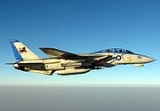
F-14 Tomcat

 
F 14 Tomcat

   Email Print
   Bookmark   Link


F-14 Tomcat


The Grumman F-14 Tomcat is a supersonic
Supersonic

The term supersonic is used to define a speed that is over the speed of sound . At a typical temperature like 21 ?C , the threshold value required for an object to be traveling at a supersonic speed is approximately 344 metre per second, ....
, twin-engine, two-seat, variable-sweep wing aircraft
Aircraft

An aircraft is a vehicle which is able to flight by being supported by the air, or in general, the atmosphere, of a planet. Examples include balloons, airplanes and helicopters....
. The F-14 was the United States Navy
United States Navy

The United States Navy is the navy of the United States Armed Forces. It is one of the seven uniformed services of the United States. The U.S. Navy currently has approximately 331,682 personnel on active duty as of 31 December 2008 and 124,000 in the United States Navy Reserve....
's primary maritime air superiority fighter
Air superiority fighter

An air superiority fighter is a type of fighter aircraft intended to enter and seize control of enemy airspace. Air superiority fighters are usually more expensive and procured in lesser numbers than multi-role fighters while being lighter, smaller, and more agile than interceptor aircraft....
, fleet defense interceptor
Interceptor aircraft

An interceptor aircraft is a type of fighter aircraft designed specifically to intercept and destroy enemy aircraft, particularly bomber aircraft, usually relying on great speed....
 and tactical reconnaissance
Reconnaissance

Reconnaissance is a military and medical term denoting exploration conducted to gain information. Militarily, its shorthand Australian, Canadian, and British form is recce , its American usage form is recon ....
 platform from 1974 to 2006. It later performed precision strike missions once it was integrated with the Low Altitude Navigation and Targeting Infrared for Night LANTIRN
LANTIRN

Low Altitude Navigation and Targeting Infrared for Night, or LANTIRN, is a system for use on the USAF premier fighter aircraft -- the F-15E Strike Eagle and F-16 Fighting Falcon ....
 system. The F-14 was developed after the collapse of the F-111B
General Dynamics F-111

The General Dynamics F-111 is a medium-range interdictor and fighter bomber aircraft that also fills the roles of strategic bomber, reconnaissance and electronic warfare in its various versions....
 project, and was the first of the American teen-series
Teen Series

The Teen Series is a popular name for a group of US combat aircraft. The name stems from a series of United States supersonic jet engine fighter aircraft built for the United States Air Force and the United States Navy during the late 20th century....
 fighters which were designed incorporating the experience of air combat
Aerial warfare

Aerial warfare is the use of military aircraft and other flying machines in warfare, including military airlift of cargo to further the national interests as was demonstrated in the Berlin Airlift....
 against MiG
Mikoyan

Russian Aircraft Corporation MiG, or RSK MiG, is a Russian joint stock company. Formerly Mikoyan or Mikoyan-i-Gurevich Design Bureau , it is a military aircraft design bureau, primarily designing fighter aircraft....
s during the Vietnam War
Vietnam War

The Vietnam War, also known as the Second Indochina Wars, the Vietnam Conflict, or often in Vietnam the American War occurred in Vietnam, Laos and Cambodia from 1959 to April 30, 1975....
.

It entered service in 1974 with the U.S.


Discussion
Ask a question about 'F-14 Tomcat'
Start a new discussion about 'F-14 Tomcat'
Answer questions from other users
Full Discussion Forum


Encyclopedia


The Grumman F-14 Tomcat is a supersonic
Supersonic

The term supersonic is used to define a speed that is over the speed of sound . At a typical temperature like 21 ?C , the threshold value required for an object to be traveling at a supersonic speed is approximately 344 metre per second, ....
, twin-engine, two-seat, variable-sweep wing aircraft
Aircraft

An aircraft is a vehicle which is able to flight by being supported by the air, or in general, the atmosphere, of a planet. Examples include balloons, airplanes and helicopters....
. The F-14 was the United States Navy
United States Navy

The United States Navy is the navy of the United States Armed Forces. It is one of the seven uniformed services of the United States. The U.S. Navy currently has approximately 331,682 personnel on active duty as of 31 December 2008 and 124,000 in the United States Navy Reserve....
's primary maritime air superiority fighter
Air superiority fighter

An air superiority fighter is a type of fighter aircraft intended to enter and seize control of enemy airspace. Air superiority fighters are usually more expensive and procured in lesser numbers than multi-role fighters while being lighter, smaller, and more agile than interceptor aircraft....
, fleet defense interceptor
Interceptor aircraft

An interceptor aircraft is a type of fighter aircraft designed specifically to intercept and destroy enemy aircraft, particularly bomber aircraft, usually relying on great speed....
 and tactical reconnaissance
Reconnaissance

Reconnaissance is a military and medical term denoting exploration conducted to gain information. Militarily, its shorthand Australian, Canadian, and British form is recce , its American usage form is recon ....
 platform from 1974 to 2006. It later performed precision strike missions once it was integrated with the Low Altitude Navigation and Targeting Infrared for Night LANTIRN
LANTIRN

Low Altitude Navigation and Targeting Infrared for Night, or LANTIRN, is a system for use on the USAF premier fighter aircraft -- the F-15E Strike Eagle and F-16 Fighting Falcon ....
 system. The F-14 was developed after the collapse of the F-111B
General Dynamics F-111

The General Dynamics F-111 is a medium-range interdictor and fighter bomber aircraft that also fills the roles of strategic bomber, reconnaissance and electronic warfare in its various versions....
 project, and was the first of the American teen-series
Teen Series

The Teen Series is a popular name for a group of US combat aircraft. The name stems from a series of United States supersonic jet engine fighter aircraft built for the United States Air Force and the United States Navy during the late 20th century....
 fighters which were designed incorporating the experience of air combat
Aerial warfare

Aerial warfare is the use of military aircraft and other flying machines in warfare, including military airlift of cargo to further the national interests as was demonstrated in the Berlin Airlift....
 against MiG
Mikoyan

Russian Aircraft Corporation MiG, or RSK MiG, is a Russian joint stock company. Formerly Mikoyan or Mikoyan-i-Gurevich Design Bureau , it is a military aircraft design bureau, primarily designing fighter aircraft....
s during the Vietnam War
Vietnam War

The Vietnam War, also known as the Second Indochina Wars, the Vietnam Conflict, or often in Vietnam the American War occurred in Vietnam, Laos and Cambodia from 1959 to April 30, 1975....
.

It entered service in 1974 with the U.S. Navy, replacing the F-4 Phantom II
F-4 Phantom II

The McDonnell Douglas F-4 Phantom II is a two-seat, twin-engined, all-weather, long-range supersonic interceptor jet fighter/fighter-bomber originally developed for the United States Navy by McDonnell Aircraft....
. It was later exported to the former Imperial Iranian Air Force
History of the Iranian Air Force

The history of the Iranian Air Force can be divided into two phases - before the Islamic Revolution, and after it....
 in 1976, during a time when the US still had good relations with Iran. It was retired from the active U.S. Navy fleet on 22 September 2006, having been replaced by the F/A-18E/F Super Hornet
F/A-18E/F Super Hornet

The Boeing F/A-18E/F Super Hornet is a supersonic aircraft carrier fighter aircraft/ground-attack aircraft. The F/A-18E single seater and F/A-18F two-seater are larger and more advanced derivative of the F/A-18 Hornet....
. As of 2008, it remains in service only with the Islamic Republic of Iran Air Force
Islamic Republic of Iran Air Force

The 'Islamic Republic of Iran Air Force' is the air force of the Iranian armed forces....
.

Development


The F-14 Tomcat program was initiated when it became obvious that the weight and maneuverability issues plaguing the U.S. Navy variant of the Tactical Fighter Experimental (TFX) (F-111B
General Dynamics F-111

The General Dynamics F-111 is a medium-range interdictor and fighter bomber aircraft that also fills the roles of strategic bomber, reconnaissance and electronic warfare in its various versions....
) would not be resolved to the Navy's satisfaction. The Navy requirement was for a fleet air defense fighter (FADF) with the primary role of intercepting Soviet bombers before they could launch missiles against the carrier battle group. The Navy also wanted the aircraft to possess inherent air superiority characteristics. The Navy strenuously opposed the TFX, which incorporated the Air Force's requirements for a low-level attack aircraft, fearing the compromises would cripple the aircraft, but were forced to participate in the program at direction of then Secretary of Defense Robert McNamara
Robert McNamara

Robert Strange McNamara is an United States business executive and the 8th United States Secretary of Defense. McNamara served as Defense Secretary during the Vietnam War from 1961 to 1968....
 who wanted "joint" solutions to the service aircraft needs to reduce developmental costs. The prior example of the F-4 Phantom II
F-4 Phantom II

The McDonnell Douglas F-4 Phantom II is a two-seat, twin-engined, all-weather, long-range supersonic interceptor jet fighter/fighter-bomber originally developed for the United States Navy by McDonnell Aircraft....
 which was a Navy and Marine Corps
United States Marine Corps

The United States Marine Corps is a branch of the United States Armed Forces responsible for providing Military power projection from the sea, using the mobility of the United States Navy to rapidly deliver Marine Air-Ground Task Force....
 program later adopted by the Air Force
United States Air Force

The United States Air Force is the aerial warfare branch of the Military of the United States and one of the uniformed services of the United States....
 (under similar direction) was the order of the day. Vice Admiral Thomas Connolly, DCNO for Air Warfare took the developmental F-111A variant for a flight and discovered it had difficulty going supersonic and had poor landing characteristics. He later testified to Congress about his concerns against the official Department of the Navy position and in May 1968, Congress killed funding for the F-111B allowing the Navy to pursue an answer tailored to their requirements.

The Naval Air Systems Command
Naval Air Systems Command

The Naval Air Systems Command, or NAVAIR, is the part of the United States Navy which provides materiel support for naval aircraft and airborne weapon systems, such as guided missiles....
 (NAVAIR) shortly issued an RFP for the Naval Fighter Experimental (VFX), a tandem two-seat fighter with maximum speed of Mach 2.2 and a secondary close air support role. Of the five companies that submitted bids (four of which incorporated variable-geometry wings as on the F-111), McDonnell Douglas
McDonnell Douglas

McDonnell Douglas was a major American aerospace manufacturer and defense contractor, producing a number of famous commercial and military aircraft....
 and Grumman were selected as finalists in December 1968, and Grumman won the contract in January 1969. Grumman had been a partner on the F-111B, and had started work on an alternative when they saw the project deteriorating, and so had an edge on its competitors. Their early design mock-ups and cost projections were discussed with Naval authorities as an alternative to the F-111B.

The winning Grumman design reused the TF30 engines from the F-111B, though the Navy planned on replacing them with the F401-PW-400 engines then under development by Pratt and Whitney for the Navy (in parallel with the related F100
Pratt & Whitney F100

The Pratt & Whitney F100 is an afterburning turbofan engine manufactured by Pratt & Whitney which powers the F-15 Eagle and F-16 Fighting Falcon....
 for the USAF). Though lighter than the F-111B, it was still the largest and heaviest U.S. fighter to ever fly from an aircraft carrier, its size a consequence of the requirement to carry the large AWG-9 radar
AWG-9 and APG-71 radars

The AN/AWG-9 and AN/APG-71 radars are all-weather, multi-mode X-Band pulse doppler radar systems designed for the F-14 Tomcat. It is a very long-range air-to-air system with the capability of guiding several AIM-54 Phoenix or AIM-7 Sparrow missiles at the same time using its track while scan mode....
 and AIM-54 Phoenix
AIM-54 Phoenix

The AIM-54 Phoenix is a radar-guided, long-range air-to-air missile missile, carried in clusters of up to six missiles ? formerly on the U.S. Navy's and currently on the Islamic Republic of Iran Air Force's F-14 Tomcat interceptors/multi-role fighters: which is the only aircraft capable of carrying it....
 missiles, also from the F-111B and an internal fuel load of 16,000 lbs (7,300 kg). The F-14 would also share a similar inlet duct, wing, and landing gear geometry with Grumman's A-6 Intruder
A-6 Intruder

The A-6 Intruder is an United States twin jet-engine, mid-wing attack aircraft built by Grumman. In service between 1963 and 1997, the Intruder was designed as an all-weather replacement for the piston-engined A-1 Skyraider medium attack aircraft....
.

Upon being granted the contract for the F-14, Grumman greatly expanded its Calverton
Calverton, New York

Calverton is a hamlet in Suffolk County, New York, New York, United States. The population was 5,704 at the 2000 census.The community is on the border of the Riverhead , New York and the Brookhaven, New York....
, Long Island, New York facility to test and evaluate the new swing-wing interceptor. Much of the testing was in the air of the Long Island Sound as well as the first few in-flight mishaps, including the first of many compressor stalls and ejections. In order to save time and forestall interference from Secretary McNamara, the Navy skipped the prototype phase and jumped directly to full-scale development; the Air Force took a similar approach with its F-15
F-15 Eagle

The McDonnell Douglas F-15 Eagle is a twin-engine, all-weather military tactics fighter aircraft designed to gain and maintain air superiority in aerial combat....
.

The F-14 first flew on 21 December 1970, just 22 months after Grumman was awarded the contract, and reached Initial Operational Capability (IOC) in 1973. The United States Marine Corps
United States Marine Corps

The United States Marine Corps is a branch of the United States Armed Forces responsible for providing Military power projection from the sea, using the mobility of the United States Navy to rapidly deliver Marine Air-Ground Task Force....
 was initially interested in the F-14 as an F-4 Phantom II
F-4 Phantom II

The McDonnell Douglas F-4 Phantom II is a two-seat, twin-engined, all-weather, long-range supersonic interceptor jet fighter/fighter-bomber originally developed for the United States Navy by McDonnell Aircraft....
 replacement and went so far as to send pilots and radar intercept officers to Fighter Squadron One Twenty-Four (VF-124
VF-124

Fighter squadron VF-124 Gunfighters was a fleet replacement squadron of the United States Navy. From 1958 to disestablishment in 1994, its task was the training of pilots for the F-8 Crusader and later F-14 Tomcat of the U.S....
), the Pacific Fleet Replacement Squadron for the F-14, to train as instructors. The Marine Corps was never fully sold on the aircraft and pulled out when the stores management system for ground attack munitions was left undeveloped, leaving the aircraft incapable of dropping air-to-ground munitions. These were not developed until the 1990s.

Improvements and changes


Firing trials involved the launch against simulated targets of every type, from cruise missiles to high flying bombers. The first AIM-54 Phoenix
AIM-54 Phoenix

The AIM-54 Phoenix is a radar-guided, long-range air-to-air missile missile, carried in clusters of up to six missiles ? formerly on the U.S. Navy's and currently on the Islamic Republic of Iran Air Force's F-14 Tomcat interceptors/multi-role fighters: which is the only aircraft capable of carrying it....
 launch by a Tomcat occurred on 28 April 1972. In November of that year, a single launch was achieved against an incoming target at over 200 km, this being outside the normal range for the Tomcat weapon system of 166 km. Another unusual test was made in 22 November 1973, with six missiles fired in 38 seconds, at Mach 0.78 and 24,800 ft (7600 m), with four scoring direct hits. This missile entered service at the beginning of 1975, just as the Vietnam War
Vietnam War

The Vietnam War, also known as the Second Indochina Wars, the Vietnam Conflict, or often in Vietnam the American War occurred in Vietnam, Laos and Cambodia from 1959 to April 30, 1975....
 was coming to an end.

With time, the early versions of all the missiles were replaced by more advanced versions, especially with the move to full solid-state electronics that allowed better reliability, better ECCM and more space for the rocket engine. So the early arrangement of the AIM-54A Phoenix active-radar air-to-air missile, the AIM-7E-2 Sparrow Semi-active radar homing
Semi-active radar homing

Semi-active radar homing, or SARH, is a common type of missile guidance system, perhaps the most common type for longer range Air-to-air missile and surface-to-air missile systems....
 air-to-air missile, and the AIM-9J Sidewinder heat-seeking air-to-air missile was replaced in the 1980s with the B (1983) and C (1986) version of the Phoenix, the F (1977), M (1982), P (1987 or later) for Sparrows, and with the Sidewinder, L (1979) and M (1982). Within these versions there are several improved batches (for example, Phoenix AIM-54C++).

The Tactical Airborne Reconnaissance Pod System
Tactical Airborne Reconnaissance Pod System

The Tactical Airborne Reconnaissance Pod System is a large and sophisticated camera pod carried by the F-14 Tomcat. It contains three camera bays with different type cameras which are pointed down at passing terrain....
 (TARPS) was developed in the late 1970s for the Tomcat. The TARPS reconnaissance pod was carried on the right rear fuselage tunnel station and required additional connections. Approximately 65 F-14As and all F-14Ds were modified to carry the pod. The system was primarily controlled by the RIO in the back seat who had a specialized TARPS display to observe reconnaissance data. TARPS system was introduced in 1980. The TARPS was upgraded with digital camera in 1996 with the "TARPS Digital (TARPS-DI)". The digital camera was further updated beginning in 1998 with the "TARPS-CD" configuration.

Some of the F-14A aircraft underwent engine upgrades to the GE F110-400
General Electric F110

The General Electric F110 is an Afterburner turbofan jet engine produced by GE Aviation. The F110 engine uses the same engine core design as the General Electric F101....
 in 1987. These upgraded Tomcats were redesignated F-14A+, which was later changed to F-14B in 1991. The F-14D variant was developed during this time. It included the GE F110-400 engines with newer digital avionics systems including a glass cockpit
Glass cockpit

A glass cockpit is an aircraft Cockpit that features electronic instrument Display device. Where a traditional cockpit relies on numerous mechanical gauges to display information, a glass cockpit utilizes several computer displays that can be adjusted to display flight information as needed....
. The F-14D also received systems for Link 16
Link 16

Link 16 is a military inter-computer data exchange format of NATO, the North Atlantic Treaty Organisation.With Link 16, military aircraft as well as ships and ground forces may exchange their tactical picture in near-real time....
 datalink for secure exchange of data. Tomcats also benefited from the Digital Flight Control System (DFCS). The DFCS improved handling qualities behind the aircraft carrier, at high angle of attack
Angle of attack

Angle of attack is a term used in aerodynamics to describe the angle between the chord of an airfoil and the vector representing the relative motion between the airfoil and the air....
, and in air combat maneuvering situations.

Adding ground attack capability


In the 1990s, with the pending retirement of the A-6 Intruder
A-6 Intruder

The A-6 Intruder is an United States twin jet-engine, mid-wing attack aircraft built by Grumman. In service between 1963 and 1997, the Intruder was designed as an all-weather replacement for the piston-engined A-1 Skyraider medium attack aircraft....
, the F-14 air-to-ground
Ground attack aircraft

Ground-attack aircraft are military aircraft designed to attack targets on the ground and are often deployed as close air support for, and in proximity to, their own ground forces....
 program was resurrected. The first experiments with bombs were carried out in the late 1980s. However, the main task of the F-14 was air defense in Operation Desert Storm, so most air-to-ground missions were left to A-7
A-7 Corsair II

The Ling-Temco-Vought A-7 Corsair II is a carrier-based subsonic light attack aircraft introduced to replace the United States Navy's A-4 Skyhawk, initially entering service during the Vietnam War....
 and F/A-18
F/A-18 Hornet

The McDonnell Douglas F/A-18 Hornet is an all-weather carrier-capable Multirole combat aircraft jet, designed to attack both ground and aerial targets....
 squadrons. The F-14 was cleared operationally to drop basic iron bombs in 1992. To provide for use of precision munitions, the remaining F-14As and F-14Bs underwent an upgrade program. The upgrade included new digital avionics systems, improved cockpit displays, structural improvements and improved defensive systems. The upgraded fighters had avionics approximately comparable to the F-14Ds and were designated F-14A (Upgrade) and F-14B (Upgrade), respectively.

By 1994 Grumman and the Navy were proposing ambitious plans for Tomcat upgrades to plug that gap between the retirement of the A-6 and F/A-18E/F Super Hornet entering service, but Congress balked. The upgrades were priced in the billions, a bit much for an interim solution, and they would take too long to implement to meet the gap. The solution finally devised was an inexpensive and quick upgrade, with fit of the Low Altitude Navigation and Targeting Infrared for Night (LANTIRN
LANTIRN

Low Altitude Navigation and Targeting Infrared for Night, or LANTIRN, is a system for use on the USAF premier fighter aircraft -- the F-15E Strike Eagle and F-16 Fighting Falcon ....
) targeting pod system that provided the F-14 with a forward-looking infrared (FLIR) camera for night operations and a laser target designator to direct laser guided bombs (LGB).

Although LANTIRN is traditionally a two-pod system, with an AN/AAQ-13 navigation pod with terrain-following radar and a wide-angle FLIR, along with an AN/AAQ-14 targeting pod with a steerable FLIR and a laser target designator, the decision was made to only use the targeting pod. The Tomcat's LANTIRN targeting pod featured some improvements over its baseline configuration, most significantly a Global Positioning System / Inertial Navigation System (GPS-INS) capability that allowed a Tomcat to find its own location at any time. The pod was carried on the right wing glove pylon.

F 14 Tomcat Vf 31 2006
Fit of the LANTIRN pod didn't require any updates to the F-14's own system software, which would have substantially increased the time and expense of the upgrade. It did require that the Tomcat have the MIL-STD-1553B bus, fitted standard to the F-14D and on upgraded F-14A/Bs. The RIO received pod imagery on his display and guided LGBs using a new hand controller. Initially the hand controller replaced the RIO's TARPS control panel, meaning a Tomcat configured for LANTIRN couldn't carry TARPS and the reverse, but eventually a workaround was developed that allowed a Tomcat to carry LANTIRN or TARPS as needed. An upgraded LANTIRN named "LANTIRN 40K" with 40K laser allowing improved operation up to 40,000 feet (12,200 m) was introduced into service in 2001.

Tomcats also added the ability to carry the GBU-38 Joint Direct Attack Munition (JDAM) in 2003, giving it the option of a variety of LGB and GPS-guided weapons. Some F-14Ds were upgraded in 2005 with a ROVER III
Rover

Rover may refer to:...
 downlink, a system transmits real-time images from the aircraft's sensors to the laptop of Forward Air Controller
Forward air control

A forward air controller is a qualified individual who, from a front line on the ground or in the air, directs the action of military aircraft engaged in close air support of army....
 (FAC) on the ground.

Design


Overview


The F-14 Tomcat was designed as both an air superiority fighter and a long range, naval interceptor. The F-14 has a two seat cockpit with a canopy that affords 360 degree visibility. The plane features variable geometry wings that swing automatically during flight. For high-speed intercept, they are swept back; they swing forward to allow the F-14 to turn sharply and dogfight. It was designed to improve on the F-4 Phantom's air combat performance in several respects. The F-14's fuselage and wings allow it to climb faster than the F-4, while the twin-tail arrangement offers better stability. The F-14 is equipped with an internal 20 mm M61 Vulcan
M61 Vulcan

The M61 Vulcan is a 20 mm hydraulically or pneumatically driven, six-barrel ed, air-cooled, electrically fired Gatling gun with an extremely high rate of fire....
 Gatling
Gatling gun

The Gatling gun was one of the most well known rapid-fire weapons to be used in the 1860s by the Union forces of the Civil War, following the 1851 invention of the mitrailleuse by the Belgian Army....
-type gun mounted on the left side, and can carry AIM-54 Phoenix
AIM-54 Phoenix

The AIM-54 Phoenix is a radar-guided, long-range air-to-air missile missile, carried in clusters of up to six missiles ? formerly on the U.S. Navy's and currently on the Islamic Republic of Iran Air Force's F-14 Tomcat interceptors/multi-role fighters: which is the only aircraft capable of carrying it....
, AIM-7 Sparrow
AIM-7 Sparrow

The AIM-7 Sparrow is a medium-range semi-active radar homing air-to-air missile operated by the United States Air Force, United States Navy, and United States Marine Corps as well as various allied air forces and navies....
, and AIM-9 Sidewinder
AIM-9 Sidewinder

The AIM-9 Sidewinder is a Infrared homing, short-range, air-to-air missile carried by fighter aircraft and recently, certain Attack helicopter. It is named after the Crotalus cerastes, which detects its prey via body heat and also because of the peculiar snake-like path of flight the early versions had when launched....
 anti-aircraft missiles. The U.S. Navy wanted the F-14 to have a thrust-to-weight ratio
Thrust-to-weight ratio

Thrust-to-weight ratio is the ratio of thrust to weight of a rocket, jet engine, propeller engine, or a vehicle propelled by such an engine. It is a dimensionless quantity and is an indicator of the performance of the engine or vehicle....
 of one or greater, though this was not achieved until after the F-14 entered service because of delays in engine development.

Fuselage and wings


The fuselage
Fuselage

The fuselage is an aircraft's main body section that holds crew and passengers or cargo. In single-engine aircraft it will usually contain an engine, although in some amphibious aircraft the single engine is mounted on a hardpoint attached to the fuselage which in turn is used as a floating Hull ....
 consists of a large flat area called the "pancake" between the engine nacelles. Fuel, electronics, flight controls, and the wing-sweep mechanism are all housed in the fuselage "pancake". The "pancake" also provides additional lift. The wings pivot from two extensions on either side of the "pancake", called wing gloves. The twin engines are housed in nacelles
Podded engine

A podded engine is a jet engine in a pod, typically attached below the wing or to the tail of the aircraft. The pod itself is called a nacelle....
 below and slightly to the rear, with the fuselage smoothly blending into the shape of the exhaust nozzles. The nacelles are spaced apart 1 to 3 feet. This produces a wide tunnel between the nacelles which causes some drag. However, this tunnel provides space to carry Phoenix or Sparrow missiles, assorted bombs, or the TARPS reconnaissance pod, and increases fuel capacity and room for equipment.

The F-14's wing sweep can be varied between 20° and 68° in flight, and is automatically controlled by an air data computer. This maintains the wing sweep to give the optimum lift-to-drag ratio
Lift-to-drag ratio

In aerodynamics, the lift-to-drag ratio, or L/D ratio , is the amount of Lift generated by a wing or vehicle, divided by the drag it creates by moving through the air....
 as the Mach number
Mach number

Mach number is the speed of an object moving through air, or any fluid substance, divided by the speed of sound as it is in that substance. It is commonly used to represent an object's speed, when it is travelling at the speed of sound....
 varies, but the system can be manually overridden by the pilot if necessary. When the aircraft is parked, the wings can be "overswept" to 75°, where they overlap the tail to save space on tight carrier decks. In an emergency, the F-14 can land with the wings fully swept to 68°, although this is far from optimum and presents a significant safety hazard. The F-14 can also fly and land safely with the wings swept asymmetrically, in emergencies.

The wings have a two-spar structure with integral fuel tanks. Much of the structure, including the wing box, wing pivots and upper and lower wing skins is made of titanium
Titanium

Titanium is a chemical element with the symbol Ti and atomic number 22. Sometimes called the ?space age metal?, it has a low density and is a strong, lustrous, corrosion-resistant transition metal with a silver colour....
, a light, rigid and strong material, but also difficult to weld, and costly. Aileron
Aileron

For the band with a similar name, see The AileronsAilerons are hinged control surfaces attached to the trailing edge of the wing of a fixed-wing aircraft....
s are not fitted, with roll control
Flight dynamics

Flight dynamics is the science of aircraft and spacecraft vehicle orientation and control in three dimensions. The three critical flight dynamics parameters are the angles of rotation in three dimensions about the vehicle's center of mass, known as pitch, roll and yaw ....
 being provided by wing mounted spoilers
Spoiler (aeronautics)

In aeronautics a spoiler is a device intended to reduce lift in an aircraft. Spoilers are plates on the top surface of a wing which can be extended upward into the airflow and spoil it....
 at low speed (which are disabled if the sweep angle exceeds 57°), and by differential operation of the all-moving tailerons at high speed. Full-span slats
Slats

Slats are aerodynamic surfaces on the leading edge of the wings of fixed-wing aircraft which, when deployed, allow the wing to operate at a higher angle of attack....
 and flaps
Flap (aircraft)

Flaps are hinged surfaces on the trailing edge of the wing of a fixed-wing aircraft. As flaps are extended, the Stall of the aircraft is reduced....
 are used to increase lift both for landing and combat, with slats being set at 17° for landing and 7° for combat, while flaps are set at 35° for landing and 10° for combat. The twin tail layout helps in maneuvers at high AoA (angle of attack) while reducing the height of the aircraft to fit within the limited roof clearance of hangar
Hangar

A hangar is an enclosed structure to hold aircraft in protective storage. Most hangars are built of metal, but wood and concrete are other materials used....
s aboard aircraft carrier
Aircraft carrier

An aircraft carrier is a warship designed with a primary mission of deploying and recovering aircraft, acting as a seagoing airbase. Aircraft carriers thus allow a navy force to project air power great distances without having to depend on local bases for staging aircraft operations....
s. Two under-engine mount points are provided for external fuel tanks.

Two retractable surfaces, called glove vanes, were originally mounted in the forward part of the wing glove, and could be automatically extended by the flight control system at high Mach numbers. They were used to generate additional lift ahead of the aircraft's center of gravity, thus helping to compensate for the nose-down pitching
Flight dynamics

Flight dynamics is the science of aircraft and spacecraft vehicle orientation and control in three dimensions. The three critical flight dynamics parameters are the angles of rotation in three dimensions about the vehicle's center of mass, known as pitch, roll and yaw ....
 tendencies at supersonic speeds. Automatically deployed at above Mach 1.4, they allowed the F-14 to pull 7.5 g at Mach 2 and could be manually extended at above Mach 1. They were later disabled, however, owing to their additional weight and complexity.

The airbrakes
Air brake (aircraft)

In aeronautics, air brakes are a type of flight controls used on an aircraft to reduce speed during landing.Air brakes differ from Spoiler in that air brakes are designed to increase Drag while making little change to lift , whereas spoilers greatly reduce the lift-to-drag ratio and a higher angle of attack required to maintain lift, re...
 consist of top-and-bottom extendable surfaces at the rearmost portion of the fuselage, between the engine nacelles. The bottom surface is split into left and right halves, with the arrestor hook hanging between the two halves. This arrangement is sometimes called the "castor tail", or "beavertail." The Tomcat has fully mechanical flying controls, with the only exception being the spoilers, which are hydro-electrically driven.

Engines and landing gear


The engines are fed by two rectangular air intakes located under the wings. These Pratt & Whitney
Pratt & Whitney

Pratt & Whitney is an American aircraft engine manufacturer of products widely used in both civil and military aircraft list. As one of the "big three" aero-engine manufacturers, it competes with GE Aircraft Engines and Rolls-Royce plc, although it has also formed joint ventures with both of these companies....
 JT10As (better known as the TF30) were relatively powerful for the time (5.670/9.480 kg/t) and being turbofans, they allowed reduced fuel consumption while cruising, which was important for long patrol missions.

Both air intakes have movable ramps and bleed doors that are operated by the air data computer to enable enough air to enter the engine while keeping shockwaves away from the engine. The exhausts also feature variable nozzles with moving petals that open or close depending on engine state. The TF30 engines left much to be desired both in power and reliability. John Lehman
John Lehman

John F. Lehman, Jr. is an United States investment banker and writer who served as United States Secretary of the Navy in the Reagan administration and in 2003-4 was a member of the 9/11 Commission....
, Secretary of the Navy
United States Secretary of the Navy

The United States Secretary of the Navy is the civilian head of the United States Department of the Navy. The position was a member of the President of the United States United States Cabinet until 1947, when the Navy, Army, and newly created Air Force were placed in the United States Department of Defense and the Secretary of the Navy was...
, told Congress that the F-14/TF30 combination was "probably the worst engine/airframe mismatch we have had in years" and said that the TF30 was "a terrible engine", with F-14 accidents attributed to engine failures accounting for 28% of overall losses. Cracks in the turbines were dangerous to the point that the engine bay was reinforced in case of blade failure, to help reduce damage to the rest of the aircraft. The TF30 engines were also extremely prone to compressor stall
Compressor stall

A compressor stall is a situation of abnormal airflow resulting from a Stall of the airfoil within the compressor. Stall is found in dynamic Gas compressor, particularly axial compressors, as used in jet engines and turbocharger reciprocating engines....
s, which could easily result in loss of control due to the wide engine spacing, which causes severe yaw oscillations and can lead to an unrecoverable flat spin. At specific altitudes, the exhaust from a launched missile could cause the engine compressor to stall. This resulted in the development of a bleed system that temporarily reduced the power of the engine and blocked the frontal intake during missile launch. The overall thrust-to-weight ratio at maximum load is around 0.56, which does not compare favorably with the F-15A's ratio of 0.85. Even so, the aircraft itself is able to reach Mach 2.4, and the maximum speed is officially Mach 2.34. Internal fuel capacity is 2,400 US gallons (9100 L): 290 US gallons (1,100 L) in each wing, 690 US gallons (2,600 L) in a series of tanks aft of the cockpit, and a further 457 US gallons (1,730 L) in two feeder tanks. The aircraft can carry two 267 US gallon (1,020 L) external drop tanks under the engine intakes. There is also an air-to-air refueling probe, which folds into the starboard nose.

The undercarriage is very robust, in order to withstand the harsh takeoffs and landings necessary for carrier operation. It comprises a double nose wheel and widely spaced single main wheels. The result is very different from the narrow and high undercarriage of F-15 Eagle
F-15 Eagle

The McDonnell Douglas F-15 Eagle is a twin-engine, all-weather military tactics fighter aircraft designed to gain and maintain air superiority in aerial combat....
. Both have similar weights and a high wing that makes undercarriage stowage impractical. The Tomcat fuselage is wider and the aircraft does not need to hold big external fuel tanks, as the Eagle often does, in the ventral positions. There are no hardpoints on the sweeping parts of the wings, and so all the armaments are fitted on the belly between the air intakes and on pylons under the wing gloves.

Avionics and flight controls

The cockpit
Cockpit

A cockpit is the area, usually near the front of an aircraft, from which a pilot controls the aircraft. Most modern cockpits are enclosed, except on some small aircraft, and cockpits on large airliners are also physically separated from the cabin....
 has two seats, arranged in tandem
Tandem

Tandem is a Latin language adverb meaning "at length" or "finally." In English, the term was originally used for two or more draft horses harnessed one behind another as opposed to side-by-side....
. The pilot and radar intercept officer (RIO) sit in Martin-Baker GRU-7A rocket-propelled ejection seats, rated from zero altitude and zero airspeed up to 450 knots
Knot (speed)

The knot is a unit of speed equal to one nautical mile per hour. Its kn abbreviation is preferred by American and Canadian maritime authorities, and by the Institute of Electrical and Electronics Engineers; however, the kt and kts abbreviations also are used....
. They have a 360° view in a canopy that is also fitted with four mirrors, one for the RIO and the others for the pilot. The canopy is still fairly traditional; being in three parts, but the overall structure is large and gives good visibility. The crews have classical controls and many older instruments, with an analog-digital hybrid lay out. Only the pilot has flight controls
Flight controls

Aircraft flight control surfaces allow a pilot to adjust and control the aircraft's flight attitude.Development of an effective set of flight controls was a critical advance in the development of the aircraft....
. No dual control version was ever made for the F-14, so the pilot starts to learn how to fly the machine using other aircraft and simulators
Flight simulator

A flight simulator is a system that tries to copy, or simulation, the experience of flight an aircraft. It is as realistic as possible. The different types of flight simulator range from video games up to full-size cockpit replicas mounted on hydraulic actuators, controlled by state of the art computer technology....
. The main control systems are a HUD
Head-Up Display

A head-up display, or HUD, is any transparent display that presents data without requiring the user to look away from his or her usual viewpoint....
 made by Kaiser, a VSI and a HSI display, that gives data on airspeed, navigation and other information. The F-14A and F-14B Tomcat do not have multi-mode displays, unlike the later F-16s and F/A-18s.

The nose of the aircraft is large because it carries not only the two person crew, but also a large number of avionics
Avionics

Avionics means "aviation electronics". It comprises Electronics systems for use on aircraft, artificial satellites and spacecraft, comprising communications, navigation and the display and management of multiple systems....
 systems. The ECM and navigation suite are extremely comprehensive and complex. The main element is the Hughes AWG-9 X-band radar, which in the initial version included a lightweight 5400B digital system with 32 kilobytes of RAM
Ram

Ram, ram, or RAM as a non-acronymic wordAs a non-acronymic word Ram, ram, or RAM may refer to:...
. The antenna dish is a 36-inch (91 cm) wide planar array, uses 10 kW of power, and has integrated IFF antennas. There are available several search and tracking modes, such as Track-While-Scan (TWS), Range-While-Search (RWS), Pulse-Doppler Single-Target Track (PDSTT), and Jam Angle Track (JAT). A maximum of 24 targets can be tracked simultaneously, and six can be engaged in TWS mode up to around 60 miles (100 km). Pulse-only STT mode has a maximum range of around 96 statute miles (150 km). The maximum search range can exceed 120 statute miles (190 km) and even a fighter can be locked onto at around 72 - 90 statute miles (120–140 km). Cruise missile
Cruise missile

A cruise missile is a guided missile missile that carries an explosive payload and uses a lifting wing and a propulsion system, usually a jet engine, to allow sustained flight; it is essentially a flying bomb....
s are also possible targets with the AWG-9, since this radar can lock onto and track even small objects at low altitude when in a Pulse-Doppler mode. The radar antenna dish is in the nose, and most of the radar avionics are located just behind the nose, near the pilot's position. Other avionics (such as IFF, communication radios, direction-finding equipment, etc) are near the RIO's position, and are mostly integrated into the AWG-9 display system.

Tomcats also feature electronic countermeasures (ECM)
Electronic countermeasures

Electronic countermeasures are a subsection of electronic warfare which includes any sort of electrical or electronic device designed to trick or deceive radar, sonar, or other detection systems like IR and Laser....
 and radar warning (RWR) systems, chaff
Chaff (radar countermeasure)

Chaff, originally called Window by the United Kingdom, and D?ppel by the World War II era Germany Luftwaffe, is a radar countermeasure in which aircraft or other targets spread a cloud of small, thin pieces of aluminium, metallised glass fibre or plastic, which either appears as a cluster of secondary targets on radar screens...
/flare
Flare

Flare may refer to:...
 dispensers in the tail, fighter-to-fighter data link, and a precise inertial navigation system. The early navigation system was purely inertial. Initial coordinates were programmed into the navigation computer, and a gyroscope in the system would track the aircraft's every motion. These aircraft motions were sent to the navigation computer, allowing it to calculate the jet's distance and direction from the initial starting point. Later, GPS was integrated into this inertial system, providing not only more precise navigation, but providing redundancy in case either system failed.

The chaff/flare dispensers were located on the belly, at the very tip of the tail, just to one side of the arresting hook. The dispenser contained several cylinders, into which either flares or chaff could be loaded in any combination. The RWR system was arranged with 4 antennae around the aircraft, and could roughly calculate the direction and the distance of many different types of radar from various aircraft and missile types. The RWR set could also display the status of the tracking aircraft's radar. It could differentiate between search radar, tracking radar, and missile-homing radar. The electronic countermeasures system could analyze incoming radar signals and send confusing radar signals back to the source.

The original set of sensors also comprised an infrared
Infrared

Infrared radiation is electromagnetic radiation whose wavelength is longer than that of visible light , but shorter than that of terahertz radiation and microwaves ....
 sensor under the nose in a "chin pod": it was AN/ALR-23 with indium antimonide
Indium(III) antimonide

Indium antimonide is a narrow gap semiconductor material from the Boron group-Nitrogen Group group used in infrared detectors, including thermal imaging cameras, FLIR systems, infrared homing missile guidance systems, and in infrared astronomy....
 detectors, cooled by a self-contained Stirling cycle
Stirling cycle

The Stirling cycle is a thermodynamic cycle that describes the general class of Stirling devices. This includes the original Stirling engine that was invented, developed and patented in 1816 by Robert Stirling with help from his brother, an engineer ....
 cryogenic system, but this proved ineffective, and was replaced with a new system. This was an optical system, Northrop AAX-1, also called TCS (TV Camera Set) and was used to help pilots visually identify and track aircraft, at least on day missions, up to a range of more than 60 miles for large aircraft (a zoom function was included to help with small fighters). The TCS could be "slaved" to the radar to follow whatever the radar is tracking, and the radar could be slaved to the TCS to track whatever the camera "sees." Both the crew have access to the images on their displays. Despite its utility, for a long time most F-14s did not have the system added. Bill Gunston reported that even in 1983, only one in eight aircraft had the system fitted.

A dual IR/TCS system was adopted for the later F-14D variant, with an ECM antenna fitted as well in the same mast. This meant Tomcats could be configured with only an ECM antenna, or the IR sensor, or TCS, or many combinations thereof. The Tomcat's ESM system consists of many subsystems: RWR, ECM, and chaff/flare dispensers in various parts of the fuselage, nose, tail and wings. This was a marked difference with many previous fighter aircraft in that some did not even include a simple RWR.

Armament


The Tomcat was originally designed to combat both highly maneuverable aircraft and the Soviet
Soviet Union

The Union of Soviet Socialist Republics was a Constitution of the Soviet Union socialist state that existed in Eurasia from 1922 to 1991.The name is a translation of the , romanization of Russian Soyuz Sovetskikh Sotsialisticheskikh Respublik, abbreviated ????, SSSR....
 cruise missile
Cruise missile

A cruise missile is a guided missile missile that carries an explosive payload and uses a lifting wing and a propulsion system, usually a jet engine, to allow sustained flight; it is essentially a flying bomb....
/bomber threat. As a result, the aircraft was designed to act effectively in every aspect of air combat. For weaponry, the Tomcat was mainly designed as a platform for the formidable AIM-54 Phoenix
AIM-54 Phoenix

The AIM-54 Phoenix is a radar-guided, long-range air-to-air missile missile, carried in clusters of up to six missiles ? formerly on the U.S. Navy's and currently on the Islamic Republic of Iran Air Force's F-14 Tomcat interceptors/multi-role fighters: which is the only aircraft capable of carrying it....
, but unlike the stillborn F-111B it could also engage medium and short range threats. As such, the F-14 was a full air superiority
Air superiority

Air superiority is the dominance in the air power of one side's air forces over the other side's during a military campaign. It is defined in the NATO Glossary as "That degree of dominance in the air battle of one force over another that permits the conduct of operations by the former and its related land, sea, and air forces at a given time...
 fighter and not only a long range interceptor. It had the standard US gun, the M61 Vulcan
M61 Vulcan

The M61 Vulcan is a 20 mm hydraulically or pneumatically driven, six-barrel ed, air-cooled, electrically fired Gatling gun with an extremely high rate of fire....
, with 676 rounds and 4,000 or 6,000 RPM selectable (although the latter is rarely used due to jamming and overheating issues). Over 6,700 kg of stores could be carried for combat missions in several hard points under the belly and on wing-mounted hardpoint
Hardpoint

A hardpoint is any part of an airframe designed to carry an external load. This technical description includes mountings for podded engines, but most commonly the term is used, as with weapon station, to refer to a point on the wings of military aircraft where external stores such as missiles, bombs, countermeasures, gun pods, or drop...
s. Commonly, this meant a maximum of two - four Phoenixes or Sparrows on the belly stations, two Phoenixes/Sparrows on the wing hardpoints, and two Sidewinders on the wing hardpoints. On occasion, four AIM-7 Sparrows (on the belly) and four AIM-9 Sidewinders (on the wingmounts) were carried, similar to the F-4 and F-15.

The maximum load of six Phoenix missiles was never used operationally. Although early testing proved it was possible, there was never a threat requirement to engage six hostile targets simultaneously and the load was too heavy to recover aboard an aircraft carrier. The Phoenix missile have been used twice in combat situations with the US Navy, both over Iraq in 1999 , but the missiles didn't score any kills. It has been claimed that Iranian F-14s did so but, as with many of the activities of the Iranian Air Force, this has not been reliably confirmed.

During the height of Cold War operations in the late 1970s and 1980s, the typical weapon loadout on carrier-deployed F-14s was rarely more than one AIM-54 Phoenix
AIM-54 Phoenix

The AIM-54 Phoenix is a radar-guided, long-range air-to-air missile missile, carried in clusters of up to six missiles ? formerly on the U.S. Navy's and currently on the Islamic Republic of Iran Air Force's F-14 Tomcat interceptors/multi-role fighters: which is the only aircraft capable of carrying it....
, normally augmented by two AIM-9 Sidewinder
AIM-9 Sidewinder

The AIM-9 Sidewinder is a Infrared homing, short-range, air-to-air missile carried by fighter aircraft and recently, certain Attack helicopter. It is named after the Crotalus cerastes, which detects its prey via body heat and also because of the peculiar snake-like path of flight the early versions had when launched....
s, two AIM-7 Sparrow IIIs, a full loadout of 20 mm
20 mm caliber

The 20 mm caliber is a specific size of cannon or autocannon ammunition, commonly the smallest caliber which is unambiguously a cannon and not a heavy machine gun....
 ammunition for the M61 cannon and two drop tanks.

Operational history


The F-14 Tomcat was the Navy's primary air superiority fighter and tactical reconnaissance platform from 1972 to 2006. The F-14 has served in Iran's Air Force from 1978 to the present day.

United States Navy

F 14 Vf 84
The F-14 began replacing the F-4 Phantom II in USN service starting in September 1974 with squadrons VF-1 Wolfpack
VF-1

This article is about the fighter squadron; for the mecha seen in Macross/Robotech, see VF-1 Valkyrie.VF-1 was the designation of a fighter squadron of the United States Navy known as the "Wolfpack"....
 and VF-2 Bounty Hunters aboard USS Enterprise
USS Enterprise (CVN-65)

USS Enterprise , formerly CVA-65, is the world's first nuclear-powered aircraft carrier and the eighth U.S. naval vessel to USS Enterprise. Like USS Enterprise of World War II fame, she is nicknamed the "Big E." At 1,123 feet , she is the longest naval vessel in the world, though her 93,500 tons displacement places her as t...
 and participated in the American withdrawal of Saigon
Operation Frequent Wind

File:Midway Helos 1975.jpgFile:Vietnamese UH-1 pushed over board, Operation Frequent Wind.jpgOperation Frequent Wind was the emergency evacuation by helicopter from Saigon, South Vietnam, in April 1975 during the last days of the Vietnam War....
. The F-14 had its first kills on 19 August 1981 over the Gulf of Sidra
Gulf of Sidra

Gulf of Sidra is a body of water in the Mediterranean Sea on the northern coast of Libya; it is also known as Gulf of Sirte. It is located by the city of Sirt....
 in what is known as the Gulf of Sidra incident
Gulf of Sidra incident (1981)

The first Gulf of Sidra incident, August 19 1981, was an incident in which two Libyan Sukhoi Sukhoi Su-17 Fitter attack aircraft were shot down by two United States F-14 Tomcats off of the Libyan coast....
 after two F-14s from VF-41 Black Aces
VFA-41

Strike Fighter Squadron 41 also known as the "Black Aces", is a United States Navy strike fighter squadron based at Naval Air Station Lemoore California....
 were engaged by two Libyan Su-22 "Fitters"
Sukhoi Su-17

The Sukhoi Su-17 was a Soviet Union attack aircraft developed from the Sukhoi Su-7 fighter-bomber. It enjoyed a long career in Soviet, later Russian, service and was widely exported to Eastern Bloc and Middle Eastern air forces....
. The F-14s evaded the short range heat seeking AA-2 "Atoll"
Vympel K-13

The K-13 , was one of the world's most proliferated air-to-air missiles. Developed by the Soviet Union as a reverse-engineered copy of the AIM-9 Sidewinder, it saw widespread service in many nations....
 missile and returned fire, downing both Libyan aircraft. U.S. Navy F-14s once again were pitted against Libyan aircraft on 4 January 1989, when two F-14s from VF-32
VFA-32

The Strike Fighter Squadron 32 "Swordsmen" are a U.S. Navy strike fighter squadron stationed at NAS Oceana. Their call sign is Gypsy, tail code is AC, and they fly the F/A-18F Super Hornet....
 shot down two Libyan MiG-23 "Floggers"
Mikoyan-Gurevich MiG-23

The Mikoyan-Gurevich MiG-23 is a swing-wing fighter aircraft, designed by the Mikoyan bureau in the Soviet Union and is considered to belong to the "Third Generation" aircraft category along with similar-aged Russian-produced fighters like the MiG-25 "Foxbat"....
 over the Gulf of Sidra
Gulf of Sidra

Gulf of Sidra is a body of water in the Mediterranean Sea on the northern coast of Libya; it is also known as Gulf of Sirte. It is located by the city of Sirt....
 in a second Gulf of Sidra incident
Gulf of Sidra incident (1989)

The second Gulf of Sidra incident, January 4, 1989, occurred when two United States F-14 Tomcats shot down two Libyan MiG-23 Flogger Es that appeared to be attempting to engage them, as had happened previously in the first Gulf of Sidra incident ....
.

Despite the attention given to the Tomcat over aerial encounters in the Gulf of Sidra, its first sustained combat baptism of fire was as a photo reconnaissance platform. The Tomcat was selected to inherit the Reconnaissance mission upon departure of the dedicated RA-5C Vigilante
A-5 Vigilante

The North American Aviation A-5 Vigilante was a powerful, highly advanced carrier-based supersonic bomber designed for the United States Navy. Its service in the nuclear strike role to replace the A-3 Skywarrior was very short....
 and RF-8G Crusaders
F-8 Crusader

The F-8 Crusader was a single-engine aircraft carrier-based fighter aircraft built by Vought. It replaced the Vought F-7 Cutlass. The first F-8 prototype was ready for flight in February 1955, and was the last United States fighter with guns as the primary weapon....
 from the fleet. A large pod called the Tactical Airborne Reconnaissance Pod System
Tactical Airborne Reconnaissance Pod System

The Tactical Airborne Reconnaissance Pod System is a large and sophisticated camera pod carried by the F-14 Tomcat. It contains three camera bays with different type cameras which are pointed down at passing terrain....
 (TARPS) was developed and fielded on the Tomcat in 1981. With the retirement of the last RF-8G Crusaders in 1982, TARPS F-14s became the U.S. Navy's primary tactical reconnaissance system. One of two Tomcat squadrons per airwing was designated as a TARPS unit and received 3 TARPS capable aircraft and training for 4 TARPS aircrews.

F 14 Tomcat Vf 114 Escorting Tu 95 Bear
While the Tomcat was being used by Iran in combat against Iraq in its intended air superiority mission over the skies of Iran in the early 1980s, the US Navy found itself flying regular daily combat missions over Lebanon to photograph activity in the Bekaa Valley. At the time, the Tomcat had been thought too large and vulnerable to be used overland, but the need for imagery was so great that Tomcat aircrews developed high speed medium altitude tactics to deal with considerable AAA and SA-7 SAM threat in the Bekaa area. An urgent combat need was stated to address the Tomcat vulnerability in this type of mission. The first exposure of a Tomcat to a SA-2 was over Somalia in April 1983 when a local battery was unaware of two Tomcats scheduled for a TARPS missions in prelude to an upcoming international exercise in vicinity of Berbera. An SA-2 was fired at the second Tomcat while conducting 10 thousand foot mapping profile at max conserve setting. The Tomcat aircrews spotted the missile launch and dove for the deck thereby evading it without damage. The unexpected demand for combat TARPS laid the way for high altitude sensors such as the KA-93 36 in (91 cm) Long Range Optics (LOROP) to be rapidly procured for the Tomcat as well as an Expanded Chaff Adapter (ECA) to be incorporated in a AIM-54 Phoenix Rail. Commercial "Fuzz buster" type radar detectors were also procured and mounted in pairs in the forward cockpit as a stop gap solution to detect SAM radars such as the SA-6. The ultimate solution was an upgrade to the ALR-67 then being developed, but it would not be ready until the advent of the F-14A+ in the latter 1980s. During the Gulf of Sidra operations in 1986, the Tomcats were used in over-water missions only due to their vulnerability overland. It was not until Desert Shield that US Navy Tomcats were introduced to overland combat operations on a regular basis.

The participation of the F-14 Tomcat in the 1991 Operation Desert Storm
Gulf War

"Persian Gulf War" and "First Gulf War" redirect here. For other uses, see Persian Gulf War .The Persian Gulf War was a United Nations-authorized military conflict between Iraq and a Coalition of Gulf War from 34 nations commissioned with expelling Iraqi forces from Kuwait after Iraq's Invasion of Kuwait of Kuwait in August 1990....
 consisted of Combat Air Patrol (CAP) over the Red Sea and Persian Gulf and overland missions consisting of strike escort and reconnaissance. Until the waning days of Desert Storm, in-country air superiority was tasked to USAF F-15 Eagle
F-15 Eagle

The McDonnell Douglas F-15 Eagle is a twin-engine, all-weather military tactics fighter aircraft designed to gain and maintain air superiority in aerial combat....
s due to the way the Air Tasking Orders (ATO) delegated primary overland CAP stations to the F-15 Eagle. The governing Rules of Engagement (ROE) also dictated a strict Identification Friend or Foe (IFF) requirement when employing Beyond Visual Range weapons such as the AIM-7 Sparrow and particularly the AIM-54 Phoenix. This hampered the Tomcat from using its most powerful weapon. Furthermore, the powerful emissions from the AWG-9 radar are detectable at great range with a radar warning receiver
Radar warning receiver

Typically fitted to military aircraft, radar warning receivers detect the radio emissions of radar systems, whether ground-based or on-board other aircraft....
. Iraqi fighters routinely displayed countertactics as soon as the Tomcats "lit them up" with the AWG-9. The US Navy suffered its only F-14 loss from enemy action on 21 January 1991 when b/n 161430, an F-14A upgraded to an F-14A+, from VF-103
VFA-103

Strike Fighter Squadron 103 is a Strike Fighter Squadron of the United States Navy flying the F/A-18F Super Hornet and is based at NAS Oceana. Their radio callsign is Victory and their tailcode AG....
 was shot down by an SA-2
S-75 Dvina

The Lavochkin S-75 is a Soviet designed high-altitude, command guided, surface-to-air missile system. Since its first deployment in 1957, it has become the most widely deployed and used air defense missile in history....
 surface-to-air missile while on an escort mission near Al Asad
Al Asad

Al Asad Airbase is the largest US military airbase in the largely Sunni western Iraq Province of Al Anbar Governorate. It is currently home to the 2nd Marine Aircraft Wing, as well as the headquarters for II Marine Expeditionary Force....
 airbase in Iraq. Both crew survived ejection with the pilot being rescued by USAF Special Operations Forces and the RIO being captured and held by Iraqi troops as a POW until the end of the war. The F-14 also achieved its final kill, an Mi-8
Mil Mi-8

The Mil Moscow Helicopter Plant Mi-8 is a medium twin-turbine transport helicopter that can also act as a gunship. The first prototype, the W-8, flew in 9 July 1961....
 "Hip" helicopter, with an AIM-9 Sidewinder
AIM-9 Sidewinder

The AIM-9 Sidewinder is a Infrared homing, short-range, air-to-air missile carried by fighter aircraft and recently, certain Attack helicopter. It is named after the Crotalus cerastes, which detects its prey via body heat and also because of the peculiar snake-like path of flight the early versions had when launched....
.

In 1995, F-14s from VF-14
VFA-14

The Strike Fighter Squadron 14 "Tophatters" are a United States Navy fighter attack squadron based at Naval Air Station Lemoore. They fly the F/A-18E Super Hornet, and are the Navy's oldest active squadron, having formed in 1919....
 and VF-41
VFA-41

Strike Fighter Squadron 41 also known as the "Black Aces", is a United States Navy strike fighter squadron based at Naval Air Station Lemoore California....
 participated in Operation Deliberate Force as well as Operation Allied Force
Operation Allied Force

The NATO bombing of Yugoslavia was NATO's military operation against the Federal Republic of Yugoslavia. The strikes lasted from March 24, 1999 to June 11, 1999....
 in 1999, and in 1998, VF-32 and VF-213 participated in Operation Desert Fox. On 15 February 2001 the Joint Direct Attack Munition or JDAM was added to the Tomcat's arsenal. On 7 October 2001 F-14s would lead some of the first strikes into Afghanistan
Afghanistan

Afghanistan , officially the Islamic republic of Afghanistan, is a landlocked country that is located approximately in the center of Asia....
 marking the start of Operation Enduring Freedom
Operation Enduring Freedom

Operation Enduring Freedom is the official name used by the U.S. Government for its contribution to the War in Afghanistan , together with three smaller military actions, under the umbrella of its War on Terrorism ....
 and the first F-14 drop of a JDAM occurred on 11 March 2002. F-14s from VF-2, VF-31
VF-31

Strike Fighter Squadron 31 , known as the Tomcatters, callsign "Felix", are a United States Navy strike fighter squadron stationed at Naval Air Station Oceana flying the F/A-18E Super Hornet....
, VF-32, VF-154, and VF-213 would also participate in Operation Iraqi Freedom. The F-14Ds of VF-2, VF-31, and VF-213 obtained JDAM capability in March 2003. On 10 December 2005, the F-14Ds of VF-31 and VF-213 were upgraded with a ROVER III downlink for transmitting images to a ground Forward Air Controller (FAC). The F-14s of VF-31 and VF-213 deployed on its last combat cruise on USS Theodore Roosevelt
USS Theodore Roosevelt (CVN-71)

USS Theodore Roosevelt is the fourth Nimitz class aircraft carrier supercarrier and her call sign is Rough Rider, the name of President Theodore Roosevelt's Rough Riders during the Spanish-American War....
 in 2005.

Replacement

While the F-14 had been developed as a light weight alternative to the 80,000 lb (36,000 kg) F-111B
General Dynamics F-111

The General Dynamics F-111 is a medium-range interdictor and fighter bomber aircraft that also fills the roles of strategic bomber, reconnaissance and electronic warfare in its various versions....
, the F-14 was still the largest and most expensive fighter of its time. VFAX
VFAX

VFAX for Naval Fighter Attack Experimental was actually two specifications for two US Naval Fighter aircraft projects. The first was for a low cost lightweight complement for the General Dynamics F-111 which could replace the F-4 Phantom II for air superiority, escort, and ground attack missions in the early 1960s....
 was revived in the 1970s as a lower cost solution to replacing the Navy's fleet of USMC Phantoms, and A-7. VFAX would be merged with the USAF Light Weight Fighter
Light Weight Fighter

The Lightweight Fighter program was a U.S. Air Force technology evaluation program initiated in the 1960s by a cabal of officers and defense analysts known as the "fighter mafia"....
 fighter competition, from which the F/A-18 Hornet
F/A-18 Hornet

The McDonnell Douglas F/A-18 Hornet is an all-weather carrier-capable Multirole combat aircraft jet, designed to attack both ground and aerial targets....
 emerged as roughly a midsize fighter.

In 1994, Congress would reject Grumman proposals to the Navy to upgrade the Tomcat beyond the D model (such as the Super Tomcat 21, the cheaper QuickStrike version, and the more advanced Attack Super Tomcat 21). Instead, the Navy elected to retire the F-14 and chose the F/A-18E/F Super Hornet
F/A-18E/F Super Hornet

The Boeing F/A-18E/F Super Hornet is a supersonic aircraft carrier fighter aircraft/ground-attack aircraft. The F/A-18E single seater and F/A-18F two-seater are larger and more advanced derivative of the F/A-18 Hornet....
 to fill the roles of fleet defense and strike formerly filled by the F-14.

Retirement
The F-14 has completed its retirement from US Naval service. At one point, it was slated to remain in service through at least 2008, but all F-14A and F-14B airframes had already been retired, and the last two squadrons, the VF-31 Tomcatters
VF-31

Strike Fighter Squadron 31 , known as the Tomcatters, callsign "Felix", are a United States Navy strike fighter squadron stationed at Naval Air Station Oceana flying the F/A-18E Super Hornet....
 and the VF-213 Black Lions, both flying the "D" models, arrived for their last fly-in at Naval Air Station Oceana
Naval Air Station Oceana

Naval Air Station Oceana or NAS Oceana is a military airport located in Virginia Beach, Virginia, and is a United States Navy Master Jet Base....
 on 10 March 2006.

Lastf14,jpg
The last American F-14 combat mission was completed on 8 February 2006, when a pair of Tomcats landed aboard the USS Theodore Roosevelt
USS Theodore Roosevelt (CVN-71)

USS Theodore Roosevelt is the fourth Nimitz class aircraft carrier supercarrier and her call sign is Rough Rider, the name of President Theodore Roosevelt's Rough Riders during the Spanish-American War....
 after one dropped a bomb in Iraq
Iraq

Iraq , officially the Republic of Iraq , is a country in Western Asia spanning most of the northwestern end of the Zagros Mountains, the eastern part of the Syrian Desert and the northern part of the Arabian Desert....
. That aircraft was assigned to VF-31 and the aircrew credited with the last bomb dropped in combat by a Navy Tomcat was pilot Lt. Justin Halligan and RIO Lt. Bill Frank. The other Tomcat on that mission was an F-14D from VF-213 piloted by Commander, Carrier Air Wing Eight
Carrier Air Wing Eight

Carrier Air Wing Eight , is a United States Navy aircraft carrier air wing based at Naval Air Station Oceana, Virginia. The air wing is attached to the aircraft carrier USS Theodore Roosevelt ....
, Capt. William G. Sizemore, and became the last F-14 to land on an aircraft carrier after a combat mission. During their final deployment with the USS Theodore Roosevelt, VF-31 and VF-213 collectively completed 1,163 combat sorties totaling 6,876 flight hours, and dropped 9,500 pounds (4,300 kg) of ordnance during reconnaissance, surveillance, and close air support missions in support of Operation Iraqi Freedom.

On 10 March 2006, the 22 planes from these squadrons flew in formation into Naval Air Station Oceana
Naval Air Station Oceana

Naval Air Station Oceana or NAS Oceana is a military airport located in Virginia Beach, Virginia, and is a United States Navy Master Jet Base....
 after the last deployment of the F-14. VF-31 remained operational in the F-14 Tomcat under the Fleet Response Plan (FRP) through September and conducted the last carrier qualifications in late July maintaining their ability to deploy right up until the end. VF-213 and VF-31 would transition to the Super Hornet training.

The USS Theodore Roosevelt (CVN-71) shot from its catapult an F-14D, assigned to VF-31, for the last time on 28 July 2006. It was piloted by Lt. Blake Coleman and Lt. Cmdr Dave Lauderbaugh as RIO. The last trap recovery was made a while before by Lt. Chris Rattigan and Lt. Paul Dort, on aircraft no. 110. The "official" final flight retirement ceremony was on 22 September 2006 at Naval Air Station Oceana. The ceremonial last flight was flown by Lt. Cmdr. Chris Richard and Lt. Mike Petronis as RIO in a backup F-14 (Felix 107), after the primary aircraft experienced a mechanical problem. The actual last flight of the F-14 Tomcat in U.S. service took place 4 October 2006, when an F-14D of VF-31 was ferried from Oceana to Republic Airport on Long Island, NY.

The remaining intact US Navy F-14 aircraft have been stored at the 309th Aerospace Maintenance and Regeneration Group "Boneyard", at Davis-Monthan Air Force Base
Davis-Monthan Air Force Base

Davis-Monthan Air Force Base is a United States Air Force base adjacent to Tucson, Arizona, Arizona. Davis-Monthan AFB is primarily an Air Combat Command installation with the 355th Fighter Wing as the host activity....
, Arizona. As of July 2007, many of the remaining 165 aircraft were being shredded to prevent parts from being acquired by Iran, the only other nation to buy the F-14. By July 2007, 23 F-14s had been shredded at a cost of $900,000. Due of the strength of the landing gear, it was removed before shredding and cut up with a torch. The last remaining F-14 after demolition will be located at Naval Air Station Pensacola, Florida
Naval Air Station Pensacola

Naval Air Station Pensacola or NAS Pensacola , "The Cradle of Naval Aviation", is a United States Navy base located in Warrington, Florida, Florida, a community southwest of the Pensacola, Florida city limits....
.

Us F 14 Painted Like An Iranian Fighter

Iran


The sole foreign customer for the Tomcat was the Imperial Iranian Air Force, during the reign of the last Shah
Shah

Shah is a Persian language term for a monarch that has been adopted in many other languages.Shah used as a last name by Jains and Hindus is unrelated....
 (King) of Iran, Mohammad Reza Pahlavi
Mohammad Reza Pahlavi

Mohammad Reza Shah Pahlavi, List of kings of Persia, , styled His Imperial Majesty, and holding the imperial titles of Shahanshah , and Aryamehr , was the monarchy of Iran from September 16, 1941, until his overthrow by the Iranian Revolution on February 11, 1979....
.

In the early 1970s, the Imperial Iranian Air Force (IIAF) was searching for an advanced fighter, specifically one capable of intercepting Soviet
Soviet Union

The Union of Soviet Socialist Republics was a Constitution of the Soviet Union socialist state that existed in Eurasia from 1922 to 1991.The name is a translation of the , romanization of Russian Soyuz Sovetskikh Sotsialisticheskikh Respublik, abbreviated ????, SSSR....
 MiG-25 "Foxbat"
Mikoyan-Gurevich MiG-25

The Mikoyan-Gurevich MiG-25 is a high-supersonic Interceptor aircraft and reconnaissance/bomber aircraft designed by the Soviet Union's Mikoyan bureau....
 reconnaissance
Reconnaissance

Reconnaissance is a military and medical term denoting exploration conducted to gain information. Militarily, its shorthand Australian, Canadian, and British form is recce , its American usage form is recon ....
 flights. After a visit of U.S. President Richard Nixon
Richard Nixon

Richard Milhous Nixon was the List of Presidents of the United States President of the United States and the only president to resign the office....
 to Iran in 1972, during which Iran was offered the latest in American military technology, the IIAF narrowed its choice to the F-14 Tomcat or McDonnell Douglas F-15 Eagle
F-15 Eagle

The McDonnell Douglas F-15 Eagle is a twin-engine, all-weather military tactics fighter aircraft designed to gain and maintain air superiority in aerial combat....
. Grumman Corporation arranged a competitive demonstration of the Eagle against the Tomcat before the Shah, and in January 1974 Iran ordered 30 F-14s and 424 AIM-54 Phoenix missiles, initiating Project Persian King, worth US$300 million. Only a few months later, this was expanded by an order for 50 additional F-14As and 290 AIM-54s. The Iranian order was for 80 Tomcats and 714 Phoenix missiles, spare parts, and replacement engines for ten years, complete armament package, and support infrastructure (including construction of the huge Khatami Air Base in the desert near Esfahan).

The first F-14 arrived in January 1976, modified only by the removal of classified avionics components, but fitted with the TF-30-414 engines. The following year 12 more were delivered. Meanwhile, training of the first groups of Iranian crews by the U.S. Navy, was underway in the USA; and one of these conducted a successful shoot-down with a Phoenix missile of a target drone flying at 50,000 ft (15 km).

Following the overthrow of the Shah
Iranian Revolution

The Iranian Revolution was the revolution that transformed Iran from a Iranian monarchy under Shah Mohammad Reza Pahlavi to an Islamic republic under Ayatollah Ruhollah Khomeini, the leader of the revolution and founder of the Islamic Republic....
 in 1979, the air force was re-named the Islamic Republic of Iran Air Force (IRIAF) and the post-revolution interim government of Iran cancelled most Western arms orders. Knowledge about F-14 use by Iran is limited; deteriorating relations led to an arms embargo being imposed on Iran, including the last Tomcat built for Iran, which was embargoed and eventually turned over to the United States Navy. Large shipments of spares were held back, and many aircraft were cannibalized for their spare parts. Limited reports from the Iran-Iraq war gave some indications Iran was exploiting the range and multi-contact tracking capabilities of the AWG-9 radar to use their Tomcats in the AWACS role, and that this usage was at least partly due to Iran's lack of a stockpile of usable AIM-54 Phoenix missiles.

It is believed that Iran used the F-14 Tomcats with great effect, achieving 144 confirmed kills against Iraqi and Soviet aircraft. This success led Iraqi Air Force to fear Iranian Tomcats and Iraqi pilots were advised to avoid Tomcats at all costs.

In January 2007, it was announced by the US Department of Defense that sales of spare parts for F-14s would be suspended, due to concerns that they could end up in Iran. It announced that the decision was taken "given the current situation in Iran". On 2 July 2007, the remaining American F-14s were being shredded to ensure that F-14 spare parts would not be acquired by governments considered hostile to the US.

Although Iran is believed to possess 59 F-14s, only 20 to 25 are estimated to be in service.

Variants


A total of 712 F-14s were built at Grumman's factory in Calverton
Calverton, New York

Calverton is a hamlet in Suffolk County, New York, New York, United States. The population was 5,704 at the 2000 census.The community is on the border of the Riverhead , New York and the Brookhaven, New York....
 on Long Island
Long Island

Long Island is an island located in southeastern New York, United States, just east of Manhattan. Stretching northeast into the Atlantic Ocean, Long Island contains four counties, two of which are Borough s of New York City, and two of which are mainly suburban....
 from 1969 to 1991. While the F-14 is listed as being produced in Bethpage, NY
Bethpage, New York

Bethpage is a Political subdivisions of New York State#Hamlet and a census-designated place located within the Town of Oyster Bay, New York in Nassau County, New York, New York, USA....
, all construction and test flights were performed out of Grumman's Calverton facility. The Bethpage facility produced World War II aircraft and was home to the engineers who designed the F-14. However the Bethpage site no longer had the facilities or airport required to produce such a large airplane. Over 160 of the US aircraft were destroyed in accidents.

F-14A


The F-14A was the original production two-seat all-weather interceptor fighter version for the US Navy. Modifications late in its service life added precision strike munitions to its armament. The US Navy received 478 F-14A aircraft plus 79 went to Iran. The first 12 F-14As were prototype versions. The final 102 F-14As were delivered with improved TF30-P-414A engines. Additionally, an 80th F-14A was manufactured for Iran, but was delivered to the US Navy.

F-14B


The F-14 received its first of many major upgrades in March 1987 with the F-14A Plus (or F-14A+). The F-14A's P&W TF30 engine was upgraded with the GE F110-400
General Electric F110

The General Electric F110 is an Afterburner turbofan jet engine produced by GE Aviation. The F110 engine uses the same engine core design as the General Electric F101....
. The F-14A+ also received the state-of-the-art ALR-67 Radar Homing and Warning (RHAW) system. Much of the avionics as well as the AWG-9 radar were retained. The F-14A+ was later redesignated F-14B on 1 May 1991. A total of 38 new aircraft were manufactured and 48 F-14A were upgraded to B variants.

The TF30 had been plagued from the start with susceptibility to compressor stall
Compressor stall

A compressor stall is a situation of abnormal airflow resulting from a Stall of the airfoil within the compressor. Stall is found in dynamic Gas compressor, particularly axial compressors, as used in jet engines and turbocharger reciprocating engines....
s at high AoA and during rapid throttle transients or above 30,000 ft. The F110 engine provided a significant increase in thrust, producing 27,600 lbf (123 kN) with afterburner. The increased thrust gave the Tomcat a better than 1:1 thrust-to-weight ratio at low fuel quantities. The basic engine thrust without afterburner was powerful enough for carrier launches, further increasing safety. Another benefit was allowing the Tomcat to cruise comfortably above 30,000 ft, which increased its range and survivability. The F-14B arrived in time to participate in Desert Storm.

In the late 1990s, 67 F-14Bs were upgraded to extend airframe life and improve offensive and defensive avionics systems. The modified aircraft became known as F-14B Upgrade aircraft.

F-14D


The final variant of the F-14 was the F-14D Super Tomcat. The F-14D variant was first delivered in 1991. The original TF-30 engines were replaced with GE F110-400 engines, similar to the F-14B. The F-14D also included newer digital avionics systems including a Glass cockpit
Glass cockpit

A glass cockpit is an aircraft Cockpit that features electronic instrument Display device. Where a traditional cockpit relies on numerous mechanical gauges to display information, a glass cockpit utilizes several computer displays that can be adjusted to display flight information as needed....
 and replaced the AWG-9 with the newer AN/APG-71 radar. Other systems included the Airborne Self Protection Jammer (ASPJ), Joint Tactical Information Distribution System (JTIDS), SJU-17(V) Naval Aircrew Common Ejection Seats (NACES) and Infrared Search and Track (IRST)
Infra-red search and track

An infra-red search and track system is a method for detecting and tracking objects which give off infrared radiation such as jet aircraft and helicopters....
.

Although the F-14D was to be the definitive version of the Tomcat, not all fleet units received the D variant. In 1989, Secretary of Defense, Dick Cheney
Dick Cheney

Richard Bruce "Dick" Cheney served as the List of Vice Presidents of the United States Vice President of the United States from 2001 to 2009 in the George W....
, recommended that no D model aircraft be purchased for $50 million each and pushed for a $25 million modernization instead. He called the aircraft 1960s technology and planned to replace the F-14 with an Advanced Tactical Fighter variant. Congress decided not to shut production down and funded 55 aircraft as part of a compromise. A total of 37 new aircraft were constructed and 18 F-14A were upgraded to D variants.

Operators

F 14 3 Yokota Tokyo
  • Islamic Republic of Iran Air Force (IRIAF) squadrons
  • 72nd TFS: F-14A, 1976 - 1980
  • 73rd TFS: F-14A, 1977 - until mid-1990s
  • 81st TFS: F-14A, 1977 - present
  • 82nd TFS: F-14A, 1978 - present
  • 83rd TFS: F-14A, re-named former 73rd TFS


  • United States Navy (USN) squadrons
  • Pacific Fleet
    • NFWS
      United States Navy Fighter Weapons School

      TOPGUN is the popular name of the United States Navy Strike Fighter Tactics Instructor program. SFTI is the modern-day evolution of the United States Navy Fighter Weapons School and carries out the same specialized fighter training as NFWS had from 1969 until 1996, when it was merged into the Naval Strike and Air Warfare Cente...
       Navy Fighter Weapons School (TOPGUN) (Merged with Strike U to form Naval Strike and Air Warfare Center
      Naval Strike and Air Warfare Center

      The Naval Strike and Air Warfare Center at Naval Air Station Fallon is the center of excellence for naval aviation training and tactics development....
       (NSAWC) 1996)
    • VF-1
      VF-1

      This article is about the fighter squadron; for the mecha seen in Macross/Robotech, see VF-1 Valkyrie.VF-1 was the designation of a fighter squadron of the United States Navy known as the "Wolfpack"....
       Wolfpack (Disestablished 30 September 1993)
    • VF-2 Bounty Hunters (Redesignated VFA-2
      VFA-2

      Strike Fighter Squadron 2 also known as the "Bounty Hunters" is a United States Navy F/A-18F Super Hornet strike fighter squadron based at Naval Air Station Lemoore, California....
       with F/A-18F 1 July 2003)
    • VF-21
      VF-21

      The VF-21 Freelancers was a U.S. Navy fighter squadron flying the F-14 Tomcat until disestablished in 1996....
       Freelancers (Disestablished 31 January 1996)
    • VF-24
      VF-24

      VF-24 Fighting Renegades was a Fighter aircraft squadron of the USN....
       Fighting Renegades (Disestablished 20 August 1996)
    • VF-51
      VF-51

      Fighter squadron VF-51 was an aviation unit of the United States Navy known as the "Screaming Eagles". The squadron established in 1943 and retired and its personnel reassigned in 1995....
       Screaming Eagles (Disestablished 31 March 1995)
    • VF-111
      VF-111

      The VF-111 Sundowners, a world famous U.S. Navy fighter squadron, was originally established in 1942 as VF-11. It served as an active Pacific Fleet Fighter Squadron until its disestablishment in 1995....
       Sundowners (Disestablished 31 March 1995; reestablished as VFC-111
      VFC-111

      Composite Fighter Squadron 111 Sundowners is a US Navy Reserve adversary squadron based at Naval Air Station Key West, Florida . It presently operates 12 Northrop F-5 aircraft....
       with F-5F 1 November 2006)
    • VF-114
      VF-114

      The VF-114 Aardvarks was a U.S. Navy fighter squadron established on 20 January 1945 and deactivated on 30 April 1993....
       Aardvarks (Disestablished 30 April 1993)
    • VF-154 Black Knights (Redesignated VFA-154
      VFA-154

      Strike Fighter Squadron 154 , also known as the "Black Knights", is a United States Navy strike fighter squadron stationed at Naval Air Station Lemoore....
       with F/A-18F 1 October 2003)
    • VF-191
      VF-191

      VF-191 Satan's Kittens was a fighter squadron of the United States Navy. It was established in 1943 and disestablished in 1978. It was reactivated for a short time again between 1986 and 1988....
       Satan's Kittens (Disestablished 30 April 1988)
    • VF-194
      VF-194

      VF-194 Red Lightnings was one of the most short-lived F-14 squadrons in the US Navy....
       Red Lightnings (Disestablished 30 April 1988)
    • VF-211 Fighting Checkmates (Redesignated VFA-211
      VFA-211

      The Strike Fighter Squadron 211 , "Fighting Checkmates," a U.S. Navy strike fighter squadron, call NAS Oceana their home port. Their call sign is Nickel, tail code is AB, and they fly the F/A-18E/F Super Hornet....
       with F/A-18F 1 October 2004)
    • VF-213 Black Lions (Redesignated VFA-213
      VFA-213

      Strike Fighter Squadron 213 is a U.S. Navy strike fighter squadron based at NAS Oceana. Their tail code is AJ, their radio callsign is Lion, and they fly the Boeing F/A-18F Super Hornet....
       with F/A-18F in May 2006)


  • Atlantic Fleet
    • VF-11 Red Rippers (Redesignated to VFA-11
      VFA-11

      Strike Fighter Squadron 11 , also known as the "Red Rippers", are a United States Navy fighter squadron stationed at Naval Air Station Oceana. Their call sign is Ripper, tail code is AB, and they fly the F/A-18F Super Hornet....
       with F/A-18F in May 2005)
    • VF-14 Tophatters (Redesignated VFA-14
      VFA-14

      The Strike Fighter Squadron 14 "Tophatters" are a United States Navy fighter attack squadron based at Naval Air Station Lemoore. They fly the F/A-18E Super Hornet, and are the Navy's oldest active squadron, having formed in 1919....
       with F/A-18E 1 December 2001)
    • VF-31
      VF-31

      Strike Fighter Squadron 31 , known as the Tomcatters, callsign "Felix", are a United States Navy strike fighter squadron stationed at Naval Air Station Oceana flying the F/A-18E Super Hornet....
       Tomcatters (Redesignated VFA-31 with F/A-18E October 2006)
    • VF-32 Swordsmen (Redesignated VFA-32
      VFA-32

      The Strike Fighter Squadron 32 "Swordsmen" are a U.S. Navy strike fighter squadron stationed at NAS Oceana. Their call sign is Gypsy, tail code is AC, and they fly the F/A-18F Super Hornet....
       with F/A-18F on 1 October 2005)
    • VF-33
      VF-33

      Fighter Squadron 33 was an aviation unit of the United States Navy. The first VF-33 was originally commissioned in 6 August 1942 and disestablished on 19 November 1945....
       Starfighters (Disestablished 1 October 1993)
    • VF-41 Black Aces (Redesignated VFA-41
      VFA-41

      Strike Fighter Squadron 41 also known as the "Black Aces", is a United States Navy strike fighter squadron based at Naval Air Station Lemoore California....
       with F/A-18F, 1 December 2001)
    • VF-74
      VF-74

      The VF-74 Be-Devilers was a U.S. Navy fighter squadron stationed at NAS Oceana until their disestablishment in 1994....
       Bedevilers (Disestablished 30 April 1994)
    • VF-84
      VFA-103

      Strike Fighter Squadron 103 is a Strike Fighter Squadron of the United States Navy flying the F/A-18F Super Hornet and is based at NAS Oceana. Their radio callsign is Victory and their tailcode AG....
       Jolly Rogers (Disestablished 1 October 1995; squadron heritage and nickname transferred to VF-103)
    • VF-102 Diamondbacks (Redesignated VFA-102
      VFA-102

      Strike Fighter Squadron 102 is a United States Navy Strike Fighter squadron based at NAF Atsugi. Their call sign is 'Diamondback', tail code is NF, and they fly the F/A-18F Super Hornet....
       with F/A-18F in 1 May 2002)
    • VF-103 Sluggers/Jolly Rogers (Redesignated VFA-103
      VFA-103

      Strike Fighter Squadron 103 is a Strike Fighter Squadron of the United States Navy flying the F/A-18F Super Hornet and is based at NAS Oceana. Their radio callsign is Victory and their tailcode AG....
       with F/A-18F 1 May 2005)
    • VF-142
      VF-142

      VF-142 Ghostriders was a US Navy Fighter aircraft squadron established on 24 August 1948 as VF-193. It was renamed VF-142 on 15 October 1963, and disestablished on 30 April 1995....
       Ghostriders (Disestablished 30 April 1995)
    • VF-143 Pukin' Dogs (Redesignated VFA-143
      VFA-143

      Strike Fighter Squadron 143 , also known as the "Pukin Dogs", are a United States Navy strike fighter squadron based at Naval Air Station Oceana, Virginia....
       with F/A-18E in early 2005)


  • Test and Evaluation Squadrons
    • VX-4
      VX-4

      The VX-4 Evaluators was a U.S. Navy Air Test and Evaluation Squadron based at Pacific Missile Test Center. Their tail code was XF, and they flew the F-14 Tomcat and F/A-18 Hornet until their disestablishment....
       Evaluators (Disestablished 30 September 1994 and merged into VX-9
      VX-9

      Air Test and Evaluation Squadron NINE is a U.S. Navy air test and evaluation squadron based at Naval Air Weapons Station China Lake, California....
      )
    • VX-9
      VX-9

      Air Test and Evaluation Squadron NINE is a U.S. Navy air test and evaluation squadron based at Naval Air Weapons Station China Lake, California....
       Vampires (Currently operates F/A-18C/D/E/F, EA-18G, EA-6B, AV-8B, AH-1 and UH-1)
    • VX-23
      VX-23

      Air Test and Evaluation Squadron TWO THREE is a U.S. Navy Air Test and Evaluation Squadron based at Naval Air Station Patuxent River. Known by the nickname of the Salty Dogs, their tail code is SD, and they fly numerous USN aircraft....
       Salty Dogs (Currently operates F/A-18C/D/E/F, EA-6B, EA-18G and T-45
      T-45 Goshawk

      The T-45 Goshawk is a highly modified version of the BAE Hawk land-based training jet aircraft. Manufactured by McDonnell Douglas and British Aerospace , the T-45 is used by the United States Navy as an aircraft carrier-capable trainer....
      )


  • Fleet Replacement Squadrons
    • VF-101
      VF-101

      Fighter Squadron 101, also known as VF-101 and the "Grim Reapers," was a United States Navy F-14 Fleet Replacement Squadron based at Naval Air Station Oceana until disestablishment in 2005....
       Grim Reapers (Disestablished 15 September 2005)
    • VF-124
      VF-124

      Fighter squadron VF-124 Gunfighters was a fleet replacement squadron of the United States Navy. From 1958 to disestablishment in 1994, its task was the training of pilots for the F-8 Crusader and later F-14 Tomcat of the U.S....
       Gunfighters (Disestablished 30 September 1994)


  • Naval Air Reserve Force Squadrons and Squadron Augmentation Units
    • VF-201 Hunters (Redesignated VFA-201
      VFA-201

      The Strike Fighter Squadron VFA-201 Hunters was an aviation unit of the United States Naval Reserve based at Naval Air Station Joint Reserve Base Fort Worth, Texas....
       with F/A-18A 1 January 1999, Disestablished 30 June 2007)
    • VF-202
      VF-202

      The Fighter Squadron VF-202 Superheats was an aviation unit of the United States Naval Reserve based at Naval Air Station Joint Reserve Base Fort Worth, Texas....
       Superheats (Disestablished 31 December 1999)
    • VF-301
      VF-301

      Fighter Squadron 301 was an aviation unit of the United States Naval Reserve in service from 1970 to 1994. The squadron's nickname was Devil's Disciples....
       Devil's Disciples (Disestablished 11 September 1994)
    • VF-302
      VF-302

      Fighter Squadron 302 was an aviation unit of the United States Naval Reserve in service from 1971 to 1994. The squadron's nickname was Stallions....
       Stallions (Disestablished 11 September 1994)
    • VF-1285 Fighting Fubijars (Disestablished)
    • VF-1485 Americans (Disestablished)
    • VF-1486 Fighting Hobos (Disestablished)


Survivors

in Alameda, California, February 2009]] F-14s preserved at museums include:
  • Bureau Number (BuNo) - Model - Location. Significance
  • (R): Signifies an F-14B or D manufactured from an F-14A.
  • 157982 YF-14A - Cradle of Aviation Museum
    Cradle of Aviation Museum

    The Cradle of Aviation Museum is an aerospace museum located in Garden City, New York on Long Island to commemorate Long Island's participation in the history of aviation....
    , Garden City, NY. Prototype #3 Nonstructural Demonstration Testbed
  • 157984 YF-14A - National Museum of Naval Aviation
    National Museum of Naval Aviation

    The National Museum of Naval Aviation is a military and aerospace museum located at Naval Air Station Pensacola, Florida. The museum opened in 1962....
    , NAS Pensacola, FL. Prototype #5 Systems Compatibility Demonstrator/Testbed
  • 157986 YF-14A/B - Intrepid Sea-Air-Space Museum
    Intrepid Sea-Air-Space Museum

    The Intrepid Sea-Air-Space Museum is a museum ship in New York City located at North River Pier 86 at 46th Street on the West Side of Manhattan....
    , New York City, NY. Prototype #7 Engine/F-14B Testbed
  • 157990 YF-14A - The March Field Air Museum, March ARB, Riverside, CA. Prototype #11 Avionics Testbed
  • 158617 F-14A - Egypt VFW Post 7293, Whitehall, PA
  • 158978 F-14A - San Diego Aircraft Carrier Museum
    San Diego Aircraft Carrier Museum

    The San Diego Aircraft Carrier Museum is a maritime museum located in downtown San Diego, California, California at Navy Pier. The museum consists of the aircraft carrier USS Midway ....
     on board the USS Midway
    USS Midway (CV-41)

    USS Midway was an aircraft carrier of the United States Navy, the lead ship of Midway class aircraft carrier, and the first to be commissioned after the end of World War II....
    , San Diego, CA
  • 158998 F-14A - Air Victory Museum (South Jersey Regional Airport), Medford, NJ
  • 158999 F-14A - NAS JRB Fort Worth (former Carswell AFB), TX
  • 159025 F-14A - Patriot's Point Naval & Maritime Museum (USS Yorktown), Mount Pleasant SC
  • 159455 F-14A - NAS Patuxent River, Lexington Park, MD. Former VX-23 Flight Test Squadron Aircraft
  • 159600 F-14D(R) - , Fort Worth Texas. On loan from National Museum of Naval Aviation, Pensacola, FL. "Christine," the longest-serving Tomcat in US Navy, remanufactured F-14 originally built in 1975, made final 2006 cruise with VF 31.
  • 159610 F-14D(R) - Steven F. Udvar-Hazy Center
    Steven F. Udvar-Hazy Center

    The Steven F. Udvar-Hazy Center is the Smithsonian Institution National Air and Space Museum 's annex at Washington Dulles International Airport in the Chantilly, Virginia area of Fairfax County, Virginia, Virginia, United States....
    , Dulles, VA. One of the F-14s involved in the second Gulf of Sidra incident
    Gulf of Sidra incident (1989)

    The second Gulf of Sidra incident, January 4, 1989, occurred when two United States F-14 Tomcats shot down two Libyan MiG-23 Flogger Es that appeared to be attempting to engage them, as had happened previously in the first Gulf of Sidra incident ....
    .
  • 159619 F-14D(R) - Florida Air Museum, Lakeland Linder Regional Airport
    Lakeland Linder Regional Airport

    Lakeland Linder Regional Airport is a public airport located four miles southwest of the central business district of Lakeland, Florida, a city in Polk County, Florida, Florida, United States....
    , Lakeland, FL
  • 159620 F-14A - NAF El Centro, CA
  • 159624 F-14A - Wings Over the Rockies Air Museum (former Lowry AFB), Denver, CO
  • 159626 F-14A - NAS Fallon, CA
  • 159629 F-14A - Wedell-Williams Aviation Museum, Patterson, LA
  • 159631 F-14A - San Diego Aerospace Museum, Gillepse Field Annex, CA
  • 159830 F-14A - Western Museum of Flight, Hawthorne Municipal Airport, CA
  • 159841 F-14A - NSWC (Airfield Ramp), NAS Oceana, Virginia Beach, VA
  • 159848 F-14A - Tillamook Air Museum, OR
  • 159853 F-14A - Defence Supply Center Richmond, VA
  • 159856 F-14A - NAF El Centro, CA
  • 160382 F-14A - Museum of Flight
    Museum of Flight

    The Museum of Flight is a private non-profit aircraft and spacecraft museum at Boeing Field in Tukwila, Washington, south of downtown Seattle....
    , Seattle, WA
  • 160386 F-14A - Delaware Valley Historical A/C Association, NAS Willow Grove, PA
  • 160391 F-14A - Texas Air Museum, Slaton, TX
  • 160395 F-14A - Kalamazoo Aviation History Museum, Kalamazoo, MI
  • 160401 F-14A - Fleet Air Control & Surveillance Facility, NAS Oceana, Virginia Bch, VA
  • 160403 F-14A - American Airpower Heritage Museum, Midland International Airport, TX
  • 160411 F-14A - Empire State Aeroscience Museum, Glenville, NY
  • 160658 F-14A - NAES Lakehurst, NJ
  • 160661 F-14A - U.S. Space & Rocket Center, Huntsville, AL (Aviation Challenge Camp) has the "Jolly Rogers" Insignia on left tail - Once on 3-day stand-by
  • 160666 F-14A - Western Aerospace Museum, Oakland, CA
  • 160671 F-14A - Yanks Air Museum
    Yanks Air Museum

    The Yanks Air Museum is a non-profit organization focused on American aviation located at the Chino Airport in Chino, California. The aircraft collection numbers about 120 aircraft from most aviation eras, ranging from 1920's biplanes, through varied World War Two aircraft up to early and modern jet aircraft....
    , Chino, CA
  • 160684 F-14A - Pima Air & Space Museum
    Pima Air & Space Museum

    The Pima Air & Space Museum in Tucson, Arizona, is the world's largest non-government funded aerospace museum. The museum was opened to the public in May 1976 with 75 aircraft on display....
    , Tucson, AZ
  • 160889 F-14A - Pacific Coast Air Museum, Santa Rosa, CA
  • 160898 F-14A - Palm Springs Air Museum, Palm Springs, CA.
  • 160694 F-14A - USS Lexington Museum, Corpus Christi, TX
  • 160889 F-14A - Pacific Coast Air Museum, Santa Rosa, CA
  • 160898 F-14A - Palm Springs Air Museum, Palm Springs, CA
  • 160899 F-14A - Cradle of Aviation Museum
    Cradle of Aviation Museum

    The Cradle of Aviation Museum is an aerospace museum located in Garden City, New York on Long Island to commemorate Long Island's participation in the history of aviation....
    , Garden City, NY
  • 160902 F-14A - Grumman Memorial Park, Calverton, NY
  • 160903 F-14A - Mid-America Air Museum
    Mid-America Air Museum

    The Mid-America Air Museum is an aerospace and aircraft museum located in Liberal, Kansas, at the Liberal Municipal Airport.Located within a hangar that formally belonged to Beech Aircraft and on an airfield that served as a B-24 Liberator training base during the Second World War, the Mid-American Air Museum is the largest aircraft museu...
    , Liberal, Kansas
    Liberal, Kansas

    Liberal is a city in Seward County, Kansas, Kansas, United States. The population was 19,666 at the United States Census 2000. It is the county seat of Seward County, Kansas....
    . Stationed on the U.S.S. Theodore Roosevelt
  • 161134 F-14A - , Titusville FL. Has squadron VF-41, "Black Aces" markings
  • 161159 F-14A - National Museum of Naval Aviation
    National Museum of Naval Aviation

    The National Museum of Naval Aviation is a military and aerospace museum located at Naval Air Station Pensacola, Florida. The museum opened in 1962....
    , NAS Pensacola, FL
  • 161163 F-14D(R) - , Bloomington, IL
  • 161166 F-14D(R) - Carolinas Aviation Museum
    Carolinas Aviation Museum

    Founded in 1992 by Floyd & Lois Wilson, the Carolinas Aviation Museum displays a collection of over 50 static aircraft, and a wealth of smaller historic items related to aviation in the North Carolina & South Carolina....
    , Charlotte, NC. VF-213, Last F-14 to launch on a combat mission (Iraq February 2006)
  • 161422 F-14B(R) - Naval Air Station Wildwood Aviation Museum, Cape May, NJ
  • 161426 F-14D(R) - DeLand Naval Air Station Museum, DeLand, FL
  • 161598 F-14A - , Tulsa, OK. Has squadron VF-41, "Black Aces" markings
  • 161605 F-14A - , Horseheads, NY
  • 161611 F-14A - Naval Air Technical Training Center (Training Aid usage), NAS Pensacola, FL
  • 161615 F-14A - Combat Air Museum, Topeka, KS
  • 161620 F-14A - Selfridge Military Air Museum, Selfridge ANGB, Mount Clemens, MI
  • 161623 F-14A - , NAS Patuxent River, Lexington Park, MD. Former VX-23 Flight Test Squadron Aircraft
  • 161860 F-14B - , Blue Grass Airport, Lexington, KY. From VF 32.
  • 161863 F-14A - Heritage Park, NAS Jacksonville, FL
  • 162591 F-14A - Quonset Air Museum (former NAS Quonset Point, North Kingstown, RI
  • 162592 F-14A - Ronald Reagan Presidential Library
    Ronald Reagan Presidential Library

    The Ronald Reagan Presidential Library and Center for Public Affairs is the presidential library of Ronald Reagan, the 40th President of the United States....
    , Simi Valley, CA
  • 162595 F-14A - NAS Patuxent River, Lexington Park, MD. Former VX-23 Flight Test Squadron Aircraft
  • 162689 F-14A - USS Hornet Museum
    USS Hornet Museum

    The USS Hornet Museum is a museum ship in Alameda, California, USA.It is composed of the aircraft carrier, exhibits from the NASA Apollo program moon exploration missions, and several retired aircraft....
    , former NAS Alameda, CA, VF-101 "Grim Reapers", retired August 31, 2000
  • 162694 F-14A - MAPS Air Museum, Akron/Canton, OH
  • 162710 F-14A - North Atrium, National Museum of Naval Aviation
    National Museum of Naval Aviation

    The National Museum of Naval Aviation is a military and aerospace museum located at Naval Air Station Pensacola, Florida. The museum opened in 1962....
    , NAS Pensacola (Sherman Field), FL
  • 162911 F-14A - Estralla Warbird Museum, Paso Robles, CA
  • 162912 F-14B - , Grissom ARB, Peru IN. First aircraft retired from VF-11 Red Rippers
  • 162926 F-14D - New England Air Museum, Windsor Locks, CT
  • 163897 F-14D - Aerospace Museum of California, Sacramento, CA
  • 163904 F-14D - Hickory Regional Airport, Hickory, NC. VF-31 Modex 107, Tomcat flown at Sunset Ceremony at NAS Oceana
  • 164342 F-14D - Wings Over Miami Air Museum, Miami, FL
  • 164343 F-14D - Evergreen Aviation Museum, McMinnville, OR
  • 164346 F-14D - , Richmond, VA. On loan from National Museum of Naval Aviation
    National Museum of Naval Aviation

    The National Museum of Naval Aviation is a military and aerospace museum located at Naval Air Station Pensacola, Florida. The museum opened in 1962....
    , Pensacola, FL. Last Tomcat to operationally trap aboard a US Navy carrier, 28 June 2006.
  • 164350 F-14D - Joe Davies Heritage Airpark, Palmdale, CA
  • 164601 F-14D - Castle Air Museum
    Castle Air Museum

    Castle Air Museum is located in Atwater, California, California, United States at the site of the former Castle Airport. It is one of the largest museums displaying vintage aircraft in the western United States....
    , former Castle AFB, Atwater, CA. It was delivered to the Navy 17 April 1992 and was one of the last five built. It also served with VF-31 and was deployed with VF-31 on the USS Abraham Lincoln and saw combat in Afghanistan and Iraq.
  • 164603 F-14D - American Air Power Museum, Farmingdale, NY. VF-31 Modex 101 Last (American) Tomcat to take flight
  • 164604 F-14D - NAS Oceana, Virginia Beach, VA. Last F-14 built by Grumman.


Specifications (F-14D)

Grumman F 14 Tomcat
F14missile

Popular culture


The F-14 inspired a number of pop cultural uses worldwide. In 1980, the time-travel film The Final Countdown featured the VF-41 "Black Aces" and VF-84 "Jolly Rogers" F-14 fighter squadrons aboard USS Nimitz
USS Nimitz (CVN-68)

USS Nimitz is a supercarrier in the United States Navy, the lead ship of Nimitz class aircraft carrier. She is one of the largest warships in the world....
. The F-14s of the "Jolly Rogers" were also a primary inspiration for the VF-1 Valkyrie
VF-1 Valkyrie

In the fictional series The Super Dimension Fortress Macross and its English adaptation Robotech, the first mass production variable fighter or Veritech fighter is called the VF-1 Valkyrie....
 in the 1982-1983 Japanese animated
Anime

is animation in Japan and considered to be "Japanese animation" in the rest of the world. Anime dates from about 1917.Anime, in addition to manga , is extremely popular in Japan and well known throughout the world....
 TV series The Super Dimension Fortress Macross
The Super Dimension Fortress Macross

is an anime television series. According to story creator Shoji Kawamori, it depicts "a small love triangle against the backdrop of great battles" during the first Human-alien war....
 (adapted outside Japan as part of Robotech
Robotech

Robotech is a science fiction franchise that was launched by an 85-episode adaptation of three different anime television series. Within the combined and edited story, Robotechnology refers to the scientific advances discovered in an alien starship that crashed on a South Pacific island....
). The F-14 featured in the prequel OAV series Macross Zero
Macross Zero

is an anime prequel Original Video Animation to The Super Dimension Fortress Macross. It was directed by Shoji Kawamori and produced by Satelight....
 in which the opening scene featured a dogfight between F-14s and Mig 29s in a fictional world war. In 1986, the F-14 was the main aircraft in the film Top Gun
Top Gun (film)

Top Gun is a 1986 American film directed by Tony Scott and produced by Don Simpson and Jerry Bruckheimer in association with Paramount Pictures....
, spawning a surge in U.S. Navy recruiting, as well as a video game franchise
Top Gun (video game)

The popularity of the 1986 in film film Top Gun resulted in a number of licensed video games that have been released since the film's theatrical debut:...
. The 1995–2005 TV series JAG
JAG

JAG is an United States Adventure /legal drama television show that was produced by Donald P. Bellisario, in association with Paramount Pictures CBS Paramount Television and, for the first season only, Universal Media Studios....
 featured a qualified F-14 pilot as a lead character and a retired F-14 airframe in several episodes. The F-14 has been featured in numerous other video games, and lesser roles in other films and TV series.

See also


Bibliography

  • Crosby, Francis. Fighter Aircraft. London: Lorenz Books, 2002. ISBN 0-7548-0990-0.
  • Donald, David. Warplanes of the Fleet. London: AIRtime Publishing Inc., 2004. ISBN 1-880588-81-1.
  • Dorr, Robert F. "F-14 Tomcat: Fleet Defender", World Air Power Journal. Volume 7 Autumn/Winter 1991, pp. 42-99. London: Aerospace Publishing. ISSN 0959-7050.
  • Drendel, Lou. F-14 Tomcat in Action. Carrollton, Texas: Squadron/Signal Publications, 1977. ISBN 0-89747-031-1.
  • Eden, Paul. Modern Military Aircraft. Phoenix, Arizona: Amber Books, 2004. ISBN 1-904687-08-3.
  • Eshel, D. Grumman F-14 Tomcat (War Data No. 15). Hod Hasharon, Israel: Eshel-Dramit Ltd., 1982.
  • Gunston, Bill and Mike Spick. Modern Air Combat. New York: Crescent Books, 1983. ISBN 0-517-41265-9.
  • Holmes, Tony. US Navy F-14 Tomcat Units of Operation Iraqi Freedom. London: Osprey Publishing Limited, 2005. ISBN 1-84176-801-4.
  • Sgarlato, Nico. "F-14 Tomcat" (in Italian). Aereonautica & Difesa magazine Edizioni Monografie SRL., December 1988.
  • Spick, Mike. "F-14 Tomcat". The Great Book of Modern Warplanes. St. Paul, Minnesota: MBI Publishing Company, 2000. ISBN 0-7603-0893-4.
  • Stevenson, J.P. Grumman F-14, Vol. 25. New York: Tab Books, 1975. ISBN 0-8306-8592-8.


External links

  • and
  • and