
All Topics  
Rotary engine

 
Rotary Engine

   Email Print
   Bookmark   Link


Rotary engine


The rotary engine was an early type of internal-combustion engine in which the crankshaft
Crankshaft

The crankshaft, sometimes casually abbreviated to crank , is the part of an engine which translates reciprocation linear piston motion into rotation....
 remained stationary and the entire cylinder block
Cylinder block

The cylinder block or engine block is a machined casting containing cylindrically bored holes for the pistons of a multi-cylinder reciprocating internal combustion engine, or for a similarly constructed device such as a pump....
 rotated around it. The design was used mostly in the years shortly before and during World War I
World War I

World War I, or the First World War , was a global military conflict which involved the Great powers, organized into two opposing military alliances: the Allies of World War I and the Central Powers....
 to power aircraft, and also saw use in a few early motorcycle
Motorcycle

A motorcycle is a Single track, two-wheeled motor vehicle powered by an Motorcycle engine. Motorcycles vary considerably depending on the task for which they are designed, such as Touring motorcycle travel, navigating Naked bike, Cruiser , Motorcycle sport and Motorbike racing, or off-road conditions....
s and cars
Automobile

An automobile or motor car is a wheeled motor vehicle for transportation passengers, which also carries its own car engine or motor. Most definitions of the term specify that automobiles are designed to run primarily on roads, to have seating for one to eight people, to typically have four wheels, and to be constructed principally f...
.

By the early 1930s the rotary aircraft engine was becoming obsolete, mainly because of an upper ceiling to its possible output torque
Torque

Torque is the tendency of a force to rotate an object about an axis . Just as a force is a push or a pull, a torque can be thought of as a twist....
, which was a fundamental consequence of the way the engine worked.


Discussion
Ask a question about 'Rotary engine'
Start a new discussion about 'Rotary engine'
Answer questions from other users
Full Discussion Forum


Recent Posts


Encyclopedia


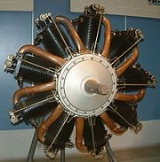
Le Rhone 9c
The rotary engine was an early type of internal-combustion engine in which the crankshaft
Crankshaft

The crankshaft, sometimes casually abbreviated to crank , is the part of an engine which translates reciprocation linear piston motion into rotation....
 remained stationary and the entire cylinder block
Cylinder block

The cylinder block or engine block is a machined casting containing cylindrically bored holes for the pistons of a multi-cylinder reciprocating internal combustion engine, or for a similarly constructed device such as a pump....
 rotated around it. The design was used mostly in the years shortly before and during World War I
World War I

World War I, or the First World War , was a global military conflict which involved the Great powers, organized into two opposing military alliances: the Allies of World War I and the Central Powers....
 to power aircraft, and also saw use in a few early motorcycle
Motorcycle

A motorcycle is a Single track, two-wheeled motor vehicle powered by an Motorcycle engine. Motorcycles vary considerably depending on the task for which they are designed, such as Touring motorcycle travel, navigating Naked bike, Cruiser , Motorcycle sport and Motorbike racing, or off-road conditions....
s and cars
Automobile

An automobile or motor car is a wheeled motor vehicle for transportation passengers, which also carries its own car engine or motor. Most definitions of the term specify that automobiles are designed to run primarily on roads, to have seating for one to eight people, to typically have four wheels, and to be constructed principally f...
.

By the early 1930s the rotary aircraft engine was becoming obsolete, mainly because of an upper ceiling to its possible output torque
Torque

Torque is the tendency of a force to rotate an object about an axis . Just as a force is a push or a pull, a torque can be thought of as a twist....
, which was a fundamental consequence of the way the engine worked. It was also limited by its inherent restriction on breathing capacity due to the need for the fuel/air mixture to be aspirated through the hollow crankshaft and crankcase, which directly affected its volumetric efficiency. However, at the time it was a very efficient solution to the problems of power output, weight, and reliability.

Description


A rotary engine is essentially a standard Otto cycle engine, but instead of having a fixed cylinder block
Cylinder block

The cylinder block or engine block is a machined casting containing cylindrically bored holes for the pistons of a multi-cylinder reciprocating internal combustion engine, or for a similarly constructed device such as a pump....
 with rotating crankshaft
Crankshaft

The crankshaft, sometimes casually abbreviated to crank , is the part of an engine which translates reciprocation linear piston motion into rotation....
 as with a conventional radial engine
Radial engine

The radial engine is a reciprocating engine internal combustion engine engine configuration in which the cylinder s point outward from a central crankshaft like the spokes on a wheel....
, the crankshaft remains stationary and the entire cylinder block rotates around it. In the most common form, the crankshaft was fixed solidly to an aircraft frame, and the propeller
Propeller

A propeller is a type of fan which transmits power by converting rotational motion into thrust. It can be used to drive an fixed-wing aircraft, ship, or the fluid within a pump....
 simply bolted onto the front of the crankcase
Crankcase

:For the Transformers characters see Crankcase .In an internal combustion engine, the crankcase is the housing for the crankshaft. The enclosure forms the largest cavity in the engine and is located below the cylinder block....
.

The rotation of the bulk of the engine's mass produced a powerful gyroscopic
Gyroscope

A gyroscope is a device for measuring or maintaining orientation , based on the principles of angular momentum. The device is a spinning wheel or disk whose axle is free to take any orientation....
 flywheel
Flywheel

A flywheel is a mechanical device with significant moment of inertia used as a storage device for rotational energy. Flywheels resist changes in their rotational speed, which helps steady the rotation of the shaft when a fluctuating torque is exerted on it by its power source such as a piston-based engine, or when the load placed on it is...
 effect, which smoothed out the power delivery and reduced vibration. Vibration had been such a serious problem on conventional piston engine designs that heavy flywheels had to be added. Because the cylinders themselves functioned as a flywheel, rotary engines gained a substantial power-to-weight ratio
Power-to-weight ratio

Power-to-weight ratio is a calculation commonly applied to engines and mobile power sources to enable the comparison of one unit or design to another....
 advantage over more conventional engines. Another advantage was improved cooling, as the rotating cylinder block created its own fast-moving airflow
Aerodynamics

Aerodynamics is a branch of Dynamics concerned with studying the motion of air, particularly when it interacts with a moving object. Aerodynamics is a subfield of fluid dynamics and gas dynamics, with much theory shared between them....
, even when the aircraft was at rest.

Most rotary engines were arranged with the cylinders pointing outwards from a single crankshaft, in the same general form as a radial, but there were also rotary boxer engines and even one-cylinder
Single cylinder engine

A single cylinder engine is the most basic configuration of an internal combustion engine. It is often used for motorcycles but has many uses in portable tools and has been used in cars and tractors....
 rotaries.

Like radial engines, rotaries were generally built with an odd number of cylinders (usually either 7 or 9), so that a consistent every-other-piston firing order could be maintained, to provide smooth running. Rotary engines with an even number of cylinders were mostly of the "two row" type.

Distinction between "Rotary" and "Radial" engines

Rotary and radial engine
Radial engine

The radial engine is a reciprocating engine internal combustion engine engine configuration in which the cylinder s point outward from a central crankshaft like the spokes on a wheel....
s look strikingly similar when they are not running and can easily be confused, since both have cylinders arranged radially around a central crankshaft. Unlike the rotary engine, however, radial engines use a conventional rotating crankshaft in a fixed engine block.

Rotary engine control

It is often asserted that rotary engines had no carburettor and hence power could only be reduced by intermittently cutting the ignition using a "blip" switch, which grounded the magneto when pressed, shutting off power to the spark plugs and stopping ignition. However, rotaries did have a simple carburettor which combined a gasoline jet and a flap valve for throtting the air supply. Unlike modern carburettors, it could not keep the fuel/air ratio constant over a range of throttle openings; in use, a pilot would set the throttle to the desired setting (usually full open) then adjust the fuel/air mixture to suit using a separate "fine adjustment" lever that controlled the fuel valve.

Due to the rotary engine's large inertia, it was possible to adjust the appropriate fuel/air mixture by trial and error without stalling it. After starting the engine with a known setting that allowed it to idle, the air valve was opened until maximum engine speed was obtained. Since the reverse process was more difficult, "throttling", especially when landing, was often accomplished by temporarily cutting the ignition using the blip switch.

By the middle stages of World War I some throttling capability was found necessary to allow pilots to fly in formation, and the improved carburettors which entered use allowed a power reduction of up to 25%. The pilot would close off the air valve to the required position, then re-adjust the fuel/air mixture to suit. Experienced pilots would gently back off the fuel lever at frequent intervals to make sure that the mixture was not too rich: a too-lean mixture was preferable, since power recovery would be instant when the fuel supply was increased, whereas a too-rich mixture could take up to 7 seconds to recover and could also cause fouling of spark plugs and the cylinders to cut out.

The Gnôme Monosoupape was an exception to this, since most of its air supply was taken in through the exhaust valve, and so could not be controlled via the crankcase intake. Monosoupapes therefore had a single petrol regulating control used for a limited degree of speed regulation. Early models also featured variable valve timing to give greater control, but this caused the valves to burn and therefore it was abandoned.

Later rotaries still used blipping the ignition for landing, and some engines were equipped with a switch that cut out only some rather than all of the cylinders to ensure that the engine kept running and did not oil up. A few 9 cylinder rotaries had this capability, typically allowing 1, 3, or 6 cylinders to be kept running. Some 9 cylinder Monosoupapes had a selector switch which allowed the pilot to cut out six cylinders so that each cylinder fired only once per three engine revolutions but the engine remained in perfect balance. Some documentation regarding the Fokker Eindecker
Fokker Eindecker

The Fokker Eindecker was a German World War I monoplane single-seat fighter aircraft designed by Netherlands engineer Anthony Fokker. Developed in April 1915, the Eindecker was the first purpose-built German fighter aircraft and the first aircraft to be fitted with synchronizer gear, enabling the pilot to fire a machine gun through t...
 shows a rotary selector switch to cut out a selected number of cylinders suggesting that German rotaries did as well.

By 1918 a Clerget
Clerget

The Clerget was an early Rotary engine aircraft engine. Manufactured in both Great Britain and France, it was used on such aircraft as the Sopwith Camel....
 handbook advised that all necessary control was to be effected using the throttle, and the engine was to be stopped and started by turning the fuel on and off. Pilots were advised to avoid use of the cut out switch as it would eventually damage the engine.

The blip switch is, however, still recommended for use during landing rotary-engined aircraft in modern times as it allows pilots a more reliable, quick source of power that lends itself to modern airfields. The landing procedure using a blip switch involved shutting off the fuel using the fuel lever, while leaving the blip switch on. The windmilling propeller allowed the engine to continue to spin without delivering any power as the aircraft descended. It was important to leave the blip switch on while the fuel was shut off to allow the spark plugs to continue to spark and keep them from oiling up, while the engine could easily be restarted simply by re-opening the fuel valve. If a pilot shut the engine off by holding the blip switch down without cutting off the fuel, fuel would continue to pass through the engine without combusting and raw fuel/air mix would collect in the cowling. This could cause a serious fire when the switch was released, or alternatively could cause the spark plugs to oil up and prevent the engine restarting.

History


Millet


Felix Millet showed a 5 cylinder rotary engine built into a bicycle wheel at the Exposition Universelle
Exposition Universelle (1889)

The Exposition Universelle of 1889 was a World's Fair held in Paris, France from May 6, to October 31, 1889.It was held during the year of the 100th anniversary of the storming of the Bastille, an event traditionally considered as the symbol for the beginning of the French Revolution....
 in Paris in 1889. Millet had patented the engine in 1888, so must be considered the pioneer of the internal combustion rotary engine. A machine powered by his engine took part in the Paris-Bordeaux-Paris race of 1895 and the system was put into production by Darracq
Darracq

Automobiles Darracq S.A. was a French motor vehicle manufacturing company founded in 1896 by Alexandre Darracq.Using part of the substantial profit he had made from selling his Gladiator bicycle factory, Alexandre Darracq began operating from a plant in the Parisian suburb of Suresnes....
 in 1900.

Hargrave


Lawrence Hargrave
Lawrence Hargrave

Lawrence Hargrave was an engineer, explorer, astronomy, inventor and aeronautics pioneer....
 first developed a rotary engine in 1889 using compressed air, intending for it to be used in powered flight. Weight of materials and lack of quality machining prevented it becoming an effective power unit.

Balzer


Stephen Balzer of New York, a former watchmaker, constructed rotary engines in the 1890s. He was interested in the rotary layout for two main reasons:
  • In order to generate at the low rpm
    Revolutions per minute

    Revolutions per minute is a units of measurement of frequency: the number of Turn completed in one minute around a rotation around a fixed axis....
     at which the engines of the day ran, the pulse resulting from each combustion stroke was quite large. To damp out these pulses, engines needed a large flywheel, which added weight. In the rotary design the engine acted as its own flywheel, thus rotaries could be lighter than similarly sized conventional engines.
  • The cylinders had good cooling airflow over them, even when the aircraft in which they were mounted were at rest, which was important, as the low airspeed attainable by aircraft of the time provided limited cooling airflow, and alloys of the day were less advanced than is currently the case. Balzer's early designs even dispensed with cooling fins, although subsequent rotaries did have this common feature of air-cooled engines.


Balzer produced a 3 cylinder, rotary engined car in 1894, then later became involved in Langley
Samuel Pierpont Langley

Samuel Pierpont Langley was an United States astronomer, physicist, inventor of the bolometer and pioneer of aviation. He graduated from Boston Latin School, was an assistant in the Harvard College Observatory, then became chair of mathematics at the United States Naval Academy....
's
Aerodrome attempts, which bankrupted him while he tried to make much larger versions of his engines. Balzer's rotary engines were later converted to static radial operation by Langley's assistant, Charles Manly
Charles Manly

Charles Manly was the United States Whig Party Governor of North Carolina of the U.S. state of North Carolina from 1849 to 1851, and the last member of his party to hold the office....
.

De Dion-Bouton


The famous De Dion-Bouton
De Dion-Bouton

De Dion-Bouton was a France automobile manufacturer and railcar manufacturer operating from 1883 to 1932. The company was founded by Comte Albert de Dion, Georges Bouton and his brother-in-law Charles Tr?pardoux....
 company produced an experimental 4 cylinder rotary engine in 1899. Though intended for aviation use, it was not fitted to any aircraft.

Adams-Farwell


The Adams-Farwell
Adams-Farwell

Adams-Farwell was a brass era American automobile manufacturer from Dubuque, Iowa, Iowa, founded by Herbert and Eugene Adams and Fay Oliver Farwell at the end of the 19th century....
 was another early US rotary engine which was being manufactured for use in automobiles by 1901. Emil Berliner sponsored its development as a lightweight power unit for his unsuccessful helicopter experiments. Adams-Farwell engines later powered fixed-wing aircraft in the US after 1910. It has also been asserted that the Gnôme design was derived from the Adams-Farwell, since an Adams-Farwell car is reported to have been demonstrated to the French Army in 1904. In contrast to the later Gnôme engines, the Adams-Farwell rotaries had conventional exhaust and inlet valves mounted in the cylinder heads.

Gnôme


The Gnôme engine was the work of the three Seguin brothers, Louis, Laurent, and Augustin. They were gifted engineers and the grandsons of famous French engineer Marc Seguin
Marc Seguin

Marc Seguin was a France engineer, inventor of the wire-cable suspension bridge and the multi-tubular steam-engine firetube boiler.Born Annonay near Lyon, France to Marc Fran?ois Seguin, founder of Seguin & Co....
. In 1906 the eldest brother, Louis, had formed the Société des Moteurs Gnôme
Gnome et Rhône

Gnome et Rh?ne was a major France aircraft engine manufacturer. Between 1914 and 1918 they produced 25,000 of their 9-cylinder Delta and Le Rh?ne 110 hp rotary engine designs, while another 75,000 were produced by various licensees, powering the majority of aircraft in the first half of the war on both sides of the conflict....
 to build stationary engine
Stationary engine

A stationary engine is an engine whose framework does not move. It is normally used not to propel a vehicle but to drive a piece of immobile equipment such as a pump or power tool....
s for industrial use, having licenced production of the Gnom single-cylinder stationary engine from Motorenfabrik Oberursel
Motorenfabrik Oberursel

Motorenfabrik Oberursel A.G. was a Germany manufacturer of automobile, locomotive and aircraft engines situated in Oberursel , near Frankfurt , Germany....
.

Louis was joined by his brother Laurent who designed a rotary engine specifically for aircraft use, using Gnom engine cylinders. The brothers' first experimental engine was a 5 cylinder model which developed , which was a radial rather than a rotary. They then turned to rotary engines in the interests of better cooling, and the first production engine, the 7 cylinder, "Omega" was shown at the 1908 Paris automobile show. The Gnôme Omega No.1 still exists, having been acquired and preserved by the late USMS
United States Maritime Service

The United States Maritime Service was established in 1938 under the provisions of the Merchant Marine Act of 1936. The mission of the organization was to train officers and other men to become United States Merchant Marine....
 retired Rear Admiral Lauren S. McCready
Lauren S. McCready

Rear Admiral Lauren S. McCready was one of the builders and founders of the United States Merchant Marine Academy, "Kings Point."He graduated from New York University in 1937 with a degree in mechanical engineering, soon after he received his marine engineers license....
, its last private owner, and is now in the collection of the Smithsonian's National Air and Space Museum
National Air and Space Museum

The National Air and Space Museum of the Smithsonian Institution is a museum in Washington, D.C., United States, and is the most popular of the Smithsonian museums....
. The Seguins used the highest strength material available - recently developed nickel steel alloy - and kept the weight down by machining components from solid metal; the cylinder wall of a 50 hp Gnôme was only 1.5 mm thick, while the connecting rods were milled with deep central channels to reduce weight. While somewhat low powered in terms of horsepower per litre, its power to weight ratio was an outstanding per kg.

The following year, 1909, the inventor Roger Ravaud fitted one to his
Aéroscaphe, a combination hydrofoil
Hydrofoil

A hydrofoil is a boat with wing-like airfoils mounted on struts below the hull . As the craft increases its speed the hydrofoils develop enough lift for the boat to become foilborne - i.e....
/aircraft, which he entered in the motor boat and aviation contests at Monaco. However, it was Henry Farman
Henry Farman

Henri Farman was a French aviator and aircraft designer and manufacturer with his brother Maurice Farman.Born in Paris in France, he was the son of a well to do English newspaper correspondent working there....
's use of the Gnôme at the famous Rheims aircraft meet that year which brought it to prominence, when he won the Grand Prix for the greatest non-stop distance flown - - and also created a world record for endurance flight.

The very first successful seaplane flight, of Henri Fabre
Henri Fabre

Henri Fabre was a France aviator and the inventor of Le Canard, the first seaplane in history.Henri Fabre was born into a prominent family of shipowners in the city of Marseilles....
's
Le Canard, was powered by a Gnôme Omega on March 28, 1910 near Marseille
Marseille

"Marseille" is the second-largest city of France and forms the third-largest aire urbaine, after those of Paris and Lyon, with a population recorded to be 1,516,340 at the 1999 census and estimated to be 1,605,000 in 2007....
.

Production of the Gnôme rotaries increased rapidly, with some 4,000 being produced before World War I, and the Omega's power output was increased to , and eventually to . By the standards of other engines of the period, the Gnôme was considered not particularly temperamental, and was considered reliable, being credited as the first engine able to run for ten hours between overhauls.

In 1913 the Seguin brothers introduced the new Monosoupape ("single valve") series, which eliminated the cylinder inlet valves, and had a single exhaust valve in each cylinder head which doubled as an air intake. Each cylinder had transfer ports of the type used on two-stroke engines at its bottom which connected with the crankcase. The engine speed was controlled by varying the opening time and extent of the exhaust valves using levers acting on the valve tappet rollers, a system which was later abandoned due to causing burning of the valves. The weight of the Monosoupape was slightly less than the earlier two-valve engines and it used less lubricating oil. The 100 hp Monosoupape was built with 9 cylinders, and developed its rated power at 1,200 rpm.

Rotary engines produced by the Clerget
Clerget

The Clerget was an early Rotary engine aircraft engine. Manufactured in both Great Britain and France, it was used on such aircraft as the Sopwith Camel....
 and Le Rhône
Le Rhône

The Le Rh?ne was a popular Rotary engine produced in France by Gnome et Rh?ne#Le Rh?ne around 1916. It powered a number of military aircraft of the World War I....
 companies used conventional pushrod-operated valves in the cylinder head, but used the same principle of drawing the fuel mixture through the crankshaft.

The 80 hp (60 kW) Gnôme was the standard at the outbreak of World War I, as the Gnôme Lambda, and it quickly found itself being used in a large number of aircraft designs. It was so good that it was licensed by a number of companies, including the German Motorenfabrik Oberursel
Motorenfabrik Oberursel

Motorenfabrik Oberursel A.G. was a Germany manufacturer of automobile, locomotive and aircraft engines situated in Oberursel , near Frankfurt , Germany....
 firm who designed the original Gnom engine. Oberursel was later purchased by Fokker
Fokker

Fokker was a Dutch aircraft manufacturer named after its founder, Anthony Fokker. The company operated under several different names, starting out in 1912 in Germany, moving to the Netherlands in 1919....
, whose 80 hp Gnôme Lambda copy was known as the Oberursel U.0. It was not at all uncommon for French Gnômes, as used in the earliest examples of the Bristol Scout
Bristol Scout

The Bristol Scout was a simple, single seat, Rotary engine biplane originally intended as a civilian racing aircraft. Like other similar fast, light aircraft of the period - it was acquired by the RNAS and the RFC as a "Scout ", or fast reconnaissance type....
 biplane, to meet German versions, powering Fokker E.I
Fokker E.I

The Fokker E.I was the first successful fighter aircraft to enter service with the German Army Air Service - in mid-1915. Its arrival at the front marked the start of a period known as the "Fokker Scourge" during which the E.I and its Fokker Eindecker successors achieved a measure of air superiority over the Western Front ....
 Eindeckers, in combat, from the latter half of 1915 on.

World War I


The favourable power-to-weight ratio
Power-to-weight ratio

Power-to-weight ratio is a calculation commonly applied to engines and mobile power sources to enable the comparison of one unit or design to another....
 of the rotaries was their greatest advantage. While larger, heavier aircraft relied almost exclusively on conventional in-line engines, many fighter aircraft designers preferred rotaries right up to the end of the war.

Rotaries had a number of disadvantages, notably very high fuel consumption, partially because the engine was typically run at full throttle, and also because the valve timing was often less than ideal. The rotating mass of the engine also made it, in effect, a large gyroscope
Gyroscope

A gyroscope is a device for measuring or maintaining orientation , based on the principles of angular momentum. The device is a spinning wheel or disk whose axle is free to take any orientation....
. During level flight the effect was not especially apparent, however under turning it was far more pronounced. Due to the direction of the force left-turns required some degree of effort and happened relatively slowly, combined with a tendency to nose-up, while right-turns were almost instantaneous, with a tendency for the nose to drop. In some aircraft this could be advantageous in situations such as dogfights while the Sopwith Camel
Sopwith Camel

The Sopwith Camel was a British World War I single-seat fighter aircraft biplane, famous for its manoeuvrability....
 suffered to such an extent that it required left rudder for both left and right turns and could be extremely hazardous if full power was used over the top of a loop at low airspeeds. Trainee Camel pilots were warned to attempt their first hard right turns only at altitudes above .

Even before the First World War attempts were made to overcome the inertia problem of rotary engines. As early as 1906 Charles Benjamin Redrup
Charles Benjamin Redrup

Charles Benjamin Redrup was a United Kingdom aeronautical engineer and inventor, who designed several innovative swashplate engine....
 had demonstrated to the Royal Flying Corps
Royal Flying Corps

The Royal Flying Corps was the over-land air arm of the British military during most of the First World War. During the early part of the war, the RFC's responsibilities were centred on support of the British Army, via artillery cooperation and photographic reconnaissance....
 at Hendon
Hendon

Hendon is a London suburb situated 7 miles north west of Charing Cross....
 a 'Reactionless' engine in which the crankshaft
Crankshaft

The crankshaft, sometimes casually abbreviated to crank , is the part of an engine which translates reciprocation linear piston motion into rotation....
 rotated in one direction and the cylinder block in the opposite direction, each one driving a propeller. A later development of this was the 1914 reactionless 'Hart' engine designed by Redrup in which there was only one propeller connected to the crankshaft, but it rotated in the opposite direction to the cylinder block, thereby largely cancelling out rotational inertia. This proved too complicated for the Air Ministry and Redrup changed the design to a static radial engine which later flew in Vickers
Vickers

Vickers was a famous name in British engineering that existed through many companies from 1828 until 2004....
 FB12b and FB16 aircraft.

As the war progressed, aircraft designers demanded ever increasing amounts of power. Inline engines were able to meet this demand by improving their upper rev limits, which meant more power. Improvements in valve timing, ignition systems, and lightweight materials made these higher revs possible, and by the end of the war the average engine had increased from 1,200 rpm to 2,000. The rotary was not able to do the same due to the drag of the rotating cylinders through the air. For instance, if an early-war model of 1,200 rpm increased its revs to only 1,400, the drag on the cylinders increased 36%, as air drag increases with the square of velocity. At lower rpm, drag could simply be ignored, but as the rev count rose, the rotary was putting more and more power into spinning the engine, with less remaining to provide useful thrust through the propeller.

One clever attempt to rescue the design was made by Siemens AG
Siemens AG

Siemens Aktiengesellschaft is Europe's largest engineering Conglomerate . Siemens' international headquarters are located in Berlin and Munich, Germany....
. The crankcase (with the propeller still fastened directly to the front of it) and cylinders spun counterclockwise at 900 rpm, as seen externally from a "nose on" viewpoint, while the crankshaft and other internal parts spun clockwise at the same speed. This was achieved by the use of bevel gearing at the rear of the crankcase, resulting in the Siemens-Halske Sh.III
Siemens-Halske Sh.III

Siemens & Halske's Sh.III was an 11-cylinder, air-cooled rotary engine developed in Germany during World War I, a larger and more powerful version of the Siemens-Halske Sh.I....
, running at 1800 rpm with little net torque. It was also apparently the only rotary engine to use a normal carburetor, which could be controlled by a conventional throttle, just as in an in-line engine. Used on the Siemens-Schuckert D.IV
Siemens-Schuckert D.IV

The Siemens-Schuckert D.IV was a late-World War I fighter aircraft from Siemens-Schuckert . Considered by many to be the best fighter to see action during the war, it reached service too late and was produced in too few numbers to have any effect on the war effort....
 fighter, the new engine created what is considered by many to be the best fighter aircraft
Fighter aircraft

A fighter aircraft is a military aircraft designed primarily for air-to-air combat with other aircraft, as opposed to a bomber, which is designed primarily to attack ground targets by dropping bombs....
 design of the war.

One new rotary powered aircraft, Fokker's own D.VIII
Fokker D.VIII

The Fokker E.V was a Germany parasol wing-monoplane fighter aircraft designed by Reinhold Platz and built by Fokker. It entered service with the Luftstreitkr?fte in the last months of the World War I....
, was designed at least in part to provide some use for the Oberursel factory's backlog of otherwise redundant Ur.II engines, themselves clones of the Le Rhône 9J rotary.

Postwar


By the time the war ended, the rotary engine had become obsolete, and it disappeared from use quite quickly. The British Royal Air Force
Royal Air Force

The Royal Air Force is the United Kingdom's air force, the oldest independent air force in the world. Formed on 1 April 1918, the RAF has taken a significant role in British military history ever since, playing a large part in World War II and in more recent conflicts....
 probably used rotary engines for longer than most other operators - the RAF's standard post-war fighter, the Sopwith Snipe
Sopwith Snipe

The Sopwith 7F.1 Snipe was a United Kingdom single-seat biplane fighter of the Royal Air Force . It was designed and built by the Sopwith Aviation Company during the World War I....
, used the Bentley BR2
Bentley BR2

The Bentley BR.2 was a British Rotary engine aircraft engine developed during the World War I by the motor car engine designer W. O. Bentley from his earlier Bentley BR.1....
 rotary, and the standard trainer, the Avro 504
Avro 504

The Avro 504 was a World War I biplane aircraft made by the Avro and under licence by others. Production during the War totalled 8,970 and continued for almost twenty years, making it the most-produced aircraft of any kind that served in World War I, in any military capacity, during that conflict....
K, had a universal mounting to allow the use of several different types of low powered rotary, of which there was a large surplus supply. However, the cheapness of war-surplus engines had to be balanced against their poor fuel efficiency
Fuel efficiency

Fuel efficiency, in its basic sense, is the same as thermal efficiency, meaning the efficiency of a process that converts chemical potential energy contained in a carrier fuel into kinetic energy or Mechanical work....
 and the operating expense of their total loss lubrication system.

By the mid-1920s, rotaries had been more or less completely displaced even in British service, largely by the new generation of air-cooled radials.

Use in cars and motorcycles


Although rotary engines were mostly used in aircraft, there were also a few cars and motorcycles with rotary engines. The most famous motorcycle (probably because of winning many races) is the Megola
Megola

The Megola was a Germany motorcycle produced between 1921 and 1925 in Munich. Like Bimota, the name is a portmanteau derived loosely from the names of its designers Meixner, Cockerell, and Landgraf....
, which had a rotary engine inside the front wheel. Another motorcycle with a rotary engine was Charles Redrup
Charles Benjamin Redrup

Charles Benjamin Redrup was a United Kingdom aeronautical engineer and inventor, who designed several innovative swashplate engine....
's 1912 Redrup Radial, which was a three-cylinder 303cc rotary engine fitted to a number of motor-cycles by Redrup.

In 1904, the Barry engine
Barry Engine

The Barry Engine first appeared in 1904 when it was exhibited at the Stanley Exhibition in London's Burners Hall. Designed by Charles Benjamin Redrup and manufactured in partnership with Alban Williams by the Barry Motor Company, the engine was a two-cylinder supercharged rotary engine....
, also designed by Charles Redrup was built in Wales, a rotating 2 cylinder boxer engine inside a motorcycle frame, weighing 6.5 kg. In the 1940s Cyril Pullin
Cyril Pullin

Cyril Pullin was a British people inventor, engineer and motorcycle race driver. His inventions contributed to the rotary engine and the helicopter....
 developed the Powerwheel, a wheel with a rotating one-cylinder engine
Single cylinder engine

A single cylinder engine is the most basic configuration of an internal combustion engine. It is often used for motorcycles but has many uses in portable tools and has been used in cars and tractors....
, clutch
Clutch

A clutch is a mechanism for transmitting rotation, which can be engaged and disengaged. Clutches are useful in devices that have two rotating shafts....
 and drum brake
Drum brake

A drum brake is a brake in which the friction is caused by a set of Brake shoe or Brake pad that press against the Brake lining of a rotating drum....
 inside the hub, but it never entered serial production.

Cars with rotary engines were built (among others) by American companies Adams-Farwell
Adams-Farwell

Adams-Farwell was a brass era American automobile manufacturer from Dubuque, Iowa, Iowa, founded by Herbert and Eugene Adams and Fay Oliver Farwell at the end of the 19th century....
, Bailey, Balzer and Intrepid
Intrepid

Intrepid can refer to:*Chevrolet Intrepid, the International Motor Sports Association GT Championship car, which raced from 1991 to 1993*William Stephenson, the Canadian World War II spymaster whose code name was Intrepid...
.

Other rotary engines


Besides the configuration described in this article with cylinders moving around a fixed crankshaft, several other very different engine designs are also called rotary engines. The most notable pistonless rotary engine
Pistonless rotary engine

A pistonless rotary engine is an internal combustion engine that does not use pistons in the way a reciprocating engine does, but instead uses one or more wikt:rotors, sometimes called rotary pistons....
, the Wankel rotary engine
Wankel engine

The Wankel engine is a type of internal combustion engine which uses a rotary combustion engine to convert pressure into a rotating motion instead of using reciprocating piston engine....
 has also been used in cars (notably by NSU
NSU Motorenwerke AG

NSU Motorenwerke Aktiengesellschaft, , was a Germany manufacturer of automobile and motorcycles, which was founded in 1873. It was acquired by Volkswagen Group in 1969....
 in the Ro80
NSU Ro 80

The NSU Ro 80 was a technologically advanced large sedan -type automobile produced by the Germany firm of NSU Motorenwerke AG from 1967 until 1977....
 and by Mazda
Mazda

is a Japanese automaker based in Hiroshima Prefecture, Japan. It is part owned by the Ford Motor Company.During 2007, Mazda produced almost 1.3 million vehicles for global sales....
 in a variety of cars such as the RX-series which includes the popular RX-7 and RX-8), as well as in some experimental aviation applications.

See also

  • Petrol engine
    Petrol engine

    A Petrol engine or Gasoline engine is an internal combustion engine with spark-ignition engine designed to run on petrol and similar volatile fuels....
  • Monosoupape engine
  • Manley-Balzer engine
    Manley-Balzer engine

    The Manly-Balzer was the first purpose-designed aircraft engine, first built in 1901 for the Langley Aerodrome project. The engine was originally ordered from Stephen Balzer in New York, but his five-cylinder radial engine design failed to live up to its claims....
  • Nutating disc engine
    Nutating disc engine

    A nutating disc engine is a recently patented internal combustion engine comprising fundamentally only one moving part and a direct drive onto the crankshaft....
  • Turbine
    Turbine

    A turbine is a rotary engine that extracts energy from a fluid flow. Claude Burdin coined the term from the Latin turbo, or vortex, during an 1828 engineering competition....
  • Wankel rotary engine
    Wankel engine

    The Wankel engine is a type of internal combustion engine which uses a rotary combustion engine to convert pressure into a rotating motion instead of using reciprocating piston engine....


External links