
All Topics  
Wing loading

 
Wing Loading

   Email Print
   Bookmark   Link


Wing loading


In aerodynamics
Aerodynamics

Aerodynamics is a branch of Dynamics concerned with studying the motion of air, particularly when it interacts with a moving object. Aerodynamics is a subfield of fluid dynamics and gas dynamics, with much theory shared between them....
, wing loading is the loaded weight of the aircraft divided by the area of the wing. The faster an aircraft flies, the more lift
Lift (force)

In the context of a fluid flow relative to a body, the lift force is the Vector #Vector components of the aerodynamic force that is perpendicular to the oncoming flow direction....
 is produced by each unit area of wing, so a smaller wing can carry the same weight in level flight, operating at a higher wing loading. Correspondingly, the landing and take-off speeds will be higher. The high wing loading also decreases maneuverability. The same constraints apply to birds.
raft "weights" are always given as masses, i.e.


Discussion
Ask a question about 'Wing loading'
Start a new discussion about 'Wing loading'
Answer questions from other users
Full Discussion Forum


Recent Posts


Encyclopedia


In aerodynamics
Aerodynamics

Aerodynamics is a branch of Dynamics concerned with studying the motion of air, particularly when it interacts with a moving object. Aerodynamics is a subfield of fluid dynamics and gas dynamics, with much theory shared between them....
, wing loading is the loaded weight of the aircraft divided by the area of the wing. The faster an aircraft flies, the more lift
Lift (force)

In the context of a fluid flow relative to a body, the lift force is the Vector #Vector components of the aerodynamic force that is perpendicular to the oncoming flow direction....
 is produced by each unit area of wing, so a smaller wing can carry the same weight in level flight, operating at a higher wing loading. Correspondingly, the landing and take-off speeds will be higher. The high wing loading also decreases maneuverability. The same constraints apply to birds.
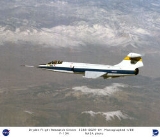
Lockheed F 104 Starfighter

Units

Aircraft "weights" are always given as masses, i.e. in units like lbs or kg, so wing loadings are nearly always given in either lb/ft2 or kg/m2. Occasionally weight (force) units replace mass, so then the wing loading is in N/m2. To get from lb/ft2 to kg/m2, multiply by 4.88; to get from kg/m2 to N/m2, multiply by 9.81.

Range of wing loadings


The table, which shows wing loadings is intended to give a feeling for the range of wing loadings used by fixed wing aircraft. Maximum weights have been used. There will be variations amongst variants of any particular type. The dates are approximate, indicating period of introduction.

The critical limit for bird
Bird

Birds are wing, Bipedalismal, endothermic , vertebrate animals that lay egg . There are around 10,000 living species, making them the most numerous tetrapod vertebrates....
 flight is about 5 lb/ft² (25 kg/m²). An analysis of bird flight which looked at 138 species ranging in mass from 1x10⁻² to 10 kg, from small passerines to swans
Swans

Swans can refer to:*Swan, the bird.Music*Swans , the band.*Swans , an EP by the above band.Places*Swan's Island, Maine, an Island town in America...
 and cranes found wing loadings from about 1 to 20 kg/m2. The wing loadings of some of the lightest aircraft fall comfortably within this range. One typical hang-glider (see table) has a maximum wing loading of 6.3 kg/m2, and an ultralight rigid glider 8.3 kg/m2.

Effect on performance

Wing loading is a useful measure of the general manoeuvring performance of an aircraft. Wings generate lift owing to the motion of air over the wing surface. Larger wings move more air, so an aircraft with a large wing area relative to its mass (i.e., low wing loading) will have more lift at any given speed. Therefore, an aircraft with lower wing loading will be able to take-off and land at a lower speed (or be able to take off with a greater load). It will also be able to turn faster.

Effect on take-off and landing speeds


Quantitatively, the lift force L on a wing of area A, travelling at speed v is given by

,


where is the density of air and CL is the lift coefficient
Lift coefficient

The lift coefficient is a dimensionless coefficient that relates the Lift generated by an airfoil, the dynamic pressure of the fluid flow around the airfoil, and the planform area of the airfoil....
. The latter is a dimensionless number of order unity which depends on the wing cross-sectional profile and the angle of attack
Angle of attack

Angle of attack is a term used in aerodynamics to describe the angle between the chord of an airfoil and the vector representing the relative motion between the airfoil and the air....
. At take-off or in steady flight, neither climbing or diving, the lift force and the weight are equal. With L/A = Mg/A =WSg , where M is the aircraft mass, WS = M/A the wing loading and g the acceleration due to gravity, that equation gives the speed v through

.
As a consequence, aircraft with the same CL at take-off under the same atmospheric conditions will have take off speeds proportional to . So if an aircraft's wing area is increased by 10% and nothing else changed, the take-off speed will fall by about 5%. Likewise, if an aircraft designed to take off at 150 mph grows in weight during development by 40%, its take-off speed increases to mph.

Some flyers rely on their muscle power to gain speed for take-off over land or water. Ground nesting and water birds have to be able to run or paddle at their take-off speed and the same is so for a hang glider pilot, though he or she may get an assist from a downhill run. For all these a low WS is critical, whereas passerines and cliff dwelling birds can get airborne with higher wing loadings.

Effect on climb rate and cruise performance

Wing loading has an effect on an aircraft's climb rate. A lighter loaded wing will have a superior rate of climb compared to a heavier loaded wing as less airspeed
Airspeed

Airspeed is the speed of an aircraft relative to the air. There are several different measures of airspeed: indicated airspeed, calibrated airspeed, equivalent airspeed and true airspeed....
 is required to generate the additional lift to increase altitude. A lightly loaded wing has a more efficient cruising performance because less thrust is required to maintain lift for level flight.

The second equation given above applies again to the cruise in level flight, though and particularly CL will be smaller than at take-off, CL because of a lower angle of incidence and the retraction of flaps or slots; the speed needed for level flight is lower for smaller WS.

The wing loading is important in determining how rapidly the climb is established. If the pilot increases the speed to vc the aircraft will begin to rise with vertical acceleration ac because the lift force is now greater than the weight. Newton's second law tells us this acceleration is given by
or
so the initial upward acceleration is inversely proportional to WS. Once the climb is established the acceleration falls to zero as the upward component of lift and the weight become numerically equal.

Effect on turning performance

To turn, an aircraft must roll
Flight dynamics

Flight dynamics is the science of aircraft and spacecraft vehicle orientation and control in three dimensions. The three critical flight dynamics parameters are the angles of rotation in three dimensions about the vehicle's center of mass, known as pitch, roll and yaw ....
 in the direction of the turn, increasing the aircraft's bank angle
Banked turn

A banked turn is the term used to describe a car riding along a circle with inclined edges. The angle at which a turn is banked refers to the angle of incline of the given path....
. Turning flight lowers the wing's lift component against gravity and hence causes a descent. To compensate, the lift force must be increased by increasing the angle of attack by use of up elevator
Elevator (aircraft)

Elevators are control surfaces, usually at the rear of an aircraft, which control the aircraft's orientation by changing the Flight dynamics of the aircraft, and so also the angle of attack of the wing....
 deflection which increases drag. Turning can be described as 'climbing around a circle' (wing lift is diverted to turning the aircraft) so the increase in wing angle of attack
Angle of attack

Angle of attack is a term used in aerodynamics to describe the angle between the chord of an airfoil and the vector representing the relative motion between the airfoil and the air....
 creates even more drag. The tighter the turn radius
RADIUS

Remote Authentication Dial In User Service is a networking protocol that provides centralized access, authorization and accounting management for people or computers to connect and use a network service....
 attempted, the more drag induced, this requires that power (thrust) be added to overcome the drag. The maximum rate of turn possible for a given aircraft design is limited by its wing size and available engine power: the maximum turn the aircraft can achieve and hold is its sustained turn performance. As the bank angle increases so does the g-force
G-force

The g-force of an object is its acceleration relative to free-fall. The unit of measure used is informally but commonly known as the "gee" , symbolized as g . An acceleration of 1 g is generally considered as equal to standard gravity , which is defined as precisely metre per second square...
 applied to the aircraft, this has the effect of increasing the wing loading and also the stalling speed. This effect is also experienced during level pitching manouevers.

Aircraft with low wing loadings tend to have superior sustained turn performance because they can generate more lift for a given quantity of engine thrust. The immediate bank angle an aircraft can achieve before drag seriously bleeds off airspeed is known as its instantaneous turn performance. An aircraft with a small, highly loaded wing may have superior instantaneous turn performance, but poor sustained turn performance: it reacts quickly to control input, but its ability to sustain a tight turn is limited. A classic example is the F-104 Starfighter
F-104 Starfighter

The Lockheed F-104 Starfighter was an United States single-engined, high-performance, supersonic interceptor aircraft that served with the United States Air Force from 1958 until 1967....
, which has a very small wing and high wing loading. At the opposite end of the spectrum was the gigantic Convair B-36
Convair B-36

The Convair B-36 was a strategic bomber built by Convair and operated solely by the United States Air Force . The B-36 was the largest mass-produced piston engined aircraft ever made and had the largest wingspan in a combat aircraft ever built , although there have been larger military transports....
. Its large wings resulted in a low wing loading, and there are disputed claims that this made the bomber more agile than contemporary jet fighters (the slightly later Hawker Hunter
Hawker Hunter

The Hawker Hunter was a jet fighter aircraft of the 1950s and 1960s. The Hunter served for many years with the Royal Air Force and was widely exported, serving with 19 air forces....
 had a similar wing loading of 250 kg/m2) at high altitude. Whatever the truth of that, the delta winged Avro Vulcan
Avro Vulcan

The Avro Vulcan is a delta wing subsonic jet bomber that was operated by the Royal Air Force from 1953 until 1984. The Vulcan was part of the RAF's V bomber force, which fulfilled the role of nuclear deterrence against the Soviet Union during the Cold War....
 bomber, with a wing loading of 260 kg/m2 could certainly be rolled at low altitudes.

Like any body in circular motion
Circular motion

In physics, circular motion is rotation along a circle: a circular path or a circular orbit. It can be uniform circular motion, that is, with constant angular rate of rotation, or non-uniform circular motion, that is, with a changing rate of rotation....
, an aircraft that is fast and strong enough to maintain level flight at speed v in a circle of radius R accelerates towards the centre at . That acceleration is caused by the inward horizontal component of the lift, , where is the banking angle. Then from Newton's second law ,
Tidying up gives
The smaller the wing loading, the tighter the turn.

Gliders designed to exploit thermals need a small turning circle in order to stay within the rising air column, and the same is true for soaring birds. Other birds, for example those that catch insects on the wing also need high manouevrability. All need low wing loadings.

Effect on stability

Wing loading also affects gust response, the degree to which the aircraft is affected by turbulence and variations in air density. A small wing has less area on which a gust can act, both of which serve to smooth the ride. For high-speed, low-level flight (such as a fast low-level bombing run in an attack aircraft), a small, thin, highly loaded wing is preferable: aircraft with a low wing loading are often subject to a rough, punishing ride in this flight regime. The F-15E Strike Eagle
F-15E Strike Eagle

The F-15E Strike Eagle is a 1980s United States all-weather strike fighter, designed for long-range Air interdiction of enemy ground targets deep behind enemy lines....
 has been criticized for its ride quality, despite its wing loading of 650 kg/m2 (excluding fuselage contributions to the effective area), as have most delta wing
Delta wing

The delta wing is a wing planform in the form of a triangle, named after the Greek uppercase delta which is a triangle . Its use in the so called "tailless delta", i.e....
 aircraft (such as the Dassault Mirage III
Dassault Mirage III

The Dassault Mirage III is a supersonic fighter aircraft designed in France by Dassault Aviation during the 1950s, and manufactured both in France and a number of other countries....
, for which WS = 387 kg/m2) which tend to have large wings and low wing loadings.

Quantitatively, if a gust produces an upward pressure of G (in N/m2, say) on an aircraft of mass M, the upward acceleration a will, by Newton's second law be given by
,
decreasing with wing loading.

Effect of development

A further complication with wing loading is that it is difficult to substantially alter the wing area of an existing aircraft design (although modest improvements are possible). As aircraft are developed they are prone to "weight growth" -- the addition of equipment and features that substantially increase the operating mass of the aircraft. An aircraft whose wing loading is moderate in its original design may end up with very high wing loading as new equipment is added. Although engines can be replaced or upgraded for additional thrust, the effects on turning and take-off performance resulting from higher wing loading are not so easily reconciled.

Water ballast use in gliders

Modern glider
Glider

Heavier-than-air unpowered aircraft do not need propulsion once airborne. Gliders, balloons and kites are unpowered aircraft.Gliders such as gliders, hang gliders and paragliders gain their initial flying speed from some launch mechanism, and then gain additional energy from gravity and from updrafts such as thermal currents....
s often use water ballast carried in the wings to increase wing loading when soaring
Soaring

Soaring is a mode of flight in which height or speed is gained by using the energy of air currents. It arises in the flight of both aircraft and birds....
 conditions are strong. By increasing the wing loading the lift-to-drag ratio
Lift-to-drag ratio

In aerodynamics, the lift-to-drag ratio, or L/D ratio , is the amount of Lift generated by a wing or vehicle, divided by the drag it creates by moving through the air....
 is increased at higher airspeed
Airspeed

Airspeed is the speed of an aircraft relative to the air. There are several different measures of airspeed: indicated airspeed, calibrated airspeed, equivalent airspeed and true airspeed....
s. The ballast can be dumped overboard when conditions weaken . (see Gliding competitions
Gliding competitions

Some of the pilots in the sport of gliding take part in gliding competitions. These are usually racing competitions, but there are also competition aerobatics and cross-country distance competitions....
)

Design considerations


Fuselage lift

Raf F 15e Strike Eagle Iraq 2004
A blended wing-fuselage design such as that found on the F-16 Fighting Falcon
F-16 Fighting Falcon

The Lockheed Martin F-16 Fighting Falcon is a Multirole combat aircraft jet aircraft fighter aircraft originally developed by General Dynamics for the United States Air Force....
 or MiG-29 Fulcrum
Mikoyan MiG-29

The Mikoyan MiG-29 is a Fourth generation jet fighter fighter aircraft designed in the Soviet Union for an Air superiority fighter role. Developed in the 1970s by the Mikoyan design bureau, it entered service with the Soviet Air Force in 1983, and remains in use by the Russian Air Force as well as in many other nations....
 helps to reduce wing loading; in such a design the fuselage generates aerodynamic lift, thus improving wing loading while maintaining high performance.

Variable-sweep wing

Aircraft like the F-14 Tomcat
F-14 Tomcat

The Grumman F-14 Tomcat is a supersonic, twin-engine, two-seat, variable-sweep wing aircraft. The F-14 was the United States Navy's primary maritime air superiority fighter, fleet defense Interceptor aircraft and tactical reconnaissance platform from 1974 to 2006....
 and the Panavia Tornado
Panavia Tornado

The Panavia Tornado is a family of twin-engine combat aircraft, which was jointly developed by the United Kingdom, West Germany and Italy. There are three primary Panavia Tornado variants of the Tornado; the Tornado IDS Ground attack aircraft, the electronic warfare Tornado ECR and the Panavia Tornado ADV Interceptor aircraft....
 employ variable-sweep wings. As their wing area varies in flight so does the wing loading (although this is not the only benefit). In the swept forward position takeoff
Takeoff

Takeoff is the phase of flight in which an aircraft goes through a transition from moving along the ground to flying in the air, usually starting on a runway....
 and landing
Landing

Landing is the last part of a flight, where a flying animal, aircraft, or spacecraft returns to the ground. When the flying object returns to water, the process is called alighting, although it is commonly called "landing" and "touchdown" as well....
 performance is greatly improved.

Fowler flaps

The use of Fowler flaps
Flap (aircraft)

Flaps are hinged surfaces on the trailing edge of the wing of a fixed-wing aircraft. As flaps are extended, the Stall of the aircraft is reduced....
 increases the wing area, decreasing the wing loading which allows slower landing approach speeds.

See also

  • Lift coefficient
    Lift coefficient

    The lift coefficient is a dimensionless coefficient that relates the Lift generated by an airfoil, the dynamic pressure of the fluid flow around the airfoil, and the planform area of the airfoil....


Bibliography

  • Meunier, K. Korrelation und Umkonstruktionen in den Größenbeziehungen zwischen Vogelflügel und Vogelkörper-Biologia Generalis 1951: p403-443. [Article in German]
  • Thom, Trevor. The Air Pilot's Manual 4-The Aeroplane-Technical. 1988. Shrewsbury, Shropshire, England. Airlife Publishing Ltd. ISBN 1-85310-017-X
  • Spick, Mike. Jet Fighter Performance-Korea to Vietnam. 1986. Osceola, Wisconsin. Motorbooks International. ISBN 0-7110-1582-1


External links

  • Retrieved 8 February 2008