

Finnish Air Force

Encyclopedia
The Finnish Air Force is one of the branches of the Finnish Defence Forces
. Its peacetime tasks are airspace surveillance, identification flights, and production of readiness formations
for wartime conditions. As a separate branch of the military, the Finnish Air Force is one of the oldest in the world, having existed officially since 6 March 1918.
erupted, in which the Soviets/Russians sided with the Reds – the communist rebels. Finland's White Guard
, the Whites, managed to seize a few aircraft from the Russians, but were forced to rely on foreign pilots and aircraft. Sweden
refused to send men and material, but individual Swedish citizens came to the aid of the Whites. The editor of the Swedish daily magazine Aftonbladet
, Waldemar Langlet, bought a N.A.B. Albatros aircraft from the Nordiska Aviatik A.B. factory with funds gathered by the Finlands vänner ("Friends of Finland") organization. This aircraft, the first to arrive from Sweden, was flown via Haparanda
on 25 February 1918 by Swedish pilots John-Allan Hygerth (who on March 10 became the first commander of the Finnish Air Force) and Per Svanbäck. The aircraft made a stop at Kokkola
and had to make a forced landing in Jakobstad
when its engine broke down. It was later given the Finnish Air Force designation F.2 ("F" coming from the Swedish word "Flygmaskin", meaning "aircraft").
 Swedish count Eric von Rosen
gave the Finnish White government its second aircraft, a Thulin
Typ D
. Its pilot, Lieutenant Nils Kindberg, flew the aircraft to Vaasa
on 6 March 1918, carrying von Rosen as a passenger. As this gift ran counter to the will of the Swedish government, and no flight permit had been given, it resulted in Kindberg receiving a 100 kronor fine for leaving the country without permission. This aircraft is considered by some to be the first aircraft of the Finnish Air Force, since the Finnish Air Force did not officially exist during the Civil War, and it was only the Red side who flew a few aircraft with the help of some Russian pilots. The von Rosen aircraft was given the designation F.1. The air force was officially called the "aviation force" during its first years. The Finnish Air Force is one of the oldest air forces of the world – the RAF
was founded as the first independent branch on 1 April 1918 and the Swedish Flygvapnet
in 1925.
Von Rosen had painted his personal good luck charm on the Thulin Typ D aircraft. This charm – a blue swastika
, the ancient symbol of the sun and good luck – was adopted as the insignia of the Finnish Air Force. The white circular background was created when the Finns tried to paint over the advertisement from the Thulin air academy. The swastika was officially taken into use after an order by Mannerheim on 18 March 1918. The FAF had to change the insignia after 1945, due to an Allied Control Commission
decree, where the swastika had to be abandoned due to its association with Nazism
.
The F.1 aircraft was destroyed in an accident, killing its crew, not long after it had been handed over to the Finns. On 7 September 1920, two newly purchased Savoia flying boats crashed in the Swiss Alps
en route to Finland, killing all on-board (three Finns and one Italian). This day has since been the memorial day for fallen pilots.
The Finnish Air Force assigns the matriculation numbers to its aircraft by assigning each type a two-letter code following by dash and an individual aircraft number. The two-letter code usually refers to the aircraft manufacturer or model, such as HN for F/A-18 Hornet, DK for Saab 35 Draken, VN for Valmet Vinka etc.
The Reds were in possession of a few airbases and a few Russian aircraft, mainly amphibious aircraft. They had 12 aircraft in all. The Reds did not have any pilots themselves, so they hired some of the Russian pilots that had stayed behind. On the 24th of February 1918 five aircraft arrived to Viipuri, and were quickly transferred to Riihimäki.
The Reds created air units in Helsinki, Tampere, Kouvola, and Viipuri. There were no overall headquarters, but the individual units served under the commander of the individual front line. A flight school was created in Helsinki, but no students were trained there before the fall of Helsinki.
Two of the aircraft, one reconnaissance aircraft (Nieuport 10
) and one fighter aircraft (Nieuport 17
) that had arrived to Riihimäki were sent to Tampere, and three to Kouvola. Four Russian pilots and six mechanics also arrived to Tampere. The first war sortie was flown on March 1, 1918 over Naistenlahti.
It seems like the Reds also operated two aircraft over the Eastern front. The Reds mainly performed reconnaissance, bombing sorties, spreading of propaganda leaflets, and artillery spotting. The Reds' air activity wasn’t particularly successful. Their air operations suffered from bad leadership, worn-out aircraft, and the un-motivated Russian pilots. Some of the aircraft were captured by the Whites, while the rest were destroyed.
However, one Morane-Saulnier Parasol, and three N.A.B. Albatros arrived from Sweden by the end of February 1918. Two of the Albatross aircraft were gifts from persons supporting the White Finnish cause, while the third was bought. It was initially meant that the aircraft would be used to support the air operations of the Whites, but the aircraft proved unsuitable.
The Whites also did not have any pilots, so all the pilots and mechanics came from Sweden. One of the Finnish Jägers, Lieutenant Bertil Månsson, had been given pilot training in the imperial Germany
, but he stayed behind in Germany, trying to secure aircraft deals for Finland.
During the Civil War the White Finnish Air Force consisted of:
The air activity consisted mainly of reconnaissance sorties. The Germans brought several of their own aircraft, but they did not contribute much to the overall outcome of the war.
The first Air Force Base of independent Finland was founded on the shore near Kolho. The base could operate three aircraft. The first aircraft was brought by rail on March 7, 1918, and on March 17, 1918 the first aircraft took off from the base. In 1918 the Finns took over nine Russian Stetinin M-9 aircraft that had been left behind.
The first air operation of the Whites during the war was flown over Lyly. It was a reconnaissance gathering mission as the front line moved south, towards Tampere, the AFB was moved first to Orivesi and then to Kaukajärvi near Tampere. The contribution of the White air force during the war was almost insignificant.
From March 10, 1918 the Finnish Air Force was led by the Swedish Lt. John. Allan Hygerth. He was however replaced on April 18, 1918, due to his unsuitability for the position and numerous accidents. His job was taken over by the German Captain Carl Seber, who commanded the air force from April 28, 1918 until December 13, 1918.
By the end of the Civil War, the Finnish Air Force had 40 aircraft, of which 20 had been captured from the Reds (the Reds did not operate this many aircraft, but some had been found abandoned by the Russians on the Åland Islands). Five of the aircraft had been flown by the Allies from Russia, four had been gifts from Sweden and eight had been bought from Germany.
 The Winter War
began on November 30, 1939, when the Soviet Air Force
bombed 21 Finnish cities and municipalities. The Soviet Union is estimated to have had about 5,000 aircraft in 1939, and of these, some 700 fighters and 800 medium bombers were brought to the Finnish front to support the Red Army's operations. As with most aerial bombardment of the early stages of WW2, the damage against the Finnish industry and railways was quite limited.
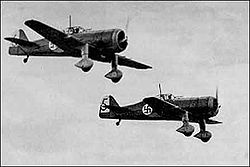
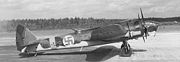
At the beginning of the Winter War, the Finnish Air Force was equipped with only 17 bombers and 31 fighters. There were also 54 liaison aircraft but 20 of these were only used for messengers. The most modern aircraft in the Finnish arsenal were the British-designed Bristol Blenheim
bombers that had been license-built in Finland. The primary fighter aircraft was the Fokker D.XXI
, a cheap but maneuverable design with fabric-covered fuselage and fixed landing gear. On paper, this force should have been no match for the attacking Soviet Red Air Force.
In order to prevent their aircraft from being destroyed on the ground, the Finns spread out their aircraft to many different airfields and hid them in the nearby forests. The Finns constructed many decoys and built shrapnel protection walls for the aircraft. Soviet air raids on Finnish airfields usually caused little or no damage as a result, and often resulted in interception of the attackers by the Finns as the bombers flew homeward.
As the war progressed, the Finns tried desperately to purchase aircraft wherever there were any to be found. This policy resulted in a very diverse aircraft inventory, which was to cause some major logistical problems until the inventory became more standardized. The Finnish Air Force was to consist of numerous American, British, Czechoslovakian, Dutch, French, German, Italian, Soviet, and Swedish designs. Other countries, like South Africa and Denmark, sent aircraft to assist in the Finnish war effort
. Many of these purchases and gifts did not arrive until the end of the hostilities, but were to see action later during the Continuation and Lapland wars.
To make up for its weaknesses (few and obsolete fighters) the FiAF mainly focused on attacking enemy bombers from directions that were disadvantageous to the enemy. Soviet fighters were usually superior in firepower, speed and agility, and were to be avoided unless the enemy were in a disadvantageous position. A good example of the wisdom of this tactics was the surprise attack on the Immola air base in late February 1940 by some 40 Soviet fighters. The Finns scrambled its available Fokker D.XXIs and Gloster Gladiators but lost seven aircraft against forty shot down enemy fighters.
As a result off these tactics, the Finnish Air Force managed to shoot down 218 Soviet aircraft during the Winter War while losing only 47 to enemy fire. The Finnish anti-aircraft also had 314 confirmed downed enemy planes. 30 Soviet planes were captured – these were "kills" that landed more or less intact within Finland and were quickly repaired.
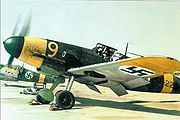 The Finnish Air Force was better prepared for the Continuation War
. It had been considerably strengthened and consisted of some 550 aircraft, though many were considered second-rate and thus "exportable" by their countries of origin. Finland purchased a large number of aircraft during the Winter War, but few of those reached service during the short conflict. Politics also played a factor, since Hitler did not wish to antagonize the Soviet Union
by allowing aircraft exports through German-controlled territory during the conflict. New aircraft types were in place by the time hostilities with Russia resumed in 1941. Small numbers of Hawker Hurricane
s arrived from the United Kingdom, Morane-Saulnier M.S.406
s from France, Fiat G.50
s from Italy, a few dozen Curtiss Hawk 75s
captured by the Germans in France and Norway then sold to Finland, when Germany began warming up its ties with Finland, and numerous Brewster B239s from the neutral USA strengthened the FiAF. The FiAF proved capable of holding its own in the upcoming battles with the Red Air Force. Older models, like the Fokker D.XXI
and Gloster Gladiator
, were replaced in front-line combat units with the new aircraft.
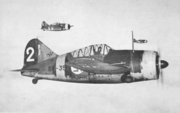
The FiAF's main mission was to achieve air superiority over Finland and prevent Soviet air power from reinforcing their front lines. The fighter squadrons were very successful in the Finnish offensive of 1941. A stripped-down, more maneuverable, and significantly lightened version of the American Brewster B239 "Buffalo" was the FiAF's main fighter until 1943. Results with this fighter were very good, even though the type was considered to be a failure in the US Navy and with British Far East forces. In the Finnish use, the Brewster had a victory rate of 32:1 – 459 kills while losing only 15. German Bf 109s replaced the B239 as the primary front-line fighter of the FiAF in 1943, though the Buffalos continued in secondary roles until the end of the wars. Other types, especially the Italian Fiat G.50
and Curtiss Hawk 75 also proved capable in the hands of well-trained Finnish pilots. Various Russian designs also saw action when lightly damaged "kills" were repaired and made airworthy.
Dornier Do 17
s (received as a gift from Hermann Göring
in 1942) and Junkers Ju 88
s improved the bombing capability of the Finnish Air Force. The bomber force was also strengthened with a number of captured Soviet bombers, which had been taken in large numbers by the Germans during Operation Barbarossa. The bomber units flew assorted missions with varying results, but a large part of their time was spent in training, waiting to use their aircraft until the time required it. Thus the bomber squadrons of Flying Regiment 4 were ready for the summer battles of 1944, which included for example the Battle of Tali-Ihantala
.
While the FiAF was successful in its mission, the conditions were not easy. Spare parts for the FiAF planes were scarce—parts from the US (Buffalo & Hawk), Britain (Hurricanes), and Italy (G.50) were unavailable for much of the war. Repairs took often a long time, and the State Aircraft Factory was burdened with restoration/repair of Soviet war booty planes, foreign aircraft with many hours of flight time, and the development of indigenous Finnish fighter types. Also, one damaged bomber took up workshop space equalling three fighters.
Finland was required to expel or intern remaining German forces as part of its peace agreement with the Soviets in mid-1944. As a result, the final air battles were against retreating Luftwaffe units.
The Finnish Air Force did not bomb any civilian targets during either war. Curiously, overflying Soviet towns and bases was also forbidden, as to avoid any unneeded provocations and to spare equipment.
According to Kalevi Keskinen's and Kari Stenman's book "Aerial Victories 1–2", the Finnish Air Force shot down 1,621 Soviet aircraft while losing 210 own aircraft during the Continuation War 1941–44.
brought with it some limitations to the FiAF. Among these were that the Finnish Air Force were to have:
These revisions followed closely Soviet demands. When Britain tried to add some of their own (fearing that the provisions were there only to augment the Soviet air-defences) they were opposed by the Soviets. The revisions were again revised in 1963 and Finland was allowed to buy guided missiles and a few bombers that were used as target-tugs. The FiAF also managed to find a loop-hole to strengthen the capacity by purchasing large numbers of two-seater aircraft, which counted as trainer aircraft and were not included in the revisions. These aircraft could have secondary roles.
During the Cold War
years, Finland tried to balance its purchases between east, west and domestic producers. This led to a diverse inventory of Soviet, British, Swedish, French and Finnish aircraft. After leading Finnish politicians held unofficial talks with their Swedish counterparts, Sweden began storing surplus Saab 35 Drakens, which were to be transferred to Finland in the event of a war with the Soviet Union. These were kept until the 1980s.
On September 22, 1990, a mere week before the unification of Germany, Finland declared that the limiting treaties were no longer active and that all the provisions of the Paris Peace Treaties were nullified. The signatory states abstained from diplomatic notes regarding the declaration, which thus confirmed the nullification.
! style="text-align: left; background: #aacccc;"|Aircraft
! style="text-align: left; background: #aacccc;"|Origin
! style="text-align: left; background: #aacccc;"|Type
! style="text-align: left; background: #aacccc;"|Versions
! style="text-align: left; background: #aacccc;"|In service
! style="text-align: left; background: #aacccc;"|Notes
|-
| McDonnell Douglas F-18 Hornet|| || Multi-role fighter || C
D
||
55
7
62 || F/A-18 is officially known as F-18 in the Finnish service.
|-
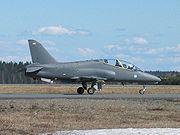
| BAE Hawk
|| || Trainer
Attack || Mk.51/51A
Mk.66
||
47
18
65 || 18 Hawks to be modernised in 2010–2013. http://www.hs.fi/kotimaa/artikkeli/Ilmavoimat+nykyaikaistaa+18+Hawk-harjoituskonetta/1135252138654
|-
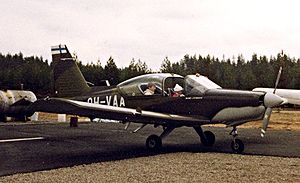
| Valmet L-70 Vinka || || Trainer || || 28 ||
|-
| Valmet L-90 Redigo || || Liaison || || 9 ||
|-
| Pilatus PC-12
|| || Liaison & light utility || NG || 6 || Contract signed April 2009.
|-
| Piper PA-31-350 Chieftain || || Liaison || A || 6 || Will be phased out in favour of the PC-12NG.
|-
| Learjet 35 || || A.W.A.C.S || A/S || 3 ||
|-
| EADS CASA C-295
|| || Transport || M || 2 (+1) || 1 more ordered
|-
| Fokker F27
|| || Transport || F.27-100
F.27-400M
|| 1
1
|| Will soon be phased out of service.
|-
The primary fighter of the air force is the F-18 Hornet. Training is done with Valmet Vinkas and BAE Hawks. Transport is done with C-295s and PC-12s.
Certain aircraft are scheduled for replacement: The Fokker F.27s will continue to serve side-by-side with the C-295Ms but are due to be replaced in a few years time.http://www.mil.fi/ilmavoimat/tiedotteet/2884.dsp. The Hawk Mk.51s and 51As are to be replaced by new planes of a so far unknown model in the next decade, and as an interim solution Swiss Mk.66s have been purchased. The Piper PA-31s will be replaced by up to 6 new PC-12 NG liaison aircraft. Tenders were invited from Pilatus Aircraft
, Raytheon Aircraft Company and B-N Group. http://defmin.fi/files/835/Bulletin_18_12_2006.pdf.
The Finnish Air Force also planned to purchase 2–3 larger transport aircraft, to fulfill the requirements for domestic operations and for troop and logistics transports in international operations, as well as to form a tactical reserve for the evacuating of people from hazardous areas. The suggestions ranged from the Airbus A330 MRTT
, Airbus A400M
to the C-17 Globemaster III
. http://defmin.fi/index.phtml?l=en&s=351 On March 25, 2008 it was decided that Finland would join NATO Strategic Airlift Capability
programme, which comprises a joint purchase of three C-17s by the new NATO countries and Sweden and Finland.
F/A-18 Hornet
multi-role attack and fighter aircraft. The aircraft is almost identical to a late F/A-18C/D used by the US Navy, as well as the Hornets used by the Swiss Air Force
, although no air-to-ground equipment or weapons were purchased with the aircraft. The decision to rename the aircraft to F-18 was mainly a political decision to underline the air defense role of the fighters.
The decision to purchase the aircraft (64 in total, with 7 two-seat F-18D models and 57 single-seated F-18C models) was made in 1992, soon after the 1991 dissolution of the Soviet Union
. The original plan was to buy about 40 western fighters and about 20 Soviet fighters due to political reasons, but after the collapse of the Soviet Union
this was no longer necessary. The plan changed to 60 single-seat + 7 dual seat fighters of the same type, and the F-18 won the contest. To keep the budget the number of fighters to be purchased was decreased by three, to 57+7. The 57 single-seat aircraft were produced in Finland by Patria
.
A key goal in the Finnish foreign policy
of that era was to take no action that might be interpreted by the Soviets as a security threat; a weapons purchase of this magnitude certainly applied. Buying only NATO-compatible, American
fighter jets was not possible for Finland
before the U.S.S.R.'s collapse.
The F-18 Hornet is the second U.S. Navy fighter in the Finnish Air Force, following the 1939 purchase of the Brewster F2A
.
and 300 AIM-120C-7 AMRAAM missiles.
In December 2007 it was announced that the FAF had purchased ten AN/AAQ-28 LITENING AT Block II
pods, which were to be integrated with its F-18s.
In April 2009, it was announced that the air force was considering both the AGM-158 JASSM
and the Taurus missile
for the aircraft.
. Helicopter types include Hughes 500D, Hughes 500E and NHI NH90
.
. Patria has also developed a Mini-UAV, which has been field tested by the Finnish Army.
Total of 38,000 personnel
Finnish Defence Forces
The Finnish Defence Forces are responsible for the defence of Finland. It is a cadre army of 15,000, of which 8,900 are professional soldiers , extended with conscripts and reservists such that the standard readiness strength is 34,700 people in uniform...
. Its peacetime tasks are airspace surveillance, identification flights, and production of readiness formations
Finnish Rapid Deployment Force
The Finnish Rapid Deployment Force is the spearhead international force of the Finnish Defence Forces . It can also be used for national defence....
for wartime conditions. As a separate branch of the military, the Finnish Air Force is one of the oldest in the world, having existed officially since 6 March 1918.
History
The first steps in the history of Finnish aviation were taken with Russian aircraft. The Russian military had a number of early designs stationed in the country, which until the Russian Revolution of 1917 had been part of the Russian Empire. Soon after the declaration of independence the Finnish Civil WarFinnish Civil War
The Finnish Civil War was a part of the national, political and social turmoil caused by World War I in Europe. The Civil War concerned control and leadership of The Grand Duchy of Finland as it achieved independence from Russia after the October Revolution in Petrograd...
erupted, in which the Soviets/Russians sided with the Reds – the communist rebels. Finland's White Guard
White Guard (Finland)
The White Guard was a voluntary militia that emerged victorious over the socialist Red Guard as part of the Whites in the Finnish Civil War of 1918...
, the Whites, managed to seize a few aircraft from the Russians, but were forced to rely on foreign pilots and aircraft. Sweden
Sweden
Sweden , officially the Kingdom of Sweden , is a Nordic country on the Scandinavian Peninsula in Northern Europe. Sweden borders with Norway and Finland and is connected to Denmark by a bridge-tunnel across the Öresund....
refused to send men and material, but individual Swedish citizens came to the aid of the Whites. The editor of the Swedish daily magazine Aftonbladet
Aftonbladet
Aftonbladet is a Swedish tabloid founded by Lars Johan Hierta in 1830 during the modernization of Sweden. It is one of the larger daily newspapers in the Nordic countries. Aftonbladet is owned by the Swedish Trade Union Confederation and Norwegian media group Schibsted, and its editorial page...
, Waldemar Langlet, bought a N.A.B. Albatros aircraft from the Nordiska Aviatik A.B. factory with funds gathered by the Finlands vänner ("Friends of Finland") organization. This aircraft, the first to arrive from Sweden, was flown via Haparanda
Haparanda
Haparanda is a locality and the seat of Haparanda Municipality in Norrbotten County, Sweden with 4,778 inhabitants in 2005. It is adjacent to Tornio, Finland...
on 25 February 1918 by Swedish pilots John-Allan Hygerth (who on March 10 became the first commander of the Finnish Air Force) and Per Svanbäck. The aircraft made a stop at Kokkola
Kokkola
Kokkola is a town and municipality of Finland.The town is located in the province of Western Finland and is part of the Central Ostrobothnia region. The town has a population of and covers an area of of which is water. The population density is...
and had to make a forced landing in Jakobstad
Jakobstad
Jakobstad is a town and municipality in Ostrobothnia, Finland. The town has a population of and covers a land area of . The population density is .- History :...
when its engine broke down. It was later given the Finnish Air Force designation F.2 ("F" coming from the Swedish word "Flygmaskin", meaning "aircraft").
Eric von Rosen
Count Carl Gustaf Bloomfield Eric von Rosen was a Swedish Honorary doctor, patron, explorer and ethnographer....
gave the Finnish White government its second aircraft, a Thulin
AB Thulinverken
AB Thulinverken was a company in Landskrona, Sweden, founded in 1914 as Enoch Thulins Aeroplanfabrik by the airman and aircraft technician Enoch Thulin. The company became Sweden's first aircraft manufacturer. In 1920, Thulin also started manufacturing automobiles, which continued until 1928...
Typ D
Morane-Saulnier Type L
-Bibliography:* Bruce, J.M. The Aeroplanes of the Royal Flying Corps . London:Putnam, 1982. ISBN 0 370 30084 x.* Green, William and Swanborough, Gordon. The Complete Book of Fighters. New York: Smithmark, 1994. ISBN 0-8317-3939-8....
. Its pilot, Lieutenant Nils Kindberg, flew the aircraft to Vaasa
Vaasa
Vaasa is a city on the west coast of Finland. It received its charter in 1606, during the reign of Charles IX of Sweden and is named after the Royal House of Vasa...
on 6 March 1918, carrying von Rosen as a passenger. As this gift ran counter to the will of the Swedish government, and no flight permit had been given, it resulted in Kindberg receiving a 100 kronor fine for leaving the country without permission. This aircraft is considered by some to be the first aircraft of the Finnish Air Force, since the Finnish Air Force did not officially exist during the Civil War, and it was only the Red side who flew a few aircraft with the help of some Russian pilots. The von Rosen aircraft was given the designation F.1. The air force was officially called the "aviation force" during its first years. The Finnish Air Force is one of the oldest air forces of the world – the RAF
Royal Air Force
The Royal Air Force is the aerial warfare service branch of the British Armed Forces. Formed on 1 April 1918, it is the oldest independent air force in the world...
was founded as the first independent branch on 1 April 1918 and the Swedish Flygvapnet
Swedish Air Force
The Swedish Air Force is the air force branch of the Swedish Armed Forces.-History:The Swedish Air Force was created on July 1, 1926 when the aircraft units of the Army and Navy were merged. Because of the escalating international tension during the 1930s the Air Force was reorganized and expanded...
in 1925.
Von Rosen had painted his personal good luck charm on the Thulin Typ D aircraft. This charm – a blue swastika
Swastika
The swastika is an equilateral cross with its arms bent at right angles, in either right-facing form in counter clock motion or its mirrored left-facing form in clock motion. Earliest archaeological evidence of swastika-shaped ornaments dates back to the Indus Valley Civilization of Ancient...
, the ancient symbol of the sun and good luck – was adopted as the insignia of the Finnish Air Force. The white circular background was created when the Finns tried to paint over the advertisement from the Thulin air academy. The swastika was officially taken into use after an order by Mannerheim on 18 March 1918. The FAF had to change the insignia after 1945, due to an Allied Control Commission
Allied Commission
Following the termination of hostilities in World War II, the Allied Powers were in control of the defeated Axis countries. Anticipating the defeat of Germany and Japan, they had already set up the European Advisory Commission and a proposed Far Eastern Advisory Commission to make recommendations...
decree, where the swastika had to be abandoned due to its association with Nazism
Nazism
Nazism, the common short form name of National Socialism was the ideology and practice of the Nazi Party and of Nazi Germany...
.
The F.1 aircraft was destroyed in an accident, killing its crew, not long after it had been handed over to the Finns. On 7 September 1920, two newly purchased Savoia flying boats crashed in the Swiss Alps
Swiss Alps
The Swiss Alps are the portion of the Alps mountain range that lies within Switzerland. Because of their central position within the entire Alpine range, they are also known as the Central Alps....
en route to Finland, killing all on-board (three Finns and one Italian). This day has since been the memorial day for fallen pilots.
The Finnish Air Force assigns the matriculation numbers to its aircraft by assigning each type a two-letter code following by dash and an individual aircraft number. The two-letter code usually refers to the aircraft manufacturer or model, such as HN for F/A-18 Hornet, DK for Saab 35 Draken, VN for Valmet Vinka etc.
The air activity of the Reds
Most of the airbases that the Russians had left in Finland had been taken over by Whites after the Russian pilots had returned to Russia.The Reds were in possession of a few airbases and a few Russian aircraft, mainly amphibious aircraft. They had 12 aircraft in all. The Reds did not have any pilots themselves, so they hired some of the Russian pilots that had stayed behind. On the 24th of February 1918 five aircraft arrived to Viipuri, and were quickly transferred to Riihimäki.
The Reds created air units in Helsinki, Tampere, Kouvola, and Viipuri. There were no overall headquarters, but the individual units served under the commander of the individual front line. A flight school was created in Helsinki, but no students were trained there before the fall of Helsinki.
Two of the aircraft, one reconnaissance aircraft (Nieuport 10
Nieuport 10
|-See also:- External links :* *...
) and one fighter aircraft (Nieuport 17
Nieuport 17
|-Specifications :-See also:-Bibliography:* Bruce, Jack. "Those Classic Nieuports". Air Enthusiast Quarterly. Number Two, 1976. Bromley, UK:Pilot Press. pp. 137–153....
) that had arrived to Riihimäki were sent to Tampere, and three to Kouvola. Four Russian pilots and six mechanics also arrived to Tampere. The first war sortie was flown on March 1, 1918 over Naistenlahti.
It seems like the Reds also operated two aircraft over the Eastern front. The Reds mainly performed reconnaissance, bombing sorties, spreading of propaganda leaflets, and artillery spotting. The Reds' air activity wasn’t particularly successful. Their air operations suffered from bad leadership, worn-out aircraft, and the un-motivated Russian pilots. Some of the aircraft were captured by the Whites, while the rest were destroyed.
The air activity of the Whites
In January 1918 the Whites did not have a single aircraft, nor pilots, so they asked the Swedes for help. Sweden was a neutral nation and it could not send any official help. Sweden also forbid its pilots to go to Finland.However, one Morane-Saulnier Parasol, and three N.A.B. Albatros arrived from Sweden by the end of February 1918. Two of the Albatross aircraft were gifts from persons supporting the White Finnish cause, while the third was bought. It was initially meant that the aircraft would be used to support the air operations of the Whites, but the aircraft proved unsuitable.
The Whites also did not have any pilots, so all the pilots and mechanics came from Sweden. One of the Finnish Jägers, Lieutenant Bertil Månsson, had been given pilot training in the imperial Germany
German Empire
The German Empire refers to Germany during the "Second Reich" period from the unification of Germany and proclamation of Wilhelm I as German Emperor on 18 January 1871, to 1918, when it became a federal republic after defeat in World War I and the abdication of the Emperor, Wilhelm II.The German...
, but he stayed behind in Germany, trying to secure aircraft deals for Finland.
During the Civil War the White Finnish Air Force consisted of:
- 29 Swedes (16 pilots, two lookouts and 11 mechanics). Of the pilots, only 4 had been given military training, and one of them was operating as a lookout.
- 2 Danes (one pilot, one lookout)
- 7 Russians (six pilots, one lookout)
- 28 Finns (four pilots of whom two were military trained, six lookouts, two engineers and 16 mechanics).
The air activity consisted mainly of reconnaissance sorties. The Germans brought several of their own aircraft, but they did not contribute much to the overall outcome of the war.
The first Air Force Base of independent Finland was founded on the shore near Kolho. The base could operate three aircraft. The first aircraft was brought by rail on March 7, 1918, and on March 17, 1918 the first aircraft took off from the base. In 1918 the Finns took over nine Russian Stetinin M-9 aircraft that had been left behind.
The first air operation of the Whites during the war was flown over Lyly. It was a reconnaissance gathering mission as the front line moved south, towards Tampere, the AFB was moved first to Orivesi and then to Kaukajärvi near Tampere. The contribution of the White air force during the war was almost insignificant.
From March 10, 1918 the Finnish Air Force was led by the Swedish Lt. John. Allan Hygerth. He was however replaced on April 18, 1918, due to his unsuitability for the position and numerous accidents. His job was taken over by the German Captain Carl Seber, who commanded the air force from April 28, 1918 until December 13, 1918.
By the end of the Civil War, the Finnish Air Force had 40 aircraft, of which 20 had been captured from the Reds (the Reds did not operate this many aircraft, but some had been found abandoned by the Russians on the Åland Islands). Five of the aircraft had been flown by the Allies from Russia, four had been gifts from Sweden and eight had been bought from Germany.
Winter War 1939–40
Winter War
The Winter War was a military conflict between the Soviet Union and Finland. It began with a Soviet offensive on 30 November 1939 – three months after the start of World War II and the Soviet invasion of Poland – and ended on 13 March 1940 with the Moscow Peace Treaty...
began on November 30, 1939, when the Soviet Air Force
Soviet Air Force
The Soviet Air Force, officially known in Russian as Военно-воздушные силы or Voenno-Vozdushnye Sily and often abbreviated VVS was the official designation of one of the air forces of the Soviet Union. The other was the Soviet Air Defence Forces...
bombed 21 Finnish cities and municipalities. The Soviet Union is estimated to have had about 5,000 aircraft in 1939, and of these, some 700 fighters and 800 medium bombers were brought to the Finnish front to support the Red Army's operations. As with most aerial bombardment of the early stages of WW2, the damage against the Finnish industry and railways was quite limited.
At the beginning of the Winter War, the Finnish Air Force was equipped with only 17 bombers and 31 fighters. There were also 54 liaison aircraft but 20 of these were only used for messengers. The most modern aircraft in the Finnish arsenal were the British-designed Bristol Blenheim
Bristol Blenheim
The Bristol Blenheim was a British light bomber aircraft designed and built by the Bristol Aeroplane Company that was used extensively in the early days of the Second World War. It was adapted as an interim long-range and night fighter, pending the availability of the Beaufighter...
bombers that had been license-built in Finland. The primary fighter aircraft was the Fokker D.XXI
Fokker D.XXI
-See also:-References:NotesBibliography* De Jong, Peter. Le Fokker D.21 . Outreau, France: Éditions Lela Presse, 2005. ISBN 2-914017-26-X....
, a cheap but maneuverable design with fabric-covered fuselage and fixed landing gear. On paper, this force should have been no match for the attacking Soviet Red Air Force.
In order to prevent their aircraft from being destroyed on the ground, the Finns spread out their aircraft to many different airfields and hid them in the nearby forests. The Finns constructed many decoys and built shrapnel protection walls for the aircraft. Soviet air raids on Finnish airfields usually caused little or no damage as a result, and often resulted in interception of the attackers by the Finns as the bombers flew homeward.
As the war progressed, the Finns tried desperately to purchase aircraft wherever there were any to be found. This policy resulted in a very diverse aircraft inventory, which was to cause some major logistical problems until the inventory became more standardized. The Finnish Air Force was to consist of numerous American, British, Czechoslovakian, Dutch, French, German, Italian, Soviet, and Swedish designs. Other countries, like South Africa and Denmark, sent aircraft to assist in the Finnish war effort
Foreign support in the Winter War
The foreign support in the Winter War contained materiel, men and moral support to the Finnish struggle against the Soviet Union in the Winter War. World opinion at large supported the Finnish cause...
. Many of these purchases and gifts did not arrive until the end of the hostilities, but were to see action later during the Continuation and Lapland wars.
To make up for its weaknesses (few and obsolete fighters) the FiAF mainly focused on attacking enemy bombers from directions that were disadvantageous to the enemy. Soviet fighters were usually superior in firepower, speed and agility, and were to be avoided unless the enemy were in a disadvantageous position. A good example of the wisdom of this tactics was the surprise attack on the Immola air base in late February 1940 by some 40 Soviet fighters. The Finns scrambled its available Fokker D.XXIs and Gloster Gladiators but lost seven aircraft against forty shot down enemy fighters.
As a result off these tactics, the Finnish Air Force managed to shoot down 218 Soviet aircraft during the Winter War while losing only 47 to enemy fire. The Finnish anti-aircraft also had 314 confirmed downed enemy planes. 30 Soviet planes were captured – these were "kills" that landed more or less intact within Finland and were quickly repaired.
Continuation War 1941–44
Continuation War
The Continuation War was the second of two wars fought between Finland and the Soviet Union during World War II.At the time of the war, the Finnish side used the name to make clear its perceived relationship to the preceding Winter War...
. It had been considerably strengthened and consisted of some 550 aircraft, though many were considered second-rate and thus "exportable" by their countries of origin. Finland purchased a large number of aircraft during the Winter War, but few of those reached service during the short conflict. Politics also played a factor, since Hitler did not wish to antagonize the Soviet Union
Soviet Union
The Soviet Union , officially the Union of Soviet Socialist Republics , was a constitutionally socialist state that existed in Eurasia between 1922 and 1991....
by allowing aircraft exports through German-controlled territory during the conflict. New aircraft types were in place by the time hostilities with Russia resumed in 1941. Small numbers of Hawker Hurricane
Hawker Hurricane
The Hawker Hurricane is a British single-seat fighter aircraft that was designed and predominantly built by Hawker Aircraft Ltd for the Royal Air Force...
s arrived from the United Kingdom, Morane-Saulnier M.S.406
Morane-Saulnier M.S.406
The M.S.406 was a French Armée de l'Air fighter aircraft built by Morane-Saulnier starting in 1938. Numerically it was France's most important fighter during the opening stages of World War II....
s from France, Fiat G.50
Fiat G.50
The Fiat G.50 Freccia was a World War II Italian fighter aircraft. First flown in February 1937, the G.50 was Italy’s first single-seat, all-metal monoplane with an enclosed cockpit and retractable landing gear to go into production...
s from Italy, a few dozen Curtiss Hawk 75s
P-36 Hawk
The Curtiss P-36 Hawk, also known as the Curtiss Hawk Model 75, was an American-designed and built fighter aircraft of the 1930s and 40s. A contemporary of both the Hawker Hurricane and Messerschmitt Bf 109, it was one of the first of a new generation of combat aircraft—a sleek monoplane design...
captured by the Germans in France and Norway then sold to Finland, when Germany began warming up its ties with Finland, and numerous Brewster B239s from the neutral USA strengthened the FiAF. The FiAF proved capable of holding its own in the upcoming battles with the Red Air Force. Older models, like the Fokker D.XXI
Fokker D.XXI
-See also:-References:NotesBibliography* De Jong, Peter. Le Fokker D.21 . Outreau, France: Éditions Lela Presse, 2005. ISBN 2-914017-26-X....
and Gloster Gladiator
Gloster Gladiator
The Gloster Gladiator was a British-built biplane fighter. It was used by the Royal Air Force and the Royal Navy and was exported to a number of other air forces during the late 1930s. It was the RAF's last biplane fighter aircraft and was rendered obsolete by newer monoplane designs even as it...
, were replaced in front-line combat units with the new aircraft.
The FiAF's main mission was to achieve air superiority over Finland and prevent Soviet air power from reinforcing their front lines. The fighter squadrons were very successful in the Finnish offensive of 1941. A stripped-down, more maneuverable, and significantly lightened version of the American Brewster B239 "Buffalo" was the FiAF's main fighter until 1943. Results with this fighter were very good, even though the type was considered to be a failure in the US Navy and with British Far East forces. In the Finnish use, the Brewster had a victory rate of 32:1 – 459 kills while losing only 15. German Bf 109s replaced the B239 as the primary front-line fighter of the FiAF in 1943, though the Buffalos continued in secondary roles until the end of the wars. Other types, especially the Italian Fiat G.50
Fiat G.50
The Fiat G.50 Freccia was a World War II Italian fighter aircraft. First flown in February 1937, the G.50 was Italy’s first single-seat, all-metal monoplane with an enclosed cockpit and retractable landing gear to go into production...
and Curtiss Hawk 75 also proved capable in the hands of well-trained Finnish pilots. Various Russian designs also saw action when lightly damaged "kills" were repaired and made airworthy.
Dornier Do 17
Dornier Do 17
The Dornier Do 17, sometimes referred to as the Fliegender Bleistift , was a World War II German light bomber produced by Claudius Dornier's company, Dornier Flugzeugwerke...
s (received as a gift from Hermann Göring
Hermann Göring
Hermann Wilhelm Göring, was a German politician, military leader, and a leading member of the Nazi Party. He was a veteran of World War I as an ace fighter pilot, and a recipient of the coveted Pour le Mérite, also known as "The Blue Max"...
in 1942) and Junkers Ju 88
Junkers Ju 88
The Junkers Ju 88 was a World War II German Luftwaffe twin-engine, multi-role aircraft. Designed by Hugo Junkers' company through the services of two American aviation engineers in the mid-1930s, it suffered from a number of technical problems during the later stages of its development and early...
s improved the bombing capability of the Finnish Air Force. The bomber force was also strengthened with a number of captured Soviet bombers, which had been taken in large numbers by the Germans during Operation Barbarossa. The bomber units flew assorted missions with varying results, but a large part of their time was spent in training, waiting to use their aircraft until the time required it. Thus the bomber squadrons of Flying Regiment 4 were ready for the summer battles of 1944, which included for example the Battle of Tali-Ihantala
Battle of Tali-Ihantala
The Battle of Tali-Ihantala was part of the Continuation War , which occurred during World War II. The battle was fought between Finnish forces—using war material provided by Germany—and Soviet forces...
.
While the FiAF was successful in its mission, the conditions were not easy. Spare parts for the FiAF planes were scarce—parts from the US (Buffalo & Hawk), Britain (Hurricanes), and Italy (G.50) were unavailable for much of the war. Repairs took often a long time, and the State Aircraft Factory was burdened with restoration/repair of Soviet war booty planes, foreign aircraft with many hours of flight time, and the development of indigenous Finnish fighter types. Also, one damaged bomber took up workshop space equalling three fighters.
Finland was required to expel or intern remaining German forces as part of its peace agreement with the Soviets in mid-1944. As a result, the final air battles were against retreating Luftwaffe units.
The Finnish Air Force did not bomb any civilian targets during either war. Curiously, overflying Soviet towns and bases was also forbidden, as to avoid any unneeded provocations and to spare equipment.
According to Kalevi Keskinen's and Kari Stenman's book "Aerial Victories 1–2", the Finnish Air Force shot down 1,621 Soviet aircraft while losing 210 own aircraft during the Continuation War 1941–44.
Post-WW2
The end of World War II, and the Paris peace talks of 1947Paris Peace Treaties, 1947
The Paris Peace Conference resulted in the Paris Peace Treaties signed on February 10, 1947. The victorious wartime Allied powers negotiated the details of treaties with Italy, Romania, Hungary, Bulgaria, and Finland .The...
brought with it some limitations to the FiAF. Among these were that the Finnish Air Force were to have:
- No more than 60 combat aircraft
- No aircraft with internal bomb bays
- No guided missiles or atomic weapons
- No weaponry of German construction or with German parts
- A personnel of maximum 3,000 persons
- No offensive weapons
These revisions followed closely Soviet demands. When Britain tried to add some of their own (fearing that the provisions were there only to augment the Soviet air-defences) they were opposed by the Soviets. The revisions were again revised in 1963 and Finland was allowed to buy guided missiles and a few bombers that were used as target-tugs. The FiAF also managed to find a loop-hole to strengthen the capacity by purchasing large numbers of two-seater aircraft, which counted as trainer aircraft and were not included in the revisions. These aircraft could have secondary roles.
During the Cold War
Cold War
The Cold War was the continuing state from roughly 1946 to 1991 of political conflict, military tension, proxy wars, and economic competition between the Communist World—primarily the Soviet Union and its satellite states and allies—and the powers of the Western world, primarily the United States...
years, Finland tried to balance its purchases between east, west and domestic producers. This led to a diverse inventory of Soviet, British, Swedish, French and Finnish aircraft. After leading Finnish politicians held unofficial talks with their Swedish counterparts, Sweden began storing surplus Saab 35 Drakens, which were to be transferred to Finland in the event of a war with the Soviet Union. These were kept until the 1980s.
On September 22, 1990, a mere week before the unification of Germany, Finland declared that the limiting treaties were no longer active and that all the provisions of the Paris Peace Treaties were nullified. The signatory states abstained from diplomatic notes regarding the declaration, which thus confirmed the nullification.
Aircraft
! style="text-align: left; background: #aacccc;"|Aircraft
! style="text-align: left; background: #aacccc;"|Origin
! style="text-align: left; background: #aacccc;"|Type
! style="text-align: left; background: #aacccc;"|Versions
! style="text-align: left; background: #aacccc;"|In service
! style="text-align: left; background: #aacccc;"|Notes
|-
| McDonnell Douglas F-18 Hornet|| || Multi-role fighter || C
D
||
55
7
62 || F/A-18 is officially known as F-18 in the Finnish service.
|-
| BAE Hawk
BAE Hawk
The BAE Systems Hawk is a British single-engine, advanced jet trainer aircraft. It first flew in 1974 as the Hawker Siddeley Hawk. The Hawk is used by the Royal Air Force, and other air forces, as either a trainer or a low-cost combat aircraft...
|| || Trainer
Attack || Mk.51/51A
Mk.66
||
47
18
65 || 18 Hawks to be modernised in 2010–2013. http://www.hs.fi/kotimaa/artikkeli/Ilmavoimat+nykyaikaistaa+18+Hawk-harjoituskonetta/1135252138654
|-
| Valmet L-70 Vinka || || Trainer || || 28 ||
|-
| Valmet L-90 Redigo || || Liaison || || 9 ||
|-
| Pilatus PC-12
Pilatus PC-12
The Pilatus PC-12 is a single-engine turboprop passenger and cargo aircraft manufactured by Pilatus Aircraft of Switzerland. The main market for the aircraft is corporate transport and regional airliner operators.-Design and development:...
|| || Liaison & light utility || NG || 6 || Contract signed April 2009.
|-
| Piper PA-31-350 Chieftain || || Liaison || A || 6 || Will be phased out in favour of the PC-12NG.
|-
| Learjet 35 || || A.W.A.C.S || A/S || 3 ||
|-
| EADS CASA C-295
EADS CASA C-295
The EADS CASA C-295 is a twin-turboprop tactical military transport aircraft manufactured by Airbus Military in Spain.-Design and development:...
|| || Transport || M || 2 (+1) || 1 more ordered
|-
| Fokker F27
Fokker F27
The Fokker F27 Friendship is a turboprop airliner designed and built by the Dutch aircraft manufacturer Fokker.-Design and development:Design of the Fokker F27 started in the 1950s as a replacement to the successful Douglas DC-3 airliner...
|| || Transport || F.27-100
F.27-400M
|| 1
1
|| Will soon be phased out of service.
|-
The primary fighter of the air force is the F-18 Hornet. Training is done with Valmet Vinkas and BAE Hawks. Transport is done with C-295s and PC-12s.
Certain aircraft are scheduled for replacement: The Fokker F.27s will continue to serve side-by-side with the C-295Ms but are due to be replaced in a few years time.http://www.mil.fi/ilmavoimat/tiedotteet/2884.dsp. The Hawk Mk.51s and 51As are to be replaced by new planes of a so far unknown model in the next decade, and as an interim solution Swiss Mk.66s have been purchased. The Piper PA-31s will be replaced by up to 6 new PC-12 NG liaison aircraft. Tenders were invited from Pilatus Aircraft
Pilatus Aircraft
Pilatus Aircraft Ltd. is an aircraft manufacturer located in Stans, Switzerland. The company employs more than 1,100 people.-History:The company was established in 1939, but it was not until 1944 that a Pilatus-built aircraft, the SB-2 Pelican, first took to the air...
, Raytheon Aircraft Company and B-N Group. http://defmin.fi/files/835/Bulletin_18_12_2006.pdf.
The Finnish Air Force also planned to purchase 2–3 larger transport aircraft, to fulfill the requirements for domestic operations and for troop and logistics transports in international operations, as well as to form a tactical reserve for the evacuating of people from hazardous areas. The suggestions ranged from the Airbus A330 MRTT
Airbus A330 MRTT
The Airbus A330 Multi Role Tanker Transport is an aerial refuelling tanker aircraft based on the civilian Airbus A330-200. The A330 MRTT has been ordered by the Royal Australian Air Force , Royal Air Force , United Arab Emirates Air Force, and Royal Saudi Air Force...
, Airbus A400M
Airbus A400M
The Airbus A400M, also known as the Atlas, is a multi-national four-engine turboprop military transport aircraft. It was designed by Airbus Military as a tactical airlifter with strategic capabilities. The aircraft's maiden flight, originally planned for 2008, took place on 11 December 2009 in...
to the C-17 Globemaster III
C-17 Globemaster III
The Boeing C-17 Globemaster III is a large military transport aircraft. Developed for the United States Air Force from the 1980s to the early 1990s by McDonnell Douglas, the C-17 is used for rapid strategic airlift of troops and cargo to main operating bases or forward operating bases throughout...
. http://defmin.fi/index.phtml?l=en&s=351 On March 25, 2008 it was decided that Finland would join NATO Strategic Airlift Capability
NATO Strategic Airlift Capability
The Strategic Airlift Capability is a consortium of 12 nations, 10 of which are member states of NATO and two of which are Partners For Peace, to pool together resources to purchase and operate Boeing C-17 Globemaster III aircraft for joint strategic airlift purposes.The SAC concept was...
programme, which comprises a joint purchase of three C-17s by the new NATO countries and Sweden and Finland.
F-18 Hornet
The F-18 Hornet is the Finnish Air Force variant of the Boeing IDSBoeing Integrated Defense Systems
Boeing Defense, Space & Security formerly known as Boeing Integrated Defense Systems is a unit of The Boeing Company responsible for defense and aerospace products and services. Boeing Integrated Defense Systems was formed in 2002 by combining the former "Military Aircraft and Missile Systems"...
F/A-18 Hornet
F/A-18 Hornet
The McDonnell Douglas F/A-18 Hornet is a supersonic, all-weather carrier-capable multirole fighter jet, designed to dogfight and attack ground targets . Designed by McDonnell Douglas and Northrop, the F/A-18 was derived from the latter's YF-17 in the 1970s for use by the United States Navy and...
multi-role attack and fighter aircraft. The aircraft is almost identical to a late F/A-18C/D used by the US Navy, as well as the Hornets used by the Swiss Air Force
Swiss Air Force
The Swiss Air Force is the air component of the Swiss Armed Forces, established on July 31, 1914, as part of the Army and as of January 1966 an independent service.In peacetime, Dübendorf is the operational Air Force HQ...
, although no air-to-ground equipment or weapons were purchased with the aircraft. The decision to rename the aircraft to F-18 was mainly a political decision to underline the air defense role of the fighters.
The decision to purchase the aircraft (64 in total, with 7 two-seat F-18D models and 57 single-seated F-18C models) was made in 1992, soon after the 1991 dissolution of the Soviet Union
Dissolution of the Soviet Union
The dissolution of the Soviet Union was the disintegration of the federal political structures and central government of the Union of Soviet Socialist Republics , resulting in the independence of all fifteen republics of the Soviet Union between March 11, 1990 and December 25, 1991...
. The original plan was to buy about 40 western fighters and about 20 Soviet fighters due to political reasons, but after the collapse of the Soviet Union
Soviet Union
The Soviet Union , officially the Union of Soviet Socialist Republics , was a constitutionally socialist state that existed in Eurasia between 1922 and 1991....
this was no longer necessary. The plan changed to 60 single-seat + 7 dual seat fighters of the same type, and the F-18 won the contest. To keep the budget the number of fighters to be purchased was decreased by three, to 57+7. The 57 single-seat aircraft were produced in Finland by Patria
Patria (company)
Patria is a Finnish company which produces a wide range of defence, aviation and aerospace technology. It carries on the firearms tradition of Valtion Kivääritehdas and the aerospace tradition of Valtion lentokonetehdas.-Patria Aviation:* NH90* Mini-UAVs...
.
A key goal in the Finnish foreign policy
Foreign relations of Finland
The foreign relations of Finland are the responsibility of President of Finland, who leads foreign policy in cooperation with the government. Implicitly the government is responsible for internal policy and decision making in the European Union...
of that era was to take no action that might be interpreted by the Soviets as a security threat; a weapons purchase of this magnitude certainly applied. Buying only NATO-compatible, American
United States
The United States of America is a federal constitutional republic comprising fifty states and a federal district...
fighter jets was not possible for Finland
Finland
Finland , officially the Republic of Finland, is a Nordic country situated in the Fennoscandian region of Northern Europe. It is bordered by Sweden in the west, Norway in the north and Russia in the east, while Estonia lies to its south across the Gulf of Finland.Around 5.4 million people reside...
before the U.S.S.R.'s collapse.
The F-18 Hornet is the second U.S. Navy fighter in the Finnish Air Force, following the 1939 purchase of the Brewster F2A
Brewster Buffalo
The Brewster F2A Buffalo was an American fighter aircraft which saw limited service early in World War II. Though the Buffalo won a competition against the Grumman F4F Wildcat in 1939 to become the US Navy's first monoplane fighter aircraft, it turned out to be a big disappointment...
.
Attack capability upgrade
On 7 December 2004 the Finnish Air Force announced that the aircraft will be modified to improve their ground attack capabitity. The modifications will include upgrades to radars, avionics and sensors, and a number of advanced weapons (such as JDAM, JSOW, SLAM-ER, and AARGM) will be tried out. Additionally the FAF has obtained 250 AIM-9Xand 300 AIM-120C-7 AMRAAM missiles.
In December 2007 it was announced that the FAF had purchased ten AN/AAQ-28 LITENING AT Block II
LITENING targeting pod
The AN/AAQ-28 LITENING targeting pod is a precision targeting pod system currently operational with a wide variety of combat aircraft. LITENING significantly increases the combat effectiveness of the aircraft during day, night and under-the-weather conditions in the attack of ground and air...
pods, which were to be integrated with its F-18s.
In April 2009, it was announced that the air force was considering both the AGM-158 JASSM
AGM-158 JASSM
The AGM-158 JASSM is a low observable standoff cruise missile developed in the United States. It is a large, semi-stealthy long-range weapon of the class. The missile's development began in 1995, but a number of problems during testing delayed its introduction into service until 2009...
and the Taurus missile
Taurus missile
TAURUS KEPD 350 is a German/Swedish air-launched cruise missile, manufactured by TAURUS Systems and used by Germany and Spain. TAURUS Systems GmbH is a partnership between LFK and Saab Bofors Dynamics.-Overview:...
for the aircraft.
F-18C to F-18D conversion
One Finnish Air Force F-18C was destroyed and one heavily damaged in a mid air collision in 2001. The Finnish Air Force decided to purchase the front fuselage of a Canadian Air Force CF-18B and use it to modify the damaged F-18C into a two-seat F-18D variant. The transformation was completed in 2009. The aircraft crashed during a test flight on 21 January 2010 due to stabilizer servomotor failure that caused the fighter's computer to switch to mechanical steering. The pilots had to eject because they were unable to gain control of the aircraft due to the failure.Helicopters
The Finnish Air Force operated helicopters until the end of the 1990s when all were transferred to the army wing. All helicopters are attached to the Utti Jaeger Regiment's Helicopter Battalion at Utti Jaeger RegimentUtti Jaeger Regiment
The Utti Jaeger Regiment is the Finnish Army training and development centre for special forces and helicopter operations. It consists of about 500 personnel of which about 200 are conscripts.-Organisation:...
. Helicopter types include Hughes 500D, Hughes 500E and NHI NH90
NHI NH90
The NHIndustries NH90 is a medium sized, twin-engine, multi-role military helicopter manufactured by NHIndustries. The first prototype had its maiden flight in December 1995...
.
UAVs
All UAVs are currently operated by the Army's Artillery brigade. The UAV Unit is stationed in Niinisalo. The Army operates the RUAG RangerRUAG Ranger
RANGER is a tactical UAV system by Swiss aerospace enterprise RUAG Aerospace. Its design and some of its technology is based on the Scout UAV system by Israel Aerospace Industries....
. Patria has also developed a Mini-UAV, which has been field tested by the Finnish Army.
Organization
The Air Force is organised into three air commands, each of which operates a fighter squadron. In addition, the Air Force includes a number of other units:- Headquarters (TikkakoskiTikkakoskiTikkakoski is a neighbourhood of Jyväskylä, Finland, about north of the city centre. It has a population of 6,000.The Jyväskylä Airport, Aviation Museum of Central Finland, and a Finnish Air Force base, with the FAF Headquarters, and the Finnish Air Force Academy are all located in...
) - C4I Materiel Command
- Lapland Air CommandLapland Air CommandThe Lapland Air Command is the peace-time Finnish Air Force unit, responsible for the protection of the airspace of northern Finland. The headquarters of the air command is located in the present-day province of Lapland, at the airport of Rovaniemi....
(RovaniemiRovaniemiRovaniemi is a city and municipality of Finland. It is the administrative capital and commercial centre of Finland's northernmost province, Lapland. It is situated close to the Arctic Circle and is between the hills of Ounasvaara and Korkalovaara, at the confluence of the Kemijoki River and its...
)- Fighter Squadron 11No. 11 Squadron, Finnish Air ForceFighter Squadron 11 is a Finnish fighter squadron located in Rovaniemi, Lapland. It is the operational part of the Lapland Wing.-Organization:1st Flight:Fighter flight, flies F-18C/D and also trains mechanics...
(Hävittäjälentolaivue 11, HävLLv 11)- 1st Flight: F-18C/D
- 2nd Flight: F-18C/D
- Communications Flight: Valmet Vinka, PA-31-350 Chieftain, Valmet L-90TP Redigo
- 5th Sector Operations Center
- Base Support Company
- C4I Workshop
- Aircraft Workshop
- Fighter Squadron 11
- Satakunta Air CommandSatakunta Air CommandThe Satakunta Air Command is the peace-time Finnish Air Force unit, responsible for the protection of the airspace of western and western part of southern Finland...
(Tampere-PirkkalaTampere-Pirkkala AirportTampere-Pirkkala Airport is located in Pirkkala, south-west of Tampere city centre. The airport is the third busiest airport in Finland, as measured by the number of passengers , and the second busiest airport in Finland, as measured by the number of international passengers...
)- Fighter Squadron 21No. 21 Squadron, Finnish Air ForceFighter Squadron 21 is a Finnish fighter squadron located in Pirkkala, near Tampere. It is the operational part of the Satakunta Wing.-Organization:...
(Hävittäjälentolaivue 21, HävLLv 21)- 1st Flight: F-18C/D
- 2nd Flight: F-18C/D
- Communications Flight: Valmet Vinka, PA-31-350 Chieftain, Valmet L-90TP Redigo
- 3rd Sector Operations Center
- Aircraft Workshop
- C4I Materiel Center
- Logistics Center
- Base Support Company
- Fighter Squadron 21
- Karelian Air CommandKarelian Air CommandThe Karelian Air Command is the peace-time Finnish Air Force unit, responsible for the protection of the airspace of eastern and southeastern Finland...
(KuopioKuopioKuopio is a city and a municipality located in the region of Northern Savonia, Finland. A population of makes it the ninth biggest city in the country. The city has a total area of , of which is water and half forest...
-Rissala)- Fighter Squadron 31No. 31 Squadron, Finnish Air ForceFighter Squadron 31 is a Finnish fighter squadron located near Kuopio. It is the operational part of the Karelia Wing.-Organization:1st Flight:Fighter flight, flies F-18C/D and also trains mechanics...
(Hävittäjälentolaivue 31, HävLLv 31)- 1st Flight: F-18C/D
- 2nd Flight: F-18C/D
- Communications Flight: Valmet Vinka, PA-31-350 Chieftain, Valmet L-90TP Redigo
- 7th Sector Operations Center
- Fighter Squadron 31
- Training Air WingTraining Air Wing, Finnish Air ForceThe Training Air Wing is the Finnish Air Force pilot jet aircraft training school. It is located at Kauhava Airport in Kauhava, in Southern Ostrobothnia. The unit trains pilots for the Finnish Defence Forces, as well as for the Finnish Border Guard....
(KauhavaKauhavaKauhava is a town and municipality of Finland.It is located in the province of Western Finland and is part of the Southern Ostrobothnia region, northwest of Helsinki and by the main railway from Helsinki to Oulu. The town has a population of and covers an area of of which is water...
)- Fighter Squadron 41 (Hävittäjälentolaivue 41, HävLLv 41): Hawk Mk 51/51A, 61
- Training Center
- Course Detail
- Base Support Company
- Logistics Center
- Aircraft Workshop
- C4I Workshop
- Air Force AcademyAir Force Academy, Finnish Air ForceThe Air Force Academy is located at Tikkakoski in Jyväskylä, Finland. It is a Finnish Air Force pilot training school, which gives initial pilot training for conscripts of the Finnish Air Force. The pilots fly Vinka aircraft and training is provided by the Patria Aviation company...
(TikkakoskiTikkakoskiTikkakoski is a neighbourhood of Jyväskylä, Finland, about north of the city centre. It has a population of 6,000.The Jyväskylä Airport, Aviation Museum of Central Finland, and a Finnish Air Force base, with the FAF Headquarters, and the Finnish Air Force Academy are all located in...
)- Supporting Air Operations Squadron (TukiLLv)
- Training Center
- Training Battalion
- Electronic Warfare Training Center
- Air Force Band
- Logistics Center
- Guard Detail
- C4I Workshop
- Logistics Center
- Air Force Air Materiel Command (TampereTampereTampere is a city in southern Finland. It is the most populous inland city in any of the Nordic countries. The city has a population of , growing to approximately 300,000 people in the conurbation and over 340,000 in the metropolitan area. Tampere is the third most-populous municipality in...
) - C4I Materiel Command (Tikkakoski)
- Aircraft and Weapon Systems Training Wing (Halli)
- Course Detail
- Training Detail
- Training Company
- Aircraft and weapon systems NCO school
- Logistics Center
- Finnish Intelligence Research Establishment, Tikkakoski
Mobilized strength
- 3 Fighter Squadrons F-18C/D
- 1 Fighter Squadron Hawk
- 6 Readiness bases
- 1 Support Squadron
- 7 Communications Flights
Total of 38,000 personnel
Commanders
| Rank | Name | From | To |
| Captain | Carl Seber | April 28, 1918 | December 13, 1918 |
| Lieutenant Colonel | Torsten Aminoff | December 14, 1918 | January 9, 1919 |
| Colonel | Sixtus Hjelmmann | January 10, 1919 | October 25, 1920 |
| Major | Arne Somersalo Arne Somersalo Arne Sakari Somersalo was a Finnish officer and anti-communist activist.... |
October 26, 1920 | February 2, 1926 |
| Colonel | Väinö Vuori | February 2, 1926 | September 7, 1932 |
| Lieutenant General | Jarl Lundqvist | September 8, 1932 | June 29, 1945 |
| Lieutenant General | Frans Helminen | June 30, 1945 | November 30, 1952 |
| Lieutenant General | Reino Artola | December 1, 1952 | December 5, 1958 |
| Major General | Fjalar Seeve | December 6, 1958 | September 12, 1964 |
| Lieutenant General | Reino Turkki | September 13, 1964 | December 4, 1968 |
| Lieutenant General | Eero Salmela | February 7, 1969 | April 21, 1975 |
| Lieutenant General | Rauno Meriö | April 22, 1975 | January 31, 1987 |
| Lieutenant General | Pertti Jokinen | February 1, 1987 | January 31, 1991 |
| Lieutenant General | Heikki Nikunen | February 1, 1991 | April 30, 1995 |
| Major General | Matti Ahola | May 1, 1995 | August 31, 1998 |
| Lieutenant General | Jouni Pystynen | September 1, 1998 | December 31, 2004 |
| Lieutenant General | Heikki Lyytinen | January 1, 2005 | July 31, 2008 |
| Major General | Jarmo Lindberg | August 1, 2008 | |