

RAF Bomber Command

Encyclopedia
RAF Bomber Command controlled the RAF
's bomber forces from 1936 to 1968. During World War II
the command destroyed a significant proportion of Nazi Germany
's industries and many German cities, and in the 1960s stood at the peak of its postwar military power with the V bomber
s and a supplemental force of Canberra
light bombers. RAF Bomber Command had 19 Victoria Cross winners.Seven of the VCs were to members of Dominion air forces and nine were posthumous. Two personnel from the same aircrew received the VC as a result of their actions on May 12, 1940. With the Germans breaking through, 12 Squadron
, flying obsolete Fairey Battle
s, was ordered to attack two bridges on the Albert Canal
near Maastricht
. The whole squadron volunteered and five aircraft, all that were available, took off. Four Battles were shot down by flak and German fighters, while the fifth staggered back to base heavily damaged. One of the four shot down was piloted by Flying Officer Donald Garland, who dived from 6000 feet (1,828.8 m) in the face of intense fire, and succeeded in destroying one of the bridges. He and his observer, Sgt Tom Gray
, both received the posthumous award of the Victoria Cross.
In August 2006, a memorial was unveiled at Lincoln Cathedral
. A memorial is also proposed for Green Park in London to highlight the price paid by the aircrews.
's slogan "the bomber will always get through
" was popular, and was cited by figures like Stanley Baldwin
. Until advances in radar
technology in the late 1930s, this statement was effectively true. Attacking bombers could not be detected early enough to assemble fighters fast enough to prevent them reaching their targets. Some damage might be done to the bombers by AA guns, and by fighters as the bombers returned to base, but that was not the same as a proper defence. Consequently, the early conception of Bomber Command was in some ways akin to its later role as a nuclear deterrent force. It was seen as an entity that threatened the enemy with utter destruction, and thus prevented war. However, in addition to being made obsolete by technology, even if the bomber did always get through, its potential for damage to cities was massively overrated.
The problem was that the British Government was basing its data on a casualty rate of 50 deaths per ton of bombs dropped. The basis for this assumption was a few raids on London in the later stages of World War I
, by Zeppelin
s and Gotha bombers. Both the government and the general public viewed the bomber as a far more terrible weapon than it really was.
When the war began on 1 September 1939, Franklin D. Roosevelt
, President of the then-neutral
United States, issued an appeal to the major belligerents to confine their air raids to military targets. The French and British agreed to abide by the request, which included the provision "that these same rules of warfare will be scrupulously observed by all of their opponents". The United Kingdom's policy was to restrict bombing to military targets and infrastructure
such as ports and railways which were of military importance. While acknowledging that bombing Germany would cause civilian casualties, the British government renounced deliberate bombing of civilian property (outside combat zones) as a military tactic. The British abandoned this policy at the end of the Phony War
on 15 May 1940, one day after the Rotterdam Blitz
.
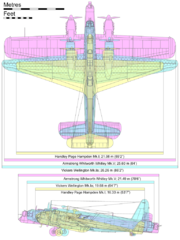 The British Government did not want to violate its agreement by attacking civilian targets outside combat zones, and the French were even more concerned lest Bomber Command operations provoke a German bombing attack on France. Since the Armée de l'Air had few modern fighters and no defence network comparable to the British chain of radar stations
, France was effectively prostrate before the threat of a German bombing attack. The final problem was lack of good enough aircraft. The main Bomber Command workhorses at the start of the war, aircraft such as the Vickers Wellington
, Armstrong Whitworth Whitley
, and Handley Page Hampden/Hereford
, had been designed as tactical-support medium bombers, and none of them had enough range or ordnance capacity for anything more than a limited strategic offensive.
Bomber Command became even smaller after the declaration of war. No. 1 Group
, with its squadrons of Fairey Battle
s, left for France to form the Advanced Air Striking Force. This was for two reasons; to give the British Expeditionary Force
some air striking power, and to allow the Battles to operate against German targets - they lacked the range to do so from British airfields.
The Sitzkrieg (or Phony War
) mainly affected the army. However, to an extent, Bomber Command too saw little combat during the first few months of hostilities. Bomber Command flew many operational missions, and lost aircraft, but it did virtually no damage to the enemy. Most of the missions either failed to find their targets, or were leaflet-dropping missions (the first flights by RAF bombers over the German homeland were only to drop propaganda leaflets at night). The attack in the west in May 1940 changed everything.
The Fairey Battles of the Advanced Air Striking Force were partially disabled by German strikes on their airfields at the opening of the invasion of France. However, far from all of the force was caught on the ground. The Faireys proved to be horrendously vulnerable to enemy fire. Many times, Battles would set out to attack, and be almost wiped out in the process. Due to French paranoia about being attacked by German aircraft during the "Phony War", the Battle force had actually trained over German airspace at night.
Following the German Rotterdam Blitz
of 14 May 1940, RAF Bomber Command was authorized to attack German targets east of the Rhine on May 15, 1940; the Air Ministry authorized Air Marshal
Charles Portal to attack targets in the Ruhr
, including oil
plants and other civilian industrial
targets which aided the German war effort, such as blast furnace
s (which at night were self-illuminating). The first attack took place on the night of 15/16 May, with 96 bombers setting off to attack targets east of the Rhine, 78 of which were against oil targets. Of these, only 24 claimed to have found their targets. Bomber Command's strategic bombing campaign on Germany had thus begun.
Bomber Command itself soon fully joined in the action. With the rapid collapse of France, invasion of England seemed a clear and present danger. As its part in Battle of Britain
, Bomber Command was assigned to pound the invasion barges and fleets assembling in the Channel ports. This was much less high profile than the battles of the Spitfires and Hurricanes of RAF Fighter Command
, but still vital and dangerous work. From July 1940 to the end of the year, Bomber Command lost nearly 330 aircraft and over 1,400 aircrew killed, missing or captured.
Bomber Command was also indirectly responsible, in part at least, for the switch of Luftwaffe
attention away from Fighter Command to bombing civilian targets. A German bomber on a raid got lost due to poor navigation and bombed London. Churchill consequently ordered a retaliatory raid on the German capital of Berlin. The damage caused was minor, but the raid sent Hitler into a rage. He ordered the Luftwaffe to level British cities, thus precipitating the Blitz
.
Like the United States Army Air Forces
later in the war, Bomber Command had first concentrated on a doctrine of "precision" bombing in daylight. However, when well-organised German defence cut several British raids to pieces in late 1939, a switch to night attack tactics was forced upon the Command. The problems of enemy defences were then replaced with the problems of simply finding the target. It was common in the early years of the war for bombers relying on dead reckoning navigation to miss entire cities. Surveys of bombing photographs and other sources published during August 1941 indicated that less than one bomb in ten fell within 5 miles (8 km) of its intended target. One of the most urgent problems of the Command was thus to develop technical navigational aids to allow the bombers to find, at least, the right part of the country.
, 2
, 3
, 4
and 5
Groups. No. 1 Group was soon sent to France. It was, however, returned to Bomber Command control after the evacuation of France, and reconstituted. No. 2 Group consisted of light and medium bombers who, although operating both by day and night, remained part of Bomber Command until 1943, when it was removed to the control of Second Tactical Air Force
, to form the light bomber
component of that command. Bomber Command also gained two new groups during the war: the Royal Canadian Air Force
(RCAF) squadrons were organised into No. 6 Group
and the Pathfinder Force
was expanded to form No. 8 (Pathfinder) Group
from existing squadrons.
Many squadrons and personnel from Commonwealth and other European countries were distributed throughout Bomber Command. No. 6 Group, which was activated on 1 January 1943, was unique among Bomber Command groups, in that it was not an RAF unit; it was a Canadian unit attached to Bomber Command. At its peak strength, 6 Group consisted of 14 operational RCAF bomber squadrons, and 15 different squadrons served with the group. No. 8 Group, also known as the Pathfinder Force, was activated on 15 August 1942. It was a critical part of solving the navigational and aiming problems experienced. Bomber Command solved its navigational problems using two methods. One was the use of a range of increasingly sophisticated electronic aids to navigation and the other was the use of specialist Pathfinder
s. The technical aids to navigation took two forms. One was external radio navigation
aids, as exemplified by Gee
and the later highly-accurate Oboe
systems. The other was the centimetric navigation equipment H2S radar
carried in the bombers themselves. The Pathfinders were a group of elite, specially trained and experienced crews who flew ahead and with the main bombing forces, and marked the targets with flares and special marker-bombs. No. 8 Group controlled the Pathfinder squadrons.
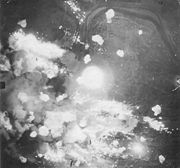 By late 1941 RAF Bomber Command regularly mounted raids involving hundreds of aircraft.
revealed shocking inaccuracies in targeting (Churchill recognised "this is a very serious paper and seems to require urgent attention"),The Area Bombing Directive
of 14 February 1942 ordered Bomber Command to target German industrial areas and the "morale of... the indutrial workers". The directive also reversed the order of the previous year to conserve its forces - this resulted in a large campaign of area bombardment
against the Ruhr area. Professor Frederick Lindemann
's dehousing paper
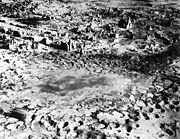
of March identified the expected effectiveness of targeting residential and general industrial areas of cities. The aerial bombing of cities
such as the Operation Millennium raid on Cologne
continued throughout the rest of the Second World War, culminating in the bombing of Dresden in 1945.
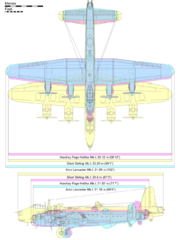
 In 1942, the main workhorse aircraft of the later part of the war came into service. The Halifax and Lancaster
made up the backbone of the Command - they had a longer range, higher speed and much greater bomb load than the earlier aircraft. The stirling and Wellington bombers were not taken out of service but used on last demanding tasks such as mine-laying. The classic aircraft of the Pathfinders, the de Havilland Mosquito
, also made its appearance. By 25 July 1943, the Bomber Command headquarters was "a substantial set of red brick buildings, hidden in the middle of a forest on top of a hill in the English county of Buckinghamshire."
A prolonged offensive against the Rhine-Ruhr
area (nicknamed "Happy Valley" by aircrew) began on the night of 5/6 March 1943 with the first raid of the Battle of the Ruhr
flew RAF Bomber Command's 100,000th sortie of the Second World War which destroyed 160 acre (0.6474976 km²) and hit 53 Krupps buildings
. The series of raids on Hamburg (the Battle of Hamburg) in mid 1943 was one of the most successful Command operations, although Harris' extension of the offensive into the Battle of Berlin
failed to decimate the capital and cost his force over 1,000 crews through the winter of 1943-44. In August 1943, the RAF Operation Hydra
preventative bombing of the Peenemünde
V-2 rocket
facility opened the secondary Crossbow
campaign against long range weapons.
By April 1944, Harris was forced to reduce his strategic offensive as the bomber force was directed to (much to his annoyance) to tactical and transport communications targets
in France in support of the imminent invasion of Normandy. The anti-transport offensive proved highly effective.
By late 1944, bombing such as Operation Hurricane
(to demonstrate the capabilities of the combined British and US bomber forces), competed against the German defences
, and Bomber Command was capable of putting 1,000 aircraft over a target without extraordinary efforts. Within 24 hours of Operation Hurricane, the RAF dropped about 10,000 tonnes of bombs in total on Duisburg
and Brunswick
, the greatest bomb load dropped on any single day in the Second World War.
The peak of Bomber Command's operations occurred in the raids of March 1945, when its squadrons dropped their highest amount of ordnance (by weight) for any month in the entire war. Wesel
in the Rhineland, bombed repeatedly on 16, 17, 18 and 19 February, was bombed again on the 23 March, leaving the city "97% destroyed". The last raid on Berlin took place on the night of 21–22 April, when 76 Mosquitos made six separate attacks just before Soviet forces entered the city centre. Most of the rest of the RAF bombing raids provided tactical support. The last major strategic raid was the destruction of the oil refinery at Vallø
, Tønsberg
in southern Norway
by 107 Lancasters, on the night of 25-26 of April.
Once the surrender of Germany had occurred, plans were put in place to send a "Very Long Range Bomber Force" known as Tiger Force
to participate in the Pacific war against Japan. Made up of about 30 British Commonwealth
heavy bomber squadronsA scaling back from the original plan of about 1,000 aircraft to be based on Okinawa, and there was a re-organisation of groups within Bomber Command for the proposed invasion of Japan
.
However, the Bombing of Hiroshima and Nagasaki occurred before any part of the force had been transferred to the Pacific.
. Until 1942 navigational technology did not allow for any more precise targeting than at best a district of a town or city by night bombing. All large German cities contained important industrial districts and so were considered legitimate targets by the Allies. New methods were introduced to create "firestorms". The single most destructive raids in terms of absolute casualties were those on Hamburg
(45,000 dead) in 1943 and Dresden
(25,000–35,000 dead) in 1945. Each caused a firestorm
and left tens of thousands dead. Other large raids on German cities which resulted in high civil casualties were Darmstadt
(12,300 dead), Pforzheim
(17,600 dead) and Kassel
(10,000 dead).
Regarding the legality of the campaign, an article in the International Review of the Red Cross stated:
Bomber Command crews also suffered an extremely high casualty rate: 55,573 killed out of a total of 125,000 aircrew (a 44.4% death rate), a further 8,403 were wounded in action and 9,838 became prisoners of war. This covered all Bomber Command operations including tactical support for ground operations and mining of sea lanes. A Bomber Command crew member had a worse chance of survival than an infantry officer in World War I. By comparison, the US Eighth Air Force
, which flew daylight raids over Europe, had 350,000 aircrew during the war, and suffered 26,000 killed and 23,000 POWs. Of the RAF Bomber Command personnel killed during the war, 72% were British, 18% were Canadian, 7% were Australian and 3% were New Zealanders.
Taking an example of 100 airmen:
In total 364,514 operational sorties were flown, 1,030,500 tons of bombs were dropped and 8,325 aircraft lost in action.
Harris was advised by an Operational Research Section (ORS) under a civilian, Basil Dickins, supported by a small team of mathematicians and scientists. ORS2 (under Reuben Smeed
) was concerned with analysing bomber losses. They were able to influence operations by identifying successful defensive tactics and equipment, though some of their more controversial advice (such as removing ineffectual turrets from bombers to increase defensive speed) was ignored.
The very high casualty levels suffered give testimony to the dedication and courage of Bomber Command's aircrew in carrying out their orders. Statistically
there was little prospect of surviving a tour of 30 operations, and by 1943 the odds against survival were pretty grim with only one in six expected to survive their first tour, while a slim one in forty would survive their second tour . For much of the war, the loss rate hovered around 5%, about 1 in 20 aircraft would, on average, be shot down although obviously there was great variation here, on some occasions the loss rate exceeded 10% sometimes much higher than that.
Sir Arthur Harris himself believed that there was a relationship between tonnage dropped, city areas destroyed, and lost production. The effect of Bomber Command's attacks on industrial production is not so clear cut. The much better provided US survey
was little concerned with the RAF area bombing campaign. It pointed to the great success of the USAAF's attacks on Germany's synthetic oil plants starting in the spring of 1944 - this had a crippling effect on German transportation and prevented the Luftwaffe from flying to anything like the order of battle that the aviation engine plants, parts and sub-assembly fabrication and final assembly manufacturing facilities; Luftwaffe training and logistics could have otherwise sustained. Further, in going for targets they knew the Germans must defend, the American escort fighters were able to inflict crippling losses on the Luftwaffe's fighter force. However it should be pointed out that the RAF also made a great contribution to the oil offensive as its abilities to attack precision targets had greatly improved- by mid 1944 it was mounting huge bombing raids in daylight too.
Albert Speer
, Hitler's Minister of Armaments noted that the larger British bombs
did much more damage and so made repair more difficult, and sometimes impossible. Shortly after the war's end, Speer was unequivocal about the effect of this:
In terms of overall production decrease resulting from the RAF area attacks, the US survey, based upon limited research, found that in 1943 it amounted to 9% and in 1944 to 17%. Relying on US gathered statistics the British survey found that actual arms production decreases were a mere 3% for 1943, and 1% for 1944. However they did find decreases of 46.5% and 39% in the second half of 1943 and 1944 respectively in the metal processing industries. These losses resulted from the devastating series of raids the Command launched on the Ruhr Valley at these times.
This apparent lack of success is accounted for in several ways. The German industrial economy was so strong, its industrial bases so widely spread, that it was a hopeless task to try and crush it by area bombing. Further, up until 1943 it is undoubtedly the case that Germany was not fully mobilised for war, Speer remarked that single shift factory working was commonplace, and so there was plenty of slack in the system. It has been argued that the RAF campaign placed a limit on German arms production. This may be true but it is also the case that the German forces did not run out of arms and ammunition and that it was manpower that was a key limiting factor, as well as the destruction of transport facilities and the fuel to move.
Some positive points should be made. The greatest contribution to winning the war made by Bomber Command was in the huge diversion of German resources into defending the homeland; this was very considerable indeed. By January 1943 some 1,000 Luftwaffe night fighters were committed to the defence of the Reich mostly twin engined Me 110 and Ju 88. Most critically, by September 1943, 8,876 of the deadly, dual purpose 88 mm guns were also defending the homeland with a further 25,000 light flak guns 20/37 mm. The 88mm gun was an effective AA weapon, it was a deadly destroyer of tanks and lethal against advancing infantry. These weapons would have done much to augment German anti-tank defences on the Russian front.
To man these weapons the flak regiments in Germany required some 90,000 fit personnel, and a further 1 million were deployed in clearing up and repairing the vast bomb-damage caused by the RAF attacks. To put this into perspective General Erwin Rommel
's German forces defending Normandy in 1944
comprised 50,000 men, and their resistance caused the Western Allies grave problems.
This diversion to defensive purposes of German arms and manpower was an enormous contribution made by RAF Bomber Command to winning the war. By 1944 the bombing offensive was costing Germany 30% of all artillery production, 20% of heavy shells, 33% of the output of the optical industry for sights and aiming devices and 50% of the country's electro-technical output which had to be diverted to the anti-aircraft role.
From the British perspective it should be noted that the RAF offensive made a great contribution in sustaining morale during the dark days of the war, especially during the bleak winter of 1941-42. It was the only means that Britain possessed of taking the war directly to the enemy at that time.
es, known to the RAF as Boeing Washingtons. These aircraft added another level of capability to a fleet dominated by Avro Lincoln
s, an update of the Lancaster.
The first jet bomber, the English Electric Canberra
light bomber, became operational in 1951. Some Canberras remained in RAF service up to 2006 as photo-reconnaissance aircraft. The model proved an extremely successful aircraft, being exported to many countries and being license-built in the United States. The joint US-UK Project E
was pushed through to make nuclear weapons available to Bomber Command in an emergency, with the Canberras the first aircraft to benefit. The next jet bomber to enter service was the Vickers Valiant
in 1955, the first of the V bombers.
The V bombers were conceived as the replacement for the wartime Lancasters and Halifaxes. Three advanced aircraft were developed from 1946, along with the Short Sperrin
fall-back design, which many argue was a waste of resources. They contend that one design should have been pursued, enabling a larger production run, but this is with 20/20 hindsight, it not being possible to predict which designs would be successful at the time. The V bombers became the backbone of the British nuclear forces and comprised the Valiant, Handley Page Victor
(in service in 1958) and Avro Vulcan
(1956).
In 1956, Bomber Command faced its first operational test since World War II, and its last major action in anger. The Egyptian Government nationalised the Suez Canal
during that year, and the British Government decided to take military action. During the Suez Crisis
, Bomber Command Canberras were deployed to Cyprus
and Malta
and Valiants were deployed to Malta
. The Canberra performed well, but the Valiant had problems; since it had just been introduced into service, this was hardly surprising. The Canberras were also vulnerable to attack by the Egyptian Air Force
, which fortunately did not choose to attack the crowded airfields of Cyprus
(RAF Akrotiri
and RAF Nicosia
holding nearly the whole RAF strike force, with a recently reactivated and poor quality airfield taking much of the French force). Over 100 Bomber Command aircraft took part in operations against Egypt. By World War II standards, the scale of attack was light.
Between 1959 and 1963, in addition to manned aircraft, Bomber Command was also equipped with 60 Thor
nuclear intermediate range ballistic missiles dispersed to 20 RAF stations around Britain, in a joint UK-US operation known as Project Emily
.
During the following twelve years, Bomber Command aircraft frequently deployed overseas to the Far East and Middle East. They were particularly used as a deterrent to Sukarno
's Indonesia
during the Konfrontasi. A detachment of Canberras was also permanently maintained at Akrotiri in Cyprus in support of CENTO
obligations.
As the remaining V bombers came into service in the late 1950s, the British nuclear deterrent was gaining notice. The first British atomic bomb was tested in 1952, with the first hydrogen bomb being exploded in 1957. Operation Grapple
saw Valiant bombers dropping hydrogen bombs over Christmas Island
.
Nuclear annihilation came dramatically to world attention during 1962. The Cuban missile crisis
was one of the closest brushes with nuclear conflict the world has seen. During that tense period, Bomber Command aircraft maintained continuous strip alerts, ready to take off at a moment's notice, and the Thor missiles were likewise maintained at advanced readiness. Heavy bombers were effectively doing what Fighter Command had done in 1940 in terms of reaction time. However, at no time did the Prime Minister take the decision to disperse the Bomber Command aircraft to satellite airfields, lest that be viewed as an aggressive step.
By the early 1960s, doubts were surfacing about the ability of Bomber Command to pierce the defences of the Soviet Union. The shooting down of a U-2
spyplane in 1960 confirmed that the Soviet Union did have surface-to-air missile
s capable of reaching the heights that bombers operated at. Since WWII, the philosophy of bombers had been to go higher and faster. That found its ultimate expression in the XB-70 Valkyrie
, developed for the USAF, but subsequently cancelled. With the deprecation of high and fast tactics, the new mantra became ultra-low-level attack. However, since the Bomber Command aircraft had not originally been designed for that kind of attack profile, problems were caused, primarily in airframe fatigue. The Valiant was the first to suffer; severe airframe fatigue meant that all Valiants were grounded in October 1964, and permanently withdrawn from service in January 1965. Low-level operations also reduced the lifespan of the Victors and Vulcans.
Bomber Command's other main function was to provide tanker aircraft to the RAF. The Valiant was the first bomber used as a tanker operationally. Trials had been carried out with air to air refuelling using Lincolns and Meteors
, and had proved successful, so many of the new bombers were designed to be able to be used in the tanker role; indeed, some Valiants were produced as a dedicated tanker variant. As high-level penetration declined as an attack technique, the Valiant saw more and more use as a tanker. With the introduction of the Victor B2, the earlier models of that aircraft were also converted to tankers. The withdrawal of the Valiant from service caused the conversion of many of the Victors to tankers to be greatly speeded up. The Vulcan also saw service as a tanker, but only in an improvised conversion during the Falklands War
. Ironically, in the tanker role, the Victor not only outlived Bomber Command, but also all the other V bombers by nine years.
In a further attempt to make the operation of the bomber force safer, attempts were made to develop stand-off weapons, with which capability the bombers would not have to penetrate Soviet airspace. However, efforts to do so had only limited success. The first attempt involved the Blue Steel missile
. It worked, but its range meant that bombers still had to enter Soviet airspace. Longer-range systems were developed, but failed and/or were cancelled. This fate befell the Mark 2 of the Blue Steel, its replacement, the American Skybolt ALBM and the ground-based Blue Streak
programme.
However, attempts to develop a stand-off nuclear deterrent were eventually successful. The American Polaris missile was procured, and Royal Navy
submarines built to carry them. The modern form of the British nuclear force was thus essentially reached. Royal Navy submarines relieved the RAF of the nuclear deterrent mission in 1969, but by that point, Bomber Command was no more.
In the postwar period, the RAF slowly declined in strength, and by the mid-1960s it had become clear that the home-command structure needed rationalisation. To that end, RAF Fighter Command
and Bomber Command were merged in 1968 to form Strike Command
. RAF Coastal Command
also followed shortly thereafter.
Bomber Command had a successful period of existence. Its early potential was at first not realised but, with the development of better navigation and aircraft, it carried the war to the enemy in spectacular fashion. Postwar, it carried Britain's nuclear deterrent through a difficult period, and continued the fine traditions existing in 1945.
spearheaded an effort to memorialize those who lost their lives during World War II and in April, 2011, it was annouced that the £5.6million needed to build the memorial was raised. The foundation stone of the Bomber Command Memorial for the crews of Bomber Command was laid in Green Park, London on 4 May 2011.
|-
Royal Air Force
The Royal Air Force is the aerial warfare service branch of the British Armed Forces. Formed on 1 April 1918, it is the oldest independent air force in the world...
's bomber forces from 1936 to 1968. During World War II
World War II
World War II, or the Second World War , was a global conflict lasting from 1939 to 1945, involving most of the world's nations—including all of the great powers—eventually forming two opposing military alliances: the Allies and the Axis...
the command destroyed a significant proportion of Nazi Germany
Nazi Germany
Nazi Germany , also known as the Third Reich , but officially called German Reich from 1933 to 1943 and Greater German Reich from 26 June 1943 onward, is the name commonly used to refer to the state of Germany from 1933 to 1945, when it was a totalitarian dictatorship ruled by...
's industries and many German cities, and in the 1960s stood at the peak of its postwar military power with the V bomber
V bomber
The term V bomber was used for the Royal Air Force aircraft during the 1950s and 1960s that comprised the United Kingdom's strategic nuclear strike force known officially as the V-force or Bomber Command Main Force...
s and a supplemental force of Canberra
English Electric Canberra
The English Electric Canberra is a first-generation jet-powered light bomber manufactured in large numbers through the 1950s. The Canberra could fly at a higher altitude than any other bomber through the 1950s and set a world altitude record of 70,310 ft in 1957...
light bombers. RAF Bomber Command had 19 Victoria Cross winners.Seven of the VCs were to members of Dominion air forces and nine were posthumous. Two personnel from the same aircrew received the VC as a result of their actions on May 12, 1940. With the Germans breaking through, 12 Squadron
No. 12 Squadron RAF
No. 12 Squadron of the Royal Air Force currently operates the Tornado GR4 from RAF Lossiemouth.-History:No. 12 Squadron Royal Flying Corps was formed in February 1915 from a flight of No. 1 Squadron RFC at Netheravon. The squadron moved to France in September 1915 and operated a variety of aircraft...
, flying obsolete Fairey Battle
Fairey Battle
The Fairey Battle was a British single-engine light bomber built by the Fairey Aviation Company in the late 1930s for the Royal Air Force. The Battle was powered by the same Rolls-Royce Merlin piston engine that gave contemporary British fighters high performance; however, the Battle was weighed...
s, was ordered to attack two bridges on the Albert Canal
Albert Canal
The Albert Canal is a canal located in northeastern Belgium, named after King Albert I of Belgium. It connects the major cities Antwerp and Liège and the Meuse and Scheldt rivers. It has a depth of , a free height of and a total length of...
near Maastricht
Maastricht
Maastricht is situated on both sides of the Meuse river in the south-eastern part of the Netherlands, on the Belgian border and near the German border...
. The whole squadron volunteered and five aircraft, all that were available, took off. Four Battles were shot down by flak and German fighters, while the fifth staggered back to base heavily damaged. One of the four shot down was piloted by Flying Officer Donald Garland, who dived from 6000 feet (1,828.8 m) in the face of intense fire, and succeeded in destroying one of the bridges. He and his observer, Sgt Tom Gray
Thomas Gray (VC)
Thomas Gray VC was an English recipient of the Victoria Cross, the highest and most prestigious award for gallantry in the face of the enemy that can be awarded to British and Commonwealth forces....
, both received the posthumous award of the Victoria Cross.
In August 2006, a memorial was unveiled at Lincoln Cathedral
Lincoln Cathedral
Lincoln Cathedral is a historic Anglican cathedral in Lincoln in England and seat of the Bishop of Lincoln in the Church of England. It was reputedly the tallest building in the world for 249 years . The central spire collapsed in 1549 and was not rebuilt...
. A memorial is also proposed for Green Park in London to highlight the price paid by the aircrews.
History 1936–1945
At the time of the formation of Bomber Command in 1936, Giulio DouhetGiulio Douhet
General Giulio Douhet was an Italian general and air power theorist. He was a key proponent of strategic bombing in aerial warfare...
's slogan "the bomber will always get through
The bomber will always get through
The bomber will always get through was a phrase used by Stanley Baldwin in 1932, in the speech "A Fear for the Future" to the British Parliament...
" was popular, and was cited by figures like Stanley Baldwin
Stanley Baldwin
Stanley Baldwin, 1st Earl Baldwin of Bewdley, KG, PC was a British Conservative politician, who dominated the government in his country between the two world wars...
. Until advances in radar
Radar
Radar is an object-detection system which uses radio waves to determine the range, altitude, direction, or speed of objects. It can be used to detect aircraft, ships, spacecraft, guided missiles, motor vehicles, weather formations, and terrain. The radar dish or antenna transmits pulses of radio...
technology in the late 1930s, this statement was effectively true. Attacking bombers could not be detected early enough to assemble fighters fast enough to prevent them reaching their targets. Some damage might be done to the bombers by AA guns, and by fighters as the bombers returned to base, but that was not the same as a proper defence. Consequently, the early conception of Bomber Command was in some ways akin to its later role as a nuclear deterrent force. It was seen as an entity that threatened the enemy with utter destruction, and thus prevented war. However, in addition to being made obsolete by technology, even if the bomber did always get through, its potential for damage to cities was massively overrated.
The problem was that the British Government was basing its data on a casualty rate of 50 deaths per ton of bombs dropped. The basis for this assumption was a few raids on London in the later stages of World War I
World War I
World War I , which was predominantly called the World War or the Great War from its occurrence until 1939, and the First World War or World War I thereafter, was a major war centred in Europe that began on 28 July 1914 and lasted until 11 November 1918...
, by Zeppelin
Zeppelin
A Zeppelin is a type of rigid airship pioneered by the German Count Ferdinand von Zeppelin in the early 20th century. It was based on designs he had outlined in 1874 and detailed in 1893. His plans were reviewed by committee in 1894 and patented in the United States on 14 March 1899...
s and Gotha bombers. Both the government and the general public viewed the bomber as a far more terrible weapon than it really was.
The early years of World War II
At the start of World War II in 1939, Bomber Command faced four problems. The first was lack of size; Bomber Command was not large enough to effectively attack the enemy as a pure, stand-alone strategic force. The second was rules of engagement; at the start of the war, the targets allocated to Bomber Command were not wide enough in scope. The third problem was the Command's lack of technology; specifically radio or radar derived navigational aids to allow accurate target location at night or through cloud. The fourth problem was the limited accuracy of bombing, especially from high level, even when the target could be clearly located by the bomb aimer.When the war began on 1 September 1939, Franklin D. Roosevelt
Franklin D. Roosevelt
Franklin Delano Roosevelt , also known by his initials, FDR, was the 32nd President of the United States and a central figure in world events during the mid-20th century, leading the United States during a time of worldwide economic crisis and world war...
, President of the then-neutral
Neutrality (international relations)
A neutral power in a particular war is a sovereign state which declares itself to be neutral towards the belligerents. A non-belligerent state does not need to be neutral. The rights and duties of a neutral power are defined in Sections 5 and 13 of the Hague Convention of 1907...
United States, issued an appeal to the major belligerents to confine their air raids to military targets. The French and British agreed to abide by the request, which included the provision "that these same rules of warfare will be scrupulously observed by all of their opponents". The United Kingdom's policy was to restrict bombing to military targets and infrastructure
Infrastructure
Infrastructure is basic physical and organizational structures needed for the operation of a society or enterprise, or the services and facilities necessary for an economy to function...
such as ports and railways which were of military importance. While acknowledging that bombing Germany would cause civilian casualties, the British government renounced deliberate bombing of civilian property (outside combat zones) as a military tactic. The British abandoned this policy at the end of the Phony War
Phony War
The Phoney War was a phase early in World War II – in the months following Britain and France's declaration of war on Germany in September 1939 and preceding the Battle of France in May 1940 – that was marked by a lack of major military operations by the Western Allies against the German Reich...
on 15 May 1940, one day after the Rotterdam Blitz
Rotterdam Blitz
The Rotterdam Blitz refers to the aerial bombardment of Rotterdam by the German Air Force on 14 May 1940, during the German invasion of the Netherlands in World War II. The objective was to support the German troops fighting in the city, break Dutch resistance and force the Dutch to surrender...
.
Chain Home
Chain Home was the codename for the ring of coastal Early Warning radar stations built by the British before and during the Second World War. The system otherwise known as AMES Type 1 consisted of radar fixed on top of a radio tower mast, called a 'station' to provide long-range detection of...
, France was effectively prostrate before the threat of a German bombing attack. The final problem was lack of good enough aircraft. The main Bomber Command workhorses at the start of the war, aircraft such as the Vickers Wellington
Vickers Wellington
The Vickers Wellington was a British twin-engine, long range medium bomber designed in the mid-1930s at Brooklands in Weybridge, Surrey, by Vickers-Armstrongs' Chief Designer, R. K. Pierson. It was widely used as a night bomber in the early years of the Second World War, before being displaced as a...
, Armstrong Whitworth Whitley
Armstrong Whitworth Whitley
The Armstrong Whitworth A.W.38 Whitley was one of three British twin-engine, front line medium bomber types in service with the Royal Air Force at the outbreak of the Second World War...
, and Handley Page Hampden/Hereford
Handley Page Hampden
The Handley Page HP.52 Hampden was a British twin-engine medium bomber of the Royal Air Force serving in the Second World War. With the Whitley and Wellington, the Hampden bore the brunt of the early bombing war over Europe, taking part in the first night raid on Berlin and the first 1,000-plane...
, had been designed as tactical-support medium bombers, and none of them had enough range or ordnance capacity for anything more than a limited strategic offensive.
Bomber Command became even smaller after the declaration of war. No. 1 Group
No. 1 Group RAF
Number 1 Group of the Royal Air Force is one of the two operations groups in Air Command.The group is today referred to as the Air Combat Group, as it controls the RAF's combat fast-jet aircraft and has airfields in the UK plus RAF Unit Goose Bay in Canada, which is used extensively as an...
, with its squadrons of Fairey Battle
Fairey Battle
The Fairey Battle was a British single-engine light bomber built by the Fairey Aviation Company in the late 1930s for the Royal Air Force. The Battle was powered by the same Rolls-Royce Merlin piston engine that gave contemporary British fighters high performance; however, the Battle was weighed...
s, left for France to form the Advanced Air Striking Force. This was for two reasons; to give the British Expeditionary Force
British Expeditionary Force (World War II)
The British Expeditionary Force was the British force in Europe from 1939–1940 during the Second World War. Commanded by General Lord Gort, the BEF constituted one-tenth of the defending Allied force....
some air striking power, and to allow the Battles to operate against German targets - they lacked the range to do so from British airfields.
The Sitzkrieg (or Phony War
Phony War
The Phoney War was a phase early in World War II – in the months following Britain and France's declaration of war on Germany in September 1939 and preceding the Battle of France in May 1940 – that was marked by a lack of major military operations by the Western Allies against the German Reich...
) mainly affected the army. However, to an extent, Bomber Command too saw little combat during the first few months of hostilities. Bomber Command flew many operational missions, and lost aircraft, but it did virtually no damage to the enemy. Most of the missions either failed to find their targets, or were leaflet-dropping missions (the first flights by RAF bombers over the German homeland were only to drop propaganda leaflets at night). The attack in the west in May 1940 changed everything.
The Fairey Battles of the Advanced Air Striking Force were partially disabled by German strikes on their airfields at the opening of the invasion of France. However, far from all of the force was caught on the ground. The Faireys proved to be horrendously vulnerable to enemy fire. Many times, Battles would set out to attack, and be almost wiped out in the process. Due to French paranoia about being attacked by German aircraft during the "Phony War", the Battle force had actually trained over German airspace at night.
Following the German Rotterdam Blitz
Rotterdam Blitz
The Rotterdam Blitz refers to the aerial bombardment of Rotterdam by the German Air Force on 14 May 1940, during the German invasion of the Netherlands in World War II. The objective was to support the German troops fighting in the city, break Dutch resistance and force the Dutch to surrender...
of 14 May 1940, RAF Bomber Command was authorized to attack German targets east of the Rhine on May 15, 1940; the Air Ministry authorized Air Marshal
Air Marshal
Air marshal is a three-star air-officer rank which originated in and continues to be used by the Royal Air Force...
Charles Portal to attack targets in the Ruhr
Ruhr
The Ruhr is a medium-size river in western Germany , a right tributary of the Rhine.-Description:The source of the Ruhr is near the town of Winterberg in the mountainous Sauerland region, at an elevation of approximately 2,200 feet...
, including oil
Oil
An oil is any substance that is liquid at ambient temperatures and does not mix with water but may mix with other oils and organic solvents. This general definition includes vegetable oils, volatile essential oils, petrochemical oils, and synthetic oils....
plants and other civilian industrial
Industry
Industry refers to the production of an economic good or service within an economy.-Industrial sectors:There are four key industrial economic sectors: the primary sector, largely raw material extraction industries such as mining and farming; the secondary sector, involving refining, construction,...
targets which aided the German war effort, such as blast furnace
Blast furnace
A blast furnace is a type of metallurgical furnace used for smelting to produce industrial metals, generally iron.In a blast furnace, fuel and ore and flux are continuously supplied through the top of the furnace, while air is blown into the bottom of the chamber, so that the chemical reactions...
s (which at night were self-illuminating). The first attack took place on the night of 15/16 May, with 96 bombers setting off to attack targets east of the Rhine, 78 of which were against oil targets. Of these, only 24 claimed to have found their targets. Bomber Command's strategic bombing campaign on Germany had thus begun.
Bomber Command itself soon fully joined in the action. With the rapid collapse of France, invasion of England seemed a clear and present danger. As its part in Battle of Britain
Battle of Britain
The Battle of Britain is the name given to the World War II air campaign waged by the German Air Force against the United Kingdom during the summer and autumn of 1940...
, Bomber Command was assigned to pound the invasion barges and fleets assembling in the Channel ports. This was much less high profile than the battles of the Spitfires and Hurricanes of RAF Fighter Command
RAF Fighter Command
RAF Fighter Command was one of three functional commands of the Royal Air Force. It was formed in 1936 to allow more specialised control of fighter aircraft. It served throughout the Second World War, gaining recognition in the Battle of Britain. The Command continued until 17 November 1943, when...
, but still vital and dangerous work. From July 1940 to the end of the year, Bomber Command lost nearly 330 aircraft and over 1,400 aircrew killed, missing or captured.
Bomber Command was also indirectly responsible, in part at least, for the switch of Luftwaffe
Luftwaffe
Luftwaffe is a generic German term for an air force. It is also the official name for two of the four historic German air forces, the Wehrmacht air arm founded in 1935 and disbanded in 1946; and the current Bundeswehr air arm founded in 1956....
attention away from Fighter Command to bombing civilian targets. A German bomber on a raid got lost due to poor navigation and bombed London. Churchill consequently ordered a retaliatory raid on the German capital of Berlin. The damage caused was minor, but the raid sent Hitler into a rage. He ordered the Luftwaffe to level British cities, thus precipitating the Blitz
The Blitz
The Blitz was the sustained strategic bombing of Britain by Nazi Germany between 7 September 1940 and 10 May 1941, during the Second World War. The city of London was bombed by the Luftwaffe for 76 consecutive nights and many towns and cities across the country followed...
.
Like the United States Army Air Forces
United States Army Air Forces
The United States Army Air Forces was the military aviation arm of the United States of America during and immediately after World War II, and the direct predecessor of the United States Air Force....
later in the war, Bomber Command had first concentrated on a doctrine of "precision" bombing in daylight. However, when well-organised German defence cut several British raids to pieces in late 1939, a switch to night attack tactics was forced upon the Command. The problems of enemy defences were then replaced with the problems of simply finding the target. It was common in the early years of the war for bombers relying on dead reckoning navigation to miss entire cities. Surveys of bombing photographs and other sources published during August 1941 indicated that less than one bomb in ten fell within 5 miles (8 km) of its intended target. One of the most urgent problems of the Command was thus to develop technical navigational aids to allow the bombers to find, at least, the right part of the country.
Organisation
Bomber Command comprised a number of Groups. It began the war with Nos. 1No. 1 Group RAF
Number 1 Group of the Royal Air Force is one of the two operations groups in Air Command.The group is today referred to as the Air Combat Group, as it controls the RAF's combat fast-jet aircraft and has airfields in the UK plus RAF Unit Goose Bay in Canada, which is used extensively as an...
, 2
No. 2 Group RAF
Number 2 Group is a Group of the Royal Air Force which was first activated in 1918, served from 1918–20, from 1936 through the Second World War to 1947, from 1948 to 1958, from 1993 to 1996, was reactivated in 2000, and is today part of Air Command....
, 3
No. 3 Group RAF
Number 3 Group of the Royal Air Force was an RAF group first active in 1918, again in 1923-26, part of RAF Bomber Command from 1936 to 1967, and part of RAF Strike Command from 2000 until it disbanded on 1 April 2006.-The 1930s and World War II:...
, 4
No. 4 Group RAF
No. 4 Group was a Royal Air Force group, originally formed in World War I, and reformed in the wake of the Second World War, mostly part of RAF Bomber Command, but ending its days in RAF Transport Command.-Formation in World War I:...
and 5
No. 5 Group RAF
No. 5 Group was a Royal Air Force bomber group of the Second World War, led during the latter part by AVM Sir Ralph Cochrane.-History:The Group was formed on 1 September 1937 with headquarters at RAF Mildenhall....
Groups. No. 1 Group was soon sent to France. It was, however, returned to Bomber Command control after the evacuation of France, and reconstituted. No. 2 Group consisted of light and medium bombers who, although operating both by day and night, remained part of Bomber Command until 1943, when it was removed to the control of Second Tactical Air Force
RAF Second Tactical Air Force
The former RAF Second Tactical Air Force was one of three tactical air forces within the Royal Air Force during and after the Second World War...
, to form the light bomber
Light bomber
A light bomber is a relatively small and fast class of military bomber aircraft which were primarily employed before the 1950s. Such aircraft would typically not carry more than one ton of ordnance....
component of that command. Bomber Command also gained two new groups during the war: the Royal Canadian Air Force
Royal Canadian Air Force
The history of the Royal Canadian Air Force begins in 1920, when the air force was created as the Canadian Air Force . In 1924 the CAF was renamed the Royal Canadian Air Force and granted royal sanction by King George V. The RCAF existed as an independent service until 1968...
(RCAF) squadrons were organised into No. 6 Group
No. 6 Group RCAF
No. 6 Group RCAF was an organization of Royal Canadian Air Force bomber squadrons which operated from airfields in Yorkshire, England during the Second World War. Although 6 Group was RCAF, it was controlled by the Royal Air Force as part of Bomber Command. No. 6 Group had been previously active...
and the Pathfinder Force
Pathfinder (RAF)
The Pathfinders were elite squadrons in RAF Bomber Command during World War II. They located and marked targets with flares, which a main bomber force could aim at, increasing the accuracy of their bombing...
was expanded to form No. 8 (Pathfinder) Group
No. 8 Group RAF
No. 8 Group RAF was a Royal Air Force group which existed during the final year of World War I and during World War II.-Formation in World War II:...
from existing squadrons.
Many squadrons and personnel from Commonwealth and other European countries were distributed throughout Bomber Command. No. 6 Group, which was activated on 1 January 1943, was unique among Bomber Command groups, in that it was not an RAF unit; it was a Canadian unit attached to Bomber Command. At its peak strength, 6 Group consisted of 14 operational RCAF bomber squadrons, and 15 different squadrons served with the group. No. 8 Group, also known as the Pathfinder Force, was activated on 15 August 1942. It was a critical part of solving the navigational and aiming problems experienced. Bomber Command solved its navigational problems using two methods. One was the use of a range of increasingly sophisticated electronic aids to navigation and the other was the use of specialist Pathfinder
Pathfinder (RAF)
The Pathfinders were elite squadrons in RAF Bomber Command during World War II. They located and marked targets with flares, which a main bomber force could aim at, increasing the accuracy of their bombing...
s. The technical aids to navigation took two forms. One was external radio navigation
Radio navigation
Radio navigation or radionavigation is the application of radio frequencies to determine a position on the Earth. Like radiolocation, it is a type of radiodetermination.The basic principles are measurements from/to electric beacons, especially...
aids, as exemplified by Gee
GEE (navigation)
Gee was the code name given to a radio navigation system used by the Royal Air Force during World War II.Different sources record the name as GEE or Gee. The naming supposedly comes from "Grid", so the lower case form is more correct, and is the form used in Drippy's publications. See Drippy 1946....
and the later highly-accurate Oboe
Oboe (navigation)
Oboe was a British aerial blind bombing targeting system in World War II, based on radio transponder technology. Oboe accurately measured the distance to an aircraft, and gave the pilot guidance on whether or not they were flying along a pre-selected circular route. The route was only 35 yards...
systems. The other was the centimetric navigation equipment H2S radar
H2S radar
H2S was the first airborne, ground scanning radar system. It was developed in Britain in World War II for the Royal Air Force and was used in various RAF bomber aircraft from 1943 to the 1990s. It was designed to identify targets on the ground for night and all-weather bombing...
carried in the bombers themselves. The Pathfinders were a group of elite, specially trained and experienced crews who flew ahead and with the main bombing forces, and marked the targets with flares and special marker-bombs. No. 8 Group controlled the Pathfinder squadrons.
Strategic bombing 1942-45
After the officially-commissioned 1941 Butt ReportButt Report
The Butt Report was a report prepared during World War II which revealed the widespread failure of bombers to deliver their payloads to the correct target....
revealed shocking inaccuracies in targeting (Churchill recognised "this is a very serious paper and seems to require urgent attention"),The Area Bombing Directive
Area bombing directive
The Area Bombing Directive was a directive from the wartime British Government's Air Ministry to the Royal Air Force which ordered RAF bombers to attack the German industrial workforce and the morale of the German populace through bombing German cities and their civilian inhabitants.- Background...
of 14 February 1942 ordered Bomber Command to target German industrial areas and the "morale of... the indutrial workers". The directive also reversed the order of the previous year to conserve its forces - this resulted in a large campaign of area bombardment
Area bombardment
In military aviation, area bombardment is aerial bombardment targeted indiscriminately at a large area, such as a city block or an entire city.Area bombing is a form of strategic bombing...
against the Ruhr area. Professor Frederick Lindemann
Frederick Lindemann, 1st Viscount Cherwell
Frederick Alexander Lindemann, 1st Viscount Cherwell FRS PC CH was an English physicist who was an influential scientific adviser to the British government, particularly Winston Churchill...
's dehousing paper
Dehousing
On 30 March 1942 Professor Frederick Lindemann, Baron Cherwell, the British government's chief scientific adviser, sent to the British Prime Minister Winston Churchill a memorandum which after it had become accepted by the Cabinet became known as the dehousing paper.Also known as the "dehousing...
of March identified the expected effectiveness of targeting residential and general industrial areas of cities. The aerial bombing of cities
Aerial bombing of cities
A species of strategic bombing, the aerial bombing of cities began in 1915 during World War I, grew to a vast scale in World War II, and continues to the present day. The development of aerial bombardment marked an increased capacity of armed forces to deliver explosive weapons in populated areas...
such as the Operation Millennium raid on Cologne
Bombing of Cologne in World War II
The City of Cologne was bombed in 262 separate air raids by the Allies during World War II, including 31 times by the Royal Air Force . Air raid alarms went off in the winter/spring of 1940 as enemy bombers passed overhead. However, the first actual bombing took place on 12 May 1940...
continued throughout the rest of the Second World War, culminating in the bombing of Dresden in 1945.
Avro Lancaster
The Avro Lancaster is a British four-engined Second World War heavy bomber made initially by Avro for the Royal Air Force . It first saw active service in 1942, and together with the Handley Page Halifax it was one of the main heavy bombers of the RAF, the RCAF, and squadrons from other...
made up the backbone of the Command - they had a longer range, higher speed and much greater bomb load than the earlier aircraft. The stirling and Wellington bombers were not taken out of service but used on last demanding tasks such as mine-laying. The classic aircraft of the Pathfinders, the de Havilland Mosquito
De Havilland Mosquito
The de Havilland DH.98 Mosquito was a British multi-role combat aircraft that served during the Second World War and the postwar era. It was known affectionately as the "Mossie" to its crews and was also nicknamed "The Wooden Wonder"...
, also made its appearance. By 25 July 1943, the Bomber Command headquarters was "a substantial set of red brick buildings, hidden in the middle of a forest on top of a hill in the English county of Buckinghamshire."
A prolonged offensive against the Rhine-Ruhr
Rhine-Ruhr
The Rhine-Ruhr metropolitan region is the largest metropolitan region in Germany with about 10,100,000 inhabitants. It is of polycentric nature and the only megacity in Germany. It covers an area of 7,110 square kilometers and lies entirely within the federal state of North Rhine-Westphalia...
area (nicknamed "Happy Valley" by aircrew) began on the night of 5/6 March 1943 with the first raid of the Battle of the Ruhr
Battle of the Ruhr
The Battle of the Ruhr was a 5-month long campaign of strategic bombing during the Second World War against the Nazi Germany Ruhr Area, which had coke plants, steelworks, and 10 synthetic oil plants...
flew RAF Bomber Command's 100,000th sortie of the Second World War which destroyed 160 acre (0.6474976 km²) and hit 53 Krupps buildings
Bombing of Essen in World War II
During World War II, the industrial town of Essen, was a target of Allied strategic bombing.The Krupp factory was an inmportant industrial target, Essen was a "primary target" designated for area bombing by the February 1942 British Area bombing directive....
. The series of raids on Hamburg (the Battle of Hamburg) in mid 1943 was one of the most successful Command operations, although Harris' extension of the offensive into the Battle of Berlin
Battle of Berlin (air)
The Battle of Berlin was a British bombing campaign on Berlin from November 1943 – March 1944. The campaign was not limited solely to Berlin. Other German cities were attacked to prevent concentration of defences in Berlin, and Bomber Command had other responsibilities and operations to conduct...
failed to decimate the capital and cost his force over 1,000 crews through the winter of 1943-44. In August 1943, the RAF Operation Hydra
Bombing of Peenemünde in World War II
Operation Hydra was a Royal Air Force attack on the Peenemünde Army Research Center on the night of 17/18 August 1943. It began the Operation Crossbow strategic bombing campaign against Nazi Germany's V-weapon programme...
preventative bombing of the Peenemünde
Peenemünde
The Peenemünde Army Research Center was founded in 1937 as one of five military proving grounds under the Army Weapons Office ....
V-2 rocket
V-2 rocket
The V-2 rocket , technical name Aggregat-4 , was a ballistic missile that was developed at the beginning of the Second World War in Germany, specifically targeted at London and later Antwerp. The liquid-propellant rocket was the world's first long-range combat-ballistic missile and first known...
facility opened the secondary Crossbow
Operation Crossbow
Crossbow was the code name of the World War II campaign of Anglo-American "operations against all phases of the German long-range weapons programme—operations against research and development of the weapons, their manufacture, transportation and their launching sites, and against missiles in flight"...
campaign against long range weapons.
By April 1944, Harris was forced to reduce his strategic offensive as the bomber force was directed to (much to his annoyance) to tactical and transport communications targets
Transport Plan
The Transportation Plan was a plan for strategic bombing during World War II against bridges, rail centres, including marshalling yards and repair shops in order to limit the German military response to the invasion of France in June 1944....
in France in support of the imminent invasion of Normandy. The anti-transport offensive proved highly effective.
By late 1944, bombing such as Operation Hurricane
Operation Hurricane (1944)
Operation Hurricane was a 24 hour bombing operation to "demonstrate to the enemy in Germany generally the overwhelming superiority of the Allied Air Forces in this theatre" and "cause mass panic and in the Ruhr, disrupt frontline communications and demonstrate the futility of resistance"...
(to demonstrate the capabilities of the combined British and US bomber forces), competed against the German defences
Defense of the Reich
The Defence of the Reich is the name given to the strategic defensive aerial campaign fought by the Luftwaffe over German occupied Europe and Germany itself during World War II. Its aim was to prevent the destruction of German military and civil industries by the Western Allies...
, and Bomber Command was capable of putting 1,000 aircraft over a target without extraordinary efforts. Within 24 hours of Operation Hurricane, the RAF dropped about 10,000 tonnes of bombs in total on Duisburg
Bombing of Duisburg in World War II
Duisburg was bombed a number of times by the Allies during World War II. The most devastating air raids on Duisburg occurred during October 1944 when the city was bombed by the Royal Air Force ....
and Brunswick
Bombing of Braunschweig in World War II
During World War II Braunschweig was attacked by Allied aircraft in 42 bombing raids.The attack on the night of 14/15 October 1944 by No. 5 Group Royal Air Force marked the high point of the destruction of Henry the Lion's city in the Second World War...
, the greatest bomb load dropped on any single day in the Second World War.
The peak of Bomber Command's operations occurred in the raids of March 1945, when its squadrons dropped their highest amount of ordnance (by weight) for any month in the entire war. Wesel
Bombing of Wesel in World War II
The German town of Wesel was heavily bombed in Allied air raids during World War II. Between this and the attacks in support of the crossing of the Rhine, the town was devastated....
in the Rhineland, bombed repeatedly on 16, 17, 18 and 19 February, was bombed again on the 23 March, leaving the city "97% destroyed". The last raid on Berlin took place on the night of 21–22 April, when 76 Mosquitos made six separate attacks just before Soviet forces entered the city centre. Most of the rest of the RAF bombing raids provided tactical support. The last major strategic raid was the destruction of the oil refinery at Vallø
Vallø
Vallø was a municipality in the former Roskilde County on the east coast of the island of Zealand in east Denmark. The municipality covered an area of 84 km², and had a total population of 10,337...
, Tønsberg
Tønsberg
is a city and municipality in Vestfold county, southern Norway, located around north-east of Sandefjord. The administrative centre of the municipality is the city of Tønsberg....
in southern Norway
Norway
Norway , officially the Kingdom of Norway, is a Nordic unitary constitutional monarchy whose territory comprises the western portion of the Scandinavian Peninsula, Jan Mayen, and the Arctic archipelago of Svalbard and Bouvet Island. Norway has a total area of and a population of about 4.9 million...
by 107 Lancasters, on the night of 25-26 of April.
Once the surrender of Germany had occurred, plans were put in place to send a "Very Long Range Bomber Force" known as Tiger Force
Tiger Force (air)
Tiger Force, also known as the Very Long Range Bomber Force, was the name given to a World War II British Commonwealth long-range heavy bomber force, formed in 1945, from squadrons serving with RAF Bomber Command in Europe, for proposed use against targets in Japan...
to participate in the Pacific war against Japan. Made up of about 30 British Commonwealth
Commonwealth of Nations
The Commonwealth of Nations, normally referred to as the Commonwealth and formerly known as the British Commonwealth, is an intergovernmental organisation of fifty-four independent member states...
heavy bomber squadronsA scaling back from the original plan of about 1,000 aircraft to be based on Okinawa, and there was a re-organisation of groups within Bomber Command for the proposed invasion of Japan
Operation Downfall
Operation Downfall was the Allied plan for the invasion of Japan near the end of World War II. The operation was cancelled when Japan surrendered after the atomic bombing of Hiroshima and Nagasaki and the Soviet Union's declaration of war against Japan. The operation had two parts: Operation...
.
However, the Bombing of Hiroshima and Nagasaki occurred before any part of the force had been transferred to the Pacific.
Casualties
Overall, Allied bombing of German cities claimed between 305,000 and 600,000 civilian lives.German Deaths by aerial bombardment (It is not clear if these totals includes Austrians, of whom about 24,000 were killed (see Austrian Press & Information Service, Washington, D.C) and other territories in the Third Reich but not in modern Germany)- 600,000 about 80,000 were children in Hamburg, Juli 1943 in Der SpiegelDer SpiegelDer Spiegel is a German weekly news magazine published in Hamburg. It is one of Europe's largest publications of its kind, with a weekly circulation of more than one million.-Overview:...
Online 2003 (in German) - Twentieth Century Atlas - Death Tolls lists the following totals and sources:
- more than 305,000 (1945 Strategic Bombing SurveyStrategic bombing surveyThe United States Strategic Bombing Survey was a board tasked with examination and analysis of the United States' involvement in the World War II. Its primary purpose was to determine the effectiveness of Allied, and more specifically American, strategic bombing campaigns in Europe and in Asia...
); - 400,000 Hammond Atlas of the 20th Century (1996)
- 410,000 R. J. RummelR. J. RummelRudolph Joseph Rummel is professor emeritus of political science at the University of Hawaii. He has spent his career assembling data on collective violence and war with a view toward helping their resolution or elimination...
, 100% democidalDemocideDemocide is a term revived and redefined by the political scientist R. J. Rummel as "the murder of any person or people by a government, including genocide, politicide, and mass murder." Rummel created the term as an extended concept to include forms of government murder that are not covered by the...
; - 499,750 Michael Clodfelter Warfare and Armed Conflict: A Statistical Reference to Casualty and Other Figures, 1618-1991;
- 593,000 John KeeganJohn KeeganSir John Keegan OBE FRSL is a British military historian, lecturer, writer and journalist. He has published many works on the nature of combat between the 14th and 21st centuries concerning land, air, maritime, and intelligence warfare, as well as the psychology of battle.-Life and career:John...
The Second World War (1989); - 593,000 J. A. S. Grenville citing "official Germany" in A History of the World in the Twentieth Century (1994)
- 600,000 Paul Johnson Modern Times (1983)
- more than 305,000 (1945 Strategic Bombing Survey
Aerial bombing of cities
A species of strategic bombing, the aerial bombing of cities began in 1915 during World War I, grew to a vast scale in World War II, and continues to the present day. The development of aerial bombardment marked an increased capacity of armed forces to deliver explosive weapons in populated areas...
. Until 1942 navigational technology did not allow for any more precise targeting than at best a district of a town or city by night bombing. All large German cities contained important industrial districts and so were considered legitimate targets by the Allies. New methods were introduced to create "firestorms". The single most destructive raids in terms of absolute casualties were those on Hamburg
Bombing of Hamburg in World War II
The Allied bombing of Hamburg during World War II included numerous strategic bombing missions and diversion/nuisance raids. As a large port and industrial center, Hamburg's shipyards, U-boat pens, and the Hamburg-Harburg area oil refineries were attacked throughout the war...
(45,000 dead) in 1943 and Dresden
Bombing of Dresden in World War II
The Bombing of Dresden was a military bombing by the British Royal Air Force and the United States Army Air Force and as part of the Allied forces between 13 February and 15 February 1945 in the Second World War...
(25,000–35,000 dead) in 1945. Each caused a firestorm
Firestorm
A firestorm is a conflagration which attains such intensity that it creates and sustains its own wind system. It is most commonly a natural phenomenon, created during some of the largest bushfires, forest fires, and wildfires...
and left tens of thousands dead. Other large raids on German cities which resulted in high civil casualties were Darmstadt
Bombing of Darmstadt in World War II
Darmstadt was bombed a number of times during World War II. The most devastating air raid on Darmstadt occurred on the night of 11/12 September 1944 when No. 5 Group the Royal Air Force bombed the city....
(12,300 dead), Pforzheim
Bombing of Pforzheim in World War II
During the latter stages of World War II, Pforzheim, a town in southwestern Germany, was bombed a number of times. The largest raid, and one of the most devastating area bombardments of the war was carried out by the Royal Air Force on the evening of February 23, 1945. As many as 17,600 people,...
(17,600 dead) and Kassel
Bombing of Kassel in World War II
The Kassel World War II bombings were a set of Allied strategic bombing attacks which took place from February 1942 to March 1945. The fire of the most severe air raid burned for seven days, at least 10,000 people died, 150,000 inhabitants were bombed-out, and the vast majority of the city center...
(10,000 dead).
Regarding the legality of the campaign, an article in the International Review of the Red Cross stated:
- In examining these events [aerial area bombardment] in the light of international humanitarian lawInternational humanitarian lawInternational humanitarian law , often referred to as the laws of war, the laws and customs of war or the law of armed conflict, is the legal corpus that comprises "the Geneva Conventions and the Hague Conventions, as well as subsequent treaties, case law, and customary international law." It...
, it should be borne in mind that during the Second World War there was no agreement, treaty, convention or any other instrument governing the protection of the civilian population or civilian property, as the conventions then in force dealt only with the protection of the wounded and the sick on the battlefield and in naval warfare, hospital ships, the laws and customs of war and the protection of prisoners of war.
Bomber Command crews also suffered an extremely high casualty rate: 55,573 killed out of a total of 125,000 aircrew (a 44.4% death rate), a further 8,403 were wounded in action and 9,838 became prisoners of war. This covered all Bomber Command operations including tactical support for ground operations and mining of sea lanes. A Bomber Command crew member had a worse chance of survival than an infantry officer in World War I. By comparison, the US Eighth Air Force
Eighth Air Force
The Eighth Air Force is a numbered air force of the United States Air Force Global Strike Command . It is headquartered at Barksdale Air Force Base, Louisiana....
, which flew daylight raids over Europe, had 350,000 aircrew during the war, and suffered 26,000 killed and 23,000 POWs. Of the RAF Bomber Command personnel killed during the war, 72% were British, 18% were Canadian, 7% were Australian and 3% were New Zealanders.
Taking an example of 100 airmen:
- 55 killed on operations or died as result of wounds
- three injured (in varying levels of severity) on operations or active service
- 12 taken prisoner of war (some injured)
- two shot down and evaded capture
- 27 survived a tour of operations
In total 364,514 operational sorties were flown, 1,030,500 tons of bombs were dropped and 8,325 aircraft lost in action.
Harris was advised by an Operational Research Section (ORS) under a civilian, Basil Dickins, supported by a small team of mathematicians and scientists. ORS2 (under Reuben Smeed
Reuben Smeed
Reuben Jacob Smeed was a British statistician and transport researcher.He obtained a degree in mathematics and PhD in aeronautical engineering from Queen Mary's College before entering academia as a teacher of mathematics....
) was concerned with analysing bomber losses. They were able to influence operations by identifying successful defensive tactics and equipment, though some of their more controversial advice (such as removing ineffectual turrets from bombers to increase defensive speed) was ignored.
The very high casualty levels suffered give testimony to the dedication and courage of Bomber Command's aircrew in carrying out their orders. Statistically
Statistics
Statistics is the study of the collection, organization, analysis, and interpretation of data. It deals with all aspects of this, including the planning of data collection in terms of the design of surveys and experiments....
there was little prospect of surviving a tour of 30 operations, and by 1943 the odds against survival were pretty grim with only one in six expected to survive their first tour, while a slim one in forty would survive their second tour . For much of the war, the loss rate hovered around 5%, about 1 in 20 aircraft would, on average, be shot down although obviously there was great variation here, on some occasions the loss rate exceeded 10% sometimes much higher than that.
The "balance sheet"
Bomber Command had an overwhelming commitment to the strategic bombing offensive against Germany, and it seems appropriate to judge its contribution to the Allied war-effort primarily in that context. The ostensible aim of the offensive, breaking the morale of the German working class, must be considered a failure. The scale and intensity of the offensive was an appalling trial to the German people and the Hamburg attacks, particularly, profoundly shook the Nazi leadership. However, on balance, the indiscriminate nature of the bombing and the heavy civilian casualties and damage stiffened German resistance to fight to the end. In any case as Sir Arthur Harris put it, the Germans living under a savage tyranny were "not allowed the luxury of morale".Sir Arthur Harris himself believed that there was a relationship between tonnage dropped, city areas destroyed, and lost production. The effect of Bomber Command's attacks on industrial production is not so clear cut. The much better provided US survey
Strategic bombing survey (Europe)
The United States Strategic Bombing Survey was established by the Secretary of War on 3 November 1944, pursuant to a Directive from President Roosevelt...
was little concerned with the RAF area bombing campaign. It pointed to the great success of the USAAF's attacks on Germany's synthetic oil plants starting in the spring of 1944 - this had a crippling effect on German transportation and prevented the Luftwaffe from flying to anything like the order of battle that the aviation engine plants, parts and sub-assembly fabrication and final assembly manufacturing facilities; Luftwaffe training and logistics could have otherwise sustained. Further, in going for targets they knew the Germans must defend, the American escort fighters were able to inflict crippling losses on the Luftwaffe's fighter force. However it should be pointed out that the RAF also made a great contribution to the oil offensive as its abilities to attack precision targets had greatly improved- by mid 1944 it was mounting huge bombing raids in daylight too.
Albert Speer
Albert Speer
Albert Speer, born Berthold Konrad Hermann Albert Speer, was a German architect who was, for a part of World War II, Minister of Armaments and War Production for the Third Reich. Speer was Adolf Hitler's chief architect before assuming ministerial office...
, Hitler's Minister of Armaments noted that the larger British bombs
Blockbuster bomb
Blockbuster or "cookie" was the name given to several of the largest conventional bombs used in World War II by the Royal Air Force...
did much more damage and so made repair more difficult, and sometimes impossible. Shortly after the war's end, Speer was unequivocal about the effect of this:
In terms of overall production decrease resulting from the RAF area attacks, the US survey, based upon limited research, found that in 1943 it amounted to 9% and in 1944 to 17%. Relying on US gathered statistics the British survey found that actual arms production decreases were a mere 3% for 1943, and 1% for 1944. However they did find decreases of 46.5% and 39% in the second half of 1943 and 1944 respectively in the metal processing industries. These losses resulted from the devastating series of raids the Command launched on the Ruhr Valley at these times.
This apparent lack of success is accounted for in several ways. The German industrial economy was so strong, its industrial bases so widely spread, that it was a hopeless task to try and crush it by area bombing. Further, up until 1943 it is undoubtedly the case that Germany was not fully mobilised for war, Speer remarked that single shift factory working was commonplace, and so there was plenty of slack in the system. It has been argued that the RAF campaign placed a limit on German arms production. This may be true but it is also the case that the German forces did not run out of arms and ammunition and that it was manpower that was a key limiting factor, as well as the destruction of transport facilities and the fuel to move.
Some positive points should be made. The greatest contribution to winning the war made by Bomber Command was in the huge diversion of German resources into defending the homeland; this was very considerable indeed. By January 1943 some 1,000 Luftwaffe night fighters were committed to the defence of the Reich mostly twin engined Me 110 and Ju 88. Most critically, by September 1943, 8,876 of the deadly, dual purpose 88 mm guns were also defending the homeland with a further 25,000 light flak guns 20/37 mm. The 88mm gun was an effective AA weapon, it was a deadly destroyer of tanks and lethal against advancing infantry. These weapons would have done much to augment German anti-tank defences on the Russian front.
To man these weapons the flak regiments in Germany required some 90,000 fit personnel, and a further 1 million were deployed in clearing up and repairing the vast bomb-damage caused by the RAF attacks. To put this into perspective General Erwin Rommel
Erwin Rommel
Erwin Johannes Eugen Rommel , popularly known as the Desert Fox , was a German Field Marshal of World War II. He won the respect of both his own troops and the enemies he fought....
's German forces defending Normandy in 1944
Operation Overlord
Operation Overlord was the code name for the Battle of Normandy, the operation that launched the invasion of German-occupied western Europe during World War II by Allied forces. The operation commenced on 6 June 1944 with the Normandy landings...
comprised 50,000 men, and their resistance caused the Western Allies grave problems.
This diversion to defensive purposes of German arms and manpower was an enormous contribution made by RAF Bomber Command to winning the war. By 1944 the bombing offensive was costing Germany 30% of all artillery production, 20% of heavy shells, 33% of the output of the optical industry for sights and aiming devices and 50% of the country's electro-technical output which had to be diverted to the anti-aircraft role.
From the British perspective it should be noted that the RAF offensive made a great contribution in sustaining morale during the dark days of the war, especially during the bleak winter of 1941-42. It was the only means that Britain possessed of taking the war directly to the enemy at that time.
History: 1946 to 1968
To significantly expand its delivery capabilities, Bomber Command acquired B-29 SuperfortressB-29 Superfortress
The B-29 Superfortress is a four-engine propeller-driven heavy bomber designed by Boeing that was flown primarily by the United States Air Forces in late-World War II and through the Korean War. The B-29 was one of the largest aircraft to see service during World War II...
es, known to the RAF as Boeing Washingtons. These aircraft added another level of capability to a fleet dominated by Avro Lincoln
Avro Lincoln
The Avro Type 694, better known as the Avro Lincoln, was a British four-engined heavy bomber, which first flew on 9 June 1944. Developed from the Avro Lancaster, the first Lincoln variants were known initially as the Lancaster IV and V, but were renamed Lincoln I and II...
s, an update of the Lancaster.
The first jet bomber, the English Electric Canberra
English Electric Canberra
The English Electric Canberra is a first-generation jet-powered light bomber manufactured in large numbers through the 1950s. The Canberra could fly at a higher altitude than any other bomber through the 1950s and set a world altitude record of 70,310 ft in 1957...
light bomber, became operational in 1951. Some Canberras remained in RAF service up to 2006 as photo-reconnaissance aircraft. The model proved an extremely successful aircraft, being exported to many countries and being license-built in the United States. The joint US-UK Project E
Project E
Project E was a joint project between the United States and the United Kingdom during the cold war to provide nuclear weapons to the British Royal Air Force prior to Britain's own nuclear weapons becoming available...
was pushed through to make nuclear weapons available to Bomber Command in an emergency, with the Canberras the first aircraft to benefit. The next jet bomber to enter service was the Vickers Valiant
Vickers Valiant
The Vickers-Armstrongs Valiant was a British four-jet bomber, once part of the Royal Air Force's V bomber nuclear force in the 1950s and 1960s...
in 1955, the first of the V bombers.
The V bombers were conceived as the replacement for the wartime Lancasters and Halifaxes. Three advanced aircraft were developed from 1946, along with the Short Sperrin
Short Sperrin
The Short SA.4 Sperrin was a British jet bomber design of the early 1950s built by Short Brothers and Harland of Belfast, popularly abbreviated "Shorts". It first flew in 1951...
fall-back design, which many argue was a waste of resources. They contend that one design should have been pursued, enabling a larger production run, but this is with 20/20 hindsight, it not being possible to predict which designs would be successful at the time. The V bombers became the backbone of the British nuclear forces and comprised the Valiant, Handley Page Victor
Handley Page Victor
The Handley Page Victor was a British jet bomber aircraft produced by the Handley Page Aircraft Company during the Cold War. It was the third and final of the V-bombers that provided Britain's nuclear deterrent. The other two V-bombers were the Avro Vulcan and the Vickers Valiant. Some aircraft...
(in service in 1958) and Avro Vulcan
Avro Vulcan
The Avro Vulcan, sometimes referred to as the Hawker Siddeley Vulcan, was a jet-powered delta wing strategic bomber, operated by the Royal Air Force from 1956 until 1984. Aircraft manufacturer A V Roe & Co designed the Vulcan in response to Specification B.35/46. Of the three V bombers produced,...
(1956).
In 1956, Bomber Command faced its first operational test since World War II, and its last major action in anger. The Egyptian Government nationalised the Suez Canal
Suez Canal
The Suez Canal , also known by the nickname "The Highway to India", is an artificial sea-level waterway in Egypt, connecting the Mediterranean Sea and the Red Sea. Opened in November 1869 after 10 years of construction work, it allows water transportation between Europe and Asia without navigation...
during that year, and the British Government decided to take military action. During the Suez Crisis
Suez Crisis
The Suez Crisis, also referred to as the Tripartite Aggression, Suez War was an offensive war fought by France, the United Kingdom, and Israel against Egypt beginning on 29 October 1956. Less than a day after Israel invaded Egypt, Britain and France issued a joint ultimatum to Egypt and Israel,...
, Bomber Command Canberras were deployed to Cyprus
Cyprus
Cyprus , officially the Republic of Cyprus , is a Eurasian island country, member of the European Union, in the Eastern Mediterranean, east of Greece, south of Turkey, west of Syria and north of Egypt. It is the third largest island in the Mediterranean Sea.The earliest known human activity on the...
and Malta
Malta
Malta , officially known as the Republic of Malta , is a Southern European country consisting of an archipelago situated in the centre of the Mediterranean, south of Sicily, east of Tunisia and north of Libya, with Gibraltar to the west and Alexandria to the east.Malta covers just over in...
and Valiants were deployed to Malta
Malta
Malta , officially known as the Republic of Malta , is a Southern European country consisting of an archipelago situated in the centre of the Mediterranean, south of Sicily, east of Tunisia and north of Libya, with Gibraltar to the west and Alexandria to the east.Malta covers just over in...
. The Canberra performed well, but the Valiant had problems; since it had just been introduced into service, this was hardly surprising. The Canberras were also vulnerable to attack by the Egyptian Air Force
Egyptian Air Force
The Egyptian Air Force, or EAF , is the aviation branch of the Egyptian Armed Forces. The EAF is headed by an Air Marshal . Currently, the commander of the Egyptian Air Force is Air Marshal Reda Mahmoud Hafez Mohamed...
, which fortunately did not choose to attack the crowded airfields of Cyprus
Cyprus
Cyprus , officially the Republic of Cyprus , is a Eurasian island country, member of the European Union, in the Eastern Mediterranean, east of Greece, south of Turkey, west of Syria and north of Egypt. It is the third largest island in the Mediterranean Sea.The earliest known human activity on the...
(RAF Akrotiri
RAF Akrotiri
Royal Air Force Station Akrotiri, more commonly known as RAF Akrotiri , is a large Royal Air Force station, on the Mediterranean island of Cyprus. It is located in the Western Sovereign Base Area, one of two areas which comprise Akrotiri and Dhekelia, a British Overseas Territory, administered as a...
and RAF Nicosia
Nicosia International Airport
Nicosia International Airport is a largely disused airport located to the west of the Cypriot capital city of Nicosia. It was originally the main airport for the island, but commercial activity ceased following the Turkish invasion of Cyprus in 1974...
holding nearly the whole RAF strike force, with a recently reactivated and poor quality airfield taking much of the French force). Over 100 Bomber Command aircraft took part in operations against Egypt. By World War II standards, the scale of attack was light.
Between 1959 and 1963, in addition to manned aircraft, Bomber Command was also equipped with 60 Thor
PGM-17 Thor
Thor was the first operational ballistic missile of the U.S. Air Force . Named after the Norse god of thunder, it was deployed in the United Kingdom between 1959 and September 1963 as an intermediate range ballistic missile with thermonuclear warheads. Thor was in height and in diameter. It was...
nuclear intermediate range ballistic missiles dispersed to 20 RAF stations around Britain, in a joint UK-US operation known as Project Emily
Project Emily
Project Emily was the deployment of American-built PGM-17 Thor Intermediate-range ballistic missiles in the United Kingdom between 1959 and 1963....
.
During the following twelve years, Bomber Command aircraft frequently deployed overseas to the Far East and Middle East. They were particularly used as a deterrent to Sukarno
Sukarno
Sukarno, born Kusno Sosrodihardjo was the first President of Indonesia.Sukarno was the leader of his country's struggle for independence from the Netherlands and was Indonesia's first President from 1945 to 1967...
's Indonesia
Indonesia
Indonesia , officially the Republic of Indonesia , is a country in Southeast Asia and Oceania. Indonesia is an archipelago comprising approximately 13,000 islands. It has 33 provinces with over 238 million people, and is the world's fourth most populous country. Indonesia is a republic, with an...
during the Konfrontasi. A detachment of Canberras was also permanently maintained at Akrotiri in Cyprus in support of CENTO
Cento
Cento is a city and comune in the province of Ferrara, part of the region Emilia-Romagna . In Italian "cento" means 100.-History:The name Cento is a reference to the centuriation of the Po Valley...
obligations.
As the remaining V bombers came into service in the late 1950s, the British nuclear deterrent was gaining notice. The first British atomic bomb was tested in 1952, with the first hydrogen bomb being exploded in 1957. Operation Grapple
Operation Grapple
Operation Grapple, and operations Grapple X, Grapple Y and Grapple Z, were the names of British nuclear tests of the hydrogen bomb. They were held 1956—1958 at Malden Island and Christmas Island in the central Pacific Ocean. Nine nuclear detonations took place during the trials, resulting in...
saw Valiant bombers dropping hydrogen bombs over Christmas Island
Christmas Island
The Territory of Christmas Island is a territory of Australia in the Indian Ocean. It is located northwest of the Western Australian city of Perth, south of the Indonesian capital, Jakarta, and ENE of the Cocos Islands....
.
Nuclear annihilation came dramatically to world attention during 1962. The Cuban missile crisis
Cuban Missile Crisis
The Cuban Missile Crisis was a confrontation among the Soviet Union, Cuba and the United States in October 1962, during the Cold War...
was one of the closest brushes with nuclear conflict the world has seen. During that tense period, Bomber Command aircraft maintained continuous strip alerts, ready to take off at a moment's notice, and the Thor missiles were likewise maintained at advanced readiness. Heavy bombers were effectively doing what Fighter Command had done in 1940 in terms of reaction time. However, at no time did the Prime Minister take the decision to disperse the Bomber Command aircraft to satellite airfields, lest that be viewed as an aggressive step.
By the early 1960s, doubts were surfacing about the ability of Bomber Command to pierce the defences of the Soviet Union. The shooting down of a U-2
Lockheed U-2
The Lockheed U-2, nicknamed "Dragon Lady", is a single-engine, very high-altitude reconnaissance aircraft operated by the United States Air Force and previously flown by the Central Intelligence Agency . It provides day and night, very high-altitude , all-weather intelligence gathering...
spyplane in 1960 confirmed that the Soviet Union did have surface-to-air missile
Surface-to-air missile
A surface-to-air missile or ground-to-air missile is a missile designed to be launched from the ground to destroy aircraft or other missiles...
s capable of reaching the heights that bombers operated at. Since WWII, the philosophy of bombers had been to go higher and faster. That found its ultimate expression in the XB-70 Valkyrie
XB-70 Valkyrie
The North American Aviation XB-70 Valkyrie was the prototype version of the proposed B-70 nuclear-armed deep-penetration strategic bomber for the United States Air Force's Strategic Air Command...
, developed for the USAF, but subsequently cancelled. With the deprecation of high and fast tactics, the new mantra became ultra-low-level attack. However, since the Bomber Command aircraft had not originally been designed for that kind of attack profile, problems were caused, primarily in airframe fatigue. The Valiant was the first to suffer; severe airframe fatigue meant that all Valiants were grounded in October 1964, and permanently withdrawn from service in January 1965. Low-level operations also reduced the lifespan of the Victors and Vulcans.
Bomber Command's other main function was to provide tanker aircraft to the RAF. The Valiant was the first bomber used as a tanker operationally. Trials had been carried out with air to air refuelling using Lincolns and Meteors
Gloster Meteor
The Gloster Meteor was the first British jet fighter and the Allies' first operational jet. It first flew in 1943 and commenced operations on 27 July 1944 with 616 Squadron of the Royal Air Force...
, and had proved successful, so many of the new bombers were designed to be able to be used in the tanker role; indeed, some Valiants were produced as a dedicated tanker variant. As high-level penetration declined as an attack technique, the Valiant saw more and more use as a tanker. With the introduction of the Victor B2, the earlier models of that aircraft were also converted to tankers. The withdrawal of the Valiant from service caused the conversion of many of the Victors to tankers to be greatly speeded up. The Vulcan also saw service as a tanker, but only in an improvised conversion during the Falklands War
Falklands War
The Falklands War , also called the Falklands Conflict or Falklands Crisis, was fought in 1982 between Argentina and the United Kingdom over the disputed Falkland Islands and South Georgia and the South Sandwich Islands...
. Ironically, in the tanker role, the Victor not only outlived Bomber Command, but also all the other V bombers by nine years.
In a further attempt to make the operation of the bomber force safer, attempts were made to develop stand-off weapons, with which capability the bombers would not have to penetrate Soviet airspace. However, efforts to do so had only limited success. The first attempt involved the Blue Steel missile
Blue Steel missile
The Avro Blue Steel was a British air-launched, rocket-propelled nuclear stand-off missile, built to arm the V bomber force. It was the primary British nuclear deterrent weapon until the Royal Navy started operating Polaris missile armed nuclear submarines....
. It worked, but its range meant that bombers still had to enter Soviet airspace. Longer-range systems were developed, but failed and/or were cancelled. This fate befell the Mark 2 of the Blue Steel, its replacement, the American Skybolt ALBM and the ground-based Blue Streak
Blue Streak missile
The Blue Streak missile was a British medium range ballistic missile . The Operational Requirement for the missile was issued in 1955 and the design was complete by 1957...
programme.
However, attempts to develop a stand-off nuclear deterrent were eventually successful. The American Polaris missile was procured, and Royal Navy
Royal Navy
The Royal Navy is the naval warfare service branch of the British Armed Forces. Founded in the 16th century, it is the oldest service branch and is known as the Senior Service...
submarines built to carry them. The modern form of the British nuclear force was thus essentially reached. Royal Navy submarines relieved the RAF of the nuclear deterrent mission in 1969, but by that point, Bomber Command was no more.
In the postwar period, the RAF slowly declined in strength, and by the mid-1960s it had become clear that the home-command structure needed rationalisation. To that end, RAF Fighter Command
RAF Fighter Command
RAF Fighter Command was one of three functional commands of the Royal Air Force. It was formed in 1936 to allow more specialised control of fighter aircraft. It served throughout the Second World War, gaining recognition in the Battle of Britain. The Command continued until 17 November 1943, when...
and Bomber Command were merged in 1968 to form Strike Command
RAF Strike Command
The Royal Air Force's Strike Command was the military formation which controlled the majority of the United Kingdom's bomber and fighter aircraft from 1968 until 2007: it was merged with Personnel and Training Command to form the single Air Command. It latterly consisted of two formations - No. 1...
. RAF Coastal Command
RAF Coastal Command
RAF Coastal Command was a formation within the Royal Air Force . Founded in 1936, it was the RAF's premier maritime arm, after the Royal Navy's secondment of the Fleet Air Arm in 1937. Naval aviation was neglected in the inter-war period, 1919–1939, and as a consequence the service did not receive...
also followed shortly thereafter.
Bomber Command had a successful period of existence. Its early potential was at first not realised but, with the development of better navigation and aircraft, it carried the war to the enemy in spectacular fashion. Postwar, it carried Britain's nuclear deterrent through a difficult period, and continued the fine traditions existing in 1945.
Commanders-in-Chief
At any one time several air officers served on the staff of Bomber Command and so the overall commander was known as the Air Officer Commander-in-Chief, the most well-known being Air Chief Marshal Sir Arthur Harris. The commanders-in-chief and their dates of appointment are listed below with the rank which they held whilst in post.- 14 July 1936 - Air Chief Marshal Sir John SteelJohn Miles SteelAir Chief Marshal Sir John Miles Steel GCB, KBE, CMG, RAF was a senior Royal Air Force commander.-Military career:...
- 12 September 1937 - Air Chief Marshal Sir Edgar Ludlow-HewittEdgar Ludlow-HewittAir Chief Marshal Sir Edgar Rainey Ludlow-Hewitt GCB, GBE, CMG, DSO, MC, DL was a senior Royal Air Force commander.-World War I:...
- 3 April 1940 - Air Marshal Sir Charles PortalCharles Portal, 1st Viscount Portal of HungerfordMarshal of the Royal Air Force Charles Frederick Algernon Portal, 1st Viscount Portal of Hungerford KG GCB OM DSO & Bar MC was a senior Royal Air Force officer and an advocate of strategic bombing...
- 5 October 1940 - Air Marshal Sir Richard PeirseRichard PeirseAir Chief Marshal Sir Richard Edmund Charles Peirse KCB DSO AFC , was a senior Royal Air Force commander.-RAF career:...
- 8 January 1942 - Air Vice Marshal J E A BaldwinJack Baldwin (RAF officer)Air Marshal Sir John Eustice Arthur Baldwin, KBE, CB, DSO, DL, RAF was a senior officer in the Royal Air Force during the Second World War.-Early life:...
(Acting C-in-C) - 22 February 1942 - Air Chief Marshal Sir Arthur HarrisSir Arthur Harris, 1st BaronetMarshal of the Royal Air Force Sir Arthur Travers Harris, 1st Baronet GCB OBE AFC , commonly known as "Bomber" Harris by the press, and often within the RAF as "Butcher" Harris, was Air Officer Commanding-in-Chief of RAF Bomber Command during the latter half of World War...
- 15 September 1945 - Air Marshal Sir Norman BottomleyNorman BottomleyAir Chief Marshal Sir Norman Howard Bottomley KCB CIE DSO AFC RAF was the Yorkshire-born successor to Arthur 'Bomber' Harris as Commander-in-Chief of RAF Bomber Command in 1945.-RAF career:...
- 16 January 1947 - Air Marshal Sir Hugh SaundersHugh SaundersAir Chief Marshal Sir Hugh William Lumsden Saunders GCB KBE MC DFC and Bar MM RAF was a South African who rose through the ranks to become a senior Royal Air Force commander.-RAF career:...
- 8 October 1947 - Air Marshal Sir Aubrey EllwoodAubrey Ellwood (RAF officer)Air Marshal Sir Aubrey Beauclerk Ellwood KCB DSC RAF was a senior Royal Air Force commander.-RAF career:...
- 2 February 1950 - Air Marshal Sir Hugh Lloyd
- 9 April 1953 - Air Marshal Sir George MillsGeorge Mills (RAF officer)Air Chief Marshal Sir George Holroyd Mills, GCB, DFC, RAF was a senior Royal Air Force commander. After his retirement from the RAF, Mills served as Black Rod in the Houses of Parliament until 1970...
- 22 January 1956 - Air Marshal Sir Harry BroadhurstHarry BroadhurstAir Chief Marshal Sir Harry Broadhurst GCB, KBE, DSO & Bar, DFC & Bar, AFC, RAF , commonly known as Broady, was a senior Royal Air Force commander.-Early life:...
- 20 May 1959 - Air Marshal Sir Kenneth CrossKenneth CrossAir Chief Marshal Sir Kenneth Brian Boyd Cross KCB CBE DSO DFC RAF , was a senior Royal Air Force commander. He was commonly known as Bing.-RAF career:...
- 1 September 1963 - Air Marshal Sir John GrandyJohn GrandyMarshal of the Royal Air Force Sir John Grandy GCB GCVO KBE DSO KStJ RAF was a senior officer in the Royal Air Force...
- 19 February 1965 - Air Marshal Sir Wallace KyleWallace KyleAir Chief Marshal Sir Wallace Hart Kyle GCB, KCVO, CBE, DSO, DFC, RAF was a senior Royal Air Force commander and the Governor of Western Australia from 1975 to 1980.-Career:...
Battle honours
- "Berlin 1940-1945": For bombardment of Berlin by aircraft of Bomber Command.
- "Fortress Europe 1940-1944": For operations by aircraft based in the British Isles against targets in Germany, Italy and enemy-occupied Europe, from the fall of France to the invasion of Normandy.
Memorials
Singer Robin GibbRobin Gibb
Robin Hugh Gibb, CBE is a British singer and songwriter. He is best known as a member of the Bee Gees, co-founded with his twin brother Maurice , and elder brother Barry....
spearheaded an effort to memorialize those who lost their lives during World War II and in April, 2011, it was annouced that the £5.6million needed to build the memorial was raised. The foundation stone of the Bomber Command Memorial for the crews of Bomber Command was laid in Green Park, London on 4 May 2011.
External links
- Staff, RAF History - The Second World War A bibliography prepared by the RAF (see the section "Bomber Command and the Strategic Air Offensive against Germany")
- - Bob Baxter's Bomber Command Comprehensive history and research about Bomber Command.
- - Bomber Command Memorial Appeal The website looking to raise funds for the Bomber Command Memorial in London.
- - Bomber Command Memorial Appeal The donation website for the Bomber Command Memorial in London.
- Timelines of Bomber Command over '42-'45
- Related Newspaper Articles
|-