

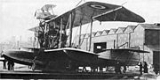
Bristol Scout

Encyclopedia
- For the later monoplane, see Bristol M.1 Monoplane ScoutBristol M.1|-See also:-External links:* * * * *...
The Bristol Scout was a simple, single seat, rotary-engined
Rotary engine
The rotary engine was an early type of internal-combustion engine, usually designed with an odd number of cylinders per row in a radial configuration, in which the crankshaft remained stationary and the entire cylinder block rotated around it...
biplane
Biplane
A biplane is a fixed-wing aircraft with two superimposed main wings. The Wright brothers' Wright Flyer used a biplane design, as did most aircraft in the early years of aviation. While a biplane wing structure has a structural advantage, it produces more drag than a similar monoplane wing...
originally intended as a civilian racing aircraft. Like other similar fast, light aircraft of the period - it was acquired by the RNAS and the RFC
Royal Flying Corps
The Royal Flying Corps was the over-land air arm of the British military during most of the First World War. During the early part of the war, the RFC's responsibilities were centred on support of the British Army, via artillery co-operation and photographic reconnaissance...
as a "scout
Scout (aircraft)
The term scout, as a description of a class of military aircraft, came into use shortly before the First World War, and referred to a light reconnaissance aircraft, initially unarmed. "Scout" types were generally adaptations of pre-war racing aircraft – although at least one was specifically...
", or fast reconnaissance type. In the event it was one of the first single-seaters to be used as fighter aircraft
Fighter aircraft
A fighter aircraft is a military aircraft designed primarily for air-to-air combat with other aircraft, as opposed to a bomber, which is designed primarily to attack ground targets...
, although it was not possible to fit it with an effective armament until the first British synchronisation gears
Interrupter gear
An interrupter gear is a device used on military aircraft and warships in order to allow them to target opponents without damaging themselves....
became available, by which time it was outmoded by later types. Single seat fighters continued to be called "scouts" in British usage into the early 1920s.
Development
The prototype for the Bristol Scout was designed in the second half of 1913 by Frank BarnwellFrank Barnwell
Captain Frank Sowter Barnwell OBE AFC FRAeS BSc was an aeronautical engineer, who performed the first powered flight in Scotland and later went on to a career as an aircraft designer.-History:...
and Harry Busteed. The first flight was first on 23 February 1914 by Busteed, and it was first shown to the public at the March 1914 London Olympia exhibition centre
Olympia, London
Olympia is an exhibition centre and conference centre in West Kensington, on the boundary between The Royal Borough of Kensington & Chelsea and Hammersmith & Fulham, London, W14 8UX, England. It opened in the 19th century and was originally known as the National Agricultural Hall.Opened in 1886,...
's Aero Show event. It had the "racing" lines fashionable in light single seaters of the 1913-1914 period, with characteristics such as a main landing gear
Undercarriage
The undercarriage or landing gear in aviation, is the structure that supports an aircraft on the ground and allows it to taxi, takeoff and land...
wheel track measured at only 39 inches (99 cm) that was barely wider than the fuselage
Fuselage
The fuselage is an aircraft's main body section that holds crew and passengers or cargo. In single-engine aircraft it will usually contain an engine, although in some amphibious aircraft the single engine is mounted on a pylon attached to the fuselage which in turn is used as a floating hull...
, only about a one half degree dihedral angle on the wing panels, making them look almost totally "flat" across from a nose-on view, and an engine cowl
Cowling
A cowling is the covering of a vehicle's engine, most often found on automobiles and aircraft.A cowling may be used:* for drag reduction* for engine cooling by directing airflow* as an air intake for jet engines* for decorative purposes...
that had no open frontal area, even though the extreme bottom was sliced away horizontally to allow cooling air to get to its seven cylinder 80 hp Gnome
Gnome et Rhône
Gnome et Rhône was a major French aircraft engine manufacturer. Between 1914 and 1918 they produced 25,000 of their 9-cylinder Delta and Le Rhône 110 hp rotary designs, while another 75,000 were produced by various licensees, powering the majority of aircraft in the first half of the war on...
Lambda
Gnome Lambda
|-See also:-Bibliography:* Lumsden, Alec. British Piston Engines and their Aircraft. Marlborough, Wiltshire: Airlife Publishing, 2003. ISBN 1-85310-294-6....
rotary engine
Rotary engine
The rotary engine was an early type of internal-combustion engine, usually designed with an odd number of cylinders per row in a radial configuration, in which the crankshaft remained stationary and the entire cylinder block rotated around it...
. It was fitted with a squared-planform "all-flying" rudder
Rudder
A rudder is a device used to steer a ship, boat, submarine, hovercraft, aircraft or other conveyance that moves through a medium . On an aircraft the rudder is used primarily to counter adverse yaw and p-factor and is not the primary control used to turn the airplane...
with no fixed vertical fin
Vertical stabilizer
The vertical stabilizers, vertical stabilisers, or fins, of aircraft, missiles or bombs are typically found on the aft end of the fuselage or body, and are intended to reduce aerodynamic side slip. It is analogical to a skeg on boats and ships.On aircraft, vertical stabilizers generally point upwards...
, similar to that used on contemporary Nieuport
Nieuport
Nieuport, later Nieuport-Delage, was a French aeroplane company that primarily built racing aircraft before World War I and fighter aircraft during World War I and between the wars.-Beginnings:...
, Morane
Morane
Morane may refer to:* Morane, an uninhabited atoll in French Polynesia* Morane-Borel, a French aircraft manufacturer* Morane-Saulnier, a French aircraft manufacturer* Bob Morane, a fictitious character of novelist Henri Vernes...
, and Fokker
Fokker
Fokker was a Dutch aircraft manufacturer named after its founder, Anthony Fokker. The company operated under several different names, starting out in 1912 in Schwerin, Germany, moving to the Netherlands in 1919....
types.
Operational history
The period of service of the Bristol Scout (1914 to 1916) marked the genesis of the fighter aircraft as a distinct type, and many of the earliest attempts to arm British "tractorTractor configuration
thumb|right|[[Evektor-Aerotechnik|Aerotechnik EV97A Eurostar]], a tractor configuration aircraft, being pulled into position by its pilot for refuelling....
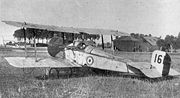
" aircraft with weaponry were tested in action using Bristol Scouts. These began with the arming of the second Scout B, RFC number 648, with two rifles, one per side, aimed outwards and forwards to clear the propeller arc.
Lanoe Hawker
Lanoe George Hawker VC, DSO was a British flying ace, with seven credited victories, during the First World War. He was the first British flying ace, and the third pilot to receive the Victoria Cross, the highest and most prestigious award for gallantry in the face of the enemy that can be awarded...
with the RFC's No. 6 Squadron
No. 6 Squadron RAF
No. 6 Squadron of the Royal Air Force operates the Eurofighter Typhoon FGR4 at RAF Leuchars.It was previously equipped with the Jaguar GR.3 in the close air support and tactical reconnaissance roles, and was based at RAF Coltishall, Norfolk until April 2006, moving to RAF Coningsby until...
, were each in their turn armed with a single Lewis machine gun on the left side of the fuselage, within a mount that Capt. Hawker had designed himself, almost identically in the manner of the rifles tried on the second Scout B. When Hawker's No.1611 aircraft was used by him to down two German aircraft and force off a third on 25 July 1915 over Passchendaele and Zillebeke
Zillebeke
Zillebeke is a village in the Flemish province of West-Vlaanderen in Belgium. The former municipality is now part of Ypres.-History:On March 3, 1914 the then municipality was granted the arms are those of the last Lords of Zillebeke, the Canton family, Viscounts of Winnezeele, which had in 1740...
he was awarded the first Victoria Cross
Victoria Cross
The Victoria Cross is the highest military decoration awarded for valour "in the face of the enemy" to members of the armed forces of various Commonwealth countries, and previous British Empire territories....
ever given for a British military pilot's actions in aerial combat.
A number of the 24 initial production RNAS' Scout C aircraft were armed with single Lewis machine guns, sometimes with the Lewis gun mounted atop the upper wing centre section in the manner of the Nieuport 11
Nieuport 11
|-See also:-References:NotesBibliography* Angelucci, Enzio, ed. The Rand McNally Encyclopedia of Military Aircraft. New York: The Military Press, 1983. ISBN 0-517-41021-4....
, and even more common was an apparently very dubious choice of placement by some RNAS pilots, in mounting the Lewis gun on the forward fuselage of their Scout Cs, just as if it were a synchronized weapon (which it was not) firing directly forward and through the propeller arc; an action likely to result in serious propeller damage. The type of bullet-deflecting wedges as Roland Garros had tried on his Morane-Saulnier Type N monoplane were also tried on one of the RFC's last Scout Cs, No. 5303, but since this seemed, in this instance, to have also required the use of the Morane Type N's immense "casserole" spinner, which almost totally blocked cooling air from reaching this particular Scout C's 80-hp Le Rhône rotary engine, the deflecting-wedge concept for propeller protection from bullets was not pursued further with Bristol Scouts.
In the early part of the war, in attempts to down German Zeppelin
Zeppelin
A Zeppelin is a type of rigid airship pioneered by the German Count Ferdinand von Zeppelin in the early 20th century. It was based on designs he had outlined in 1874 and detailed in 1893. His plans were reviewed by committee in 1894 and patented in the United States on 14 March 1899...
airships, one unusual weapon tried from a RNAS Scout D was the Ranken Dart
Ranken dart
A Ranken dart was an air-dropped weapon developed during World War I for the purpose of destroying or damaging the German Zeppelins which were attacking Britain at the time. It was a 1lb explosive missile-shaped flechette-type of bomb which was commonly carried in packs of 24 and could be...
, a type of droppable, explosive-laden flechette
Flechette
A flechette is a pointed steel projectile, with a vaned tail for stable flight. The name comes from French , "little arrow" or "dart", and sometimes retains the acute accent in English: fléchette.-Bulk and artillery use:...
with 1 lb (0.45 kg) of explosive per projectile. Scout D No. 8953, flown by Flt. Lt. C. T. Freeman, flew from the deck of the flight-deck-converted Isle of Man
Isle of Man
The Isle of Man , otherwise known simply as Mann , is a self-governing British Crown Dependency, located in the Irish Sea between the islands of Great Britain and Ireland, within the British Isles. The head of state is Queen Elizabeth II, who holds the title of Lord of Mann. The Lord of Mann is...
packet steamer HMS Vindex
HMS Vindex (1915)
HMS Vindex was a Royal Navy seaplane carrier of the First World War. She had been built in 1905 by Armstrong Whitworth as the Viking, a fast passenger ferry for the Isle of Man Steam Packet. Viking was requisitioned by the Royal Navy on 15 March 1915 for conversion to a seaplane carrier, and was...
(formerly with the civilian name Viking), which possessed a takeoff deck on its forward half, and on 2 August 1916, Flt Lt. Freeman tried to down the Zeppelin
Zeppelin
A Zeppelin is a type of rigid airship pioneered by the German Count Ferdinand von Zeppelin in the early 20th century. It was based on designs he had outlined in 1874 and detailed in 1893. His plans were reviewed by committee in 1894 and patented in the United States on 14 March 1899...
L.17 with Ranken Darts, released from two vertically-oriented internal cylindrical containers located just behind his feet, in the belly of his Scout D. None of the darts did any damage to the Zeppelin, and since Freeman's aircraft could not land back on the Vindex, and was too far from land for a safe return, he had to ditch
Water landing
A water landing is, in the broadest sense, any landing on a body of water. All waterfowl, those seabirds capable of flight, and some human-built vehicles are capable of landing in water as a matter of course....
his Scout D in the ocean after the unsuccessful attack.
One attempt to arm RFC Bristol Scouts with a synchronizable machine gun, like the air-cooled version of the Maxim-type Vickers machine gun
Vickers machine gun
Not to be confused with the Vickers light machine gunThe Vickers machine gun or Vickers gun is a name primarily used to refer to the water-cooled .303 inch machine gun produced by Vickers Limited, originally for the British Army...
that would later be used with great success on the contemporary Sopwith Pup
Sopwith Pup
The Sopwith Pup was a British single seater biplane fighter aircraft built by the Sopwith Aviation Company. It entered service with the Royal Flying Corps and the Royal Naval Air Service in the autumn of 1916. With pleasant flying characteristics and good maneuverability, the aircraft proved very...
fighter, was first tried with the late production RFC Scout C No.5313 in March 1916, and even though six other Scouts, both late Scout Cs and early Scout Ds, were tried out with the same setup as No. 5313 had used, the bulky Vickers-Challenger synchronizing gear used on all these Scouts seemed to have trouble in safely firing the Vickers guns; in May 1916 one of these Scouts fired every bullet from its Vickers gun through the propeller in testing.
Not one of the RFC or RNAS squadrons that ever received Bristol Scout aircraft was ever equipped "entirely" with the aircraft, and by the end of the summer of 1916 no new Bristol Scout aircraft were being supplied to the British squadrons of either service, often being replaced in RFC service with the Airco DH.2
Airco DH.2
|-DH.2 aces:Distinguished pilots of the DH.2 included Victoria Cross winner Lanoe Hawker , who was the first commander of No 24 Squadron and ace Alan Wilkinson. The commander of No. 32 Squadron, Lionel Rees won the Victoria Cross flying the D.H.2 for single handedly attacking a formation of 10...
single seat "pusher
Pusher configuration
In a craft with a pusher configuration the propeller are mounted behind their respective engine. According to Bill Gunston, a "pusher propeller" is one mounted behind engine so that drive shaft is in compression...
" fighter. A small number of Bristol Scouts did end up being based in the Middle East (in Egypt, Macedonia
Macedonia (region)
Macedonia is a geographical and historical region of the Balkan peninsula in southeastern Europe. Its boundaries have changed considerably over time, but nowadays the region is considered to include parts of five Balkan countries: Greece, the Republic of Macedonia, Bulgaria, Albania, Serbia, as...
, Mesopotamia
Mesopotamia
Mesopotamia is a toponym for the area of the Tigris–Euphrates river system, largely corresponding to modern-day Iraq, northeastern Syria, southeastern Turkey and southwestern Iran.Widely considered to be the cradle of civilization, Bronze Age Mesopotamia included Sumer and the...
, and Palestine
Palestine
Palestine is a conventional name, among others, used to describe the geographic region between the Mediterranean Sea and the Jordan River, and various adjoining lands....
) in 1916 with the last known Bristol Scout in military service being the former RNAS Scout D No. 8978 in Australia
Australia
Australia , officially the Commonwealth of Australia, is a country in the Southern Hemisphere comprising the mainland of the Australian continent, the island of Tasmania, and numerous smaller islands in the Indian and Pacific Oceans. It is the world's sixth-largest country by total area...
, which was based at Point Cook, near Melbourne
Melbourne
Melbourne is the capital and most populous city in the state of Victoria, and the second most populous city in Australia. The Melbourne City Centre is the hub of the greater metropolitan area and the Census statistical division—of which "Melbourne" is the common name. As of June 2009, the greater...
, as late as October 1926.
Once the Bristol Scouts were no longer required for front line service they were officially classed as "trainers". In fact most were not sent to training units, however, but retained by senior officers as personal "run-abouts" - their delightful flying characteristics making them very popular for this purpose.
Scout A
Farnborough Airfield
Farnborough Airport or TAG London Farnborough Airport is an airport situated in Farnborough, Rushmoor, Hampshire, England...
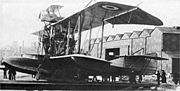
when the aircraft achieved a top airspeed of 97.5 mph (157 km/h).
The Scout A also entered two air races in the summer of 1914 after being purchased by British Lord Carbery
Baron Carbery
Baron Carbery, of Carbery in the County of Cork, is a title in the Peerage of Ireland. It was created in 1715 for George Evans, with remainder to the heirs male of his father and namesake George Evans, a supporter of William and Mary during the Glorious Revolution, who had earlier declined the...
for £400 without its engine. Flying with an 80 hp Le Rhône
Le Rhône
Le Rhône was the name given to a series of popular rotary aircraft engines produced in France by Société des Moteurs Le Rhône and the successor company of Gnome et Rhône. They powered a number of military aircraft types of the First World War...
9C nine cylinder rotary installed by its purchaser it was ditched in the English Channel
English Channel
The English Channel , often referred to simply as the Channel, is an arm of the Atlantic Ocean that separates southern England from northern France, and joins the North Sea to the Atlantic. It is about long and varies in width from at its widest to in the Strait of Dover...
during the second air race it participated in; a round trip from Hendon
Hendon
Hendon is a London suburb situated northwest of Charing Cross.-History:Hendon was historically a civil parish in the county of Middlesex. The manor is described in Domesday , but the name, 'Hendun' meaning 'at the highest hill', is earlier...
in the UK to the French Buc aerodrome (near Versailles
Versailles
Versailles , a city renowned for its château, the Palace of Versailles, was the de facto capital of the kingdom of France for over a century, from 1682 to 1789. It is now a wealthy suburb of Paris and remains an important administrative and judicial centre...
) and back, due to its running out of fuel. While in France, the tanks had been only half-filled by mistake.
Scout B
Two Scout B aircraft, identical to the modified Scout A aircraft with the 80 hp Gnôme Lambda rotary for power, except for having half-hoop-style underwing skids mounted on them, and a widened rudder surface, were built for military evaluation just as the Austro-Hungarian Archduke Franz Ferdinand was shot in SarajevoSarajevo
Sarajevo |Bosnia]], surrounded by the Dinaric Alps and situated along the Miljacka River in the heart of Southeastern Europe and the Balkans....
Bosnia. The outbreak of the First World War followed shortly. These two Scout B aircraft, bearing Royal Flying Corps
Royal Flying Corps
The Royal Flying Corps was the over-land air arm of the British military during most of the First World War. During the early part of the war, the RFC's responsibilities were centred on support of the British Army, via artillery co-operation and photographic reconnaissance...
serial numbers 644 and 648, first saw evaluational service from 20 September 1914, with the first one,serial number 644, being damaged beyond repair on 12 November of that year in a crash landing.
Type 1 Scout C
The Type 1 Scout C aircraft, very similar to the previous Scout B, was first ordered by the British government on 5 November 1914, in a 12 aircraft production batch for the Royal Flying Corps, and on 7 December 1914 by the competing Royal Naval Air ServiceRoyal Naval Air Service
The Royal Naval Air Service or RNAS was the air arm of the Royal Navy until near the end of the First World War, when it merged with the British Army's Royal Flying Corps to form a new service , the Royal Air Force...
(RNAS) in a 24-aircraft batch. Both these first two production batches of the Scout C aircraft were powered by the 80 hp Gnôme Lambda rotary, just as the Scout A had been, and when compared to the Scout B before it, these first 36 Scout C aircraft were fitted out with unusual "dome-front" cowls with much smaller frontal openings than the Scout B's six segment cowl had possessed. These early Scout C aircraft also had their main oil tank moved to a position directly behind the pilot's shoulders, requiring a raised rear dorsal fairing immediately behind the pilot's seat, to accommodate the oil tank and its filler cap.
Later Scout C production batches, comprising 50 aircraft built for the RNAS and 75 for the RFC, changed the cowl to a flat-fronted, and longer-depth version more able to house the alternate choice of an 80 hp Le Rhone 9C rotary engine when the Gnôme Lambda was not used, and moved the oil tank forward to a position in front of the pilot, for better weight distribution and more reliable engine operation. The later cowl for the remaining Scout C aircraft still had the small opening of the domed unit, but often had a small cutaway made to the lower rear edge of the cowl to increase the cooling effect.
Types 2, 3, 4 and 5 Scout D
The last, and most numerous production version, the Scout D, gradually came about as a series of further improvements to the Scout C design. One of the earliest changes that marked the change to the Scout D version showed up on seventeen of the 75 naval Scout Cs with an increase in the wing dihedral angle from 1-3/4º to 3º, and other aircraft in the 75-plane naval Scouts production run introduced larger tail surfaces, shorter-span ailerons, and a large front opening for the cowl, much like the Scout B had used, but made as a "one-piece" ring cowl, sometimes with a blister on the starboard lower side, when it was meant to house the eventual choice of the more powerful, nine cylinder 100 hp Gnôme Monosoupape rotary engine in later production batches, to improve its performance. Some 210 examples of the Scout D version were produced, with 80 of these being ordered by the RNAS, and the other 130 being ordered by the Royal Flying Corps.Other variants
- S.S.A. : Designed as a single-seat armoured biplane for the French government. One Built.
- G.B.1 : Single-seat racing aircraft. Not built or never completed.
- S.2A : Two-seat fighter version of the Scout D. Two were built as advanced training aircraft.
Operators
- Royal Flying CorpsRoyal Flying CorpsThe Royal Flying Corps was the over-land air arm of the British military during most of the First World War. During the early part of the war, the RFC's responsibilities were centred on support of the British Army, via artillery co-operation and photographic reconnaissance...
-
- No. 1 Squadron RFCNo. 1 Squadron RAFNo. 1 Squadron is a squadron of the Royal Air Force. It operated the Harrier GR9 from RAF Cottesmore until 28 January 2011.The squadron motto is In omnibus princeps , appropriate for the RAF's oldest squadron and one that has been involved in almost every major British military operation since...
- No. 2 Squadron RFCNo. 2 Squadron RAFNo. 2 Squadron of the Royal Air Force is currently one of two RAF squadrons operating in the reconnaissance role with the Tornado GR4A and GR4 and is based at RAF Marham, Norfolk.No. II Squadron holds claim to being "the oldest heavier-than-air flying machine squadron in the world", along with No...
- No. 3 Squadron RFCNo. 3 Squadron RAFNo 3 Squadron of the Royal Air Force operates the Typhoon F2, FGR4 and T3 from RAF Coningsby, Lincolnshire.No 3 Squadron, which celebrated its 95th anniversary over the weekend of 11-13 May 2007, is unique in the RAF for having two official crests....
- No. 4 Squadron RFC
- No. 5 Squadron RFCNo. 5 Squadron RAFNo. 5 Squadron of the Royal Air Force is the operator of the new Sentinel R1 Airborne STand-Off Radar aircraft and is based at RAF Waddington.-History:As No...
- No. 6 Squadron RFCNo. 6 Squadron RAFNo. 6 Squadron of the Royal Air Force operates the Eurofighter Typhoon FGR4 at RAF Leuchars.It was previously equipped with the Jaguar GR.3 in the close air support and tactical reconnaissance roles, and was based at RAF Coltishall, Norfolk until April 2006, moving to RAF Coningsby until...
- No. 7 Squadron RFCNo. 7 Squadron RAFNo. 7 Squadron of the Royal Air Force operates the Boeing Chinook HC.2 from RAF Odiham, Hampshire.-Formation and early years:No. 7 Squadron was formed at Farnborough Airfield on 1 May 1914 as the last squadron of the RFC to be formed before the First World War, but has been disbanded and reformed...
- No. 8 Squadron RFC
- No. 9 Squadron RFC
- No. 10 Squadron RFCNo. 10 Squadron RAFNo. 10 Squadron was a Royal Air Force squadron. The squadron served in a variety of roles over its 90 year history...
- No. 11 Squadron RFC
- No. 12 Squadron RFCNo. 12 Squadron RAFNo. 12 Squadron of the Royal Air Force currently operates the Tornado GR4 from RAF Lossiemouth.-History:No. 12 Squadron Royal Flying Corps was formed in February 1915 from a flight of No. 1 Squadron RFC at Netheravon. The squadron moved to France in September 1915 and operated a variety of aircraft...
- No. 13 Squadron RFC
- No. 14 Squadron RFCNo. 14 Squadron RAFNo. 14 Squadron of the Royal Air Force currently operates the Beechcraft Shadow R1 in the ISTAR role from RAF Waddington.-World War I:...
- No. 1 Squadron RFC
-
- No. 15 Squadron RFC
- No. 16 Squadron RFCNo. 16 Squadron RAFNo. 16 Squadron is a flying squadron of the Royal Air Force. It formed in 1915 at Saint-Omer to carry out a mixture of offensive patrolling and reconnaissance and was disbanded in 1919 with the end of the First World War...
- No. 17 Squadron RFC
- No. 18 Squadron RFCNo. 18 Squadron RAFNo. 18 Squadron of the Royal Air Force operates the CH-47 Chinook HC.2 from RAF Odiham. No. 18 Squadron was the first and is currently the largest RAF operator of the Chinook.-First World War:...
- No. 21 Squadron RFCNo. 21 Squadron RAFNo. 21 Squadron of the Royal Air Force was formed in 1915 and was disbanded for the last time in 1979.The squadron is famous for Operation Jericho: on 18 February 1944, the crews of de Havilland Mosquitoes breached the walls of a Gestapo prison at Amiens, France, allowing members of the French...
- No. 24 Squadron RFC
- No. 25 Squadron RFC
- No. 30 Squadron RFCNo. 30 Squadron RAFNo. 30 Squadron of the Royal Air Force operates the second generation C-130J Hercules from RAF Brize Norton, Oxfordshire. The squadron operates alongside No. 24 Squadron and No. 47 Squadron all flying the Hercules.-History:...
- No. 36 Squadron RFCNo. 36 Squadron RAFNo. 36 Squadron of the Royal Flying Corps was formed at Cramlington on February 1, 1916 and was disbanded for the last time in 1975.-First World War:No...
- No. 47 Squadron RFCNo. 47 Squadron RAFNo. 47 Squadron of the Royal Air Force operates the Hercules from RAF Brize Norton, Oxfordshire.-First formation:No. 47 Squadron Royal Flying Corps was formed at Beverley, East Riding of Yorkshire on 1 March 1916 as a home defence unit, protecting Hull and East Yorkshire against attack by German...
- No. 63 Squadron RFCNo. 63 Squadron RAF-In World War I:No. 63 Squadron was formed on 31 August 1916 at Stirling, Scotland as a squadron of the Royal Flying Corps. The squadron was intended to operate as a day-bomber unit over the Western Front in France, and was therefore equipped with de Havilland DH4 aircraft; however at the last...
- No. 65 Squadron RAFNo. 65 Squadron RAFNo. 65 Squadron was a squadron of the Royal Air Force.-World War I:The squadron was first formed at Wyton on 1 August 1916 as a squadron of the Royal Flying Corps with a core provided from the training ground at Norwich. By the end of World War I, it had claimed over 200 victories...
- No. 111 Squadron RFCNo. 111 Squadron RAFNo. 111 Squadron of the Royal Air Force operated the Panavia Tornado F3 from RAF Leuchars, Scotland until March 2011, when the squadron was disbanded, ending the Tornado F3's RAF service.-In World War I:...
- Royal Naval Air ServiceRoyal Naval Air ServiceThe Royal Naval Air Service or RNAS was the air arm of the Royal Navy until near the end of the First World War, when it merged with the British Army's Royal Flying Corps to form a new service , the Royal Air Force...
- Australian Flying Corps
- No. 1 Squadron AFCNo. 1 Squadron RAAFNo. 1 Squadron is a Royal Australian Air Force squadron based at RAAF Amberley. The squadron is currently being re-equipped with F/A-18F Super Hornet multi-role fighters.-World War I:...
in EgyptEgyptEgypt , officially the Arab Republic of Egypt, Arabic: , is a country mainly in North Africa, with the Sinai Peninsula forming a land bridge in Southwest Asia. Egypt is thus a transcontinental country, and a major power in Africa, the Mediterranean Basin, the Middle East and the Muslim world...
and PalestinePalestinePalestine is a conventional name, among others, used to describe the geographic region between the Mediterranean Sea and the Jordan River, and various adjoining lands....
. - No. 6 (Training) Squadron AFCNo. 6 Squadron RAAFNo. 6 Squadron is a Royal Australian Air Force training and bomber squadron. The squadron was first formed in 1917 and served as a training unit based in England during World War I. It was disbanded in 1919 but re-formed at the start of 1939...
in the United KingdomUnited KingdomThe United Kingdom of Great Britain and Northern IrelandIn the United Kingdom and Dependencies, other languages have been officially recognised as legitimate autochthonous languages under the European Charter for Regional or Minority Languages...
. - Central Flying School AFC at Point Cook, VictoriaPoint Cook, VictoriaPoint Cook is a suburb in Melbourne, Victoria, Australia, 25 km south-west from Melbourne's central business district. Its Local Government Area is the City of Wyndham. At the 2006 Census, Point Cook had a population of 14,162, now it is estimated that the population of Point Cook is 32,167...
.
- No. 1 Squadron AFC
 Greece
- Hellenic NavyHellenic NavyThe Hellenic Navy is the naval force of Greece, part of the Greek Armed Forces. The modern Greek navy has its roots in the naval forces of various Aegean Islands, which fought in the Greek War of Independence...
Specifications (Bristol Scout D)
See also
External links
- "TheAerodrome.com's" Bristol Scout page
- [www.cbrnp.com/profiles/quarter1/scout.htm The Bristol Scout By Chris Banyai-Riepl]