
All Topics  
Ramjet


   Email Print
   Bookmark   Link


Ramjet


A ramjet, sometimes referred to as a stovepipe jet, or an athodyd, is a form of jet engine
Jet engine

A jet engine is a reaction engine that discharges a fast moving jet of fluid to generate thrust in accordance with Isaac Newton Newton's laws of motion....
 using the engine's forward motion to compress incoming air, without a rotary compressor. Ramjets therefore require forward motion through the air to produce thrust.

Ramjets require considerable forward speed to operate well, and as a class work most efficiently at speeds around Mach 3, and this type of jet can operate up to speeds of at least Mach 5.

Ramjets can be particularly useful in applications requiring a small and simple engine for high speed use; such as missile
Missile

A guided missile is a self-propelled projectile used as a weapon. Missiles are typically propelled by rockets or jet engines. Missiles generally have one or more explosive warheads, although other weapon types may also be used....
s.


Discussion
Ask a question about 'Ramjet'
Start a new discussion about 'Ramjet'
Answer questions from other users
Full Discussion Forum


Recent Posts


Encyclopedia


A ramjet, sometimes referred to as a stovepipe jet, or an athodyd, is a form of jet engine
Jet engine

A jet engine is a reaction engine that discharges a fast moving jet of fluid to generate thrust in accordance with Isaac Newton Newton's laws of motion....
 using the engine's forward motion to compress incoming air, without a rotary compressor. Ramjets therefore require forward motion through the air to produce thrust.

Ramjets require considerable forward speed to operate well, and as a class work most efficiently at speeds around Mach 3, and this type of jet can operate up to speeds of at least Mach 5.

Ramjets can be particularly useful in applications requiring a small and simple engine for high speed use; such as missile
Missile

A guided missile is a self-propelled projectile used as a weapon. Missiles are typically propelled by rockets or jet engines. Missiles generally have one or more explosive warheads, although other weapon types may also be used....
s. They have also been used successfully, though not efficiently, as tip jets on helicopter
Helicopter

A helicopter is an aircraft that is Lift and propelled by one or more horizontal plane Helicopter rotors, each rotor consisting of two or more rotor blades....
 rotors.

Ramjets are frequently confused with pulsejets, which use an intermittent combustion, but ramjets employ a continuous combustion process, and are a quite distinct type of jet engine.

History


René Lorin

The ramjet was invented in 1913 by French
France

France , officially the French Republic , is a country whose Metropolitan France is located in Western Europe and that also comprises various Overseas departments and territories of France....
 inventor René Lorin
René Lorin

Ren? Lorin , a graduate of the Ecole Centrale Paris, invented the ramjet, which he patented in 1908; when he patented a subsonic ramjet design, and had not considered supersonic applications....
, who was granted a patent for his device. Attempts to build a prototype failed due to inadequate materials.

Lorin's idea was more a pulsejet than a real ramjet.

Albert Fonó

In 1915 Hungarian inventor Albert Fonó
Albert Fonó

Albert Fon? , was a Hungary mechanical engineer who was one of the early pioneers of turbojet and ramjet propulsion and was first to patent a ramjet engine in 1928, ....
 devised a solution for increasing the range of artillery
Artillery

Artillery is a military Combat Arms which employs any apparatus, machine, an assortment of tools or instruments, a system or systems used as weapons for the discharge of large projectiles in combat as a major contribution of fire power within the overall military capability of an armed force....
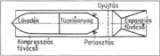
, comprising a gun-launched projectile which was to be united with a ramjet propulsion unit, thus giving a long range from relatively low muzzle velocities, allowing heavy shells to be fired from relatively lightweight guns. Fonó submitted his invention to the Austro-Hungarian Army
Austro-Hungarian Army

The Austro-Hungarian Army was the ground force of the Austria Hungary Dual Monarchy . It was composed of the joint army , the Austrian Landwehr , and the Hungarian Honv?ds?g ....
 but the proposal was rejected. After World War I
World War I

World War I, or the First World War , was a global military conflict which involved the Great powers, organized into two opposing military alliances: the Allies of World War I and the Central Powers....
 Fonó returned to the subject of jet propulsion, in May 1928 describing an "air-jet engine" which he described as being suitable for high-altitude supersonic aircraft, in a German patent application. In an additional patent application he adapted the engine for subsonic speed. The patent was finally granted in 1932 after four years of examination (German Patent No. 554,906, 1932-11-02).

Soviet Union

In the Soviet Union
Soviet Union

The Union of Soviet Socialist Republics was a Constitution of the Soviet Union socialist state that existed in Eurasia from 1922 to 1991.The name is a translation of the , romanization of Russian Soyuz Sovetskikh Sotsialisticheskikh Respublik, abbreviated ????, SSSR....
, a theory of supersonic ramjet engines was presented in 1928 by Boris S. Stechkin. Yuri Pobedonostsev, chief of GIRD
Gird

Gird is a list of regions of India of Madhya Pradesh state in central India. It includes the districts of Bhind District, Gwalior District, Morena District, Sheopur District, and Shivpuri District....
's 3rd Brigade, carried out a great deal of research into ramjet engines. The first engine, the GIRD-04, was designed by I.A. Merkulov and tested in April 1933. To simulate supersonic flight, it was fed by air compressed to 200 atmospheres, and was fueled with hydrogen. The GIRD-08 phosphorus-fueled ramjet was tested by firing it from an artillery cannon. These shells may have been the first jet powered projectiles to break the speed of sound.

In 1939, Merkulov did further ramjet tests using a two-stage rocket, the R-3. In August of that year, he developed the first ramjet engine for use as an auxiliary motor of an aircraft, the DM-1. The worlds's first ramjet powered airplane flight took place in December 1939, using two DM-2 engines on a modified Polikarpov I-15. Merkulov designed a ramjet fighter "Samolet D" in 1941, which was never completed. Two of his DM-4 engines were installed on the YaK-7PVRD fighter, during World War II. In 1940, the Kostikov-302 experimental plane was designed, powered by liquid fuel rocket for take-off and ramjet engines for flight. That project was cancelled in 1944.

In 1947, Mstislav Keldysh
Mstislav Keldysh

Mstislav Vsevolodovich Keldysh was a Soviet Union scientist in the field of mathematics and mechanics, academician of the Russian Academy of Sciences , President of the USSR Academy of Sciences , three times Hero of Socialist Labor , fellow of the Royal Society of Edinburgh ....
 proposed a long-range antipodal bomber, similar to the Saenger-Bredt bomber, but powered by ramjet instead of rocket. In 1954, NPO Lavochkin and the Keldysh Institute began development of a trisonic ramjet-powered cruise missile, Burya
Burya

The Burya was a trisonic, intercontinental cruise missile developed by the Lavochkin design bureau , based on a Request For Proposal issued by the Soviet Union government in 1954....
. This project competed with the R-7 ICBM being developed by Sergei Korolev, and was cancelled in 1957.

Germany

In 1936 Hellmuth Walter
Hellmuth Walter

Hellmuth Walter was a Germany engineer who pioneered research into rocket engines and gas turbines. His most noteworthy contributions were rocket motors for the Messerschmitt Me 163 and Bachem Ba 349 interceptor aircraft, JATO units used for a variety of Luftwaffe aircraft during World War II, and a revolutionary new propulsion system for su...
 constructed a test engine powered by natural gas
Natural gas

Natural gas is a gas consisting primarily of methane. It is found associated with fossil fuels, in coal beds, as methane clathrates, and is created by methanogenic organisms in marshes, bogs, and landfills....
 based on Lorin's work. Theoretical work was carried out at BMW
BMW

, is an independent German automotive industry founded in 1916. It also produces BMW Motorrad, is the owner of the MINI brand and is the parent company of Rolls-Royce Motor Cars....
 and Junkers
Junkers

Junkers & Co was a major Germany aircraft manufacturer. It produced some of the world's most innovative and best-known airplanes over the course of its fifty-plus year history in Dessau, Germany....
 as well as the DFL
DFL

The initialism DFL can stand for the following:*Danmarks L?rerforening, the Danish Union of Teachers*David Florida Laboratory, a Canada aerospace laboratory...
. In 1941 Eugen Sänger
Eugen Sänger

Eugen S?nger was an Austrian-German aerospace engineer best known for his contributions to lifting body and ramjet technology....
 of the DFL proposed a ramjet engine with a very high combustion chamber temperature. He constructed very large ramjet pips with and diameter and carried out combustion tests on lorries and on a special test rig on a Dornier Do 17Z
Dornier Do 17

The Dornier Do 17, sometimes referred to as the Fliegender Bleistift , was a second World War Germany light bomber produced by Claudius Dornier's company, Dornier Flugzeugwerke....
 at flight speeds of up to 200 m/s (656 ft/s). Later, with petrol becoming scarce in Germany due to wartime conditions, tests were carried out with blocks of pressed coal dust which were not successful due to slow combustion.

France

In France
France

France , officially the French Republic , is a country whose Metropolitan France is located in Western Europe and that also comprises various Overseas departments and territories of France....
 the works of René Leduc
René Leduc

Ren? Leduc was a France engineer who is much acclaimed for his work on ramjets. In 1949 he created the first aircraft to fly under the power of ramjets alone, the Leduc 0.10....
 were notable, as was that of William Avery
William H. Avery (engineer)

William H. Avery was an influential aeronautics engineer. He is most remembered for designing the propulsion mechanisms known as the ramjet, and for heading the Ocean Thermal Energy Conversion program which generates electricity from the temperature differential between shallow and deep ocean water....
 in the United States
United States

The United States of America is a Federal government constitutional republic comprising U.S. state and a federal district. The country is situated mostly in central North America, where its Contiguous United States and Washington, D.C., the Capital districts and territories, lie between the Pacific Ocean and Atlantic Oceans, Borders of the U...
. Leduc's Model, the Leduc 0.10 was one of the first ramjet-powered aircraft to fly, in 1949.

The Nord 1500 Griffon
Nord 1500 Griffon

The Nord 1500 Griffon was the prototype of a ramjet-powered fighter aircraft designed and built in the mid-1950s by France state-owned aircraft manufacturer Nord Aviation....
 reached Mach 2.19 in 1958.

Design

A ramjet is designed around its inlet. An object moving at high speed through air generates a high pressure region in front and a low pressure region to the rear. A ramjet uses this high pressure in front of the engine to force air through the tube, where it is heated by combusting some of it with fuel. It is then passed through a nozzle to accelerate it to supersonic speeds. This acceleration gives the ramjet forward thrust
Thrust

Thrust is a reaction force described quantitatively by Isaac Newton's Newton's laws of motion. When a system expels or acceleration mass in one direction the accelerated mass will cause a proportional but opposite force on that system....
.

A ramjet is sometimes referred to as a 'flying stovepipe', a very simple device comprising an air intake, a combustor, and a nozzle
Nozzle

A nozzle is a mechanical device designed to control the characteristics of a fluid flow as it exits an enclosed chamber or pipe via an orifice....
. Normally the only moving parts are those within the turbopump
Turbopump

As the name suggests, a turbopump comprises basically two main components: a rotodynamic pump and a driving turbine, both mounted on the same shaft....
, which pumps the fuel to the combustor in a liquid-fuel ramjet. Solid-fuel ramjets are even simpler.

By way of contrast, a turbojet
Turbojet

Turbojets are the oldest kind of general purpose jet engines. Two engineers, Frank Whittle in the United Kingdom and Hans von Ohain in Germany, developed the concept independently into practical engines during the late 1930s, although credit for the first turbojet is given to Whittle who submitted the first proposal and held a UK patent that...
 uses a gas turbine driven fan
Gas compressor

A gas compressor is a mechanical device that increases the pressure of a gas by reducing its volume.Compressors are similar to pumps: both increase the pressure on a fluid and both can transport the fluid through a pipe ....
 to compress the air further. This gives greater efficiency and far more power at low speeds, where the ram effect is weak, but is also more complex, heavier and more expensive, and the temperature limits of the turbine
Turbine

A turbine is a rotary engine that extracts energy from a fluid flow. Claude Burdin coined the term from the Latin turbo, or vortex, during an 1828 engineering competition....
 section limits the top speed and thrust at high speed.

Inlet

Ramjets try to exploit the very high dynamic pressure within the air approaching the intake lip. An efficient intake will recover much of the freestream stagnation pressure
Stagnation pressure

In fluid dynamics, stagnation pressure is the pressure at a stagnation point in a fluid flow, where the kinetic energy is converted into pressure energy....
, which is used to support the combustion and expansion process in the nozzle.

Most ramjets operate at supersonic
Supersonic

The term supersonic is used to define a speed that is over the speed of sound . At a typical temperature like 21 ?C , the threshold value required for an object to be traveling at a supersonic speed is approximately 344 metre per second, ....
 flight speeds and use one or more conical
Cone (geometry)

A cone is a dimension geometric shape that tapers smoothly from a flat, round base to a point called the apex or vertex. More precisely, it is the solid figure bounded by a plane base and the surface formed by the locus of all straight line segments joining the apex to the perimeter of the base....
 (or oblique) shock wave
Shock wave

A shock wave is a type of propagating disturbance. Like an ordinary wave, it carries energy and can propagate through a medium or in some cases in the absence of a material medium, through a field such as the electromagnetic field....
s, terminated by a strong normal shock, to slow down the airflow to a subsonic velocity at the exit of the intake. Further diffusion is then required to get the air velocity down to level suitable for the combustor.

Subsonic ramjets don't need such a sophisticated inlet since the airflow is already subsonic and a simple hole is usually used. This would also work at slightly supersonic speeds, as the air will choke at the inlet, but this is inefficient.

Combustor

Since there is no downstream turbine, a ramjet combustor can safely operate at stoichiometric
Stoichiometry

Stoichiometry is the calculation of quantitative relationships of the reactants and Product in a balanced chemical reaction .Etymology...
 fuel:air ratios, which implies a combustor exit stagnation temperature
Stagnation temperature

Stagnation temperature is the temperature at a stagnation point in a fluid flow. At a stagnation point the speed of the fluid is zero and all of the kinetic energy has been converted to internal energy and is added to the local Enthalpy....
 of the order of 2400 K for kerosene. Normally the combustor must be capable of operating over a wide range of throttle settings, for a range of flight speeds/altitudes. Usually a sheltered pilot region enables combustion to continue when the vehicle intake undergoes high yaw/pitch
Flight dynamics

Flight dynamics is the science of aircraft and spacecraft vehicle orientation and control in three dimensions. The three critical flight dynamics parameters are the angles of rotation in three dimensions about the vehicle's center of mass, known as pitch, roll and yaw ....
, during turns. Other flame stabilization techniques make use of flame holders, which vary in design from combustor cans to simple flat plates, to shelter the flame and improve fuel mixing. Overfuelling the combustor can cause the normal shock within a supersonic intake system to be pushed forward beyond the intake lip, resulting in a substantial drop in engine airflow and net thrust.

Nozzles

The propelling nozzle
Propelling nozzle

A propelling nozzle is a component of a jet engine that is found at the tail of the engine that operates to form an exhaust jet and to maximise the use of the exhaust gas's energy throughout the engine so that the maximum overall thrust is achieved....
 is a critical part of a ramjet design, since it accelerates exhaust flow to produce thrust.

For a ramjet operating at a subsonic flight Mach number, exhaust flow is accelerated through a converging nozzle
Nozzle

A nozzle is a mechanical device designed to control the characteristics of a fluid flow as it exits an enclosed chamber or pipe via an orifice....
. For a supersonic flight Mach number, acceleration is typically achieved via a convergent-divergent nozzle
De Laval nozzle

A de Laval nozzle is a tube that is pinched in the middle, making an hourglass-shape. It is used as a means of accelerating the flow of a gas passing through it to a supersonic speed....
.

Performance and control

Ramjets have been run from as low as 45 m/s (100 mph) upwards. Below about Mach 0.5 they give little thrust and are highly inefficient due to their low pressure ratios.

Above this speed, given sufficient initial flight velocity, a ramjet will be self-sustaining. Indeed, unless the vehicle drag
Drag (physics)

The term drag is widely used in Physics and Engineering and is central to the field of fluid dynamics. "Drag" refers to forces that oppose the motion of a solid object through a fluid ....
 is extremely high, the engine/airframe combination will tend to accelerate to higher and higher flight speeds, substantially increasing the air intake temperature. As this could have a detrimental effect on the integrity of the engine and/or airframe, the fuel control system must reduce engine fuel flow to stabilize the flight Mach number
Mach number

Mach number is the speed of an object moving through air, or any fluid substance, divided by the speed of sound as it is in that substance. It is commonly used to represent an object's speed, when it is travelling at the speed of sound....
 and, thereby, air intake temperature to sensible levels.

Due to the stoichiometric combustion temperature, efficiency is usually good at high speeds (Mach 2-3), whereas at low speeds the relatively poor compression ratio means that ramjets are outperformed by turbojets or even rockets.

Ramjet Types

Ramjets can be classified according to the type of fuel, liquid or solid; and the booster.

In a liquid fuel ramjet (LFRJ) hydrocarbon fuel (typically) is injected into the combustor ahead of a flameholder which stabilises the flame resulting from the combustion of the fuel with the compressed air from the intake(s). A means of pressurising and supplying the fuel to the ramcombustor is required which can be complicated and expensive. Aerospatiale-Celerg
Aérospatiale

A?rospatiale was a French aerospace manufacturer that primarily built both civilian and military aircraft, rockets and satellites.History...
 have designed an LFRJ where the fuel is forced into the injectors by an elastomer bladder which inflates progressively along the length of the fuel tank. Initially the bladder forms a close-fitting sheath around the compressed air bottle from which it is inflated, which is mounted lengthwise in the tank. This offers a lower cost approach than a regulated LFRJ requiring a turbopump and associated hardware to supply the fuel.

A ramjet generates no static thrust and needs a booster to achieve a forward velocity high enough for efficient operation of the intake system. The first ramjet powered missiles used external boosters, usually solid-propellant rockets, either in tandem, where the booster is mounted immediately aft of the ramjet, e.g. Sea Dart
Sea Dart missile

Sea Dart or Guided Weapon System 30 is a United Kingdom surface-to-air missile system designed by Hawker Siddeley Dynamics and built by British Aerospace from 1977....
, or wraparound where multiple boosters are attached alongside the outside of the ramjet e.g. SA-4 Ganef
SA-4 Ganef

The 2K11 Krug is a Soviet and now Russian long range, medium-to-high altitude surface-to-air missile system. "2K11" is its GRAU designation, while SA-4 Ganef is its NATO reporting name....
. The choice of booster arrangement is usually driven by the size of the launch platform. A tandem booster increases the overall length of the system whereas wraparound boosters increase the overall diameter. Wraparound boosters will usually generate higher drag than a tandem arrangement.

Integrated boosters provide a more efficient packaging option since the booster propellant is cast inside the otherwise empty combustor. This approach has been used on solid, for example SA-6 Gainful
SA-6 Gainful

The 2K12 "Kub" mobile surface-to-air missile system is a Soviet low to medium-level air defence system designed to protect ground forces from air attack....
, liquid, for example ASMP
Air-Sol Moyenne Portée

The Air-Sol Moyenne Port?e is a France air-launched nuclear weapon missile. Part of the Force de frappe, in French nuclear doctrine it is the last-resort "warning shot" prior to a full-scale employment of strategic nuclear weapons....
, and ducted rocket, for example Meteor
MBDA Meteor

Meteor is an Active radar homing Beyond Visual Range missile air-to-air missile missile being developed by MBDA to equip the Eurofighter Typhoons of the United Kingdom Royal Air Force , Germany's Luftwaffe, Spain's Spanish Air Force and Italy's Aeronautica Militare, the F-35 of the British Royal Navy, the Dassault Aviation Rafales of France'...
, designs. Integrated designs are complicated by the different nozzle requirements of the boost and ramjet phases of flight. Due to the higher thrust levels of the booster a different shaped nozzle is required for optimum thrust compared to that required for the lower thrust ramjet sustainer. This is usually achieved via a separate nozzle which is ejected after booster burnout. However, designs such as Meteor feature nozzleless boosters. This offers the advantages of elimination of the hazard to launch aircraft from the ejected boost nozzle debris, simplicity, reliability, and reduced mass and cost, although this must be traded against the reduction in performance compared with that provided by a dedicated booster nozzle.

Integral rocket ramjet/ducted rocket


These are a slight variation on the ramjet where the supersonic exhaust from a rocket combustion process is used to compress and react with the incoming air in the main combustion chamber. This has the advantage of giving thrust even at zero speed.

In a solid fuel integrated rocket ramjet (SFIRR) the solid fuel is cast along the outer wall of the ramcombustor. In this case fuel injection is through ablation of the propellant by the hot compressed air from the intake(s). An aft mixer may be used to improve combustion efficiency. SFIRRs are preferred over LFRJs for some applications because of the simplicity of the fuel supply but only when the throttling requirements are minimal i.e. when variations in altitude or Mach number are limited.

In a ducted rocket a solid fuel gas generator produces a hot fuel-rich gas which is burnt in the ramcombustor with the compressed air supplied by the intake(s). The flow of gas improves the mixing of the fuel and air and increases total pressure recovery. In a Throttleable Ducted Rocket (TDR), also known as a Variable Flow Ducted Rocket (VFDR), a valve allows the gas generator exhaust to be throttled allowing control of the thrust. Unlike an LFRJ solid propellant ramjets cannot flameout
Flameout

A flameout refers to the failure of a jet engine caused by the extinction of the flame in the combustion chamber. It can be caused by a number of factors, including fuel exhaustion; compressor stall; insufficient oxygen supply; foreign object damage ; severe inclement weather; mechanical failure; and other factors....
. The ducted rocket sits somewhere between the simplicity of the SFRJ and the unlimited throttleability of the LFRJ.

Flight speed

Ramjets generally give little or no thrust below about half the speed of sound
Speed of sound

Sound is a vibration that travels through an elasticity medium as a wave. The speed of sound describes how much distance such a wave travels in a certain amount of time....
, and they are inefficient (less than 600 seconds
Specific impulse

Specific impulse is a way to describe the efficiency of rocket engine and jet engine engines. It represents the impulse per unit of propellant....
) until the airspeed exceeds 1000 km/h (600 mph) due to low compression ratios. Even above the minimum speed a wide flight envelope
Flight envelope

In aerodynamics, the flight envelope or performance envelope of an aircraft refers to the capabilities of a design in terms of speed and altitude....
 (range of flight conditions), such as low to high speeds and low to high altitudes, can force significant design compromises, and they tend to work best optimised for one designed speed and altitude (point designs). However, ramjets generally outperform gas turbine based jet engine designs and work best at supersonic
Supersonic

The term supersonic is used to define a speed that is over the speed of sound . At a typical temperature like 21 ?C , the threshold value required for an object to be traveling at a supersonic speed is approximately 344 metre per second, ....
 speeds (Mach
Mach number

Mach number is the speed of an object moving through air, or any fluid substance, divided by the speed of sound as it is in that substance. It is commonly used to represent an object's speed, when it is travelling at the speed of sound....
 2-4). Although inefficient at slower speeds they are more fuel-efficient than rocket
Rocket

A rocket or rocket vehicle is a missile, aircraft or other vehicle which obtains thrust by the Reaction of the rocket to the ejection of fast moving fluid exhaust from a rocket engine....
s over their entire useful working range up to at least Mach 5.5.

The performance of conventional ramjets falls off above Mach 6 due to dissociation and pressure loss caused by shock as the incoming air is slowed to subsonic velocities for combustion. In addition, the combustion chamber's inlet temperature increases to very high values, approaching the dissociation limit at some limiting Mach number.

Related engines


Air turbo ramjet

Another example of this is the Air Turbo Ramjet (ATR) which operates as a conventional turbojet at subsonic speeds and a fan assisted ramjet at speeds below Mach 6.

Scramjets

Ramjets always slow the incoming air to a subsonic velocity within the combustor. Scramjet
Scramjet

A scramjet is a variation of a ramjet distinguished by supersonic combustion. At higher speeds, it is necessary to combust supersonically to maximize the efficiency of the combustion process....
s, or "supersonic combustion ramjet" are similar to ramjets, but some of the air goes through the entire engine at supersonic speeds. This increases the stagnation pressure recovered from the freestream and improves net thrust. Thermal choking of the exhaust is avoided by having a relatively high supersonic air velocity at combustor entry. Fuel injection is often into a sheltered region below a step in the combustor wall. Although scramjet engines have been studied for many decades it is only recently that small experimental units have been flight tested and then only very briefly (e.g. the Boeing X-43
Boeing X-43

The X-43 is an Unmanned aerial vehicle experimental aircraft hypersonic aircraft design with multiple planned scale variations meant to test different aspects of hypersonic flight....
).

In the scramjet, the ram air is not slowed to subsonic speeds for combustion and as a result, shocks are not encountered and pressure loss is avoided.

Precooled engines

A variant of the pure ramjet is the 'combined cycle' engine, intended to overcome the limitations of the pure ramjet. One example of this is the SABRE
Sabre

The sabre or saber is a kind of backsword that usually but not always has a curved, single-edged blade and a rather large Guard , covering the knuckles of the hand as well as the thumb and forefinger....
 engine; this uses a precooler, behind which is ramjet and turbine machinery.

The ATREX
ATREX

The ATREX engine developed in Japan is an experimental precooled jet engine that works as a turbojet at low speeds and a ramjet up to Mach number 6.0....
 engine developed in Japan is an experimental implementation of this concept. It uses liquid hydrogen fuel in a fairly exotic single-fan arrangement. The liquid hydrogen fuel is pumped through a heat exchanger
Heat exchanger

A heat exchanger is a device built for efficient heat transfer from one medium to another, whether the media are separated by a solid wall so that they never mix, or the media are in direct contact....
 in the air-intake, simultaneously heating the liquid hydrogen, and cooling the incoming air. This cooling of the incoming air is critical to achieving a reasonable efficiency. The hydrogen then continues through a second heat exchanger position after the combustion section, where the hot exhaust is used to further heat the hydrogen, turning it into a very high pressure gas. This gas is then passed through the tips of the fan providing driving power to the fan at sub-sonic speeds. After mixing with the air it's then combusted in the combustion chamber.

Nuclear powered ramjets

During the Cold War
Cold War

The Cold War was the continuing state of conflict, tension and competition that existed between a number of world powers, including the United States, the Soviet Union, People's Republic of China, France, United Kingdom and those countries' respective allies from the mid-1940s to the early 1990s....
 the United States designed and ground-tested a nuclear-powered ramjet called Project Pluto
Project Pluto

Project Pluto was a United States government program to develop nuclear powered ramjet engines for use in cruise missiles. Two experimental engines were tested at the United States Department of Energy Nevada Test Site in 1961 and 1964....
. This system used no combustion - a nuclear reactor
Nuclear reactor

A nuclear reactor is a device in which nuclear chain reactions are initiated, controlled, and sustained at a steady rate, as opposed to a nuclear bomb, in which the chain reaction occurs in a fraction of a second and is uncontrolled causing an explosion....
 heated the air instead. The project was ultimately canceled because ICBMs seemed to serve the purpose better, and because a low-flying radioactive missile could cause problems for any allied soldiers.

J58


The SR-71's Pratt & Whitney J58
Pratt & Whitney J58

The Pratt & Whitney J58 was a Variable cycle engine turbojet aircraft engine used on the Lockheed A-12, and subsequently on the Lockheed YF-12 and SR-71 Blackbird aircraft....
 engines act as turbojet-assisted ramjets at high-speeds (Mach 3.2).

Ionospheric ramjet

The upper atmosphere above about 100km contains monatomic oxygen that has been produced by the sun through photochemistry. A concept was created by NASA for recombining this thin gas back to diatomic molecules at orbital speeds to power a ramjet.

Bussard ramjet

The Bussard ramjet is a space drive concept that is intended to fuse
Fusion

Fusion can refer to combining two or more distinct things*Cell fusion*Melting, a chemistry term for a solid undergoing a phase change into a liquid...
 interstellar wind and exhaust it at high speed from the rear of the vehicle.

Aircraft using ramjets

  • Hiller Hornet (a ramjet powered helicopter)
  • Leduc experimental aircraft
    Leduc experimental aircraft

    The Leduc 0.10 was a research aircraft built in France that became the the world's first aircraft to fly powered by a ramjet....
  • Lockheed D-21
    Lockheed D-21/M-21

    The Lockheed D-21 was a Mach number 3+ reconnaissance Unmanned aerial vehicle that began development in October 1962. Originally known by the Lockheed designation Q-12, it was intended to be launched off the back of the Lockheed A-12 for extra-long or very dangerous missions....
  • Lockheed X-7
    Lockheed X-7

    The Lockheed Corporation X-7 was an unmanned test bed for ramjet engines and missile guidance technology. It was carried aloft by a B-29 Superfortress or B-50 Superfortress carrier aircraft....
  • Nord 1500 Griffon
    Nord 1500 Griffon

    The Nord 1500 Griffon was the prototype of a ramjet-powered fighter aircraft designed and built in the mid-1950s by France state-owned aircraft manufacturer Nord Aviation....
  • Republic XF-103
    Republic XF-103

    The Republic XF-103 Thunderwarrior was an United States project to develop a high speed interceptor aircraft to destroy Soviet Union bombers....
  • SR-71 Blackbird
    SR-71 Blackbird

    The Lockheed SR-71 was an advanced, long-range, Mach number 3 strategic reconnaissance aircraft developed from the Lockheed Lockheed A-12 and Lockheed YF-12 aircraft by the Lockheed Skunk Works....
     (Turbojet engines that function as ramjets at mach 1+ speeds.)


Missiles using ramjets

  • Bomarc
    Bomarc Missile Program

    The CIM-10 Bomarc was the product of the Bomarc Missile Program. The Program was a joint United States?Canada effort between 1957 and 1972 to protect against the Soviet Union bomber threat....
  • BrahMos
    BrahMos

    BrahMos is a Cruise_missile#Supersonic_cruise_missile that can be launched from submarines, ships, aircraft or land. It is a joint venture between India's Defense Research and Development Organization and Russia's NPO Mashinostroeyenia who have together formed the BrahMos Aerospace Private Limited....
  • MBDA Meteor
    MBDA Meteor

    Meteor is an Active radar homing Beyond Visual Range missile air-to-air missile missile being developed by MBDA to equip the Eurofighter Typhoons of the United Kingdom Royal Air Force , Germany's Luftwaffe, Spain's Spanish Air Force and Italy's Aeronautica Militare, the F-35 of the British Royal Navy, the Dassault Aviation Rafales of France'...
  • Bristol Bloodhound
  • Bendix RIM-8 Talos
    RIM-8 Talos

    The Bendix Corporation RIM-8 Talos was a long-range naval surface-to-air missile, and was among the earliest surface-to-air missiles to equip United States Navy ships....
  • North American SM-64 Navaho
    SM-64 Navaho

    The North American SM-64 Navaho was a supersonic intercontinental cruise missile project built by North American Aviation. The program ran from 1946 to 1958 when it was cancelled in favor of the Intercontinental Ballistic Missile....
  • P-270 Moskit
  • Akash missile
    Akash missile

    Akash is India's medium range surface-to-air missile defense system developed by the Defence Research and Development Organisation and Bharat Electronics Ltd as part of the Integrated Guided Missile Development Program....
  • Sea Dart missile
    Sea Dart missile

    Sea Dart or Guided Weapon System 30 is a United Kingdom surface-to-air missile system designed by Hawker Siddeley Dynamics and built by British Aerospace from 1977....
  • 2K11_Krug


See also


  • Wikibooks: Jet
propulsion

External links