

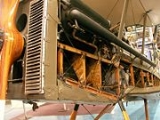
Royal Aircraft Factory S.E.5

Encyclopedia
The Royal Aircraft Factory S.E.5 was a British biplane
fighter aircraft
of the First World War
. Although the first examples reached the Western Front
before the Sopwith Camel
and it had a much better overall performance, problems with its Hispano-Suiza
engine, particularly the geared-output H-S 8B-powered versions, meant that there was a chronic shortage of S.E.5s until well into 1918 and fewer squadrons were equipped with the type than with the Sopwith fighter. Together with the Camel, the S.E.5 was instrumental in regaining allied air superiority in mid-1917 and maintaining this for the rest of the war, ensuring there was no repetition of "Bloody April
" 1917 when losses in the Royal Flying Corps
were much heavier than in the Luftstreitkräfte
.


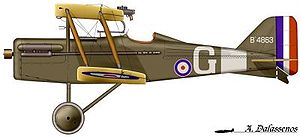
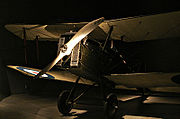 The S.E.5 (Scout Experimental 5) was designed by Henry P. Folland
, John Kenworthy
and Major Frank W. Goodden of the Royal Aircraft Factory in Farnborough
. It was built around the new 150 hp (112 kW) Hispano-Suiza 8
a V8 engine
that, while providing excellent performance, was initially under-developed and unreliable. The first of three prototypes flew on 22 November 1916. The first two prototypes were lost in crashes (the first killing the chief test pilot at the Royal Aircraft Factory, Major F. W. Goodden on 28 January 1917) due to a weakness in their wing design. The third prototype underwent modification before production commenced; the S.E.5 was known in service as an exceptionally strong aircraft which could be dived at very high speed - the squarer wings also gave much improved lateral control at low airspeeds.
Like the other significant Royal Aircraft Factory aircraft of the war (B.E.2, F.E.2
and R.E.8
) the S.E.5 was inherently stable, making it an excellent gunnery platform, but it was also quite manoeverable. It was one of the fastest aircraft of the war at 138 mph (222 km/h), equal at least in speed to the SPAD S.XIII
and faster than any standard German type of the period.
While the S.E.5 was not as agile and effective in a tight dog fight as the Camel it was much easier and safer to fly, particularly for novice pilots. The S.E.5 had one synchronised
.303
-in Vickers machine gun
to the Camel's two, but it also had a wing-mounted Lewis gun
on a Foster mounting
, which enabled the pilot to fire at an enemy aircraft from below as well as providing two guns firing forward. This was much appreciated by the pilots of the first S.E.5 squadrons as the new hydraulic-link "C.C."
synchronising gear
for the Vickers was unreliable at first. The Vickers gun was mounted on the forward left dorsal surface of the fuselage
with the breech inside the cockpit. The cockpit was set amidships, making it difficult to see over the long front fuselage, but otherwise visibility was good. Perhaps its greatest advantage over the Camel was its superior performance at altitude – so that it was a much better match for the Fokker D.VII
when that fighter arrived at the front.
(560), Curtiss
(1), Martinsyde
(258), the Royal Aircraft Factory (200), Vickers
(2,164) and Wolseley Motor Company
(431). A few were converted as two-seat trainer
s and there were plans for Curtiss
to build 1,000 S.E.5s in the United States but only one was completed before the end of the war. At first, airframe construction outstripped the very limited supply of French-built Hispano-Suiza engines and squadrons earmarked to receive the new fighter had to soldier on with Airco DH 5s and Nieuport 24s until early 1918. The troublesome geared "-8b" model of the "Hisso" V8 was prone to have serious gear reduction system problems, sometimes with the propeller (and even the entire gearbox on a very few occasions) separating from the engine and airframe in flight.
The introduction of the 200 hp (149 kW) Wolseley Viper
, a high-compression, direct drive version of the Hispano-Suiza 8a made under licence by the Wolseley Motor Company
, solved the S.E.5a's engine problems and was adopted as the standard powerplant.
About 38 of the Austin-built S.E.5as were assigned to the American Expeditionary Force
with the 25th Aero Squadron getting its aircraft (mostly armed only with the fuselage-mounted Vickers gun) at the very end of the war.
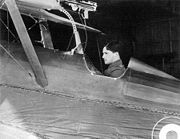 The S.E.5 entered service with No. 56 Squadron RFC in March 1917, although the squadron did not deploy to the Western Front
until the following month, among other reasons so that the very large and unpopular "greenhouse" windscreens could be replaced with small rectangular screens of conventional design. Pilots also disliked the original high seating position, designed to improve vision over the upper wing, preferring to sit lower (and more comfortably) in the cockpit. The squadron flew its first patrol with the S.E.5 on 22 April. While pilots, some of whom were initially disappointed with the S.E.5, quickly came to appreciate its strength and fine flying qualities, it was universally held to be under-powered and the more powerful S.E.5a began to replace the S.E.5 in June.
At this time 56 Squadron was still the only unit flying the new fighter; in fact it was the only operational unit to be fully equipped with the initial 150 hp S.E.5 – all other S.E.5 squadrons officially used the 200 hp S.E.5a from the outset - although a few S.E.5s were issued to other squadrons due to an acute shortage of the S.E.5a. This shortage resulted in a very slow initial build up of new S.E.5a squadrons, and lasted well into 1918. Once the Wolseley Viper
powered model became plentiful many more units re-equipped, until by the end of the war the type was employed by 21 British Empire
squadrons as well as two U.S. units. Many of the top Allied aces
flew this fighter including Billy Bishop
, Andrew Beauchamp-Proctor
, Edward Mannock
and James McCudden
. Legendary British ace Albert Ball
was initially disparaging of the S.E.5 but in the end claimed 11 of his 44 victories flying it. McCudden wrote of the S.E.5 "It was very fine to be in a machine that was faster than the Huns, and to know that one could run away just as things got too hot."
Sholto Douglas who commanded No. 84 Squadron RFC
which was initially equipped with the S.E.5a, listed the type's qualities as:
S.E.5a
S.E.5b
Eberhart S.E.5e
 Canada
 South Africa
 United States
at Old Warden
, England, UK. This aircraft was originally serial F904 of No. 84 Squadron RAF
, then flew as G-EBIA from September 1923 to February 1932. It was restored and passed to the Shuttleworth Collection. Re-registered as G-EBIA, it was first painted as D7000, then as F904.
An original S.E.5e may be seen in the National Museum of the United States Air Force
at Dayton
, Ohio, USA. The museum acquired the S.E.5e through a donation by the estate of Lt. Col. William C. Lambert, USAF Ret,. a First World War ace with 21.5 victories. Lambert flew the S.E.5a as an American member of the Royal Flying Corps and the Royal Air Force. The Air Force Museum Foundation also helped buy the aircraft. It is painted to represent an S.E.5e of the 18th Headquarters Squadron, Bolling Field, Washington, D.C., in 1925.
Two full scale replica S.E.5a aircraft were built by Miles Aircraft
in 1965 for use in film making and were transferred to the Irish civil aircraft register in 1967 whilst the two were employed in flying scenes. Both were destroyed in crashes in Ireland during 1970.
Another four original airframes are statically displayed at: the Science Museum
, London, UK; Royal Air Force Museum, London, UK; South African National Museum of Military History
, Johannesburg, South Africa; and the Australian War Memorial
, Canberra, Australia.
Three very faithful reproductions (designated Se.5a-1) were built by The Vintage Aviator Limited in New Zealand and these fly from Hood Aerodrome, Masterton. Another SE5a project was started in the UK in the 1980s by John Tetley and "Bill" Sneesby. The machine, built using original plans was transferred to The Memorial Flight (based at La Ferte Alais, in France) to be completed and flown. Some parts are original such as the engine, instruments and fuel tank and the machine is painted in the colours of Lt. H. J. 'Hank' Burden of 56 Squadron as of April 1918.
Biplane
A biplane is a fixed-wing aircraft with two superimposed main wings. The Wright brothers' Wright Flyer used a biplane design, as did most aircraft in the early years of aviation. While a biplane wing structure has a structural advantage, it produces more drag than a similar monoplane wing...
fighter aircraft
Fighter aircraft
A fighter aircraft is a military aircraft designed primarily for air-to-air combat with other aircraft, as opposed to a bomber, which is designed primarily to attack ground targets...
of the First World War
World War I
World War I , which was predominantly called the World War or the Great War from its occurrence until 1939, and the First World War or World War I thereafter, was a major war centred in Europe that began on 28 July 1914 and lasted until 11 November 1918...
. Although the first examples reached the Western Front
Western Front (World War I)
Following the outbreak of World War I in 1914, the German Army opened the Western Front by first invading Luxembourg and Belgium, then gaining military control of important industrial regions in France. The tide of the advance was dramatically turned with the Battle of the Marne...
before the Sopwith Camel
Sopwith Camel
The Sopwith Camel was a British First World War single-seat biplane fighter introduced on the Western Front in 1917. Manufactured by Sopwith Aviation Company, it had a short-coupled fuselage, heavy, powerful rotary engine, and concentrated fire from twin synchronized machine guns. Though difficult...
and it had a much better overall performance, problems with its Hispano-Suiza
Hispano-Suiza
Hispano-Suiza was a Spanish automotive and engineering firm, best known for its luxury cars and aviation engines in the pre-World War II period of the twentieth century. In 1923, its French subsidiary became a semi-autonomous partnership with the parent company and is now part of the French SAFRAN...
engine, particularly the geared-output H-S 8B-powered versions, meant that there was a chronic shortage of S.E.5s until well into 1918 and fewer squadrons were equipped with the type than with the Sopwith fighter. Together with the Camel, the S.E.5 was instrumental in regaining allied air superiority in mid-1917 and maintaining this for the rest of the war, ensuring there was no repetition of "Bloody April
Bloody April
During the First World War, the month of April 1917 was known as Bloody April by the Royal Flying Corps . The RFC suffered particularly severe losses — about three times as many as the Imperial German Army Air Service over the same period — but continued its primary role in support of the ground...
" 1917 when losses in the Royal Flying Corps
Royal Flying Corps
The Royal Flying Corps was the over-land air arm of the British military during most of the First World War. During the early part of the war, the RFC's responsibilities were centred on support of the British Army, via artillery co-operation and photographic reconnaissance...
were much heavier than in the Luftstreitkräfte
Luftstreitkräfte
The Deutsche Luftstreitkräfte , known before October 1916 as Die Fliegertruppen des deutschen Kaiserreiches , or simply Die Fliegertruppen, was the air arm of the Imperial German Army during World War I...
.
Design and development
Henry Folland
Henry Philip Folland was an English aviation engineer and aircraft designer.-Life:Folland was born to Frederick and Mary Folland at 2 King Street, Holy Trinity, Cambridge. His father was listed as a Stonemason....
, John Kenworthy
John Kenworthy
John Kenworthy B.Sc., F.R.Aes was an English aviation engineer and aircraft designer.John Kenworthy appears in the 1901 Census of Darlington, aged 17, living with four sisters, one brother and his parents George and Ellen Kenworthy at 65 Greenbank Road, Darlington, County Durham...
and Major Frank W. Goodden of the Royal Aircraft Factory in Farnborough
Farnborough, Hampshire
-History:Name changes: Ferneberga ; Farnburghe, Farenberg ; Farnborowe, Fremborough, Fameborough .Tower Hill, Cove: There is substantial evidence...
. It was built around the new 150 hp (112 kW) Hispano-Suiza 8
Hispano-Suiza 8
The Hispano-Suiza 8 was a water-cooled V8 SOHC aero engine introduced by Hispano-Suiza in 1914 and used by a number of Allied aircraft during the First World War...
a V8 engine
V8 engine
A V8 engine is a V engine with eight cylinders mounted on the crankcase in two banks of four cylinders, in most cases set at a right angle to each other but sometimes at a narrower angle, with all eight pistons driving a common crankshaft....
that, while providing excellent performance, was initially under-developed and unreliable. The first of three prototypes flew on 22 November 1916. The first two prototypes were lost in crashes (the first killing the chief test pilot at the Royal Aircraft Factory, Major F. W. Goodden on 28 January 1917) due to a weakness in their wing design. The third prototype underwent modification before production commenced; the S.E.5 was known in service as an exceptionally strong aircraft which could be dived at very high speed - the squarer wings also gave much improved lateral control at low airspeeds.
Like the other significant Royal Aircraft Factory aircraft of the war (B.E.2, F.E.2
Royal Aircraft Factory F.E.2
The Royal Aircraft Factory F.E.2 was a two-seat pusher biplane that was operated as a day and night bomber and as a fighter aircraft by the Royal Flying Corps during the First World War...
and R.E.8
Royal Aircraft Factory R.E.8
The Royal Aircraft Factory R.E.8 was a British two-seat biplane reconnaissance and bomber aircraft of the First World War designed by John Kenworthy. Intended as a replacement for the vulnerable B.E.2, the R.E.8 was more difficult to fly, and was regarded with great suspicion at first in the Royal...
) the S.E.5 was inherently stable, making it an excellent gunnery platform, but it was also quite manoeverable. It was one of the fastest aircraft of the war at 138 mph (222 km/h), equal at least in speed to the SPAD S.XIII
SPAD S.XIII
|-See also:-Bibliography:* Bruce, J.M. The Aeroplanes of the Royal Flying Corps . London: Putnam, 1982. ISBN 0-370-30084-X.* Sharpe, Michael. Biplanes, Triplanes, and Seaplanes. London: Friedman/Fairfax Books, 2000. ISBN 1-58663-300-7....
and faster than any standard German type of the period.
While the S.E.5 was not as agile and effective in a tight dog fight as the Camel it was much easier and safer to fly, particularly for novice pilots. The S.E.5 had one synchronised
Interrupter gear
An interrupter gear is a device used on military aircraft and warships in order to allow them to target opponents without damaging themselves....
.303
.303
.303 may refer to:* .303 British, a rifle cartridge* .303 Savage, a rifle cartridge* Lee-Enfield rifle* .303 , a short film...
-in Vickers machine gun
Vickers machine gun
Not to be confused with the Vickers light machine gunThe Vickers machine gun or Vickers gun is a name primarily used to refer to the water-cooled .303 inch machine gun produced by Vickers Limited, originally for the British Army...
to the Camel's two, but it also had a wing-mounted Lewis gun
Lewis Gun
The Lewis Gun is a World War I–era light machine gun of American design that was perfected and widely used by the British Empire. It was first used in combat in World War I, and continued in service with a number of armed forces through to the end of the Korean War...
on a Foster mounting
Foster mounting
In early 1916 Sergeant Foster of No. 11 Squadron RFC devised a sliding rail mounting for the upper wing Lewis Gun on a Nieuport 11. It enabled the gun to be pulled down so that its breech was conveniently in front of the pilot, making it much easier to change ammunition drums or to clear stoppages...
, which enabled the pilot to fire at an enemy aircraft from below as well as providing two guns firing forward. This was much appreciated by the pilots of the first S.E.5 squadrons as the new hydraulic-link "C.C."
George Constantinescu
George Constantinescu was a Romanian scientist, engineer and inventor. During his career, he registered over 130 inventions. He is the creator of the theory of sonics, a new branch of continuum mechanics, in which he described the transmission of mechanical energy through vibrations.Born in...
synchronising gear
Interrupter gear
An interrupter gear is a device used on military aircraft and warships in order to allow them to target opponents without damaging themselves....
for the Vickers was unreliable at first. The Vickers gun was mounted on the forward left dorsal surface of the fuselage
Fuselage
The fuselage is an aircraft's main body section that holds crew and passengers or cargo. In single-engine aircraft it will usually contain an engine, although in some amphibious aircraft the single engine is mounted on a pylon attached to the fuselage which in turn is used as a floating hull...
with the breech inside the cockpit. The cockpit was set amidships, making it difficult to see over the long front fuselage, but otherwise visibility was good. Perhaps its greatest advantage over the Camel was its superior performance at altitude – so that it was a much better match for the Fokker D.VII
Fokker D.VII
The Fokker D.VII was a German World War I fighter aircraft designed by Reinhold Platz of the Fokker-Flugzeugwerke. Germany produced around 3,300 D.VII aircraft in the summer and autumn of 1918. In service, the D.VII quickly proved itself to be a formidable aircraft...
when that fighter arrived at the front.
S.E.5a
Only 77 original S.E.5 aircraft were built before production settled on the improved S.E.5a. The S.E.5a differed from late production examples of the S.E.5 only in the type of engine installed - a geared 200 hp Hispano-Suiza 8b, often turning a large clockwise-rotation four-bladed propeller, replacing the 150 hp model. In total 5,265 S.E.5s were built by six manufacturers: Austin Motors (1,650), Air Navigation and Engineering CompanyAir Navigation and Engineering Company
Aircraft Navigation and Engineering Company Limited was a British aircraft manufacturer from its formation in 1919 to 1927.-History:The company was formed in 1919 when the Blériot & SPAD Manufacturing Company Limited was renamed...
(560), Curtiss
Curtiss Aeroplane and Motor Company
Curtiss Aeroplane and Motor Company was an American aircraft manufacturer that went public in 1916 with Glenn Hammond Curtiss as president. Throughout the 1920s and 1930s, the company was the largest aircraft manufacturer in the United States...
(1), Martinsyde
Martinsyde
Martinsyde was a British aircraft and motorcycle manufacturer between 1908 and 1922, when they were forced into liquidation by a factory fire.-History:...
(258), the Royal Aircraft Factory (200), Vickers
Vickers
Vickers was a famous name in British engineering that existed through many companies from 1828 until 1999.-Early history:Vickers was formed in Sheffield as a steel foundry by the miller Edward Vickers and his father-in-law George Naylor in 1828. Naylor was a partner in the foundry Naylor &...
(2,164) and Wolseley Motor Company
Wolseley Motor Company
The Wolseley Motor Company was a British automobile manufacturer founded in 1901. After 1935 it was incorporated into larger companies but the Wolseley name remained as an upmarket marque until 1975.-History:...
(431). A few were converted as two-seat trainer
Trainer (aircraft)
A trainer is a class of aircraft designed specifically to facilitate in-flight training of pilots and aircrews. The use of a dedicated trainer aircraft with additional safety features—such as tandem flight controls, forgiving flight characteristics and a simplified cockpit arrangement—allows...
s and there were plans for Curtiss
Curtiss Aeroplane and Motor Company
Curtiss Aeroplane and Motor Company was an American aircraft manufacturer that went public in 1916 with Glenn Hammond Curtiss as president. Throughout the 1920s and 1930s, the company was the largest aircraft manufacturer in the United States...
to build 1,000 S.E.5s in the United States but only one was completed before the end of the war. At first, airframe construction outstripped the very limited supply of French-built Hispano-Suiza engines and squadrons earmarked to receive the new fighter had to soldier on with Airco DH 5s and Nieuport 24s until early 1918. The troublesome geared "-8b" model of the "Hisso" V8 was prone to have serious gear reduction system problems, sometimes with the propeller (and even the entire gearbox on a very few occasions) separating from the engine and airframe in flight.
The introduction of the 200 hp (149 kW) Wolseley Viper
Wolseley Viper
|-See also:-Bibliography:* Lumsden, Alec. British Piston Engines and their Aircraft. Marlborough, Wiltshire: Airlife Publishing, 2003. ISBN 1-85310-294-6....
, a high-compression, direct drive version of the Hispano-Suiza 8a made under licence by the Wolseley Motor Company
Wolseley Motor Company
The Wolseley Motor Company was a British automobile manufacturer founded in 1901. After 1935 it was incorporated into larger companies but the Wolseley name remained as an upmarket marque until 1975.-History:...
, solved the S.E.5a's engine problems and was adopted as the standard powerplant.
About 38 of the Austin-built S.E.5as were assigned to the American Expeditionary Force
American Expeditionary Force
The American Expeditionary Forces or AEF were the United States Armed Forces sent to Europe in World War I. During the United States campaigns in World War I the AEF fought in France alongside British and French allied forces in the last year of the war, against Imperial German forces...
with the 25th Aero Squadron getting its aircraft (mostly armed only with the fuselage-mounted Vickers gun) at the very end of the war.
S.E.5b
The S.E.5b was a variant of the S.E.5 with a streamlined nose and wings of unequal span and chord. The single example, a converted S.E.5a first flew in early April 1918. It had a spinner on the propeller and a retractable underslung radiator. The S.E.5b was not a true sesquiplane - as the lower wing had two spars. Its performance was little better than the S.E.5a - the increased drag from the large upper wing seems to have cancelled out any benefit from the better streamlined nose. The S.E.5b was not considered for production; probably it was always intended mainly as a research aeroplane. In January 1919 it was tested with standard S.E.5a wings and in this form survived as a research aircraft into the early twenties.Operational history
Western Front (World War I)
Following the outbreak of World War I in 1914, the German Army opened the Western Front by first invading Luxembourg and Belgium, then gaining military control of important industrial regions in France. The tide of the advance was dramatically turned with the Battle of the Marne...
until the following month, among other reasons so that the very large and unpopular "greenhouse" windscreens could be replaced with small rectangular screens of conventional design. Pilots also disliked the original high seating position, designed to improve vision over the upper wing, preferring to sit lower (and more comfortably) in the cockpit. The squadron flew its first patrol with the S.E.5 on 22 April. While pilots, some of whom were initially disappointed with the S.E.5, quickly came to appreciate its strength and fine flying qualities, it was universally held to be under-powered and the more powerful S.E.5a began to replace the S.E.5 in June.
At this time 56 Squadron was still the only unit flying the new fighter; in fact it was the only operational unit to be fully equipped with the initial 150 hp S.E.5 – all other S.E.5 squadrons officially used the 200 hp S.E.5a from the outset - although a few S.E.5s were issued to other squadrons due to an acute shortage of the S.E.5a. This shortage resulted in a very slow initial build up of new S.E.5a squadrons, and lasted well into 1918. Once the Wolseley Viper
Wolseley Viper
|-See also:-Bibliography:* Lumsden, Alec. British Piston Engines and their Aircraft. Marlborough, Wiltshire: Airlife Publishing, 2003. ISBN 1-85310-294-6....
powered model became plentiful many more units re-equipped, until by the end of the war the type was employed by 21 British Empire
British Empire
The British Empire comprised the dominions, colonies, protectorates, mandates and other territories ruled or administered by the United Kingdom. It originated with the overseas colonies and trading posts established by England in the late 16th and early 17th centuries. At its height, it was the...
squadrons as well as two U.S. units. Many of the top Allied aces
Flying ace
A flying ace or fighter ace is a military aviator credited with shooting down several enemy aircraft during aerial combat. The actual number of aerial victories required to officially qualify as an "ace" has varied, but is usually considered to be five or more...
flew this fighter including Billy Bishop
Billy Bishop
Air Marshal William Avery "Billy" Bishop VC, CB, DSO & Bar, MC, DFC, ED was a Canadian First World War flying ace, officially credited with 72 victories, making him the top Canadian ace, and according to some sources, the top ace of the British Empire.-Early life:Bishop was born in Owen Sound,...
, Andrew Beauchamp-Proctor
Andrew Beauchamp-Proctor
Captain Andrew Frederick Weatherby Beauchamp-Proctor, VC, DSO, MC and bar, DFC was a South African recipient of the Victoria Cross, the highest and most prestigious award for gallantry in the face of the enemy that can be awarded to British and Commonwealth forces...
, Edward Mannock
Edward Mannock
Major Edward Corringham "Mick" Mannock VC, DSO and Two Bars, MC & Bar was a British First World War flying ace. Mannock was probably born in Ireland, though of English and Scottish parentage....
and James McCudden
James McCudden
James Thomas Byford McCudden VC, DSO & Bar, MC & Bar, MM was an English recipient of the Victoria Cross, the highest award for valour in the face of the enemy that can be awarded to British and Commonwealth forces...
. Legendary British ace Albert Ball
Albert Ball
Albert Ball VC, DSO & Two Bars, MC was an English fighter pilot of the First World War and a recipient of the Victoria Cross, the highest decoration for gallantry "in the face of the enemy" that can be awarded to members of the British or Commonwealth armed forces...
was initially disparaging of the S.E.5 but in the end claimed 11 of his 44 victories flying it. McCudden wrote of the S.E.5 "It was very fine to be in a machine that was faster than the Huns, and to know that one could run away just as things got too hot."
Sholto Douglas who commanded No. 84 Squadron RFC
No. 84 Squadron RAF
No. 84 Squadron of the Royal Air Force is at present a Search and Rescue Squadron based at RAF Akrotiri, it uses the Bell Griffin HAR.2 helicopter. It is currently part of the RAF's Search and Rescue Force-History:...
which was initially equipped with the S.E.5a, listed the type's qualities as:
- Comfortable, with a good all-round view.
- Retaining its performance and manoeuvrability at high level
- Steady and quick to gather speed in the dive.
- Capable of a very fine zoom.
- Useful in both offence and defence.
- Strong in design and construction.
- Possessing a reliable engine.
Variants
S.E.5- First production version. Single-seat fighter biplane, powered by a 150 hp (112 kW) Hispano-Suiza 8a piston engine.
S.E.5a
- Improved production version, powered by a 200 hp (149 kW) Hispano-Suiza 8b V-8 or 200 hp (149 kW) Wolseley Viper piston engine.
S.E.5b
- Experimental prototype, with semi-sequiplane wings, streamlined nose and retractable radiator.
Eberhart S.E.5e
- S.E.5a assembled from spare parts by American company Eberhart AeroplaneEberhart Steel Products CompanyEberhart Steel Products Company was an American aircraft parts manufacturer, formed in 1918 in Buffalo, New York. In 1922 Eberhart received a contract to rebuilt 50 Royal Aircraft Factory S.E.5A's, redesignated Eberhart S.E.5E. Eberhart also converted the French made SPAD S.XIII, replacing the...
, 180 hp Wright-Hispano E engine and plywood covered fuselages, about 60 built.
Operators
- Argentine NavyArgentine NavyThe Navy of the Argentine Republic or Armada of the Argentine Republic is the navy of Argentina. It is one of the three branches of the Armed Forces of the Argentine Republic, together with the Army and the Air Force....
- One SE.5a aircraft, in service from 1926 - 1929.
- Australian Flying CorpsRoyal Australian Air ForceThe Royal Australian Air Force is the air force branch of the Australian Defence Force. The RAAF was formed in March 1921. It continues the traditions of the Australian Flying Corps , which was formed on 22 October 1912. The RAAF has taken part in many of the 20th century's major conflicts...
- No. 2 Squadron AFCNo. 2 Squadron RAAFNo. 2 Squadron is a Royal Australian Air Force squadron. From its formation in 1916, it has operated a variety of aircraft types including fighters, bombers, and Airborne Early Warning & Control.-World War I:No...
in France. - No. 5 (Training) Squadron AFCNo. 5 Squadron RAAFNo. 5 Squadron was a Royal Australian Air Force training, army co-operation and helicopter squadron. The Squadron was first formed in 1917 and was disbanded in December 1989.-Squadron history:...
in the United Kingdom. - No. 6 (Training) Squadron AFCNo. 6 Squadron RAAFNo. 6 Squadron is a Royal Australian Air Force training and bomber squadron. The squadron was first formed in 1917 and served as a training unit based in England during World War I. It was disbanded in 1919 but re-formed at the start of 1939...
- One aircraft only.
- No. 2 Squadron AFC
- Royal Australian Air ForceRoyal Australian Air ForceThe Royal Australian Air Force is the air force branch of the Australian Defence Force. The RAAF was formed in March 1921. It continues the traditions of the Australian Flying Corps , which was formed on 22 October 1912. The RAAF has taken part in many of the 20th century's major conflicts...
- No. 1 Squadron RAAFNo. 1 Squadron RAAFNo. 1 Squadron is a Royal Australian Air Force squadron based at RAAF Amberley. The squadron is currently being re-equipped with F/A-18F Super Hornet multi-role fighters.-World War I:...
- No. 3 Squadron RAAFNo. 3 Squadron RAAFNo. 3 Squadron is a Royal Australian Air Force fighter squadron. It was first formed in 1916 and currently operates F/A-18 Hornet aircraft from RAAF Base Williamtown, near Newcastle, New South Wales.-World War I:...
- No. 1 Flying Training School RAAF
- No. 1 Squadron RAAF
Canada
- Canadian Air ForceCanadian Air Force (1918-1920)The Canadian Air Force was a contingent of two Canadian air force squadrons - one fighter and one bomber - authorized by the British Air Ministry in August 1918 during the close of the First World War...
- Royal Canadian Air ForceRoyal Canadian Air ForceThe history of the Royal Canadian Air Force begins in 1920, when the air force was created as the Canadian Air Force . In 1924 the CAF was renamed the Royal Canadian Air Force and granted royal sanction by King George V. The RCAF existed as an independent service until 1968...
- Chilean Air ForceChilean Air ForceThe Chilean Air Force is the air force of Chile, a branch of the Chilean military.-History:The first step towards the current FACh was taken by Teniente Coronel Pedro Pablo Dartnell, when he founded the Servicio de Aviación Militar de Chile on December 20, 1910, being trained as a pilot in France...
- Irish Air Service
- Irish Air CorpsIrish Air CorpsThe Air Corps is the air component of the Defence Forces of Ireland providing support to the Army and Naval Service, together with non-military air services such as search and rescue and the Ministerial Air Transport Service...
- Polish Air ForcePolish Air ForceThe Polish Air Force is the military Air Force wing of the Polish Armed Forces. Until July 2004 it was officially known as Wojska Lotnicze i Obrony Powietrznej...
- Polish 7th Air EscadrillePolish 7th Air EscadrillePolish 7th Air Escadrille , better known as the Kościuszko Squadron, was one of the units of the Polish Air Force during the Polish-Soviet War of 1919-1921. Formed in late 1918, it was re-formed in late 1919 from US volunteers...
operated only one S.E.5a in 1920, during Polish-Soviet warPolish-Soviet WarThe Polish–Soviet War was an armed conflict between Soviet Russia and Soviet Ukraine and the Second Polish Republic and the Ukrainian People's Republic—four states in post–World War I Europe...
- Polish 7th Air Escadrille
South Africa
- South African Air ForceSouth African Air ForceThe South African Air Force is the air force of South Africa, with headquarters in Pretoria. It is the world's second oldest independent air force, and its motto is Per Aspera Ad Astra...
- Royal Flying CorpsRoyal Flying CorpsThe Royal Flying Corps was the over-land air arm of the British military during most of the First World War. During the early part of the war, the RFC's responsibilities were centred on support of the British Army, via artillery co-operation and photographic reconnaissance...
/ Royal Air ForceRoyal Air ForceThe Royal Air Force is the aerial warfare service branch of the British Armed Forces. Formed on 1 April 1918, it is the oldest independent air force in the world...
- No. 1 Squadron RAFNo. 1 Squadron RAFNo. 1 Squadron is a squadron of the Royal Air Force. It operated the Harrier GR9 from RAF Cottesmore until 28 January 2011.The squadron motto is In omnibus princeps , appropriate for the RAF's oldest squadron and one that has been involved in almost every major British military operation since...
- No. 17 Squadron RAF
- No. 24 Squadron RAF
- No. 29 Squadron RAFNo. 29 Squadron RAFNo. 29 Squadron of the Royal Air Force was first raised in 1915, and is one of the world's oldest fighter squadrons. The second British squadron to receive the Eurofighter Typhoon, it is currently the Operational Conversion Unit for the RAF's newest fighter.-Service in World War I:This unit was...
- No. 30 Squadron RAFNo. 30 Squadron RAFNo. 30 Squadron of the Royal Air Force operates the second generation C-130J Hercules from RAF Brize Norton, Oxfordshire. The squadron operates alongside No. 24 Squadron and No. 47 Squadron all flying the Hercules.-History:...
- No. 32 Squadron RAF
- No. 40 Squadron RAFNo. 40 Squadron RAFNo. 40 Squadron of the Royal Air Force was formed in 1916 at Gosport as No 40 Squadron RFC and was disbanded for the last time in 1957.Edward Mannock gained 16 of his 73 victories while with 40 Squadron, 15 of which he shot down while flying a Nieuport Scout...
- No. 41 Squadron RAFNo. 41 Squadron RAFNo. 41 Squadron of the Royal Air Force is currently the RAF's Test and Evaluation Squadron , based at RAF Coningsby, Lincolnshire. Its official title is "41 TES". The Squadron celebrates its 95th anniversary in 2011, and is one of the oldest RAF squadrons in existence.-First World War, 1916–1919:No...
- No. 47 Squadron RAFNo. 47 Squadron RAFNo. 47 Squadron of the Royal Air Force operates the Hercules from RAF Brize Norton, Oxfordshire.-First formation:No. 47 Squadron Royal Flying Corps was formed at Beverley, East Riding of Yorkshire on 1 March 1916 as a home defence unit, protecting Hull and East Yorkshire against attack by German...
- No. 50 Squadron RAFNo. 50 Squadron RAFNo. 50 Squadron was a squadron of the Royal Air Force. It was formed during the First World War as a home defence fighter squadron, and operated as a bomber squadron during the Second World War and the Cold War. It disbanded for the last time in 1984....
- No. 56 Squadron RAFNo. 56 Squadron RAFNumber 56 Squadron is one of the oldest and most successful squadrons of the Royal Air Force, with battle honours from many of the significant air campaigns of both World War I and World War II...
- No. 60 Squadron RAFNo. 60 Squadron RAFNo. 60 Squadron of the Royal Air Force was formed in 1916 at Gosport. It is currently part of the Defence Helicopter Flying School based at RAF Shawbury in Shropshire....
- No. 61 Squadron RAF
- No. 64 Squadron RAFNo. 64 Squadron RAFNo. 64 Squadron was a squadron of the Royal Air Force. It was first formed on 1 August 1916 as a squadron of the Royal Flying Corps. It was last disbanded on 31 January 1991 at RAF Leuchars.- 1916 to 1919 :...
- No. 68 Squadron RAFNo. 68 Squadron RAFThe name No. 68 Squadron has been used by the Royal Air Force for two quite different units.No. 2 Squadron, Australian Flying Corps was formed at Heliopolis, Egypt in 1916. For a while it was known to the British military as "No. 68 Squadron RFC" - according to some accounts in order to avoid...
- No. 1 Squadron RAF
-
- No. 72 Squadron RAFNo. 72 Squadron RAFNo. 72 Squadron Royal Air Force started its service life supporting the army during World War I on operations in Middle East and afterwards was quickly disbanded. In its second incarnation the squadron was a real fighter unit, transitioning from Gloster Gladiator biplanes to Gloster Javelin...
- No. 74 Squadron RAFNo. 74 Squadron RAFNo. 74 Squadron RAF, also known as a "Tiger Squadron" from its tiger head motif, is a squadron of the Royal Air Force. It operated fighter aircraft from 1917 to the 1990s.-First World War:...
- No. 78 Squadron RAFNo. 78 Squadron RAFNo. 78 Squadron of the Royal Air Force operates the Merlin HC3/3A transport helicopter from RAF Benson.Until December 2007 it was the operator of two Westland Sea King HAR3s from RAF Mount Pleasant, Falkland Islands.-History:No...
- No. 81 Squadron RAFNo. 81 Squadron RAFNo 81 Squadron was a squadron of the Royal Air Force. It flew Fighter aircraft during the Second World War, and reconnaissance aircraft in the Far East after the war, but was disbanded in 1970.-First World War:No...
- No. 84 Squadron RAFNo. 84 Squadron RAFNo. 84 Squadron of the Royal Air Force is at present a Search and Rescue Squadron based at RAF Akrotiri, it uses the Bell Griffin HAR.2 helicopter. It is currently part of the RAF's Search and Rescue Force-History:...
- No. 85 Squadron RAFNo. 85 Squadron RAFNo. 85 Squadron is a squadron of the Royal Air Force. It most recently served as No. 85 Squadron based at RAF Church Fenton.-In World War I:...
- No. 87 Squadron RAFNo. 87 Squadron RAFNo. 87 Squadron RAF was an aircraft squadron of the Royal Air Force during the First World War and Second World War.-World War I:87 Squadron Royal Flying Corps was first formed on 1 September 1917 at Upavon from elements of the Central Flying School...
- No. 92 Squadron RAFNo. 92 Squadron RAFNo. 92 Squadron, also known as No 92 Squadron, of the Royal Air Force was formed as part of the Royal Flying Corps at London Colney as a fighter squadron on 1 September 1917. It deployed to France in July 1918 and saw action for just four months, until the end of the war. During the conflict it...
- No. 93 Squadron RAFNo. 93 Squadron RAFNo. 93 Squadron RAF was an aircraft squadron of the Royal Air Force during World War II. It operated Turbinlite-equipped Bostons from RAF Burtonwood, making night attacks and towing aerial mine charges with steel cables....
- No. 94 Squadron RAFNo. 94 Squadron RAFNo. 94 Squadron RAF was a unit of the Royal Air Force that served during World War I & World War II. The squadron has been formed a total of four times.The squadron was formed at RAF Harling Road on 1 August 1917, as a training unit for the Sopwith Camel...
- No. 111 Squadron RAFNo. 111 Squadron RAFNo. 111 Squadron of the Royal Air Force operated the Panavia Tornado F3 from RAF Leuchars, Scotland until March 2011, when the squadron was disbanded, ending the Tornado F3's RAF service.-In World War I:...
- No. 143 Squadron RAFNo. 143 Squadron RAFNo. 143 Squadron RAF was a Royal Air Force Squadron formed as a fighter unit in World War I and reformed as an RAF Coastal Command fighter and anti-submarine unit in World War II.-Formation and World War I:No...
- No. 145 Squadron RAFNo. 145 Squadron RAFNo. 145 Squadron was a Royal Air Force squadron that operated during World War I, World War II and the Cold War. Its motto was Diu noctuque pugnamus .-History:...
- No. 150 Squadron RAFNo. 150 Squadron RAFNo. 150 Squadron RAF was an aircraft squadron of the Royal Air Force during both World War I and World War II.The squadron was reformed - as 150 Sqn. - on 8 January 1959 as one of 20 Strategic Missile squadrons associated with Project Emily...
- No. 229 Squadron RAFNo. 229 Squadron RAFNo. 229 Squadron RAF was a squadron of the Royal Air Force, and is an officially accredited Battle of Britain Squadron. It became No. 603 Squadron RAF in January 1945.-Formation & World War I:...
- No. 72 Squadron RAF
United States
- United States Army Air ServiceUnited States Army Air ServiceThe Air Service, United States Army was a forerunner of the United States Air Force during and after World War I. It was established as an independent but temporary wartime branch of the War Department by two executive orders of President Woodrow Wilson: on May 24, 1918, replacing the Aviation...
Survivors and reproductions
An original flying S.E.5a may be seen in the Shuttleworth CollectionShuttleworth Collection
The Shuttleworth Collection is an aeronautical and automotive museum located at the Old Warden airfield in Bedfordshire, England. It is one of the most prestigious in the world due to the variety of old and well-preserved aircraft.- History :...
at Old Warden
Old Warden
Old Warden is a village and civil parish in Bedfordshire, England, just west of the town of Biggleswade. It has a population of 275. The village grew up under the protection of the Cistercian Wardon or Warden Abbey nearby....
, England, UK. This aircraft was originally serial F904 of No. 84 Squadron RAF
No. 84 Squadron RAF
No. 84 Squadron of the Royal Air Force is at present a Search and Rescue Squadron based at RAF Akrotiri, it uses the Bell Griffin HAR.2 helicopter. It is currently part of the RAF's Search and Rescue Force-History:...
, then flew as G-EBIA from September 1923 to February 1932. It was restored and passed to the Shuttleworth Collection. Re-registered as G-EBIA, it was first painted as D7000, then as F904.
An original S.E.5e may be seen in the National Museum of the United States Air Force
National Museum of the United States Air Force
The National Museum of the United States Air Force is the official museum of the United States Air Force located at Wright-Patterson Air Force Base northeast of Dayton, Ohio. The NMUSAF is the world's largest and oldest military aviation museum with more than 360 aircraft and missiles on display...
at Dayton
Dayton
Dayton is a city in Ohio and the county seat of Montgomery County, Ohio, United States.Dayton may also refer to:-United States:*Dayton, Alabama*Dayton, California, in Butte County*Dayton, Lassen County, California*Dayton, Idaho*Dayton, Indiana...
, Ohio, USA. The museum acquired the S.E.5e through a donation by the estate of Lt. Col. William C. Lambert, USAF Ret,. a First World War ace with 21.5 victories. Lambert flew the S.E.5a as an American member of the Royal Flying Corps and the Royal Air Force. The Air Force Museum Foundation also helped buy the aircraft. It is painted to represent an S.E.5e of the 18th Headquarters Squadron, Bolling Field, Washington, D.C., in 1925.
Two full scale replica S.E.5a aircraft were built by Miles Aircraft
Miles Aircraft
Miles was the name used to market the aircraft of British engineer Frederick George Miles, who designed numerous light civil and military aircraft and a range of curious prototypes...
in 1965 for use in film making and were transferred to the Irish civil aircraft register in 1967 whilst the two were employed in flying scenes. Both were destroyed in crashes in Ireland during 1970.
Another four original airframes are statically displayed at: the Science Museum
Science museum
A science museum or a science centre is a museum devoted primarily to science. Older science museums tended to concentrate on static displays of objects related to natural history, paleontology, geology, industry and industrial machinery, etc. Modern trends in museology have broadened the range of...
, London, UK; Royal Air Force Museum, London, UK; South African National Museum of Military History
South African National Museum of Military History
The South African National War Museum in Johannesburg was officially opened by Prime Minister Jan Smuts on 29 August 1947 to preserve the history of South Africa's involvement in the Second World War. In 1975 the museum was renamed the South African National Museum of Military History and its...
, Johannesburg, South Africa; and the Australian War Memorial
Australian War Memorial
The Australian War Memorial is Australia's national memorial to the members of all its armed forces and supporting organisations who have died or participated in the wars of the Commonwealth of Australia...
, Canberra, Australia.
Three very faithful reproductions (designated Se.5a-1) were built by The Vintage Aviator Limited in New Zealand and these fly from Hood Aerodrome, Masterton. Another SE5a project was started in the UK in the 1980s by John Tetley and "Bill" Sneesby. The machine, built using original plans was transferred to The Memorial Flight (based at La Ferte Alais, in France) to be completed and flown. Some parts are original such as the engine, instruments and fuel tank and the machine is painted in the colours of Lt. H. J. 'Hank' Burden of 56 Squadron as of April 1918.
Specifications (S.E.5a)
See also
Notable pilots of the S.E.5
- Albert BallAlbert BallAlbert Ball VC, DSO & Two Bars, MC was an English fighter pilot of the First World War and a recipient of the Victoria Cross, the highest decoration for gallantry "in the face of the enemy" that can be awarded to members of the British or Commonwealth armed forces...
, VC, DSO and two bars, MC - Mick Mannock, VC, DSO & two Bars, MC & Bar
- James McCuddenJames McCuddenJames Thomas Byford McCudden VC, DSO & Bar, MC & Bar, MM was an English recipient of the Victoria Cross, the highest award for valour in the face of the enemy that can be awarded to British and Commonwealth forces...
, VC, DSO & Bar, MC & Bar, MM - Captain Andrew (Anthony) Frederick Weatherby Beauchamp-Proctor, VC, DSO, MC and bar, DFCAndrew Beauchamp-ProctorCaptain Andrew Frederick Weatherby Beauchamp-Proctor, VC, DSO, MC and bar, DFC was a South African recipient of the Victoria Cross, the highest and most prestigious award for gallantry in the face of the enemy that can be awarded to British and Commonwealth forces...
- Cecil LewisCecil LewisCecil Arthur Lewis MC was a British fighter pilot who flew in World War I. He went on to co-found the BBC and enjoy a long career as a writer....
, MC
External links
- Building the SE.5a, the story of the S.E.5a Reproduction Project at The Vintage Aviator Ltd, New Zealand.
- THE ENGLISH S.E.V.A. SINGLE-SEATER FIGHTER - contemporary German report on the SE.5 translated for Flight