


De Havilland Vampire

Encyclopedia
The de Havilland
DH.100 Vampire was a British
jet-engine fighter commissioned by the Royal Air Force
during the Second World War
. Following the Gloster Meteor
, it was the second jet fighter
to enter service with the RAF. Although it arrived too late to see combat during the war, the Vampire served with front line RAF squadrons until 1955 and continued in use as a trainer until 1966. The Vampire also served with many air forces worldwide, setting aviation firsts and records.
Almost 3,300 Vampires were built, a quarter of them under licence
in other countries. The Vampire design was also developed into the de Havilland Venom
fighter-bomber as well as naval Sea Vampire variants.
which was always specified for production. The low-powered early British jet engines meant that only twin-engine aircraft designs were considered practical; but as more powerful engines were developed, particularly Frank Halford
's H.1 (later known as the Goblin), a single-engined jet fighter became more viable. De Havilland
were approached to produce an airframe for the H.1, and their first design, the DH.99, was an all-metal, twin-boom, tricycle undercarriage aircraft armed with four cannons. The use of a twin boom (similar to that of the Lockheed P-38) kept the jet pipe short which avoided the power loss of a long pipe that would have been needed in a conventional fuselage. The DH.99 was modified to a mixed wood and metal construction in light of Ministry of Aircraft Production recommendations, and the design was renumbered to DH.100 by November 1941.
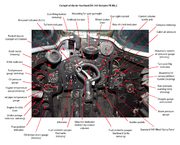 Under specification E.6/41 for two prototypes, design work on the DH.100 began at the de Havilland works at Hatfield
in mid-1942, two years after the Meteor.
Originally named the "Spider Crab," the aircraft was entirely a de Havilland project, exploiting the company's extensive experience in building with moulded plywood
for aircraft construction. Many of the basic design features were first used in their Mosquito
bomber. It had conventional straight mid-wings and a single jet engine placed in an egg-shaped, aluminium
-skinned fuselage, exhausting in a straight line.
Geoffrey de Havilland Jr
, the de Havilland chief test pilot and son of the company's founder, test flew prototype LZ548/G
on its maiden flight 20 September 1943 from Hatfield. The flight took place only six months after the Meteor's maiden flight. The first Vampire flight had been delayed due to the need to send the sole remaining flight engine to Lockheed
to replace one destroyed in ground engine runs in the prototype XP-80
. The production Vampire Mk I did not fly until April 1945, with most being built by English Electric Aircraft
due to the pressures on de Havilland's production facilities which were busy with other types. Although eagerly taken into service by the RAF, it was still being developed at war's end, and never saw combat in the Second World War.
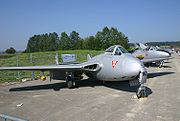 The Vampire was first powered by a Halford H1 (later renamed the "Goblin") producing 2,100 lbf (9.3 kN) of thrust, designed by Frank B Halford and built by de Havilland. The engine was a centrifugal-flow type, a design soon superseded post-war by the slimmer axial-flow units. Initially, the Goblin gave the aircraft a disappointingly limited range. This was a common problem with all the early jets, and later marks were distinguished by greatly increased fuel capacities. As designs improved the engine was often upgraded. Later Mk Is used the Goblin II; the F.3 onwards used the Goblin III. Certain marks were test-beds for the Rolls-Royce Nene
but did not enter production. An unusual characteristic of the low positioning of the engine meant that a Vampire could not remain on idle for longer than a certain time because it would melt the tarmac on which it stood.
De Havilland initiated a private venture night fighter
, the DH.113 intended for export, fitting a two seat cockpit closely based on that of the Mosquito night fighter, and a lengthened nose accommodating AI Mk X radar
. An order to supply the Egyptian Air Force
was received, but this was blocked by the British government as part of a general ban on supplying arms to Egypt
. Instead the RAF took over the order and put them into service as an interim between the retirement of the de Havilland Mosquito
night fighter and the full introduction of the Meteor night fighter. Removal of the radar from the night fighter and fitting of dual controls gave a jet trainer, the DH.115 Vampire or Vampire T.11. This was built in large numbers, both for the RAF and for export.
A total of 3,268 Vampires were built in 15 versions, including a twin-seat night fighter
, trainer and carrier-based aircraft designated Sea Vampire.
The Vampire was used by some 31 air forces. Germany, the Netherlands, Spain and the U.S. were the only major Western powers not to use the aircraft type.
 On 8 June 1946, the Vampire was introduced to the British public when Fighter Command
's 247 Squadron
was given the honour of leading the flypast over London at the Victory Day Celebrations.
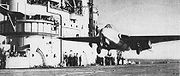
The Vampire was a versatile aircraft, setting many aviation firsts and records, being the first RAF fighter with a top speed exceeding 500 mph (804.7 km/h). On 3 December 1945, a Sea Vampire piloted by Captain
Eric "Winkle" Brown became the first pure-jet aircraft to land on and take off from an aircraft carrier
.
Vampires were used in trials from 1947 to 1955 to develop undercarriage-less fighters that could operate from flexible rubber decks on aircraft carriers, which would allow the weight and complication of an undercarriage to be eliminated. Despite demonstrating that the technique was practicable, with many landings being made with undercarriage retracted on flexible decks both at RAE
Farnborough
and onboard the carrier HMS Warrior
, the proposal was not taken further. On 23 March 1948, John Cunningham
, flying a modified Mk I with extended wing tips and powered by a de Havilland Ghost
engine, set a new world altitude record of 59,446 ft (18,119 m).
On 14 July 1948, six Vampire F.3s of No. 54 Squadron RAF became the first jet aircraft to fly across the Atlantic Ocean
. They went via Stornoway
in the Outer Hebrides
of Scotland
, Keflavik
in Iceland
, and Goose Bay
at Labrador
, before going on to Montreal
(c. 3,000 mi/4,828 km) to start the RAF’s annual goodwill tour of Canada
and the U.S.
where they gave formation aerobatic displays.
At the same time, USAF Colonel
David C. Schilling
led a group of F-80 Shooting Stars flying to Fürstenfeldbruck Air Base
in Germany
to relieve a unit based there. There were conflicting reports later regarding competition between the RAF and USAF to be the first to fly the Atlantic. One report said the USAF squadron delayed completion of its movement to allow the Vampires to be "the first jets across the Atlantic". Another said that the Vampire pilots celebrated “winning the race against the rival F-80s.”
and the Vampire as a ground-attack fighter-bomber (although their roles probably should have been reversed). The first prototype of the "Vampire Fighter-Bomber Mk 5" (FB.5), modified from a Vampire F.3, carried out its initial flight on 23 June 1948. The FB.5 retained the Goblin III engine of the F.3, but featured armour protection around engine systems, wings clipped back by 1 ft (30 cm), and longer-stroke main landing gear
to handle greater takeoff
weights and provide clearance for stores/weapons load. An external tank or 500 lb (227 kg) bomb could be carried under each wing, and eight "3-inch" rocket projectiles
("RPs") could be stacked in pairs on four attachments inboard of the booms. Although an ejection seat was considered, it was not fitted.
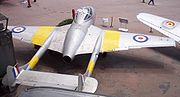 At its peak, 19 RAF squadrons flew the FB.5 in Europe, the Middle East and the Far East. The FB.5 undertook attack missions during the successful British Commonwealth
campaign to suppress the insurgency in Malaya
in the late 1940s and early 1950s. The FB.5 fighter-bomber became the most numerous single-seat variant with 473 aircraft produced.
The NF.10 served from 1951 to 1954 with three squadrons (23
, 25 and 151
) but was often flown in daytime as well as night time. After replacement by the Venom
conversions were made to NF(T).10 standard for operation by the Central Navigation and Control School at RAF Shawbury
. Others were sold to the Indian Air Force.
The RAF eventually relegated the Vampire to advanced training roles in the mid-1950s and the type was generally out of RAF service by the end of the decade.
The Mk 5 was navalised
as the Sea Vampire, the first Royal Navy
jet aircraft. Although its short range meant that it was unsuitable as a front-line carrier fighter, the Navy had been very impressed with the aircraft since 3 December 1945, when a Vampire carried out the flying trials on the carrier , and 18 Sea Vampires were purchased to gain experience in carrier jet operations.
The final Vampire was the T (trainer) model. First flown in 1950, over 600 examples of the T.11 were produced in both air force and naval models. The T models remained in service with the RAF until 1966. There was a Vampire trainer in service at CFS
RAF Little Rissington
until at least January 1972.
. The first three machines were British-built aircraft, an F1, F2 and FB.5, and were given serial numbers A78-1 to A78-3. The second aircraft, the F2 (A78-2), was significant in that it was powered by a Rolls Royce Nene jet engine, rather than the usual Goblin. All 80 F.30 fighters and FB.31 fighter-bomber aircraft built in Australia by de Havilland Australia
were to be powered by Commonwealth Aircraft Corporation
licence-built versions of the Nene engine. The Nene required a greater intake cross-section than the Goblin, and the initial solution was to mount auxiliary intakes on top of the fuselage behind the canopy. Unfortunately these intakes led to elevator blanking on formation of shock waves, and three aircraft and pilots were lost in unrecoverable dives. All Nene-engined aircraft were later modified to have the auxiliary intakes beneath the fuselage, thus avoiding the problem.
The first Vampire F.30 fighter (A79-1) flew in June 1949, and it was followed by 56 more F.30 variants before the final 23 aircraft were completed as FB.31s with strengthened and clipped wings with underwing hardpoints. The last FB.31 was delivered in August 1953, and 24 late-production F.30s were subsequently upgraded to FB.31 standard. Single seat Vampires were retired in the RAAF in 1954.
The T.33, T.34 and T.35 were used by the RAAF and the Royal Australian Navy (RAN) (known as Mk33 through to Mk35W in RAAF service) and many were manufactured or assembled at de Havilland Australia's facilities in Sydney. The Mk35W was a Mk35 fitted with spare Mk33 wings following overstress or achievement of fatigue life. Vampire trainer production amounted to 110 aircraft, and the initial order was filled by 35 T.33s for the RAAF, deliveries being made in 1952 with five T.34s for the RAN delivered in 1954. The trainers remained in service in the RAAF until 1970 while RAN Vampires were retired in 1971.
in 1946. The F.3 was chosen as one of two types of operational fighters for the Royal Canadian Air Force
and was first flown in Canada on 17 January 1948 where it went into service as a Central Flying School training aircraft at RCAF Station Trenton. With 86 in total, the F.3 was the first jet fighter to enter RCAF service in any significant numbers. It served to introduce fighter pilots not only to jet flying, but also to cockpit pressurization and the tricycle landing gear. The "Vamp" was a popular aircraft, easy to fly and considered a "hot rod." It served in both operational and air reserve units (400, 401, 402, 411, 438 and 442 squadrons) until retirement in the late 1950s when it was replaced by the Canadair Sabre.
lost three Vampires in combat with Israeli jets during the Suez Crisis
.
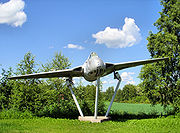 The Finnish Air Force received six FB.52 Vampires in 1953. The model was nicknamed "Vamppi" in Finnish service. An additional nine twin-seat T.55s were purchased in 1955. The aircraft were assigned to 2nd Wing at Pori, but were transferred to 1st Wing at Tikkakoski at the end of the 1950s. The last Finnish Vampire was decommissioned in 1965.
(IAF) received Vampires in January 1949. Although the unit was put on high alert during the Sino-Indian War
of 1962, it did not see any action, as the air force's role was limited to supply and evacuation.
On September 1, 1965, during the Indo-Pakistani War
, IAF Vampires saw action for the first time. No. 45 Squadron responded to a request for strikes against a counter-attack by the Pakistani Army (Operation Grand Slam
) and four Vampire Mk 52 fighter-bombers were successful in slowing the Pakistani advance. However, the Vampires encountered two Pakistan Air Force
(PAF) F-86 Sabres, armed with air to air missiles; in the ensuing dogfight, the outdated Vampires were outclassed. One was shot down by ground fire and another three were shot down by Sabres. The Vampires were withdrawn from front line service after these losses.
purchased 20 Vampires F.3s, 36 FB.52s and six T.55 trainers. The Vampire was in use in Norway from 1948 to 1957 equipping a three-squadron Vampire wing at Gardermoen. The Vampires were withdrawn in 1957 when the air force re-equipped with the Republic F-84G Thunderjet. The Vampire trainers were replaced by the Lockheed T-33 in 1955 and returned to the United Kingdom and used by the Royal Air Force.
purchased its first batch of 70 FB 1 Vampires in 1946, looking for a jet to replace the already outdated SAAB 21
and J 22
s of its fighter force. The aircraft was designated J 28A and was assigned to the F 13 Norrköping
Wing. It provided such good service that it was selected as the backbone of the fighter force. A total of 310 of the more modern FB.50, designated J 28B, were purchased in 1949. The last one was delivered in 1952, after which all piston-engined fighters were decommissioned. In addition, a total of 57 two-seater DH 115 Vampires called J 28C were used for training.
The Swedish Vampires were retired as fighters in 1956 and replaced with J 29 (SAAB Tunnan
) and J 34 (Hawker Hunter
). The last Vampire trainer was retired in 1968. (All Vampire warbirds being flown in Sweden today originate from the Swiss Air Force
.)
in the late 1960s and early 1970s. Rhodesia operated Vampires until the end of the bush war
in 1979. They were eventually replaced by the BAe Hawk 60
in the early 1980s. After 30 years service, they were the last Vampires used on operations anywhere in the world.
 Austria
 Australia
 Myanmar
 Canada
 Chile
Chile
 Republic of the Congo
 Dominican Republic
 Egypt
Egypt
 Finland
 Early Modern France
 India
India
 Indonesia
 Iraq
Iraq
 Republic of Ireland
 Italy
Italy
 Japan
Japan
 Jordan
 State of Katanga
 Lebanon
 Mexico
 New Zealand
 Norway
 Portugal
 Rhodesia
 South Africa
 Sweden
 Switzerland
 Syria
Syria
 United Kingdom
 Venezuela
in Essex, UK. Several ex-Swiss and ex-Australian Vampires operate as collectors' aircraft in the United States. One ex-Australian two-seat Mk 35W Vampire, S/N A79-617 was restored by Red Star Aviation of Hackettstown, New Jersey
and then repatriated to Australia, where it is displayed in air shows. Two ex-RAAF Mk 35s (A79-637 and A79-665) are owned by the Historical Aircraft Restoration Society (HARS) at Illawarra Regional Airport
, NSW, one of which is being restored to flying condition. Several other US-based Vampires are abandoned and in disrepair.
An ex-RNZAF T.11 is being restored at the New Zealand Fighter Pilots Museum
.
In 1964 Lynn Garrison
acquired two ex-RCAF Vampire Mk IIIs. One of these survives, displayed in The Aerospace Museum in Calgary, Alberta.
On 6 June 2009, the world's oldest flying jet, a Vampire built in 1947, formerly of the RCAF and owned by the Wings of Flight Air Museum
in Batavia, New York, crashed during an emergency landing at Rochester International Airport
. The aircraft had just taken off to fly to Batavia but returned due to engine trouble. Experiencing a total flameout
the pilot belly landed
on the grass parallel to the runway. The aircraft struck a berm near the taxiway which caused substantial damage. The pilot escaped with minor injuries. The aircraft had previously been restored with funding from actor John Travolta
.
South African Air Force Museum, Zwartkop, Pretoria has an airworthy Vampire T55 which is flown occasionally, usually at their airshows.
 Examples of the de Havilland Vampire on display include:
Australia
Austria
Canada
Finland
India
Indonesia
Ireland
Israel
Japan
Malta
New Zealand
Saudia Arabia
South Africa
United Kingdom
United States
Venezuela
De Havilland
The de Havilland Aircraft Company was a British aviation manufacturer founded in 1920 when Airco, of which Geoffrey de Havilland had been chief designer, was sold to BSA by the owner George Holt Thomas. De Havilland then set up a company under his name in September of that year at Stag Lane...
DH.100 Vampire was a British
United Kingdom
The United Kingdom of Great Britain and Northern IrelandIn the United Kingdom and Dependencies, other languages have been officially recognised as legitimate autochthonous languages under the European Charter for Regional or Minority Languages...
jet-engine fighter commissioned by the Royal Air Force
Royal Air Force
The Royal Air Force is the aerial warfare service branch of the British Armed Forces. Formed on 1 April 1918, it is the oldest independent air force in the world...
during the Second World War
World War II
World War II, or the Second World War , was a global conflict lasting from 1939 to 1945, involving most of the world's nations—including all of the great powers—eventually forming two opposing military alliances: the Allies and the Axis...
. Following the Gloster Meteor
Gloster Meteor
The Gloster Meteor was the first British jet fighter and the Allies' first operational jet. It first flew in 1943 and commenced operations on 27 July 1944 with 616 Squadron of the Royal Air Force...
, it was the second jet fighter
Fighter aircraft
A fighter aircraft is a military aircraft designed primarily for air-to-air combat with other aircraft, as opposed to a bomber, which is designed primarily to attack ground targets...
to enter service with the RAF. Although it arrived too late to see combat during the war, the Vampire served with front line RAF squadrons until 1955 and continued in use as a trainer until 1966. The Vampire also served with many air forces worldwide, setting aviation firsts and records.
Almost 3,300 Vampires were built, a quarter of them under licence
Licence-built
The term licence-built refers to an object manufactured by one organisation with the authorisation of the organisation that owns the intellectual property of the design...
in other countries. The Vampire design was also developed into the de Havilland Venom
De Havilland Venom
The de Havilland DH 112 Venom was a British postwar single-engined jet aircraft developed from the de Havilland Vampire. It served with the Royal Air Force as a single-seat fighter-bomber and two-seat night fighter....
fighter-bomber as well as naval Sea Vampire variants.
Design and development
The Vampire was considered to be a largely experimental design due to its unorthodox arrangement and the use of a single engine, unlike the Gloster MeteorGloster Meteor
The Gloster Meteor was the first British jet fighter and the Allies' first operational jet. It first flew in 1943 and commenced operations on 27 July 1944 with 616 Squadron of the Royal Air Force...
which was always specified for production. The low-powered early British jet engines meant that only twin-engine aircraft designs were considered practical; but as more powerful engines were developed, particularly Frank Halford
Frank Halford
Major Frank Bernard Halford CBE FRAeS was an English aircraft engine designer.-Career:Educated at Felsted, In 1913 he left the University of Nottingham before graduating to learn to fly at Brooklands and Bristol Flying School and became a flight instructor using Bristol Boxkites.He served in the...
's H.1 (later known as the Goblin), a single-engined jet fighter became more viable. De Havilland
De Havilland
The de Havilland Aircraft Company was a British aviation manufacturer founded in 1920 when Airco, of which Geoffrey de Havilland had been chief designer, was sold to BSA by the owner George Holt Thomas. De Havilland then set up a company under his name in September of that year at Stag Lane...
were approached to produce an airframe for the H.1, and their first design, the DH.99, was an all-metal, twin-boom, tricycle undercarriage aircraft armed with four cannons. The use of a twin boom (similar to that of the Lockheed P-38) kept the jet pipe short which avoided the power loss of a long pipe that would have been needed in a conventional fuselage. The DH.99 was modified to a mixed wood and metal construction in light of Ministry of Aircraft Production recommendations, and the design was renumbered to DH.100 by November 1941.
Hatfield, Hertfordshire
Hatfield is a town and civil parish in Hertfordshire, England in the borough of Welwyn Hatfield. It has a population of 29,616, and is of Saxon origin. Hatfield House, the home of the Marquess of Salisbury, is the nucleus of the old town...
in mid-1942, two years after the Meteor.
Originally named the "Spider Crab," the aircraft was entirely a de Havilland project, exploiting the company's extensive experience in building with moulded plywood
Plywood
Plywood is a type of manufactured timber made from thin sheets of wood veneer. It is one of the most widely used wood products. It is flexible, inexpensive, workable, re-usable, and can usually be locally manufactured...
for aircraft construction. Many of the basic design features were first used in their Mosquito
De Havilland Mosquito
The de Havilland DH.98 Mosquito was a British multi-role combat aircraft that served during the Second World War and the postwar era. It was known affectionately as the "Mossie" to its crews and was also nicknamed "The Wooden Wonder"...
bomber. It had conventional straight mid-wings and a single jet engine placed in an egg-shaped, aluminium
Aluminium
Aluminium or aluminum is a silvery white member of the boron group of chemical elements. It has the symbol Al, and its atomic number is 13. It is not soluble in water under normal circumstances....
-skinned fuselage, exhausting in a straight line.
Geoffrey de Havilland Jr
Geoffrey de Havilland Jr
* For the father of the same name see: Geoffrey de HavillandGeoffrey Roal de Havilland Jr., OBE was a British test pilot and the son of the English aviation pioneer and aircraft designer of the same name, Geoffrey de Havilland....
, the de Havilland chief test pilot and son of the company's founder, test flew prototype LZ548/G
Serial number
A serial number is a unique number assigned for identification which varies from its successor or predecessor by a fixed discrete integer value...
on its maiden flight 20 September 1943 from Hatfield. The flight took place only six months after the Meteor's maiden flight. The first Vampire flight had been delayed due to the need to send the sole remaining flight engine to Lockheed
Lockheed Corporation
The Lockheed Corporation was an American aerospace company. Lockheed was founded in 1912 and later merged with Martin Marietta to form Lockheed Martin in 1995.-Origins:...
to replace one destroyed in ground engine runs in the prototype XP-80
P-80 Shooting Star
The Lockheed P-80 Shooting Star was the first jet fighter used operationally by the United States Army Air Forces. Designed in 1943 as a response to the German Messerschmitt Me-262 jet fighter, and delivered in just 143 days from the start of the design process, production models were flying but...
. The production Vampire Mk I did not fly until April 1945, with most being built by English Electric Aircraft
English Electric
English Electric was a British industrial manufacturer. Founded in 1918, it initially specialised in industrial electric motors and transformers...
due to the pressures on de Havilland's production facilities which were busy with other types. Although eagerly taken into service by the RAF, it was still being developed at war's end, and never saw combat in the Second World War.
Rolls-Royce Nene
|-See also:-References:NotesBibliography* Bridgman, L, Jane's fighting aircraft of World War II. Crescent. ISBN 0-517-67964-7-External links:* *...
but did not enter production. An unusual characteristic of the low positioning of the engine meant that a Vampire could not remain on idle for longer than a certain time because it would melt the tarmac on which it stood.
De Havilland initiated a private venture night fighter
Night fighter
A night fighter is a fighter aircraft adapted for use at night or in other times of bad visibility...
, the DH.113 intended for export, fitting a two seat cockpit closely based on that of the Mosquito night fighter, and a lengthened nose accommodating AI Mk X radar
Radar
Radar is an object-detection system which uses radio waves to determine the range, altitude, direction, or speed of objects. It can be used to detect aircraft, ships, spacecraft, guided missiles, motor vehicles, weather formations, and terrain. The radar dish or antenna transmits pulses of radio...
. An order to supply the Egyptian Air Force
Egyptian Air Force
The Egyptian Air Force, or EAF , is the aviation branch of the Egyptian Armed Forces. The EAF is headed by an Air Marshal . Currently, the commander of the Egyptian Air Force is Air Marshal Reda Mahmoud Hafez Mohamed...
was received, but this was blocked by the British government as part of a general ban on supplying arms to Egypt
Egypt
Egypt , officially the Arab Republic of Egypt, Arabic: , is a country mainly in North Africa, with the Sinai Peninsula forming a land bridge in Southwest Asia. Egypt is thus a transcontinental country, and a major power in Africa, the Mediterranean Basin, the Middle East and the Muslim world...
. Instead the RAF took over the order and put them into service as an interim between the retirement of the de Havilland Mosquito
De Havilland Mosquito
The de Havilland DH.98 Mosquito was a British multi-role combat aircraft that served during the Second World War and the postwar era. It was known affectionately as the "Mossie" to its crews and was also nicknamed "The Wooden Wonder"...
night fighter and the full introduction of the Meteor night fighter. Removal of the radar from the night fighter and fitting of dual controls gave a jet trainer, the DH.115 Vampire or Vampire T.11. This was built in large numbers, both for the RAF and for export.
A total of 3,268 Vampires were built in 15 versions, including a twin-seat night fighter
Night fighter
A night fighter is a fighter aircraft adapted for use at night or in other times of bad visibility...
, trainer and carrier-based aircraft designated Sea Vampire.
The Vampire was used by some 31 air forces. Germany, the Netherlands, Spain and the U.S. were the only major Western powers not to use the aircraft type.
Records and achievements
RAF Fighter Command
RAF Fighter Command was one of three functional commands of the Royal Air Force. It was formed in 1936 to allow more specialised control of fighter aircraft. It served throughout the Second World War, gaining recognition in the Battle of Britain. The Command continued until 17 November 1943, when...
's 247 Squadron
No. 247 Squadron RAF
No. 247 Squadron was formerly a squadron of the Royal Air Force. It was also known as No.247 Squadron in recognition of the donations made by the British colonies, which at the outbreak of the Second World War, were established on the Chinese coast...
was given the honour of leading the flypast over London at the Victory Day Celebrations.
The Vampire was a versatile aircraft, setting many aviation firsts and records, being the first RAF fighter with a top speed exceeding 500 mph (804.7 km/h). On 3 December 1945, a Sea Vampire piloted by Captain
Captain (naval)
Captain is the name most often given in English-speaking navies to the rank corresponding to command of the largest ships. The NATO rank code is OF-5, equivalent to an army full colonel....
Eric "Winkle" Brown became the first pure-jet aircraft to land on and take off from an aircraft carrier
Aircraft carrier
An aircraft carrier is a warship designed with a primary mission of deploying and recovering aircraft, acting as a seagoing airbase. Aircraft carriers thus allow a naval force to project air power worldwide without having to depend on local bases for staging aircraft operations...
.
Vampires were used in trials from 1947 to 1955 to develop undercarriage-less fighters that could operate from flexible rubber decks on aircraft carriers, which would allow the weight and complication of an undercarriage to be eliminated. Despite demonstrating that the technique was practicable, with many landings being made with undercarriage retracted on flexible decks both at RAE
Royal Aircraft Establishment
The Royal Aircraft Establishment , was a British research establishment, known by several different names during its history, that eventually came under the aegis of the UK Ministry of Defence , before finally losing its identity in mergers with other institutions.The first site was at Farnborough...
Farnborough
Farnborough Airfield
Farnborough Airport or TAG London Farnborough Airport is an airport situated in Farnborough, Rushmoor, Hampshire, England...
and onboard the carrier HMS Warrior
HMS Warrior (R31)
HMS Warrior was a Colossus-class light aircraft carrier which served in the Royal Canadian Navy from 1946 to 1948 , the Royal Navy from 1948 to 1958, and the Argentine Navy from 1959 to 1969 .- History :Built by Harland and Wolff in Belfast, she was originally to be called HMS Brave; the Royal...
, the proposal was not taken further. On 23 March 1948, John Cunningham
John Cunningham (RAF officer)
Group Captain John "Cat's Eyes" Cunningham CBE, DSO & Two Bars, DFC & Bar, , was a British Royal Air Force night fighter ace during World War II and a test pilot, both before and after the war...
, flying a modified Mk I with extended wing tips and powered by a de Havilland Ghost
De Havilland Ghost
|-See also:-Bibliography:*Gunston, Bill. World Encyclopedia of Aero Engines. Cambridge, England. Patrick Stephens Limited, 1989. ISBN 1-85260-163-9...
engine, set a new world altitude record of 59,446 ft (18,119 m).
On 14 July 1948, six Vampire F.3s of No. 54 Squadron RAF became the first jet aircraft to fly across the Atlantic Ocean
Atlantic Ocean
The Atlantic Ocean is the second-largest of the world's oceanic divisions. With a total area of about , it covers approximately 20% of the Earth's surface and about 26% of its water surface area...
. They went via Stornoway
Stornoway Airport
-Other Tenants:* Maritime and Coastguard Agency - 2 Sikorsky S-92 helicopters operated by CHC Helicopter-Accident and incidents:...
in the Outer Hebrides
Outer Hebrides
The Outer Hebrides also known as the Western Isles and the Long Island, is an island chain off the west coast of Scotland. The islands are geographically contiguous with Comhairle nan Eilean Siar, one of the 32 unitary council areas of Scotland...
of Scotland
Scotland
Scotland is a country that is part of the United Kingdom. Occupying the northern third of the island of Great Britain, it shares a border with England to the south and is bounded by the North Sea to the east, the Atlantic Ocean to the north and west, and the North Channel and Irish Sea to the...
, Keflavik
Keflavík
Keflavík is a town in the Reykjanes region in southwest Iceland. In 2009 its population was of 8,169.In 1995 it merged with Njarðvík and Hafnir to form a municipality called Reykjanesbær with a population of 13,971 .- History :...
in Iceland
Iceland
Iceland , described as the Republic of Iceland, is a Nordic and European island country in the North Atlantic Ocean, on the Mid-Atlantic Ridge. Iceland also refers to the main island of the country, which contains almost all the population and almost all the land area. The country has a population...
, and Goose Bay
CFB Goose Bay
Canadian Forces Base Goose Bay , is a Canadian Forces Base located in the town of Happy Valley-Goose Bay, Newfoundland and Labrador....
at Labrador
Labrador
Labrador is the distinct, northerly region of the Canadian province of Newfoundland and Labrador. It comprises the mainland portion of the province, separated from the island of Newfoundland by the Strait of Belle Isle...
, before going on to Montreal
Montreal
Montreal is a city in Canada. It is the largest city in the province of Quebec, the second-largest city in Canada and the seventh largest in North America...
(c. 3,000 mi/4,828 km) to start the RAF’s annual goodwill tour of Canada
Canada
Canada is a North American country consisting of ten provinces and three territories. Located in the northern part of the continent, it extends from the Atlantic Ocean in the east to the Pacific Ocean in the west, and northward into the Arctic Ocean...
and the U.S.
United States
The United States of America is a federal constitutional republic comprising fifty states and a federal district...
where they gave formation aerobatic displays.
At the same time, USAF Colonel
Colonel
Colonel , abbreviated Col or COL, is a military rank of a senior commissioned officer. It or a corresponding rank exists in most armies and in many air forces; the naval equivalent rank is generally "Captain". It is also used in some police forces and other paramilitary rank structures...
David C. Schilling
David C. Schilling
David Carl Schilling was a U.S. Air Force officer, fighter ace, and leading advocate of long-range jet fighter operations. Kansas' Schilling Air Force Base was named in his memory.-Biography:...
led a group of F-80 Shooting Stars flying to Fürstenfeldbruck Air Base
Fürstenfeldbruck Air Base
Fürstenfeldbruck Air Base is a German Air Force airfield located near the town of Fürstenfeldbruck in Bavaria, near Munich, Germany....
in Germany
Germany
Germany , officially the Federal Republic of Germany , is a federal parliamentary republic in Europe. The country consists of 16 states while the capital and largest city is Berlin. Germany covers an area of 357,021 km2 and has a largely temperate seasonal climate...
to relieve a unit based there. There were conflicting reports later regarding competition between the RAF and USAF to be the first to fly the Atlantic. One report said the USAF squadron delayed completion of its movement to allow the Vampires to be "the first jets across the Atlantic". Another said that the Vampire pilots celebrated “winning the race against the rival F-80s.”
RAF and Royal Navy service
In postwar service, the RAF employed the Gloster Meteor as an interceptorInterceptor aircraft
An interceptor aircraft is a type of fighter aircraft designed specifically to prevent missions of enemy aircraft, particularly bombers and reconnaissance aircraft. Interceptors generally rely on high speed and powerful armament in order to complete their mission as quickly as possible and set up...
and the Vampire as a ground-attack fighter-bomber (although their roles probably should have been reversed). The first prototype of the "Vampire Fighter-Bomber Mk 5" (FB.5), modified from a Vampire F.3, carried out its initial flight on 23 June 1948. The FB.5 retained the Goblin III engine of the F.3, but featured armour protection around engine systems, wings clipped back by 1 ft (30 cm), and longer-stroke main landing gear
Landing Gear
Landing Gear is Devin the Dude's fifth studio album. It was released on October 7, 2008. It was his first studio album since signing with the label Razor & Tie. It features a high-profile guest appearance from Snoop Dogg. As of October 30, 2008, the album has sold 18,906 copies.-Track...
to handle greater takeoff
Takeoff
Takeoff is the phase of flight in which an aerospace vehicle goes from the ground to flying in the air.For horizontal takeoff aircraft this usually involves starting with a transition from moving along the ground on a runway. For balloons, helicopters and some specialized fixed-wing aircraft , no...
weights and provide clearance for stores/weapons load. An external tank or 500 lb (227 kg) bomb could be carried under each wing, and eight "3-inch" rocket projectiles
RP-3
The RP-3 , was a British rocket used in the Second World War. Though primarily an air-to-ground weapon, it saw limited use in other roles. Its 60 lb warhead gave rise to the alternative name of the "60 lb rocket"; the 25 lb solid-shot armour piercing variant was referred to as the "25 lb rocket"...
("RPs") could be stacked in pairs on four attachments inboard of the booms. Although an ejection seat was considered, it was not fitted.
Commonwealth of Nations
The Commonwealth of Nations, normally referred to as the Commonwealth and formerly known as the British Commonwealth, is an intergovernmental organisation of fifty-four independent member states...
campaign to suppress the insurgency in Malaya
Malayan Emergency
The Malayan Emergency was a guerrilla war fought between Commonwealth armed forces and the Malayan National Liberation Army , the military arm of the Malayan Communist Party, from 1948 to 1960....
in the late 1940s and early 1950s. The FB.5 fighter-bomber became the most numerous single-seat variant with 473 aircraft produced.
The NF.10 served from 1951 to 1954 with three squadrons (23
No. 23 Squadron RAF
No. 23 Squadron was a squadron of the Royal Air Force. Until October 2009, it operated the Boeing Sentry AEW1 Airborne Warning And Control System aircraft from RAF Waddington, Lincolnshire.-First World War:...
, 25 and 151
No. 151 Squadron RAF
-World War I:No. 151 squadron was founded at Hainault Farm in Essex on 12 June 1918, and was equipped with Sopwith Camel aircraft.During the five months in which 151 Squadron had taken part in hostilities overseas, the total number of hours flown by night was 1443 hrs 26 mins.Sixteen enemy aircraft...
) but was often flown in daytime as well as night time. After replacement by the Venom
De Havilland Venom
The de Havilland DH 112 Venom was a British postwar single-engined jet aircraft developed from the de Havilland Vampire. It served with the Royal Air Force as a single-seat fighter-bomber and two-seat night fighter....
conversions were made to NF(T).10 standard for operation by the Central Navigation and Control School at RAF Shawbury
RAF Shawbury
RAF Shawbury is a Royal Air Force station by the village of Shawbury near Shrewsbury, Shropshire.The station at Shawbury was first used for military flying training in 1917 by the Royal Flying Corps, but it was returned to agricultural use in 1920. In 1938 it was reactivated as a training...
. Others were sold to the Indian Air Force.
The RAF eventually relegated the Vampire to advanced training roles in the mid-1950s and the type was generally out of RAF service by the end of the decade.
The Mk 5 was navalised
Navalised
A navalised aircraft is an aircraft that has been specifically designed for naval use, in some cases as a variant of a land-based design.-Characteristics:...
as the Sea Vampire, the first Royal Navy
Royal Navy
The Royal Navy is the naval warfare service branch of the British Armed Forces. Founded in the 16th century, it is the oldest service branch and is known as the Senior Service...
jet aircraft. Although its short range meant that it was unsuitable as a front-line carrier fighter, the Navy had been very impressed with the aircraft since 3 December 1945, when a Vampire carried out the flying trials on the carrier , and 18 Sea Vampires were purchased to gain experience in carrier jet operations.
The final Vampire was the T (trainer) model. First flown in 1950, over 600 examples of the T.11 were produced in both air force and naval models. The T models remained in service with the RAF until 1966. There was a Vampire trainer in service at CFS
Central Flying School
The Central Flying School is the Royal Air Force's primary institution for the training of military flying instructors. Established in 1912 it is the longest existing flying training school.-History:...
RAF Little Rissington
RAF Little Rissington
RAF Little Rissington is an RAF aerodrome and former RAF station in Gloucestershire, England. It was once home to the Central Flying School, the Vintage Pair and the Red Arrows.Built during the 1930s, the station was opened in 1938 and closed in 1994...
until at least January 1972.
Australia
In 1946 approval was given for the purchase of an initial 50 Vampire aircraft for the RAAFRoyal Australian Air Force
The Royal Australian Air Force is the air force branch of the Australian Defence Force. The RAAF was formed in March 1921. It continues the traditions of the Australian Flying Corps , which was formed on 22 October 1912. The RAAF has taken part in many of the 20th century's major conflicts...
. The first three machines were British-built aircraft, an F1, F2 and FB.5, and were given serial numbers A78-1 to A78-3. The second aircraft, the F2 (A78-2), was significant in that it was powered by a Rolls Royce Nene jet engine, rather than the usual Goblin. All 80 F.30 fighters and FB.31 fighter-bomber aircraft built in Australia by de Havilland Australia
De Havilland Australia
De Havilland Aircraft Pty Ltd was part of de Havilland, then became a separate company. It was purchased by Boeing and is now Hawker de Havilland Aerospace Pty Ltd, a subsidiary of Boeing Australia Ltd-Early Years and WWII:...
were to be powered by Commonwealth Aircraft Corporation
Commonwealth Aircraft Corporation
The Commonwealth Aircraft Corporation was an Australian aircraft manufacturer. The CAC was established in 1936, to provide Australia with the capability to produce military aircraft and engines.-History:...
licence-built versions of the Nene engine. The Nene required a greater intake cross-section than the Goblin, and the initial solution was to mount auxiliary intakes on top of the fuselage behind the canopy. Unfortunately these intakes led to elevator blanking on formation of shock waves, and three aircraft and pilots were lost in unrecoverable dives. All Nene-engined aircraft were later modified to have the auxiliary intakes beneath the fuselage, thus avoiding the problem.
The first Vampire F.30 fighter (A79-1) flew in June 1949, and it was followed by 56 more F.30 variants before the final 23 aircraft were completed as FB.31s with strengthened and clipped wings with underwing hardpoints. The last FB.31 was delivered in August 1953, and 24 late-production F.30s were subsequently upgraded to FB.31 standard. Single seat Vampires were retired in the RAAF in 1954.
The T.33, T.34 and T.35 were used by the RAAF and the Royal Australian Navy (RAN) (known as Mk33 through to Mk35W in RAAF service) and many were manufactured or assembled at de Havilland Australia's facilities in Sydney. The Mk35W was a Mk35 fitted with spare Mk33 wings following overstress or achievement of fatigue life. Vampire trainer production amounted to 110 aircraft, and the initial order was filled by 35 T.33s for the RAAF, deliveries being made in 1952 with five T.34s for the RAN delivered in 1954. The trainers remained in service in the RAAF until 1970 while RAN Vampires were retired in 1971.
Canada
An F.1 version began operating on an evaluation basis in Canada at the Winter Experimental Establishment in EdmontonEdmonton
Edmonton is the capital of the Canadian province of Alberta and is the province's second-largest city. Edmonton is located on the North Saskatchewan River and is the centre of the Edmonton Capital Region, which is surrounded by the central region of the province.The city and its census...
in 1946. The F.3 was chosen as one of two types of operational fighters for the Royal Canadian Air Force
Royal Canadian Air Force
The history of the Royal Canadian Air Force begins in 1920, when the air force was created as the Canadian Air Force . In 1924 the CAF was renamed the Royal Canadian Air Force and granted royal sanction by King George V. The RCAF existed as an independent service until 1968...
and was first flown in Canada on 17 January 1948 where it went into service as a Central Flying School training aircraft at RCAF Station Trenton. With 86 in total, the F.3 was the first jet fighter to enter RCAF service in any significant numbers. It served to introduce fighter pilots not only to jet flying, but also to cockpit pressurization and the tricycle landing gear. The "Vamp" was a popular aircraft, easy to fly and considered a "hot rod." It served in both operational and air reserve units (400, 401, 402, 411, 438 and 442 squadrons) until retirement in the late 1950s when it was replaced by the Canadair Sabre.
Egypt
In 1954 Egypt was operating 49 Vampires, acquired from Italy and Britain, as fighter-bombers. In 1955 twelve Vampire trainers were ordered, with delivery starting in July that year. The Egyptian Air ForceEgyptian Air Force
The Egyptian Air Force, or EAF , is the aviation branch of the Egyptian Armed Forces. The EAF is headed by an Air Marshal . Currently, the commander of the Egyptian Air Force is Air Marshal Reda Mahmoud Hafez Mohamed...
lost three Vampires in combat with Israeli jets during the Suez Crisis
Suez Crisis
The Suez Crisis, also referred to as the Tripartite Aggression, Suez War was an offensive war fought by France, the United Kingdom, and Israel against Egypt beginning on 29 October 1956. Less than a day after Israel invaded Egypt, Britain and France issued a joint ultimatum to Egypt and Israel,...
.
Finland
India
No. 7 Squadron, Indian Air ForceNo. 7 Squadron, Indian Air Force
No. 7 Squadron, Indian Air Force operates as a CAS and air superiority unit. Based at Gwalior AFB, No.7 Squadron along with No. 1 Squadron IAF , and No. 9 Squadron IAF , forms a part of No. 40 Wing IAF, Central Air Command.-Crest:No...
(IAF) received Vampires in January 1949. Although the unit was put on high alert during the Sino-Indian War
Sino-Indian War
The Sino-Indian War , also known as the Sino-Indian Border Conflict , was a war between China and India that occurred in 1962. A disputed Himalayan border was the main pretext for war, but other issues played a role. There had been a series of violent border incidents after the 1959 Tibetan...
of 1962, it did not see any action, as the air force's role was limited to supply and evacuation.
On September 1, 1965, during the Indo-Pakistani War
Aerial warfare in 1965 India Pakistan War
The Indo-Pakistani War of 1965 saw the Indian and Pakistani Air Forces engaged in large-scale aerial combat against each other for the first time since the Partition in 1947. The war took place during the course of September 1965 and saw both air forces conduct defensive and offensive operations...
, IAF Vampires saw action for the first time. No. 45 Squadron responded to a request for strikes against a counter-attack by the Pakistani Army (Operation Grand Slam
Operation Grand Slam
Operation Grand Slam is virtually synonymous with the 1965 Indo-Pakistani War. It refers to an audacious plan drawn up by the Pakistan Army, in May 1965, to attack the vital Akhnoor Bridge in Jammu and Kashmir, which was not only the lifeline of an entire infantry division in Jammu and Kashmir but...
) and four Vampire Mk 52 fighter-bombers were successful in slowing the Pakistani advance. However, the Vampires encountered two Pakistan Air Force
Pakistan Air Force
The Pakistan Air Force is the leading air arm of the Pakistan Armed Forces and is primarily tasked with the aerial defence of Pakistan with a secondary role of providing air support to the Pakistan Army and the Pakistan Navy. The PAF also has a tertiary role of providing strategic air transport...
(PAF) F-86 Sabres, armed with air to air missiles; in the ensuing dogfight, the outdated Vampires were outclassed. One was shot down by ground fire and another three were shot down by Sabres. The Vampires were withdrawn from front line service after these losses.
Norway
The Royal Norwegian Air ForceRoyal Norwegian Air Force
The Royal Norwegian Air Force is the air force of Norway. It was established as a separate arm of the Norwegian armed forces on 10 November 1944. The RNoAF's peace force is approximately 1,430 employees . 600 personnel also serve their draft period in the RNoAF...
purchased 20 Vampires F.3s, 36 FB.52s and six T.55 trainers. The Vampire was in use in Norway from 1948 to 1957 equipping a three-squadron Vampire wing at Gardermoen. The Vampires were withdrawn in 1957 when the air force re-equipped with the Republic F-84G Thunderjet. The Vampire trainers were replaced by the Lockheed T-33 in 1955 and returned to the United Kingdom and used by the Royal Air Force.
Sweden
The Swedish Air ForceSwedish Air Force
The Swedish Air Force is the air force branch of the Swedish Armed Forces.-History:The Swedish Air Force was created on July 1, 1926 when the aircraft units of the Army and Navy were merged. Because of the escalating international tension during the 1930s the Air Force was reorganized and expanded...
purchased its first batch of 70 FB 1 Vampires in 1946, looking for a jet to replace the already outdated SAAB 21
Saab 21
|-See also:-References:NotesBibliography* Billing, Peter. "A Fork-Tailed Swede." Air Enthusiast Twenty-two, August–November 1983. Bromley, Kent, UK: Pilot Press Ltd., 1983....
and J 22
FFVS J 22
|-See also:-Bibliography:* Andersson, Hans G. SAAB Aircraft since 1937; 2nd revised edition. London: Putnam Aeronautical books, 1997. ISBN 0-85177-886-0...
s of its fighter force. The aircraft was designated J 28A and was assigned to the F 13 Norrköping
F 13 Norrköping
F 13 Norrköping, Bråvalla Flygflottilj, Bråvalla Air Force Wing, or simply "F 13", is a former Swedish Air Force wing with the main base located near Norrköping in south-eastern Sweden.- History of the airbase :...
Wing. It provided such good service that it was selected as the backbone of the fighter force. A total of 310 of the more modern FB.50, designated J 28B, were purchased in 1949. The last one was delivered in 1952, after which all piston-engined fighters were decommissioned. In addition, a total of 57 two-seater DH 115 Vampires called J 28C were used for training.
The Swedish Vampires were retired as fighters in 1956 and replaced with J 29 (SAAB Tunnan
Saab Tunnan
The Saab 29, popularly called Flygande tunnan , was a Swedish fighter designed and manufactured by Saab in the 1950s. It was Sweden's second turbojet-powered combat aircraft, the first being the Saab 21R...
) and J 34 (Hawker Hunter
Hawker Hunter
The Hawker Hunter is a subsonic British jet aircraft developed in the 1950s. The single-seat Hunter entered service as a manoeuvrable fighter aircraft, and later operated in fighter-bomber and reconnaissance roles in numerous conflicts. Two-seat variants remained in use for training and secondary...
). The last Vampire trainer was retired in 1968. (All Vampire warbirds being flown in Sweden today originate from the Swiss Air Force
Swiss Air Force
The Swiss Air Force is the air component of the Swiss Armed Forces, established on July 31, 1914, as part of the Army and as of January 1966 an independent service.In peacetime, Dübendorf is the operational Air Force HQ...
.)
Rhodesia
The Rhodesian Air Force acquired 16 Vampire FB.9 fighters and a further 16 Vampire FB11 trainers in the early 1950s, its first jet aircraft, equipping two squadrons. These were regularly deployed to Aden between 1957 and 1961, supporting British counter-insurgency operations. 21 more two seaters and 13 single seaters were supplied by South AfricaSouth Africa
The Republic of South Africa is a country in southern Africa. Located at the southern tip of Africa, it is divided into nine provinces, with of coastline on the Atlantic and Indian oceans...
in the late 1960s and early 1970s. Rhodesia operated Vampires until the end of the bush war
Rhodesian Bush War
The Rhodesian Bush War – also known as the Second Chimurenga or the Zimbabwe War of Liberation – was a civil war which took place between July 1964 and December 1979 in the unrecognised country of Rhodesia...
in 1979. They were eventually replaced by the BAe Hawk 60
BAE Hawk
The BAE Systems Hawk is a British single-engine, advanced jet trainer aircraft. It first flew in 1974 as the Hawker Siddeley Hawk. The Hawk is used by the Royal Air Force, and other air forces, as either a trainer or a low-cost combat aircraft...
in the early 1980s. After 30 years service, they were the last Vampires used on operations anywhere in the world.
Variants
- DH 100: three prototypes.
- Vampire Mk I: single-seat fighter version for the RAF; 244 production aircraft being built.
- Mk II: three prototypes, with Rolls-Royce Nene turbojet engine. One built and two conversions.
- F.3: single-seat fighter for the RAF. Two prototypes were converted from the Mk 1; 202 production aircraft were built, 20 were exported to Norway
- Mk IV: Nene-engined project, not built.
- FB.5: single-seat fighter-bomber version. Powered by the Goblin 2 turbojet; 930 built for the RAF and 88 for export.
- FB.6: single-seat fighter-bomber. Powered by a Goblin 3 turbojet; 178 built, 100 built in SwitzerlandSwitzerlandSwitzerland name of one of the Swiss cantons. ; ; ; or ), in its full name the Swiss Confederation , is a federal republic consisting of 26 cantons, with Bern as the seat of the federal authorities. The country is situated in Western Europe,Or Central Europe depending on the definition....
for the Swiss Air ForceSwiss Air ForceThe Swiss Air Force is the air component of the Swiss Armed Forces, established on July 31, 1914, as part of the Army and as of January 1966 an independent service.In peacetime, Dübendorf is the operational Air Force HQ...
. - Mk 8: Ghost-engined, one conversion from Mk 1.
- FB.9: tropicalised fighter-bomber through addition of air conditioning to Mark 5. Powered by Goblin 3 turbojet; 326 built, mostly by de Havilland, but also by Fairey AviationFairey AviationThe Fairey Aviation Company Limited was a British aircraft manufacturer of the first half of the 20th century based in Hayes in Greater London and Heaton Chapel and RAF Ringway in Greater Manchester...
. - Mk 10 or DH 113 Vampire: Goblin-powered two-seater prototype; two built.
- NF.10: two-seat night fighter version for the RAF; 95 built including 29 as the NF.54.
- Sea Vampire Mk 10: prototype for deck trials. One conversion.
- Mk 11 or DH 115 Vampire Trainer: private venture, two-seat jet trainer prototype.
- T.11: two-seat training version for the RAF. Powered by a Goblin 35 turbojet engine; 731 were built by DH and Fairey Aviation.
- Sea Vampire F 20: naval version of the FB.5; 18 built by English Electric.
- Sea Vampire Mk 21: six aircraft converted from F.3s with strengthened belly and arrester hook for trials of undercarriage-less landings on flexible decks.
- Sea Vampire T 22: two-seat training version for the Royal Navy; 73 built by De Havilland.
- FB 25: FB.5 variants; 25 exported to New Zealand
- F.30: single-seat fighter-bomber version for the RAAF. Powered by Rolls-Royce Nene turbojet; 80 built in Australia.
- FB.31: Nene-engined, 29 built in Australia.
- F 32: one Australian conversion with air conditioning.
- T.33: two-seat training version. Powered by the Goblin turbojet; 36 were built in Australia.
- T.34: two-seat training version for the Royal Australian Navy; five were built in Australia.
- T.34A: Vampire T.34s fitted with ejection seats.
- T.35: modified two-seat training version; 68 built in Australia.
- T.35A: T.33 conversions to T.35 configuration.
- FB.50: exported to Sweden as the J 28B; 310 built, 12 of which were eventually rebuilt to T.55 standard.
- FB.51: export prototype (one conversion) to France.
- FB.52: export version of Mk 6, 101 bouilt; 36 exported to Norway and in use from 1949 to 1957
- FB.52A: single-seat fighter-bomber for the Italian Air ForceItalian Air ForceThe Italian Air Force has gone under different names in different periods:*Regia Aeronautica , from 1923 to June 1946*Aeronautica Nazionale Repubblicana, the air force of Italian Social Republic during World War II...
; 80 built in Italy. . - FB.53: single-seat fighter-bomber for the Armee de l'Air; 250 built in France, as the Sud-Est SE 535 Mistral.
- NF.54: export version of Vampire NF.10 for the Italian Air Force; 29 being built.
- T.55: export version of the DH 115 trainer; 216 built and six converted from the T.11.
Operators
Austria
- Austrian Air ForceAustrian Air ForceThe Austrian Air Force is a component part of the Austrian armed forces .-History:The Austrian Air Force was formed in May 1955 by the victorious Allied powers, subject to restrictions on its use of guided missiles...
Australia
- Royal Australian Air ForceRoyal Australian Air ForceThe Royal Australian Air Force is the air force branch of the Australian Defence Force. The RAAF was formed in March 1921. It continues the traditions of the Australian Flying Corps , which was formed on 22 October 1912. The RAAF has taken part in many of the 20th century's major conflicts...
- No. 21 Squadron RAAFNo. 21 Squadron RAAFNo. 21 Squadron is a Royal Australian Air Force general reserve squadron. It saw action as a fighter, dive bomber and heavy bomber unit during World War II.-History:...
- No. 22 Squadron RAAFNo. 22 Squadron RAAFNo. 22 Squadron is a Royal Australian Air Force mixed regular and reserve squadron that provides support for the RAAF in the Sydney region. Formed in 1936, the squadron served in Papua New Guinea during the Second World War, and later followed the Pacific war as far as the Philippines...
- No. 23 Squadron RAAFNo. 23 Squadron RAAFNo. 23 Squadron of the Royal Australian Air Force is a non-flying base operations and training squadron headquartered at RAAF Base Amberley near Brisbane, Queensland. The Squadron was formed in 1937 and saw action during World War II as a bomber squadron.-History:No...
- No. 25 Squadron RAAFNo. 25 Squadron RAAFNo. 25 Squadron is a general reserve squadron of the Royal Australian Air Force. The squadron is based at RAAF Base Pearce in Perth, Western Australia and forms part of the Combat Reserve Wing. The squadron has been based at Pearce since 1938. 25 Squadron was originally formed at RAAF Base...
- No. 75 Squadron RAAFNo. 75 Squadron RAAFNo. 75 Squadron is a Royal Australian Air Force fighter unit based at RAAF Base Tindal in the Northern Territory. The squadron was formed in 1942 and saw extensive action in the South West Pacific theatre of World War II, operating P-40 Kittyhawks. It was disbanded in 1948, but reformed the...
- No. 76 Squadron RAAFNo. 76 Squadron RAAFNo. 76 Squadron is a Royal Australian Air Force flight training squadron. Established in 1942, the squadron operated P-40 Kittyhawk fighter aircraft and saw combat during World War II. Following the war it formed part of Australia's contribution to the occupation of Japan until it was...
- No. 1 Advanced Flying Training School RAAFNo. 2 Flying Training School RAAFNo. 2 Flying Training School is the main flying training school of the Royal Australian Air Force . Formed under its present name in 1969, it is located at RAAF Base Pearce, Western Australia. The unit operates a fleet of Pilatus PC-9 turboprop trainers...
- No. 2 Operational Conversion Unit RAAFNo. 2 Operational Conversion Unit RAAFNo. 2 Operational Conversion Unit is a Royal Australian Air Force training unit located at RAAF Base Williamtown. 2OCU's main role is to train pilots to operate the F/A-18 Hornet. New RAAF pilots enter 2OCU for training after first qualifying to fly jet fighters in No. 76 Squadron...
- No. 5 Operational Training Unit RAAFNo. 5 Operational Training Unit RAAFNo. 5 Operational Training Unit was an operational training unit of the Royal Australian Air Force during World War II.-History:5OTU was formed at formed at RAAF Base Forest Hill, Wagga Wagga on 26 October 1942 as a light bomber training unit equipped with Beaufort and Beaufighter aircraft...
- Central Flying School RAAFCentral Flying School RAAFThe Central Flying School RAAF is a Royal Australian Air Force training establishment, based at RAAF Base East Sale. It was formed in March 1913, and during the First World War it trained over 150 pilots, who fought in Europe and the Middle East....
- No. 21 Squadron RAAF
- Royal Australian NavyRoyal Australian NavyThe Royal Australian Navy is the naval branch of the Australian Defence Force. Following the Federation of Australia in 1901, the ships and resources of the separate colonial navies were integrated into a national force: the Commonwealth Naval Forces...
Fleet Air Arm (RAN)Fleet Air Arm (RAN)The Fleet Air Arm , known formally as the Australian Navy Aviation Group, is the division of the Royal Australian Navy responsible for the operation of aircraft. The FAA was founded in 1947 following the purchase of two aircraft carriers from the Royal Navy...
- 723 Squadron RAN723 Squadron RAN723 Squadron is a Royal Australian Navy Fleet Air Arm squadron.-History:723 Squadron was first commissioned into the RAN on 7 April 1952 and was equipped with one Dakota, one Wirraway, one Sea Otter and two Sea Fury aircraft...
- 724 Squadron RAN724 Squadron RAN724 Squadron was a Royal Navy Fleet Air Arm and Royal Australian Navy Fleet Air Arm flying squadron. The squadron was formed for the first time in 1945 and was last disbanded in 1984.-History:...
- 723 Squadron RAN
Myanmar
- Burmese Air Force
- Royal Ceylon Air Force
Canada
- Royal Canadian Air ForceRoyal Canadian Air ForceThe history of the Royal Canadian Air Force begins in 1920, when the air force was created as the Canadian Air Force . In 1924 the CAF was renamed the Royal Canadian Air Force and granted royal sanction by King George V. The RCAF existed as an independent service until 1968...
Chile
- Chilean Air ForceChilean Air ForceThe Chilean Air Force is the air force of Chile, a branch of the Chilean military.-History:The first step towards the current FACh was taken by Teniente Coronel Pedro Pablo Dartnell, when he founded the Servicio de Aviación Militar de Chile on December 20, 1910, being trained as a pilot in France...
Republic of the Congo Dominican Republic
- Dominican Air ForceDominican Air ForceThe Air Force of the Dominican Republic or Fuerza Aérea Dominicana, is one of the three branches of the Military of the Dominican Republic, together with the Army and the Navy.- History :...
- (F.1: 25 (ex Swedish); FB.50: 17 (ex Swedish))
Egypt
- Egyptian Air ForceEgyptian Air ForceThe Egyptian Air Force, or EAF , is the aviation branch of the Egyptian Armed Forces. The EAF is headed by an Air Marshal . Currently, the commander of the Egyptian Air Force is Air Marshal Reda Mahmoud Hafez Mohamed...
Finland
- Finnish Air ForceFinnish Air ForceThe Finnish Air Force is one of the branches of the Finnish Defence Forces. Its peacetime tasks are airspace surveillance, identification flights, and production of readiness formations for wartime conditions...
Early Modern France
- Armee de l'Air
- Aeronavale
India
- Indian Air ForceIndian Air ForceThe Indian Air Force is the air arm of the Indian armed forces. Its primary responsibility is to secure Indian airspace and to conduct aerial warfare during a conflict...
Indonesia
- Indonesian Air ForceIndonesian Air ForceThe Indonesian Air Force is the air force branch of the Indonesian National Armed Forces.The Indonesian Air Force has 34,930 personnel equipped with 110 combat aircraft including Su-27 and Su-30.-Before Indonesian independence :...
- (T.11: 6)
Iraq
- Iraqi Air ForceIraqi Air ForceThe Iraqi Air Force or IQAF is the military branch in Iraq responsible for the policing of international borders, surveillance of national assets and aerial operations...
Republic of Ireland
- Irish Air CorpsIrish Air CorpsThe Air Corps is the air component of the Defence Forces of Ireland providing support to the Army and Naval Service, together with non-military air services such as search and rescue and the Ministerial Air Transport Service...
Italy
- Italian Air ForceItalian Air ForceThe Italian Air Force has gone under different names in different periods:*Regia Aeronautica , from 1923 to June 1946*Aeronautica Nazionale Repubblicana, the air force of Italian Social Republic during World War II...
Japan
- Japan Air Self-Defense ForceJapan Air Self-Defense ForceThe , or JASDF, is the aviation branch of the Japan Self-Defense Forces responsible for the defense of Japanese airspace and other aerospace operations. The JASDF carries out combat air patrols around Japan, while also maintaining an extensive network of ground and air early warning radar systems...
One Vampire T55 trainer delivered in 1955 for JSDAF evaluation.
Jordan
- Royal Jordanian Air ForceRoyal Jordanian Air ForceThe Royal Jordanian Air Force is the air force branch of the Jordanian Armed Forces.-Early days:...
State of Katanga
- (T.11: 2 (ex Portuguese))
Lebanon
- Lebanese Air ForceLebanese Air ForceThe Lebanese Air Force is the aerial warfare branch of the Lebanese Armed Forces. The seal of the air force is constituted of a Roundel with two wings and a Lebanese Cedar tree, surrounded by two laurel leaves on a blue background.-History:...
Mexico
- Mexican Air ForceMexican Air ForceThe Mexican Air Force is the aviation branch of the Mexican Army and depends on the National Defense Secretariat . Since 2008, its commander is Gen...
(retired 1970)
New Zealand
- Royal New Zealand Air ForceRoyal New Zealand Air ForceThe Royal New Zealand Air Force is the air arm of the New Zealand Defence Force...
- No. 14 Squadron RNZAFNo. 14 Squadron RNZAF14 Squadron RNZAF was a squadron of the Royal New Zealand Air Force.- New Zealand fighters before 1941 :Until World War II, New Zealand's air force concentrated on training, transport and maritime attack. The vast distance of the Pacific Ocean seemed a defence against attack by air...
- No. 75 Squadron RNZAFNo. 75 Squadron RNZAFNo. 75 Squadron RNZAF was an air combat squadron of the Royal New Zealand Air Force. It was formed from the RAF's World War II bomber squadron, No. 75 Squadron, which had been initially equipped by the New Zealand government and was largely manned by New Zealanders...
- No. 14 Squadron RNZAF
Norway
- Royal Norwegian Air ForceRoyal Norwegian Air ForceThe Royal Norwegian Air Force is the air force of Norway. It was established as a separate arm of the Norwegian armed forces on 10 November 1944. The RNoAF's peace force is approximately 1,430 employees . 600 personnel also serve their draft period in the RNoAF...
- No. 336 Squadron RNoAF
- No. 337 Squadron RNoAF
- No. 339 Squadron RNoAF
- Jet Training Wing
Portugal
- Portuguese Air ForcePortuguese Air ForceThe Portuguese Air Force is the air force of Portugal. Formed on July 1, 1952, with the Aeronáutica Militar and Aviação Naval united in a single independent Air Force, it is one of the three branches of the Portuguese Armed Forces and its origins dates back to 1912, when the military aviation...
Rhodesia
- Rhodesian Air Force
South Africa
- South African Air ForceSouth African Air ForceThe South African Air Force is the air force of South Africa, with headquarters in Pretoria. It is the world's second oldest independent air force, and its motto is Per Aspera Ad Astra...
Sweden
- Swedish Air ForceSwedish Air ForceThe Swedish Air Force is the air force branch of the Swedish Armed Forces.-History:The Swedish Air Force was created on July 1, 1926 when the aircraft units of the Army and Navy were merged. Because of the escalating international tension during the 1930s the Air Force was reorganized and expanded...
: (F.1 (J 28A): 70; FB.50 (J 28B): 310; T.55 (J 28C): 57)
Switzerland
- Swiss Air ForceSwiss Air ForceThe Swiss Air Force is the air component of the Swiss Armed Forces, established on July 31, 1914, as part of the Army and as of January 1966 an independent service.In peacetime, Dübendorf is the operational Air Force HQ...
Syria
- Syrian Air ForceSyrian Air ForceThe Syrian Air Force is the Aviation branch of the Syrian Armed Forces. It was established in 1948.-History:The end of World War II led to a withdrawal of the United Kingdom and France from the Middle East, and this included a withdrawal from Syria...
United Kingdom
- Royal Air ForceRoyal Air ForceThe Royal Air Force is the aerial warfare service branch of the British Armed Forces. Formed on 1 April 1918, it is the oldest independent air force in the world...
- Fleet Air ArmFleet Air ArmThe Fleet Air Arm is the branch of the British Royal Navy responsible for the operation of naval aircraft. The Fleet Air Arm currently operates the AgustaWestland Merlin, Westland Sea King and Westland Lynx helicopters...
Venezuela
- Venezuelan Air Force
- Zimbabwe Air Force
Survivors
Although 80+ Vampires are still airworthy, only a small number are flying including two ex-Swiss aircraft (T.11 and FB.6) in Sweden. Another ex-Swiss two-seater is privately owned in Norway and does promotional work for the Norwegian Airforce. An airworthy Vampire T.11 is operated by the Vampire Preservation Group from North WealdNorth Weald Airfield
North Weald Airfield is an operational airfield, near the village of North Weald Bassett in Epping Forest, Essex, England. It was an important fighter station during the Battle of Britain, when it was known as the RAF Station RAF North Weald. It is the home of North Weald Airfield Museum...
in Essex, UK. Several ex-Swiss and ex-Australian Vampires operate as collectors' aircraft in the United States. One ex-Australian two-seat Mk 35W Vampire, S/N A79-617 was restored by Red Star Aviation of Hackettstown, New Jersey
Hackettstown, New Jersey
Hackettstown is a town in Warren County, New Jersey, United States. As of the 2010 United States Census, the town population was 9,724. The town is located in the eastern most region of the Lehigh Valley....
and then repatriated to Australia, where it is displayed in air shows. Two ex-RAAF Mk 35s (A79-637 and A79-665) are owned by the Historical Aircraft Restoration Society (HARS) at Illawarra Regional Airport
Illawarra Regional Airport
Illawarra Regional Airport is an airport located 18 km southwest of Wollongong, New South Wales, Australia.-Airport features:...
, NSW, one of which is being restored to flying condition. Several other US-based Vampires are abandoned and in disrepair.
An ex-RNZAF T.11 is being restored at the New Zealand Fighter Pilots Museum
New Zealand Fighter Pilots Museum
The New Zealand Fighter Pilots Museum is an aerospace museum located at Wanaka Airport on New Zealand's South Island. It was founded by Sir Tim Wallis and in 1996 became one of the first aerospace museums on the internet. The museum includes the Alpine Fighter Collection, dedicated to New Zealand's...
.
In 1964 Lynn Garrison
Lynn Garrison
Lynn Garrison is a Canadian pilot and political adviser. He was an RCAF fighter pilot from the 403 City of Calgary Squadron, commercial pilot, film producer, director and mercenary...
acquired two ex-RCAF Vampire Mk IIIs. One of these survives, displayed in The Aerospace Museum in Calgary, Alberta.
On 6 June 2009, the world's oldest flying jet, a Vampire built in 1947, formerly of the RCAF and owned by the Wings of Flight Air Museum
in Batavia, New York, crashed during an emergency landing at Rochester International Airport
Rochester International Airport
Rochester International Airport is a nonhub primary airport located seven miles southwest of the central business district of Rochester, a city in Olmsted County, Minnesota, United States. It is the second busiest commercial airport in Minnesota...
. The aircraft had just taken off to fly to Batavia but returned due to engine trouble. Experiencing a total flameout
Flameout
A flameout refers to the failure of a jet engine caused by the extinction of the flame in the combustion chamber. It can be caused by a number of factors, including fuel exhaustion; compressor stall; insufficient oxygen supply; foreign object damage ; severe inclement weather; and mechanical...
the pilot belly landed
Belly landing
A belly landing or gear-up landing occurs when an aircraft lands without its landing gear fully extended and uses its underside, or belly, as its primary landing device...
on the grass parallel to the runway. The aircraft struck a berm near the taxiway which caused substantial damage. The pilot escaped with minor injuries. The aircraft had previously been restored with funding from actor John Travolta
John Travolta
John Joseph Travolta is an American actor, dancer and singer. Travolta first became known in the 1970s, after appearing on the television series Welcome Back, Kotter and starring in the box office successes Saturday Night Fever and Grease...
.
South African Air Force Museum, Zwartkop, Pretoria has an airworthy Vampire T55 which is flown occasionally, usually at their airshows.
Aircraft on display
Australia
- Forbes, New South WalesForbes, New South Wales-Notable residents:*Carolyn Simpson - Judge of the Supreme Court of New South Wales; Member of the first all-female bench to sit in an Australian court*NSW Deputy Premier Carmel Tebbutt was born and raised in Forbes....
. Monument next to Lake Forbes - Tamworth, Australia, Hands of Fame Park
- Temora Aviation MuseumTemora Aviation MuseumThe Temora Aviation Museum is an Australian aerospace museum located in Temora, New South Wales. The Museum was established in late 1999, based on the collection of warbird aircraft owned by David Lowy...
, New South WalesNew South WalesNew South Wales is a state of :Australia, located in the east of the country. It is bordered by Queensland, Victoria and South Australia to the north, south and west respectively. To the east, the state is bordered by the Tasman Sea, which forms part of the Pacific Ocean. New South Wales...
, ex-RAAF A79-617 (Flying condition) - Wagga Wagga, New South WalesNew South WalesNew South Wales is a state of :Australia, located in the east of the country. It is bordered by Queensland, Victoria and South Australia to the north, south and west respectively. To the east, the state is bordered by the Tasman Sea, which forms part of the Pacific Ocean. New South Wales...
, ex-RAAF A79-612 on pylon in Bolton Park next to the Sturt HighwaySturt HighwayThe Sturt Highway is an Australian highway in New South Wales, Victoria, and South Australia. It is part of the Auslink National network and is part of the main highway route between Sydney and Adelaide.-Route:... - Wingham, New South WalesWingham, New South WalesWingham is a town in the Mid North Coast region of New South Wales, Australia in the City of Greater Taree north of Sydney. At the 2006 census, Wingham had a population of 4,812.- History :...
ex-RAAF A79-593 on pylon in Central Park.
Austria
- Austrian Airforce Museum Zeltweg/Styria (Vampire Two Seat Trainer)
Canada
- Aero Space MuseumAero Space MuseumThe Aero Space Museum of Calgary is a museum in Calgary, Alberta, Canada. The museum is located immediately south of the Calgary International Airport....
, CalgaryCalgaryCalgary is a city in the Province of Alberta, Canada. It is located in the south of the province, in an area of foothills and prairie, approximately east of the front ranges of the Canadian Rockies...
, AlbertaAlbertaAlberta is a province of Canada. It had an estimated population of 3.7 million in 2010 making it the most populous of Canada's three prairie provinces...
(Vampire F.3) - Alberta Aviation MuseumAlberta Aviation MuseumThe Alberta Aviation Museum is a museum in Edmonton, Alberta, Canada. It is located on-site at the Edmonton City Centre Airport CYXD on the southwest corner of the field ....
(Vampire T.35 (1964)) - Canada Aviation and Space Museum (Vampire Mk 3)
- Canadian Warplane Heritage MuseumCanadian Warplane Heritage MuseumThe Canadian Warplane Heritage Museum is a Canadian aviation museum located at the John C. Munro Hamilton International Airport near Hamilton, Ontario. The museum has 36 military jets, propeller-driven aircraft and helicopters on display....
- Canadian Museum of FlightCanadian Museum of Flightthumb|right|De Havilland DH100 Vampire Mk.3 at Canadian Museum of FlightThe Canadian Museum of Flight is an aviation museum at the Langley Regional Airport in Langley, British Columbia, Canada...
- Reynolds-Alberta MuseumReynolds-Alberta MuseumThe Reynolds-Alberta Museum, in Wetaskiwin, Alberta, Canada, one of 18 provincially owned and operated historic sites and museums, honours the "spirit of the machine"...
Finland
- Aviation Museum of Central FinlandAviation Museum of Central FinlandThe Aviation Museum of Central Finland is an aviation museum located near Jyväskylä Airport in Tikkakoski, Jyväskylä, Finland. The museum exhibits the aviation history of Finland, from the early 1900s until today....
(three examples of Vampire Mk 52 and two examples of Mk 55 in storage)
India
- Indian Air ForceIndian Air ForceThe Indian Air Force is the air arm of the Indian armed forces. Its primary responsibility is to secure Indian airspace and to conduct aerial warfare during a conflict...
Museum, Palam, New Delhi - Air Force Technical College Indian Air ForceIndian Air ForceThe Indian Air Force is the air arm of the Indian armed forces. Its primary responsibility is to secure Indian airspace and to conduct aerial warfare during a conflict...
Bangalore
Indonesia
- Indonesian Air ForceIndonesian Air ForceThe Indonesian Air Force is the air force branch of the Indonesian National Armed Forces.The Indonesian Air Force has 34,930 personnel equipped with 110 combat aircraft including Su-27 and Su-30.-Before Indonesian independence :...
Dirgantara Mandala Museum, Adisutjipto Air Force Base, Yogyakarta
Ireland
- Collins Barracks (Dublin)Collins Barracks (Dublin)Collins Barracks is a former military barracks in the Arbour Hill area of Dublin, Ireland. The buildings are now the National Museum of Ireland, Decorative Arts and History...
as part of the National Museum of IrelandNational Museum of IrelandThe National Museum of Ireland is the national museum in Ireland. It has three branches in Dublin and one in County Mayo, with a strong emphasis on Irish art, culture and natural history.-Archaeology:...
.
Israel
- Israeli Air Force MuseumIsraeli Air Force MuseumThe Israeli Air Force Museum is located at Hatzerim Airbase in the Negev desert.The museum was established in 1977 and is open to the public since 1991. The museum display a variety of Israeli Air Force and foreign aircraft, as well as anti aircraft arms....
Japan
- Japan Air Self-Defense ForceJapan Air Self-Defense ForceThe , or JASDF, is the aviation branch of the Japan Self-Defense Forces responsible for the defense of Japanese airspace and other aerospace operations. The JASDF carries out combat air patrols around Japan, while also maintaining an extensive network of ground and air early warning radar systems...
Hamamatsu Air BaseHamamatsu Air Baseis a Japan Air Self-Defense Force base located north of the city of Hamamatsu, Shizuoka Prefecture, in central Japan.-History:Hamamatsu Air Base was established in 1925 as an Imperial Japanese Army Air Force base to be home to the newly-formed IJAAF No.7 Air Regiment. In 1933, it was designated as...
Publication Center in Hamamatsu, JapanJapanJapan is an island nation in East Asia. Located in the Pacific Ocean, it lies to the east of the Sea of Japan, China, North Korea, South Korea and Russia, stretching from the Sea of Okhotsk in the north to the East China Sea and Taiwan in the south...
(Vampire T.55)
Malta
- Malta Aviation Muesum in MaltaMaltaMalta , officially known as the Republic of Malta , is a Southern European country consisting of an archipelago situated in the centre of the Mediterranean, south of Sicily, east of Tunisia and north of Libya, with Gibraltar to the west and Alexandria to the east.Malta covers just over in...
. (Vampire T.11)
New Zealand
- Museum of Transport and TechnologyMuseum of Transport and TechnologyThe Museum of Transport and Technology is a museum located in Western Springs, Auckland, New Zealand. It is located close to the Western Springs Stadium, Auckland Zoo and the Western Springs Park. The museum has large collections of civilian and military aircraft and other land transport vehicles...
in AucklandAucklandThe Auckland metropolitan area , in the North Island of New Zealand, is the largest and most populous urban area in the country with residents, percent of the country's population. Auckland also has the largest Polynesian population of any city in the world...
, New ZealandNew ZealandNew Zealand is an island country in the south-western Pacific Ocean comprising two main landmasses and numerous smaller islands. The country is situated some east of Australia across the Tasman Sea, and roughly south of the Pacific island nations of New Caledonia, Fiji, and Tonga...
(Vampire FB.9) - Royal New Zealand Air Force MuseumRoyal New Zealand Air Force MuseumThe Royal New Zealand Air Force Museum or Air Force Museum of New Zealand as it is now known, is an air force museum located located at Wigram, the RNZAF's first operational base, in Christchurch, in the South Island of New Zealand...
Saudia Arabia
- Royal Saudi Air Force MuseumRoyal Saudi Air Force MuseumThe Royal Saudi Air Force Museum or Saqr Al-Jazira is located on the East Ring Road of Riyadh between exits 10 and 11. A Saudia Lockheed L-1011 Tristar serves as a gateguard visible from the ring road. Admission is Sr.10 for adults & Sr.5 for children...
South Africa
- South African Air Force MuseumSouth African Air Force MuseumThe South African Air Force Museum houses, exhibits and restores material related to the history of the South African Air Force. The Museum is divided into three locations, AFB Swartkop outside Pretoria, AFB Ysterplaat in Cape Town and at the Port Elizabeth airport.-AFB Swartkop:Swartkop is the...
, Port Elizabeth, SAAF 205, FB.5, static display - South African Air Force Museum, Ysterplaat, Cape Town, SAAF "208", FB.5, Static display.
United Kingdom
- de Havilland Aircraft Heritage CentreDe Havilland Aircraft Heritage CentreThe de Havilland Aircraft Heritage Centre, formerly the Mosquito Aircraft Museum, is a volunteer-run aviation museum in London Colney, Hertfordshire, England...
in Hertfordshire - Southward Car MuseumSouthward Car MuseumThe Southward Car Museum is an automobile museum housing a collection of over 250 vehicles, as well as three aircraft, located on Otaihanga Road, Otaihanga, just north of Paraparaumu on the Kapiti Coast of New Zealand's North Island...
- FB.5 WA346United Kingdom military aircraft serialsIn the United Kingdom to identify individual aircraft, all military aircraft are allocated and display a unique serial number. A unified serial number system, maintained by the Air Ministry , and its successor the Ministry of Defence , is used for aircraft operated by the Royal Air Force , Fleet...
under restoration at the Royal Air Force Museum Cosford, England. - T.11 WZ590 on display at the Imperial War Museum DuxfordImperial War Museum DuxfordImperial War Museum Duxford is a branch of the Imperial War Museum near the village of Duxford in Cambridgeshire, England. Britain's largest aviation museum, Duxford houses the museum's large exhibits, including nearly 200 aircraft, military vehicles, artillery and minor naval vessels in seven...
, England. - T.11 XH313 on display at the Tangmere Military Aviation Museum, England.
- T.11 XD593 on display at the Newark Air MuseumNewark Air Museumright|thumb|200px|[[Handley Page Hastings]] T5 TG517 at the Newark Air Museum.Newark Air Museum is an air museum located on a former Royal Air Force station at Winthorpe, near Newark on Trent in Nottinghamshire, England. The museum contains a variety of aircraft...
, England. - T.11 XD626 on display at the Midland Air MuseumMidland Air MuseumThe Midland Air Museum is situated just outside the village of Baginton in Warwickshire, England, and is adjacent to Coventry Airport. The museum includes the Sir Frank Whittle Jet Heritage Centre , where many exhibits are on display in a large hangar...
, Coventry, England. - T.11 WZ518 on display at the North East Aircraft MuseumNorth East Aircraft MuseumThe North East Aircraft Museum is a volunteer-run aviation museum situated on the site of the former RAF Usworth/Sunderland Airport, between Washington and Sunderland, England. The museum has the largest aviation collection between Yorkshire and Scotland and houses over 30 aircraft and a wide...
, Sunderland, England. - T.11 XK624 on display at the Norfolk and Suffolk Aviation MuseumNorfolk and Suffolk Aviation MuseumThe Norfolk and Suffolk Aviation Museum is a museum collection of aircraft and aviation-related artefacts, located near the former RAF Bungay airfield on the outskirts of Flixton, in the United Kingdom....
, Flixton, England - T.11 on display at Headquarters No 2247 (HawardenHawardenHawarden is a village in Flintshire, North Wales. Hawarden forms part of the Deeside conurbation on the Welsh/English border. At the 2001 Census, the population of Hawarden Ward was 1,858...
) Squadron Air Training CorpsAir Training CorpsThe Air Training Corps , commonly known as the Air Cadets, is a cadet organisation based in the United Kingdom. It is a voluntary youth group which is part of the Air Cadet Organisation and the Royal Air Force . It is supported by the Ministry of Defence, with a regular RAF Officer, currently Air...
, Hawarden, Flintshire, North Wales.
United States
- Evergreen Aviation MuseumEvergreen Aviation MuseumThe Evergreen Aviation & Space Museum is an aviation museum which displays a number of military and civilian aircraft and spacecraft, most notably, the Hughes H-4 Hercules "Spruce Goose". The museum is located in McMinnville, Oregon, across the street from the headquarters of Evergreen...
in McMinnville, OregonMcMinnville, OregonMcMinnville is the county seat and largest city of Yamhill County, Oregon, United States. According to Oregon Geographic Names, it was named by its founder, William T. Newby , an early immigrant on the Oregon Trail, for his hometown of McMinnville, Tennessee... - An ex-Swiss example is displayed at the Quonset Air Museum, North Kingstown, RI, USA, and is owned and flown by the Red Star Aviation Museum, who contract with QAM for storage while the aircraft is not being flown.
Venezuela
- FB.52 (3C35) and T.11 (IE35) at the Aeronautics Museum of Maracay, VenezuelaVenezuelaVenezuela , officially called the Bolivarian Republic of Venezuela , is a tropical country on the northern coast of South America. It borders Colombia to the west, Guyana to the east, and Brazil to the south...
Specifications (Vampire FB.6)
See also
External links
- Manual: (1960) A.P. 4099J-P.N. Pilots Notes Vampire T.11
- Vampire Preservation Group's website
- Autobiography of Bill Wood, who was part of the team that crossed the Atlantic by jet for the first time.
- Midland Air Museum, Coventry, England. The museum has the only Vampire Mk.1 in the UK on public display.
- Dumfries and Galloway Aviation Museum in Scotland
- Norwegian Aviation Museum
- Temora Aviation Museum at Temora, New South Wales, Australia
- Çengelhan Rahmi M. Koç Museum, Ankara, Turkey. An ex-Swiss Air Force FB.6, repainted in RAF colours
- Vampire and Sea Vampire (1946 - 1969)
- Restored RNoAF Vampire FB.52 flying