
All Topics  
Carbon fiber

 
Carbon Fiber

   Email Print
   Bookmark   Link


Carbon fiber


Carbon fiber or (alternatively called carbon fibre, graphite
Graphite

The mineral graphite is one of the allotropes of carbon. It was named by Abraham Gottlob Werner in 1789 from the Greek language ??afe?? : "to draw/write", for its use in pencils, where it is commonly called lead, as distinguished from the actual metallic element lead....
 fiber
, graphite fibre or carbon graphite) is a material consisting of extremely thin fibers about 0.005–0.010 mm in diameter and composed mostly of carbon
Carbon

Carbon is a chemical element with chemical symbol C and atomic number 6. As a member of group 14 on the periodic table, it is nonmetallic and tetravalence?making four electrons available to form covalent bond chemical bonds....
 atoms. The carbon atoms are bonded together in microscopic crystals that are more or less aligned parallel to the long axis of the fiber.


Discussion
Ask a question about 'Carbon fiber'
Start a new discussion about 'Carbon fiber'
Answer questions from other users
Full Discussion Forum


Recent Posts


Encyclopedia


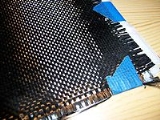
Kohlenstofffasermatte
Carbon fiber or (alternatively called carbon fibre, graphite
Graphite

The mineral graphite is one of the allotropes of carbon. It was named by Abraham Gottlob Werner in 1789 from the Greek language ??afe?? : "to draw/write", for its use in pencils, where it is commonly called lead, as distinguished from the actual metallic element lead....
 fiber
, graphite fibre or carbon graphite) is a material consisting of extremely thin fibers about 0.005–0.010 mm in diameter and composed mostly of carbon
Carbon

Carbon is a chemical element with chemical symbol C and atomic number 6. As a member of group 14 on the periodic table, it is nonmetallic and tetravalence?making four electrons available to form covalent bond chemical bonds....
 atoms. The carbon atoms are bonded together in microscopic crystals that are more or less aligned parallel to the long axis of the fiber. The crystal alignment makes the fiber very strong for its size. Several thousand carbon fibers are twisted together to form a yarn
Yarn

Yarn is a long continuous length of interlocked fibers, suitable for use in the production of textiles, sewing, crocheting, knitting, weaving, embroidery and ropemaking....
, which may be used by itself or woven
Woven

A woven is a cloth formed by weaving. It only stretches in the bias directions , unless the threads are elastic. Woven cloth usually frays at the edges, unless measures are taken to counter this, such as the use of pinking shears or hemming....
 into a fabric. Carbon fiber has many different weave patterns and can be combined with a plastic resin
Plastic

Plastic is the general common term for a wide range of synthetic or semisynthetic organic chemistry solid materials suitable for the manufacture of industrial products....
 and wound or molded to form composite material
Composite material

Composite materials are engineered materials made from two or more constituent materials with significantly different physical or chemical properties which remain separate and distinct on a macroscopic level within the finished structure....
s such as carbon fiber reinforced plastic
Carbon fiber reinforced plastic

Carbon fiber reinforced polymer or carbon fiber reinforced plastic , is a very strong, light, and expensive composite material or fiber-reinforced polymer....
 (also referenced as carbon fiber) to provide a high strength-to-weight ratio material. The density of carbon fiber is also considerably lower than the density of steel, making it ideal for applications requiring low weight. The properties of carbon fiber such as high tensile strength, low weight, and low thermal expansion make it very popular in aerospace, civil engineering, military, and motorsports, along with other competition sports.

History of carbon fibre

In 1958, Dr. Roger Bacon created high-performance carbon fibers at the Union Carbide
Union Carbide

Union Carbide Corporation is one of the oldest chemical and polymers companies in the United States, currently employing more than 3,800 people....
 Parma Technical Center, located outside of Cleveland, Ohio
Ohio

Ohio is a Midwestern United States U.S. state of the United States. As part of the Great Lakes region , Ohio has long been a cultural and geographical crossroads in North America....
. Those fibers were manufactured by heating strands of rayon
Rayon

Rayon is a manufactured regenerated cellulose fiber. Because it is produced from naturally occurring polymers, it is neither a truly synthetic fiber nor a natural fiber; it is a semi-synthetic fiber ....
 until they carbonized. This process proved to be inefficient, as the resulting fibers contained only about 20% carbon and had low strength and stiffness properties. In the early 1960s, a process was developed using polyacrylonitrile
Polyacrylonitrile

Polyacrylonitrile is a resinous, fiber, or rubbery organic polymer. Almost all polyacrylonitrile resins are copolymers made from mixtures of monomers; with acrylonitrile as the main component....
 (PAN) as a raw material. This had produced a carbon fiber that contained about 55% carbon and had much better properties. The polyacrylonitrile (PAN) conversion process quickly became the primary method for producing carbon fibers.

The high potential strength of carbon fiber was realized in 1963 in a process developed at the Royal Aircraft Establishment
Royal Aircraft Establishment

The Royal Aircraft Establishment England, was a British research establishment latterly under the Ministry of Defence .The first site was at Farnborough Airfield in Hampshire to which was added a second site RAE Bedford in 1946....
 at Farnborough in the UK. The process was patented by the Ministry of Defense and then licensed by the NRDC to three British companies: Rolls-Royce
Rolls-Royce Limited

Rolls-Royce Limited was a United Kingdom automobile and, from 1914, aero-engine manufacturing company founded by Henry Royce and Charles Stewart Rolls on 15 March 1906 and was the result of a partnership formed in 1904....
, already making carbon fiber, Morganite
Morganite

Morganite, also known as "Pink Beryl," "Rose Beryl," "Pink Emerald," and "Cesian Beryl," is a rare light pink to rose-colored Gemstone-quality variety of the mineral beryl , which is better known for its green variety and its blue variety ....
 and Courtaulds
Courtaulds

Courtaulds was an England based manufacturer of fabric, clothing, artificial fibres, and chemicals....
. They were able to establish industrial carbon fiber production facilities within a few years, and Rolls-Royce took advantage of the new material's properties to break into the American market with its RB-211 aero-engine.

Even then, though, there was public concern over the ability of British industry to make the best of this breakthrough. In 1969 a House of Commons select committee inquiry into carbon fiber prophetically asked: "How then is the nation to reap the maximum benefit without it becoming yet another British invention to be exploited more successfully overseas?" Ultimately, this concern was justified. One by one the licensees pulled out of carbon-fiber manufacture. Rolls-Royce's interest was in state-of-the-art aero-engine applications. Its own production process was to enable it to be leader in the use of carbon-fibre reinforced plastics. In-house production would typically cease once reliable commercial sources became available.

Unfortunately, Rolls-Royce pushed the state-of-the-art too far, too quickly, in using carbon fibre in the engine's compressor blades, which proved vulnerable to damage from bird impact. What seemed a great British technological triumph in 1968 quickly became a disaster as Roll-Royce's ambitious schedule for the RB-211 was endangered. Indeed, Rolls-Royce's problems became so great that the company was eventually nationalised by Edward Heath's Conservative government in 1971 and the carbon-fibre production plant sold off to form Bristol Composites.

Given the limited market for a very expensive product of variable quality, Morganite also decided that carbon-fibre production was peripheral to its core business, leaving Courtaulds as the only big UK manufacturer.

The company continued making carbon fiber, developing two main markets: aerospace and sports equipment.The speed of production and the quality of the product were improved.

Continuing collaboration with the staff at Farnborough proved helpful in the quest for higher quality, but, ironically, Courtaulds's big advantage as manufacturer of the "Courtelle" precursor now became a weakness. Low cost and ready availability were potential advantages, but the water-based inorganic process used to produce Courtelle made it susceptible to impurities that did not affect the organic process used by other carbon-fibre manufacturers.

Nevertheless, during the 1980s Courtaulds continued to be a major supplier of carbon fibre for the sports-goodsmarket, with Mitsubishi its main customer. But a move to expand, including building a production plant in California, turned out badly. The investment did not generate the anticipated returns, leading to a decision to pull out of the area. Courtaulds ceased carbon-fiber production in 1991, though ironically the one surviving UK carbon-fiber manufacturer continued to thrive making fibre based on Courtaulds's precursor. Inverness-based RK Carbon Fibres Ltd has concentrated on producing carbon fibre for industrial applications, and thus does not need to compete at the quality levels reached by overseas manufacturers.

On January 14, 1969 Carr Reinforcements (Stockport
Stockport

Stockport is a large town in Greater Manchester, England. It lies on elevated ground on the River Mersey at the influx of the rivers River Goyt and River Tame, Greater Manchester, southeast of the city of Manchester....
, England
England

native_name =|conventional_long_name = England|common_name = England|image_flag = Flag of England.svg|image_coat = England COA.svg|symbol_type = Royal Coat of Arms...
) wove a carbon fiber fabric.

During the 1970s, experimental work to find alternative raw materials led to the introduction of carbon fibers made from a petroleum pitch derived from oil processing. These fibers contained about 85% carbon and had excellent flexural strength.

Structure and properties


Carbon fibers are the closest to asbestos
Asbestos

Asbestos is a naturally occurring silicate mineral with long, thin fibrous crystals. The word asbestos is derived from a Greek language adjective meaning inextinguishable....
 in a number of properties. Each carbon filament thread is a bundle of many thousand carbon filaments. A single such filament is a thin tube with a diameter of 5–8 micrometer
Micrometre

A micrometre or micron is one Micro- of a metre, or equivalently one thousandth of a millimetre. It is also commonly known as a micron....
s and consists almost exclusively of carbon
Carbon

Carbon is a chemical element with chemical symbol C and atomic number 6. As a member of group 14 on the periodic table, it is nonmetallic and tetravalence?making four electrons available to form covalent bond chemical bonds....
.

The atomic structure of carbon fiber is similar to that of graphite
Graphite

The mineral graphite is one of the allotropes of carbon. It was named by Abraham Gottlob Werner in 1789 from the Greek language ??afe?? : "to draw/write", for its use in pencils, where it is commonly called lead, as distinguished from the actual metallic element lead....
, consisting of sheets of carbon atoms (graphene
Graphene

Graphene is a one-atom-thick planar sheet of sp2 bond carbon atoms that are densely packed in a honeycomb crystal lattice. It can be viewed as an chicken wire made of carbon atoms and their bonds....
 sheets) arranged in a regular hexagonal
Hexagon

In geometry, a hexagon is a polygon with six edges and six Vertex . A regular hexagon has Schl?fli symbol ....
 pattern. The difference lies in the way these sheets interlock. Graphite is a crystalline material in which the sheets are stacked parallel to one another in regular fashion. The intermolecular forces between the sheets are relatively weak Van der Waals force
Van der Waals force

In physical chemistry, the van der Waals force , named after The Netherlands scientist Johannes Diderik van der Waals, is the attractive or repulsive force between molecules other than those due to covalent bonds or to the electrostatic interaction of ions with one another or with neutral molecules....
s, giving graphite its soft and brittle characteristics. Depending upon the precursor to make the fiber, carbon fiber may be turbostratic or graphitic, or have a hybrid structure with both graphitic and turbostratic parts present. In turbostratic carbon fiber the sheets of carbon atoms are haphazardly folded, or crumpled, together. Carbon fibers derived from Polyacrylonitrile (PAN)
Polyacrylonitrile

Polyacrylonitrile is a resinous, fiber, or rubbery organic polymer. Almost all polyacrylonitrile resins are copolymers made from mixtures of monomers; with acrylonitrile as the main component....
 are turbostratic, whereas carbon fibers derived from mesophase pitch
Pitch (resin)

Pitch is the name for any of a number of highly viscosity liquids which appear solid. Pitch can be made from petroleum products or plants. Petroleum-derived pitch is also called bitumen....
 are graphitic after heat treatment at temperatures exceeding 2200 C. Turbostratic carbon fibers tend to have high tensile strength
Tensile strength

Tensile strength , or is the Stress at which a material breaks or permanently deforms. Tensile strength is an Intensive and extensive properties and, consequently, does not depend on the size of the test specimen....
, whereas heat-treated mesophase-pitch-derived carbon fibers have high Young's modulus
Young's modulus

In solid mechanics, Young's modulus is a measure of the stiffness of an isotropic elastic material. It is also known as the Young modulus, modulus of elasticity, elastic modulus or tensile modulus....
 and high thermal conductivity
Thermal conductivity

In physics, thermal conductivity, , is the List of materials properties of a material that indicates its ability to conduct heat. It appears primarily in Heat conduction#Fourier's law for heat conduction....
.

Applications


Carbon fiber is most notably used to reinforce composite material
Composite material

Composite materials are engineered materials made from two or more constituent materials with significantly different physical or chemical properties which remain separate and distinct on a macroscopic level within the finished structure....
s, particularly the class of materials known as Carbon fiber or graphite reinforced polymers
Carbon fiber reinforced plastic

Carbon fiber reinforced polymer or carbon fiber reinforced plastic , is a very strong, light, and expensive composite material or fiber-reinforced polymer....
. Non-polymer materials can also be used as the matrix for carbon fibers. Due to the formation of metal carbides (i.e., water-soluble AlC) and corrosion
Corrosion

Corrosion means the breaking down of essential properties in a material due to chemical reactions with its surroundings. In the most common use of the word, this means a loss of electrons of metals reacting with water and oxygen....
 considerations, carbon has seen limited success in metal matrix composite
Metal matrix composite

A metal matrix composite is composite material with at least two constituent parts, one being a metal. The other material may be a different metal or another material, such as a ceramic or organic compound....
 applications. Reinforced carbon-carbon
Reinforced carbon-carbon

Carbon fibre-reinforced Carbon is a composite material consisting of carbon fiber reinforcement in a matrix of graphite. It was developed for the nose cones of intercontinental ballistic missiles, and is most widely known as the material for the nose cone and leading edges of the Space Shuttle....
 (RCC) consists of carbon fiber-reinforced graphite, and is used structurally in high-temperature applications. The fiber also finds use in filtration
Filtration

Filtration is a mechanical or physical operation which is used for the separation of solids from fluids by interposing a medium to fluid flow through which the fluid can pass, but the solids in the fluid are retained....
 of high-temperature gases, as an electrode
Electrode

An electrode is an electrical conductor used to make contact with a nonmetallic part of a Electronic circuit . The word was coined by the scientist Michael Faraday from the Greek language words elektron and hodos, a way....
 with high surface area and impeccable corrosion
Corrosion

Corrosion means the breaking down of essential properties in a material due to chemical reactions with its surroundings. In the most common use of the word, this means a loss of electrons of metals reacting with water and oxygen....
 resistance, and as an anti-static
Triboelectric effect

The triboelectric effect is a type of contact electrification in which certain materials become electric charge after they come into contact with another different material and are then separated ....
 component. Molding a thin layer of carbon fibers significantly improves fire resistance of polymers or thermoset composites because dense, compact layer of carbon fibers efficiently reflects heat..

Synthesis


Each carbon
Carbon

Carbon is a chemical element with chemical symbol C and atomic number 6. As a member of group 14 on the periodic table, it is nonmetallic and tetravalence?making four electrons available to form covalent bond chemical bonds....
 filament is made out of long, thin filaments of carbon sometimes transformed to graphite. A common method of making carbon filaments is the oxidation and thermal pyrolysis
Pyrolysis

Pyrolysis is the chemical decomposition of a condensed substance by heating. The word is coined from the Greek language-derived morphemes pyro "fire" and lysys "decomposition"....
 of polyacrylonitrile
Polyacrylonitrile

Polyacrylonitrile is a resinous, fiber, or rubbery organic polymer. Almost all polyacrylonitrile resins are copolymers made from mixtures of monomers; with acrylonitrile as the main component....
 (PAN), a polymer
Polymer

A polymer is a large molecule composed of repeating structural units typically connected by covalent chemical bonds. While polymer in popular usage suggests plastic, the term actually refers to a large class of natural and synthetic materials with a variety of properties....
 based on acrylonitrile
Acrylonitrile

Acrylonitrile is the chemical compound with the formula CH2CHCN. This pungent-smelling colorless liquid often appears yellow due to impurities....
 used in the creation of synthetic materials. Like all polymers, polyacrylonitrile molecules are long chains, which are aligned in the process of drawing continuous filaments. A common method of manufacture involves heating the PAN to approximately 300 °C in air, which breaks many of the hydrogen bonds and oxidizes the material. The oxidized PAN is then placed into a furnace having an inert atmosphere of a gas such as argon
Argon

Argon is a chemical element designated by the symbol Ar. Argon has atomic number 18 and is the third element in group 18 of the periodic table ....
, and heated to approximately 2000 °C, which induces graphitization of the material, changing the molecular bond structure. When heated in the correct conditions, these chains bond side-to-side (ladder polymers), forming narrow graphene
Graphene

Graphene is a one-atom-thick planar sheet of sp2 bond carbon atoms that are densely packed in a honeycomb crystal lattice. It can be viewed as an chicken wire made of carbon atoms and their bonds....
 sheets which eventually merge to form a single, jelly roll
Swiss roll

Swiss roll is a type of sponge cake roll. The thin cake is made of eggs, flour and sugar and baked in a very shallow rectangular baking tray, and then usually filled with jam or butter cream, rolled up, and served in circular slices....
-shaped or round filament. The result is usually 93–95% carbon. Lower-quality fiber can be manufactured using pitch
Pitch (resin)

Pitch is the name for any of a number of highly viscosity liquids which appear solid. Pitch can be made from petroleum products or plants. Petroleum-derived pitch is also called bitumen....
 or rayon
Rayon

Rayon is a manufactured regenerated cellulose fiber. Because it is produced from naturally occurring polymers, it is neither a truly synthetic fiber nor a natural fiber; it is a semi-synthetic fiber ....
 as the precursor instead of PAN. The carbon can become further enhanced, as high modulus, or high strength carbon, by heat treatment processes. Carbon heated in the range of 1500-2000 °C (carbonization) exhibits the highest tensile strength
Tensile strength

Tensile strength , or is the Stress at which a material breaks or permanently deforms. Tensile strength is an Intensive and extensive properties and, consequently, does not depend on the size of the test specimen....
 (820,000 psi or 5,650 MPa or 5,650 N/mm²), while carbon fiber heated from 2500 to 3000 °C (graphitizing) exhibits a higher modulus of elasticity (77,000,000 psi or 531 GPa or 531 kN/mm²).

Textile

Precursors for carbon fibers are PAN
PAN

Pan and panning can have many meanings as listed below in various categories....
, rayon
Rayon

Rayon is a manufactured regenerated cellulose fiber. Because it is produced from naturally occurring polymers, it is neither a truly synthetic fiber nor a natural fiber; it is a semi-synthetic fiber ....
 and pitch
Pitch (resin)

Pitch is the name for any of a number of highly viscosity liquids which appear solid. Pitch can be made from petroleum products or plants. Petroleum-derived pitch is also called bitumen....
. Carbon fiber filament yarns are used in several processing techniques: the direct uses are for prepregging, filament winding, pultrusion, weaving, braiding etc. Carbon fiber yarn is rated by the linear density (weight per unit length = 1 g/1000 m = tex) or by number of filaments per yarn count, in thousands. For example, 200 tex for 3,000 filaments of carbon fiber is three times as strong as 1,000 carbon fibers but is also three times as heavy. This thread can then be used to weave
Weave

Weave may refer to:*Hair weave*Mozilla Weave*Weaving...
 a carbon fiber filament fabric
Textile

A textile is a flexible material consisting of a network of natural or artificial fibres often referred to as thread or yarn. Yarn is produced by Spinning raw wool fibres, linen, cotton, or other material on a spinning wheel to produce long strands known as yarn....
 or cloth. The appearance of this fabric generally depends on the linear density of the yarn and the weave chosen. Some commonly used types of weave are twill
Twill

Twill is a type of textile weaving with a pattern of diagonal parallel ribs.It is made by passing the weft thread over one or more Warp threads and then under two or more warp threads and so on, with a "step" or offset between rows to create the characteristic diagonal pattern....
, satin
Satin weave

Satin weave is one of the three important textile weaving. The satin weave is distinguished by its lustrous, or 'silky', appearance. Satin describes the way the threads are combined, and the yarn used may be silk or polyester, among others, giving different fabrics....
 and plain
Plain weave

Plain weave is the most basic of the three fundamental types of textile weaving. It is strong and hard-wearing, used for fashion and furnishing fabrics....
.

Manufacturers

PAN aerospace/high end carbon fiber:
  • Toray Industries (largest worldwide manufacturer)
  • Toho Tenax
    Toho Tenax

    has been a member of the Teijin since 2000. Toho Tenax is an international company that supplies customers throughout the world with carbon fiber under the trade name Tenax....
  • Mitsubishi Rayon
    Mitsubishi Rayon

    is a Japanese company that manufactures chemicals, plastics, and fibers. It is Japan's biggest acrylic fiber maker. Mitsubishi Rayon is one of the textile companies tracked by the Nikkei 225 on the Tokyo Stock Exchange....
  • Hexcel
    Hexcel

    Hexcel is a materials company incorporated in Delaware and headquartered in Stamford, Connecticut that manufactures advanced structural materials....
  • Cytec Industries
    Cytec Industries

    Cytec Industries, based in Woodland Park, New Jersey is a specialty Chemical industry and materials technology company with pro-forma sales in 2004, including the Surface Specialties acquisition, of approximately $3.0 billion....
  • Schunk Gruppe
    Schunk Group

    The Schunk Group is a Germany manufacturing conglomerate composed of 75 subsidiary companies in 28 countries. It produces carbon brushes, graphite products, and moulded bipolar plates....


PAN commercial grade carbon fiber:
  • Zoltek
  • SGL Carbon
    SGL Carbon

    SGL Carbon is one of the world's leading manufacturers of products from carbon. The company portfolio ranges from carbon and graphite materials to carbon fibers and composites....
  • Fortafil


Pitch carbon fiber:
  • Sumitomo
  • Kureha Corporation


See also

  • Carbon fiber reinforced polymer
  • Carbon nanotube
    Carbon nanotube

    Carbon nanotubes are allotropes of carbon with a nanostructure that can have a length-to-diameter ratio of up to 28,000,000:1, which is significantly larger than any other material....


External links

  • at ACS.org
  • at ps