
All Topics  
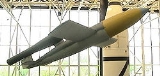
V-1 flying bomb

 
V 1 Flying Bomb

   Email Print
   Bookmark   Link


V-1 flying bomb


The Fieseler Fi 103, better known as V-1 was an early cruise missile
Cruise missile

A cruise missile is a guided missile missile that carries an explosive payload and uses a lifting wing and a propulsion system, usually a jet engine, to allow sustained flight; it is essentially a flying bomb....
 used during World War II
World War II

World War II, or the Second World War , was a global military conflict which involved a Participants in World War II, including all of the great powers, organised into two opposing military alliances: the Allies of World War II and the Axis powers....
. The V-1 was developed at Peenemünde
Peenemünde

Peenem?nde is a village in the northeast of the Germany part of the Usedom island. It stands near the mouth of the Peene river, on the easternmost part of the German Baltic Sea coast....
 by the German Luftwaffe
Luftwaffe

is a generic German term for an air force. It is also the official name for two of the four historic German air forces, the Wehrmacht air arm founded in 1933 and disbanded in 1946; and the current Bundeswehr air arm founded in 1956....
 during the Second World War. Between 13 June 1944 and 29 March 1945, it was fired at population centres such as London
London

London is the capital of both England and the United Kingdom, and the most populous municipality in the European Union. An important settlement for two millennia, History of London goes back to its founding by the Roman Empire....
 and Antwerp
Antwerp

||-||-||-||}Antwerp is a city and municipality in Belgium and the capital of the Antwerp in Flanders, one of Belgium's three regions....
. V-1s were launched from "ski" launch sites along the French (Pas-de-Calais
Pas-de-Calais

Pas-de-Calais is a Departments of France in northern France. Its name is the French language equivalent of the Strait of Dover, which it borders....
) and Dutch
Netherlands

The Netherlands is a country that is part of the Kingdom of the Netherlands. It is a parliamentary democratic constitutional monarchy. The Netherlands is located in North-West Europe, and bordered by the North Sea to the north and west, Belgium to the south, and Germany to the east....
 coasts until the sites were overrun by Allied
Allies of World War II

The Allies of World War II were the countries officially opposed to the Axis powers of World War II during the World War II. Within the ranks of the Allies powers, the British Empire, the Soviet Union, and the United States of America were known as "The Big Three"....
 forces. The underground V-1 storage depots
List of V-1 storage depots

V-1 facilities were Nazi Germany military installations for the V-1 flying bomb. The unpiloted aircraft was designed by Fieseler's Robert Lusser and assembled at the KdF-Stadt Volkswagen factory near Fallersleben, at Cham, Germany /Bruns Werke,n addition to the storage and launching sites listed below, operational facilities included the ai...
 at Saint-Leu-d'Esserent
Saint-Leu-d'Esserent

Saint-Leu-d'Esserent is a Communes of France in the Oise Departments of France in northern France....
, Nucourt
Nucourt

Nucourt is a village and a Communes of France in the Val-d'Oise Departments of France, in the France Regions of France of ?le-de-France ....
 and Rilly-la-Montagne
Rilly-la-Montagne

Rilly-la-Montagne is a Communes of France in the Marne Departments of France in northeastern France....
, as well as the launch sites, were bombed during Operation Crossbow
Operation Crossbow

'Crossbow' was a World War II campaign consisting of "Anglo-American operations against all phases of the Vergeltungswaffe?operations against German research, experimentation, manufacture, construction of launching sites, and Mittelwerk#V-2 Rocket production and firing of finished missiles, and also against missiles in flight, once they had...
.

V-1 was designed by Robert Lusser
Robert Lusser

Robert Lusser was a Germany engineer, aircraft designer and aviator. He is remembered both for several designs significant during World War II, and for his theoretical study of the reliability of complex systems....
 of the Fieseler
Fieseler

The Gerhard Fieseler Werke was a Germany aircraft manufacturer of the 1930s and 40s. The company is remembered mostly for its military aircraft built for the Luftwaffe during the Second World War....
 company and Fritz Gosslau from the Argus
Argus Motoren

Argus Motoren was a Germany manufacturing firm known for their series of small inverted-V engines and the V1 flying bomb pulse jet engine....
 engine works, with a fuselage
Fuselage

The fuselage is an aircraft's main body section that holds crew and passengers or cargo. In single-engine aircraft it will usually contain an engine, although in some amphibious aircraft the single engine is mounted on a hardpoint attached to the fuselage which in turn is used as a floating Hull ....
 constructed mainly of welded sheet steel
Steel

Steel is an alloy consisting mostly of iron, with a carbon content between 0.2% and 2.14% by weight , depending on grade. Carbon is the most cost-effective alloying material for iron, but various other alloying elements are used such as manganese, chromium, vanadium, and tungsten....
 and wings built similarly or of plywood
Plywood

Sorry, no overview for this topic
.


Discussion
Ask a question about 'V-1 flying bomb'
Start a new discussion about 'V-1 flying bomb'
Answer questions from other users
Full Discussion Forum


Recent Posts


Encyclopedia


The Fieseler Fi 103, better known as V-1 was an early cruise missile
Cruise missile

A cruise missile is a guided missile missile that carries an explosive payload and uses a lifting wing and a propulsion system, usually a jet engine, to allow sustained flight; it is essentially a flying bomb....
 used during World War II
World War II

World War II, or the Second World War , was a global military conflict which involved a Participants in World War II, including all of the great powers, organised into two opposing military alliances: the Allies of World War II and the Axis powers....
. The V-1 was developed at Peenemünde
Peenemünde

Peenem?nde is a village in the northeast of the Germany part of the Usedom island. It stands near the mouth of the Peene river, on the easternmost part of the German Baltic Sea coast....
 by the German Luftwaffe
Luftwaffe

is a generic German term for an air force. It is also the official name for two of the four historic German air forces, the Wehrmacht air arm founded in 1933 and disbanded in 1946; and the current Bundeswehr air arm founded in 1956....
 during the Second World War. Between 13 June 1944 and 29 March 1945, it was fired at population centres such as London
London

London is the capital of both England and the United Kingdom, and the most populous municipality in the European Union. An important settlement for two millennia, History of London goes back to its founding by the Roman Empire....
 and Antwerp
Antwerp

||-||-||-||}Antwerp is a city and municipality in Belgium and the capital of the Antwerp in Flanders, one of Belgium's three regions....
. V-1s were launched from "ski" launch sites along the French (Pas-de-Calais
Pas-de-Calais

Pas-de-Calais is a Departments of France in northern France. Its name is the French language equivalent of the Strait of Dover, which it borders....
) and Dutch
Netherlands

The Netherlands is a country that is part of the Kingdom of the Netherlands. It is a parliamentary democratic constitutional monarchy. The Netherlands is located in North-West Europe, and bordered by the North Sea to the north and west, Belgium to the south, and Germany to the east....
 coasts until the sites were overrun by Allied
Allies of World War II

The Allies of World War II were the countries officially opposed to the Axis powers of World War II during the World War II. Within the ranks of the Allies powers, the British Empire, the Soviet Union, and the United States of America were known as "The Big Three"....
 forces. The underground V-1 storage depots
List of V-1 storage depots

V-1 facilities were Nazi Germany military installations for the V-1 flying bomb. The unpiloted aircraft was designed by Fieseler's Robert Lusser and assembled at the KdF-Stadt Volkswagen factory near Fallersleben, at Cham, Germany /Bruns Werke,n addition to the storage and launching sites listed below, operational facilities included the ai...
 at Saint-Leu-d'Esserent
Saint-Leu-d'Esserent

Saint-Leu-d'Esserent is a Communes of France in the Oise Departments of France in northern France....
, Nucourt
Nucourt

Nucourt is a village and a Communes of France in the Val-d'Oise Departments of France, in the France Regions of France of ?le-de-France ....
 and Rilly-la-Montagne
Rilly-la-Montagne

Rilly-la-Montagne is a Communes of France in the Marne Departments of France in northeastern France....
, as well as the launch sites, were bombed during Operation Crossbow
Operation Crossbow

'Crossbow' was a World War II campaign consisting of "Anglo-American operations against all phases of the Vergeltungswaffe?operations against German research, experimentation, manufacture, construction of launching sites, and Mittelwerk#V-2 Rocket production and firing of finished missiles, and also against missiles in flight, once they had...
.

Design and development

The V-1 was designed by Robert Lusser
Robert Lusser

Robert Lusser was a Germany engineer, aircraft designer and aviator. He is remembered both for several designs significant during World War II, and for his theoretical study of the reliability of complex systems....
 of the Fieseler
Fieseler

The Gerhard Fieseler Werke was a Germany aircraft manufacturer of the 1930s and 40s. The company is remembered mostly for its military aircraft built for the Luftwaffe during the Second World War....
 company and Fritz Gosslau from the Argus
Argus Motoren

Argus Motoren was a Germany manufacturing firm known for their series of small inverted-V engines and the V1 flying bomb pulse jet engine....
 engine works, with a fuselage
Fuselage

The fuselage is an aircraft's main body section that holds crew and passengers or cargo. In single-engine aircraft it will usually contain an engine, although in some amphibious aircraft the single engine is mounted on a hardpoint attached to the fuselage which in turn is used as a floating Hull ....
 constructed mainly of welded sheet steel
Steel

Steel is an alloy consisting mostly of iron, with a carbon content between 0.2% and 2.14% by weight , depending on grade. Carbon is the most cost-effective alloying material for iron, but various other alloying elements are used such as manganese, chromium, vanadium, and tungsten....
 and wings built similarly or of plywood
Plywood

Sorry, no overview for this topic
. The simple pulse jet engine
Pulse jet engine

A pulse jet engine is a very simple form of internal combustion engine based jet engine where combustion occurs in pulses.A typical pulsejet comprises an air intake fitted with a one-way valve, a combustion chamber, and an acoustically resonance exhaust pipe....
 pulsed 50 times per second, and the characteristic buzzing sound gave rise to the colloquial names "buzz bomb" or "doodlebug"
Doodlebug

Doodlebug or Doodle bug may refer to:*Antlion larva*Armadillidiidae, the pill bugs, or more generally woodlice*Ciara Brady, a character on Days of our Lives who was originally called "Doodlebug"...
 (after an Australian insect).

It is a common myth that the V-1's pulsejet engine needed a minimum airspeed
Airspeed

Airspeed is the speed of an aircraft relative to the air. There are several different measures of airspeed: indicated airspeed, calibrated airspeed, equivalent airspeed and true airspeed....
 of 150 mph (240 km/h) for operation as it is commonly confused with the Lorin
René Lorin

Ren? Lorin , a graduate of the Ecole Centrale Paris, invented the ramjet, which he patented in 1908; when he patented a subsonic ramjet design, and had not considered supersonic applications....
 ramjet
Ramjet

A ramjet, sometimes referred to as a stovepipe jet, or an athodyd, is a form of jet engine using the engine's forward motion to compress incoming air, without a rotary compressor....
. The V-1's Argus Schmidt pulsejet, also known as a resonant jet, could operate at zero airspeed owing to the nature of its intake vane system and acoustically tuned resonant combustion chamber. Film footage of the V-1 always shows the distinctive pulsating jet exhaust of a fully running engine before the catapult system is triggered. The engine would always be started first (using a compressed air
Pneumatics

Pneumatics is the use of pressurized gas to affect mechanical motion.Pneumatic power is used in industry, where factory machines are commonly plumbed for compressed air; other compressed inert gases can also be used....
 line) while the craft was stationary on the ramp. The low static thrust of the jet engine and very high stall speed of the small wings meant that the craft could not take off under its own power in a practically short distance, and thus required an aircraft catapult
Aircraft catapult

An aircraft catapult is a device used to launch aircraft from ships?in particular aircraft carriers?as a form of assisted take off. It consists of a track built into the flight deck, below which is a large piston or shuttle that is attached through the track to the Undercarriage of the aircraft....
 launch or an airlaunch from a modified bomber
Bomber

A bomber is a military aircraft designed to attack ground and sea targets, primarily by dropping bombs on them....
 aircraft such as the Heinkel He-111. On the ground, takeoff speed was attained by using a chemical or steam catapult which accelerated the V-1 to 360 mph (579 km/h).

The V-1's pulse jet engine was also tested on a variety of craft, including an experimental attack boat known as the "Tornado". The unsuccessful prototype was a version of a Sprengboot, in which a boat loaded with explosives was steered towards a target ship and the pilot would leap out the back at the last moment. The Tornado was assembled from surplus seaplane
Seaplane

A seaplane is a fixed-wing aircraft capable of takeoff and Water landing on water. Seaplanes are usually divided into two categories: floatplanes and flying boats....
 hulls connected in catamaran
Catamaran

A catamaran is a type of multihulled boat or ship consisting of two hull s, or Vaka s, joined by some structure, the most basic being a frame, formed of Aka s....
 fashion with a small pilot cabin on the cross beams. The Tornado prototype was a noisy underperformer and was abandoned in favour of more conventional piston engined craft.

Guidance system


The V-1 guidance system
Guidance system

A guidance system is a device or group of devices used to navigation a ship, aircraft, missile, rocket, satellite, or other craft. Typically, this refers to a system that navigates without direct or continuous human control....
 used a simple autopilot
Autopilot

An autopilot is a mechanical, electrical, or hydraulic system used to guide a vehicle without assistance from a human being. Most people understand an autopilot to refer specifically to aircraft, but self-steering gear for ships, boats, space craft and missiles is sometimes also called by this term....
 to regulate height and speed. A weighted pendulum system provided fore-and-aft attitude measurement to control pitch
Flight dynamics

Flight dynamics is the science of aircraft and spacecraft vehicle orientation and control in three dimensions. The three critical flight dynamics parameters are the angles of rotation in three dimensions about the vehicle's center of mass, known as pitch, roll and yaw ....
 (damped by a gyrocompass
Gyrocompass

A gyrocompass is similar to a gyroscope. It is a compass that finds true north by using an fast-spinning wheel and friction forces in order to exploit the rotation of the Earth....
, which it also stabilized). There was a more sophisticated interaction between yaw
Flight dynamics

Flight dynamics is the science of aircraft and spacecraft vehicle orientation and control in three dimensions. The three critical flight dynamics parameters are the angles of rotation in three dimensions about the vehicle's center of mass, known as pitch, roll and yaw ....
, roll
Flight dynamics

Flight dynamics is the science of aircraft and spacecraft vehicle orientation and control in three dimensions. The three critical flight dynamics parameters are the angles of rotation in three dimensions about the vehicle's center of mass, known as pitch, roll and yaw ....
, and other sensors: a gyrocompass (set by swinging in a hangar before launch) gave feedback to control each of pitch and roll, but it was angled away from the horizontal so that controlling these degrees of freedom
Degrees of freedom (engineering)

In classical mechanics, degrees of freedom are the set of independent displacement s and/or rotations that specify completely the displaced or deformed position and orientation of the body or system....
 interacted: the gyroscope stayed trued up by feedback from the magnetic field, and from the fore and aft pendulum. This interaction meant that rudder
Rudder

A rudder is a device used to steer a ship, boat, submarine, hovercraft, or other conveyance that moves through a fluid . On an aircraft the rudder is used primarily to counter adverse yaw and p-factor and is not the primary control used to turn the airplane....
 control was enough without a separate banking mechanism. Into the left wing [tubular] steel spar of a V-1 having landed without explosion between Tilburg and Goirle, The Netherlands, March 1945, about 6 rolled issues of the German war time propaganda magazine 'Signal' had been used to preset static equilibrium before launching. It is also known that the launching parties provided several of the first to be ignited bombs with a small radio transmitter [using a triode valve for this case marked 'S3' but being a current power valve RL 2,4T1], to by radio bearing check the general direction of flight related to the launching place's and the target's grid coordinates.

An odometer driven by a vane anemometer
Vane anemometer

A vane anemometer is a type of anemometer, a meteorology instrument used to measure wind speed. The vane anemometer can also measure wind direction....
 on the nose determined when target range had been reached, accurately enough for area bombing. Before launch the counter was set to a value that would reach zero upon arrival at the target in the prevailing wind conditions. As the missile flew, the airflow turned the propeller and every 30 rotations of the propeller counted down one number on the counter. This counter triggered the arming of the warhead after about 60 km (38 miles). When the count reached zero, two detonating bolts were fired. Two spoilers
Spoiler (aeronautics)

In aeronautics a spoiler is a device intended to reduce lift in an aircraft. Spoilers are plates on the top surface of a wing which can be extended upward into the airflow and spoil it....
 on the elevator
Elevator (aircraft)

Elevators are control surfaces, usually at the rear of an aircraft, which control the aircraft's orientation by changing the Flight dynamics of the aircraft, and so also the angle of attack of the wing....
 were released, the linkage between the elevator and servo was jammed and a guillotine
Guillotine

The guillotine consists of a tall upright frame from which a long, smooth, heavy blade is suspended. This blade is raised with a rope and then allowed to drop, severing the victim's head from his or her body....
 device cut off the control hoses to the rudder servo, setting the rudder in neutral. These actions led the V-1 into a steep dive. While this was originally intended to be a power dive, in practice the dive caused the fuel flow to cease, which stopped the engine. The sudden silence after the buzzing alerted listeners that the V-1 would impact soon. The fuel problem was quickly fixed and by the time the last V-1 fell, the majority had impacted under full power.

With the counter determining how far the missile would fly, it was only necessary to launch the V-1 with the ramp in the rough direction and the autopilot controlled the rest.

Operation and effectiveness

The first test flight of the V-1 was in late 1941 or early 1942 at Peenemünde
Peenemünde

Peenem?nde is a village in the northeast of the Germany part of the Usedom island. It stands near the mouth of the Peene river, on the easternmost part of the German Baltic Sea coast....
.

A myth arose that early guidance and stabilisation problems were resolved by a daring test flight by Hanna Reitsch
Hanna Reitsch

Hanna Reitsch was a German aviatrix who was once Adolf Hitler's personal pilot, and was the only woman awarded the Iron Cross First Class and the Luftwaffe Combined Pilots-Observation Badge in Gold with Diamonds during World War II....
 in a V-1 modified for manned operation. The myth entered popular consciousness from Reitsch's fictional exploits in the George Peppard
George Peppard

George Peppard, Jr. was an United States film and television actor.He secured a major role early in his career when he starred alongside Audrey Hepburn in Breakfast at Tiffany's , and he played the title role of the millionaire sleuth Thomas Banacek in the early-1970s television series Banacek, but he is probably best known to youn...
 film Operation Crossbow
Operation Crossbow (film)

Operation Crossbow is a 1965 in film spy thriller and World War II film, made from a story from Duilio Coletti and Vittoriano Petrilli. It is a highly fictionalized account of the real-life Operation Crossbow, but it does touch on the main aspects of the operation....
.

Reitsch's first flights in the modified V-1 Fieseler Reichenberg were late in the war when she was asked to work out why test pilots were unable to land it and had died in landing attempts. Her discovery after simulated landing attempts at high altitude where there might be air space to recover, was that the craft had an extremely high stall speed and the previous pilots with little high speed experience had attempted their approaches much too slowly. Her recommendations of much higher landing speeds were then introduced in training new Reichenberg volunteer pilots. The Reichenbergs were air-launched rather than fired from the catapult ramp as erroneously portrayed in "Operation Crossbow".

Mile End Grove Road 2
The conventional launch sites could theoretically launch about 15 V-1s per day, but this rate was difficult to achieve on a consistent basis; the maximum rate achieved was 18. Overall, only about 25% of the V-1s hit their targets, the majority being lost because of a combination of defensive measures (see Countermeasures below), mechanical unreliability or guidance errors. With the capture or destruction of the launch facilities used to attack England, the V-1s were employed in attacks against strategic points in the Low Countries
Low Countries

The Low Countries, the historical region of de Nederlanden, are the country on low-lying land around the river delta of the Rhine, Scheldt, and Meuse River rivers....
, primarily the port of Antwerp
Antwerp

||-||-||-||}Antwerp is a city and municipality in Belgium and the capital of the Antwerp in Flanders, one of Belgium's three regions....
.

The earliest experimental versions of the V-1 were air-launched. Most operational V-1s were launched from static sites on land, but from July 1944 to January 1945 the Luftwaffe
Luftwaffe

is a generic German term for an air force. It is also the official name for two of the four historic German air forces, the Wehrmacht air arm founded in 1933 and disbanded in 1946; and the current Bundeswehr air arm founded in 1956....
 launched approximately 1,176 from modified Heinkel He 111
Heinkel He 111

The Heinkel He 111 was a German aircraft designed by G?nter brothers in the early 1930s in violation of the Treaty of Versailles. Often described as a "Wolf in sheep's clothing", it masqueraded as a transport aircraft, but its purpose was to provide the Luftwaffe with a fast medium bomber....
 H-22s flying with the Luftwaffe's 3rd Bomber Wing or Kampfgeschwader 3
Kampfgeschwader 3

Kampfgeschwader 3 "Blitz" was a Luftwaffe bomber wing during World War II .Its units participated on all of the fronts in the European Theatre until it was disbanded in September-October 1944....
 (the so-named "Blitz Wing") flying over the North Sea
North Sea

The North Sea is a marginal sea, epeiric sea on the European continental shelf. The Dover Strait and the English Channel in the south and the Norwegian Sea in the north connect it to the Atlantic Ocean....
. Apart from the obvious motive of permitting the bombardment campaign to continue after static ground sites on the French coast were lost, air-launching gave the Luftwaffe the opportunity to outflank the increasingly effective ground and air defences put up by the British against the missile. To minimise the risks associated with air launches (primarily radar detection), the aircrews involved developed a tactic called "lo-hi-lo": the He 111s would, upon leaving their airbases and crossing the coast, descend to an exceptionally low altitude. When the launch point was neared, the bombers would swiftly ascend, fire their V-1s, and then rapidly descend again to the previous 'wave-top' level for the return flight. Research after the war estimated a 40% failure rate of air-launched V-1s, and the He-111s used in this role were extremely vulnerable to night fighter attack, as the launch lit up the area around the aircraft for several seconds.

During undetermined date in 1941,The Wehrmatch occupied Strelna
Strelna

Strelna is a historic settlement situated about halfway between Saint Petersburg and Peterhof, Russia, and overlooking the shore of the Gulf of Finland....
 and had a naval base here,were based Decima Flottiglia MAS
Decima Flottiglia MAS

The Decima Flottiglia MAS was an Italy commando frogman unit of the Regia Marina created during the Italian fascism regime.The acronym MAS also refers to various light torpedo boats used by the Regia Marina during World War I and World War II....
 men and attack boats from Italy
Italy

Italy , officially the Italian Republic , is a country located on the Italian Peninsula in Southern Europe and on the two largest islands in the Mediterranean Sea, Sicily and Sardinia....
.Germans also initiated the built V1 rocket launching pads in area for striking Leningrad
Leningrad

Leningrad is the former name of Saint Petersburg, Russia.Leningrad may also refer to:* Leningrad Oblast, a federal subject of Russia* Soviet helicopter carrier Leningrad, of the Soviet Navy...
 among transfer to Blizna
Blizna

Blizna is a village in the administrative district of Gmina Ostr?w, within Ropczyce-Sedzisz?w County, Subcarpathian Voivodeship, in south-eastern Poland....
 some Fi-103s mobile launcher units from West to later operated in Eastern Front
Eastern Front

Eastern Front may refer to one of the following:* Eastern Front * Eastern Front * Eastern Front * Eastern Front ...
.

The diver-intelligence officer Vladimir Borisov swam to the area and changed into German clothes and reconnoitered in the plant and returned and reported what he had found.Soviet aircraft and artillery destroyed the V1 launching pads along Russian commando frogmen striking the naval base and boats stationed here.

Experimental and long-range variants

Late in the war several air-launched piloted V-1s, known as Reichenbergs, were built, but never used in combat. There were plans, not carried into practice, to use the Arado Ar 234
Arado Ar 234

The Arado Flugzeugwerke Ar 234 was the world's first operational jet engine bomber, built by the Germany Arado company in the closing stages of World War II....
 jet bomber to launch V-1s either by towing them aloft or by launching them from a "piggy back" position atop the aircraft. In the latter configuration, a pilot-operated hydraulic arrangement would lift the missile on its launch cradle some eight feet clear of the 234's dorsal fuselage. This was necessary, of course, to avoid damaging the mother craft when the pulse jet ignited, as well as to ensure a 'clean' airflow for the Argus motor's intake. A somewhat less ambitious project study undertaken was the adaptation of the missile as a 'flying fuel tank' for the Me 262 jet fighter. The pulse-jet, internal systems and warhead of the missile were removed, leaving only the wings and basic fuselage, now containing a single large fuel tank. A small cylindrical module, similar in shape to a finless dart, was placed atop the vertical stabilizer at the rear of the tank, acting as a center of gravity balance and attachment point for a variety of equipment sets. A rigid tow-bar with a pitch pivot at the forward end connected the flying tank to the Me 262. The operational procedure for this unusual configuration saw the tank resting on a wheeled trolley for take-off. The trolley was dropped once the combination was airborne, and explosive bolts separated the towbar from the fighter upon exhaustion of the tank's fuel supply. A number of test flights were conducted in 1944 with this set-up, but inflight "porpoising" of the tank, with the instability transferred to the fighter, meant the system was too unreliable to be used. An identical utilisation of the V-1 flying tank for the Ar 234 bomber was also investigated, with the same conclusions reached. Some of the "flying fuel tanks" used in trials utilised a cumbersome fixed and spatted undercarriage arrangement, which (along with being pointless) merely increased the drag and stability problems already inherent in the design. One variant of the basic Fi 103 design did, however, see operational use. The progressive loss of French launch sites as 1944 proceeded and the area of territory under German control shrank meant that soon the V-1 would lack the range to hit targets in England. Air-launching was one alternative utilised, but the most obvious solution was to extend the missile's range. Thus was the F-1 version developed. The weapon's fuel tank was increased in size, with a corresponding reduction in the capacity of the warhead. Additionally, the nose-cones of the F-1 models were made of wood, affording a considerable weight saving. With these modifications, the V-1 could be fired at London and nearby urban centres from prospective ground sites in Holland. Frantic efforts were made to construct sufficient F-1s so that a large-scale bombardment campaign could coincide with the Ardennes Offensive, but numerous factors (bombing of the factories producing the missiles, shortages of steel and rail transport, the chaotic tactical situation Germany was facing at this point in the war etc) delayed the delivery of these long-range V-1s until February/March 1945. Before the V-1 campaign ended for good at the end of the latter month, several hundred F-1s were launched at Britain from Dutch sites.

Almost 30,000 V-1s were made. Approximately 10,000 were fired at England; 2,419 reached London, killing about 6,184 people and injuring 17,981. The greatest density of hits were received by Croydon, on the SE fringe of London.

Antwerp
Antwerp

||-||-||-||}Antwerp is a city and municipality in Belgium and the capital of the Antwerp in Flanders, one of Belgium's three regions....
 (Belgium) was hit by 2,448 V-1s from October 1944 to March 1945.

Intelligence reports

V 1
The codename Flakzielgerät 76 - "Flak aiming apparatus" helped to hide the nature of the device, and it was some time before references to FZG 76 were linked to the V-83 pilotless aircraft (an experimental V-1) that had crashed on Bornholm
Bornholm

Bornholm is a Denmark island in the Baltic Sea located to the east of the rest of Denmark, the south of Sweden, and the north of Poland. The main industries on the island include fishing, arts and crafts like glass making and pottery using locally worked clay, and dairy farming....
 in the Baltic and to reports from agents of a flying bomb capable of being used against London. Especially the Polish Home Army intelligence contributed information
Home Army and V1 and V2

Aside from military operations, the Polish Armia Krajowa was also heavily involved in military intelligence work, including work done with regard to the German "Wunderwaffe" - the V-1 flying bomb and the V-2 rocket....
 on V-1 construction and a place of development (Peenemünde). Initially British experts were skeptical of the V-1 because they had considered only solid fuel rockets, which could not attain the stated range of 130 miles (209 km). However they later considered other types of engine, and by the time German scientists had achieved the needed accuracy to deploy the V-1 as a weapon, British intelligence had a very accurate assessment of it.

Countermeasures


Lacking adequate photo reconnaissance, the Germans relied in part on reports from their agents to determine if the range settings in the guidance system were correct. British Intelligence used the Double Cross System
Double Cross System

The Double Cross System or XX System, was a World War II anti-espionage and deception operation of the United Kingdom military intelligence arm, MI5....
 to provide Germany with false reports showing impacts northwest of the city center. Many V-1s were then programmed for too short a run and fell well southeast of the city.

The British defence against the German long-range weapons was Operation Crossbow
Operation Crossbow

'Crossbow' was a World War II campaign consisting of "Anglo-American operations against all phases of the Vergeltungswaffe?operations against German research, experimentation, manufacture, construction of launching sites, and Mittelwerk#V-2 Rocket production and firing of finished missiles, and also against missiles in flight, once they had...
. Anti-aircraft guns were redeployed in several movements: first in mid-June 1944 from positions on the North Downs
North Downs

The North Downs are a ridge of chalk hills in south east England that stretch for 120 miles from Farnham in Surrey to the White Cliffs of Dover in Kent....
 to the south coast of England, then a cordon closing the Thames Estuary
Thames Estuary

The Thames Estuary is the area in which the River Thames meets the waters of the North Sea.It is not easy to define the limits of the estuary , although physically the head of ??Sea Reach??, near Canvey Island on the Essex shore is probably the western boundary....
 to attacks from the east. In September 1944, a new linear defence line was formed on the coast of East Anglia
East Anglia

East Anglia is a region of eastern England. It was named after one of the ancient Heptarchy, the Kingdom of the East Angles, which was in turn named after the homeland of the Angles, Angeln, in northern Germany....
, and finally in December there was a further layout along the Lincolnshire
Lincolnshire

Lincolnshire is a Counties of England in the east of England. It borders Norfolk, Cambridgeshire, Rutland, Leicestershire, Nottinghamshire, South Yorkshire, and the East Riding of Yorkshire....
-Yorkshire
Yorkshire

Yorkshire is a Historic counties of England of northern England and the largest in Great Britain. Because of its great size, over time functions were increasingly undertaken by its subdivisions, which have been subject to History of local government in Yorkshire....
 coast. The deployments were prompted by changes to the approach tracks of the V-1 as launch sites were overrun by the Allies' advance.

On the first night of sustained bombardment, the anti-aircraft crews around Croydon were jubilant - suddenly they were downing unprecedented numbers of German bombers; most of their targets burst into flames and fell when their engines cut out. There was great disappointment when the truth was announced. Anti-aircraft gunners soon found that such small fast-moving targets were, in fact, very difficult to hit. The cruising altitude of the V-1, between 2,000 and 3,000 feet (600 to 900 m), was just above the effective range of light anti-aircraft guns, and just below the optimum engagement height of heavier guns. The altitude and speed were more than the rate of traverse of the standard British QF 3.7 inch mobile gun could cope with, and faster-traversing static gun emplacements had to be built at great cost. The development of centimetric
History of radar

The history of radar began in the 1900s when engineers invented simple uni-directional ranging devices. The technique developed through the 1920s and 1930s, leading to the introduction of the first early warning radar networks just before the opening of World War II....
, 30 gigahertz frequency gun-laying radars based on the cavity magnetron
Cavity magnetron

A cavity magnetron is a high-powered vacuum tube that generates coherence microwaves. They are commonly found in microwave ovens, as well as various radar applications....
 and of the proximity fuze
Proximity fuze

A proximity fuze is a Fuse #Munition_fuses that is designed to detonate an Explosive material device automatically when the distance to target becomes smaller than a predetermined value or when the target passes through a given plane....
 helped to counter the V-1's high speed and small size. In 1944, Bell Labs
Bell Labs

Bell Laboratories is the research organization of Alcatel-Lucent and previously of the American Telephone & Telegraph Company .Bell Laboratories has had its headquarters at Berkeley Heights, New Jersey, and it has research and development facilities throughout the world....
 started delivery of an anti-aircraft predictor
Kerrison Predictor

The Kerrison Predictor was one of the first fully-automated anti-aircraft predictors, fire-control systems which would aim a weapon at a plane based on simple inputs like the observed speed and angle to the target....
 fire-control system
Fire-control system

A fire-control system is a computer, often mechanical, which is designed to assist a weapon system in hitting its target. It performs the same task as a human gunner firing a weapon, but attempts to do so faster and more accurately....
 based around an analog computer
Analog computer

An analog computer is a form of computer that uses continuous physical phenomena such as electrical, mechanical, or hydraulic quantities to model the problem being solved....
, just in time for the Allied invasion of Europe
Battle of Normandy

The Invasion of Normandy was the invasion and establishment of Western Allies forces in Normandy, France, during Operation Overlord in World War II....
.

Eventually some 2,000 barrage balloon
Barrage balloon

A barrage balloon is a large moored balloon tethered with metal cables, used to defend against low-level attack by aircraft by damaging the aircraft on collision with the cables, or at least making the attacker's approach more difficult....
s were deployed, in the hope that V-1s would be destroyed when they struck the balloons' tethering cables. The leading edges of the V-1's wings were fitted with cable cutters, and fewer than 300 V-1s are known to have been brought down by barrage balloons.

Fighters were mobilized to intercept the V-1, though most aircraft were too slow to catch a V-1 unless they had a height advantage, allowing them to gain speed by diving on the V1 from altitude. Anti-V1 sorties by allied aircraft were known as "Diver patrols" because of the tactic used. Hawker Tempest
Hawker Tempest

The Hawker Tempest was a British fighter aircraft primarily used by the Royal Air Force in the Second World War. The Tempest was an improved derivative of the Hawker Typhoon, and one of the most powerful fighter aircraft used in the war....
s, Gloster Meteor
Gloster Meteor

The Gloster Aircraft Company Meteor was the first United Kingdom jet aircraft Fighter aircraft and the Allies of World War II first operational jet aircraft....
s and clipped-wing Spitfire
Supermarine Spitfire

The Supermarine Spitfire is a United Kingdom single-seat fighter aircraft used by the Royal Air Force and many other Allies of World War II countries through the Second World War and on into the 1950s as a frontline fighter and in secondary roles....
s were used on Diver patrols because these aircraft had sufficient speed to catch a V1 and were also armed with 20mm cannon. By definition, attacking a flying bomb was highly dangerous for pilots: solid machine gun bullets had little effect on the V-1's sheet steel structure, and if an explosive cannon shell detonated the warhead, the subsequent explosion could destroy the attacking fighter. The first interception of a V-1, by F/L JG Musgrave of No. 605 Squadron RAF
No. 605 Squadron RAF

No 605 Squadron is an Royal Auxiliary Air Force Squadron. It was one of the most successful participants of the Battle of Britain....
, took place on the night of 14/15 June 1944.

The Defence Committee expressed some doubt as to the ability of the Royal Observer Corps
Royal Observer Corps

The Royal Observer Corps was a civil defence organisation operating in the United Kingdom between 29 October 1925 and 31 December 1995, when the Corps' civilian volunteers were stood down....
 adequately to deal with this new threat, but the ROC's Commandant Air Commodore Finlay Crerar
Finlay Crerar

Air Commodore Finlay Crerar CBE RAF, was a senior Royal Air Force officer during the Second World War who served as the fourth Commandant of the Royal Observer Corps and led the ROC through the final two years of the war and the difficult period of the V-1 flying bomb raids on Southern England....
 assured the committee that the ROC could again rise to the occasion and prove its alertness and flexibility. He oversaw plans for handling the new threat, codenamed by the RAF and ROC as "Operation Totter".

Observers at the coast post of Dymchurch identified the very first of these weapons and within seconds of their report the anti-aircraft defences were in action. This new weapon gave the ROC much additional work both at posts and operations rooms. Eventually RAF controllers actually took their radio equipment to the two closest ROC operations rooms at Horsham and Maidstone and vectored fighters direct from the ROC's plotting tables. The critics who had said that the Corps would be unable to handle the fast-flying jet aircraft were answered when these aircraft on their first operation were actually controlled entirely by using ROC information both on the coast and at inland.

The V-1 also lacked the primary points of vulnerability of conventional aircraft: pilot, life-support, and a complex engine. Hits to the pilot, oxygen system, or complex reciprocating engines of a piloted aircraft by a bullet or small shell fragment can destroy its fighting capability, but the V-1's Argus pulsejet provided sufficient thrust for flight even if damaged. The only vulnerable point of the Argus was the valve array at the front of the engine. The V-1's only one-shot stop points were the two bomb detonators and the line from the fuel tank—three very small targets buried inside the fuselage. A direct hit on the warhead by an explosive shell from a fighter's cannon, or a very close anti-aircraft shell explosion, were the most effective forms of gunfire.

Spitfire Tipping V 1 Flying Bomb
When V-1 attacks began in mid-June 1944, there were fewer than 30 Tempest
Hawker Tempest

The Hawker Tempest was a British fighter aircraft primarily used by the Royal Air Force in the Second World War. The Tempest was an improved derivative of the Hawker Typhoon, and one of the most powerful fighter aircraft used in the war....
s, the only aircraft with the low-altitude speed needed to be effective against the V-1. They were assigned to No. 150 Wing RAF. Early attempts to intercept and destroy V-1s often failed, but improved techniques soon emerged. These included using the airflow over an interceptor's wing to raise one wing of the V-1, by sliding the wingtip to within six inches (15 cm) of the lower surface of the V-1's wing. If properly executed, this manoeuvre would tip the V-1's wing up, overriding the gyros and sending the V-1 into an out-of-control dive. At least three V-1s were destroyed this way. That the method was from time to time actually effective could be seen over southern parts of Holland when V-1's headed due eastwards at low altitude, the engine quenched. In early 1945 such missile soared below cloud over Tilburg, The Netherlands, only to gently alight eastwards of the city in open fields.

The Tempest fleet was built up to over 100 aircraft by September; P-51 Mustang
P-51 Mustang

The North American Aviation P-51 Mustang was a long-range single-seat fighter aircraft that entered service with Allies of World War II air forces in the middle years of World War II....
s and Griffon
Rolls-Royce Griffon

The Rolls-Royce Griffon was a 2,240 in? , 6.0" bore x 6.6" stroke 60-degree v12 aero-engine. The usual assumption still prevails that the Griffon was derived from the Rolls-Royce R racing engine used in the Schneider Trophy races....
-engined Spitfire XIVs
Supermarine Spitfire

The Supermarine Spitfire is a United Kingdom single-seat fighter aircraft used by the Royal Air Force and many other Allies of World War II countries through the Second World War and on into the 1950s as a frontline fighter and in secondary roles....
 were tuned to make them almost fast enough, and during the short summer nights the Tempests shared defensive duty with de Havilland Mosquito
De Havilland Mosquito

The de Havilland Mosquito was a United Kingdom combat aircraft that excelled in a number of roles during the World War II. Originally conceived as an unarmed fast bomber, uses of the Mosquito included: low to medium altitude daytime tactical bomber, high altitude night bomber, Pathfinder , Day fighter or Night fighter fighter aircraft, fighte...
es. There was no need for radar
Radar

Radar is a system that uses electromagnetic radiation waves to identify the range, altitude, direction, or speed of both moving and fixed objects such as aircraft, ships, motor vehicles, weather formations, and terrain....
 — at night the V-1's engine could be heard from 16 km (10 miles) or more away, and the exhaust plume was visible from a long distance. Wing Commander Roland Beamont
Roland Beamont

Wing Commander Roland Prosper "Bee" Beamont Order of the British Empire, Distinguished Service Order Medal bar, Distinguished Flying Cross Medal bar was a United Kingdom Fighter aircraft pilot in the Royal Air Force during the Second World War....
 had the 20 mm cannons on his Tempest harmonised (regulated) at 300 yards (275 m) (i.e. set to fire at the same spot 300 yards ahead). This was so successful that all other aircraft in 150 Wing were thus modified.

In daylight, V-1 chases were chaotic and often unsuccessful until a special defence zone was declared between London and the coast, in which only the fastest fighters were permitted. Between June and 5 September 1944, the handful of 150 Wing Tempests shot down 638 flying bombs, with No. 3 Squadron RAF
No. 3 Squadron RAF

No. 3 Squadron of the Royal Air Force operates the Eurofighter Typhoon and T1 from RAF Coningsby, Lincolnshire....
 alone claiming 305. One Tempest pilot, Squadron Leader Joseph Berry of No. 501 (Tempest) Squadron
No. 501 Squadron RAF

No. 50I Squadron is one of the oldest units in the Royal Auxiliary Air Force, the volunteer reserve part of the British Royal Air Force. The squadron won seven battle honours flying Hawker Hurricane fighter aircraft during World War II, and was one of the most heavily engaged units in Fighter Command....
, shot down 59 V-1s, and Wing Commander
Wing Commander (rank)

Wing Commander is a Officer #Commissioned officers Military rank in the Royal Air Force and the air forces of many other Commonwealth of Nations countries....
 Roland Beamont
Roland Beamont

Wing Commander Roland Prosper "Bee" Beamont Order of the British Empire, Distinguished Service Order Medal bar, Distinguished Flying Cross Medal bar was a United Kingdom Fighter aircraft pilot in the Royal Air Force during the Second World War....
 destroyed 31.

Next most successful were the Mosquito (428), Spitfire XIV (303), and Mustang (232). All other types combined added 158. Even though it was not fully operational, the jet-powered Gloster Meteor
Gloster Meteor

The Gloster Aircraft Company Meteor was the first United Kingdom jet aircraft Fighter aircraft and the Allies of World War II first operational jet aircraft....
 was rushed into service with No. 616 Squadron RAF
No. 616 Squadron RAF

No. 616 Squadron was a unit of the United Kingdom Auxiliary Air Force and later the Royal Auxiliary Air Force between 1938 and 1957....
 to fight the V-1s. It had ample speed but its cannons were prone to jamming, and it shot down only 13 V-1s. These were the first air combats between two jet-powered aircraft in history, although that achievement is usually ascribed to the battles between manned jet aircraft during the Korea War in the fall of 1950.

In mid-1944 the V-1 threat was drastically reduced by the arrival of two electronic aids for anti-aircraft guns requested by AA Command, both developed in the USA by the MIT Rad Lab after the British John Randall
John Randall

John Randall is the name of:*John Randall , mayor of Annapolis, Maryland and colonel in the American Revolution*Sir John Randall , British physicist, developer of the cavity magnetron...
 and Harry Boot
Harry Boot

Henry Albert Howard "Harry" Boot was an England physicist who with Sir John Randall and James Sayers developed the cavity magnetron, which was one of the keys to the Allied victory in the Second World War....
 had invented the cavity magnetron
Cavity magnetron

A cavity magnetron is a high-powered vacuum tube that generates coherence microwaves. They are commonly found in microwave ovens, as well as various radar applications....
 and provided it to them free of charge: radar
Radar

Radar is a system that uses electromagnetic radiation waves to identify the range, altitude, direction, or speed of both moving and fixed objects such as aircraft, ships, motor vehicles, weather formations, and terrain....
-based automatic gunlaying (using the SCR-584
SCR-584 radar

The SCR-584 was a microwave radar developed by the MIT Radiation Laboratory during World War II. It replaced the earlier and much more complex SCR-268 as the US Army's primary anti-aircraft gun laying system as quickly as they could be produced....
 and other radars), and the proximity fuze
Proximity fuze

A proximity fuze is a Fuse #Munition_fuses that is designed to detonate an Explosive material device automatically when the distance to target becomes smaller than a predetermined value or when the target passes through a given plane....
.

These electronic aids arrived in quantity from June 1944, just as the guns reached their firing positions on the coast. Seventeen percent of all flying bombs entering the coastal 'gun belt' were destroyed by guns in their first week on the coast. This rose to 60% by 23 August and 74% in the last week of the month, when on one day 82% were shot down. The rate improved from one V-1 destroyed for every 2,500 shells fired initially, to one for every 100. This still did not stem the problem, however, and the threat was not properly contained until the launch sites could be captured by infantry.

In late 1944 a radar-equipped Vickers Wellington
Vickers Wellington

The Vickers Wellington was a United Kingdom twin-engine, long range medium bomber designed in the mid-1930s at Brooklands in Weybridge, Surrey, by Vickers-Armstrongs' Chief Designer, R....
 bomber was modified for use by the RAF's Fighter Interception Unit
Fighter Interception Unit

The Fighter Interception Unit was a special fighter unit of the Royal Air Force during the Second World War. It was part of Air Defence Great Britain...
 as what would now be described as an Airborne Early Warning and Control aircraft. It operated at an altitude of some 4,000 feet over the North Sea to control Mosquito fighters intercepting He 111s flying from Dutch airbases and carrying out airborne launches of the V-1.

By September 1944, the V-1 threat to England ended when all launch sites were overrun by the advancing Allied Armies. 4,261 V-1s had been destroyed by fighters, anti-aircraft fire and barrage balloons.

The last enemy-action incident of any kind on British soil occurred on 29 March 1945, when a V-1 struck Datchworth
Datchworth

Datchworth is a village and civil parish between the towns of Hertford, Stevenage and Welwyn Garden City in the county of Hertfordshire, England....
 in Hertfordshire
Hertfordshire

Hertfordshire is a Ceremonial counties of England and Metropolitan and non-metropolitan counties of England Counties of England in the East of England region of England....
.

Assessment


In early December 1944, American General Clayton Bissell
Clayton Bissell

Major general Clayton Lawrence Bissell was born in Kane, Pennsylvania, in 1896. He graduated from Valparaiso University, Indiana, in 1917 with a degree of doctor of laws....
 wrote a paper which argued strongly in favour of the V-1 compared to conventional bombers

The following is a table he produced. It discounts the V1 as an aircraft; whereas V1 production consumed industrial resources that may have been devoted to aircraft construction; so his positive value analysis is readily dismissed.

Blitz
The Blitz

The Blitz was the sustained bombing of United Kingdom by Nazi Germany between 7 September 1940 and 10 May 1941, in World War II. While the "Blitz" hit many towns and cities across the country, it began with the bombing of London for 57 consecutive nights ....
 (12 months) vs V-1 flying bombs (2¾ months)
 BlitzV-1
1. Cost to Germany  
Sorties90,0008,025
Weight of bombs tons61,14914,600
Fuel consumed tons71,7004,681
Aircraft lost3,0750
Men lost7,6900
2. Results  
Houses damaged/destroyed1,150,0001,127,000
Casualties92,56622,892
Rate casualties/bombs tons1.61.6
3. Allied air effort  
Sorties86,80044,770
Planes lost1,260351
Men lost2,233805


Japanese versions

In 1943, an Argus pulse jet engine was shipped to Japan by German submarine. The Aeronautical Institute of Tokyo Imperial University
University of Tokyo

The , abbreviated as , is a major research university located in Tokyo, Japan. The University has 10 faculty with a total of around 30,000 students, 2,100 of whom are foreign....
 and the Kawanishi Aircraft Company
Kawanishi Aircraft Company

The Kawanishi Aircraft Company was a Japanese aircraft manufacturer during World War II.It was founded in 1920 in Hyogo Prefecture as an outgrowth of the Kawanishi conglomerate, which had been funding the Nakajima Aircraft Company....
 conducted a joint study of the feasibility of mounting a similar engine on a piloted plane. The resulting design was based on the Fieseler Fi-103 Reichenberg (Fi 103R, a piloted V-1), and was named Baika
Kawanishi Baika

The Kawanishi Aircraft Company Baika was a pulsejet-powered kamikaze aircraft under development for the Imperial Japanese Navy towards the end of World War II....
 ("ume
Ume

Prunus mume, common name as or Japanese apricot, or Chinese plum is a species of Asian Prunus in the family Rosaceae. The flower, long a beloved subject in the traditional painting of East Asia and Vietnam, is usually translated as plum blossom....
 blossom").

Baika never left the design stage but technical drawings and notes suggest that two versions were under consideration: an air-launch version with the engine mounted under the fuselage, and a ground-launch version that could take off without a ramp.

Intelligence reports of the new "Baika" weapon are rumored to be the source of the name given to the Yokosuka MXY-7, a rocket-propelled suicide plane better known as the "Baka
Ohka

The Yokosuka Naval Air Technical Arsenal MXY-7 Ohka, was a purpose-built, rocket powered human-guided anti-shipping Kamikaze attack plane employed by Japan towards the end of World War II....
 Bomb." However, as baka means "fool" in Japanese, and the MXY-7 was officially designated the "Ohka
Ohka

The Yokosuka Naval Air Technical Arsenal MXY-7 Ohka, was a purpose-built, rocket powered human-guided anti-shipping Kamikaze attack plane employed by Japan towards the end of World War II....
," the true origin is unknown. The MXY-7 was usually carried by the G4M2e
Mitsubishi G4M

The Mitsubishi G4M or ???? Ichishiki rikujo kogeki ki, Isshikirikko was the main twin-engined, land-based bomber aircraft used by the Imperial Japanese Navy Air Service in World War II....
 version of the Mitsubishi G4M "Betty" naval bomber, then the pilot lit the solid-fuel rockets and guided his flying bomb into a ship. During the Boeing B-29 firebomb
Firebomb

Firebomb may refer to:* Firebombing* Incendiary device* Molotov cocktail* A Alias episodes #Firebomb of the television show Alias ...
 attacks on Japanese cities, the Baka was deployed against American bombers.

Another Japanese Fi 103 version was the Mizuno Shinryu
Mizuno Shinryu

The Mizuno Shinryu was a proposed rocket-powered kamikaze aircraft designed for the Imperial Japanese Navy towards the end of World War II. It never reached production....
, a proposed rocket-powered kamikaze
Kamikaze

The were suicide attacks by military aviation from the Empire of Japan against Allies Of World War II shipping, in the closing stages of the Pacific War of World War II, to destroy as many warships as possible....
 aircraft design, but it was not built.

Post-war

Duxford Uk Feb2005 V1flyingbomb
After the war, the armed forces of France, the Soviet Union
Soviet Union

The Union of Soviet Socialist Republics was a Constitution of the Soviet Union socialist state that existed in Eurasia from 1922 to 1991.The name is a translation of the , romanization of Russian Soyuz Sovetskikh Sotsialisticheskikh Respublik, abbreviated ????, SSSR....
 and the United States experimented with the V-1.

France: The French produced copies of the V-1 for use as target drone
Target drone

A target drone is an unmanned, remote controlled aerial vehicle, usually used in the training of anti-aircraft crews.In its simplest form target drones often resemble radio controlled model aircraft....
s. These were called the CT-10 and were smaller than the V-1 with twin tail surfaces. The CT 10 could be ground launched using a rocket booster
JATO

Sorry, no overview for this topic
 or from an aircraft. Some CT-10s were sold to the UK and USA.

Soviet Union: The Soviet Union captured V-1s when they overran the Blizna
Blizna

Blizna is a village in the administrative district of Gmina Ostr?w, within Ropczyce-Sedzisz?w County, Subcarpathian Voivodeship, in south-eastern Poland....
 test range in Poland. The 10Kh was their copy of the V-1, later called Izdeliye 10. Initial tests began in March 1945 at a test range in Tashkent
Tashkent

Tashkent is the Capital of Uzbekistan and also of the Tashkent Province. The officially registered population of the city in 2008 was 2.18 million....
 with further launches from ground sites and from aircraft of improved versions continuing into the late 1940s. The inaccuracy of the guidance system compared to new methods such as beam-riding and TV guidance saw development end in the early 1950s. The Soviets also worked on a piloted attack aircraft based on the Argus pulse jet engine of the V-1 which began as a German project, the Junkers EF 126 Lilli , in the latter stages of the war. The Soviet development of the Lilli ended in 1946 after a crash that killed the test pilot.

United States: The US Navy
United States Navy

The United States Navy is the navy of the United States Armed Forces. It is one of the seven uniformed services of the United States. The U.S. Navy currently has approximately 331,682 personnel on active duty as of 31 December 2008 and 124,000 in the United States Navy Reserve....
 conducted experiments to mount V-1s on submarine
Submarine

A submarine is a watercraft capable of independent operation below water. It differs from a submersible, which has only limited underwater capability....
s. This was called the KGW-1 Loon, which was an adaptation of the US Army's
United States Army

The United States Army is the branch of the United States Armed Forces responsible for Army operations. It is the largest and oldest established branch of the U.S....
 JB-2 Doodle Bug
Republic-Ford JB-2

The Republic/Ford JB-2 LOON was a U.S.-made copy of the famous Germany V-1 flying bomb surface-to-surface, pilotless flying bomb first used against England in June 1944....
. The JB-2, built by Republic Aviation (airframe) and Ford Motor Company
Ford Motor Company

The Ford Motor Company is an United States multinational corporation and the world's List of automobile manufacturers#World Motor Vehicle Production by Manufacturer based on worldwide vehicle sales, following Toyota, General Motors, and Volkswagen Group....
 (pulsejet engine), was reverse-engineered
Reverse engineering

Reverse engineering is the process of discovering the technological principles of a device, object or system through analysis of its structure, function and operation....
 by inspecting V-1 wreckage found in England and was first flight-tested less than four months after the first V-1 attack. While the first flights were from Eglin AAF
Eglin Air Force Base

Eglin Air Force Base is a United States Air Force base located southwest of Valparaiso, Florida in Okaloosa County, Florida, Florida, United States....
, Florida
Florida

Florida is a U.S. state located in the Southeastern United States of the United States, bordering Alabama to the northwest and Georgia to the northeast....
, extensive testing was also done at Wendover AAF
Wendover Air Force Base

Wendover Air Force Base is a former United States Air Force base in Utah now known as Wendover Airport. During World War II, it was a training base for B-17 and B-24 bomber crews before being deployed to the European and Pacific Theaters....
 in Utah
Utah

The State of Utah is a western United States U.S. state of the United States. It was the List of U.S. states by date of statehood admitted to the United States on January 4, 1896....
, launching only a few hundred feet from the sheds where delivery methods for the first atomic bombs were being developed under Project Alberta
Project Alberta

Project Alberta was a section of the Manhattan Project which developed the means of Nuclear weapons delivery the first nuclear weapon, used by the United States Army Air Forces against the Empire of Japan during World War II....
. The JB-2 was intended as a weapon in the planned invasion of Japan
Operation Downfall

Operation Downfall was the overall Allies of World War II plan for the invasion of Japan near the end of World War II. The operation was cancelled when Surrender of Japan following the atomic bombings of Hiroshima and Nagasaki of Hiroshima and Nagasaki, Nagasaki, and the Soviet Union's declaration of war against Japan....
, but Japan surrendered and the invasion did not take place. Following the war, testing at Wendover continued, including comparison tests between the original German missile and the American copy. Later, preliminary design work was done on a small atomic warhead to be fitted to the JB-2, but it was never built. The US briefly considered using the Loon in the Korean War
Korean War

The Korean War refers to a period of military conflict between North Korea and South Korea regimes, with major hostilities lasting from June 25, 1950 until the armistice signed on July 27, 1953....
 against North Korean targets.

Operators


  • Luftwaffe
    Luftwaffe

    is a generic German term for an air force. It is also the official name for two of the four historic German air forces, the Wehrmacht air arm founded in 1933 and disbanded in 1946; and the current Bundeswehr air arm founded in 1956....


Survivors

  • JB-2 is on display at the National Museum of the United States Air Force
    National Museum of the United States Air Force

    The National Museum of the United States Air Force is the official National Museum of the United States Air Force and is located at Wright-Patterson Air Force Base, in Riverside, Ohio near Dayton, Ohio, Ohio....
     in Dayton, Ohio
    Dayton, Ohio

    Dayton is a city in and the county seat of Montgomery County, Ohio, Ohio, United States, in the southwestern part of the state. The population was 166,179 at the United States Census, 2000....
    . It was donated by the Continental Motors Corporation in 1957. The aircraft is displayed as a WWII German V-1 and is on display in the Museum's Air Power gallery.
  • Fi-103 serial number 442795 is on display at the Science Museum, London. It was presented to the museum in 1945 by the War Office.
  • FZG-76 is on display as a war memorial in Greencastle, Indiana
    Greencastle, Indiana

    Greencastle is a city in Greencastle Township, Putnam County, Indiana, Putnam County, Indiana, Indiana, United States. The population was 9,880 at the 2000 census....
    . It was provided to the city by a resident of the city, serving in Germany at the end of World War II
    World War II

    World War II, or the Second World War , was a global military conflict which involved a Participants in World War II, including all of the great powers, organised into two opposing military alliances: the Allies of World War II and the Axis powers....
  • A V1 is on display at the Danish defence museum
  • Another V1 is on display at the National Air and Space Museum
    National Air and Space Museum

    The National Air and Space Museum of the Smithsonian Institution is a museum in Washington, D.C., United States, and is the most popular of the Smithsonian museums....
     on the National Mall in Washington, D.C.
    Washington, D.C.

    Washington, D.C. , formally the District of Columbia and commonly referred to as Washington, the District, or simply D.C., is the Capital of the United States, founded on July 16, 1790....
  • The Australian War Memorial
    Australian War Memorial

    The Australian War Memorial is Australia's national war memorial to the members of all its Australian Defence Force and supporting organisations who have died or participated in the wars of the Australia....
     in Canberra, Australia also has a V1 on display.


See also

  • V-1 flying bomb (facilities)
  • Kettering "Bug" Aerial Torpedo
    Kettering Bug

    The Kettering Bug was an aerial torpedo, the forerunner of what today is considered a Unmanned aerial vehicle or a cruise missile. It was capable of striking ground targets up to 75 miles from its launch point....
  • Selbstopfer
    Selbstopfer

    The Fieseler Fi 103R was a late-World War II Nazi Germany manned version of the V-1 flying bomb produced for missions which were to be carried out by the "Leonidas Squadron", Group V of the Luftwaffe's Kampfgeschwader 200....
     – The piloted version of the V-1
  • V-2 rocket
    V-2 rocket

    The V-2 rocket was the first ballistic missile and first man-made object to achieve sub-orbital spaceflight, the progenitor of all modern rockets....
  • List of missiles
    List of missiles

    Below is a list of missiles, sorted alphabetically by name. See also the list of rockets and the list of missiles by country....
  • List of World War II guided missiles of Germany
    List of World War II guided missiles of Germany

    During World War II, Nazi Germany developed many missile and precision-guided munition systems.These included the first cruise missile, the first short-range ballistic missile, the first guided surface-to-air missiles, and the first anti-ship missiles....
  • List of World War II jet aircraft
  • Ivan A. Getting
    Ivan A. Getting

    Ivan Alexander Getting was an United States physicist and electrical engineer, credited with the development of the Global Positioning System ....
  • Henschel Hs 293
    Henschel Hs 293

    The Henschel Hs 293 was a World War II Nazi Germany anti-shipping guided missile: a radio-controlled glide bomb with a rocket engine slung underneath it....
  • Fritz-X


Bibliography
  • Haining, Peter. The Flying Bomb War. Robson Books, 2002. ISBN 1-86105-581-1.
  • Jones, R.V. Most Secret War. Hamish Hamilton, London, 1978. ISBN 0 241 89746 7
  • Kay, Anthony L. Buzz Bomb, Monogram Close-Up 4. Boylston, MA: Monogram Aviation Publications, 1977. ISBN 0-914144-04-9.
  • King, Benjamin and Kutta, Timothy. IMPACT. The History of Germany's V-Weapons in World War II. Rockville Center, New York: Sarpedon Publishers, 1998. ISBN 1-885119-51-8.
  • Ramsay, Winston; The Blitz Then & Now(Volume 3). Battle of Britain Prints International, 1990. ISBN 0-900913-58-4
  • Zaloga, Steven; V-1 Flying Bomb 1942-52. Osprey Publishing, 2005. ISBN 1-84176-791-3.


External links

  • – Archived version of Daniel Green's World War II Air Power website
  • – From Marshall Stelzriede's Wartime Story website; with June 1944 UK/US news reports on V-1 attacks
  • – From the Luftwaffe Resource Center website, hosted by The Warbirds Resource Group; with 42 photos
  • Includes a sound recording of an incoming V1 - circa 1944