

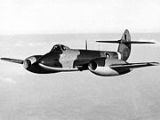
Gloster Meteor

Encyclopedia
The Gloster
Meteor was the first British jet
fighter
and the Allies'
first operational jet
. It first flew in 1943 and commenced operations on 27 July 1944 with 616 Squadron of the Royal Air Force
(RAF). The Gloster Meteor was not an aerodynamically advanced aircraft but the Gloster design team succeeded in producing an effective jet fighter that served the RAF and other air forces for decades. Meteors saw action with the Royal Australian Air Force
(RAAF) in the Korean War
, and remained in service with numerous air forces until the 1970s. Two Meteors, WL419 and WA638, remain in service with the Martin-Baker
company as ejection seat testbeds.
's firm, Power Jets
Ltd., and the Gloster Aircraft Company
began in 1940, with George Carter
, Gloster's chief designer, presenting initial proposals for a twin-engined jet fighter with a nosewheel undercarriage in August 1940. Gloster received an order for twelve prototypes (later reduced to eight) under Specification F9/40 on 7 February 1941. The first British jet-powered aircraft, the single-engined Gloster E28/39 prototype
, had its maiden flight on 15 May 1941. A letter of intent for production of 300 of the new fighter, to be named Thunderbolt, was placed on 21 June but to avoid confusion with the USAAF P-47 Thunderbolt
, the name was changed to Meteor.
The Meteor's construction was all-metal with a tricycle undercarriage
and conventional low, straight wings, featuring turbojets mid-mounted in the wings with a high-mounted tailplane
to keep it clear of the jet exhaust.
Eight prototypes were produced. Delays with getting type approval for the engines meant that although taxiing
trials were carried out it was not until the following year (1942) that flights took place. The fifth prototype, serial
DG206, powered by two de Havilland Halford H.1 engines owing to problems with the intended Whittle W.2 engines, was the first to become airborne on 5 March 1943 from RAF Cranwell
, pilot
ed by Michael Daunt. Development then moved to Newmarket Heath
and, later, a Gloster-owned site at Moreton Valence. The first Whittle-engined aircraft, DG205/G, flew on 12 June 1943 (it crashed shortly after takeoff on 27 April 1944) and was followed by DG202/G on 24 July. DG202/G was later used for deck-handling tests aboard aircraft carrier
. DG203/G made its first flight on 9 November 1943 but was eventually relegated to a ground instructional role. DG204/G (powered by Metrovick F.2
engines) first flew on 13 November 1943 and crashed on 1 April 1944. DG208/G made its debut on 20 January 1944, by which time the majority of design problems had been overcome and a production design approved. DG209/G was used as an engine test-bed by Rolls-Royce
, first flying on 18 April 1944, while DG207/G was intended to be the basis for the Meteor F.2 with de Havilland
engines, not flying until 24 July 1945, by which time the Meteor 3 was in full production and the F.2 was cancelled.
On 12 January 1944, the first Meteor F.1, serial EE210/G, took to the air from Moreton Valence. It was essentially identical to the F9/40 prototypes except for the addition of four nose-mounted 20 mm (.79 in) Hispano Mk V
cannons and some changes to the canopy to improve all-round visibility. For the production Meteor F.1, the engine was switched to the Whittle W.2 design, by then taken over by Rolls-Royce
. The W.2B/23C
turbojet engines produced 1,700 lbf (7.58 kN) of thrust each, giving the aircraft a maximum speed of 417 mph (670 km/h) at 3,000 m and a range of 1,610 km. The Meteor Mk.I was 41 ft 3 in (12.58 m) long with a span of 43 ft 0 in (13.11 m), with an empty weight of 8,140 lb (3,823 kg) and a maximum takeoff weight of 13,795 lb (6,270 kg). This aircraft was later sent to the U.S., where it was first flown at Muroc Army Airfield
on 15 April 1944.
Typical of early jet aircraft, the Meteor F.1 suffered from stability problems at high transonic
speeds, experiencing large trim changes, high stick
forces and self-sustained yaw instability (snaking) caused by airflow separation over the thick tail surfaces.
for comparative evaluation.
No. 616 Squadron RAF
was the first to receive operational Meteors, 14 of them. The squadron was based at RAF Culmhead
, Somerset
and had been previously equipped with the Spitfire VII
. After a conversion course at Farnborough
for the six leading pilots, the first aircraft was delivered to Culmhead on 12 July 1944. The squadron now with seven Meteors moved on 21 July 1944 to RAF Manston
on the east Kent
coast and, within a week, 30 pilots were converted.
The Meteor was initially used to counter the V-1 flying bomb
threat. 616 Squadron Meteors saw action for the first time on 27 July 1944, when three aircraft were active over Kent. These were the Meteor's (and the Royal Air Force's) first operational jet combat missions. After some problems, especially with jamming guns, the first two V1 "kills" were made on 4 August. By war's end, Meteors accounted for 14 flying bombs.
After the end of the V-1 threat, and the introduction of the ballistic V-2 rocket
, the RAF was forbidden to fly Meteor F.1 on combat missions over German-held territory for fear of an aircraft being shot down and then salvaged by the Germans. In any case, the greatly improved F.3 was in prospect. No. 616 Squadron briefly moved to RAF Debden
to allow USAAF bomber crews to gain experience in facing jet-engined foes before moving to Colerne
, Wiltshire
.
No. 616 Squadron exchanged its F.1s for the first Meteor F.3s on 18 December 1944. This was a substantial improvement over the earlier mark, although the basic design still had not reached its potential. Wind tunnel
and flight tests demonstrated that the original short nacelle
s, which did not extend fore and aft of the wing, contributed heavily to compressibility buffeting at high speed. New, longer nacelles not only cured some of the compressibility problems but added 120 km/h (75 mph) at altitude, even without upgraded powerplants. The last batch of Meteor F.3s featured the longer nacelles while other F.3s were retrofitted in the field with the new nacelles. The F.3 also had the new Rolls-Royce Derwent engines, increased fuel capacity, and a new larger, more strongly raked bubble canopy
.
On 20 January 1945, four Meteors were moved to Melsbroek in Belgium
. In March, the entire squadron was moved to Gilze-Rijen and then in April, to Nijmegen. The Meteors flew armed reconnaissance
and ground attack operations without encountering any German jet fighters. By late April, the squadron was based at Faßberg
, Germany
and suffered its first losses when two pilots collided in poor visibility. The war ended with the Meteors having destroyed 46 German aircraft through ground attack and having faced more problems through misidentification as the Me 262 by Allied aircraft and flak than from the Luftwaffe. To counter this, continental-based Meteors were given an all-white finish as a recognition aid.
The next major change was the Meteor F.4 that went into production in 1946, by which time there were 16 RAF squadrons equipped with Meteors. The first F.4 prototype flew on 17 May 1945. The F.4 had the Rolls-Royce Derwent 5 engines (a smaller version of the Nene
), wings 86.4 cm shorter than the F.3's and with blunter tips (derived from the world speed record prototypes), a stronger airframe, fully pressurized cockpit
, lighter aileron
s (to improve maneuverability), and rudder
trim adjustments to reduce snaking
. The F.4 could also be fitted with a drop tank under each wing while experiments were performed with carriage of underwing stores
and also in lengthened fuselage
models. The F.4 was 170 mi/h faster than the F.1 at sea level (585 against 415), although the reduced wings impaired its rate of climb.
Because of the increased demand, F.4 production was divided between Gloster and the Armstrong Whitworth
factory at Baginton. The majority of early F.4s did not go directly to the RAF: 100 were exported to Argentina
(and saw action on both sides in the 1955 revolution
, one being lost on 19 September 1955) while in 1947, only RAF Nos. 74 and 222 Squadrons were fully equipped with the F.4. Nine further RAF squadrons were upgraded over 1948. From 1948, 38 F.4s were exported to the Dutch
, equipping four squadrons (322, 323, 326 and 327) split between bases in Soesterberg and Leeuwarden until the mid-1950s. In 1949, only two RAF squadrons were converted to the F.4, Belgium
was sold 48 aircraft in the same year (going to 349 and 350 Squadrons at Beauvechain
) and Denmark
received 20 over 1949–50. In 1950, three more RAF squadrons were upgraded, including No. 616 and, in 1951, six more. In 1950, a single order of 20 F.4s was delivered to Egypt
.
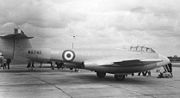 A modified two-seater F.4 for jet-conversion and advanced training was tested in 1949 as the T.7. It was accepted by the RAF and the Fleet Air Arm
and became a common addition to the various export packages (for example 43 to Belgium 1948–57, a similar number to the Netherlands over the same period, two to Syria
in 1952, six to Israel
in 1953, etc.). Despite its limitations—unpressurized cockpit, no armament, limited instructor instrumentation—over 650 T.7s were manufactured.
As improved jet fighters began to emerge, Gloster decided to perform a redesign of the F.4 to keep it up to date, while retaining as much of the manufacturing tooling of the F.4 as possible. The result was the Meteor F.8 (G-41-K) which was to be the definitive production model, serving as a major Royal Air Force single-seat fighter until the introduction of the Hawker Hunter
and the Supermarine Swift
.
The first prototype F.8 was a modified F.4, followed by a true prototype, VT150, that flew on 12 October 1948 at Moreton Valence. Flight testing of the F.8 prototype led to the discovery of an aerodynamic problem: when ammunition was expended, the aircraft became tail-heavy and unstable around the pitch axis due to the weight of fuel retained in fuselage tanks no longer being balanced by the ammunition. Gloster designers solved the problem by substituting the tail
of the abortive "G 42
" single-engine jet fighter. The F.8 and other production variants were to successfully use the new tail design; the new tail gave the later Meteors a distinctive appearance, with taller straighter edges compared to the rounded tail of the F.4s and earlier marks.
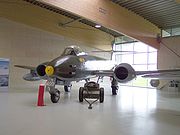 The F.8 also featured a fuselage
stretch of 76 centimetres (30 inches), intended to shift the aircraft's centre of gravity and also eliminate the use of ballast that had been necessary in earlier marks. The F.8 incorporated uprated engines, Derwent 8s, with 16 kN (1,633 kgp / 3,600 lbf) thrust each combined with structural strengthening, a Martin Baker
ejection seat and a "blown" teardrop cockpit canopy that provided improved pilot visibility. Between 1950 and 1955, the Meteor F.8 was the mainstay of RAF Fighter Command
, and served with distinction in combat in Korea
with the RAAF as well as operating with many air forces worldwide, although it was clear that the original design was obsolete compared to contemporary swept-wing fighters such as the North American F-86 Sabre
and the Soviet
MiG-15.
Initial deliveries of the F.8 to the RAF were in August 1949, with the first squadron receiving its fighters in late 1950. Like the F.4, there were strong export sales of the F.8. Belgium ordered 240 aircraft, the majority assembled in The Netherlands by Fokker. The Netherlands had 160 F.8s, equipping seven squadrons until 1955. Denmark had 20, ordered in 1951; they were to be the last F.8s in front-line service in Europe
. The RAAF ordered 94 F.8s, which served in Korea (see below). Despite arms embargoes, both Syria and Egypt received F.8s from 1952, as did Israel (where they served until 1961). On 1 September 1955, two Israeli F.8s shot down two Egyptian Vampires
and in the 1956 Suez Crisis
, F.8s were employed by both Egypt and Israel in ground-attack roles. After the crisis, both Egypt and Syria disposed of their Meteors in favour of various MiG variants. Brazil
ordered 60 new Meteor F.8s and 10 T.7 trainers in October 1952, paying with 15,000 tons of raw cotton.
In the 1950s, Meteors also were developed into effective photo-reconnaissance
, training
and night fighter
versions. The fighter-reconnaissance (FR) versions were the first to be built, replacing the ageing Spitfires and Mosquitos
then in use. Two FR.5s were built on the F.4 body; one was used for nose section camera tests and the other broke up in midair while in testing over Moreton Valence. On 23 March 1950, the first FR.9 flew. Based on the F.8, it was 20 cm longer with a new nose incorporating a remote-control camera and window and was also fitted with additional external ventral and wing fuel tanks. Production of the FR.9 began in July. No. 208 Squadron, then based at Fayid, Egypt was the first to be upgraded followed by the 2nd Tactical Air Force in West Germany
, No. 2 Squadron RAF
at Bückeburg
and No. 79 Squadron RAF
at RAF Gutersloh
flew the FR.9 from 1951 until 1956. In Aden
, No. 8 Squadron RAF was given the FR.9 in November 1958 and used them until 1961. Ecuador
(12), Israel (7) and Syria (2) were the only foreign customers for the FR.9.
In addition to the armed, low-altitude operation, tactical FR.9 variant, Gloster also developed the PR.10 for high-altitude missions. The first prototype flew on 29 March 1950 and was actually converted into the first production aircraft. Based on the F.4, it had the F.4-style tail and the longer wings of the earlier variant. All the cannons were removed and a single camera placed in the nose with two more in the rear fuselage; the canopy was also changed. The PR.10 was delivered to the RAF in December 1950 and were given to No. 2 and No. 541 Squadrons in Germany and No. 13 Squadron RAF in Cyprus
. The PR.10 was rapidly phased out from 1956 with improving surface to air missile technology and newer, faster aircraft rendering it obsolete.
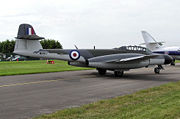 As a night fighter, the Meteor again replaced the Mosquito; however, it was never more than an interim measure. The Mosquito night fighter had remained in use even though it was largely obsolete. Gloster proposed a night fighter design to meet the Air Ministry specification for the Mosquito replacement. Based on the two seater trainer, the pilot in the front seat and the Navigator in the rear. Once accepted however, the work passed to Armstrong Whitworth for both the detail design and production; the first prototype flew on 31 May 1950. Although based on the T.7 twin seater, it used the fuselage and tail of the F.8, and the longer wings of the F.3. An extended nose contained the AI Mk 10 (the 1940s Westinghouse SCR-720) Air Intercept radar. As a consequence the 20 mm cannons were moved into the wings, outboard of the engines. A ventral fuel tank and wing mounted drop tanks completed the Armstrong Whitworth Meteor NF.11.
Nos. 29, 141 and 85 Squadrons were given the NF.11 in 1951 and the aircraft was rolled out across the RAF until the final deliveries in 1955. A "tropicalised" version of the NF.11 for Middle East
service was developed; first flying on 23 December 1952 as the NF.13. The aircraft equipped No. 219 Squadron RAF
at Kabrit
and No. 39 Squadron at Fayid, both in Egypt. The aircraft served during the Suez crisis
and remained with No. 39 Squadron when they were withdrawn to Malta
until 1958. The aircraft had a number of problems, notably the limited visibility through the heavily framed T.7 canopy made landings tricky and the external fuel tanks under the wings tended to break up when the wing cannon were fired. Gun harmonisation, normally set to about 400 yards, was poor due to flexing of the wings in flight.
Belgium (24), Denmark (20), Australia (one) and France
(41) were the foreign customers for the NF.11. Ex-RAF NF.13s were sold to Syria (six), Egypt (six) and Israel (six). An Israeli NF.13 carried out Operation Tarnegol
, downing an Egyptian Ilyushin Il-14
carrying high ranking members of the Egyptian Military on the eve of the Suez Crisis. Some of the French aircraft remained in operation as test beds into the 1980s.
 As radar
technology developed, a new Meteor night-fighter was developed to use the improved US-built APS-21 system. The NF.12 first flew on 21 April 1953. It was similar to the NF 11 but had a nose section 17 inches (43.2 cm) longer; the fin was enlarged to compensate for the greater keel area of the enlarged nose and to counter the airframe reaction to the "wig-wag" scan of the radar which affected the gunsighting, an anti-tramp motor operating on the rudder was fitted midway up the front leading edge of the fin. The NF.12 also had the new Rolls-Royce Derwent 9 engines and the wings were reinforced to handle the new engine. Deliveries of the NF.12 started in 1953, with the type entering squadron service in early 1954, equipping seven squadrons (Nos 85, 25, 152, 46, 72, 153 and 64); the aircraft was replaced over 1958–59. Because of the "sensitive" nature of the radar system, no NF.12s were offered for export.
The final Meteor night fighter was the NF.14. First flown on 23 October 1953, the NF.14 was based on the NF.12 but had an even longer nose, extended by a further 17 inches to accommodate new equipment, increasing the total length to 51 ft 4 in (15.65 m) and a larger bubble canopy to replace the framed T.7 version. Just 100 NF.14s were built; they first entered service in February 1954 beginning with No. 25 Squadron and were being replaced as early as 1956 with the Gloster Javelin
. Overseas, they remained in service a little longer, serving with No. 60 Squadron at Tengah
, Singapore
until 1961. As the NF.14 was replaced, some 14 were converted to training aircraft as the NF(T).14 and given to No. 2 Air Navigation School on Thorney Island
where they served until 1965.
.jpg) The Royal Australian Air Force acquired 113 Meteors between 1946 and 1952, 94 of which were the F.8 variant. F.8 Meteors saw extensive service during the Korean War
The Royal Australian Air Force acquired 113 Meteors between 1946 and 1952, 94 of which were the F.8 variant. F.8 Meteors saw extensive service during the Korean War
with No. 77 Squadron RAAF
, part of British Commonwealth Forces Korea
, and had personnel from other Commonwealth air forces attached to it. The squadron arrived in Korea equipped with P-51D Mustangs. It did jet conversion training at Iwakuni, Japan, and returned to Korea in April 1951 with about 30 Meteor F.8s and T.7s. The squadron moved to Kimpo in June, and was declared combat-ready the following month. There was some apprehension, as the F 8 was clearly inferior in most respects to the communist forces' MiG-15, and was superior to the North American F-86 Sabre only in rate-of-climb and acceleration.
No. 77
squadron first flew Meteors in a combat mission on 30 July 1951. The squadron had mainly been trained in the ground-attack role
, and had difficulties when assigned to bomber escort duty at sub-optimum altitudes. On 29 August 1951, eight Meteors were on escort duty in "MiG Alley
" when they were engaged by six MiG-15s; one Meteor was lost and two damaged, and 77 Squadron did not officially destroy any enemy aircraft on this occasion. On 27 October, the squadron achieved its first probable followed by two probables six days later. On 1 December, during a clash between 12 Meteors and some 40 MiG-15s, the squadron had its first two confirmed victories: Flying Officer
Bruce Gogerly made the first kill. However, this occurred at the cost of four Meteors destroyed. As a result, bomber escort was taken over by the USAF and 77 Squadron returned to ground-attack duties. The Meteor performed well but proved vulnerable to ground fire, as the rocket sights required a long level run to operate effectively.
By the end of the conflict, the squadron had flown 4,836 missions, destroying six MiG-15s, over 3,500 structures and some 1,500 vehicles. About 30 Meteors were lost to enemy action in Korea—the vast majority shot down by anti-aircraft fire while serving in a ground-attack capacity.
. On 7 November 1945 at Herne Bay in Kent
, UK, Group Captain H.J. (Willy) Wilson set the first official air speed record by a jet aircraft of 606 mph (975 km/h) TAS
. A small plaque commemorating this achievement can be found in Macari's Cafe, Herne Bay.
In 1946, Group Captain
Edward "Teddy" Donaldson
broke this record with a speed of 616 mph (991 km/h) TAS
, in EE549, a Meteor F.4. Test pilot Roland Beamont
had previously taken the same aircraft to its compressibility limit at 632 mi/h, but not under official record conditions, and outside its official safety limits.
In 1947, Sqn Ldr Janusz Żurakowski
set an international speed record: London-Copenhagen-London, 4–5 April 1950 in a production standard F.8 (VZ468). The Danes were suitably impressed and purchased the type soon after.
Another "claim to fame" was the Meteor's ability to perform the "Żurabatic Cartwheel", a new aerobatics manoeuvre, named after the Gloster acting Chief Test Pilot, first accomplished in the Gloster Meteor G-7-1 prototype at the 1951 Farnborough Air Show where the Meteor, due to its unique location of widely set engines could have individual engines throttled back and forward to achieve a seemingly stationary vertical cartwheel. Many Meteor pilots went on to "prove their mettle" by attempting the same feat.
On 7 August 1949, the Meteor III, EE397, on-loan from the RAF and flown by Flight Refuelling Ltd (FRL) test pilot
Patrick Hornidge, took off from Tarrant Rushton
and, refuelled 10 times by the Lancaster tanker, remained airborne for 12 hours and 3 minutes, receiving 2,352 gallons of fuel from the tanker in ten tanker contacts and flying an overall distance of 3600 miles (5,793.6 km), achieving a new jet endurance record.
Meteor F.8 WA820 was adapted during 1948 to take two Armstrong Siddeley Sapphire turbojets, and from Moreton Valence, on August 31st, 1951, established a time-to-height climb record. The pilot was Flt Lt
Tom Prickett, of Armstrong Siddeley
. A height of 9,843 ft was reached in 1 min 16 sec, 19,685 ft in 1 min 50 sec, 29,500 ft in 2 min 29 sec, and 39,370 ft in 3 min 7 sec. Air Service Training
Ltd were responsible for the conversion.
Contributory factors in the number of crashes were the high fuel consumption and therefore short endurance (less than one hour) causing pilots to run out of fuel, and difficult handling with one engine out due to the widely set engines. The casualty rate was exacerbated by the lack of ejection seats except in the F.8, especially in the training version T.7 and F.4 fighters relegated to training/conversion duties.
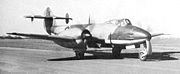
Meteor F.1
Meteor F.1, Trent turboprop
Meteor F.2
Meteor F.3
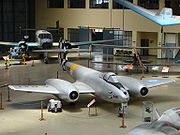 Meteor F.4
Meteor FR.5
Meteor F.6
Meteor T.7
Meteor F.8
Meteor F.8 Prone Pilot
Meteor FR.9
Meteor PR.10
Meteor NF.11
Meteor NF.12
Meteor NF.13
Meteor NF.14
Meteor U.15
Meteor U.16
Meteor TT.20
Meteor U.21
Ground Attack Fighter
 Biafra
 Canada
 Egypt
Egypt
 West Germany
 South Africa
 Syria
Syria
 United States
with Royal Australian Air Force markings as 'A77-851'
Gloster Aircraft Company
The Gloster Aircraft Company, Limited, known locally as GAC, was a British aircraft manufacturer. The company produced a famous lineage of fighters for the Royal Air Force : the Grebe, Gladiator, Meteor and Javelin. It also produced the Hawker Hurricane and Hawker Typhoon for the parent company...
Meteor was the first British jet
Jet aircraft
A jet aircraft is an aircraft propelled by jet engines. Jet aircraft generally fly much faster than propeller-powered aircraft and at higher altitudes – as high as . At these altitudes, jet engines achieve maximum efficiency over long distances. The engines in propeller-powered aircraft...
fighter
Fighter aircraft
A fighter aircraft is a military aircraft designed primarily for air-to-air combat with other aircraft, as opposed to a bomber, which is designed primarily to attack ground targets...
and the Allies'
Allies of World War II
The Allies of World War II were the countries that opposed the Axis powers during the Second World War . Former Axis states contributing to the Allied victory are not considered Allied states...
first operational jet
Jet aircraft
A jet aircraft is an aircraft propelled by jet engines. Jet aircraft generally fly much faster than propeller-powered aircraft and at higher altitudes – as high as . At these altitudes, jet engines achieve maximum efficiency over long distances. The engines in propeller-powered aircraft...
. It first flew in 1943 and commenced operations on 27 July 1944 with 616 Squadron of the Royal Air Force
Royal Air Force
The Royal Air Force is the aerial warfare service branch of the British Armed Forces. Formed on 1 April 1918, it is the oldest independent air force in the world...
(RAF). The Gloster Meteor was not an aerodynamically advanced aircraft but the Gloster design team succeeded in producing an effective jet fighter that served the RAF and other air forces for decades. Meteors saw action with the Royal Australian Air Force
Royal Australian Air Force
The Royal Australian Air Force is the air force branch of the Australian Defence Force. The RAAF was formed in March 1921. It continues the traditions of the Australian Flying Corps , which was formed on 22 October 1912. The RAAF has taken part in many of the 20th century's major conflicts...
(RAAF) in the Korean War
Korean War
The Korean War was a conventional war between South Korea, supported by the United Nations, and North Korea, supported by the People's Republic of China , with military material aid from the Soviet Union...
, and remained in service with numerous air forces until the 1970s. Two Meteors, WL419 and WA638, remain in service with the Martin-Baker
Martin-Baker
Martin-Baker Aircraft Co. Ltd. is a manufacturer of ejection seats and safety related equipment for aviation. The company origins were as an aircraft manufacturer before becoming a pioneer in the field of ejection seats...
company as ejection seat testbeds.
Design and development
Development of a turbojet-powered fighter by Sir Frank WhittleFrank Whittle
Air Commodore Sir Frank Whittle, OM, KBE, CB, FRS, Hon FRAeS was a British Royal Air Force engineer officer. He is credited with independently inventing the turbojet engine Air Commodore Sir Frank Whittle, OM, KBE, CB, FRS, Hon FRAeS (1 June 1907 – 9 August 1996) was a British Royal Air...
's firm, Power Jets
Power Jets
Power Jets Ltd was a United Kingdom company set up by Frank Whittle for the purpose of designing and manufacturing jet engines.-History:Founded on January 27, 1936, the company consisted of Whittle, Rolf Dudley-Williams, James Collingwood Tinling, and Lancelot Law Whyte of investment bankers O T...
Ltd., and the Gloster Aircraft Company
Gloster Aircraft Company
The Gloster Aircraft Company, Limited, known locally as GAC, was a British aircraft manufacturer. The company produced a famous lineage of fighters for the Royal Air Force : the Grebe, Gladiator, Meteor and Javelin. It also produced the Hawker Hurricane and Hawker Typhoon for the parent company...
began in 1940, with George Carter
George Carter (engineer)
Wilfred George Carter CBE FRAeS was a British engineer, who was the chief designer at Glosters from 1937. He was awarded the C.B.E. in 1947 and was appointed Technical Director of Gloster Aircraft in 1948 remaining on the board of directors until 1954. He continued to serve Glosters for a number...
, Gloster's chief designer, presenting initial proposals for a twin-engined jet fighter with a nosewheel undercarriage in August 1940. Gloster received an order for twelve prototypes (later reduced to eight) under Specification F9/40 on 7 February 1941. The first British jet-powered aircraft, the single-engined Gloster E28/39 prototype
Prototype
A prototype is an early sample or model built to test a concept or process or to act as a thing to be replicated or learned from.The word prototype derives from the Greek πρωτότυπον , "primitive form", neutral of πρωτότυπος , "original, primitive", from πρῶτος , "first" and τύπος ,...
, had its maiden flight on 15 May 1941. A letter of intent for production of 300 of the new fighter, to be named Thunderbolt, was placed on 21 June but to avoid confusion with the USAAF P-47 Thunderbolt
P-47 Thunderbolt
Republic Aviation's P-47 Thunderbolt, also known as the "Jug", was the largest, heaviest, and most expensive fighter aircraft in history to be powered by a single reciprocating engine. It was heavily armed with eight .50-caliber machine guns, four per wing. When fully loaded, the P-47 weighed up to...
, the name was changed to Meteor.
The Meteor's construction was all-metal with a tricycle undercarriage
Undercarriage
The undercarriage or landing gear in aviation, is the structure that supports an aircraft on the ground and allows it to taxi, takeoff and land...
and conventional low, straight wings, featuring turbojets mid-mounted in the wings with a high-mounted tailplane
Tailplane
A tailplane, also known as horizontal stabilizer , is a small lifting surface located on the tail behind the main lifting surfaces of a fixed-wing aircraft as well as other non-fixed wing aircraft such as helicopters and gyroplanes...
to keep it clear of the jet exhaust.
Eight prototypes were produced. Delays with getting type approval for the engines meant that although taxiing
Taxiing
Taxiing refers to the movement of an aircraft on the ground, under its own power, in contrast to towing or push-back where the aircraft is moved by a tug...
trials were carried out it was not until the following year (1942) that flights took place. The fifth prototype, serial
United Kingdom military aircraft serials
In the United Kingdom to identify individual aircraft, all military aircraft are allocated and display a unique serial number. A unified serial number system, maintained by the Air Ministry , and its successor the Ministry of Defence , is used for aircraft operated by the Royal Air Force , Fleet...
DG206, powered by two de Havilland Halford H.1 engines owing to problems with the intended Whittle W.2 engines, was the first to become airborne on 5 March 1943 from RAF Cranwell
RAF Cranwell
RAF Cranwell is a Royal Air Force station in Lincolnshire close to the village of Cranwell, near Sleaford. It is currently commanded by Group Captain Dave Waddington...
, pilot
Aviator
An aviator is a person who flies an aircraft. The first recorded use of the term was in 1887, as a variation of 'aviation', from the Latin avis , coined in 1863 by G. de la Landelle in Aviation Ou Navigation Aérienne...
ed by Michael Daunt. Development then moved to Newmarket Heath
RAF Newmarket
RAF Newmarket was an RAF station near Newmarket, Suffolk, England, near the border with Cambridgeshire.The RAF station was actually a grass-strip on Newmarket's Rowley Mile Racecourse...
and, later, a Gloster-owned site at Moreton Valence. The first Whittle-engined aircraft, DG205/G, flew on 12 June 1943 (it crashed shortly after takeoff on 27 April 1944) and was followed by DG202/G on 24 July. DG202/G was later used for deck-handling tests aboard aircraft carrier
Aircraft carrier
An aircraft carrier is a warship designed with a primary mission of deploying and recovering aircraft, acting as a seagoing airbase. Aircraft carriers thus allow a naval force to project air power worldwide without having to depend on local bases for staging aircraft operations...
. DG203/G made its first flight on 9 November 1943 but was eventually relegated to a ground instructional role. DG204/G (powered by Metrovick F.2
Metrovick F.2
The Metropolitan-Vickers F.2 was an early turbojet engine and the first British design to be based on an axial-flow compressor. It was considered too unreliable for use during the war, and never entered production...
engines) first flew on 13 November 1943 and crashed on 1 April 1944. DG208/G made its debut on 20 January 1944, by which time the majority of design problems had been overcome and a production design approved. DG209/G was used as an engine test-bed by Rolls-Royce
Rolls-Royce Limited
Rolls-Royce Limited was a renowned British car and, from 1914 on, aero-engine manufacturing company founded by Charles Stewart Rolls and Henry Royce on 15 March 1906 as the result of a partnership formed in 1904....
, first flying on 18 April 1944, while DG207/G was intended to be the basis for the Meteor F.2 with de Havilland
De Havilland
The de Havilland Aircraft Company was a British aviation manufacturer founded in 1920 when Airco, of which Geoffrey de Havilland had been chief designer, was sold to BSA by the owner George Holt Thomas. De Havilland then set up a company under his name in September of that year at Stag Lane...
engines, not flying until 24 July 1945, by which time the Meteor 3 was in full production and the F.2 was cancelled.
On 12 January 1944, the first Meteor F.1, serial EE210/G, took to the air from Moreton Valence. It was essentially identical to the F9/40 prototypes except for the addition of four nose-mounted 20 mm (.79 in) Hispano Mk V
Hispano-Suiza HS.404
The Hispano-Suiza HS.404 was an autocannon widely used as both an aircraft and land weapon in the 20th century by British, American, French, and numerous other military services. The cannon is also referred to as Birkigt type 404, after its designer. Firing a 20 mm caliber projectile, it delivered...
cannons and some changes to the canopy to improve all-round visibility. For the production Meteor F.1, the engine was switched to the Whittle W.2 design, by then taken over by Rolls-Royce
Rolls-Royce Limited
Rolls-Royce Limited was a renowned British car and, from 1914 on, aero-engine manufacturing company founded by Charles Stewart Rolls and Henry Royce on 15 March 1906 as the result of a partnership formed in 1904....
. The W.2B/23C
Rolls-Royce Welland
-Bibliography:* Jane's Fighting Aircraft of World War II. London. Studio Editions Ltd, 1989. ISBN 0-517-67964-7-External links:*...
turbojet engines produced 1,700 lbf (7.58 kN) of thrust each, giving the aircraft a maximum speed of 417 mph (670 km/h) at 3,000 m and a range of 1,610 km. The Meteor Mk.I was 41 ft 3 in (12.58 m) long with a span of 43 ft 0 in (13.11 m), with an empty weight of 8,140 lb (3,823 kg) and a maximum takeoff weight of 13,795 lb (6,270 kg). This aircraft was later sent to the U.S., where it was first flown at Muroc Army Airfield
Edwards Air Force Base
Edwards Air Force Base is a United States Air Force base located on the border of Kern County, Los Angeles County, and San Bernardino County, California, in the Antelope Valley. It is southwest of the central business district of North Edwards, California and due east of Rosamond.It is named in...
on 15 April 1944.
Typical of early jet aircraft, the Meteor F.1 suffered from stability problems at high transonic
Transonic
Transonic speed is an aeronautics term referring to the condition of flight in which a range of velocities of airflow exist surrounding and flowing past an air vehicle or an airfoil that are concurrently below, at, and above the speed of sound in the range of Mach 0.8 to 1.2, i.e. 600–900 mph...
speeds, experiencing large trim changes, high stick
Joystick
A joystick is an input device consisting of a stick that pivots on a base and reports its angle or direction to the device it is controlling. Joysticks, also known as 'control columns', are the principal control in the cockpit of many civilian and military aircraft, either as a center stick or...
forces and self-sustained yaw instability (snaking) caused by airflow separation over the thick tail surfaces.
Operational service
The first 20 aircraft were delivered to the Royal Air Force on 1 June 1944; one was also sent to the U.S. in exchange for a Bell YP-59A AiracometP-59 Airacomet
The Bell P-59 Airacomet was the first American jet fighter aircraft, designed and built during World War II. The United States Army Air Forces was not impressed by its performance and cancelled the contract when fewer than half of the aircraft ordered had been produced. Although no P-59s went...
for comparative evaluation.
No. 616 Squadron RAF
No. 616 Squadron RAF
No. 616 Squadron was a unit of the British Auxiliary Air Force and later the Royal Auxiliary Air Force between 1938 and 1957.-Formation:...
was the first to receive operational Meteors, 14 of them. The squadron was based at RAF Culmhead
RAF Culmhead
RAF Culmhead is an ex-Royal Air Force airbase, situated at Churchstanton on the Blackdown Hills in Somerset, England.It had 3 tarmac runways that are now in poor condition and the control towers are currently derelict...
, Somerset
Somerset
The ceremonial and non-metropolitan county of Somerset in South West England borders Bristol and Gloucestershire to the north, Wiltshire to the east, Dorset to the south-east, and Devon to the south-west. It is partly bounded to the north and west by the Bristol Channel and the estuary of the...
and had been previously equipped with the Spitfire VII
Supermarine Spitfire
The Supermarine Spitfire is a British single-seat fighter aircraft that was used by the Royal Air Force and many other Allied countries throughout the Second World War. The Spitfire continued to be used as a front line fighter and in secondary roles into the 1950s...
. After a conversion course at Farnborough
Farnborough Airfield
Farnborough Airport or TAG London Farnborough Airport is an airport situated in Farnborough, Rushmoor, Hampshire, England...
for the six leading pilots, the first aircraft was delivered to Culmhead on 12 July 1944. The squadron now with seven Meteors moved on 21 July 1944 to RAF Manston
RAF Manston
RAF Manston was an RAF station in the north-east of Kent, at on the Isle of Thanet from 1916 until 1996. The site is now split between a commercial airport Kent International Airport and a continuing military use by the Defence Fire Training and Development Centre , following on from a long...
on the east Kent
Kent
Kent is a county in southeast England, and is one of the home counties. It borders East Sussex, Surrey and Greater London and has a defined boundary with Essex in the middle of the Thames Estuary. The ceremonial county boundaries of Kent include the shire county of Kent and the unitary borough of...
coast and, within a week, 30 pilots were converted.
The Meteor was initially used to counter the V-1 flying bomb
V-1 flying bomb
The V-1 flying bomb, also known as the Buzz Bomb or Doodlebug, was an early pulse-jet-powered predecessor of the cruise missile....
threat. 616 Squadron Meteors saw action for the first time on 27 July 1944, when three aircraft were active over Kent. These were the Meteor's (and the Royal Air Force's) first operational jet combat missions. After some problems, especially with jamming guns, the first two V1 "kills" were made on 4 August. By war's end, Meteors accounted for 14 flying bombs.
After the end of the V-1 threat, and the introduction of the ballistic V-2 rocket
V-2 rocket
The V-2 rocket , technical name Aggregat-4 , was a ballistic missile that was developed at the beginning of the Second World War in Germany, specifically targeted at London and later Antwerp. The liquid-propellant rocket was the world's first long-range combat-ballistic missile and first known...
, the RAF was forbidden to fly Meteor F.1 on combat missions over German-held territory for fear of an aircraft being shot down and then salvaged by the Germans. In any case, the greatly improved F.3 was in prospect. No. 616 Squadron briefly moved to RAF Debden
RAF Debden
RAF Debden is a former RAF airfield in England. The field is located 3 miles SE of Saffron Walden and approximately 1 mile north of the village of Debden in North Essex.-RAF Fighter Command:...
to allow USAAF bomber crews to gain experience in facing jet-engined foes before moving to Colerne
Colerne
Colerne is a village and civil parish in the Cotswolds Area of Outstanding Natural Beauty, midway between Bath and Chippenham in Wiltshire, England. It has an elevated position above sea level and overlooks the Box Valley to the south...
, Wiltshire
Wiltshire
Wiltshire is a ceremonial county in South West England. It is landlocked and borders the counties of Dorset, Somerset, Hampshire, Gloucestershire, Oxfordshire and Berkshire. It contains the unitary authority of Swindon and covers...
.
No. 616 Squadron exchanged its F.1s for the first Meteor F.3s on 18 December 1944. This was a substantial improvement over the earlier mark, although the basic design still had not reached its potential. Wind tunnel
Wind tunnel
A wind tunnel is a research tool used in aerodynamic research to study the effects of air moving past solid objects.-Theory of operation:Wind tunnels were first proposed as a means of studying vehicles in free flight...
and flight tests demonstrated that the original short nacelle
Nacelle
The nacelle is a cover housing that holds engines, fuel, or equipment on an aircraft. In some cases—for instance in the typical "Farman" type "pusher" aircraft, or the World War II-era P-38 Lightning—an aircraft's cockpit may also be housed in a nacelle, which essentially fills the...
s, which did not extend fore and aft of the wing, contributed heavily to compressibility buffeting at high speed. New, longer nacelles not only cured some of the compressibility problems but added 120 km/h (75 mph) at altitude, even without upgraded powerplants. The last batch of Meteor F.3s featured the longer nacelles while other F.3s were retrofitted in the field with the new nacelles. The F.3 also had the new Rolls-Royce Derwent engines, increased fuel capacity, and a new larger, more strongly raked bubble canopy
Bubble canopy
A bubble canopy is a canopy made like a soap bubble, which attempts to provide 360° vision to the pilot.-History:Bubble canopies have been in use since World War II. The British had already developed the "Malcolm hood", which was a bulged canopy, but the British Miles M.20 was one of the first...
.
On 20 January 1945, four Meteors were moved to Melsbroek in Belgium
Belgium
Belgium , officially the Kingdom of Belgium, is a federal state in Western Europe. It is a founding member of the European Union and hosts the EU's headquarters, and those of several other major international organisations such as NATO.Belgium is also a member of, or affiliated to, many...
. In March, the entire squadron was moved to Gilze-Rijen and then in April, to Nijmegen. The Meteors flew armed reconnaissance
Reconnaissance
Reconnaissance is the military term for exploring beyond the area occupied by friendly forces to gain information about enemy forces or features of the environment....
and ground attack operations without encountering any German jet fighters. By late April, the squadron was based at Faßberg
Faßberg Air Base
Faßberg Air Base is located 2 km northeast of the municipality of Faßberg, Lower Saxony, Germany. The air base is jointly used by the German Army and the German Air Force . Its main user is the German Army Aviation Corps.- History :An airfield was established in 1934...
, Germany
Germany
Germany , officially the Federal Republic of Germany , is a federal parliamentary republic in Europe. The country consists of 16 states while the capital and largest city is Berlin. Germany covers an area of 357,021 km2 and has a largely temperate seasonal climate...
and suffered its first losses when two pilots collided in poor visibility. The war ended with the Meteors having destroyed 46 German aircraft through ground attack and having faced more problems through misidentification as the Me 262 by Allied aircraft and flak than from the Luftwaffe. To counter this, continental-based Meteors were given an all-white finish as a recognition aid.
The next major change was the Meteor F.4 that went into production in 1946, by which time there were 16 RAF squadrons equipped with Meteors. The first F.4 prototype flew on 17 May 1945. The F.4 had the Rolls-Royce Derwent 5 engines (a smaller version of the Nene
Rolls-Royce Nene
|-See also:-References:NotesBibliography* Bridgman, L, Jane's fighting aircraft of World War II. Crescent. ISBN 0-517-67964-7-External links:* *...
), wings 86.4 cm shorter than the F.3's and with blunter tips (derived from the world speed record prototypes), a stronger airframe, fully pressurized cockpit
Cabin pressurization
Cabin pressurization is the pumping of compressed air into an aircraft cabin to maintain a safe and comfortable environment for crew and passengers when flying at altitude.-Need for cabin pressurization:...
, lighter aileron
Aileron
Ailerons are hinged flight control surfaces attached to the trailing edge of the wing of a fixed-wing aircraft. The ailerons are used to control the aircraft in roll, which results in a change in heading due to the tilting of the lift vector...
s (to improve maneuverability), and rudder
Rudder
A rudder is a device used to steer a ship, boat, submarine, hovercraft, aircraft or other conveyance that moves through a medium . On an aircraft the rudder is used primarily to counter adverse yaw and p-factor and is not the primary control used to turn the airplane...
trim adjustments to reduce snaking
Dutch roll
Dutch roll is a type of aircraft motion, consisting of an out-of-phase combination of "tail-wagging" and rocking from side to side. This yaw-roll coupling is one of the basic flight dynamic modes...
. The F.4 could also be fitted with a drop tank under each wing while experiments were performed with carriage of underwing stores
Hardpoint
A hardpoint, or weapon station, is any part of an airframe designed to carry an external load. This includes a point on the wing or fuselage of military aircraft where external ordnance, countermeasures, gun pods, targeting pods or drop tanks can be mounted.-Rail launchers:Large missiles and...
and also in lengthened fuselage
Fuselage
The fuselage is an aircraft's main body section that holds crew and passengers or cargo. In single-engine aircraft it will usually contain an engine, although in some amphibious aircraft the single engine is mounted on a pylon attached to the fuselage which in turn is used as a floating hull...
models. The F.4 was 170 mi/h faster than the F.1 at sea level (585 against 415), although the reduced wings impaired its rate of climb.
Because of the increased demand, F.4 production was divided between Gloster and the Armstrong Whitworth
Armstrong Whitworth
Sir W G Armstrong Whitworth & Co Ltd was a major British manufacturing company of the early years of the 20th century. Headquartered in Elswick, Newcastle upon Tyne, Armstrong Whitworth engaged in the construction of armaments, ships, locomotives, automobiles, and aircraft.-History:In 1847,...
factory at Baginton. The majority of early F.4s did not go directly to the RAF: 100 were exported to Argentina
Argentina
Argentina , officially the Argentine Republic , is the second largest country in South America by land area, after Brazil. It is constituted as a federation of 23 provinces and an autonomous city, Buenos Aires...
(and saw action on both sides in the 1955 revolution
Revolución Libertadora
The Revolución Libertadora was a military uprising that ended the second presidential term of Juan Perón in Argentina, on September 16, 1955.-History:...
, one being lost on 19 September 1955) while in 1947, only RAF Nos. 74 and 222 Squadrons were fully equipped with the F.4. Nine further RAF squadrons were upgraded over 1948. From 1948, 38 F.4s were exported to the Dutch
Netherlands
The Netherlands is a constituent country of the Kingdom of the Netherlands, located mainly in North-West Europe and with several islands in the Caribbean. Mainland Netherlands borders the North Sea to the north and west, Belgium to the south, and Germany to the east, and shares maritime borders...
, equipping four squadrons (322, 323, 326 and 327) split between bases in Soesterberg and Leeuwarden until the mid-1950s. In 1949, only two RAF squadrons were converted to the F.4, Belgium
Belgium
Belgium , officially the Kingdom of Belgium, is a federal state in Western Europe. It is a founding member of the European Union and hosts the EU's headquarters, and those of several other major international organisations such as NATO.Belgium is also a member of, or affiliated to, many...
was sold 48 aircraft in the same year (going to 349 and 350 Squadrons at Beauvechain
Beauvechain
Beauvechain is a Walloon municipality located in the Belgian province of Walloon Brabant. On 1 January 2006 the municipality had 6,529 inhabitants. The total area is 38.58 km², giving a population density of 169 inhabitants per km²....
) and Denmark
Denmark
Denmark is a Scandinavian country in Northern Europe. The countries of Denmark and Greenland, as well as the Faroe Islands, constitute the Kingdom of Denmark . It is the southernmost of the Nordic countries, southwest of Sweden and south of Norway, and bordered to the south by Germany. Denmark...
received 20 over 1949–50. In 1950, three more RAF squadrons were upgraded, including No. 616 and, in 1951, six more. In 1950, a single order of 20 F.4s was delivered to Egypt
Egypt
Egypt , officially the Arab Republic of Egypt, Arabic: , is a country mainly in North Africa, with the Sinai Peninsula forming a land bridge in Southwest Asia. Egypt is thus a transcontinental country, and a major power in Africa, the Mediterranean Basin, the Middle East and the Muslim world...
.
Fleet Air Arm
The Fleet Air Arm is the branch of the British Royal Navy responsible for the operation of naval aircraft. The Fleet Air Arm currently operates the AgustaWestland Merlin, Westland Sea King and Westland Lynx helicopters...
and became a common addition to the various export packages (for example 43 to Belgium 1948–57, a similar number to the Netherlands over the same period, two to Syria
Syria
Syria , officially the Syrian Arab Republic , is a country in Western Asia, bordering Lebanon and the Mediterranean Sea to the West, Turkey to the north, Iraq to the east, Jordan to the south, and Israel to the southwest....
in 1952, six to Israel
Israel
The State of Israel is a parliamentary republic located in the Middle East, along the eastern shore of the Mediterranean Sea...
in 1953, etc.). Despite its limitations—unpressurized cockpit, no armament, limited instructor instrumentation—over 650 T.7s were manufactured.
As improved jet fighters began to emerge, Gloster decided to perform a redesign of the F.4 to keep it up to date, while retaining as much of the manufacturing tooling of the F.4 as possible. The result was the Meteor F.8 (G-41-K) which was to be the definitive production model, serving as a major Royal Air Force single-seat fighter until the introduction of the Hawker Hunter
Hawker Hunter
The Hawker Hunter is a subsonic British jet aircraft developed in the 1950s. The single-seat Hunter entered service as a manoeuvrable fighter aircraft, and later operated in fighter-bomber and reconnaissance roles in numerous conflicts. Two-seat variants remained in use for training and secondary...
and the Supermarine Swift
Supermarine Swift
The Supermarine Swift was a British single-seat jet fighter of the Royal Air Force , built by Supermarine during the 1950s. After a protracted development period, the Swift entered service as an interceptor, but, due to a spate of accidents, its service life was short...
.
The first prototype F.8 was a modified F.4, followed by a true prototype, VT150, that flew on 12 October 1948 at Moreton Valence. Flight testing of the F.8 prototype led to the discovery of an aerodynamic problem: when ammunition was expended, the aircraft became tail-heavy and unstable around the pitch axis due to the weight of fuel retained in fuselage tanks no longer being balanced by the ammunition. Gloster designers solved the problem by substituting the tail
Empennage
The empennage , also known as the tail or tail assembly, of most aircraft gives stability to the aircraft, in a similar way to the feathers on an arrow...
of the abortive "G 42
Gloster E.1/44
|-See also:-References:NotesBibliography* Ashley, Glenn. Meteor in Action. Carrollton, Texas: Squadron/Signal Publications Inc., 1995. ISBN 0-89747-332-9.* Bowyer, Chaz. Gloster Meteor. London: Ian Allan Ltd., 1985. ISBN 0-7110-1477-9....
" single-engine jet fighter. The F.8 and other production variants were to successfully use the new tail design; the new tail gave the later Meteors a distinctive appearance, with taller straighter edges compared to the rounded tail of the F.4s and earlier marks.
Fuselage
The fuselage is an aircraft's main body section that holds crew and passengers or cargo. In single-engine aircraft it will usually contain an engine, although in some amphibious aircraft the single engine is mounted on a pylon attached to the fuselage which in turn is used as a floating hull...
stretch of 76 centimetres (30 inches), intended to shift the aircraft's centre of gravity and also eliminate the use of ballast that had been necessary in earlier marks. The F.8 incorporated uprated engines, Derwent 8s, with 16 kN (1,633 kgp / 3,600 lbf) thrust each combined with structural strengthening, a Martin Baker
Martin Baker
Martin Baker may refer to:*Martin-Baker Aircraft Co. Ltd*Martin Baker , Scottish footballer*Martin Baker...
ejection seat and a "blown" teardrop cockpit canopy that provided improved pilot visibility. Between 1950 and 1955, the Meteor F.8 was the mainstay of RAF Fighter Command
RAF Fighter Command
RAF Fighter Command was one of three functional commands of the Royal Air Force. It was formed in 1936 to allow more specialised control of fighter aircraft. It served throughout the Second World War, gaining recognition in the Battle of Britain. The Command continued until 17 November 1943, when...
, and served with distinction in combat in Korea
Korean War
The Korean War was a conventional war between South Korea, supported by the United Nations, and North Korea, supported by the People's Republic of China , with military material aid from the Soviet Union...
with the RAAF as well as operating with many air forces worldwide, although it was clear that the original design was obsolete compared to contemporary swept-wing fighters such as the North American F-86 Sabre
F-86 Sabre
The North American F-86 Sabre was a transonic jet fighter aircraft. Produced by North American Aviation, the Sabre is best known as America's first swept wing fighter which could counter the similarly-winged Soviet MiG-15 in high speed dogfights over the skies of the Korean War...
and the Soviet
Soviet Union
The Soviet Union , officially the Union of Soviet Socialist Republics , was a constitutionally socialist state that existed in Eurasia between 1922 and 1991....
MiG-15.
Initial deliveries of the F.8 to the RAF were in August 1949, with the first squadron receiving its fighters in late 1950. Like the F.4, there were strong export sales of the F.8. Belgium ordered 240 aircraft, the majority assembled in The Netherlands by Fokker. The Netherlands had 160 F.8s, equipping seven squadrons until 1955. Denmark had 20, ordered in 1951; they were to be the last F.8s in front-line service in Europe
Europe
Europe is, by convention, one of the world's seven continents. Comprising the westernmost peninsula of Eurasia, Europe is generally 'divided' from Asia to its east by the watershed divides of the Ural and Caucasus Mountains, the Ural River, the Caspian and Black Seas, and the waterways connecting...
. The RAAF ordered 94 F.8s, which served in Korea (see below). Despite arms embargoes, both Syria and Egypt received F.8s from 1952, as did Israel (where they served until 1961). On 1 September 1955, two Israeli F.8s shot down two Egyptian Vampires
De Havilland Vampire
The de Havilland DH.100 Vampire was a British jet-engine fighter commissioned by the Royal Air Force during the Second World War. Following the Gloster Meteor, it was the second jet fighter to enter service with the RAF. Although it arrived too late to see combat during the war, the Vampire served...
and in the 1956 Suez Crisis
Suez Crisis
The Suez Crisis, also referred to as the Tripartite Aggression, Suez War was an offensive war fought by France, the United Kingdom, and Israel against Egypt beginning on 29 October 1956. Less than a day after Israel invaded Egypt, Britain and France issued a joint ultimatum to Egypt and Israel,...
, F.8s were employed by both Egypt and Israel in ground-attack roles. After the crisis, both Egypt and Syria disposed of their Meteors in favour of various MiG variants. Brazil
Brazil
Brazil , officially the Federative Republic of Brazil , is the largest country in South America. It is the world's fifth largest country, both by geographical area and by population with over 192 million people...
ordered 60 new Meteor F.8s and 10 T.7 trainers in October 1952, paying with 15,000 tons of raw cotton.
In the 1950s, Meteors also were developed into effective photo-reconnaissance
Reconnaissance
Reconnaissance is the military term for exploring beyond the area occupied by friendly forces to gain information about enemy forces or features of the environment....
, training
Trainer (aircraft)
A trainer is a class of aircraft designed specifically to facilitate in-flight training of pilots and aircrews. The use of a dedicated trainer aircraft with additional safety features—such as tandem flight controls, forgiving flight characteristics and a simplified cockpit arrangement—allows...
and night fighter
Night fighter
A night fighter is a fighter aircraft adapted for use at night or in other times of bad visibility...
versions. The fighter-reconnaissance (FR) versions were the first to be built, replacing the ageing Spitfires and Mosquitos
De Havilland Mosquito
The de Havilland DH.98 Mosquito was a British multi-role combat aircraft that served during the Second World War and the postwar era. It was known affectionately as the "Mossie" to its crews and was also nicknamed "The Wooden Wonder"...
then in use. Two FR.5s were built on the F.4 body; one was used for nose section camera tests and the other broke up in midair while in testing over Moreton Valence. On 23 March 1950, the first FR.9 flew. Based on the F.8, it was 20 cm longer with a new nose incorporating a remote-control camera and window and was also fitted with additional external ventral and wing fuel tanks. Production of the FR.9 began in July. No. 208 Squadron, then based at Fayid, Egypt was the first to be upgraded followed by the 2nd Tactical Air Force in West Germany
West Germany
West Germany is the common English, but not official, name for the Federal Republic of Germany or FRG in the period between its creation in May 1949 to German reunification on 3 October 1990....
, No. 2 Squadron RAF
No. 2 Squadron RAF
No. 2 Squadron of the Royal Air Force is currently one of two RAF squadrons operating in the reconnaissance role with the Tornado GR4A and GR4 and is based at RAF Marham, Norfolk.No. II Squadron holds claim to being "the oldest heavier-than-air flying machine squadron in the world", along with No...
at Bückeburg
Bückeburg
Bückeburg is a town in Lower Saxony, Germany, on the border with North Rhine Westphalia. It was once the capital of the tiny principality of Schaumburg-Lippe and is today located in the district of Schaumburg close to the northern slopes of the Weserbergland ridge...
and No. 79 Squadron RAF
No. 79 Squadron RAF
-World War I:It was first formed at Gosport on 1 August 1917 as a squadron of the Royal Flying Corps. It was equipped with Sopwith Dolphin fighter aircraft in December that year, moving to France in February 1918. It specialised in low-level ground-attack operations, mainly in support of the...
at RAF Gutersloh
RAF Gütersloh
The former Royal Air Force Station Gütersloh, more commonly known as RAF Gütersloh, was a Royal Air Force Germany military airbase, the nearest Royal Air Force airbase to the East/West German border, in the vicinity of the town of Gütersloh. It was constructed by the Germans prior to World War II...
flew the FR.9 from 1951 until 1956. In Aden
Aden
Aden is a seaport city in Yemen, located by the eastern approach to the Red Sea , some 170 kilometres east of Bab-el-Mandeb. Its population is approximately 800,000. Aden's ancient, natural harbour lies in the crater of an extinct volcano which now forms a peninsula, joined to the mainland by a...
, No. 8 Squadron RAF was given the FR.9 in November 1958 and used them until 1961. Ecuador
Ecuador
Ecuador , officially the Republic of Ecuador is a representative democratic republic in South America, bordered by Colombia on the north, Peru on the east and south, and by the Pacific Ocean to the west. It is one of only two countries in South America, along with Chile, that do not have a border...
(12), Israel (7) and Syria (2) were the only foreign customers for the FR.9.
In addition to the armed, low-altitude operation, tactical FR.9 variant, Gloster also developed the PR.10 for high-altitude missions. The first prototype flew on 29 March 1950 and was actually converted into the first production aircraft. Based on the F.4, it had the F.4-style tail and the longer wings of the earlier variant. All the cannons were removed and a single camera placed in the nose with two more in the rear fuselage; the canopy was also changed. The PR.10 was delivered to the RAF in December 1950 and were given to No. 2 and No. 541 Squadrons in Germany and No. 13 Squadron RAF in Cyprus
Cyprus
Cyprus , officially the Republic of Cyprus , is a Eurasian island country, member of the European Union, in the Eastern Mediterranean, east of Greece, south of Turkey, west of Syria and north of Egypt. It is the third largest island in the Mediterranean Sea.The earliest known human activity on the...
. The PR.10 was rapidly phased out from 1956 with improving surface to air missile technology and newer, faster aircraft rendering it obsolete.
Night fighter
Nos. 29, 141 and 85 Squadrons were given the NF.11 in 1951 and the aircraft was rolled out across the RAF until the final deliveries in 1955. A "tropicalised" version of the NF.11 for Middle East
Middle East
The Middle East is a region that encompasses Western Asia and Northern Africa. It is often used as a synonym for Near East, in opposition to Far East...
service was developed; first flying on 23 December 1952 as the NF.13. The aircraft equipped No. 219 Squadron RAF
No. 219 Squadron RAF
No. 219 Squadron of the Royal Air Force was originally founded in 1918 and disbanded in 1957 after four separate periods of service. During the First World War it served as a coastal defence unit, and through most of the Second World War and the 1950s it operated as a night fighter air defence...
at Kabrit
RAF Kabrit
Kibrit Air Base is a closed Egyptian Air Force base located in Egypt, approximately 20 miles north of Suez; 125 km east of Cairo. The name of the station came from a nearby village, and in Egyptian means "sulphur كبريت".-History:...
and No. 39 Squadron at Fayid, both in Egypt. The aircraft served during the Suez crisis
Suez Crisis
The Suez Crisis, also referred to as the Tripartite Aggression, Suez War was an offensive war fought by France, the United Kingdom, and Israel against Egypt beginning on 29 October 1956. Less than a day after Israel invaded Egypt, Britain and France issued a joint ultimatum to Egypt and Israel,...
and remained with No. 39 Squadron when they were withdrawn to Malta
Malta
Malta , officially known as the Republic of Malta , is a Southern European country consisting of an archipelago situated in the centre of the Mediterranean, south of Sicily, east of Tunisia and north of Libya, with Gibraltar to the west and Alexandria to the east.Malta covers just over in...
until 1958. The aircraft had a number of problems, notably the limited visibility through the heavily framed T.7 canopy made landings tricky and the external fuel tanks under the wings tended to break up when the wing cannon were fired. Gun harmonisation, normally set to about 400 yards, was poor due to flexing of the wings in flight.
Belgium (24), Denmark (20), Australia (one) and France
France
The French Republic , The French Republic , The French Republic , (commonly known as France , is a unitary semi-presidential republic in Western Europe with several overseas territories and islands located on other continents and in the Indian, Pacific, and Atlantic oceans. Metropolitan France...
(41) were the foreign customers for the NF.11. Ex-RAF NF.13s were sold to Syria (six), Egypt (six) and Israel (six). An Israeli NF.13 carried out Operation Tarnegol
Operation Tarnegol
Operation Tarnegol was an Israeli Air Force operation carried out on the eve of the 1956 Suez Crisis. It witnessed an Israeli Gloster Meteor NF.13 intercept and destroy an Egyptian Ilyushin Il-14 carrying high-ranking members of the Egyptian General Staff en route from Syria to...
, downing an Egyptian Ilyushin Il-14
Ilyushin Il-14
The Ilyushin Il-14 was a Soviet twin-engine commercial and military personnel and cargo transport aircraft that first flew in 1950, and entered service in 1954. Il-14 was also manufactured in East Germany by VVB Flugzeugbau, in Czechoslovakia as the Avia 14, and in China under the Chinese...
carrying high ranking members of the Egyptian Military on the eve of the Suez Crisis. Some of the French aircraft remained in operation as test beds into the 1980s.
Radar
Radar is an object-detection system which uses radio waves to determine the range, altitude, direction, or speed of objects. It can be used to detect aircraft, ships, spacecraft, guided missiles, motor vehicles, weather formations, and terrain. The radar dish or antenna transmits pulses of radio...
technology developed, a new Meteor night-fighter was developed to use the improved US-built APS-21 system. The NF.12 first flew on 21 April 1953. It was similar to the NF 11 but had a nose section 17 inches (43.2 cm) longer; the fin was enlarged to compensate for the greater keel area of the enlarged nose and to counter the airframe reaction to the "wig-wag" scan of the radar which affected the gunsighting, an anti-tramp motor operating on the rudder was fitted midway up the front leading edge of the fin. The NF.12 also had the new Rolls-Royce Derwent 9 engines and the wings were reinforced to handle the new engine. Deliveries of the NF.12 started in 1953, with the type entering squadron service in early 1954, equipping seven squadrons (Nos 85, 25, 152, 46, 72, 153 and 64); the aircraft was replaced over 1958–59. Because of the "sensitive" nature of the radar system, no NF.12s were offered for export.
The final Meteor night fighter was the NF.14. First flown on 23 October 1953, the NF.14 was based on the NF.12 but had an even longer nose, extended by a further 17 inches to accommodate new equipment, increasing the total length to 51 ft 4 in (15.65 m) and a larger bubble canopy to replace the framed T.7 version. Just 100 NF.14s were built; they first entered service in February 1954 beginning with No. 25 Squadron and were being replaced as early as 1956 with the Gloster Javelin
Gloster Javelin
The Gloster Javelin was an "all-weather" interceptor aircraft that served with Britain's Royal Air Force in the late 1950s and most of the 1960s...
. Overseas, they remained in service a little longer, serving with No. 60 Squadron at Tengah
Tengah
Tengah is an Indonesian and Malay word meaning "Central". It can be found in topography, e.g.*Kalimantan Tengah*Kepulauan Tengah or Central Archipelago....
, Singapore
Singapore
Singapore , officially the Republic of Singapore, is a Southeast Asian city-state off the southern tip of the Malay Peninsula, north of the equator. An island country made up of 63 islands, it is separated from Malaysia by the Straits of Johor to its north and from Indonesia's Riau Islands by the...
until 1961. As the NF.14 was replaced, some 14 were converted to training aircraft as the NF(T).14 and given to No. 2 Air Navigation School on Thorney Island
Thorney Island (West Sussex)
Thorney Island is an island that juts into Chichester Harbour in West Sussex. It is separated from the mainland by a narrow channel called the Great Deep. The village of West Thorney lies on the east coast of the island and has been incorporated into the military base...
where they served until 1965.
Service during the Korean War
Korean War
The Korean War was a conventional war between South Korea, supported by the United Nations, and North Korea, supported by the People's Republic of China , with military material aid from the Soviet Union...
with No. 77 Squadron RAAF
No. 77 Squadron RAAF
No. 77 Squadron is a Royal Australian Air Force fighter squadron. The Squadron was formed in 1942 and currently operates F/A-18 Hornet aircraft from RAAF Base Williamtown.-History:...
, part of British Commonwealth Forces Korea
British Commonwealth Forces Korea
British Commonwealth Forces Korea was the formal name, from 1952, of the Commonwealth army, naval and air units serving with the United Nations in the Korean War. Australian, British, Canadian, Indian and New Zealand units were part of BCFK...
, and had personnel from other Commonwealth air forces attached to it. The squadron arrived in Korea equipped with P-51D Mustangs. It did jet conversion training at Iwakuni, Japan, and returned to Korea in April 1951 with about 30 Meteor F.8s and T.7s. The squadron moved to Kimpo in June, and was declared combat-ready the following month. There was some apprehension, as the F 8 was clearly inferior in most respects to the communist forces' MiG-15, and was superior to the North American F-86 Sabre only in rate-of-climb and acceleration.
No. 77
No. 77 Squadron RAAF
No. 77 Squadron is a Royal Australian Air Force fighter squadron. The Squadron was formed in 1942 and currently operates F/A-18 Hornet aircraft from RAAF Base Williamtown.-History:...
squadron first flew Meteors in a combat mission on 30 July 1951. The squadron had mainly been trained in the ground-attack role
Ground attack aircraft
Ground-attack aircraft are military aircraft with primary role of attacking targets on the ground with greater precision than bombers and prepared to face stronger low-level air defense...
, and had difficulties when assigned to bomber escort duty at sub-optimum altitudes. On 29 August 1951, eight Meteors were on escort duty in "MiG Alley
MiG Alley
"MIG Alley" is the name given by U.S. Air Force pilots to the northwestern portion of North Korea, where the Yalu River empties into the Yellow Sea. During the Korean War, it was the site of numerous dogfights between U.S. fighter jets and those of the Communist forces, particularly the Soviet...
" when they were engaged by six MiG-15s; one Meteor was lost and two damaged, and 77 Squadron did not officially destroy any enemy aircraft on this occasion. On 27 October, the squadron achieved its first probable followed by two probables six days later. On 1 December, during a clash between 12 Meteors and some 40 MiG-15s, the squadron had its first two confirmed victories: Flying Officer
Flying Officer
Flying officer is a junior commissioned rank in the Royal Air Force and the air forces of many countries which have historical British influence...
Bruce Gogerly made the first kill. However, this occurred at the cost of four Meteors destroyed. As a result, bomber escort was taken over by the USAF and 77 Squadron returned to ground-attack duties. The Meteor performed well but proved vulnerable to ground fire, as the rocket sights required a long level run to operate effectively.
By the end of the conflict, the squadron had flown 4,836 missions, destroying six MiG-15s, over 3,500 structures and some 1,500 vehicles. About 30 Meteors were lost to enemy action in Korea—the vast majority shot down by anti-aircraft fire while serving in a ground-attack capacity.
Record setting
Late in 1945, two F.3 Meteors were modified for an attempt on the world air speed recordAir speed record
An air speed record is the highest airspeed attained by an aircraft of a particular class. The rules for all official aviation records are defined by Fédération Aéronautique Internationale , which also ratifies any claims. Speed records are divided into multiple classes with sub-divisions...
. On 7 November 1945 at Herne Bay in Kent
Herne Bay, Kent
Herne Bay is a seaside town in Kent, South East England, with a population of 35,188. On the south coast of the Thames Estuary, it is north of Canterbury and east of Whitstable. It neighbours the ancient villages of Herne and Reculver and is part of the City of Canterbury local government district...
, UK, Group Captain H.J. (Willy) Wilson set the first official air speed record by a jet aircraft of 606 mph (975 km/h) TAS
True airspeed
True airspeed of an aircraft is the speed of the aircraft relative to the airmass in which it is flying. True airspeed is important information for accurate navigation of an aircraft.-Performance:...
. A small plaque commemorating this achievement can be found in Macari's Cafe, Herne Bay.
In 1946, Group Captain
Group Captain
Group captain is a senior commissioned rank in the Royal Air Force and the air forces of many other Commonwealth countries. It ranks above wing commander and immediately below air commodore...
Edward "Teddy" Donaldson
Edward Mortlock Donaldson
Air Commodore Edward "Teddy" Mortlock Donaldson CB, CBE, DSO, AFC & Bar was an RAF Second World War Flying ace, and former holder of the airspeed World Record.-Biography:...
broke this record with a speed of 616 mph (991 km/h) TAS
True airspeed
True airspeed of an aircraft is the speed of the aircraft relative to the airmass in which it is flying. True airspeed is important information for accurate navigation of an aircraft.-Performance:...
, in EE549, a Meteor F.4. Test pilot Roland Beamont
Roland Beamont
Wing Commander Roland Prosper "Bee" Beamont CBE, DSO & Bar, DFC & Bar was a British fighter pilot and test pilot for the Royal Air Force during the Second World War, and the years that followed...
had previously taken the same aircraft to its compressibility limit at 632 mi/h, but not under official record conditions, and outside its official safety limits.
In 1947, Sqn Ldr Janusz Żurakowski
Janusz Zurakowski
Janusz Żurakowski was a renowned Polish fighter and test pilot, who, at various times, lived and worked in Poland, the United Kingdom, and Canada.-Early life:...
set an international speed record: London-Copenhagen-London, 4–5 April 1950 in a production standard F.8 (VZ468). The Danes were suitably impressed and purchased the type soon after.
Another "claim to fame" was the Meteor's ability to perform the "Żurabatic Cartwheel", a new aerobatics manoeuvre, named after the Gloster acting Chief Test Pilot, first accomplished in the Gloster Meteor G-7-1 prototype at the 1951 Farnborough Air Show where the Meteor, due to its unique location of widely set engines could have individual engines throttled back and forward to achieve a seemingly stationary vertical cartwheel. Many Meteor pilots went on to "prove their mettle" by attempting the same feat.
On 7 August 1949, the Meteor III, EE397, on-loan from the RAF and flown by Flight Refuelling Ltd (FRL) test pilot
Test pilot
A test pilot is an aviator who flies new and modified aircraft in specific maneuvers, known as flight test techniques or FTTs, allowing the results to be measured and the design to be evaluated....
Patrick Hornidge, took off from Tarrant Rushton
RAF Tarrant Rushton
RAF Tarrant Rushton was a Royal Air Force station near the village of Tarrant Rushton east of Blandford Forum in Dorset, England from 1943 to 1947.It was used for glider operations during World War II and later revived for civilian operations...
and, refuelled 10 times by the Lancaster tanker, remained airborne for 12 hours and 3 minutes, receiving 2,352 gallons of fuel from the tanker in ten tanker contacts and flying an overall distance of 3600 miles (5,793.6 km), achieving a new jet endurance record.
Meteor F.8 WA820 was adapted during 1948 to take two Armstrong Siddeley Sapphire turbojets, and from Moreton Valence, on August 31st, 1951, established a time-to-height climb record. The pilot was Flt Lt
Flight Lieutenant
Flight lieutenant is a junior commissioned rank in the Royal Air Force and the air forces of many Commonwealth countries. It ranks above flying officer and immediately below squadron leader. The name of the rank is the complete phrase; it is never shortened to "lieutenant"...
Tom Prickett, of Armstrong Siddeley
Armstrong Siddeley
Armstrong Siddeley was a British engineering group that operated during the first half of the 20th century. It was formed in 1919 and is best known for the production of luxury motor cars and aircraft engines.-Siddeley Autocars:...
. A height of 9,843 ft was reached in 1 min 16 sec, 19,685 ft in 1 min 50 sec, 29,500 ft in 2 min 29 sec, and 39,370 ft in 3 min 7 sec. Air Service Training
Air Service Training
Air Service Training is an organisation in Perth, Scotland, that has been training engineers and pilots for airlines, maintenance organisations and the military since 1931...
Ltd were responsible for the conversion.
Other uses
Production of the Meteor continued until 1954 with almost 3,900 made, mainly the F.8 variant. As the Meteor was progressively relegated to secondary duties in later years, target tug, drone and specialized test vehicles were added to the diverse roles that this first-generation jet fighter took on.Safety record
A total of 890 Meteors were lost in service with the RAF (145 crashes in 1953 alone), resulting in the deaths of 450 pilots.Contributory factors in the number of crashes were the high fuel consumption and therefore short endurance (less than one hour) causing pilots to run out of fuel, and difficult handling with one engine out due to the widely set engines. The casualty rate was exacerbated by the lack of ejection seats except in the F.8, especially in the training version T.7 and F.4 fighters relegated to training/conversion duties.
Variants
Gloster F.9/40- Prototypes, eight built -
- DG202/G powered by two Rover W2BPower Jets W.2|-See also:-Bibliography:*Gunston, Bill. World Encyclopedia of Aero Engines. Cambridge, England. Patrick Stephens Limited, 1989. ISBN 1-85260-163-9*Jane's Fighting Aircraft of World War II. London. Studio Editions Ltd, 1998...
jet engines, first flown 24 July 1943. - DG203/G powered by two Power Jets W2/500Power Jets W.2|-See also:-Bibliography:*Gunston, Bill. World Encyclopedia of Aero Engines. Cambridge, England. Patrick Stephens Limited, 1989. ISBN 1-85260-163-9*Jane's Fighting Aircraft of World War II. London. Studio Editions Ltd, 1998...
engines, first flown 9 November 1943. - DG204/G powered by two Metrovik F2 jet engines, unlike the other F.9/40s the engines were mounted under the wing, first flown 13 November 1943.
- DG205/G powered by two Rover W2B/23Power Jets W.2|-See also:-Bibliography:*Gunston, Bill. World Encyclopedia of Aero Engines. Cambridge, England. Patrick Stephens Limited, 1989. ISBN 1-85260-163-9*Jane's Fighting Aircraft of World War II. London. Studio Editions Ltd, 1998...
jet engines, first flown 12 June 1943. - DG206/G powered by two Halford H1 jet engines, the first to fly on 5 March 1943.
- DG207/G powered by two Halford H1 jet engines, first flown 24 July 1945, became the prototype F.2 variant.
- DG208/G powered by two Rover W2B/23Power Jets W.2|-See also:-Bibliography:*Gunston, Bill. World Encyclopedia of Aero Engines. Cambridge, England. Patrick Stephens Limited, 1989. ISBN 1-85260-163-9*Jane's Fighting Aircraft of World War II. London. Studio Editions Ltd, 1998...
engines, first flown 20 January 1944. - DG209/G powered by two Rover W2B/27Power Jets W.2|-See also:-Bibliography:*Gunston, Bill. World Encyclopedia of Aero Engines. Cambridge, England. Patrick Stephens Limited, 1989. ISBN 1-85260-163-9*Jane's Fighting Aircraft of World War II. London. Studio Editions Ltd, 1998...
engines, first flown 18 April 1944.
- DG202/G powered by two Rover W2B
Meteor F.1
- First production aircraft built between 1943 and 1944, 20 built.
Meteor F.1, Trent turboprop
- One-off engine test bed, built 1945, designated EE227, for the new and highly successful Rolls-Royce Trent turbopropTurbopropA turboprop engine is a type of turbine engine which drives an aircraft propeller using a reduction gear.The gas turbine is designed specifically for this application, with almost all of its output being used to drive the propeller...
engine making it the world's first turboprop-powered aircraft.
Meteor F.2
- Alternative engined version – only one built.
Meteor F.3
- Derwent I powered with sliding canopy, first flown 11 September 1944, 210 built (first 15 were Welland-powered)
- Derwent 5 powered with strengthened fuselage, 489 built by Glosters and 46 by Armstrong Whitworth for the Royal Air Force. The F.4 was also exported to Argentina (50 aircraft), Belgium (48 aircraft), Denmark (20 aircraft), Egypt (12 aircraft), Netherlands (38 aircraft).
Meteor FR.5
- One-off fighter reconnaissance version of the F.4, fitted with vertical cameras in the nose instead of the four cannon and had obliques cameras in the fuselage, destroyed on maiden flight 15 June 1949.
Meteor F.6
- Proposed swept-wing variant of the F.4, not built.
Meteor T.7
- Two-seat trainer variant of the F.4, company prototype first flew 19 March 1948, 640 production aircraft for the Royal Air Force and the Royal Navy (43) and 72 for export (Belgium, Brazil, Denmark, Egypt, France, Israel, Netherlands). Avions Fairey modified 20 Belgian Air Force F.4s to T.7 standard.
Meteor F.8
- Greatly improved from the F.4. Longer fuselage, greater fuel capacity, standard ejection seat and modified tail (derived from the E.1/44Gloster E.1/44|-See also:-References:NotesBibliography* Ashley, Glenn. Meteor in Action. Carrollton, Texas: Squadron/Signal Publications Inc., 1995. ISBN 0-89747-332-9.* Bowyer, Chaz. Gloster Meteor. London: Ian Allan Ltd., 1985. ISBN 0-7110-1477-9....
). This variant was a prolific frontline fighter in RAF squadron service, 1950–54.
Meteor F.8 Prone Pilot
- One-off experimental prone pilot F.8, WK935 modified by Armstrong Whitworth.
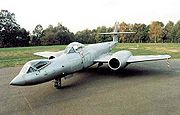
Meteor FR.9
- Fighter armed reconnaissance version of the F.8, first flown 23 March 1950, 126 built by Glosters for the Royal Air Force. Former RAF aircraft were later sold to Ecuador, Israel and Syria.
Meteor PR.10
- Photo reconnaissance version of the F.8, first flown 29 March 1950, 59 built for the Royal Air Force.
Meteor NF.11
- Night Fighter variant with Airborne Intercept radar designed and built by Armstrong Whitworth, three protoypes followed by 311 production aircraft for the Royal Air Force and 20 for the Royal Danish Air Force.
Meteor NF.12
- Longer nosed version of the NF.11 with American AN/APS-21 radar, this was balanced by a slightly larger fin, first flown on 21 April 1953, 100 built by Armstrong Whitworth.
Meteor NF.13
- Tropicalised version of the NF.11 to replace the Mosquito NF.36 for service with 39 SquadronNo. 39 Squadron RAFNo. 39 Squadron of the Royal Air Force operates the MQ-9 Reaper since 2007, operating from Creech AFB, Nevada, USA.-World War I:39 Squadron was founded at Hounslow Heath Aerodrome in April 1916 with B.E.2s and Royal Aircraft Factory B.E.12s in an attempt to defend against German Zeppelin raids on...
in Malta and Cyprus and 219 SquadronNo. 219 Squadron RAFNo. 219 Squadron of the Royal Air Force was originally founded in 1918 and disbanded in 1957 after four separate periods of service. During the First World War it served as a coastal defence unit, and through most of the Second World War and the 1950s it operated as a night fighter air defence...
based in Egypt. The first of 40 production aircraft built by Armstrong Whitworth was first flown on 21 December 1952. Former Royal Air Force aircraft were later sold to Egypt (6 aircraft), France (2 aircraft), Israel (6 aircraft) and Syria (6 aircraft).
Meteor NF.14
- NF.11 with new two-piece blown canopy rather than the heavy-framed version. It also had a longer nose giving a length of 51 ft 4 in. Protoype modified from an NF.11 was first flown 23 October 1953 and was followed by 100 production aircraft built by Armstrong Whitworth for the Royal Air Force.
Meteor U.15
- Target droneTarget droneA target drone is an unmanned, remote controlled aerial vehicle, usually used in the training of anti-aircraft crews.In their simplest form, target drones often resemble radio controlled model aircraft...
conversion of the F.4, 92 modified by Flight Refuelling.
Meteor U.16
- Target drone conversion of the F.8, 108 modified by Flight Refuelling.
Meteor TT.20
- High speed target towing conversion of the NF.11 for the Royal Navy by Armstrong Whitworth, 20 former Royal Air Force NF.11s were modified. Four additional conversions of four NF.11s of Royal Danish Air Force, after conversion these were flown by civil operators on behalf of the Danish military.
Meteor U.21
- Target drone conversion of the F.8 for the Royal Australian Air Force by Flight Refuelling, some aircraft modified in Australia by Fairey Aviation of Australasia using Flight Refueling supplied modification kits.
Ground Attack Fighter
- Also known as the Reaper, it was a F.8 modified by Gloster as a private venture ground attack fighter. The modification allowed the carriage of external Rocket-Assisted Take-Off Gear (RATOGJATOJATO is an acronym for jet-fuel assisted take off. It is a system for helping overloaded aircraft into the air by providing additional thrust in the form of small rockets....
), added a ventral cannon and tip tanks. First flown 4 September 1950, only one was built.
Military operators
- Argentine Air ForceArgentine Air ForceThe Argentine Air Force is the national aviation branch of the Armed Forces of the Argentine Republic. , it had 14,606 military and 6,854 civilian staff.-History:...
ordered 100 F.4s in May 1947, comprising 50 ex-RAF aircraft and 50 newly built. Deliveries started in July that year, the Meteor remaining in service until 1970, when the last examples were replaced by Dassault Mirage IIIDassault Mirage IIIThe Mirage III is a supersonic fighter aircraft designed by Dassault Aviation during the late 1950s, and manufactured both in France and a number of other countries. It was a successful fighter aircraft, being sold to many air forces around the world and remaining in production for over a decade...
s.
- Royal Australian Air ForceRoyal Australian Air ForceThe Royal Australian Air Force is the air force branch of the Australian Defence Force. The RAAF was formed in March 1921. It continues the traditions of the Australian Flying Corps , which was formed on 22 October 1912. The RAAF has taken part in many of the 20th century's major conflicts...
operated 104 aircraft from 1946 to 1947 and 1951 to 1963.- No. 22 Squadron RAAFNo. 22 Squadron RAAFNo. 22 Squadron is a Royal Australian Air Force mixed regular and reserve squadron that provides support for the RAAF in the Sydney region. Formed in 1936, the squadron served in Papua New Guinea during the Second World War, and later followed the Pacific war as far as the Philippines...
- No. 23 Squadron RAAFNo. 23 Squadron RAAFNo. 23 Squadron of the Royal Australian Air Force is a non-flying base operations and training squadron headquartered at RAAF Base Amberley near Brisbane, Queensland. The Squadron was formed in 1937 and saw action during World War II as a bomber squadron.-History:No...
- No. 75 Squadron RAAFNo. 75 Squadron RAAFNo. 75 Squadron is a Royal Australian Air Force fighter unit based at RAAF Base Tindal in the Northern Territory. The squadron was formed in 1942 and saw extensive action in the South West Pacific theatre of World War II, operating P-40 Kittyhawks. It was disbanded in 1948, but reformed the...
- No. 77 Squadron RAAFNo. 77 Squadron RAAFNo. 77 Squadron is a Royal Australian Air Force fighter squadron. The Squadron was formed in 1942 and currently operates F/A-18 Hornet aircraft from RAAF Base Williamtown.-History:...
- No. 22 Squadron RAAF
- Belgian Air ForceBelgian Air ForceThe Air Component, formerly the Belgian Air Force, is the air arm of the Belgian Armed Forces. Originally founded in 1909, it is one of the world's first air forces, and was a pioneer in aerial combat during the First World War...
received 40 aircraft of F.4 variant, 43 of T.7 variant, 240 of F.8 variant and 24 aircraft of NF.11 variant.
Biafra
- Biafran Air ForceBiafraBiafra, officially the Republic of Biafra, was a secessionist state in south-eastern Nigeria that existed from 30 May 1967 to 15 January 1970, taking its name from the Bight of Biafra . The inhabitants were mostly the Igbo people who led the secession due to economic, ethnic, cultural and religious...
purchased two Meteor NF 14s through a cover company. One crashed during a ferry flight between MadeiraMadeiraMadeira is a Portuguese archipelago that lies between and , just under 400 km north of Tenerife, Canary Islands, in the north Atlantic Ocean and an outermost region of the European Union...
and Cape VerdeCape VerdeThe Republic of Cape Verde is an island country, spanning an archipelago of 10 islands located in the central Atlantic Ocean, 570 kilometres off the coast of Western Africa...
, while the second was abandoned at BissauBissauBissau is the capital city of Guinea-Bissau. The city's borders are conterminous with the Bissau Autonomous Sector. In 2007, the city had an estimated population of 407,424 according to the Instituto Nacional de Estatística e Censos...
, Portuguese GuineaPortuguese GuineaPortuguese Guinea was the name for what is today Guinea-Bissau from 1446 to September 10, 1974.-History:...
. An attempt to purchase a further two ex-Danish target tugs via a German intermediary was discovered by the BundesnachrichtendienstBundesnachrichtendienstThe Bundesnachrichtendienst [ˌbʊndəsˈnaːχʁɪçtnˌdiːnst] is the foreign intelligence agency of Germany, directly subordinated to the Chancellor's Office. Its headquarters are in Pullach near Munich, and Berlin . The BND has 300 locations in Germany and foreign countries...
, the West German intelligence service, and stopped by grounding the aircraft.
- Brazilian Air ForceBrazilian Air ForceThe Brazilian Air Force is the air branch of the Brazilian Armed Forces and one of the three national uniformed services. The FAB was formed when the Army and Navy air branch were merged into a single military force initially called "National Air Forces"...
received 62 aircraft in F.8 and TF.7 variants. - 2°/1°GAvCa
- 1°/1°GAvCa
- 1°/14°GAv
Canada
- Royal Canadian Air ForceRoyal Canadian Air ForceThe history of the Royal Canadian Air Force begins in 1920, when the air force was created as the Canadian Air Force . In 1924 the CAF was renamed the Royal Canadian Air Force and granted royal sanction by King George V. The RCAF existed as an independent service until 1968...
— from 1945 to 1950, one Meteor III and Meteor T.7 were used for tests and evaluation by the RCAF.
- Royal Danish Air ForceRoyal Danish Air ForceThe Royal Danish Air Force is the air force of Denmark with the capability to undertake homeland defense and homeland security roles as well international operations.-History:...
- Ecuadorian Air ForceEcuadorian Air ForceThe Ecuadorian Air Force is the Air arm of the Military of Ecuador and responsible for the protection of the Ecuadorian airspace.-Mission:To develop the military air wing, in order to execute institutional objectives which guarantee sovereignty and contribute towards the nation's security and...
Egypt
- Royal Egyptian Air Force
- French Air ForceFrench Air ForceThe French Air Force , literally Army of the Air) is the air force of the French Armed Forces. It was formed in 1909 as the Service Aéronautique, a service arm of the French Army, then was made an independent military arm in 1933...
West Germany
- LuftwaffeLuftwaffeLuftwaffe is a generic German term for an air force. It is also the official name for two of the four historic German air forces, the Wehrmacht air arm founded in 1935 and disbanded in 1946; and the current Bundeswehr air arm founded in 1956....
– Meteor TT.20 target towing aircraft.
- Israeli Air ForceIsraeli Air ForceThe Israeli Air Force is the air force of the State of Israel and the aerial arm of the Israel Defense Forces. It was founded on May 28, 1948, shortly after the Israeli Declaration of Independence...
- Royal Netherlands Air ForceRoyal Netherlands Air ForceThe Royal Netherlands Air Force , Dutch Koninklijke Luchtmacht , is the military aviation branch of the Netherlands Armed Forces. Its ancestor, the Luchtvaartafdeling of the Dutch Army was founded on 1 July 1913, with four pilots...
- Dutch Naval Aviation Service
- Royal New Zealand Air ForceRoyal New Zealand Air ForceThe Royal New Zealand Air Force is the air arm of the New Zealand Defence Force...
- No. 14 Squadron RNZAFNo. 14 Squadron RNZAF14 Squadron RNZAF was a squadron of the Royal New Zealand Air Force.- New Zealand fighters before 1941 :Until World War II, New Zealand's air force concentrated on training, transport and maritime attack. The vast distance of the Pacific Ocean seemed a defence against attack by air...
operated two Meteor T.7 aircraft hired from the RAF.
- No. 14 Squadron RNZAF
South Africa
- South African Air ForceSouth African Air ForceThe South African Air Force is the air force of South Africa, with headquarters in Pretoria. It is the world's second oldest independent air force, and its motto is Per Aspera Ad Astra...
– Meteor F.3 aircraft, in service from 1946 to 1949.
- Swedish Air ForceSwedish Air ForceThe Swedish Air Force is the air force branch of the Swedish Armed Forces.-History:The Swedish Air Force was created on July 1, 1926 when the aircraft units of the Army and Navy were merged. Because of the escalating international tension during the 1930s the Air Force was reorganized and expanded...
operated Meteors by Svensk Flygtjanst under Air Force contract.
Syria
- Syrian Air ForceSyrian Air ForceThe Syrian Air Force is the Aviation branch of the Syrian Armed Forces. It was established in 1948.-History:The end of World War II led to a withdrawal of the United Kingdom and France from the Middle East, and this included a withdrawal from Syria...
- Royal Air ForceRoyal Air ForceThe Royal Air Force is the aerial warfare service branch of the British Armed Forces. Formed on 1 April 1918, it is the oldest independent air force in the world...
-
- No. 1 Squadron RAFNo. 1 Squadron RAFNo. 1 Squadron is a squadron of the Royal Air Force. It operated the Harrier GR9 from RAF Cottesmore until 28 January 2011.The squadron motto is In omnibus princeps , appropriate for the RAF's oldest squadron and one that has been involved in almost every major British military operation since...
- No. 2 Squadron RAFNo. 2 Squadron RAFNo. 2 Squadron of the Royal Air Force is currently one of two RAF squadrons operating in the reconnaissance role with the Tornado GR4A and GR4 and is based at RAF Marham, Norfolk.No. II Squadron holds claim to being "the oldest heavier-than-air flying machine squadron in the world", along with No...
- No. 5 Squadron RAFNo. 5 Squadron RAFNo. 5 Squadron of the Royal Air Force is the operator of the new Sentinel R1 Airborne STand-Off Radar aircraft and is based at RAF Waddington.-History:As No...
- No. 8 Squadron RAF
- No. 11 Squadron RAF
- No. 13 Squadron RAF
- No. 19 Squadron RAF
- No. 25 Squadron RAF
- No. 29 Squadron RAFNo. 29 Squadron RAFNo. 29 Squadron of the Royal Air Force was first raised in 1915, and is one of the world's oldest fighter squadrons. The second British squadron to receive the Eurofighter Typhoon, it is currently the Operational Conversion Unit for the RAF's newest fighter.-Service in World War I:This unit was...
- No. 33 Squadron RAFNo. 33 Squadron RAFNo. 33 Squadron of the Royal Air Force operates the Puma HC.1 from RAF Benson, Oxfordshire.-Current role:The squadron is part of the RAF Support Helicopter force, which reports into the Joint Helicopter Command....
- No. 34 Squadron RAFNo. 34 Squadron RAFNo. 34 Squadron RAF was a squadron of the Royal Air Force. During the First World War it operated as a reconnaissance and bomber squadron, and in the 1930s operated light bombers...
- No. 39 Squadron RAFNo. 39 Squadron RAFNo. 39 Squadron of the Royal Air Force operates the MQ-9 Reaper since 2007, operating from Creech AFB, Nevada, USA.-World War I:39 Squadron was founded at Hounslow Heath Aerodrome in April 1916 with B.E.2s and Royal Aircraft Factory B.E.12s in an attempt to defend against German Zeppelin raids on...
- No. 41 Squadron RAFNo. 41 Squadron RAFNo. 41 Squadron of the Royal Air Force is currently the RAF's Test and Evaluation Squadron , based at RAF Coningsby, Lincolnshire. Its official title is "41 TES". The Squadron celebrates its 95th anniversary in 2011, and is one of the oldest RAF squadrons in existence.-First World War, 1916–1919:No...
- No. 43 Squadron RAFNo. 43 Squadron RAFNo. 43 Squadron was a Royal Air Force aircraft squadron originally formed in 1916 as part of the Royal Flying Corps. It last operated the Panavia Tornado F3 from RAF Leuchars, Scotland in the air defence role until disbanded in July 2009.-In World War I:...
- No. 46 Squadron RAFNo. 46 Squadron RAFNo. 46 Squadron of the Royal Flying Corps and the Royal Air Force, formed in 1916, was disbanded and re-formed three times before its last disbandment in 1975. It served in both World War I and World War II.- World War I :...
- No. 54 Squadron RAF
- No. 1 Squadron RAF
-
- No. 56 Squadron RAFNo. 56 Squadron RAFNumber 56 Squadron is one of the oldest and most successful squadrons of the Royal Air Force, with battle honours from many of the significant air campaigns of both World War I and World War II...
- No. 60 Squadron RAFNo. 60 Squadron RAFNo. 60 Squadron of the Royal Air Force was formed in 1916 at Gosport. It is currently part of the Defence Helicopter Flying School based at RAF Shawbury in Shropshire....
- No. 63 Squadron RAFNo. 63 Squadron RAF-In World War I:No. 63 Squadron was formed on 31 August 1916 at Stirling, Scotland as a squadron of the Royal Flying Corps. The squadron was intended to operate as a day-bomber unit over the Western Front in France, and was therefore equipped with de Havilland DH4 aircraft; however at the last...
- No. 64 Squadron RAFNo. 64 Squadron RAFNo. 64 Squadron was a squadron of the Royal Air Force. It was first formed on 1 August 1916 as a squadron of the Royal Flying Corps. It was last disbanded on 31 January 1991 at RAF Leuchars.- 1916 to 1919 :...
- No. 65 Squadron RAFNo. 65 Squadron RAFNo. 65 Squadron was a squadron of the Royal Air Force.-World War I:The squadron was first formed at Wyton on 1 August 1916 as a squadron of the Royal Flying Corps with a core provided from the training ground at Norwich. By the end of World War I, it had claimed over 200 victories...
- No. 66 Squadron RAFNo. 66 Squadron RAFNo. 66 Squadron was a Royal Flying Corps and eventually Royal Air Force aircraft squadron.-In World War I:It was first formed at Filton on 30 June 1916 as a Training Squadron equipped with BE2c,d & e, BE12 and Avroe 504A machines. The squadron received its first Sopwith Pup on 3 February 1917,...
- No. 68 Squadron RAFNo. 68 Squadron RAFThe name No. 68 Squadron has been used by the Royal Air Force for two quite different units.No. 2 Squadron, Australian Flying Corps was formed at Heliopolis, Egypt in 1916. For a while it was known to the British military as "No. 68 Squadron RFC" - according to some accounts in order to avoid...
- No. 72 Squadron RAFNo. 72 Squadron RAFNo. 72 Squadron Royal Air Force started its service life supporting the army during World War I on operations in Middle East and afterwards was quickly disbanded. In its second incarnation the squadron was a real fighter unit, transitioning from Gloster Gladiator biplanes to Gloster Javelin...
- No. 74 Squadron RAFNo. 74 Squadron RAFNo. 74 Squadron RAF, also known as a "Tiger Squadron" from its tiger head motif, is a squadron of the Royal Air Force. It operated fighter aircraft from 1917 to the 1990s.-First World War:...
- No. 79 Squadron RAFNo. 79 Squadron RAF-World War I:It was first formed at Gosport on 1 August 1917 as a squadron of the Royal Flying Corps. It was equipped with Sopwith Dolphin fighter aircraft in December that year, moving to France in February 1918. It specialised in low-level ground-attack operations, mainly in support of the...
- No. 81 Squadron RAFNo. 81 Squadron RAFNo 81 Squadron was a squadron of the Royal Air Force. It flew Fighter aircraft during the Second World War, and reconnaissance aircraft in the Far East after the war, but was disbanded in 1970.-First World War:No...
- No. 85 Squadron RAFNo. 85 Squadron RAFNo. 85 Squadron is a squadron of the Royal Air Force. It most recently served as No. 85 Squadron based at RAF Church Fenton.-In World War I:...
- No. 87 Squadron RAFNo. 87 Squadron RAFNo. 87 Squadron RAF was an aircraft squadron of the Royal Air Force during the First World War and Second World War.-World War I:87 Squadron Royal Flying Corps was first formed on 1 September 1917 at Upavon from elements of the Central Flying School...
- No. 91 Squadron RAFNo. 91 Squadron RAFNo 91 Squadron was a squadron of the Royal Air Force but is no longer operational. The name acknowledges the contribution made by Nigeria to the cost of the squadron's aeroplanes.-World War I:...
- No. 92 Squadron RAFNo. 92 Squadron RAFNo. 92 Squadron, also known as No 92 Squadron, of the Royal Air Force was formed as part of the Royal Flying Corps at London Colney as a fighter squadron on 1 September 1917. It deployed to France in July 1918 and saw action for just four months, until the end of the war. During the conflict it...
- No. 96 Squadron RAFNo. 96 Squadron RAFNo. 96 Squadron was a Royal Air Force squadron. The squadron served on the Western Front during World War II and the Burma Campaign in the South-East Asian Theatre of World War II. No. 96 Squadron served in a variety of roles such as night fighter cover and transportation. It was disbanded in 1959,...
- No. 56 Squadron RAF
-
- No. 111 Squadron RAFNo. 111 Squadron RAFNo. 111 Squadron of the Royal Air Force operated the Panavia Tornado F3 from RAF Leuchars, Scotland until March 2011, when the squadron was disbanded, ending the Tornado F3's RAF service.-In World War I:...
- No. 124 Squadron RAFNo. 124 Squadron RAFNo. 124 Squadron RAF was a Royal Air Force Squadron formed to be a light bomber unit in World War I and reformed as a fighter unit in World War II.-Formation and World War I:...
- No. 125 Squadron RAFNo. 125 Squadron RAFNo. 125 Squadron was a Royal Air Force squadron active during and after World War II.-World War I:Like a number of Squadrons, No. 125 was initially formed during the later months of the first world war but never became operational before the Armistice.-World War II:No...
- No. 141 Squadron RAFNo. 141 Squadron RAFNo. 141 Squadron of the Royal Air Force was formed on 1 January 1918 at Rochford, for home defence in the London Area. The Squadron moved to RAF Biggin Hill in February and giving up its mixed collection of types in favour of Bristol F.2 Fighters during March...
- No. 151 Squadron RAFNo. 151 Squadron RAF-World War I:No. 151 squadron was founded at Hainault Farm in Essex on 12 June 1918, and was equipped with Sopwith Camel aircraft.During the five months in which 151 Squadron had taken part in hostilities overseas, the total number of hours flown by night was 1443 hrs 26 mins.Sixteen enemy aircraft...
- No. 152 Squadron RAFNo. 152 Squadron RAFNo. 152 Squadron of the Royal Air Force .-History:No 152 Squadron was formed on 1 October 1918 at Rochford as a Camel night fighter unit. 30 June 1919, the squadron disbanded....
- No. 153 Squadron RAFNo. 153 Squadron RAFNo. 153 Squadron RAF was a unit of the Royal Air Force. On 1 July, 1958, the unit was renumbered as No. 25 Squadron RAF.-Aircraft operated:...
- No. 208 Squadron RAFNo. 208 Squadron RAFNo 208 Squadron is at present a reserve unit of the Royal Air Force based at RAF Valley, Anglesey, Wales. It operates the BAe Hawk aircraft.-World War I:...
- No. 219 Squadron RAFNo. 219 Squadron RAFNo. 219 Squadron of the Royal Air Force was originally founded in 1918 and disbanded in 1957 after four separate periods of service. During the First World War it served as a coastal defence unit, and through most of the Second World War and the 1950s it operated as a night fighter air defence...
- No. 222 Squadron RAFNo. 222 Squadron RAF-In World War I:The Squadron was formally formed at Thasos on 1 April 1918 from A squadron of the former No. 2 Wing, RNAS when the Royal Air Force was formed. Later, 6 April 1918 former Z Squadron of No. 2 Wing, RNAS was added to the strength. Renumbered No. 62 Wing and consisting of Nos...
- No. 234 Squadron RAFNo. 234 Squadron RAFNo. 234 Squadron RAF had a long career within the RAF, being operational on flying boats in World War I and on fighter aircraft in World War II. After the war it remained a fighter unit till 1957. In its last incarnation the squadron was in turn Operational Training Unit , Tactical Weapon Unit and...
- No. 245 Squadron RAFNo. 245 Squadron RAFNo. 245 Squadron was a squadron of the Royal Air Force. It flew as an anti-submarine squadron during World War I and as a fighter squadron during World War II. After the war it was first a jet-fighter squadron and its last role was as a radar-calibration unit....
- No. 247 Squadron RAFNo. 247 Squadron RAFNo. 247 Squadron was formerly a squadron of the Royal Air Force. It was also known as No.247 Squadron in recognition of the donations made by the British colonies, which at the outbreak of the Second World War, were established on the Chinese coast...
- No. 256 Squadron RAFNo. 256 Squadron RAFNo. 256 Squadron RAF was an aircraft squadron of the Royal Air Force during World War II. It operated Defiant Mk IIs out of RAF Squires Gate in the night defence of Liverpool....
- No. 257 Squadron RAFNo. 257 Squadron RAF-In World War I:No. 257 Squadron was formed at Dundee on 18 August 1918 from Nos. 318 and 319 Flights. It flew both seaplanes and flying boats on anti-submarine patrols from Dundee until the end of the First World War and disbanded there on 30 June 1919....
- No. 111 Squadron RAF
-
- No. 263 Squadron RAFNo. 263 Squadron RAFNo 263 Squadron was an Royal Air Force fighter squadron formed in Italy towards the end of World War I. After being disbanded in 1919 it reformed in 1939 flying mainly strike and heavy fighter aircraft until becoming No 1 Squadron in 1958.-First World War:...
- No. 264 Squadron RAFNo. 264 Squadron RAFNo. 264 Squadron RAF also known as No 264 Squadron was a squadron of the Royal Air Force formed from two former Royal Naval Air Service flights, No. 439 and No. 440, on 27 September 1918 at Souda Bay, Crete to perform anti-submarine patrols. It operated the Short 184 floatplanes on patrols in the...
- No. 266 Squadron RAFNo. 266 Squadron RAF-World War I:The squadron was formed from No's 437 and 438 Flights at Mudros, Greece on 27 September 1918 to carry out anti-submarine patrols in that area, flying Short 184s and 320s along with Felixtowe F.3s. In February 1919 it was transferred to the Caucasus on HMS Engadine. It operated from...
- No. 500 Squadron RAFNo. 500 Squadron RAFNo. 500 Squadron AAF was formed in 1931 as a Special Reserve squadron and in 1936 became part of the Auxiliary Air Force. It served in a number of roles before being disbanded in 1957.-Formation and early years:...
- No. 504 Squadron RAFNo. 504 Squadron RAFNo. 504 Squadron was one of the Special Reserve Squadrons of the Auxiliary Air Force. It was integrated into the AAF proper in 1936. Based at RAF Cottesmore, Rutland, 504 Squadron used a variety of light bombers before being re-tasked to fighters with the Hawker Hurricane in 1939. It subsequently...
- No. 527 Squadron RAFNo. 527 Squadron RAFNo. 527 Squadron RAF was a radar calibration unit of the Royal Air Force between 1943 and 1958.-Formation:No. 527 Squadron was formed from various calibration flights at RAF Castle Camps, Cambridgeshire on 15 June 1943 for radar calibration duties with Bristol Blenheims and Hawker Hurricanes...
- No. 541 Squadron RAFNo. 541 Squadron RAFNo. 541 Squadron RAF was a Royal Air Force Squadron formed as a photographic reconnaissance squadron in World War II.-Formation in World War II:The squadron formed at RAF Benson on 19 October 1942 and was equipped with Spitfires to fly missions over Europe...
- No. 600 Squadron RAFNo. 600 Squadron RAFNo. 600 Squadron RAuxAF is a squadron of the RAF Reserves. It was formed in 1925 and operated as a night fighter squadron during the Second World War with great distinction. After the war, 600 Squadron went on to operate jet fighters until 1957. Reactivated in 1999, 600 Squadron is the only RAF...
- No. 601 Squadron RAFNo. 601 Squadron RAFNo. 601 Squadron was a squadron of the Royal Auxiliary Air Force, based in London. The squadron battle honours most notably include the Battle of Britain and the first Americans to fly in World War II were members of this squadron.-History:...
- No. 604 Squadron RAFNo. 604 Squadron RAFNo. 604 Squadron RAF was a squadron of the Royal Air Force notable for its pioneering role the development of radar-controlled night-fighter operations. The squadron was established in March 1930 at RAF Hendon as a day-bombing squadron of the Royal Auxiliary Air Force. In July 1934, the squadron...
- No. 609 Squadron RAFNo. 609 Squadron RAFNo. 609 Squadron of the Royal Auxiliary Air Force, originally formed as a bomber squadron and in World War II active as fighter squadron, nowadays provides personnel to augment and support the operations of the Royal Air Force. The squadron is no longer a flying Squadron, but instead has the role...
- No. 610 Squadron RAFNo. 610 Squadron RAFNo. 610 Squadron of the Royal Air Force was as a Squadron of the Auxiliary Air Force, its pilots were initially part timers who would spend their weekends and spare time flying and practicing combat maneuvers. The squadron was named the "County of Chester" and adopted the motto "Alifero tollitur...
- No. 611 Squadron RAFNo. 611 Squadron RAFNo. 611 Squadron was a British Auxiliary Air Force later Royal Auxiliary Air Force squadron first formed in 1936 and lastly disbanded in 1957.-Early years:...
- No. 615 Squadron RAFNo. 615 Squadron RAFNo. 615 Squadron was a unit of the British Auxiliary Air Force and later the Royal Auxiliary Air Force between 1937 and 1957.-Formation and early years:...
- No. 616 Squadron RAFNo. 616 Squadron RAFNo. 616 Squadron was a unit of the British Auxiliary Air Force and later the Royal Auxiliary Air Force between 1938 and 1957.-Formation:...
- No. 263 Squadron RAF
- Fleet Air ArmFleet Air ArmThe Fleet Air Arm is the branch of the British Royal Navy responsible for the operation of naval aircraft. The Fleet Air Arm currently operates the AgustaWestland Merlin, Westland Sea King and Westland Lynx helicopters...
-
- 700 Naval Air Squadron
- 702 Naval Air Squadron702 Naval Air Squadron702 Naval Air Squadron is a naval squadron of the Royal Navy's Fleet Air Arm. It is currently based at RNAS Yeovilton in Somerset. It is also the parent unit of the Royal Navy's Black Cats aerobatic Display Team.-Formation and WWII :...
- 703 Naval Air Squadron703 Naval Air Squadron703 Naval Air Squadron of the Fleet Air Arm of the Royal Navy was formed as a long-range catapult squadron on 3 June 1942 at RNAS Lee-on-Solent. During the Cold War it was reformed as an experimental trials unit, and then as a helicopter training squadron...
-
- 728 Naval Air Squadron
- 736 Naval Air Squadron736 Naval Air Squadron736 Naval Air Squadron was a Naval Air Squadron of the Royal Navy. She was recommissioned at RNAS Lossiemouth in June 1959. The squadron was equipped with Supermarine Scimitar F MK1 aircraft under the command of Lieutenant Commander J.D. Baker, to provide support for operational squadrons...
- 759 Naval Air Squadron
-
- 764 Naval Air Squadron
- 767 Naval Air Squadron
- 771 Naval Air Squadron
-
- 781 Naval Air Squadron
- 806 Naval Air Squadron806 Naval Air Squadron806 Naval Air Squadron was a fighter squadron in the Fleet Air Arm that existed from February 1940 to December 1960 and saw active service in Norway, the Dunkirk evacuation and the Malta Convoys.-Formation:...
- 813 Naval Air Squadron813 Naval Air Squadron813 Naval Air Squadron was an aircraft squadron of the Royal Navy's Fleet Air Arm during World War II and again post-war. It initially operated Swordfish Mk Is from the aircraft carrier Illustrious and took part in the successful raid on Taranto in November 1940.In July 1943, the squadron was a...
United States
- United States Army Air ForcesUnited States Army Air ForcesThe United States Army Air Forces was the military aviation arm of the United States of America during and immediately after World War II, and the direct predecessor of the United States Air Force....
tested one aircraft and returned it to UK after tests.
Civilian operators
- DERA LlanbedrLlanbedr Airport-History:Llanbedr Airfield , formerly RAF Llanbedr, is a former military facility located in the Snowdonia National Park near the village of Llanbedr, Gwynedd, northwest Wales. It opened in 1941 as part of RAF Fighter Command's 12 Group...
- Martin-BakerMartin-BakerMartin-Baker Aircraft Co. Ltd. is a manufacturer of ejection seats and safety related equipment for aviation. The company origins were as an aircraft manufacturer before becoming a pioneer in the field of ejection seats...
Aircraft Company - Flight Refuelling LtdCobham plcCobham plc is a British manufacturing company based in Wimborne Minster, Dorset, England. It is listed on the London Stock Exchange and is a constituent of the FTSE 250 Index...
(FRL) were lent the RAF Meteor III EE397 for use in probe-and-drogueAerial refuelingAerial refueling, also called air refueling, in-flight refueling , air-to-air refueling or tanking, is the process of transferring fuel from one aircraft to another during flight....
trials. This aircraft set a world jet endurance record of 12 hours and 3 minutes on 7 August 1949
Survivors
Although many Meteors survive in museums, collections and on pylons in public spaces, only five remain airworthy. Four of these are in the United Kingdom, two Meteor T.7/F.8 Hybrids used by Martin-Baker as ejector seat test aircraft "WA638" & "WL419", a privately owned former RAF NF.11 (G-LOSM) based at Coventry (where it was built) and a recently restored RAF T7 (WA591) also at Coventry. A former RAF F.8 flies in Australia with the Temora Aviation MuseumTemora Aviation Museum
The Temora Aviation Museum is an Australian aerospace museum located in Temora, New South Wales. The Museum was established in late 1999, based on the collection of warbird aircraft owned by David Lowy...
with Royal Australian Air Force markings as 'A77-851'
Specifications (Meteor F.8)
See also
External links
- Preserving the Gloster aviation heritage
- Flight article of 1945 describing structure of Meteor
- Temora Aviation Museum Meteor F 8
- Meteor flight
- Warbird Alley: Meteor
- Imperial War Museum Duxford: Meteor F 8
- Jewish Virtual Library: Meteor
- Vic Flintham (aviation historian): Meteor
- Jets 35: Trent engine
- 2 Sqn Association Meteor album
- Archival RAF film from 1948 on fighter tactics around bomber formations, in collaboration with the USAAF.
- Progress with Jet Propulsion Flight 1945