
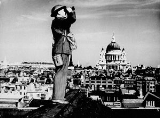
Battle of Britain

Encyclopedia
The Battle of Britain (German: Luftschlacht um England or Luftschlacht um Großbritannien, literally "Air battle for England" or "Air battle for Great Britain") is the name given to the World War II
air campaign waged by the German Air Force (Luftwaffe
) against the United Kingdom during the summer and autumn of 1940. The objective of the campaign was to gain air superiority over the Royal Air Force
(RAF), especially Fighter Command
. The name derives from a famous speech
delivered by Prime Minister Winston Churchill
in the House of Commons: "...the Battle of France
is over. I expect that the Battle of Britain is about to begin."
The Battle of Britain was the first major campaign to be fought entirely by air forces, and was also the largest and most sustained aerial bombing campaign to that date. From July 1940 coastal shipping convoys and shipping centres, such as Portsmouth
, were the main targets; one month later the Luftwaffe shifted its attacks to RAF airfields and infrastructure. As the battle progressed the Luftwaffe also targeted aircraft factories
and ground infrastructure
. Eventually the Luftwaffe resorted to attacking areas of political significance and using terror bombing tactics.
The failure of Germany
to achieve its objectives of destroying Britain's air defences, or forcing Britain to negotiate an armistice
or an outright surrender, is considered its first major defeat and one of the crucial turning points in the war. If Germany had gained air superiority over England, Adolf Hitler
might have launched Operation Sea Lion, an amphibious and airborne invasion of Britain.
while believing that the British, defeated on the continent and without European allies, would quickly come to terms. Although the Foreign Secretary
, Lord Halifax
, and an element of British public and political sentiment favoured a negotiated peace with an ascendant Germany, Winston Churchill
, newly installed as Prime Minister, and a majority of his Cabinet refused to consider an armistice with Hitler. Instead Churchill used his skilful rhetoric to harden public opinion against capitulation, and to prepare the British for a long war.
On 11 July, Grand Admiral Erich Raeder
, Commander-in-Chief of the Kriegsmarine
(German Navy), told Hitler that an invasion could only be contemplated as a last resort, and only after full air superiority had been achieved. The Kriegsmarine had been nearly crippled by the Norwegian Campaign
, with many of its ships having been sunk or damaged, while the Royal Navy
still had over 50 destroyers, 21 cruisers and eight battleships in the British Home Fleet. There was little the weakened Kriegsmarine could do to stop the Royal Navy from intervening. The only alternative was to use the Luftwaffes dive bomber
s and torpedo bomber
s, which required air superiority to operate effectively. Grand Admiral Raeder said, "A powerful and effective air force might create conditions favourable for an invasion, whether it could was not in the Navy War Staff's province."
On 16 July, although he agreed with Raeder, Hitler ordered the preparation of a plan to invade Britain; he also hoped that news of the preparations would frighten Britain into peace negotiations. "Directive No. 16; On the Preparation of a Landing Operation against England" read, in part, as follows:
All preparations were to be made by mid-August.
The plan, code named Unternehmen Seelöwe ("Operation Sealion"), was submitted by OKW (Oberkommando der Wehrmacht
or "High Command of the Armed Forces") and was scheduled to take place in mid-September 1940. Seelöwe called for landings on the south coast of Great Britain, backed by an airborne assault
. Neither Hitler nor OKW believed it would be possible to carry out a successful amphibious assault on Britain until the RAF had been neutralised. Raeder believed that air superiority might make a successful landing possible although it would be a risky operation and required "absolute mastery over the Channel by our air forces".
Conversely Grand Admiral Karl Dönitz
believed air superiority was "not enough". Dönitz stated, "we possessed neither control of the air or the sea; nor were we in any position to gain it". Some writers, such as Derek Robinson, have agreed with Dönitz. Robinson argues that the massive superiority of the Royal Navy over the Kriegsmarine would have made Sealion a disaster and the Luftwaffe could not have prevented decisive intervention by British cruisers and destroyers, even with air superiority. Williamson Murray argued the task facing the Germans in the summer, 1940 was beyond their capabilities. The three German armed services were not capable of solving the problem of invading the British Isles. Murray contends that the Kriegsmarine had been effectively eliminated owing to heavy losses during the Norwegian Campaign
. Murray states it is doubtful that the Kriegsmarine and Luftwaffe could have prevented the Royal Navy engaging the invasion fleet.
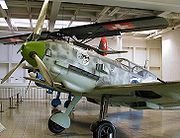
 The Luftwaffes Messerschmitt Bf 109E and Bf 110C
squared off against the RAF's workhorse Hurricane Mk I
and the less numerous Spitfire Mk I
. The Bf 109E had a better climb rate and was 10 to 30 mph faster than the Hurricane, depending on altitude. In the spring and summer of 1940, RAF fighters benefited from increased availability of 100 octane aviation fuel, which allowed their Merlin
engines to generate significantly more power through the use of an Emergency Boost Override
. In September 1940 the more powerful Mk IIa series 1 Hurricanes started entering service although only in small numbers. This version was capable of a maximum speed of 342 mph, some 25 to 30 mph faster than the Mk I.
The performance of the Spitfire over Dunkirk came as a surprise to the Jagdwaffe
, although the German pilots retained a strong belief that the 109 was the superior fighter. However, the Bf 109E had a much larger turning circle than either the Hurricane or the Spitfire. The two British fighters were equipped with eight Browning .303
(7.7mm) machine guns, and while most Bf 109Es only had two 7.9mm machine guns they were supplemented by two 20mm wing cannons. The latter was a much more effective weapon compared to the British .303s, an 8 gun complement of which was designed for an earlier era of aerial combat. Many German planes returned to base with large numbers of .303 hits which still had not resulted in the destruction of the aeroplane. The Bf 109E and the Spitfire were superior to each other in key areas; for instance, at some altitudes, the Bf 109 could out-climb the British fighter. In general, though, as Alfred Price noted in The Spitfire Story:
The Bf 109 was also used as a fighter-bomber—the E-4/B and E-7 models could carry a 250 kg bomb underneath the fuselage. The Bf 109, unlike the Stuka
, could fight on equal terms with RAF fighters after releasing its ordnance.
At the start of the battle, the twin-engined Messerschmitt Bf 110 long range Zerstörer ("Destroyer") was also expected to engage in air-to-air combat while escorting the Luftwaffe bomber fleet. Although the 110 was faster than the Hurricane and almost as fast as the Spitfire, its lack of manoeuvrability and acceleration meant that it was a failure as a long-range escort fighter. On 13 and 15 August, 13 and 30 aircraft were lost, the equivalent of an entire Gruppe, and the type's worst losses during the campaign. This trend continued with a further eight and 15 lost on 16 and 17 August. Göring ordered the Bf 110 units to operate "where the range of the single-engined machines were not sufficient".
The most successful role of the Bf 110 during the battle was as a Schnellbomber (fast bomber). The Bf 110 usually used a shallow dive to bomb the target and escaped at high speed. One unit, Erprobungsgruppe 210, proved that the Bf 110 could be used to good effect in attacking small or "pinpoint" targets.
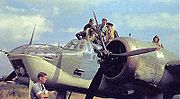
 The RAF's Boulton Paul Defiant
had some initial success over Dunkirk because of its resemblance to the Hurricane; Luftwaffe fighters attacking from the rear were surprised by its unusual gun turret. However, during the Battle of Britain, this single-engined two-seater proved hopelessly outclassed. For various reasons, the Defiant lacked any form of forward firing armament and the heavy turret meant it could not out-run or out-manoeuvre either the Bf 109 or Bf 110. By the end of August, after disastrous losses, the aircraft was withdrawn from daylight service.
at the front was free to watch for the enemy; the other pilots had to concentrate on keeping station. RAF fighter training also emphasised by-the-book attacks by sections breaking away in sequence. Fighter Command recognised the weaknesses of this rigid structure early in the battle, but it was felt too risky to change tactics during the battle, because replacement pilots—often with only minimal flying time—could not be readily retrained, and inexperienced RAF pilots needed firm leadership in the air only rigid formations could provide. German pilots dubbed the RAF formations Idiotenreihen ("rows of idiots") because they left squadrons vulnerable to attack.
By contrast the, Luftwaffe formations
employed a loose section of two (nicknamed the Rotte), based on a leader (Rottenführer) followed at a distance of about 183 meters (200 yards) by his wingman (nicknamed the Rottenhund or Katschmareks), who also flew slightly higher and was trained to always stay with his leader. While the leader was free to search for enemy aircraft, and could cover his wingman's blind spots, his wingman could concentrate on searching the airspace in the leader's blind spots, behind and below. Attacking aircraft could be sandwiched between the two 109s. The rotte allowed the Rottenführer to concentrate on getting kills although this led to some grievances in the lower ranks because it was felt that the high scores of some Rottenführer came at the expense of the Katschmareks. During the Battle of Britain, a pilot who shot down 20 aircraft was automatically awarded the Ritterkreuz (Knight's Cross
), to which was added Oak Leaves, Swords, and Diamonds for each additional 20 aircraft. Those pilots who appeared to be pursuing these awards were said to be suffering from Halsweh (a sore throat), a reference to the convention of wearing the decoration at the neck. Few wingmen in Luftwaffe fighter formations were able to shoot down opposing aircraft, while their formation leaders were scoring heavily.
Two of these sections were usually teamed up into a Schwarm
, where all the pilots could watch what was happening around them. Each Schwarm in a Staffel flew at staggered heights and with 183 meters (200 yards) of room between them, making the formation difficult to spot at longer ranges and allowing for a great deal of flexibility. By utilising a tight "cross-over" turn, a Schwarm could quickly change direction.
The Me 110 fighters adopted the same Schwarm formation as the 109s, but were seldom able to use this to the same advantage. When attacked, Zerstörergruppen increasingly resorted to forming large "defensive circles". Each Bf 110 guarded the tail of the aircraft ahead of it. Göring ordered that they be renamed "offensive circles" in a vain bid to improve rapidly declining morale. These conspicuous formations were often successful in attracting RAF fighters that were sometimes "bounced" by high-flying Bf 109s. This led to the often repeated myth that the Bf 110s were escorted by Bf 109s. The Bf 110's most successful method of attack was the "bounce" from above.
Front line RAF pilots were acutely aware of the inherent deficiencies of their own tactics. A compromise was adopted whereby squadron formations used much looser formations with one or two "weavers" flying independently above and behind to provide increased observation and rear protection; these tended to be the least experienced men and were often the first to be shot down without the other pilots even noticing that they were under attack. During the battle, 74 Squadron
under Squadron Leader Adolph "Sailor" Malan
adopted a variation of the German formation called the "fours in line astern", which was a vast improvement on the old three aircraft "vic." Malan's formation was later generally used by Fighter Command.
 The Luftwaffes four primary bombers were the Heinkel He 111
, Dornier Do 17
, and Junkers Ju 88
for level bombing, and the Junkers Ju 87
Stuka for diving attacks. The Heinkel He 111 was used in greater numbers than the others during the conflict and is better known, partly due to its distinctive wing shape. Each level bomber also had a few reconnaissance versions that were used during the battle.
Although successful in previous Luftwaffe engagements, the Stuka suffered heavy losses in the Battle of Britain, particularly on 18 August, due to its slow speed and vulnerability to fighter interception after the dive bombing. As a result of the losses and limited payload and range, Stuka units were largely removed from operations over England and concentrated on shipping instead until they were re-deployed to the Eastern Front in 1941. They returned on occasion, such as on the 13 September attack on Tangmere airfield
.
The remaining three bomber types differed in their capabilities; the Heinkel 111 was the slowest; the Ju 88 was the fastest once its mainly external bomb load was dropped; and the Do 17 had the smallest bomb load. All three bomber types suffered heavy losses from British fighters, but the Ju 88 disproportionately so. The German bombers required constant protection by the Luftwaffes fighter force. There were not enough Bf 109E
s to support more than 300–400 bombers on any given day. Later in the conflict, when night bombing became more frequent, all three were used. However, due to its reduced bomb load, the lighter Do 17 was used less than the He 111 and Ju 88 for this purpose.
On the British side, three bombers were mostly used on night operations against targets such as factories, invasion ports and railway centres; the Armstrong Whitworth Whitley
, the Handley-Page Hampden and the Vickers Wellington
were classified as heavy bombers by the RAF, although the Hampden was a medium bomber comparable to the He 111. The twin-engined Bristol Blenheim
and the obsolescent single-engined Fairey Battle
were both light bombers; the Blenheim was the most numerous of the aircraft equipping RAF Bomber Command
and was used in attacks against shipping, ports, airfields and factories on the continent by day and by night. The Fairey Battle squadrons, which had suffered heavy losses in daylight attacks during the Battle of France, were brought up to strength with reserve aircraft and continued to operate at night in attacks against the invasion ports, until the Battle was withdrawn from UK front line service in October 1940.
did retain some of their upper class exclusiveness but their number were soon swamped by the newcomers of the RAFVR and by Sept 1 1939, 6646 pilots had been trained through the RAFVR.
By summer 1940, there were about 9,000 pilots in the RAF for approximately 5,000 aircraft, most of which were bombers. Fighter Command was never short of pilots, but the problem of finding sufficient numbers of fully trained fighter pilots became acute by mid-August 1940. At all times, new pilots had "almost no chance at all" of surviving their first five sortie
s because of inexperience, because they received the most-damaged and least-reliable planes, and because they were likely to be their formations' "tail-end charlie"s and thus most vulnerable. For the survivors, the odds of survival rose during the next 15 sorties as their skill and confidence grew. After 20, however, the odds again decreased to zero.
With aircraft production running at 300 each week, only 200 pilots were trained in the same period. In addition, more pilots were allocated to squadrons than there were aircraft, as this allowed squadrons to maintain operational strength despite casualties and still provide for pilot leave. Another factor was that only about 30% of the 9,000 pilots were assigned to operational squadrons; 20% of the pilots were involved in conducting pilot training, and a further 20% were undergoing further instruction, like those offered in Canada and in Southern Rhodesia
to the Commonwealth trainees, although already qualified. The rest were assigned to staff positions, since RAF policy dictated that only pilots could make many staff and operational command decisions, even in engineering matters. At the height of fighting, and despite Churchill's insistence, only 30 pilots were released to the front line from administrative duties.The pilots occupying these administrative positions included such officers as Dowding, Park and Leigh-Mallory and the numbers actually fit to serve in front line fighter squadrons are open to question.
For these reasons, and the permanent loss of 435 pilots during Battle of France alone with many more wounded, and others lost in Norway, the RAF had fewer experienced pilots at the start of the battle, and it was the lack of trained pilots in the fighting squadrons, rather than the lack of aircraft
, that became the greatest concern for Air Chief Marshal Hugh Dowding, Commander of Fighter Command. Drawing from regular RAF forces and the Auxiliary Air Force
and the Volunteer Reserve
, the British could muster some 1,103 fighter pilots on 1 July. Replacement pilots, with little flight training and often no gunnery training, suffered high casualty rates.
The Luftwaffe could muster a larger number (1,450) of more experienced fighter pilots. Drawing from a cadre of Spanish Civil War
veterans, they had comprehensive courses in aerial gunnery and instructions in tactics suited for fighter-versus-fighter combat. Training manuals also discouraged heroism, stressing the utmost importance of attacking only when the odds were in the pilot's favour. However, German fighter formations did not provide a sufficient reserve of pilots to allow for losses and leave, and the Luftwaffe was unable to produce enough pilots to prevent a decline in operational strength as the battle progressed.
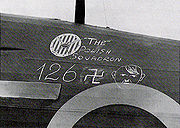
The Royal Air Force roll of honour for the Battle of Britain recognises 595 non-British pilots (out of 2,936) as flying at least one authorised operational sortie
with an eligible unit of the RAF or Fleet Air Arm
between 10 July and 31 October 1940. These included 145 Poles
, 127 New Zealand
ers, 112 Canadians
, 88 Czechoslovaks
, 32 Australians, 28 Belgians
, 25 South Africans
, 13 French, 10 Irish
, 7 Americans, and one each from Jamaica
, the British Mandate of Palestine, and Southern Rhodesia
.
) called the Italian Air Corps (Corpo Aereo Italiano or CAI) first saw action in late October 1940. It took part in the latter stages of the battle, but achieved limited success. The unit was redeployed in early 1941.
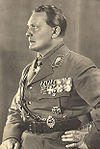
 The Luftwaffe was devised to provide tactical support for the army on the battlefield. During the blitzkrieg
offensives against Poland, Denmark and Norway
and France and the Low Countries
, the Luftwaffe had co-operated fully with the Wehrmacht. For the Battle of Britain however, the Luftwaffe had to operate in a strategic role, something for which it was unsuited. Its main task was to ensure air supremacy over southeast England, to pave the way for an invasion fleet.
The Luftwaffe regrouped after the Battle of France into three Luftflotten (Air Fleets) on Britain's southern and northern flanks. Luftflotte 2
, commanded by Generalfeldmarschall
Albert Kesselring
, was responsible for the bombing of southeast England and the London
area. Luftflotte 3
, under Generalfeldmarschall Hugo Sperrle
, targeted the West Country
, Wales
, the Midlands, and northwest England. Luftflotte 5
, led by Generaloberst Hans-Jürgen Stumpff
from his headquarters in Norway
, targeted the north of England and Scotland
. As the battle progressed, command responsibility shifted, with Luftflotte 3 taking more responsibility for the night-time Blitz
attacks while the main daylight operations fell upon Luftflotte 2's shoulders.
Initial Luftwaffe estimates were that it would take four days to defeat the RAF Fighter Command in southern England. This would be followed by a four-week offensive during which the bombers and long-range fighters would destroy all military installations throughout the country and wreck the British aircraft industry. The campaign was planned to begin with attacks on airfields near the coast, gradually moving inland to attack the ring of sector airfields defending London. Later reassessments gave the Luftwaffe five weeks, from 8 August to 15 September, to establish temporary air superiority over England. To achieve this goal, Fighter Command had to be destroyed, either on the ground or in the air, yet the Luftwaffe had to be able to preserve its own strength to be able to support the invasion; this meant that the Luftwaffe had to maintain a high "kill ratio" over the RAF fighters. The only alternative to the goal of air superiority was a terror bombing campaign aimed at the civilian population, but this was considered a last resort and it was (at this stage of the battle) expressly forbidden by Hitler.
The Luftwaffe kept broadly to this scheme, but its commanders had differences of opinion on strategy. Sperrle wanted to eradicate the air defence infrastructure by bombing it. His counterpart, Kesselring, championed attacking London directly—either to bombard the British government into submission or to draw RAF fighters into a decisive battle. Göring did nothing to resolve this disagreement between his commanders, and only vague directives were set down during the initial stages of the battle, with Göring seemingly unable to decide upon which strategy to pursue. He seemed at times obsessed with maintaining his own power base in the Luftwaffe and indulging his out-dated beliefs on air fighting, which were later to lead to tactical and strategic errors.
The Luftwaffe consistently varied its tactics in its attempts to break through the RAF defences. It launched many Freie Jagd to draw up RAF fighters. RAF fighter controllers, however, were often able to detect these and position squadrons to avoid them, keeping to Dowding's plan to preserve fighter strength for the bomber formations. The Luftwaffe also tried using small formations of bombers as bait, covering them with large numbers of escorts. This was more successful, but escort duty tied the fighters to the bombers' slow speed and made them more vulnerable.
By September, standard tactics for raids had become an amalgam of techniques. A Freie Jagd would precede the main attack formations. The bombers would fly in at altitudes between 16000 feet (4,876.8 m) and 20000 feet (6,096 m), closely escorted by fighters. Escorts were divided into two parts (usually Gruppen), some operating in close contact with the bombers, and others a few hundred yards away and a little above. If the formation was attacked from the starboard, the starboard section engaged the attackers, the top section moving to starboard and the port section to the top position. If the attack came from the port side the system was reversed. British fighters coming from the rear were engaged by the rear section and the two outside sections similarly moving to the rear. If the threat came from above, the top section went into action while the side sections gained height to be able to follow RAF fighters down as they broke away. If attacked, all sections flew in defensive circles. These tactics were skilfully evolved and carried out, and were extremely difficult to counter.
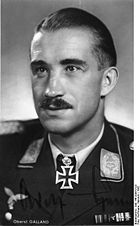 Adolf Galland
noted:
The biggest disadvantage faced by Bf 109 pilots was that without the benefit of long-range drop tank
s (which were introduced in limited numbers in the late stages of the battle), usually of 300 l (66 imp gal; 79.3 US gal) capacity, the 109s had an endurance
of just over an hour and, for the 109E, a 600 km (360 mi) range. Once over Britain, a 109 pilot had to keep an eye on a red "low fuel" light on the instrument panel: once this was illuminated, he was forced to turn back and head for France. With the prospect of two long over-water flights, and knowing their range was substantially reduced when escorting bombers or during combat, the Jagdflieger coined the term Kanalkrankheit or "Channel sickness".
about the British defences. The German intelligence services were fractured and plagued by rivalries; their performance was "amateurish". By 1940, there were few German agents operating in Great Britain and a handful of bungled attempts to insert spies into the country were foiled.
As a result of intercepted radio transmissions, the Germans began to realise that the RAF fighters were being controlled from ground facilities; in July and August 1939, for example, the airship Graf Zeppelin
, which was packed with equipment for listening in on RAF radio and RDF transmissions, flew around the coasts of Britain. Although the Luftwaffe correctly interpreted these new ground control procedures, they were incorrectly assessed as being rigid and ineffectual. A British radar
system was well known to the Luftwaffe from intelligence gathered before the war, but the highly developed "Dowding system" linked with fighter control had been a well-kept secret. Even when good information existed, such as a November 1939 Abwehr assessment of Fighter Command strengths and capabilities by Abteilung V, it was ignored if it did not match conventional preconceptions.
On 16 July 1940, Abteilung V, commanded by Oberstleutnant
"Beppo" Schmid, produced a report on the RAF and on Britain's defensive capabilities which was adopted by the frontline commanders as a basis for their operational plans. One of the most conspicuous failures of the report was the lack of information on the RAF's RDF network and control systems capabilities; it was assumed that the system was rigid and inflexible, with the RAF fighters being "tied" to their home bases. An optimistic and, as it turned out, erroneous conclusion reached was:
Because of this statement, reinforced by another more detailed report, issued on 10 August, there was a mindset in the ranks of the Luftwaffe that the RAF would run out of frontline fighters. The Luftwaffe believed it was weakening Fighter Command at three times the actual attrition rate. Many times, the leadership believed Fighter Command's strength had collapsed, only to discover that the RAF were able to send up defensive formations at will.
Throughout the battle, the Luftwaffe had to use numerous reconnaissance sorties to make up for the poor intelligence. Reconnaissance aircraft (initially mostly Dornier Do 17s, but increasingly Bf 110s) proved easy prey for British fighters, as it was seldom possible for them to be escorted by Bf 109s. Thus, the Luftwaffe operated "blind" for much of the battle, unsure of its enemy's true strengths, capabilities, and deployments. Many of the Fighter Command airfields were never attacked, while raids against supposed fighter airfields fell instead on bomber or coastal defence stations. The results of bombing and air fighting were consistently exaggerated, due to over-enthusiastic claims and the difficulty of confirmation over enemy territory. In the euphoric atmosphere of perceived victory, the Luftwaffe leadership became increasingly disconnected from reality. This lack of leadership and solid intelligence meant the Germans did not adopt consistent strategy, even when the RAF had its back to the wall. Moreover, there was never a systematic focus on one type of target (such as airbases, radar stations, or aircraft factories); consequently, the already haphazard effort was further diluted.
systems of which the British were initially not aware. One of these was Knickebein ("crooked leg"); this system was used at night and for raids where precision was required. It was rarely used during the Battle of Britain (see Reginald Victor Jones
and Battle of the Beams
).
than the RAF, specifically tasking the Seenotdienst
unit, equipped with Heinkel He 59
floatplanes, with picking up downed aircrew from the North Sea
, English Channel
and the Dover Straits. In addition, Luftwaffe aircraft were equipped with life rafts and the aircrew were provided with sachets of a chemical called fluorescein
which, on reacting with water, created a large, easy-to-see, bright green patch.
In accordance with the Geneva Convention, the He 59s were unarmed and painted white with civilian registration markings and red crosses. Nevertheless, RAF aircraft attacked these aircraft, as some were escorted by Bf 109s.
After single He 59s were forced to land on the sea by RAF fighters, on 1 and 9 July respectively, a controversial order was issued to the RAF on 13 July; this stated that as of 20 July, Seenotdienst aircraft were to be shot down. One of the reasons given by Churchill was:
The Air Ministry issuing a communiqué to the German government on 14 July:
The white He 59s were soon repainted in camouflage colours and armed with defensive machine guns. Although another four He 59s were shot down by RAF aircraft, the Seenotdienst continued to pick up downed Luftwaffe and Allied aircrew throughout the battle, earning praise from Adolf Galland for their gallantry.
Sir H.C.T. "Stuffy" Dowding, and the leader of RAF Fighter Command. Much of the air defence system had been originally set up from 1917 by Major General
E B Ashmore
. Dowding built upon and modernised many of the features of this system, including the use of two-way radio and the Royal Observer Corps (ROC). However, the core of Dowding's system was implemented by Dowding himself: the use of Radio Direction Finding (RDF, later called radar
, for radio detection and ranging) was at his behest, and its use, supplemented by information by the ROC, was crucial to the RAF's ability to efficiently intercept incoming German aircraft. He also insisted on having the radar operators linked via telephone (whose wires were laid deep underground with concrete anti-bomb protection) to an operational centre: this was Fighter Command control at Bentley Priory
. During the Battle several Coastal Command and Fleet Air Arm
units came under Fighter Command control.
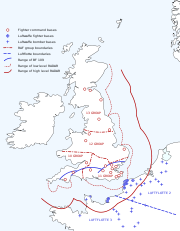 Usually the first indications of incoming air raids were received by the Chain Home
Radio Direction Finding (RDF) facilities which were located around the coastlines of Great Britain. In most circumstances, RDF could pick up formations of Luftwaffe aircraft as they organised over their own airfields. Once the raiding aircraft moved inland over England, the formations were also plotted by the Observer Corps
. The information from RDF and the Observer Corps were sent through to the main operations room of Fighter Command Headquarters at Bentley Priory
. The plots were assessed to determine whether they were "hostile" or "friendly". If hostile, the information was sent to the main "operations room", which was in a large underground bunker.
Here the course information of each raid was plotted by WAAF
s who received information by a telephone system. Additional intelligence was provided by the "Y" Service radio posts, which monitored enemy radio transmissions, and the "Ultra" decoding centre based at Bletchley Park
. Colour coded counters representing each raid were placed on a large table, which had a map of Britain overlaid and squared off with a British Modified Grid
. The colour of counter to use for a new sighting was determined by the time of the sighting, the proper colour being indicated by the minute hand of the sector clock
. As the plots of the raiding aircraft moved, the counters were pushed across the map by magnetic "rakes". This system enabled the main "Fighter Controller" (usually of squadron leader rank) and Dowding to see quickly where each formation was heading and allowed an estimate to be made of possible targets. The age of the information was readily apparent from the colour of the counter. Because of the simplicity of the system, decisions could be made quickly and easily.
Apart from the controller, most of the room and map information was operated by members of the WAAF. Before the war, there was still a great deal of doubt about the ability of women to stand up to battle conditions, with many airwomen employed on front-line RDF stations and aerodromes. Experience during the battle proved that such doubts were unfounded and the contribution of the WAAFs became essential to the RAF in its control and communications systems and in many other duties.
This information was simultaneously sent to the headquarters of each Group (for example, RAF Uxbridge
for 11 Group), where it was "filtered" through a filter room (that is, collated, cross-checked and simplified), before being sent through to another operations room, housed in the Battle of Britain Bunker
. Because Group had tactical control of the battle the operations room was different in layout from the one at Bentley Priory. The main map on the plotting table represented the Group command area and its associated airfields. Extensive radio and telephone equipment transmitted and received a constant flow of information from the various sector airfields as well as the Observer Corps, AA Command and the navy. The "Duty fighter controller" was (for example in 11 Group) Park's personal representative, whose job was to control how and when each raid would be dealt with. He ordered the squadrons airborne and positioned them as he thought best. Timing was of the essence, because "(e)ach minute of unnecessary delay waiting to make absolutely sure that the raid was coming in meant about 2,000 feet of vital altitude our fighters would not have when they met the enemy." (Wing Commander
Lord Willoughby de Broke
, Senior Fighter Controller, Uxbridge.)
Each Group room had a "tote board" which showed each squadron available to that group. The tote board had a system of lights which enabled the controllers to see the squadron status: Released (not available); Available (airborne in 20 minutes); Readiness (airborne in 5 minutes); Standby (pilots in cockpit, airborne in 2 minutes); Airborne and moving into position; Enemy sighted; Ordered to land; Landed and refuelling/rearming. Next to the tote board, where it could be clearly seen, was a weather board which showed the state of the weather around each airfield. It was the responsibility of the WAAF plotters to continually update the tote and weather boards.
A vital role was played by the telephone engineers of the GPO "who worked all hours repairing communications, installing completely new facilities in the emergency centres, and keeping the nervous system of Fighter Command functioning..." (Air Commodore Eric Roberts, Commander Middle Wallop Sector in 1940)
Despite appearances, the Groups were not mutually supporting; Park, for instance, could only request – not demand – assistance from Brand (who usually co-operated), or from Leigh-Mallory (who often prevaricated). This was because Dowding had never issued standing orders to assist, nor had he created a method to co-ordinate it.
There was a further problem in that the aircraft were not assigned equitably between Groups. While the most effective RAF fighter was the Spitfire, 70% of 11 Group aircraft were Hurricanes. "In total, less than a third of Britain's best fighters were operating in the key sector."
with a "Sector operations room", were the heart of this organisation, and they were also responsible for operating satellite aerodromes to which squadrons could be dispersed. The operations rooms duplicated those at the Group HQs, although they were on a smaller scale and most were still housed in brick, single-storey, tile-roofed structures above ground, where they were vulnerable to attack. By 1940, most were semi-protected by an earth bank or "blast wall" surrounding them which reached as high as the eaves
. Fortunately for Fighter Command, Luftwaffe Intelligence was unaware of the importance of these rooms and most were left alone. The control rooms at Biggin Hill were destroyed by a raid on 31 August, but this was due to a chance bomb hit. Their vulnerability in time of war was appreciated and new airfields built during the expansion programme of the 1930s had new, bombproof Mk II, L-shaped structures. As a further precaution, emergency control rooms were set up in different locations away from the airfields, with small loss in efficiency; RAF Kenley
, for example, could use an alternative room housed in a butcher's shop in nearby Caterham. The plotting table was laid out with a map of the sector and its airfields, and the tote and weather boards reflected this more localised information.
When ordered by their Group HQ, the sector stations would "scramble" their squadrons into the air. Once airborne, the squadrons would be directed by radio-telephone (R/T) from their sector station. Squadrons could be ordered to patrol airfields or vital targets or be "vectored" to intercept incoming raids. As well as directing the fighter squadrons, Sector stations also controlled the anti-aircraft batteries
in their area; an army officer sat beside each fighter controller and directed the gun crews when to open fire and, if RAF aircraft flew into the gun-zones, ordered the guns to cease fire.
scheme instituted by Hugh Trenchard. RDF (radar) was subject to significant errors and the Observer Corps had difficulties tracking raids at night and in bad weather. R/T (radio telephone) communications with airborne fighters were restricted because the standard radio set used by RAF fighters at the beginning of the battle was the TR9D HF
set, which operated over two selectable frequencies in the band 4.3–6.6 Megahertz (MHz); the RAF soon realised that this equipment was limited in the range at which it could receive and transmit radio signals because of its limited power. In addition, the increase in the number of civil, military and foreign HF-band radio transmitters since the adoption of the TR9 meant that the signal often suffered from distortion and interference, making clear communication with the RAF fighters difficult. It was also restricted to a single frequency per squadron, making inter-squadron communication impossible. Finally, the system for tracking RAF fighters, known as HF/DF or "Huff-Duff
", restricted sectors to a maximum of four squadrons in the air. The addition of IFF
, "Pipsqueak", while a welcome help in identifying RAF aircraft, took up another radio channel.
In late September 1940, VHF
T/R Type 1133 radios started replacing the TR9s. These had first been fitted to Spitfires of 54 and 66 Squadron
s starting in October 1939, but production delays with the improved T/R 1143 set meant the bulk of Spitfires and Hurricanes were not fitted with this equipment until October 1940. The reception was much clearer over a longer range, and controllers and pilots had a wider range of communications channels to choose from.
, who was the senior Air Staff representative in the Secret Intelligence Service, Ultra helped establish the strength and composition of the Luftwaffe's formations, the aims of the commanders and provided early warning of some raids. In early August it was decided that a small unit would be set up at Fighter Command headquarters (Stanmore), which would process the flow of information from Bletchley and provide Dowding only with the most essential Ultra material; thus the Air Ministry did not have to send a continual flow of information to Stanmore, preserving secrecy, and Dowding was not inundated with non-essential information. Keith Park and his controllers were also told about Ultra. In a further attempt to camouflage the existence of Ultra Dowding created a unit called 421 Flight. This unit (which later became 91 Squadron
), was equipped with Hurricanes and Spitfires and sent out aircraft to search for and report Luftwaffe formations approaching England. In addition the radio listening service (known as Y Service
), monitoring the patterns of Luftwaffe radio traffic, contributed considerably to the early warning of raids.
RAF aircrew were issued with a life jacket, nicknamed the "Mae West
" but in 1940 it still required manual inflation, which was almost impossible for someone who was injured or in shock. The waters of the English Channel
and Dover Straits are cold, even in the middle of summer, and clothing issued to RAF aircrew did little to insulate them against these freezing conditions. A conference in 1939 had placed air-sea rescue under Coastal Command. Because a number of pilots had been lost at sea during the "Channel Battle", on 22 August, control of RAF rescue launches was passed to the local naval authorities and 12 Lysander
s were given to Fighter Command to help look for pilots at sea. In all some 200 pilots and aircrew were lost at sea during the battle. No proper air-sea rescue service was formed until 1941.
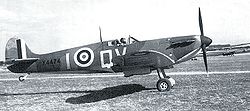 The weight of the battle fell upon 11 Group. Keith Park's tactics were to dispatch individual squadrons to intercept raids. The intention was to subject incoming bombers to continual attacks by relatively small numbers of fighters and try to break up the tight German formations. Once formations had fallen apart, stragglers could be picked off one by one. Where multiple squadrons reached a raid the procedure was for the slower Hurricanes to tackle the bombers while the more agile Spitfires held up the fighter escort. This ideal was not always achieved, resulting in occasions when Spitfires and Hurricanes reversed roles. Park also issued instructions to his units to engage in frontal attacks against the bombers, which were more vulnerable to such attacks. Again, in the environment of fast moving, three-dimensional air battles, few RAF fighter units were able to attack the bombers from head-on.
During the battle, some commanders, notably Leigh-Mallory, proposed squadrons be formed into "Big Wing
s," consisting of at least three squadrons, to attack the enemy en masse, a method pioneered by Douglas Bader
.
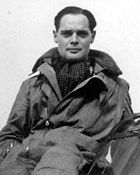 Proponents of this tactic claimed interceptions in large numbers caused greater enemy losses while reducing their own casualties. Opponents pointed out the big wings would take too long to form up, and the strategy ran a greater risk of fighters being caught on the ground refuelling. The big wing idea also caused pilots to over-claim their kills, due to the confusion of a more intense battle zone. This led to the belief big wings were far more effective than they were.
The issue caused intense friction between Park and Leigh-Mallory, as 12 Group was tasked with protecting 11 Group's airfields whilst Park's squadrons intercepted incoming raids. However, the delay in forming up Big Wings meant the formations often did not arrive at all or until after German bombers had hit 11 Group's airfields. Dowding, to highlight the problem of the Big Wing's performance, submitted a report compiled by Park to the Air Ministry on 15 November. In the report, he highlighted that during the period of 11 September – 31 October, the extensive use of the Big Wing had resulted in just 10 interceptions and one German aircraft destroyed, but his report was ignored. Post-war analysis agrees Dowding and Park's approach was best for 11 Group.
Dowding's removal from his post in November 1940 has been blamed on this struggle between Park and Leigh-Mallory's daylight strategy. However, the intensive raids and destruction wrought during the Blitz damaged both Dowding and Park in particular, for the failure to produce an effective night-fighter defence system, something for which the influential Leigh-Mallory had long criticised them.
 Bomber Command
and Coastal Command
aircraft flew offensive sorties against targets in Germany and France during the battle. After the initial disasters of the war, with Vickers Wellington
bombers shot down in large numbers attacking Wilhelmshaven
and the slaughter of the Fairey Battle
squadrons sent to France, it became clear that Bomber Command would have to operate mainly at night to achieve any results without incurring very high losses. From 15 May 1940, a night time bomber campaign was launched against the German oil industry, communications, and forests/crops, mainly in the Ruhr area
.
As the threat mounted, Bomber Command changed targeting priority on 3 June 1940 to attack the German aircraft industry. On 4 July, the Air Ministry gave Bomber Command orders to attack ports and shipping. By September, the build-up of invasion barges in the Channel ports had become a top priority target. On 7 September, the government issued a warning that the invasion could be expected within the next few days and, that night, Bomber Command attacked the Channel ports and supply dumps. On 13 September, they carried out another large raid on the Channel ports, sinking 80 large barges in the port of Ostend
. 84 barges were sunk in Dunkirk after another raid on 17 September and by 19 September, almost 200 barges had been sunk. The loss of these barges may have contributed to Hitler's decision to postpone Operation Sealion indefinitely. The success of these raids was in part because the Germans had few Freya radar
stations set up in France, so that air defences of the French harbours were not nearly as good as the air defences over Germany; Bomber Command had directed some 60% of its strength against the Channel ports.
The Bristol Blenheim
units also raided German-occupied airfields throughout July to December 1940, both during daylight hours and at night. Although most of these raids were unproductive, there were some successes; on 1 August, five out of 12 Blenheims sent to attack Haamstede
and Evere
(Brussels
) were able to bomb, destroying or heavily damaging three Bf 109s of II./JG 27 and apparently killing a Staffelkapitän
identified as a Hauptmann
Albrecht von Ankum-Frank. Two other 109s were claimed by Blenheim gunners. Another successful raid on Haamstede was made by a single Blenheim on 7 August which destroyed one 109 of 4./JG 54, heavily damaged another and caused lighter damage to four more.
There were some missions which produced an almost 100% casualty rate amongst the Blenheims; one such operation was mounted on 13 August 1940 against a Luftwaffe airfield near Aalborg
in north-eastern Denmark
by 12 aircraft of 82 Squadron
. One Blenheim returned early (the pilot was later charged and due to appear before a court martial, but was killed on another operation), the other 11, which reached Denmark, were shot down, five by flak and six by Bf 109s. Of the 33 crewmen who took part in the attack, 20 were killed and 13 captured.
As well as the bombing operations, Blenheim-equipped units had been formed to carry out long-range strategic reconnaissance missions over Germany and German-occupied territories. In this role, the Blenheims again proved to be too slow and vulnerable against Luftwaffe fighters, and they took constant casualties.
Coastal Command directed its attention towards the protection of British shipping, and the destruction of enemy shipping. As invasion became more likely, it participated in the strikes on French harbours and airfields, laying mines, and mounting numerous reconnaissance missions over the enemy-held coast. In all, some 9,180 sorties were flown by bombers from July to October 1940. Although this was much less than the 80,000 sorties flown by fighters, bomber crews suffered about half the total number of casualties borne by their fighter colleagues. The bomber contribution was, therefore, much more dangerous on a loss-per-sortie comparison.
It is a testament to the courage of the men in these bomber, reconnaissance and Coastal Command units that they continued to operate throughout these months with little respite and with little of the publicity accorded to Fighter Command. In his famous 20 August speech about "The Few
", praising Fighter Command, Churchill also made a point to mention Bomber Command's contribution, adding that bombers were even then striking back at Germany; this part of the speech is often overlooked. The Battle of Britain Chapel in Westminster Abbey
lists in a Roll of Honour 718 Bomber Command crew members, and 280 from Coastal Command who were killed between 10 July and 31 October.
 The Battle can be roughly divided into four phases:
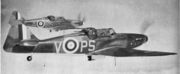 The Kanalkampf comprised a series of running fights over convoys in the English Channel and occasional attacks on the convoys by Stuka dive bomber
s. It was launched partly because Kesselring and Sperrle were not sure about what else to do, and partly because it gave German aircrews some training and a chance to probe the British defences. These battles off the coast tended to favour the Germans, whose bomber escorts massively outnumbered the convoy patrols. The need for constant patrols over the convoys put a severe strain on RAF pilots and machines. It cost fuel and engine hours and exhausted pilots. Eventually, ship losses became so great the British Admiralty
cancelled all further convoys through the Channel. However, these early combat encounters provided both sides with experience. They also gave the first indications some aircraft, such as the Defiant and Bf 110, were not up to the intense dog-fighting that would characterise the battle.
Poor weather delayed Adlertag ("Eagle Day") until 13 August 1940. On 12 August, the first attempt was made to blind the Dowding system, when aircraft from the specialist fighter-bomber unit Erprobungsgruppe 210 attacked four radar stations
. Three were briefly taken off the air but were back working within six hours. The raids appeared to show that British radars were difficult to knock out. The failure to mount follow-up attacks allowed the RAF to get the stations back on the air, and the Luftwaffe neglected strikes on the supporting infrastructure, such as phone lines and power stations, which could have rendered the radars useless, even if the towers themselves (which were very difficult to destroy) remained intact.
Adlertag opened with a series of attacks, led again by Epro 210, on coastal airfields used as forward landing grounds for the RAF fighters, as well as 'satellite airfields'"Satellite" airfields were mostly fully equipped but did not have the sector control room which allowed "Sector" airfields such as Biggin Hill to monitor and control RAF fighter formations. RAF units from Sector airfields often flew into a satellite airfield for operations during the day, returning to their home airfield in the evenings. (including Manston
and Hawkinge
). As the week drew on, the airfield attacks moved further inland, and repeated raids were made on the radar chain. 15 August was "The Greatest Day" when the Luftwaffe mounted the largest number of sorties of the campaign. Luftflotte 5 attacked the north of England. Believing Fighter Command strength to be concentrated in the south, raiding forces from Denmark
and Norway
ran into unexpectedly strong resistance. Inadequately escorted by Bf 110s, bombers were shot down in large numbers. North East England was attacked by 65 Heinkel 111s escorted by 34 Messerschmitt 110s, and RAF Great Driffield was attacked by 50 unescorted Junkers 88s. Out of 115 bombers and 35 fighters sent, 16 bombers and 7 fighters were destroyed. As a result of these casualties, Luftflotte 5 did not appear in strength again in the campaign.
18 August, which had the greatest number of casualties to both sides, has been dubbed "The Hardest Day
". Following the grinding battles of 18 August, exhaustion and the weather reduced operations for most of a week, allowing the Luftwaffe to review their performance. "The Hardest Day" had sounded the end for the Ju 87 in the campaign. This veteran of Blitzkrieg was too vulnerable to fighters to operate over Britain, and to preserve the Stuka force, Göring withdrew them from the fighting. This removed the main Luftwaffe precision-bombing weapon and shifted the burden of pinpoint attacks on the already-stretched Erpro 210. The Bf 110 proved too clumsy for dogfighting with single-engined fighters, and its participation was scaled back. It would only be used when range required it or when sufficient single-engined escort could not be provided for the bombers.
Göring made yet another fateful decision: to order more bomber escorts at the expense of free-hunting sweeps. To achieve this, the weight of the attack now fell on Luftflotte 2, and the bulk of the Bf 109s in Luftflotte 3
were transferred to Kesselring's command, reinforcing the fighter bases in the Pas-de-Calais. Stripped of its fighters, Luftflotte 3 would concentrate on the night bombing campaign. Göring, expressing disappointment with the fighter performance thus far in the campaign, also made sweeping changes in the command structure of the fighter units, replacing many Geschwaderkommodore
with younger, more aggressive pilots like Adolf Galland and Werner Mölders
.
Finally, Göring stopped the attacks on the radar chain. These were seen as unsuccessful, and neither the Reichsmarschall
nor his subordinates realised how vital the Chain Home stations were to the defence. It was known that radar provided some early warning of raids, but the belief among German fighter pilots was that anything bringing up the "Tommies
" to fight was to be encouraged.
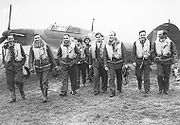 Göring ordered attacks on aircraft factories on 19 August 1940; on 23 August 1940 he ordered that RAF airfields be attacked. That evening an attack was mounted on a tyre factory in Birmingham
. Raids on airfields continued through 24 August, and Portsmouth
was hit by a major attack. That night, several areas of London were bombed; the East End
was set ablaze and bombs landed on central London. Some historians believe that these bombs were dropped accidentally by a group of Heinkel He 111
s which had failed to find their target; this account has been contested. In retaliation, the RAF bombed Berlin on the night of 25–26 August, and continued bombing raids on Berlin. Göring's pride was hurt, as he had previously claimed the British would never be able to bomb the city. The attacks enraged Hitler, who ordered retaliatory attacks on London.
From 24 August onwards, the battle was a fight between Kesselring's Luftflotte 2 and Park's 11 Group. The Luftwaffe concentrated all their strength on knocking out Fighter Command and made repeated attacks on the airfields. Of the 33 heavy attacks in the following two weeks, 24 were against airfields. The key sector stations were hit repeatedly: Biggin Hill and Hornchurch
four times each; Debden
and North Weald
twice each. Croydon
, Gravesend
, Rochford
, Hawkinge
and Manston
were also attacked in strength. Coastal Command's Eastchurch
was bombed at least seven times because it was believed to be a Fighter Command aerodrome. At times these raids caused some damage to the sector stations, threatening the integrity of the Dowding system.
To offset some losses, some 58 Fleet Air Arm fighter pilot volunteers were seconded to RAF squadrons, and a similar number of former Fairey Battle pilots were used. Most replacements from Operational Training Unit
s (OTUs) had as little as nine hours flying time and no gunnery or air-to-air combat training. At this point, the multinational nature of Fighter Command
came to the fore. Many squadrons and personnel from the air forces of the Dominions were already attached to the RAF, including top level commanders – Australians, Canadians
, New Zealanders, Rhodesia
ns and South Africans. In addition, there were other nationalities represented, including Free French
, Belgian
and a Jewish pilot from the British mandate of Palestine.
They were bolstered by the arrival of fresh Czechoslovak
and Polish squadrons
. These had been held back by Dowding, who mistakenly thought non-English speaking aircrew would have trouble working within his control system. However, Polish and Czech fliers proved to be especially effective. The pre-war Polish Air Force
had lengthy and extensive training, and high standards; with Poland conquered and under brutal German occupation, the pilots of No. 303 (Polish) Squadron
, the highest-scoring Allied unit, were strongly motivated. Josef František
, a Czech regular airman who had flown from the occupation of his own country to join the Polish
and then French air forces before arriving in Britain, flew as a guest of 303 Squadron and was ultimately credited with the highest "RAF score" in the Battle of Britain.
The RAF had the advantage of fighting over home territory. Pilots who bailed out of their downed aircraft could be back at their airfields within hours. For Luftwaffe aircrews, a bailout over England meant capture, while parachuting into the English Channel often meant drowning or death from exposure. Morale began to suffer, and Kanalkrankheit ("Channel sickness") – a form of combat fatigue
– began to appear among the German pilots. Their replacement problem was even worse than the British.
's research tells us that Dowding, in a letter to Hugh Trenchard accompanying Park's report on the period 8 August – 10 September 1940, states that the Luftwaffe "achieved very little" in the last week of August and the first week of September. The only Sector Station to be shut down operationally was Biggin Hill, and it was non-operational for just two hours. Dowding admitted 11 Group's efficiency was impaired but, despite serious damage to some airfields, only two out of 13 heavily attacked airfields were down for more than a few hours. The German refocus on London was not critical.
Retired air marshal Peter Dye, head of the RAF Museum, discussed the logistics of the battle in 2000 and 2010, dealing specifically with the single-seat fighters. Dye contends that not only was British aircraft production replacing aircraft, but replacement pilots were keeping pace with losses. The number of pilots in RAF Fighter Command increased during July, August and September. The figures indicate the number of pilots available never decreased. From July, 1 200 were available. In 1 August, 1 400 were available. Just over that number were in the field by September. In October the figure was nearly 1,600. By 1 November 1800 were available. Throughout the battle, the RAF had more fighter pilots available than the Luftwaffe. Although the RAF's reserves of single seat fighters fell during July, the wastage was made up for by an efficient Civilian Repair Organisation (CRO), which by December had repaired and put back into service some 4,955 aircraft, and by aircraft held at Air Servicing Unit (ASU) airfields.
Richard Overy
endorses Dye and Bungay. Overy asserts only one airfield was temporarily put out of action and "only" 103 pilots were lost. British fighter production produced 496 new aircraft in July and 467 in August, and another 467 in September (not counting repaired aircraft), covering the losses of August and September. Overy indicates the number of serviceable and total strength returns reveal an increase in fighters from 3 August to 7 September, 1,061 on strength and 708 serviceable to 1,161 on strength and 746 serviceable. Moreover, Overy points out that the number of RAF fighter pilots grew by one-third between June and August 1940. Personnel records show a constant supply of around 1,400 pilots in the crucial weeks of the battle. In the second half of September it reached 1,500. The shortfall of pilots was never above 10 percent. The Germans never had more than between 1,100 and 1,200 pilots, a deficiency of up to one-third. "If Fighter Command were 'the few', the German fighter pilots were fewer".
American historian James Corum
points out that it was unlikely that the Luftwaffe was ever able to destroy the RAF. If British losses became severe, the RAF could simply withdraw northward and regroup. It could then deploy when and if the Germans launched an invasion. Corum doubts that the Luftwaffe could have defeated the RAF in the limited time available before the weather window closed in October. Corum also argues that the Sea Lion would have failed because of the weaknesses of German sea power.
Older history books assert this period was the most dangerous of all. In The Narrow Margin, published in 1961, historians Derek Wood and Derek Dempster believed that the period from 24 August to 6 September represented a real danger. According to them, from 24 August to 6 September 295 fighters had been totally destroyed and 171 badly damaged, against a total output of 269 new and repaired Spitfires and Hurricanes. They assert that 103 pilots were killed or missing and 128 were wounded, which represented a total wastage of 120 pilots per week out of a fighting strength of just fewer than 1,000. They conclude that during August no more than 260 fighter pilots were turned out by OTUs and casualties in the same month were just over 300. A full squadron establishment was 26 pilots whereas the average in August was 16. In their assessment, the RAF was losing the battle.
By this point Hitler had becoming impatient with the Luftwaffe. On 14 September, General Hans Jeschonnek, Luftwaffe Chief of Staff, persuaded Hitler for a last chance to defeat the RAF and sought permission to launch attacks on civilian residential areas to cause mass panic. Hitler refused the latter, perhaps unaware of just how much damage had already been done to civilian targets, as he wanted to reserve for himself the right to unleash the terror weapon. Political will was to be broken by the collapse of the material infrastructure, the weapons industry, along with the destruction of stocks of fuel and food. On 16 September, Göring ordered the air fleets to begin the new phase of the battle.
 Hitler's No. 17 Directive, issued 1 August 1940 on the conduct of war against England specifically prohibited Luftwaffe from conducting terror raids on its own initiative, and reserved the right of ordering terror attacks as means of reprisal for the Führer himself:
The Luftwaffe offensive against Britain had included numerous raids on major ports since August, but Hitler had issued a directive London was not to be bombed save on his sole instruction. However, on the afternoon of 15 August, Hauptmann Walter Rubensdörffer leading Erprobungsgruppe 210 mistakenly bombed the Croydon airfield
(on the outskirts of London) instead of the intended target, RAF Kenley; this was followed on the night of 23/24 August by the accidental bombing of Harrow
, also on the outskirts of London, as well as raids on Aberdeen
, Bristol, and South Wales
. The focus on attacking airfields had also been accompanied by a sustained bombing campaign which begun on 24 August with the largest raid so far, killing 100 in Portsmouth
, and that evening the first night raid on London as described above. On 25 August 1940, 81 bombers of Bomber Command were sent out to raid industrial and commercial targets in Berlin. Clouds prevented accurate identification and the bombs fell across the city, causing some casualties amongst the civilian population as well as damage to residential areas. Continuing RAF raids on Berlin in retaliation led to Hitler withdrawing his directive, and on 3 September Göring planned to bomb London daily, with Kesselring's enthusiastic support, having received reports the average strength of RAF squadrons was down to five or seven fighters out of 12 and their airfields in the area were out of action. Hitler issued a directive on 5 September to attack cities including London. In his speech delivered on 4 September 1940, Hitler threatened to obliterate (ausradieren) British cities if British bombing runs against Germany did not stop.
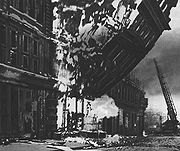 On 7 September, a massive series of raids involving nearly four hundred bombers and more than six hundred fighters targeted docks in the East End of London, day and night. The raids were codenamed Operation Loge. The RAF anticipated attacks on airfields and 11 Group rose to meet them, in greater numbers than the Luftwaffe expected. The first official deployment of 12 Group's Big Wing took twenty minutes to gain formation, missing its intended target, but encountering another formation of bombers while still climbing. They returned, apologetic about their limited success, and blamed the delay on being requested too late. Fighter Command had been at its lowest ebb, short of men and machines, and the break from airfield attacks allowed them to recover. 11 Group had considerable success in breaking up daytime raids. 12 Group repeatedly disobeyed orders and failed to meet requests to protect 11 Group airfields, but their experiments with increasingly large Big Wings had some successes. The Luftwaffe began to abandon their morning raids, with attacks on London starting late in the afternoon for 57 consecutive nights of attacks.
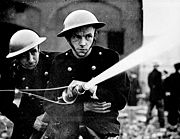 The most damaging aspect to the Luftwaffe of the change in targets (to London) was the increase in range. The Bf 109 escorts had a limited fuel capacity, and by the time they arrived had only 10 minutes of flying time before they had to turn for home. This left many raids undefended by fighter escorts.
On 14 September Hitler chaired a meeting with the OKW staff. Göring was absent in France, as he had decided to direct the decisive part of the battle from there, and left Erhard Milch
to deputise for him. At the meeting Hitler raised the question, "Should we call it off altogether?". Hitler had accepted that an invasion with massive air cover was no longer possible. Instead he opted to try to crush British morale, while maintaining the threat of invasion. Hitler concluded this might result in "eight million going mad" (referring to the population of London in 1940), which would "cause a catastrophe" for the British. In those circumstances, Hitler said, "even a small invasion might go a long way". At this point Hitler was against cancelling the invasion as "the cancellation would reach the ears of the enemy and strengthen his resolve".
On 15 September two massive waves of German attacks were decisively repulsed by the RAF, with every aircraft of 11 Group being used on that day. The total casualties on this critical day were 60 German and 26 RAF aircraft shot down. The German defeat caused Hitler to order, two days later, the postponement of preparations for the invasion of Britain. Henceforth, in the face of mounting losses in men, aircraft and the lack of adequate replacements, the Luftwaffe switched from daylight to nighttime bombing. The air battles on 15 September became known as the Battle of Britain Day
.
On 27 September, a Junkers Ju 88 returning from a raid on London was shot down in Kent
, resulting in the Battle of Graveney Marsh
, the last action between British and foreign military forces on British mainland soil.
On 13 October, Hitler again postponed the invasion "until the spring of 1941"; however, the invasion never happened, and October is regarded as the month regular bombing of Britain ended. It was not until Hitler's Directive 21 was issued, on 18 December 1940, that the threat of invasion finally dissipated.
During the battle, and for the rest of the war, an important factor in keeping public morale high was the continued presence in London of King George VI
and his wife Queen Elizabeth
. When war broke out in 1939, the King and Queen decided to stay in London and not flee to Canada, as had been suggested.This proposal has since been confused, or conflated, with a possible flight by HMG in exile. George VI and Elizabeth officially stayed in Buckingham Palace
throughout the war, although they often spent weekends at Windsor Castle
to visit their daughters, Elizabeth (the future queen
) and Margaret. Buckingham Palace was damaged by bombs which landed in the grounds on 10 September, and on 13 September, more serious damage was caused by two bombs which destroyed the Royal Chapel. The royal couple were in a small sitting room about 80 yards from where the bombs exploded. On 24 September, in recognition of the bravery of civilians, King George VI inaugurated the award of the George Cross
.
, Stephen Bungay asserts German fighter and bomber "strength" declined without recovery, and that from August – December 1940, the German fighter and bomber strength declined by 30 and 25 percent. In contrast, Williamson Murray, asserts (using translations by the Air Historical Branch) that 1,380 German bombers were on strength on 29 June 1940, 1,420 bombers on 28 September, 1,423 level bombers on 2 November and 1,393 bombers on 30 November 1940. In July – September the number of Luftwaffe pilots available fell by 136, but the number of operational pilots had shrunk by 171 by September. The training organisation of the Luftwaffe was failing to replace losses. German fighter pilots, in contrast to popular perception, were not afforded training or rest rotations unlike their British counterparts. The first week of September accounted for 25 per cent of the Fighter Command, and 24 per cent of the Luftwaffe's overall losses. Between the dates 26 August – 6 September, the Germans destroyed more aircraft than they lost on only one day (1 September). Losses were 325 German and 248 British.
Luftwaffe losses for August numbered 774 aircraft to all causes, representing 18.5 per cent of all combat aircraft at the beginning of the month. Fighter Command's losses in August were 426 fighters destroyed, amounting to 40 per cent of 1,061 fighters available on 3 August. In addition, 99 bombers and 27 other types were destroyed between 1 and 29 August.
From July to September, the Luftwaffe's loss records indicate the loss of 1,636 aircraft, 1,184 to enemy action. This represented 47 per cent of the initial strength of single-engined fighters, 66 per cent of twin-engined fighters, and 45 per cent of bombers. This indicates the Germans were running out of aircrews as well as aircraft.
Throughout the battle, the Germans
Between the 24 August and 4 September German serviceability rates, which were acceptable at Stuka units, were running at 75% with Bf 109s, 70% with bombers and 65% with Bf 110s, indicating a shortage of spare parts. All units were well below established strength. The attrition was beginning to affect the fighters in particular." By 14 September the Luftwaffe's Bf 109 Geschwader possessed only 67 percent of their operational crews against authorised aircraft. For Bf 110 units it was 46 per cent; and for bombers it was 59 per cent. A week later the figures had dropped to 64 per cent, 52 per cent, and 52 per cent. Serviceability rates in Fighter Command's fighter squadrons, between the 24 August and 7 September, were listed as: 64.8% on the 24 August; 64.7% on 31 August and 64.25% on the 7 September 1940, indicating a slow decline.
Due to the failure of the Luftwaffe to establish air supremacy, a conference assembled on 14 September at Hitler's headquarters. Hitler concluded that air superiority had not yet been established and "promised to review the situation on 17 September for possible landings on 27 September or 8 October. Three days later, when the evidence was clear that the German Air Force had greatly exaggerated the extent of their successes against the RAF, Hitler postponed Sealion indefinitely."
, and British public opinion was invigorated by having come through the ordeal. For the British, Fighter Command had achieved a great victory in successfully carrying out Sir Thomas Inskip's
1937 air policy of preventing the Germans from knocking Britain out of the war. The Fighter Command was so successful that the conclusion to Churchill's famous 'Battle of Britain' speech made in the House of Commons on 18 June, has come to refer solely to them: "...if the British Empire and its Commonwealth lasts for a thousand years, men will still say, 'This was their finest hour.'"
The Battle also signalled a significant shift in US opinion. During the battle, many people from the U.S. accepted the view promoted by Joseph Kennedy, the U.S. ambassador in London, and believed that Great Britain could not survive. However, Roosevelt wanted a second opinion, and sent "Wild Bill" Donovan
on a brief visit to Britain; he became convinced Britain would survive and should be supported in every possible way.
Both sides in the battle made exaggerated claims of numbers of enemy aircraft shot down. In general, claims were two to three times the actual numbers, because of the confusion of fighting in dynamic three-dimensional air battles. Postwar analysis of records has shown that between July and September, the RAF claimed 2,698 kills, while the Luftwaffe fighters claimed 3,198 RAF aircraft downed. Total losses, and start and end dates for recorded losses, vary for both sides. Luftwaffe losses from 10 July to 30 October 1940 total 1,652 aircraft, including 229 twin- and 533 single-engined fighters. In the same period, RAF Fighter Command aircraft losses number 1,087, including 53 twin-engined fighters. To the RAF figure should be added 376 Bomber Command and 148 Coastal Command aircraft conducting bombing, mining, and reconnaissance operations in defence of the country.
Dr. Andrew Gordon, who lectures at the Joint Services Command and Staff College, and a former lecturer Professor Gary Sheffield
, have suggested the existence of the Royal Navy was enough to prevent the Germans from invading; even had the Luftwaffe won the air battle, the Germans had limited means with which to combat the Royal Navy, which would have intervened to prevent a landing. Some veterans of the battle point out the Royal Navy would have been vulnerable to air attack by the Luftwaffe if Germany had achieved air superiority, citing the sinking of Prince of Wales and Repulse
in December 1941 by an attack by Japanese aircraft. In late May 1941 during the successful German airborne assault which seized Crete, the Royal Navy was able to prevent attempted German seaborne landings on the coast of Crete, but they lost six ships in three days due to undisputed Luftwaffe air supremacy and the British were forced to evacuate the island. Churchill later wrote that the Royal Navy's defeat of "these practically defenceless convoys of troops across waters of which they did not possess the naval command as well as that of the air is a sample of what might have happened on a gigantic scale in the North Sea and English Channel in September, 1940."
Though the claims about the Royal Navy's ability to repel an invasion may be contested, there is a consensus among historians the Luftwaffe simply could not crush the RAF. Stephen Bungay
described Dowding and Park's strategy of choosing when to engage the enemy whilst maintaining a coherent force as vindicated. The RAF proved to be a robust and capable organisation which was to use all the modern resources available to it to the maximum advantage. Richard Evans wrote:
A considered view of the battle also has to take into account the vital role of the Royal Navy. It was widely acknowledged by both sides that the only way of achieving a successful invasion of the British Isles was through the establishment of naval supremacy. Given the inability of the Luftwaffe to effect real damage on the RN throughout the Battle and during the Dunkirk and Norwegian campaigns, as well as the lack of surface assets in the Kreigsmarine's inventory, sea control of the Channel by Germany was impossible. As one of 'the Few', Wg Cdr H R Allen said, "It was sea power that ruled the day in 1940, and fortunately Britain had a sufficiency. The air situation was, of course, important, but by no means fundamental. Without doubt the five hundred of so section, flight and squadron commanders in Fighter Command earned their laurels. But the real victor was the Royal Navy, the Silent Service."
The Luftwaffe had 1,380 bombers on 29 June 1940. By 2 November 1940 this had increased to 1,423, and to 1,511 by 21 June 1941, prior to Operation Barbarossa
, but showing a drop of 200 from 1,711 reported on 11 May 1940. 1,107 single- and 357 twin-engined daylight fighters were reported on strength prior to the Battle on 29 June 1940, compared to 1,440 single- and 188 twin-engined fighters, plus 263 night fighter
s, on 21 June 1941.
The Germans launched some spectacular attacks against important British industries, but they could not destroy the British industrial potential, and made little systematic effort to do so. Hindsight does not disguise the fact the threat to Fighter Command was very real, and for the participants it seemed as if there was a narrow margin between victory and defeat. Nevertheless, even if the German attacks on the 11 Group airfields which guarded southeast England and the approaches to London had continued, the RAF could have withdrawn to the Midlands out of German fighter range and continued the battle from there. The victory was as much psychological as physical. Writes Alfred Price:
The British victory in the Battle of Britain was achieved at a heavy cost. Total British civilian losses from July to December 1940 were 23,002 dead and 32,138 wounded, with one of the largest single raids on 19 December 1940, in which almost 3,000 civilians died.
The brilliant leadership of Dowding and Keith Park in successfully proving their theories of air defence, however, had created enmity among RAF senior commanders and both were sacked from their posts in the immediate aftermath of the battle.
The end of the battle allowed Britain to rebuild its military forces and establish itself as an Allied stronghold. Britain later served as a base from which the Liberation of Western Europe
was launched.
summed up the effect of the battle and the contribution of Fighter Command with the words, "Never in the field of human conflict was so much owed by so many to so few
". Pilots who fought in the Battle have been known as The Few
ever since. Battle of Britain Day is commemorated in the United Kingdom on 15 September. Within the Commonwealth
, Battle of Britain Day is usually observed on the third Sunday in September. In some areas in the British Channel Islands
, it is celebrated on the second Thursday in September.
, which drew many respected British actors to act key figures of the battle, including Sir Laurence Olivier
as Hugh Dowding and Trevor Howard
as Keith Park
. It also starred Michael Caine
, Christopher Plummer
and Robert Shaw
as Squadron Leaders. Former participants of the battle served as technical advisors including Douglas Bader
, James Lacey, Robert Stanford Tuck
, Adolf Galland and Dowding himself. An Italian film around the same time titled Eagles Over London
(1969) also featured the Battle of Britain.
It was also the subject of the 1941 Allied propaganda film
Churchill's Island
, winner of the first-ever Academy Award for Documentary Short Subject
.
In 2010, actor Julian Glover
played a 101-year-old Polish veteran RAF pilot in the short film, Battle for Britain.
The Battle of Britain (German: Luftschlacht um England or Luftschlacht um Großbritannien, literally "Air battle for England" or "Air battle for Great Britain") is the name given to the World War II
air campaign waged by the German Air Force (Luftwaffe
) against the United Kingdom during the summer and autumn of 1940. The objective of the campaign was to gain air superiority over the Royal Air Force
(RAF), especially Fighter Command
. The name derives from a famous speech
delivered by Prime Minister Winston Churchill
in the House of Commons: "...the Battle of France
is over. I expect that the Battle of Britain is about to begin."
The Battle of Britain was the first major campaign to be fought entirely by air forces, and was also the largest and most sustained aerial bombing campaign to that date. From July 1940 coastal shipping convoys and shipping centres, such as Portsmouth
, were the main targets; one month later the Luftwaffe shifted its attacks to RAF airfields and infrastructure. As the battle progressed the Luftwaffe also targeted aircraft factories
and ground infrastructure
. Eventually the Luftwaffe resorted to attacking areas of political significance and using terror bombing tactics.
The failure of Germany
to achieve its objectives of destroying Britain's air defences, or forcing Britain to negotiate an armistice
or an outright surrender, is considered its first major defeat and one of the crucial turning points in the war. If Germany had gained air superiority over England, Adolf Hitler
might have launched Operation Sea Lion, an amphibious and airborne invasion of Britain.
while believing that the British, defeated on the continent and without European allies, would quickly come to terms. Although the Foreign Secretary
, Lord Halifax
, and an element of British public and political sentiment favoured a negotiated peace with an ascendant Germany, Winston Churchill
, newly installed as Prime Minister, and a majority of his Cabinet refused to consider an armistice with Hitler. Instead Churchill used his skilful rhetoric to harden public opinion against capitulation, and to prepare the British for a long war.
On 11 July, Grand Admiral Erich Raeder
, Commander-in-Chief of the Kriegsmarine
(German Navy), told Hitler that an invasion could only be contemplated as a last resort, and only after full air superiority had been achieved. The Kriegsmarine had been nearly crippled by the Norwegian Campaign
, with many of its ships having been sunk or damaged, while the Royal Navy
still had over 50 destroyers, 21 cruisers and eight battleships in the British Home Fleet. There was little the weakened Kriegsmarine could do to stop the Royal Navy from intervening. The only alternative was to use the Luftwaffes dive bomber
s and torpedo bomber
s, which required air superiority to operate effectively. Grand Admiral Raeder said, "A powerful and effective air force might create conditions favourable for an invasion, whether it could was not in the Navy War Staff's province."
On 16 July, although he agreed with Raeder, Hitler ordered the preparation of a plan to invade Britain; he also hoped that news of the preparations would frighten Britain into peace negotiations. "Directive No. 16; On the Preparation of a Landing Operation against England" read, in part, as follows:
All preparations were to be made by mid-August.
The plan, code named Unternehmen Seelöwe ("Operation Sealion"), was submitted by OKW (Oberkommando der Wehrmacht
or "High Command of the Armed Forces") and was scheduled to take place in mid-September 1940. Seelöwe called for landings on the south coast of Great Britain, backed by an airborne assault
. Neither Hitler nor OKW believed it would be possible to carry out a successful amphibious assault on Britain until the RAF had been neutralised. Raeder believed that air superiority might make a successful landing possible although it would be a risky operation and required "absolute mastery over the Channel by our air forces".
Conversely Grand Admiral Karl Dönitz
believed air superiority was "not enough". Dönitz stated, "we possessed neither control of the air or the sea; nor were we in any position to gain it". Some writers, such as Derek Robinson, have agreed with Dönitz. Robinson argues that the massive superiority of the Royal Navy over the Kriegsmarine would have made Sealion a disaster and the Luftwaffe could not have prevented decisive intervention by British cruisers and destroyers, even with air superiority. Williamson Murray argued the task facing the Germans in the summer, 1940 was beyond their capabilities. The three German armed services were not capable of solving the problem of invading the British Isles. Murray contends that the Kriegsmarine had been effectively eliminated owing to heavy losses during the Norwegian Campaign
. Murray states it is doubtful that the Kriegsmarine and Luftwaffe could have prevented the Royal Navy engaging the invasion fleet.
The Luftwaffes Messerschmitt Bf 109E and Bf 110C
squared off against the RAF's workhorse Hurricane Mk I
and the less numerous Spitfire Mk I
. The Bf 109E had a better climb rate and was 10 to 30 mph faster than the Hurricane, depending on altitude. In the spring and summer of 1940, RAF fighters benefited from increased availability of 100 octane aviation fuel, which allowed their Merlin
engines to generate significantly more power through the use of an Emergency Boost Override
. In September 1940 the more powerful Mk IIa series 1 Hurricanes started entering service although only in small numbers. This version was capable of a maximum speed of 342 mph, some 25 to 30 mph faster than the Mk I.
The performance of the Spitfire over Dunkirk came as a surprise to the Jagdwaffe
, although the German pilots retained a strong belief that the 109 was the superior fighter. However, the Bf 109E had a much larger turning circle than either the Hurricane or the Spitfire. The two British fighters were equipped with eight Browning .303
(7.7mm) machine guns, and while most Bf 109Es only had two 7.9mm machine guns they were supplemented by two 20mm wing cannons. The latter was a much more effective weapon compared to the British .303s, an 8 gun complement of which was designed for an earlier era of aerial combat. Many German planes returned to base with large numbers of .303 hits which still had not resulted in the destruction of the aeroplane. The Bf 109E and the Spitfire were superior to each other in key areas; for instance, at some altitudes, the Bf 109 could out-climb the British fighter. In general, though, as Alfred Price noted in The Spitfire Story:
The Bf 109 was also used as a fighter-bomber—the E-4/B and E-7 models could carry a 250 kg bomb underneath the fuselage. The Bf 109, unlike the Stuka
, could fight on equal terms with RAF fighters after releasing its ordnance.
At the start of the battle, the twin-engined Messerschmitt Bf 110 long range Zerstörer ("Destroyer") was also expected to engage in air-to-air combat while escorting the Luftwaffe bomber fleet. Although the 110 was faster than the Hurricane and almost as fast as the Spitfire, its lack of manoeuvrability and acceleration meant that it was a failure as a long-range escort fighter. On 13 and 15 August, 13 and 30 aircraft were lost, the equivalent of an entire Gruppe, and the type's worst losses during the campaign. This trend continued with a further eight and 15 lost on 16 and 17 August. Göring ordered the Bf 110 units to operate "where the range of the single-engined machines were not sufficient".
The most successful role of the Bf 110 during the battle was as a Schnellbomber (fast bomber). The Bf 110 usually used a shallow dive to bomb the target and escaped at high speed. One unit, Erprobungsgruppe 210, proved that the Bf 110 could be used to good effect in attacking small or "pinpoint" targets.
The RAF's Boulton Paul Defiant
had some initial success over Dunkirk because of its resemblance to the Hurricane; Luftwaffe fighters attacking from the rear were surprised by its unusual gun turret. However, during the Battle of Britain, this single-engined two-seater proved hopelessly outclassed. For various reasons, the Defiant lacked any form of forward firing armament and the heavy turret meant it could not out-run or out-manoeuvre either the Bf 109 or Bf 110. By the end of August, after disastrous losses, the aircraft was withdrawn from daylight service.
at the front was free to watch for the enemy; the other pilots had to concentrate on keeping station. RAF fighter training also emphasised by-the-book attacks by sections breaking away in sequence. Fighter Command recognised the weaknesses of this rigid structure early in the battle, but it was felt too risky to change tactics during the battle, because replacement pilots—often with only minimal flying time—could not be readily retrained, and inexperienced RAF pilots needed firm leadership in the air only rigid formations could provide. German pilots dubbed the RAF formations Idiotenreihen ("rows of idiots") because they left squadrons vulnerable to attack.
By contrast the, Luftwaffe formations
employed a loose section of two (nicknamed the Rotte), based on a leader (Rottenführer) followed at a distance of about 183 meters (200 yards) by his wingman (nicknamed the Rottenhund or Katschmareks), who also flew slightly higher and was trained to always stay with his leader. While the leader was free to search for enemy aircraft, and could cover his wingman's blind spots, his wingman could concentrate on searching the airspace in the leader's blind spots, behind and below. Attacking aircraft could be sandwiched between the two 109s. The rotte allowed the Rottenführer to concentrate on getting kills although this led to some grievances in the lower ranks because it was felt that the high scores of some Rottenführer came at the expense of the Katschmareks. During the Battle of Britain, a pilot who shot down 20 aircraft was automatically awarded the Ritterkreuz (Knight's Cross
), to which was added Oak Leaves, Swords, and Diamonds for each additional 20 aircraft. Those pilots who appeared to be pursuing these awards were said to be suffering from Halsweh (a sore throat), a reference to the convention of wearing the decoration at the neck. Few wingmen in Luftwaffe fighter formations were able to shoot down opposing aircraft, while their formation leaders were scoring heavily.
Two of these sections were usually teamed up into a Schwarm
, where all the pilots could watch what was happening around them. Each Schwarm in a Staffel flew at staggered heights and with 183 meters (200 yards) of room between them, making the formation difficult to spot at longer ranges and allowing for a great deal of flexibility. By utilising a tight "cross-over" turn, a Schwarm could quickly change direction.
The Me 110 fighters adopted the same Schwarm formation as the 109s, but were seldom able to use this to the same advantage. When attacked, Zerstörergruppen increasingly resorted to forming large "defensive circles". Each Bf 110 guarded the tail of the aircraft ahead of it. Göring ordered that they be renamed "offensive circles" in a vain bid to improve rapidly declining morale. These conspicuous formations were often successful in attracting RAF fighters that were sometimes "bounced" by high-flying Bf 109s. This led to the often repeated myth that the Bf 110s were escorted by Bf 109s. The Bf 110's most successful method of attack was the "bounce" from above.
Front line RAF pilots were acutely aware of the inherent deficiencies of their own tactics. A compromise was adopted whereby squadron formations used much looser formations with one or two "weavers" flying independently above and behind to provide increased observation and rear protection; these tended to be the least experienced men and were often the first to be shot down without the other pilots even noticing that they were under attack. During the battle, 74 Squadron
under Squadron Leader Adolph "Sailor" Malan
adopted a variation of the German formation called the "fours in line astern", which was a vast improvement on the old three aircraft "vic." Malan's formation was later generally used by Fighter Command.
The Luftwaffes four primary bombers were the Heinkel He 111
, Dornier Do 17
, and Junkers Ju 88
for level bombing, and the Junkers Ju 87
Stuka for diving attacks. The Heinkel He 111 was used in greater numbers than the others during the conflict and is better known, partly due to its distinctive wing shape. Each level bomber also had a few reconnaissance versions that were used during the battle.
Although successful in previous Luftwaffe engagements, the Stuka suffered heavy losses in the Battle of Britain, particularly on 18 August, due to its slow speed and vulnerability to fighter interception after the dive bombing. As a result of the losses and limited payload and range, Stuka units were largely removed from operations over England and concentrated on shipping instead until they were re-deployed to the Eastern Front in 1941. They returned on occasion, such as on the 13 September attack on Tangmere airfield
.
The remaining three bomber types differed in their capabilities; the Heinkel 111 was the slowest; the Ju 88 was the fastest once its mainly external bomb load was dropped; and the Do 17 had the smallest bomb load. All three bomber types suffered heavy losses from British fighters, but the Ju 88 disproportionately so. The German bombers required constant protection by the Luftwaffes fighter force. There were not enough Bf 109E
s to support more than 300–400 bombers on any given day. Later in the conflict, when night bombing became more frequent, all three were used. However, due to its reduced bomb load, the lighter Do 17 was used less than the He 111 and Ju 88 for this purpose.
On the British side, three bombers were mostly used on night operations against targets such as factories, invasion ports and railway centres; the Armstrong Whitworth Whitley
, the Handley-Page Hampden and the Vickers Wellington
were classified as heavy bombers by the RAF, although the Hampden was a medium bomber comparable to the He 111. The twin-engined Bristol Blenheim
and the obsolescent single-engined Fairey Battle
were both light bombers; the Blenheim was the most numerous of the aircraft equipping RAF Bomber Command
and was used in attacks against shipping, ports, airfields and factories on the continent by day and by night. The Fairey Battle squadrons, which had suffered heavy losses in daylight attacks during the Battle of France, were brought up to strength with reserve aircraft and continued to operate at night in attacks against the invasion ports, until the Battle was withdrawn from UK front line service in October 1940.
did retain some of their upper class exclusiveness but their number were soon swamped by the newcomers of the RAFVR and by Sept 1 1939, 6646 pilots had been trained through the RAFVR.
By summer 1940, there were about 9,000 pilots in the RAF for approximately 5,000 aircraft, most of which were bombers. Fighter Command was never short of pilots, but the problem of finding sufficient numbers of fully trained fighter pilots became acute by mid-August 1940. At all times, new pilots had "almost no chance at all" of surviving their first five sortie
s because of inexperience, because they received the most-damaged and least-reliable planes, and because they were likely to be their formations' "tail-end charlie"s and thus most vulnerable. For the survivors, the odds of survival rose during the next 15 sorties as their skill and confidence grew. After 20, however, the odds again decreased to zero.
With aircraft production running at 300 each week, only 200 pilots were trained in the same period. In addition, more pilots were allocated to squadrons than there were aircraft, as this allowed squadrons to maintain operational strength despite casualties and still provide for pilot leave. Another factor was that only about 30% of the 9,000 pilots were assigned to operational squadrons; 20% of the pilots were involved in conducting pilot training, and a further 20% were undergoing further instruction, like those offered in Canada and in Southern Rhodesia
to the Commonwealth trainees, although already qualified. The rest were assigned to staff positions, since RAF policy dictated that only pilots could make many staff and operational command decisions, even in engineering matters. At the height of fighting, and despite Churchill's insistence, only 30 pilots were released to the front line from administrative duties.The pilots occupying these administrative positions included such officers as Dowding, Park and Leigh-Mallory and the numbers actually fit to serve in front line fighter squadrons are open to question.
For these reasons, and the permanent loss of 435 pilots during Battle of France alone with many more wounded, and others lost in Norway, the RAF had fewer experienced pilots at the start of the battle, and it was the lack of trained pilots in the fighting squadrons, rather than the lack of aircraft
, that became the greatest concern for Air Chief Marshal Hugh Dowding, Commander of Fighter Command. Drawing from regular RAF forces and the Auxiliary Air Force
and the Volunteer Reserve
, the British could muster some 1,103 fighter pilots on 1 July. Replacement pilots, with little flight training and often no gunnery training, suffered high casualty rates.
The Luftwaffe could muster a larger number (1,450) of more experienced fighter pilots. Drawing from a cadre of Spanish Civil War
veterans, they had comprehensive courses in aerial gunnery and instructions in tactics suited for fighter-versus-fighter combat. Training manuals also discouraged heroism, stressing the utmost importance of attacking only when the odds were in the pilot's favour. However, German fighter formations did not provide a sufficient reserve of pilots to allow for losses and leave, and the Luftwaffe was unable to produce enough pilots to prevent a decline in operational strength as the battle progressed.
The Royal Air Force roll of honour for the Battle of Britain recognises 595 non-British pilots (out of 2,936) as flying at least one authorised operational sortie
with an eligible unit of the RAF or Fleet Air Arm
between 10 July and 31 October 1940. These included 145 Poles
, 127 New Zealand
ers, 112 Canadians
, 88 Czechoslovaks
, 32 Australians, 28 Belgians
, 25 South Africans
, 13 French, 10 Irish
, 7 Americans, and one each from Jamaica
, the British Mandate of Palestine, and Southern Rhodesia
.
) called the Italian Air Corps (Corpo Aereo Italiano or CAI) first saw action in late October 1940. It took part in the latter stages of the battle, but achieved limited success. The unit was redeployed in early 1941.
The Luftwaffe was devised to provide tactical support for the army on the battlefield. During the blitzkrieg
offensives against Poland, Denmark and Norway
and France and the Low Countries
, the Luftwaffe had co-operated fully with the Wehrmacht. For the Battle of Britain however, the Luftwaffe had to operate in a strategic role, something for which it was unsuited. Its main task was to ensure air supremacy over southeast England, to pave the way for an invasion fleet.
The Luftwaffe regrouped after the Battle of France into three Luftflotten (Air Fleets) on Britain's southern and northern flanks. Luftflotte 2
, commanded by Generalfeldmarschall
Albert Kesselring
, was responsible for the bombing of southeast England and the London
area. Luftflotte 3
, under Generalfeldmarschall Hugo Sperrle
, targeted the West Country
, Wales
, the Midlands, and northwest England. Luftflotte 5
, led by Generaloberst Hans-Jürgen Stumpff
from his headquarters in Norway
, targeted the north of England and Scotland
. As the battle progressed, command responsibility shifted, with Luftflotte 3 taking more responsibility for the night-time Blitz
attacks while the main daylight operations fell upon Luftflotte 2's shoulders.
Initial Luftwaffe estimates were that it would take four days to defeat the RAF Fighter Command in southern England. This would be followed by a four-week offensive during which the bombers and long-range fighters would destroy all military installations throughout the country and wreck the British aircraft industry. The campaign was planned to begin with attacks on airfields near the coast, gradually moving inland to attack the ring of sector airfields defending London. Later reassessments gave the Luftwaffe five weeks, from 8 August to 15 September, to establish temporary air superiority over England. To achieve this goal, Fighter Command had to be destroyed, either on the ground or in the air, yet the Luftwaffe had to be able to preserve its own strength to be able to support the invasion; this meant that the Luftwaffe had to maintain a high "kill ratio" over the RAF fighters. The only alternative to the goal of air superiority was a terror bombing campaign aimed at the civilian population, but this was considered a last resort and it was (at this stage of the battle) expressly forbidden by Hitler.
The Luftwaffe kept broadly to this scheme, but its commanders had differences of opinion on strategy. Sperrle wanted to eradicate the air defence infrastructure by bombing it. His counterpart, Kesselring, championed attacking London directly—either to bombard the British government into submission or to draw RAF fighters into a decisive battle. Göring did nothing to resolve this disagreement between his commanders, and only vague directives were set down during the initial stages of the battle, with Göring seemingly unable to decide upon which strategy to pursue. He seemed at times obsessed with maintaining his own power base in the Luftwaffe and indulging his out-dated beliefs on air fighting, which were later to lead to tactical and strategic errors.
The Luftwaffe consistently varied its tactics in its attempts to break through the RAF defences. It launched many Freie Jagd to draw up RAF fighters. RAF fighter controllers, however, were often able to detect these and position squadrons to avoid them, keeping to Dowding's plan to preserve fighter strength for the bomber formations. The Luftwaffe also tried using small formations of bombers as bait, covering them with large numbers of escorts. This was more successful, but escort duty tied the fighters to the bombers' slow speed and made them more vulnerable.
By September, standard tactics for raids had become an amalgam of techniques. A Freie Jagd would precede the main attack formations. The bombers would fly in at altitudes between 16000 feet (4,876.8 m) and 20000 feet (6,096 m), closely escorted by fighters. Escorts were divided into two parts (usually Gruppen), some operating in close contact with the bombers, and others a few hundred yards away and a little above. If the formation was attacked from the starboard, the starboard section engaged the attackers, the top section moving to starboard and the port section to the top position. If the attack came from the port side the system was reversed. British fighters coming from the rear were engaged by the rear section and the two outside sections similarly moving to the rear. If the threat came from above, the top section went into action while the side sections gained height to be able to follow RAF fighters down as they broke away. If attacked, all sections flew in defensive circles. These tactics were skilfully evolved and carried out, and were extremely difficult to counter.
Adolf Galland
noted:
The biggest disadvantage faced by Bf 109 pilots was that without the benefit of long-range drop tank
s (which were introduced in limited numbers in the late stages of the battle), usually of 300 l (66 imp gal; 79.3 US gal) capacity, the 109s had an endurance
of just over an hour and, for the 109E, a 600 km (360 mi) range. Once over Britain, a 109 pilot had to keep an eye on a red "low fuel" light on the instrument panel: once this was illuminated, he was forced to turn back and head for France. With the prospect of two long over-water flights, and knowing their range was substantially reduced when escorting bombers or during combat, the Jagdflieger coined the term Kanalkrankheit or "Channel sickness".
about the British defences. The German intelligence services were fractured and plagued by rivalries; their performance was "amateurish". By 1940, there were few German agents operating in Great Britain and a handful of bungled attempts to insert spies into the country were foiled.
As a result of intercepted radio transmissions, the Germans began to realise that the RAF fighters were being controlled from ground facilities; in July and August 1939, for example, the airship Graf Zeppelin
, which was packed with equipment for listening in on RAF radio and RDF transmissions, flew around the coasts of Britain. Although the Luftwaffe correctly interpreted these new ground control procedures, they were incorrectly assessed as being rigid and ineffectual. A British radar
system was well known to the Luftwaffe from intelligence gathered before the war, but the highly developed "Dowding system" linked with fighter control had been a well-kept secret. Even when good information existed, such as a November 1939 Abwehr assessment of Fighter Command strengths and capabilities by Abteilung V, it was ignored if it did not match conventional preconceptions.
On 16 July 1940, Abteilung V, commanded by Oberstleutnant
"Beppo" Schmid, produced a report on the RAF and on Britain's defensive capabilities which was adopted by the frontline commanders as a basis for their operational plans. One of the most conspicuous failures of the report was the lack of information on the RAF's RDF network and control systems capabilities; it was assumed that the system was rigid and inflexible, with the RAF fighters being "tied" to their home bases. An optimistic and, as it turned out, erroneous conclusion reached was:
Because of this statement, reinforced by another more detailed report, issued on 10 August, there was a mindset in the ranks of the Luftwaffe that the RAF would run out of frontline fighters. The Luftwaffe believed it was weakening Fighter Command at three times the actual attrition rate. Many times, the leadership believed Fighter Command's strength had collapsed, only to discover that the RAF were able to send up defensive formations at will.
Throughout the battle, the Luftwaffe had to use numerous reconnaissance sorties to make up for the poor intelligence. Reconnaissance aircraft (initially mostly Dornier Do 17s, but increasingly Bf 110s) proved easy prey for British fighters, as it was seldom possible for them to be escorted by Bf 109s. Thus, the Luftwaffe operated "blind" for much of the battle, unsure of its enemy's true strengths, capabilities, and deployments. Many of the Fighter Command airfields were never attacked, while raids against supposed fighter airfields fell instead on bomber or coastal defence stations. The results of bombing and air fighting were consistently exaggerated, due to over-enthusiastic claims and the difficulty of confirmation over enemy territory. In the euphoric atmosphere of perceived victory, the Luftwaffe leadership became increasingly disconnected from reality. This lack of leadership and solid intelligence meant the Germans did not adopt consistent strategy, even when the RAF had its back to the wall. Moreover, there was never a systematic focus on one type of target (such as airbases, radar stations, or aircraft factories); consequently, the already haphazard effort was further diluted.
systems of which the British were initially not aware. One of these was Knickebein ("crooked leg"); this system was used at night and for raids where precision was required. It was rarely used during the Battle of Britain (see Reginald Victor Jones
and Battle of the Beams
).
than the RAF, specifically tasking the Seenotdienst
unit, equipped with Heinkel He 59
floatplanes, with picking up downed aircrew from the North Sea
, English Channel
and the Dover Straits. In addition, Luftwaffe aircraft were equipped with life rafts and the aircrew were provided with sachets of a chemical called fluorescein
which, on reacting with water, created a large, easy-to-see, bright green patch.
In accordance with the Geneva Convention, the He 59s were unarmed and painted white with civilian registration markings and red crosses. Nevertheless, RAF aircraft attacked these aircraft, as some were escorted by Bf 109s.
After single He 59s were forced to land on the sea by RAF fighters, on 1 and 9 July respectively, a controversial order was issued to the RAF on 13 July; this stated that as of 20 July, Seenotdienst aircraft were to be shot down. One of the reasons given by Churchill was:
The Air Ministry issuing a communiqué to the German government on 14 July:
The white He 59s were soon repainted in camouflage colours and armed with defensive machine guns. Although another four He 59s were shot down by RAF aircraft, the Seenotdienst continued to pick up downed Luftwaffe and Allied aircrew throughout the battle, earning praise from Adolf Galland for their gallantry.
Sir H.C.T. "Stuffy" Dowding, and the leader of RAF Fighter Command. Much of the air defence system had been originally set up from 1917 by Major General
E B Ashmore
. Dowding built upon and modernised many of the features of this system, including the use of two-way radio and the Royal Observer Corps (ROC). However, the core of Dowding's system was implemented by Dowding himself: the use of Radio Direction Finding (RDF, later called radar
, for radio detection and ranging) was at his behest, and its use, supplemented by information by the ROC, was crucial to the RAF's ability to efficiently intercept incoming German aircraft. He also insisted on having the radar operators linked via telephone (whose wires were laid deep underground with concrete anti-bomb protection) to an operational centre: this was Fighter Command control at Bentley Priory
. During the Battle several Coastal Command and Fleet Air Arm
units came under Fighter Command control.
Usually the first indications of incoming air raids were received by the Chain Home
Radio Direction Finding (RDF) facilities which were located around the coastlines of Great Britain. In most circumstances, RDF could pick up formations of Luftwaffe aircraft as they organised over their own airfields. Once the raiding aircraft moved inland over England, the formations were also plotted by the Observer Corps
. The information from RDF and the Observer Corps were sent through to the main operations room of Fighter Command Headquarters at Bentley Priory
. The plots were assessed to determine whether they were "hostile" or "friendly". If hostile, the information was sent to the main "operations room", which was in a large underground bunker.
Here the course information of each raid was plotted by WAAF
s who received information by a telephone system. Additional intelligence was provided by the "Y" Service radio posts, which monitored enemy radio transmissions, and the "Ultra" decoding centre based at Bletchley Park
. Colour coded counters representing each raid were placed on a large table, which had a map of Britain overlaid and squared off with a British Modified Grid
. The colour of counter to use for a new sighting was determined by the time of the sighting, the proper colour being indicated by the minute hand of the sector clock
. As the plots of the raiding aircraft moved, the counters were pushed across the map by magnetic "rakes". This system enabled the main "Fighter Controller" (usually of squadron leader rank) and Dowding to see quickly where each formation was heading and allowed an estimate to be made of possible targets. The age of the information was readily apparent from the colour of the counter. Because of the simplicity of the system, decisions could be made quickly and easily.
Apart from the controller, most of the room and map information was operated by members of the WAAF. Before the war, there was still a great deal of doubt about the ability of women to stand up to battle conditions, with many airwomen employed on front-line RDF stations and aerodromes. Experience during the battle proved that such doubts were unfounded and the contribution of the WAAFs became essential to the RAF in its control and communications systems and in many other duties.
This information was simultaneously sent to the headquarters of each Group (for example, RAF Uxbridge
for 11 Group), where it was "filtered" through a filter room (that is, collated, cross-checked and simplified), before being sent through to another operations room, housed in the Battle of Britain Bunker
. Because Group had tactical control of the battle the operations room was different in layout from the one at Bentley Priory. The main map on the plotting table represented the Group command area and its associated airfields. Extensive radio and telephone equipment transmitted and received a constant flow of information from the various sector airfields as well as the Observer Corps, AA Command and the navy. The "Duty fighter controller" was (for example in 11 Group) Park's personal representative, whose job was to control how and when each raid would be dealt with. He ordered the squadrons airborne and positioned them as he thought best. Timing was of the essence, because "(e)ach minute of unnecessary delay waiting to make absolutely sure that the raid was coming in meant about 2,000 feet of vital altitude our fighters would not have when they met the enemy." (Wing Commander
Lord Willoughby de Broke
, Senior Fighter Controller, Uxbridge.)
Each Group room had a "tote board" which showed each squadron available to that group. The tote board had a system of lights which enabled the controllers to see the squadron status: Released (not available); Available (airborne in 20 minutes); Readiness (airborne in 5 minutes); Standby (pilots in cockpit, airborne in 2 minutes); Airborne and moving into position; Enemy sighted; Ordered to land; Landed and refuelling/rearming. Next to the tote board, where it could be clearly seen, was a weather board which showed the state of the weather around each airfield. It was the responsibility of the WAAF plotters to continually update the tote and weather boards.
A vital role was played by the telephone engineers of the GPO "who worked all hours repairing communications, installing completely new facilities in the emergency centres, and keeping the nervous system of Fighter Command functioning..." (Air Commodore Eric Roberts, Commander Middle Wallop Sector in 1940)
Despite appearances, the Groups were not mutually supporting; Park, for instance, could only request – not demand – assistance from Brand (who usually co-operated), or from Leigh-Mallory (who often prevaricated). This was because Dowding had never issued standing orders to assist, nor had he created a method to co-ordinate it.
There was a further problem in that the aircraft were not assigned equitably between Groups. While the most effective RAF fighter was the Spitfire, 70% of 11 Group aircraft were Hurricanes. "In total, less than a third of Britain's best fighters were operating in the key sector."
with a "Sector operations room", were the heart of this organisation, and they were also responsible for operating satellite aerodromes to which squadrons could be dispersed. The operations rooms duplicated those at the Group HQs, although they were on a smaller scale and most were still housed in brick, single-storey, tile-roofed structures above ground, where they were vulnerable to attack. By 1940, most were semi-protected by an earth bank or "blast wall" surrounding them which reached as high as the eaves
. Fortunately for Fighter Command, Luftwaffe Intelligence was unaware of the importance of these rooms and most were left alone. The control rooms at Biggin Hill were destroyed by a raid on 31 August, but this was due to a chance bomb hit. Their vulnerability in time of war was appreciated and new airfields built during the expansion programme of the 1930s had new, bombproof Mk II, L-shaped structures. As a further precaution, emergency control rooms were set up in different locations away from the airfields, with small loss in efficiency; RAF Kenley
, for example, could use an alternative room housed in a butcher's shop in nearby Caterham. The plotting table was laid out with a map of the sector and its airfields, and the tote and weather boards reflected this more localised information.
When ordered by their Group HQ, the sector stations would "scramble" their squadrons into the air. Once airborne, the squadrons would be directed by radio-telephone (R/T) from their sector station. Squadrons could be ordered to patrol airfields or vital targets or be "vectored" to intercept incoming raids. As well as directing the fighter squadrons, Sector stations also controlled the anti-aircraft batteries
in their area; an army officer sat beside each fighter controller and directed the gun crews when to open fire and, if RAF aircraft flew into the gun-zones, ordered the guns to cease fire.
scheme instituted by Hugh Trenchard. RDF (radar) was subject to significant errors and the Observer Corps had difficulties tracking raids at night and in bad weather. R/T (radio telephone) communications with airborne fighters were restricted because the standard radio set used by RAF fighters at the beginning of the battle was the TR9D HF
set, which operated over two selectable frequencies in the band 4.3–6.6 Megahertz (MHz); the RAF soon realised that this equipment was limited in the range at which it could receive and transmit radio signals because of its limited power. In addition, the increase in the number of civil, military and foreign HF-band radio transmitters since the adoption of the TR9 meant that the signal often suffered from distortion and interference, making clear communication with the RAF fighters difficult. It was also restricted to a single frequency per squadron, making inter-squadron communication impossible. Finally, the system for tracking RAF fighters, known as HF/DF or "Huff-Duff
", restricted sectors to a maximum of four squadrons in the air. The addition of IFF
, "Pipsqueak", while a welcome help in identifying RAF aircraft, took up another radio channel.
In late September 1940, VHF
T/R Type 1133 radios started replacing the TR9s. These had first been fitted to Spitfires of 54 and 66 Squadron
s starting in October 1939, but production delays with the improved T/R 1143 set meant the bulk of Spitfires and Hurricanes were not fitted with this equipment until October 1940. The reception was much clearer over a longer range, and controllers and pilots had a wider range of communications channels to choose from.
, who was the senior Air Staff representative in the Secret Intelligence Service, Ultra helped establish the strength and composition of the Luftwaffe's formations, the aims of the commanders and provided early warning of some raids. In early August it was decided that a small unit would be set up at Fighter Command headquarters (Stanmore), which would process the flow of information from Bletchley and provide Dowding only with the most essential Ultra material; thus the Air Ministry did not have to send a continual flow of information to Stanmore, preserving secrecy, and Dowding was not inundated with non-essential information. Keith Park and his controllers were also told about Ultra. In a further attempt to camouflage the existence of Ultra Dowding created a unit called 421 Flight. This unit (which later became 91 Squadron
), was equipped with Hurricanes and Spitfires and sent out aircraft to search for and report Luftwaffe formations approaching England. In addition the radio listening service (known as Y Service
), monitoring the patterns of Luftwaffe radio traffic, contributed considerably to the early warning of raids.
RAF aircrew were issued with a life jacket, nicknamed the "Mae West
" but in 1940 it still required manual inflation, which was almost impossible for someone who was injured or in shock. The waters of the English Channel
and Dover Straits are cold, even in the middle of summer, and clothing issued to RAF aircrew did little to insulate them against these freezing conditions. A conference in 1939 had placed air-sea rescue under Coastal Command. Because a number of pilots had been lost at sea during the "Channel Battle", on 22 August, control of RAF rescue launches was passed to the local naval authorities and 12 Lysander
s were given to Fighter Command to help look for pilots at sea. In all some 200 pilots and aircrew were lost at sea during the battle. No proper air-sea rescue service was formed until 1941.
The weight of the battle fell upon 11 Group. Keith Park's tactics were to dispatch individual squadrons to intercept raids. The intention was to subject incoming bombers to continual attacks by relatively small numbers of fighters and try to break up the tight German formations. Once formations had fallen apart, stragglers could be picked off one by one. Where multiple squadrons reached a raid the procedure was for the slower Hurricanes to tackle the bombers while the more agile Spitfires held up the fighter escort. This ideal was not always achieved, resulting in occasions when Spitfires and Hurricanes reversed roles. Park also issued instructions to his units to engage in frontal attacks against the bombers, which were more vulnerable to such attacks. Again, in the environment of fast moving, three-dimensional air battles, few RAF fighter units were able to attack the bombers from head-on.
During the battle, some commanders, notably Leigh-Mallory, proposed squadrons be formed into "Big Wing
s," consisting of at least three squadrons, to attack the enemy en masse, a method pioneered by Douglas Bader
.
Proponents of this tactic claimed interceptions in large numbers caused greater enemy losses while reducing their own casualties. Opponents pointed out the big wings would take too long to form up, and the strategy ran a greater risk of fighters being caught on the ground refuelling. The big wing idea also caused pilots to over-claim their kills, due to the confusion of a more intense battle zone. This led to the belief big wings were far more effective than they were.
The issue caused intense friction between Park and Leigh-Mallory, as 12 Group was tasked with protecting 11 Group's airfields whilst Park's squadrons intercepted incoming raids. However, the delay in forming up Big Wings meant the formations often did not arrive at all or until after German bombers had hit 11 Group's airfields. Dowding, to highlight the problem of the Big Wing's performance, submitted a report compiled by Park to the Air Ministry on 15 November. In the report, he highlighted that during the period of 11 September – 31 October, the extensive use of the Big Wing had resulted in just 10 interceptions and one German aircraft destroyed, but his report was ignored. Post-war analysis agrees Dowding and Park's approach was best for 11 Group.
Dowding's removal from his post in November 1940 has been blamed on this struggle between Park and Leigh-Mallory's daylight strategy. However, the intensive raids and destruction wrought during the Blitz damaged both Dowding and Park in particular, for the failure to produce an effective night-fighter defence system, something for which the influential Leigh-Mallory had long criticised them.
Bomber Command
and Coastal Command
aircraft flew offensive sorties against targets in Germany and France during the battle. After the initial disasters of the war, with Vickers Wellington
bombers shot down in large numbers attacking Wilhelmshaven
and the slaughter of the Fairey Battle
squadrons sent to France, it became clear that Bomber Command would have to operate mainly at night to achieve any results without incurring very high losses. From 15 May 1940, a night time bomber campaign was launched against the German oil industry, communications, and forests/crops, mainly in the Ruhr area
.
As the threat mounted, Bomber Command changed targeting priority on 3 June 1940 to attack the German aircraft industry. On 4 July, the Air Ministry gave Bomber Command orders to attack ports and shipping. By September, the build-up of invasion barges in the Channel ports had become a top priority target. On 7 September, the government issued a warning that the invasion could be expected within the next few days and, that night, Bomber Command attacked the Channel ports and supply dumps. On 13 September, they carried out another large raid on the Channel ports, sinking 80 large barges in the port of Ostend
. 84 barges were sunk in Dunkirk after another raid on 17 September and by 19 September, almost 200 barges had been sunk. The loss of these barges may have contributed to Hitler's decision to postpone Operation Sealion indefinitely. The success of these raids was in part because the Germans had few Freya radar
stations set up in France, so that air defences of the French harbours were not nearly as good as the air defences over Germany; Bomber Command had directed some 60% of its strength against the Channel ports.
The Bristol Blenheim
units also raided German-occupied airfields throughout July to December 1940, both during daylight hours and at night. Although most of these raids were unproductive, there were some successes; on 1 August, five out of 12 Blenheims sent to attack Haamstede
and Evere
(Brussels
) were able to bomb, destroying or heavily damaging three Bf 109s of II./JG 27 and apparently killing a Staffelkapitän
identified as a Hauptmann
Albrecht von Ankum-Frank. Two other 109s were claimed by Blenheim gunners. Another successful raid on Haamstede was made by a single Blenheim on 7 August which destroyed one 109 of 4./JG 54, heavily damaged another and caused lighter damage to four more.
There were some missions which produced an almost 100% casualty rate amongst the Blenheims; one such operation was mounted on 13 August 1940 against a Luftwaffe airfield near Aalborg
in north-eastern Denmark
by 12 aircraft of 82 Squadron
. One Blenheim returned early (the pilot was later charged and due to appear before a court martial, but was killed on another operation), the other 11, which reached Denmark, were shot down, five by flak and six by Bf 109s. Of the 33 crewmen who took part in the attack, 20 were killed and 13 captured.
As well as the bombing operations, Blenheim-equipped units had been formed to carry out long-range strategic reconnaissance missions over Germany and German-occupied territories. In this role, the Blenheims again proved to be too slow and vulnerable against Luftwaffe fighters, and they took constant casualties.
Coastal Command directed its attention towards the protection of British shipping, and the destruction of enemy shipping. As invasion became more likely, it participated in the strikes on French harbours and airfields, laying mines, and mounting numerous reconnaissance missions over the enemy-held coast. In all, some 9,180 sorties were flown by bombers from July to October 1940. Although this was much less than the 80,000 sorties flown by fighters, bomber crews suffered about half the total number of casualties borne by their fighter colleagues. The bomber contribution was, therefore, much more dangerous on a loss-per-sortie comparison.
It is a testament to the courage of the men in these bomber, reconnaissance and Coastal Command units that they continued to operate throughout these months with little respite and with little of the publicity accorded to Fighter Command. In his famous 20 August speech about "The Few
", praising Fighter Command, Churchill also made a point to mention Bomber Command's contribution, adding that bombers were even then striking back at Germany; this part of the speech is often overlooked. The Battle of Britain Chapel in Westminster Abbey
lists in a Roll of Honour 718 Bomber Command crew members, and 280 from Coastal Command who were killed between 10 July and 31 October.
The Battle can be roughly divided into four phases:
The Kanalkampf comprised a series of running fights over convoys in the English Channel and occasional attacks on the convoys by Stuka dive bomber
s. It was launched partly because Kesselring and Sperrle were not sure about what else to do, and partly because it gave German aircrews some training and a chance to probe the British defences. These battles off the coast tended to favour the Germans, whose bomber escorts massively outnumbered the convoy patrols. The need for constant patrols over the convoys put a severe strain on RAF pilots and machines. It cost fuel and engine hours and exhausted pilots. Eventually, ship losses became so great the British Admiralty
cancelled all further convoys through the Channel. However, these early combat encounters provided both sides with experience. They also gave the first indications some aircraft, such as the Defiant and Bf 110, were not up to the intense dog-fighting that would characterise the battle.
Poor weather delayed Adlertag ("Eagle Day") until 13 August 1940. On 12 August, the first attempt was made to blind the Dowding system, when aircraft from the specialist fighter-bomber unit Erprobungsgruppe 210 attacked four radar stations
. Three were briefly taken off the air but were back working within six hours. The raids appeared to show that British radars were difficult to knock out. The failure to mount follow-up attacks allowed the RAF to get the stations back on the air, and the Luftwaffe neglected strikes on the supporting infrastructure, such as phone lines and power stations, which could have rendered the radars useless, even if the towers themselves (which were very difficult to destroy) remained intact.
Adlertag opened with a series of attacks, led again by Epro 210, on coastal airfields used as forward landing grounds for the RAF fighters, as well as 'satellite airfields'"Satellite" airfields were mostly fully equipped but did not have the sector control room which allowed "Sector" airfields such as Biggin Hill to monitor and control RAF fighter formations. RAF units from Sector airfields often flew into a satellite airfield for operations during the day, returning to their home airfield in the evenings. (including Manston
and Hawkinge
). As the week drew on, the airfield attacks moved further inland, and repeated raids were made on the radar chain. 15 August was "The Greatest Day" when the Luftwaffe mounted the largest number of sorties of the campaign. Luftflotte 5 attacked the north of England. Believing Fighter Command strength to be concentrated in the south, raiding forces from Denmark
and Norway
ran into unexpectedly strong resistance. Inadequately escorted by Bf 110s, bombers were shot down in large numbers. North East England was attacked by 65 Heinkel 111s escorted by 34 Messerschmitt 110s, and RAF Great Driffield was attacked by 50 unescorted Junkers 88s. Out of 115 bombers and 35 fighters sent, 16 bombers and 7 fighters were destroyed. As a result of these casualties, Luftflotte 5 did not appear in strength again in the campaign.
18 August, which had the greatest number of casualties to both sides, has been dubbed "The Hardest Day
". Following the grinding battles of 18 August, exhaustion and the weather reduced operations for most of a week, allowing the Luftwaffe to review their performance. "The Hardest Day" had sounded the end for the Ju 87 in the campaign. This veteran of Blitzkrieg was too vulnerable to fighters to operate over Britain, and to preserve the Stuka force, Göring withdrew them from the fighting. This removed the main Luftwaffe precision-bombing weapon and shifted the burden of pinpoint attacks on the already-stretched Erpro 210. The Bf 110 proved too clumsy for dogfighting with single-engined fighters, and its participation was scaled back. It would only be used when range required it or when sufficient single-engined escort could not be provided for the bombers.
Göring made yet another fateful decision: to order more bomber escorts at the expense of free-hunting sweeps. To achieve this, the weight of the attack now fell on Luftflotte 2, and the bulk of the Bf 109s in Luftflotte 3
were transferred to Kesselring's command, reinforcing the fighter bases in the Pas-de-Calais. Stripped of its fighters, Luftflotte 3 would concentrate on the night bombing campaign. Göring, expressing disappointment with the fighter performance thus far in the campaign, also made sweeping changes in the command structure of the fighter units, replacing many Geschwaderkommodore
with younger, more aggressive pilots like Adolf Galland and Werner Mölders
.
Finally, Göring stopped the attacks on the radar chain. These were seen as unsuccessful, and neither the Reichsmarschall
nor his subordinates realised how vital the Chain Home stations were to the defence. It was known that radar provided some early warning of raids, but the belief among German fighter pilots was that anything bringing up the "Tommies
" to fight was to be encouraged.
Göring ordered attacks on aircraft factories on 19 August 1940; on 23 August 1940 he ordered that RAF airfields be attacked. That evening an attack was mounted on a tyre factory in Birmingham
. Raids on airfields continued through 24 August, and Portsmouth
was hit by a major attack. That night, several areas of London were bombed; the East End
was set ablaze and bombs landed on central London. Some historians believe that these bombs were dropped accidentally by a group of Heinkel He 111
s which had failed to find their target; this account has been contested. In retaliation, the RAF bombed Berlin on the night of 25–26 August, and continued bombing raids on Berlin. Göring's pride was hurt, as he had previously claimed the British would never be able to bomb the city. The attacks enraged Hitler, who ordered retaliatory attacks on London.
From 24 August onwards, the battle was a fight between Kesselring's Luftflotte 2 and Park's 11 Group. The Luftwaffe concentrated all their strength on knocking out Fighter Command and made repeated attacks on the airfields. Of the 33 heavy attacks in the following two weeks, 24 were against airfields. The key sector stations were hit repeatedly: Biggin Hill and Hornchurch
four times each; Debden
and North Weald
twice each. Croydon
, Gravesend
, Rochford
, Hawkinge
and Manston
were also attacked in strength. Coastal Command's Eastchurch
was bombed at least seven times because it was believed to be a Fighter Command aerodrome. At times these raids caused some damage to the sector stations, threatening the integrity of the Dowding system.
To offset some losses, some 58 Fleet Air Arm fighter pilot volunteers were seconded to RAF squadrons, and a similar number of former Fairey Battle pilots were used. Most replacements from Operational Training Unit
s (OTUs) had as little as nine hours flying time and no gunnery or air-to-air combat training. At this point, the multinational nature of Fighter Command
came to the fore. Many squadrons and personnel from the air forces of the Dominions were already attached to the RAF, including top level commanders – Australians, Canadians
, New Zealanders, Rhodesia
ns and South Africans. In addition, there were other nationalities represented, including Free French
, Belgian
and a Jewish pilot from the British mandate of Palestine.
They were bolstered by the arrival of fresh Czechoslovak
and Polish squadrons
. These had been held back by Dowding, who mistakenly thought non-English speaking aircrew would have trouble working within his control system. However, Polish and Czech fliers proved to be especially effective. The pre-war Polish Air Force
had lengthy and extensive training, and high standards; with Poland conquered and under brutal German occupation, the pilots of No. 303 (Polish) Squadron
, the highest-scoring Allied unit, were strongly motivated. Josef František
, a Czech regular airman who had flown from the occupation of his own country to join the Polish
and then French air forces before arriving in Britain, flew as a guest of 303 Squadron and was ultimately credited with the highest "RAF score" in the Battle of Britain.
The RAF had the advantage of fighting over home territory. Pilots who bailed out of their downed aircraft could be back at their airfields within hours. For Luftwaffe aircrews, a bailout over England meant capture, while parachuting into the English Channel often meant drowning or death from exposure. Morale began to suffer, and Kanalkrankheit ("Channel sickness") – a form of combat fatigue
– began to appear among the German pilots. Their replacement problem was even worse than the British.
's research tells us that Dowding, in a letter to Hugh Trenchard accompanying Park's report on the period 8 August – 10 September 1940, states that the Luftwaffe "achieved very little" in the last week of August and the first week of September. The only Sector Station to be shut down operationally was Biggin Hill, and it was non-operational for just two hours. Dowding admitted 11 Group's efficiency was impaired but, despite serious damage to some airfields, only two out of 13 heavily attacked airfields were down for more than a few hours. The German refocus on London was not critical.
Retired air marshal Peter Dye, head of the RAF Museum, discussed the logistics of the battle in 2000 and 2010, dealing specifically with the single-seat fighters. Dye contends that not only was British aircraft production replacing aircraft, but replacement pilots were keeping pace with losses. The number of pilots in RAF Fighter Command increased during July, August and September. The figures indicate the number of pilots available never decreased. From July, 1 200 were available. In 1 August, 1 400 were available. Just over that number were in the field by September. In October the figure was nearly 1,600. By 1 November 1800 were available. Throughout the battle, the RAF had more fighter pilots available than the Luftwaffe. Although the RAF's reserves of single seat fighters fell during July, the wastage was made up for by an efficient Civilian Repair Organisation (CRO), which by December had repaired and put back into service some 4,955 aircraft, and by aircraft held at Air Servicing Unit (ASU) airfields.
Richard Overy
endorses Dye and Bungay. Overy asserts only one airfield was temporarily put out of action and "only" 103 pilots were lost. British fighter production produced 496 new aircraft in July and 467 in August, and another 467 in September (not counting repaired aircraft), covering the losses of August and September. Overy indicates the number of serviceable and total strength returns reveal an increase in fighters from 3 August to 7 September, 1,061 on strength and 708 serviceable to 1,161 on strength and 746 serviceable. Moreover, Overy points out that the number of RAF fighter pilots grew by one-third between June and August 1940. Personnel records show a constant supply of around 1,400 pilots in the crucial weeks of the battle. In the second half of September it reached 1,500. The shortfall of pilots was never above 10 percent. The Germans never had more than between 1,100 and 1,200 pilots, a deficiency of up to one-third. "If Fighter Command were 'the few', the German fighter pilots were fewer".
American historian James Corum
points out that it was unlikely that the Luftwaffe was ever able to destroy the RAF. If British losses became severe, the RAF could simply withdraw northward and regroup. It could then deploy when and if the Germans launched an invasion. Corum doubts that the Luftwaffe could have defeated the RAF in the limited time available before the weather window closed in October. Corum also argues that the Sea Lion would have failed because of the weaknesses of German sea power.
Older history books assert this period was the most dangerous of all. In The Narrow Margin, published in 1961, historians Derek Wood and Derek Dempster believed that the period from 24 August to 6 September represented a real danger. According to them, from 24 August to 6 September 295 fighters had been totally destroyed and 171 badly damaged, against a total output of 269 new and repaired Spitfires and Hurricanes. They assert that 103 pilots were killed or missing and 128 were wounded, which represented a total wastage of 120 pilots per week out of a fighting strength of just fewer than 1,000. They conclude that during August no more than 260 fighter pilots were turned out by OTUs and casualties in the same month were just over 300. A full squadron establishment was 26 pilots whereas the average in August was 16. In their assessment, the RAF was losing the battle.
By this point Hitler had becoming impatient with the Luftwaffe. On 14 September, General Hans Jeschonnek, Luftwaffe Chief of Staff, persuaded Hitler for a last chance to defeat the RAF and sought permission to launch attacks on civilian residential areas to cause mass panic. Hitler refused the latter, perhaps unaware of just how much damage had already been done to civilian targets, as he wanted to reserve for himself the right to unleash the terror weapon. Political will was to be broken by the collapse of the material infrastructure, the weapons industry, along with the destruction of stocks of fuel and food. On 16 September, Göring ordered the air fleets to begin the new phase of the battle.
Hitler's No. 17 Directive, issued 1 August 1940 on the conduct of war against England specifically prohibited Luftwaffe from conducting terror raids on its own initiative, and reserved the right of ordering terror attacks as means of reprisal for the Führer himself:
The Luftwaffe offensive against Britain had included numerous raids on major ports since August, but Hitler had issued a directive London was not to be bombed save on his sole instruction. However, on the afternoon of 15 August, Hauptmann Walter Rubensdörffer leading Erprobungsgruppe 210 mistakenly bombed the Croydon airfield
(on the outskirts of London) instead of the intended target, RAF Kenley; this was followed on the night of 23/24 August by the accidental bombing of Harrow
, also on the outskirts of London, as well as raids on Aberdeen
, Bristol, and South Wales
. The focus on attacking airfields had also been accompanied by a sustained bombing campaign which begun on 24 August with the largest raid so far, killing 100 in Portsmouth
, and that evening the first night raid on London as described above. On 25 August 1940, 81 bombers of Bomber Command were sent out to raid industrial and commercial targets in Berlin. Clouds prevented accurate identification and the bombs fell across the city, causing some casualties amongst the civilian population as well as damage to residential areas. Continuing RAF raids on Berlin in retaliation led to Hitler withdrawing his directive, and on 3 September Göring planned to bomb London daily, with Kesselring's enthusiastic support, having received reports the average strength of RAF squadrons was down to five or seven fighters out of 12 and their airfields in the area were out of action. Hitler issued a directive on 5 September to attack cities including London. In his speech delivered on 4 September 1940, Hitler threatened to obliterate (ausradieren) British cities if British bombing runs against Germany did not stop.
On 7 September, a massive series of raids involving nearly four hundred bombers and more than six hundred fighters targeted docks in the East End of London, day and night. The raids were codenamed Operation Loge. The RAF anticipated attacks on airfields and 11 Group rose to meet them, in greater numbers than the Luftwaffe expected. The first official deployment of 12 Group's Big Wing took twenty minutes to gain formation, missing its intended target, but encountering another formation of bombers while still climbing. They returned, apologetic about their limited success, and blamed the delay on being requested too late. Fighter Command had been at its lowest ebb, short of men and machines, and the break from airfield attacks allowed them to recover. 11 Group had considerable success in breaking up daytime raids. 12 Group repeatedly disobeyed orders and failed to meet requests to protect 11 Group airfields, but their experiments with increasingly large Big Wings had some successes. The Luftwaffe began to abandon their morning raids, with attacks on London starting late in the afternoon for 57 consecutive nights of attacks.
The most damaging aspect to the Luftwaffe of the change in targets (to London) was the increase in range. The Bf 109 escorts had a limited fuel capacity, and by the time they arrived had only 10 minutes of flying time before they had to turn for home. This left many raids undefended by fighter escorts.
On 14 September Hitler chaired a meeting with the OKW staff. Göring was absent in France, as he had decided to direct the decisive part of the battle from there, and left Erhard Milch
to deputise for him. At the meeting Hitler raised the question, "Should we call it off altogether?". Hitler had accepted that an invasion with massive air cover was no longer possible. Instead he opted to try to crush British morale, while maintaining the threat of invasion. Hitler concluded this might result in "eight million going mad" (referring to the population of London in 1940), which would "cause a catastrophe" for the British. In those circumstances, Hitler said, "even a small invasion might go a long way". At this point Hitler was against cancelling the invasion as "the cancellation would reach the ears of the enemy and strengthen his resolve".
On 15 September two massive waves of German attacks were decisively repulsed by the RAF, with every aircraft of 11 Group being used on that day. The total casualties on this critical day were 60 German and 26 RAF aircraft shot down. The German defeat caused Hitler to order, two days later, the postponement of preparations for the invasion of Britain. Henceforth, in the face of mounting losses in men, aircraft and the lack of adequate replacements, the Luftwaffe switched from daylight to nighttime bombing. The air battles on 15 September became known as the Battle of Britain Day
.
On 27 September, a Junkers Ju 88 returning from a raid on London was shot down in Kent
, resulting in the Battle of Graveney Marsh
, the last action between British and foreign military forces on British mainland soil.
On 13 October, Hitler again postponed the invasion "until the spring of 1941"; however, the invasion never happened, and October is regarded as the month regular bombing of Britain ended. It was not until Hitler's Directive 21 was issued, on 18 December 1940, that the threat of invasion finally dissipated.
During the battle, and for the rest of the war, an important factor in keeping public morale high was the continued presence in London of King George VI
and his wife Queen Elizabeth
. When war broke out in 1939, the King and Queen decided to stay in London and not flee to Canada, as had been suggested.This proposal has since been confused, or conflated, with a possible flight by HMG in exile. George VI and Elizabeth officially stayed in Buckingham Palace
throughout the war, although they often spent weekends at Windsor Castle
to visit their daughters, Elizabeth (the future queen
) and Margaret. Buckingham Palace was damaged by bombs which landed in the grounds on 10 September, and on 13 September, more serious damage was caused by two bombs which destroyed the Royal Chapel. The royal couple were in a small sitting room about 80 yards from where the bombs exploded. On 24 September, in recognition of the bravery of civilians, King George VI inaugurated the award of the George Cross
.
, Stephen Bungay asserts German fighter and bomber "strength" declined without recovery, and that from August – December 1940, the German fighter and bomber strength declined by 30 and 25 percent. In contrast, Williamson Murray, asserts (using translations by the Air Historical Branch) that 1,380 German bombers were on strength on 29 June 1940, 1,420 bombers on 28 September, 1,423 level bombers on 2 November and 1,393 bombers on 30 November 1940. In July – September the number of Luftwaffe pilots available fell by 136, but the number of operational pilots had shrunk by 171 by September. The training organisation of the Luftwaffe was failing to replace losses. German fighter pilots, in contrast to popular perception, were not afforded training or rest rotations unlike their British counterparts. The first week of September accounted for 25 per cent of the Fighter Command, and 24 per cent of the Luftwaffe's overall losses. Between the dates 26 August – 6 September, the Germans destroyed more aircraft than they lost on only one day (1 September). Losses were 325 German and 248 British.
Luftwaffe losses for August numbered 774 aircraft to all causes, representing 18.5 per cent of all combat aircraft at the beginning of the month. Fighter Command's losses in August were 426 fighters destroyed, amounting to 40 per cent of 1,061 fighters available on 3 August. In addition, 99 bombers and 27 other types were destroyed between 1 and 29 August.
From July to September, the Luftwaffe's loss records indicate the loss of 1,636 aircraft, 1,184 to enemy action. This represented 47 per cent of the initial strength of single-engined fighters, 66 per cent of twin-engined fighters, and 45 per cent of bombers. This indicates the Germans were running out of aircrews as well as aircraft.
Throughout the battle, the Germans
Between the 24 August and 4 September German serviceability rates, which were acceptable at Stuka units, were running at 75% with Bf 109s, 70% with bombers and 65% with Bf 110s, indicating a shortage of spare parts. All units were well below established strength. The attrition was beginning to affect the fighters in particular." By 14 September the Luftwaffe's Bf 109 Geschwader possessed only 67 percent of their operational crews against authorised aircraft. For Bf 110 units it was 46 per cent; and for bombers it was 59 per cent. A week later the figures had dropped to 64 per cent, 52 per cent, and 52 per cent. Serviceability rates in Fighter Command's fighter squadrons, between the 24 August and 7 September, were listed as: 64.8% on the 24 August; 64.7% on 31 August and 64.25% on the 7 September 1940, indicating a slow decline.
Due to the failure of the Luftwaffe to establish air supremacy, a conference assembled on 14 September at Hitler's headquarters. Hitler concluded that air superiority had not yet been established and "promised to review the situation on 17 September for possible landings on 27 September or 8 October. Three days later, when the evidence was clear that the German Air Force had greatly exaggerated the extent of their successes against the RAF, Hitler postponed Sealion indefinitely."
, and British public opinion was invigorated by having come through the ordeal. For the British, Fighter Command had achieved a great victory in successfully carrying out Sir Thomas Inskip's
1937 air policy of preventing the Germans from knocking Britain out of the war. The Fighter Command was so successful that the conclusion to Churchill's famous 'Battle of Britain' speech made in the House of Commons on 18 June, has come to refer solely to them: "...if the British Empire and its Commonwealth lasts for a thousand years, men will still say, 'This was their finest hour.'"
The Battle also signalled a significant shift in US opinion. During the battle, many people from the U.S. accepted the view promoted by Joseph Kennedy, the U.S. ambassador in London, and believed that Great Britain could not survive. However, Roosevelt wanted a second opinion, and sent "Wild Bill" Donovan
on a brief visit to Britain; he became convinced Britain would survive and should be supported in every possible way.
Both sides in the battle made exaggerated claims of numbers of enemy aircraft shot down. In general, claims were two to three times the actual numbers, because of the confusion of fighting in dynamic three-dimensional air battles. Postwar analysis of records has shown that between July and September, the RAF claimed 2,698 kills, while the Luftwaffe fighters claimed 3,198 RAF aircraft downed. Total losses, and start and end dates for recorded losses, vary for both sides. Luftwaffe losses from 10 July to 30 October 1940 total 1,652 aircraft, including 229 twin- and 533 single-engined fighters. In the same period, RAF Fighter Command aircraft losses number 1,087, including 53 twin-engined fighters. To the RAF figure should be added 376 Bomber Command and 148 Coastal Command aircraft conducting bombing, mining, and reconnaissance operations in defence of the country.
Dr. Andrew Gordon, who lectures at the Joint Services Command and Staff College, and a former lecturer Professor Gary Sheffield
, have suggested the existence of the Royal Navy was enough to prevent the Germans from invading; even had the Luftwaffe won the air battle, the Germans had limited means with which to combat the Royal Navy, which would have intervened to prevent a landing. Some veterans of the battle point out the Royal Navy would have been vulnerable to air attack by the Luftwaffe if Germany had achieved air superiority, citing the sinking of Prince of Wales and Repulse
in December 1941 by an attack by Japanese aircraft. In late May 1941 during the successful German airborne assault which seized Crete, the Royal Navy was able to prevent attempted German seaborne landings on the coast of Crete, but they lost six ships in three days due to undisputed Luftwaffe air supremacy and the British were forced to evacuate the island. Churchill later wrote that the Royal Navy's defeat of "these practically defenceless convoys of troops across waters of which they did not possess the naval command as well as that of the air is a sample of what might have happened on a gigantic scale in the North Sea and English Channel in September, 1940."
Though the claims about the Royal Navy's ability to repel an invasion may be contested, there is a consensus among historians the Luftwaffe simply could not crush the RAF. Stephen Bungay
described Dowding and Park's strategy of choosing when to engage the enemy whilst maintaining a coherent force as vindicated. The RAF proved to be a robust and capable organisation which was to use all the modern resources available to it to the maximum advantage. Richard Evans wrote:
A considered view of the battle also has to take into account the vital role of the Royal Navy. It was widely acknowledged by both sides that the only way of achieving a successful invasion of the British Isles was through the establishment of naval supremacy. Given the inability of the Luftwaffe to effect real damage on the RN throughout the Battle and during the Dunkirk and Norwegian campaigns, as well as the lack of surface assets in the Kreigsmarine's inventory, sea control of the Channel by Germany was impossible. As one of 'the Few', Wg Cdr H R Allen said, "It was sea power that ruled the day in 1940, and fortunately Britain had a sufficiency. The air situation was, of course, important, but by no means fundamental. Without doubt the five hundred of so section, flight and squadron commanders in Fighter Command earned their laurels. But the real victor was the Royal Navy, the Silent Service."
The Luftwaffe had 1,380 bombers on 29 June 1940. By 2 November 1940 this had increased to 1,423, and to 1,511 by 21 June 1941, prior to Operation Barbarossa
, but showing a drop of 200 from 1,711 reported on 11 May 1940. 1,107 single- and 357 twin-engined daylight fighters were reported on strength prior to the Battle on 29 June 1940, compared to 1,440 single- and 188 twin-engined fighters, plus 263 night fighter
s, on 21 June 1941.
The Germans launched some spectacular attacks against important British industries, but they could not destroy the British industrial potential, and made little systematic effort to do so. Hindsight does not disguise the fact the threat to Fighter Command was very real, and for the participants it seemed as if there was a narrow margin between victory and defeat. Nevertheless, even if the German attacks on the 11 Group airfields which guarded southeast England and the approaches to London had continued, the RAF could have withdrawn to the Midlands out of German fighter range and continued the battle from there. The victory was as much psychological as physical. Writes Alfred Price:
The British victory in the Battle of Britain was achieved at a heavy cost. Total British civilian losses from July to December 1940 were 23,002 dead and 32,138 wounded, with one of the largest single raids on 19 December 1940, in which almost 3,000 civilians died.
The brilliant leadership of Dowding and Keith Park in successfully proving their theories of air defence, however, had created enmity among RAF senior commanders and both were sacked from their posts in the immediate aftermath of the battle.
The end of the battle allowed Britain to rebuild its military forces and establish itself as an Allied stronghold. Britain later served as a base from which the Liberation of Western Europe
was launched.
summed up the effect of the battle and the contribution of Fighter Command with the words, "Never in the field of human conflict was so much owed by so many to so few
". Pilots who fought in the Battle have been known as The Few
ever since. Battle of Britain Day is commemorated in the United Kingdom on 15 September. Within the Commonwealth
, Battle of Britain Day is usually observed on the third Sunday in September. In some areas in the British Channel Islands
, it is celebrated on the second Thursday in September.
, which drew many respected British actors to act key figures of the battle, including Sir Laurence Olivier
as Hugh Dowding and Trevor Howard
as Keith Park
. It also starred Michael Caine
, Christopher Plummer
and Robert Shaw
as Squadron Leaders. Former participants of the battle served as technical advisors including Douglas Bader
, James Lacey, Robert Stanford Tuck
, Adolf Galland and Dowding himself. An Italian film around the same time titled Eagles Over London
(1969) also featured the Battle of Britain.
It was also the subject of the 1941 Allied propaganda film
Churchill's Island
, winner of the first-ever Academy Award for Documentary Short Subject
.
In 2010, actor Julian Glover
played a 101-year-old Polish veteran RAF pilot in the short film, Battle for Britain.
The Battle of Britain (German: Luftschlacht um England or Luftschlacht um Großbritannien, literally "Air battle for England" or "Air battle for Great Britain") is the name given to the World War II
air campaign waged by the German Air Force (Luftwaffe
) against the United Kingdom during the summer and autumn of 1940. The objective of the campaign was to gain air superiority over the Royal Air Force
(RAF), especially Fighter Command
. The name derives from a famous speech
delivered by Prime Minister Winston Churchill
in the House of Commons: "...the Battle of France
is over. I expect that the Battle of Britain is about to begin."
The Battle of Britain was the first major campaign to be fought entirely by air forces, and was also the largest and most sustained aerial bombing campaign to that date. From July 1940 coastal shipping convoys and shipping centres, such as Portsmouth
, were the main targets; one month later the Luftwaffe shifted its attacks to RAF airfields and infrastructure. As the battle progressed the Luftwaffe also targeted aircraft factories
and ground infrastructure
. Eventually the Luftwaffe resorted to attacking areas of political significance and using terror bombing tactics.
The failure of Germany
to achieve its objectives of destroying Britain's air defences, or forcing Britain to negotiate an armistice
or an outright surrender, is considered its first major defeat and one of the crucial turning points in the war. If Germany had gained air superiority over England, Adolf Hitler
might have launched Operation Sea Lion, an amphibious and airborne invasion of Britain.
while believing that the British, defeated on the continent and without European allies, would quickly come to terms. Although the Foreign Secretary
, Lord Halifax
, and an element of British public and political sentiment favoured a negotiated peace with an ascendant Germany, Winston Churchill
, newly installed as Prime Minister, and a majority of his Cabinet refused to consider an armistice with Hitler. Instead Churchill used his skilful rhetoric to harden public opinion against capitulation, and to prepare the British for a long war.
On 11 July, Grand Admiral Erich Raeder
, Commander-in-Chief of the Kriegsmarine
(German Navy), told Hitler that an invasion could only be contemplated as a last resort, and only after full air superiority had been achieved. The Kriegsmarine had been nearly crippled by the Norwegian Campaign
, with many of its ships having been sunk or damaged, while the Royal Navy
still had over 50 destroyers, 21 cruisers and eight battleships in the British Home Fleet. There was little the weakened Kriegsmarine could do to stop the Royal Navy from intervening. The only alternative was to use the Luftwaffes dive bomber
s and torpedo bomber
s, which required air superiority to operate effectively. Grand Admiral Raeder said, "A powerful and effective air force might create conditions favourable for an invasion, whether it could was not in the Navy War Staff's province."
On 16 July, although he agreed with Raeder, Hitler ordered the preparation of a plan to invade Britain; he also hoped that news of the preparations would frighten Britain into peace negotiations. "Directive No. 16; On the Preparation of a Landing Operation against England" read, in part, as follows:
All preparations were to be made by mid-August.
The plan, code named Unternehmen Seelöwe ("Operation Sealion"), was submitted by OKW (Oberkommando der Wehrmacht
or "High Command of the Armed Forces") and was scheduled to take place in mid-September 1940. Seelöwe called for landings on the south coast of Great Britain, backed by an airborne assault
. Neither Hitler nor OKW believed it would be possible to carry out a successful amphibious assault on Britain until the RAF had been neutralised. Raeder believed that air superiority might make a successful landing possible although it would be a risky operation and required "absolute mastery over the Channel by our air forces".
Conversely Grand Admiral Karl Dönitz
believed air superiority was "not enough". Dönitz stated, "we possessed neither control of the air or the sea; nor were we in any position to gain it". Some writers, such as Derek Robinson, have agreed with Dönitz. Robinson argues that the massive superiority of the Royal Navy over the Kriegsmarine would have made Sealion a disaster and the Luftwaffe could not have prevented decisive intervention by British cruisers and destroyers, even with air superiority. Williamson Murray argued the task facing the Germans in the summer, 1940 was beyond their capabilities. The three German armed services were not capable of solving the problem of invading the British Isles. Murray contends that the Kriegsmarine had been effectively eliminated owing to heavy losses during the Norwegian Campaign
. Murray states it is doubtful that the Kriegsmarine and Luftwaffe could have prevented the Royal Navy engaging the invasion fleet.
The Luftwaffes Messerschmitt Bf 109E and Bf 110C
squared off against the RAF's workhorse Hurricane Mk I
and the less numerous Spitfire Mk I
. The Bf 109E had a better climb rate and was 10 to 30 mph faster than the Hurricane, depending on altitude. In the spring and summer of 1940, RAF fighters benefited from increased availability of 100 octane aviation fuel, which allowed their Merlin
engines to generate significantly more power through the use of an Emergency Boost Override
. In September 1940 the more powerful Mk IIa series 1 Hurricanes started entering service although only in small numbers. This version was capable of a maximum speed of 342 mph, some 25 to 30 mph faster than the Mk I.
The performance of the Spitfire over Dunkirk came as a surprise to the Jagdwaffe
, although the German pilots retained a strong belief that the 109 was the superior fighter. However, the Bf 109E had a much larger turning circle than either the Hurricane or the Spitfire. The two British fighters were equipped with eight Browning .303
(7.7mm) machine guns, and while most Bf 109Es only had two 7.9mm machine guns they were supplemented by two 20mm wing cannons. The latter was a much more effective weapon compared to the British .303s, an 8 gun complement of which was designed for an earlier era of aerial combat. Many German planes returned to base with large numbers of .303 hits which still had not resulted in the destruction of the aeroplane. The Bf 109E and the Spitfire were superior to each other in key areas; for instance, at some altitudes, the Bf 109 could out-climb the British fighter. In general, though, as Alfred Price noted in The Spitfire Story:
The Bf 109 was also used as a fighter-bomber—the E-4/B and E-7 models could carry a 250 kg bomb underneath the fuselage. The Bf 109, unlike the Stuka
, could fight on equal terms with RAF fighters after releasing its ordnance.
At the start of the battle, the twin-engined Messerschmitt Bf 110 long range Zerstörer ("Destroyer") was also expected to engage in air-to-air combat while escorting the Luftwaffe bomber fleet. Although the 110 was faster than the Hurricane and almost as fast as the Spitfire, its lack of manoeuvrability and acceleration meant that it was a failure as a long-range escort fighter. On 13 and 15 August, 13 and 30 aircraft were lost, the equivalent of an entire Gruppe, and the type's worst losses during the campaign. This trend continued with a further eight and 15 lost on 16 and 17 August. Göring ordered the Bf 110 units to operate "where the range of the single-engined machines were not sufficient".
The most successful role of the Bf 110 during the battle was as a Schnellbomber (fast bomber). The Bf 110 usually used a shallow dive to bomb the target and escaped at high speed. One unit, Erprobungsgruppe 210, proved that the Bf 110 could be used to good effect in attacking small or "pinpoint" targets.
The RAF's Boulton Paul Defiant
had some initial success over Dunkirk because of its resemblance to the Hurricane; Luftwaffe fighters attacking from the rear were surprised by its unusual gun turret. However, during the Battle of Britain, this single-engined two-seater proved hopelessly outclassed. For various reasons, the Defiant lacked any form of forward firing armament and the heavy turret meant it could not out-run or out-manoeuvre either the Bf 109 or Bf 110. By the end of August, after disastrous losses, the aircraft was withdrawn from daylight service.
at the front was free to watch for the enemy; the other pilots had to concentrate on keeping station. RAF fighter training also emphasised by-the-book attacks by sections breaking away in sequence. Fighter Command recognised the weaknesses of this rigid structure early in the battle, but it was felt too risky to change tactics during the battle, because replacement pilots—often with only minimal flying time—could not be readily retrained, and inexperienced RAF pilots needed firm leadership in the air only rigid formations could provide. German pilots dubbed the RAF formations Idiotenreihen ("rows of idiots") because they left squadrons vulnerable to attack.
By contrast the, Luftwaffe formations
employed a loose section of two (nicknamed the Rotte), based on a leader (Rottenführer) followed at a distance of about 183 meters (200 yards) by his wingman (nicknamed the Rottenhund or Katschmareks), who also flew slightly higher and was trained to always stay with his leader. While the leader was free to search for enemy aircraft, and could cover his wingman's blind spots, his wingman could concentrate on searching the airspace in the leader's blind spots, behind and below. Attacking aircraft could be sandwiched between the two 109s. The rotte allowed the Rottenführer to concentrate on getting kills although this led to some grievances in the lower ranks because it was felt that the high scores of some Rottenführer came at the expense of the Katschmareks. During the Battle of Britain, a pilot who shot down 20 aircraft was automatically awarded the Ritterkreuz (Knight's Cross
), to which was added Oak Leaves, Swords, and Diamonds for each additional 20 aircraft. Those pilots who appeared to be pursuing these awards were said to be suffering from Halsweh (a sore throat), a reference to the convention of wearing the decoration at the neck. Few wingmen in Luftwaffe fighter formations were able to shoot down opposing aircraft, while their formation leaders were scoring heavily.
Two of these sections were usually teamed up into a Schwarm
, where all the pilots could watch what was happening around them. Each Schwarm in a Staffel flew at staggered heights and with 183 meters (200 yards) of room between them, making the formation difficult to spot at longer ranges and allowing for a great deal of flexibility. By utilising a tight "cross-over" turn, a Schwarm could quickly change direction.
The Me 110 fighters adopted the same Schwarm formation as the 109s, but were seldom able to use this to the same advantage. When attacked, Zerstörergruppen increasingly resorted to forming large "defensive circles". Each Bf 110 guarded the tail of the aircraft ahead of it. Göring ordered that they be renamed "offensive circles" in a vain bid to improve rapidly declining morale. These conspicuous formations were often successful in attracting RAF fighters that were sometimes "bounced" by high-flying Bf 109s. This led to the often repeated myth that the Bf 110s were escorted by Bf 109s. The Bf 110's most successful method of attack was the "bounce" from above.
Front line RAF pilots were acutely aware of the inherent deficiencies of their own tactics. A compromise was adopted whereby squadron formations used much looser formations with one or two "weavers" flying independently above and behind to provide increased observation and rear protection; these tended to be the least experienced men and were often the first to be shot down without the other pilots even noticing that they were under attack. During the battle, 74 Squadron
under Squadron Leader Adolph "Sailor" Malan
adopted a variation of the German formation called the "fours in line astern", which was a vast improvement on the old three aircraft "vic." Malan's formation was later generally used by Fighter Command.
The Luftwaffes four primary bombers were the Heinkel He 111
, Dornier Do 17
, and Junkers Ju 88
for level bombing, and the Junkers Ju 87
Stuka for diving attacks. The Heinkel He 111 was used in greater numbers than the others during the conflict and is better known, partly due to its distinctive wing shape. Each level bomber also had a few reconnaissance versions that were used during the battle.
Although successful in previous Luftwaffe engagements, the Stuka suffered heavy losses in the Battle of Britain, particularly on 18 August, due to its slow speed and vulnerability to fighter interception after the dive bombing. As a result of the losses and limited payload and range, Stuka units were largely removed from operations over England and concentrated on shipping instead until they were re-deployed to the Eastern Front in 1941. They returned on occasion, such as on the 13 September attack on Tangmere airfield
.
The remaining three bomber types differed in their capabilities; the Heinkel 111 was the slowest; the Ju 88 was the fastest once its mainly external bomb load was dropped; and the Do 17 had the smallest bomb load. All three bomber types suffered heavy losses from British fighters, but the Ju 88 disproportionately so. The German bombers required constant protection by the Luftwaffes fighter force. There were not enough Bf 109E
s to support more than 300–400 bombers on any given day. Later in the conflict, when night bombing became more frequent, all three were used. However, due to its reduced bomb load, the lighter Do 17 was used less than the He 111 and Ju 88 for this purpose.
On the British side, three bombers were mostly used on night operations against targets such as factories, invasion ports and railway centres; the Armstrong Whitworth Whitley
, the Handley-Page Hampden and the Vickers Wellington
were classified as heavy bombers by the RAF, although the Hampden was a medium bomber comparable to the He 111. The twin-engined Bristol Blenheim
and the obsolescent single-engined Fairey Battle
were both light bombers; the Blenheim was the most numerous of the aircraft equipping RAF Bomber Command
and was used in attacks against shipping, ports, airfields and factories on the continent by day and by night. The Fairey Battle squadrons, which had suffered heavy losses in daylight attacks during the Battle of France, were brought up to strength with reserve aircraft and continued to operate at night in attacks against the invasion ports, until the Battle was withdrawn from UK front line service in October 1940.
did retain some of their upper class exclusiveness but their number were soon swamped by the newcomers of the RAFVR and by Sept 1 1939, 6646 pilots had been trained through the RAFVR.
By summer 1940, there were about 9,000 pilots in the RAF for approximately 5,000 aircraft, most of which were bombers. Fighter Command was never short of pilots, but the problem of finding sufficient numbers of fully trained fighter pilots became acute by mid-August 1940. At all times, new pilots had "almost no chance at all" of surviving their first five sortie
s because of inexperience, because they received the most-damaged and least-reliable planes, and because they were likely to be their formations' "tail-end charlie"s and thus most vulnerable. For the survivors, the odds of survival rose during the next 15 sorties as their skill and confidence grew. After 20, however, the odds again decreased to zero.
With aircraft production running at 300 each week, only 200 pilots were trained in the same period. In addition, more pilots were allocated to squadrons than there were aircraft, as this allowed squadrons to maintain operational strength despite casualties and still provide for pilot leave. Another factor was that only about 30% of the 9,000 pilots were assigned to operational squadrons; 20% of the pilots were involved in conducting pilot training, and a further 20% were undergoing further instruction, like those offered in Canada and in Southern Rhodesia
to the Commonwealth trainees, although already qualified. The rest were assigned to staff positions, since RAF policy dictated that only pilots could make many staff and operational command decisions, even in engineering matters. At the height of fighting, and despite Churchill's insistence, only 30 pilots were released to the front line from administrative duties.The pilots occupying these administrative positions included such officers as Dowding, Park and Leigh-Mallory and the numbers actually fit to serve in front line fighter squadrons are open to question.
For these reasons, and the permanent loss of 435 pilots during Battle of France alone with many more wounded, and others lost in Norway, the RAF had fewer experienced pilots at the start of the battle, and it was the lack of trained pilots in the fighting squadrons, rather than the lack of aircraft
, that became the greatest concern for Air Chief Marshal Hugh Dowding, Commander of Fighter Command. Drawing from regular RAF forces and the Auxiliary Air Force
and the Volunteer Reserve
, the British could muster some 1,103 fighter pilots on 1 July. Replacement pilots, with little flight training and often no gunnery training, suffered high casualty rates.
The Luftwaffe could muster a larger number (1,450) of more experienced fighter pilots. Drawing from a cadre of Spanish Civil War
veterans, they had comprehensive courses in aerial gunnery and instructions in tactics suited for fighter-versus-fighter combat. Training manuals also discouraged heroism, stressing the utmost importance of attacking only when the odds were in the pilot's favour. However, German fighter formations did not provide a sufficient reserve of pilots to allow for losses and leave, and the Luftwaffe was unable to produce enough pilots to prevent a decline in operational strength as the battle progressed.
The Royal Air Force roll of honour for the Battle of Britain recognises 595 non-British pilots (out of 2,936) as flying at least one authorised operational sortie
with an eligible unit of the RAF or Fleet Air Arm
between 10 July and 31 October 1940. These included 145 Poles
, 127 New Zealand
ers, 112 Canadians
, 88 Czechoslovaks
, 32 Australians, 28 Belgians
, 25 South Africans
, 13 French, 10 Irish
, 7 Americans, and one each from Jamaica
, the British Mandate of Palestine, and Southern Rhodesia
.
) called the Italian Air Corps (Corpo Aereo Italiano or CAI) first saw action in late October 1940. It took part in the latter stages of the battle, but achieved limited success. The unit was redeployed in early 1941.
The Luftwaffe was devised to provide tactical support for the army on the battlefield. During the blitzkrieg
offensives against Poland, Denmark and Norway
and France and the Low Countries
, the Luftwaffe had co-operated fully with the Wehrmacht. For the Battle of Britain however, the Luftwaffe had to operate in a strategic role, something for which it was unsuited. Its main task was to ensure air supremacy over southeast England, to pave the way for an invasion fleet.
The Luftwaffe regrouped after the Battle of France into three Luftflotten (Air Fleets) on Britain's southern and northern flanks. Luftflotte 2
, commanded by Generalfeldmarschall
Albert Kesselring
, was responsible for the bombing of southeast England and the London
area. Luftflotte 3
, under Generalfeldmarschall Hugo Sperrle
, targeted the West Country
, Wales
, the Midlands, and northwest England. Luftflotte 5
, led by Generaloberst Hans-Jürgen Stumpff
from his headquarters in Norway
, targeted the north of England and Scotland
. As the battle progressed, command responsibility shifted, with Luftflotte 3 taking more responsibility for the night-time Blitz
attacks while the main daylight operations fell upon Luftflotte 2's shoulders.
Initial Luftwaffe estimates were that it would take four days to defeat the RAF Fighter Command in southern England. This would be followed by a four-week offensive during which the bombers and long-range fighters would destroy all military installations throughout the country and wreck the British aircraft industry. The campaign was planned to begin with attacks on airfields near the coast, gradually moving inland to attack the ring of sector airfields defending London. Later reassessments gave the Luftwaffe five weeks, from 8 August to 15 September, to establish temporary air superiority over England. To achieve this goal, Fighter Command had to be destroyed, either on the ground or in the air, yet the Luftwaffe had to be able to preserve its own strength to be able to support the invasion; this meant that the Luftwaffe had to maintain a high "kill ratio" over the RAF fighters. The only alternative to the goal of air superiority was a terror bombing campaign aimed at the civilian population, but this was considered a last resort and it was (at this stage of the battle) expressly forbidden by Hitler.
The Luftwaffe kept broadly to this scheme, but its commanders had differences of opinion on strategy. Sperrle wanted to eradicate the air defence infrastructure by bombing it. His counterpart, Kesselring, championed attacking London directly—either to bombard the British government into submission or to draw RAF fighters into a decisive battle. Göring did nothing to resolve this disagreement between his commanders, and only vague directives were set down during the initial stages of the battle, with Göring seemingly unable to decide upon which strategy to pursue. He seemed at times obsessed with maintaining his own power base in the Luftwaffe and indulging his out-dated beliefs on air fighting, which were later to lead to tactical and strategic errors.
The Luftwaffe consistently varied its tactics in its attempts to break through the RAF defences. It launched many Freie Jagd to draw up RAF fighters. RAF fighter controllers, however, were often able to detect these and position squadrons to avoid them, keeping to Dowding's plan to preserve fighter strength for the bomber formations. The Luftwaffe also tried using small formations of bombers as bait, covering them with large numbers of escorts. This was more successful, but escort duty tied the fighters to the bombers' slow speed and made them more vulnerable.
By September, standard tactics for raids had become an amalgam of techniques. A Freie Jagd would precede the main attack formations. The bombers would fly in at altitudes between 16000 feet (4,876.8 m) and 20000 feet (6,096 m), closely escorted by fighters. Escorts were divided into two parts (usually Gruppen), some operating in close contact with the bombers, and others a few hundred yards away and a little above. If the formation was attacked from the starboard, the starboard section engaged the attackers, the top section moving to starboard and the port section to the top position. If the attack came from the port side the system was reversed. British fighters coming from the rear were engaged by the rear section and the two outside sections similarly moving to the rear. If the threat came from above, the top section went into action while the side sections gained height to be able to follow RAF fighters down as they broke away. If attacked, all sections flew in defensive circles. These tactics were skilfully evolved and carried out, and were extremely difficult to counter.
Adolf Galland
noted:
The biggest disadvantage faced by Bf 109 pilots was that without the benefit of long-range drop tank
s (which were introduced in limited numbers in the late stages of the battle), usually of 300 l (66 imp gal; 79.3 US gal) capacity, the 109s had an endurance
of just over an hour and, for the 109E, a 600 km (360 mi) range. Once over Britain, a 109 pilot had to keep an eye on a red "low fuel" light on the instrument panel: once this was illuminated, he was forced to turn back and head for France. With the prospect of two long over-water flights, and knowing their range was substantially reduced when escorting bombers or during combat, the Jagdflieger coined the term Kanalkrankheit or "Channel sickness".
about the British defences. The German intelligence services were fractured and plagued by rivalries; their performance was "amateurish". By 1940, there were few German agents operating in Great Britain and a handful of bungled attempts to insert spies into the country were foiled.
As a result of intercepted radio transmissions, the Germans began to realise that the RAF fighters were being controlled from ground facilities; in July and August 1939, for example, the airship Graf Zeppelin
, which was packed with equipment for listening in on RAF radio and RDF transmissions, flew around the coasts of Britain. Although the Luftwaffe correctly interpreted these new ground control procedures, they were incorrectly assessed as being rigid and ineffectual. A British radar
system was well known to the Luftwaffe from intelligence gathered before the war, but the highly developed "Dowding system" linked with fighter control had been a well-kept secret. Even when good information existed, such as a November 1939 Abwehr assessment of Fighter Command strengths and capabilities by Abteilung V, it was ignored if it did not match conventional preconceptions.
On 16 July 1940, Abteilung V, commanded by Oberstleutnant
"Beppo" Schmid, produced a report on the RAF and on Britain's defensive capabilities which was adopted by the frontline commanders as a basis for their operational plans. One of the most conspicuous failures of the report was the lack of information on the RAF's RDF network and control systems capabilities; it was assumed that the system was rigid and inflexible, with the RAF fighters being "tied" to their home bases. An optimistic and, as it turned out, erroneous conclusion reached was:
Because of this statement, reinforced by another more detailed report, issued on 10 August, there was a mindset in the ranks of the Luftwaffe that the RAF would run out of frontline fighters. The Luftwaffe believed it was weakening Fighter Command at three times the actual attrition rate. Many times, the leadership believed Fighter Command's strength had collapsed, only to discover that the RAF were able to send up defensive formations at will.
Throughout the battle, the Luftwaffe had to use numerous reconnaissance sorties to make up for the poor intelligence. Reconnaissance aircraft (initially mostly Dornier Do 17s, but increasingly Bf 110s) proved easy prey for British fighters, as it was seldom possible for them to be escorted by Bf 109s. Thus, the Luftwaffe operated "blind" for much of the battle, unsure of its enemy's true strengths, capabilities, and deployments. Many of the Fighter Command airfields were never attacked, while raids against supposed fighter airfields fell instead on bomber or coastal defence stations. The results of bombing and air fighting were consistently exaggerated, due to over-enthusiastic claims and the difficulty of confirmation over enemy territory. In the euphoric atmosphere of perceived victory, the Luftwaffe leadership became increasingly disconnected from reality. This lack of leadership and solid intelligence meant the Germans did not adopt consistent strategy, even when the RAF had its back to the wall. Moreover, there was never a systematic focus on one type of target (such as airbases, radar stations, or aircraft factories); consequently, the already haphazard effort was further diluted.
systems of which the British were initially not aware. One of these was Knickebein ("crooked leg"); this system was used at night and for raids where precision was required. It was rarely used during the Battle of Britain (see Reginald Victor Jones
and Battle of the Beams
).
than the RAF, specifically tasking the Seenotdienst
unit, equipped with Heinkel He 59
floatplanes, with picking up downed aircrew from the North Sea
, English Channel
and the Dover Straits. In addition, Luftwaffe aircraft were equipped with life rafts and the aircrew were provided with sachets of a chemical called fluorescein
which, on reacting with water, created a large, easy-to-see, bright green patch.
In accordance with the Geneva Convention, the He 59s were unarmed and painted white with civilian registration markings and red crosses. Nevertheless, RAF aircraft attacked these aircraft, as some were escorted by Bf 109s.
After single He 59s were forced to land on the sea by RAF fighters, on 1 and 9 July respectively, a controversial order was issued to the RAF on 13 July; this stated that as of 20 July, Seenotdienst aircraft were to be shot down. One of the reasons given by Churchill was:
The Air Ministry issuing a communiqué to the German government on 14 July:
The white He 59s were soon repainted in camouflage colours and armed with defensive machine guns. Although another four He 59s were shot down by RAF aircraft, the Seenotdienst continued to pick up downed Luftwaffe and Allied aircrew throughout the battle, earning praise from Adolf Galland for their gallantry.
Sir H.C.T. "Stuffy" Dowding, and the leader of RAF Fighter Command. Much of the air defence system had been originally set up from 1917 by Major General
E B Ashmore
. Dowding built upon and modernised many of the features of this system, including the use of two-way radio and the Royal Observer Corps (ROC). However, the core of Dowding's system was implemented by Dowding himself: the use of Radio Direction Finding (RDF, later called radar
, for radio detection and ranging) was at his behest, and its use, supplemented by information by the ROC, was crucial to the RAF's ability to efficiently intercept incoming German aircraft. He also insisted on having the radar operators linked via telephone (whose wires were laid deep underground with concrete anti-bomb protection) to an operational centre: this was Fighter Command control at Bentley Priory
. During the Battle several Coastal Command and Fleet Air Arm
units came under Fighter Command control.
Usually the first indications of incoming air raids were received by the Chain Home
Radio Direction Finding (RDF) facilities which were located around the coastlines of Great Britain. In most circumstances, RDF could pick up formations of Luftwaffe aircraft as they organised over their own airfields. Once the raiding aircraft moved inland over England, the formations were also plotted by the Observer Corps
. The information from RDF and the Observer Corps were sent through to the main operations room of Fighter Command Headquarters at Bentley Priory
. The plots were assessed to determine whether they were "hostile" or "friendly". If hostile, the information was sent to the main "operations room", which was in a large underground bunker.
Here the course information of each raid was plotted by WAAF
s who received information by a telephone system. Additional intelligence was provided by the "Y" Service radio posts, which monitored enemy radio transmissions, and the "Ultra" decoding centre based at Bletchley Park
. Colour coded counters representing each raid were placed on a large table, which had a map of Britain overlaid and squared off with a British Modified Grid
. The colour of counter to use for a new sighting was determined by the time of the sighting, the proper colour being indicated by the minute hand of the sector clock
. As the plots of the raiding aircraft moved, the counters were pushed across the map by magnetic "rakes". This system enabled the main "Fighter Controller" (usually of squadron leader rank) and Dowding to see quickly where each formation was heading and allowed an estimate to be made of possible targets. The age of the information was readily apparent from the colour of the counter. Because of the simplicity of the system, decisions could be made quickly and easily.
Apart from the controller, most of the room and map information was operated by members of the WAAF. Before the war, there was still a great deal of doubt about the ability of women to stand up to battle conditions, with many airwomen employed on front-line RDF stations and aerodromes. Experience during the battle proved that such doubts were unfounded and the contribution of the WAAFs became essential to the RAF in its control and communications systems and in many other duties.
This information was simultaneously sent to the headquarters of each Group (for example, RAF Uxbridge
for 11 Group), where it was "filtered" through a filter room (that is, collated, cross-checked and simplified), before being sent through to another operations room, housed in the Battle of Britain Bunker
. Because Group had tactical control of the battle the operations room was different in layout from the one at Bentley Priory. The main map on the plotting table represented the Group command area and its associated airfields. Extensive radio and telephone equipment transmitted and received a constant flow of information from the various sector airfields as well as the Observer Corps, AA Command and the navy. The "Duty fighter controller" was (for example in 11 Group) Park's personal representative, whose job was to control how and when each raid would be dealt with. He ordered the squadrons airborne and positioned them as he thought best. Timing was of the essence, because "(e)ach minute of unnecessary delay waiting to make absolutely sure that the raid was coming in meant about 2,000 feet of vital altitude our fighters would not have when they met the enemy." (Wing Commander
Lord Willoughby de Broke
, Senior Fighter Controller, Uxbridge.)
Each Group room had a "tote board" which showed each squadron available to that group. The tote board had a system of lights which enabled the controllers to see the squadron status: Released (not available); Available (airborne in 20 minutes); Readiness (airborne in 5 minutes); Standby (pilots in cockpit, airborne in 2 minutes); Airborne and moving into position; Enemy sighted; Ordered to land; Landed and refuelling/rearming. Next to the tote board, where it could be clearly seen, was a weather board which showed the state of the weather around each airfield. It was the responsibility of the WAAF plotters to continually update the tote and weather boards.
A vital role was played by the telephone engineers of the GPO "who worked all hours repairing communications, installing completely new facilities in the emergency centres, and keeping the nervous system of Fighter Command functioning..." (Air Commodore Eric Roberts, Commander Middle Wallop Sector in 1940)
Despite appearances, the Groups were not mutually supporting; Park, for instance, could only request – not demand – assistance from Brand (who usually co-operated), or from Leigh-Mallory (who often prevaricated). This was because Dowding had never issued standing orders to assist, nor had he created a method to co-ordinate it.
There was a further problem in that the aircraft were not assigned equitably between Groups. While the most effective RAF fighter was the Spitfire, 70% of 11 Group aircraft were Hurricanes. "In total, less than a third of Britain's best fighters were operating in the key sector."
with a "Sector operations room", were the heart of this organisation, and they were also responsible for operating satellite aerodromes to which squadrons could be dispersed. The operations rooms duplicated those at the Group HQs, although they were on a smaller scale and most were still housed in brick, single-storey, tile-roofed structures above ground, where they were vulnerable to attack. By 1940, most were semi-protected by an earth bank or "blast wall" surrounding them which reached as high as the eaves
. Fortunately for Fighter Command, Luftwaffe Intelligence was unaware of the importance of these rooms and most were left alone. The control rooms at Biggin Hill were destroyed by a raid on 31 August, but this was due to a chance bomb hit. Their vulnerability in time of war was appreciated and new airfields built during the expansion programme of the 1930s had new, bombproof Mk II, L-shaped structures. As a further precaution, emergency control rooms were set up in different locations away from the airfields, with small loss in efficiency; RAF Kenley
, for example, could use an alternative room housed in a butcher's shop in nearby Caterham. The plotting table was laid out with a map of the sector and its airfields, and the tote and weather boards reflected this more localised information.
When ordered by their Group HQ, the sector stations would "scramble" their squadrons into the air. Once airborne, the squadrons would be directed by radio-telephone (R/T) from their sector station. Squadrons could be ordered to patrol airfields or vital targets or be "vectored" to intercept incoming raids. As well as directing the fighter squadrons, Sector stations also controlled the anti-aircraft batteries
in their area; an army officer sat beside each fighter controller and directed the gun crews when to open fire and, if RAF aircraft flew into the gun-zones, ordered the guns to cease fire.
scheme instituted by Hugh Trenchard. RDF (radar) was subject to significant errors and the Observer Corps had difficulties tracking raids at night and in bad weather. R/T (radio telephone) communications with airborne fighters were restricted because the standard radio set used by RAF fighters at the beginning of the battle was the TR9D HF
set, which operated over two selectable frequencies in the band 4.3–6.6 Megahertz (MHz); the RAF soon realised that this equipment was limited in the range at which it could receive and transmit radio signals because of its limited power. In addition, the increase in the number of civil, military and foreign HF-band radio transmitters since the adoption of the TR9 meant that the signal often suffered from distortion and interference, making clear communication with the RAF fighters difficult. It was also restricted to a single frequency per squadron, making inter-squadron communication impossible. Finally, the system for tracking RAF fighters, known as HF/DF or "Huff-Duff
", restricted sectors to a maximum of four squadrons in the air. The addition of IFF
, "Pipsqueak", while a welcome help in identifying RAF aircraft, took up another radio channel.
In late September 1940, VHF
T/R Type 1133 radios started replacing the TR9s. These had first been fitted to Spitfires of 54 and 66 Squadron
s starting in October 1939, but production delays with the improved T/R 1143 set meant the bulk of Spitfires and Hurricanes were not fitted with this equipment until October 1940. The reception was much clearer over a longer range, and controllers and pilots had a wider range of communications channels to choose from.
, who was the senior Air Staff representative in the Secret Intelligence Service, Ultra helped establish the strength and composition of the Luftwaffe's formations, the aims of the commanders and provided early warning of some raids. In early August it was decided that a small unit would be set up at Fighter Command headquarters (Stanmore), which would process the flow of information from Bletchley and provide Dowding only with the most essential Ultra material; thus the Air Ministry did not have to send a continual flow of information to Stanmore, preserving secrecy, and Dowding was not inundated with non-essential information. Keith Park and his controllers were also told about Ultra. In a further attempt to camouflage the existence of Ultra Dowding created a unit called 421 Flight. This unit (which later became 91 Squadron
), was equipped with Hurricanes and Spitfires and sent out aircraft to search for and report Luftwaffe formations approaching England. In addition the radio listening service (known as Y Service
), monitoring the patterns of Luftwaffe radio traffic, contributed considerably to the early warning of raids.
RAF aircrew were issued with a life jacket, nicknamed the "Mae West
" but in 1940 it still required manual inflation, which was almost impossible for someone who was injured or in shock. The waters of the English Channel
and Dover Straits are cold, even in the middle of summer, and clothing issued to RAF aircrew did little to insulate them against these freezing conditions. A conference in 1939 had placed air-sea rescue under Coastal Command. Because a number of pilots had been lost at sea during the "Channel Battle", on 22 August, control of RAF rescue launches was passed to the local naval authorities and 12 Lysander
s were given to Fighter Command to help look for pilots at sea. In all some 200 pilots and aircrew were lost at sea during the battle. No proper air-sea rescue service was formed until 1941.
The weight of the battle fell upon 11 Group. Keith Park's tactics were to dispatch individual squadrons to intercept raids. The intention was to subject incoming bombers to continual attacks by relatively small numbers of fighters and try to break up the tight German formations. Once formations had fallen apart, stragglers could be picked off one by one. Where multiple squadrons reached a raid the procedure was for the slower Hurricanes to tackle the bombers while the more agile Spitfires held up the fighter escort. This ideal was not always achieved, resulting in occasions when Spitfires and Hurricanes reversed roles. Park also issued instructions to his units to engage in frontal attacks against the bombers, which were more vulnerable to such attacks. Again, in the environment of fast moving, three-dimensional air battles, few RAF fighter units were able to attack the bombers from head-on.
During the battle, some commanders, notably Leigh-Mallory, proposed squadrons be formed into "Big Wing
s," consisting of at least three squadrons, to attack the enemy en masse, a method pioneered by Douglas Bader
.
Proponents of this tactic claimed interceptions in large numbers caused greater enemy losses while reducing their own casualties. Opponents pointed out the big wings would take too long to form up, and the strategy ran a greater risk of fighters being caught on the ground refuelling. The big wing idea also caused pilots to over-claim their kills, due to the confusion of a more intense battle zone. This led to the belief big wings were far more effective than they were.
The issue caused intense friction between Park and Leigh-Mallory, as 12 Group was tasked with protecting 11 Group's airfields whilst Park's squadrons intercepted incoming raids. However, the delay in forming up Big Wings meant the formations often did not arrive at all or until after German bombers had hit 11 Group's airfields. Dowding, to highlight the problem of the Big Wing's performance, submitted a report compiled by Park to the Air Ministry on 15 November. In the report, he highlighted that during the period of 11 September – 31 October, the extensive use of the Big Wing had resulted in just 10 interceptions and one German aircraft destroyed, but his report was ignored. Post-war analysis agrees Dowding and Park's approach was best for 11 Group.
Dowding's removal from his post in November 1940 has been blamed on this struggle between Park and Leigh-Mallory's daylight strategy. However, the intensive raids and destruction wrought during the Blitz damaged both Dowding and Park in particular, for the failure to produce an effective night-fighter defence system, something for which the influential Leigh-Mallory had long criticised them.
Bomber Command
and Coastal Command
aircraft flew offensive sorties against targets in Germany and France during the battle. After the initial disasters of the war, with Vickers Wellington
bombers shot down in large numbers attacking Wilhelmshaven
and the slaughter of the Fairey Battle
squadrons sent to France, it became clear that Bomber Command would have to operate mainly at night to achieve any results without incurring very high losses. From 15 May 1940, a night time bomber campaign was launched against the German oil industry, communications, and forests/crops, mainly in the Ruhr area
.
As the threat mounted, Bomber Command changed targeting priority on 3 June 1940 to attack the German aircraft industry. On 4 July, the Air Ministry gave Bomber Command orders to attack ports and shipping. By September, the build-up of invasion barges in the Channel ports had become a top priority target. On 7 September, the government issued a warning that the invasion could be expected within the next few days and, that night, Bomber Command attacked the Channel ports and supply dumps. On 13 September, they carried out another large raid on the Channel ports, sinking 80 large barges in the port of Ostend
. 84 barges were sunk in Dunkirk after another raid on 17 September and by 19 September, almost 200 barges had been sunk. The loss of these barges may have contributed to Hitler's decision to postpone Operation Sealion indefinitely. The success of these raids was in part because the Germans had few Freya radar
stations set up in France, so that air defences of the French harbours were not nearly as good as the air defences over Germany; Bomber Command had directed some 60% of its strength against the Channel ports.
The Bristol Blenheim
units also raided German-occupied airfields throughout July to December 1940, both during daylight hours and at night. Although most of these raids were unproductive, there were some successes; on 1 August, five out of 12 Blenheims sent to attack Haamstede
and Evere
(Brussels
) were able to bomb, destroying or heavily damaging three Bf 109s of II./JG 27 and apparently killing a Staffelkapitän
identified as a Hauptmann
Albrecht von Ankum-Frank. Two other 109s were claimed by Blenheim gunners. Another successful raid on Haamstede was made by a single Blenheim on 7 August which destroyed one 109 of 4./JG 54, heavily damaged another and caused lighter damage to four more.
There were some missions which produced an almost 100% casualty rate amongst the Blenheims; one such operation was mounted on 13 August 1940 against a Luftwaffe airfield near Aalborg
in north-eastern Denmark
by 12 aircraft of 82 Squadron
. One Blenheim returned early (the pilot was later charged and due to appear before a court martial, but was killed on another operation), the other 11, which reached Denmark, were shot down, five by flak and six by Bf 109s. Of the 33 crewmen who took part in the attack, 20 were killed and 13 captured.
As well as the bombing operations, Blenheim-equipped units had been formed to carry out long-range strategic reconnaissance missions over Germany and German-occupied territories. In this role, the Blenheims again proved to be too slow and vulnerable against Luftwaffe fighters, and they took constant casualties.
Coastal Command directed its attention towards the protection of British shipping, and the destruction of enemy shipping. As invasion became more likely, it participated in the strikes on French harbours and airfields, laying mines, and mounting numerous reconnaissance missions over the enemy-held coast. In all, some 9,180 sorties were flown by bombers from July to October 1940. Although this was much less than the 80,000 sorties flown by fighters, bomber crews suffered about half the total number of casualties borne by their fighter colleagues. The bomber contribution was, therefore, much more dangerous on a loss-per-sortie comparison.
It is a testament to the courage of the men in these bomber, reconnaissance and Coastal Command units that they continued to operate throughout these months with little respite and with little of the publicity accorded to Fighter Command. In his famous 20 August speech about "The Few
", praising Fighter Command, Churchill also made a point to mention Bomber Command's contribution, adding that bombers were even then striking back at Germany; this part of the speech is often overlooked. The Battle of Britain Chapel in Westminster Abbey
lists in a Roll of Honour 718 Bomber Command crew members, and 280 from Coastal Command who were killed between 10 July and 31 October.
The Battle can be roughly divided into four phases:
The Kanalkampf comprised a series of running fights over convoys in the English Channel and occasional attacks on the convoys by Stuka dive bomber
s. It was launched partly because Kesselring and Sperrle were not sure about what else to do, and partly because it gave German aircrews some training and a chance to probe the British defences. These battles off the coast tended to favour the Germans, whose bomber escorts massively outnumbered the convoy patrols. The need for constant patrols over the convoys put a severe strain on RAF pilots and machines. It cost fuel and engine hours and exhausted pilots. Eventually, ship losses became so great the British Admiralty
cancelled all further convoys through the Channel. However, these early combat encounters provided both sides with experience. They also gave the first indications some aircraft, such as the Defiant and Bf 110, were not up to the intense dog-fighting that would characterise the battle.
Poor weather delayed Adlertag ("Eagle Day") until 13 August 1940. On 12 August, the first attempt was made to blind the Dowding system, when aircraft from the specialist fighter-bomber unit Erprobungsgruppe 210 attacked four radar stations
. Three were briefly taken off the air but were back working within six hours. The raids appeared to show that British radars were difficult to knock out. The failure to mount follow-up attacks allowed the RAF to get the stations back on the air, and the Luftwaffe neglected strikes on the supporting infrastructure, such as phone lines and power stations, which could have rendered the radars useless, even if the towers themselves (which were very difficult to destroy) remained intact.
Adlertag opened with a series of attacks, led again by Epro 210, on coastal airfields used as forward landing grounds for the RAF fighters, as well as 'satellite airfields'"Satellite" airfields were mostly fully equipped but did not have the sector control room which allowed "Sector" airfields such as Biggin Hill to monitor and control RAF fighter formations. RAF units from Sector airfields often flew into a satellite airfield for operations during the day, returning to their home airfield in the evenings. (including Manston
and Hawkinge
). As the week drew on, the airfield attacks moved further inland, and repeated raids were made on the radar chain. 15 August was "The Greatest Day" when the Luftwaffe mounted the largest number of sorties of the campaign. Luftflotte 5 attacked the north of England. Believing Fighter Command strength to be concentrated in the south, raiding forces from Denmark
and Norway
ran into unexpectedly strong resistance. Inadequately escorted by Bf 110s, bombers were shot down in large numbers. North East England was attacked by 65 Heinkel 111s escorted by 34 Messerschmitt 110s, and RAF Great Driffield was attacked by 50 unescorted Junkers 88s. Out of 115 bombers and 35 fighters sent, 16 bombers and 7 fighters were destroyed. As a result of these casualties, Luftflotte 5 did not appear in strength again in the campaign.
18 August, which had the greatest number of casualties to both sides, has been dubbed "The Hardest Day
". Following the grinding battles of 18 August, exhaustion and the weather reduced operations for most of a week, allowing the Luftwaffe to review their performance. "The Hardest Day" had sounded the end for the Ju 87 in the campaign. This veteran of Blitzkrieg was too vulnerable to fighters to operate over Britain, and to preserve the Stuka force, Göring withdrew them from the fighting. This removed the main Luftwaffe precision-bombing weapon and shifted the burden of pinpoint attacks on the already-stretched Erpro 210. The Bf 110 proved too clumsy for dogfighting with single-engined fighters, and its participation was scaled back. It would only be used when range required it or when sufficient single-engined escort could not be provided for the bombers.
Göring made yet another fateful decision: to order more bomber escorts at the expense of free-hunting sweeps. To achieve this, the weight of the attack now fell on Luftflotte 2, and the bulk of the Bf 109s in Luftflotte 3
were transferred to Kesselring's command, reinforcing the fighter bases in the Pas-de-Calais. Stripped of its fighters, Luftflotte 3 would concentrate on the night bombing campaign. Göring, expressing disappointment with the fighter performance thus far in the campaign, also made sweeping changes in the command structure of the fighter units, replacing many Geschwaderkommodore
with younger, more aggressive pilots like Adolf Galland and Werner Mölders
.
Finally, Göring stopped the attacks on the radar chain. These were seen as unsuccessful, and neither the Reichsmarschall
nor his subordinates realised how vital the Chain Home stations were to the defence. It was known that radar provided some early warning of raids, but the belief among German fighter pilots was that anything bringing up the "Tommies
" to fight was to be encouraged.
Göring ordered attacks on aircraft factories on 19 August 1940; on 23 August 1940 he ordered that RAF airfields be attacked. That evening an attack was mounted on a tyre factory in Birmingham
. Raids on airfields continued through 24 August, and Portsmouth
was hit by a major attack. That night, several areas of London were bombed; the East End
was set ablaze and bombs landed on central London. Some historians believe that these bombs were dropped accidentally by a group of Heinkel He 111
s which had failed to find their target; this account has been contested. In retaliation, the RAF bombed Berlin on the night of 25–26 August, and continued bombing raids on Berlin. Göring's pride was hurt, as he had previously claimed the British would never be able to bomb the city. The attacks enraged Hitler, who ordered retaliatory attacks on London.
From 24 August onwards, the battle was a fight between Kesselring's Luftflotte 2 and Park's 11 Group. The Luftwaffe concentrated all their strength on knocking out Fighter Command and made repeated attacks on the airfields. Of the 33 heavy attacks in the following two weeks, 24 were against airfields. The key sector stations were hit repeatedly: Biggin Hill and Hornchurch
four times each; Debden
and North Weald
twice each. Croydon
, Gravesend
, Rochford
, Hawkinge
and Manston
were also attacked in strength. Coastal Command's Eastchurch
was bombed at least seven times because it was believed to be a Fighter Command aerodrome. At times these raids caused some damage to the sector stations, threatening the integrity of the Dowding system.
To offset some losses, some 58 Fleet Air Arm fighter pilot volunteers were seconded to RAF squadrons, and a similar number of former Fairey Battle pilots were used. Most replacements from Operational Training Unit
s (OTUs) had as little as nine hours flying time and no gunnery or air-to-air combat training. At this point, the multinational nature of Fighter Command
came to the fore. Many squadrons and personnel from the air forces of the Dominions were already attached to the RAF, including top level commanders – Australians, Canadians
, New Zealanders, Rhodesia
ns and South Africans. In addition, there were other nationalities represented, including Free French
, Belgian
and a Jewish pilot from the British mandate of Palestine.
They were bolstered by the arrival of fresh Czechoslovak
and Polish squadrons
. These had been held back by Dowding, who mistakenly thought non-English speaking aircrew would have trouble working within his control system. However, Polish and Czech fliers proved to be especially effective. The pre-war Polish Air Force
had lengthy and extensive training, and high standards; with Poland conquered and under brutal German occupation, the pilots of No. 303 (Polish) Squadron
, the highest-scoring Allied unit, were strongly motivated. Josef František
, a Czech regular airman who had flown from the occupation of his own country to join the Polish
and then French air forces before arriving in Britain, flew as a guest of 303 Squadron and was ultimately credited with the highest "RAF score" in the Battle of Britain.
The RAF had the advantage of fighting over home territory. Pilots who bailed out of their downed aircraft could be back at their airfields within hours. For Luftwaffe aircrews, a bailout over England meant capture, while parachuting into the English Channel often meant drowning or death from exposure. Morale began to suffer, and Kanalkrankheit ("Channel sickness") – a form of combat fatigue
– began to appear among the German pilots. Their replacement problem was even worse than the British.
's research tells us that Dowding, in a letter to Hugh Trenchard accompanying Park's report on the period 8 August – 10 September 1940, states that the Luftwaffe "achieved very little" in the last week of August and the first week of September. The only Sector Station to be shut down operationally was Biggin Hill, and it was non-operational for just two hours. Dowding admitted 11 Group's efficiency was impaired but, despite serious damage to some airfields, only two out of 13 heavily attacked airfields were down for more than a few hours. The German refocus on London was not critical.
Retired air marshal Peter Dye, head of the RAF Museum, discussed the logistics of the battle in 2000 and 2010, dealing specifically with the single-seat fighters. Dye contends that not only was British aircraft production replacing aircraft, but replacement pilots were keeping pace with losses. The number of pilots in RAF Fighter Command increased during July, August and September. The figures indicate the number of pilots available never decreased. From July, 1 200 were available. In 1 August, 1 400 were available. Just over that number were in the field by September. In October the figure was nearly 1,600. By 1 November 1800 were available. Throughout the battle, the RAF had more fighter pilots available than the Luftwaffe. Although the RAF's reserves of single seat fighters fell during July, the wastage was made up for by an efficient Civilian Repair Organisation (CRO), which by December had repaired and put back into service some 4,955 aircraft, and by aircraft held at Air Servicing Unit (ASU) airfields.
Richard Overy
endorses Dye and Bungay. Overy asserts only one airfield was temporarily put out of action and "only" 103 pilots were lost. British fighter production produced 496 new aircraft in July and 467 in August, and another 467 in September (not counting repaired aircraft), covering the losses of August and September. Overy indicates the number of serviceable and total strength returns reveal an increase in fighters from 3 August to 7 September, 1,061 on strength and 708 serviceable to 1,161 on strength and 746 serviceable. Moreover, Overy points out that the number of RAF fighter pilots grew by one-third between June and August 1940. Personnel records show a constant supply of around 1,400 pilots in the crucial weeks of the battle. In the second half of September it reached 1,500. The shortfall of pilots was never above 10 percent. The Germans never had more than between 1,100 and 1,200 pilots, a deficiency of up to one-third. "If Fighter Command were 'the few', the German fighter pilots were fewer".
American historian James Corum
points out that it was unlikely that the Luftwaffe was ever able to destroy the RAF. If British losses became severe, the RAF could simply withdraw northward and regroup. It could then deploy when and if the Germans launched an invasion. Corum doubts that the Luftwaffe could have defeated the RAF in the limited time available before the weather window closed in October. Corum also argues that the Sea Lion would have failed because of the weaknesses of German sea power.
Older history books assert this period was the most dangerous of all. In The Narrow Margin, published in 1961, historians Derek Wood and Derek Dempster believed that the period from 24 August to 6 September represented a real danger. According to them, from 24 August to 6 September 295 fighters had been totally destroyed and 171 badly damaged, against a total output of 269 new and repaired Spitfires and Hurricanes. They assert that 103 pilots were killed or missing and 128 were wounded, which represented a total wastage of 120 pilots per week out of a fighting strength of just fewer than 1,000. They conclude that during August no more than 260 fighter pilots were turned out by OTUs and casualties in the same month were just over 300. A full squadron establishment was 26 pilots whereas the average in August was 16. In their assessment, the RAF was losing the battle.
By this point Hitler had becoming impatient with the Luftwaffe. On 14 September, General Hans Jeschonnek, Luftwaffe Chief of Staff, persuaded Hitler for a last chance to defeat the RAF and sought permission to launch attacks on civilian residential areas to cause mass panic. Hitler refused the latter, perhaps unaware of just how much damage had already been done to civilian targets, as he wanted to reserve for himself the right to unleash the terror weapon. Political will was to be broken by the collapse of the material infrastructure, the weapons industry, along with the destruction of stocks of fuel and food. On 16 September, Göring ordered the air fleets to begin the new phase of the battle.
Hitler's No. 17 Directive, issued 1 August 1940 on the conduct of war against England specifically prohibited Luftwaffe from conducting terror raids on its own initiative, and reserved the right of ordering terror attacks as means of reprisal for the Führer himself:
The Luftwaffe offensive against Britain had included numerous raids on major ports since August, but Hitler had issued a directive London was not to be bombed save on his sole instruction. However, on the afternoon of 15 August, Hauptmann Walter Rubensdörffer leading Erprobungsgruppe 210 mistakenly bombed the Croydon airfield
(on the outskirts of London) instead of the intended target, RAF Kenley; this was followed on the night of 23/24 August by the accidental bombing of Harrow
, also on the outskirts of London, as well as raids on Aberdeen
, Bristol, and South Wales
. The focus on attacking airfields had also been accompanied by a sustained bombing campaign which begun on 24 August with the largest raid so far, killing 100 in Portsmouth
, and that evening the first night raid on London as described above. On 25 August 1940, 81 bombers of Bomber Command were sent out to raid industrial and commercial targets in Berlin. Clouds prevented accurate identification and the bombs fell across the city, causing some casualties amongst the civilian population as well as damage to residential areas. Continuing RAF raids on Berlin in retaliation led to Hitler withdrawing his directive, and on 3 September Göring planned to bomb London daily, with Kesselring's enthusiastic support, having received reports the average strength of RAF squadrons was down to five or seven fighters out of 12 and their airfields in the area were out of action. Hitler issued a directive on 5 September to attack cities including London. In his speech delivered on 4 September 1940, Hitler threatened to obliterate (ausradieren) British cities if British bombing runs against Germany did not stop.
On 7 September, a massive series of raids involving nearly four hundred bombers and more than six hundred fighters targeted docks in the East End of London, day and night. The raids were codenamed Operation Loge. The RAF anticipated attacks on airfields and 11 Group rose to meet them, in greater numbers than the Luftwaffe expected. The first official deployment of 12 Group's Big Wing took twenty minutes to gain formation, missing its intended target, but encountering another formation of bombers while still climbing. They returned, apologetic about their limited success, and blamed the delay on being requested too late. Fighter Command had been at its lowest ebb, short of men and machines, and the break from airfield attacks allowed them to recover. 11 Group had considerable success in breaking up daytime raids. 12 Group repeatedly disobeyed orders and failed to meet requests to protect 11 Group airfields, but their experiments with increasingly large Big Wings had some successes. The Luftwaffe began to abandon their morning raids, with attacks on London starting late in the afternoon for 57 consecutive nights of attacks.
The most damaging aspect to the Luftwaffe of the change in targets (to London) was the increase in range. The Bf 109 escorts had a limited fuel capacity, and by the time they arrived had only 10 minutes of flying time before they had to turn for home. This left many raids undefended by fighter escorts.
On 14 September Hitler chaired a meeting with the OKW staff. Göring was absent in France, as he had decided to direct the decisive part of the battle from there, and left Erhard Milch
to deputise for him. At the meeting Hitler raised the question, "Should we call it off altogether?". Hitler had accepted that an invasion with massive air cover was no longer possible. Instead he opted to try to crush British morale, while maintaining the threat of invasion. Hitler concluded this might result in "eight million going mad" (referring to the population of London in 1940), which would "cause a catastrophe" for the British. In those circumstances, Hitler said, "even a small invasion might go a long way". At this point Hitler was against cancelling the invasion as "the cancellation would reach the ears of the enemy and strengthen his resolve".
On 15 September two massive waves of German attacks were decisively repulsed by the RAF, with every aircraft of 11 Group being used on that day. The total casualties on this critical day were 60 German and 26 RAF aircraft shot down. The German defeat caused Hitler to order, two days later, the postponement of preparations for the invasion of Britain. Henceforth, in the face of mounting losses in men, aircraft and the lack of adequate replacements, the Luftwaffe switched from daylight to nighttime bombing. The air battles on 15 September became known as the Battle of Britain Day
.
On 27 September, a Junkers Ju 88 returning from a raid on London was shot down in Kent
, resulting in the Battle of Graveney Marsh
, the last action between British and foreign military forces on British mainland soil.
On 13 October, Hitler again postponed the invasion "until the spring of 1941"; however, the invasion never happened, and October is regarded as the month regular bombing of Britain ended. It was not until Hitler's Directive 21 was issued, on 18 December 1940, that the threat of invasion finally dissipated.
During the battle, and for the rest of the war, an important factor in keeping public morale high was the continued presence in London of King George VI
and his wife Queen Elizabeth
. When war broke out in 1939, the King and Queen decided to stay in London and not flee to Canada, as had been suggested.This proposal has since been confused, or conflated, with a possible flight by HMG in exile. George VI and Elizabeth officially stayed in Buckingham Palace
throughout the war, although they often spent weekends at Windsor Castle
to visit their daughters, Elizabeth (the future queen
) and Margaret. Buckingham Palace was damaged by bombs which landed in the grounds on 10 September, and on 13 September, more serious damage was caused by two bombs which destroyed the Royal Chapel. The royal couple were in a small sitting room about 80 yards from where the bombs exploded. On 24 September, in recognition of the bravery of civilians, King George VI inaugurated the award of the George Cross
.
, Stephen Bungay asserts German fighter and bomber "strength" declined without recovery, and that from August – December 1940, the German fighter and bomber strength declined by 30 and 25 percent. In contrast, Williamson Murray, asserts (using translations by the Air Historical Branch) that 1,380 German bombers were on strength on 29 June 1940, 1,420 bombers on 28 September, 1,423 level bombers on 2 November and 1,393 bombers on 30 November 1940. In July – September the number of Luftwaffe pilots available fell by 136, but the number of operational pilots had shrunk by 171 by September. The training organisation of the Luftwaffe was failing to replace losses. German fighter pilots, in contrast to popular perception, were not afforded training or rest rotations unlike their British counterparts. The first week of September accounted for 25 per cent of the Fighter Command, and 24 per cent of the Luftwaffe's overall losses. Between the dates 26 August – 6 September, the Germans destroyed more aircraft than they lost on only one day (1 September). Losses were 325 German and 248 British.
Luftwaffe losses for August numbered 774 aircraft to all causes, representing 18.5 per cent of all combat aircraft at the beginning of the month. Fighter Command's losses in August were 426 fighters destroyed, amounting to 40 per cent of 1,061 fighters available on 3 August. In addition, 99 bombers and 27 other types were destroyed between 1 and 29 August.
From July to September, the Luftwaffe's loss records indicate the loss of 1,636 aircraft, 1,184 to enemy action. This represented 47 per cent of the initial strength of single-engined fighters, 66 per cent of twin-engined fighters, and 45 per cent of bombers. This indicates the Germans were running out of aircrews as well as aircraft.
Throughout the battle, the Germans
Between the 24 August and 4 September German serviceability rates, which were acceptable at Stuka units, were running at 75% with Bf 109s, 70% with bombers and 65% with Bf 110s, indicating a shortage of spare parts. All units were well below established strength. The attrition was beginning to affect the fighters in particular." By 14 September the Luftwaffe's Bf 109 Geschwader possessed only 67 percent of their operational crews against authorised aircraft. For Bf 110 units it was 46 per cent; and for bombers it was 59 per cent. A week later the figures had dropped to 64 per cent, 52 per cent, and 52 per cent. Serviceability rates in Fighter Command's fighter squadrons, between the 24 August and 7 September, were listed as: 64.8% on the 24 August; 64.7% on 31 August and 64.25% on the 7 September 1940, indicating a slow decline.
Due to the failure of the Luftwaffe to establish air supremacy, a conference assembled on 14 September at Hitler's headquarters. Hitler concluded that air superiority had not yet been established and "promised to review the situation on 17 September for possible landings on 27 September or 8 October. Three days later, when the evidence was clear that the German Air Force had greatly exaggerated the extent of their successes against the RAF, Hitler postponed Sealion indefinitely."
, and British public opinion was invigorated by having come through the ordeal. For the British, Fighter Command had achieved a great victory in successfully carrying out Sir Thomas Inskip's
1937 air policy of preventing the Germans from knocking Britain out of the war. The Fighter Command was so successful that the conclusion to Churchill's famous 'Battle of Britain' speech made in the House of Commons on 18 June, has come to refer solely to them: "...if the British Empire and its Commonwealth lasts for a thousand years, men will still say, 'This was their finest hour.'"
The Battle also signalled a significant shift in US opinion. During the battle, many people from the U.S. accepted the view promoted by Joseph Kennedy, the U.S. ambassador in London, and believed that Great Britain could not survive. However, Roosevelt wanted a second opinion, and sent "Wild Bill" Donovan
on a brief visit to Britain; he became convinced Britain would survive and should be supported in every possible way.
Both sides in the battle made exaggerated claims of numbers of enemy aircraft shot down. In general, claims were two to three times the actual numbers, because of the confusion of fighting in dynamic three-dimensional air battles. Postwar analysis of records has shown that between July and September, the RAF claimed 2,698 kills, while the Luftwaffe fighters claimed 3,198 RAF aircraft downed. Total losses, and start and end dates for recorded losses, vary for both sides. Luftwaffe losses from 10 July to 30 October 1940 total 1,652 aircraft, including 229 twin- and 533 single-engined fighters. In the same period, RAF Fighter Command aircraft losses number 1,087, including 53 twin-engined fighters. To the RAF figure should be added 376 Bomber Command and 148 Coastal Command aircraft conducting bombing, mining, and reconnaissance operations in defence of the country.
Dr. Andrew Gordon, who lectures at the Joint Services Command and Staff College, and a former lecturer Professor Gary Sheffield
, have suggested the existence of the Royal Navy was enough to prevent the Germans from invading; even had the Luftwaffe won the air battle, the Germans had limited means with which to combat the Royal Navy, which would have intervened to prevent a landing. Some veterans of the battle point out the Royal Navy would have been vulnerable to air attack by the Luftwaffe if Germany had achieved air superiority, citing the sinking of Prince of Wales and Repulse
in December 1941 by an attack by Japanese aircraft. In late May 1941 during the successful German airborne assault which seized Crete, the Royal Navy was able to prevent attempted German seaborne landings on the coast of Crete, but they lost six ships in three days due to undisputed Luftwaffe air supremacy and the British were forced to evacuate the island. Churchill later wrote that the Royal Navy's defeat of "these practically defenceless convoys of troops across waters of which they did not possess the naval command as well as that of the air is a sample of what might have happened on a gigantic scale in the North Sea and English Channel in September, 1940."
Though the claims about the Royal Navy's ability to repel an invasion may be contested, there is a consensus among historians the Luftwaffe simply could not crush the RAF. Stephen Bungay
described Dowding and Park's strategy of choosing when to engage the enemy whilst maintaining a coherent force as vindicated. The RAF proved to be a robust and capable organisation which was to use all the modern resources available to it to the maximum advantage. Richard Evans wrote:
A considered view of the battle also has to take into account the vital role of the Royal Navy. It was widely acknowledged by both sides that the only way of achieving a successful invasion of the British Isles was through the establishment of naval supremacy. Given the inability of the Luftwaffe to effect real damage on the RN throughout the Battle and during the Dunkirk and Norwegian campaigns, as well as the lack of surface assets in the Kreigsmarine's inventory, sea control of the Channel by Germany was impossible. As one of 'the Few', Wg Cdr H R Allen said, "It was sea power that ruled the day in 1940, and fortunately Britain had a sufficiency. The air situation was, of course, important, but by no means fundamental. Without doubt the five hundred of so section, flight and squadron commanders in Fighter Command earned their laurels. But the real victor was the Royal Navy, the Silent Service."
The Luftwaffe had 1,380 bombers on 29 June 1940. By 2 November 1940 this had increased to 1,423, and to 1,511 by 21 June 1941, prior to Operation Barbarossa
, but showing a drop of 200 from 1,711 reported on 11 May 1940. 1,107 single- and 357 twin-engined daylight fighters were reported on strength prior to the Battle on 29 June 1940, compared to 1,440 single- and 188 twin-engined fighters, plus 263 night fighter
s, on 21 June 1941.
The Germans launched some spectacular attacks against important British industries, but they could not destroy the British industrial potential, and made little systematic effort to do so. Hindsight does not disguise the fact the threat to Fighter Command was very real, and for the participants it seemed as if there was a narrow margin between victory and defeat. Nevertheless, even if the German attacks on the 11 Group airfields which guarded southeast England and the approaches to London had continued, the RAF could have withdrawn to the Midlands out of German fighter range and continued the battle from there. The victory was as much psychological as physical. Writes Alfred Price:
The British victory in the Battle of Britain was achieved at a heavy cost. Total British civilian losses from July to December 1940 were 23,002 dead and 32,138 wounded, with one of the largest single raids on 19 December 1940, in which almost 3,000 civilians died.
The brilliant leadership of Dowding and Keith Park in successfully proving their theories of air defence, however, had created enmity among RAF senior commanders and both were sacked from their posts in the immediate aftermath of the battle.
The end of the battle allowed Britain to rebuild its military forces and establish itself as an Allied stronghold. Britain later served as a base from which the Liberation of Western Europe
was launched.
summed up the effect of the battle and the contribution of Fighter Command with the words, "Never in the field of human conflict was so much owed by so many to so few
". Pilots who fought in the Battle have been known as The Few
ever since. Battle of Britain Day is commemorated in the United Kingdom on 15 September. Within the Commonwealth
, Battle of Britain Day is usually observed on the third Sunday in September. In some areas in the British Channel Islands
, it is celebrated on the second Thursday in September.
, which drew many respected British actors to act key figures of the battle, including Sir Laurence Olivier
as Hugh Dowding and Trevor Howard
as Keith Park
. It also starred Michael Caine
, Christopher Plummer
and Robert Shaw
as Squadron Leaders. Former participants of the battle served as technical advisors including Douglas Bader
, James Lacey, Robert Stanford Tuck
, Adolf Galland and Dowding himself. An Italian film around the same time titled Eagles Over London
(1969) also featured the Battle of Britain.
It was also the subject of the 1941 Allied propaganda film
Churchill's Island
, winner of the first-ever Academy Award for Documentary Short Subject
.
In 2010, actor Julian Glover
played a 101-year-old Polish veteran RAF pilot in the short film, Battle for Britain.

World War II
World War II, or the Second World War , was a global conflict lasting from 1939 to 1945, involving most of the world's nations—including all of the great powers—eventually forming two opposing military alliances: the Allies and the Axis...
air campaign waged by the German Air Force (Luftwaffe
Luftwaffe
Luftwaffe is a generic German term for an air force. It is also the official name for two of the four historic German air forces, the Wehrmacht air arm founded in 1935 and disbanded in 1946; and the current Bundeswehr air arm founded in 1956....
) against the United Kingdom during the summer and autumn of 1940. The objective of the campaign was to gain air superiority over the Royal Air Force
Royal Air Force
The Royal Air Force is the aerial warfare service branch of the British Armed Forces. Formed on 1 April 1918, it is the oldest independent air force in the world...
(RAF), especially Fighter Command
RAF Fighter Command
RAF Fighter Command was one of three functional commands of the Royal Air Force. It was formed in 1936 to allow more specialised control of fighter aircraft. It served throughout the Second World War, gaining recognition in the Battle of Britain. The Command continued until 17 November 1943, when...
. The name derives from a famous speech
This was their finest hour
The This was their finest hour speech was delivered by Winston Churchill to the House of Commons of the Parliament of the United Kingdom on 18 June 1940...
delivered by Prime Minister Winston Churchill
Winston Churchill
Sir Winston Leonard Spencer-Churchill, was a predominantly Conservative British politician and statesman known for his leadership of the United Kingdom during the Second World War. He is widely regarded as one of the greatest wartime leaders of the century and served as Prime Minister twice...
in the House of Commons: "...the Battle of France
Battle of France
In the Second World War, the Battle of France was the German invasion of France and the Low Countries, beginning on 10 May 1940, which ended the Phoney War. The battle consisted of two main operations. In the first, Fall Gelb , German armoured units pushed through the Ardennes, to cut off and...
is over. I expect that the Battle of Britain is about to begin."
The Battle of Britain was the first major campaign to be fought entirely by air forces, and was also the largest and most sustained aerial bombing campaign to that date. From July 1940 coastal shipping convoys and shipping centres, such as Portsmouth
Portsmouth
Portsmouth is the second largest city in the ceremonial county of Hampshire on the south coast of England. Portsmouth is notable for being the United Kingdom's only island city; it is located mainly on Portsea Island...
, were the main targets; one month later the Luftwaffe shifted its attacks to RAF airfields and infrastructure. As the battle progressed the Luftwaffe also targeted aircraft factories
World War II aircraft production
This table lists aircraft production during World War II by country and year.See Also:*German aircraft production during World War II*United States aircraft production during World War II...
and ground infrastructure
Infrastructure
Infrastructure is basic physical and organizational structures needed for the operation of a society or enterprise, or the services and facilities necessary for an economy to function...
. Eventually the Luftwaffe resorted to attacking areas of political significance and using terror bombing tactics.
The failure of Germany
Nazi Germany
Nazi Germany , also known as the Third Reich , but officially called German Reich from 1933 to 1943 and Greater German Reich from 26 June 1943 onward, is the name commonly used to refer to the state of Germany from 1933 to 1945, when it was a totalitarian dictatorship ruled by...
to achieve its objectives of destroying Britain's air defences, or forcing Britain to negotiate an armistice
Armistice
An armistice is a situation in a war where the warring parties agree to stop fighting. It is not necessarily the end of a war, but may be just a cessation of hostilities while an attempt is made to negotiate a lasting peace...
or an outright surrender, is considered its first major defeat and one of the crucial turning points in the war. If Germany had gained air superiority over England, Adolf Hitler
Adolf Hitler
Adolf Hitler was an Austrian-born German politician and the leader of the National Socialist German Workers Party , commonly referred to as the Nazi Party). He was Chancellor of Germany from 1933 to 1945, and head of state from 1934 to 1945...
might have launched Operation Sea Lion, an amphibious and airborne invasion of Britain.
Background
Following the evacuation of British and French soldiers from Dunkirk and the French surrender on 22 June 1940, Adolf Hitler was mainly focused on the possibilities of invading the Soviet UnionSoviet Union
The Soviet Union , officially the Union of Soviet Socialist Republics , was a constitutionally socialist state that existed in Eurasia between 1922 and 1991....
while believing that the British, defeated on the continent and without European allies, would quickly come to terms. Although the Foreign Secretary
Secretary of State for Foreign and Commonwealth Affairs
The Secretary of State for Foreign and Commonwealth Affairs, commonly referred to as the Foreign Secretary, is a senior member of Her Majesty's Government heading the Foreign and Commonwealth Office and regarded as one of the Great Offices of State...
, Lord Halifax
E. F. L. Wood, 1st Earl of Halifax
Edward Frederick Lindley Wood, 1st Earl of Halifax, , known as The Lord Irwin from 1925 until 1934 and as The Viscount Halifax from 1934 until 1944, was one of the most senior British Conservative politicians of the 1930s, during which he held several senior ministerial posts, most notably as...
, and an element of British public and political sentiment favoured a negotiated peace with an ascendant Germany, Winston Churchill
Winston Churchill
Sir Winston Leonard Spencer-Churchill, was a predominantly Conservative British politician and statesman known for his leadership of the United Kingdom during the Second World War. He is widely regarded as one of the greatest wartime leaders of the century and served as Prime Minister twice...
, newly installed as Prime Minister, and a majority of his Cabinet refused to consider an armistice with Hitler. Instead Churchill used his skilful rhetoric to harden public opinion against capitulation, and to prepare the British for a long war.
On 11 July, Grand Admiral Erich Raeder
Erich Raeder
Erich Johann Albert Raeder was a naval leader in Germany before and during World War II. Raeder attained the highest possible naval rank—that of Großadmiral — in 1939, becoming the first person to hold that rank since Alfred von Tirpitz...
, Commander-in-Chief of the Kriegsmarine
Kriegsmarine
The Kriegsmarine was the name of the German Navy during the Nazi regime . It superseded the Kaiserliche Marine of World War I and the post-war Reichsmarine. The Kriegsmarine was one of three official branches of the Wehrmacht, the unified armed forces of Nazi Germany.The Kriegsmarine grew rapidly...
(German Navy), told Hitler that an invasion could only be contemplated as a last resort, and only after full air superiority had been achieved. The Kriegsmarine had been nearly crippled by the Norwegian Campaign
Norwegian Campaign
The Norwegian Campaign was a military campaign that was fought in Norway during the Second World War between the Allies and Germany, after the latter's invasion of the country. In April 1940, the United Kingdom and France came to Norway's aid with an expeditionary force...
, with many of its ships having been sunk or damaged, while the Royal Navy
Royal Navy
The Royal Navy is the naval warfare service branch of the British Armed Forces. Founded in the 16th century, it is the oldest service branch and is known as the Senior Service...
still had over 50 destroyers, 21 cruisers and eight battleships in the British Home Fleet. There was little the weakened Kriegsmarine could do to stop the Royal Navy from intervening. The only alternative was to use the Luftwaffes dive bomber
Dive bomber
A dive bomber is a bomber aircraft that dives directly at its targets in order to provide greater accuracy for the bomb it drops. Diving towards the target reduces the distance the bomb has to fall, which is the primary factor in determining the accuracy of the drop...
s and torpedo bomber
Torpedo bomber
A torpedo bomber is a bomber aircraft designed primarily to attack ships with aerial torpedoes which could also carry out conventional bombings. Torpedo bombers existed almost exclusively prior to and during World War II when they were an important element in many famous battles, notably the...
s, which required air superiority to operate effectively. Grand Admiral Raeder said, "A powerful and effective air force might create conditions favourable for an invasion, whether it could was not in the Navy War Staff's province."
On 16 July, although he agreed with Raeder, Hitler ordered the preparation of a plan to invade Britain; he also hoped that news of the preparations would frighten Britain into peace negotiations. "Directive No. 16; On the Preparation of a Landing Operation against England" read, in part, as follows:
All preparations were to be made by mid-August.
The plan, code named Unternehmen Seelöwe ("Operation Sealion"), was submitted by OKW (Oberkommando der Wehrmacht
Oberkommando der Wehrmacht
The Oberkommando der Wehrmacht was part of the command structure of the armed forces of Nazi Germany during World War II.- Genesis :...
or "High Command of the Armed Forces") and was scheduled to take place in mid-September 1940. Seelöwe called for landings on the south coast of Great Britain, backed by an airborne assault
Airborne forces
Airborne forces are military units, usually light infantry, set up to be moved by aircraft and 'dropped' into battle. Thus they can be placed behind enemy lines, and have an ability to deploy almost anywhere with little warning...
. Neither Hitler nor OKW believed it would be possible to carry out a successful amphibious assault on Britain until the RAF had been neutralised. Raeder believed that air superiority might make a successful landing possible although it would be a risky operation and required "absolute mastery over the Channel by our air forces".
Conversely Grand Admiral Karl Dönitz
Karl Dönitz
Karl Dönitz was a German naval commander during World War II. He started his career in the German Navy during World War I. In 1918, while he was in command of , the submarine was sunk by British forces and Dönitz was taken prisoner...
believed air superiority was "not enough". Dönitz stated, "we possessed neither control of the air or the sea; nor were we in any position to gain it". Some writers, such as Derek Robinson, have agreed with Dönitz. Robinson argues that the massive superiority of the Royal Navy over the Kriegsmarine would have made Sealion a disaster and the Luftwaffe could not have prevented decisive intervention by British cruisers and destroyers, even with air superiority. Williamson Murray argued the task facing the Germans in the summer, 1940 was beyond their capabilities. The three German armed services were not capable of solving the problem of invading the British Isles. Murray contends that the Kriegsmarine had been effectively eliminated owing to heavy losses during the Norwegian Campaign
Norwegian Campaign
The Norwegian Campaign was a military campaign that was fought in Norway during the Second World War between the Allies and Germany, after the latter's invasion of the country. In April 1940, the United Kingdom and France came to Norway's aid with an expeditionary force...
. Murray states it is doubtful that the Kriegsmarine and Luftwaffe could have prevented the Royal Navy engaging the invasion fleet.
Opposing forces
The Luftwaffe faced a more capable opponent than any it had previously met: a sizeable, highly coordinated, well-supplied, modern air force.Fighters
Messerschmitt Bf 110
The Messerschmitt Bf 110, often called Me 110, was a twin-engine heavy fighter in the service of the Luftwaffe during World War II. Hermann Göring was a proponent of the Bf 110, and nicknamed it his Eisenseiten...
squared off against the RAF's workhorse Hurricane Mk I
Hawker Hurricane
The Hawker Hurricane is a British single-seat fighter aircraft that was designed and predominantly built by Hawker Aircraft Ltd for the Royal Air Force...
and the less numerous Spitfire Mk I
Supermarine Spitfire (early Merlin powered variants)
The British Supermarine Spitfire was the only fighter aircraft of the Second World War to fight in front line service, from the beginnings of the conflict, in September 1939, through to the end in August 1945. Post-war the Spitfire's service career continued into the 1950s...
. The Bf 109E had a better climb rate and was 10 to 30 mph faster than the Hurricane, depending on altitude. In the spring and summer of 1940, RAF fighters benefited from increased availability of 100 octane aviation fuel, which allowed their Merlin
Rolls-Royce Merlin
The Rolls-Royce Merlin is a British liquid-cooled, V-12, piston aero engine, of 27-litre capacity. Rolls-Royce Limited designed and built the engine which was initially known as the PV-12: the PV-12 became known as the Merlin following the company convention of naming its piston aero engines after...
engines to generate significantly more power through the use of an Emergency Boost Override
War emergency power
War Emergency Power is an American term for the throttle setting on some World War II military aircraft engines. For use in emergency situations, it produced more than 100% of the engine's normal rated power for a limited amount of time, often about five minutes...
. In September 1940 the more powerful Mk IIa series 1 Hurricanes started entering service although only in small numbers. This version was capable of a maximum speed of 342 mph, some 25 to 30 mph faster than the Mk I.
The performance of the Spitfire over Dunkirk came as a surprise to the Jagdwaffe
Jagdwaffe
Jagdwaffe , was the German Luftwaffes fighter force during World War II.-Aircraft:The Jagdwaffe used many aircraft, including the Messerschmitt Bf 109, Bf 110 , Me 163, Me 262 and Focke Wulf Fw 190....
, although the German pilots retained a strong belief that the 109 was the superior fighter. However, the Bf 109E had a much larger turning circle than either the Hurricane or the Spitfire. The two British fighters were equipped with eight Browning .303
.303 British
.303 British, or 7.7x56mmR, is a .311 inch calibre rifle and machine gun cartridge first developed in Britain as a blackpowder round put into service in December 1888 for the Lee-Metford rifle, later adapted to use smokeless powders...
(7.7mm) machine guns, and while most Bf 109Es only had two 7.9mm machine guns they were supplemented by two 20mm wing cannons. The latter was a much more effective weapon compared to the British .303s, an 8 gun complement of which was designed for an earlier era of aerial combat. Many German planes returned to base with large numbers of .303 hits which still had not resulted in the destruction of the aeroplane. The Bf 109E and the Spitfire were superior to each other in key areas; for instance, at some altitudes, the Bf 109 could out-climb the British fighter. In general, though, as Alfred Price noted in The Spitfire Story:
The Bf 109 was also used as a fighter-bomber—the E-4/B and E-7 models could carry a 250 kg bomb underneath the fuselage. The Bf 109, unlike the Stuka
Junkers Ju 87
The Junkers Ju 87 or Stuka was a two-man German ground-attack aircraft...
, could fight on equal terms with RAF fighters after releasing its ordnance.
At the start of the battle, the twin-engined Messerschmitt Bf 110 long range Zerstörer ("Destroyer") was also expected to engage in air-to-air combat while escorting the Luftwaffe bomber fleet. Although the 110 was faster than the Hurricane and almost as fast as the Spitfire, its lack of manoeuvrability and acceleration meant that it was a failure as a long-range escort fighter. On 13 and 15 August, 13 and 30 aircraft were lost, the equivalent of an entire Gruppe, and the type's worst losses during the campaign. This trend continued with a further eight and 15 lost on 16 and 17 August. Göring ordered the Bf 110 units to operate "where the range of the single-engined machines were not sufficient".
The most successful role of the Bf 110 during the battle was as a Schnellbomber (fast bomber). The Bf 110 usually used a shallow dive to bomb the target and escaped at high speed. One unit, Erprobungsgruppe 210, proved that the Bf 110 could be used to good effect in attacking small or "pinpoint" targets.
Boulton Paul Defiant
The Boulton Paul Defiant was a British interceptor aircraft that served with the Royal Air Force early in the Second World War. The Defiant was designed and built by Boulton Paul Aircraft as a "turret fighter", without any forward-firing guns. It was a contemporary of the Royal Navy's Blackburn Roc...
had some initial success over Dunkirk because of its resemblance to the Hurricane; Luftwaffe fighters attacking from the rear were surprised by its unusual gun turret. However, during the Battle of Britain, this single-engined two-seater proved hopelessly outclassed. For various reasons, the Defiant lacked any form of forward firing armament and the heavy turret meant it could not out-run or out-manoeuvre either the Bf 109 or Bf 110. By the end of August, after disastrous losses, the aircraft was withdrawn from daylight service.
Fighter formations
In the late 1930s, Fighter Command expected to face only bombers over Britain, not single-engined fighters. With this in mind, a series of "Fighting Area Tactics" were formulated and rigidly adhered to, involving a series of manoeuvres designed to concentrate a squadron's firepower to bring down bombers: with no apparent prospect of escorting fighters to worry about, RAF fighter pilots flew in tight, vee-shaped sections ("vics") of three. These restricted squadrons to tight 12 aircraft formations composed of four sections in another tight "V". With this formation, only the squadron leaderSquadron Leader
Squadron Leader is a commissioned rank in the Royal Air Force and the air forces of many countries which have historical British influence. It is also sometimes used as the English translation of an equivalent rank in countries which have a non-English air force-specific rank structure. In these...
at the front was free to watch for the enemy; the other pilots had to concentrate on keeping station. RAF fighter training also emphasised by-the-book attacks by sections breaking away in sequence. Fighter Command recognised the weaknesses of this rigid structure early in the battle, but it was felt too risky to change tactics during the battle, because replacement pilots—often with only minimal flying time—could not be readily retrained, and inexperienced RAF pilots needed firm leadership in the air only rigid formations could provide. German pilots dubbed the RAF formations Idiotenreihen ("rows of idiots") because they left squadrons vulnerable to attack.
By contrast the, Luftwaffe formations
Luftwaffe Organization
Between 1933 and 1945, the organization of the Luftwaffe underwent several changes. Originally, the German military high command decided to use an organizational structure similar to the army and navy, treating the branch as a strategic weapon of war...
employed a loose section of two (nicknamed the Rotte), based on a leader (Rottenführer) followed at a distance of about 183 meters (200 yards) by his wingman (nicknamed the Rottenhund or Katschmareks), who also flew slightly higher and was trained to always stay with his leader. While the leader was free to search for enemy aircraft, and could cover his wingman's blind spots, his wingman could concentrate on searching the airspace in the leader's blind spots, behind and below. Attacking aircraft could be sandwiched between the two 109s. The rotte allowed the Rottenführer to concentrate on getting kills although this led to some grievances in the lower ranks because it was felt that the high scores of some Rottenführer came at the expense of the Katschmareks. During the Battle of Britain, a pilot who shot down 20 aircraft was automatically awarded the Ritterkreuz (Knight's Cross
Knight's Cross of the Iron Cross
The Knight's Cross of the Iron Cross was a grade of the 1939 version of the 1813 created Iron Cross . The Knight's Cross of the Iron Cross was the highest award of Germany to recognize extreme battlefield bravery or successful military leadership during World War II...
), to which was added Oak Leaves, Swords, and Diamonds for each additional 20 aircraft. Those pilots who appeared to be pursuing these awards were said to be suffering from Halsweh (a sore throat), a reference to the convention of wearing the decoration at the neck. Few wingmen in Luftwaffe fighter formations were able to shoot down opposing aircraft, while their formation leaders were scoring heavily.
Two of these sections were usually teamed up into a Schwarm
Finger-four
The "Finger-four" formation , is a flight formation used by fighter aircraft. It consists of four aircraft, and four of these formations can be combined into a squadron formation.- Description :...
, where all the pilots could watch what was happening around them. Each Schwarm in a Staffel flew at staggered heights and with 183 meters (200 yards) of room between them, making the formation difficult to spot at longer ranges and allowing for a great deal of flexibility. By utilising a tight "cross-over" turn, a Schwarm could quickly change direction.
The Me 110 fighters adopted the same Schwarm formation as the 109s, but were seldom able to use this to the same advantage. When attacked, Zerstörergruppen increasingly resorted to forming large "defensive circles". Each Bf 110 guarded the tail of the aircraft ahead of it. Göring ordered that they be renamed "offensive circles" in a vain bid to improve rapidly declining morale. These conspicuous formations were often successful in attracting RAF fighters that were sometimes "bounced" by high-flying Bf 109s. This led to the often repeated myth that the Bf 110s were escorted by Bf 109s. The Bf 110's most successful method of attack was the "bounce" from above.
Front line RAF pilots were acutely aware of the inherent deficiencies of their own tactics. A compromise was adopted whereby squadron formations used much looser formations with one or two "weavers" flying independently above and behind to provide increased observation and rear protection; these tended to be the least experienced men and were often the first to be shot down without the other pilots even noticing that they were under attack. During the battle, 74 Squadron
No. 74 Squadron RAF
No. 74 Squadron RAF, also known as a "Tiger Squadron" from its tiger head motif, is a squadron of the Royal Air Force. It operated fighter aircraft from 1917 to the 1990s.-First World War:...
under Squadron Leader Adolph "Sailor" Malan
Adolph Malan
Adolph Gysbert Malan DSO & Bar DFC & Bar , better known as Sailor Malan, was a famed South African World War II RAF fighter pilot who led No. 74 Squadron RAF during the height of the Battle of Britain. Malan was known for sending German bomber pilots home with dead crews as a warning to other...
adopted a variation of the German formation called the "fours in line astern", which was a vast improvement on the old three aircraft "vic." Malan's formation was later generally used by Fighter Command.
Bombers
Heinkel He 111
The Heinkel He 111 was a German aircraft designed by Siegfried and Walter Günter in the early 1930s in violation of the Treaty of Versailles. Often described as a "Wolf in sheep's clothing", it masqueraded as a transport aircraft, but its purpose was to provide the Luftwaffe with a fast medium...
, Dornier Do 17
Dornier Do 17
The Dornier Do 17, sometimes referred to as the Fliegender Bleistift , was a World War II German light bomber produced by Claudius Dornier's company, Dornier Flugzeugwerke...
, and Junkers Ju 88
Junkers Ju 88
The Junkers Ju 88 was a World War II German Luftwaffe twin-engine, multi-role aircraft. Designed by Hugo Junkers' company through the services of two American aviation engineers in the mid-1930s, it suffered from a number of technical problems during the later stages of its development and early...
for level bombing, and the Junkers Ju 87
Junkers Ju 87
The Junkers Ju 87 or Stuka was a two-man German ground-attack aircraft...
Stuka for diving attacks. The Heinkel He 111 was used in greater numbers than the others during the conflict and is better known, partly due to its distinctive wing shape. Each level bomber also had a few reconnaissance versions that were used during the battle.
Although successful in previous Luftwaffe engagements, the Stuka suffered heavy losses in the Battle of Britain, particularly on 18 August, due to its slow speed and vulnerability to fighter interception after the dive bombing. As a result of the losses and limited payload and range, Stuka units were largely removed from operations over England and concentrated on shipping instead until they were re-deployed to the Eastern Front in 1941. They returned on occasion, such as on the 13 September attack on Tangmere airfield
RAF Tangmere
RAF Tangmere was a Royal Air Force station famous for its role in the Battle of Britain, located at Tangmere village about 3 miles east of Chichester in West Sussex, England. American RAF pilot Billy Fiske died at Tangmere and was the first American aviator to die during World War II...
.
The remaining three bomber types differed in their capabilities; the Heinkel 111 was the slowest; the Ju 88 was the fastest once its mainly external bomb load was dropped; and the Do 17 had the smallest bomb load. All three bomber types suffered heavy losses from British fighters, but the Ju 88 disproportionately so. The German bombers required constant protection by the Luftwaffes fighter force. There were not enough Bf 109E
Messerschmitt Bf 109
The Messerschmitt Bf 109, often called Me 109, was a German World War II fighter aircraft designed by Willy Messerschmitt and Robert Lusser during the early to mid 1930s...
s to support more than 300–400 bombers on any given day. Later in the conflict, when night bombing became more frequent, all three were used. However, due to its reduced bomb load, the lighter Do 17 was used less than the He 111 and Ju 88 for this purpose.
On the British side, three bombers were mostly used on night operations against targets such as factories, invasion ports and railway centres; the Armstrong Whitworth Whitley
Armstrong Whitworth Whitley
The Armstrong Whitworth A.W.38 Whitley was one of three British twin-engine, front line medium bomber types in service with the Royal Air Force at the outbreak of the Second World War...
, the Handley-Page Hampden and the Vickers Wellington
Vickers Wellington
The Vickers Wellington was a British twin-engine, long range medium bomber designed in the mid-1930s at Brooklands in Weybridge, Surrey, by Vickers-Armstrongs' Chief Designer, R. K. Pierson. It was widely used as a night bomber in the early years of the Second World War, before being displaced as a...
were classified as heavy bombers by the RAF, although the Hampden was a medium bomber comparable to the He 111. The twin-engined Bristol Blenheim
Bristol Blenheim
The Bristol Blenheim was a British light bomber aircraft designed and built by the Bristol Aeroplane Company that was used extensively in the early days of the Second World War. It was adapted as an interim long-range and night fighter, pending the availability of the Beaufighter...
and the obsolescent single-engined Fairey Battle
Fairey Battle
The Fairey Battle was a British single-engine light bomber built by the Fairey Aviation Company in the late 1930s for the Royal Air Force. The Battle was powered by the same Rolls-Royce Merlin piston engine that gave contemporary British fighters high performance; however, the Battle was weighed...
were both light bombers; the Blenheim was the most numerous of the aircraft equipping RAF Bomber Command
RAF Bomber Command
RAF Bomber Command controlled the RAF's bomber forces from 1936 to 1968. During World War II the command destroyed a significant proportion of Nazi Germany's industries and many German cities, and in the 1960s stood at the peak of its postwar military power with the V bombers and a supplemental...
and was used in attacks against shipping, ports, airfields and factories on the continent by day and by night. The Fairey Battle squadrons, which had suffered heavy losses in daylight attacks during the Battle of France, were brought up to strength with reserve aircraft and continued to operate at night in attacks against the invasion ports, until the Battle was withdrawn from UK front line service in October 1940.
Pilots
Before the war, the RAF's processes for selecting potential candidates was opened to men of all social classes through the creation of the RAF Volunteer Reserve in 1936 which "...was designed to appeal, to...young men...without any class distinctions..." The older squadrons of the Royal Auxiliary Air ForceRoyal Auxiliary Air Force
The Royal Auxiliary Air Force , originally the Auxiliary Air Force , is the voluntary active duty reserve element of the Royal Air Force, providing a primary reinforcement capability for the regular service...
did retain some of their upper class exclusiveness but their number were soon swamped by the newcomers of the RAFVR and by Sept 1 1939, 6646 pilots had been trained through the RAFVR.
By summer 1940, there were about 9,000 pilots in the RAF for approximately 5,000 aircraft, most of which were bombers. Fighter Command was never short of pilots, but the problem of finding sufficient numbers of fully trained fighter pilots became acute by mid-August 1940. At all times, new pilots had "almost no chance at all" of surviving their first five sortie
Sortie
Sortie is a term for deployment or dispatch of one military unit, be it an aircraft, ship, or troops from a strongpoint. The sortie, whether by one or more aircraft or vessels, usually has a specific mission....
s because of inexperience, because they received the most-damaged and least-reliable planes, and because they were likely to be their formations' "tail-end charlie"s and thus most vulnerable. For the survivors, the odds of survival rose during the next 15 sorties as their skill and confidence grew. After 20, however, the odds again decreased to zero.
With aircraft production running at 300 each week, only 200 pilots were trained in the same period. In addition, more pilots were allocated to squadrons than there were aircraft, as this allowed squadrons to maintain operational strength despite casualties and still provide for pilot leave. Another factor was that only about 30% of the 9,000 pilots were assigned to operational squadrons; 20% of the pilots were involved in conducting pilot training, and a further 20% were undergoing further instruction, like those offered in Canada and in Southern Rhodesia
Southern Rhodesia
Southern Rhodesia was the name of the British colony situated north of the Limpopo River and the Union of South Africa. From its independence in 1965 until its extinction in 1980, it was known as Rhodesia...
to the Commonwealth trainees, although already qualified. The rest were assigned to staff positions, since RAF policy dictated that only pilots could make many staff and operational command decisions, even in engineering matters. At the height of fighting, and despite Churchill's insistence, only 30 pilots were released to the front line from administrative duties.The pilots occupying these administrative positions included such officers as Dowding, Park and Leigh-Mallory and the numbers actually fit to serve in front line fighter squadrons are open to question.
For these reasons, and the permanent loss of 435 pilots during Battle of France alone with many more wounded, and others lost in Norway, the RAF had fewer experienced pilots at the start of the battle, and it was the lack of trained pilots in the fighting squadrons, rather than the lack of aircraft
Minister of Aircraft Production
The Minister of Aircraft Production was the British government position in charge of the Ministry of Aircraft Production, one of the specialised supply ministries set up by the British Government during World War II...
, that became the greatest concern for Air Chief Marshal Hugh Dowding, Commander of Fighter Command. Drawing from regular RAF forces and the Auxiliary Air Force
Royal Auxiliary Air Force
The Royal Auxiliary Air Force , originally the Auxiliary Air Force , is the voluntary active duty reserve element of the Royal Air Force, providing a primary reinforcement capability for the regular service...
and the Volunteer Reserve
Royal Air Force Volunteer Reserve
The Royal Air Force Volunteer Reserve consists of a number of groupings of individual military reservists for the management and operation of the Royal Air Force's Air Training Corps and CCF Air Cadet formations, Volunteer Gliding Squadrons , Air Experience Flights, and also to form the...
, the British could muster some 1,103 fighter pilots on 1 July. Replacement pilots, with little flight training and often no gunnery training, suffered high casualty rates.
The Luftwaffe could muster a larger number (1,450) of more experienced fighter pilots. Drawing from a cadre of Spanish Civil War
Spanish Civil War
The Spanish Civil WarAlso known as The Crusade among Nationalists, the Fourth Carlist War among Carlists, and The Rebellion or Uprising among Republicans. was a major conflict fought in Spain from 17 July 1936 to 1 April 1939...
veterans, they had comprehensive courses in aerial gunnery and instructions in tactics suited for fighter-versus-fighter combat. Training manuals also discouraged heroism, stressing the utmost importance of attacking only when the odds were in the pilot's favour. However, German fighter formations did not provide a sufficient reserve of pilots to allow for losses and leave, and the Luftwaffe was unable to produce enough pilots to prevent a decline in operational strength as the battle progressed.
Allies
The Royal Air Force roll of honour for the Battle of Britain recognises 595 non-British pilots (out of 2,936) as flying at least one authorised operational sortie
Sortie
Sortie is a term for deployment or dispatch of one military unit, be it an aircraft, ship, or troops from a strongpoint. The sortie, whether by one or more aircraft or vessels, usually has a specific mission....
with an eligible unit of the RAF or Fleet Air Arm
Fleet Air Arm
The Fleet Air Arm is the branch of the British Royal Navy responsible for the operation of naval aircraft. The Fleet Air Arm currently operates the AgustaWestland Merlin, Westland Sea King and Westland Lynx helicopters...
between 10 July and 31 October 1940. These included 145 Poles
Poland
Poland , officially the Republic of Poland , is a country in Central Europe bordered by Germany to the west; the Czech Republic and Slovakia to the south; Ukraine, Belarus and Lithuania to the east; and the Baltic Sea and Kaliningrad Oblast, a Russian exclave, to the north...
, 127 New Zealand
New Zealand
New Zealand is an island country in the south-western Pacific Ocean comprising two main landmasses and numerous smaller islands. The country is situated some east of Australia across the Tasman Sea, and roughly south of the Pacific island nations of New Caledonia, Fiji, and Tonga...
ers, 112 Canadians
Canada
Canada is a North American country consisting of ten provinces and three territories. Located in the northern part of the continent, it extends from the Atlantic Ocean in the east to the Pacific Ocean in the west, and northward into the Arctic Ocean...
, 88 Czechoslovaks
Czechoslovakia
Czechoslovakia or Czecho-Slovakia was a sovereign state in Central Europe which existed from October 1918, when it declared its independence from the Austro-Hungarian Empire, until 1992...
, 32 Australians, 28 Belgians
Belgium
Belgium , officially the Kingdom of Belgium, is a federal state in Western Europe. It is a founding member of the European Union and hosts the EU's headquarters, and those of several other major international organisations such as NATO.Belgium is also a member of, or affiliated to, many...
, 25 South Africans
Union of South Africa
The Union of South Africa is the historic predecessor to the present-day Republic of South Africa. It came into being on 31 May 1910 with the unification of the previously separate colonies of the Cape, Natal, Transvaal and the Orange Free State...
, 13 French, 10 Irish
Ireland
Ireland is an island to the northwest of continental Europe. It is the third-largest island in Europe and the twentieth-largest island on Earth...
, 7 Americans, and one each from Jamaica
Jamaica
Jamaica is an island nation of the Greater Antilles, in length, up to in width and 10,990 square kilometres in area. It is situated in the Caribbean Sea, about south of Cuba, and west of Hispaniola, the island harbouring the nation-states Haiti and the Dominican Republic...
, the British Mandate of Palestine, and Southern Rhodesia
Southern Rhodesia
Southern Rhodesia was the name of the British colony situated north of the Limpopo River and the Union of South Africa. From its independence in 1965 until its extinction in 1980, it was known as Rhodesia...
.
Axis
An element of the Italian Royal Air Force (Regia AeronauticaRegia Aeronautica
The Italian Royal Air Force was the name of the air force of the Kingdom of Italy. It was established as a service independent of the Royal Italian Army from 1923 until 1946...
) called the Italian Air Corps (Corpo Aereo Italiano or CAI) first saw action in late October 1940. It took part in the latter stages of the battle, but achieved limited success. The unit was redeployed in early 1941.
Luftwaffe strategy
Blitzkrieg
For other uses of the word, see: Blitzkrieg Blitzkrieg is an anglicized word describing all-motorised force concentration of tanks, infantry, artillery, combat engineers and air power, concentrating overwhelming force at high speed to break through enemy lines, and, once the lines are broken,...
offensives against Poland, Denmark and Norway
Operation Weserübung
Operation Weserübung was the code name for Germany's assault on Denmark and Norway during the Second World War and the opening operation of the Norwegian Campaign...
and France and the Low Countries
Low Countries
The Low Countries are the historical lands around the low-lying delta of the Rhine, Scheldt, and Meuse rivers, including the modern countries of Belgium, the Netherlands, Luxembourg and parts of northern France and western Germany....
, the Luftwaffe had co-operated fully with the Wehrmacht. For the Battle of Britain however, the Luftwaffe had to operate in a strategic role, something for which it was unsuited. Its main task was to ensure air supremacy over southeast England, to pave the way for an invasion fleet.
The Luftwaffe regrouped after the Battle of France into three Luftflotten (Air Fleets) on Britain's southern and northern flanks. Luftflotte 2
Luftflotte 2
Luftflotte 2 was one of the primary divisions of the German Luftwaffe in World War II. It was formed February 1, 1939 in Braunschweig and transferred to Italy on November 15, 1941...
, commanded by Generalfeldmarschall
Generalfeldmarschall
Field Marshal or Generalfeldmarschall in German, was a rank in the armies of several German states and the Holy Roman Empire; in the Austrian Empire, the rank Feldmarschall was used...
Albert Kesselring
Albert Kesselring
Albert Kesselring was a German Luftwaffe Generalfeldmarschall during World War II. In a military career that spanned both World Wars, Kesselring became one of Nazi Germany's most skilful commanders, being one of 27 soldiers awarded the Knight's Cross of the Iron Cross with Oak Leaves, Swords...
, was responsible for the bombing of southeast England and the London
London
London is the capital city of :England and the :United Kingdom, the largest metropolitan area in the United Kingdom, and the largest urban zone in the European Union by most measures. Located on the River Thames, London has been a major settlement for two millennia, its history going back to its...
area. Luftflotte 3
Luftflotte 3
Luftflotte 3 was one of the primary divisions of the German Luftwaffe in World War II. It was formed on February 1, 1939 from Luftwaffengruppenkommando 3 in Munich and redesignated Luftwaffenkommando West on September 26, 1944...
, under Generalfeldmarschall Hugo Sperrle
Hugo Sperrle
Hugo Sperrle was a German field marshal of the Luftwaffe during World War II. His forces were deployed solely on the Western Front and the Mediterranean throughout the war...
, targeted the West Country
West Country
The West Country is an informal term for the area of south western England roughly corresponding to the modern South West England government region. It is often defined to encompass the historic counties of Cornwall, Devon, Dorset and Somerset and the City of Bristol, while the counties of...
, Wales
Wales
Wales is a country that is part of the United Kingdom and the island of Great Britain, bordered by England to its east and the Atlantic Ocean and Irish Sea to its west. It has a population of three million, and a total area of 20,779 km²...
, the Midlands, and northwest England. Luftflotte 5
Luftflotte 5
Luftflotte 5 was one of the primary divisions of the German Luftwaffe in World War II. It was formed 12 April 1940 in Hamburg for the invasion of Norway....
, led by Generaloberst Hans-Jürgen Stumpff
Hans-Jürgen Stumpff
Hans-Jürgen Stumpff , was a German general of the Luftwaffe during the Second World War.-Early life:Born in Kolberg, Stumpff entered the Brandenburgisches Grenadierregiment Nr. 12 "Prinz Karl von Preußen" as an ensign in 1907. Promoted to lieutenant in 1908, by the start of the First World War,...
from his headquarters in Norway
Norway
Norway , officially the Kingdom of Norway, is a Nordic unitary constitutional monarchy whose territory comprises the western portion of the Scandinavian Peninsula, Jan Mayen, and the Arctic archipelago of Svalbard and Bouvet Island. Norway has a total area of and a population of about 4.9 million...
, targeted the north of England and Scotland
Scotland
Scotland is a country that is part of the United Kingdom. Occupying the northern third of the island of Great Britain, it shares a border with England to the south and is bounded by the North Sea to the east, the Atlantic Ocean to the north and west, and the North Channel and Irish Sea to the...
. As the battle progressed, command responsibility shifted, with Luftflotte 3 taking more responsibility for the night-time Blitz
The Blitz
The Blitz was the sustained strategic bombing of Britain by Nazi Germany between 7 September 1940 and 10 May 1941, during the Second World War. The city of London was bombed by the Luftwaffe for 76 consecutive nights and many towns and cities across the country followed...
attacks while the main daylight operations fell upon Luftflotte 2's shoulders.
Initial Luftwaffe estimates were that it would take four days to defeat the RAF Fighter Command in southern England. This would be followed by a four-week offensive during which the bombers and long-range fighters would destroy all military installations throughout the country and wreck the British aircraft industry. The campaign was planned to begin with attacks on airfields near the coast, gradually moving inland to attack the ring of sector airfields defending London. Later reassessments gave the Luftwaffe five weeks, from 8 August to 15 September, to establish temporary air superiority over England. To achieve this goal, Fighter Command had to be destroyed, either on the ground or in the air, yet the Luftwaffe had to be able to preserve its own strength to be able to support the invasion; this meant that the Luftwaffe had to maintain a high "kill ratio" over the RAF fighters. The only alternative to the goal of air superiority was a terror bombing campaign aimed at the civilian population, but this was considered a last resort and it was (at this stage of the battle) expressly forbidden by Hitler.
The Luftwaffe kept broadly to this scheme, but its commanders had differences of opinion on strategy. Sperrle wanted to eradicate the air defence infrastructure by bombing it. His counterpart, Kesselring, championed attacking London directly—either to bombard the British government into submission or to draw RAF fighters into a decisive battle. Göring did nothing to resolve this disagreement between his commanders, and only vague directives were set down during the initial stages of the battle, with Göring seemingly unable to decide upon which strategy to pursue. He seemed at times obsessed with maintaining his own power base in the Luftwaffe and indulging his out-dated beliefs on air fighting, which were later to lead to tactical and strategic errors.
Tactics
Luftwaffe tactics were influenced by their fighters. The Bf 110 proved too vulnerable to the nimble single-engined RAF fighters. This meant the bulk of fighter escort duties fell on the Bf 109. Fighter tactics were then complicated by bomber crews who demanded closer protection. After the hard-fought battles of 15 and 18 August, Göring met with his unit leaders. During this conference, the need for the fighters to meet up on time with the bombers was stressed. It was also decided that one bomber Gruppe could only be properly protected by several Gruppen of 109s. In addition Göring stipulated that as many fighters as possible were to be left free for Freie Jagd ("Free Hunts": a free-roving fighter sweep preceded a raid to try to sweep defenders out of the raid's path). The Ju 87 units, which had suffered heavy casualties, were only to be used under favourable circumstances. In early September, due to increasing complaints from the bomber crews about RAF fighters seemingly able to get through the escort screen, Göring ordered an increase in close escort duties. This decision shackled many of the Bf 109s to the bombers and, although they were more successful at protecting the bomber forces, casualties amongst the fighters mounted primarily because they were forced to fly and manoeuvre at reduced speeds.The Luftwaffe consistently varied its tactics in its attempts to break through the RAF defences. It launched many Freie Jagd to draw up RAF fighters. RAF fighter controllers, however, were often able to detect these and position squadrons to avoid them, keeping to Dowding's plan to preserve fighter strength for the bomber formations. The Luftwaffe also tried using small formations of bombers as bait, covering them with large numbers of escorts. This was more successful, but escort duty tied the fighters to the bombers' slow speed and made them more vulnerable.
By September, standard tactics for raids had become an amalgam of techniques. A Freie Jagd would precede the main attack formations. The bombers would fly in at altitudes between 16000 feet (4,876.8 m) and 20000 feet (6,096 m), closely escorted by fighters. Escorts were divided into two parts (usually Gruppen), some operating in close contact with the bombers, and others a few hundred yards away and a little above. If the formation was attacked from the starboard, the starboard section engaged the attackers, the top section moving to starboard and the port section to the top position. If the attack came from the port side the system was reversed. British fighters coming from the rear were engaged by the rear section and the two outside sections similarly moving to the rear. If the threat came from above, the top section went into action while the side sections gained height to be able to follow RAF fighters down as they broke away. If attacked, all sections flew in defensive circles. These tactics were skilfully evolved and carried out, and were extremely difficult to counter.
Adolf Galland
Adolf "Dolfo" Joseph Ferdinand Galland was a German Luftwaffe General and flying ace who served throughout World War II in Europe. He flew 705 combat missions, and fought on the Western and the Defence of the Reich fronts...
noted:
The biggest disadvantage faced by Bf 109 pilots was that without the benefit of long-range drop tank
Drop tank
In aeronautics, a drop tank is used to describe auxiliary fuel tanks externally carried by aircraft. A drop tank is expendable and often jettisonable...
s (which were introduced in limited numbers in the late stages of the battle), usually of 300 l (66 imp gal; 79.3 US gal) capacity, the 109s had an endurance
Combat endurance
Combat endurance is the time for which a military system can remain in combat before having to withdraw due to depleted resources. The definition is not precise; for example the combat endurance of an aircraft, without qualification, is usually the time the aircraft can remain at an altitude...
of just over an hour and, for the 109E, a 600 km (360 mi) range. Once over Britain, a 109 pilot had to keep an eye on a red "low fuel" light on the instrument panel: once this was illuminated, he was forced to turn back and head for France. With the prospect of two long over-water flights, and knowing their range was substantially reduced when escorting bombers or during combat, the Jagdflieger coined the term Kanalkrankheit or "Channel sickness".
Intelligence
The Luftwaffe was ill-served by its lack of military intelligenceMilitary intelligence
Military intelligence is a military discipline that exploits a number of information collection and analysis approaches to provide guidance and direction to commanders in support of their decisions....
about the British defences. The German intelligence services were fractured and plagued by rivalries; their performance was "amateurish". By 1940, there were few German agents operating in Great Britain and a handful of bungled attempts to insert spies into the country were foiled.
As a result of intercepted radio transmissions, the Germans began to realise that the RAF fighters were being controlled from ground facilities; in July and August 1939, for example, the airship Graf Zeppelin
LZ 130 Graf Zeppelin
The Graf Zeppelin II was the last of the great German rigid airships built by the Zeppelin Luftschiffbau during the period between the World Wars, the second and final ship of the Hindenburg class named in honor of Paul von Hindenburg...
, which was packed with equipment for listening in on RAF radio and RDF transmissions, flew around the coasts of Britain. Although the Luftwaffe correctly interpreted these new ground control procedures, they were incorrectly assessed as being rigid and ineffectual. A British radar
Radar
Radar is an object-detection system which uses radio waves to determine the range, altitude, direction, or speed of objects. It can be used to detect aircraft, ships, spacecraft, guided missiles, motor vehicles, weather formations, and terrain. The radar dish or antenna transmits pulses of radio...
system was well known to the Luftwaffe from intelligence gathered before the war, but the highly developed "Dowding system" linked with fighter control had been a well-kept secret. Even when good information existed, such as a November 1939 Abwehr assessment of Fighter Command strengths and capabilities by Abteilung V, it was ignored if it did not match conventional preconceptions.
On 16 July 1940, Abteilung V, commanded by Oberstleutnant
Oberstleutnant
Oberstleutnant is a German Army and Air Force rank equal to Lieutenant Colonel, above Major, and below Oberst.There are two paygrade associated to the rank of Oberstleutnant...
"Beppo" Schmid, produced a report on the RAF and on Britain's defensive capabilities which was adopted by the frontline commanders as a basis for their operational plans. One of the most conspicuous failures of the report was the lack of information on the RAF's RDF network and control systems capabilities; it was assumed that the system was rigid and inflexible, with the RAF fighters being "tied" to their home bases. An optimistic and, as it turned out, erroneous conclusion reached was:
Because of this statement, reinforced by another more detailed report, issued on 10 August, there was a mindset in the ranks of the Luftwaffe that the RAF would run out of frontline fighters. The Luftwaffe believed it was weakening Fighter Command at three times the actual attrition rate. Many times, the leadership believed Fighter Command's strength had collapsed, only to discover that the RAF were able to send up defensive formations at will.
Throughout the battle, the Luftwaffe had to use numerous reconnaissance sorties to make up for the poor intelligence. Reconnaissance aircraft (initially mostly Dornier Do 17s, but increasingly Bf 110s) proved easy prey for British fighters, as it was seldom possible for them to be escorted by Bf 109s. Thus, the Luftwaffe operated "blind" for much of the battle, unsure of its enemy's true strengths, capabilities, and deployments. Many of the Fighter Command airfields were never attacked, while raids against supposed fighter airfields fell instead on bomber or coastal defence stations. The results of bombing and air fighting were consistently exaggerated, due to over-enthusiastic claims and the difficulty of confirmation over enemy territory. In the euphoric atmosphere of perceived victory, the Luftwaffe leadership became increasingly disconnected from reality. This lack of leadership and solid intelligence meant the Germans did not adopt consistent strategy, even when the RAF had its back to the wall. Moreover, there was never a systematic focus on one type of target (such as airbases, radar stations, or aircraft factories); consequently, the already haphazard effort was further diluted.
Navigational aids
While the British were using radar for air defence more effectively than the Germans realised, the Luftwaffe attempted to press its own offensive advantage with advanced radio navigationRadio navigation
Radio navigation or radionavigation is the application of radio frequencies to determine a position on the Earth. Like radiolocation, it is a type of radiodetermination.The basic principles are measurements from/to electric beacons, especially...
systems of which the British were initially not aware. One of these was Knickebein ("crooked leg"); this system was used at night and for raids where precision was required. It was rarely used during the Battle of Britain (see Reginald Victor Jones
Reginald Victor Jones
Reginald Victor Jones, CH CB CBE FRS, was a British physicist and scientific military intelligence expert who played an important role in the defence of Britain in -Education:...
and Battle of the Beams
Battle of the beams
The Battle of the Beams was a period early in the Second World War when bombers of the German Air Force used a number of increasingly accurate systems of radio navigation for night bombing. British "scientific intelligence" at the Air Ministry fought back with a variety of increasingly effective...
).
Air-sea rescue
The Luftwaffe was much better prepared for the task of air-sea rescueAir-sea rescue
Air-sea rescue is the coordinated search and rescue of the survivors of emergency water landings as well as people who have survived the loss of their sea-going vessel. ASR can involve a wide variety of resources including seaplanes, helicopters, submarines, rescue boats and ships...
than the RAF, specifically tasking the Seenotdienst
Seenotdienst
The Seenotdienst was a German military organization formed within the Luftwaffe to save downed airmen from emergency water landings...
unit, equipped with Heinkel He 59
Heinkel He 59
|-See also:-Bibliography:* Green, William.War Planes of the Second World War: Volume Six: Floatplanes. London: Macdonald, 1962.* Green, William. Warplanes of the Third Reich. New York: Doubleday, 1972. ISBN 0-385-05782-2....
floatplanes, with picking up downed aircrew from the North Sea
North Sea
In the southwest, beyond the Straits of Dover, the North Sea becomes the English Channel connecting to the Atlantic Ocean. In the east, it connects to the Baltic Sea via the Skagerrak and Kattegat, narrow straits that separate Denmark from Norway and Sweden respectively...
, English Channel
English Channel
The English Channel , often referred to simply as the Channel, is an arm of the Atlantic Ocean that separates southern England from northern France, and joins the North Sea to the Atlantic. It is about long and varies in width from at its widest to in the Strait of Dover...
and the Dover Straits. In addition, Luftwaffe aircraft were equipped with life rafts and the aircrew were provided with sachets of a chemical called fluorescein
Fluorescein
Fluorescein is a synthetic organic compound available as a dark orange/red powder soluble in water and alcohol. It is widely used as a fluorescent tracer for many applications....
which, on reacting with water, created a large, easy-to-see, bright green patch.
In accordance with the Geneva Convention, the He 59s were unarmed and painted white with civilian registration markings and red crosses. Nevertheless, RAF aircraft attacked these aircraft, as some were escorted by Bf 109s.
After single He 59s were forced to land on the sea by RAF fighters, on 1 and 9 July respectively, a controversial order was issued to the RAF on 13 July; this stated that as of 20 July, Seenotdienst aircraft were to be shot down. One of the reasons given by Churchill was:
The Air Ministry issuing a communiqué to the German government on 14 July:
The white He 59s were soon repainted in camouflage colours and armed with defensive machine guns. Although another four He 59s were shot down by RAF aircraft, the Seenotdienst continued to pick up downed Luftwaffe and Allied aircrew throughout the battle, earning praise from Adolf Galland for their gallantry.
The Dowding System
The keystone of the British defence was the complex infrastructure of detection, command, and control that ran the battle. This was the "Dowding System", after its chief architect, Air Chief MarshalAir Chief Marshal
Air chief marshal is a senior 4-star air-officer rank which originated in and continues to be used by the Royal Air Force...
Sir H.C.T. "Stuffy" Dowding, and the leader of RAF Fighter Command. Much of the air defence system had been originally set up from 1917 by Major General
Major-General (United Kingdom)
Major general is a senior rank in the British Army. Since 1996 the highest position within the Royal Marines is the Commandant General Royal Marines who holds the rank of major general...
E B Ashmore
Edward Ashmore (British Army officer)
Major General Edward Bailey Ashmore CB, CMG, MVO was a British Army officer from the 1890s to the 1920s who served in the Royal Artillery, the Royal Flying Corps and briefly in the Royal Air Force before founding and developing the organisation that would become the Royal Observer Corps.-Early...
. Dowding built upon and modernised many of the features of this system, including the use of two-way radio and the Royal Observer Corps (ROC). However, the core of Dowding's system was implemented by Dowding himself: the use of Radio Direction Finding (RDF, later called radar
Radar
Radar is an object-detection system which uses radio waves to determine the range, altitude, direction, or speed of objects. It can be used to detect aircraft, ships, spacecraft, guided missiles, motor vehicles, weather formations, and terrain. The radar dish or antenna transmits pulses of radio...
, for radio detection and ranging) was at his behest, and its use, supplemented by information by the ROC, was crucial to the RAF's ability to efficiently intercept incoming German aircraft. He also insisted on having the radar operators linked via telephone (whose wires were laid deep underground with concrete anti-bomb protection) to an operational centre: this was Fighter Command control at Bentley Priory
RAF Bentley Priory
RAF Bentley Priory was a non-flying Royal Air Force station near Stanmore in the London Borough of Harrow. It was famous as the headquarters of Fighter Command during the Battle of Britain and the Second World War. The RAF Bentley Priory site includes a Grade II* listed Officers' Mess and Italian...
. During the Battle several Coastal Command and Fleet Air Arm
Fleet Air Arm
The Fleet Air Arm is the branch of the British Royal Navy responsible for the operation of naval aircraft. The Fleet Air Arm currently operates the AgustaWestland Merlin, Westland Sea King and Westland Lynx helicopters...
units came under Fighter Command control.
Groups
The British airspace was divided up into four Groups.- 10 GroupNo. 10 Group RAFNo. 10 Group of the Royal Air Force was formed on 1 April 1918 in No. 2 Area. On 8 May of the next year it was transferred to South-Western Area. In 1919 it was transferred to Coastal Area where it remained until it was disbanded on 18 January 1932....
defended WalesWalesWales is a country that is part of the United Kingdom and the island of Great Britain, bordered by England to its east and the Atlantic Ocean and Irish Sea to its west. It has a population of three million, and a total area of 20,779 km²...
and the West CountryWest CountryThe West Country is an informal term for the area of south western England roughly corresponding to the modern South West England government region. It is often defined to encompass the historic counties of Cornwall, Devon, Dorset and Somerset and the City of Bristol, while the counties of...
and was commanded by Air Vice-MarshalAir Vice-MarshalAir vice-marshal is a two-star air-officer rank which originated in and continues to be used by the Royal Air Force. The rank is also used by the air forces of many countries which have historical British influence and it is sometimes used as the English translation of an equivalent rank in...
Sir Quintin Brand. - 11 GroupNo. 11 Group RAFNo. 11 Group was a group in the Royal Air Force for various periods in the 20th century, finally disbanding in 1996. Its most famous service was during 1940 when it defended London and the south-east against the attacks of the Luftwaffe during the Battle of Britain.-First World War:No. 11 Group was...
covered the southeast of England and the critical approaches to London and was commanded by New Zealander Air Vice-Marshal Keith ParkKeith ParkAir Chief Marshal Sir Keith Rodney Park GCB, KBE, MC & Bar, DFC, RAF was a New Zealand soldier, First World War flying ace and Second World War Royal Air Force commander...
from the No. 11 Group Fighter CommandNo. 11 Group RAFNo. 11 Group was a group in the Royal Air Force for various periods in the 20th century, finally disbanding in 1996. Its most famous service was during 1940 when it defended London and the south-east against the attacks of the Luftwaffe during the Battle of Britain.-First World War:No. 11 Group was...
Operations Room in the underground bunker at RAF UxbridgeRAF UxbridgeRAF Uxbridge was a Royal Air Force station in Uxbridge within the London Borough of Hillingdon. Its grounds covered originally belonging to the Hillingdon House estate, which was purchased by the British Government in 1915, three years before the founding of the RAF...
, now known as the Battle of Britain BunkerBattle of Britain BunkerThe Battle of Britain Bunker is an underground operations room at RAF Uxbridge, formerly used by No. 11 Group Fighter Command during the Second World War. Fighter aircraft operations were controlled from there throughout the War but most notably during the Battle of Britain and on D-Day...
. - 12 GroupNo. 12 Group RAFNo. 12 Group of the Royal Air Force was a command organization that exisited over two separate periods, namely the end of World War I when it had a training function and from just prior to World War II until the early 1960s when it was tasked with an air defence role.No. 12 Group was first formed...
defended the Midlands and East AngliaEast AngliaEast Anglia is a traditional name for a region of eastern England, named after an ancient Anglo-Saxon kingdom, the Kingdom of the East Angles. The Angles took their name from their homeland Angeln, in northern Germany. East Anglia initially consisted of Norfolk and Suffolk, but upon the marriage of...
and was led by Air Vice-Marshal Trafford Leigh-MalloryTrafford Leigh-MalloryAir Chief Marshal Sir Trafford Leigh-Mallory KCB, DSO & Bar was a senior commander in the Royal Air Force. Leigh-Mallory served as a Royal Flying Corps pilot and squadron commander during World War I...
. - 13 GroupNo. 13 Group RAFNo. 13 Group was a group in the Royal Air Force for various periods in the 20th century. It is most famous for having the responsibility for defending the North of Great Britain during the Battle of Britain-World War I:...
covered the north of England, ScotlandScotlandScotland is a country that is part of the United Kingdom. Occupying the northern third of the island of Great Britain, it shares a border with England to the south and is bounded by the North Sea to the east, the Atlantic Ocean to the north and west, and the North Channel and Irish Sea to the...
and Northern IrelandNorthern IrelandNorthern Ireland is one of the four countries of the United Kingdom. Situated in the north-east of the island of Ireland, it shares a border with the Republic of Ireland to the south and west...
and was commanded by Air Vice-Marshal Richard SaulRichard SaulAir Vice-Marshal Richard Ernest Saul CB, DFC, RAF was a pilot during World War I and a senior Royal Air Force commander during World War II.- Earlier Years :Saul was born in Dublin, Ireland, in 1891...
.
Control systems
Chain Home
Chain Home was the codename for the ring of coastal Early Warning radar stations built by the British before and during the Second World War. The system otherwise known as AMES Type 1 consisted of radar fixed on top of a radio tower mast, called a 'station' to provide long-range detection of...
Radio Direction Finding (RDF) facilities which were located around the coastlines of Great Britain. In most circumstances, RDF could pick up formations of Luftwaffe aircraft as they organised over their own airfields. Once the raiding aircraft moved inland over England, the formations were also plotted by the Observer Corps
Royal Observer Corps
The Royal Observer Corps was a civil defence organisation operating in the United Kingdom between 29 October 1925 and 31 December 1995, when the Corps' civilian volunteers were stood down....
. The information from RDF and the Observer Corps were sent through to the main operations room of Fighter Command Headquarters at Bentley Priory
RAF Bentley Priory
RAF Bentley Priory was a non-flying Royal Air Force station near Stanmore in the London Borough of Harrow. It was famous as the headquarters of Fighter Command during the Battle of Britain and the Second World War. The RAF Bentley Priory site includes a Grade II* listed Officers' Mess and Italian...
. The plots were assessed to determine whether they were "hostile" or "friendly". If hostile, the information was sent to the main "operations room", which was in a large underground bunker.
Here the course information of each raid was plotted by WAAF
Women's Auxiliary Air Force
The Women's Auxiliary Air Force , whose members were invariably referred to as Waafs , was the female auxiliary of the Royal Air Force during World War II, established in 1939. At its peak strength, in 1943, WAAF numbers exceeded 180,000, with over 2,000 women enlisting per week.A Women's Royal Air...
s who received information by a telephone system. Additional intelligence was provided by the "Y" Service radio posts, which monitored enemy radio transmissions, and the "Ultra" decoding centre based at Bletchley Park
Bletchley Park
Bletchley Park is an estate located in the town of Bletchley, in Buckinghamshire, England, which currently houses the National Museum of Computing...
. Colour coded counters representing each raid were placed on a large table, which had a map of Britain overlaid and squared off with a British Modified Grid
British national grid reference system
The Ordnance Survey National Grid reference system is a system of geographic grid references used in Great Britain, different from using latitude and longitude....
. The colour of counter to use for a new sighting was determined by the time of the sighting, the proper colour being indicated by the minute hand of the sector clock
Sector clock
A Sector clock was a round clock mounted on mahogany used at military airfields and observation posts in the United Kingdom to track the movements of enemy aircraft and control friendly aircraft.- History :...
. As the plots of the raiding aircraft moved, the counters were pushed across the map by magnetic "rakes". This system enabled the main "Fighter Controller" (usually of squadron leader rank) and Dowding to see quickly where each formation was heading and allowed an estimate to be made of possible targets. The age of the information was readily apparent from the colour of the counter. Because of the simplicity of the system, decisions could be made quickly and easily.
Apart from the controller, most of the room and map information was operated by members of the WAAF. Before the war, there was still a great deal of doubt about the ability of women to stand up to battle conditions, with many airwomen employed on front-line RDF stations and aerodromes. Experience during the battle proved that such doubts were unfounded and the contribution of the WAAFs became essential to the RAF in its control and communications systems and in many other duties.
This information was simultaneously sent to the headquarters of each Group (for example, RAF Uxbridge
RAF Uxbridge
RAF Uxbridge was a Royal Air Force station in Uxbridge within the London Borough of Hillingdon. Its grounds covered originally belonging to the Hillingdon House estate, which was purchased by the British Government in 1915, three years before the founding of the RAF...
for 11 Group), where it was "filtered" through a filter room (that is, collated, cross-checked and simplified), before being sent through to another operations room, housed in the Battle of Britain Bunker
Battle of Britain Bunker
The Battle of Britain Bunker is an underground operations room at RAF Uxbridge, formerly used by No. 11 Group Fighter Command during the Second World War. Fighter aircraft operations were controlled from there throughout the War but most notably during the Battle of Britain and on D-Day...
. Because Group had tactical control of the battle the operations room was different in layout from the one at Bentley Priory. The main map on the plotting table represented the Group command area and its associated airfields. Extensive radio and telephone equipment transmitted and received a constant flow of information from the various sector airfields as well as the Observer Corps, AA Command and the navy. The "Duty fighter controller" was (for example in 11 Group) Park's personal representative, whose job was to control how and when each raid would be dealt with. He ordered the squadrons airborne and positioned them as he thought best. Timing was of the essence, because "(e)ach minute of unnecessary delay waiting to make absolutely sure that the raid was coming in meant about 2,000 feet of vital altitude our fighters would not have when they met the enemy." (Wing Commander
Wing Commander (rank)
Wing commander is a commissioned rank in the Royal Air Force and the air forces of many other Commonwealth countries...
Lord Willoughby de Broke
John Verney, 20th Baron Willoughby de Broke
John Henry Peyto Verney, 20th Baron Willoughby de Broke, MC, AFC was the son of Richard Greville Verney and Marie Frances Lisette Hanbury. He was educated at Eton College and the Royal Military Academy Sandhurst...
, Senior Fighter Controller, Uxbridge.)
Each Group room had a "tote board" which showed each squadron available to that group. The tote board had a system of lights which enabled the controllers to see the squadron status: Released (not available); Available (airborne in 20 minutes); Readiness (airborne in 5 minutes); Standby (pilots in cockpit, airborne in 2 minutes); Airborne and moving into position; Enemy sighted; Ordered to land; Landed and refuelling/rearming. Next to the tote board, where it could be clearly seen, was a weather board which showed the state of the weather around each airfield. It was the responsibility of the WAAF plotters to continually update the tote and weather boards.
A vital role was played by the telephone engineers of the GPO "who worked all hours repairing communications, installing completely new facilities in the emergency centres, and keeping the nervous system of Fighter Command functioning..." (Air Commodore Eric Roberts, Commander Middle Wallop Sector in 1940)
Despite appearances, the Groups were not mutually supporting; Park, for instance, could only request – not demand – assistance from Brand (who usually co-operated), or from Leigh-Mallory (who often prevaricated). This was because Dowding had never issued standing orders to assist, nor had he created a method to co-ordinate it.
There was a further problem in that the aircraft were not assigned equitably between Groups. While the most effective RAF fighter was the Spitfire, 70% of 11 Group aircraft were Hurricanes. "In total, less than a third of Britain's best fighters were operating in the key sector."
Sectors
The Group areas were subdivided into Sectors; each commanding officer was assigned between two and four squadrons. Sector Stations, comprising an aerodromeAerodrome
An aerodrome, airdrome or airfield is a term for any location from which aircraft flight operations take place, regardless of whether they involve cargo, passengers or neither...
with a "Sector operations room", were the heart of this organisation, and they were also responsible for operating satellite aerodromes to which squadrons could be dispersed. The operations rooms duplicated those at the Group HQs, although they were on a smaller scale and most were still housed in brick, single-storey, tile-roofed structures above ground, where they were vulnerable to attack. By 1940, most were semi-protected by an earth bank or "blast wall" surrounding them which reached as high as the eaves
Eaves
The eaves of a roof are its lower edges. They usually project beyond the walls of the building to carry rain water away.-Etymology:"Eaves" is derived from Old English and is both the singular and plural form of the word.- Function :...
. Fortunately for Fighter Command, Luftwaffe Intelligence was unaware of the importance of these rooms and most were left alone. The control rooms at Biggin Hill were destroyed by a raid on 31 August, but this was due to a chance bomb hit. Their vulnerability in time of war was appreciated and new airfields built during the expansion programme of the 1930s had new, bombproof Mk II, L-shaped structures. As a further precaution, emergency control rooms were set up in different locations away from the airfields, with small loss in efficiency; RAF Kenley
RAF Kenley
The former Royal Air Force Station Kenley, more commonly known as RAF Kenley was a station of the Royal Flying Corps in World War I and the RAF in World War II. It is located near Kenley, London, England.-History:...
, for example, could use an alternative room housed in a butcher's shop in nearby Caterham. The plotting table was laid out with a map of the sector and its airfields, and the tote and weather boards reflected this more localised information.
When ordered by their Group HQ, the sector stations would "scramble" their squadrons into the air. Once airborne, the squadrons would be directed by radio-telephone (R/T) from their sector station. Squadrons could be ordered to patrol airfields or vital targets or be "vectored" to intercept incoming raids. As well as directing the fighter squadrons, Sector stations also controlled the anti-aircraft batteries
Anti-aircraft warfare
NATO defines air defence as "all measures designed to nullify or reduce the effectiveness of hostile air action." They include ground and air based weapon systems, associated sensor systems, command and control arrangements and passive measures. It may be to protect naval, ground and air forces...
in their area; an army officer sat beside each fighter controller and directed the gun crews when to open fire and, if RAF aircraft flew into the gun-zones, ordered the guns to cease fire.
Limitations
Though it was the most sophisticated air defence system in the world at that time, the Dowding System had many limitations, including, but not often stressed, its emphatic need for qualified ground maintenance personnel, many of whom had received their training under the Aircraft ApprenticeAircraft Apprentice
The Aircraft Apprentice Scheme was a training programme for Royal Air Force ground crew personnel.-Formation:World War I saw the beginning of aerial combat. By 1 April 1918 the Royal Flying Corps and the Royal Naval Air Service had amalgamated into the Royal Air Force...
scheme instituted by Hugh Trenchard. RDF (radar) was subject to significant errors and the Observer Corps had difficulties tracking raids at night and in bad weather. R/T (radio telephone) communications with airborne fighters were restricted because the standard radio set used by RAF fighters at the beginning of the battle was the TR9D HF
High frequency
High frequency radio frequencies are between 3 and 30 MHz. Also known as the decameter band or decameter wave as the wavelengths range from one to ten decameters . Frequencies immediately below HF are denoted Medium-frequency , and the next higher frequencies are known as Very high frequency...
set, which operated over two selectable frequencies in the band 4.3–6.6 Megahertz (MHz); the RAF soon realised that this equipment was limited in the range at which it could receive and transmit radio signals because of its limited power. In addition, the increase in the number of civil, military and foreign HF-band radio transmitters since the adoption of the TR9 meant that the signal often suffered from distortion and interference, making clear communication with the RAF fighters difficult. It was also restricted to a single frequency per squadron, making inter-squadron communication impossible. Finally, the system for tracking RAF fighters, known as HF/DF or "Huff-Duff
Huff-Duff
High-frequency direction finding, usually known by its abbreviation HF/DF is the common name for a type of radio direction finding employed especially during the two World Wars....
", restricted sectors to a maximum of four squadrons in the air. The addition of IFF
Identification friend or foe
In telecommunications, identification, friend or foe is an identification system designed for command and control. It is a system that enables military and national interrogation systems to identify aircraft, vehicles, or forces as friendly and to determine their bearing and range from the...
, "Pipsqueak", while a welcome help in identifying RAF aircraft, took up another radio channel.
In late September 1940, VHF
Very high frequency
Very high frequency is the radio frequency range from 30 MHz to 300 MHz. Frequencies immediately below VHF are denoted High frequency , and the next higher frequencies are known as Ultra high frequency...
T/R Type 1133 radios started replacing the TR9s. These had first been fitted to Spitfires of 54 and 66 Squadron
No. 66 Squadron RAF
No. 66 Squadron was a Royal Flying Corps and eventually Royal Air Force aircraft squadron.-In World War I:It was first formed at Filton on 30 June 1916 as a Training Squadron equipped with BE2c,d & e, BE12 and Avroe 504A machines. The squadron received its first Sopwith Pup on 3 February 1917,...
s starting in October 1939, but production delays with the improved T/R 1143 set meant the bulk of Spitfires and Hurricanes were not fitted with this equipment until October 1940. The reception was much clearer over a longer range, and controllers and pilots had a wider range of communications channels to choose from.
Effect of signals intelligence
It is unclear how much the British intercepts of the Enigma cipher, used for high-security German radio communications, affected the battle. Ultra, the information obtained from Enigma intercepts, gave the highest echelons of the British command a view of German intentions. According to F. W. WinterbothamF. W. Winterbotham
Frederick William Winterbotham was a British Royal Air Force officer who during World War II supervised the distribution of Ultra intelligence. Later, Winterbotham published the first popular account of Ultra....
, who was the senior Air Staff representative in the Secret Intelligence Service, Ultra helped establish the strength and composition of the Luftwaffe's formations, the aims of the commanders and provided early warning of some raids. In early August it was decided that a small unit would be set up at Fighter Command headquarters (Stanmore), which would process the flow of information from Bletchley and provide Dowding only with the most essential Ultra material; thus the Air Ministry did not have to send a continual flow of information to Stanmore, preserving secrecy, and Dowding was not inundated with non-essential information. Keith Park and his controllers were also told about Ultra. In a further attempt to camouflage the existence of Ultra Dowding created a unit called 421 Flight. This unit (which later became 91 Squadron
No. 91 Squadron RAF
No 91 Squadron was a squadron of the Royal Air Force but is no longer operational. The name acknowledges the contribution made by Nigeria to the cost of the squadron's aeroplanes.-World War I:...
), was equipped with Hurricanes and Spitfires and sent out aircraft to search for and report Luftwaffe formations approaching England. In addition the radio listening service (known as Y Service
Y-stations
Y-stations were British Signals Intelligence collection sites initially established during World War I and later used during World War II. These sites were operated by a range of agencies including the Army, Navy and RAF plus the Foreign Office , General Post Office and Marconi Company receiving...
), monitoring the patterns of Luftwaffe radio traffic, contributed considerably to the early warning of raids.
Air-sea rescue
One of the biggest oversights of the entire system was the lack of a proper air-sea rescue organisation. The RAF had started organising a system in 1940 with High Speed Launches (HSLs) based on flying boat bases and at a number of overseas locations, but it was still believed that the amount of cross-Channel traffic meant that there was no need for a rescue service to cover these areas. Downed pilots and aircrew, it was hoped, would be picked up by any boats or ships which happened to be passing by. Otherwise the local life boat would be alerted, assuming someone had seen the pilot going into the water.RAF aircrew were issued with a life jacket, nicknamed the "Mae West
Personal flotation device
A personal flotation device is a device designed to assist a wearer, either conscious or unconscious, to keep afloat.Devices designed and approved by authorities for use by...
" but in 1940 it still required manual inflation, which was almost impossible for someone who was injured or in shock. The waters of the English Channel
English Channel
The English Channel , often referred to simply as the Channel, is an arm of the Atlantic Ocean that separates southern England from northern France, and joins the North Sea to the Atlantic. It is about long and varies in width from at its widest to in the Strait of Dover...
and Dover Straits are cold, even in the middle of summer, and clothing issued to RAF aircrew did little to insulate them against these freezing conditions. A conference in 1939 had placed air-sea rescue under Coastal Command. Because a number of pilots had been lost at sea during the "Channel Battle", on 22 August, control of RAF rescue launches was passed to the local naval authorities and 12 Lysander
Westland Lysander
The Westland Lysander was a British army co-operation and liaison aircraft produced by Westland Aircraft used immediately before and during the Second World War...
s were given to Fighter Command to help look for pilots at sea. In all some 200 pilots and aircrew were lost at sea during the battle. No proper air-sea rescue service was formed until 1941.
Tactics
During the battle, some commanders, notably Leigh-Mallory, proposed squadrons be formed into "Big Wing
Big Wing
The Big Wing, also known as a Balbo, was an air fighting tactic proposed during the Battle of Britain by 12 Group commander Air Vice-Marshal Trafford Leigh-Mallory and Acting Squadron Leader Douglas Bader. In essence, the tactic involved meeting incoming Luftwaffe bombing raids in strength with a...
s," consisting of at least three squadrons, to attack the enemy en masse, a method pioneered by Douglas Bader
Douglas Bader
Group Captain Sir Douglas Robert Steuart Bader CBE, DSO & Bar, DFC & Bar, FRAeS, DL was a Royal Air Force fighter ace during the Second World War. He was credited with 20 aerial victories, four shared victories, six probables, one shared probable and 11 enemy aircraft damaged.Bader joined the...
.
The issue caused intense friction between Park and Leigh-Mallory, as 12 Group was tasked with protecting 11 Group's airfields whilst Park's squadrons intercepted incoming raids. However, the delay in forming up Big Wings meant the formations often did not arrive at all or until after German bombers had hit 11 Group's airfields. Dowding, to highlight the problem of the Big Wing's performance, submitted a report compiled by Park to the Air Ministry on 15 November. In the report, he highlighted that during the period of 11 September – 31 October, the extensive use of the Big Wing had resulted in just 10 interceptions and one German aircraft destroyed, but his report was ignored. Post-war analysis agrees Dowding and Park's approach was best for 11 Group.
Dowding's removal from his post in November 1940 has been blamed on this struggle between Park and Leigh-Mallory's daylight strategy. However, the intensive raids and destruction wrought during the Blitz damaged both Dowding and Park in particular, for the failure to produce an effective night-fighter defence system, something for which the influential Leigh-Mallory had long criticised them.
Bomber and Coastal Command contributions
RAF Bomber Command
RAF Bomber Command controlled the RAF's bomber forces from 1936 to 1968. During World War II the command destroyed a significant proportion of Nazi Germany's industries and many German cities, and in the 1960s stood at the peak of its postwar military power with the V bombers and a supplemental...
and Coastal Command
RAF Coastal Command
RAF Coastal Command was a formation within the Royal Air Force . Founded in 1936, it was the RAF's premier maritime arm, after the Royal Navy's secondment of the Fleet Air Arm in 1937. Naval aviation was neglected in the inter-war period, 1919–1939, and as a consequence the service did not receive...
aircraft flew offensive sorties against targets in Germany and France during the battle. After the initial disasters of the war, with Vickers Wellington
Vickers Wellington
The Vickers Wellington was a British twin-engine, long range medium bomber designed in the mid-1930s at Brooklands in Weybridge, Surrey, by Vickers-Armstrongs' Chief Designer, R. K. Pierson. It was widely used as a night bomber in the early years of the Second World War, before being displaced as a...
bombers shot down in large numbers attacking Wilhelmshaven
Wilhelmshaven
Wilhelmshaven is a coastal town in Lower Saxony, Germany. It is situated on the western side of the Jade Bight, a bay of the North Sea.-History:...
and the slaughter of the Fairey Battle
Fairey Battle
The Fairey Battle was a British single-engine light bomber built by the Fairey Aviation Company in the late 1930s for the Royal Air Force. The Battle was powered by the same Rolls-Royce Merlin piston engine that gave contemporary British fighters high performance; however, the Battle was weighed...
squadrons sent to France, it became clear that Bomber Command would have to operate mainly at night to achieve any results without incurring very high losses. From 15 May 1940, a night time bomber campaign was launched against the German oil industry, communications, and forests/crops, mainly in the Ruhr area
Ruhr
The Ruhr is a medium-size river in western Germany , a right tributary of the Rhine.-Description:The source of the Ruhr is near the town of Winterberg in the mountainous Sauerland region, at an elevation of approximately 2,200 feet...
.
As the threat mounted, Bomber Command changed targeting priority on 3 June 1940 to attack the German aircraft industry. On 4 July, the Air Ministry gave Bomber Command orders to attack ports and shipping. By September, the build-up of invasion barges in the Channel ports had become a top priority target. On 7 September, the government issued a warning that the invasion could be expected within the next few days and, that night, Bomber Command attacked the Channel ports and supply dumps. On 13 September, they carried out another large raid on the Channel ports, sinking 80 large barges in the port of Ostend
Ostend
Ostend is a Belgian city and municipality located in the Flemish province of West Flanders. It comprises the boroughs of Mariakerke , Stene and Zandvoorde, and the city of Ostend proper – the largest on the Belgian coast....
. 84 barges were sunk in Dunkirk after another raid on 17 September and by 19 September, almost 200 barges had been sunk. The loss of these barges may have contributed to Hitler's decision to postpone Operation Sealion indefinitely. The success of these raids was in part because the Germans had few Freya radar
Freya radar
Freya was an early warning radar deployed by Germany during World War II, named after the Norse Goddess Freyja. During the war over a thousand stations were built. A naval version operating on a slightly different wavelength was also developed as Seetakt...
stations set up in France, so that air defences of the French harbours were not nearly as good as the air defences over Germany; Bomber Command had directed some 60% of its strength against the Channel ports.
The Bristol Blenheim
Bristol Blenheim
The Bristol Blenheim was a British light bomber aircraft designed and built by the Bristol Aeroplane Company that was used extensively in the early days of the Second World War. It was adapted as an interim long-range and night fighter, pending the availability of the Beaufighter...
units also raided German-occupied airfields throughout July to December 1940, both during daylight hours and at night. Although most of these raids were unproductive, there were some successes; on 1 August, five out of 12 Blenheims sent to attack Haamstede
Haamstede
Haamstede is a town in the Dutch province of Zeeland. It is a part of the municipality of Schouwen-Duiveland.The statistical area "Haamstede", which also can include the surrounding countryside, has a population of around 2460....
and Evere
Evere
Evere is one of the nineteen municipalities located in the Brussels-Capital Region of Belgium. On January 1, 2006 the municipality had a total population of 33,462...
(Brussels
Brussels
Brussels , officially the Brussels Region or Brussels-Capital Region , is the capital of Belgium and the de facto capital of the European Union...
) were able to bomb, destroying or heavily damaging three Bf 109s of II./JG 27 and apparently killing a Staffelkapitän
Staffelkapitän
Staffelkapitän is a position in flying units of the German Luftwaffe that is the equivalent of RAF/USAF Squadron Commander. Usually today a Staffelkapitän is of Oberstleutnant or Major rank....
identified as a Hauptmann
Hauptmann
Hauptmann is a German word usually translated as captain when it is used as an officer's rank in the German, Austrian and Swiss armies. While "haupt" in contemporary German means "main", it also has the dated meaning of "head", i.e...
Albrecht von Ankum-Frank. Two other 109s were claimed by Blenheim gunners. Another successful raid on Haamstede was made by a single Blenheim on 7 August which destroyed one 109 of 4./JG 54, heavily damaged another and caused lighter damage to four more.
There were some missions which produced an almost 100% casualty rate amongst the Blenheims; one such operation was mounted on 13 August 1940 against a Luftwaffe airfield near Aalborg
Aalborg
-Transport:On the north side of the Limfjord is Nørresundby, which is connected to Aalborg by a road bridge Limfjordsbroen, an iron railway bridge Jernbanebroen over Limfjorden, as well as a motorway tunnel running under the Limfjord Limfjordstunnelen....
in north-eastern Denmark
Denmark
Denmark is a Scandinavian country in Northern Europe. The countries of Denmark and Greenland, as well as the Faroe Islands, constitute the Kingdom of Denmark . It is the southernmost of the Nordic countries, southwest of Sweden and south of Norway, and bordered to the south by Germany. Denmark...
by 12 aircraft of 82 Squadron
No. 82 Squadron RAF
No. 82 Squadron RAF was a Royal Air Force squadron that was first formed in 1917 and last disbanded in 1963. It served at times as a bomber unit, a reconnaissance unit and lastly as a Intermediate Range Ballistic Missile unit...
. One Blenheim returned early (the pilot was later charged and due to appear before a court martial, but was killed on another operation), the other 11, which reached Denmark, were shot down, five by flak and six by Bf 109s. Of the 33 crewmen who took part in the attack, 20 were killed and 13 captured.
As well as the bombing operations, Blenheim-equipped units had been formed to carry out long-range strategic reconnaissance missions over Germany and German-occupied territories. In this role, the Blenheims again proved to be too slow and vulnerable against Luftwaffe fighters, and they took constant casualties.
Coastal Command directed its attention towards the protection of British shipping, and the destruction of enemy shipping. As invasion became more likely, it participated in the strikes on French harbours and airfields, laying mines, and mounting numerous reconnaissance missions over the enemy-held coast. In all, some 9,180 sorties were flown by bombers from July to October 1940. Although this was much less than the 80,000 sorties flown by fighters, bomber crews suffered about half the total number of casualties borne by their fighter colleagues. The bomber contribution was, therefore, much more dangerous on a loss-per-sortie comparison.
It is a testament to the courage of the men in these bomber, reconnaissance and Coastal Command units that they continued to operate throughout these months with little respite and with little of the publicity accorded to Fighter Command. In his famous 20 August speech about "The Few
The Few
The Few is a term used to describe the Allied airmen of the Royal Air Force who fought the Battle of Britain in the Second World War. It comes from Winston Churchill's phrase "Never, in the field of human conflict, was so much owed by so many to so few"....
", praising Fighter Command, Churchill also made a point to mention Bomber Command's contribution, adding that bombers were even then striking back at Germany; this part of the speech is often overlooked. The Battle of Britain Chapel in Westminster Abbey
Westminster Abbey
The Collegiate Church of St Peter at Westminster, popularly known as Westminster Abbey, is a large, mainly Gothic church, in the City of Westminster, London, United Kingdom, located just to the west of the Palace of Westminster. It is the traditional place of coronation and burial site for English,...
lists in a Roll of Honour 718 Bomber Command crew members, and 280 from Coastal Command who were killed between 10 July and 31 October.
Phases of the battle
- 10 July – 11 August: Kanalkampf, ("the Channel battles").
- 12 August – 23 August: Adlerangriff ("Eagle Attack"), the early assault against the coastal airfields.
- 24 August – 6 September: the Luftwaffe targets the airfields. The critical phase of the battle.
- 7 September onwards: the day attacks switch to British towns and cities.
Channel battles
Dive bomber
A dive bomber is a bomber aircraft that dives directly at its targets in order to provide greater accuracy for the bomb it drops. Diving towards the target reduces the distance the bomb has to fall, which is the primary factor in determining the accuracy of the drop...
s. It was launched partly because Kesselring and Sperrle were not sure about what else to do, and partly because it gave German aircrews some training and a chance to probe the British defences. These battles off the coast tended to favour the Germans, whose bomber escorts massively outnumbered the convoy patrols. The need for constant patrols over the convoys put a severe strain on RAF pilots and machines. It cost fuel and engine hours and exhausted pilots. Eventually, ship losses became so great the British Admiralty
Admiralty
The Admiralty was formerly the authority in the Kingdom of England, and later in the United Kingdom, responsible for the command of the Royal Navy...
cancelled all further convoys through the Channel. However, these early combat encounters provided both sides with experience. They also gave the first indications some aircraft, such as the Defiant and Bf 110, were not up to the intense dog-fighting that would characterise the battle.
Main assault
The main attack upon the RAF's defences was code-named Adlerangriff ("Eagle Attack").Poor weather delayed Adlertag ("Eagle Day") until 13 August 1940. On 12 August, the first attempt was made to blind the Dowding system, when aircraft from the specialist fighter-bomber unit Erprobungsgruppe 210 attacked four radar stations
Chain Home
Chain Home was the codename for the ring of coastal Early Warning radar stations built by the British before and during the Second World War. The system otherwise known as AMES Type 1 consisted of radar fixed on top of a radio tower mast, called a 'station' to provide long-range detection of...
. Three were briefly taken off the air but were back working within six hours. The raids appeared to show that British radars were difficult to knock out. The failure to mount follow-up attacks allowed the RAF to get the stations back on the air, and the Luftwaffe neglected strikes on the supporting infrastructure, such as phone lines and power stations, which could have rendered the radars useless, even if the towers themselves (which were very difficult to destroy) remained intact.
Adlertag opened with a series of attacks, led again by Epro 210, on coastal airfields used as forward landing grounds for the RAF fighters, as well as 'satellite airfields'"Satellite" airfields were mostly fully equipped but did not have the sector control room which allowed "Sector" airfields such as Biggin Hill to monitor and control RAF fighter formations. RAF units from Sector airfields often flew into a satellite airfield for operations during the day, returning to their home airfield in the evenings. (including Manston
RAF Manston
RAF Manston was an RAF station in the north-east of Kent, at on the Isle of Thanet from 1916 until 1996. The site is now split between a commercial airport Kent International Airport and a continuing military use by the Defence Fire Training and Development Centre , following on from a long...
and Hawkinge
RAF Hawkinge
RAF Hawkinge was an airfield in Kent, near to the south coast and the closest airfield to the French coast.It took part in the Battle of Britain and it was home to No. 79 Squadron RAF. After the war, the station hosted the Home Command Gliding Centre, and is fondly remembered by many Air Cadets as...
). As the week drew on, the airfield attacks moved further inland, and repeated raids were made on the radar chain. 15 August was "The Greatest Day" when the Luftwaffe mounted the largest number of sorties of the campaign. Luftflotte 5 attacked the north of England. Believing Fighter Command strength to be concentrated in the south, raiding forces from Denmark
Denmark
Denmark is a Scandinavian country in Northern Europe. The countries of Denmark and Greenland, as well as the Faroe Islands, constitute the Kingdom of Denmark . It is the southernmost of the Nordic countries, southwest of Sweden and south of Norway, and bordered to the south by Germany. Denmark...
and Norway
Norway
Norway , officially the Kingdom of Norway, is a Nordic unitary constitutional monarchy whose territory comprises the western portion of the Scandinavian Peninsula, Jan Mayen, and the Arctic archipelago of Svalbard and Bouvet Island. Norway has a total area of and a population of about 4.9 million...
ran into unexpectedly strong resistance. Inadequately escorted by Bf 110s, bombers were shot down in large numbers. North East England was attacked by 65 Heinkel 111s escorted by 34 Messerschmitt 110s, and RAF Great Driffield was attacked by 50 unescorted Junkers 88s. Out of 115 bombers and 35 fighters sent, 16 bombers and 7 fighters were destroyed. As a result of these casualties, Luftflotte 5 did not appear in strength again in the campaign.
18 August, which had the greatest number of casualties to both sides, has been dubbed "The Hardest Day
The Hardest Day
The Hardest Day was the name of a Second World War air battle fought during the Battle of Britain on 18 August 1940, by the Luftwaffe and British Royal Air Force . By June 1940 the Allies had been defeated in Western Europe and Scandinavia...
". Following the grinding battles of 18 August, exhaustion and the weather reduced operations for most of a week, allowing the Luftwaffe to review their performance. "The Hardest Day" had sounded the end for the Ju 87 in the campaign. This veteran of Blitzkrieg was too vulnerable to fighters to operate over Britain, and to preserve the Stuka force, Göring withdrew them from the fighting. This removed the main Luftwaffe precision-bombing weapon and shifted the burden of pinpoint attacks on the already-stretched Erpro 210. The Bf 110 proved too clumsy for dogfighting with single-engined fighters, and its participation was scaled back. It would only be used when range required it or when sufficient single-engined escort could not be provided for the bombers.
Göring made yet another fateful decision: to order more bomber escorts at the expense of free-hunting sweeps. To achieve this, the weight of the attack now fell on Luftflotte 2, and the bulk of the Bf 109s in Luftflotte 3
Luftflotte 3
Luftflotte 3 was one of the primary divisions of the German Luftwaffe in World War II. It was formed on February 1, 1939 from Luftwaffengruppenkommando 3 in Munich and redesignated Luftwaffenkommando West on September 26, 1944...
were transferred to Kesselring's command, reinforcing the fighter bases in the Pas-de-Calais. Stripped of its fighters, Luftflotte 3 would concentrate on the night bombing campaign. Göring, expressing disappointment with the fighter performance thus far in the campaign, also made sweeping changes in the command structure of the fighter units, replacing many Geschwaderkommodore
Geschwaderkommodore
Geschwaderkommodore is a Luftwaffe position , originating during World War II, that is the equivalent of a RAF Group Commander or USAF Wing Commander. A Geschwaderkommodore is usually of Oberstleutnant or Oberst rank...
with younger, more aggressive pilots like Adolf Galland and Werner Mölders
Werner Mölders
Werner Mölders was a World War II German Luftwaffe pilot and the leading German fighter ace in the Spanish Civil War. Mölders became the first pilot in aviation history to claim 100 aerial victories—that is, 100 aerial combat encounters resulting in the destruction of the enemy aircraft, and was...
.
Finally, Göring stopped the attacks on the radar chain. These were seen as unsuccessful, and neither the Reichsmarschall
Reichsmarschall
Reichsmarschall literally in ; was the highest rank in the armed forces of Nazi Germany during World War II after the position of Supreme Commander held by Adolf Hitler....
nor his subordinates realised how vital the Chain Home stations were to the defence. It was known that radar provided some early warning of raids, but the belief among German fighter pilots was that anything bringing up the "Tommies
Tommy Atkins
Tommy Atkins is a term for a common soldier in the British Army that was already well established in the 19th century, but is particularly associated with World War I. It can be used as a term of reference, or as a form of address. German soldiers would call out to "Tommy" across no man's land if...
" to fight was to be encouraged.
Battle
Birmingham
Birmingham is a city and metropolitan borough in the West Midlands of England. It is the most populous British city outside the capital London, with a population of 1,036,900 , and lies at the heart of the West Midlands conurbation, the second most populous urban area in the United Kingdom with a...
. Raids on airfields continued through 24 August, and Portsmouth
Portsmouth
Portsmouth is the second largest city in the ceremonial county of Hampshire on the south coast of England. Portsmouth is notable for being the United Kingdom's only island city; it is located mainly on Portsea Island...
was hit by a major attack. That night, several areas of London were bombed; the East End
East End of London
The East End of London, also known simply as the East End, is the area of London, England, United Kingdom, east of the medieval walled City of London and north of the River Thames. Although not defined by universally accepted formal boundaries, the River Lea can be considered another boundary...
was set ablaze and bombs landed on central London. Some historians believe that these bombs were dropped accidentally by a group of Heinkel He 111
Heinkel He 111
The Heinkel He 111 was a German aircraft designed by Siegfried and Walter Günter in the early 1930s in violation of the Treaty of Versailles. Often described as a "Wolf in sheep's clothing", it masqueraded as a transport aircraft, but its purpose was to provide the Luftwaffe with a fast medium...
s which had failed to find their target; this account has been contested. In retaliation, the RAF bombed Berlin on the night of 25–26 August, and continued bombing raids on Berlin. Göring's pride was hurt, as he had previously claimed the British would never be able to bomb the city. The attacks enraged Hitler, who ordered retaliatory attacks on London.
From 24 August onwards, the battle was a fight between Kesselring's Luftflotte 2 and Park's 11 Group. The Luftwaffe concentrated all their strength on knocking out Fighter Command and made repeated attacks on the airfields. Of the 33 heavy attacks in the following two weeks, 24 were against airfields. The key sector stations were hit repeatedly: Biggin Hill and Hornchurch
RAF Hornchurch
RAF Hornchurch was an airfield in the south of Hornchurch in what is now the London Borough of Havering. Known as Sutton's Farm during the First World War, it occupied of the farm of the same name and was situated east north-east of Charing Cross...
four times each; Debden
RAF Debden
RAF Debden is a former RAF airfield in England. The field is located 3 miles SE of Saffron Walden and approximately 1 mile north of the village of Debden in North Essex.-RAF Fighter Command:...
and North Weald
North Weald Airfield
North Weald Airfield is an operational airfield, near the village of North Weald Bassett in Epping Forest, Essex, England. It was an important fighter station during the Battle of Britain, when it was known as the RAF Station RAF North Weald. It is the home of North Weald Airfield Museum...
twice each. Croydon
Croydon Airport
Croydon Airport was an airport in South London which straddled the boundary between what are now the London boroughs of Croydon and Sutton. It was the main airport for London before it was replaced by Northolt Aerodrome, London Heathrow Airport and London Gatwick Airport...
, Gravesend
Gravesend Airport
Gravesend Airport, located to the east of the town of Gravesend, Kent, England operated from 1932 until 1956. It was initially a civil airfield, and became a Royal Air Force station shortly after opening.-Civil operation:...
, Rochford
London Southend Airport
London Southend Airport or Southend Airport is a regional airport in the district of Rochford within Essex, England.During the 1960s, Southend was the third-busiest airport in the United Kingdom. It remained London's third-busiest airport in terms of passengers handled until the end of the 1970s,...
, Hawkinge
RAF Hawkinge
RAF Hawkinge was an airfield in Kent, near to the south coast and the closest airfield to the French coast.It took part in the Battle of Britain and it was home to No. 79 Squadron RAF. After the war, the station hosted the Home Command Gliding Centre, and is fondly remembered by many Air Cadets as...
and Manston
RAF Manston
RAF Manston was an RAF station in the north-east of Kent, at on the Isle of Thanet from 1916 until 1996. The site is now split between a commercial airport Kent International Airport and a continuing military use by the Defence Fire Training and Development Centre , following on from a long...
were also attacked in strength. Coastal Command's Eastchurch
RAF Eastchurch
RAF Eastchurch was a Royal Air Force station near Eastchurch village in the English County of Kent. The history of aviation at Eastchurch stretches back to the first decade of the 20th century when it was used as an airfield by members of the Royal Aero Club...
was bombed at least seven times because it was believed to be a Fighter Command aerodrome. At times these raids caused some damage to the sector stations, threatening the integrity of the Dowding system.
To offset some losses, some 58 Fleet Air Arm fighter pilot volunteers were seconded to RAF squadrons, and a similar number of former Fairey Battle pilots were used. Most replacements from Operational Training Unit
Operational Conversion Unit
An Operational Conversion Unit is a unit within an air force whose role is to support preparation for the operational missions of a specific aircraft type by providing trained personnel. OCUs teach pilots how to fly an aircraft and which tactics best exploit the performance of their aircraft and...
s (OTUs) had as little as nine hours flying time and no gunnery or air-to-air combat training. At this point, the multinational nature of Fighter Command
Battle of Britain Foreign Contribution
The British Royal Air Force and Fleet Air Arm had included non-British personnel from before the beginning of the Second World War. After the beginning of the Second World War, there were volunteers from the British Dominions and refugees and exiles from nations in Europe.The RAF Roll of Honour...
came to the fore. Many squadrons and personnel from the air forces of the Dominions were already attached to the RAF, including top level commanders – Australians, Canadians
Canada
Canada is a North American country consisting of ten provinces and three territories. Located in the northern part of the continent, it extends from the Atlantic Ocean in the east to the Pacific Ocean in the west, and northward into the Arctic Ocean...
, New Zealanders, Rhodesia
Rhodesia
Rhodesia , officially the Republic of Rhodesia from 1970, was an unrecognised state located in southern Africa that existed between 1965 and 1979 following its Unilateral Declaration of Independence from the United Kingdom on 11 November 1965...
ns and South Africans. In addition, there were other nationalities represented, including Free French
Free French Forces
The Free French Forces were French partisans in World War II who decided to continue fighting against the forces of the Axis powers after the surrender of France and subsequent German occupation and, in the case of Vichy France, collaboration with the Germans.-Definition:In many sources, Free...
, Belgian
Belgium
Belgium , officially the Kingdom of Belgium, is a federal state in Western Europe. It is a founding member of the European Union and hosts the EU's headquarters, and those of several other major international organisations such as NATO.Belgium is also a member of, or affiliated to, many...
and a Jewish pilot from the British mandate of Palestine.
They were bolstered by the arrival of fresh Czechoslovak
Czechoslovakia
Czechoslovakia or Czecho-Slovakia was a sovereign state in Central Europe which existed from October 1918, when it declared its independence from the Austro-Hungarian Empire, until 1992...
and Polish squadrons
Polish Air Forces in France and Great Britain
The Polish Air Forces was a name of Polish Air Forces formed in France and the United Kingdom during World War II. The core of the Polish air units fighting alongside the allies were experienced veterans of Invasion of Poland of 1939 and they contributed to Allied victory in the Battle of Britain...
. These had been held back by Dowding, who mistakenly thought non-English speaking aircrew would have trouble working within his control system. However, Polish and Czech fliers proved to be especially effective. The pre-war Polish Air Force
Polish Air Force
The Polish Air Force is the military Air Force wing of the Polish Armed Forces. Until July 2004 it was officially known as Wojska Lotnicze i Obrony Powietrznej...
had lengthy and extensive training, and high standards; with Poland conquered and under brutal German occupation, the pilots of No. 303 (Polish) Squadron
No. 303 Polish Fighter Squadron
No. 303 Polish Fighter Squadron was one of 16 Polish squadrons in the Royal Air Force during the Second World War. It was the highest scoring RAF squadron of the Battle of Britain....
, the highest-scoring Allied unit, were strongly motivated. Josef František
Josef František
Sergeant Josef František DFM* was a Czech fighter pilot and World War II flying ace. He flew for the air forces of Czechoslovakia, Poland and the United Kingdom. He is famous as being the number one allied ace in the Battle of Britain.- Career :Born in Otaslavice in 1913, Josef František joined...
, a Czech regular airman who had flown from the occupation of his own country to join the Polish
Invasion of Poland (1939)
The Invasion of Poland, also known as the September Campaign or 1939 Defensive War in Poland and the Poland Campaign in Germany, was an invasion of Poland by Germany, the Soviet Union, and a small Slovak contingent that marked the start of World War II in Europe...
and then French air forces before arriving in Britain, flew as a guest of 303 Squadron and was ultimately credited with the highest "RAF score" in the Battle of Britain.
The RAF had the advantage of fighting over home territory. Pilots who bailed out of their downed aircraft could be back at their airfields within hours. For Luftwaffe aircrews, a bailout over England meant capture, while parachuting into the English Channel often meant drowning or death from exposure. Morale began to suffer, and Kanalkrankheit ("Channel sickness") – a form of combat fatigue
Combat stress reaction
Combat stress reaction , in the past commonly known as shell shock or battle fatigue, is a range of behaviours resulting from the stress of battle which decrease the combatant's fighting efficiency. The most common symptoms are fatigue, slower reaction times, indecision, disconnection from one's...
– began to appear among the German pilots. Their replacement problem was even worse than the British.
Impact of offensive
The effect of the German attacks on airfields is not straightforward. Stephen BungayStephen Bungay
Stephen Bungay is a British management consultant, historian and author who has made a special study of the Battle of Britain.He read Modern Languages at Oxford, where he received an MA with First Class Honours. He subsequently studied for a doctorate in philosophy at Oxford and the University of...
's research tells us that Dowding, in a letter to Hugh Trenchard accompanying Park's report on the period 8 August – 10 September 1940, states that the Luftwaffe "achieved very little" in the last week of August and the first week of September. The only Sector Station to be shut down operationally was Biggin Hill, and it was non-operational for just two hours. Dowding admitted 11 Group's efficiency was impaired but, despite serious damage to some airfields, only two out of 13 heavily attacked airfields were down for more than a few hours. The German refocus on London was not critical.
Retired air marshal Peter Dye, head of the RAF Museum, discussed the logistics of the battle in 2000 and 2010, dealing specifically with the single-seat fighters. Dye contends that not only was British aircraft production replacing aircraft, but replacement pilots were keeping pace with losses. The number of pilots in RAF Fighter Command increased during July, August and September. The figures indicate the number of pilots available never decreased. From July, 1 200 were available. In 1 August, 1 400 were available. Just over that number were in the field by September. In October the figure was nearly 1,600. By 1 November 1800 were available. Throughout the battle, the RAF had more fighter pilots available than the Luftwaffe. Although the RAF's reserves of single seat fighters fell during July, the wastage was made up for by an efficient Civilian Repair Organisation (CRO), which by December had repaired and put back into service some 4,955 aircraft, and by aircraft held at Air Servicing Unit (ASU) airfields.
Richard Overy
Richard Overy
Richard Overy is a British historian who has published extensively on the history of World War II and the Third Reich. In 2007 as The Times editor of Complete History of the World he chose the 50 key dates of world history....
endorses Dye and Bungay. Overy asserts only one airfield was temporarily put out of action and "only" 103 pilots were lost. British fighter production produced 496 new aircraft in July and 467 in August, and another 467 in September (not counting repaired aircraft), covering the losses of August and September. Overy indicates the number of serviceable and total strength returns reveal an increase in fighters from 3 August to 7 September, 1,061 on strength and 708 serviceable to 1,161 on strength and 746 serviceable. Moreover, Overy points out that the number of RAF fighter pilots grew by one-third between June and August 1940. Personnel records show a constant supply of around 1,400 pilots in the crucial weeks of the battle. In the second half of September it reached 1,500. The shortfall of pilots was never above 10 percent. The Germans never had more than between 1,100 and 1,200 pilots, a deficiency of up to one-third. "If Fighter Command were 'the few', the German fighter pilots were fewer".
American historian James Corum
James Corum
Dr James Sterling Corum is an American air power historian and authority on counter-insurgency.-Academic career:...
points out that it was unlikely that the Luftwaffe was ever able to destroy the RAF. If British losses became severe, the RAF could simply withdraw northward and regroup. It could then deploy when and if the Germans launched an invasion. Corum doubts that the Luftwaffe could have defeated the RAF in the limited time available before the weather window closed in October. Corum also argues that the Sea Lion would have failed because of the weaknesses of German sea power.
Older history books assert this period was the most dangerous of all. In The Narrow Margin, published in 1961, historians Derek Wood and Derek Dempster believed that the period from 24 August to 6 September represented a real danger. According to them, from 24 August to 6 September 295 fighters had been totally destroyed and 171 badly damaged, against a total output of 269 new and repaired Spitfires and Hurricanes. They assert that 103 pilots were killed or missing and 128 were wounded, which represented a total wastage of 120 pilots per week out of a fighting strength of just fewer than 1,000. They conclude that during August no more than 260 fighter pilots were turned out by OTUs and casualties in the same month were just over 300. A full squadron establishment was 26 pilots whereas the average in August was 16. In their assessment, the RAF was losing the battle.
By this point Hitler had becoming impatient with the Luftwaffe. On 14 September, General Hans Jeschonnek, Luftwaffe Chief of Staff, persuaded Hitler for a last chance to defeat the RAF and sought permission to launch attacks on civilian residential areas to cause mass panic. Hitler refused the latter, perhaps unaware of just how much damage had already been done to civilian targets, as he wanted to reserve for himself the right to unleash the terror weapon. Political will was to be broken by the collapse of the material infrastructure, the weapons industry, along with the destruction of stocks of fuel and food. On 16 September, Göring ordered the air fleets to begin the new phase of the battle.
Raids on British cities
The Luftwaffe offensive against Britain had included numerous raids on major ports since August, but Hitler had issued a directive London was not to be bombed save on his sole instruction. However, on the afternoon of 15 August, Hauptmann Walter Rubensdörffer leading Erprobungsgruppe 210 mistakenly bombed the Croydon airfield
Croydon Airport
Croydon Airport was an airport in South London which straddled the boundary between what are now the London boroughs of Croydon and Sutton. It was the main airport for London before it was replaced by Northolt Aerodrome, London Heathrow Airport and London Gatwick Airport...
(on the outskirts of London) instead of the intended target, RAF Kenley; this was followed on the night of 23/24 August by the accidental bombing of Harrow
Harrow, London
Harrow is an area in the London Borough of Harrow, northwest London, United Kingdom. It is a suburban area and is situated 12.2 miles northwest of Charing Cross...
, also on the outskirts of London, as well as raids on Aberdeen
Aberdeen
Aberdeen is Scotland's third most populous city, one of Scotland's 32 local government council areas and the United Kingdom's 25th most populous city, with an official population estimate of ....
, Bristol, and South Wales
South Wales
South Wales is an area of Wales bordered by England and the Bristol Channel to the east and south, and Mid Wales and West Wales to the north and west. The most densely populated region in the south-west of the United Kingdom, it is home to around 2.1 million people and includes the capital city of...
. The focus on attacking airfields had also been accompanied by a sustained bombing campaign which begun on 24 August with the largest raid so far, killing 100 in Portsmouth
Portsmouth
Portsmouth is the second largest city in the ceremonial county of Hampshire on the south coast of England. Portsmouth is notable for being the United Kingdom's only island city; it is located mainly on Portsea Island...
, and that evening the first night raid on London as described above. On 25 August 1940, 81 bombers of Bomber Command were sent out to raid industrial and commercial targets in Berlin. Clouds prevented accurate identification and the bombs fell across the city, causing some casualties amongst the civilian population as well as damage to residential areas. Continuing RAF raids on Berlin in retaliation led to Hitler withdrawing his directive, and on 3 September Göring planned to bomb London daily, with Kesselring's enthusiastic support, having received reports the average strength of RAF squadrons was down to five or seven fighters out of 12 and their airfields in the area were out of action. Hitler issued a directive on 5 September to attack cities including London. In his speech delivered on 4 September 1940, Hitler threatened to obliterate (ausradieren) British cities if British bombing runs against Germany did not stop.
On 14 September Hitler chaired a meeting with the OKW staff. Göring was absent in France, as he had decided to direct the decisive part of the battle from there, and left Erhard Milch
Erhard Milch
Erhard Milch was a German Field Marshal who oversaw the development of the Luftwaffe as part of the re-armament of Germany following World War I, and served as founding Director of Deutsche Luft Hansa...
to deputise for him. At the meeting Hitler raised the question, "Should we call it off altogether?". Hitler had accepted that an invasion with massive air cover was no longer possible. Instead he opted to try to crush British morale, while maintaining the threat of invasion. Hitler concluded this might result in "eight million going mad" (referring to the population of London in 1940), which would "cause a catastrophe" for the British. In those circumstances, Hitler said, "even a small invasion might go a long way". At this point Hitler was against cancelling the invasion as "the cancellation would reach the ears of the enemy and strengthen his resolve".
On 15 September two massive waves of German attacks were decisively repulsed by the RAF, with every aircraft of 11 Group being used on that day. The total casualties on this critical day were 60 German and 26 RAF aircraft shot down. The German defeat caused Hitler to order, two days later, the postponement of preparations for the invasion of Britain. Henceforth, in the face of mounting losses in men, aircraft and the lack of adequate replacements, the Luftwaffe switched from daylight to nighttime bombing. The air battles on 15 September became known as the Battle of Britain Day
Battle of Britain Day
The Battle of Britain Day is the name given to the large-scale aerial battle that took place on 15 September 1940, during the Battle of Britain ....
.
On 27 September, a Junkers Ju 88 returning from a raid on London was shot down in Kent
Kent
Kent is a county in southeast England, and is one of the home counties. It borders East Sussex, Surrey and Greater London and has a defined boundary with Essex in the middle of the Thames Estuary. The ceremonial county boundaries of Kent include the shire county of Kent and the unitary borough of...
, resulting in the Battle of Graveney Marsh
Battle of Graveney Marsh
The Battle of Graveney Marsh, which occurred on the night of 27 September 1940 in Kent, England, was the last action involving a foreign invading force to take place on mainland British soil...
, the last action between British and foreign military forces on British mainland soil.
On 13 October, Hitler again postponed the invasion "until the spring of 1941"; however, the invasion never happened, and October is regarded as the month regular bombing of Britain ended. It was not until Hitler's Directive 21 was issued, on 18 December 1940, that the threat of invasion finally dissipated.
During the battle, and for the rest of the war, an important factor in keeping public morale high was the continued presence in London of King George VI
George VI of the United Kingdom
George VI was King of the United Kingdom and the Dominions of the British Commonwealth from 11 December 1936 until his death...
and his wife Queen Elizabeth
Elizabeth Bowes-Lyon
Elizabeth Angela Marguerite Bowes-Lyon was the queen consort of King George VI from 1936 until her husband's death in 1952, after which she was known as Queen Elizabeth The Queen Mother, to avoid confusion with her daughter, Queen Elizabeth II...
. When war broke out in 1939, the King and Queen decided to stay in London and not flee to Canada, as had been suggested.This proposal has since been confused, or conflated, with a possible flight by HMG in exile. George VI and Elizabeth officially stayed in Buckingham Palace
Buckingham Palace
Buckingham Palace, in London, is the principal residence and office of the British monarch. Located in the City of Westminster, the palace is a setting for state occasions and royal hospitality...
throughout the war, although they often spent weekends at Windsor Castle
Windsor Castle
Windsor Castle is a medieval castle and royal residence in Windsor in the English county of Berkshire, notable for its long association with the British royal family and its architecture. The original castle was built after the Norman invasion by William the Conqueror. Since the time of Henry I it...
to visit their daughters, Elizabeth (the future queen
Elizabeth II of the United Kingdom
Elizabeth II is the constitutional monarch of 16 sovereign states known as the Commonwealth realms: the United Kingdom, Canada, Australia, New Zealand, Jamaica, Barbados, the Bahamas, Grenada, Papua New Guinea, the Solomon Islands, Tuvalu, Saint Lucia, Saint Vincent and the Grenadines, Belize,...
) and Margaret. Buckingham Palace was damaged by bombs which landed in the grounds on 10 September, and on 13 September, more serious damage was caused by two bombs which destroyed the Royal Chapel. The royal couple were in a small sitting room about 80 yards from where the bombs exploded. On 24 September, in recognition of the bravery of civilians, King George VI inaugurated the award of the George Cross
George Cross
The George Cross is the highest civil decoration of the United Kingdom, and also holds, or has held, that status in many of the other countries of the Commonwealth of Nations...
.
Attrition statistics
Overall, by 2 November, the RAF fielded 1,796 pilots, an increase of over 40% from July 1940's count of 1,259 pilots. Based on German sources (from a Luftwaffe intelligence officer Otto Bechtle attached to KG 2 in February 1944) translated by the Air Historical BranchAir Historical Branch
The Air Historical Branch is the historical archive and records service of the Royal Air Force.First established in 1919, the AHB was responsible for creating the Official History of British Air Operations in the First World War....
, Stephen Bungay asserts German fighter and bomber "strength" declined without recovery, and that from August – December 1940, the German fighter and bomber strength declined by 30 and 25 percent. In contrast, Williamson Murray, asserts (using translations by the Air Historical Branch) that 1,380 German bombers were on strength on 29 June 1940, 1,420 bombers on 28 September, 1,423 level bombers on 2 November and 1,393 bombers on 30 November 1940. In July – September the number of Luftwaffe pilots available fell by 136, but the number of operational pilots had shrunk by 171 by September. The training organisation of the Luftwaffe was failing to replace losses. German fighter pilots, in contrast to popular perception, were not afforded training or rest rotations unlike their British counterparts. The first week of September accounted for 25 per cent of the Fighter Command, and 24 per cent of the Luftwaffe's overall losses. Between the dates 26 August – 6 September, the Germans destroyed more aircraft than they lost on only one day (1 September). Losses were 325 German and 248 British.
Luftwaffe losses for August numbered 774 aircraft to all causes, representing 18.5 per cent of all combat aircraft at the beginning of the month. Fighter Command's losses in August were 426 fighters destroyed, amounting to 40 per cent of 1,061 fighters available on 3 August. In addition, 99 bombers and 27 other types were destroyed between 1 and 29 August.
From July to September, the Luftwaffe's loss records indicate the loss of 1,636 aircraft, 1,184 to enemy action. This represented 47 per cent of the initial strength of single-engined fighters, 66 per cent of twin-engined fighters, and 45 per cent of bombers. This indicates the Germans were running out of aircrews as well as aircraft.
Throughout the battle, the Germans
greatly underestimated the size of the RAF and the scale of British aircraft production. Across the Channel, the Air Intelligence division of the Air Ministry consistently overestimated the size of the German air enemy and the productive capacity of the German aviation industry. As the battle was fought, both sides exaggerated the losses inflicted on the other by an equally large margin. However, the intelligence picture formed before the battle encouraged the German Air Force to believe that such losses pushed Fighter Command to the very edge of defeat, while the exaggerated picture of German air strength persuaded the RAF that the threat it faced was larger and more dangerous than was the case.This led the British to the conclusion that another fortnight of attacks on airfields might force Fighter Command to withdraw their squadrons from the south of England. The German misconception, on the other hand,
encouraged first complacency, then strategic misjudgement. The shift of targets from air bases to industry and communications was taken because it was assumed that Fighter Command was virtually eliminated.
Between the 24 August and 4 September German serviceability rates, which were acceptable at Stuka units, were running at 75% with Bf 109s, 70% with bombers and 65% with Bf 110s, indicating a shortage of spare parts. All units were well below established strength. The attrition was beginning to affect the fighters in particular." By 14 September the Luftwaffe's Bf 109 Geschwader possessed only 67 percent of their operational crews against authorised aircraft. For Bf 110 units it was 46 per cent; and for bombers it was 59 per cent. A week later the figures had dropped to 64 per cent, 52 per cent, and 52 per cent. Serviceability rates in Fighter Command's fighter squadrons, between the 24 August and 7 September, were listed as: 64.8% on the 24 August; 64.7% on 31 August and 64.25% on the 7 September 1940, indicating a slow decline.
Due to the failure of the Luftwaffe to establish air supremacy, a conference assembled on 14 September at Hitler's headquarters. Hitler concluded that air superiority had not yet been established and "promised to review the situation on 17 September for possible landings on 27 September or 8 October. Three days later, when the evidence was clear that the German Air Force had greatly exaggerated the extent of their successes against the RAF, Hitler postponed Sealion indefinitely."
Aftermath
The Battle of Britain marked the first defeat of Hitler's military forces, with air superiority seen as the key to victory. Pre-war theories led to exaggerated fears of strategic bombingStrategic bombing
Strategic bombing is a military strategy used in a total war with the goal of defeating an enemy nation-state by destroying its economic ability and public will to wage war rather than destroying its land or naval forces...
, and British public opinion was invigorated by having come through the ordeal. For the British, Fighter Command had achieved a great victory in successfully carrying out Sir Thomas Inskip's
Thomas Inskip, 1st Viscount Caldecote
Thomas Walker Hobart Inskip, 1st Viscount Caldecote CBE, PC, KC was a British politician who served in many legal posts, culminating in serving as Lord Chancellor from 1939 until 1940...
1937 air policy of preventing the Germans from knocking Britain out of the war. The Fighter Command was so successful that the conclusion to Churchill's famous 'Battle of Britain' speech made in the House of Commons on 18 June, has come to refer solely to them: "...if the British Empire and its Commonwealth lasts for a thousand years, men will still say, 'This was their finest hour.'"
The Battle also signalled a significant shift in US opinion. During the battle, many people from the U.S. accepted the view promoted by Joseph Kennedy, the U.S. ambassador in London, and believed that Great Britain could not survive. However, Roosevelt wanted a second opinion, and sent "Wild Bill" Donovan
William Joseph Donovan
William Joseph Donovan was a United States soldier, lawyer and intelligence officer, best remembered as the wartime head of the Office of Strategic Services...
on a brief visit to Britain; he became convinced Britain would survive and should be supported in every possible way.
Both sides in the battle made exaggerated claims of numbers of enemy aircraft shot down. In general, claims were two to three times the actual numbers, because of the confusion of fighting in dynamic three-dimensional air battles. Postwar analysis of records has shown that between July and September, the RAF claimed 2,698 kills, while the Luftwaffe fighters claimed 3,198 RAF aircraft downed. Total losses, and start and end dates for recorded losses, vary for both sides. Luftwaffe losses from 10 July to 30 October 1940 total 1,652 aircraft, including 229 twin- and 533 single-engined fighters. In the same period, RAF Fighter Command aircraft losses number 1,087, including 53 twin-engined fighters. To the RAF figure should be added 376 Bomber Command and 148 Coastal Command aircraft conducting bombing, mining, and reconnaissance operations in defence of the country.
Dr. Andrew Gordon, who lectures at the Joint Services Command and Staff College, and a former lecturer Professor Gary Sheffield
Gary Sheffield (historian)
Professor Gary Sheffield is an English academic at the University of Birmingham and a military historian. He has published widely, especially on the First World War, and contributes to many newspapers, journals and magazines. He frequently broadcasts on television and radio.Sheffield studied...
, have suggested the existence of the Royal Navy was enough to prevent the Germans from invading; even had the Luftwaffe won the air battle, the Germans had limited means with which to combat the Royal Navy, which would have intervened to prevent a landing. Some veterans of the battle point out the Royal Navy would have been vulnerable to air attack by the Luftwaffe if Germany had achieved air superiority, citing the sinking of Prince of Wales and Repulse
Sinking of Prince of Wales and Repulse
The sinking of Prince of Wales and Repulse was a Second World War naval engagement that took place north of Singapore, off the east coast of Malaya, near Kuantan, Pahang where the British Royal Navy battleship HMS Prince of Wales and battlecruiser HMS Repulse were sunk by land-based bombers and...
in December 1941 by an attack by Japanese aircraft. In late May 1941 during the successful German airborne assault which seized Crete, the Royal Navy was able to prevent attempted German seaborne landings on the coast of Crete, but they lost six ships in three days due to undisputed Luftwaffe air supremacy and the British were forced to evacuate the island. Churchill later wrote that the Royal Navy's defeat of "these practically defenceless convoys of troops across waters of which they did not possess the naval command as well as that of the air is a sample of what might have happened on a gigantic scale in the North Sea and English Channel in September, 1940."
Though the claims about the Royal Navy's ability to repel an invasion may be contested, there is a consensus among historians the Luftwaffe simply could not crush the RAF. Stephen Bungay
Stephen Bungay
Stephen Bungay is a British management consultant, historian and author who has made a special study of the Battle of Britain.He read Modern Languages at Oxford, where he received an MA with First Class Honours. He subsequently studied for a doctorate in philosophy at Oxford and the University of...
described Dowding and Park's strategy of choosing when to engage the enemy whilst maintaining a coherent force as vindicated. The RAF proved to be a robust and capable organisation which was to use all the modern resources available to it to the maximum advantage. Richard Evans wrote:
A considered view of the battle also has to take into account the vital role of the Royal Navy. It was widely acknowledged by both sides that the only way of achieving a successful invasion of the British Isles was through the establishment of naval supremacy. Given the inability of the Luftwaffe to effect real damage on the RN throughout the Battle and during the Dunkirk and Norwegian campaigns, as well as the lack of surface assets in the Kreigsmarine's inventory, sea control of the Channel by Germany was impossible. As one of 'the Few', Wg Cdr H R Allen said, "It was sea power that ruled the day in 1940, and fortunately Britain had a sufficiency. The air situation was, of course, important, but by no means fundamental. Without doubt the five hundred of so section, flight and squadron commanders in Fighter Command earned their laurels. But the real victor was the Royal Navy, the Silent Service."
The Luftwaffe had 1,380 bombers on 29 June 1940. By 2 November 1940 this had increased to 1,423, and to 1,511 by 21 June 1941, prior to Operation Barbarossa
Operation Barbarossa
Operation Barbarossa was the code name for Germany's invasion of the Soviet Union during World War II that began on 22 June 1941. Over 4.5 million troops of the Axis powers invaded the USSR along a front., the largest invasion in the history of warfare...
, but showing a drop of 200 from 1,711 reported on 11 May 1940. 1,107 single- and 357 twin-engined daylight fighters were reported on strength prior to the Battle on 29 June 1940, compared to 1,440 single- and 188 twin-engined fighters, plus 263 night fighter
Night fighter
A night fighter is a fighter aircraft adapted for use at night or in other times of bad visibility...
s, on 21 June 1941.
The Germans launched some spectacular attacks against important British industries, but they could not destroy the British industrial potential, and made little systematic effort to do so. Hindsight does not disguise the fact the threat to Fighter Command was very real, and for the participants it seemed as if there was a narrow margin between victory and defeat. Nevertheless, even if the German attacks on the 11 Group airfields which guarded southeast England and the approaches to London had continued, the RAF could have withdrawn to the Midlands out of German fighter range and continued the battle from there. The victory was as much psychological as physical. Writes Alfred Price:
The truth of the matter, borne out by the events of 18 August is more prosaic: neither by attacking the airfields, nor by attacking London, was the Luftwaffe likely to destroy Fighter Command. Given the size of the British fighter force and the general high quality of its equipment, training and morale, the Luftwaffe could have achieved no more than a Pyrrhic victory. During the action on 18 August it had cost the Luftwaffe five trained aircrewmen killed, wounded or taken prisoner, for each British fighter pilot killed or wounded; the ratio was similar on other days in the battle. And this ratio of 5:1 was very close to that between the number of German aircrew involved in the battle and those in Fighter Command. In other words the two sides were suffering almost the same losses in trained aircrew, in proportion to their overall strengths. In the Battle of Britain, for the first time during the Second World War, the German war machine had set itself a major task which it patently failed to achieve, and so demonstrated that it was not invincible. In stiffening the resolve of those determined to resist Hitler the battle was an important turning point in the conflict.
The British victory in the Battle of Britain was achieved at a heavy cost. Total British civilian losses from July to December 1940 were 23,002 dead and 32,138 wounded, with one of the largest single raids on 19 December 1940, in which almost 3,000 civilians died.
The brilliant leadership of Dowding and Keith Park in successfully proving their theories of air defence, however, had created enmity among RAF senior commanders and both were sacked from their posts in the immediate aftermath of the battle.
The end of the battle allowed Britain to rebuild its military forces and establish itself as an Allied stronghold. Britain later served as a base from which the Liberation of Western Europe
Operation Overlord
Operation Overlord was the code name for the Battle of Normandy, the operation that launched the invasion of German-occupied western Europe during World War II by Allied forces. The operation commenced on 6 June 1944 with the Normandy landings...
was launched.
Battle of Britain Day
Winston ChurchillWinston Churchill
Sir Winston Leonard Spencer-Churchill, was a predominantly Conservative British politician and statesman known for his leadership of the United Kingdom during the Second World War. He is widely regarded as one of the greatest wartime leaders of the century and served as Prime Minister twice...
summed up the effect of the battle and the contribution of Fighter Command with the words, "Never in the field of human conflict was so much owed by so many to so few
Never was so much owed by so many to so few
Never was so much owed by so many to so few was a wartime speech made by the British Prime Minister Winston Churchill on 20 August 1940. The name stems from the specific line in the speech, Never in the field of human conflict was so much owed by so many to so few, referring to the ongoing efforts...
". Pilots who fought in the Battle have been known as The Few
The Few
The Few is a term used to describe the Allied airmen of the Royal Air Force who fought the Battle of Britain in the Second World War. It comes from Winston Churchill's phrase "Never, in the field of human conflict, was so much owed by so many to so few"....
ever since. Battle of Britain Day is commemorated in the United Kingdom on 15 September. Within the Commonwealth
Commonwealth of Nations
The Commonwealth of Nations, normally referred to as the Commonwealth and formerly known as the British Commonwealth, is an intergovernmental organisation of fifty-four independent member states...
, Battle of Britain Day is usually observed on the third Sunday in September. In some areas in the British Channel Islands
Channel Islands
The Channel Islands are an archipelago of British Crown Dependencies in the English Channel, off the French coast of Normandy. They include two separate bailiwicks: the Bailiwick of Guernsey and the Bailiwick of Jersey...
, it is celebrated on the second Thursday in September.
Film
The story of the battle was documented in, amongst many others, the 1969 film Battle of BritainBattle of Britain (film)
Battle of Britain is a 1969 Technicolor film directed by Guy Hamilton, and produced by Harry Saltzman and S. Benjamin Fisz. The film broadly relates the events of the Battle of Britain...
, which drew many respected British actors to act key figures of the battle, including Sir Laurence Olivier
Laurence Olivier
Laurence Kerr Olivier, Baron Olivier, OM was an English actor, director, and producer. He was one of the most famous and revered actors of the 20th century. He married three times, to fellow actors Jill Esmond, Vivien Leigh, and Joan Plowright...
as Hugh Dowding and Trevor Howard
Trevor Howard
Trevor Howard , born Trevor Wallace Howard-Smith, was an English film, stage and television actor.-Early life:...
as Keith Park
Keith Park
Air Chief Marshal Sir Keith Rodney Park GCB, KBE, MC & Bar, DFC, RAF was a New Zealand soldier, First World War flying ace and Second World War Royal Air Force commander...
. It also starred Michael Caine
Michael Caine
Sir Michael Caine, CBE is an English actor. He won Academy Awards for best supporting actor in both Hannah and Her Sisters and The Cider House Rules ....
, Christopher Plummer
Christopher Plummer
Arthur Christopher Orne Plummer, CC is a Canadian theatre, film and television actor. He made his film debut in 1957's Stage Struck, and notable early film performances include Night of the Generals, The Return of the Pink Panther and The Man Who Would Be King.In a career that spans over five...
and Robert Shaw
Robert Shaw (actor)
Robert Archibald Shaw was an English actor and novelist, remembered for his performances in The Sting , From Russia with Love , A Man for All Seasons , the original The Taking of Pelham One Two Three , Black Sunday , The Deep and Jaws , where he played the shark hunter Quint.-Early life...
as Squadron Leaders. Former participants of the battle served as technical advisors including Douglas Bader
Douglas Bader
Group Captain Sir Douglas Robert Steuart Bader CBE, DSO & Bar, DFC & Bar, FRAeS, DL was a Royal Air Force fighter ace during the Second World War. He was credited with 20 aerial victories, four shared victories, six probables, one shared probable and 11 enemy aircraft damaged.Bader joined the...
, James Lacey, Robert Stanford Tuck
Robert Stanford Tuck
Wing Commander Roland Robert Stanford Tuck DSO, DFC & Two Bars, AFC was a British fighter pilot and test pilot.Tuck joined the RAF in 1935. Tuck first engaged in combat during the Battle of France, over Dunkirk, claiming his first victories...
, Adolf Galland and Dowding himself. An Italian film around the same time titled Eagles Over London
Eagles Over London
Eagles Over London, also known as Battle Squadron and Battle Command , is a 1969 Italian "macaroni combat" war film directed by Enzo G. Castellari.-Plot:...
(1969) also featured the Battle of Britain.
It was also the subject of the 1941 Allied propaganda film
Propaganda film
The term propaganda can be defined as the ability to produce and spread fertile messages that, once sown, will germinate in large human cultures.” However, in the 20th century, a “new” propaganda emerged, which revolved around political organizations and their need to communicate messages that...
Churchill's Island
Churchill's Island
Churchill's Island is a 1941 propaganda film chronicling the defence of Great Britain during World War II...
, winner of the first-ever Academy Award for Documentary Short Subject
Academy Award for Documentary Short Subject
This is a list of films by year that have received an Oscar together with the other nominations for best documentary short subject. Following the Academy's practice, the year listed for each film is the year of release: the awards are announced and presented early in the following year.-1940s:*1941...
.
In 2010, actor Julian Glover
Julian Glover
Julian Wyatt Glover is a British actor best known for such roles as General Maximilian Veers in Star Wars Episode V: The Empire Strikes Back, the Bond villain Aristotle Kristatos in For Your Eyes Only, and Walter Donovan in Indiana Jones and the Last Crusade.-Personal life:Glover was born in...
played a 101-year-old Polish veteran RAF pilot in the short film, Battle for Britain.
See also
- Air warfare of World War IIAir warfare of World War IIAir warfare of World War II was a major component of World War II in all theatres, and consumed a large fraction of the industrial output of the major powers....
- Battle Information
- Battle of Britain RAF squadrons
- Battle of Britain RAF airfieldsBattle of Britain airfieldsDuring the Battle of Britain, the defence of the UK's airspace was divided up within RAF Fighter Command into four Groups, each comprising several airfields and squadrons....
- List of RAF aircrew in the Battle of Britain
- List of military aircraft operational during World War II
- Operation BanquetOperation BanquetOperation Banquet was a British plan to use every available aircraft in a last ditch effort to repel an expected German invasion in 1940 or 1941. During the Second World War, in May 1940, the Air Ministry realised that beyond the normal reserves of the Royal Air Force , it may be necessary to throw...
- Operation LucidOperation LucidOperation Lucid was a British plan to use fire ships to attack invasion barges that were gathering in ports on the northern coast of France in preparation for a German invasion of Britain in 1940...
- Battle in contemporary history
- The Darkest HourThe Darkest HourThe Darkest Hour is a phrase coined by British prime minister Winston Churchill to describe the period of World War II between the fall of France in 1940 and the Nazi invasion of the Soviet Union in 1941, when the British Commonwealth stood alone against Nazi Germany and the Axis Powers in Europe...
- The FewThe FewThe Few is a term used to describe the Allied airmen of the Royal Air Force who fought the Battle of Britain in the Second World War. It comes from Winston Churchill's phrase "Never, in the field of human conflict, was so much owed by so many to so few"....
- Coventry BlitzCoventry BlitzThe Coventry blitz was a series of bombing raids that took place in the English city of Coventry. The city was bombed many times during the Second World War by the German Air Force...
- Polish Air Forces in France and Great BritainPolish Air Forces in France and Great BritainThe Polish Air Forces was a name of Polish Air Forces formed in France and the United Kingdom during World War II. The core of the Polish air units fighting alongside the allies were experienced veterans of Invasion of Poland of 1939 and they contributed to Allied victory in the Battle of Britain...
- Evacuations of civilians in Britain during World War IIEvacuations of civilians in Britain during World War IIEvacuation of civilians in Britain during the Second World War was designed to save the population of urban or military areas in the United Kingdom from aerial bombing of cities and military targets such as docks. Civilians, particularly children, were moved to areas thought to be less at risk....
- History of the Luftwaffe (1933–1945)
- The Darkest Hour
- Post-war memorials
- Battle of Britain Memorial FlightBattle of Britain Memorial FlightThe Battle of Britain Memorial Flight is a Royal Air Force flight which provides an aerial display group comprising an Avro Lancaster, a Supermarine Spitfire and a Hawker Hurricane...
- Battle of Britain Memorial, Capel-le-FerneBattle of Britain Memorial, Capel-le-FerneThe Battle of Britain Memorial is a monument to aircrew who flew in the Battle of Britain. It is sited on the White Cliffs at Capel-le-Ferne, near Folkestone, on the coast of Kent. It was initiated by the Battle of Britain Memorial Trust, and opened by the Queen Mother on July 9 1993...
- Battle of Britain Monument in LondonBattle of Britain Monument in LondonThe Battle of Britain Monument in London is a sculpture on the Victoria Embankment overlooking the River Thames in central London, England which pays tribute to those who took part in the Battle of Britain during World War II...
- Kent Battle of Britain MuseumKent Battle of Britain MuseumThe Kent Battle of Britain Museum is located on the former RAF Hawkinge, a World War II airfield 4 miles inland from Folkestone, England. It is privately operated and is the oldest museum dedicated to the Battle of Britain...
- Battle of Britain Class steam locomotives of the Southern Railway
- Battle of Britain Memorial Flight
General
- Allen, Hubert Raymond "Dizzy", Wing Commander, RAF. Who Won the Battle of Britain? London: Arthur Barker, 1974. ISBN 0-213-16489-2.
- Bishop, Edward. Their Finest Hour: The Battle of Britain 1940. London: Ballantine Books, 1968.
- Buckley, John. Air Power in the Age of Total War. London: UCL Press, 1999. ISBN 1-85728-589-1.
- Buell, Thomas. The Second World War: Europe and the Mediterranean. New York: Square One Publishers, 2002. ISBN 978-0757001604.
- Bungay, StephenStephen BungayStephen Bungay is a British management consultant, historian and author who has made a special study of the Battle of Britain.He read Modern Languages at Oxford, where he received an MA with First Class Honours. He subsequently studied for a doctorate in philosophy at Oxford and the University of...
. The Most Dangerous Enemy: A History of the Battle of Britain. London: Aurum Press, 2000. ISBN 1-85410-721-6 (hardcover), 2002, ISBN 1-85410-801-8 (paperback). - Churchill, Winston S. The Second World War – Their Finest Hour (Volume 2). London: Cassell, 1949.
- Churchill, Winston S. The Second World War – The Grand Alliance (Volume 3). Bantam Books, 1962.
- Corum, JamesJames CorumDr James Sterling Corum is an American air power historian and authority on counter-insurgency.-Academic career:...
. The Luftwaffe: Creating the Operational Air War, 1918–1940. Kansas University Press, 1997. ISBN 0-7006-0836-2 - Deighton, LenLen DeightonLeonard Cyril Deighton is a British military historian, cookery writer, and novelist. He is perhaps most famous for his spy novel The IPCRESS File, which was made into a film starring Michael Caine....
. Fighter: The True Story of the Battle of BritainFighter: The True Story of the Battle of BritainFighter: The True Story of the Battle of Britain is a Second World War military history book by English author Len Deighton. First published in 1977, Fighter was Deighton's first history book, having made his name as a writer of spy fiction. Deighton was encouraged to write the book by his...
. London: Pimlico, 1996. (Originally published: London: Jonathan Cape, 1977.) ISBN 0-71267-423-3. - Deighton, Len. Battle of Britain. London: Cape, 1980. ISBN 0-22401-826-4.
- de Zeng, Henry L., Doug G. Stankey and Eddie J. Creek. Bomber Units of the Luftwaffe 1933–1945: A Reference Source, Volume 1. Hersham, Surrey, UK: Ian Allen Publishing, 2007. ISBN 978-1-85780-279-5.
- Dönitz, Karl. Ten years and Twenty Days. New York: Da Capo Press, First Edition, 1997. ISBN 0-306-80764-5.
- Dye, Air Commodore Peter J. "Logistics and the Battle of Britain". Air Force Journal of Logistics No. 24, Vol 4, Winter 2000.
- Ellis, John. Brute Force: Allied Strategy and Tactics in the Second World War. London: Andre Deutsch, 1990. ISBN 0-8264-8031-4.
- Evans, Michael. "Never in the field of human conflict was so much owed by so many to... the Navy." The Times, 24 August 2006. Retrieved: 3 March 2007.
- Haining, Peter. The Chianti Raiders: The Extraordinary Story of the Italian Air Force in the Battle of Britain. London: Robson Books, 2005. ISBN1-86105-829-2
- Halpenny, Bruce Barrymore. Action Station 4: Military Airfields of Yorkshire. Cambridge, UK: Patrick Stevens, 1984. ISBN 0-85059-532-0.
- Harding, Thomas. "Battle of Britain was won at sea." The Telegraph, 25 August 2006. Retrieved: 25 August 2006.
- Holland, James. The Battle of Britain. London: Bantam, 2010. ISBN 978-0-59305-913-5.
- Hooton, E.R. Luftwaffe at War: Blitzkrieg in the West, Vol. 2. London: Chevron/Ian Allen, 2007. ISBN 978-1-85780-272-6.
- Hough, Richard and Denis Richards. The Battle of Britain: The Greatest Air Battle of World War II. New York: W.W. Norton & Co Inc, 2007. ISBN 978-0393027662.
- Irving, David. The Rise and Fall of the Luftwaffe: The Life of Field Marshal Erhard Milch. Dorney, Windsor, UK: Focal Point Publications, 1974. ISBN 978-029776-532-5.
- Keegan, JohnJohn KeeganSir John Keegan OBE FRSL is a British military historian, lecturer, writer and journalist. He has published many works on the nature of combat between the 14th and 21st centuries concerning land, air, maritime, and intelligence warfare, as well as the psychology of battle.-Life and career:John...
. The Second World War London: Pimlico, 1997. ISBN 978-0712673488. - Kieser, Egbert. Operation Sea Lion; The German Plan to Invade Britain 1940. London: Cassel Military Paperbacks, 1999. ISBN 0-304-35208-X.
- Kieser, Egbert. Unternehmen Seelöwe: Die geplante Invasion in England 1940 (in German). Berlin, Germany: Becthle, 2000. ISBN 3-76280-457-5.
- Korda, Michael. With Wings Like Eagles: The Untold Story of the Battle of Britain. New York: Harper Perennial, 2010. ISBN 978-0-06-112536-2.
- Macksey, Kenneth. Invasion: The German Invasion of England, July 1940. London: Greenhill Books, 1990. ISBN 0-85368-324-7.
- Murray, Willamson. Strategy for Defeat. The Luftwaffe 1935–1945. Princeton, New Jersey: University Press of the Pacific, 2002. ISBN 0-898-75797-5.
- Overy, Richard. The Battle of Britain: The Myth and the Reality. New York: W.W. Norton, 2001. ISBN 0-393-02008-8 (hardcover); 2002, ISBN 0-393-32297-1(paperback).
- Peszke, Michael Alfred. "A Synopsis of Polish-Allied Military Agreements During World War Two." The Journal of Military History , Volume 44, No. 3, October 1980, pp. 128–134.
- Ponting, Clive. 1940: Myth and reality. Chicago: Ivan R. Dee, 1991. ISBN 978-1-56663-036-8.
- Pope, Stephan. "Across the Ether: Part One". Aeroplane, Vol. 23, No. 5, Issue No. 265, May 1995.
- Price, Alfred. The Hardest Day: 18 August 1940. New York: Charles Scribner's Sons, 1980. ISBN 0-684-16503-1.
- Ramsay, Winston, ed. The Blitz Then and Now: Volume 1. London: Battle of Britain Prints International Ltd, 1987. ISBN 0-900913-45-2.
- Raeder, Erich. Erich Rader, Grand Admiral. New York: Da Capo Press. United States Naval Institute, 2001. ISBN 0-306-80962-1.
- Ramsay, Winston, ed. The Blitz Then and Now: Volume 2. London: Battle of Britain Prints International Ltd, 1988. ISBN 0-900913-54-1.
- Ramsay, Winston, ed. The Battle of Britain Then and Now Mk V. London: Battle of Britain Prints International Ltd, 1989. ISBN 0-900913-46-0.
- Robinson, Derek. Invasion, 1940: Did the Battle of Britain Alone Stop Hitler? New York: Carroll & Graf, 2005. ISBN 0-7867-1618-5.
- Shulman, Milton. Defeat in the West. London: Cassell, 2004 (First edition 1947). ISBN 03-0436-603-X.
- Shirer, William. The Rise and Fall of the Third Reich: A History of Nazi Germany. London: Ballantine, 1991. ISBN 978-0449219775.
- Taylor, A.J.P. and S.L. Mayer, eds. A History Of World War Two. London: Octopus Books, 1974. ISBN 0-70640-399-1.
- Terraine, John. The Right of the Line: The Royal Air Force in the European War, 1939–1945. New York: Sceptre, 1985. ISBN 0-340-41919-9.
- Terraine, John. A Time for Courage: The Royal Air Force in the European War, 1939–1945. London: Macmillan, 1985. ISBN 978-0026169707.
- Winterbotham, F.W.F. W. WinterbothamFrederick William Winterbotham was a British Royal Air Force officer who during World War II supervised the distribution of Ultra intelligence. Later, Winterbotham published the first popular account of Ultra....
The Ultra Secret. London: Futura Publications Limited, 1975. ISBN 0-860-07268-1 (paperback). - Wood, Derek and Derek Dempster. The Narrow Margin: The Battle of Britain and the Rise of Air Power, 1930–1949. London: Pen & Sword, 2003, First edition 1961. ISBN 978-0850529159.
- Wright, Gordon. The Ordeal of Total War: 1939–1945. New York: Harper & Row, 1968.
Autobiographies and biographies
- Deere, Alan C. Nine Lives. London: Hodder Paperbacks Ltd for Coronet Books, 1974. ISBN 0-340-01441-5.
- Duncan Smith, Group Captain W.G.G. Spitfire into Battle. London: John Murray, 2002. ISBN 0-71955-484-5.
- Franks, NormanNorman FranksNorman Leslie Robert Franks is an English writer who specialises in aviation books on the pilots and squadrons of World Wars I and II.-Biography:...
. Wings of Freedom: Twelve Battle of Britain Pilots. London: William Kimber, 1980. ISBN 0-7183-01978. - Galland, Adolf. The First and the Last: Germany's Fighter Force in WWII (Fortunes of War). South Miami, Florida: Cerberus Press, 2005. ISBN 1-84145-020-0.
- Halpenny, Bruce BarrymoreBruce Barrymore HalpennyBruce Barrymore Halpenny is a widely respected English military historian and author, specialising in airfields and aircraft, as well as ghost stories and mysteries. He is also a broadcaster and games inventor.-Parents:...
. Fight for the Sky: Stories of Wartime Fighter Pilots. Cambridge, UK: Patrick Stephens, 1986. ISBN 0-85059-749-8. - Halpenny, Bruce BarrymoreBruce Barrymore HalpennyBruce Barrymore Halpenny is a widely respected English military historian and author, specialising in airfields and aircraft, as well as ghost stories and mysteries. He is also a broadcaster and games inventor.-Parents:...
. Fighter Pilots in World War II: True Stories of Frontline Air Combat (paperback). Barnsley, UK: Pen and Sword Books Ltd, 2004. ISBN 1-84415-065-8. - Orange, Vincent. Park: The Biography of Air Chief Marshal Sir Keith Park. London: Grub Street, 2001. ISBN 1-902-304-616.
Aircraft
- Ansell, Mark. Boulton Paul Defiant: Technical Details and History of the Famous British Night Fighter. Redbourn, Herts, UK: Mushroom Model Publications, 2005. pp. 712–714. ISBN 8-389-45019-4.
- de Zeng, Henry L., Doug G. Stankey and Eddie J. Creek. Bomber Units of the Luftwaffe 1933–1945: A Reference Source, Volume 2. Hersham, Surrey, UK: Ian Allen Publishing, 2007. ISBN 978-1-903223-87-1.
- Feist, Uwe. The Fighting Me 109. London: Arms and Armour Press, 1993. ISBN 1-85409-209-X.
- Goss, Chris. Dornier 17: In Focus. Surrey, UK: Red Kite Books, 2005. ISBN 0-9546201-4-3.
- Green, William. Famous Fighters of the Second World War. London: Macdonald, 1962.
- Holmes, Tony. Hurricane Aces 1939–1940 (Aircraft of the Aces). Botley, Oxford, UK: Osprey Publishing, 1998. ISBN 1-85532-597-7.
- Holmes, Tony. Spitfire vs Bf 109: Battle of Britain. Oxford, London: Osprey Publishing, 2007. ISBN 978-1-84603-190-8.
- Huntley, Ian D. Fairey Battle, Aviation Guide 1. Bedford, UK: SAM Publications, 2004. ISBN 0-9533465-9-5.
- Jones, Robert C. Camouflage and Markings Number 8:Boulton Paul Defiant, RAF Norther Europe 1936–45. London: Ducimus Book Limited.
- Mason, Francis K. Hawker Aircraft since 1920. London: Putnam, 1991. ISBN 0-85177-839-9.
- McKinstry, Leo. Hurricane: Victor of the Battle of Britain. London: John Murray Publishers, 2010. ISBN 1-84854-339-5
- Molson, Kenneth M. et al. Canada's National Aviation Museum: Its History and Collections. Ottawa: National Aviation Museum, 1988. ISBN 978-0-660-12001-0.
- Moyes, Philip, J.R. "The Fairey Battle." Aircraft in Profile, Volume 2 (nos. 25–48). Windsor, Berkshire, UK: Profile Publications, 1971. ISBN 0-85383-011-8
- Parry, Simon W. Intruders over Britain: The Story of the Luftwaffe's Night Intruder Force, the Fernnachtjager. Washington, DC: Smithsonian Books, 1989. ISBN 0-904811-07-7.
- Price, Alfred. Spitfire Mark I/II Aces 1939–41 (Aircraft of the Aces 12). London: Osprey Books, 1996, ISBN 1-85532-627-2.
- Price, Alfred. The Spitfire Story: Revised second edition. Enderby, Leicester, UK: Silverdale Books, 2002. ISBN 1-85605-702-X.
- Sarkar, Dilip. How the Spitfire Won the Battle of Britain. London: Amberly, 2011. ISBN 1-84868-868-7.
- Scutts, Jerry. Messerschmitt Bf 109: The Operational Record. Sarasota, FL: Crestline Publishers, 1996. ISBN 978-076-030262-0.
- Ward, John. Hitler's Stuka Squadrons. London: Brown Reference, 2004. ISBN 0-76031-991-X.
- Warner, G. The Bristol Blenheim: A Complete History. London: Crécy Publishing, 2nd edition 2005. ISBN 0-85979-101-7.
- Weal, John. Messerschmitt Bf 110 Zerstōrer Aces of World War 2. Botley, Oxford UK: Osprey Publishing, 1999. ISBN 1-85532-753-8.
Additional references
Books- Addison, Paul and Jeremy Crang. The Burning Blue: A New History of the Battle of Britain. London: Pimlico, 2000. ISBN 0-7126-6475-0.
- Bergström, Christer. Barbarossa – The Air Battle: July–December 1941. London: Chervron/Ian Allen, 2007. ISBN 978-1-85780-270-2.
- Bishop, Patrick. Fighter Boys: The Battle of Britain, 1940. New York: Viking, 2003 (hardcover, ISBN 0-670-03230-1); Penguin Books, 2004. ISBN 0-14-200466-9. As Fighter Boys: Saving Britain 1940. London: Harper Perennial, 2004. ISBN 0-00-653204-7.
- Brittain, Vera. England's Hour. London: Continuum International Publishing Group, 2005 (paperback, ISBN 0-8264-8031-4); Obscure Press (paperback, ISBN 1-84664-834-3).
- Cooper, Matthew. The German Air Force 1933–1945: An Anatomy of Failure. New York: Jane's Publishing Incorporated, 1981. ISBN 0-531-03733-9.
- Craig, Phil and Tim Clayton. Finest Hour: The Battle of Britain. New York: Simon & Schuster, 2000. ISBN 0-684-86930-6 (hardcover); 2006, ISBN 0-684-86931-4(paperback).
- Fisher, David E. A Summer Bright and Terrible: Winston Churchill, Lord Dowding, Radar and the Impossible Triumph of the Battle of Britain. Emeryville, CA: Shoemaker & Hoard, 2005. ISBN 1-59376-047-7 (hardcover,); 2006, ISBN 1-59376-116-3 (paperback).
- Foreman, John. Battle of Britain: The Forgotten Months, November And December 1940. Wythenshawe, Lancashire, UK: Crécy Publishing, 1989. ISBN 1-871187-02-8.
- Gaskin, Margaret. Blitz: The Story of 29 December 1940. New York: Harcourt, 2006. ISBN 0-15-101404-3.
- Haining, Peter. Where the Eagle Landed: The Mystery of the German Invasion of Britain, 1940. London: Robson Books, 2004. ISBN 1-86105-750-4.
- Halpenny, Bruce BarrymoreBruce Barrymore HalpennyBruce Barrymore Halpenny is a widely respected English military historian and author, specialising in airfields and aircraft, as well as ghost stories and mysteries. He is also a broadcaster and games inventor.-Parents:...
. Action Stations: Military Airfields of Greater London v. 8. Cambridge, UK: Patrick Stephens, 1984. ISBN 0-85039-885-1. - Harding, Thomas. "It's baloney, say RAF aces". The Telegraph, 24 August 2006. Retrieved: 3 March 2007.
- Hough, Richard. The Battle of Britain: The Greatest Air Battle of World War II. New York: W.W. Norton, 1989. ISBN 0-393-02766-X (hardcover); 2005, ISBN 0-393-30734-4(paperback).
- James, T.C.G. The Battle of Britain (Air Defence of Great Britain; vol. 2). London/New York: Frank Cass Publishers, 2000. ISBN 0-7146-5123-0(hardcover); ISBN 0-7146-8149-0 (paperback,).
- James, T.C.G. Growth of Fighter Command, 1936–1940 (Air Defence of Great Britain; vol. 1). London; New York: Frank Cass Publishers, 2000. ISBN 0-7146-5118-4.
- James, T.C.G. Night Air Defence During the Blitz. London/New York: Frank Cass Publishers, 2003. ISBN 0-7146-5166-4.
- McGlashan, Kenneth B. with Owen P. Zupp. Down to Earth: A Fighter Pilot Recounts His Experiences of Dunkirk, the Battle of Britain, Dieppe, D-Day and Beyond. London: Grub Street Publishing, 2007. ISBN 1-90494-384-5.
- March, Edgar J. British Destroyers; a History of Development 1892–1953. London: Seely Service & Co. Limited, 1966.
- Olson, Lynne and Stanley Cloud. A Question of Honor: The Kościuszko Squadron: Forgotten Heroes of World War II. New York: Knopf, 2003. ISBN 0-37541-197-6. NB: This book is also published under the following title:
- For Your Freedom and Ours: The Kościuszko Squadron – Forgotten Heroes of World War II.
- Prien, Jochen and Peter Rodeike.Messerschmitt Bf 109 F,G, and K: An Illustrated Study. Atglen, Pennsylvania: Schiffer Publishing, 1995. ISBN 0-88740-424-3.
- Ray, John. Battle of Britain. London: The Orion Publishing Co., 2003. ISBN 1-85409-345-2.
- Ray, John Philip. The Battle of Britain: Dowding and the First Victory 1940. London: Cassel & Co., 2001. ISBN 0-304-35677-8.
- Ray, John Philip. The Battle of Britain: New Perspectives: Behind the Scenes of the Great Air War. London: Arms & Armour Press, 1994 (hardcover, ISBN 1-85409-229-4); London: Orion Publishing, 1996 (paperback, ISBN 1-85409-345-2).
- Rongers, Eppo H. De oorlog in mei '40, Utrecht/Antwerpen: Uitgeverij Het Spectrum N.V., 1969, No ISBN.
- Townsend, Peter. Duel of Eagles (new edition). London: Phoenix, 2000. ISBN 1-84212-211-8.
- Wellum, Geoffrey. First Light: The Story of the Boy Who Became a Man in the War-Torn Skies Above Britain. New York: Viking Books, 2002. ISBN 0-670-91248-4 (hardcover); Hoboken, NJ: Wiley & Sons, 2003. ISBN 0-471-42627-X (hardcover); London: Penguin Books, 2003. ISBN 0-14-100814-8 (paperback).
- Zaloga, Steven J. and Richard Hook. The Polish Army 1939–45. London: Osprey, 1982. ISBN 0-85045-417-4.
External links
General- Day by Day blog charting the progress of the Battle by ex RAF veteran
- Battle Of Britain Historical Society
- video: Battle of Britain, (52 min.) complete film documentary by Frank CapraFrank CapraFrank Russell Capra was a Sicilian-born American film director. He emigrated to the U.S. when he was six, and eventually became a creative force behind major award-winning films during the 1930s and 1940s...
made for U.S. Army - The Battle of Britain "In Photos"
- Royal Air Force history
- RAF Battle of Britain Roll of Honour
- Battle of Britain Memorial
- BBC History Overview of Battle
- Historical recording BBC: Churchill's "This Was Their Finest Hour" speech
- Historical recording Radio New Zealand: Sir Keith Park describes Battle of Britain.(scroll down to 10:50 am, 25 April 2008).
- Air Chief Marshal Hugh Dowding on the Battle of Britain (despatch to the Secretary of State, August 1941)
- Royal Engineers Museum: Royal Engineers during the Second World War (airfield repair)
- Shoreham Aircraft Museum
- Tangmere Military Aviation Museum
- Kent Battle of Britain Museum
- ADLG Visits RAF Uxbridge Battle of Britain Operations Room
- British Invasion Defences
- Battle of Britain Website in Dutch.
- The Falco and Regia Aeronautica in the Battle of Britain
- History of North Weald Airfield
- The Royal Mint Memorial website
- New Zealanders in the Battle of Britain (NZHistory.net.nz)
- Battle for Britain, short film starring Julian Glover
- Interactive map showing Battle of Britain airfields and squadrons by date
The Battle of Britain (German: Luftschlacht um England or Luftschlacht um Großbritannien, literally "Air battle for England" or "Air battle for Great Britain") is the name given to the World War II
World War II
World War II, or the Second World War , was a global conflict lasting from 1939 to 1945, involving most of the world's nations—including all of the great powers—eventually forming two opposing military alliances: the Allies and the Axis...
air campaign waged by the German Air Force (Luftwaffe
Luftwaffe
Luftwaffe is a generic German term for an air force. It is also the official name for two of the four historic German air forces, the Wehrmacht air arm founded in 1935 and disbanded in 1946; and the current Bundeswehr air arm founded in 1956....
) against the United Kingdom during the summer and autumn of 1940. The objective of the campaign was to gain air superiority over the Royal Air Force
Royal Air Force
The Royal Air Force is the aerial warfare service branch of the British Armed Forces. Formed on 1 April 1918, it is the oldest independent air force in the world...
(RAF), especially Fighter Command
RAF Fighter Command
RAF Fighter Command was one of three functional commands of the Royal Air Force. It was formed in 1936 to allow more specialised control of fighter aircraft. It served throughout the Second World War, gaining recognition in the Battle of Britain. The Command continued until 17 November 1943, when...
. The name derives from a famous speech
This was their finest hour
The This was their finest hour speech was delivered by Winston Churchill to the House of Commons of the Parliament of the United Kingdom on 18 June 1940...
delivered by Prime Minister Winston Churchill
Winston Churchill
Sir Winston Leonard Spencer-Churchill, was a predominantly Conservative British politician and statesman known for his leadership of the United Kingdom during the Second World War. He is widely regarded as one of the greatest wartime leaders of the century and served as Prime Minister twice...
in the House of Commons: "...the Battle of France
Battle of France
In the Second World War, the Battle of France was the German invasion of France and the Low Countries, beginning on 10 May 1940, which ended the Phoney War. The battle consisted of two main operations. In the first, Fall Gelb , German armoured units pushed through the Ardennes, to cut off and...
is over. I expect that the Battle of Britain is about to begin."
The Battle of Britain was the first major campaign to be fought entirely by air forces, and was also the largest and most sustained aerial bombing campaign to that date. From July 1940 coastal shipping convoys and shipping centres, such as Portsmouth
Portsmouth
Portsmouth is the second largest city in the ceremonial county of Hampshire on the south coast of England. Portsmouth is notable for being the United Kingdom's only island city; it is located mainly on Portsea Island...
, were the main targets; one month later the Luftwaffe shifted its attacks to RAF airfields and infrastructure. As the battle progressed the Luftwaffe also targeted aircraft factories
World War II aircraft production
This table lists aircraft production during World War II by country and year.See Also:*German aircraft production during World War II*United States aircraft production during World War II...
and ground infrastructure
Infrastructure
Infrastructure is basic physical and organizational structures needed for the operation of a society or enterprise, or the services and facilities necessary for an economy to function...
. Eventually the Luftwaffe resorted to attacking areas of political significance and using terror bombing tactics.
The failure of Germany
Nazi Germany
Nazi Germany , also known as the Third Reich , but officially called German Reich from 1933 to 1943 and Greater German Reich from 26 June 1943 onward, is the name commonly used to refer to the state of Germany from 1933 to 1945, when it was a totalitarian dictatorship ruled by...
to achieve its objectives of destroying Britain's air defences, or forcing Britain to negotiate an armistice
Armistice
An armistice is a situation in a war where the warring parties agree to stop fighting. It is not necessarily the end of a war, but may be just a cessation of hostilities while an attempt is made to negotiate a lasting peace...
or an outright surrender, is considered its first major defeat and one of the crucial turning points in the war. If Germany had gained air superiority over England, Adolf Hitler
Adolf Hitler
Adolf Hitler was an Austrian-born German politician and the leader of the National Socialist German Workers Party , commonly referred to as the Nazi Party). He was Chancellor of Germany from 1933 to 1945, and head of state from 1934 to 1945...
might have launched Operation Sea Lion, an amphibious and airborne invasion of Britain.
Background
Following the evacuation of British and French soldiers from Dunkirk and the French surrender on 22 June 1940, Adolf Hitler was mainly focused on the possibilities of invading the Soviet UnionSoviet Union
The Soviet Union , officially the Union of Soviet Socialist Republics , was a constitutionally socialist state that existed in Eurasia between 1922 and 1991....
while believing that the British, defeated on the continent and without European allies, would quickly come to terms. Although the Foreign Secretary
Secretary of State for Foreign and Commonwealth Affairs
The Secretary of State for Foreign and Commonwealth Affairs, commonly referred to as the Foreign Secretary, is a senior member of Her Majesty's Government heading the Foreign and Commonwealth Office and regarded as one of the Great Offices of State...
, Lord Halifax
E. F. L. Wood, 1st Earl of Halifax
Edward Frederick Lindley Wood, 1st Earl of Halifax, , known as The Lord Irwin from 1925 until 1934 and as The Viscount Halifax from 1934 until 1944, was one of the most senior British Conservative politicians of the 1930s, during which he held several senior ministerial posts, most notably as...
, and an element of British public and political sentiment favoured a negotiated peace with an ascendant Germany, Winston Churchill
Winston Churchill
Sir Winston Leonard Spencer-Churchill, was a predominantly Conservative British politician and statesman known for his leadership of the United Kingdom during the Second World War. He is widely regarded as one of the greatest wartime leaders of the century and served as Prime Minister twice...
, newly installed as Prime Minister, and a majority of his Cabinet refused to consider an armistice with Hitler. Instead Churchill used his skilful rhetoric to harden public opinion against capitulation, and to prepare the British for a long war.
On 11 July, Grand Admiral Erich Raeder
Erich Raeder
Erich Johann Albert Raeder was a naval leader in Germany before and during World War II. Raeder attained the highest possible naval rank—that of Großadmiral — in 1939, becoming the first person to hold that rank since Alfred von Tirpitz...
, Commander-in-Chief of the Kriegsmarine
Kriegsmarine
The Kriegsmarine was the name of the German Navy during the Nazi regime . It superseded the Kaiserliche Marine of World War I and the post-war Reichsmarine. The Kriegsmarine was one of three official branches of the Wehrmacht, the unified armed forces of Nazi Germany.The Kriegsmarine grew rapidly...
(German Navy), told Hitler that an invasion could only be contemplated as a last resort, and only after full air superiority had been achieved. The Kriegsmarine had been nearly crippled by the Norwegian Campaign
Norwegian Campaign
The Norwegian Campaign was a military campaign that was fought in Norway during the Second World War between the Allies and Germany, after the latter's invasion of the country. In April 1940, the United Kingdom and France came to Norway's aid with an expeditionary force...
, with many of its ships having been sunk or damaged, while the Royal Navy
Royal Navy
The Royal Navy is the naval warfare service branch of the British Armed Forces. Founded in the 16th century, it is the oldest service branch and is known as the Senior Service...
still had over 50 destroyers, 21 cruisers and eight battleships in the British Home Fleet. There was little the weakened Kriegsmarine could do to stop the Royal Navy from intervening. The only alternative was to use the Luftwaffes dive bomber
Dive bomber
A dive bomber is a bomber aircraft that dives directly at its targets in order to provide greater accuracy for the bomb it drops. Diving towards the target reduces the distance the bomb has to fall, which is the primary factor in determining the accuracy of the drop...
s and torpedo bomber
Torpedo bomber
A torpedo bomber is a bomber aircraft designed primarily to attack ships with aerial torpedoes which could also carry out conventional bombings. Torpedo bombers existed almost exclusively prior to and during World War II when they were an important element in many famous battles, notably the...
s, which required air superiority to operate effectively. Grand Admiral Raeder said, "A powerful and effective air force might create conditions favourable for an invasion, whether it could was not in the Navy War Staff's province."
On 16 July, although he agreed with Raeder, Hitler ordered the preparation of a plan to invade Britain; he also hoped that news of the preparations would frighten Britain into peace negotiations. "Directive No. 16; On the Preparation of a Landing Operation against England" read, in part, as follows:
All preparations were to be made by mid-August.
The plan, code named Unternehmen Seelöwe ("Operation Sealion"), was submitted by OKW (Oberkommando der Wehrmacht
Oberkommando der Wehrmacht
The Oberkommando der Wehrmacht was part of the command structure of the armed forces of Nazi Germany during World War II.- Genesis :...
or "High Command of the Armed Forces") and was scheduled to take place in mid-September 1940. Seelöwe called for landings on the south coast of Great Britain, backed by an airborne assault
Airborne forces
Airborne forces are military units, usually light infantry, set up to be moved by aircraft and 'dropped' into battle. Thus they can be placed behind enemy lines, and have an ability to deploy almost anywhere with little warning...
. Neither Hitler nor OKW believed it would be possible to carry out a successful amphibious assault on Britain until the RAF had been neutralised. Raeder believed that air superiority might make a successful landing possible although it would be a risky operation and required "absolute mastery over the Channel by our air forces".
Conversely Grand Admiral Karl Dönitz
Karl Dönitz
Karl Dönitz was a German naval commander during World War II. He started his career in the German Navy during World War I. In 1918, while he was in command of , the submarine was sunk by British forces and Dönitz was taken prisoner...
believed air superiority was "not enough". Dönitz stated, "we possessed neither control of the air or the sea; nor were we in any position to gain it". Some writers, such as Derek Robinson, have agreed with Dönitz. Robinson argues that the massive superiority of the Royal Navy over the Kriegsmarine would have made Sealion a disaster and the Luftwaffe could not have prevented decisive intervention by British cruisers and destroyers, even with air superiority. Williamson Murray argued the task facing the Germans in the summer, 1940 was beyond their capabilities. The three German armed services were not capable of solving the problem of invading the British Isles. Murray contends that the Kriegsmarine had been effectively eliminated owing to heavy losses during the Norwegian Campaign
Norwegian Campaign
The Norwegian Campaign was a military campaign that was fought in Norway during the Second World War between the Allies and Germany, after the latter's invasion of the country. In April 1940, the United Kingdom and France came to Norway's aid with an expeditionary force...
. Murray states it is doubtful that the Kriegsmarine and Luftwaffe could have prevented the Royal Navy engaging the invasion fleet.
Opposing forces
The Luftwaffe faced a more capable opponent than any it had previously met: a sizeable, highly coordinated, well-supplied, modern air force.Fighters
Messerschmitt Bf 110
The Messerschmitt Bf 110, often called Me 110, was a twin-engine heavy fighter in the service of the Luftwaffe during World War II. Hermann Göring was a proponent of the Bf 110, and nicknamed it his Eisenseiten...
squared off against the RAF's workhorse Hurricane Mk I
Hawker Hurricane
The Hawker Hurricane is a British single-seat fighter aircraft that was designed and predominantly built by Hawker Aircraft Ltd for the Royal Air Force...
and the less numerous Spitfire Mk I
Supermarine Spitfire (early Merlin powered variants)
The British Supermarine Spitfire was the only fighter aircraft of the Second World War to fight in front line service, from the beginnings of the conflict, in September 1939, through to the end in August 1945. Post-war the Spitfire's service career continued into the 1950s...
. The Bf 109E had a better climb rate and was 10 to 30 mph faster than the Hurricane, depending on altitude. In the spring and summer of 1940, RAF fighters benefited from increased availability of 100 octane aviation fuel, which allowed their Merlin
Rolls-Royce Merlin
The Rolls-Royce Merlin is a British liquid-cooled, V-12, piston aero engine, of 27-litre capacity. Rolls-Royce Limited designed and built the engine which was initially known as the PV-12: the PV-12 became known as the Merlin following the company convention of naming its piston aero engines after...
engines to generate significantly more power through the use of an Emergency Boost Override
War emergency power
War Emergency Power is an American term for the throttle setting on some World War II military aircraft engines. For use in emergency situations, it produced more than 100% of the engine's normal rated power for a limited amount of time, often about five minutes...
. In September 1940 the more powerful Mk IIa series 1 Hurricanes started entering service although only in small numbers. This version was capable of a maximum speed of 342 mph, some 25 to 30 mph faster than the Mk I.
The performance of the Spitfire over Dunkirk came as a surprise to the Jagdwaffe
Jagdwaffe
Jagdwaffe , was the German Luftwaffes fighter force during World War II.-Aircraft:The Jagdwaffe used many aircraft, including the Messerschmitt Bf 109, Bf 110 , Me 163, Me 262 and Focke Wulf Fw 190....
, although the German pilots retained a strong belief that the 109 was the superior fighter. However, the Bf 109E had a much larger turning circle than either the Hurricane or the Spitfire. The two British fighters were equipped with eight Browning .303
.303 British
.303 British, or 7.7x56mmR, is a .311 inch calibre rifle and machine gun cartridge first developed in Britain as a blackpowder round put into service in December 1888 for the Lee-Metford rifle, later adapted to use smokeless powders...
(7.7mm) machine guns, and while most Bf 109Es only had two 7.9mm machine guns they were supplemented by two 20mm wing cannons. The latter was a much more effective weapon compared to the British .303s, an 8 gun complement of which was designed for an earlier era of aerial combat. Many German planes returned to base with large numbers of .303 hits which still had not resulted in the destruction of the aeroplane. The Bf 109E and the Spitfire were superior to each other in key areas; for instance, at some altitudes, the Bf 109 could out-climb the British fighter. In general, though, as Alfred Price noted in The Spitfire Story:
The Bf 109 was also used as a fighter-bomber—the E-4/B and E-7 models could carry a 250 kg bomb underneath the fuselage. The Bf 109, unlike the Stuka
Junkers Ju 87
The Junkers Ju 87 or Stuka was a two-man German ground-attack aircraft...
, could fight on equal terms with RAF fighters after releasing its ordnance.
At the start of the battle, the twin-engined Messerschmitt Bf 110 long range Zerstörer ("Destroyer") was also expected to engage in air-to-air combat while escorting the Luftwaffe bomber fleet. Although the 110 was faster than the Hurricane and almost as fast as the Spitfire, its lack of manoeuvrability and acceleration meant that it was a failure as a long-range escort fighter. On 13 and 15 August, 13 and 30 aircraft were lost, the equivalent of an entire Gruppe, and the type's worst losses during the campaign. This trend continued with a further eight and 15 lost on 16 and 17 August. Göring ordered the Bf 110 units to operate "where the range of the single-engined machines were not sufficient".
The most successful role of the Bf 110 during the battle was as a Schnellbomber (fast bomber). The Bf 110 usually used a shallow dive to bomb the target and escaped at high speed. One unit, Erprobungsgruppe 210, proved that the Bf 110 could be used to good effect in attacking small or "pinpoint" targets.
Boulton Paul Defiant
The Boulton Paul Defiant was a British interceptor aircraft that served with the Royal Air Force early in the Second World War. The Defiant was designed and built by Boulton Paul Aircraft as a "turret fighter", without any forward-firing guns. It was a contemporary of the Royal Navy's Blackburn Roc...
had some initial success over Dunkirk because of its resemblance to the Hurricane; Luftwaffe fighters attacking from the rear were surprised by its unusual gun turret. However, during the Battle of Britain, this single-engined two-seater proved hopelessly outclassed. For various reasons, the Defiant lacked any form of forward firing armament and the heavy turret meant it could not out-run or out-manoeuvre either the Bf 109 or Bf 110. By the end of August, after disastrous losses, the aircraft was withdrawn from daylight service.
Fighter formations
In the late 1930s, Fighter Command expected to face only bombers over Britain, not single-engined fighters. With this in mind, a series of "Fighting Area Tactics" were formulated and rigidly adhered to, involving a series of manoeuvres designed to concentrate a squadron's firepower to bring down bombers: with no apparent prospect of escorting fighters to worry about, RAF fighter pilots flew in tight, vee-shaped sections ("vics") of three. These restricted squadrons to tight 12 aircraft formations composed of four sections in another tight "V". With this formation, only the squadron leaderSquadron Leader
Squadron Leader is a commissioned rank in the Royal Air Force and the air forces of many countries which have historical British influence. It is also sometimes used as the English translation of an equivalent rank in countries which have a non-English air force-specific rank structure. In these...
at the front was free to watch for the enemy; the other pilots had to concentrate on keeping station. RAF fighter training also emphasised by-the-book attacks by sections breaking away in sequence. Fighter Command recognised the weaknesses of this rigid structure early in the battle, but it was felt too risky to change tactics during the battle, because replacement pilots—often with only minimal flying time—could not be readily retrained, and inexperienced RAF pilots needed firm leadership in the air only rigid formations could provide. German pilots dubbed the RAF formations Idiotenreihen ("rows of idiots") because they left squadrons vulnerable to attack.
By contrast the, Luftwaffe formations
Luftwaffe Organization
Between 1933 and 1945, the organization of the Luftwaffe underwent several changes. Originally, the German military high command decided to use an organizational structure similar to the army and navy, treating the branch as a strategic weapon of war...
employed a loose section of two (nicknamed the Rotte), based on a leader (Rottenführer) followed at a distance of about 183 meters (200 yards) by his wingman (nicknamed the Rottenhund or Katschmareks), who also flew slightly higher and was trained to always stay with his leader. While the leader was free to search for enemy aircraft, and could cover his wingman's blind spots, his wingman could concentrate on searching the airspace in the leader's blind spots, behind and below. Attacking aircraft could be sandwiched between the two 109s. The rotte allowed the Rottenführer to concentrate on getting kills although this led to some grievances in the lower ranks because it was felt that the high scores of some Rottenführer came at the expense of the Katschmareks. During the Battle of Britain, a pilot who shot down 20 aircraft was automatically awarded the Ritterkreuz (Knight's Cross
Knight's Cross of the Iron Cross
The Knight's Cross of the Iron Cross was a grade of the 1939 version of the 1813 created Iron Cross . The Knight's Cross of the Iron Cross was the highest award of Germany to recognize extreme battlefield bravery or successful military leadership during World War II...
), to which was added Oak Leaves, Swords, and Diamonds for each additional 20 aircraft. Those pilots who appeared to be pursuing these awards were said to be suffering from Halsweh (a sore throat), a reference to the convention of wearing the decoration at the neck. Few wingmen in Luftwaffe fighter formations were able to shoot down opposing aircraft, while their formation leaders were scoring heavily.
Two of these sections were usually teamed up into a Schwarm
Finger-four
The "Finger-four" formation , is a flight formation used by fighter aircraft. It consists of four aircraft, and four of these formations can be combined into a squadron formation.- Description :...
, where all the pilots could watch what was happening around them. Each Schwarm in a Staffel flew at staggered heights and with 183 meters (200 yards) of room between them, making the formation difficult to spot at longer ranges and allowing for a great deal of flexibility. By utilising a tight "cross-over" turn, a Schwarm could quickly change direction.
The Me 110 fighters adopted the same Schwarm formation as the 109s, but were seldom able to use this to the same advantage. When attacked, Zerstörergruppen increasingly resorted to forming large "defensive circles". Each Bf 110 guarded the tail of the aircraft ahead of it. Göring ordered that they be renamed "offensive circles" in a vain bid to improve rapidly declining morale. These conspicuous formations were often successful in attracting RAF fighters that were sometimes "bounced" by high-flying Bf 109s. This led to the often repeated myth that the Bf 110s were escorted by Bf 109s. The Bf 110's most successful method of attack was the "bounce" from above.
Front line RAF pilots were acutely aware of the inherent deficiencies of their own tactics. A compromise was adopted whereby squadron formations used much looser formations with one or two "weavers" flying independently above and behind to provide increased observation and rear protection; these tended to be the least experienced men and were often the first to be shot down without the other pilots even noticing that they were under attack. During the battle, 74 Squadron
No. 74 Squadron RAF
No. 74 Squadron RAF, also known as a "Tiger Squadron" from its tiger head motif, is a squadron of the Royal Air Force. It operated fighter aircraft from 1917 to the 1990s.-First World War:...
under Squadron Leader Adolph "Sailor" Malan
Adolph Malan
Adolph Gysbert Malan DSO & Bar DFC & Bar , better known as Sailor Malan, was a famed South African World War II RAF fighter pilot who led No. 74 Squadron RAF during the height of the Battle of Britain. Malan was known for sending German bomber pilots home with dead crews as a warning to other...
adopted a variation of the German formation called the "fours in line astern", which was a vast improvement on the old three aircraft "vic." Malan's formation was later generally used by Fighter Command.
Bombers
Heinkel He 111
The Heinkel He 111 was a German aircraft designed by Siegfried and Walter Günter in the early 1930s in violation of the Treaty of Versailles. Often described as a "Wolf in sheep's clothing", it masqueraded as a transport aircraft, but its purpose was to provide the Luftwaffe with a fast medium...
, Dornier Do 17
Dornier Do 17
The Dornier Do 17, sometimes referred to as the Fliegender Bleistift , was a World War II German light bomber produced by Claudius Dornier's company, Dornier Flugzeugwerke...
, and Junkers Ju 88
Junkers Ju 88
The Junkers Ju 88 was a World War II German Luftwaffe twin-engine, multi-role aircraft. Designed by Hugo Junkers' company through the services of two American aviation engineers in the mid-1930s, it suffered from a number of technical problems during the later stages of its development and early...
for level bombing, and the Junkers Ju 87
Junkers Ju 87
The Junkers Ju 87 or Stuka was a two-man German ground-attack aircraft...
Stuka for diving attacks. The Heinkel He 111 was used in greater numbers than the others during the conflict and is better known, partly due to its distinctive wing shape. Each level bomber also had a few reconnaissance versions that were used during the battle.
Although successful in previous Luftwaffe engagements, the Stuka suffered heavy losses in the Battle of Britain, particularly on 18 August, due to its slow speed and vulnerability to fighter interception after the dive bombing. As a result of the losses and limited payload and range, Stuka units were largely removed from operations over England and concentrated on shipping instead until they were re-deployed to the Eastern Front in 1941. They returned on occasion, such as on the 13 September attack on Tangmere airfield
RAF Tangmere
RAF Tangmere was a Royal Air Force station famous for its role in the Battle of Britain, located at Tangmere village about 3 miles east of Chichester in West Sussex, England. American RAF pilot Billy Fiske died at Tangmere and was the first American aviator to die during World War II...
.
The remaining three bomber types differed in their capabilities; the Heinkel 111 was the slowest; the Ju 88 was the fastest once its mainly external bomb load was dropped; and the Do 17 had the smallest bomb load. All three bomber types suffered heavy losses from British fighters, but the Ju 88 disproportionately so. The German bombers required constant protection by the Luftwaffes fighter force. There were not enough Bf 109E
Messerschmitt Bf 109
The Messerschmitt Bf 109, often called Me 109, was a German World War II fighter aircraft designed by Willy Messerschmitt and Robert Lusser during the early to mid 1930s...
s to support more than 300–400 bombers on any given day. Later in the conflict, when night bombing became more frequent, all three were used. However, due to its reduced bomb load, the lighter Do 17 was used less than the He 111 and Ju 88 for this purpose.
On the British side, three bombers were mostly used on night operations against targets such as factories, invasion ports and railway centres; the Armstrong Whitworth Whitley
Armstrong Whitworth Whitley
The Armstrong Whitworth A.W.38 Whitley was one of three British twin-engine, front line medium bomber types in service with the Royal Air Force at the outbreak of the Second World War...
, the Handley-Page Hampden and the Vickers Wellington
Vickers Wellington
The Vickers Wellington was a British twin-engine, long range medium bomber designed in the mid-1930s at Brooklands in Weybridge, Surrey, by Vickers-Armstrongs' Chief Designer, R. K. Pierson. It was widely used as a night bomber in the early years of the Second World War, before being displaced as a...
were classified as heavy bombers by the RAF, although the Hampden was a medium bomber comparable to the He 111. The twin-engined Bristol Blenheim
Bristol Blenheim
The Bristol Blenheim was a British light bomber aircraft designed and built by the Bristol Aeroplane Company that was used extensively in the early days of the Second World War. It was adapted as an interim long-range and night fighter, pending the availability of the Beaufighter...
and the obsolescent single-engined Fairey Battle
Fairey Battle
The Fairey Battle was a British single-engine light bomber built by the Fairey Aviation Company in the late 1930s for the Royal Air Force. The Battle was powered by the same Rolls-Royce Merlin piston engine that gave contemporary British fighters high performance; however, the Battle was weighed...
were both light bombers; the Blenheim was the most numerous of the aircraft equipping RAF Bomber Command
RAF Bomber Command
RAF Bomber Command controlled the RAF's bomber forces from 1936 to 1968. During World War II the command destroyed a significant proportion of Nazi Germany's industries and many German cities, and in the 1960s stood at the peak of its postwar military power with the V bombers and a supplemental...
and was used in attacks against shipping, ports, airfields and factories on the continent by day and by night. The Fairey Battle squadrons, which had suffered heavy losses in daylight attacks during the Battle of France, were brought up to strength with reserve aircraft and continued to operate at night in attacks against the invasion ports, until the Battle was withdrawn from UK front line service in October 1940.
Pilots
Before the war, the RAF's processes for selecting potential candidates was opened to men of all social classes through the creation of the RAF Volunteer Reserve in 1936 which "...was designed to appeal, to...young men...without any class distinctions..." The older squadrons of the Royal Auxiliary Air ForceRoyal Auxiliary Air Force
The Royal Auxiliary Air Force , originally the Auxiliary Air Force , is the voluntary active duty reserve element of the Royal Air Force, providing a primary reinforcement capability for the regular service...
did retain some of their upper class exclusiveness but their number were soon swamped by the newcomers of the RAFVR and by Sept 1 1939, 6646 pilots had been trained through the RAFVR.
By summer 1940, there were about 9,000 pilots in the RAF for approximately 5,000 aircraft, most of which were bombers. Fighter Command was never short of pilots, but the problem of finding sufficient numbers of fully trained fighter pilots became acute by mid-August 1940. At all times, new pilots had "almost no chance at all" of surviving their first five sortie
Sortie
Sortie is a term for deployment or dispatch of one military unit, be it an aircraft, ship, or troops from a strongpoint. The sortie, whether by one or more aircraft or vessels, usually has a specific mission....
s because of inexperience, because they received the most-damaged and least-reliable planes, and because they were likely to be their formations' "tail-end charlie"s and thus most vulnerable. For the survivors, the odds of survival rose during the next 15 sorties as their skill and confidence grew. After 20, however, the odds again decreased to zero.
With aircraft production running at 300 each week, only 200 pilots were trained in the same period. In addition, more pilots were allocated to squadrons than there were aircraft, as this allowed squadrons to maintain operational strength despite casualties and still provide for pilot leave. Another factor was that only about 30% of the 9,000 pilots were assigned to operational squadrons; 20% of the pilots were involved in conducting pilot training, and a further 20% were undergoing further instruction, like those offered in Canada and in Southern Rhodesia
Southern Rhodesia
Southern Rhodesia was the name of the British colony situated north of the Limpopo River and the Union of South Africa. From its independence in 1965 until its extinction in 1980, it was known as Rhodesia...
to the Commonwealth trainees, although already qualified. The rest were assigned to staff positions, since RAF policy dictated that only pilots could make many staff and operational command decisions, even in engineering matters. At the height of fighting, and despite Churchill's insistence, only 30 pilots were released to the front line from administrative duties.The pilots occupying these administrative positions included such officers as Dowding, Park and Leigh-Mallory and the numbers actually fit to serve in front line fighter squadrons are open to question.
For these reasons, and the permanent loss of 435 pilots during Battle of France alone with many more wounded, and others lost in Norway, the RAF had fewer experienced pilots at the start of the battle, and it was the lack of trained pilots in the fighting squadrons, rather than the lack of aircraft
Minister of Aircraft Production
The Minister of Aircraft Production was the British government position in charge of the Ministry of Aircraft Production, one of the specialised supply ministries set up by the British Government during World War II...
, that became the greatest concern for Air Chief Marshal Hugh Dowding, Commander of Fighter Command. Drawing from regular RAF forces and the Auxiliary Air Force
Royal Auxiliary Air Force
The Royal Auxiliary Air Force , originally the Auxiliary Air Force , is the voluntary active duty reserve element of the Royal Air Force, providing a primary reinforcement capability for the regular service...
and the Volunteer Reserve
Royal Air Force Volunteer Reserve
The Royal Air Force Volunteer Reserve consists of a number of groupings of individual military reservists for the management and operation of the Royal Air Force's Air Training Corps and CCF Air Cadet formations, Volunteer Gliding Squadrons , Air Experience Flights, and also to form the...
, the British could muster some 1,103 fighter pilots on 1 July. Replacement pilots, with little flight training and often no gunnery training, suffered high casualty rates.
The Luftwaffe could muster a larger number (1,450) of more experienced fighter pilots. Drawing from a cadre of Spanish Civil War
Spanish Civil War
The Spanish Civil WarAlso known as The Crusade among Nationalists, the Fourth Carlist War among Carlists, and The Rebellion or Uprising among Republicans. was a major conflict fought in Spain from 17 July 1936 to 1 April 1939...
veterans, they had comprehensive courses in aerial gunnery and instructions in tactics suited for fighter-versus-fighter combat. Training manuals also discouraged heroism, stressing the utmost importance of attacking only when the odds were in the pilot's favour. However, German fighter formations did not provide a sufficient reserve of pilots to allow for losses and leave, and the Luftwaffe was unable to produce enough pilots to prevent a decline in operational strength as the battle progressed.
Allies
The Royal Air Force roll of honour for the Battle of Britain recognises 595 non-British pilots (out of 2,936) as flying at least one authorised operational sortie
Sortie
Sortie is a term for deployment or dispatch of one military unit, be it an aircraft, ship, or troops from a strongpoint. The sortie, whether by one or more aircraft or vessels, usually has a specific mission....
with an eligible unit of the RAF or Fleet Air Arm
Fleet Air Arm
The Fleet Air Arm is the branch of the British Royal Navy responsible for the operation of naval aircraft. The Fleet Air Arm currently operates the AgustaWestland Merlin, Westland Sea King and Westland Lynx helicopters...
between 10 July and 31 October 1940. These included 145 Poles
Poland
Poland , officially the Republic of Poland , is a country in Central Europe bordered by Germany to the west; the Czech Republic and Slovakia to the south; Ukraine, Belarus and Lithuania to the east; and the Baltic Sea and Kaliningrad Oblast, a Russian exclave, to the north...
, 127 New Zealand
New Zealand
New Zealand is an island country in the south-western Pacific Ocean comprising two main landmasses and numerous smaller islands. The country is situated some east of Australia across the Tasman Sea, and roughly south of the Pacific island nations of New Caledonia, Fiji, and Tonga...
ers, 112 Canadians
Canada
Canada is a North American country consisting of ten provinces and three territories. Located in the northern part of the continent, it extends from the Atlantic Ocean in the east to the Pacific Ocean in the west, and northward into the Arctic Ocean...
, 88 Czechoslovaks
Czechoslovakia
Czechoslovakia or Czecho-Slovakia was a sovereign state in Central Europe which existed from October 1918, when it declared its independence from the Austro-Hungarian Empire, until 1992...
, 32 Australians, 28 Belgians
Belgium
Belgium , officially the Kingdom of Belgium, is a federal state in Western Europe. It is a founding member of the European Union and hosts the EU's headquarters, and those of several other major international organisations such as NATO.Belgium is also a member of, or affiliated to, many...
, 25 South Africans
Union of South Africa
The Union of South Africa is the historic predecessor to the present-day Republic of South Africa. It came into being on 31 May 1910 with the unification of the previously separate colonies of the Cape, Natal, Transvaal and the Orange Free State...
, 13 French, 10 Irish
Ireland
Ireland is an island to the northwest of continental Europe. It is the third-largest island in Europe and the twentieth-largest island on Earth...
, 7 Americans, and one each from Jamaica
Jamaica
Jamaica is an island nation of the Greater Antilles, in length, up to in width and 10,990 square kilometres in area. It is situated in the Caribbean Sea, about south of Cuba, and west of Hispaniola, the island harbouring the nation-states Haiti and the Dominican Republic...
, the British Mandate of Palestine, and Southern Rhodesia
Southern Rhodesia
Southern Rhodesia was the name of the British colony situated north of the Limpopo River and the Union of South Africa. From its independence in 1965 until its extinction in 1980, it was known as Rhodesia...
.
Axis
An element of the Italian Royal Air Force (Regia AeronauticaRegia Aeronautica
The Italian Royal Air Force was the name of the air force of the Kingdom of Italy. It was established as a service independent of the Royal Italian Army from 1923 until 1946...
) called the Italian Air Corps (Corpo Aereo Italiano or CAI) first saw action in late October 1940. It took part in the latter stages of the battle, but achieved limited success. The unit was redeployed in early 1941.
Luftwaffe strategy
Blitzkrieg
For other uses of the word, see: Blitzkrieg Blitzkrieg is an anglicized word describing all-motorised force concentration of tanks, infantry, artillery, combat engineers and air power, concentrating overwhelming force at high speed to break through enemy lines, and, once the lines are broken,...
offensives against Poland, Denmark and Norway
Operation Weserübung
Operation Weserübung was the code name for Germany's assault on Denmark and Norway during the Second World War and the opening operation of the Norwegian Campaign...
and France and the Low Countries
Low Countries
The Low Countries are the historical lands around the low-lying delta of the Rhine, Scheldt, and Meuse rivers, including the modern countries of Belgium, the Netherlands, Luxembourg and parts of northern France and western Germany....
, the Luftwaffe had co-operated fully with the Wehrmacht. For the Battle of Britain however, the Luftwaffe had to operate in a strategic role, something for which it was unsuited. Its main task was to ensure air supremacy over southeast England, to pave the way for an invasion fleet.
The Luftwaffe regrouped after the Battle of France into three Luftflotten (Air Fleets) on Britain's southern and northern flanks. Luftflotte 2
Luftflotte 2
Luftflotte 2 was one of the primary divisions of the German Luftwaffe in World War II. It was formed February 1, 1939 in Braunschweig and transferred to Italy on November 15, 1941...
, commanded by Generalfeldmarschall
Generalfeldmarschall
Field Marshal or Generalfeldmarschall in German, was a rank in the armies of several German states and the Holy Roman Empire; in the Austrian Empire, the rank Feldmarschall was used...
Albert Kesselring
Albert Kesselring
Albert Kesselring was a German Luftwaffe Generalfeldmarschall during World War II. In a military career that spanned both World Wars, Kesselring became one of Nazi Germany's most skilful commanders, being one of 27 soldiers awarded the Knight's Cross of the Iron Cross with Oak Leaves, Swords...
, was responsible for the bombing of southeast England and the London
London
London is the capital city of :England and the :United Kingdom, the largest metropolitan area in the United Kingdom, and the largest urban zone in the European Union by most measures. Located on the River Thames, London has been a major settlement for two millennia, its history going back to its...
area. Luftflotte 3
Luftflotte 3
Luftflotte 3 was one of the primary divisions of the German Luftwaffe in World War II. It was formed on February 1, 1939 from Luftwaffengruppenkommando 3 in Munich and redesignated Luftwaffenkommando West on September 26, 1944...
, under Generalfeldmarschall Hugo Sperrle
Hugo Sperrle
Hugo Sperrle was a German field marshal of the Luftwaffe during World War II. His forces were deployed solely on the Western Front and the Mediterranean throughout the war...
, targeted the West Country
West Country
The West Country is an informal term for the area of south western England roughly corresponding to the modern South West England government region. It is often defined to encompass the historic counties of Cornwall, Devon, Dorset and Somerset and the City of Bristol, while the counties of...
, Wales
Wales
Wales is a country that is part of the United Kingdom and the island of Great Britain, bordered by England to its east and the Atlantic Ocean and Irish Sea to its west. It has a population of three million, and a total area of 20,779 km²...
, the Midlands, and northwest England. Luftflotte 5
Luftflotte 5
Luftflotte 5 was one of the primary divisions of the German Luftwaffe in World War II. It was formed 12 April 1940 in Hamburg for the invasion of Norway....
, led by Generaloberst Hans-Jürgen Stumpff
Hans-Jürgen Stumpff
Hans-Jürgen Stumpff , was a German general of the Luftwaffe during the Second World War.-Early life:Born in Kolberg, Stumpff entered the Brandenburgisches Grenadierregiment Nr. 12 "Prinz Karl von Preußen" as an ensign in 1907. Promoted to lieutenant in 1908, by the start of the First World War,...
from his headquarters in Norway
Norway
Norway , officially the Kingdom of Norway, is a Nordic unitary constitutional monarchy whose territory comprises the western portion of the Scandinavian Peninsula, Jan Mayen, and the Arctic archipelago of Svalbard and Bouvet Island. Norway has a total area of and a population of about 4.9 million...
, targeted the north of England and Scotland
Scotland
Scotland is a country that is part of the United Kingdom. Occupying the northern third of the island of Great Britain, it shares a border with England to the south and is bounded by the North Sea to the east, the Atlantic Ocean to the north and west, and the North Channel and Irish Sea to the...
. As the battle progressed, command responsibility shifted, with Luftflotte 3 taking more responsibility for the night-time Blitz
The Blitz
The Blitz was the sustained strategic bombing of Britain by Nazi Germany between 7 September 1940 and 10 May 1941, during the Second World War. The city of London was bombed by the Luftwaffe for 76 consecutive nights and many towns and cities across the country followed...
attacks while the main daylight operations fell upon Luftflotte 2's shoulders.
Initial Luftwaffe estimates were that it would take four days to defeat the RAF Fighter Command in southern England. This would be followed by a four-week offensive during which the bombers and long-range fighters would destroy all military installations throughout the country and wreck the British aircraft industry. The campaign was planned to begin with attacks on airfields near the coast, gradually moving inland to attack the ring of sector airfields defending London. Later reassessments gave the Luftwaffe five weeks, from 8 August to 15 September, to establish temporary air superiority over England. To achieve this goal, Fighter Command had to be destroyed, either on the ground or in the air, yet the Luftwaffe had to be able to preserve its own strength to be able to support the invasion; this meant that the Luftwaffe had to maintain a high "kill ratio" over the RAF fighters. The only alternative to the goal of air superiority was a terror bombing campaign aimed at the civilian population, but this was considered a last resort and it was (at this stage of the battle) expressly forbidden by Hitler.
The Luftwaffe kept broadly to this scheme, but its commanders had differences of opinion on strategy. Sperrle wanted to eradicate the air defence infrastructure by bombing it. His counterpart, Kesselring, championed attacking London directly—either to bombard the British government into submission or to draw RAF fighters into a decisive battle. Göring did nothing to resolve this disagreement between his commanders, and only vague directives were set down during the initial stages of the battle, with Göring seemingly unable to decide upon which strategy to pursue. He seemed at times obsessed with maintaining his own power base in the Luftwaffe and indulging his out-dated beliefs on air fighting, which were later to lead to tactical and strategic errors.
Tactics
Luftwaffe tactics were influenced by their fighters. The Bf 110 proved too vulnerable to the nimble single-engined RAF fighters. This meant the bulk of fighter escort duties fell on the Bf 109. Fighter tactics were then complicated by bomber crews who demanded closer protection. After the hard-fought battles of 15 and 18 August, Göring met with his unit leaders. During this conference, the need for the fighters to meet up on time with the bombers was stressed. It was also decided that one bomber Gruppe could only be properly protected by several Gruppen of 109s. In addition Göring stipulated that as many fighters as possible were to be left free for Freie Jagd ("Free Hunts": a free-roving fighter sweep preceded a raid to try to sweep defenders out of the raid's path). The Ju 87 units, which had suffered heavy casualties, were only to be used under favourable circumstances. In early September, due to increasing complaints from the bomber crews about RAF fighters seemingly able to get through the escort screen, Göring ordered an increase in close escort duties. This decision shackled many of the Bf 109s to the bombers and, although they were more successful at protecting the bomber forces, casualties amongst the fighters mounted primarily because they were forced to fly and manoeuvre at reduced speeds.The Luftwaffe consistently varied its tactics in its attempts to break through the RAF defences. It launched many Freie Jagd to draw up RAF fighters. RAF fighter controllers, however, were often able to detect these and position squadrons to avoid them, keeping to Dowding's plan to preserve fighter strength for the bomber formations. The Luftwaffe also tried using small formations of bombers as bait, covering them with large numbers of escorts. This was more successful, but escort duty tied the fighters to the bombers' slow speed and made them more vulnerable.
By September, standard tactics for raids had become an amalgam of techniques. A Freie Jagd would precede the main attack formations. The bombers would fly in at altitudes between 16000 feet (4,876.8 m) and 20000 feet (6,096 m), closely escorted by fighters. Escorts were divided into two parts (usually Gruppen), some operating in close contact with the bombers, and others a few hundred yards away and a little above. If the formation was attacked from the starboard, the starboard section engaged the attackers, the top section moving to starboard and the port section to the top position. If the attack came from the port side the system was reversed. British fighters coming from the rear were engaged by the rear section and the two outside sections similarly moving to the rear. If the threat came from above, the top section went into action while the side sections gained height to be able to follow RAF fighters down as they broke away. If attacked, all sections flew in defensive circles. These tactics were skilfully evolved and carried out, and were extremely difficult to counter.
Adolf Galland
Adolf "Dolfo" Joseph Ferdinand Galland was a German Luftwaffe General and flying ace who served throughout World War II in Europe. He flew 705 combat missions, and fought on the Western and the Defence of the Reich fronts...
noted:
The biggest disadvantage faced by Bf 109 pilots was that without the benefit of long-range drop tank
Drop tank
In aeronautics, a drop tank is used to describe auxiliary fuel tanks externally carried by aircraft. A drop tank is expendable and often jettisonable...
s (which were introduced in limited numbers in the late stages of the battle), usually of 300 l (66 imp gal; 79.3 US gal) capacity, the 109s had an endurance
Combat endurance
Combat endurance is the time for which a military system can remain in combat before having to withdraw due to depleted resources. The definition is not precise; for example the combat endurance of an aircraft, without qualification, is usually the time the aircraft can remain at an altitude...
of just over an hour and, for the 109E, a 600 km (360 mi) range. Once over Britain, a 109 pilot had to keep an eye on a red "low fuel" light on the instrument panel: once this was illuminated, he was forced to turn back and head for France. With the prospect of two long over-water flights, and knowing their range was substantially reduced when escorting bombers or during combat, the Jagdflieger coined the term Kanalkrankheit or "Channel sickness".
Intelligence
The Luftwaffe was ill-served by its lack of military intelligenceMilitary intelligence
Military intelligence is a military discipline that exploits a number of information collection and analysis approaches to provide guidance and direction to commanders in support of their decisions....
about the British defences. The German intelligence services were fractured and plagued by rivalries; their performance was "amateurish". By 1940, there were few German agents operating in Great Britain and a handful of bungled attempts to insert spies into the country were foiled.
As a result of intercepted radio transmissions, the Germans began to realise that the RAF fighters were being controlled from ground facilities; in July and August 1939, for example, the airship Graf Zeppelin
LZ 130 Graf Zeppelin
The Graf Zeppelin II was the last of the great German rigid airships built by the Zeppelin Luftschiffbau during the period between the World Wars, the second and final ship of the Hindenburg class named in honor of Paul von Hindenburg...
, which was packed with equipment for listening in on RAF radio and RDF transmissions, flew around the coasts of Britain. Although the Luftwaffe correctly interpreted these new ground control procedures, they were incorrectly assessed as being rigid and ineffectual. A British radar
Radar
Radar is an object-detection system which uses radio waves to determine the range, altitude, direction, or speed of objects. It can be used to detect aircraft, ships, spacecraft, guided missiles, motor vehicles, weather formations, and terrain. The radar dish or antenna transmits pulses of radio...
system was well known to the Luftwaffe from intelligence gathered before the war, but the highly developed "Dowding system" linked with fighter control had been a well-kept secret. Even when good information existed, such as a November 1939 Abwehr assessment of Fighter Command strengths and capabilities by Abteilung V, it was ignored if it did not match conventional preconceptions.
On 16 July 1940, Abteilung V, commanded by Oberstleutnant
Oberstleutnant
Oberstleutnant is a German Army and Air Force rank equal to Lieutenant Colonel, above Major, and below Oberst.There are two paygrade associated to the rank of Oberstleutnant...
"Beppo" Schmid, produced a report on the RAF and on Britain's defensive capabilities which was adopted by the frontline commanders as a basis for their operational plans. One of the most conspicuous failures of the report was the lack of information on the RAF's RDF network and control systems capabilities; it was assumed that the system was rigid and inflexible, with the RAF fighters being "tied" to their home bases. An optimistic and, as it turned out, erroneous conclusion reached was:
Because of this statement, reinforced by another more detailed report, issued on 10 August, there was a mindset in the ranks of the Luftwaffe that the RAF would run out of frontline fighters. The Luftwaffe believed it was weakening Fighter Command at three times the actual attrition rate. Many times, the leadership believed Fighter Command's strength had collapsed, only to discover that the RAF were able to send up defensive formations at will.
Throughout the battle, the Luftwaffe had to use numerous reconnaissance sorties to make up for the poor intelligence. Reconnaissance aircraft (initially mostly Dornier Do 17s, but increasingly Bf 110s) proved easy prey for British fighters, as it was seldom possible for them to be escorted by Bf 109s. Thus, the Luftwaffe operated "blind" for much of the battle, unsure of its enemy's true strengths, capabilities, and deployments. Many of the Fighter Command airfields were never attacked, while raids against supposed fighter airfields fell instead on bomber or coastal defence stations. The results of bombing and air fighting were consistently exaggerated, due to over-enthusiastic claims and the difficulty of confirmation over enemy territory. In the euphoric atmosphere of perceived victory, the Luftwaffe leadership became increasingly disconnected from reality. This lack of leadership and solid intelligence meant the Germans did not adopt consistent strategy, even when the RAF had its back to the wall. Moreover, there was never a systematic focus on one type of target (such as airbases, radar stations, or aircraft factories); consequently, the already haphazard effort was further diluted.
Navigational aids
While the British were using radar for air defence more effectively than the Germans realised, the Luftwaffe attempted to press its own offensive advantage with advanced radio navigationRadio navigation
Radio navigation or radionavigation is the application of radio frequencies to determine a position on the Earth. Like radiolocation, it is a type of radiodetermination.The basic principles are measurements from/to electric beacons, especially...
systems of which the British were initially not aware. One of these was Knickebein ("crooked leg"); this system was used at night and for raids where precision was required. It was rarely used during the Battle of Britain (see Reginald Victor Jones
Reginald Victor Jones
Reginald Victor Jones, CH CB CBE FRS, was a British physicist and scientific military intelligence expert who played an important role in the defence of Britain in -Education:...
and Battle of the Beams
Battle of the beams
The Battle of the Beams was a period early in the Second World War when bombers of the German Air Force used a number of increasingly accurate systems of radio navigation for night bombing. British "scientific intelligence" at the Air Ministry fought back with a variety of increasingly effective...
).
Air-sea rescue
The Luftwaffe was much better prepared for the task of air-sea rescueAir-sea rescue
Air-sea rescue is the coordinated search and rescue of the survivors of emergency water landings as well as people who have survived the loss of their sea-going vessel. ASR can involve a wide variety of resources including seaplanes, helicopters, submarines, rescue boats and ships...
than the RAF, specifically tasking the Seenotdienst
Seenotdienst
The Seenotdienst was a German military organization formed within the Luftwaffe to save downed airmen from emergency water landings...
unit, equipped with Heinkel He 59
Heinkel He 59
|-See also:-Bibliography:* Green, William.War Planes of the Second World War: Volume Six: Floatplanes. London: Macdonald, 1962.* Green, William. Warplanes of the Third Reich. New York: Doubleday, 1972. ISBN 0-385-05782-2....
floatplanes, with picking up downed aircrew from the North Sea
North Sea
In the southwest, beyond the Straits of Dover, the North Sea becomes the English Channel connecting to the Atlantic Ocean. In the east, it connects to the Baltic Sea via the Skagerrak and Kattegat, narrow straits that separate Denmark from Norway and Sweden respectively...
, English Channel
English Channel
The English Channel , often referred to simply as the Channel, is an arm of the Atlantic Ocean that separates southern England from northern France, and joins the North Sea to the Atlantic. It is about long and varies in width from at its widest to in the Strait of Dover...
and the Dover Straits. In addition, Luftwaffe aircraft were equipped with life rafts and the aircrew were provided with sachets of a chemical called fluorescein
Fluorescein
Fluorescein is a synthetic organic compound available as a dark orange/red powder soluble in water and alcohol. It is widely used as a fluorescent tracer for many applications....
which, on reacting with water, created a large, easy-to-see, bright green patch.
In accordance with the Geneva Convention, the He 59s were unarmed and painted white with civilian registration markings and red crosses. Nevertheless, RAF aircraft attacked these aircraft, as some were escorted by Bf 109s.
After single He 59s were forced to land on the sea by RAF fighters, on 1 and 9 July respectively, a controversial order was issued to the RAF on 13 July; this stated that as of 20 July, Seenotdienst aircraft were to be shot down. One of the reasons given by Churchill was:
The Air Ministry issuing a communiqué to the German government on 14 July:
The white He 59s were soon repainted in camouflage colours and armed with defensive machine guns. Although another four He 59s were shot down by RAF aircraft, the Seenotdienst continued to pick up downed Luftwaffe and Allied aircrew throughout the battle, earning praise from Adolf Galland for their gallantry.
The Dowding System
The keystone of the British defence was the complex infrastructure of detection, command, and control that ran the battle. This was the "Dowding System", after its chief architect, Air Chief MarshalAir Chief Marshal
Air chief marshal is a senior 4-star air-officer rank which originated in and continues to be used by the Royal Air Force...
Sir H.C.T. "Stuffy" Dowding, and the leader of RAF Fighter Command. Much of the air defence system had been originally set up from 1917 by Major General
Major-General (United Kingdom)
Major general is a senior rank in the British Army. Since 1996 the highest position within the Royal Marines is the Commandant General Royal Marines who holds the rank of major general...
E B Ashmore
Edward Ashmore (British Army officer)
Major General Edward Bailey Ashmore CB, CMG, MVO was a British Army officer from the 1890s to the 1920s who served in the Royal Artillery, the Royal Flying Corps and briefly in the Royal Air Force before founding and developing the organisation that would become the Royal Observer Corps.-Early...
. Dowding built upon and modernised many of the features of this system, including the use of two-way radio and the Royal Observer Corps (ROC). However, the core of Dowding's system was implemented by Dowding himself: the use of Radio Direction Finding (RDF, later called radar
Radar
Radar is an object-detection system which uses radio waves to determine the range, altitude, direction, or speed of objects. It can be used to detect aircraft, ships, spacecraft, guided missiles, motor vehicles, weather formations, and terrain. The radar dish or antenna transmits pulses of radio...
, for radio detection and ranging) was at his behest, and its use, supplemented by information by the ROC, was crucial to the RAF's ability to efficiently intercept incoming German aircraft. He also insisted on having the radar operators linked via telephone (whose wires were laid deep underground with concrete anti-bomb protection) to an operational centre: this was Fighter Command control at Bentley Priory
RAF Bentley Priory
RAF Bentley Priory was a non-flying Royal Air Force station near Stanmore in the London Borough of Harrow. It was famous as the headquarters of Fighter Command during the Battle of Britain and the Second World War. The RAF Bentley Priory site includes a Grade II* listed Officers' Mess and Italian...
. During the Battle several Coastal Command and Fleet Air Arm
Fleet Air Arm
The Fleet Air Arm is the branch of the British Royal Navy responsible for the operation of naval aircraft. The Fleet Air Arm currently operates the AgustaWestland Merlin, Westland Sea King and Westland Lynx helicopters...
units came under Fighter Command control.
Groups
The British airspace was divided up into four Groups.- 10 GroupNo. 10 Group RAFNo. 10 Group of the Royal Air Force was formed on 1 April 1918 in No. 2 Area. On 8 May of the next year it was transferred to South-Western Area. In 1919 it was transferred to Coastal Area where it remained until it was disbanded on 18 January 1932....
defended WalesWalesWales is a country that is part of the United Kingdom and the island of Great Britain, bordered by England to its east and the Atlantic Ocean and Irish Sea to its west. It has a population of three million, and a total area of 20,779 km²...
and the West CountryWest CountryThe West Country is an informal term for the area of south western England roughly corresponding to the modern South West England government region. It is often defined to encompass the historic counties of Cornwall, Devon, Dorset and Somerset and the City of Bristol, while the counties of...
and was commanded by Air Vice-MarshalAir Vice-MarshalAir vice-marshal is a two-star air-officer rank which originated in and continues to be used by the Royal Air Force. The rank is also used by the air forces of many countries which have historical British influence and it is sometimes used as the English translation of an equivalent rank in...
Sir Quintin Brand. - 11 GroupNo. 11 Group RAFNo. 11 Group was a group in the Royal Air Force for various periods in the 20th century, finally disbanding in 1996. Its most famous service was during 1940 when it defended London and the south-east against the attacks of the Luftwaffe during the Battle of Britain.-First World War:No. 11 Group was...
covered the southeast of England and the critical approaches to London and was commanded by New Zealander Air Vice-Marshal Keith ParkKeith ParkAir Chief Marshal Sir Keith Rodney Park GCB, KBE, MC & Bar, DFC, RAF was a New Zealand soldier, First World War flying ace and Second World War Royal Air Force commander...
from the No. 11 Group Fighter CommandNo. 11 Group RAFNo. 11 Group was a group in the Royal Air Force for various periods in the 20th century, finally disbanding in 1996. Its most famous service was during 1940 when it defended London and the south-east against the attacks of the Luftwaffe during the Battle of Britain.-First World War:No. 11 Group was...
Operations Room in the underground bunker at RAF UxbridgeRAF UxbridgeRAF Uxbridge was a Royal Air Force station in Uxbridge within the London Borough of Hillingdon. Its grounds covered originally belonging to the Hillingdon House estate, which was purchased by the British Government in 1915, three years before the founding of the RAF...
, now known as the Battle of Britain BunkerBattle of Britain BunkerThe Battle of Britain Bunker is an underground operations room at RAF Uxbridge, formerly used by No. 11 Group Fighter Command during the Second World War. Fighter aircraft operations were controlled from there throughout the War but most notably during the Battle of Britain and on D-Day...
. - 12 GroupNo. 12 Group RAFNo. 12 Group of the Royal Air Force was a command organization that exisited over two separate periods, namely the end of World War I when it had a training function and from just prior to World War II until the early 1960s when it was tasked with an air defence role.No. 12 Group was first formed...
defended the Midlands and East AngliaEast AngliaEast Anglia is a traditional name for a region of eastern England, named after an ancient Anglo-Saxon kingdom, the Kingdom of the East Angles. The Angles took their name from their homeland Angeln, in northern Germany. East Anglia initially consisted of Norfolk and Suffolk, but upon the marriage of...
and was led by Air Vice-Marshal Trafford Leigh-MalloryTrafford Leigh-MalloryAir Chief Marshal Sir Trafford Leigh-Mallory KCB, DSO & Bar was a senior commander in the Royal Air Force. Leigh-Mallory served as a Royal Flying Corps pilot and squadron commander during World War I...
. - 13 GroupNo. 13 Group RAFNo. 13 Group was a group in the Royal Air Force for various periods in the 20th century. It is most famous for having the responsibility for defending the North of Great Britain during the Battle of Britain-World War I:...
covered the north of England, ScotlandScotlandScotland is a country that is part of the United Kingdom. Occupying the northern third of the island of Great Britain, it shares a border with England to the south and is bounded by the North Sea to the east, the Atlantic Ocean to the north and west, and the North Channel and Irish Sea to the...
and Northern IrelandNorthern IrelandNorthern Ireland is one of the four countries of the United Kingdom. Situated in the north-east of the island of Ireland, it shares a border with the Republic of Ireland to the south and west...
and was commanded by Air Vice-Marshal Richard SaulRichard SaulAir Vice-Marshal Richard Ernest Saul CB, DFC, RAF was a pilot during World War I and a senior Royal Air Force commander during World War II.- Earlier Years :Saul was born in Dublin, Ireland, in 1891...
.
Control systems
Chain Home
Chain Home was the codename for the ring of coastal Early Warning radar stations built by the British before and during the Second World War. The system otherwise known as AMES Type 1 consisted of radar fixed on top of a radio tower mast, called a 'station' to provide long-range detection of...
Radio Direction Finding (RDF) facilities which were located around the coastlines of Great Britain. In most circumstances, RDF could pick up formations of Luftwaffe aircraft as they organised over their own airfields. Once the raiding aircraft moved inland over England, the formations were also plotted by the Observer Corps
Royal Observer Corps
The Royal Observer Corps was a civil defence organisation operating in the United Kingdom between 29 October 1925 and 31 December 1995, when the Corps' civilian volunteers were stood down....
. The information from RDF and the Observer Corps were sent through to the main operations room of Fighter Command Headquarters at Bentley Priory
RAF Bentley Priory
RAF Bentley Priory was a non-flying Royal Air Force station near Stanmore in the London Borough of Harrow. It was famous as the headquarters of Fighter Command during the Battle of Britain and the Second World War. The RAF Bentley Priory site includes a Grade II* listed Officers' Mess and Italian...
. The plots were assessed to determine whether they were "hostile" or "friendly". If hostile, the information was sent to the main "operations room", which was in a large underground bunker.
Here the course information of each raid was plotted by WAAF
Women's Auxiliary Air Force
The Women's Auxiliary Air Force , whose members were invariably referred to as Waafs , was the female auxiliary of the Royal Air Force during World War II, established in 1939. At its peak strength, in 1943, WAAF numbers exceeded 180,000, with over 2,000 women enlisting per week.A Women's Royal Air...
s who received information by a telephone system. Additional intelligence was provided by the "Y" Service radio posts, which monitored enemy radio transmissions, and the "Ultra" decoding centre based at Bletchley Park
Bletchley Park
Bletchley Park is an estate located in the town of Bletchley, in Buckinghamshire, England, which currently houses the National Museum of Computing...
. Colour coded counters representing each raid were placed on a large table, which had a map of Britain overlaid and squared off with a British Modified Grid
British national grid reference system
The Ordnance Survey National Grid reference system is a system of geographic grid references used in Great Britain, different from using latitude and longitude....
. The colour of counter to use for a new sighting was determined by the time of the sighting, the proper colour being indicated by the minute hand of the sector clock
Sector clock
A Sector clock was a round clock mounted on mahogany used at military airfields and observation posts in the United Kingdom to track the movements of enemy aircraft and control friendly aircraft.- History :...
. As the plots of the raiding aircraft moved, the counters were pushed across the map by magnetic "rakes". This system enabled the main "Fighter Controller" (usually of squadron leader rank) and Dowding to see quickly where each formation was heading and allowed an estimate to be made of possible targets. The age of the information was readily apparent from the colour of the counter. Because of the simplicity of the system, decisions could be made quickly and easily.
Apart from the controller, most of the room and map information was operated by members of the WAAF. Before the war, there was still a great deal of doubt about the ability of women to stand up to battle conditions, with many airwomen employed on front-line RDF stations and aerodromes. Experience during the battle proved that such doubts were unfounded and the contribution of the WAAFs became essential to the RAF in its control and communications systems and in many other duties.
This information was simultaneously sent to the headquarters of each Group (for example, RAF Uxbridge
RAF Uxbridge
RAF Uxbridge was a Royal Air Force station in Uxbridge within the London Borough of Hillingdon. Its grounds covered originally belonging to the Hillingdon House estate, which was purchased by the British Government in 1915, three years before the founding of the RAF...
for 11 Group), where it was "filtered" through a filter room (that is, collated, cross-checked and simplified), before being sent through to another operations room, housed in the Battle of Britain Bunker
Battle of Britain Bunker
The Battle of Britain Bunker is an underground operations room at RAF Uxbridge, formerly used by No. 11 Group Fighter Command during the Second World War. Fighter aircraft operations were controlled from there throughout the War but most notably during the Battle of Britain and on D-Day...
. Because Group had tactical control of the battle the operations room was different in layout from the one at Bentley Priory. The main map on the plotting table represented the Group command area and its associated airfields. Extensive radio and telephone equipment transmitted and received a constant flow of information from the various sector airfields as well as the Observer Corps, AA Command and the navy. The "Duty fighter controller" was (for example in 11 Group) Park's personal representative, whose job was to control how and when each raid would be dealt with. He ordered the squadrons airborne and positioned them as he thought best. Timing was of the essence, because "(e)ach minute of unnecessary delay waiting to make absolutely sure that the raid was coming in meant about 2,000 feet of vital altitude our fighters would not have when they met the enemy." (Wing Commander
Wing Commander (rank)
Wing commander is a commissioned rank in the Royal Air Force and the air forces of many other Commonwealth countries...
Lord Willoughby de Broke
John Verney, 20th Baron Willoughby de Broke
John Henry Peyto Verney, 20th Baron Willoughby de Broke, MC, AFC was the son of Richard Greville Verney and Marie Frances Lisette Hanbury. He was educated at Eton College and the Royal Military Academy Sandhurst...
, Senior Fighter Controller, Uxbridge.)
Each Group room had a "tote board" which showed each squadron available to that group. The tote board had a system of lights which enabled the controllers to see the squadron status: Released (not available); Available (airborne in 20 minutes); Readiness (airborne in 5 minutes); Standby (pilots in cockpit, airborne in 2 minutes); Airborne and moving into position; Enemy sighted; Ordered to land; Landed and refuelling/rearming. Next to the tote board, where it could be clearly seen, was a weather board which showed the state of the weather around each airfield. It was the responsibility of the WAAF plotters to continually update the tote and weather boards.
A vital role was played by the telephone engineers of the GPO "who worked all hours repairing communications, installing completely new facilities in the emergency centres, and keeping the nervous system of Fighter Command functioning..." (Air Commodore Eric Roberts, Commander Middle Wallop Sector in 1940)
Despite appearances, the Groups were not mutually supporting; Park, for instance, could only request – not demand – assistance from Brand (who usually co-operated), or from Leigh-Mallory (who often prevaricated). This was because Dowding had never issued standing orders to assist, nor had he created a method to co-ordinate it.
There was a further problem in that the aircraft were not assigned equitably between Groups. While the most effective RAF fighter was the Spitfire, 70% of 11 Group aircraft were Hurricanes. "In total, less than a third of Britain's best fighters were operating in the key sector."
Sectors
The Group areas were subdivided into Sectors; each commanding officer was assigned between two and four squadrons. Sector Stations, comprising an aerodromeAerodrome
An aerodrome, airdrome or airfield is a term for any location from which aircraft flight operations take place, regardless of whether they involve cargo, passengers or neither...
with a "Sector operations room", were the heart of this organisation, and they were also responsible for operating satellite aerodromes to which squadrons could be dispersed. The operations rooms duplicated those at the Group HQs, although they were on a smaller scale and most were still housed in brick, single-storey, tile-roofed structures above ground, where they were vulnerable to attack. By 1940, most were semi-protected by an earth bank or "blast wall" surrounding them which reached as high as the eaves
Eaves
The eaves of a roof are its lower edges. They usually project beyond the walls of the building to carry rain water away.-Etymology:"Eaves" is derived from Old English and is both the singular and plural form of the word.- Function :...
. Fortunately for Fighter Command, Luftwaffe Intelligence was unaware of the importance of these rooms and most were left alone. The control rooms at Biggin Hill were destroyed by a raid on 31 August, but this was due to a chance bomb hit. Their vulnerability in time of war was appreciated and new airfields built during the expansion programme of the 1930s had new, bombproof Mk II, L-shaped structures. As a further precaution, emergency control rooms were set up in different locations away from the airfields, with small loss in efficiency; RAF Kenley
RAF Kenley
The former Royal Air Force Station Kenley, more commonly known as RAF Kenley was a station of the Royal Flying Corps in World War I and the RAF in World War II. It is located near Kenley, London, England.-History:...
, for example, could use an alternative room housed in a butcher's shop in nearby Caterham. The plotting table was laid out with a map of the sector and its airfields, and the tote and weather boards reflected this more localised information.
When ordered by their Group HQ, the sector stations would "scramble" their squadrons into the air. Once airborne, the squadrons would be directed by radio-telephone (R/T) from their sector station. Squadrons could be ordered to patrol airfields or vital targets or be "vectored" to intercept incoming raids. As well as directing the fighter squadrons, Sector stations also controlled the anti-aircraft batteries
Anti-aircraft warfare
NATO defines air defence as "all measures designed to nullify or reduce the effectiveness of hostile air action." They include ground and air based weapon systems, associated sensor systems, command and control arrangements and passive measures. It may be to protect naval, ground and air forces...
in their area; an army officer sat beside each fighter controller and directed the gun crews when to open fire and, if RAF aircraft flew into the gun-zones, ordered the guns to cease fire.
Limitations
Though it was the most sophisticated air defence system in the world at that time, the Dowding System had many limitations, including, but not often stressed, its emphatic need for qualified ground maintenance personnel, many of whom had received their training under the Aircraft ApprenticeAircraft Apprentice
The Aircraft Apprentice Scheme was a training programme for Royal Air Force ground crew personnel.-Formation:World War I saw the beginning of aerial combat. By 1 April 1918 the Royal Flying Corps and the Royal Naval Air Service had amalgamated into the Royal Air Force...
scheme instituted by Hugh Trenchard. RDF (radar) was subject to significant errors and the Observer Corps had difficulties tracking raids at night and in bad weather. R/T (radio telephone) communications with airborne fighters were restricted because the standard radio set used by RAF fighters at the beginning of the battle was the TR9D HF
High frequency
High frequency radio frequencies are between 3 and 30 MHz. Also known as the decameter band or decameter wave as the wavelengths range from one to ten decameters . Frequencies immediately below HF are denoted Medium-frequency , and the next higher frequencies are known as Very high frequency...
set, which operated over two selectable frequencies in the band 4.3–6.6 Megahertz (MHz); the RAF soon realised that this equipment was limited in the range at which it could receive and transmit radio signals because of its limited power. In addition, the increase in the number of civil, military and foreign HF-band radio transmitters since the adoption of the TR9 meant that the signal often suffered from distortion and interference, making clear communication with the RAF fighters difficult. It was also restricted to a single frequency per squadron, making inter-squadron communication impossible. Finally, the system for tracking RAF fighters, known as HF/DF or "Huff-Duff
Huff-Duff
High-frequency direction finding, usually known by its abbreviation HF/DF is the common name for a type of radio direction finding employed especially during the two World Wars....
", restricted sectors to a maximum of four squadrons in the air. The addition of IFF
Identification friend or foe
In telecommunications, identification, friend or foe is an identification system designed for command and control. It is a system that enables military and national interrogation systems to identify aircraft, vehicles, or forces as friendly and to determine their bearing and range from the...
, "Pipsqueak", while a welcome help in identifying RAF aircraft, took up another radio channel.
In late September 1940, VHF
Very high frequency
Very high frequency is the radio frequency range from 30 MHz to 300 MHz. Frequencies immediately below VHF are denoted High frequency , and the next higher frequencies are known as Ultra high frequency...
T/R Type 1133 radios started replacing the TR9s. These had first been fitted to Spitfires of 54 and 66 Squadron
No. 66 Squadron RAF
No. 66 Squadron was a Royal Flying Corps and eventually Royal Air Force aircraft squadron.-In World War I:It was first formed at Filton on 30 June 1916 as a Training Squadron equipped with BE2c,d & e, BE12 and Avroe 504A machines. The squadron received its first Sopwith Pup on 3 February 1917,...
s starting in October 1939, but production delays with the improved T/R 1143 set meant the bulk of Spitfires and Hurricanes were not fitted with this equipment until October 1940. The reception was much clearer over a longer range, and controllers and pilots had a wider range of communications channels to choose from.
Effect of signals intelligence
It is unclear how much the British intercepts of the Enigma cipher, used for high-security German radio communications, affected the battle. Ultra, the information obtained from Enigma intercepts, gave the highest echelons of the British command a view of German intentions. According to F. W. WinterbothamF. W. Winterbotham
Frederick William Winterbotham was a British Royal Air Force officer who during World War II supervised the distribution of Ultra intelligence. Later, Winterbotham published the first popular account of Ultra....
, who was the senior Air Staff representative in the Secret Intelligence Service, Ultra helped establish the strength and composition of the Luftwaffe's formations, the aims of the commanders and provided early warning of some raids. In early August it was decided that a small unit would be set up at Fighter Command headquarters (Stanmore), which would process the flow of information from Bletchley and provide Dowding only with the most essential Ultra material; thus the Air Ministry did not have to send a continual flow of information to Stanmore, preserving secrecy, and Dowding was not inundated with non-essential information. Keith Park and his controllers were also told about Ultra. In a further attempt to camouflage the existence of Ultra Dowding created a unit called 421 Flight. This unit (which later became 91 Squadron
No. 91 Squadron RAF
No 91 Squadron was a squadron of the Royal Air Force but is no longer operational. The name acknowledges the contribution made by Nigeria to the cost of the squadron's aeroplanes.-World War I:...
), was equipped with Hurricanes and Spitfires and sent out aircraft to search for and report Luftwaffe formations approaching England. In addition the radio listening service (known as Y Service
Y-stations
Y-stations were British Signals Intelligence collection sites initially established during World War I and later used during World War II. These sites were operated by a range of agencies including the Army, Navy and RAF plus the Foreign Office , General Post Office and Marconi Company receiving...
), monitoring the patterns of Luftwaffe radio traffic, contributed considerably to the early warning of raids.
Air-sea rescue
One of the biggest oversights of the entire system was the lack of a proper air-sea rescue organisation. The RAF had started organising a system in 1940 with High Speed Launches (HSLs) based on flying boat bases and at a number of overseas locations, but it was still believed that the amount of cross-Channel traffic meant that there was no need for a rescue service to cover these areas. Downed pilots and aircrew, it was hoped, would be picked up by any boats or ships which happened to be passing by. Otherwise the local life boat would be alerted, assuming someone had seen the pilot going into the water.RAF aircrew were issued with a life jacket, nicknamed the "Mae West
Personal flotation device
A personal flotation device is a device designed to assist a wearer, either conscious or unconscious, to keep afloat.Devices designed and approved by authorities for use by...
" but in 1940 it still required manual inflation, which was almost impossible for someone who was injured or in shock. The waters of the English Channel
English Channel
The English Channel , often referred to simply as the Channel, is an arm of the Atlantic Ocean that separates southern England from northern France, and joins the North Sea to the Atlantic. It is about long and varies in width from at its widest to in the Strait of Dover...
and Dover Straits are cold, even in the middle of summer, and clothing issued to RAF aircrew did little to insulate them against these freezing conditions. A conference in 1939 had placed air-sea rescue under Coastal Command. Because a number of pilots had been lost at sea during the "Channel Battle", on 22 August, control of RAF rescue launches was passed to the local naval authorities and 12 Lysander
Westland Lysander
The Westland Lysander was a British army co-operation and liaison aircraft produced by Westland Aircraft used immediately before and during the Second World War...
s were given to Fighter Command to help look for pilots at sea. In all some 200 pilots and aircrew were lost at sea during the battle. No proper air-sea rescue service was formed until 1941.
Tactics
During the battle, some commanders, notably Leigh-Mallory, proposed squadrons be formed into "Big Wing
Big Wing
The Big Wing, also known as a Balbo, was an air fighting tactic proposed during the Battle of Britain by 12 Group commander Air Vice-Marshal Trafford Leigh-Mallory and Acting Squadron Leader Douglas Bader. In essence, the tactic involved meeting incoming Luftwaffe bombing raids in strength with a...
s," consisting of at least three squadrons, to attack the enemy en masse, a method pioneered by Douglas Bader
Douglas Bader
Group Captain Sir Douglas Robert Steuart Bader CBE, DSO & Bar, DFC & Bar, FRAeS, DL was a Royal Air Force fighter ace during the Second World War. He was credited with 20 aerial victories, four shared victories, six probables, one shared probable and 11 enemy aircraft damaged.Bader joined the...
.
The issue caused intense friction between Park and Leigh-Mallory, as 12 Group was tasked with protecting 11 Group's airfields whilst Park's squadrons intercepted incoming raids. However, the delay in forming up Big Wings meant the formations often did not arrive at all or until after German bombers had hit 11 Group's airfields. Dowding, to highlight the problem of the Big Wing's performance, submitted a report compiled by Park to the Air Ministry on 15 November. In the report, he highlighted that during the period of 11 September – 31 October, the extensive use of the Big Wing had resulted in just 10 interceptions and one German aircraft destroyed, but his report was ignored. Post-war analysis agrees Dowding and Park's approach was best for 11 Group.
Dowding's removal from his post in November 1940 has been blamed on this struggle between Park and Leigh-Mallory's daylight strategy. However, the intensive raids and destruction wrought during the Blitz damaged both Dowding and Park in particular, for the failure to produce an effective night-fighter defence system, something for which the influential Leigh-Mallory had long criticised them.
Bomber and Coastal Command contributions
RAF Bomber Command
RAF Bomber Command controlled the RAF's bomber forces from 1936 to 1968. During World War II the command destroyed a significant proportion of Nazi Germany's industries and many German cities, and in the 1960s stood at the peak of its postwar military power with the V bombers and a supplemental...
and Coastal Command
RAF Coastal Command
RAF Coastal Command was a formation within the Royal Air Force . Founded in 1936, it was the RAF's premier maritime arm, after the Royal Navy's secondment of the Fleet Air Arm in 1937. Naval aviation was neglected in the inter-war period, 1919–1939, and as a consequence the service did not receive...
aircraft flew offensive sorties against targets in Germany and France during the battle. After the initial disasters of the war, with Vickers Wellington
Vickers Wellington
The Vickers Wellington was a British twin-engine, long range medium bomber designed in the mid-1930s at Brooklands in Weybridge, Surrey, by Vickers-Armstrongs' Chief Designer, R. K. Pierson. It was widely used as a night bomber in the early years of the Second World War, before being displaced as a...
bombers shot down in large numbers attacking Wilhelmshaven
Wilhelmshaven
Wilhelmshaven is a coastal town in Lower Saxony, Germany. It is situated on the western side of the Jade Bight, a bay of the North Sea.-History:...
and the slaughter of the Fairey Battle
Fairey Battle
The Fairey Battle was a British single-engine light bomber built by the Fairey Aviation Company in the late 1930s for the Royal Air Force. The Battle was powered by the same Rolls-Royce Merlin piston engine that gave contemporary British fighters high performance; however, the Battle was weighed...
squadrons sent to France, it became clear that Bomber Command would have to operate mainly at night to achieve any results without incurring very high losses. From 15 May 1940, a night time bomber campaign was launched against the German oil industry, communications, and forests/crops, mainly in the Ruhr area
Ruhr
The Ruhr is a medium-size river in western Germany , a right tributary of the Rhine.-Description:The source of the Ruhr is near the town of Winterberg in the mountainous Sauerland region, at an elevation of approximately 2,200 feet...
.
As the threat mounted, Bomber Command changed targeting priority on 3 June 1940 to attack the German aircraft industry. On 4 July, the Air Ministry gave Bomber Command orders to attack ports and shipping. By September, the build-up of invasion barges in the Channel ports had become a top priority target. On 7 September, the government issued a warning that the invasion could be expected within the next few days and, that night, Bomber Command attacked the Channel ports and supply dumps. On 13 September, they carried out another large raid on the Channel ports, sinking 80 large barges in the port of Ostend
Ostend
Ostend is a Belgian city and municipality located in the Flemish province of West Flanders. It comprises the boroughs of Mariakerke , Stene and Zandvoorde, and the city of Ostend proper – the largest on the Belgian coast....
. 84 barges were sunk in Dunkirk after another raid on 17 September and by 19 September, almost 200 barges had been sunk. The loss of these barges may have contributed to Hitler's decision to postpone Operation Sealion indefinitely. The success of these raids was in part because the Germans had few Freya radar
Freya radar
Freya was an early warning radar deployed by Germany during World War II, named after the Norse Goddess Freyja. During the war over a thousand stations were built. A naval version operating on a slightly different wavelength was also developed as Seetakt...
stations set up in France, so that air defences of the French harbours were not nearly as good as the air defences over Germany; Bomber Command had directed some 60% of its strength against the Channel ports.
The Bristol Blenheim
Bristol Blenheim
The Bristol Blenheim was a British light bomber aircraft designed and built by the Bristol Aeroplane Company that was used extensively in the early days of the Second World War. It was adapted as an interim long-range and night fighter, pending the availability of the Beaufighter...
units also raided German-occupied airfields throughout July to December 1940, both during daylight hours and at night. Although most of these raids were unproductive, there were some successes; on 1 August, five out of 12 Blenheims sent to attack Haamstede
Haamstede
Haamstede is a town in the Dutch province of Zeeland. It is a part of the municipality of Schouwen-Duiveland.The statistical area "Haamstede", which also can include the surrounding countryside, has a population of around 2460....
and Evere
Evere
Evere is one of the nineteen municipalities located in the Brussels-Capital Region of Belgium. On January 1, 2006 the municipality had a total population of 33,462...
(Brussels
Brussels
Brussels , officially the Brussels Region or Brussels-Capital Region , is the capital of Belgium and the de facto capital of the European Union...
) were able to bomb, destroying or heavily damaging three Bf 109s of II./JG 27 and apparently killing a Staffelkapitän
Staffelkapitän
Staffelkapitän is a position in flying units of the German Luftwaffe that is the equivalent of RAF/USAF Squadron Commander. Usually today a Staffelkapitän is of Oberstleutnant or Major rank....
identified as a Hauptmann
Hauptmann
Hauptmann is a German word usually translated as captain when it is used as an officer's rank in the German, Austrian and Swiss armies. While "haupt" in contemporary German means "main", it also has the dated meaning of "head", i.e...
Albrecht von Ankum-Frank. Two other 109s were claimed by Blenheim gunners. Another successful raid on Haamstede was made by a single Blenheim on 7 August which destroyed one 109 of 4./JG 54, heavily damaged another and caused lighter damage to four more.
There were some missions which produced an almost 100% casualty rate amongst the Blenheims; one such operation was mounted on 13 August 1940 against a Luftwaffe airfield near Aalborg
Aalborg
-Transport:On the north side of the Limfjord is Nørresundby, which is connected to Aalborg by a road bridge Limfjordsbroen, an iron railway bridge Jernbanebroen over Limfjorden, as well as a motorway tunnel running under the Limfjord Limfjordstunnelen....
in north-eastern Denmark
Denmark
Denmark is a Scandinavian country in Northern Europe. The countries of Denmark and Greenland, as well as the Faroe Islands, constitute the Kingdom of Denmark . It is the southernmost of the Nordic countries, southwest of Sweden and south of Norway, and bordered to the south by Germany. Denmark...
by 12 aircraft of 82 Squadron
No. 82 Squadron RAF
No. 82 Squadron RAF was a Royal Air Force squadron that was first formed in 1917 and last disbanded in 1963. It served at times as a bomber unit, a reconnaissance unit and lastly as a Intermediate Range Ballistic Missile unit...
. One Blenheim returned early (the pilot was later charged and due to appear before a court martial, but was killed on another operation), the other 11, which reached Denmark, were shot down, five by flak and six by Bf 109s. Of the 33 crewmen who took part in the attack, 20 were killed and 13 captured.
As well as the bombing operations, Blenheim-equipped units had been formed to carry out long-range strategic reconnaissance missions over Germany and German-occupied territories. In this role, the Blenheims again proved to be too slow and vulnerable against Luftwaffe fighters, and they took constant casualties.
Coastal Command directed its attention towards the protection of British shipping, and the destruction of enemy shipping. As invasion became more likely, it participated in the strikes on French harbours and airfields, laying mines, and mounting numerous reconnaissance missions over the enemy-held coast. In all, some 9,180 sorties were flown by bombers from July to October 1940. Although this was much less than the 80,000 sorties flown by fighters, bomber crews suffered about half the total number of casualties borne by their fighter colleagues. The bomber contribution was, therefore, much more dangerous on a loss-per-sortie comparison.
It is a testament to the courage of the men in these bomber, reconnaissance and Coastal Command units that they continued to operate throughout these months with little respite and with little of the publicity accorded to Fighter Command. In his famous 20 August speech about "The Few
The Few
The Few is a term used to describe the Allied airmen of the Royal Air Force who fought the Battle of Britain in the Second World War. It comes from Winston Churchill's phrase "Never, in the field of human conflict, was so much owed by so many to so few"....
", praising Fighter Command, Churchill also made a point to mention Bomber Command's contribution, adding that bombers were even then striking back at Germany; this part of the speech is often overlooked. The Battle of Britain Chapel in Westminster Abbey
Westminster Abbey
The Collegiate Church of St Peter at Westminster, popularly known as Westminster Abbey, is a large, mainly Gothic church, in the City of Westminster, London, United Kingdom, located just to the west of the Palace of Westminster. It is the traditional place of coronation and burial site for English,...
lists in a Roll of Honour 718 Bomber Command crew members, and 280 from Coastal Command who were killed between 10 July and 31 October.
Phases of the battle
- 10 July – 11 August: Kanalkampf, ("the Channel battles").
- 12 August – 23 August: Adlerangriff ("Eagle Attack"), the early assault against the coastal airfields.
- 24 August – 6 September: the Luftwaffe targets the airfields. The critical phase of the battle.
- 7 September onwards: the day attacks switch to British towns and cities.
Channel battles
Dive bomber
A dive bomber is a bomber aircraft that dives directly at its targets in order to provide greater accuracy for the bomb it drops. Diving towards the target reduces the distance the bomb has to fall, which is the primary factor in determining the accuracy of the drop...
s. It was launched partly because Kesselring and Sperrle were not sure about what else to do, and partly because it gave German aircrews some training and a chance to probe the British defences. These battles off the coast tended to favour the Germans, whose bomber escorts massively outnumbered the convoy patrols. The need for constant patrols over the convoys put a severe strain on RAF pilots and machines. It cost fuel and engine hours and exhausted pilots. Eventually, ship losses became so great the British Admiralty
Admiralty
The Admiralty was formerly the authority in the Kingdom of England, and later in the United Kingdom, responsible for the command of the Royal Navy...
cancelled all further convoys through the Channel. However, these early combat encounters provided both sides with experience. They also gave the first indications some aircraft, such as the Defiant and Bf 110, were not up to the intense dog-fighting that would characterise the battle.
Main assault
The main attack upon the RAF's defences was code-named Adlerangriff ("Eagle Attack").Poor weather delayed Adlertag ("Eagle Day") until 13 August 1940. On 12 August, the first attempt was made to blind the Dowding system, when aircraft from the specialist fighter-bomber unit Erprobungsgruppe 210 attacked four radar stations
Chain Home
Chain Home was the codename for the ring of coastal Early Warning radar stations built by the British before and during the Second World War. The system otherwise known as AMES Type 1 consisted of radar fixed on top of a radio tower mast, called a 'station' to provide long-range detection of...
. Three were briefly taken off the air but were back working within six hours. The raids appeared to show that British radars were difficult to knock out. The failure to mount follow-up attacks allowed the RAF to get the stations back on the air, and the Luftwaffe neglected strikes on the supporting infrastructure, such as phone lines and power stations, which could have rendered the radars useless, even if the towers themselves (which were very difficult to destroy) remained intact.
Adlertag opened with a series of attacks, led again by Epro 210, on coastal airfields used as forward landing grounds for the RAF fighters, as well as 'satellite airfields'"Satellite" airfields were mostly fully equipped but did not have the sector control room which allowed "Sector" airfields such as Biggin Hill to monitor and control RAF fighter formations. RAF units from Sector airfields often flew into a satellite airfield for operations during the day, returning to their home airfield in the evenings. (including Manston
RAF Manston
RAF Manston was an RAF station in the north-east of Kent, at on the Isle of Thanet from 1916 until 1996. The site is now split between a commercial airport Kent International Airport and a continuing military use by the Defence Fire Training and Development Centre , following on from a long...
and Hawkinge
RAF Hawkinge
RAF Hawkinge was an airfield in Kent, near to the south coast and the closest airfield to the French coast.It took part in the Battle of Britain and it was home to No. 79 Squadron RAF. After the war, the station hosted the Home Command Gliding Centre, and is fondly remembered by many Air Cadets as...
). As the week drew on, the airfield attacks moved further inland, and repeated raids were made on the radar chain. 15 August was "The Greatest Day" when the Luftwaffe mounted the largest number of sorties of the campaign. Luftflotte 5 attacked the north of England. Believing Fighter Command strength to be concentrated in the south, raiding forces from Denmark
Denmark
Denmark is a Scandinavian country in Northern Europe. The countries of Denmark and Greenland, as well as the Faroe Islands, constitute the Kingdom of Denmark . It is the southernmost of the Nordic countries, southwest of Sweden and south of Norway, and bordered to the south by Germany. Denmark...
and Norway
Norway
Norway , officially the Kingdom of Norway, is a Nordic unitary constitutional monarchy whose territory comprises the western portion of the Scandinavian Peninsula, Jan Mayen, and the Arctic archipelago of Svalbard and Bouvet Island. Norway has a total area of and a population of about 4.9 million...
ran into unexpectedly strong resistance. Inadequately escorted by Bf 110s, bombers were shot down in large numbers. North East England was attacked by 65 Heinkel 111s escorted by 34 Messerschmitt 110s, and RAF Great Driffield was attacked by 50 unescorted Junkers 88s. Out of 115 bombers and 35 fighters sent, 16 bombers and 7 fighters were destroyed. As a result of these casualties, Luftflotte 5 did not appear in strength again in the campaign.
18 August, which had the greatest number of casualties to both sides, has been dubbed "The Hardest Day
The Hardest Day
The Hardest Day was the name of a Second World War air battle fought during the Battle of Britain on 18 August 1940, by the Luftwaffe and British Royal Air Force . By June 1940 the Allies had been defeated in Western Europe and Scandinavia...
". Following the grinding battles of 18 August, exhaustion and the weather reduced operations for most of a week, allowing the Luftwaffe to review their performance. "The Hardest Day" had sounded the end for the Ju 87 in the campaign. This veteran of Blitzkrieg was too vulnerable to fighters to operate over Britain, and to preserve the Stuka force, Göring withdrew them from the fighting. This removed the main Luftwaffe precision-bombing weapon and shifted the burden of pinpoint attacks on the already-stretched Erpro 210. The Bf 110 proved too clumsy for dogfighting with single-engined fighters, and its participation was scaled back. It would only be used when range required it or when sufficient single-engined escort could not be provided for the bombers.
Göring made yet another fateful decision: to order more bomber escorts at the expense of free-hunting sweeps. To achieve this, the weight of the attack now fell on Luftflotte 2, and the bulk of the Bf 109s in Luftflotte 3
Luftflotte 3
Luftflotte 3 was one of the primary divisions of the German Luftwaffe in World War II. It was formed on February 1, 1939 from Luftwaffengruppenkommando 3 in Munich and redesignated Luftwaffenkommando West on September 26, 1944...
were transferred to Kesselring's command, reinforcing the fighter bases in the Pas-de-Calais. Stripped of its fighters, Luftflotte 3 would concentrate on the night bombing campaign. Göring, expressing disappointment with the fighter performance thus far in the campaign, also made sweeping changes in the command structure of the fighter units, replacing many Geschwaderkommodore
Geschwaderkommodore
Geschwaderkommodore is a Luftwaffe position , originating during World War II, that is the equivalent of a RAF Group Commander or USAF Wing Commander. A Geschwaderkommodore is usually of Oberstleutnant or Oberst rank...
with younger, more aggressive pilots like Adolf Galland and Werner Mölders
Werner Mölders
Werner Mölders was a World War II German Luftwaffe pilot and the leading German fighter ace in the Spanish Civil War. Mölders became the first pilot in aviation history to claim 100 aerial victories—that is, 100 aerial combat encounters resulting in the destruction of the enemy aircraft, and was...
.
Finally, Göring stopped the attacks on the radar chain. These were seen as unsuccessful, and neither the Reichsmarschall
Reichsmarschall
Reichsmarschall literally in ; was the highest rank in the armed forces of Nazi Germany during World War II after the position of Supreme Commander held by Adolf Hitler....
nor his subordinates realised how vital the Chain Home stations were to the defence. It was known that radar provided some early warning of raids, but the belief among German fighter pilots was that anything bringing up the "Tommies
Tommy Atkins
Tommy Atkins is a term for a common soldier in the British Army that was already well established in the 19th century, but is particularly associated with World War I. It can be used as a term of reference, or as a form of address. German soldiers would call out to "Tommy" across no man's land if...
" to fight was to be encouraged.
Battle
Birmingham
Birmingham is a city and metropolitan borough in the West Midlands of England. It is the most populous British city outside the capital London, with a population of 1,036,900 , and lies at the heart of the West Midlands conurbation, the second most populous urban area in the United Kingdom with a...
. Raids on airfields continued through 24 August, and Portsmouth
Portsmouth
Portsmouth is the second largest city in the ceremonial county of Hampshire on the south coast of England. Portsmouth is notable for being the United Kingdom's only island city; it is located mainly on Portsea Island...
was hit by a major attack. That night, several areas of London were bombed; the East End
East End of London
The East End of London, also known simply as the East End, is the area of London, England, United Kingdom, east of the medieval walled City of London and north of the River Thames. Although not defined by universally accepted formal boundaries, the River Lea can be considered another boundary...
was set ablaze and bombs landed on central London. Some historians believe that these bombs were dropped accidentally by a group of Heinkel He 111
Heinkel He 111
The Heinkel He 111 was a German aircraft designed by Siegfried and Walter Günter in the early 1930s in violation of the Treaty of Versailles. Often described as a "Wolf in sheep's clothing", it masqueraded as a transport aircraft, but its purpose was to provide the Luftwaffe with a fast medium...
s which had failed to find their target; this account has been contested. In retaliation, the RAF bombed Berlin on the night of 25–26 August, and continued bombing raids on Berlin. Göring's pride was hurt, as he had previously claimed the British would never be able to bomb the city. The attacks enraged Hitler, who ordered retaliatory attacks on London.
From 24 August onwards, the battle was a fight between Kesselring's Luftflotte 2 and Park's 11 Group. The Luftwaffe concentrated all their strength on knocking out Fighter Command and made repeated attacks on the airfields. Of the 33 heavy attacks in the following two weeks, 24 were against airfields. The key sector stations were hit repeatedly: Biggin Hill and Hornchurch
RAF Hornchurch
RAF Hornchurch was an airfield in the south of Hornchurch in what is now the London Borough of Havering. Known as Sutton's Farm during the First World War, it occupied of the farm of the same name and was situated east north-east of Charing Cross...
four times each; Debden
RAF Debden
RAF Debden is a former RAF airfield in England. The field is located 3 miles SE of Saffron Walden and approximately 1 mile north of the village of Debden in North Essex.-RAF Fighter Command:...
and North Weald
North Weald Airfield
North Weald Airfield is an operational airfield, near the village of North Weald Bassett in Epping Forest, Essex, England. It was an important fighter station during the Battle of Britain, when it was known as the RAF Station RAF North Weald. It is the home of North Weald Airfield Museum...
twice each. Croydon
Croydon Airport
Croydon Airport was an airport in South London which straddled the boundary between what are now the London boroughs of Croydon and Sutton. It was the main airport for London before it was replaced by Northolt Aerodrome, London Heathrow Airport and London Gatwick Airport...
, Gravesend
Gravesend Airport
Gravesend Airport, located to the east of the town of Gravesend, Kent, England operated from 1932 until 1956. It was initially a civil airfield, and became a Royal Air Force station shortly after opening.-Civil operation:...
, Rochford
London Southend Airport
London Southend Airport or Southend Airport is a regional airport in the district of Rochford within Essex, England.During the 1960s, Southend was the third-busiest airport in the United Kingdom. It remained London's third-busiest airport in terms of passengers handled until the end of the 1970s,...
, Hawkinge
RAF Hawkinge
RAF Hawkinge was an airfield in Kent, near to the south coast and the closest airfield to the French coast.It took part in the Battle of Britain and it was home to No. 79 Squadron RAF. After the war, the station hosted the Home Command Gliding Centre, and is fondly remembered by many Air Cadets as...
and Manston
RAF Manston
RAF Manston was an RAF station in the north-east of Kent, at on the Isle of Thanet from 1916 until 1996. The site is now split between a commercial airport Kent International Airport and a continuing military use by the Defence Fire Training and Development Centre , following on from a long...
were also attacked in strength. Coastal Command's Eastchurch
RAF Eastchurch
RAF Eastchurch was a Royal Air Force station near Eastchurch village in the English County of Kent. The history of aviation at Eastchurch stretches back to the first decade of the 20th century when it was used as an airfield by members of the Royal Aero Club...
was bombed at least seven times because it was believed to be a Fighter Command aerodrome. At times these raids caused some damage to the sector stations, threatening the integrity of the Dowding system.
To offset some losses, some 58 Fleet Air Arm fighter pilot volunteers were seconded to RAF squadrons, and a similar number of former Fairey Battle pilots were used. Most replacements from Operational Training Unit
Operational Conversion Unit
An Operational Conversion Unit is a unit within an air force whose role is to support preparation for the operational missions of a specific aircraft type by providing trained personnel. OCUs teach pilots how to fly an aircraft and which tactics best exploit the performance of their aircraft and...
s (OTUs) had as little as nine hours flying time and no gunnery or air-to-air combat training. At this point, the multinational nature of Fighter Command
Battle of Britain Foreign Contribution
The British Royal Air Force and Fleet Air Arm had included non-British personnel from before the beginning of the Second World War. After the beginning of the Second World War, there were volunteers from the British Dominions and refugees and exiles from nations in Europe.The RAF Roll of Honour...
came to the fore. Many squadrons and personnel from the air forces of the Dominions were already attached to the RAF, including top level commanders – Australians, Canadians
Canada
Canada is a North American country consisting of ten provinces and three territories. Located in the northern part of the continent, it extends from the Atlantic Ocean in the east to the Pacific Ocean in the west, and northward into the Arctic Ocean...
, New Zealanders, Rhodesia
Rhodesia
Rhodesia , officially the Republic of Rhodesia from 1970, was an unrecognised state located in southern Africa that existed between 1965 and 1979 following its Unilateral Declaration of Independence from the United Kingdom on 11 November 1965...
ns and South Africans. In addition, there were other nationalities represented, including Free French
Free French Forces
The Free French Forces were French partisans in World War II who decided to continue fighting against the forces of the Axis powers after the surrender of France and subsequent German occupation and, in the case of Vichy France, collaboration with the Germans.-Definition:In many sources, Free...
, Belgian
Belgium
Belgium , officially the Kingdom of Belgium, is a federal state in Western Europe. It is a founding member of the European Union and hosts the EU's headquarters, and those of several other major international organisations such as NATO.Belgium is also a member of, or affiliated to, many...
and a Jewish pilot from the British mandate of Palestine.
They were bolstered by the arrival of fresh Czechoslovak
Czechoslovakia
Czechoslovakia or Czecho-Slovakia was a sovereign state in Central Europe which existed from October 1918, when it declared its independence from the Austro-Hungarian Empire, until 1992...
and Polish squadrons
Polish Air Forces in France and Great Britain
The Polish Air Forces was a name of Polish Air Forces formed in France and the United Kingdom during World War II. The core of the Polish air units fighting alongside the allies were experienced veterans of Invasion of Poland of 1939 and they contributed to Allied victory in the Battle of Britain...
. These had been held back by Dowding, who mistakenly thought non-English speaking aircrew would have trouble working within his control system. However, Polish and Czech fliers proved to be especially effective. The pre-war Polish Air Force
Polish Air Force
The Polish Air Force is the military Air Force wing of the Polish Armed Forces. Until July 2004 it was officially known as Wojska Lotnicze i Obrony Powietrznej...
had lengthy and extensive training, and high standards; with Poland conquered and under brutal German occupation, the pilots of No. 303 (Polish) Squadron
No. 303 Polish Fighter Squadron
No. 303 Polish Fighter Squadron was one of 16 Polish squadrons in the Royal Air Force during the Second World War. It was the highest scoring RAF squadron of the Battle of Britain....
, the highest-scoring Allied unit, were strongly motivated. Josef František
Josef František
Sergeant Josef František DFM* was a Czech fighter pilot and World War II flying ace. He flew for the air forces of Czechoslovakia, Poland and the United Kingdom. He is famous as being the number one allied ace in the Battle of Britain.- Career :Born in Otaslavice in 1913, Josef František joined...
, a Czech regular airman who had flown from the occupation of his own country to join the Polish
Invasion of Poland (1939)
The Invasion of Poland, also known as the September Campaign or 1939 Defensive War in Poland and the Poland Campaign in Germany, was an invasion of Poland by Germany, the Soviet Union, and a small Slovak contingent that marked the start of World War II in Europe...
and then French air forces before arriving in Britain, flew as a guest of 303 Squadron and was ultimately credited with the highest "RAF score" in the Battle of Britain.
The RAF had the advantage of fighting over home territory. Pilots who bailed out of their downed aircraft could be back at their airfields within hours. For Luftwaffe aircrews, a bailout over England meant capture, while parachuting into the English Channel often meant drowning or death from exposure. Morale began to suffer, and Kanalkrankheit ("Channel sickness") – a form of combat fatigue
Combat stress reaction
Combat stress reaction , in the past commonly known as shell shock or battle fatigue, is a range of behaviours resulting from the stress of battle which decrease the combatant's fighting efficiency. The most common symptoms are fatigue, slower reaction times, indecision, disconnection from one's...
– began to appear among the German pilots. Their replacement problem was even worse than the British.
Impact of offensive
The effect of the German attacks on airfields is not straightforward. Stephen BungayStephen Bungay
Stephen Bungay is a British management consultant, historian and author who has made a special study of the Battle of Britain.He read Modern Languages at Oxford, where he received an MA with First Class Honours. He subsequently studied for a doctorate in philosophy at Oxford and the University of...
's research tells us that Dowding, in a letter to Hugh Trenchard accompanying Park's report on the period 8 August – 10 September 1940, states that the Luftwaffe "achieved very little" in the last week of August and the first week of September. The only Sector Station to be shut down operationally was Biggin Hill, and it was non-operational for just two hours. Dowding admitted 11 Group's efficiency was impaired but, despite serious damage to some airfields, only two out of 13 heavily attacked airfields were down for more than a few hours. The German refocus on London was not critical.
Retired air marshal Peter Dye, head of the RAF Museum, discussed the logistics of the battle in 2000 and 2010, dealing specifically with the single-seat fighters. Dye contends that not only was British aircraft production replacing aircraft, but replacement pilots were keeping pace with losses. The number of pilots in RAF Fighter Command increased during July, August and September. The figures indicate the number of pilots available never decreased. From July, 1 200 were available. In 1 August, 1 400 were available. Just over that number were in the field by September. In October the figure was nearly 1,600. By 1 November 1800 were available. Throughout the battle, the RAF had more fighter pilots available than the Luftwaffe. Although the RAF's reserves of single seat fighters fell during July, the wastage was made up for by an efficient Civilian Repair Organisation (CRO), which by December had repaired and put back into service some 4,955 aircraft, and by aircraft held at Air Servicing Unit (ASU) airfields.
Richard Overy
Richard Overy
Richard Overy is a British historian who has published extensively on the history of World War II and the Third Reich. In 2007 as The Times editor of Complete History of the World he chose the 50 key dates of world history....
endorses Dye and Bungay. Overy asserts only one airfield was temporarily put out of action and "only" 103 pilots were lost. British fighter production produced 496 new aircraft in July and 467 in August, and another 467 in September (not counting repaired aircraft), covering the losses of August and September. Overy indicates the number of serviceable and total strength returns reveal an increase in fighters from 3 August to 7 September, 1,061 on strength and 708 serviceable to 1,161 on strength and 746 serviceable. Moreover, Overy points out that the number of RAF fighter pilots grew by one-third between June and August 1940. Personnel records show a constant supply of around 1,400 pilots in the crucial weeks of the battle. In the second half of September it reached 1,500. The shortfall of pilots was never above 10 percent. The Germans never had more than between 1,100 and 1,200 pilots, a deficiency of up to one-third. "If Fighter Command were 'the few', the German fighter pilots were fewer".
American historian James Corum
James Corum
Dr James Sterling Corum is an American air power historian and authority on counter-insurgency.-Academic career:...
points out that it was unlikely that the Luftwaffe was ever able to destroy the RAF. If British losses became severe, the RAF could simply withdraw northward and regroup. It could then deploy when and if the Germans launched an invasion. Corum doubts that the Luftwaffe could have defeated the RAF in the limited time available before the weather window closed in October. Corum also argues that the Sea Lion would have failed because of the weaknesses of German sea power.
Older history books assert this period was the most dangerous of all. In The Narrow Margin, published in 1961, historians Derek Wood and Derek Dempster believed that the period from 24 August to 6 September represented a real danger. According to them, from 24 August to 6 September 295 fighters had been totally destroyed and 171 badly damaged, against a total output of 269 new and repaired Spitfires and Hurricanes. They assert that 103 pilots were killed or missing and 128 were wounded, which represented a total wastage of 120 pilots per week out of a fighting strength of just fewer than 1,000. They conclude that during August no more than 260 fighter pilots were turned out by OTUs and casualties in the same month were just over 300. A full squadron establishment was 26 pilots whereas the average in August was 16. In their assessment, the RAF was losing the battle.
By this point Hitler had becoming impatient with the Luftwaffe. On 14 September, General Hans Jeschonnek, Luftwaffe Chief of Staff, persuaded Hitler for a last chance to defeat the RAF and sought permission to launch attacks on civilian residential areas to cause mass panic. Hitler refused the latter, perhaps unaware of just how much damage had already been done to civilian targets, as he wanted to reserve for himself the right to unleash the terror weapon. Political will was to be broken by the collapse of the material infrastructure, the weapons industry, along with the destruction of stocks of fuel and food. On 16 September, Göring ordered the air fleets to begin the new phase of the battle.
Raids on British cities
The Luftwaffe offensive against Britain had included numerous raids on major ports since August, but Hitler had issued a directive London was not to be bombed save on his sole instruction. However, on the afternoon of 15 August, Hauptmann Walter Rubensdörffer leading Erprobungsgruppe 210 mistakenly bombed the Croydon airfield
Croydon Airport
Croydon Airport was an airport in South London which straddled the boundary between what are now the London boroughs of Croydon and Sutton. It was the main airport for London before it was replaced by Northolt Aerodrome, London Heathrow Airport and London Gatwick Airport...
(on the outskirts of London) instead of the intended target, RAF Kenley; this was followed on the night of 23/24 August by the accidental bombing of Harrow
Harrow, London
Harrow is an area in the London Borough of Harrow, northwest London, United Kingdom. It is a suburban area and is situated 12.2 miles northwest of Charing Cross...
, also on the outskirts of London, as well as raids on Aberdeen
Aberdeen
Aberdeen is Scotland's third most populous city, one of Scotland's 32 local government council areas and the United Kingdom's 25th most populous city, with an official population estimate of ....
, Bristol, and South Wales
South Wales
South Wales is an area of Wales bordered by England and the Bristol Channel to the east and south, and Mid Wales and West Wales to the north and west. The most densely populated region in the south-west of the United Kingdom, it is home to around 2.1 million people and includes the capital city of...
. The focus on attacking airfields had also been accompanied by a sustained bombing campaign which begun on 24 August with the largest raid so far, killing 100 in Portsmouth
Portsmouth
Portsmouth is the second largest city in the ceremonial county of Hampshire on the south coast of England. Portsmouth is notable for being the United Kingdom's only island city; it is located mainly on Portsea Island...
, and that evening the first night raid on London as described above. On 25 August 1940, 81 bombers of Bomber Command were sent out to raid industrial and commercial targets in Berlin. Clouds prevented accurate identification and the bombs fell across the city, causing some casualties amongst the civilian population as well as damage to residential areas. Continuing RAF raids on Berlin in retaliation led to Hitler withdrawing his directive, and on 3 September Göring planned to bomb London daily, with Kesselring's enthusiastic support, having received reports the average strength of RAF squadrons was down to five or seven fighters out of 12 and their airfields in the area were out of action. Hitler issued a directive on 5 September to attack cities including London. In his speech delivered on 4 September 1940, Hitler threatened to obliterate (ausradieren) British cities if British bombing runs against Germany did not stop.
On 14 September Hitler chaired a meeting with the OKW staff. Göring was absent in France, as he had decided to direct the decisive part of the battle from there, and left Erhard Milch
Erhard Milch
Erhard Milch was a German Field Marshal who oversaw the development of the Luftwaffe as part of the re-armament of Germany following World War I, and served as founding Director of Deutsche Luft Hansa...
to deputise for him. At the meeting Hitler raised the question, "Should we call it off altogether?". Hitler had accepted that an invasion with massive air cover was no longer possible. Instead he opted to try to crush British morale, while maintaining the threat of invasion. Hitler concluded this might result in "eight million going mad" (referring to the population of London in 1940), which would "cause a catastrophe" for the British. In those circumstances, Hitler said, "even a small invasion might go a long way". At this point Hitler was against cancelling the invasion as "the cancellation would reach the ears of the enemy and strengthen his resolve".
On 15 September two massive waves of German attacks were decisively repulsed by the RAF, with every aircraft of 11 Group being used on that day. The total casualties on this critical day were 60 German and 26 RAF aircraft shot down. The German defeat caused Hitler to order, two days later, the postponement of preparations for the invasion of Britain. Henceforth, in the face of mounting losses in men, aircraft and the lack of adequate replacements, the Luftwaffe switched from daylight to nighttime bombing. The air battles on 15 September became known as the Battle of Britain Day
Battle of Britain Day
The Battle of Britain Day is the name given to the large-scale aerial battle that took place on 15 September 1940, during the Battle of Britain ....
.
On 27 September, a Junkers Ju 88 returning from a raid on London was shot down in Kent
Kent
Kent is a county in southeast England, and is one of the home counties. It borders East Sussex, Surrey and Greater London and has a defined boundary with Essex in the middle of the Thames Estuary. The ceremonial county boundaries of Kent include the shire county of Kent and the unitary borough of...
, resulting in the Battle of Graveney Marsh
Battle of Graveney Marsh
The Battle of Graveney Marsh, which occurred on the night of 27 September 1940 in Kent, England, was the last action involving a foreign invading force to take place on mainland British soil...
, the last action between British and foreign military forces on British mainland soil.
On 13 October, Hitler again postponed the invasion "until the spring of 1941"; however, the invasion never happened, and October is regarded as the month regular bombing of Britain ended. It was not until Hitler's Directive 21 was issued, on 18 December 1940, that the threat of invasion finally dissipated.
During the battle, and for the rest of the war, an important factor in keeping public morale high was the continued presence in London of King George VI
George VI of the United Kingdom
George VI was King of the United Kingdom and the Dominions of the British Commonwealth from 11 December 1936 until his death...
and his wife Queen Elizabeth
Elizabeth Bowes-Lyon
Elizabeth Angela Marguerite Bowes-Lyon was the queen consort of King George VI from 1936 until her husband's death in 1952, after which she was known as Queen Elizabeth The Queen Mother, to avoid confusion with her daughter, Queen Elizabeth II...
. When war broke out in 1939, the King and Queen decided to stay in London and not flee to Canada, as had been suggested.This proposal has since been confused, or conflated, with a possible flight by HMG in exile. George VI and Elizabeth officially stayed in Buckingham Palace
Buckingham Palace
Buckingham Palace, in London, is the principal residence and office of the British monarch. Located in the City of Westminster, the palace is a setting for state occasions and royal hospitality...
throughout the war, although they often spent weekends at Windsor Castle
Windsor Castle
Windsor Castle is a medieval castle and royal residence in Windsor in the English county of Berkshire, notable for its long association with the British royal family and its architecture. The original castle was built after the Norman invasion by William the Conqueror. Since the time of Henry I it...
to visit their daughters, Elizabeth (the future queen
Elizabeth II of the United Kingdom
Elizabeth II is the constitutional monarch of 16 sovereign states known as the Commonwealth realms: the United Kingdom, Canada, Australia, New Zealand, Jamaica, Barbados, the Bahamas, Grenada, Papua New Guinea, the Solomon Islands, Tuvalu, Saint Lucia, Saint Vincent and the Grenadines, Belize,...
) and Margaret. Buckingham Palace was damaged by bombs which landed in the grounds on 10 September, and on 13 September, more serious damage was caused by two bombs which destroyed the Royal Chapel. The royal couple were in a small sitting room about 80 yards from where the bombs exploded. On 24 September, in recognition of the bravery of civilians, King George VI inaugurated the award of the George Cross
George Cross
The George Cross is the highest civil decoration of the United Kingdom, and also holds, or has held, that status in many of the other countries of the Commonwealth of Nations...
.
Attrition statistics
Overall, by 2 November, the RAF fielded 1,796 pilots, an increase of over 40% from July 1940's count of 1,259 pilots. Based on German sources (from a Luftwaffe intelligence officer Otto Bechtle attached to KG 2 in February 1944) translated by the Air Historical BranchAir Historical Branch
The Air Historical Branch is the historical archive and records service of the Royal Air Force.First established in 1919, the AHB was responsible for creating the Official History of British Air Operations in the First World War....
, Stephen Bungay asserts German fighter and bomber "strength" declined without recovery, and that from August – December 1940, the German fighter and bomber strength declined by 30 and 25 percent. In contrast, Williamson Murray, asserts (using translations by the Air Historical Branch) that 1,380 German bombers were on strength on 29 June 1940, 1,420 bombers on 28 September, 1,423 level bombers on 2 November and 1,393 bombers on 30 November 1940. In July – September the number of Luftwaffe pilots available fell by 136, but the number of operational pilots had shrunk by 171 by September. The training organisation of the Luftwaffe was failing to replace losses. German fighter pilots, in contrast to popular perception, were not afforded training or rest rotations unlike their British counterparts. The first week of September accounted for 25 per cent of the Fighter Command, and 24 per cent of the Luftwaffe's overall losses. Between the dates 26 August – 6 September, the Germans destroyed more aircraft than they lost on only one day (1 September). Losses were 325 German and 248 British.
Luftwaffe losses for August numbered 774 aircraft to all causes, representing 18.5 per cent of all combat aircraft at the beginning of the month. Fighter Command's losses in August were 426 fighters destroyed, amounting to 40 per cent of 1,061 fighters available on 3 August. In addition, 99 bombers and 27 other types were destroyed between 1 and 29 August.
From July to September, the Luftwaffe's loss records indicate the loss of 1,636 aircraft, 1,184 to enemy action. This represented 47 per cent of the initial strength of single-engined fighters, 66 per cent of twin-engined fighters, and 45 per cent of bombers. This indicates the Germans were running out of aircrews as well as aircraft.
Throughout the battle, the Germans
greatly underestimated the size of the RAF and the scale of British aircraft production. Across the Channel, the Air Intelligence division of the Air Ministry consistently overestimated the size of the German air enemy and the productive capacity of the German aviation industry. As the battle was fought, both sides exaggerated the losses inflicted on the other by an equally large margin. However, the intelligence picture formed before the battle encouraged the German Air Force to believe that such losses pushed Fighter Command to the very edge of defeat, while the exaggerated picture of German air strength persuaded the RAF that the threat it faced was larger and more dangerous than was the case.This led the British to the conclusion that another fortnight of attacks on airfields might force Fighter Command to withdraw their squadrons from the south of England. The German misconception, on the other hand,
encouraged first complacency, then strategic misjudgement. The shift of targets from air bases to industry and communications was taken because it was assumed that Fighter Command was virtually eliminated.
Between the 24 August and 4 September German serviceability rates, which were acceptable at Stuka units, were running at 75% with Bf 109s, 70% with bombers and 65% with Bf 110s, indicating a shortage of spare parts. All units were well below established strength. The attrition was beginning to affect the fighters in particular." By 14 September the Luftwaffe's Bf 109 Geschwader possessed only 67 percent of their operational crews against authorised aircraft. For Bf 110 units it was 46 per cent; and for bombers it was 59 per cent. A week later the figures had dropped to 64 per cent, 52 per cent, and 52 per cent. Serviceability rates in Fighter Command's fighter squadrons, between the 24 August and 7 September, were listed as: 64.8% on the 24 August; 64.7% on 31 August and 64.25% on the 7 September 1940, indicating a slow decline.
Due to the failure of the Luftwaffe to establish air supremacy, a conference assembled on 14 September at Hitler's headquarters. Hitler concluded that air superiority had not yet been established and "promised to review the situation on 17 September for possible landings on 27 September or 8 October. Three days later, when the evidence was clear that the German Air Force had greatly exaggerated the extent of their successes against the RAF, Hitler postponed Sealion indefinitely."
Aftermath
The Battle of Britain marked the first defeat of Hitler's military forces, with air superiority seen as the key to victory. Pre-war theories led to exaggerated fears of strategic bombingStrategic bombing
Strategic bombing is a military strategy used in a total war with the goal of defeating an enemy nation-state by destroying its economic ability and public will to wage war rather than destroying its land or naval forces...
, and British public opinion was invigorated by having come through the ordeal. For the British, Fighter Command had achieved a great victory in successfully carrying out Sir Thomas Inskip's
Thomas Inskip, 1st Viscount Caldecote
Thomas Walker Hobart Inskip, 1st Viscount Caldecote CBE, PC, KC was a British politician who served in many legal posts, culminating in serving as Lord Chancellor from 1939 until 1940...
1937 air policy of preventing the Germans from knocking Britain out of the war. The Fighter Command was so successful that the conclusion to Churchill's famous 'Battle of Britain' speech made in the House of Commons on 18 June, has come to refer solely to them: "...if the British Empire and its Commonwealth lasts for a thousand years, men will still say, 'This was their finest hour.'"
The Battle also signalled a significant shift in US opinion. During the battle, many people from the U.S. accepted the view promoted by Joseph Kennedy, the U.S. ambassador in London, and believed that Great Britain could not survive. However, Roosevelt wanted a second opinion, and sent "Wild Bill" Donovan
William Joseph Donovan
William Joseph Donovan was a United States soldier, lawyer and intelligence officer, best remembered as the wartime head of the Office of Strategic Services...
on a brief visit to Britain; he became convinced Britain would survive and should be supported in every possible way.
Both sides in the battle made exaggerated claims of numbers of enemy aircraft shot down. In general, claims were two to three times the actual numbers, because of the confusion of fighting in dynamic three-dimensional air battles. Postwar analysis of records has shown that between July and September, the RAF claimed 2,698 kills, while the Luftwaffe fighters claimed 3,198 RAF aircraft downed. Total losses, and start and end dates for recorded losses, vary for both sides. Luftwaffe losses from 10 July to 30 October 1940 total 1,652 aircraft, including 229 twin- and 533 single-engined fighters. In the same period, RAF Fighter Command aircraft losses number 1,087, including 53 twin-engined fighters. To the RAF figure should be added 376 Bomber Command and 148 Coastal Command aircraft conducting bombing, mining, and reconnaissance operations in defence of the country.
Dr. Andrew Gordon, who lectures at the Joint Services Command and Staff College, and a former lecturer Professor Gary Sheffield
Gary Sheffield (historian)
Professor Gary Sheffield is an English academic at the University of Birmingham and a military historian. He has published widely, especially on the First World War, and contributes to many newspapers, journals and magazines. He frequently broadcasts on television and radio.Sheffield studied...
, have suggested the existence of the Royal Navy was enough to prevent the Germans from invading; even had the Luftwaffe won the air battle, the Germans had limited means with which to combat the Royal Navy, which would have intervened to prevent a landing. Some veterans of the battle point out the Royal Navy would have been vulnerable to air attack by the Luftwaffe if Germany had achieved air superiority, citing the sinking of Prince of Wales and Repulse
Sinking of Prince of Wales and Repulse
The sinking of Prince of Wales and Repulse was a Second World War naval engagement that took place north of Singapore, off the east coast of Malaya, near Kuantan, Pahang where the British Royal Navy battleship HMS Prince of Wales and battlecruiser HMS Repulse were sunk by land-based bombers and...
in December 1941 by an attack by Japanese aircraft. In late May 1941 during the successful German airborne assault which seized Crete, the Royal Navy was able to prevent attempted German seaborne landings on the coast of Crete, but they lost six ships in three days due to undisputed Luftwaffe air supremacy and the British were forced to evacuate the island. Churchill later wrote that the Royal Navy's defeat of "these practically defenceless convoys of troops across waters of which they did not possess the naval command as well as that of the air is a sample of what might have happened on a gigantic scale in the North Sea and English Channel in September, 1940."
Though the claims about the Royal Navy's ability to repel an invasion may be contested, there is a consensus among historians the Luftwaffe simply could not crush the RAF. Stephen Bungay
Stephen Bungay
Stephen Bungay is a British management consultant, historian and author who has made a special study of the Battle of Britain.He read Modern Languages at Oxford, where he received an MA with First Class Honours. He subsequently studied for a doctorate in philosophy at Oxford and the University of...
described Dowding and Park's strategy of choosing when to engage the enemy whilst maintaining a coherent force as vindicated. The RAF proved to be a robust and capable organisation which was to use all the modern resources available to it to the maximum advantage. Richard Evans wrote:
A considered view of the battle also has to take into account the vital role of the Royal Navy. It was widely acknowledged by both sides that the only way of achieving a successful invasion of the British Isles was through the establishment of naval supremacy. Given the inability of the Luftwaffe to effect real damage on the RN throughout the Battle and during the Dunkirk and Norwegian campaigns, as well as the lack of surface assets in the Kreigsmarine's inventory, sea control of the Channel by Germany was impossible. As one of 'the Few', Wg Cdr H R Allen said, "It was sea power that ruled the day in 1940, and fortunately Britain had a sufficiency. The air situation was, of course, important, but by no means fundamental. Without doubt the five hundred of so section, flight and squadron commanders in Fighter Command earned their laurels. But the real victor was the Royal Navy, the Silent Service."
The Luftwaffe had 1,380 bombers on 29 June 1940. By 2 November 1940 this had increased to 1,423, and to 1,511 by 21 June 1941, prior to Operation Barbarossa
Operation Barbarossa
Operation Barbarossa was the code name for Germany's invasion of the Soviet Union during World War II that began on 22 June 1941. Over 4.5 million troops of the Axis powers invaded the USSR along a front., the largest invasion in the history of warfare...
, but showing a drop of 200 from 1,711 reported on 11 May 1940. 1,107 single- and 357 twin-engined daylight fighters were reported on strength prior to the Battle on 29 June 1940, compared to 1,440 single- and 188 twin-engined fighters, plus 263 night fighter
Night fighter
A night fighter is a fighter aircraft adapted for use at night or in other times of bad visibility...
s, on 21 June 1941.
The Germans launched some spectacular attacks against important British industries, but they could not destroy the British industrial potential, and made little systematic effort to do so. Hindsight does not disguise the fact the threat to Fighter Command was very real, and for the participants it seemed as if there was a narrow margin between victory and defeat. Nevertheless, even if the German attacks on the 11 Group airfields which guarded southeast England and the approaches to London had continued, the RAF could have withdrawn to the Midlands out of German fighter range and continued the battle from there. The victory was as much psychological as physical. Writes Alfred Price:
The truth of the matter, borne out by the events of 18 August is more prosaic: neither by attacking the airfields, nor by attacking London, was the Luftwaffe likely to destroy Fighter Command. Given the size of the British fighter force and the general high quality of its equipment, training and morale, the Luftwaffe could have achieved no more than a Pyrrhic victory. During the action on 18 August it had cost the Luftwaffe five trained aircrewmen killed, wounded or taken prisoner, for each British fighter pilot killed or wounded; the ratio was similar on other days in the battle. And this ratio of 5:1 was very close to that between the number of German aircrew involved in the battle and those in Fighter Command. In other words the two sides were suffering almost the same losses in trained aircrew, in proportion to their overall strengths. In the Battle of Britain, for the first time during the Second World War, the German war machine had set itself a major task which it patently failed to achieve, and so demonstrated that it was not invincible. In stiffening the resolve of those determined to resist Hitler the battle was an important turning point in the conflict.
The British victory in the Battle of Britain was achieved at a heavy cost. Total British civilian losses from July to December 1940 were 23,002 dead and 32,138 wounded, with one of the largest single raids on 19 December 1940, in which almost 3,000 civilians died.
The brilliant leadership of Dowding and Keith Park in successfully proving their theories of air defence, however, had created enmity among RAF senior commanders and both were sacked from their posts in the immediate aftermath of the battle.
The end of the battle allowed Britain to rebuild its military forces and establish itself as an Allied stronghold. Britain later served as a base from which the Liberation of Western Europe
Operation Overlord
Operation Overlord was the code name for the Battle of Normandy, the operation that launched the invasion of German-occupied western Europe during World War II by Allied forces. The operation commenced on 6 June 1944 with the Normandy landings...
was launched.
Battle of Britain Day
Winston ChurchillWinston Churchill
Sir Winston Leonard Spencer-Churchill, was a predominantly Conservative British politician and statesman known for his leadership of the United Kingdom during the Second World War. He is widely regarded as one of the greatest wartime leaders of the century and served as Prime Minister twice...
summed up the effect of the battle and the contribution of Fighter Command with the words, "Never in the field of human conflict was so much owed by so many to so few
Never was so much owed by so many to so few
Never was so much owed by so many to so few was a wartime speech made by the British Prime Minister Winston Churchill on 20 August 1940. The name stems from the specific line in the speech, Never in the field of human conflict was so much owed by so many to so few, referring to the ongoing efforts...
". Pilots who fought in the Battle have been known as The Few
The Few
The Few is a term used to describe the Allied airmen of the Royal Air Force who fought the Battle of Britain in the Second World War. It comes from Winston Churchill's phrase "Never, in the field of human conflict, was so much owed by so many to so few"....
ever since. Battle of Britain Day is commemorated in the United Kingdom on 15 September. Within the Commonwealth
Commonwealth of Nations
The Commonwealth of Nations, normally referred to as the Commonwealth and formerly known as the British Commonwealth, is an intergovernmental organisation of fifty-four independent member states...
, Battle of Britain Day is usually observed on the third Sunday in September. In some areas in the British Channel Islands
Channel Islands
The Channel Islands are an archipelago of British Crown Dependencies in the English Channel, off the French coast of Normandy. They include two separate bailiwicks: the Bailiwick of Guernsey and the Bailiwick of Jersey...
, it is celebrated on the second Thursday in September.
Film
The story of the battle was documented in, amongst many others, the 1969 film Battle of BritainBattle of Britain (film)
Battle of Britain is a 1969 Technicolor film directed by Guy Hamilton, and produced by Harry Saltzman and S. Benjamin Fisz. The film broadly relates the events of the Battle of Britain...
, which drew many respected British actors to act key figures of the battle, including Sir Laurence Olivier
Laurence Olivier
Laurence Kerr Olivier, Baron Olivier, OM was an English actor, director, and producer. He was one of the most famous and revered actors of the 20th century. He married three times, to fellow actors Jill Esmond, Vivien Leigh, and Joan Plowright...
as Hugh Dowding and Trevor Howard
Trevor Howard
Trevor Howard , born Trevor Wallace Howard-Smith, was an English film, stage and television actor.-Early life:...
as Keith Park
Keith Park
Air Chief Marshal Sir Keith Rodney Park GCB, KBE, MC & Bar, DFC, RAF was a New Zealand soldier, First World War flying ace and Second World War Royal Air Force commander...
. It also starred Michael Caine
Michael Caine
Sir Michael Caine, CBE is an English actor. He won Academy Awards for best supporting actor in both Hannah and Her Sisters and The Cider House Rules ....
, Christopher Plummer
Christopher Plummer
Arthur Christopher Orne Plummer, CC is a Canadian theatre, film and television actor. He made his film debut in 1957's Stage Struck, and notable early film performances include Night of the Generals, The Return of the Pink Panther and The Man Who Would Be King.In a career that spans over five...
and Robert Shaw
Robert Shaw (actor)
Robert Archibald Shaw was an English actor and novelist, remembered for his performances in The Sting , From Russia with Love , A Man for All Seasons , the original The Taking of Pelham One Two Three , Black Sunday , The Deep and Jaws , where he played the shark hunter Quint.-Early life...
as Squadron Leaders. Former participants of the battle served as technical advisors including Douglas Bader
Douglas Bader
Group Captain Sir Douglas Robert Steuart Bader CBE, DSO & Bar, DFC & Bar, FRAeS, DL was a Royal Air Force fighter ace during the Second World War. He was credited with 20 aerial victories, four shared victories, six probables, one shared probable and 11 enemy aircraft damaged.Bader joined the...
, James Lacey, Robert Stanford Tuck
Robert Stanford Tuck
Wing Commander Roland Robert Stanford Tuck DSO, DFC & Two Bars, AFC was a British fighter pilot and test pilot.Tuck joined the RAF in 1935. Tuck first engaged in combat during the Battle of France, over Dunkirk, claiming his first victories...
, Adolf Galland and Dowding himself. An Italian film around the same time titled Eagles Over London
Eagles Over London
Eagles Over London, also known as Battle Squadron and Battle Command , is a 1969 Italian "macaroni combat" war film directed by Enzo G. Castellari.-Plot:...
(1969) also featured the Battle of Britain.
It was also the subject of the 1941 Allied propaganda film
Propaganda film
The term propaganda can be defined as the ability to produce and spread fertile messages that, once sown, will germinate in large human cultures.” However, in the 20th century, a “new” propaganda emerged, which revolved around political organizations and their need to communicate messages that...
Churchill's Island
Churchill's Island
Churchill's Island is a 1941 propaganda film chronicling the defence of Great Britain during World War II...
, winner of the first-ever Academy Award for Documentary Short Subject
Academy Award for Documentary Short Subject
This is a list of films by year that have received an Oscar together with the other nominations for best documentary short subject. Following the Academy's practice, the year listed for each film is the year of release: the awards are announced and presented early in the following year.-1940s:*1941...
.
In 2010, actor Julian Glover
Julian Glover
Julian Wyatt Glover is a British actor best known for such roles as General Maximilian Veers in Star Wars Episode V: The Empire Strikes Back, the Bond villain Aristotle Kristatos in For Your Eyes Only, and Walter Donovan in Indiana Jones and the Last Crusade.-Personal life:Glover was born in...
played a 101-year-old Polish veteran RAF pilot in the short film, Battle for Britain.
See also
- Air warfare of World War IIAir warfare of World War IIAir warfare of World War II was a major component of World War II in all theatres, and consumed a large fraction of the industrial output of the major powers....
- Battle Information
- Battle of Britain RAF squadrons
- Battle of Britain RAF airfieldsBattle of Britain airfieldsDuring the Battle of Britain, the defence of the UK's airspace was divided up within RAF Fighter Command into four Groups, each comprising several airfields and squadrons....
- List of RAF aircrew in the Battle of Britain
- List of military aircraft operational during World War II
- Operation BanquetOperation BanquetOperation Banquet was a British plan to use every available aircraft in a last ditch effort to repel an expected German invasion in 1940 or 1941. During the Second World War, in May 1940, the Air Ministry realised that beyond the normal reserves of the Royal Air Force , it may be necessary to throw...
- Operation LucidOperation LucidOperation Lucid was a British plan to use fire ships to attack invasion barges that were gathering in ports on the northern coast of France in preparation for a German invasion of Britain in 1940...
- Battle in contemporary history
- The Darkest HourThe Darkest HourThe Darkest Hour is a phrase coined by British prime minister Winston Churchill to describe the period of World War II between the fall of France in 1940 and the Nazi invasion of the Soviet Union in 1941, when the British Commonwealth stood alone against Nazi Germany and the Axis Powers in Europe...
- The FewThe FewThe Few is a term used to describe the Allied airmen of the Royal Air Force who fought the Battle of Britain in the Second World War. It comes from Winston Churchill's phrase "Never, in the field of human conflict, was so much owed by so many to so few"....
- Coventry BlitzCoventry BlitzThe Coventry blitz was a series of bombing raids that took place in the English city of Coventry. The city was bombed many times during the Second World War by the German Air Force...
- Polish Air Forces in France and Great BritainPolish Air Forces in France and Great BritainThe Polish Air Forces was a name of Polish Air Forces formed in France and the United Kingdom during World War II. The core of the Polish air units fighting alongside the allies were experienced veterans of Invasion of Poland of 1939 and they contributed to Allied victory in the Battle of Britain...
- Evacuations of civilians in Britain during World War IIEvacuations of civilians in Britain during World War IIEvacuation of civilians in Britain during the Second World War was designed to save the population of urban or military areas in the United Kingdom from aerial bombing of cities and military targets such as docks. Civilians, particularly children, were moved to areas thought to be less at risk....
- History of the Luftwaffe (1933–1945)
- The Darkest Hour
- Post-war memorials
- Battle of Britain Memorial FlightBattle of Britain Memorial FlightThe Battle of Britain Memorial Flight is a Royal Air Force flight which provides an aerial display group comprising an Avro Lancaster, a Supermarine Spitfire and a Hawker Hurricane...
- Battle of Britain Memorial, Capel-le-FerneBattle of Britain Memorial, Capel-le-FerneThe Battle of Britain Memorial is a monument to aircrew who flew in the Battle of Britain. It is sited on the White Cliffs at Capel-le-Ferne, near Folkestone, on the coast of Kent. It was initiated by the Battle of Britain Memorial Trust, and opened by the Queen Mother on July 9 1993...
- Battle of Britain Monument in LondonBattle of Britain Monument in LondonThe Battle of Britain Monument in London is a sculpture on the Victoria Embankment overlooking the River Thames in central London, England which pays tribute to those who took part in the Battle of Britain during World War II...
- Kent Battle of Britain MuseumKent Battle of Britain MuseumThe Kent Battle of Britain Museum is located on the former RAF Hawkinge, a World War II airfield 4 miles inland from Folkestone, England. It is privately operated and is the oldest museum dedicated to the Battle of Britain...
- Battle of Britain Class steam locomotives of the Southern Railway
- Battle of Britain Memorial Flight
General
- Allen, Hubert Raymond "Dizzy", Wing Commander, RAF. Who Won the Battle of Britain? London: Arthur Barker, 1974. ISBN 0-213-16489-2.
- Bishop, Edward. Their Finest Hour: The Battle of Britain 1940. London: Ballantine Books, 1968.
- Buckley, John. Air Power in the Age of Total War. London: UCL Press, 1999. ISBN 1-85728-589-1.
- Buell, Thomas. The Second World War: Europe and the Mediterranean. New York: Square One Publishers, 2002. ISBN 978-0757001604.
- Bungay, StephenStephen BungayStephen Bungay is a British management consultant, historian and author who has made a special study of the Battle of Britain.He read Modern Languages at Oxford, where he received an MA with First Class Honours. He subsequently studied for a doctorate in philosophy at Oxford and the University of...
. The Most Dangerous Enemy: A History of the Battle of Britain. London: Aurum Press, 2000. ISBN 1-85410-721-6 (hardcover), 2002, ISBN 1-85410-801-8 (paperback). - Churchill, Winston S. The Second World War – Their Finest Hour (Volume 2). London: Cassell, 1949.
- Churchill, Winston S. The Second World War – The Grand Alliance (Volume 3). Bantam Books, 1962.
- Corum, JamesJames CorumDr James Sterling Corum is an American air power historian and authority on counter-insurgency.-Academic career:...
. The Luftwaffe: Creating the Operational Air War, 1918–1940. Kansas University Press, 1997. ISBN 0-7006-0836-2 - Deighton, LenLen DeightonLeonard Cyril Deighton is a British military historian, cookery writer, and novelist. He is perhaps most famous for his spy novel The IPCRESS File, which was made into a film starring Michael Caine....
. Fighter: The True Story of the Battle of BritainFighter: The True Story of the Battle of BritainFighter: The True Story of the Battle of Britain is a Second World War military history book by English author Len Deighton. First published in 1977, Fighter was Deighton's first history book, having made his name as a writer of spy fiction. Deighton was encouraged to write the book by his...
. London: Pimlico, 1996. (Originally published: London: Jonathan Cape, 1977.) ISBN 0-71267-423-3. - Deighton, Len. Battle of Britain. London: Cape, 1980. ISBN 0-22401-826-4.
- de Zeng, Henry L., Doug G. Stankey and Eddie J. Creek. Bomber Units of the Luftwaffe 1933–1945: A Reference Source, Volume 1. Hersham, Surrey, UK: Ian Allen Publishing, 2007. ISBN 978-1-85780-279-5.
- Dönitz, Karl. Ten years and Twenty Days. New York: Da Capo Press, First Edition, 1997. ISBN 0-306-80764-5.
- Dye, Air Commodore Peter J. "Logistics and the Battle of Britain". Air Force Journal of Logistics No. 24, Vol 4, Winter 2000.
- Ellis, John. Brute Force: Allied Strategy and Tactics in the Second World War. London: Andre Deutsch, 1990. ISBN 0-8264-8031-4.
- Evans, Michael. "Never in the field of human conflict was so much owed by so many to... the Navy." The Times, 24 August 2006. Retrieved: 3 March 2007.
- Haining, Peter. The Chianti Raiders: The Extraordinary Story of the Italian Air Force in the Battle of Britain. London: Robson Books, 2005. ISBN1-86105-829-2
- Halpenny, Bruce Barrymore. Action Station 4: Military Airfields of Yorkshire. Cambridge, UK: Patrick Stevens, 1984. ISBN 0-85059-532-0.
- Harding, Thomas. "Battle of Britain was won at sea." The Telegraph, 25 August 2006. Retrieved: 25 August 2006.
- Holland, James. The Battle of Britain. London: Bantam, 2010. ISBN 978-0-59305-913-5.
- Hooton, E.R. Luftwaffe at War: Blitzkrieg in the West, Vol. 2. London: Chevron/Ian Allen, 2007. ISBN 978-1-85780-272-6.
- Hough, Richard and Denis Richards. The Battle of Britain: The Greatest Air Battle of World War II. New York: W.W. Norton & Co Inc, 2007. ISBN 978-0393027662.
- Irving, David. The Rise and Fall of the Luftwaffe: The Life of Field Marshal Erhard Milch. Dorney, Windsor, UK: Focal Point Publications, 1974. ISBN 978-029776-532-5.
- Keegan, JohnJohn KeeganSir John Keegan OBE FRSL is a British military historian, lecturer, writer and journalist. He has published many works on the nature of combat between the 14th and 21st centuries concerning land, air, maritime, and intelligence warfare, as well as the psychology of battle.-Life and career:John...
. The Second World War London: Pimlico, 1997. ISBN 978-0712673488. - Kieser, Egbert. Operation Sea Lion; The German Plan to Invade Britain 1940. London: Cassel Military Paperbacks, 1999. ISBN 0-304-35208-X.
- Kieser, Egbert. Unternehmen Seelöwe: Die geplante Invasion in England 1940 (in German). Berlin, Germany: Becthle, 2000. ISBN 3-76280-457-5.
- Korda, Michael. With Wings Like Eagles: The Untold Story of the Battle of Britain. New York: Harper Perennial, 2010. ISBN 978-0-06-112536-2.
- Macksey, Kenneth. Invasion: The German Invasion of England, July 1940. London: Greenhill Books, 1990. ISBN 0-85368-324-7.
- Murray, Willamson. Strategy for Defeat. The Luftwaffe 1935–1945. Princeton, New Jersey: University Press of the Pacific, 2002. ISBN 0-898-75797-5.
- Overy, Richard. The Battle of Britain: The Myth and the Reality. New York: W.W. Norton, 2001. ISBN 0-393-02008-8 (hardcover); 2002, ISBN 0-393-32297-1(paperback).
- Peszke, Michael Alfred. "A Synopsis of Polish-Allied Military Agreements During World War Two." The Journal of Military History , Volume 44, No. 3, October 1980, pp. 128–134.
- Ponting, Clive. 1940: Myth and reality. Chicago: Ivan R. Dee, 1991. ISBN 978-1-56663-036-8.
- Pope, Stephan. "Across the Ether: Part One". Aeroplane, Vol. 23, No. 5, Issue No. 265, May 1995.
- Price, Alfred. The Hardest Day: 18 August 1940. New York: Charles Scribner's Sons, 1980. ISBN 0-684-16503-1.
- Ramsay, Winston, ed. The Blitz Then and Now: Volume 1. London: Battle of Britain Prints International Ltd, 1987. ISBN 0-900913-45-2.
- Raeder, Erich. Erich Rader, Grand Admiral. New York: Da Capo Press. United States Naval Institute, 2001. ISBN 0-306-80962-1.
- Ramsay, Winston, ed. The Blitz Then and Now: Volume 2. London: Battle of Britain Prints International Ltd, 1988. ISBN 0-900913-54-1.
- Ramsay, Winston, ed. The Battle of Britain Then and Now Mk V. London: Battle of Britain Prints International Ltd, 1989. ISBN 0-900913-46-0.
- Robinson, Derek. Invasion, 1940: Did the Battle of Britain Alone Stop Hitler? New York: Carroll & Graf, 2005. ISBN 0-7867-1618-5.
- Shulman, Milton. Defeat in the West. London: Cassell, 2004 (First edition 1947). ISBN 03-0436-603-X.
- Shirer, William. The Rise and Fall of the Third Reich: A History of Nazi Germany. London: Ballantine, 1991. ISBN 978-0449219775.
- Taylor, A.J.P. and S.L. Mayer, eds. A History Of World War Two. London: Octopus Books, 1974. ISBN 0-70640-399-1.
- Terraine, John. The Right of the Line: The Royal Air Force in the European War, 1939–1945. New York: Sceptre, 1985. ISBN 0-340-41919-9.
- Terraine, John. A Time for Courage: The Royal Air Force in the European War, 1939–1945. London: Macmillan, 1985. ISBN 978-0026169707.
- Winterbotham, F.W.F. W. WinterbothamFrederick William Winterbotham was a British Royal Air Force officer who during World War II supervised the distribution of Ultra intelligence. Later, Winterbotham published the first popular account of Ultra....
The Ultra Secret. London: Futura Publications Limited, 1975. ISBN 0-860-07268-1 (paperback). - Wood, Derek and Derek Dempster. The Narrow Margin: The Battle of Britain and the Rise of Air Power, 1930–1949. London: Pen & Sword, 2003, First edition 1961. ISBN 978-0850529159.
- Wright, Gordon. The Ordeal of Total War: 1939–1945. New York: Harper & Row, 1968.
Autobiographies and biographies
- Deere, Alan C. Nine Lives. London: Hodder Paperbacks Ltd for Coronet Books, 1974. ISBN 0-340-01441-5.
- Duncan Smith, Group Captain W.G.G. Spitfire into Battle. London: John Murray, 2002. ISBN 0-71955-484-5.
- Franks, NormanNorman FranksNorman Leslie Robert Franks is an English writer who specialises in aviation books on the pilots and squadrons of World Wars I and II.-Biography:...
. Wings of Freedom: Twelve Battle of Britain Pilots. London: William Kimber, 1980. ISBN 0-7183-01978. - Galland, Adolf. The First and the Last: Germany's Fighter Force in WWII (Fortunes of War). South Miami, Florida: Cerberus Press, 2005. ISBN 1-84145-020-0.
- Halpenny, Bruce BarrymoreBruce Barrymore HalpennyBruce Barrymore Halpenny is a widely respected English military historian and author, specialising in airfields and aircraft, as well as ghost stories and mysteries. He is also a broadcaster and games inventor.-Parents:...
. Fight for the Sky: Stories of Wartime Fighter Pilots. Cambridge, UK: Patrick Stephens, 1986. ISBN 0-85059-749-8. - Halpenny, Bruce BarrymoreBruce Barrymore HalpennyBruce Barrymore Halpenny is a widely respected English military historian and author, specialising in airfields and aircraft, as well as ghost stories and mysteries. He is also a broadcaster and games inventor.-Parents:...
. Fighter Pilots in World War II: True Stories of Frontline Air Combat (paperback). Barnsley, UK: Pen and Sword Books Ltd, 2004. ISBN 1-84415-065-8. - Orange, Vincent. Park: The Biography of Air Chief Marshal Sir Keith Park. London: Grub Street, 2001. ISBN 1-902-304-616.
Aircraft
- Ansell, Mark. Boulton Paul Defiant: Technical Details and History of the Famous British Night Fighter. Redbourn, Herts, UK: Mushroom Model Publications, 2005. pp. 712–714. ISBN 8-389-45019-4.
- de Zeng, Henry L., Doug G. Stankey and Eddie J. Creek. Bomber Units of the Luftwaffe 1933–1945: A Reference Source, Volume 2. Hersham, Surrey, UK: Ian Allen Publishing, 2007. ISBN 978-1-903223-87-1.
- Feist, Uwe. The Fighting Me 109. London: Arms and Armour Press, 1993. ISBN 1-85409-209-X.
- Goss, Chris. Dornier 17: In Focus. Surrey, UK: Red Kite Books, 2005. ISBN 0-9546201-4-3.
- Green, William. Famous Fighters of the Second World War. London: Macdonald, 1962.
- Holmes, Tony. Hurricane Aces 1939–1940 (Aircraft of the Aces). Botley, Oxford, UK: Osprey Publishing, 1998. ISBN 1-85532-597-7.
- Holmes, Tony. Spitfire vs Bf 109: Battle of Britain. Oxford, London: Osprey Publishing, 2007. ISBN 978-1-84603-190-8.
- Huntley, Ian D. Fairey Battle, Aviation Guide 1. Bedford, UK: SAM Publications, 2004. ISBN 0-9533465-9-5.
- Jones, Robert C. Camouflage and Markings Number 8:Boulton Paul Defiant, RAF Norther Europe 1936–45. London: Ducimus Book Limited.
- Mason, Francis K. Hawker Aircraft since 1920. London: Putnam, 1991. ISBN 0-85177-839-9.
- McKinstry, Leo. Hurricane: Victor of the Battle of Britain. London: John Murray Publishers, 2010. ISBN 1-84854-339-5
- Molson, Kenneth M. et al. Canada's National Aviation Museum: Its History and Collections. Ottawa: National Aviation Museum, 1988. ISBN 978-0-660-12001-0.
- Moyes, Philip, J.R. "The Fairey Battle." Aircraft in Profile, Volume 2 (nos. 25–48). Windsor, Berkshire, UK: Profile Publications, 1971. ISBN 0-85383-011-8
- Parry, Simon W. Intruders over Britain: The Story of the Luftwaffe's Night Intruder Force, the Fernnachtjager. Washington, DC: Smithsonian Books, 1989. ISBN 0-904811-07-7.
- Price, Alfred. Spitfire Mark I/II Aces 1939–41 (Aircraft of the Aces 12). London: Osprey Books, 1996, ISBN 1-85532-627-2.
- Price, Alfred. The Spitfire Story: Revised second edition. Enderby, Leicester, UK: Silverdale Books, 2002. ISBN 1-85605-702-X.
- Sarkar, Dilip. How the Spitfire Won the Battle of Britain. London: Amberly, 2011. ISBN 1-84868-868-7.
- Scutts, Jerry. Messerschmitt Bf 109: The Operational Record. Sarasota, FL: Crestline Publishers, 1996. ISBN 978-076-030262-0.
- Ward, John. Hitler's Stuka Squadrons. London: Brown Reference, 2004. ISBN 0-76031-991-X.
- Warner, G. The Bristol Blenheim: A Complete History. London: Crécy Publishing, 2nd edition 2005. ISBN 0-85979-101-7.
- Weal, John. Messerschmitt Bf 110 Zerstōrer Aces of World War 2. Botley, Oxford UK: Osprey Publishing, 1999. ISBN 1-85532-753-8.
Additional references
Books- Addison, Paul and Jeremy Crang. The Burning Blue: A New History of the Battle of Britain. London: Pimlico, 2000. ISBN 0-7126-6475-0.
- Bergström, Christer. Barbarossa – The Air Battle: July–December 1941. London: Chervron/Ian Allen, 2007. ISBN 978-1-85780-270-2.
- Bishop, Patrick. Fighter Boys: The Battle of Britain, 1940. New York: Viking, 2003 (hardcover, ISBN 0-670-03230-1); Penguin Books, 2004. ISBN 0-14-200466-9. As Fighter Boys: Saving Britain 1940. London: Harper Perennial, 2004. ISBN 0-00-653204-7.
- Brittain, Vera. England's Hour. London: Continuum International Publishing Group, 2005 (paperback, ISBN 0-8264-8031-4); Obscure Press (paperback, ISBN 1-84664-834-3).
- Cooper, Matthew. The German Air Force 1933–1945: An Anatomy of Failure. New York: Jane's Publishing Incorporated, 1981. ISBN 0-531-03733-9.
- Craig, Phil and Tim Clayton. Finest Hour: The Battle of Britain. New York: Simon & Schuster, 2000. ISBN 0-684-86930-6 (hardcover); 2006, ISBN 0-684-86931-4(paperback).
- Fisher, David E. A Summer Bright and Terrible: Winston Churchill, Lord Dowding, Radar and the Impossible Triumph of the Battle of Britain. Emeryville, CA: Shoemaker & Hoard, 2005. ISBN 1-59376-047-7 (hardcover,); 2006, ISBN 1-59376-116-3 (paperback).
- Foreman, John. Battle of Britain: The Forgotten Months, November And December 1940. Wythenshawe, Lancashire, UK: Crécy Publishing, 1989. ISBN 1-871187-02-8.
- Gaskin, Margaret. Blitz: The Story of 29 December 1940. New York: Harcourt, 2006. ISBN 0-15-101404-3.
- Haining, Peter. Where the Eagle Landed: The Mystery of the German Invasion of Britain, 1940. London: Robson Books, 2004. ISBN 1-86105-750-4.
- Halpenny, Bruce BarrymoreBruce Barrymore HalpennyBruce Barrymore Halpenny is a widely respected English military historian and author, specialising in airfields and aircraft, as well as ghost stories and mysteries. He is also a broadcaster and games inventor.-Parents:...
. Action Stations: Military Airfields of Greater London v. 8. Cambridge, UK: Patrick Stephens, 1984. ISBN 0-85039-885-1. - Harding, Thomas. "It's baloney, say RAF aces". The Telegraph, 24 August 2006. Retrieved: 3 March 2007.
- Hough, Richard. The Battle of Britain: The Greatest Air Battle of World War II. New York: W.W. Norton, 1989. ISBN 0-393-02766-X (hardcover); 2005, ISBN 0-393-30734-4(paperback).
- James, T.C.G. The Battle of Britain (Air Defence of Great Britain; vol. 2). London/New York: Frank Cass Publishers, 2000. ISBN 0-7146-5123-0(hardcover); ISBN 0-7146-8149-0 (paperback,).
- James, T.C.G. Growth of Fighter Command, 1936–1940 (Air Defence of Great Britain; vol. 1). London; New York: Frank Cass Publishers, 2000. ISBN 0-7146-5118-4.
- James, T.C.G. Night Air Defence During the Blitz. London/New York: Frank Cass Publishers, 2003. ISBN 0-7146-5166-4.
- McGlashan, Kenneth B. with Owen P. Zupp. Down to Earth: A Fighter Pilot Recounts His Experiences of Dunkirk, the Battle of Britain, Dieppe, D-Day and Beyond. London: Grub Street Publishing, 2007. ISBN 1-90494-384-5.
- March, Edgar J. British Destroyers; a History of Development 1892–1953. London: Seely Service & Co. Limited, 1966.
- Olson, Lynne and Stanley Cloud. A Question of Honor: The Kościuszko Squadron: Forgotten Heroes of World War II. New York: Knopf, 2003. ISBN 0-37541-197-6. NB: This book is also published under the following title:
- For Your Freedom and Ours: The Kościuszko Squadron – Forgotten Heroes of World War II.
- Prien, Jochen and Peter Rodeike.Messerschmitt Bf 109 F,G, and K: An Illustrated Study. Atglen, Pennsylvania: Schiffer Publishing, 1995. ISBN 0-88740-424-3.
- Ray, John. Battle of Britain. London: The Orion Publishing Co., 2003. ISBN 1-85409-345-2.
- Ray, John Philip. The Battle of Britain: Dowding and the First Victory 1940. London: Cassel & Co., 2001. ISBN 0-304-35677-8.
- Ray, John Philip. The Battle of Britain: New Perspectives: Behind the Scenes of the Great Air War. London: Arms & Armour Press, 1994 (hardcover, ISBN 1-85409-229-4); London: Orion Publishing, 1996 (paperback, ISBN 1-85409-345-2).
- Rongers, Eppo H. De oorlog in mei '40, Utrecht/Antwerpen: Uitgeverij Het Spectrum N.V., 1969, No ISBN.
- Townsend, Peter. Duel of Eagles (new edition). London: Phoenix, 2000. ISBN 1-84212-211-8.
- Wellum, Geoffrey. First Light: The Story of the Boy Who Became a Man in the War-Torn Skies Above Britain. New York: Viking Books, 2002. ISBN 0-670-91248-4 (hardcover); Hoboken, NJ: Wiley & Sons, 2003. ISBN 0-471-42627-X (hardcover); London: Penguin Books, 2003. ISBN 0-14-100814-8 (paperback).
- Zaloga, Steven J. and Richard Hook. The Polish Army 1939–45. London: Osprey, 1982. ISBN 0-85045-417-4.
External links
General- Day by Day blog charting the progress of the Battle by ex RAF veteran
- Battle Of Britain Historical Society
- video: Battle of Britain, (52 min.) complete film documentary by Frank CapraFrank CapraFrank Russell Capra was a Sicilian-born American film director. He emigrated to the U.S. when he was six, and eventually became a creative force behind major award-winning films during the 1930s and 1940s...
made for U.S. Army - The Battle of Britain "In Photos"
- Royal Air Force history
- RAF Battle of Britain Roll of Honour
- Battle of Britain Memorial
- BBC History Overview of Battle
- Historical recording BBC: Churchill's "This Was Their Finest Hour" speech
- Historical recording Radio New Zealand: Sir Keith Park describes Battle of Britain.(scroll down to 10:50 am, 25 April 2008).
- Air Chief Marshal Hugh Dowding on the Battle of Britain (despatch to the Secretary of State, August 1941)
- Royal Engineers Museum: Royal Engineers during the Second World War (airfield repair)
- Shoreham Aircraft Museum
- Tangmere Military Aviation Museum
- Kent Battle of Britain Museum
- ADLG Visits RAF Uxbridge Battle of Britain Operations Room
- British Invasion Defences
- Battle of Britain Website in Dutch.
- The Falco and Regia Aeronautica in the Battle of Britain
- History of North Weald Airfield
- The Royal Mint Memorial website
- New Zealanders in the Battle of Britain (NZHistory.net.nz)
- Battle for Britain, short film starring Julian Glover
- Interactive map showing Battle of Britain airfields and squadrons by date
The Battle of Britain (German: Luftschlacht um England or Luftschlacht um Großbritannien, literally "Air battle for England" or "Air battle for Great Britain") is the name given to the World War II
World War II
World War II, or the Second World War , was a global conflict lasting from 1939 to 1945, involving most of the world's nations—including all of the great powers—eventually forming two opposing military alliances: the Allies and the Axis...
air campaign waged by the German Air Force (Luftwaffe
Luftwaffe
Luftwaffe is a generic German term for an air force. It is also the official name for two of the four historic German air forces, the Wehrmacht air arm founded in 1935 and disbanded in 1946; and the current Bundeswehr air arm founded in 1956....
) against the United Kingdom during the summer and autumn of 1940. The objective of the campaign was to gain air superiority over the Royal Air Force
Royal Air Force
The Royal Air Force is the aerial warfare service branch of the British Armed Forces. Formed on 1 April 1918, it is the oldest independent air force in the world...
(RAF), especially Fighter Command
RAF Fighter Command
RAF Fighter Command was one of three functional commands of the Royal Air Force. It was formed in 1936 to allow more specialised control of fighter aircraft. It served throughout the Second World War, gaining recognition in the Battle of Britain. The Command continued until 17 November 1943, when...
. The name derives from a famous speech
This was their finest hour
The This was their finest hour speech was delivered by Winston Churchill to the House of Commons of the Parliament of the United Kingdom on 18 June 1940...
delivered by Prime Minister Winston Churchill
Winston Churchill
Sir Winston Leonard Spencer-Churchill, was a predominantly Conservative British politician and statesman known for his leadership of the United Kingdom during the Second World War. He is widely regarded as one of the greatest wartime leaders of the century and served as Prime Minister twice...
in the House of Commons: "...the Battle of France
Battle of France
In the Second World War, the Battle of France was the German invasion of France and the Low Countries, beginning on 10 May 1940, which ended the Phoney War. The battle consisted of two main operations. In the first, Fall Gelb , German armoured units pushed through the Ardennes, to cut off and...
is over. I expect that the Battle of Britain is about to begin."
The Battle of Britain was the first major campaign to be fought entirely by air forces, and was also the largest and most sustained aerial bombing campaign to that date. From July 1940 coastal shipping convoys and shipping centres, such as Portsmouth
Portsmouth
Portsmouth is the second largest city in the ceremonial county of Hampshire on the south coast of England. Portsmouth is notable for being the United Kingdom's only island city; it is located mainly on Portsea Island...
, were the main targets; one month later the Luftwaffe shifted its attacks to RAF airfields and infrastructure. As the battle progressed the Luftwaffe also targeted aircraft factories
World War II aircraft production
This table lists aircraft production during World War II by country and year.See Also:*German aircraft production during World War II*United States aircraft production during World War II...
and ground infrastructure
Infrastructure
Infrastructure is basic physical and organizational structures needed for the operation of a society or enterprise, or the services and facilities necessary for an economy to function...
. Eventually the Luftwaffe resorted to attacking areas of political significance and using terror bombing tactics.
The failure of Germany
Nazi Germany
Nazi Germany , also known as the Third Reich , but officially called German Reich from 1933 to 1943 and Greater German Reich from 26 June 1943 onward, is the name commonly used to refer to the state of Germany from 1933 to 1945, when it was a totalitarian dictatorship ruled by...
to achieve its objectives of destroying Britain's air defences, or forcing Britain to negotiate an armistice
Armistice
An armistice is a situation in a war where the warring parties agree to stop fighting. It is not necessarily the end of a war, but may be just a cessation of hostilities while an attempt is made to negotiate a lasting peace...
or an outright surrender, is considered its first major defeat and one of the crucial turning points in the war. If Germany had gained air superiority over England, Adolf Hitler
Adolf Hitler
Adolf Hitler was an Austrian-born German politician and the leader of the National Socialist German Workers Party , commonly referred to as the Nazi Party). He was Chancellor of Germany from 1933 to 1945, and head of state from 1934 to 1945...
might have launched Operation Sea Lion, an amphibious and airborne invasion of Britain.
Background
Following the evacuation of British and French soldiers from Dunkirk and the French surrender on 22 June 1940, Adolf Hitler was mainly focused on the possibilities of invading the Soviet UnionSoviet Union
The Soviet Union , officially the Union of Soviet Socialist Republics , was a constitutionally socialist state that existed in Eurasia between 1922 and 1991....
while believing that the British, defeated on the continent and without European allies, would quickly come to terms. Although the Foreign Secretary
Secretary of State for Foreign and Commonwealth Affairs
The Secretary of State for Foreign and Commonwealth Affairs, commonly referred to as the Foreign Secretary, is a senior member of Her Majesty's Government heading the Foreign and Commonwealth Office and regarded as one of the Great Offices of State...
, Lord Halifax
E. F. L. Wood, 1st Earl of Halifax
Edward Frederick Lindley Wood, 1st Earl of Halifax, , known as The Lord Irwin from 1925 until 1934 and as The Viscount Halifax from 1934 until 1944, was one of the most senior British Conservative politicians of the 1930s, during which he held several senior ministerial posts, most notably as...
, and an element of British public and political sentiment favoured a negotiated peace with an ascendant Germany, Winston Churchill
Winston Churchill
Sir Winston Leonard Spencer-Churchill, was a predominantly Conservative British politician and statesman known for his leadership of the United Kingdom during the Second World War. He is widely regarded as one of the greatest wartime leaders of the century and served as Prime Minister twice...
, newly installed as Prime Minister, and a majority of his Cabinet refused to consider an armistice with Hitler. Instead Churchill used his skilful rhetoric to harden public opinion against capitulation, and to prepare the British for a long war.
On 11 July, Grand Admiral Erich Raeder
Erich Raeder
Erich Johann Albert Raeder was a naval leader in Germany before and during World War II. Raeder attained the highest possible naval rank—that of Großadmiral — in 1939, becoming the first person to hold that rank since Alfred von Tirpitz...
, Commander-in-Chief of the Kriegsmarine
Kriegsmarine
The Kriegsmarine was the name of the German Navy during the Nazi regime . It superseded the Kaiserliche Marine of World War I and the post-war Reichsmarine. The Kriegsmarine was one of three official branches of the Wehrmacht, the unified armed forces of Nazi Germany.The Kriegsmarine grew rapidly...
(German Navy), told Hitler that an invasion could only be contemplated as a last resort, and only after full air superiority had been achieved. The Kriegsmarine had been nearly crippled by the Norwegian Campaign
Norwegian Campaign
The Norwegian Campaign was a military campaign that was fought in Norway during the Second World War between the Allies and Germany, after the latter's invasion of the country. In April 1940, the United Kingdom and France came to Norway's aid with an expeditionary force...
, with many of its ships having been sunk or damaged, while the Royal Navy
Royal Navy
The Royal Navy is the naval warfare service branch of the British Armed Forces. Founded in the 16th century, it is the oldest service branch and is known as the Senior Service...
still had over 50 destroyers, 21 cruisers and eight battleships in the British Home Fleet. There was little the weakened Kriegsmarine could do to stop the Royal Navy from intervening. The only alternative was to use the Luftwaffes dive bomber
Dive bomber
A dive bomber is a bomber aircraft that dives directly at its targets in order to provide greater accuracy for the bomb it drops. Diving towards the target reduces the distance the bomb has to fall, which is the primary factor in determining the accuracy of the drop...
s and torpedo bomber
Torpedo bomber
A torpedo bomber is a bomber aircraft designed primarily to attack ships with aerial torpedoes which could also carry out conventional bombings. Torpedo bombers existed almost exclusively prior to and during World War II when they were an important element in many famous battles, notably the...
s, which required air superiority to operate effectively. Grand Admiral Raeder said, "A powerful and effective air force might create conditions favourable for an invasion, whether it could was not in the Navy War Staff's province."
On 16 July, although he agreed with Raeder, Hitler ordered the preparation of a plan to invade Britain; he also hoped that news of the preparations would frighten Britain into peace negotiations. "Directive No. 16; On the Preparation of a Landing Operation against England" read, in part, as follows:
All preparations were to be made by mid-August.
The plan, code named Unternehmen Seelöwe ("Operation Sealion"), was submitted by OKW (Oberkommando der Wehrmacht
Oberkommando der Wehrmacht
The Oberkommando der Wehrmacht was part of the command structure of the armed forces of Nazi Germany during World War II.- Genesis :...
or "High Command of the Armed Forces") and was scheduled to take place in mid-September 1940. Seelöwe called for landings on the south coast of Great Britain, backed by an airborne assault
Airborne forces
Airborne forces are military units, usually light infantry, set up to be moved by aircraft and 'dropped' into battle. Thus they can be placed behind enemy lines, and have an ability to deploy almost anywhere with little warning...
. Neither Hitler nor OKW believed it would be possible to carry out a successful amphibious assault on Britain until the RAF had been neutralised. Raeder believed that air superiority might make a successful landing possible although it would be a risky operation and required "absolute mastery over the Channel by our air forces".
Conversely Grand Admiral Karl Dönitz
Karl Dönitz
Karl Dönitz was a German naval commander during World War II. He started his career in the German Navy during World War I. In 1918, while he was in command of , the submarine was sunk by British forces and Dönitz was taken prisoner...
believed air superiority was "not enough". Dönitz stated, "we possessed neither control of the air or the sea; nor were we in any position to gain it". Some writers, such as Derek Robinson, have agreed with Dönitz. Robinson argues that the massive superiority of the Royal Navy over the Kriegsmarine would have made Sealion a disaster and the Luftwaffe could not have prevented decisive intervention by British cruisers and destroyers, even with air superiority. Williamson Murray argued the task facing the Germans in the summer, 1940 was beyond their capabilities. The three German armed services were not capable of solving the problem of invading the British Isles. Murray contends that the Kriegsmarine had been effectively eliminated owing to heavy losses during the Norwegian Campaign
Norwegian Campaign
The Norwegian Campaign was a military campaign that was fought in Norway during the Second World War between the Allies and Germany, after the latter's invasion of the country. In April 1940, the United Kingdom and France came to Norway's aid with an expeditionary force...
. Murray states it is doubtful that the Kriegsmarine and Luftwaffe could have prevented the Royal Navy engaging the invasion fleet.
Opposing forces
The Luftwaffe faced a more capable opponent than any it had previously met: a sizeable, highly coordinated, well-supplied, modern air force.Fighters
Messerschmitt Bf 110
The Messerschmitt Bf 110, often called Me 110, was a twin-engine heavy fighter in the service of the Luftwaffe during World War II. Hermann Göring was a proponent of the Bf 110, and nicknamed it his Eisenseiten...
squared off against the RAF's workhorse Hurricane Mk I
Hawker Hurricane
The Hawker Hurricane is a British single-seat fighter aircraft that was designed and predominantly built by Hawker Aircraft Ltd for the Royal Air Force...
and the less numerous Spitfire Mk I
Supermarine Spitfire (early Merlin powered variants)
The British Supermarine Spitfire was the only fighter aircraft of the Second World War to fight in front line service, from the beginnings of the conflict, in September 1939, through to the end in August 1945. Post-war the Spitfire's service career continued into the 1950s...
. The Bf 109E had a better climb rate and was 10 to 30 mph faster than the Hurricane, depending on altitude. In the spring and summer of 1940, RAF fighters benefited from increased availability of 100 octane aviation fuel, which allowed their Merlin
Rolls-Royce Merlin
The Rolls-Royce Merlin is a British liquid-cooled, V-12, piston aero engine, of 27-litre capacity. Rolls-Royce Limited designed and built the engine which was initially known as the PV-12: the PV-12 became known as the Merlin following the company convention of naming its piston aero engines after...
engines to generate significantly more power through the use of an Emergency Boost Override
War emergency power
War Emergency Power is an American term for the throttle setting on some World War II military aircraft engines. For use in emergency situations, it produced more than 100% of the engine's normal rated power for a limited amount of time, often about five minutes...
. In September 1940 the more powerful Mk IIa series 1 Hurricanes started entering service although only in small numbers. This version was capable of a maximum speed of 342 mph, some 25 to 30 mph faster than the Mk I.
The performance of the Spitfire over Dunkirk came as a surprise to the Jagdwaffe
Jagdwaffe
Jagdwaffe , was the German Luftwaffes fighter force during World War II.-Aircraft:The Jagdwaffe used many aircraft, including the Messerschmitt Bf 109, Bf 110 , Me 163, Me 262 and Focke Wulf Fw 190....
, although the German pilots retained a strong belief that the 109 was the superior fighter. However, the Bf 109E had a much larger turning circle than either the Hurricane or the Spitfire. The two British fighters were equipped with eight Browning .303
.303 British
.303 British, or 7.7x56mmR, is a .311 inch calibre rifle and machine gun cartridge first developed in Britain as a blackpowder round put into service in December 1888 for the Lee-Metford rifle, later adapted to use smokeless powders...
(7.7mm) machine guns, and while most Bf 109Es only had two 7.9mm machine guns they were supplemented by two 20mm wing cannons. The latter was a much more effective weapon compared to the British .303s, an 8 gun complement of which was designed for an earlier era of aerial combat. Many German planes returned to base with large numbers of .303 hits which still had not resulted in the destruction of the aeroplane. The Bf 109E and the Spitfire were superior to each other in key areas; for instance, at some altitudes, the Bf 109 could out-climb the British fighter. In general, though, as Alfred Price noted in The Spitfire Story:
The Bf 109 was also used as a fighter-bomber—the E-4/B and E-7 models could carry a 250 kg bomb underneath the fuselage. The Bf 109, unlike the Stuka
Junkers Ju 87
The Junkers Ju 87 or Stuka was a two-man German ground-attack aircraft...
, could fight on equal terms with RAF fighters after releasing its ordnance.
At the start of the battle, the twin-engined Messerschmitt Bf 110 long range Zerstörer ("Destroyer") was also expected to engage in air-to-air combat while escorting the Luftwaffe bomber fleet. Although the 110 was faster than the Hurricane and almost as fast as the Spitfire, its lack of manoeuvrability and acceleration meant that it was a failure as a long-range escort fighter. On 13 and 15 August, 13 and 30 aircraft were lost, the equivalent of an entire Gruppe, and the type's worst losses during the campaign. This trend continued with a further eight and 15 lost on 16 and 17 August. Göring ordered the Bf 110 units to operate "where the range of the single-engined machines were not sufficient".
The most successful role of the Bf 110 during the battle was as a Schnellbomber (fast bomber). The Bf 110 usually used a shallow dive to bomb the target and escaped at high speed. One unit, Erprobungsgruppe 210, proved that the Bf 110 could be used to good effect in attacking small or "pinpoint" targets.
Boulton Paul Defiant
The Boulton Paul Defiant was a British interceptor aircraft that served with the Royal Air Force early in the Second World War. The Defiant was designed and built by Boulton Paul Aircraft as a "turret fighter", without any forward-firing guns. It was a contemporary of the Royal Navy's Blackburn Roc...
had some initial success over Dunkirk because of its resemblance to the Hurricane; Luftwaffe fighters attacking from the rear were surprised by its unusual gun turret. However, during the Battle of Britain, this single-engined two-seater proved hopelessly outclassed. For various reasons, the Defiant lacked any form of forward firing armament and the heavy turret meant it could not out-run or out-manoeuvre either the Bf 109 or Bf 110. By the end of August, after disastrous losses, the aircraft was withdrawn from daylight service.
Fighter formations
In the late 1930s, Fighter Command expected to face only bombers over Britain, not single-engined fighters. With this in mind, a series of "Fighting Area Tactics" were formulated and rigidly adhered to, involving a series of manoeuvres designed to concentrate a squadron's firepower to bring down bombers: with no apparent prospect of escorting fighters to worry about, RAF fighter pilots flew in tight, vee-shaped sections ("vics") of three. These restricted squadrons to tight 12 aircraft formations composed of four sections in another tight "V". With this formation, only the squadron leaderSquadron Leader
Squadron Leader is a commissioned rank in the Royal Air Force and the air forces of many countries which have historical British influence. It is also sometimes used as the English translation of an equivalent rank in countries which have a non-English air force-specific rank structure. In these...
at the front was free to watch for the enemy; the other pilots had to concentrate on keeping station. RAF fighter training also emphasised by-the-book attacks by sections breaking away in sequence. Fighter Command recognised the weaknesses of this rigid structure early in the battle, but it was felt too risky to change tactics during the battle, because replacement pilots—often with only minimal flying time—could not be readily retrained, and inexperienced RAF pilots needed firm leadership in the air only rigid formations could provide. German pilots dubbed the RAF formations Idiotenreihen ("rows of idiots") because they left squadrons vulnerable to attack.
By contrast the, Luftwaffe formations
Luftwaffe Organization
Between 1933 and 1945, the organization of the Luftwaffe underwent several changes. Originally, the German military high command decided to use an organizational structure similar to the army and navy, treating the branch as a strategic weapon of war...
employed a loose section of two (nicknamed the Rotte), based on a leader (Rottenführer) followed at a distance of about 183 meters (200 yards) by his wingman (nicknamed the Rottenhund or Katschmareks), who also flew slightly higher and was trained to always stay with his leader. While the leader was free to search for enemy aircraft, and could cover his wingman's blind spots, his wingman could concentrate on searching the airspace in the leader's blind spots, behind and below. Attacking aircraft could be sandwiched between the two 109s. The rotte allowed the Rottenführer to concentrate on getting kills although this led to some grievances in the lower ranks because it was felt that the high scores of some Rottenführer came at the expense of the Katschmareks. During the Battle of Britain, a pilot who shot down 20 aircraft was automatically awarded the Ritterkreuz (Knight's Cross
Knight's Cross of the Iron Cross
The Knight's Cross of the Iron Cross was a grade of the 1939 version of the 1813 created Iron Cross . The Knight's Cross of the Iron Cross was the highest award of Germany to recognize extreme battlefield bravery or successful military leadership during World War II...
), to which was added Oak Leaves, Swords, and Diamonds for each additional 20 aircraft. Those pilots who appeared to be pursuing these awards were said to be suffering from Halsweh (a sore throat), a reference to the convention of wearing the decoration at the neck. Few wingmen in Luftwaffe fighter formations were able to shoot down opposing aircraft, while their formation leaders were scoring heavily.
Two of these sections were usually teamed up into a Schwarm
Finger-four
The "Finger-four" formation , is a flight formation used by fighter aircraft. It consists of four aircraft, and four of these formations can be combined into a squadron formation.- Description :...
, where all the pilots could watch what was happening around them. Each Schwarm in a Staffel flew at staggered heights and with 183 meters (200 yards) of room between them, making the formation difficult to spot at longer ranges and allowing for a great deal of flexibility. By utilising a tight "cross-over" turn, a Schwarm could quickly change direction.
The Me 110 fighters adopted the same Schwarm formation as the 109s, but were seldom able to use this to the same advantage. When attacked, Zerstörergruppen increasingly resorted to forming large "defensive circles". Each Bf 110 guarded the tail of the aircraft ahead of it. Göring ordered that they be renamed "offensive circles" in a vain bid to improve rapidly declining morale. These conspicuous formations were often successful in attracting RAF fighters that were sometimes "bounced" by high-flying Bf 109s. This led to the often repeated myth that the Bf 110s were escorted by Bf 109s. The Bf 110's most successful method of attack was the "bounce" from above.
Front line RAF pilots were acutely aware of the inherent deficiencies of their own tactics. A compromise was adopted whereby squadron formations used much looser formations with one or two "weavers" flying independently above and behind to provide increased observation and rear protection; these tended to be the least experienced men and were often the first to be shot down without the other pilots even noticing that they were under attack. During the battle, 74 Squadron
No. 74 Squadron RAF
No. 74 Squadron RAF, also known as a "Tiger Squadron" from its tiger head motif, is a squadron of the Royal Air Force. It operated fighter aircraft from 1917 to the 1990s.-First World War:...
under Squadron Leader Adolph "Sailor" Malan
Adolph Malan
Adolph Gysbert Malan DSO & Bar DFC & Bar , better known as Sailor Malan, was a famed South African World War II RAF fighter pilot who led No. 74 Squadron RAF during the height of the Battle of Britain. Malan was known for sending German bomber pilots home with dead crews as a warning to other...
adopted a variation of the German formation called the "fours in line astern", which was a vast improvement on the old three aircraft "vic." Malan's formation was later generally used by Fighter Command.
Bombers
Heinkel He 111
The Heinkel He 111 was a German aircraft designed by Siegfried and Walter Günter in the early 1930s in violation of the Treaty of Versailles. Often described as a "Wolf in sheep's clothing", it masqueraded as a transport aircraft, but its purpose was to provide the Luftwaffe with a fast medium...
, Dornier Do 17
Dornier Do 17
The Dornier Do 17, sometimes referred to as the Fliegender Bleistift , was a World War II German light bomber produced by Claudius Dornier's company, Dornier Flugzeugwerke...
, and Junkers Ju 88
Junkers Ju 88
The Junkers Ju 88 was a World War II German Luftwaffe twin-engine, multi-role aircraft. Designed by Hugo Junkers' company through the services of two American aviation engineers in the mid-1930s, it suffered from a number of technical problems during the later stages of its development and early...
for level bombing, and the Junkers Ju 87
Junkers Ju 87
The Junkers Ju 87 or Stuka was a two-man German ground-attack aircraft...
Stuka for diving attacks. The Heinkel He 111 was used in greater numbers than the others during the conflict and is better known, partly due to its distinctive wing shape. Each level bomber also had a few reconnaissance versions that were used during the battle.
Although successful in previous Luftwaffe engagements, the Stuka suffered heavy losses in the Battle of Britain, particularly on 18 August, due to its slow speed and vulnerability to fighter interception after the dive bombing. As a result of the losses and limited payload and range, Stuka units were largely removed from operations over England and concentrated on shipping instead until they were re-deployed to the Eastern Front in 1941. They returned on occasion, such as on the 13 September attack on Tangmere airfield
RAF Tangmere
RAF Tangmere was a Royal Air Force station famous for its role in the Battle of Britain, located at Tangmere village about 3 miles east of Chichester in West Sussex, England. American RAF pilot Billy Fiske died at Tangmere and was the first American aviator to die during World War II...
.
The remaining three bomber types differed in their capabilities; the Heinkel 111 was the slowest; the Ju 88 was the fastest once its mainly external bomb load was dropped; and the Do 17 had the smallest bomb load. All three bomber types suffered heavy losses from British fighters, but the Ju 88 disproportionately so. The German bombers required constant protection by the Luftwaffes fighter force. There were not enough Bf 109E
Messerschmitt Bf 109
The Messerschmitt Bf 109, often called Me 109, was a German World War II fighter aircraft designed by Willy Messerschmitt and Robert Lusser during the early to mid 1930s...
s to support more than 300–400 bombers on any given day. Later in the conflict, when night bombing became more frequent, all three were used. However, due to its reduced bomb load, the lighter Do 17 was used less than the He 111 and Ju 88 for this purpose.
On the British side, three bombers were mostly used on night operations against targets such as factories, invasion ports and railway centres; the Armstrong Whitworth Whitley
Armstrong Whitworth Whitley
The Armstrong Whitworth A.W.38 Whitley was one of three British twin-engine, front line medium bomber types in service with the Royal Air Force at the outbreak of the Second World War...
, the Handley-Page Hampden and the Vickers Wellington
Vickers Wellington
The Vickers Wellington was a British twin-engine, long range medium bomber designed in the mid-1930s at Brooklands in Weybridge, Surrey, by Vickers-Armstrongs' Chief Designer, R. K. Pierson. It was widely used as a night bomber in the early years of the Second World War, before being displaced as a...
were classified as heavy bombers by the RAF, although the Hampden was a medium bomber comparable to the He 111. The twin-engined Bristol Blenheim
Bristol Blenheim
The Bristol Blenheim was a British light bomber aircraft designed and built by the Bristol Aeroplane Company that was used extensively in the early days of the Second World War. It was adapted as an interim long-range and night fighter, pending the availability of the Beaufighter...
and the obsolescent single-engined Fairey Battle
Fairey Battle
The Fairey Battle was a British single-engine light bomber built by the Fairey Aviation Company in the late 1930s for the Royal Air Force. The Battle was powered by the same Rolls-Royce Merlin piston engine that gave contemporary British fighters high performance; however, the Battle was weighed...
were both light bombers; the Blenheim was the most numerous of the aircraft equipping RAF Bomber Command
RAF Bomber Command
RAF Bomber Command controlled the RAF's bomber forces from 1936 to 1968. During World War II the command destroyed a significant proportion of Nazi Germany's industries and many German cities, and in the 1960s stood at the peak of its postwar military power with the V bombers and a supplemental...
and was used in attacks against shipping, ports, airfields and factories on the continent by day and by night. The Fairey Battle squadrons, which had suffered heavy losses in daylight attacks during the Battle of France, were brought up to strength with reserve aircraft and continued to operate at night in attacks against the invasion ports, until the Battle was withdrawn from UK front line service in October 1940.
Pilots
Before the war, the RAF's processes for selecting potential candidates was opened to men of all social classes through the creation of the RAF Volunteer Reserve in 1936 which "...was designed to appeal, to...young men...without any class distinctions..." The older squadrons of the Royal Auxiliary Air ForceRoyal Auxiliary Air Force
The Royal Auxiliary Air Force , originally the Auxiliary Air Force , is the voluntary active duty reserve element of the Royal Air Force, providing a primary reinforcement capability for the regular service...
did retain some of their upper class exclusiveness but their number were soon swamped by the newcomers of the RAFVR and by Sept 1 1939, 6646 pilots had been trained through the RAFVR.
By summer 1940, there were about 9,000 pilots in the RAF for approximately 5,000 aircraft, most of which were bombers. Fighter Command was never short of pilots, but the problem of finding sufficient numbers of fully trained fighter pilots became acute by mid-August 1940. At all times, new pilots had "almost no chance at all" of surviving their first five sortie
Sortie
Sortie is a term for deployment or dispatch of one military unit, be it an aircraft, ship, or troops from a strongpoint. The sortie, whether by one or more aircraft or vessels, usually has a specific mission....
s because of inexperience, because they received the most-damaged and least-reliable planes, and because they were likely to be their formations' "tail-end charlie"s and thus most vulnerable. For the survivors, the odds of survival rose during the next 15 sorties as their skill and confidence grew. After 20, however, the odds again decreased to zero.
With aircraft production running at 300 each week, only 200 pilots were trained in the same period. In addition, more pilots were allocated to squadrons than there were aircraft, as this allowed squadrons to maintain operational strength despite casualties and still provide for pilot leave. Another factor was that only about 30% of the 9,000 pilots were assigned to operational squadrons; 20% of the pilots were involved in conducting pilot training, and a further 20% were undergoing further instruction, like those offered in Canada and in Southern Rhodesia
Southern Rhodesia
Southern Rhodesia was the name of the British colony situated north of the Limpopo River and the Union of South Africa. From its independence in 1965 until its extinction in 1980, it was known as Rhodesia...
to the Commonwealth trainees, although already qualified. The rest were assigned to staff positions, since RAF policy dictated that only pilots could make many staff and operational command decisions, even in engineering matters. At the height of fighting, and despite Churchill's insistence, only 30 pilots were released to the front line from administrative duties.The pilots occupying these administrative positions included such officers as Dowding, Park and Leigh-Mallory and the numbers actually fit to serve in front line fighter squadrons are open to question.
For these reasons, and the permanent loss of 435 pilots during Battle of France alone with many more wounded, and others lost in Norway, the RAF had fewer experienced pilots at the start of the battle, and it was the lack of trained pilots in the fighting squadrons, rather than the lack of aircraft
Minister of Aircraft Production
The Minister of Aircraft Production was the British government position in charge of the Ministry of Aircraft Production, one of the specialised supply ministries set up by the British Government during World War II...
, that became the greatest concern for Air Chief Marshal Hugh Dowding, Commander of Fighter Command. Drawing from regular RAF forces and the Auxiliary Air Force
Royal Auxiliary Air Force
The Royal Auxiliary Air Force , originally the Auxiliary Air Force , is the voluntary active duty reserve element of the Royal Air Force, providing a primary reinforcement capability for the regular service...
and the Volunteer Reserve
Royal Air Force Volunteer Reserve
The Royal Air Force Volunteer Reserve consists of a number of groupings of individual military reservists for the management and operation of the Royal Air Force's Air Training Corps and CCF Air Cadet formations, Volunteer Gliding Squadrons , Air Experience Flights, and also to form the...
, the British could muster some 1,103 fighter pilots on 1 July. Replacement pilots, with little flight training and often no gunnery training, suffered high casualty rates.
The Luftwaffe could muster a larger number (1,450) of more experienced fighter pilots. Drawing from a cadre of Spanish Civil War
Spanish Civil War
The Spanish Civil WarAlso known as The Crusade among Nationalists, the Fourth Carlist War among Carlists, and The Rebellion or Uprising among Republicans. was a major conflict fought in Spain from 17 July 1936 to 1 April 1939...
veterans, they had comprehensive courses in aerial gunnery and instructions in tactics suited for fighter-versus-fighter combat. Training manuals also discouraged heroism, stressing the utmost importance of attacking only when the odds were in the pilot's favour. However, German fighter formations did not provide a sufficient reserve of pilots to allow for losses and leave, and the Luftwaffe was unable to produce enough pilots to prevent a decline in operational strength as the battle progressed.
Allies
The Royal Air Force roll of honour for the Battle of Britain recognises 595 non-British pilots (out of 2,936) as flying at least one authorised operational sortie
Sortie
Sortie is a term for deployment or dispatch of one military unit, be it an aircraft, ship, or troops from a strongpoint. The sortie, whether by one or more aircraft or vessels, usually has a specific mission....
with an eligible unit of the RAF or Fleet Air Arm
Fleet Air Arm
The Fleet Air Arm is the branch of the British Royal Navy responsible for the operation of naval aircraft. The Fleet Air Arm currently operates the AgustaWestland Merlin, Westland Sea King and Westland Lynx helicopters...
between 10 July and 31 October 1940. These included 145 Poles
Poland
Poland , officially the Republic of Poland , is a country in Central Europe bordered by Germany to the west; the Czech Republic and Slovakia to the south; Ukraine, Belarus and Lithuania to the east; and the Baltic Sea and Kaliningrad Oblast, a Russian exclave, to the north...
, 127 New Zealand
New Zealand
New Zealand is an island country in the south-western Pacific Ocean comprising two main landmasses and numerous smaller islands. The country is situated some east of Australia across the Tasman Sea, and roughly south of the Pacific island nations of New Caledonia, Fiji, and Tonga...
ers, 112 Canadians
Canada
Canada is a North American country consisting of ten provinces and three territories. Located in the northern part of the continent, it extends from the Atlantic Ocean in the east to the Pacific Ocean in the west, and northward into the Arctic Ocean...
, 88 Czechoslovaks
Czechoslovakia
Czechoslovakia or Czecho-Slovakia was a sovereign state in Central Europe which existed from October 1918, when it declared its independence from the Austro-Hungarian Empire, until 1992...
, 32 Australians, 28 Belgians
Belgium
Belgium , officially the Kingdom of Belgium, is a federal state in Western Europe. It is a founding member of the European Union and hosts the EU's headquarters, and those of several other major international organisations such as NATO.Belgium is also a member of, or affiliated to, many...
, 25 South Africans
Union of South Africa
The Union of South Africa is the historic predecessor to the present-day Republic of South Africa. It came into being on 31 May 1910 with the unification of the previously separate colonies of the Cape, Natal, Transvaal and the Orange Free State...
, 13 French, 10 Irish
Ireland
Ireland is an island to the northwest of continental Europe. It is the third-largest island in Europe and the twentieth-largest island on Earth...
, 7 Americans, and one each from Jamaica
Jamaica
Jamaica is an island nation of the Greater Antilles, in length, up to in width and 10,990 square kilometres in area. It is situated in the Caribbean Sea, about south of Cuba, and west of Hispaniola, the island harbouring the nation-states Haiti and the Dominican Republic...
, the British Mandate of Palestine, and Southern Rhodesia
Southern Rhodesia
Southern Rhodesia was the name of the British colony situated north of the Limpopo River and the Union of South Africa. From its independence in 1965 until its extinction in 1980, it was known as Rhodesia...
.
Axis
An element of the Italian Royal Air Force (Regia AeronauticaRegia Aeronautica
The Italian Royal Air Force was the name of the air force of the Kingdom of Italy. It was established as a service independent of the Royal Italian Army from 1923 until 1946...
) called the Italian Air Corps (Corpo Aereo Italiano or CAI) first saw action in late October 1940. It took part in the latter stages of the battle, but achieved limited success. The unit was redeployed in early 1941.
Luftwaffe strategy
Blitzkrieg
For other uses of the word, see: Blitzkrieg Blitzkrieg is an anglicized word describing all-motorised force concentration of tanks, infantry, artillery, combat engineers and air power, concentrating overwhelming force at high speed to break through enemy lines, and, once the lines are broken,...
offensives against Poland, Denmark and Norway
Operation Weserübung
Operation Weserübung was the code name for Germany's assault on Denmark and Norway during the Second World War and the opening operation of the Norwegian Campaign...
and France and the Low Countries
Low Countries
The Low Countries are the historical lands around the low-lying delta of the Rhine, Scheldt, and Meuse rivers, including the modern countries of Belgium, the Netherlands, Luxembourg and parts of northern France and western Germany....
, the Luftwaffe had co-operated fully with the Wehrmacht. For the Battle of Britain however, the Luftwaffe had to operate in a strategic role, something for which it was unsuited. Its main task was to ensure air supremacy over southeast England, to pave the way for an invasion fleet.
The Luftwaffe regrouped after the Battle of France into three Luftflotten (Air Fleets) on Britain's southern and northern flanks. Luftflotte 2
Luftflotte 2
Luftflotte 2 was one of the primary divisions of the German Luftwaffe in World War II. It was formed February 1, 1939 in Braunschweig and transferred to Italy on November 15, 1941...
, commanded by Generalfeldmarschall
Generalfeldmarschall
Field Marshal or Generalfeldmarschall in German, was a rank in the armies of several German states and the Holy Roman Empire; in the Austrian Empire, the rank Feldmarschall was used...
Albert Kesselring
Albert Kesselring
Albert Kesselring was a German Luftwaffe Generalfeldmarschall during World War II. In a military career that spanned both World Wars, Kesselring became one of Nazi Germany's most skilful commanders, being one of 27 soldiers awarded the Knight's Cross of the Iron Cross with Oak Leaves, Swords...
, was responsible for the bombing of southeast England and the London
London
London is the capital city of :England and the :United Kingdom, the largest metropolitan area in the United Kingdom, and the largest urban zone in the European Union by most measures. Located on the River Thames, London has been a major settlement for two millennia, its history going back to its...
area. Luftflotte 3
Luftflotte 3
Luftflotte 3 was one of the primary divisions of the German Luftwaffe in World War II. It was formed on February 1, 1939 from Luftwaffengruppenkommando 3 in Munich and redesignated Luftwaffenkommando West on September 26, 1944...
, under Generalfeldmarschall Hugo Sperrle
Hugo Sperrle
Hugo Sperrle was a German field marshal of the Luftwaffe during World War II. His forces were deployed solely on the Western Front and the Mediterranean throughout the war...
, targeted the West Country
West Country
The West Country is an informal term for the area of south western England roughly corresponding to the modern South West England government region. It is often defined to encompass the historic counties of Cornwall, Devon, Dorset and Somerset and the City of Bristol, while the counties of...
, Wales
Wales
Wales is a country that is part of the United Kingdom and the island of Great Britain, bordered by England to its east and the Atlantic Ocean and Irish Sea to its west. It has a population of three million, and a total area of 20,779 km²...
, the Midlands, and northwest England. Luftflotte 5
Luftflotte 5
Luftflotte 5 was one of the primary divisions of the German Luftwaffe in World War II. It was formed 12 April 1940 in Hamburg for the invasion of Norway....
, led by Generaloberst Hans-Jürgen Stumpff
Hans-Jürgen Stumpff
Hans-Jürgen Stumpff , was a German general of the Luftwaffe during the Second World War.-Early life:Born in Kolberg, Stumpff entered the Brandenburgisches Grenadierregiment Nr. 12 "Prinz Karl von Preußen" as an ensign in 1907. Promoted to lieutenant in 1908, by the start of the First World War,...
from his headquarters in Norway
Norway
Norway , officially the Kingdom of Norway, is a Nordic unitary constitutional monarchy whose territory comprises the western portion of the Scandinavian Peninsula, Jan Mayen, and the Arctic archipelago of Svalbard and Bouvet Island. Norway has a total area of and a population of about 4.9 million...
, targeted the north of England and Scotland
Scotland
Scotland is a country that is part of the United Kingdom. Occupying the northern third of the island of Great Britain, it shares a border with England to the south and is bounded by the North Sea to the east, the Atlantic Ocean to the north and west, and the North Channel and Irish Sea to the...
. As the battle progressed, command responsibility shifted, with Luftflotte 3 taking more responsibility for the night-time Blitz
The Blitz
The Blitz was the sustained strategic bombing of Britain by Nazi Germany between 7 September 1940 and 10 May 1941, during the Second World War. The city of London was bombed by the Luftwaffe for 76 consecutive nights and many towns and cities across the country followed...
attacks while the main daylight operations fell upon Luftflotte 2's shoulders.
Initial Luftwaffe estimates were that it would take four days to defeat the RAF Fighter Command in southern England. This would be followed by a four-week offensive during which the bombers and long-range fighters would destroy all military installations throughout the country and wreck the British aircraft industry. The campaign was planned to begin with attacks on airfields near the coast, gradually moving inland to attack the ring of sector airfields defending London. Later reassessments gave the Luftwaffe five weeks, from 8 August to 15 September, to establish temporary air superiority over England. To achieve this goal, Fighter Command had to be destroyed, either on the ground or in the air, yet the Luftwaffe had to be able to preserve its own strength to be able to support the invasion; this meant that the Luftwaffe had to maintain a high "kill ratio" over the RAF fighters. The only alternative to the goal of air superiority was a terror bombing campaign aimed at the civilian population, but this was considered a last resort and it was (at this stage of the battle) expressly forbidden by Hitler.
The Luftwaffe kept broadly to this scheme, but its commanders had differences of opinion on strategy. Sperrle wanted to eradicate the air defence infrastructure by bombing it. His counterpart, Kesselring, championed attacking London directly—either to bombard the British government into submission or to draw RAF fighters into a decisive battle. Göring did nothing to resolve this disagreement between his commanders, and only vague directives were set down during the initial stages of the battle, with Göring seemingly unable to decide upon which strategy to pursue. He seemed at times obsessed with maintaining his own power base in the Luftwaffe and indulging his out-dated beliefs on air fighting, which were later to lead to tactical and strategic errors.
Tactics
Luftwaffe tactics were influenced by their fighters. The Bf 110 proved too vulnerable to the nimble single-engined RAF fighters. This meant the bulk of fighter escort duties fell on the Bf 109. Fighter tactics were then complicated by bomber crews who demanded closer protection. After the hard-fought battles of 15 and 18 August, Göring met with his unit leaders. During this conference, the need for the fighters to meet up on time with the bombers was stressed. It was also decided that one bomber Gruppe could only be properly protected by several Gruppen of 109s. In addition Göring stipulated that as many fighters as possible were to be left free for Freie Jagd ("Free Hunts": a free-roving fighter sweep preceded a raid to try to sweep defenders out of the raid's path). The Ju 87 units, which had suffered heavy casualties, were only to be used under favourable circumstances. In early September, due to increasing complaints from the bomber crews about RAF fighters seemingly able to get through the escort screen, Göring ordered an increase in close escort duties. This decision shackled many of the Bf 109s to the bombers and, although they were more successful at protecting the bomber forces, casualties amongst the fighters mounted primarily because they were forced to fly and manoeuvre at reduced speeds.The Luftwaffe consistently varied its tactics in its attempts to break through the RAF defences. It launched many Freie Jagd to draw up RAF fighters. RAF fighter controllers, however, were often able to detect these and position squadrons to avoid them, keeping to Dowding's plan to preserve fighter strength for the bomber formations. The Luftwaffe also tried using small formations of bombers as bait, covering them with large numbers of escorts. This was more successful, but escort duty tied the fighters to the bombers' slow speed and made them more vulnerable.
By September, standard tactics for raids had become an amalgam of techniques. A Freie Jagd would precede the main attack formations. The bombers would fly in at altitudes between 16000 feet (4,876.8 m) and 20000 feet (6,096 m), closely escorted by fighters. Escorts were divided into two parts (usually Gruppen), some operating in close contact with the bombers, and others a few hundred yards away and a little above. If the formation was attacked from the starboard, the starboard section engaged the attackers, the top section moving to starboard and the port section to the top position. If the attack came from the port side the system was reversed. British fighters coming from the rear were engaged by the rear section and the two outside sections similarly moving to the rear. If the threat came from above, the top section went into action while the side sections gained height to be able to follow RAF fighters down as they broke away. If attacked, all sections flew in defensive circles. These tactics were skilfully evolved and carried out, and were extremely difficult to counter.
Adolf Galland
Adolf "Dolfo" Joseph Ferdinand Galland was a German Luftwaffe General and flying ace who served throughout World War II in Europe. He flew 705 combat missions, and fought on the Western and the Defence of the Reich fronts...
noted:
The biggest disadvantage faced by Bf 109 pilots was that without the benefit of long-range drop tank
Drop tank
In aeronautics, a drop tank is used to describe auxiliary fuel tanks externally carried by aircraft. A drop tank is expendable and often jettisonable...
s (which were introduced in limited numbers in the late stages of the battle), usually of 300 l (66 imp gal; 79.3 US gal) capacity, the 109s had an endurance
Combat endurance
Combat endurance is the time for which a military system can remain in combat before having to withdraw due to depleted resources. The definition is not precise; for example the combat endurance of an aircraft, without qualification, is usually the time the aircraft can remain at an altitude...
of just over an hour and, for the 109E, a 600 km (360 mi) range. Once over Britain, a 109 pilot had to keep an eye on a red "low fuel" light on the instrument panel: once this was illuminated, he was forced to turn back and head for France. With the prospect of two long over-water flights, and knowing their range was substantially reduced when escorting bombers or during combat, the Jagdflieger coined the term Kanalkrankheit or "Channel sickness".
Intelligence
The Luftwaffe was ill-served by its lack of military intelligenceMilitary intelligence
Military intelligence is a military discipline that exploits a number of information collection and analysis approaches to provide guidance and direction to commanders in support of their decisions....
about the British defences. The German intelligence services were fractured and plagued by rivalries; their performance was "amateurish". By 1940, there were few German agents operating in Great Britain and a handful of bungled attempts to insert spies into the country were foiled.
As a result of intercepted radio transmissions, the Germans began to realise that the RAF fighters were being controlled from ground facilities; in July and August 1939, for example, the airship Graf Zeppelin
LZ 130 Graf Zeppelin
The Graf Zeppelin II was the last of the great German rigid airships built by the Zeppelin Luftschiffbau during the period between the World Wars, the second and final ship of the Hindenburg class named in honor of Paul von Hindenburg...
, which was packed with equipment for listening in on RAF radio and RDF transmissions, flew around the coasts of Britain. Although the Luftwaffe correctly interpreted these new ground control procedures, they were incorrectly assessed as being rigid and ineffectual. A British radar
Radar
Radar is an object-detection system which uses radio waves to determine the range, altitude, direction, or speed of objects. It can be used to detect aircraft, ships, spacecraft, guided missiles, motor vehicles, weather formations, and terrain. The radar dish or antenna transmits pulses of radio...
system was well known to the Luftwaffe from intelligence gathered before the war, but the highly developed "Dowding system" linked with fighter control had been a well-kept secret. Even when good information existed, such as a November 1939 Abwehr assessment of Fighter Command strengths and capabilities by Abteilung V, it was ignored if it did not match conventional preconceptions.
On 16 July 1940, Abteilung V, commanded by Oberstleutnant
Oberstleutnant
Oberstleutnant is a German Army and Air Force rank equal to Lieutenant Colonel, above Major, and below Oberst.There are two paygrade associated to the rank of Oberstleutnant...
"Beppo" Schmid, produced a report on the RAF and on Britain's defensive capabilities which was adopted by the frontline commanders as a basis for their operational plans. One of the most conspicuous failures of the report was the lack of information on the RAF's RDF network and control systems capabilities; it was assumed that the system was rigid and inflexible, with the RAF fighters being "tied" to their home bases. An optimistic and, as it turned out, erroneous conclusion reached was:
Because of this statement, reinforced by another more detailed report, issued on 10 August, there was a mindset in the ranks of the Luftwaffe that the RAF would run out of frontline fighters. The Luftwaffe believed it was weakening Fighter Command at three times the actual attrition rate. Many times, the leadership believed Fighter Command's strength had collapsed, only to discover that the RAF were able to send up defensive formations at will.
Throughout the battle, the Luftwaffe had to use numerous reconnaissance sorties to make up for the poor intelligence. Reconnaissance aircraft (initially mostly Dornier Do 17s, but increasingly Bf 110s) proved easy prey for British fighters, as it was seldom possible for them to be escorted by Bf 109s. Thus, the Luftwaffe operated "blind" for much of the battle, unsure of its enemy's true strengths, capabilities, and deployments. Many of the Fighter Command airfields were never attacked, while raids against supposed fighter airfields fell instead on bomber or coastal defence stations. The results of bombing and air fighting were consistently exaggerated, due to over-enthusiastic claims and the difficulty of confirmation over enemy territory. In the euphoric atmosphere of perceived victory, the Luftwaffe leadership became increasingly disconnected from reality. This lack of leadership and solid intelligence meant the Germans did not adopt consistent strategy, even when the RAF had its back to the wall. Moreover, there was never a systematic focus on one type of target (such as airbases, radar stations, or aircraft factories); consequently, the already haphazard effort was further diluted.
Navigational aids
While the British were using radar for air defence more effectively than the Germans realised, the Luftwaffe attempted to press its own offensive advantage with advanced radio navigationRadio navigation
Radio navigation or radionavigation is the application of radio frequencies to determine a position on the Earth. Like radiolocation, it is a type of radiodetermination.The basic principles are measurements from/to electric beacons, especially...
systems of which the British were initially not aware. One of these was Knickebein ("crooked leg"); this system was used at night and for raids where precision was required. It was rarely used during the Battle of Britain (see Reginald Victor Jones
Reginald Victor Jones
Reginald Victor Jones, CH CB CBE FRS, was a British physicist and scientific military intelligence expert who played an important role in the defence of Britain in -Education:...
and Battle of the Beams
Battle of the beams
The Battle of the Beams was a period early in the Second World War when bombers of the German Air Force used a number of increasingly accurate systems of radio navigation for night bombing. British "scientific intelligence" at the Air Ministry fought back with a variety of increasingly effective...
).
Air-sea rescue
The Luftwaffe was much better prepared for the task of air-sea rescueAir-sea rescue
Air-sea rescue is the coordinated search and rescue of the survivors of emergency water landings as well as people who have survived the loss of their sea-going vessel. ASR can involve a wide variety of resources including seaplanes, helicopters, submarines, rescue boats and ships...
than the RAF, specifically tasking the Seenotdienst
Seenotdienst
The Seenotdienst was a German military organization formed within the Luftwaffe to save downed airmen from emergency water landings...
unit, equipped with Heinkel He 59
Heinkel He 59
|-See also:-Bibliography:* Green, William.War Planes of the Second World War: Volume Six: Floatplanes. London: Macdonald, 1962.* Green, William. Warplanes of the Third Reich. New York: Doubleday, 1972. ISBN 0-385-05782-2....
floatplanes, with picking up downed aircrew from the North Sea
North Sea
In the southwest, beyond the Straits of Dover, the North Sea becomes the English Channel connecting to the Atlantic Ocean. In the east, it connects to the Baltic Sea via the Skagerrak and Kattegat, narrow straits that separate Denmark from Norway and Sweden respectively...
, English Channel
English Channel
The English Channel , often referred to simply as the Channel, is an arm of the Atlantic Ocean that separates southern England from northern France, and joins the North Sea to the Atlantic. It is about long and varies in width from at its widest to in the Strait of Dover...
and the Dover Straits. In addition, Luftwaffe aircraft were equipped with life rafts and the aircrew were provided with sachets of a chemical called fluorescein
Fluorescein
Fluorescein is a synthetic organic compound available as a dark orange/red powder soluble in water and alcohol. It is widely used as a fluorescent tracer for many applications....
which, on reacting with water, created a large, easy-to-see, bright green patch.
In accordance with the Geneva Convention, the He 59s were unarmed and painted white with civilian registration markings and red crosses. Nevertheless, RAF aircraft attacked these aircraft, as some were escorted by Bf 109s.
After single He 59s were forced to land on the sea by RAF fighters, on 1 and 9 July respectively, a controversial order was issued to the RAF on 13 July; this stated that as of 20 July, Seenotdienst aircraft were to be shot down. One of the reasons given by Churchill was:
The Air Ministry issuing a communiqué to the German government on 14 July:
The white He 59s were soon repainted in camouflage colours and armed with defensive machine guns. Although another four He 59s were shot down by RAF aircraft, the Seenotdienst continued to pick up downed Luftwaffe and Allied aircrew throughout the battle, earning praise from Adolf Galland for their gallantry.
The Dowding System
The keystone of the British defence was the complex infrastructure of detection, command, and control that ran the battle. This was the "Dowding System", after its chief architect, Air Chief MarshalAir Chief Marshal
Air chief marshal is a senior 4-star air-officer rank which originated in and continues to be used by the Royal Air Force...
Sir H.C.T. "Stuffy" Dowding, and the leader of RAF Fighter Command. Much of the air defence system had been originally set up from 1917 by Major General
Major-General (United Kingdom)
Major general is a senior rank in the British Army. Since 1996 the highest position within the Royal Marines is the Commandant General Royal Marines who holds the rank of major general...
E B Ashmore
Edward Ashmore (British Army officer)
Major General Edward Bailey Ashmore CB, CMG, MVO was a British Army officer from the 1890s to the 1920s who served in the Royal Artillery, the Royal Flying Corps and briefly in the Royal Air Force before founding and developing the organisation that would become the Royal Observer Corps.-Early...
. Dowding built upon and modernised many of the features of this system, including the use of two-way radio and the Royal Observer Corps (ROC). However, the core of Dowding's system was implemented by Dowding himself: the use of Radio Direction Finding (RDF, later called radar
Radar
Radar is an object-detection system which uses radio waves to determine the range, altitude, direction, or speed of objects. It can be used to detect aircraft, ships, spacecraft, guided missiles, motor vehicles, weather formations, and terrain. The radar dish or antenna transmits pulses of radio...
, for radio detection and ranging) was at his behest, and its use, supplemented by information by the ROC, was crucial to the RAF's ability to efficiently intercept incoming German aircraft. He also insisted on having the radar operators linked via telephone (whose wires were laid deep underground with concrete anti-bomb protection) to an operational centre: this was Fighter Command control at Bentley Priory
RAF Bentley Priory
RAF Bentley Priory was a non-flying Royal Air Force station near Stanmore in the London Borough of Harrow. It was famous as the headquarters of Fighter Command during the Battle of Britain and the Second World War. The RAF Bentley Priory site includes a Grade II* listed Officers' Mess and Italian...
. During the Battle several Coastal Command and Fleet Air Arm
Fleet Air Arm
The Fleet Air Arm is the branch of the British Royal Navy responsible for the operation of naval aircraft. The Fleet Air Arm currently operates the AgustaWestland Merlin, Westland Sea King and Westland Lynx helicopters...
units came under Fighter Command control.
Groups
The British airspace was divided up into four Groups.- 10 GroupNo. 10 Group RAFNo. 10 Group of the Royal Air Force was formed on 1 April 1918 in No. 2 Area. On 8 May of the next year it was transferred to South-Western Area. In 1919 it was transferred to Coastal Area where it remained until it was disbanded on 18 January 1932....
defended WalesWalesWales is a country that is part of the United Kingdom and the island of Great Britain, bordered by England to its east and the Atlantic Ocean and Irish Sea to its west. It has a population of three million, and a total area of 20,779 km²...
and the West CountryWest CountryThe West Country is an informal term for the area of south western England roughly corresponding to the modern South West England government region. It is often defined to encompass the historic counties of Cornwall, Devon, Dorset and Somerset and the City of Bristol, while the counties of...
and was commanded by Air Vice-MarshalAir Vice-MarshalAir vice-marshal is a two-star air-officer rank which originated in and continues to be used by the Royal Air Force. The rank is also used by the air forces of many countries which have historical British influence and it is sometimes used as the English translation of an equivalent rank in...
Sir Quintin Brand. - 11 GroupNo. 11 Group RAFNo. 11 Group was a group in the Royal Air Force for various periods in the 20th century, finally disbanding in 1996. Its most famous service was during 1940 when it defended London and the south-east against the attacks of the Luftwaffe during the Battle of Britain.-First World War:No. 11 Group was...
covered the southeast of England and the critical approaches to London and was commanded by New Zealander Air Vice-Marshal Keith ParkKeith ParkAir Chief Marshal Sir Keith Rodney Park GCB, KBE, MC & Bar, DFC, RAF was a New Zealand soldier, First World War flying ace and Second World War Royal Air Force commander...
from the No. 11 Group Fighter CommandNo. 11 Group RAFNo. 11 Group was a group in the Royal Air Force for various periods in the 20th century, finally disbanding in 1996. Its most famous service was during 1940 when it defended London and the south-east against the attacks of the Luftwaffe during the Battle of Britain.-First World War:No. 11 Group was...
Operations Room in the underground bunker at RAF UxbridgeRAF UxbridgeRAF Uxbridge was a Royal Air Force station in Uxbridge within the London Borough of Hillingdon. Its grounds covered originally belonging to the Hillingdon House estate, which was purchased by the British Government in 1915, three years before the founding of the RAF...
, now known as the Battle of Britain BunkerBattle of Britain BunkerThe Battle of Britain Bunker is an underground operations room at RAF Uxbridge, formerly used by No. 11 Group Fighter Command during the Second World War. Fighter aircraft operations were controlled from there throughout the War but most notably during the Battle of Britain and on D-Day...
. - 12 GroupNo. 12 Group RAFNo. 12 Group of the Royal Air Force was a command organization that exisited over two separate periods, namely the end of World War I when it had a training function and from just prior to World War II until the early 1960s when it was tasked with an air defence role.No. 12 Group was first formed...
defended the Midlands and East AngliaEast AngliaEast Anglia is a traditional name for a region of eastern England, named after an ancient Anglo-Saxon kingdom, the Kingdom of the East Angles. The Angles took their name from their homeland Angeln, in northern Germany. East Anglia initially consisted of Norfolk and Suffolk, but upon the marriage of...
and was led by Air Vice-Marshal Trafford Leigh-MalloryTrafford Leigh-MalloryAir Chief Marshal Sir Trafford Leigh-Mallory KCB, DSO & Bar was a senior commander in the Royal Air Force. Leigh-Mallory served as a Royal Flying Corps pilot and squadron commander during World War I...
. - 13 GroupNo. 13 Group RAFNo. 13 Group was a group in the Royal Air Force for various periods in the 20th century. It is most famous for having the responsibility for defending the North of Great Britain during the Battle of Britain-World War I:...
covered the north of England, ScotlandScotlandScotland is a country that is part of the United Kingdom. Occupying the northern third of the island of Great Britain, it shares a border with England to the south and is bounded by the North Sea to the east, the Atlantic Ocean to the north and west, and the North Channel and Irish Sea to the...
and Northern IrelandNorthern IrelandNorthern Ireland is one of the four countries of the United Kingdom. Situated in the north-east of the island of Ireland, it shares a border with the Republic of Ireland to the south and west...
and was commanded by Air Vice-Marshal Richard SaulRichard SaulAir Vice-Marshal Richard Ernest Saul CB, DFC, RAF was a pilot during World War I and a senior Royal Air Force commander during World War II.- Earlier Years :Saul was born in Dublin, Ireland, in 1891...
.
Control systems
Chain Home
Chain Home was the codename for the ring of coastal Early Warning radar stations built by the British before and during the Second World War. The system otherwise known as AMES Type 1 consisted of radar fixed on top of a radio tower mast, called a 'station' to provide long-range detection of...
Radio Direction Finding (RDF) facilities which were located around the coastlines of Great Britain. In most circumstances, RDF could pick up formations of Luftwaffe aircraft as they organised over their own airfields. Once the raiding aircraft moved inland over England, the formations were also plotted by the Observer Corps
Royal Observer Corps
The Royal Observer Corps was a civil defence organisation operating in the United Kingdom between 29 October 1925 and 31 December 1995, when the Corps' civilian volunteers were stood down....
. The information from RDF and the Observer Corps were sent through to the main operations room of Fighter Command Headquarters at Bentley Priory
RAF Bentley Priory
RAF Bentley Priory was a non-flying Royal Air Force station near Stanmore in the London Borough of Harrow. It was famous as the headquarters of Fighter Command during the Battle of Britain and the Second World War. The RAF Bentley Priory site includes a Grade II* listed Officers' Mess and Italian...
. The plots were assessed to determine whether they were "hostile" or "friendly". If hostile, the information was sent to the main "operations room", which was in a large underground bunker.
Here the course information of each raid was plotted by WAAF
Women's Auxiliary Air Force
The Women's Auxiliary Air Force , whose members were invariably referred to as Waafs , was the female auxiliary of the Royal Air Force during World War II, established in 1939. At its peak strength, in 1943, WAAF numbers exceeded 180,000, with over 2,000 women enlisting per week.A Women's Royal Air...
s who received information by a telephone system. Additional intelligence was provided by the "Y" Service radio posts, which monitored enemy radio transmissions, and the "Ultra" decoding centre based at Bletchley Park
Bletchley Park
Bletchley Park is an estate located in the town of Bletchley, in Buckinghamshire, England, which currently houses the National Museum of Computing...
. Colour coded counters representing each raid were placed on a large table, which had a map of Britain overlaid and squared off with a British Modified Grid
British national grid reference system
The Ordnance Survey National Grid reference system is a system of geographic grid references used in Great Britain, different from using latitude and longitude....
. The colour of counter to use for a new sighting was determined by the time of the sighting, the proper colour being indicated by the minute hand of the sector clock
Sector clock
A Sector clock was a round clock mounted on mahogany used at military airfields and observation posts in the United Kingdom to track the movements of enemy aircraft and control friendly aircraft.- History :...
. As the plots of the raiding aircraft moved, the counters were pushed across the map by magnetic "rakes". This system enabled the main "Fighter Controller" (usually of squadron leader rank) and Dowding to see quickly where each formation was heading and allowed an estimate to be made of possible targets. The age of the information was readily apparent from the colour of the counter. Because of the simplicity of the system, decisions could be made quickly and easily.
Apart from the controller, most of the room and map information was operated by members of the WAAF. Before the war, there was still a great deal of doubt about the ability of women to stand up to battle conditions, with many airwomen employed on front-line RDF stations and aerodromes. Experience during the battle proved that such doubts were unfounded and the contribution of the WAAFs became essential to the RAF in its control and communications systems and in many other duties.
This information was simultaneously sent to the headquarters of each Group (for example, RAF Uxbridge
RAF Uxbridge
RAF Uxbridge was a Royal Air Force station in Uxbridge within the London Borough of Hillingdon. Its grounds covered originally belonging to the Hillingdon House estate, which was purchased by the British Government in 1915, three years before the founding of the RAF...
for 11 Group), where it was "filtered" through a filter room (that is, collated, cross-checked and simplified), before being sent through to another operations room, housed in the Battle of Britain Bunker
Battle of Britain Bunker
The Battle of Britain Bunker is an underground operations room at RAF Uxbridge, formerly used by No. 11 Group Fighter Command during the Second World War. Fighter aircraft operations were controlled from there throughout the War but most notably during the Battle of Britain and on D-Day...
. Because Group had tactical control of the battle the operations room was different in layout from the one at Bentley Priory. The main map on the plotting table represented the Group command area and its associated airfields. Extensive radio and telephone equipment transmitted and received a constant flow of information from the various sector airfields as well as the Observer Corps, AA Command and the navy. The "Duty fighter controller" was (for example in 11 Group) Park's personal representative, whose job was to control how and when each raid would be dealt with. He ordered the squadrons airborne and positioned them as he thought best. Timing was of the essence, because "(e)ach minute of unnecessary delay waiting to make absolutely sure that the raid was coming in meant about 2,000 feet of vital altitude our fighters would not have when they met the enemy." (Wing Commander
Wing Commander (rank)
Wing commander is a commissioned rank in the Royal Air Force and the air forces of many other Commonwealth countries...
Lord Willoughby de Broke
John Verney, 20th Baron Willoughby de Broke
John Henry Peyto Verney, 20th Baron Willoughby de Broke, MC, AFC was the son of Richard Greville Verney and Marie Frances Lisette Hanbury. He was educated at Eton College and the Royal Military Academy Sandhurst...
, Senior Fighter Controller, Uxbridge.)
Each Group room had a "tote board" which showed each squadron available to that group. The tote board had a system of lights which enabled the controllers to see the squadron status: Released (not available); Available (airborne in 20 minutes); Readiness (airborne in 5 minutes); Standby (pilots in cockpit, airborne in 2 minutes); Airborne and moving into position; Enemy sighted; Ordered to land; Landed and refuelling/rearming. Next to the tote board, where it could be clearly seen, was a weather board which showed the state of the weather around each airfield. It was the responsibility of the WAAF plotters to continually update the tote and weather boards.
A vital role was played by the telephone engineers of the GPO "who worked all hours repairing communications, installing completely new facilities in the emergency centres, and keeping the nervous system of Fighter Command functioning..." (Air Commodore Eric Roberts, Commander Middle Wallop Sector in 1940)
Despite appearances, the Groups were not mutually supporting; Park, for instance, could only request – not demand – assistance from Brand (who usually co-operated), or from Leigh-Mallory (who often prevaricated). This was because Dowding had never issued standing orders to assist, nor had he created a method to co-ordinate it.
There was a further problem in that the aircraft were not assigned equitably between Groups. While the most effective RAF fighter was the Spitfire, 70% of 11 Group aircraft were Hurricanes. "In total, less than a third of Britain's best fighters were operating in the key sector."
Sectors
The Group areas were subdivided into Sectors; each commanding officer was assigned between two and four squadrons. Sector Stations, comprising an aerodromeAerodrome
An aerodrome, airdrome or airfield is a term for any location from which aircraft flight operations take place, regardless of whether they involve cargo, passengers or neither...
with a "Sector operations room", were the heart of this organisation, and they were also responsible for operating satellite aerodromes to which squadrons could be dispersed. The operations rooms duplicated those at the Group HQs, although they were on a smaller scale and most were still housed in brick, single-storey, tile-roofed structures above ground, where they were vulnerable to attack. By 1940, most were semi-protected by an earth bank or "blast wall" surrounding them which reached as high as the eaves
Eaves
The eaves of a roof are its lower edges. They usually project beyond the walls of the building to carry rain water away.-Etymology:"Eaves" is derived from Old English and is both the singular and plural form of the word.- Function :...
. Fortunately for Fighter Command, Luftwaffe Intelligence was unaware of the importance of these rooms and most were left alone. The control rooms at Biggin Hill were destroyed by a raid on 31 August, but this was due to a chance bomb hit. Their vulnerability in time of war was appreciated and new airfields built during the expansion programme of the 1930s had new, bombproof Mk II, L-shaped structures. As a further precaution, emergency control rooms were set up in different locations away from the airfields, with small loss in efficiency; RAF Kenley
RAF Kenley
The former Royal Air Force Station Kenley, more commonly known as RAF Kenley was a station of the Royal Flying Corps in World War I and the RAF in World War II. It is located near Kenley, London, England.-History:...
, for example, could use an alternative room housed in a butcher's shop in nearby Caterham. The plotting table was laid out with a map of the sector and its airfields, and the tote and weather boards reflected this more localised information.
When ordered by their Group HQ, the sector stations would "scramble" their squadrons into the air. Once airborne, the squadrons would be directed by radio-telephone (R/T) from their sector station. Squadrons could be ordered to patrol airfields or vital targets or be "vectored" to intercept incoming raids. As well as directing the fighter squadrons, Sector stations also controlled the anti-aircraft batteries
Anti-aircraft warfare
NATO defines air defence as "all measures designed to nullify or reduce the effectiveness of hostile air action." They include ground and air based weapon systems, associated sensor systems, command and control arrangements and passive measures. It may be to protect naval, ground and air forces...
in their area; an army officer sat beside each fighter controller and directed the gun crews when to open fire and, if RAF aircraft flew into the gun-zones, ordered the guns to cease fire.
Limitations
Though it was the most sophisticated air defence system in the world at that time, the Dowding System had many limitations, including, but not often stressed, its emphatic need for qualified ground maintenance personnel, many of whom had received their training under the Aircraft ApprenticeAircraft Apprentice
The Aircraft Apprentice Scheme was a training programme for Royal Air Force ground crew personnel.-Formation:World War I saw the beginning of aerial combat. By 1 April 1918 the Royal Flying Corps and the Royal Naval Air Service had amalgamated into the Royal Air Force...
scheme instituted by Hugh Trenchard. RDF (radar) was subject to significant errors and the Observer Corps had difficulties tracking raids at night and in bad weather. R/T (radio telephone) communications with airborne fighters were restricted because the standard radio set used by RAF fighters at the beginning of the battle was the TR9D HF
High frequency
High frequency radio frequencies are between 3 and 30 MHz. Also known as the decameter band or decameter wave as the wavelengths range from one to ten decameters . Frequencies immediately below HF are denoted Medium-frequency , and the next higher frequencies are known as Very high frequency...
set, which operated over two selectable frequencies in the band 4.3–6.6 Megahertz (MHz); the RAF soon realised that this equipment was limited in the range at which it could receive and transmit radio signals because of its limited power. In addition, the increase in the number of civil, military and foreign HF-band radio transmitters since the adoption of the TR9 meant that the signal often suffered from distortion and interference, making clear communication with the RAF fighters difficult. It was also restricted to a single frequency per squadron, making inter-squadron communication impossible. Finally, the system for tracking RAF fighters, known as HF/DF or "Huff-Duff
Huff-Duff
High-frequency direction finding, usually known by its abbreviation HF/DF is the common name for a type of radio direction finding employed especially during the two World Wars....
", restricted sectors to a maximum of four squadrons in the air. The addition of IFF
Identification friend or foe
In telecommunications, identification, friend or foe is an identification system designed for command and control. It is a system that enables military and national interrogation systems to identify aircraft, vehicles, or forces as friendly and to determine their bearing and range from the...
, "Pipsqueak", while a welcome help in identifying RAF aircraft, took up another radio channel.
In late September 1940, VHF
Very high frequency
Very high frequency is the radio frequency range from 30 MHz to 300 MHz. Frequencies immediately below VHF are denoted High frequency , and the next higher frequencies are known as Ultra high frequency...
T/R Type 1133 radios started replacing the TR9s. These had first been fitted to Spitfires of 54 and 66 Squadron
No. 66 Squadron RAF
No. 66 Squadron was a Royal Flying Corps and eventually Royal Air Force aircraft squadron.-In World War I:It was first formed at Filton on 30 June 1916 as a Training Squadron equipped with BE2c,d & e, BE12 and Avroe 504A machines. The squadron received its first Sopwith Pup on 3 February 1917,...
s starting in October 1939, but production delays with the improved T/R 1143 set meant the bulk of Spitfires and Hurricanes were not fitted with this equipment until October 1940. The reception was much clearer over a longer range, and controllers and pilots had a wider range of communications channels to choose from.
Effect of signals intelligence
It is unclear how much the British intercepts of the Enigma cipher, used for high-security German radio communications, affected the battle. Ultra, the information obtained from Enigma intercepts, gave the highest echelons of the British command a view of German intentions. According to F. W. WinterbothamF. W. Winterbotham
Frederick William Winterbotham was a British Royal Air Force officer who during World War II supervised the distribution of Ultra intelligence. Later, Winterbotham published the first popular account of Ultra....
, who was the senior Air Staff representative in the Secret Intelligence Service, Ultra helped establish the strength and composition of the Luftwaffe's formations, the aims of the commanders and provided early warning of some raids. In early August it was decided that a small unit would be set up at Fighter Command headquarters (Stanmore), which would process the flow of information from Bletchley and provide Dowding only with the most essential Ultra material; thus the Air Ministry did not have to send a continual flow of information to Stanmore, preserving secrecy, and Dowding was not inundated with non-essential information. Keith Park and his controllers were also told about Ultra. In a further attempt to camouflage the existence of Ultra Dowding created a unit called 421 Flight. This unit (which later became 91 Squadron
No. 91 Squadron RAF
No 91 Squadron was a squadron of the Royal Air Force but is no longer operational. The name acknowledges the contribution made by Nigeria to the cost of the squadron's aeroplanes.-World War I:...
), was equipped with Hurricanes and Spitfires and sent out aircraft to search for and report Luftwaffe formations approaching England. In addition the radio listening service (known as Y Service
Y-stations
Y-stations were British Signals Intelligence collection sites initially established during World War I and later used during World War II. These sites were operated by a range of agencies including the Army, Navy and RAF plus the Foreign Office , General Post Office and Marconi Company receiving...
), monitoring the patterns of Luftwaffe radio traffic, contributed considerably to the early warning of raids.
Air-sea rescue
One of the biggest oversights of the entire system was the lack of a proper air-sea rescue organisation. The RAF had started organising a system in 1940 with High Speed Launches (HSLs) based on flying boat bases and at a number of overseas locations, but it was still believed that the amount of cross-Channel traffic meant that there was no need for a rescue service to cover these areas. Downed pilots and aircrew, it was hoped, would be picked up by any boats or ships which happened to be passing by. Otherwise the local life boat would be alerted, assuming someone had seen the pilot going into the water.RAF aircrew were issued with a life jacket, nicknamed the "Mae West
Personal flotation device
A personal flotation device is a device designed to assist a wearer, either conscious or unconscious, to keep afloat.Devices designed and approved by authorities for use by...
" but in 1940 it still required manual inflation, which was almost impossible for someone who was injured or in shock. The waters of the English Channel
English Channel
The English Channel , often referred to simply as the Channel, is an arm of the Atlantic Ocean that separates southern England from northern France, and joins the North Sea to the Atlantic. It is about long and varies in width from at its widest to in the Strait of Dover...
and Dover Straits are cold, even in the middle of summer, and clothing issued to RAF aircrew did little to insulate them against these freezing conditions. A conference in 1939 had placed air-sea rescue under Coastal Command. Because a number of pilots had been lost at sea during the "Channel Battle", on 22 August, control of RAF rescue launches was passed to the local naval authorities and 12 Lysander
Westland Lysander
The Westland Lysander was a British army co-operation and liaison aircraft produced by Westland Aircraft used immediately before and during the Second World War...
s were given to Fighter Command to help look for pilots at sea. In all some 200 pilots and aircrew were lost at sea during the battle. No proper air-sea rescue service was formed until 1941.
Tactics
During the battle, some commanders, notably Leigh-Mallory, proposed squadrons be formed into "Big Wing
Big Wing
The Big Wing, also known as a Balbo, was an air fighting tactic proposed during the Battle of Britain by 12 Group commander Air Vice-Marshal Trafford Leigh-Mallory and Acting Squadron Leader Douglas Bader. In essence, the tactic involved meeting incoming Luftwaffe bombing raids in strength with a...
s," consisting of at least three squadrons, to attack the enemy en masse, a method pioneered by Douglas Bader
Douglas Bader
Group Captain Sir Douglas Robert Steuart Bader CBE, DSO & Bar, DFC & Bar, FRAeS, DL was a Royal Air Force fighter ace during the Second World War. He was credited with 20 aerial victories, four shared victories, six probables, one shared probable and 11 enemy aircraft damaged.Bader joined the...
.
The issue caused intense friction between Park and Leigh-Mallory, as 12 Group was tasked with protecting 11 Group's airfields whilst Park's squadrons intercepted incoming raids. However, the delay in forming up Big Wings meant the formations often did not arrive at all or until after German bombers had hit 11 Group's airfields. Dowding, to highlight the problem of the Big Wing's performance, submitted a report compiled by Park to the Air Ministry on 15 November. In the report, he highlighted that during the period of 11 September – 31 October, the extensive use of the Big Wing had resulted in just 10 interceptions and one German aircraft destroyed, but his report was ignored. Post-war analysis agrees Dowding and Park's approach was best for 11 Group.
Dowding's removal from his post in November 1940 has been blamed on this struggle between Park and Leigh-Mallory's daylight strategy. However, the intensive raids and destruction wrought during the Blitz damaged both Dowding and Park in particular, for the failure to produce an effective night-fighter defence system, something for which the influential Leigh-Mallory had long criticised them.
Bomber and Coastal Command contributions
RAF Bomber Command
RAF Bomber Command controlled the RAF's bomber forces from 1936 to 1968. During World War II the command destroyed a significant proportion of Nazi Germany's industries and many German cities, and in the 1960s stood at the peak of its postwar military power with the V bombers and a supplemental...
and Coastal Command
RAF Coastal Command
RAF Coastal Command was a formation within the Royal Air Force . Founded in 1936, it was the RAF's premier maritime arm, after the Royal Navy's secondment of the Fleet Air Arm in 1937. Naval aviation was neglected in the inter-war period, 1919–1939, and as a consequence the service did not receive...
aircraft flew offensive sorties against targets in Germany and France during the battle. After the initial disasters of the war, with Vickers Wellington
Vickers Wellington
The Vickers Wellington was a British twin-engine, long range medium bomber designed in the mid-1930s at Brooklands in Weybridge, Surrey, by Vickers-Armstrongs' Chief Designer, R. K. Pierson. It was widely used as a night bomber in the early years of the Second World War, before being displaced as a...
bombers shot down in large numbers attacking Wilhelmshaven
Wilhelmshaven
Wilhelmshaven is a coastal town in Lower Saxony, Germany. It is situated on the western side of the Jade Bight, a bay of the North Sea.-History:...
and the slaughter of the Fairey Battle
Fairey Battle
The Fairey Battle was a British single-engine light bomber built by the Fairey Aviation Company in the late 1930s for the Royal Air Force. The Battle was powered by the same Rolls-Royce Merlin piston engine that gave contemporary British fighters high performance; however, the Battle was weighed...
squadrons sent to France, it became clear that Bomber Command would have to operate mainly at night to achieve any results without incurring very high losses. From 15 May 1940, a night time bomber campaign was launched against the German oil industry, communications, and forests/crops, mainly in the Ruhr area
Ruhr
The Ruhr is a medium-size river in western Germany , a right tributary of the Rhine.-Description:The source of the Ruhr is near the town of Winterberg in the mountainous Sauerland region, at an elevation of approximately 2,200 feet...
.
As the threat mounted, Bomber Command changed targeting priority on 3 June 1940 to attack the German aircraft industry. On 4 July, the Air Ministry gave Bomber Command orders to attack ports and shipping. By September, the build-up of invasion barges in the Channel ports had become a top priority target. On 7 September, the government issued a warning that the invasion could be expected within the next few days and, that night, Bomber Command attacked the Channel ports and supply dumps. On 13 September, they carried out another large raid on the Channel ports, sinking 80 large barges in the port of Ostend
Ostend
Ostend is a Belgian city and municipality located in the Flemish province of West Flanders. It comprises the boroughs of Mariakerke , Stene and Zandvoorde, and the city of Ostend proper – the largest on the Belgian coast....
. 84 barges were sunk in Dunkirk after another raid on 17 September and by 19 September, almost 200 barges had been sunk. The loss of these barges may have contributed to Hitler's decision to postpone Operation Sealion indefinitely. The success of these raids was in part because the Germans had few Freya radar
Freya radar
Freya was an early warning radar deployed by Germany during World War II, named after the Norse Goddess Freyja. During the war over a thousand stations were built. A naval version operating on a slightly different wavelength was also developed as Seetakt...
stations set up in France, so that air defences of the French harbours were not nearly as good as the air defences over Germany; Bomber Command had directed some 60% of its strength against the Channel ports.
The Bristol Blenheim
Bristol Blenheim
The Bristol Blenheim was a British light bomber aircraft designed and built by the Bristol Aeroplane Company that was used extensively in the early days of the Second World War. It was adapted as an interim long-range and night fighter, pending the availability of the Beaufighter...
units also raided German-occupied airfields throughout July to December 1940, both during daylight hours and at night. Although most of these raids were unproductive, there were some successes; on 1 August, five out of 12 Blenheims sent to attack Haamstede
Haamstede
Haamstede is a town in the Dutch province of Zeeland. It is a part of the municipality of Schouwen-Duiveland.The statistical area "Haamstede", which also can include the surrounding countryside, has a population of around 2460....
and Evere
Evere
Evere is one of the nineteen municipalities located in the Brussels-Capital Region of Belgium. On January 1, 2006 the municipality had a total population of 33,462...
(Brussels
Brussels
Brussels , officially the Brussels Region or Brussels-Capital Region , is the capital of Belgium and the de facto capital of the European Union...
) were able to bomb, destroying or heavily damaging three Bf 109s of II./JG 27 and apparently killing a Staffelkapitän
Staffelkapitän
Staffelkapitän is a position in flying units of the German Luftwaffe that is the equivalent of RAF/USAF Squadron Commander. Usually today a Staffelkapitän is of Oberstleutnant or Major rank....
identified as a Hauptmann
Hauptmann
Hauptmann is a German word usually translated as captain when it is used as an officer's rank in the German, Austrian and Swiss armies. While "haupt" in contemporary German means "main", it also has the dated meaning of "head", i.e...
Albrecht von Ankum-Frank. Two other 109s were claimed by Blenheim gunners. Another successful raid on Haamstede was made by a single Blenheim on 7 August which destroyed one 109 of 4./JG 54, heavily damaged another and caused lighter damage to four more.
There were some missions which produced an almost 100% casualty rate amongst the Blenheims; one such operation was mounted on 13 August 1940 against a Luftwaffe airfield near Aalborg
Aalborg
-Transport:On the north side of the Limfjord is Nørresundby, which is connected to Aalborg by a road bridge Limfjordsbroen, an iron railway bridge Jernbanebroen over Limfjorden, as well as a motorway tunnel running under the Limfjord Limfjordstunnelen....
in north-eastern Denmark
Denmark
Denmark is a Scandinavian country in Northern Europe. The countries of Denmark and Greenland, as well as the Faroe Islands, constitute the Kingdom of Denmark . It is the southernmost of the Nordic countries, southwest of Sweden and south of Norway, and bordered to the south by Germany. Denmark...
by 12 aircraft of 82 Squadron
No. 82 Squadron RAF
No. 82 Squadron RAF was a Royal Air Force squadron that was first formed in 1917 and last disbanded in 1963. It served at times as a bomber unit, a reconnaissance unit and lastly as a Intermediate Range Ballistic Missile unit...
. One Blenheim returned early (the pilot was later charged and due to appear before a court martial, but was killed on another operation), the other 11, which reached Denmark, were shot down, five by flak and six by Bf 109s. Of the 33 crewmen who took part in the attack, 20 were killed and 13 captured.
As well as the bombing operations, Blenheim-equipped units had been formed to carry out long-range strategic reconnaissance missions over Germany and German-occupied territories. In this role, the Blenheims again proved to be too slow and vulnerable against Luftwaffe fighters, and they took constant casualties.
Coastal Command directed its attention towards the protection of British shipping, and the destruction of enemy shipping. As invasion became more likely, it participated in the strikes on French harbours and airfields, laying mines, and mounting numerous reconnaissance missions over the enemy-held coast. In all, some 9,180 sorties were flown by bombers from July to October 1940. Although this was much less than the 80,000 sorties flown by fighters, bomber crews suffered about half the total number of casualties borne by their fighter colleagues. The bomber contribution was, therefore, much more dangerous on a loss-per-sortie comparison.
It is a testament to the courage of the men in these bomber, reconnaissance and Coastal Command units that they continued to operate throughout these months with little respite and with little of the publicity accorded to Fighter Command. In his famous 20 August speech about "The Few
The Few
The Few is a term used to describe the Allied airmen of the Royal Air Force who fought the Battle of Britain in the Second World War. It comes from Winston Churchill's phrase "Never, in the field of human conflict, was so much owed by so many to so few"....
", praising Fighter Command, Churchill also made a point to mention Bomber Command's contribution, adding that bombers were even then striking back at Germany; this part of the speech is often overlooked. The Battle of Britain Chapel in Westminster Abbey
Westminster Abbey
The Collegiate Church of St Peter at Westminster, popularly known as Westminster Abbey, is a large, mainly Gothic church, in the City of Westminster, London, United Kingdom, located just to the west of the Palace of Westminster. It is the traditional place of coronation and burial site for English,...
lists in a Roll of Honour 718 Bomber Command crew members, and 280 from Coastal Command who were killed between 10 July and 31 October.
Phases of the battle
- 10 July – 11 August: Kanalkampf, ("the Channel battles").
- 12 August – 23 August: Adlerangriff ("Eagle Attack"), the early assault against the coastal airfields.
- 24 August – 6 September: the Luftwaffe targets the airfields. The critical phase of the battle.
- 7 September onwards: the day attacks switch to British towns and cities.
Channel battles
Dive bomber
A dive bomber is a bomber aircraft that dives directly at its targets in order to provide greater accuracy for the bomb it drops. Diving towards the target reduces the distance the bomb has to fall, which is the primary factor in determining the accuracy of the drop...
s. It was launched partly because Kesselring and Sperrle were not sure about what else to do, and partly because it gave German aircrews some training and a chance to probe the British defences. These battles off the coast tended to favour the Germans, whose bomber escorts massively outnumbered the convoy patrols. The need for constant patrols over the convoys put a severe strain on RAF pilots and machines. It cost fuel and engine hours and exhausted pilots. Eventually, ship losses became so great the British Admiralty
Admiralty
The Admiralty was formerly the authority in the Kingdom of England, and later in the United Kingdom, responsible for the command of the Royal Navy...
cancelled all further convoys through the Channel. However, these early combat encounters provided both sides with experience. They also gave the first indications some aircraft, such as the Defiant and Bf 110, were not up to the intense dog-fighting that would characterise the battle.
Main assault
The main attack upon the RAF's defences was code-named Adlerangriff ("Eagle Attack").Poor weather delayed Adlertag ("Eagle Day") until 13 August 1940. On 12 August, the first attempt was made to blind the Dowding system, when aircraft from the specialist fighter-bomber unit Erprobungsgruppe 210 attacked four radar stations
Chain Home
Chain Home was the codename for the ring of coastal Early Warning radar stations built by the British before and during the Second World War. The system otherwise known as AMES Type 1 consisted of radar fixed on top of a radio tower mast, called a 'station' to provide long-range detection of...
. Three were briefly taken off the air but were back working within six hours. The raids appeared to show that British radars were difficult to knock out. The failure to mount follow-up attacks allowed the RAF to get the stations back on the air, and the Luftwaffe neglected strikes on the supporting infrastructure, such as phone lines and power stations, which could have rendered the radars useless, even if the towers themselves (which were very difficult to destroy) remained intact.
Adlertag opened with a series of attacks, led again by Epro 210, on coastal airfields used as forward landing grounds for the RAF fighters, as well as 'satellite airfields'"Satellite" airfields were mostly fully equipped but did not have the sector control room which allowed "Sector" airfields such as Biggin Hill to monitor and control RAF fighter formations. RAF units from Sector airfields often flew into a satellite airfield for operations during the day, returning to their home airfield in the evenings. (including Manston
RAF Manston
RAF Manston was an RAF station in the north-east of Kent, at on the Isle of Thanet from 1916 until 1996. The site is now split between a commercial airport Kent International Airport and a continuing military use by the Defence Fire Training and Development Centre , following on from a long...
and Hawkinge
RAF Hawkinge
RAF Hawkinge was an airfield in Kent, near to the south coast and the closest airfield to the French coast.It took part in the Battle of Britain and it was home to No. 79 Squadron RAF. After the war, the station hosted the Home Command Gliding Centre, and is fondly remembered by many Air Cadets as...
). As the week drew on, the airfield attacks moved further inland, and repeated raids were made on the radar chain. 15 August was "The Greatest Day" when the Luftwaffe mounted the largest number of sorties of the campaign. Luftflotte 5 attacked the north of England. Believing Fighter Command strength to be concentrated in the south, raiding forces from Denmark
Denmark
Denmark is a Scandinavian country in Northern Europe. The countries of Denmark and Greenland, as well as the Faroe Islands, constitute the Kingdom of Denmark . It is the southernmost of the Nordic countries, southwest of Sweden and south of Norway, and bordered to the south by Germany. Denmark...
and Norway
Norway
Norway , officially the Kingdom of Norway, is a Nordic unitary constitutional monarchy whose territory comprises the western portion of the Scandinavian Peninsula, Jan Mayen, and the Arctic archipelago of Svalbard and Bouvet Island. Norway has a total area of and a population of about 4.9 million...
ran into unexpectedly strong resistance. Inadequately escorted by Bf 110s, bombers were shot down in large numbers. North East England was attacked by 65 Heinkel 111s escorted by 34 Messerschmitt 110s, and RAF Great Driffield was attacked by 50 unescorted Junkers 88s. Out of 115 bombers and 35 fighters sent, 16 bombers and 7 fighters were destroyed. As a result of these casualties, Luftflotte 5 did not appear in strength again in the campaign.
18 August, which had the greatest number of casualties to both sides, has been dubbed "The Hardest Day
The Hardest Day
The Hardest Day was the name of a Second World War air battle fought during the Battle of Britain on 18 August 1940, by the Luftwaffe and British Royal Air Force . By June 1940 the Allies had been defeated in Western Europe and Scandinavia...
". Following the grinding battles of 18 August, exhaustion and the weather reduced operations for most of a week, allowing the Luftwaffe to review their performance. "The Hardest Day" had sounded the end for the Ju 87 in the campaign. This veteran of Blitzkrieg was too vulnerable to fighters to operate over Britain, and to preserve the Stuka force, Göring withdrew them from the fighting. This removed the main Luftwaffe precision-bombing weapon and shifted the burden of pinpoint attacks on the already-stretched Erpro 210. The Bf 110 proved too clumsy for dogfighting with single-engined fighters, and its participation was scaled back. It would only be used when range required it or when sufficient single-engined escort could not be provided for the bombers.
Göring made yet another fateful decision: to order more bomber escorts at the expense of free-hunting sweeps. To achieve this, the weight of the attack now fell on Luftflotte 2, and the bulk of the Bf 109s in Luftflotte 3
Luftflotte 3
Luftflotte 3 was one of the primary divisions of the German Luftwaffe in World War II. It was formed on February 1, 1939 from Luftwaffengruppenkommando 3 in Munich and redesignated Luftwaffenkommando West on September 26, 1944...
were transferred to Kesselring's command, reinforcing the fighter bases in the Pas-de-Calais. Stripped of its fighters, Luftflotte 3 would concentrate on the night bombing campaign. Göring, expressing disappointment with the fighter performance thus far in the campaign, also made sweeping changes in the command structure of the fighter units, replacing many Geschwaderkommodore
Geschwaderkommodore
Geschwaderkommodore is a Luftwaffe position , originating during World War II, that is the equivalent of a RAF Group Commander or USAF Wing Commander. A Geschwaderkommodore is usually of Oberstleutnant or Oberst rank...
with younger, more aggressive pilots like Adolf Galland and Werner Mölders
Werner Mölders
Werner Mölders was a World War II German Luftwaffe pilot and the leading German fighter ace in the Spanish Civil War. Mölders became the first pilot in aviation history to claim 100 aerial victories—that is, 100 aerial combat encounters resulting in the destruction of the enemy aircraft, and was...
.
Finally, Göring stopped the attacks on the radar chain. These were seen as unsuccessful, and neither the Reichsmarschall
Reichsmarschall
Reichsmarschall literally in ; was the highest rank in the armed forces of Nazi Germany during World War II after the position of Supreme Commander held by Adolf Hitler....
nor his subordinates realised how vital the Chain Home stations were to the defence. It was known that radar provided some early warning of raids, but the belief among German fighter pilots was that anything bringing up the "Tommies
Tommy Atkins
Tommy Atkins is a term for a common soldier in the British Army that was already well established in the 19th century, but is particularly associated with World War I. It can be used as a term of reference, or as a form of address. German soldiers would call out to "Tommy" across no man's land if...
" to fight was to be encouraged.
Battle
Birmingham
Birmingham is a city and metropolitan borough in the West Midlands of England. It is the most populous British city outside the capital London, with a population of 1,036,900 , and lies at the heart of the West Midlands conurbation, the second most populous urban area in the United Kingdom with a...
. Raids on airfields continued through 24 August, and Portsmouth
Portsmouth
Portsmouth is the second largest city in the ceremonial county of Hampshire on the south coast of England. Portsmouth is notable for being the United Kingdom's only island city; it is located mainly on Portsea Island...
was hit by a major attack. That night, several areas of London were bombed; the East End
East End of London
The East End of London, also known simply as the East End, is the area of London, England, United Kingdom, east of the medieval walled City of London and north of the River Thames. Although not defined by universally accepted formal boundaries, the River Lea can be considered another boundary...
was set ablaze and bombs landed on central London. Some historians believe that these bombs were dropped accidentally by a group of Heinkel He 111
Heinkel He 111
The Heinkel He 111 was a German aircraft designed by Siegfried and Walter Günter in the early 1930s in violation of the Treaty of Versailles. Often described as a "Wolf in sheep's clothing", it masqueraded as a transport aircraft, but its purpose was to provide the Luftwaffe with a fast medium...
s which had failed to find their target; this account has been contested. In retaliation, the RAF bombed Berlin on the night of 25–26 August, and continued bombing raids on Berlin. Göring's pride was hurt, as he had previously claimed the British would never be able to bomb the city. The attacks enraged Hitler, who ordered retaliatory attacks on London.
From 24 August onwards, the battle was a fight between Kesselring's Luftflotte 2 and Park's 11 Group. The Luftwaffe concentrated all their strength on knocking out Fighter Command and made repeated attacks on the airfields. Of the 33 heavy attacks in the following two weeks, 24 were against airfields. The key sector stations were hit repeatedly: Biggin Hill and Hornchurch
RAF Hornchurch
RAF Hornchurch was an airfield in the south of Hornchurch in what is now the London Borough of Havering. Known as Sutton's Farm during the First World War, it occupied of the farm of the same name and was situated east north-east of Charing Cross...
four times each; Debden
RAF Debden
RAF Debden is a former RAF airfield in England. The field is located 3 miles SE of Saffron Walden and approximately 1 mile north of the village of Debden in North Essex.-RAF Fighter Command:...
and North Weald
North Weald Airfield
North Weald Airfield is an operational airfield, near the village of North Weald Bassett in Epping Forest, Essex, England. It was an important fighter station during the Battle of Britain, when it was known as the RAF Station RAF North Weald. It is the home of North Weald Airfield Museum...
twice each. Croydon
Croydon Airport
Croydon Airport was an airport in South London which straddled the boundary between what are now the London boroughs of Croydon and Sutton. It was the main airport for London before it was replaced by Northolt Aerodrome, London Heathrow Airport and London Gatwick Airport...
, Gravesend
Gravesend Airport
Gravesend Airport, located to the east of the town of Gravesend, Kent, England operated from 1932 until 1956. It was initially a civil airfield, and became a Royal Air Force station shortly after opening.-Civil operation:...
, Rochford
London Southend Airport
London Southend Airport or Southend Airport is a regional airport in the district of Rochford within Essex, England.During the 1960s, Southend was the third-busiest airport in the United Kingdom. It remained London's third-busiest airport in terms of passengers handled until the end of the 1970s,...
, Hawkinge
RAF Hawkinge
RAF Hawkinge was an airfield in Kent, near to the south coast and the closest airfield to the French coast.It took part in the Battle of Britain and it was home to No. 79 Squadron RAF. After the war, the station hosted the Home Command Gliding Centre, and is fondly remembered by many Air Cadets as...
and Manston
RAF Manston
RAF Manston was an RAF station in the north-east of Kent, at on the Isle of Thanet from 1916 until 1996. The site is now split between a commercial airport Kent International Airport and a continuing military use by the Defence Fire Training and Development Centre , following on from a long...
were also attacked in strength. Coastal Command's Eastchurch
RAF Eastchurch
RAF Eastchurch was a Royal Air Force station near Eastchurch village in the English County of Kent. The history of aviation at Eastchurch stretches back to the first decade of the 20th century when it was used as an airfield by members of the Royal Aero Club...
was bombed at least seven times because it was believed to be a Fighter Command aerodrome. At times these raids caused some damage to the sector stations, threatening the integrity of the Dowding system.
To offset some losses, some 58 Fleet Air Arm fighter pilot volunteers were seconded to RAF squadrons, and a similar number of former Fairey Battle pilots were used. Most replacements from Operational Training Unit
Operational Conversion Unit
An Operational Conversion Unit is a unit within an air force whose role is to support preparation for the operational missions of a specific aircraft type by providing trained personnel. OCUs teach pilots how to fly an aircraft and which tactics best exploit the performance of their aircraft and...
s (OTUs) had as little as nine hours flying time and no gunnery or air-to-air combat training. At this point, the multinational nature of Fighter Command
Battle of Britain Foreign Contribution
The British Royal Air Force and Fleet Air Arm had included non-British personnel from before the beginning of the Second World War. After the beginning of the Second World War, there were volunteers from the British Dominions and refugees and exiles from nations in Europe.The RAF Roll of Honour...
came to the fore. Many squadrons and personnel from the air forces of the Dominions were already attached to the RAF, including top level commanders – Australians, Canadians
Canada
Canada is a North American country consisting of ten provinces and three territories. Located in the northern part of the continent, it extends from the Atlantic Ocean in the east to the Pacific Ocean in the west, and northward into the Arctic Ocean...
, New Zealanders, Rhodesia
Rhodesia
Rhodesia , officially the Republic of Rhodesia from 1970, was an unrecognised state located in southern Africa that existed between 1965 and 1979 following its Unilateral Declaration of Independence from the United Kingdom on 11 November 1965...
ns and South Africans. In addition, there were other nationalities represented, including Free French
Free French Forces
The Free French Forces were French partisans in World War II who decided to continue fighting against the forces of the Axis powers after the surrender of France and subsequent German occupation and, in the case of Vichy France, collaboration with the Germans.-Definition:In many sources, Free...
, Belgian
Belgium
Belgium , officially the Kingdom of Belgium, is a federal state in Western Europe. It is a founding member of the European Union and hosts the EU's headquarters, and those of several other major international organisations such as NATO.Belgium is also a member of, or affiliated to, many...
and a Jewish pilot from the British mandate of Palestine.
They were bolstered by the arrival of fresh Czechoslovak
Czechoslovakia
Czechoslovakia or Czecho-Slovakia was a sovereign state in Central Europe which existed from October 1918, when it declared its independence from the Austro-Hungarian Empire, until 1992...
and Polish squadrons
Polish Air Forces in France and Great Britain
The Polish Air Forces was a name of Polish Air Forces formed in France and the United Kingdom during World War II. The core of the Polish air units fighting alongside the allies were experienced veterans of Invasion of Poland of 1939 and they contributed to Allied victory in the Battle of Britain...
. These had been held back by Dowding, who mistakenly thought non-English speaking aircrew would have trouble working within his control system. However, Polish and Czech fliers proved to be especially effective. The pre-war Polish Air Force
Polish Air Force
The Polish Air Force is the military Air Force wing of the Polish Armed Forces. Until July 2004 it was officially known as Wojska Lotnicze i Obrony Powietrznej...
had lengthy and extensive training, and high standards; with Poland conquered and under brutal German occupation, the pilots of No. 303 (Polish) Squadron
No. 303 Polish Fighter Squadron
No. 303 Polish Fighter Squadron was one of 16 Polish squadrons in the Royal Air Force during the Second World War. It was the highest scoring RAF squadron of the Battle of Britain....
, the highest-scoring Allied unit, were strongly motivated. Josef František
Josef František
Sergeant Josef František DFM* was a Czech fighter pilot and World War II flying ace. He flew for the air forces of Czechoslovakia, Poland and the United Kingdom. He is famous as being the number one allied ace in the Battle of Britain.- Career :Born in Otaslavice in 1913, Josef František joined...
, a Czech regular airman who had flown from the occupation of his own country to join the Polish
Invasion of Poland (1939)
The Invasion of Poland, also known as the September Campaign or 1939 Defensive War in Poland and the Poland Campaign in Germany, was an invasion of Poland by Germany, the Soviet Union, and a small Slovak contingent that marked the start of World War II in Europe...
and then French air forces before arriving in Britain, flew as a guest of 303 Squadron and was ultimately credited with the highest "RAF score" in the Battle of Britain.
The RAF had the advantage of fighting over home territory. Pilots who bailed out of their downed aircraft could be back at their airfields within hours. For Luftwaffe aircrews, a bailout over England meant capture, while parachuting into the English Channel often meant drowning or death from exposure. Morale began to suffer, and Kanalkrankheit ("Channel sickness") – a form of combat fatigue
Combat stress reaction
Combat stress reaction , in the past commonly known as shell shock or battle fatigue, is a range of behaviours resulting from the stress of battle which decrease the combatant's fighting efficiency. The most common symptoms are fatigue, slower reaction times, indecision, disconnection from one's...
– began to appear among the German pilots. Their replacement problem was even worse than the British.
Impact of offensive
The effect of the German attacks on airfields is not straightforward. Stephen BungayStephen Bungay
Stephen Bungay is a British management consultant, historian and author who has made a special study of the Battle of Britain.He read Modern Languages at Oxford, where he received an MA with First Class Honours. He subsequently studied for a doctorate in philosophy at Oxford and the University of...
's research tells us that Dowding, in a letter to Hugh Trenchard accompanying Park's report on the period 8 August – 10 September 1940, states that the Luftwaffe "achieved very little" in the last week of August and the first week of September. The only Sector Station to be shut down operationally was Biggin Hill, and it was non-operational for just two hours. Dowding admitted 11 Group's efficiency was impaired but, despite serious damage to some airfields, only two out of 13 heavily attacked airfields were down for more than a few hours. The German refocus on London was not critical.
Retired air marshal Peter Dye, head of the RAF Museum, discussed the logistics of the battle in 2000 and 2010, dealing specifically with the single-seat fighters. Dye contends that not only was British aircraft production replacing aircraft, but replacement pilots were keeping pace with losses. The number of pilots in RAF Fighter Command increased during July, August and September. The figures indicate the number of pilots available never decreased. From July, 1 200 were available. In 1 August, 1 400 were available. Just over that number were in the field by September. In October the figure was nearly 1,600. By 1 November 1800 were available. Throughout the battle, the RAF had more fighter pilots available than the Luftwaffe. Although the RAF's reserves of single seat fighters fell during July, the wastage was made up for by an efficient Civilian Repair Organisation (CRO), which by December had repaired and put back into service some 4,955 aircraft, and by aircraft held at Air Servicing Unit (ASU) airfields.
Richard Overy
Richard Overy
Richard Overy is a British historian who has published extensively on the history of World War II and the Third Reich. In 2007 as The Times editor of Complete History of the World he chose the 50 key dates of world history....
endorses Dye and Bungay. Overy asserts only one airfield was temporarily put out of action and "only" 103 pilots were lost. British fighter production produced 496 new aircraft in July and 467 in August, and another 467 in September (not counting repaired aircraft), covering the losses of August and September. Overy indicates the number of serviceable and total strength returns reveal an increase in fighters from 3 August to 7 September, 1,061 on strength and 708 serviceable to 1,161 on strength and 746 serviceable. Moreover, Overy points out that the number of RAF fighter pilots grew by one-third between June and August 1940. Personnel records show a constant supply of around 1,400 pilots in the crucial weeks of the battle. In the second half of September it reached 1,500. The shortfall of pilots was never above 10 percent. The Germans never had more than between 1,100 and 1,200 pilots, a deficiency of up to one-third. "If Fighter Command were 'the few', the German fighter pilots were fewer".
American historian James Corum
James Corum
Dr James Sterling Corum is an American air power historian and authority on counter-insurgency.-Academic career:...
points out that it was unlikely that the Luftwaffe was ever able to destroy the RAF. If British losses became severe, the RAF could simply withdraw northward and regroup. It could then deploy when and if the Germans launched an invasion. Corum doubts that the Luftwaffe could have defeated the RAF in the limited time available before the weather window closed in October. Corum also argues that the Sea Lion would have failed because of the weaknesses of German sea power.
Older history books assert this period was the most dangerous of all. In The Narrow Margin, published in 1961, historians Derek Wood and Derek Dempster believed that the period from 24 August to 6 September represented a real danger. According to them, from 24 August to 6 September 295 fighters had been totally destroyed and 171 badly damaged, against a total output of 269 new and repaired Spitfires and Hurricanes. They assert that 103 pilots were killed or missing and 128 were wounded, which represented a total wastage of 120 pilots per week out of a fighting strength of just fewer than 1,000. They conclude that during August no more than 260 fighter pilots were turned out by OTUs and casualties in the same month were just over 300. A full squadron establishment was 26 pilots whereas the average in August was 16. In their assessment, the RAF was losing the battle.
By this point Hitler had becoming impatient with the Luftwaffe. On 14 September, General Hans Jeschonnek, Luftwaffe Chief of Staff, persuaded Hitler for a last chance to defeat the RAF and sought permission to launch attacks on civilian residential areas to cause mass panic. Hitler refused the latter, perhaps unaware of just how much damage had already been done to civilian targets, as he wanted to reserve for himself the right to unleash the terror weapon. Political will was to be broken by the collapse of the material infrastructure, the weapons industry, along with the destruction of stocks of fuel and food. On 16 September, Göring ordered the air fleets to begin the new phase of the battle.
Raids on British cities
The Luftwaffe offensive against Britain had included numerous raids on major ports since August, but Hitler had issued a directive London was not to be bombed save on his sole instruction. However, on the afternoon of 15 August, Hauptmann Walter Rubensdörffer leading Erprobungsgruppe 210 mistakenly bombed the Croydon airfield
Croydon Airport
Croydon Airport was an airport in South London which straddled the boundary between what are now the London boroughs of Croydon and Sutton. It was the main airport for London before it was replaced by Northolt Aerodrome, London Heathrow Airport and London Gatwick Airport...
(on the outskirts of London) instead of the intended target, RAF Kenley; this was followed on the night of 23/24 August by the accidental bombing of Harrow
Harrow, London
Harrow is an area in the London Borough of Harrow, northwest London, United Kingdom. It is a suburban area and is situated 12.2 miles northwest of Charing Cross...
, also on the outskirts of London, as well as raids on Aberdeen
Aberdeen
Aberdeen is Scotland's third most populous city, one of Scotland's 32 local government council areas and the United Kingdom's 25th most populous city, with an official population estimate of ....
, Bristol, and South Wales
South Wales
South Wales is an area of Wales bordered by England and the Bristol Channel to the east and south, and Mid Wales and West Wales to the north and west. The most densely populated region in the south-west of the United Kingdom, it is home to around 2.1 million people and includes the capital city of...
. The focus on attacking airfields had also been accompanied by a sustained bombing campaign which begun on 24 August with the largest raid so far, killing 100 in Portsmouth
Portsmouth
Portsmouth is the second largest city in the ceremonial county of Hampshire on the south coast of England. Portsmouth is notable for being the United Kingdom's only island city; it is located mainly on Portsea Island...
, and that evening the first night raid on London as described above. On 25 August 1940, 81 bombers of Bomber Command were sent out to raid industrial and commercial targets in Berlin. Clouds prevented accurate identification and the bombs fell across the city, causing some casualties amongst the civilian population as well as damage to residential areas. Continuing RAF raids on Berlin in retaliation led to Hitler withdrawing his directive, and on 3 September Göring planned to bomb London daily, with Kesselring's enthusiastic support, having received reports the average strength of RAF squadrons was down to five or seven fighters out of 12 and their airfields in the area were out of action. Hitler issued a directive on 5 September to attack cities including London. In his speech delivered on 4 September 1940, Hitler threatened to obliterate (ausradieren) British cities if British bombing runs against Germany did not stop.
On 14 September Hitler chaired a meeting with the OKW staff. Göring was absent in France, as he had decided to direct the decisive part of the battle from there, and left Erhard Milch
Erhard Milch
Erhard Milch was a German Field Marshal who oversaw the development of the Luftwaffe as part of the re-armament of Germany following World War I, and served as founding Director of Deutsche Luft Hansa...
to deputise for him. At the meeting Hitler raised the question, "Should we call it off altogether?". Hitler had accepted that an invasion with massive air cover was no longer possible. Instead he opted to try to crush British morale, while maintaining the threat of invasion. Hitler concluded this might result in "eight million going mad" (referring to the population of London in 1940), which would "cause a catastrophe" for the British. In those circumstances, Hitler said, "even a small invasion might go a long way". At this point Hitler was against cancelling the invasion as "the cancellation would reach the ears of the enemy and strengthen his resolve".
On 15 September two massive waves of German attacks were decisively repulsed by the RAF, with every aircraft of 11 Group being used on that day. The total casualties on this critical day were 60 German and 26 RAF aircraft shot down. The German defeat caused Hitler to order, two days later, the postponement of preparations for the invasion of Britain. Henceforth, in the face of mounting losses in men, aircraft and the lack of adequate replacements, the Luftwaffe switched from daylight to nighttime bombing. The air battles on 15 September became known as the Battle of Britain Day
Battle of Britain Day
The Battle of Britain Day is the name given to the large-scale aerial battle that took place on 15 September 1940, during the Battle of Britain ....
.
On 27 September, a Junkers Ju 88 returning from a raid on London was shot down in Kent
Kent
Kent is a county in southeast England, and is one of the home counties. It borders East Sussex, Surrey and Greater London and has a defined boundary with Essex in the middle of the Thames Estuary. The ceremonial county boundaries of Kent include the shire county of Kent and the unitary borough of...
, resulting in the Battle of Graveney Marsh
Battle of Graveney Marsh
The Battle of Graveney Marsh, which occurred on the night of 27 September 1940 in Kent, England, was the last action involving a foreign invading force to take place on mainland British soil...
, the last action between British and foreign military forces on British mainland soil.
On 13 October, Hitler again postponed the invasion "until the spring of 1941"; however, the invasion never happened, and October is regarded as the month regular bombing of Britain ended. It was not until Hitler's Directive 21 was issued, on 18 December 1940, that the threat of invasion finally dissipated.
During the battle, and for the rest of the war, an important factor in keeping public morale high was the continued presence in London of King George VI
George VI of the United Kingdom
George VI was King of the United Kingdom and the Dominions of the British Commonwealth from 11 December 1936 until his death...
and his wife Queen Elizabeth
Elizabeth Bowes-Lyon
Elizabeth Angela Marguerite Bowes-Lyon was the queen consort of King George VI from 1936 until her husband's death in 1952, after which she was known as Queen Elizabeth The Queen Mother, to avoid confusion with her daughter, Queen Elizabeth II...
. When war broke out in 1939, the King and Queen decided to stay in London and not flee to Canada, as had been suggested.This proposal has since been confused, or conflated, with a possible flight by HMG in exile. George VI and Elizabeth officially stayed in Buckingham Palace
Buckingham Palace
Buckingham Palace, in London, is the principal residence and office of the British monarch. Located in the City of Westminster, the palace is a setting for state occasions and royal hospitality...
throughout the war, although they often spent weekends at Windsor Castle
Windsor Castle
Windsor Castle is a medieval castle and royal residence in Windsor in the English county of Berkshire, notable for its long association with the British royal family and its architecture. The original castle was built after the Norman invasion by William the Conqueror. Since the time of Henry I it...
to visit their daughters, Elizabeth (the future queen
Elizabeth II of the United Kingdom
Elizabeth II is the constitutional monarch of 16 sovereign states known as the Commonwealth realms: the United Kingdom, Canada, Australia, New Zealand, Jamaica, Barbados, the Bahamas, Grenada, Papua New Guinea, the Solomon Islands, Tuvalu, Saint Lucia, Saint Vincent and the Grenadines, Belize,...
) and Margaret. Buckingham Palace was damaged by bombs which landed in the grounds on 10 September, and on 13 September, more serious damage was caused by two bombs which destroyed the Royal Chapel. The royal couple were in a small sitting room about 80 yards from where the bombs exploded. On 24 September, in recognition of the bravery of civilians, King George VI inaugurated the award of the George Cross
George Cross
The George Cross is the highest civil decoration of the United Kingdom, and also holds, or has held, that status in many of the other countries of the Commonwealth of Nations...
.
Attrition statistics
Overall, by 2 November, the RAF fielded 1,796 pilots, an increase of over 40% from July 1940's count of 1,259 pilots. Based on German sources (from a Luftwaffe intelligence officer Otto Bechtle attached to KG 2 in February 1944) translated by the Air Historical BranchAir Historical Branch
The Air Historical Branch is the historical archive and records service of the Royal Air Force.First established in 1919, the AHB was responsible for creating the Official History of British Air Operations in the First World War....
, Stephen Bungay asserts German fighter and bomber "strength" declined without recovery, and that from August – December 1940, the German fighter and bomber strength declined by 30 and 25 percent. In contrast, Williamson Murray, asserts (using translations by the Air Historical Branch) that 1,380 German bombers were on strength on 29 June 1940, 1,420 bombers on 28 September, 1,423 level bombers on 2 November and 1,393 bombers on 30 November 1940. In July – September the number of Luftwaffe pilots available fell by 136, but the number of operational pilots had shrunk by 171 by September. The training organisation of the Luftwaffe was failing to replace losses. German fighter pilots, in contrast to popular perception, were not afforded training or rest rotations unlike their British counterparts. The first week of September accounted for 25 per cent of the Fighter Command, and 24 per cent of the Luftwaffe's overall losses. Between the dates 26 August – 6 September, the Germans destroyed more aircraft than they lost on only one day (1 September). Losses were 325 German and 248 British.
Luftwaffe losses for August numbered 774 aircraft to all causes, representing 18.5 per cent of all combat aircraft at the beginning of the month. Fighter Command's losses in August were 426 fighters destroyed, amounting to 40 per cent of 1,061 fighters available on 3 August. In addition, 99 bombers and 27 other types were destroyed between 1 and 29 August.
From July to September, the Luftwaffe's loss records indicate the loss of 1,636 aircraft, 1,184 to enemy action. This represented 47 per cent of the initial strength of single-engined fighters, 66 per cent of twin-engined fighters, and 45 per cent of bombers. This indicates the Germans were running out of aircrews as well as aircraft.
Throughout the battle, the Germans
greatly underestimated the size of the RAF and the scale of British aircraft production. Across the Channel, the Air Intelligence division of the Air Ministry consistently overestimated the size of the German air enemy and the productive capacity of the German aviation industry. As the battle was fought, both sides exaggerated the losses inflicted on the other by an equally large margin. However, the intelligence picture formed before the battle encouraged the German Air Force to believe that such losses pushed Fighter Command to the very edge of defeat, while the exaggerated picture of German air strength persuaded the RAF that the threat it faced was larger and more dangerous than was the case.This led the British to the conclusion that another fortnight of attacks on airfields might force Fighter Command to withdraw their squadrons from the south of England. The German misconception, on the other hand,
encouraged first complacency, then strategic misjudgement. The shift of targets from air bases to industry and communications was taken because it was assumed that Fighter Command was virtually eliminated.
Between the 24 August and 4 September German serviceability rates, which were acceptable at Stuka units, were running at 75% with Bf 109s, 70% with bombers and 65% with Bf 110s, indicating a shortage of spare parts. All units were well below established strength. The attrition was beginning to affect the fighters in particular." By 14 September the Luftwaffe's Bf 109 Geschwader possessed only 67 percent of their operational crews against authorised aircraft. For Bf 110 units it was 46 per cent; and for bombers it was 59 per cent. A week later the figures had dropped to 64 per cent, 52 per cent, and 52 per cent. Serviceability rates in Fighter Command's fighter squadrons, between the 24 August and 7 September, were listed as: 64.8% on the 24 August; 64.7% on 31 August and 64.25% on the 7 September 1940, indicating a slow decline.
Due to the failure of the Luftwaffe to establish air supremacy, a conference assembled on 14 September at Hitler's headquarters. Hitler concluded that air superiority had not yet been established and "promised to review the situation on 17 September for possible landings on 27 September or 8 October. Three days later, when the evidence was clear that the German Air Force had greatly exaggerated the extent of their successes against the RAF, Hitler postponed Sealion indefinitely."
Aftermath
The Battle of Britain marked the first defeat of Hitler's military forces, with air superiority seen as the key to victory. Pre-war theories led to exaggerated fears of strategic bombingStrategic bombing
Strategic bombing is a military strategy used in a total war with the goal of defeating an enemy nation-state by destroying its economic ability and public will to wage war rather than destroying its land or naval forces...
, and British public opinion was invigorated by having come through the ordeal. For the British, Fighter Command had achieved a great victory in successfully carrying out Sir Thomas Inskip's
Thomas Inskip, 1st Viscount Caldecote
Thomas Walker Hobart Inskip, 1st Viscount Caldecote CBE, PC, KC was a British politician who served in many legal posts, culminating in serving as Lord Chancellor from 1939 until 1940...
1937 air policy of preventing the Germans from knocking Britain out of the war. The Fighter Command was so successful that the conclusion to Churchill's famous 'Battle of Britain' speech made in the House of Commons on 18 June, has come to refer solely to them: "...if the British Empire and its Commonwealth lasts for a thousand years, men will still say, 'This was their finest hour.'"
The Battle also signalled a significant shift in US opinion. During the battle, many people from the U.S. accepted the view promoted by Joseph Kennedy, the U.S. ambassador in London, and believed that Great Britain could not survive. However, Roosevelt wanted a second opinion, and sent "Wild Bill" Donovan
William Joseph Donovan
William Joseph Donovan was a United States soldier, lawyer and intelligence officer, best remembered as the wartime head of the Office of Strategic Services...
on a brief visit to Britain; he became convinced Britain would survive and should be supported in every possible way.
Both sides in the battle made exaggerated claims of numbers of enemy aircraft shot down. In general, claims were two to three times the actual numbers, because of the confusion of fighting in dynamic three-dimensional air battles. Postwar analysis of records has shown that between July and September, the RAF claimed 2,698 kills, while the Luftwaffe fighters claimed 3,198 RAF aircraft downed. Total losses, and start and end dates for recorded losses, vary for both sides. Luftwaffe losses from 10 July to 30 October 1940 total 1,652 aircraft, including 229 twin- and 533 single-engined fighters. In the same period, RAF Fighter Command aircraft losses number 1,087, including 53 twin-engined fighters. To the RAF figure should be added 376 Bomber Command and 148 Coastal Command aircraft conducting bombing, mining, and reconnaissance operations in defence of the country.
Dr. Andrew Gordon, who lectures at the Joint Services Command and Staff College, and a former lecturer Professor Gary Sheffield
Gary Sheffield (historian)
Professor Gary Sheffield is an English academic at the University of Birmingham and a military historian. He has published widely, especially on the First World War, and contributes to many newspapers, journals and magazines. He frequently broadcasts on television and radio.Sheffield studied...
, have suggested the existence of the Royal Navy was enough to prevent the Germans from invading; even had the Luftwaffe won the air battle, the Germans had limited means with which to combat the Royal Navy, which would have intervened to prevent a landing. Some veterans of the battle point out the Royal Navy would have been vulnerable to air attack by the Luftwaffe if Germany had achieved air superiority, citing the sinking of Prince of Wales and Repulse
Sinking of Prince of Wales and Repulse
The sinking of Prince of Wales and Repulse was a Second World War naval engagement that took place north of Singapore, off the east coast of Malaya, near Kuantan, Pahang where the British Royal Navy battleship HMS Prince of Wales and battlecruiser HMS Repulse were sunk by land-based bombers and...
in December 1941 by an attack by Japanese aircraft. In late May 1941 during the successful German airborne assault which seized Crete, the Royal Navy was able to prevent attempted German seaborne landings on the coast of Crete, but they lost six ships in three days due to undisputed Luftwaffe air supremacy and the British were forced to evacuate the island. Churchill later wrote that the Royal Navy's defeat of "these practically defenceless convoys of troops across waters of which they did not possess the naval command as well as that of the air is a sample of what might have happened on a gigantic scale in the North Sea and English Channel in September, 1940."
Though the claims about the Royal Navy's ability to repel an invasion may be contested, there is a consensus among historians the Luftwaffe simply could not crush the RAF. Stephen Bungay
Stephen Bungay
Stephen Bungay is a British management consultant, historian and author who has made a special study of the Battle of Britain.He read Modern Languages at Oxford, where he received an MA with First Class Honours. He subsequently studied for a doctorate in philosophy at Oxford and the University of...
described Dowding and Park's strategy of choosing when to engage the enemy whilst maintaining a coherent force as vindicated. The RAF proved to be a robust and capable organisation which was to use all the modern resources available to it to the maximum advantage. Richard Evans wrote:
A considered view of the battle also has to take into account the vital role of the Royal Navy. It was widely acknowledged by both sides that the only way of achieving a successful invasion of the British Isles was through the establishment of naval supremacy. Given the inability of the Luftwaffe to effect real damage on the RN throughout the Battle and during the Dunkirk and Norwegian campaigns, as well as the lack of surface assets in the Kreigsmarine's inventory, sea control of the Channel by Germany was impossible. As one of 'the Few', Wg Cdr H R Allen said, "It was sea power that ruled the day in 1940, and fortunately Britain had a sufficiency. The air situation was, of course, important, but by no means fundamental. Without doubt the five hundred of so section, flight and squadron commanders in Fighter Command earned their laurels. But the real victor was the Royal Navy, the Silent Service."
The Luftwaffe had 1,380 bombers on 29 June 1940. By 2 November 1940 this had increased to 1,423, and to 1,511 by 21 June 1941, prior to Operation Barbarossa
Operation Barbarossa
Operation Barbarossa was the code name for Germany's invasion of the Soviet Union during World War II that began on 22 June 1941. Over 4.5 million troops of the Axis powers invaded the USSR along a front., the largest invasion in the history of warfare...
, but showing a drop of 200 from 1,711 reported on 11 May 1940. 1,107 single- and 357 twin-engined daylight fighters were reported on strength prior to the Battle on 29 June 1940, compared to 1,440 single- and 188 twin-engined fighters, plus 263 night fighter
Night fighter
A night fighter is a fighter aircraft adapted for use at night or in other times of bad visibility...
s, on 21 June 1941.
The Germans launched some spectacular attacks against important British industries, but they could not destroy the British industrial potential, and made little systematic effort to do so. Hindsight does not disguise the fact the threat to Fighter Command was very real, and for the participants it seemed as if there was a narrow margin between victory and defeat. Nevertheless, even if the German attacks on the 11 Group airfields which guarded southeast England and the approaches to London had continued, the RAF could have withdrawn to the Midlands out of German fighter range and continued the battle from there. The victory was as much psychological as physical. Writes Alfred Price:
The truth of the matter, borne out by the events of 18 August is more prosaic: neither by attacking the airfields, nor by attacking London, was the Luftwaffe likely to destroy Fighter Command. Given the size of the British fighter force and the general high quality of its equipment, training and morale, the Luftwaffe could have achieved no more than a Pyrrhic victory. During the action on 18 August it had cost the Luftwaffe five trained aircrewmen killed, wounded or taken prisoner, for each British fighter pilot killed or wounded; the ratio was similar on other days in the battle. And this ratio of 5:1 was very close to that between the number of German aircrew involved in the battle and those in Fighter Command. In other words the two sides were suffering almost the same losses in trained aircrew, in proportion to their overall strengths. In the Battle of Britain, for the first time during the Second World War, the German war machine had set itself a major task which it patently failed to achieve, and so demonstrated that it was not invincible. In stiffening the resolve of those determined to resist Hitler the battle was an important turning point in the conflict.
The British victory in the Battle of Britain was achieved at a heavy cost. Total British civilian losses from July to December 1940 were 23,002 dead and 32,138 wounded, with one of the largest single raids on 19 December 1940, in which almost 3,000 civilians died.
The brilliant leadership of Dowding and Keith Park in successfully proving their theories of air defence, however, had created enmity among RAF senior commanders and both were sacked from their posts in the immediate aftermath of the battle.
The end of the battle allowed Britain to rebuild its military forces and establish itself as an Allied stronghold. Britain later served as a base from which the Liberation of Western Europe
Operation Overlord
Operation Overlord was the code name for the Battle of Normandy, the operation that launched the invasion of German-occupied western Europe during World War II by Allied forces. The operation commenced on 6 June 1944 with the Normandy landings...
was launched.
Battle of Britain Day
Winston ChurchillWinston Churchill
Sir Winston Leonard Spencer-Churchill, was a predominantly Conservative British politician and statesman known for his leadership of the United Kingdom during the Second World War. He is widely regarded as one of the greatest wartime leaders of the century and served as Prime Minister twice...
summed up the effect of the battle and the contribution of Fighter Command with the words, "Never in the field of human conflict was so much owed by so many to so few
Never was so much owed by so many to so few
Never was so much owed by so many to so few was a wartime speech made by the British Prime Minister Winston Churchill on 20 August 1940. The name stems from the specific line in the speech, Never in the field of human conflict was so much owed by so many to so few, referring to the ongoing efforts...
". Pilots who fought in the Battle have been known as The Few
The Few
The Few is a term used to describe the Allied airmen of the Royal Air Force who fought the Battle of Britain in the Second World War. It comes from Winston Churchill's phrase "Never, in the field of human conflict, was so much owed by so many to so few"....
ever since. Battle of Britain Day is commemorated in the United Kingdom on 15 September. Within the Commonwealth
Commonwealth of Nations
The Commonwealth of Nations, normally referred to as the Commonwealth and formerly known as the British Commonwealth, is an intergovernmental organisation of fifty-four independent member states...
, Battle of Britain Day is usually observed on the third Sunday in September. In some areas in the British Channel Islands
Channel Islands
The Channel Islands are an archipelago of British Crown Dependencies in the English Channel, off the French coast of Normandy. They include two separate bailiwicks: the Bailiwick of Guernsey and the Bailiwick of Jersey...
, it is celebrated on the second Thursday in September.
Film
The story of the battle was documented in, amongst many others, the 1969 film Battle of BritainBattle of Britain (film)
Battle of Britain is a 1969 Technicolor film directed by Guy Hamilton, and produced by Harry Saltzman and S. Benjamin Fisz. The film broadly relates the events of the Battle of Britain...
, which drew many respected British actors to act key figures of the battle, including Sir Laurence Olivier
Laurence Olivier
Laurence Kerr Olivier, Baron Olivier, OM was an English actor, director, and producer. He was one of the most famous and revered actors of the 20th century. He married three times, to fellow actors Jill Esmond, Vivien Leigh, and Joan Plowright...
as Hugh Dowding and Trevor Howard
Trevor Howard
Trevor Howard , born Trevor Wallace Howard-Smith, was an English film, stage and television actor.-Early life:...
as Keith Park
Keith Park
Air Chief Marshal Sir Keith Rodney Park GCB, KBE, MC & Bar, DFC, RAF was a New Zealand soldier, First World War flying ace and Second World War Royal Air Force commander...
. It also starred Michael Caine
Michael Caine
Sir Michael Caine, CBE is an English actor. He won Academy Awards for best supporting actor in both Hannah and Her Sisters and The Cider House Rules ....
, Christopher Plummer
Christopher Plummer
Arthur Christopher Orne Plummer, CC is a Canadian theatre, film and television actor. He made his film debut in 1957's Stage Struck, and notable early film performances include Night of the Generals, The Return of the Pink Panther and The Man Who Would Be King.In a career that spans over five...
and Robert Shaw
Robert Shaw (actor)
Robert Archibald Shaw was an English actor and novelist, remembered for his performances in The Sting , From Russia with Love , A Man for All Seasons , the original The Taking of Pelham One Two Three , Black Sunday , The Deep and Jaws , where he played the shark hunter Quint.-Early life...
as Squadron Leaders. Former participants of the battle served as technical advisors including Douglas Bader
Douglas Bader
Group Captain Sir Douglas Robert Steuart Bader CBE, DSO & Bar, DFC & Bar, FRAeS, DL was a Royal Air Force fighter ace during the Second World War. He was credited with 20 aerial victories, four shared victories, six probables, one shared probable and 11 enemy aircraft damaged.Bader joined the...
, James Lacey, Robert Stanford Tuck
Robert Stanford Tuck
Wing Commander Roland Robert Stanford Tuck DSO, DFC & Two Bars, AFC was a British fighter pilot and test pilot.Tuck joined the RAF in 1935. Tuck first engaged in combat during the Battle of France, over Dunkirk, claiming his first victories...
, Adolf Galland and Dowding himself. An Italian film around the same time titled Eagles Over London
Eagles Over London
Eagles Over London, also known as Battle Squadron and Battle Command , is a 1969 Italian "macaroni combat" war film directed by Enzo G. Castellari.-Plot:...
(1969) also featured the Battle of Britain.
It was also the subject of the 1941 Allied propaganda film
Propaganda film
The term propaganda can be defined as the ability to produce and spread fertile messages that, once sown, will germinate in large human cultures.” However, in the 20th century, a “new” propaganda emerged, which revolved around political organizations and their need to communicate messages that...
Churchill's Island
Churchill's Island
Churchill's Island is a 1941 propaganda film chronicling the defence of Great Britain during World War II...
, winner of the first-ever Academy Award for Documentary Short Subject
Academy Award for Documentary Short Subject
This is a list of films by year that have received an Oscar together with the other nominations for best documentary short subject. Following the Academy's practice, the year listed for each film is the year of release: the awards are announced and presented early in the following year.-1940s:*1941...
.
In 2010, actor Julian Glover
Julian Glover
Julian Wyatt Glover is a British actor best known for such roles as General Maximilian Veers in Star Wars Episode V: The Empire Strikes Back, the Bond villain Aristotle Kristatos in For Your Eyes Only, and Walter Donovan in Indiana Jones and the Last Crusade.-Personal life:Glover was born in...
played a 101-year-old Polish veteran RAF pilot in the short film, Battle for Britain.
See also
- Air warfare of World War IIAir warfare of World War IIAir warfare of World War II was a major component of World War II in all theatres, and consumed a large fraction of the industrial output of the major powers....
- Battle Information
- Battle of Britain RAF squadrons
- Battle of Britain RAF airfieldsBattle of Britain airfieldsDuring the Battle of Britain, the defence of the UK's airspace was divided up within RAF Fighter Command into four Groups, each comprising several airfields and squadrons....
- List of RAF aircrew in the Battle of Britain
- List of military aircraft operational during World War II
- Operation BanquetOperation BanquetOperation Banquet was a British plan to use every available aircraft in a last ditch effort to repel an expected German invasion in 1940 or 1941. During the Second World War, in May 1940, the Air Ministry realised that beyond the normal reserves of the Royal Air Force , it may be necessary to throw...
- Operation LucidOperation LucidOperation Lucid was a British plan to use fire ships to attack invasion barges that were gathering in ports on the northern coast of France in preparation for a German invasion of Britain in 1940...
- Battle in contemporary history
- The Darkest HourThe Darkest HourThe Darkest Hour is a phrase coined by British prime minister Winston Churchill to describe the period of World War II between the fall of France in 1940 and the Nazi invasion of the Soviet Union in 1941, when the British Commonwealth stood alone against Nazi Germany and the Axis Powers in Europe...
- The FewThe FewThe Few is a term used to describe the Allied airmen of the Royal Air Force who fought the Battle of Britain in the Second World War. It comes from Winston Churchill's phrase "Never, in the field of human conflict, was so much owed by so many to so few"....
- Coventry BlitzCoventry BlitzThe Coventry blitz was a series of bombing raids that took place in the English city of Coventry. The city was bombed many times during the Second World War by the German Air Force...
- Polish Air Forces in France and Great BritainPolish Air Forces in France and Great BritainThe Polish Air Forces was a name of Polish Air Forces formed in France and the United Kingdom during World War II. The core of the Polish air units fighting alongside the allies were experienced veterans of Invasion of Poland of 1939 and they contributed to Allied victory in the Battle of Britain...
- Evacuations of civilians in Britain during World War IIEvacuations of civilians in Britain during World War IIEvacuation of civilians in Britain during the Second World War was designed to save the population of urban or military areas in the United Kingdom from aerial bombing of cities and military targets such as docks. Civilians, particularly children, were moved to areas thought to be less at risk....
- History of the Luftwaffe (1933–1945)
- The Darkest Hour
- Post-war memorials
- Battle of Britain Memorial FlightBattle of Britain Memorial FlightThe Battle of Britain Memorial Flight is a Royal Air Force flight which provides an aerial display group comprising an Avro Lancaster, a Supermarine Spitfire and a Hawker Hurricane...
- Battle of Britain Memorial, Capel-le-FerneBattle of Britain Memorial, Capel-le-FerneThe Battle of Britain Memorial is a monument to aircrew who flew in the Battle of Britain. It is sited on the White Cliffs at Capel-le-Ferne, near Folkestone, on the coast of Kent. It was initiated by the Battle of Britain Memorial Trust, and opened by the Queen Mother on July 9 1993...
- Battle of Britain Monument in LondonBattle of Britain Monument in LondonThe Battle of Britain Monument in London is a sculpture on the Victoria Embankment overlooking the River Thames in central London, England which pays tribute to those who took part in the Battle of Britain during World War II...
- Kent Battle of Britain MuseumKent Battle of Britain MuseumThe Kent Battle of Britain Museum is located on the former RAF Hawkinge, a World War II airfield 4 miles inland from Folkestone, England. It is privately operated and is the oldest museum dedicated to the Battle of Britain...
- Battle of Britain Class steam locomotives of the Southern Railway
- Battle of Britain Memorial Flight
General
- Allen, Hubert Raymond "Dizzy", Wing Commander, RAF. Who Won the Battle of Britain? London: Arthur Barker, 1974. ISBN 0-213-16489-2.
- Bishop, Edward. Their Finest Hour: The Battle of Britain 1940. London: Ballantine Books, 1968.
- Buckley, John. Air Power in the Age of Total War. London: UCL Press, 1999. ISBN 1-85728-589-1.
- Buell, Thomas. The Second World War: Europe and the Mediterranean. New York: Square One Publishers, 2002. ISBN 978-0757001604.
- Bungay, StephenStephen BungayStephen Bungay is a British management consultant, historian and author who has made a special study of the Battle of Britain.He read Modern Languages at Oxford, where he received an MA with First Class Honours. He subsequently studied for a doctorate in philosophy at Oxford and the University of...
. The Most Dangerous Enemy: A History of the Battle of Britain. London: Aurum Press, 2000. ISBN 1-85410-721-6 (hardcover), 2002, ISBN 1-85410-801-8 (paperback). - Churchill, Winston S. The Second World War – Their Finest Hour (Volume 2). London: Cassell, 1949.
- Churchill, Winston S. The Second World War – The Grand Alliance (Volume 3). Bantam Books, 1962.
- Corum, JamesJames CorumDr James Sterling Corum is an American air power historian and authority on counter-insurgency.-Academic career:...
. The Luftwaffe: Creating the Operational Air War, 1918–1940. Kansas University Press, 1997. ISBN 0-7006-0836-2 - Deighton, LenLen DeightonLeonard Cyril Deighton is a British military historian, cookery writer, and novelist. He is perhaps most famous for his spy novel The IPCRESS File, which was made into a film starring Michael Caine....
. Fighter: The True Story of the Battle of BritainFighter: The True Story of the Battle of BritainFighter: The True Story of the Battle of Britain is a Second World War military history book by English author Len Deighton. First published in 1977, Fighter was Deighton's first history book, having made his name as a writer of spy fiction. Deighton was encouraged to write the book by his...
. London: Pimlico, 1996. (Originally published: London: Jonathan Cape, 1977.) ISBN 0-71267-423-3. - Deighton, Len. Battle of Britain. London: Cape, 1980. ISBN 0-22401-826-4.
- de Zeng, Henry L., Doug G. Stankey and Eddie J. Creek. Bomber Units of the Luftwaffe 1933–1945: A Reference Source, Volume 1. Hersham, Surrey, UK: Ian Allen Publishing, 2007. ISBN 978-1-85780-279-5.
- Dönitz, Karl. Ten years and Twenty Days. New York: Da Capo Press, First Edition, 1997. ISBN 0-306-80764-5.
- Dye, Air Commodore Peter J. "Logistics and the Battle of Britain". Air Force Journal of Logistics No. 24, Vol 4, Winter 2000.
- Ellis, John. Brute Force: Allied Strategy and Tactics in the Second World War. London: Andre Deutsch, 1990. ISBN 0-8264-8031-4.
- Evans, Michael. "Never in the field of human conflict was so much owed by so many to... the Navy." The Times, 24 August 2006. Retrieved: 3 March 2007.
- Haining, Peter. The Chianti Raiders: The Extraordinary Story of the Italian Air Force in the Battle of Britain. London: Robson Books, 2005. ISBN1-86105-829-2
- Halpenny, Bruce Barrymore. Action Station 4: Military Airfields of Yorkshire. Cambridge, UK: Patrick Stevens, 1984. ISBN 0-85059-532-0.
- Harding, Thomas. "Battle of Britain was won at sea." The Telegraph, 25 August 2006. Retrieved: 25 August 2006.
- Holland, James. The Battle of Britain. London: Bantam, 2010. ISBN 978-0-59305-913-5.
- Hooton, E.R. Luftwaffe at War: Blitzkrieg in the West, Vol. 2. London: Chevron/Ian Allen, 2007. ISBN 978-1-85780-272-6.
- Hough, Richard and Denis Richards. The Battle of Britain: The Greatest Air Battle of World War II. New York: W.W. Norton & Co Inc, 2007. ISBN 978-0393027662.
- Irving, David. The Rise and Fall of the Luftwaffe: The Life of Field Marshal Erhard Milch. Dorney, Windsor, UK: Focal Point Publications, 1974. ISBN 978-029776-532-5.
- Keegan, JohnJohn KeeganSir John Keegan OBE FRSL is a British military historian, lecturer, writer and journalist. He has published many works on the nature of combat between the 14th and 21st centuries concerning land, air, maritime, and intelligence warfare, as well as the psychology of battle.-Life and career:John...
. The Second World War London: Pimlico, 1997. ISBN 978-0712673488. - Kieser, Egbert. Operation Sea Lion; The German Plan to Invade Britain 1940. London: Cassel Military Paperbacks, 1999. ISBN 0-304-35208-X.
- Kieser, Egbert. Unternehmen Seelöwe: Die geplante Invasion in England 1940 (in German). Berlin, Germany: Becthle, 2000. ISBN 3-76280-457-5.
- Korda, Michael. With Wings Like Eagles: The Untold Story of the Battle of Britain. New York: Harper Perennial, 2010. ISBN 978-0-06-112536-2.
- Macksey, Kenneth. Invasion: The German Invasion of England, July 1940. London: Greenhill Books, 1990. ISBN 0-85368-324-7.
- Murray, Willamson. Strategy for Defeat. The Luftwaffe 1935–1945. Princeton, New Jersey: University Press of the Pacific, 2002. ISBN 0-898-75797-5.
- Overy, Richard. The Battle of Britain: The Myth and the Reality. New York: W.W. Norton, 2001. ISBN 0-393-02008-8 (hardcover); 2002, ISBN 0-393-32297-1(paperback).
- Peszke, Michael Alfred. "A Synopsis of Polish-Allied Military Agreements During World War Two." The Journal of Military History , Volume 44, No. 3, October 1980, pp. 128–134.
- Ponting, Clive. 1940: Myth and reality. Chicago: Ivan R. Dee, 1991. ISBN 978-1-56663-036-8.
- Pope, Stephan. "Across the Ether: Part One". Aeroplane, Vol. 23, No. 5, Issue No. 265, May 1995.
- Price, Alfred. The Hardest Day: 18 August 1940. New York: Charles Scribner's Sons, 1980. ISBN 0-684-16503-1.
- Ramsay, Winston, ed. The Blitz Then and Now: Volume 1. London: Battle of Britain Prints International Ltd, 1987. ISBN 0-900913-45-2.
- Raeder, Erich. Erich Rader, Grand Admiral. New York: Da Capo Press. United States Naval Institute, 2001. ISBN 0-306-80962-1.
- Ramsay, Winston, ed. The Blitz Then and Now: Volume 2. London: Battle of Britain Prints International Ltd, 1988. ISBN 0-900913-54-1.
- Ramsay, Winston, ed. The Battle of Britain Then and Now Mk V. London: Battle of Britain Prints International Ltd, 1989. ISBN 0-900913-46-0.
- Robinson, Derek. Invasion, 1940: Did the Battle of Britain Alone Stop Hitler? New York: Carroll & Graf, 2005. ISBN 0-7867-1618-5.
- Shulman, Milton. Defeat in the West. London: Cassell, 2004 (First edition 1947). ISBN 03-0436-603-X.
- Shirer, William. The Rise and Fall of the Third Reich: A History of Nazi Germany. London: Ballantine, 1991. ISBN 978-0449219775.
- Taylor, A.J.P. and S.L. Mayer, eds. A History Of World War Two. London: Octopus Books, 1974. ISBN 0-70640-399-1.
- Terraine, John. The Right of the Line: The Royal Air Force in the European War, 1939–1945. New York: Sceptre, 1985. ISBN 0-340-41919-9.
- Terraine, John. A Time for Courage: The Royal Air Force in the European War, 1939–1945. London: Macmillan, 1985. ISBN 978-0026169707.
- Winterbotham, F.W.F. W. WinterbothamFrederick William Winterbotham was a British Royal Air Force officer who during World War II supervised the distribution of Ultra intelligence. Later, Winterbotham published the first popular account of Ultra....
The Ultra Secret. London: Futura Publications Limited, 1975. ISBN 0-860-07268-1 (paperback). - Wood, Derek and Derek Dempster. The Narrow Margin: The Battle of Britain and the Rise of Air Power, 1930–1949. London: Pen & Sword, 2003, First edition 1961. ISBN 978-0850529159.
- Wright, Gordon. The Ordeal of Total War: 1939–1945. New York: Harper & Row, 1968.
Autobiographies and biographies
- Deere, Alan C. Nine Lives. London: Hodder Paperbacks Ltd for Coronet Books, 1974. ISBN 0-340-01441-5.
- Duncan Smith, Group Captain W.G.G. Spitfire into Battle. London: John Murray, 2002. ISBN 0-71955-484-5.
- Franks, NormanNorman FranksNorman Leslie Robert Franks is an English writer who specialises in aviation books on the pilots and squadrons of World Wars I and II.-Biography:...
. Wings of Freedom: Twelve Battle of Britain Pilots. London: William Kimber, 1980. ISBN 0-7183-01978. - Galland, Adolf. The First and the Last: Germany's Fighter Force in WWII (Fortunes of War). South Miami, Florida: Cerberus Press, 2005. ISBN 1-84145-020-0.
- Halpenny, Bruce BarrymoreBruce Barrymore HalpennyBruce Barrymore Halpenny is a widely respected English military historian and author, specialising in airfields and aircraft, as well as ghost stories and mysteries. He is also a broadcaster and games inventor.-Parents:...
. Fight for the Sky: Stories of Wartime Fighter Pilots. Cambridge, UK: Patrick Stephens, 1986. ISBN 0-85059-749-8. - Halpenny, Bruce BarrymoreBruce Barrymore HalpennyBruce Barrymore Halpenny is a widely respected English military historian and author, specialising in airfields and aircraft, as well as ghost stories and mysteries. He is also a broadcaster and games inventor.-Parents:...
. Fighter Pilots in World War II: True Stories of Frontline Air Combat (paperback). Barnsley, UK: Pen and Sword Books Ltd, 2004. ISBN 1-84415-065-8. - Orange, Vincent. Park: The Biography of Air Chief Marshal Sir Keith Park. London: Grub Street, 2001. ISBN 1-902-304-616.
Aircraft
- Ansell, Mark. Boulton Paul Defiant: Technical Details and History of the Famous British Night Fighter. Redbourn, Herts, UK: Mushroom Model Publications, 2005. pp. 712–714. ISBN 8-389-45019-4.
- de Zeng, Henry L., Doug G. Stankey and Eddie J. Creek. Bomber Units of the Luftwaffe 1933–1945: A Reference Source, Volume 2. Hersham, Surrey, UK: Ian Allen Publishing, 2007. ISBN 978-1-903223-87-1.
- Feist, Uwe. The Fighting Me 109. London: Arms and Armour Press, 1993. ISBN 1-85409-209-X.
- Goss, Chris. Dornier 17: In Focus. Surrey, UK: Red Kite Books, 2005. ISBN 0-9546201-4-3.
- Green, William. Famous Fighters of the Second World War. London: Macdonald, 1962.
- Holmes, Tony. Hurricane Aces 1939–1940 (Aircraft of the Aces). Botley, Oxford, UK: Osprey Publishing, 1998. ISBN 1-85532-597-7.
- Holmes, Tony. Spitfire vs Bf 109: Battle of Britain. Oxford, London: Osprey Publishing, 2007. ISBN 978-1-84603-190-8.
- Huntley, Ian D. Fairey Battle, Aviation Guide 1. Bedford, UK: SAM Publications, 2004. ISBN 0-9533465-9-5.
- Jones, Robert C. Camouflage and Markings Number 8:Boulton Paul Defiant, RAF Norther Europe 1936–45. London: Ducimus Book Limited.
- Mason, Francis K. Hawker Aircraft since 1920. London: Putnam, 1991. ISBN 0-85177-839-9.
- McKinstry, Leo. Hurricane: Victor of the Battle of Britain. London: John Murray Publishers, 2010. ISBN 1-84854-339-5
- Molson, Kenneth M. et al. Canada's National Aviation Museum: Its History and Collections. Ottawa: National Aviation Museum, 1988. ISBN 978-0-660-12001-0.
- Moyes, Philip, J.R. "The Fairey Battle." Aircraft in Profile, Volume 2 (nos. 25–48). Windsor, Berkshire, UK: Profile Publications, 1971. ISBN 0-85383-011-8
- Parry, Simon W. Intruders over Britain: The Story of the Luftwaffe's Night Intruder Force, the Fernnachtjager. Washington, DC: Smithsonian Books, 1989. ISBN 0-904811-07-7.
- Price, Alfred. Spitfire Mark I/II Aces 1939–41 (Aircraft of the Aces 12). London: Osprey Books, 1996, ISBN 1-85532-627-2.
- Price, Alfred. The Spitfire Story: Revised second edition. Enderby, Leicester, UK: Silverdale Books, 2002. ISBN 1-85605-702-X.
- Sarkar, Dilip. How the Spitfire Won the Battle of Britain. London: Amberly, 2011. ISBN 1-84868-868-7.
- Scutts, Jerry. Messerschmitt Bf 109: The Operational Record. Sarasota, FL: Crestline Publishers, 1996. ISBN 978-076-030262-0.
- Ward, John. Hitler's Stuka Squadrons. London: Brown Reference, 2004. ISBN 0-76031-991-X.
- Warner, G. The Bristol Blenheim: A Complete History. London: Crécy Publishing, 2nd edition 2005. ISBN 0-85979-101-7.
- Weal, John. Messerschmitt Bf 110 Zerstōrer Aces of World War 2. Botley, Oxford UK: Osprey Publishing, 1999. ISBN 1-85532-753-8.
Additional references
Books- Addison, Paul and Jeremy Crang. The Burning Blue: A New History of the Battle of Britain. London: Pimlico, 2000. ISBN 0-7126-6475-0.
- Bergström, Christer. Barbarossa – The Air Battle: July–December 1941. London: Chervron/Ian Allen, 2007. ISBN 978-1-85780-270-2.
- Bishop, Patrick. Fighter Boys: The Battle of Britain, 1940. New York: Viking, 2003 (hardcover, ISBN 0-670-03230-1); Penguin Books, 2004. ISBN 0-14-200466-9. As Fighter Boys: Saving Britain 1940. London: Harper Perennial, 2004. ISBN 0-00-653204-7.
- Brittain, Vera. England's Hour. London: Continuum International Publishing Group, 2005 (paperback, ISBN 0-8264-8031-4); Obscure Press (paperback, ISBN 1-84664-834-3).
- Cooper, Matthew. The German Air Force 1933–1945: An Anatomy of Failure. New York: Jane's Publishing Incorporated, 1981. ISBN 0-531-03733-9.
- Craig, Phil and Tim Clayton. Finest Hour: The Battle of Britain. New York: Simon & Schuster, 2000. ISBN 0-684-86930-6 (hardcover); 2006, ISBN 0-684-86931-4(paperback).
- Fisher, David E. A Summer Bright and Terrible: Winston Churchill, Lord Dowding, Radar and the Impossible Triumph of the Battle of Britain. Emeryville, CA: Shoemaker & Hoard, 2005. ISBN 1-59376-047-7 (hardcover,); 2006, ISBN 1-59376-116-3 (paperback).
- Foreman, John. Battle of Britain: The Forgotten Months, November And December 1940. Wythenshawe, Lancashire, UK: Crécy Publishing, 1989. ISBN 1-871187-02-8.
- Gaskin, Margaret. Blitz: The Story of 29 December 1940. New York: Harcourt, 2006. ISBN 0-15-101404-3.
- Haining, Peter. Where the Eagle Landed: The Mystery of the German Invasion of Britain, 1940. London: Robson Books, 2004. ISBN 1-86105-750-4.
- Halpenny, Bruce BarrymoreBruce Barrymore HalpennyBruce Barrymore Halpenny is a widely respected English military historian and author, specialising in airfields and aircraft, as well as ghost stories and mysteries. He is also a broadcaster and games inventor.-Parents:...
. Action Stations: Military Airfields of Greater London v. 8. Cambridge, UK: Patrick Stephens, 1984. ISBN 0-85039-885-1. - Harding, Thomas. "It's baloney, say RAF aces". The Telegraph, 24 August 2006. Retrieved: 3 March 2007.
- Hough, Richard. The Battle of Britain: The Greatest Air Battle of World War II. New York: W.W. Norton, 1989. ISBN 0-393-02766-X (hardcover); 2005, ISBN 0-393-30734-4(paperback).
- James, T.C.G. The Battle of Britain (Air Defence of Great Britain; vol. 2). London/New York: Frank Cass Publishers, 2000. ISBN 0-7146-5123-0(hardcover); ISBN 0-7146-8149-0 (paperback,).
- James, T.C.G. Growth of Fighter Command, 1936–1940 (Air Defence of Great Britain; vol. 1). London; New York: Frank Cass Publishers, 2000. ISBN 0-7146-5118-4.
- James, T.C.G. Night Air Defence During the Blitz. London/New York: Frank Cass Publishers, 2003. ISBN 0-7146-5166-4.
- McGlashan, Kenneth B. with Owen P. Zupp. Down to Earth: A Fighter Pilot Recounts His Experiences of Dunkirk, the Battle of Britain, Dieppe, D-Day and Beyond. London: Grub Street Publishing, 2007. ISBN 1-90494-384-5.
- March, Edgar J. British Destroyers; a History of Development 1892–1953. London: Seely Service & Co. Limited, 1966.
- Olson, Lynne and Stanley Cloud. A Question of Honor: The Kościuszko Squadron: Forgotten Heroes of World War II. New York: Knopf, 2003. ISBN 0-37541-197-6. NB: This book is also published under the following title:
- For Your Freedom and Ours: The Kościuszko Squadron – Forgotten Heroes of World War II.
- Prien, Jochen and Peter Rodeike.Messerschmitt Bf 109 F,G, and K: An Illustrated Study. Atglen, Pennsylvania: Schiffer Publishing, 1995. ISBN 0-88740-424-3.
- Ray, John. Battle of Britain. London: The Orion Publishing Co., 2003. ISBN 1-85409-345-2.
- Ray, John Philip. The Battle of Britain: Dowding and the First Victory 1940. London: Cassel & Co., 2001. ISBN 0-304-35677-8.
- Ray, John Philip. The Battle of Britain: New Perspectives: Behind the Scenes of the Great Air War. London: Arms & Armour Press, 1994 (hardcover, ISBN 1-85409-229-4); London: Orion Publishing, 1996 (paperback, ISBN 1-85409-345-2).
- Rongers, Eppo H. De oorlog in mei '40, Utrecht/Antwerpen: Uitgeverij Het Spectrum N.V., 1969, No ISBN.
- Townsend, Peter. Duel of Eagles (new edition). London: Phoenix, 2000. ISBN 1-84212-211-8.
- Wellum, Geoffrey. First Light: The Story of the Boy Who Became a Man in the War-Torn Skies Above Britain. New York: Viking Books, 2002. ISBN 0-670-91248-4 (hardcover); Hoboken, NJ: Wiley & Sons, 2003. ISBN 0-471-42627-X (hardcover); London: Penguin Books, 2003. ISBN 0-14-100814-8 (paperback).
- Zaloga, Steven J. and Richard Hook. The Polish Army 1939–45. London: Osprey, 1982. ISBN 0-85045-417-4.
External links
General- Day by Day blog charting the progress of the Battle by ex RAF veteran
- Battle Of Britain Historical Society
- video: Battle of Britain, (52 min.) complete film documentary by Frank CapraFrank CapraFrank Russell Capra was a Sicilian-born American film director. He emigrated to the U.S. when he was six, and eventually became a creative force behind major award-winning films during the 1930s and 1940s...
made for U.S. Army - The Battle of Britain "In Photos"
- Royal Air Force history
- RAF Battle of Britain Roll of Honour
- Battle of Britain Memorial
- BBC History Overview of Battle
- Historical recording BBC: Churchill's "This Was Their Finest Hour" speech
- Historical recording Radio New Zealand: Sir Keith Park describes Battle of Britain.(scroll down to 10:50 am, 25 April 2008).
- Air Chief Marshal Hugh Dowding on the Battle of Britain (despatch to the Secretary of State, August 1941)
- Royal Engineers Museum: Royal Engineers during the Second World War (airfield repair)
- Shoreham Aircraft Museum
- Tangmere Military Aviation Museum
- Kent Battle of Britain Museum
- ADLG Visits RAF Uxbridge Battle of Britain Operations Room
- British Invasion Defences
- Battle of Britain Website in Dutch.
- The Falco and Regia Aeronautica in the Battle of Britain
- History of North Weald Airfield
- The Royal Mint Memorial website
- New Zealanders in the Battle of Britain (NZHistory.net.nz)
- Battle for Britain, short film starring Julian Glover
- Interactive map showing Battle of Britain airfields and squadrons by date