
|
|
|
|
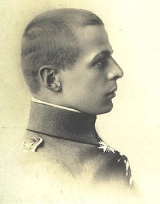
Oswald Boelcke
|
| |
|
| |
Oswald Boelcke (; 19 May, 1891 – 28 October, 1916) was a German flying ace of the First World War and one of the most influential patrol leaders and tacticians of the early years of air combat. Boelcke is considered the father of the German fighter air force, as well as the "Father of Air Fighting Tactics"; he was the first to formalize rules of air fighting, which he presented as the Dicta Boelcke. While he promulgated rules for the individual pilot, his main concern was the use of formation fighting rather than single effort.
Germany's premier ace, Manfred von Richthofen (The Red Baron), had been taught by Boelcke and continued to idolize his late mentor long after he had surpassed Boelcke's tally of victories.
- "I am after all only a combat pilot, but Boelcke, he was a hero." (Manfred von Richthofen, September 1917)
cke was born in Giebichenstein, the son of a schoolmaster.

Discussion
Ask a question about 'Oswald Boelcke'
Start a new discussion about 'Oswald Boelcke'
Answer questions from other users
|
Encyclopedia
Oswald Boelcke (; 19 May, 1891 – 28 October, 1916) was a German flying ace of the First World War and one of the most influential patrol leaders and tacticians of the early years of air combat. Boelcke is considered the father of the German fighter air force, as well as the "Father of Air Fighting Tactics"; he was the first to formalize rules of air fighting, which he presented as the Dicta Boelcke. While he promulgated rules for the individual pilot, his main concern was the use of formation fighting rather than single effort.
Germany's premier ace, Manfred von Richthofen (The Red Baron), had been taught by Boelcke and continued to idolize his late mentor long after he had surpassed Boelcke's tally of victories.
- "I am after all only a combat pilot, but Boelcke, he was a hero." (Manfred von Richthofen, September 1917)
Early life, entrance into World War I
Boelcke was born in Giebichenstein, the son of a schoolmaster. His father's first teaching job had been in Argentina from where the family had recently returned; Boelcke's three elder siblings were born in Buenos Aires.
His family name was originally spelt Bölcke, but Oswald and his elder brother Wilhelm dispensed with the umlaut and adopted the Latin spelling in place of the German. The pronunciation is the same for both spellings.
Whilst he was young, Boelcke's family moved to Dessau, the capital of the Duchy of Anhalt. As a youth he caught whooping cough; in order to build up his stamina, he became increasingly involved in playing sports but retained a tendency towards asthma throughout his life. Among his athletic pursuits were swimming, tennis, rowing, and gymnastics. However, he never did become very large; in later life, he was described as being about 5 feet 7 inches tall.
Oswald Boelcke was studious as well as athletic; he excelled at mathematics and physics. His father was a nationalist and a militarist; under his influence, the thirteen-year-old Boelcke had the audacity to write a personal letter to the Kaiser requesting an appointment to military school. His wish was granted, and he attended Cadets School.
After leaving school he joined Telegraphen-Bataillon Nr. 3 in Koblenz as a Fahnenjunker (cadet officer) in March 1911; he received a Prussian officer commission a year later . In mid-1914 he transferred to the Fliegertruppe. His flight training took place from May to August at the Halberstädter Fliegerschule. He passed his final pilot's exam on 15 August 1914. He was then immediately posted to active duty.
Career as a combat fighter pilot Due to the influence of his elder brother, Hauptmann Wilhelm Boelcke, Boelcke was initially posted to Fliegerabteilung 13 (Aviation Section 13), of which Wilhelm was a member. Boelcke won an Iron Cross Second Class for flying 50 missions with this unit, in company with his brother. They were such a successful team they aroused antipathy in other members of the section. As a result, Wilhelm was transferred away from his brother.
Oswald later wangled a transfer to Fliegerabteilung 62 in April 1915; it was based at Douai. FA 62 was a reconnaissance unit using two-seater aircraft to observe and adjust artillery fire.
In July 1915, Boelcke, Kurt Wintgens, and Max Immelmann became the first German fighter pilots, being given three of the five constructed Fokker M.5K/MG production prototypes of the Fokker E.I aircraft, fitted with a synchronized forward-firing Parabellum machine gun. These airplanes were doled out one or two per flying section, to be flown when pilots were not flying reconnaissance missions in their two seaters. They were considered so revolutionary that orders had been given that they wouldn't be risked over enemy lines for fear of capture.
Wintgens made the first victory claim with the new airplane, on 1 July 1915, but it went unconfirmed because it fell behind French lines. Historians have since identified the plane and crew as being a Morane-Saulnier crewed by Capitaine de Peuty and Sous-Lieutenant de Boutiny, who were both wounded
In the meantime, while flying a two-seater, Boelcke's observer shot down their first enemy aircraft on 4 July 1915, in a protracted running fight between reconnaissance craft. Boelcke landed near the French airplane's wreckage and verified the death of the crew. On that same day, Wintgens had another unconfirmed win. Wintgens finally got credit for a triumph on 15 July.
Boelcke won his first individual aerial combat on 19 August 1915. Just nine days later, he was a hero on the ground. He dived into a canal near his aerodrome, fully clothed, and rescued a drowning French boy, Albert DePlace. The child's parents wanted Boelcke to be awarded the French Legion d'Honneur; instead, he received a German lifesaving award.
Boelcke downed four more enemy aircraft before the end of the year.
Max Immelmann had scored his victory just before Boelcke's first, on 1 August. He and Boelcke had a "horse race" of victories, with first one rival leading, then the other, as they left Wintgens behind. By the end of 1915, Boelcke and Immelmann had six victories each.
Boelcke had three more 'kills' in January 1916; Immelman had two. Also in January 1916 Boelcke and Immelmann were the first German fliers to be awarded the Pour le Mérite, Germany's highest military medal.
In March 1916 Boelcke was made leader of the newly formed Fliegerabteilung Sivery and led them in action over Verdun. This unit of six fighter pilots was the precursor of German fighter squadrons.
By this time, the unpopular Fokker E.I was being supplanted by newer Halberstadt and Albatros aircraft with synchronized guns. The French had countered the "Fokker Scourge" with fast new Nieuports; the British also countered, with pusher planes that could fire in their direction of flight without need of synchronizing gear. Boelcke focused on developing his own counter methods--flying in tight formations, accurate gunnery in combat, and remaining within his own German lines.
The new fighter unit was stationed near Stenay, which was the headquarters of Crown Prince Wilhelm. A friendship developed between the Crown Prince and the ace.
By the first of May, Boelcke established his lead over Immelman for good, 15 victories to 14, to become the highest scoring ace in the war.
After Immelmann was killed on 18 June 1916 after his 17th victory, Boelcke, who then had 18 victories, was left the preeminent ace of the war. Kaiser Wilhelm II ordered Boelcke grounded for a month to avoid losing him in combat soon after Immelman. He had become such an important hero to the German public, as well as such an authority on aerial warfare, that he could not be risked.
Boelcke was detailed to share his expertise with the head of German military aviation. The German air force (Luftstreitkräfte) was being reorganized in mid-1916; this reorganization was inspired by Boelcke. At this time, Boelcke codified his Dicta. He also shared his views on creation of a fighter arm, and the organization of fighter squadrons.
He was given permission by the head of German aviation, Feldflugchef (Aviation Chief of Staff) Oberstleutnant Hermann von der Lieth-Thomsen, to choose his own pilots to form a fighter squadron.
Boelcke was sent on a tour of the Balkans. He transited Austria to visit Turkey. Upon his return swing, he visited Bulgaria and the Russian Front. Along the way, he interviewed pilots.
Among his first selections upon his return were Manfred von Richthofen, Erwin Böhme and Hans Reimann.
Boelcke was appointed commander of his hand-picked group of pilots on 30 August 1916. Though technically they were the second German fighter squadron founded (Jasta 1 was 8 days senior), Jagdstaffel 2, became the premier German unit. It would end the war with 20 aces among its members, a total of 336 victories, and a casualty list of only 44.
The unit initially flew Fokker D.II and Halberstadt D.II fighters, but really got into its stride with the new Albatros D.I and D.II.
Boelcke shot down ten Royal Flying Corps planes in his first month with Jasta 2. His pilots always flew in disciplined formations, and he repeatedly drilled them in his tactics. Among them were his famed combat rules, called "Boelcke's Dicta", which were the first systematic analysis of air combat and continued to be applicable through World War II.
Despite his run of personal successes, Boelcke's attitude is best expressed thus, in his own words: "Everything depends on sticking together when the Staffel goes into battle. It does not matter who actually scores the victory as long as the Staffel wins."
He not only preached this doctrine to his own "cubs"; he proselytized throughout the Luftstreitkräfte. He wrote upon his ideas, sketched them out, and delivered them in person to other aerodromes.
Death in action Boelcke set out on 28 October 1916 for his sixth sortie of the day with his two best pilots, Manfred von Richthofen and Erwin Böhme, and three others. Before they had set out on their attack, Boelcke, rushing to get ready, failed to properly strap on his safety belt. The patrol would eventually lead them into a dogfight with single-seater DH.2 fighters from no. 24 squadron RFC.
In the ensuing dogfight, Boelcke and Böhme, neither aware of the other's presence, closed in on the same aircraft, flown by Captain Arthur Knight. Von Richthofen dived in on the flight path of that very same airplane; he was chasing the other DH.2, piloted by Lieutenant Alfred Edwin McKay. Boelcke swerved to avoid a collision with the interceding aircraft. Böhme's landing gear brushed Boelcke's upper wing. As the fabric peeled off the upper wing of his plane, Boelcke struggled for control. He and his aircraft fell out of sight into a cloud. When it emerged, the top wing was gone. However, Boelcke made a relatively soft crashlanding. The impact seemed survivable. However, his lap belt didn't restrain him, and he never wore a helmet when he flew.
Minutes later, the pilot's lifeless body was pulled from his smashed Albatros D.II. The great Oswald Boelcke, victor of 40 aerial engagements, was dead at age 25.
Both Bohme and Richthofen left descriptions of the catastrophe.
Richthofen's account, from his posthumous memoirs:
"One day we were flying, once more guided by Boelcke against the enemy. We always had a wonderful feeling of security when he was with us. After all he was the one and only. The weather was very gusty and there were many clouds. There were no aeroplanes about except fighting ones.
"From a long distance we saw two impertinent Englishmen in the air who actually seemed to enjoy the terrible weather. We were six and they were two. If they had been twenty and if Boelcke had given us the signal to attack we should not have been at all surprised.
"The struggle began in the usual way. Boelcke tackled the one and I the other. I had to let go because one of the German machines got in my way. I looked around and noticed Boelcke settling his victim about two hundred yards away from me. It was the usual thing. Boelcke would shoot down his opponent and I had to look on. Close to Boelcke flew a good friend of his. It was an interesting struggle. Both men were shooting. It was probable that the Englishman would fall at any moment. Suddenly I noticed an unnatural movement of the two German flying machines. Immediately I thought: Collision. I had not yet seen a collision in the air. I had imagined that it would look quite different. In reality, what happened was not a collision. The two machines merely touched one another. However, if two machines go at the tremendous pace of flying machines, the slightest contact has the effect of a violent concussion.
"Boelcke drew away from his victim and descended in large curves. He did not seem to be falling, but when I saw him descending below me I noticed that part of his planes had broken off. I could not see what happened afterwards, but in the clouds he lost an entire plane. Now his machine was no longer steerable. It fell accompanied all the time by Boelcke's faithful friend.
"When we reached home we found the report "Boelcke is dead!" had already arrived. We could scarcely realize it.
"The greatest pain was, of course, felt by the man who had the misfortune to be involved in the accident.
"It is a strange thing that everybody who met Boelcke imagined that he alone was his true friend. I have made the acquaintance of about forty men, each of whom imagined that he alone was Boelcke's intimate. Each imagined that he had the monopoly of Boelcke's affections. Men whose names were unknown to Boelcke believed that he was particularly fond of them. This is a curious phenomenon which I have never noticed in anyone else. Boelcke had not a personal enemy. He was equally polite to everybody, making no differences.
"The only one who was perhaps more intimate with him than the others was the very man who had the misfortune to be in the accident which caused his death."
Bohme wrote his fiance:
"Boelcke is no longer among us now. It could not have hit us pilots any harder.
"On Saturday afternoon we were sitting on stand-by alert in our aerodrome blockhouse. I had just begun a chess match with Boelcke – it was then, shortly after 4 o'clock during an infantry attack at the front, that we were called. As usual, Boelcke led us. It wasn't long before we were flying over Flers and started an attack on several English aeroplanes, fast single-seaters, which resisted efficiently.
"In the following wild turning-flight combat, which allowed us to take shots only in short bursts, we sought to force down our opponent by alternately cutting him off, as we had already done so often with success. Boelcke and I had the one Englishman evenly between us, when another opponent, hunted by our friend Richthofen, cut directly in our path. As fast as lightning, Boelcke and I took evasive action simultaneously, and for one instant our wings obstructed our view of each other – it was then it occurred.
"How I am to describe my feelings to you from that instant on, when Boelcke suddenly emerged a few meters on the right from me, his machine ducked, I pulled up hard, however nevertheless we still touched and we both fell towards the earth! It was only a slight touching, but at the enormous speed this still also meant it was an impact. Fate is usually so senseless in its selection: me, only one side of the undercarriage had torn away, him, the outermost piece of the left wing.
"After a few hundred meters I got my machine under control again and could now follow Boelcke's, which I could see was only somewhat downwardly inclined in a gentle glide, heading towards our lines. It was only in a cloud layer at lower regions that violent gusts caused his machine to gradually descended more steeply, and I had to watch as he could no longer set it down evenly, and saw it impact beside a battery position. People immediately hurried to his assistance. My attempts to land beside my friend were made impossible because of the shell craters and trenches. Thus I flew rapidly to our field.
"The fact that I had missed the landing, they told me of only the other day – I have no recollection of this at all. I was completely distressed, however I still had hope. But as we arrived in the car, they brought the body to us. He died in the blink of an eye at the moment of the crash. Boelcke never wore a crash helmet and did not strap himself in the Albatros either – otherwise he would have even survived the not at all too powerful of an impact.
"Now everything is so empty to us. Only little by little does it come fully to our consciousness, that within the gap which our Boelcke leaves, the soul of the total is missing. He was nevertheless in each relationship our leader and master. He had an irresistible influence on all, even on superiors, which had to do purely with his personality, the all naturalness of his being. He could take us everywhere. We never had the feeling that anything could fail if he were there, and almost everything succeeded as well. In these one and a half months he has been with us we have put over 60 hostile aeroplanes out-of-action and made the dominance of the Englishmen shrink from day to day. Now we all must see that his triumphant spirit does not sink in the Staffel.
"This afternoon the funeral service was in Cambrai, from where the parents and brothers escorted their hero for burying at the cemetery of honour in Dessau. His parents are magnificent people – courageously accepting the unalterable with all the pain they feel. This gives me some solace as well, but nothing can be taken away from the sorrow over the loss of this extraordinary human being."
Bohme also remarked, "Why did he, the irreplaceable, have to be the victim of this blind fate, and why not I?"
Böhme, blaming himself for Boelcke's death, had to be talked out of committing suicide. As the Fatherland mourned, Boelcke was buried with full honors at his aerodrome in Cambrai. The Royal Flying Corps dropped a wreath a day later over Jasta 2 which read, "To the memory of Captain Boelcke, a brave and chivalrous foe."
In honor of their great leader, Jasta 2 was officially named "Jasta Boelcke" on 17 December 1916, a name the squadron still bears to this very day. Erwin Böhme was killed exactly one year, one month, and one day after his collision with Boelcke.
In the end, Boelcke had died because of a violation of one of his own dicta, which stated to never close in on a single combatant when others are also pursuing it.
See also
External links
[edit]
|
| |
|
|