
All Topics  
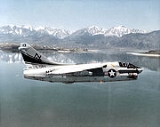
A-7 Corsair II

 
A 7 Corsair II

   Email Print
   Bookmark   Link


A-7 Corsair II


The Ling-Temco-Vought
Ling-Temco-Vought

Ling-Temco-Vought was a large U.S. Conglomerate ....
 A-7 Corsair II
is a carrier-based subsonic light attack aircraft introduced to replace the United States Navy
United States Navy

The United States Navy is the navy of the United States Armed Forces. It is one of the seven uniformed services of the United States. The U.S. Navy currently has approximately 331,682 personnel on active duty as of 31 December 2008 and 124,000 in the United States Navy Reserve....
's A-4 Skyhawk
A-4 Skyhawk

The Douglas A-4 Skyhawk is a aircraft carrier ground-attack aircraft designed for the United States Navy and U.S. Marine Corps. The delta winged "Skyhawk", powered by a single turbojet was designed and produced by Douglas Aircraft Company ....
, initially entering service during the Vietnam War
Vietnam War

The Vietnam War, also known as the Second Indochina Wars, the Vietnam Conflict, or often in Vietnam the American War occurred in Vietnam, Laos and Cambodia from 1959 to April 30, 1975....
. The Corsair was adopted by the United States Air Force
United States Air Force

The United States Air Force is the aerial warfare branch of the Military of the United States and one of the uniformed services of the United States....
, as well as the Air National Guard
Air National Guard

The Air National Guard , often referred to as the Air Guard, is the air force militia organized by each of the fifty U.S. states, the commonwealth of Puerto Rico, the territories of Guam and the U.S....
, to replace the A-1 Skyraider
A-1 Skyraider

The Douglas A-1 Skyraider was a United States single-seat ground attack aircraft bomber of the 1950s, 1960s and early 1970s. A propeller-driven anachronism in the jet age, the Skyraider had a remarkably long and successful career well into the space age, and inspired a straight-winged, slow-flying, jet-powered successor which is still...
, F-100 Super Sabre
F-100 Super Sabre

The North American Aviation F-100 Super Sabre was a jet engine fighter aircraft that served with the United States Air Force from 1954 to 1971 and with the Air National Guard until 1979....
 and F-105 Thunderchief
F-105 Thunderchief

The Republic Aviation Company F-105 Thunderchief, was a supersonic fighter-bomber used by the United States Air Force. The Mach 2 capable F-105 bore the brunt of strike bombing over North Vietnam during the early years of the Vietnam War....
. The aircraft was also exported to Greece
Greece

Greece , officially the Hellenic Republic , is a country in southeastern Europe, situated on the southern end of the Balkans. It has borders with Albania, Bulgaria and the former Yugoslav Republic of Macedonia to the north, and Turkey to the east....
 in the 1970s, and Portugal
Portugal

Portugal , officially the Portuguese Republic , is a country on the Iberian Peninsula. Located in southwestern Europe, Portugal is the westernmost country of mainland Europe and is bordered by the Atlantic Ocean to the west and south and by Spain to the north and east....
 and Thailand
Thailand

The Kingdom of Thailand is an independent country that lies in the heart of Southeast Asia. It is bordered to the north by Laos and Myanmar, to the east by Laos and Cambodia, to the south by the Gulf of Thailand and Malaysia, and to the west by the Andaman Sea and Myanmar....
 in the late 1980s. The A-7 airframe design was based on the successful supersonic
Supersonic

The term supersonic is used to define a speed that is over the speed of sound . At a typical temperature like 21 ?C , the threshold value required for an object to be traveling at a supersonic speed is approximately 344 metre per second, ....
 F-8 Crusader
F-8 Crusader

The F-8 Crusader was a single-engine aircraft carrier-based fighter aircraft built by Vought. It replaced the Vought F-7 Cutlass. The first F-8 prototype was ready for flight in February 1955, and was the last United States fighter with guns as the primary weapon....
 produced by Chance Vought
Vought

Vought is the name of several related aerospace firms. These have included, in the past, Lewis and Vought Corporation, Chance Vought, Vought Sikorsky, LTV Aerospace , Vought Aircraft Companies, and the current Vought Aircraft Industries....
.


Discussion
Ask a question about 'A-7 Corsair II'
Start a new discussion about 'A-7 Corsair II'
Answer questions from other users
Full Discussion Forum


Encyclopedia


The Ling-Temco-Vought
Ling-Temco-Vought

Ling-Temco-Vought was a large U.S. Conglomerate ....
 A-7 Corsair II
is a carrier-based subsonic light attack aircraft introduced to replace the United States Navy
United States Navy

The United States Navy is the navy of the United States Armed Forces. It is one of the seven uniformed services of the United States. The U.S. Navy currently has approximately 331,682 personnel on active duty as of 31 December 2008 and 124,000 in the United States Navy Reserve....
's A-4 Skyhawk
A-4 Skyhawk

The Douglas A-4 Skyhawk is a aircraft carrier ground-attack aircraft designed for the United States Navy and U.S. Marine Corps. The delta winged "Skyhawk", powered by a single turbojet was designed and produced by Douglas Aircraft Company ....
, initially entering service during the Vietnam War
Vietnam War

The Vietnam War, also known as the Second Indochina Wars, the Vietnam Conflict, or often in Vietnam the American War occurred in Vietnam, Laos and Cambodia from 1959 to April 30, 1975....
. The Corsair was adopted by the United States Air Force
United States Air Force

The United States Air Force is the aerial warfare branch of the Military of the United States and one of the uniformed services of the United States....
, as well as the Air National Guard
Air National Guard

The Air National Guard , often referred to as the Air Guard, is the air force militia organized by each of the fifty U.S. states, the commonwealth of Puerto Rico, the territories of Guam and the U.S....
, to replace the A-1 Skyraider
A-1 Skyraider

The Douglas A-1 Skyraider was a United States single-seat ground attack aircraft bomber of the 1950s, 1960s and early 1970s. A propeller-driven anachronism in the jet age, the Skyraider had a remarkably long and successful career well into the space age, and inspired a straight-winged, slow-flying, jet-powered successor which is still...
, F-100 Super Sabre
F-100 Super Sabre

The North American Aviation F-100 Super Sabre was a jet engine fighter aircraft that served with the United States Air Force from 1954 to 1971 and with the Air National Guard until 1979....
 and F-105 Thunderchief
F-105 Thunderchief

The Republic Aviation Company F-105 Thunderchief, was a supersonic fighter-bomber used by the United States Air Force. The Mach 2 capable F-105 bore the brunt of strike bombing over North Vietnam during the early years of the Vietnam War....
. The aircraft was also exported to Greece
Greece

Greece , officially the Hellenic Republic , is a country in southeastern Europe, situated on the southern end of the Balkans. It has borders with Albania, Bulgaria and the former Yugoslav Republic of Macedonia to the north, and Turkey to the east....
 in the 1970s, and Portugal
Portugal

Portugal , officially the Portuguese Republic , is a country on the Iberian Peninsula. Located in southwestern Europe, Portugal is the westernmost country of mainland Europe and is bordered by the Atlantic Ocean to the west and south and by Spain to the north and east....
 and Thailand
Thailand

The Kingdom of Thailand is an independent country that lies in the heart of Southeast Asia. It is bordered to the north by Laos and Myanmar, to the east by Laos and Cambodia, to the south by the Gulf of Thailand and Malaysia, and to the west by the Andaman Sea and Myanmar....
 in the late 1980s. The A-7 airframe design was based on the successful supersonic
Supersonic

The term supersonic is used to define a speed that is over the speed of sound . At a typical temperature like 21 ?C , the threshold value required for an object to be traveling at a supersonic speed is approximately 344 metre per second, ....
 F-8 Crusader
F-8 Crusader

The F-8 Crusader was a single-engine aircraft carrier-based fighter aircraft built by Vought. It replaced the Vought F-7 Cutlass. The first F-8 prototype was ready for flight in February 1955, and was the last United States fighter with guns as the primary weapon....
 produced by Chance Vought
Vought

Vought is the name of several related aerospace firms. These have included, in the past, Lewis and Vought Corporation, Chance Vought, Vought Sikorsky, LTV Aerospace , Vought Aircraft Companies, and the current Vought Aircraft Industries....
. It was one of the first combat aircraft to feature a head-up display
Head-Up Display

A head-up display, or HUD, is any transparent display that presents data without requiring the user to look away from his or her usual viewpoint....
 (HUD), an inertial navigation system
Inertial navigation system

An Inertial Navigation System is a navigation aid that uses a computer and motion sensors to continuously calculate via dead reckoning the position, orientation, and velocity of a moving object without the need for external references....
 (INS), and a turbofan
Turbofan

A turbofan is a type of aircraft engine consisting of a ducted fan which is powered by a gas turbine. Part of the airstream from the ducted fan passes through the gas turbine core, providing oxygen to burn fuel to create power....
 engine.

Design and development

A 7b Corsair Ii Va 305
In 1962, the United States Navy
United States Navy

The United States Navy is the navy of the United States Armed Forces. It is one of the seven uniformed services of the United States. The U.S. Navy currently has approximately 331,682 personnel on active duty as of 31 December 2008 and 124,000 in the United States Navy Reserve....
 began preliminary work on VAX (Heavier-than-air, Attack, Experimental), a replacement for the A-4 Skyhawk
A-4 Skyhawk

The Douglas A-4 Skyhawk is a aircraft carrier ground-attack aircraft designed for the United States Navy and U.S. Marine Corps. The delta winged "Skyhawk", powered by a single turbojet was designed and produced by Douglas Aircraft Company ....
 with greater range and payload. A particular emphasis was placed on accurate delivery of weapons to reduce the cost per target. The requirements were finalized in 1963 and in 1964, the Navy announced the VAL (Heavier-than-air, Attack, Light) competition. Contrary to USAF philosophy, which was to employ only supersonic fighter bombers such as the F-105 Thunderchief
F-105 Thunderchief

The Republic Aviation Company F-105 Thunderchief, was a supersonic fighter-bomber used by the United States Air Force. The Mach 2 capable F-105 bore the brunt of strike bombing over North Vietnam during the early years of the Vietnam War....
 and F-100 Super Sabre
F-100 Super Sabre

The North American Aviation F-100 Super Sabre was a jet engine fighter aircraft that served with the United States Air Force from 1954 to 1971 and with the Air National Guard until 1979....
, the Navy felt that a subsonic design could carry the most payload the farthest distance. Theoretically, a "slow fat duck" could fly nearly as fast as a supersonic one, since carrying dozens of iron bombs also restricted its entry speed, but a fast aircraft with small wings and an afterburner would burn more fuel.

To minimize costs, all proposals had to be based on existing designs. Vought
Vought

Vought is the name of several related aerospace firms. These have included, in the past, Lewis and Vought Corporation, Chance Vought, Vought Sikorsky, LTV Aerospace , Vought Aircraft Companies, and the current Vought Aircraft Industries....
, Douglas Aircraft
Douglas Aircraft Company

The Douglas Aircraft Company was an American aerospace manufacturer, based in Long Beach, California. It was founded in 1921 by Donald Wills Douglas, Sr....
, Grumman and North American Aviation
North American Aviation

North American Aviation was a major United States aircraft manufacturer, responsible for a number of historic aircraft, including the T-6 Texan trainer, the P-51 Mustang fighter aircraft, the B-25 Mitchell bomber, the F-86 Sabre jet aircraft fighter, and the X-15 rocket plane, as well as Apollo Apollo spacecraft, the second stage of the Satu...
 responded. The Vought proposal was based on the successful F-8 Crusader
F-8 Crusader

The F-8 Crusader was a single-engine aircraft carrier-based fighter aircraft built by Vought. It replaced the Vought F-7 Cutlass. The first F-8 prototype was ready for flight in February 1955, and was the last United States fighter with guns as the primary weapon....
 fighter, having a similar configuration, but shorter and more stubby, with a rounded nose. It was selected as the winner on 11 February 1964, and on 19 March the company received a contract for the initial batch of aircraft, designated A-7. In 1965, the aircraft received the popular name Corsair II, after Vought's highly successful F4U Corsair
F4U Corsair

The Vought F4U Corsair was a Naval aviation fighter aircraft that saw service in World War II and the Korean War . Goodyear Tire and Rubber Company-built Corsairs were designated FG and Brewster Aeronautical Corporation-built aircraft F3A....
 of World War II
World War II

World War II, or the Second World War , was a global military conflict which involved a Participants in World War II, including all of the great powers, organised into two opposing military alliances: the Allies of World War II and the Axis powers....
. (There was also a Vought O2U Corsair
O2U Corsair

The Vought O2U Corsair was a 1920s biplane scout and observation aircraft. Made by Vought Corporation, the O2U was ordered by the United States Navy in 1927....
 biplane scout and observation aircraft in 1920s.)

Compared to the F-8 fighter, the A-7 had a shorter, broader fuselage. The wing was made larger, and the unique variable incidence wing of the F-8 was deleted. To achieve the required range, the A-7 was powered by a Pratt & Whitney TF30-P-6 turbofan
Turbofan

A turbofan is a type of aircraft engine consisting of a ducted fan which is powered by a gas turbine. Part of the airstream from the ducted fan passes through the gas turbine core, providing oxygen to burn fuel to create power....
 producing 11,345 lbf (50.5 kN) of thrust, the same innovative combat turbofan produced for the F-111
General Dynamics F-111

The General Dynamics F-111 is a medium-range interdictor and fighter bomber aircraft that also fills the roles of strategic bomber, reconnaissance and electronic warfare in its various versions....
 and early F-14 Tomcat
F-14 Tomcat

The Grumman F-14 Tomcat is a supersonic, twin-engine, two-seat, variable-sweep wing aircraft. The F-14 was the United States Navy's primary maritime air superiority fighter, fleet defense Interceptor aircraft and tactical reconnaissance platform from 1974 to 2006....
s, but without the afterburner needed for supersonic speeds. Turbofans achieve greater efficiency by moving a larger mass of air at a lower velocity.

The aircraft was fitted with an AN/APQ-116
AN/APQ-116

The Texas Instruments AN/APQ-116 is a terrain-following radar used in A-7 Corsair II and C-130 Hercules aircraft....
 radar, later followed by the AN/APQ-126, which was integrated into the ILAAS digital navigation system. The radar also fed a digital weapons computer which made possible accurate delivery of bombs from a greater stand-off distance, greatly improving survivability compared with faster platforms such as the F-4 Phantom II
F-4 Phantom II

The McDonnell Douglas F-4 Phantom II is a two-seat, twin-engined, all-weather, long-range supersonic interceptor jet fighter/fighter-bomber originally developed for the United States Navy by McDonnell Aircraft....
. It was the first U.S. aircraft to have a modern head-up display, now a standard instrument, which displayed information such as dive angle, airspeed, altitude, drift and aiming reticle. The integrated navigation system allowed for another innovation – the projected map display system (PMDS) which accurately showed aircraft position on two different map scales.

The A-7 enjoyed the fastest and most trouble free development period of any American combat aircraft since World War II
World War II

World War II, or the Second World War , was a global military conflict which involved a Participants in World War II, including all of the great powers, organised into two opposing military alliances: the Allies of World War II and the Axis powers....
. The YA-7A made its first flight on 27 September 1965, and began to enter Navy squadron service late in 1966. The first Navy A-7 squadrons reached operation status on 1 February 1967, and began combat operations over Vietnam
Vietnam War

The Vietnam War, also known as the Second Indochina Wars, the Vietnam Conflict, or often in Vietnam the American War occurred in Vietnam, Laos and Cambodia from 1959 to April 30, 1975....
 in December of that year.

Secretary of Defence Robert McNamara
Robert McNamara

Robert Strange McNamara is an United States business executive and the 8th United States Secretary of Defense. McNamara served as Defense Secretary during the Vietnam War from 1961 to 1968....
 prodded the Air Force to adopt not only the hugely successful F-4, but also the Navy's A-7 Corsair as a low-cost follow-on to F-105s until the troubled F-111 came online, and as a close-air support replacement for A-1 Skyraider
A-1 Skyraider

The Douglas A-1 Skyraider was a United States single-seat ground attack aircraft bomber of the 1950s, 1960s and early 1970s. A propeller-driven anachronism in the jet age, the Skyraider had a remarkably long and successful career well into the space age, and inspired a straight-winged, slow-flying, jet-powered successor which is still...
. On 5 November 1965, the USAF announced that it would purchase a version of the A-7, designated the A-7D, for Tactical Air Command
Tactical Air Command

Tactical Air Command is an inactive United States Air Force organization. It was a List of Major Commands of the United States Air Force of the United States Air Force, established on March 21, 1946 being headquartered at Langley Air Force Base, Virginia....
. The Air Force ordered the A-7D with a fixed high speed refueling receptacle behind the pilot optimized for the KC-135
KC-135 Stratotanker

The Boeing KC-135 Stratotanker is a United States aerial refueling tanker aircraft. It has been in service with the United States Air Force since 1957....
's flying boom rather than the folding long probe
Aerial refueling

Aerial refueling, also called air refueling, in-flight refueling , air-to-air refueling or tanking, is the process of transferring fuel from one aircraft to another during flight....
 of the Navy aircraft. The most important difference from the preceding Navy versions was the adoption of the Allison TF41-A-1
Rolls-Royce Spey

The Rolls-Royce RB.168 Spey is a low-bypass turbofan engine originally designed and manufactured by Rolls-Royce Limited that has been in widespread service for over 40 years....
 turbofan, a license-built version of British Rolls-Royce Spey. With 14,500 lbf (64.5 kN) of thrust, the engine offered a considerable boost in performance. The M61 Vulcan
M61 Vulcan

The M61 Vulcan is a 20 mm hydraulically or pneumatically driven, six-barrel ed, air-cooled, electrically fired Gatling gun with an extremely high rate of fire....
 cannon was selected in place of the twin single-barrel 20 mm cannon. In addition, avionics were upgraded. The YA-7D prototype with TF30 flew on 6 April 1968, with the first TF41 aircraft taking to the air on 26 September 1968. The aircraft were later updated to carry the Pave Penny
Pave Penny

The Lockheed-Martin AN/AAS-35V Pave Penny is a laser spot tracker carried by United States Air Force attack aircraft and fighter-bombers to enable them to track a laser spot on the ground ....
 laser spot tracker to add the capability to drop guided bombs. A total of 459 were built and assigned to tactical fighter wings of the Tactical Air Command
Tactical Air Command

Tactical Air Command is an inactive United States Air Force organization. It was a List of Major Commands of the United States Air Force of the United States Air Force, established on March 21, 1946 being headquartered at Langley Air Force Base, Virginia....
 (TAC).

The Navy was so impressed with the performance gain of USAF A-7D that they ordered their own version with the TF41 engine and M61 cannon, the A-7E, to go along with the new continuous solution weapon systems and sophisticated avionics that was developed in the A-7C model that was highly advanced for that era. The first prototype flew on 25 November 1968. A-7Es were turned out in 1970s with outstanding mission success in the fleet. In 1979 the first around-the-clock night-attack FLIR-capable aircraft were delivered to VA-81 at NAS Cecil Field, Florida. During the 1980s, when defense budgets finally allowed, funding for upgrades various system upgrades and engineering change proposal mods were incorporated to increase reliability, safety and mission effectiveness. In 1986, 231 A-7Es were equipped to carry the LANA (Low-Altitude Night Attack) pod which projected amplified light image on the HUD and, in conjunction with radar, provided terrain following down to 460 mph (740 km/h) at 200 ft (60 m). A total of 529 examples were built (not counting 67 A-7Cs).

In 1985, the USAF requested proposals for a fast strike aircraft because of concerns that A-10 Thunderbolt II
A-10 Thunderbolt II

The A-10 Thunderbolt II is an United states single-seat, twin-engine, straight-wing jet aircraft developed by Fairchild for the United States Air Force to provide close air support of ground forces by attacking tanks, armored vehicles and other ground targets with a limited air interdiction capability....
 was too slow for interdiction. The design called for a new engine, either the Pratt & Whitney F100
Pratt & Whitney F100

The Pratt & Whitney F100 is an afterburning turbofan engine manufactured by Pratt & Whitney which powers the F-15 Eagle and F-16 Fighting Falcon....
-PW-220 or General Electric F110
General Electric F110

The General Electric F110 is an Afterburner turbofan jet engine produced by GE Aviation. The F110 engine uses the same engine core design as the General Electric F101....
-GE 100. LTV responded with the YA-7F, a supersonic version of A-7 powered by an F100-PW-220 with 26,000 lbf (116 kN) thrust. To accommodate the new engine, the fuselage was lengthened about 4 ft (1.22 m). New fuselage sections were inserted in both the forward and aft fuselage - a 30 in (76 cm) section in front of the wing and an 18 in (46 cm) section behind the wing. The wing was strengthened and fitted with new augmented flaps, leading edge extensions and automatic maneuvering flaps. The vertical stabilizer height was increased about 10 in (25 cm)the unit horizontal tail was flipped from dihedral to anhedral, and control surfaces were flattened. Unsurprisingly, the end result resembled the supersonic F-8 Crusader from which the original subsonic A-7 was derived.

The new supersonic A-7 could accelerate with a bomb load from 400 to in under 15 seconds and could sustain Mach 1.6 for longer times with the extra fuel. The YA-7F modifications allowed 7-g turn and burn capability that permitted high-speed sustained evasive maneuvers plus great improvements in high angle of attack performance. As a CAS/BAI platform to penetrate into enemy territory and return safely, the "Strikefighter" moniker was most fitting. Two A-7Ds were extensively modified, the first one flying on 29 November 1989 and breaking the sound barrier
Sound barrier

In aerodynamics, the sound barrier usually refers to the point at which an aircraft moves from transonic to supersonic speed. The term came into use during World War II when a number of aircraft started to encounter the effects of compressibility, a grab-bag of unrelated aerodynamic effects....
 on its second flight. The second prototype flew on 3 April 1990. The project was canceled due to improved relations with former adversaries, lower defense budgets, and the Air National Guard
Air National Guard

The Air National Guard , often referred to as the Air Guard, is the air force militia organized by each of the fifty U.S. states, the commonwealth of Puerto Rico, the territories of Guam and the U.S....
, by then the principal USAF operator of the A-7 generally favoring the in-production F-16 Fighting Falcon
F-16 Fighting Falcon

The Lockheed Martin F-16 Fighting Falcon is a Multirole combat aircraft jet aircraft fighter aircraft originally developed by General Dynamics for the United States Air Force....
.

Production

Production of Corsairs continued through 1984, yielding a total of 1,569 aircraft built. The A-7 Corsair has the distinction of being the only United States single seat jet fighter-bomber of the 1960s that was designed, built, and deployed directly into the Vietnam War.

Operational history

Initial operational basing/homeporting for U.S. Navy A-7 squadrons was at NAS Cecil Field, Florida for Atlantic Fleet units and NAS Lemoore, California for Pacific Fleet units. This was in keeping with the role of these bases in already hosting the A-4 Skyhawk
A-4 Skyhawk

The Douglas A-4 Skyhawk is a aircraft carrier ground-attack aircraft designed for the United States Navy and U.S. Marine Corps. The delta winged "Skyhawk", powered by a single turbojet was designed and produced by Douglas Aircraft Company ....
 attack squadrons that would eventually transition to the A-7. From 1967 - 1971 a total of 27 Navy squadrons took delivery of four different A-7A/B/C/E models. The Vought plant in Dallas, TX employed up to 35,000 workers turned out one aircraft a day for several years to support the Navy carrier-based needs for Vietnam and SE Asia and commitments to NATO in Europe. In 1974, when the USS Midway
USS Midway

USS Midway may refer to:*, was the Oritani and then the Tyree before being chartered as a general auxiliary in 1942, renamed to Panay in 1943, and returned to her owner in 1946...
 (CV 41) became the first Forward Deployed Naval Force (FDNF) aircraft carrier to be homeported in Yokosuka, Japan, two A-7A squadrons assigned to Carrier Air Wing FIVE (CVW-5) were concurrently homeported at NAF Atsugi, Japan. In 1978, these squadrons (VA-93 and VA-56) finally transitioned to the much more advanced A-7E model. Six Naval Reserve squadrons would also eventually transition to the A-7, operating from NAS Cecil Field, Florida; NAS Atlanta/Dobbins ARB, Georgia; NAS New Orleans, Louisiana; NAS Alameda, California and NAS Point Mugu, California. An additional active duty squadron stood up in the 1980s, Tactical Electronic Warfare Squadron 34 (VAQ-34) at NAS Point Mugu would also operate twin-seat TA-7C and EA-7L aircraft with both a pilot and a Naval Flight Officer
Naval Flight Officer

A Naval Flight Officer is an officer in the United States Navy or United States Marine Corps that specializes in airborne weapons and sensor systems....
 in an adversary electroic warfare role.

A 7d Corsair Ii Usaf
Initial USAF basing of the A-7D was at Edwards AFB, California
California

California is a U.S. state on the West Coast of the United States of the United States, along the Pacific Ocean. It is bordered by Oregon to the north, Nevada to the east, Arizona to the southeast, and to the south the Mexico state of Baja California....
 and Eglin AFB, Florida
Florida

Florida is a U.S. state located in the Southeastern United States of the United States, bordering Alabama to the northwest and Georgia to the northeast....
 in 1968 for prototype testing. Initial lead-in pilot training squadrons were established at Luke AFB, Arizona
Arizona

The State of Arizona is a U.S. state located in the Southwestern United States of the United States. The capital and largest city is Phoenix, Arizona....
, and Nellis AFB, Nevada
Nevada

Nevada is a U.S. state located in the Western United States of the United States of America. The capital is Carson City and the largest city is Las Vegas, Nevada....
 in 1969. The first operational USAF basing was at Myrtle Beach AFB, South Carolina
South Carolina

South Carolina is a U.S. state in the Southern United States of the United States. It borders Georgia to the south and North Carolina to the north....
 (354 TFW) in 1970, with subsequent basing at Davis-Monthan AFB, Arizona
Arizona

The State of Arizona is a U.S. state located in the Southwestern United States of the United States. The capital and largest city is Phoenix, Arizona....
 (355 TFW) in 1971 and England AFB, Louisiana
Louisiana

The State of Louisiana is a U.S. state located in the U.S. Southern States of the United States of America. Its capital is Baton Rouge and largest city is New Orleans....
 (23 TFW) in 1972. The Luke-based A-7Ds were reassigned to Davis-Monthan in 1971 along with the lead-in pilot training mission. A fourth operational A-7D wing was assigned to Korat Royal Thai Air Force Base
Korat Royal Thai Air Force Base

Korat Royal Thai Air Force Base is a base of the Royal Thai Air Force. It is located in in central Thailand, located approximately 157 miles northeast of Bangkok and about 5 miles south of Nakhon Ratchasima , the third largest city in Thailand....
, Thailand
Thailand

The Kingdom of Thailand is an independent country that lies in the heart of Southeast Asia. It is bordered to the north by Laos and Myanmar, to the east by Laos and Cambodia, to the south by the Gulf of Thailand and Malaysia, and to the west by the Andaman Sea and Myanmar....
 (388 TFW) in early 1973 derived from deployed Myrtle Beach aircraft.

Pilots of the early A-7s lauded the aircraft for general ease of flying (with the exceptions of poor stability on cross-wind landings and miserable stopping performance on wet runways with an inoperative anti-skid braking system) and excellent forward visibility but noted a lack of engine thrust. This was addressed with A-7B and more thoroughly with A-7D/E. The turbofan engine provided a dramatic increase in fuel efficiency compared with earlier turbojet
Turbojet

Turbojets are the oldest kind of general purpose jet engines. Two engineers, Frank Whittle in the United Kingdom and Hans von Ohain in Germany, developed the concept independently into practical engines during the late 1930s, although credit for the first turbojet is given to Whittle who submitted the first proposal and held a UK patent that...
s – the A-7D was said to have specific fuel consumption
Specific fuel consumption

Specific fuel consumption, often shortened to SFC, or TSFC is an engineering term that is used to describe the fuel efficiency of an engine design with respect to thrust output....
 one sixth that of an F-100 Super Sabre
F-100 Super Sabre

The North American Aviation F-100 Super Sabre was a jet engine fighter aircraft that served with the United States Air Force from 1954 to 1971 and with the Air National Guard until 1979....
 at equivalent thrust. An A-7D carrying 12 x 500 lb (227 kg) bombs at 480 mph (775 km/h) at 33,000 ft (10,000 m) used only 3,350 lb (1,500 kg) of fuel per hour. Typical fuel consumption at mission retrograde during aircraft carrier recovery was approximately 30 pounds per minute compared to 100+ pounds per minute for the Phantom F-4J/N series. The A-7 Corsair II was tagged with the nickname "SLUF" ("Short Little Ugly Fucker") by pilots.

The integrated weapons computer provided highly accurate bombing with CEP
Circular error probable

In the military science of ballistics, circular error probable or circular error probability is an intuitive measure of a weapon system's Accuracy and precision....
 of 60 ft (20 m) regardless of pilot experience. When Vought technical representatives were available to "tweak" the inertial systems, the CEP was often less than five meters for experienced fleet aviators. The inertial navigation system required a mere 2.5 minutes on the ground for partial (coarse) alignment, a big improvement over 13 minutes required in F-4 Phantom II
F-4 Phantom II

The McDonnell Douglas F-4 Phantom II is a two-seat, twin-engined, all-weather, long-range supersonic interceptor jet fighter/fighter-bomber originally developed for the United States Navy by McDonnell Aircraft....
. For newly manufactured E models, the A-7 required only 11.5 man hour
Man hour

A man-hour is the amount of Manual labour performed by an average worker in one hour. It is used in written "estimates" for estimation of the total amount of uninterrupted labour required to perform a task....
s of maintenance per mission resulting in quick turnaround and high number of combat-ready aircraft. However, after several years of exposure to the harsh marine conditions aboard aircraft carriers, the maintenance hours per sortie were often twice this amount.

For its day, the SLUF offered a plethora of leading edge avionics. This included data link capabilities that, among other features, provided fully "hands-off" carrier landing capability when used in conjunction with its approach power compensator (APC) or auto throttle. Other notable and highly advanced equipment was a projected map display located just below the radar scope. The map display was slaved to the inertial navigation system and provided a high-resolution map image of the aircraft's position superimposed over TPC/JNC charts. Moreover, when slaved to the all-axis auto pilot, the inertial navigation system could fly the aircraft "hands off" to up to nine individual way points. Typical inertial drift was minimal for newly manufactured models and the inertial measurement system accepted fly over, radar, and TACAN updates.

Pilots quipped that the Corsair "is not very fast, but it sure is slow." For dissimilar air combat training
Dissimilar air combat training

Dissimilar air combat training was introduced as a formal part of US air combat training after disappointing aerial combat exchange rates in the Vietnam War....
 (DACT), and aerial demonstrations by the Blue Angels
Blue Angels

The United States Navy's Navy Flight Demonstration Squadron, popularly known as the Blue Angels, first performed in 1946 and was the world's first officially sanctioned military aerial demonstration team....
, the Navy would choose the more nimble A-4 Skyhawk
A-4 Skyhawk

The Douglas A-4 Skyhawk is a aircraft carrier ground-attack aircraft designed for the United States Navy and U.S. Marine Corps. The delta winged "Skyhawk", powered by a single turbojet was designed and produced by Douglas Aircraft Company ....
 as a subsonic maneuvering platform, as some considered the A-7 to be inadequate in air combat, even though it was highly maneuverable and was more fitting as a highly successful attack aircraft with a stable bombing platform. The Marine Corps would also pass on the Corsair, opting instead for the V/STOL
V/STOL

Vertical and/or Short Take-Off and Landing is a term used to describe aircraft that are able to take-off or land vertically or on short runways....
 vertical landing AV-8 Harrier as their light attack aircraft to replace their A-4F/M Skyhawks. Naval Reserve
Naval Reserve

A Naval Reserve is the reserve body of a nation's Navy, typically called-upon in times of conflict. Naval Reserves include:* La r?serve Marine ...
 and Air National Guard
Air National Guard

The Air National Guard , often referred to as the Air Guard, is the air force militia organized by each of the fifty U.S. states, the commonwealth of Puerto Rico, the territories of Guam and the U.S....
 units, however, were often forced to operate the A-7E and D models in rather challenging air-to-air duels with USAF F-15 Eagle
F-15 Eagle

The McDonnell Douglas F-15 Eagle is a twin-engine, all-weather military tactics fighter aircraft designed to gain and maintain air superiority in aerial combat....
s and USN F-14 Tomcat
F-14 Tomcat

The Grumman F-14 Tomcat is a supersonic, twin-engine, two-seat, variable-sweep wing aircraft. The F-14 was the United States Navy's primary maritime air superiority fighter, fleet defense Interceptor aircraft and tactical reconnaissance platform from 1974 to 2006....
s. Several SLUF units adopted a technique pioneered by the Puerto Rico Air National Guard
Puerto Rico Air National Guard

The Puerto Rico Air National Guard is a component of the United States Air Force operating within Puerto Rico. It was federally recognized on November 23 1947....
: if an F-15 Eagle approaches gun range, depart the A-7 from controlled flight and deploy as much chaff and flares as possible. Departing an A-7 from controlled flight resulted in very high and simultaneous roll, yaw and pitch rates. It also caused a near instantaneous airspeed loss of 100 to that made successful gun-tracking by an opponent nearly impossible. Deploying chaff and flares during such an event spewed these devices in all directions as the range between the two aircraft rapidly diminished and consequently posed a chaff/flare collision threat to the attacking aircraft documented by Puerto Rican and Louisiana Air National Guard
Louisiana Air National Guard

The Louisiana Air National Guard consists of the 159th Fighter Wing and the 122nd Fighter Squadron based at NAS/JRB New Orleans with additional resources elsewhere in the Louisiana....
 units.

Southeast Asia

In Vietnam, the hot, humid air robbed even the upgraded A-7D and A-7E of power. Takeoff rolls were lengthy and fully-armed aircraft struggled to reach 800 km/h. For A-7A aircraft, high density altitude and maximum weight runway takeoffs often necessitated a "low transition," where the aircraft was intentionally held in "ground effect" a few feet off the runway during gear retraction, and as much as a departure at treetop altitude before reaching a safe flap retraction speed.(Note: the A-7A wing flap systems were either fully extended or fully retracted. The A-7A flap handle did not have the microswitch feature of later models that permitted the flaps to be slowly raised by several degrees per tap of the flap handle as airspeed slowly increased during max-weight takeoffs.)

Carrier catapult launches at maximum weight under these performance-robbing conditions were not significantly better and were characterized by the aircraft decelerating by as much as immediately after launch. As a result, A-7A units operated their aircraft 4 thousand pounds below the max-rated takeoff weight for the A-7E.

The first U.S. Navy A-7As were deployed to Vietnam in 1967 with VA-147 Argonauts aboard USS Ranger. The aircraft made their first combat sortie on 4 December 1967. In the following months, VA-147 flew around 1,400 sorties losing only one aircraft. In January 1968, USS Ranger participated in the incident surrounding the capture of USS Pueblo
USS Pueblo (AGER-2)

USS Pueblo is a Banner class environmental research ship technical research ship which was boarded and captured by the Democratic People's Republic of Korea on 23 January 1968 in what is known as the Pueblo incident or alternatively as the Pueblo crisis or Pueblo affair....
 in the Sea of Japan
Sea of Japan

The Sea of Japan is a marginal sea of the western Pacific Ocean, bordered by Japan, South Korea, North Korea and Russia. It is referred to in North Korea as the Korea East Sea and in South Korea as the East Sea....
 by North Korea
North Korea

North Korea, officially the Democratic People's Republic of Korea , is a state in East Asia, occupying the northern half of the Korean Peninsula....
. The Navy's improved A-7B model arrived in Vietnam in early 1969, with the definitive A-7E following in 1971. The U.S. Navy's first A-7 loss occurred on 22 December 1967, less than three weeks after entering combat.

The USAF A-7Ds were also widely used in Vietnam and Cambodia
Cambodia

The Kingdom of Cambodia is a country in South East Asia with a population of over 13 million people. The kingdom's capital and largest city is Phnom Penh....
 with 354th Tactical Fighter Wing
354th Fighter Wing

The 354th Fighter Wing is the host wing at Eielson Air Force Base, Alaska, and is assigned to the Eleventh Air Force....
, and the 388th Tactical Fighter Wing
388th Fighter Wing

The 388th Fighter Wing is a wing of the United States Air Force based out of Hill Air Force Base, Utah....
, flying from Korat RTAFB, Thailand. A-7s from the 354th TFW entered action in October 1972 and attacked targets as far as 800 km from airbases, extensively utilizing mid-air refueling. The A-7Ds were quickly assigned the "Sandy mission" of providing air cover for Combat Search and Rescue
Search and rescue

Search and rescue is the search for and provision of aid to people who are in distress or imminent danger....
 missions of downed pilots. Taking over for A-1 Skyraider
A-1 Skyraider

The Douglas A-1 Skyraider was a United States single-seat ground attack aircraft bomber of the 1950s, 1960s and early 1970s. A propeller-driven anachronism in the jet age, the Skyraider had a remarkably long and successful career well into the space age, and inspired a straight-winged, slow-flying, jet-powered successor which is still...
s (and adopting their call sign of "Sandy"), the A-7's higher speed was somewhat detrimental for escorting the helicopters but the aircraft's high endurance and durability were an asset and it performed admirably. On 18 November 1972, Major Colin A. Clarke led a successful CSAR mission near Thanh Hoa
Thanh Hóa

Thanh H?a is the capital city of Vietnam's Thanh H?a Province. The population of Thanh H?a city is nearly 200,000 with an area of only 57.9 square kilometers....
 to rescue a downed F-105 Wild Weasel
F-105 Thunderchief

The Republic Aviation Company F-105 Thunderchief, was a supersonic fighter-bomber used by the United States Air Force. The Mach 2 capable F-105 bore the brunt of strike bombing over North Vietnam during the early years of the Vietnam War....
 crew. The mission lasted a total of 8.8 hours during which Clarke and his wingman took a number of hits from 0.51 cal (12.7 mm) anti-aircraft fire. For his actions in coordinating the rescue, Clarke was awarded the Air Force Cross
Air Force Cross (United States)

The Air Force Cross is the second highest Awards and decorations of the United States military that can be awarded to a member of the United States Air Force....
, the USAF's second-highest decoration for valor, and his A-7D (AF Serial No. 70-0970) was eventually placed on display on 31 January 1992 at the National Museum of the United States Air Force
National Museum of the United States Air Force

The National Museum of the United States Air Force is the official National Museum of the United States Air Force and is located at Wright-Patterson Air Force Base, in Riverside, Ohio near Dayton, Ohio, Ohio....
 at Wright-Patterson AFB, Ohio.

The USAF A-7D flew a total of 12,928 combat sorties during the war with only six losses – the lowest of any U.S. fighter in the theater. The aircraft was second only to B-52 Stratofortress
B-52 Stratofortress

The Boeing B-52 Stratofortress is a long-range, subsonic, jet engine, strategic bomber operated by the United States Air Force since 1955.Beginning with the successful contract bid on 5 June 1946, the B-52 went through several design steps; from a straight wing aircraft powered by six turboprop engines to the final prototype YB-52, with ei...
 in the amount of ordnance dropped on Hanoi
Hanoi

Hanoi , estimated population 3,398,889 , is the Capital of Vietnam. From 1010 until 1802, with a few brief interruptions, it was the political centre of an independent Vietnam....
 and dropped more bombs per sortie with greater accuracy than any other U.S. attack aircraft.

A-7Ds from Korat flew combat operations over Vietnam until mid-January 1973, in Laos until 22 February 1973, and in Cambodia until 15 August 1973. The last shot fired in anger by United States military forces in Southeast Asia was fired by an A-7D of the deployed 345th TFW / 353 TFS assigned to Korat RTAFB on 15 August 1973.

During the war in Southeast Asia, U.S. Navy A-7 Corsairs were painted gloss gray/white in color while USAF A-7s were normally painted in full jungle camouflage paint schemes. The U.S. Navy did experiment with camouflage
Camouflage

Camouflage is a method of cryptic or concealing coloration that allows an otherwise visible organism or object to remain invisibility through deception....
 paint schemes for some of their aircraft during the war, but during landing operations, the flight deck crews found their duties complicated, due to the inherent changing of the weather conditions aboard a moving ship and the color coded uniforms of the flight deck crew; with the added dangers involved to an already cluttered flight deck, it was determined to keep naval aircraft readily visible for the sake of safety.

On 15 May 1975, A-7E aircraft aboard the USS Coral Sea, in conjunction with A-7D aircraft assigned to the 388 TFW / 3 TFS at Korat RTAFB, provided air cover in what is considered the last battle of the Vietnam war, the recovery of the SS Mayagüez after it was hijacked by Cambodian communists. By the time Operation Mayaguez was over, three U.S. helicopters had been shot down, six received severe damage, three others were heavily damaged and only one was still flyable. Of the total force of 231 Marines, Airmen, and Sailors who landed on Koh Tang Island during this operation, 18 men were KIA or unaccounted for and at least three of these were later determined to have been inadvertently left alive on the island.

Grenada

Navy A-7E squadrons VA-15 and VA-87, from the USS Independence, provided close air support during the Invasion of Grenada
Invasion of Grenada

The Invasion of Grenada, codenamed Operation Urgent Fury, was an invasion of the nation of Grenada, an island in the Caribbean Sea, 100 miles north of Venezuela, and over 1,500 miles southeast of the United States, by the combined force of troops from the United States , Jamaica and members of the Regional Security System ....
, codenamed Operation Urgent Fury, in October 1983.

Lebanon

Navy A-7s also provided air support during the U.S. mission
Multinational Force in Lebanon

The Multinational Force in Lebanon was an international peacekeeping force created in 1982 and sent to Lebanon to oversee the withdrawal of the Palestine Liberation Organization....
 in Lebanon
Lebanon

Lebanon , officially the Republic of Lebanon or Lebanese Republic , is a country in Western Asia, on the eastern shore of the Mediterranean Sea....
 in 1983. Along with an A-6 Intruder
A-6 Intruder

The A-6 Intruder is an United States twin jet-engine, mid-wing attack aircraft built by Grumman. In service between 1963 and 1997, the Intruder was designed as an all-weather replacement for the piston-engined A-1 Skyraider medium attack aircraft....
, one A-7 was shot down by Syria
Syria

Syria , officially the Syrian Arab Republic , is an Arab-majority country in Southwest Asia, bordering Lebanon and the Mediterranean Sea to the west, Israel to the southwest, Jordan to the south, Iraq to the east, and Turkey to the north....
n surface-to-air missiles (SAM) on 4 December 1983.

Libya

On 24 March 1986, during the Gulf of Sidra
Gulf of Sidra

Gulf of Sidra is a body of water in the Mediterranean Sea on the northern coast of Libya; it is also known as Gulf of Sirte. It is located by the city of Sirt....
 dispute with Libya
Libya

Libya , officially the Great Socialist People's Libyan Arab Jamahiriya , is a country located in North Africa. Bordering the Mediterranean Sea to the north, Libya lies between Egypt to the east, Sudan to the southeast, Chad and Niger to the south, and Algeria and Tunisia to the west....
, Libyan air defense operators fired SA-5 missiles at two Fighter Squadron 102 (VF-102) F-14s
F-14 Tomcat

The Grumman F-14 Tomcat is a supersonic, twin-engine, two-seat, variable-sweep wing aircraft. The F-14 was the United States Navy's primary maritime air superiority fighter, fleet defense Interceptor aircraft and tactical reconnaissance platform from 1974 to 2006....
 from USS America
USS America

USS America may refer to:, a 74-gun ship of the line, laid down in 1777, but not launched until 1782* America pressed into United States naval service as a picket boat during the Civil War...
 that were orbiting in international air space on a Combat Air Patrol
Combat air patrol

Combat air patrol is a type of flying mission for fighter aircraft.A combat air patrol is an aircraft patrol provided over an objective area, over the force protected, over the critical area of a combat zone, or over an air defense area, for the purpose of intercepting and destroying hostile aircraft before they reach their target....
 (CAP) station. The next day, a Navy A-7E aircraft accompanied the fighters and responded to the SA-5 radar emissions by firing the first AGM-88 HARM
AGM-88 HARM

The AGM-88 High-speed Anti-radiation missile is a tactical, air-to-surface missile designed to home in on electronic transmissions coming from surface-to-air radar systems....
 missiles used in combat and destroying the Libyan radar.

In April 1986, Navy Sixth Fleet A-7Es from VA-72 and VA-46 aboard USS America (CV 66) also participated in Operation El Dorado Canyon
Operation El Dorado Canyon

The United States bombing of Libya comprised the joint United States United States Air Force, United States Navy and United States Marine Corps air-strikes against Libya on April 15, 1986....
, the retaliatory attack on Libya
Libya

Libya , officially the Great Socialist People's Libyan Arab Jamahiriya , is a country located in North Africa. Bordering the Mediterranean Sea to the north, Libya lies between Egypt to the east, Sudan to the southeast, Chad and Niger to the south, and Algeria and Tunisia to the west....
 using HARM and Shrike anti-radar missiles.

Operation Earnest Will/Operation Praying Mantis

During the Iran–Iraq War of the 1980s, continued Iranian and Iraqi attacks on shipping in the Persian Gulf were becoming so frequent that by 1987 the Kuwaitis requested U.S. assistance and Operation Earnest Will
Operation Earnest Will

Operation Earnest Will was the U.S. military protection of Kuwaiti owned oil tankers from Iranian attacks in 1987 and 1988, three years into the Tanker War phase of the Iran?Iraq War....
, designed to maintain freedom of navigation within that body of water, was initiated. At the outset, 11 Kuwaiti tankers were “re-flagged,” the Middle East Force escorting the first ships through the Strait of Hormuz into the Persian Gulf to Kuwait, and then returning outbound, beginning on 22 July 1987.

During escort duty while steaming northeast of Qatar on 14 April 1988, lookouts on board guided missile frigate USS Samuel B. Roberts
USS Samuel B. Roberts (FFG-58)

USS Samuel B. Roberts is one of the final ships in the United States Navy's Oliver Hazard Perry class frigate of guided missile frigates . The ship was severely damaged by an Iranian Naval mine in 1988, leading U.S....
 spotted three mines ahead. Going to general quarters, the ship soon struck a fourth mine that exploded and blew a hole in her port side near frame 276, injuring 10 sailors, and inflicting "considerable damage to the hull, deckhouse and foundation structures, essentially breaking the ship’s back." Herculean damage control efforts by the crew, however, saved the ship. Over the next 10 days, Coalition mine countermeasures vessels located eight additional mines, examination of which left little doubt as to their Iranian origins.

Operation Praying Mantis

Operation Praying Mantis was an April 18, 1988 attack by United States Navy in retaliation for the Iranian naval mine of the Persian Gulf and the subsequent damage to an American warship....
 was designed as a "measured response" to this incident, as well as to repeated Iranian shipping harassment and provocations; A-7Es from VA-22
VA-22

VA-22 has the following meanings:*Attack Squadron 22 *State Route 22 ...
 and VA-94, along with A-6E Intruders from VA-95
VA-95

VA-95 has the following meanings:*Attack Squadron 95 *State Route 95 ...
 participated in sinking the Iranian Frigate Sahand
Iranian frigate Sahand

Iranian frigate Sahand , a United Kingdom-made Vosper & Company Mark V class frigate , was commissioned as part of a four-ship order.The ship was originally called Faramarz, named after a character in Ferdosi Shahnameh....
, which had fired missiles at two American A-6Es.

Panama

The Ohio Air National Guard
Ohio Air National Guard

The Ohio Air National Guard is a part of the United States National Guard and an Reserve Component of the Armed Forces of the United States of the United States Air Force....
's 180th Tactical Fighter Group (180 TFG) was deployed on rotation in Panama when hostilities began in late December 1989 and participated in Operation Just Cause. They were among the ANG units that routinely rotated to Howard Air Force Base
Howard Air Force Base

Howard Air Force Base is a former United States Air Force base locaerd in Panama. It was closed on 1 November 1999 as a result of the Torrijos-Carter Treaties which specified that United States military facilities in the former Panama Canal Zone be closed and the facilities be turned over to the Panamanian government....
 to provide a presence in Panama Cornet Cove deployment exercises.

Operation Desert Shield/Storm


While USAF A-7s stayed home in favor of A-10s, the US Navy deployed two of their last A-7E squadrons to Operation Desert Shield
Gulf War

"Persian Gulf War" and "First Gulf War" redirect here. For other uses, see Persian Gulf War .The Persian Gulf War was a United Nations-authorized military conflict between Iraq and a Coalition of Gulf War from 34 nations commissioned with expelling Iraqi forces from Kuwait after Iraq's Invasion of Kuwait of Kuwait in August 1990....
 in August 1990 aboard USS John F. Kennedy (CV 67), the only carrier of six deployed to Desert Storm to operate the A-7. VA-46 and VA-72 made the last combat sorties of the A-7 in Operation Desert Storm flying from the Red Sea to targets throughout Iraq. The A-7 was used both day and night to attack a wide range of heavily defended deep interdiction targets in Iraq as well as "kill boxes" (geographically defined kill zones) in Kuwait, employing a variety of weapons including precision-guided munitions (PGM's), such as the TV-guided Walleye glide bomb, unguided general purpose bombs, and High Speed Anti-Radiation missiles (HARM). The A-7 was also used as a tanker in numerous in-flight refueling missions.

Use in F-117 development

The 4450th Tactical Group
4450th Tactical Group

The 4450th Tactical Group is an inactive United States Air Force unit. It was headquartered at Nellis Air Force Base, Nevada, and operationally located at Tonopah Test Range Airport, Nevada....
 stationed at Nellis AFB, Nevada
Nevada

Nevada is a U.S. state located in the Western United States of the United States of America. The capital is Carson City and the largest city is Las Vegas, Nevada....
 had the distinction of being the last active USAF unit to operate the A-7 Corsair II. The mission of the 4450th TG was the operational development of the F-117 Nighthawk
F-117 Nighthawk

The Lockheed Corporation F-117 Nighthawk is a stealth technology ground attack aircraft formerly operated by the United States Air Force. The F-117A's first flight was in 1981, and it achieved Initial Operational Capability status in October 1983....
, and the unit needed a surrogate aircraft for pilot training and practice. A-7Ds and A-7Ks were obtained from various active duty and air national guard squadrons and were assigned initially to the "(P)" or "Provisional" unit of the 4450th Tactical Group, redesignated the 4451st Tactical Squadron in January 1983.

The A-7s were used as a deception and training aircraft by the group between 1981 and 1989. It was selected because it demanded about the correct amount of pilot workload expected in the F-117A, was single seat, and many of the F-117A pilots had F-4 or F-111 backgrounds. A-7s were used for pilot training before any F-117As had been delivered to bring all pilots to a common flight training base line. Later, the A-7s were used to chase F-117A tests and other weapon tests at the Nellis Range.

A-7 flight operations began in June 1981 concurrent with the very first YF-117A flights. The A-7s wore a unique "LV" tailcode (for Las Vegas) and had a dark purple/black paint motif. The A-7s were based officially at Nellis Air Force Base
Nellis Air Force Base

Nellis Air Force Base is a United States Air Force base located in Clark County, Nevada, Nevada. It is seven nautical miles northeast of the central business district of Las Vegas, Nevada....
 and were maintained by the 4450th Maintenance Squadron.

In addition to providing an excuse for the 4450th's existence and activities, the A-7s were also used to maintain pilot currency, particularly in the early stages when very few production F-117As were available. The pilots learned to fly chase on F-117A test and training flights, perform practice covert deployments, and practice any other purpose that could not be accomplished using F-117As, given the tight restrictions imposed on all F-117A operations.

Some A-7s operated from the Tonopah Test Range Airport
Tonopah Test Range Airport

Tonopah Test Range Airport is located near the center of the Tonopah Test Range, 27 miles southeast of Tonopah, Nevada, Nevada and 140 miles northwest of Las Vegas, Nevada....
, about southeast of Tonopah, Nevada
Tonopah, Nevada

Tonopah is a census-designated place in Nye County, Nevada, Nevada, United States. The population was 2,627 at the United States Census 2000....
 where the F-117s were being operationally tested and care was taken to leave them outside the aircraft hangars during the daytime. The existence of A-7s on the Tonopah flight line would not interest Soviet intelligence agencies when examining spy satellite imagery of the base. That way the Soviets would see that Tonopah operated nothing more exciting than some Corsairs.

As part of the deception and to develop deployment procedures, the 4451st TS deployed A-7s to Kunsan AB, South Korea
South Korea

South Korea, officially the Republic of Korea , ), often referred to as Korea and the "names of Korea#Revival of the names", is a Semi-presidential system republic in East Asia, located in the southern half of the Korean Peninsula....
 in 1984 to participate in Team Spirit 1984. The word was purposely leaked that the 4450th TG A-7Ds were carrying "super secret" atomic anti-radar devices that would render the aircraft invisible. To maintain the deception, each A-7D was outfitted with old napalm canisters painted black with a flashing red danger light in the rear. The canisters carried a radiation warning tag over an ominous-looking slot on which was printed: "Reactor Cooling Fill Port." When the 4450th TG deployed carrying these bogus devices, the USAF Security Police closed down the base and ringed the field with machine gun toting vehicles. They forced all the runway personnel to turn their backs to the A-7s as they taxied past, and actually had them spreadeagled on the deck with their eyes closed until the 4450th TG A-7s took off.

There were approximately 20 A-7D aircraft used in developing the F-117, including several two-seat TA-7K trainers. In January 1989, just three months after the USAF admitted the F-117A existed, the A-7s were retired to AMARC
Aerospace Maintenance and Regeneration Center

The 309th Aerospace Maintenance and Regeneration Group , often called The Aircraft boneyard, is a United States Air Force aircraft storage and maintenance facility in Tucson, Arizona, located on Davis-Monthan Air Force Base....
 and were replaced by AT-38B Talons
T-38 Talon

The Northrop T-38 Talon is an United States supersonic jet trainer. It was the world's first, and most produced supersonic trainer. It remains in service as of 2008 in air forces throughout the world including the United States Air Force , which remains its largest user....
 as training aircraft and the 4451st TS was deactivated.

Retirement

Beginning in 1974, active duty U.S. Air Force wings began transferring A-7Ds to Air National Guard
Air National Guard

The Air National Guard , often referred to as the Air Guard, is the air force militia organized by each of the fifty U.S. states, the commonwealth of Puerto Rico, the territories of Guam and the U.S....
 (ANG) units. The Air Force had planned to end procurement of the A-7D in 1974 as a result of the development of the Fairchild-Republic A-10 Thunderbolt II
A-10 Thunderbolt II

The A-10 Thunderbolt II is an United states single-seat, twin-engine, straight-wing jet aircraft developed by Fairchild for the United States Air Force to provide close air support of ground forces by attacking tanks, armored vehicles and other ground targets with a limited air interdiction capability....
, which was programmed to replace the Corsair as the Air Force's close air support aircraft. However, Congressional decisions added additional funding to the DOD FY 1975 and FY 1976 budgets for the procurement of additional A-7Ds, primary to keep the LTV production line in Dallas open and the workers employed in the wake of post-Vietnam DOD procurement reductions. As a result of these unplanned acquisitions, the Air Force assigned these new 1975 and 1976 built aircraft, along with new twin seat A-7Ks trainers in 1979 directly to the Air National Guard. In March 1976, A-10 production aircraft began arriving at active-duty units (355th TFW
355th Fighter Wing

The 355th Fighter Wing is a wing of the United States Air Force based out of Davis-Monthan Air Force Base, Arizona....
; 354th TFW
354th Fighter Wing

The 354th Fighter Wing is the host wing at Eielson Air Force Base, Alaska, and is assigned to the Eleventh Air Force....
), and replacing the Corsairs of active duty squadrons with the Corsairs being transferred to Air National Guard units.

By 1981, with the exception of the A-7Ds used in the F-117A program, the last active-duty Corsairs were reassigned to ANG squadrons by the 23d Tactical Fighter Wing
23d Wing

The 23d Wing is a front-line United States Air Force Air Combat Command wing currently assigned to Moody Air Force Base, Georgia....
 at England Air Force Base
England Air Force Base

England Air Force Base is a former United States Air Force base in Louisiana, located 5 miles Northwest of Alexandria, Louisiana and about 170 miles Northwest of New Orleans....
, Louisiana
Louisiana

The State of Louisiana is a U.S. state located in the U.S. Southern States of the United States of America. Its capital is Baton Rouge and largest city is New Orleans....
. Many active duty pilots missed the performance and sophistication of the Corsair. The A-7Ds used by the 4450th Tactical Group in Nevada were either retired or sent to ANG units in 1989.

F-16s
F-16 Fighting Falcon

The Lockheed Martin F-16 Fighting Falcon is a Multirole combat aircraft jet aircraft fighter aircraft originally developed by General Dynamics for the United States Air Force....
 began replacing the Air National Guard
Air National Guard

The Air National Guard , often referred to as the Air Guard, is the air force militia organized by each of the fifty U.S. states, the commonwealth of Puerto Rico, the territories of Guam and the U.S....
 Corsairs beginning in the late 1980s and the last were retired in 1993 by the ANG units at Rickenbacker ANGB
Rickenbacker Air National Guard Base

Rickenbacker Air National Guard Base is an Air National Guard facility of the Ohio Air National Guard. It is the home of the United States Air Force's 121st Air Refueling Wing , which serves as the host wing and is an Air National Guard unit operationally-gained by the Air Mobility Command ....
, (Ohio
Ohio

Ohio is a Midwestern United States U.S. state of the United States. As part of the Great Lakes region , Ohio has long been a cultural and geographical crossroads in North America....
); Des Moines International Airport
Des Moines International Airport

Des Moines International Airport is a public hub primary located three miles southwest of the central business district of Des Moines, Iowa, a city in Polk County, Iowa, Iowa, United States....
/ANGB, (Iowa
Iowa

The State of Iowa is a U.S. state in the Midwestern region of the United States of America, an area often referred to as the "American Heartland." It is bordered by Minnesota to the north, Wisconsin and Illinois to the east, Nebraska and South Dakota to the west, and Missouri to the south....
); Tulsa International Airport
Tulsa International Airport

Tulsa International Airport is a city-owned public-use airport located five miles northeast of the central business district of Tulsa, Oklahoma, a city in Tulsa County, Oklahoma, Oklahoma, United States....
/ANGB, (Oklahoma
Oklahoma

Oklahoma is a U.S. state and a sovereignty located in the South Central United States and Southern United States of the United States of America ....
); and Springfield-Beckley Municipal Airport
Springfield-Beckley Municipal Airport

Springfield-Beckley Municipal Airport is a public airport located five miles south of the central business district of Springfield, Ohio, a city in Clark County, Ohio, Ohio, United States....
/ANGB, (Ohio).

U.S. Navy A-7 Corsairs began being phased out of the fleet during the mid-1980s with the arrival of the McDonnell Douglas (now Boeing) F/A-18 Hornet
F/A-18 Hornet

The McDonnell Douglas F/A-18 Hornet is an all-weather carrier-capable Multirole combat aircraft jet, designed to attack both ground and aerial targets....
. The last Navy A-7s were retired by the last fleet operational squadrons (VA-46 and VA-72) in May 1991 shortly after their return from Operation Desert Storm.

Some of these surplus aircraft were passed to Greece
Greece

Greece , officially the Hellenic Republic , is a country in southeastern Europe, situated on the southern end of the Balkans. It has borders with Albania, Bulgaria and the former Yugoslav Republic of Macedonia to the north, and Turkey to the east....
, Thailand
Thailand

The Kingdom of Thailand is an independent country that lies in the heart of Southeast Asia. It is bordered to the north by Laos and Myanmar, to the east by Laos and Cambodia, to the south by the Gulf of Thailand and Malaysia, and to the west by the Andaman Sea and Myanmar....
 and Portugal
Portugal

Portugal , officially the Portuguese Republic , is a country on the Iberian Peninsula. Located in southwestern Europe, Portugal is the westernmost country of mainland Europe and is bordered by the Atlantic Ocean to the west and south and by Spain to the north and east....
; however by the end of 1998, with the exception of some airframes used as static displays, all US A-7s were disposed of by the AMARC
Aerospace Maintenance and Regeneration Center

The 309th Aerospace Maintenance and Regeneration Group , often called The Aircraft boneyard, is a United States Air Force aircraft storage and maintenance facility in Tucson, Arizona, located on Davis-Monthan Air Force Base....
 at Davis-Monthan AFB, Arizona.

Even with an advanced technology afterburning turbofan, some Air Force pilots still remark that the F-16 lacks the long range of the old A-7. In the Navy, the complaint that the original models of the F/A-18 Hornet lacked sufficient range reached such a level that the larger F/A-18E/F Super Hornet
F/A-18E/F Super Hornet

The Boeing F/A-18E/F Super Hornet is a supersonic aircraft carrier fighter aircraft/ground-attack aircraft. The F/A-18E single seater and F/A-18F two-seater are larger and more advanced derivative of the F/A-18 Hornet....
 was developed to carry more fuel. The Hellenic Air Force purchased new A-7H aircraft in moderate numbers. The last two squadrons that used the aircraft were the 335th
335th Bomber Squadron (HAF)

The 335th Bomber Squadron , callsign "Tigers", is the oldest squadron currently in service with the Hellenic Air Force. It is currently based at Araxos Air Base in the Peloponnese....
 and 336th
336th Bomber Squadron (HAF)

The 336th Bomber Squadron , callsign "Olympus", is the second oldest squadron currently in service with the Hellenic Air Force. It is currently based at Araxos Air Base in the Peloponnese, and, following the withdrawal of the type from 335th Bomber Squadron , it is the last HAF squadron equipped with the A-7 Corsair II....
. The A-7 remains still in limited operational use by the latter, as the type is gradually being retired, to be replaced by newly purchased F-16s. The Portuguese Air Force selected the A-7P (modified A-7A/B models) and flew them extensively from 1981 onward. The reliability and exceptional range allowing unrefueled routine flights to the Madera Islands and Lajes AB in the Azores.

Variants

Corsair
A-7A
First production version. Early USN Corsair IIs had two 20 mm Colt Mk 12 cannon
Colt Mk 12 cannon

The Colt-Browning Mk 12 was a 20 mm cannon widely used by the United States Navy after World War II....
s with 250 rounds per gun. Maximum ordnance, carried primarily on the wing pylons, was theoretically 15,000 lb (6,804 kg), but was limited by maximum takeoff weight, so the full weapon load could only be carried with greatly reduced internal fuel; 199 built.
A-7B
Uprated TF30-P-8 engine with 12,190 lbf (54.2 kN) of thrust. In 1971, surviving A-7Bs were further upgraded to TF30-P-408 with 13,390 lbf (59.6 kN) of thrust; 196 built.
A-7C
First 67 production A-7E with TF30-P-408 engines.
TA-7C
Two-seat trainer version for U.S. Navy, 24 converted from A-7B, 36 from A-7C. In 1984, 49 airframes, including the 8 EA-7Ls, were re-engined with the TF41-A-402 and upgraded to A-7E standard.
A-7D
Version built for the USAF, with one Allison TF41-A-1
Rolls-Royce Spey

The Rolls-Royce RB.168 Spey is a low-bypass turbofan engine originally designed and manufactured by Rolls-Royce Limited that has been in widespread service for over 40 years....
 turbofan, and a single 20 mm M61 Vulcan
M61 Vulcan

The M61 Vulcan is a 20 mm hydraulically or pneumatically driven, six-barrel ed, air-cooled, electrically fired Gatling gun with an extremely high rate of fire....
 gatling cannon; 459 built.
A-7E
Naval carrier-capable equivalent of the A-7D; 529 built.
YA-7F (A-7D Plus / A-7 Strikefighter)
Stretched, supersonic version of A-7 powered by an F100, optimized for interdiction role, but cancelled after only two were built.
A-7G
Proposed version for Switzerland, none built.
A-7H
Modified A-7E for Greece without air-refuelling capability, 60 built.
TA-7H
Two-seat trainer version for Greece.
EA-7L
8 TA-7C modified into electronic aggressor aircraft used by VAQ-34, upgraded to A-7E standard while retaining twin seats in 1984.
TA-7K
Two-seat trainer version for Air National Guard, 30 built.
A-7P
Ex-US Navy A-7A rebuilt for Portugal, 44 refurbished with TF30-P-408 engines and an avionics fit similar to the A-7E.
TA-7P
Two-seat trainer version for Portugal; six converted from ex-US Navy A-7A.
YA-7E/YA-7H
Two-seat prototypes built by Ling-Temco-Vought as a private venture.


Operators


Survivors


  • There is an A-7D on display at the National Museum of the U.S. Air Force, Wright-Patterson AFB, Dayton, Ohio. The aircraft (s/n 70-0970) was flown by Major Colin Clark on a nine hour rescue mission in Southeast Asia, for which he received the Air Force Cross
    Air Force Cross (United States)

    The Air Force Cross is the second highest Awards and decorations of the United States military that can be awarded to a member of the United States Air Force....
    .
  • An A-7E in the markings of VA-174 is on display at the War Eagles Air Museum, located at the Doña Ana County Airport, Santa Teresa, New Mexico.
  • An A-7E in the markings of VA-72 is on display at the National Museum of Naval Aviation
    National Museum of Naval Aviation

    The National Museum of Naval Aviation is a military and aerospace museum located at Naval Air Station Pensacola, Florida. The museum opened in 1962....
     at NAS Pensacola, Florida.
  • An A-7E in the markings of VA-46 on loan from the National Museum of Naval Aviation
    National Museum of Naval Aviation

    The National Museum of Naval Aviation is a military and aerospace museum located at Naval Air Station Pensacola, Florida. The museum opened in 1962....
     is on display at NAS Jacksonville, Florida.
  • An A-7E on loan from the National Museum of Naval Aviation
    National Museum of Naval Aviation

    The National Museum of Naval Aviation is a military and aerospace museum located at Naval Air Station Pensacola, Florida. The museum opened in 1962....
     is on display aboard the USS Midway
    USS Midway

    USS Midway may refer to:*, was the Oritani and then the Tyree before being chartered as a general auxiliary in 1942, renamed to Panay in 1943, and returned to her owner in 1946...
     (CV-41) Museum in San Diego, California.
  • An A-7E on loan from the National Museum of Naval Aviation
    National Museum of Naval Aviation

    The National Museum of Naval Aviation is a military and aerospace museum located at Naval Air Station Pensacola, Florida. The museum opened in 1962....
     is on display at NAS Lemoore, California.
  • An A-7E on loan from the National Museum of Naval Aviation
    National Museum of Naval Aviation

    The National Museum of Naval Aviation is a military and aerospace museum located at Naval Air Station Pensacola, Florida. The museum opened in 1962....
     is on display at NAS Fallon], Nevada.
  • An A-7 donated from the National Museum of Naval Aviation
    National Museum of Naval Aviation

    The National Museum of Naval Aviation is a military and aerospace museum located at Naval Air Station Pensacola, Florida. The museum opened in 1962....
     at NAS Pensacola, Florida is located on the east side of the Interstate 75, just south of Lake City, Florida near Mile Marker 275.
  • There is also an A-7 inside an Akron-Canton airport hangar at MAPS air museum in Akron, Ohio. An A-7 mounted to appear in flight adorns the Atlanta Road side of Naval Air Station Atlanta
    Naval Air Station Atlanta

    Naval Air Station Atlanta is a military airport located south of Marietta, Georgia. It is located immediately south of Dobbins Air Reserve Base in and shares its runways....
    /Dobbins ARB in Marietta, Georgia.
  • In Danville, IL, there is a weather-beaten A-7 on display at the intersection of Route 150 at Gilbert Street, just as you enter town from the west.
  • In Oregon, there is an A-7 on display in a World War II blimp hanger known as the Tillamook Air Museum. There is also an A-7D on display at the Evergreen Air & Space Museum in McMinville, Oregon.
  • In Hickory, North Carolina, there is another A-7 Corsair on display at the Hickory Regional Airport's new Hickory Aviation Museum (May 2007), operated by the Sabre Society of North Carolina (also based there). The society has a small but very nice collection of aircraft, most donated by the National Museum of Naval Aviation in Pensacola.
  • There is a TA-A7C Corsair II located at the National Atomic Museum
    National Atomic Museum

    The National Atomic Museum is a national repository of nuclear science information chartered by the 102nd United States Congress under Public Law 102-190, and located in Albuquerque, New Mexico....
     in Albuqerque, New Mexico.
  • There is an A-7 cross sectioned and displayed in a mock aircraft carrier hanger at the Museum of Science and Industry
    Museum of Science and Industry (Chicago)

    The Museum of Science and Industry is located in Chicago, Illinois in Jackson Park , in the Hyde Park, Chicago neighborhood adjacent to Lake Michigan....
     in Chicago
    Chicago

    Chicago is the largest city in the U.S. state of Illinois and the Midwestern United States, as well as the List of United States cities by population city in the United States with more than 2.8 million residents....
    , Illinois
    Illinois

    The State of Illinois is a U.S. state of the United States, the 21st to be admitted to the United States. Illinois is the most populous and demographically diverse Midwestern United States state and the fifth most populous state in the nation....
    .
  • In a public park in the downtown area of Dorado, Puerto Rico, there is an A-7 that belonged to the Puerto Rico Air National Guard
    Puerto Rico Air National Guard

    The Puerto Rico Air National Guard is a component of the United States Air Force operating within Puerto Rico. It was federally recognized on November 23 1947....
    .
  • There is a A-7D on display at the Aerospace Museum of California
    Aerospace Museum of California

    The Aerospace Museum of California is an aviation museum located on the former McClellan Air Force Base, which closed in 2001. It features displays of authentic military and civilian aircraft as well as space vehicle replicas....
     in Sacramento
    Sacramento

    Sacramento, an Italian language-, Spanish language- and Portuguese language-language word meaning sacrament, is a common Toponymy in parts of the world where those tongues were or are spoken....
    , California
    California

    California is a U.S. state on the West Coast of the United States of the United States, along the Pacific Ocean. It is bordered by Oregon to the north, Nevada to the east, Arizona to the southeast, and to the south the Mexico state of Baja California....
     on the former McClellan Air Force Base
    McClellan Air Force Base

    McClellan Air Force Base is a former United States Air Force base located 7 miles northeast of Sacramento, California. For the vast majority of its operational lifetime, McClellan was a logistics and maintenance facility for a wide variety of military aircraft, equipment and supplies, primarily under the cognizance of the Air Force Logist...
    .
  • An A-7 is on display at the entrance to the public airport in Montrose, Colorado
    Montrose, Colorado

    The City of Montrose is a Colorado municipalities#Home_Rule_Municipality that is the county seat and the most populous city of Montrose County, Colorado, Colorado, United States....
     (near Telluride, Colorado
    Telluride, Colorado

    The Town of Telluride is a Colorado municipalities#Home_Rule_Municipality that is the county seat and the most populous town of San Miguel County, Colorado in the southwestern portion of the U.S....
    )
  • An A-7 is on display at the entrance to the public airport in Greeley, Colorado
    Greeley, Colorado

    The City of Greeley is a Colorado municipalities#Home_Rule_Municipality that is the county seat and the most populous city of Weld County, Colorado, Colorado, United States....
    .
  • An A-7 is currently on display on the USS Midway
    USS Midway

    USS Midway may refer to:*, was the Oritani and then the Tyree before being chartered as a general auxiliary in 1942, renamed to Panay in 1943, and returned to her owner in 1946...
    , which is now a floating museum in San Diego, CA.
  • An A-7 is on display at the USS Kidd Memorial in Baton Rouge, LA
  • An A-7 is on display at the municipal airport in Pocahontas, AR
  • An A-7 is on display at the Virginia Aviation Museum in Richmond, VA
  • An A-7 is on display at England Airpark (formerly England Air Force Base
    England Air Force Base

    England Air Force Base is a former United States Air Force base in Louisiana, located 5 miles Northwest of Alexandria, Louisiana and about 170 miles Northwest of New Orleans....
    ) in Alexandria, LA. It is displayed in the markings of the wing commanders jet of the 23rd TFW "Flying Tigers".
  • A-7D S/N:69-6200 is on display at the driveway entrance of the "Wings of Eagles" Museum at the Elmira-Corning Regional Airport, in Horseheads, NY.
  • An A-7, tail number 68-0290, is on loan from the National Museum of the United States Air Force and is located on the corner of East Jackson Street and South Maple Street in Cullom, Illinois
    Cullom, Illinois

    Cullom is a village in Livingston County, Illinois, Illinois, United States. The population was 563 at the 2000 census....
    .
  • An A-7 with Gulf War markings is on static display at the Rimini Aviation Museum in Italy, on the coast of the Adriatic Sea.
  • Two A-7s are on static display at New Century AirCenter
    New Century AirCenter

    New Century AirCenter , formerly known as Naval Air Station Olathe, Flatley Field and Johnson County Industrial Airport, is a general aviation airport located four miles southwest of the central business district of Olathe, Kansas, a city in Johnson County, Kansas, Kansas, United States....
    , New Century, Kansas, which was formerly "Naval Air Station Olathe," near Kansas City. One is a two-seat version.
  • An A-7 is currently on display at the entrance of Portuguese bombing range in Alcochete.
  • There are several A-7's on display at the Pima Air Museum in Tuscon, Arizona.


Specifications (A-7D)

A 7 Corsair Ii 76th Tfs

See also


Bibliography

  • Donald, David and Jon Lake, eds. Encyclopedia of World Military Aircraft. London: AIRtime Publishing, 1996. ISBN 1-880588-24-2.
  • Higham, Robin and Carol Williams. Flying Combat Aircraft of USAAF-USAF (Volume 2). Andrews AFB, Maryland: Air Force Historical Foundation, 1978. ISBN 0-8138-0375-6.
  • Hobson, Chris. Vietnam Air Losses, USAF/USN/USMC, Fixed-Wing Aircraft Losses in Southeast Asia, 1961-1973. North Branch, Minnesota: Specialty Press, 2001. ISBN 1-85780-1156.
  • Swanborough, Gordon and Peter M. Bowers. United States Military Aircraft Since 1909. Washington, DC: Smithsonian Books, 1989. ISBN 0-87474-880-1.
  • Swanborough, Gordon and Peter M. Bowers. United States Navy Aircraft Since 1911. Annapolis, Maryland: Naval Institute Press, 1990. ISBN 0-87021-792-5.


External links