

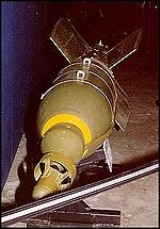
Laser-guided bomb

Encyclopedia
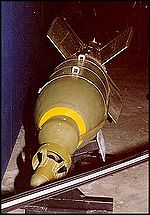
A laser-guided bomb is a guided bomb
that uses semi-active laser homing to strike a designated target with greater accuracy than an unguided bomb. LGBs are one of the most common and widespread guided bombs, used by a large number of the world's air forces.
 Laser-guided munitions use a laser designator
to mark (illuminate) a target. The reflected laser light ("sparkle") from the target is then detected by the seeker head of the weapon, which sends signals to the weapon's control surfaces to guide it toward the designated point. Laser-guided bombs are generally unpowered, using small fins to glide towards their targets. Powered laser-guided missiles, such as some variants of the US AGM-65 Maverick
and the French AS.30L, use the same guidance system, but have greater range and maneuverability because they are not limited to unpowered flight. Some LGB's have been fitted with strap-on rocket motors to increase their range; one such weapon is the USN AGM-123 Skipper
.
The earliest laser guidance seekers measured the intensity of the reflected laser light at four corners of the seeker window. The seeker then actuated the control fins to steer the weapon in the direction of the strongest signal return, thereby keeping the weapon centered on the laser sparkle. Later weapons have more sensitive seekers and more sophisticated control systems that waste less energy with course corrections, improving accuracy and range, but the principle remains essentially the same. The first such weapon to be developed was the Texas Instruments
BOLT-117
.
Most laser-guided bombs are produced in the form of strap-on kits: seeker heads, and steering fins that can be attached to a standard general-purpose bomb
or penetration bomb. Such kits are modular, allowing relatively easy upgrades, and are considerably cheaper than purpose-built weapons.
issued the first development contracts in 1964, leading to the development of the Paveway
series, which was used operationally in Vietnam
starting in 1968. Although there were a variety of technical and operational problems, the results were generally positive. LGBs proved to offer a much higher degree of accuracy than unguided weapons, but without the expense, complexity, and limitations of guided air-to-ground missiles like the AGM-12 Bullpup
. The LGB proved particularly effective against difficult fixed targets like bridges, which previously had required huge loads of "dumb" ordnance to destroy.
It was determined that 48% of Paveways dropped during 1972–73 around Hanoi
and Haiphong
achieved direct hits, compared with only 5.5% of unguided bombs dropped on the same area a few years earlier. The average Paveway landed within 23 feet of its target, as opposed to 447 feet for gravity bombs. The leap in accuracy brought about primarily by laser guidance made it possible to take out heavily defended, point objectives that had eluded earlier air raids.
The most dramatic example was the Thanh Hoa Bridge
, 70 miles south of Hanoi, a critical crossing point over the Red River
. Starting in 1965, U.S. pilots had flown 871 sorties against it, losing 11 planes without managing to put it out of commission. In 1972 the “Dragon’s Jaw” bridge was attacked with Paveway bombs, and 14 jets managed to do what the previous 871 had not: drop the span, and cut a critical North Vietnamese supply artery.
In the wake of this success, other nations, specifically the Soviet Union, France, and Great Britain, began developing similar weapons in the late 1960s and early 1970s, while US weapons were refined based on combat experience.
Recently, in October 2010, India has developed its first laser-guided bomb with the help of IRDE
, a lab of DRDO. This is a part of ongoing research to achieve self-dependency in defense area.
The USAF and other air forces are now seeking to upgrade their LGBs with GPS guidance as a back-up. These weapons, such as the USAF Enhanced Guided Bomb Unit (part of the Paveway family), use laser designation for precision attacks, but contain an inertial navigation system
with GPS receiver for back-up, so that if the target illumination is lost or broken, the weapon will continue to home in on the GPS coordinates of the original target.
The first problem is designation. To ensure accurate guidance, the target must be illuminated by a laser designator and the pilot must deliver the weapon within the "weapon basket" (the zone in which the weapon seeker can observe the laser target marker and the weapon has sufficient energy to guide to the target). Laser guided bombs can be launched without the laser designator turned on, in which case it will follow a ballistic path, until such time as the seeker picks up the reflected laser signal. This allows the aircraft to deliver an LGB using techniques such as loft or toss bombing
. However, if the designator is turned off, the laser spot moved, the laser signal is blocked (for example by cloud or smoke), the weapon's accuracy will be greatly reduced. A particular problem with laser designation can be path length under certain environmental conditions. Laser designators operate in the Infra-Red wavebands and attenuation of the laser signal by the moisture content of the atmosphere can reduce the signal strength below the threshold of the seeker. Laser designators modulate their output on a number of discrete codes and to guide correctly the bomb and designator must be matched.
For an accurate attack against a small target, uninterrupted designation is desirable. But, the simple guidance system of early LGBs (such as the American Paveway II) resulted in a rectilinear flight path, with a tendency to lag below the sightline. To compensate, crews will release their weapons on an unguided, ballistic flightpath, activating the designator only to refine the bomb's final impact point. This is more demanding of crew and aircraft, requiring a high standard of basic, unguided bombing accuracy and more attention to the bomb's flight.
In the 1970s and 1980s it was common for aircraft to rely on a separate designator, either carried by ground forces, operated by the forward air controller, or carried by another aircraft in the strike group. It was often deemed more practical for one aircraft to designate for its comrades. Modern conflicts and a growing emphasis on precision-guided weapons have pointed to the need for autonomous designation, and many fighter-bomber
aircraft are now being fitted with designator pods to self-designate for laser-guided munitions.
Even if the launch aircraft is capable of autonomous designation, the problems described above remain. Laser illumination can be interrupted by smoke, fog, or clouds, limiting the usefulness of LGBs in poor weather or very dusty conditions. In desert warfare, such as the 1991 Gulf War
, laser designation sometimes reflected off the sand, causing weapons to home on false targets. Furthermore, the need to provide designation may leave the aircraft dangerously exposed to ground fire or enemy air support.
An additional concern is the limited "weapon basket", if the weapon is released too low or too far from the target, or in a trajectory that puts the weapon outside the seeker's field of view, it will miss. Optimum altitude for an effective LGB attack is from medium altitude (20,000 - 30,000 ft), increasing the aircraft's vulnerability to surface-to-air missile
(SAM) attacks.
For these reasons, while all modern air forces have put an increasing emphasis on LGBs and other precision-guided munitions, some tacticians still see an important role for the accurate delivery of unguided bombs. During their 1981 raid on the Iraq
i nuclear reactor
at Osirak, the Israeli Air Force
chose to use unguided Mark 84 bomb
s rather than laser-guided weapons because they felt the need to designate the target would leave the attackers unacceptably vulnerable.
Guided bomb
A guided bomb is a precision-guided munition intended to precisely hit a specific target, and to minimize damage to things other than the target....
that uses semi-active laser homing to strike a designated target with greater accuracy than an unguided bomb. LGBs are one of the most common and widespread guided bombs, used by a large number of the world's air forces.
Overview
Laser designator
A laser designator is a laser light source which is used to designate a target. Laser designators provide targeting for laser guided bombs, missiles, or precision artillery munitions, such as the Paveway series of bombs, Lockheed-Martin's Hellfire, or the Copperhead round, respectively.When a...
to mark (illuminate) a target. The reflected laser light ("sparkle") from the target is then detected by the seeker head of the weapon, which sends signals to the weapon's control surfaces to guide it toward the designated point. Laser-guided bombs are generally unpowered, using small fins to glide towards their targets. Powered laser-guided missiles, such as some variants of the US AGM-65 Maverick
AGM-65 Maverick
The AGM-65 Maverick is an air-to-ground tactical missile designed for close-air support. It is effective against a wide range of tactical targets, including armor, air defenses, ships, ground transportation and fuel storage facilities....
and the French AS.30L, use the same guidance system, but have greater range and maneuverability because they are not limited to unpowered flight. Some LGB's have been fitted with strap-on rocket motors to increase their range; one such weapon is the USN AGM-123 Skipper
AGM-123 Skipper
AGM-123 Skipper II is a short-range laser-guided missile developed by the U.S. Navy.-Overview:The Skipper is a short range missile intended for precision strikes. It is composed of a Mark 83 bomb, fitted with a Paveway kit, and an attached rocket propulsion system to allow it to be dropped at...
.
The earliest laser guidance seekers measured the intensity of the reflected laser light at four corners of the seeker window. The seeker then actuated the control fins to steer the weapon in the direction of the strongest signal return, thereby keeping the weapon centered on the laser sparkle. Later weapons have more sensitive seekers and more sophisticated control systems that waste less energy with course corrections, improving accuracy and range, but the principle remains essentially the same. The first such weapon to be developed was the Texas Instruments
Texas Instruments
Texas Instruments Inc. , widely known as TI, is an American company based in Dallas, Texas, United States, which develops and commercializes semiconductor and computer technology...
BOLT-117
BOLT-117
The Texas Instruments BOLT-117 , retrospectively redesignated as the GBU-1/B was the world's first laser-guided bomb . It consisted of a standard M117 750-pound bomb case with a KMU-342 laser guidance and control kit...
.
Most laser-guided bombs are produced in the form of strap-on kits: seeker heads, and steering fins that can be attached to a standard general-purpose bomb
General-purpose bomb
A general-purpose bomb is an air-dropped bomb intended as a compromise between blast damage, penetration, and fragmentation in explosive effect.-Characteristics:...
or penetration bomb. Such kits are modular, allowing relatively easy upgrades, and are considerably cheaper than purpose-built weapons.
Development
Laser-guided weapons were first developed in the United States in the early 1960s. The United States Air ForceUnited States Air Force
The United States Air Force is the aerial warfare service branch of the United States Armed Forces and one of the American uniformed services. Initially part of the United States Army, the USAF was formed as a separate branch of the military on September 18, 1947 under the National Security Act of...
issued the first development contracts in 1964, leading to the development of the Paveway
Paveway
Paveway is a generic term for Laser Guided Bombs .Pave or PAVE is sometimes used as an acronym for precision avionics vectoring equipment; literally, electronics for controlling the speed and direction of aircraft...
series, which was used operationally in Vietnam
Vietnam War
The Vietnam War was a Cold War-era military conflict that occurred in Vietnam, Laos, and Cambodia from 1 November 1955 to the fall of Saigon on 30 April 1975. This war followed the First Indochina War and was fought between North Vietnam, supported by its communist allies, and the government of...
starting in 1968. Although there were a variety of technical and operational problems, the results were generally positive. LGBs proved to offer a much higher degree of accuracy than unguided weapons, but without the expense, complexity, and limitations of guided air-to-ground missiles like the AGM-12 Bullpup
AGM-12 Bullpup
The AGM-12 Bullpup is an air-to-ground missile which was used on the A-4 Skyhawk, A-6 Intruder, F-105 Thunderchief and F-4 Phantom among others...
. The LGB proved particularly effective against difficult fixed targets like bridges, which previously had required huge loads of "dumb" ordnance to destroy.
It was determined that 48% of Paveways dropped during 1972–73 around Hanoi
Hanoi
Hanoi , is the capital of Vietnam and the country's second largest city. Its population in 2009 was estimated at 2.6 million for urban districts, 6.5 million for the metropolitan jurisdiction. From 1010 until 1802, it was the most important political centre of Vietnam...
and Haiphong
Haiphong
, also Haiphong, is the third most populous city in Vietnam. The name means, "coastal defence".-History:Hai Phong was originally founded by Lê Chân, the female general of a Vietnamese revolution against the Chinese led by the Trưng Sisters in the year 43 C.E.The area which is now known as Duong...
achieved direct hits, compared with only 5.5% of unguided bombs dropped on the same area a few years earlier. The average Paveway landed within 23 feet of its target, as opposed to 447 feet for gravity bombs. The leap in accuracy brought about primarily by laser guidance made it possible to take out heavily defended, point objectives that had eluded earlier air raids.
The most dramatic example was the Thanh Hoa Bridge
Thanh Hoa Bridge
The Thanh Hoa Bridge, spanning the Song Ma river, is situated northeast of Thanh Hóa , the capital of Thanh Hoa province in Vietnam. The Vietnamese gave it the nickname Ham Rong . In 1965 during the Vietnam war, it was the objective of many attacks by US Air Force and US Navy aircraft which would...
, 70 miles south of Hanoi, a critical crossing point over the Red River
Red River (Vietnam)
The Red River , also known as the Sông Cái - Mother River , or Yuan River , is a river that flows from southwest China through northern Vietnam to the Gulf of Tonkin...
. Starting in 1965, U.S. pilots had flown 871 sorties against it, losing 11 planes without managing to put it out of commission. In 1972 the “Dragon’s Jaw” bridge was attacked with Paveway bombs, and 14 jets managed to do what the previous 871 had not: drop the span, and cut a critical North Vietnamese supply artery.
In the wake of this success, other nations, specifically the Soviet Union, France, and Great Britain, began developing similar weapons in the late 1960s and early 1970s, while US weapons were refined based on combat experience.
Recently, in October 2010, India has developed its first laser-guided bomb with the help of IRDE
Instruments Research and Development Establishment
Instruments Research & Development Establishment is a laboratory of the Defence Research & Development Organization . Located in Dehradun, its primary function is research and development in the field of optical and electro-optical instrumentation. Their objective is to develop products like night...
, a lab of DRDO. This is a part of ongoing research to achieve self-dependency in defense area.
The USAF and other air forces are now seeking to upgrade their LGBs with GPS guidance as a back-up. These weapons, such as the USAF Enhanced Guided Bomb Unit (part of the Paveway family), use laser designation for precision attacks, but contain an inertial navigation system
Inertial navigation system
An inertial navigation system is a navigation aid that uses a computer, motion sensors and rotation sensors to continuously calculate via dead reckoning the position, orientation, and velocity of a moving object without the need for external references...
with GPS receiver for back-up, so that if the target illumination is lost or broken, the weapon will continue to home in on the GPS coordinates of the original target.
Problems and limitations
While LGBs are highly accurate under ideal conditions, they present several challenges for successful use, making them somewhat less than the "silver bullet" sometimes suggested.The first problem is designation. To ensure accurate guidance, the target must be illuminated by a laser designator and the pilot must deliver the weapon within the "weapon basket" (the zone in which the weapon seeker can observe the laser target marker and the weapon has sufficient energy to guide to the target). Laser guided bombs can be launched without the laser designator turned on, in which case it will follow a ballistic path, until such time as the seeker picks up the reflected laser signal. This allows the aircraft to deliver an LGB using techniques such as loft or toss bombing
Toss bombing
Toss bombing is a method of bombing where the attacking aircraft pulls upwards when releasing its bomb load, giving the bomb additional time of flight by starting its ballistic path with an upward vector.The purpose of toss bombing is to compensate for the gravity drop of the...
. However, if the designator is turned off, the laser spot moved, the laser signal is blocked (for example by cloud or smoke), the weapon's accuracy will be greatly reduced. A particular problem with laser designation can be path length under certain environmental conditions. Laser designators operate in the Infra-Red wavebands and attenuation of the laser signal by the moisture content of the atmosphere can reduce the signal strength below the threshold of the seeker. Laser designators modulate their output on a number of discrete codes and to guide correctly the bomb and designator must be matched.
For an accurate attack against a small target, uninterrupted designation is desirable. But, the simple guidance system of early LGBs (such as the American Paveway II) resulted in a rectilinear flight path, with a tendency to lag below the sightline. To compensate, crews will release their weapons on an unguided, ballistic flightpath, activating the designator only to refine the bomb's final impact point. This is more demanding of crew and aircraft, requiring a high standard of basic, unguided bombing accuracy and more attention to the bomb's flight.
In the 1970s and 1980s it was common for aircraft to rely on a separate designator, either carried by ground forces, operated by the forward air controller, or carried by another aircraft in the strike group. It was often deemed more practical for one aircraft to designate for its comrades. Modern conflicts and a growing emphasis on precision-guided weapons have pointed to the need for autonomous designation, and many fighter-bomber
Fighter-bomber
A fighter-bomber is a fixed-wing aircraft with an intended primary role of light tactical bombing and also incorporating certain performance characteristics of a fighter aircraft. This term, although still used, has less significance since the introduction of rockets and guided missiles into aerial...
aircraft are now being fitted with designator pods to self-designate for laser-guided munitions.
Even if the launch aircraft is capable of autonomous designation, the problems described above remain. Laser illumination can be interrupted by smoke, fog, or clouds, limiting the usefulness of LGBs in poor weather or very dusty conditions. In desert warfare, such as the 1991 Gulf War
Gulf War
The Persian Gulf War , commonly referred to as simply the Gulf War, was a war waged by a U.N.-authorized coalition force from 34 nations led by the United States, against Iraq in response to Iraq's invasion and annexation of Kuwait.The war is also known under other names, such as the First Gulf...
, laser designation sometimes reflected off the sand, causing weapons to home on false targets. Furthermore, the need to provide designation may leave the aircraft dangerously exposed to ground fire or enemy air support.
An additional concern is the limited "weapon basket", if the weapon is released too low or too far from the target, or in a trajectory that puts the weapon outside the seeker's field of view, it will miss. Optimum altitude for an effective LGB attack is from medium altitude (20,000 - 30,000 ft), increasing the aircraft's vulnerability to surface-to-air missile
Surface-to-air missile
A surface-to-air missile or ground-to-air missile is a missile designed to be launched from the ground to destroy aircraft or other missiles...
(SAM) attacks.
For these reasons, while all modern air forces have put an increasing emphasis on LGBs and other precision-guided munitions, some tacticians still see an important role for the accurate delivery of unguided bombs. During their 1981 raid on the Iraq
Iraq
Iraq ; officially the Republic of Iraq is a country in Western Asia spanning most of the northwestern end of the Zagros mountain range, the eastern part of the Syrian Desert and the northern part of the Arabian Desert....
i nuclear reactor
Nuclear reactor
A nuclear reactor is a device to initiate and control a sustained nuclear chain reaction. Most commonly they are used for generating electricity and for the propulsion of ships. Usually heat from nuclear fission is passed to a working fluid , which runs through turbines that power either ship's...
at Osirak, the Israeli Air Force
Israeli Air Force
The Israeli Air Force is the air force of the State of Israel and the aerial arm of the Israel Defense Forces. It was founded on May 28, 1948, shortly after the Israeli Declaration of Independence...
chose to use unguided Mark 84 bomb
Mark 84 bomb
The Mark 84 is an American general-purpose bomb, it is also the largest of the Mark 80 series of weapons. Entering service during the Vietnam War, it became a commonly used US heavy unguided bomb to be dropped, second only to the BLU-82 "Daisy Cutter" then in service and presently third only to...
s rather than laser-guided weapons because they felt the need to designate the target would leave the attackers unacceptably vulnerable.
See also
- Joint Direct Attack MunitionJoint Direct Attack MunitionThe Joint Direct Attack Munition is a guidance kit that converts unguided bombs, or "dumb bombs" into all-weather "smart" munitions. JDAM-equipped bombs are guided by an integrated inertial guidance system coupled to a Global Positioning System receiver, giving them a published range of up to...
- KAB-500LKAB-500LThe KAB-500L is a laser-guided bomb developed by the Soviet Air Force. It remains in service with the CIS and post-Soviet Russian Air Force.The KAB-500L is analogous to the U.S...
- Bombe Guidée LaserBombe Guidée LaserBombe Guidée Laser laser-guided bombs were developed by MATRA starting in 1978. The guidance system had to work using the same principles as the US Paveway guided bombs. The guidance kits were intended as modifications to existing free fall bombs that were in service with the French Air Force...
- Laser guidanceLaser guidanceLaser guidance is a technique of guiding a missile or other projectile or vehicle to a target by means of a laser beam. Some laser guided systems utilise beam riding guidance, but most operate more similarly to semi-active radar homing . This technique is sometimes called SALH, for Semi-Active...
- Missile guidanceMissile guidanceMissile guidance refers to a variety of methods of guiding a missile or a guided bomb to its intended target. The missile's target accuracy is a critical factor for its effectiveness...