


Eurofighter Typhoon

Encyclopedia
The Eurofighter Typhoon is a twin-engine, canard
-delta wing
, multirole
combat aircraft, designed and built by a consortium
of three companies: EADS
, Alenia Aeronautica
and BAE Systems
; working through a holding company, Eurofighter GmbH
, which was formed in 1986. The project
is managed by the NATO Eurofighter and Tornado Management Agency, which acts as the prime customer.
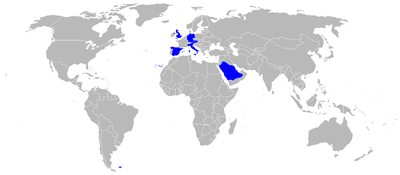
The series production of the Eurofighter Typhoon is underway, and the aircraft is being procured under separate contracts, named "tranches", each for aircraft with generally improved capabilities. The aircraft has entered service with the Austrian Air Force
, the Italian Air Force
, the German Luftwaffe
, the British Royal Air Force
, the Spanish Air Force
, and the Royal Saudi Air Force
.
 The UK had identified a requirement for a new fighter as early as 1971. A specification, AST 403, issued by the Air Staff in 1972, resulted in a conventional "tailed" design known as P.96, which was presented in the late 1970s. While the design would have met the Air Staff's requirements, the UK air industry had reservations as it appeared to be very similar to the McDonnell Douglas F/A-18 Hornet
, which was then well advanced in its development. The design had little potential for future growth, and when it entered production it would secure few exports in a market in which the Hornet would be well established. However, the simultaneous West German requirement for a new fighter had led by 1979 to the development of the TKF-90 concept. This was a cranked delta wing design with forward canard controls
and artificial stability. Although the British Aerospace designers rejected some of its advanced features such as vectoring engine nozzles and vented trailing-edge controls, they agreed with the overall configuration.
In 1979, Messerschmitt-Bölkow-Blohm
(MBB) and British Aerospace
(BAe) presented a formal proposal to their respective governments for the ECF, the European Collaborative Fighter or European Combat Fighter. In October 1979 Dassault
joined the ECF team for a tri-national study, which became known as the European Combat Aircraft. It was at this stage of development that the Eurofighter name was first attached to the aircraft. The development of different national prototypes continued. France produced the ACX. The UK produced two designs; the P.106was a single-engined "lightweight" fighter, superficially resembling the JAS 39 Gripen
, the P.110 was a twin-engined fighter. The P.106 concept was rejected by the RAF, on the grounds that it had "half the effectiveness of the two-engined aircraft at two thirds of the cost". West Germany continued to refine the TFK-90 concept. The ECA project collapsed in 1981 for several reasons including differing requirements, Dassault's insistence on "design leadership" and the British preference for a new version of the RB199
to power the aircraft versus the French preference for the new Snecma M88
.
As a result the Panavia partners (MBB, BAe and Aeritalia
) launched the Agile Combat Aircraft (ACA) programme in April 1982. The ACA was very similar to the BAe P.110, having a cranked delta wing, canards and a twin tail. One major external difference was the replacement of the side mounted engine intakes with a chin intake. The ACA was to be powered by a modified version of the RB199. The German and Italian governments withdrew funding, and the UK Ministry of Defence
agreed to fund 50% of the cost with the remaining 50% to be provided by industry. MBB and Aeritalia signed up with the aim of producing two aircraft, one at Warton and one by MBB. In May 1983 BAe announced a contract with the MoD
for the development and production of an ACA demonstrator, the Experimental Aircraft Programme
.
In 1983 the Germany, France, UK, Italy and Spain launched the Future European Fighter Aircraft (FEFA) programme. The aircraft was to have short take off and landing
(STOL) and beyond visual range (BVR) capabilities. In 1984 France reiterated its requirement for a carrier-capable
version and demanded a leading role. The West Germany, UK and Italy opted out and established a new EFA programme. In Turin
on 2 August 1985, West Germany, UK and Italy agreed to go ahead with the Eurofighter; and confirmed that France, along with Spain, had chosen not to proceed as a member of the project. Despite pressure from France, Spain rejoined the Eurofighter project in early September 1985. France officially withdrew from the project to pursue its own ACX project, which was to become the Dassault Rafale
.
 By 1986, the cost of the programme had reached £
180 million. When the EAP programme had started, the cost was supposed to be equally shared by both government and industry, but the West German and Italian government wavered on the agreement and the three main industrial partners had to provide £100 million to keep the programme from ending. In April 1986 the BAe EAP was rolled out at BAe Warton, by this time also partially funded by MBB, BAe and Aeritalia. The EAP first flew on 6 August 1986. The Eurofighter bears a strong resemblance to the EAP. Design work continued over the next five years using data from the EAP. Initial requirements were: UK: 250 aircraft, Germany: 250, Italy: 165 and Spain: 100. The share of the production work was divided among the countries in proportion to their projected procurement – DASA (33%), British Aerospace
(33%), Aeritalia
(21%), and Construcciones Aeronáuticas SA
(CASA) (13%).
The Munich based Eurofighter Jagdflugzeug GmbH was established in 1986 to manage development of the project and EuroJet Turbo GmbH
, the alliance of Rolls-Royce
, MTU Aero Engines
, FiatAvio (now Avio) and ITP
for development of the EJ200
. The aircraft was known as Eurofighter EFA from the late 1980s until it was renamed EF 2000 in 1992.
By 1990, the selection of the aircraft's radar had become a major stumbling block. The UK, Italy and Spain supported the Ferranti Defence Systems
-led ECR-90, while Germany preferred the APG-65 based MSD2000 (a collaboration between Hughes
, AEG
and GEC-Marconi). An agreement was reached after UK Defence Secretary Tom King
assured his West German counterpart Gerhard Stoltenberg
that the British government would approve the project and allow GEC to acquire Ferranti Defence Systems from its troubled parent. GEC thus withdrew its support for the MSD2000.
of the Eurofighter prototype took place in Bavaria
on 27 March 1994, flown by DASA Chief Test Pilot Peter Weger. On 9 December 2004, Eurofighter Typhoon IPA4 began three months of Cold Environmental Trials (CET) at the Vidsel
Air Base in Sweden, the purpose of which was to verify the operational behaviour of the aircraft and its systems in temperatures between −25 and 31 °C. The maiden flight of Instrumented Production Aircraft 7 (IPA7), the first fully equipped Tranche 2 aircraft, took place from EADS' Manching
airfield on 16 January 2008.
In May 2007, Eurofighter Development Aircraft 5 made the first flight with the CAESAR demonstrator system, a development of the Euroradar CAPTOR
incorporating Active Electronically Scanned Array
(AESA) technology. The production version of the CAPTOR-E radar was being proposed as part of Tranche 3 of the Typhoon from 2012. Tranche 2 aircraft use the non AESA, mechanically scanned Captor-M which incorporates weight and space provisions for possible upgrade to CAESAR (AESA) standard in the future. The Italian Air Force doubted that the AESA radar would be ready in time for Tranche 3 production. In July 2010, Eurofighter announced that the AESA radar would enter service in 2015.
On 2 September 1998, a naming ceremony was held at Farnborough
, United Kingdom. This saw the Typhoon name formally adopted, initially for export aircraft only. This was reportedly resisted by Germany; perhaps because the Hawker Typhoon
was a fighter-bomber aircraft which served with the RAF during the Second World War against German targets. The name "Spitfire II" (for the famous British WWII fighter, the Supermarine Spitfire
) had also been considered and rejected for the same reason early in the development programme. In September 1998 contracts were signed for production of 148 Tranche 1 aircraft and procurement of long lead-time items for Tranche 2 aircraft. In March 2008 the final aircraft out of Tranche 1 was delivered to the German Luftwaffe, with all successive deliveries being at the Tranche 2 standard. On 21 October 2008, the first two of 91 Tranche 2 aircraft, ordered four years before, were delivered to RAF Coningsby.
In October 2008, the Eurofighter nations were considering splitting the 236-fighter Tranche 3 into two parts. In June 2009, RAF Air Chief Marshal Sir Glenn Torpy
suggested that the RAF fleet might only be 123 jets, instead of the 232 previously planned. In spite of this reduction in the number of required aircraft, on 14 May 2009, British Prime Minister Gordon Brown confirmed that the UK would move ahead with the third batch purchase. A contract for the first part, Tranche 3A, was signed at the end of July 2009 for 112 aircraft split across the four partner nations, including 40 aircraft for the UK, 31 for Germany, 21 for Italy and 20 for Spain. These 40 aircraft were said to have fully covered the UK's obligations in the project by Air Commodore Chris Bushell, due to cost overruns in the project.
By 2007, Germany estimated the system cost (aircraft, training plus spare parts) to €120m and said it was in perpetual increase. On 17 June 2009, Germany ordered 31 aircraft of Tranche 3A for €2,800m, leading to a system cost of €90m per aircraft. The UK's Committee of Public Accounts reported that the mismanagement of the project had helped increase the cost of each aircraft by 75 percent. Defence Secretary
Liam Fox
responded that "I am determined that in the future such projects are properly run from the outset, and I have announced reforms to reduce equipment delays and cost overruns."
caused Helmut Kohl
to make an election
promise to cancel the Eurofighter. In early to mid-1991 German Defence Minister Volker Rühe
sought to withdraw Germany from the project in favour of using Eurofighter technology in a cheaper, lighter plane. Due to the amount of money already spent on development, the number of jobs dependent on the project, and the binding commitments on each partner government, Helmut Kohl
was unable to withdraw; "Rühe's predecessors had locked themselves into the project by a punitive penalty system of their own devising."
In 1995 concerns over workshare appeared. Since the formation of Eurofighter the workshare split had been agreed at the 33/33/21/13 (United Kingdom/Germany/Italy/Spain) based on the number of units being ordered by each contributing nation. All the nations then reduced their orders. The UK cut its orders from 250 to 232, Germany from 250 to 140, Italy from 165 to 121 and Spain from 100 to 87. According to these order levels the workshare split should have been 39/24/22/15 UK/Germany/Italy/Spain, Germany was unwilling to give up such a large amount of work. In January 1996, after much negotiation between German and UK partners, a compromise was reached whereby Germany would purchase another 40 aircraft. The workshare split is now 43% for EADS MAS in Germany and Spain; 37.5% BAE Systems in the UK; and 19.5% for Alenia in Italy.
The next major milestone came at the Farnborough Airshow in September 1996. The UK announced the funding for the construction phase of the project. In November 1996 Spain confirmed its order but Germany delayed its decision. After much diplomatic activity between Germany and UK, an interim funding arrangement of DM100 million (€51 million) was contributed by the German government in July 1997 to continue flight trials. Further negotiation finally resulted in German approval to purchase the Eurofighter in October 1997.
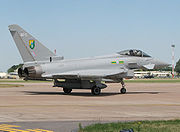 The Eurofighter Typhoon is unique in modern combat aircraft in that there are four separate assembly lines. Each partner company assembles its own national aircraft, but builds the same parts for all 683 aircraft (including exports). A fifth assembly line will be established for the final 48 Saudi aircraft.
Premium AEROTEC
: Main centre fuselage
EADS CASA: Right wing, leading edge slats
BAE Systems
: Front fuselage (including foreplanes), canopy, dorsal spine, tail fin, inboard flaperons, rear fuselage section
Alenia Aeronautica
: Left wing, outboard flaperon
s, rear fuselage sections
Production is divided into three tranches (see table below). Tranches are a production/funding distinction, and do not necessarily imply an incremental increase in capability with each tranche. Tranche 3 will most likely be based on late Tranche 2 aircraft with improvements added. Tranche 3 has been split into A and B parts.
Tranches are further divided up into production standard/capability blocks and funding/procurement batches, though these do not coincide, and are not the same thing; e.g., the Eurofighter designated FGR4 by the RAF is a Tranche 1, block 5. Batch 1 covered block 1, but batch 2 covered blocks 2, 2B and 5.
On 25 May 2011 the 100th production aircraft, ZK315, rolled off the production line at Warton.
 Unite the Union
general secretary Len McCluskey
has called for the development of a more advanced radar to make the Eurofighter "more exportable". This AESA radar is seen as vital for the Indian purchase.
had agreed to purchase 72 Typhoons. In November and December it was reported that Saudi Arabia had threatened to buy French Rafales because of a UK Serious Fraud Office
investigation into the Al Yamamah
("the dove") defence deals which commenced in the 1980s.
On 14 December 2006, Britain's attorney general, Lord Goldsmith, ordered that the Serious Fraud Office discontinue its investigation in the BAE Systems' alleged bribery to senior Saudi officials in the al-Yamamah contracts, citing "the need to safeguard national and international security". The Times
has raised the possibility that RAF production aircraft will be diverted as early Saudi Arabian aircraft, with the service forced to wait for its full complement of aircraft. This arrangement would mirror the diversion of RAF Tornados
to the RSAF. The Times has also reported that such an arrangement will make the UK purchase of its Tranche 3 commitments more likely. On 17 September 2007, Saudi Arabia
confirmed it had signed a GB£4.43 billion contract for 72 aircraft. 24 aircraft will be at the Tranche 2 build standard, previously destined for the UK RAF, the first being delivered in 2008. The remaining 48 aircraft will be assembled in Saudi Arabia and delivered from 2011. Saudi Arabia is considering an order of 24 additional jets in the future, more recent reports suggest that number may be as high as 60 or 72, but this may have been superseded by Saudi Arabia's request in August 2010 to purchase 84 new F-15s.
On 29 September 2008 the United States Department of State approved the sale, required because of a certain technology governed by the ITAR process which was incorporated into the MIDS
of the Eurofighter.
On 22 October 2008, the first Typhoon in the colours of the Royal Saudi Air Force flew for the first time at BAE Systems’ Warton Aerodrome, marking the start of the test flight programme for RSAF aircraft. Following the official handover of the first Eurofighter Typhoon to the Royal Saudi Air Force on 11 June 2009, the delivery ferry flight took place on 23 June 2009. Since 2010, BAE Systems has been training Saudi Arabian personnel at their factory in Warton, in preparation for setting up an assembly plant in Saudi Arabia.
Eurofighter Typhoon is one of the contenders in the Indian MRCA competition
to supply the Indian Air Force
with 126 "Medium Multi-Role Combat Aircraft". The other competitors are the Boeing F/A-18IN, Dassault Rafale
, Saab JAS 39 GripenNG/IN, Mikoyan MiG-35
, and Lockheed Martin F-16IN Fighting Falcon. Bernhard Gerwert, CEO of EADS military air systems, said that India is invited to join the Eurofighter Typhoon programme as a partner. The production of the Eurofighter Typhoon will create thousands of new jobs in India and Europe. He also said that in order to win the contract, EADS would move avionics jobs from Germany to India. The campaign is fully supported by the four European nations (Germany, United Kingdom, Spain and Italy), their four Air Forces and Europe's leading aerospace companies Alenia/Finmeccanica, BAE Systems and EADS.
In July 2007, Indian Air Force's (IAF) Sukhoi Su-30MKI fighters, which were at Waddington for the bilateral air "Exercise Indradhanush-2007", trained with RAF Typhoons.
In January 2010, India's ambassador to Italy, Arif Shahid Khan, said that the Eurofighter was "leading the race" to win the MMRCA competition. As reported by the Ministry of Defence on 27 April 2011, the Government of India announced that the Eurofighter is one of two fighters selected for initial bidding for the multi-billion dollar deal of 126 Multi-role medium fighter aircraft. The other fighter shortlisted is the French Rafale.
In March 2007, Jane's Information Group
reported that the Typhoon was the favourite to win the contest for Japan's next-generation fighter requirement. The other competitors then were the F/A-18E/F Super Hornet and McDonnell Douglas F-15E Strike Eagle. On 17 October 2007, Japanese Defence Minister Shigeru Ishiba
confirmed that Japan may buy the Typhoon. Although the F-22 Raptor was in his words "exceptional", it was not "absolutely necessary for Japan", and the Typhoon was the best alternative. The F-22 is currently unavailable for export per US law. During a visit to Japan in June 2009, Andy Latham of BAE pointed out that while F-22 exports were restricted to keep advanced military technology from falling into the wrong hands, selling the Typhoon would take a "no black box approach", that is that even licensed production and integration with Japanese equipment would not carry the risk of leakage of restricted military technology. In July 2010, it was reported that the Japan Air Self-Defense Force
favoured acquiring the F-35 ahead of the Typhoon and the F/A-18E/F to fulfill its F-X requirement due to its stealth characteristics, but the Defense Ministry was delaying its budget request to evaluate when the F-35 would be produced and delivered. David Howell of the UK foreign office has suggested that Japan could partner with Britain in the continuing development of the Eurofighter.
In 1999, the Greek government agreed to acquire 60 Typhoons in order to replace its existing second-generation combat aircraft. The purchase was put on hold due to budget constraints, largely driven by other development programmes and the need to cover the cost of the 2004 Summer Olympics
. In June 2006 the government announced a 22 billion euro multi-year acquisition plan intended to provide the necessary budgetary framework to enable the purchase of a next-generation fighter over the next 10 years. The Typhoon is currently under consideration to fill this requirement.
During the 2008 Farnborough Airshow it was announced that Oman was in an "advanced stage" of discussions towards purchasing EF Typhoons as a replacement for its Jaguar aircraft. Oman remained interested in ordering Typhoons in April 2010 though the Saab JAS 39 Gripen was also being considered. In April 2010, Oman revealed negotiations for an order of 18 F-16s, thus making a Eurofighter order less likely. The Qatar Emiri Air Force is, as of January 2011, evaluating the Typhoon together with the Lockheed Martin F-35 Joint Strike Fighter, the Boeing F/A-18E/F Super Hornet, the Boeing F-15 and the Dassault Rafale to replace its current inventory of Dassault Mirage 2000-5s. The total order for 24–36 aircraft will be decided on by the end of 2012.
Other potential customers of the Typhoon are Denmark, Norway and Romania
. BAE Systems itself reports that Typhoon is "actively being promoted in a number of other markets including Greece, Switzerland, Turkey
and Japan". Turkey has since indicated a preference for purchasing larger quantities of F-35 Lightning IIs and that: "Eurofighter is off Turkey's agenda". In 2010, the government of Serbia
displayed open interest in the Eurofighter. In July 2011, South Korea
was invited to join the Eurofighter project as a full member.
On 2 December 2009, BAE Systems announced its intention to market the Typhoon as a replacement for the Royal Malaysian Air Force (RMAF) Mikoyan MiG-29
N, due to be phased out in late 2010. According to the Regional Director-Business Development Dave Potter, the Typhoon's multi-role capabilities allow it to replace the MiG-29N. Other contenders include Boeing F/A-18E/F Super Hornet, Boeing F-15, Dassault Rafale, JAS 39 Gripen NG, Sukhoi Su-35
, and Lockheed F-16C/D block 52 Fighting Falcon.
was selected as the long range air-to-air missile armament of Eurofighter Typhoon. Pending Meteor availability, Typhoon will be equipped with the Raytheon
AMRAAM. The predicted in-service date for Meteor is August 2012.
In 2009, Eurofighter operators and manufacturers met to consider the upgrading of the current fleet with the MBDA Meteor
missile and an Active Electronically Scanned Array
radar. On 22 June 2011, it was announced that the partner nations had agreed to fund development of the next generation E-Scan radar, and confirmed an entry into service date of 2015.
Eurojet is attempting to find funding to test a thrust vectoring nozzle (TVN) on a flight demonstrator. Additionally, the RAF has sought to develop conformal fuel tanks (CFT) for their Typhoons to free up underwing space for weapons.
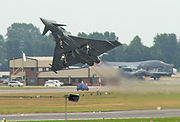
design. It has a quadruplex digital fly-by-wire
control system providing artificial stability, manual operation alone could not compensate for the inherent instability. The fly-by-wire system is described as "carefree", and prevents the pilot from exceeding the permitted manoeuvre envelope. Roll control is primarily achieved by use of the wing flaperon
s. Pitch control is by operation of the foreplanes and flaperons, the yaw control is by rudder. Control surfaces are moved through two independent hydraulic systems that are incorporated in the aircraft, which also supply various other items, such as the canopy, brakes and undercarriage; powered by a 4000 psi engine-driven gearbox.
 Navigation is via both GPS and an inertial navigation system
. The Typhoon can use Instrument Landing System
(ILS) for landing in poor weather. The aircraft also features a ground proximity warning system
based on the TERPROM
Terrain Referenced Navigation (TRN) system used by the Panavia Tornado. The Multifunctional Information Distribution System (MIDS) provides a Link 16
data link.
The aircraft employs a sophisticated and highly integrated Defensive Aids Sub-System named Praetorian (formerly called EuroDASS). Praetorian monitors and responds automatically to Air-to-Air and Air-to-Surface threats, provides an all-round prioritized assessment, and can respond to multiple threats simutaneously. Threat detection methods include a Radar Warning Receiver
(RWR) and a Laser Warning Receiver
(LWR, only on UK Typhoons). Protection is provided by Chaff, Jaff and Flares, Electronic Counter Measures (ECM) and a Towed Radar Decoy (TRD).
The Typhoon features lightweight construction (82% composites consisting of 70% carbon fibre composites and 12% glass reinforced composites) with an estimated lifespan of 6000 flying hours.
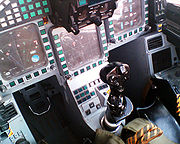 The Eurofighter Typhoon features a glass cockpit
without any conventional instruments. It includes: three full colour multi-function head-down displays (MHD
Ds) (the formats on which are manipulated by means of softkeys, XY cursor, and voice (DVI
) command), a wide angle head-up display (HUD
) with forward-looking infrared (FLIR), voice and hands-on throttle and stick (Voice+HOTAS
), Helmet Mounted Symbology System (HMSS
), Multifunctional Information Distribution System
(MIDS), a manual data-entry facility (MDEF) located on the left glareshield and a fully integrated aircraft warning system with a dedicated warnings panel (DWP). Reversionary flying instruments, lit by LED
s, are located under a hinged right glareshield.
The cockpit was developed with a user-centric focus, the layout and functionality was created through feedback and assessments from military pilots and a specialist testing facility. The pilot controls the aircraft by means of a centre stick
and left hand throttle
s, designed on a Hand on Throttle & Stick (HOTAS) principle to lower pilot workloads. Emergency escape is provided by a Martin-Baker
Mk.16A ejection seat, with the canopy being jettisoned by two rocket motors. The HMSS has been delayed for many years but should be operational by the end of 2011.
The aircraft's standard g-force protection is provided by the full-cover anti-g trousers (FCAGTs). This specially developed g suit provides sustained protection up to 9 g. The Typhoon pilots of the German Air Force and Austrian Air Force wear a hydrostatic g-suit called Libelle (dragonfly) Multi G Plus instead, which also provides protection to the arms, theoretically allowing for more complete g tolerance.
system utilises a speech recognition module (SRM), developed by Smiths Aerospace (now GE Aviation Systems) and Computing Devices (now General Dynamics
UK). It was the first production DVI system utilised in a military cockpit. DVI provides the pilot with an additional natural mode of command and control over approximately 26 non-critical cockpit functions, to reduce pilot workload, improve aircraft safety, and expand mission capabilities. An important step in the development of the DVI occurred in 1987 when Texas Instruments
completed the TMS-320-C30, a digital signal processor, enabling reductions size and system complexity required. The project was given the go ahead in July 1997, with development and pilot assessment carried out on the Eurofighter Active Cockpit Simulator at BAE Systems Warton.
The DVI system is speaker-dependent; i.e., requires each pilot to create a template. It is not used for any safety-critical or weapon-critical tasks, such as weapon release or lowering of the undercarriage, but is used for a wide range of other cockpit functions. Voice commands are confirmed by visual or aural feedback. The system is seen as a major design feature in the reduction of pilot workload
and even allows the pilot to assign targets to himself with two simple voice commands, or to any of his wingmen with only five commands.
is the lead contractor which, along with Thales Optronics
(system technical authority) and Tecnobit of Spain, make up the EUROFIRST consortium responsible for the system's design and development.
PIRATE operates in two IR bands, 3–5 and 8–11 micrometres. When used with the radar in an air-to-air role, it functions as an infrared search and track system, providing passive target detection and tracking. In an air-to-surface role, it performs target identification and acquisition. It also provides a navigation and landing aid. PIRATE is linked to the pilot’s helmet mounted display.
Eurofighters starting with Tranche 1 block 5 have the PIRATE. The first Eurofighter Typhoon with PIRATE-IRST was delivered to the Italian Aeronautica Militare
in August 2007. More advanced targeting capabilities can be provided with the addition of a targeting pod such as the LITENING pod.
 In 2004, United States Air Force
Chief of Staff General John P. Jumper
said after flying the Eurofighter, "I have flown all the air force jets. None was as good as the Eurofighter."
The Typhoon's combat performance, compared to the F-22 Raptor and the upcoming F-35 Lightning II
fighters and the French Dassault Rafale, has been the subject of much discussion. In March 2005, Jumper, then the only person to have flown both the Eurofighter Typhoon and the Raptor, talked to Air Force Print News about these two aircraft. He said,
In July 2007, the Indian Air Force fielded the Su-30MKI during the Indra-Dhanush exercise with Royal Air Force's Typhoon. This was the first time that the two jets had taken part in such an exercise. The IAF did not allow their pilots to use the MKI's radar during the exercise to protect the highly-classified N011M Bars
. RAF Tornado
pilots were candid in their admission of the Su-30MKI's superior manoeuvring in the air, just as they had anticipated, but the IAF pilots were also impressed by the Typhoon's agility in the air. This summary of the Indra-Dhanush is often mis-quoted by leaving the word "Tornado" out of the statement, to make it appear that it is the Typhoon which was less manoeuvrable than the Su-30MKI. The RAF however, were adamant that the Typhoon and Sukhoi did not actually go in mock combat on that particular exercise. In this context, the quote from the IAF pilots concerning the agility of the Typhoon no longer appears self contradictory.
The Typhoon is capable of supersonic cruise without using afterburner
s (referred to as supercruise
). According to the official German Luftwaffe and Austrian Eurofighter website, the maximum speed possible without reheat is between Mach 1.2 and Mach 1.5. Air Forces Monthly gives a maximum supercruise speed of Mach 1.1 for the RAF FGR4 multirole version. It has been suggested, in contradiction to other sources that the Eurofighter Typhoon could only supercruise in a clean configuration without external missiles and fuel tanks. While this is untrue, attention is drawn by these suggestions to the fact that not all weapons loadouts are necessarily certified for supersonic flight at all, even with afterburner.
The Eurofighter consortium claims their fighter has a larger sustained subsonic turn rate, sustained supersonic turn rate, and faster acceleration at Mach 0.9 at 20000 feet (6,096 m) than the Grumman F-14 Tomcat, F-15 Eagle, F-16 Fighting Falcon, McDonnell Douglas F/A-18 Hornet, Dassault Mirage 2000, Dassault Rafale, the Sukhoi Su-27
, and the Mikoyan MiG-29
.
In 2005, a trainer Eurofighter T1 was reported to have had a chance encounter the previous year with two U.S. Air Force F-15Es over the Lake District in the north of England. The encounter became a mock dogfight with the Eurofighter allegedly emerging "victorious".
In the 2005 Singapore evaluation, the Typhoon won all three combat tests, including one in which a single Typhoon defeated three RSAF F-16s, and reliably completed all planned flight tests. In July 2009, Former Chief of Air Staff for the Royal Air Force, Air Chief Marshal Sir Glenn Torpy
, said that "The Eurofighter Typhoon is an excellent aircraft. It will be the backbone of the Royal Air Force along with the JSF".
Eurofighter claims that their aircraft will be able to defeat a "generic" stealth fighter through the use of IRST and by flying a wall formation, which would ensure that at least some of the Eurofighters are not facing the minimum nose-on RCS that stealth fighters have been designed for.
 The Typhoon is a multi-role fighter with maturing air-to-ground capabilities. Earlier than scheduled, the RAF integrated the air to ground capability, based on the Rafael/Ultra Electronics
Litening III
laser designator
and the Enhanced Paveway II/III
laser guided bomb under the "Austere" programme. A more comprehensive air-to-ground attack capability including Paveway IV
, EGBU-16 bombs and a higher degree of automation will be achieved for all partner nations with the Phase 1 Enhancements currently in development. Synthetic Aperture Radar is expected to be fielded as part of the AESA radar upgrade starting in 2013 which will give the Eurofighter an all-weather ground attack capability.
The absence of such a capability is believed to have been a factor in the type's rejection from Singapore
's fighter competition in 2005. At the time it was claimed that Singapore was concerned about the delivery timescale and the ability of the Eurofighter partner nations to fund the current capability packages. With the planned Phase 2 Enhancements Eurofighter GmbH hopes to increase the appeal of Typhoon to possible export customers and to make the aircraft more useful to partner air forces.
, measures were taken to reduce the Typhoon's radar cross section
(RCS), especially from the frontal aspect. An example of these measures is that the Typhoon has jet inlets that conceal the front of the jet engine (a strong radar target) from radar. Many important potential radar targets, such as the wing, canard and fin leading edges, are highly swept, so will reflect radar energy well away from the front sector. Some external weapons are mounted semi-recessed into the aircraft, partially shielding these missiles from incoming radar waves. In addition radar absorbent material
s (RAM) developed primarily by EADS
/DASA coat many of the most significant reflectors, e.g., the wing leading edges, the intake edges and interior, the rudder surrounds, and strakes. The Typhoon does not use internal storage of weapons. External mounting points are used instead, which increases its radar cross section but allows for more and larger stores.
The Eurofighter operates automatic Emission Controls (EMCON) to reduce the Electro-Magnetic emissions of the current mechanically scanned Radar. The Captor-M was the first NATO-Radar with three rather than two working channels, one intended for classification of jammer and for jamming suppression. The German BW-Plan 2009 indicates that Germany will equip/retrofit the Luftwaffe's Eurofighters with the AESA Captor-E from 2012. The conversion to AESA will give the Eurofighter a low probability of intercept radar with much better jam resistance. These include an innovative design with a gimbal to meet RAF requirements for a wider scan field than a fixed AESA. The coverage of a fixed AESA is limited to 120° in azimuth and elevation.
According to the RAF, the Eurofighter's RCS is better than RAF requirements. Comments from BAE Systems suggest the radar return is around one quarter of that of the Tornado
it replaces. The Eurofighter is thought to have an RCS of less than one square metre in a clean configuration by author Doug Richardson, although no official value is available.
The manufacturers have carried out tests on the early Eurofighter prototypes to optimize the low observability characteristics of the aircraft from the early 1990s. Testing at BAE's Warton facility on the DA4 prototype measured the RCS of the aircraft and investigated the effects of a variety of RAM coatings. Another measure to reduce the likelihood of discovery is the use of passive sensors, which minimises the radiation of treacherous electronic emissions. While canards generally have poor stealth characteristics, the flight control system is designed to minimise the RCS in flight, maintaining the elevon trim and canards at an angle to minimise RCS.
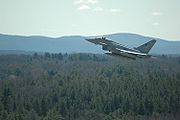 On 4 August 2003, Germany accepted the first series production Eurofighter (GT003). Also that year, Spain took delivery of its first series production aircraft. On 16 December 2005, the Typhoon reached initial operational capability (IOC) with the Italian Air Force. Its Typhoons were put into service as air defence fighters at Grosseto
Air Base, and immediately assigned to Quick Reaction Alert (QRA) at the same base.
On 9 August 2007, the UK's Ministry of Defence reported that No. XI Squadron of the RAF, which stood up as a Typhoon squadron on 29 March 2007, had taken delivery of its first two multi-role Typhoons. Two of XI Squadron's Typhoons were sent to intercept a Russian Tupolev Tu-95
approaching British airspace on 17 August 2007. The RAF Typhoons were declared combat ready in the air-to-ground role by 1 July 2008. The RAF Typhoons were projected to be ready to deploy for operations by mid-2008.
Around 25 April 2008 a Typhoon from 17 Squadron at RAF Coningsby
, operating at the US Naval Air Weapons Station China Lake
test centre in California, USA, suffered extensive damage during landing when its landing gear did not deploy. Although no immediate cause was determined it was speculated that pilot error may have been to blame. The National Audit Office
observed in 2011 that the distribution of the Eurofighter's parts supply and repairs over several countries has led to parts shortages, long timescales for repairs and the cannibalisation
of some aircraft to keep others flying.
On 11 September 2008, the combined flying time of the five customer Air Forces and the industrial Flight Test programme saw aircraft surpass the 50,000 flight hours milestone. On 31 March 2009 a Eurofighter Typhoon fired an AMRAAM whilst having its radar in passive mode for the first time, the necessary target data for the missile was acquired by the radar of a second Eurofighter Typhoon and transmitted using the Multi Functional Information Distribution System (MIDS).
's airspace.
In September 2009, four RAF Typhoons deployed to RAF Mount Pleasant
replacing the Tornado F3s defending the Falkland Islands
. The government of Argentina
"is understood to have made a formal protest".
On 24 August 2010, the project suffered its first fatality when a two seat Typhoon crashed, for unknown reasons, killing a Saudi Air Force Lieutenant Colonel
, the front seat occupant, shortly after taking off from Moron Air Base
in Spain. Experts suspect that a bird strike had destroyed "important sensors
". The Spanish instructor ejected and sustained only minor injuries. Following this incident the German Luftwaffe grounded its 55 planes on 16 September 2010, amidst concerns that after ejecting successfully the pilot had fallen to his death. In response to the investigation of the crash, on 17 September 2010, the RAF temporarily grounded all Typhoon training flights. Quick Reaction Alert
duties were unaffected. On 21 September, the RAF announced that the harness system had been sufficiently modified to enable routine flying from RAF Coningsby. The Austrian Air Force also said that all its aircraft had been cleared for flight. On 24 August 2010, the ejection seat manufacturer Martin Baker commented: ".. under certain conditions, the quick release fitting could be unlocked using the palm of the hands, rather than the thumb and fingers and that this posed a risk of inadvertent release," and added that a modification had been rapidly developed and approved "to eliminate this risk" and was being fitted to all Typhoon seats.
On 18 March 2011, British Prime Minister David Cameron
announced that the UK would deploy Typhoons, alongside Panavia Tornado
s, to enforce a no-fly zone in Libya. On 20 March 10 Typhoons from RAF Coningsby and RAF Leuchars arrived at the Gioia del Colle
airbase in southern Italy. On 21 March RAF Typhoons flew their first ever combat mission while patrolling the no-fly Zone. On 29 March, it was revealed that the RAF were short of pilots to fly the required number of sorties over Libya and were having to divert personnel from Typhoon training in order to meet the shortfall.
On 12 April 2011 a mixed pair of RAF Typhoon and Tornado GR4 dropped precision-guided bombs on ground vehicles operated by Gaddafi forces that were parked in an abandoned tank park. Chief of the Air Staff
, Air Chief Marshal
Sir Stephen Dalton, revealed during the Royal Aeronautical Society
's Aerospace 2011 conference in London, that each aircraft dropped one GBU-16 Paveway II
454 kg (1,000 lb) laser guided bomb which struck "very successfully and very accurately". The event represented "a significant milestone in the delivery of multi-role Typhoon." Target designation was provided by the Tornados with their Litening III
targeting pods due to the lack of Typhoon pilots trained in air-to-ground missions.
UK's then Defence Secretary Liam Fox admitted on 14 April that Britain's Eurofighter Typhoon jets were grounded last year due to shortage of spare parts. The RAF is currently "cannibalising" aircraft for spare parts in a bid to keep the maximum number of Typhoons operational on any given day. The Ministry of Defence had warned the problems were likely to continue until 2015.
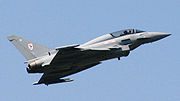
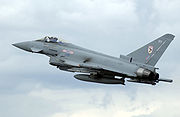
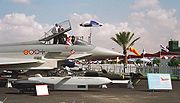 The Eurofighter is produced in single-seat and twin-seat variants. The twin-seat variant is not used operationally, but only for training. The aircraft has been manufactured in three major standards; seven Development Aircraft (DA), seven production standard Instrumented Production Aircraft (IPA) for further system development and a continuing number of Series Production Aircraft. The production aircraft are now operational with the partner nation's air forces.
The Tranche 1 aircraft were produced from 2000 onwards. Aircraft capabilities are being increased incrementally, with each software upgrade resulting in a different standard, known as blocks. With the introduction of the block 5 standard, the R2 retrofit programme began to bring all aircraft to that standard.
Block 2: Initial air-to-air capabilities.
Block 2B: Full air-to-air capabilities.
Block 5: Full operational capability (FOC) by combining existing air-to-air role with air-to-ground capabilities.
Block 10: Software: EOC 1 (advanced multi-role step 1) AIM-120C-5 AMRAAM, IRIS-T digital. A2G: GBU-24, GPS-controlled weapons, ALARM, Paveway III & IV, Rafael Litening III
Block 15: Software: EOC 2 (advanced multi-role step 2) A2A Meteor A2G: TAURUS, Storm Shadow, Brimstone
The Indian Navy
has made a request for information for a carrier based variant of the Eurofighter. In this contest it will once again be up against the Rafale, which split from the Eurofighter project over the need for a carrier based variant.
In February 2011, BAE debuted a navalized Typhoon in response to the Indian tender. The model offered is STOBAR (Short Take Off But Arrested Recovery) capable corresponding to the Indian Navy's future Vikrant class aircraft carrier. The changes needed to enable the Typhoon to launch by ski-jump and recover by arrestor hook added about 500 kg to the airframe.
.jpg)
Canard (aeronautics)
In aeronautics, canard is an airframe configuration of fixed-wing aircraft in which the forward surface is smaller than the rearward, the former being known as the "canard", while the latter is the main wing...
-delta wing
Delta wing
The delta wing is a wing planform in the form of a triangle. It is named for its similarity in shape to the Greek uppercase letter delta .-Delta-shaped stabilizers:...
, multirole
Multirole combat aircraft
A multirole combat aircraft is an aircraft designed to act in at least two different roles in combat. The primary role is usually a fighter—hence, it is as often called a multirole fighter—while the secondary role is usually air-to-surface attack. More roles are added, such as air reconnaissance,...
combat aircraft, designed and built by a consortium
Consortium
A consortium is an association of two or more individuals, companies, organizations or governments with the objective of participating in a common activity or pooling their resources for achieving a common goal....
of three companies: EADS
EADS
The European Aeronautic Defence and Space Company N.V. is a global pan-European aerospace and defence corporation and a leading defence and military contractor worldwide...
, Alenia Aeronautica
Alenia Aeronautica
Alenia Aeronautica, a Finmeccanica subsidiary, is a European aerospace company from Italy. Its subsidiaries include Alenia Aermacchi and Alenia Aeronavali...
and BAE Systems
BAE Systems
BAE Systems plc is a British multinational defence, security and aerospace company headquartered in London, United Kingdom, that has global interests, particularly in North America through its subsidiary BAE Systems Inc. BAE is among the world's largest military contractors; in 2009 it was the...
; working through a holding company, Eurofighter GmbH
Eurofighter GmbH
Eurofighter Jagdflugzeug GmbH is a multinational company that co-ordinates the design, production and upgrade of the Eurofighter Typhoon, this includes incorporating the jet engines designed and manufactured by EuroJet Turbo GmbH.Founded in 1986, it has its head office in Hallbergmoos, Bavaria,...
, which was formed in 1986. The project
Megaproject
A megaproject is an extremely large-scale investment project. Megaprojects are typically defined as costing more than US$1 billion and attracting a lot of public attention because of substantial impacts on communities, environment, and budgets. Megaprojects can also be defined as "initiatives that...
is managed by the NATO Eurofighter and Tornado Management Agency, which acts as the prime customer.
The series production of the Eurofighter Typhoon is underway, and the aircraft is being procured under separate contracts, named "tranches", each for aircraft with generally improved capabilities. The aircraft has entered service with the Austrian Air Force
Austrian Air Force
The Austrian Air Force is a component part of the Austrian armed forces .-History:The Austrian Air Force was formed in May 1955 by the victorious Allied powers, subject to restrictions on its use of guided missiles...
, the Italian Air Force
Italian Air Force
The Italian Air Force has gone under different names in different periods:*Regia Aeronautica , from 1923 to June 1946*Aeronautica Nazionale Repubblicana, the air force of Italian Social Republic during World War II...
, the German Luftwaffe
Luftwaffe
Luftwaffe is a generic German term for an air force. It is also the official name for two of the four historic German air forces, the Wehrmacht air arm founded in 1935 and disbanded in 1946; and the current Bundeswehr air arm founded in 1956....
, the British Royal Air Force
Royal Air Force
The Royal Air Force is the aerial warfare service branch of the British Armed Forces. Formed on 1 April 1918, it is the oldest independent air force in the world...
, the Spanish Air Force
Spanish Air Force
-The early stages:Hot air balloons had been used with military purposes in Spain as far back as 1896. In 1905, with the help of Alfredo Kindelán, Leonardo Torres y Quevedo directed the construction of the first Spanish dirigible in the Army Military Aerostatics Service, created in 1896 and located...
, and the Royal Saudi Air Force
Royal Saudi Air Force
The Royal Saudi Air Force , is the aviation branch of the Saudi Arabian armed forces. The RSAF has developed from a largely defensive military force into one with an advanced offensive capability...
.
Origins
F/A-18 Hornet
The McDonnell Douglas F/A-18 Hornet is a supersonic, all-weather carrier-capable multirole fighter jet, designed to dogfight and attack ground targets . Designed by McDonnell Douglas and Northrop, the F/A-18 was derived from the latter's YF-17 in the 1970s for use by the United States Navy and...
, which was then well advanced in its development. The design had little potential for future growth, and when it entered production it would secure few exports in a market in which the Hornet would be well established. However, the simultaneous West German requirement for a new fighter had led by 1979 to the development of the TKF-90 concept. This was a cranked delta wing design with forward canard controls
Canard (aeronautics)
In aeronautics, canard is an airframe configuration of fixed-wing aircraft in which the forward surface is smaller than the rearward, the former being known as the "canard", while the latter is the main wing...
and artificial stability. Although the British Aerospace designers rejected some of its advanced features such as vectoring engine nozzles and vented trailing-edge controls, they agreed with the overall configuration.
In 1979, Messerschmitt-Bölkow-Blohm
Messerschmitt-Bölkow-Blohm
Messerschmitt-Bölkow-Blohm was a German aerospace company formed as the result of several mergers in the late 1960s. Among its best-known products was the MBB Bo 105 light twin helicopter...
(MBB) and British Aerospace
British Aerospace
British Aerospace plc was a UK aircraft, munitions and defence-systems manufacturer. Its head office was in the Warwick House in the Farnborough Aerospace Centre in Farnborough, Hampshire...
(BAe) presented a formal proposal to their respective governments for the ECF, the European Collaborative Fighter or European Combat Fighter. In October 1979 Dassault
Dassault Aviation
Dassault Aviation is a French aircraft manufacturer of military, regional and business jets, a subsidiary of Dassault Group.It was founded in 1930 by Marcel Bloch as Société des Avions Marcel Bloch or "MB". After World War II, Marcel Bloch changed his name to Marcel Dassault, and the name of the...
joined the ECF team for a tri-national study, which became known as the European Combat Aircraft. It was at this stage of development that the Eurofighter name was first attached to the aircraft. The development of different national prototypes continued. France produced the ACX. The UK produced two designs; the P.106was a single-engined "lightweight" fighter, superficially resembling the JAS 39 Gripen
JAS 39 Gripen
The Saab JAS 39 Gripen is a lightweight single-engine multirole fighter manufactured by the Swedish aerospace company Saab. It was designed to replace the Saab 35 Draken and 37 Viggen in the Swedish Air Force...
, the P.110 was a twin-engined fighter. The P.106 concept was rejected by the RAF, on the grounds that it had "half the effectiveness of the two-engined aircraft at two thirds of the cost". West Germany continued to refine the TFK-90 concept. The ECA project collapsed in 1981 for several reasons including differing requirements, Dassault's insistence on "design leadership" and the British preference for a new version of the RB199
Turbo-Union RB199
|-See also:-External links:*...
to power the aircraft versus the French preference for the new Snecma M88
SNECMA M88
|-See also:-External links:* * Snecma M88's pdf* *...
.
As a result the Panavia partners (MBB, BAe and Aeritalia
Aeritalia
Aeritalia was an aerospace engineering corporation based in Italy, originally Fiat Aviazione before merging with Aerfer, and now part of Alenia Aeronautica....
) launched the Agile Combat Aircraft (ACA) programme in April 1982. The ACA was very similar to the BAe P.110, having a cranked delta wing, canards and a twin tail. One major external difference was the replacement of the side mounted engine intakes with a chin intake. The ACA was to be powered by a modified version of the RB199. The German and Italian governments withdrew funding, and the UK Ministry of Defence
Ministry of Defence (United Kingdom)
The Ministry of Defence is the United Kingdom government department responsible for implementation of government defence policy and is the headquarters of the British Armed Forces....
agreed to fund 50% of the cost with the remaining 50% to be provided by industry. MBB and Aeritalia signed up with the aim of producing two aircraft, one at Warton and one by MBB. In May 1983 BAe announced a contract with the MoD
Ministry of Defence (United Kingdom)
The Ministry of Defence is the United Kingdom government department responsible for implementation of government defence policy and is the headquarters of the British Armed Forces....
for the development and production of an ACA demonstrator, the Experimental Aircraft Programme
British Aerospace EAP
-External links:*...
.
In 1983 the Germany, France, UK, Italy and Spain launched the Future European Fighter Aircraft (FEFA) programme. The aircraft was to have short take off and landing
STOL
STOL is an acronym for short take-off and landing, a term used to describe aircraft with very short runway requirements.-Definitions:There is no one accepted definition of STOL and many different definitions have been used by different authorities and nations at various times and for a myriad of...
(STOL) and beyond visual range (BVR) capabilities. In 1984 France reiterated its requirement for a carrier-capable
Aircraft carrier
An aircraft carrier is a warship designed with a primary mission of deploying and recovering aircraft, acting as a seagoing airbase. Aircraft carriers thus allow a naval force to project air power worldwide without having to depend on local bases for staging aircraft operations...
version and demanded a leading role. The West Germany, UK and Italy opted out and established a new EFA programme. In Turin
Turin
Turin is a city and major business and cultural centre in northern Italy, capital of the Piedmont region, located mainly on the left bank of the Po River and surrounded by the Alpine arch. The population of the city proper is 909,193 while the population of the urban area is estimated by Eurostat...
on 2 August 1985, West Germany, UK and Italy agreed to go ahead with the Eurofighter; and confirmed that France, along with Spain, had chosen not to proceed as a member of the project. Despite pressure from France, Spain rejoined the Eurofighter project in early September 1985. France officially withdrew from the project to pursue its own ACX project, which was to become the Dassault Rafale
Dassault Rafale
The Dassault Rafale is a French twin-engine delta-wing multi-role jet fighter aircraft designed and built by Dassault Aviation. Introduced in 2000, the Rafale is being produced both for land-based use with the French Air Force and for carrier-based operations with the French Navy...
.
Pound sterling
The pound sterling , commonly called the pound, is the official currency of the United Kingdom, its Crown Dependencies and the British Overseas Territories of South Georgia and the South Sandwich Islands, British Antarctic Territory and Tristan da Cunha. It is subdivided into 100 pence...
180 million. When the EAP programme had started, the cost was supposed to be equally shared by both government and industry, but the West German and Italian government wavered on the agreement and the three main industrial partners had to provide £100 million to keep the programme from ending. In April 1986 the BAe EAP was rolled out at BAe Warton, by this time also partially funded by MBB, BAe and Aeritalia. The EAP first flew on 6 August 1986. The Eurofighter bears a strong resemblance to the EAP. Design work continued over the next five years using data from the EAP. Initial requirements were: UK: 250 aircraft, Germany: 250, Italy: 165 and Spain: 100. The share of the production work was divided among the countries in proportion to their projected procurement – DASA (33%), British Aerospace
British Aerospace
British Aerospace plc was a UK aircraft, munitions and defence-systems manufacturer. Its head office was in the Warwick House in the Farnborough Aerospace Centre in Farnborough, Hampshire...
(33%), Aeritalia
Aeritalia
Aeritalia was an aerospace engineering corporation based in Italy, originally Fiat Aviazione before merging with Aerfer, and now part of Alenia Aeronautica....
(21%), and Construcciones Aeronáuticas SA
Construcciones Aeronáuticas SA
Construcciones Aeronáuticas SA , was a Spanish aircraft manufacturer. It became EADS CASA the Spanish branch of EADS in 1999, but was absorbed by Airbus Military in 2009...
(CASA) (13%).
The Munich based Eurofighter Jagdflugzeug GmbH was established in 1986 to manage development of the project and EuroJet Turbo GmbH
EuroJet Turbo GmbH
EuroJet Turbo GmbH is a multi-national consortium, the partner companies of which are Rolls-Royce plc, Avio of Italy, ITP of Spain and MTU Aero Engines of Germany. It is based in Hallbergmoos near Munich....
, the alliance of Rolls-Royce
Rolls-Royce plc
Rolls-Royce Group plc is a global power systems company headquartered in the City of Westminster, London, United Kingdom. It is the world’s second-largest maker of aircraft engines , and also has major businesses in the marine propulsion and energy sectors. Through its defence-related activities...
, MTU Aero Engines
MTU Aero Engines
MTU Aero Engines GmbH is Germany's leading aircraft engine manufacturer. MTU develops, manufactures and provides service support for military and civil aircraft engines...
, FiatAvio (now Avio) and ITP
Industria de Turbo Propulsores
Industria de Turbo Propulsores S.A. is a Spanish aeronautical engine and gas turbine manufacturer. It is owned by Sener Aeronáutica and Rolls-Royce plc .-Shareholdings/partnerships:...
for development of the EJ200
Eurojet EJ200
|-See also:-External links:* * * * *...
. The aircraft was known as Eurofighter EFA from the late 1980s until it was renamed EF 2000 in 1992.
By 1990, the selection of the aircraft's radar had become a major stumbling block. The UK, Italy and Spain supported the Ferranti Defence Systems
Ferranti
Ferranti or Ferranti International plc was a UK electrical engineering and equipment firm that operated for over a century from 1885 until it went bankrupt in 1993. Known primarily for defence electronics, the Company was once a constituent of the FTSE 100 Index but ceased trading in 1993.The...
-led ECR-90, while Germany preferred the APG-65 based MSD2000 (a collaboration between Hughes
Hughes Aircraft
Hughes Aircraft Company was a major American aerospace and defense contractor founded in 1932 by Howard Hughes in Culver City, California as a division of Hughes Tool Company...
, AEG
AEG
Allgemeine Elektricitäts-Gesellschaft was a German producer of electrical equipment founded in 1883 by Emil Rathenau....
and GEC-Marconi). An agreement was reached after UK Defence Secretary Tom King
Tom King, Baron King of Bridgwater
Thomas Jeremy King, Baron King of Bridgwater, CH, PC , is a British politician. A member of the Conservative Party, he served in the Cabinet from 1983–92, and was the Member of Parliament for the constituency of Bridgwater in Somerset from 1970-2001...
assured his West German counterpart Gerhard Stoltenberg
Gerhard Stoltenberg
Gerhard Stoltenberg was a German politician and minister in the cabinets of Ludwig Erhard, Kurt Georg Kiesinger and Helmut Kohl. He served as minister-president of the German state of Schleswig-Holstein from 1971 to 1982 and as such as President of the Bundesrat in 1977/78.-Life:Stoltenberg was...
that the British government would approve the project and allow GEC to acquire Ferranti Defence Systems from its troubled parent. GEC thus withdrew its support for the MSD2000.
Testing
The maiden flightMaiden flight
The maiden flight of an aircraft is the first occasion on which an aircraft leaves the ground of its own accord. This is similar to a ship's maiden voyage....
of the Eurofighter prototype took place in Bavaria
Bavaria
Bavaria, formally the Free State of Bavaria is a state of Germany, located in the southeast of Germany. With an area of , it is the largest state by area, forming almost 20% of the total land area of Germany...
on 27 March 1994, flown by DASA Chief Test Pilot Peter Weger. On 9 December 2004, Eurofighter Typhoon IPA4 began three months of Cold Environmental Trials (CET) at the Vidsel
Vidsel
Vidsel is a locality situated in Älvsbyn Municipality, Norrbotten County, Sweden with 569 inhabitants in 2005. It is situated about 900 km north of Stockholm, Sweden, in the Arctic Circle; Perhaps its earliest history is as a seasonal settlement, but permanent inhabitants have lived here since...
Air Base in Sweden, the purpose of which was to verify the operational behaviour of the aircraft and its systems in temperatures between −25 and 31 °C. The maiden flight of Instrumented Production Aircraft 7 (IPA7), the first fully equipped Tranche 2 aircraft, took place from EADS' Manching
Manching
Manching is a municipality in the district of Pfaffenhofen, in Bavaria, Germany. It is situated on the river Paar, 7 km southeast of Ingolstadt...
airfield on 16 January 2008.
In May 2007, Eurofighter Development Aircraft 5 made the first flight with the CAESAR demonstrator system, a development of the Euroradar CAPTOR
Euroradar CAPTOR
The Euroradar CAPTOR is a next generation mechanical multi-mode pulse doppler radar designed for the Eurofighter Typhoon.The radar is produced by the Euroradar consortium and is a development of the BAE Systems Blue Vixen radar which had been developed for the BAE Sea Harrier...
incorporating Active Electronically Scanned Array
Active Electronically Scanned Array
An Active Electronically Scanned Array , also known as active phased array radar is a type of phased array radar whose transmitter and receiver functions are composed of numerous small solid-state transmit/receive modules . AESAs aim their "beam" by broadcasting radio energy that interfere...
(AESA) technology. The production version of the CAPTOR-E radar was being proposed as part of Tranche 3 of the Typhoon from 2012. Tranche 2 aircraft use the non AESA, mechanically scanned Captor-M which incorporates weight and space provisions for possible upgrade to CAESAR (AESA) standard in the future. The Italian Air Force doubted that the AESA radar would be ready in time for Tranche 3 production. In July 2010, Eurofighter announced that the AESA radar would enter service in 2015.
Orders
The first production contract was signed on 30 January 1998 between Eurofighter GmbH, Eurojet and NETMA. The procurement totals were as follows: UK 232, Germany 180, Italy 121, and Spain 87. Production was again allotted according to procurement: British Aerospace (37.42%), DASA (29.03%), Aeritalia (19.52%), and CASA (14.03%).On 2 September 1998, a naming ceremony was held at Farnborough
Farnborough Airfield
Farnborough Airport or TAG London Farnborough Airport is an airport situated in Farnborough, Rushmoor, Hampshire, England...
, United Kingdom. This saw the Typhoon name formally adopted, initially for export aircraft only. This was reportedly resisted by Germany; perhaps because the Hawker Typhoon
Hawker Typhoon
The Hawker Typhoon was a British single-seat fighter-bomber, produced by Hawker Aircraft. While the Typhoon was designed to be a medium-high altitude interceptor, and a direct replacement for the Hawker Hurricane, several design problems were encountered, and the Typhoon never completely satisfied...
was a fighter-bomber aircraft which served with the RAF during the Second World War against German targets. The name "Spitfire II" (for the famous British WWII fighter, the Supermarine Spitfire
Supermarine Spitfire
The Supermarine Spitfire is a British single-seat fighter aircraft that was used by the Royal Air Force and many other Allied countries throughout the Second World War. The Spitfire continued to be used as a front line fighter and in secondary roles into the 1950s...
) had also been considered and rejected for the same reason early in the development programme. In September 1998 contracts were signed for production of 148 Tranche 1 aircraft and procurement of long lead-time items for Tranche 2 aircraft. In March 2008 the final aircraft out of Tranche 1 was delivered to the German Luftwaffe, with all successive deliveries being at the Tranche 2 standard. On 21 October 2008, the first two of 91 Tranche 2 aircraft, ordered four years before, were delivered to RAF Coningsby.
In October 2008, the Eurofighter nations were considering splitting the 236-fighter Tranche 3 into two parts. In June 2009, RAF Air Chief Marshal Sir Glenn Torpy
Glenn Torpy
Air Chief Marshal Sir Glenn Lester Torpy, GCB, CBE, DSO, ADC is a retired senior Royal Air Force commander. He was a fast jet pilot in the late 1970s and 1980s, a senior officer in the early 1990s and a senior commander in the late 1990s and 2000s...
suggested that the RAF fleet might only be 123 jets, instead of the 232 previously planned. In spite of this reduction in the number of required aircraft, on 14 May 2009, British Prime Minister Gordon Brown confirmed that the UK would move ahead with the third batch purchase. A contract for the first part, Tranche 3A, was signed at the end of July 2009 for 112 aircraft split across the four partner nations, including 40 aircraft for the UK, 31 for Germany, 21 for Italy and 20 for Spain. These 40 aircraft were said to have fully covered the UK's obligations in the project by Air Commodore Chris Bushell, due to cost overruns in the project.
Costs
In 1988, the Parliamentary Under-Secretary of State for the Armed Forces told the UK House of Commons that the European Fighter Aircraft would "be a major project, costing the United Kingdom about £7 billion". It was soon apparent that a more realistic estimate was £13 billion, made up of £3.3 billion development costs plus £30 million per aircraft. By 1997 the estimated cost was £17 billion; by 2003, £20 billion, and the in-service date (2003; defined as the date of delivery of the first aircraft to the RAF) was 54 months late. After 2003 the Ministry of Defence have refused to release updated cost estimates on the grounds of 'commercial sensitivity', however in 2011 the National Audit Office estimated the UK's "total programme cost [would] eventually hit £37 billion".By 2007, Germany estimated the system cost (aircraft, training plus spare parts) to €120m and said it was in perpetual increase. On 17 June 2009, Germany ordered 31 aircraft of Tranche 3A for €2,800m, leading to a system cost of €90m per aircraft. The UK's Committee of Public Accounts reported that the mismanagement of the project had helped increase the cost of each aircraft by 75 percent. Defence Secretary
Secretary of State for Defence
The Secretary of State for Defence, popularly known as the Defence Secretary, is the senior Government of the United Kingdom minister in charge of the Ministry of Defence, chairing the Defence Council. It is a Cabinet position...
Liam Fox
Liam Fox
Liam Fox MP is a British Conservative politician, Member of Parliament for North Somerset, and former Secretary of State for Defence....
responded that "I am determined that in the future such projects are properly run from the outset, and I have announced reforms to reduce equipment delays and cost overruns."
Delays
The financial burdens placed on Germany by reunificationGerman reunification
German reunification was the process in 1990 in which the German Democratic Republic joined the Federal Republic of Germany , and when Berlin reunited into a single city, as provided by its then Grundgesetz constitution Article 23. The start of this process is commonly referred by Germans as die...
caused Helmut Kohl
Helmut Kohl
Helmut Josef Michael Kohl is a German conservative politician and statesman. He was Chancellor of Germany from 1982 to 1998 and the chairman of the Christian Democratic Union from 1973 to 1998...
to make an election
German federal election, 1990
The 12th German federal election, 1990 was conducted on December 2, 1990, to elect members to the Bundestag of the Federal Republic of Germany...
promise to cancel the Eurofighter. In early to mid-1991 German Defence Minister Volker Rühe
Volker Rühe
Volker Rühe is a German politician affiliated with the CDU. He served as German Defence minister from April 1, 1992, succeeding Gerhard Stoltenberg during the first government of a reunified Germany in the fourth cabinet of Chancellor Kohl, to the end of the fifth Kohl Cabinet on October 27, 1998...
sought to withdraw Germany from the project in favour of using Eurofighter technology in a cheaper, lighter plane. Due to the amount of money already spent on development, the number of jobs dependent on the project, and the binding commitments on each partner government, Helmut Kohl
Helmut Kohl
Helmut Josef Michael Kohl is a German conservative politician and statesman. He was Chancellor of Germany from 1982 to 1998 and the chairman of the Christian Democratic Union from 1973 to 1998...
was unable to withdraw; "Rühe's predecessors had locked themselves into the project by a punitive penalty system of their own devising."
In 1995 concerns over workshare appeared. Since the formation of Eurofighter the workshare split had been agreed at the 33/33/21/13 (United Kingdom/Germany/Italy/Spain) based on the number of units being ordered by each contributing nation. All the nations then reduced their orders. The UK cut its orders from 250 to 232, Germany from 250 to 140, Italy from 165 to 121 and Spain from 100 to 87. According to these order levels the workshare split should have been 39/24/22/15 UK/Germany/Italy/Spain, Germany was unwilling to give up such a large amount of work. In January 1996, after much negotiation between German and UK partners, a compromise was reached whereby Germany would purchase another 40 aircraft. The workshare split is now 43% for EADS MAS in Germany and Spain; 37.5% BAE Systems in the UK; and 19.5% for Alenia in Italy.
The next major milestone came at the Farnborough Airshow in September 1996. The UK announced the funding for the construction phase of the project. In November 1996 Spain confirmed its order but Germany delayed its decision. After much diplomatic activity between Germany and UK, an interim funding arrangement of DM100 million (€51 million) was contributed by the German government in July 1997 to continue flight trials. Further negotiation finally resulted in German approval to purchase the Eurofighter in October 1997.
Production
Premium AEROTEC
Premium AEROTEC
Premium AEROTEC is an aerospace manufacturing business, headquartered in Augsburg in Germany. It is a subsidiary of EADS.-History:Premium AEROTEC started as a division of EADS; it was spun off as a wholly owned subsidiary in September 2008....
: Main centre fuselage
EADS CASA: Right wing, leading edge slats
BAE Systems
BAE Systems
BAE Systems plc is a British multinational defence, security and aerospace company headquartered in London, United Kingdom, that has global interests, particularly in North America through its subsidiary BAE Systems Inc. BAE is among the world's largest military contractors; in 2009 it was the...
: Front fuselage (including foreplanes), canopy, dorsal spine, tail fin, inboard flaperons, rear fuselage section
Alenia Aeronautica
Alenia Aeronautica
Alenia Aeronautica, a Finmeccanica subsidiary, is a European aerospace company from Italy. Its subsidiaries include Alenia Aermacchi and Alenia Aeronavali...
: Left wing, outboard flaperon
Flaperon
A flaperon is a type of aircraft control surface that combines aspects of both flaps and ailerons. In addition to controlling the roll or bank of an aircraft as do conventional ailerons, both flaperons can be lowered together to function similarly to a dedicated set of flaps...
s, rear fuselage sections
Production is divided into three tranches (see table below). Tranches are a production/funding distinction, and do not necessarily imply an incremental increase in capability with each tranche. Tranche 3 will most likely be based on late Tranche 2 aircraft with improvements added. Tranche 3 has been split into A and B parts.
Tranches are further divided up into production standard/capability blocks and funding/procurement batches, though these do not coincide, and are not the same thing; e.g., the Eurofighter designated FGR4 by the RAF is a Tranche 1, block 5. Batch 1 covered block 1, but batch 2 covered blocks 2, 2B and 5.
| Country | Tranche 1 | Tranche 2 | Tranche 3A | Total |
|---|---|---|---|---|
| 15 | 0 | 0 | 15 | |
| 33 | 79 | 31 | 143 | |
| 28 | 47 | 21 | 96 | |
| 0 | 24 | 48 | 72 | |
| 19 | 34 | 20 | 73 | |
| 53 | 67 | 40 | 160 | |
| Total | 148 | 299 | 112 | 559 |
- Notes: The change in Austria's order from 6 Tranche 1 and 12 Tranche 2 aircraft to 15 Tranche 1 jets led to a reduction in Tranche 1 quantities for the four partner nations, with a commensurate increase in Tranche 2 numbers. 24 Saudi aircraft were taken from UK Tranche 2 production, and were to have been replaced at the end of Tranche 2, but will now be accounted against the UK's Tranche 3A total. This marks an effective reduction of 24 aircraft in the UK order total.
On 25 May 2011 the 100th production aircraft, ZK315, rolled off the production line at Warton.
Exports
Unite the Union
Unite – the Union, known as Unite, is a British and Irish trade union, formed on 1 May 2007, by the merger of Amicus and the Transport and General Workers' Union...
general secretary Len McCluskey
Len McCluskey
Len McCluskey is the General Secretary of the British and Irish union Unite and a former Liverpool dock worker.- Early life :McCluskey was born in the Liverpool docklands. and went to Cardinal Godfrey school in Anfield...
has called for the development of a more advanced radar to make the Eurofighter "more exportable". This AESA radar is seen as vital for the Indian purchase.
Austria
On 2 July 2002, the Austrian government announced the decision to buy the Typhoon as its new air defence aircraft. The purchase of 18 Typhoons was agreed on 1 July 2003, and included training, logistics, maintenance, and a simulator. On 26 June 2007, Austrian Minister for Defense Norbert Darabos announced a reduction to 15 aircraft. The first aircraft was delivered on 12 July 2007 and formally entered service in the Austrian Air Force.Saudi Arabia
After unsuccessful campaigns in South Korea and Singapore (losing in both cases to versions of the Boeing F-15E), on 18 August 2006 it was announced that Saudi ArabiaSaudi Arabia
The Kingdom of Saudi Arabia , commonly known in British English as Saudi Arabia and in Arabic as as-Sa‘ūdiyyah , is the largest state in Western Asia by land area, constituting the bulk of the Arabian Peninsula, and the second-largest in the Arab World...
had agreed to purchase 72 Typhoons. In November and December it was reported that Saudi Arabia had threatened to buy French Rafales because of a UK Serious Fraud Office
Serious Fraud Office
The Serious Fraud Office may refer to:*Serious Fraud Office *Serious Fraud Office...
investigation into the Al Yamamah
Al Yamamah
Al Yamamah is the name of a series of a record arms sales by the United Kingdom to Saudi Arabia, which have been paid for by the delivery of up to of crude oil per day to the UK government. The prime contractor has been BAE Systems and its predecessor British Aerospace...
("the dove") defence deals which commenced in the 1980s.
On 14 December 2006, Britain's attorney general, Lord Goldsmith, ordered that the Serious Fraud Office discontinue its investigation in the BAE Systems' alleged bribery to senior Saudi officials in the al-Yamamah contracts, citing "the need to safeguard national and international security". The Times
The Times
The Times is a British daily national newspaper, first published in London in 1785 under the title The Daily Universal Register . The Times and its sister paper The Sunday Times are published by Times Newspapers Limited, a subsidiary since 1981 of News International...
has raised the possibility that RAF production aircraft will be diverted as early Saudi Arabian aircraft, with the service forced to wait for its full complement of aircraft. This arrangement would mirror the diversion of RAF Tornados
Panavia Tornado
The Panavia Tornado is a family of twin-engine, variable-sweep wing combat aircraft, which was jointly developed and manufactured by the United Kingdom, West Germany and Italy...
to the RSAF. The Times has also reported that such an arrangement will make the UK purchase of its Tranche 3 commitments more likely. On 17 September 2007, Saudi Arabia
Saudi Arabia
The Kingdom of Saudi Arabia , commonly known in British English as Saudi Arabia and in Arabic as as-Sa‘ūdiyyah , is the largest state in Western Asia by land area, constituting the bulk of the Arabian Peninsula, and the second-largest in the Arab World...
confirmed it had signed a GB£4.43 billion contract for 72 aircraft. 24 aircraft will be at the Tranche 2 build standard, previously destined for the UK RAF, the first being delivered in 2008. The remaining 48 aircraft will be assembled in Saudi Arabia and delivered from 2011. Saudi Arabia is considering an order of 24 additional jets in the future, more recent reports suggest that number may be as high as 60 or 72, but this may have been superseded by Saudi Arabia's request in August 2010 to purchase 84 new F-15s.
On 29 September 2008 the United States Department of State approved the sale, required because of a certain technology governed by the ITAR process which was incorporated into the MIDS
Multifunctional Information Distribution System
Multifunctional Information Distribution System is the NATO name for the communication component of Link-16.One commonly used instantiation of an MIDS is the MIDS Low Volume Terminal which has been funded by the United States, France, Germany, Italy, and Spain and developed by MIDSCO, a joint...
of the Eurofighter.
On 22 October 2008, the first Typhoon in the colours of the Royal Saudi Air Force flew for the first time at BAE Systems’ Warton Aerodrome, marking the start of the test flight programme for RSAF aircraft. Following the official handover of the first Eurofighter Typhoon to the Royal Saudi Air Force on 11 June 2009, the delivery ferry flight took place on 23 June 2009. Since 2010, BAE Systems has been training Saudi Arabian personnel at their factory in Warton, in preparation for setting up an assembly plant in Saudi Arabia.
India
Eurofighter Typhoon is one of the contenders in the Indian MRCA competition
Indian MRCA Competition
The Indian Air Force Medium Multi-Role Combat Aircraft Competition, also known as the MRCA tender, is an ongoing competition to supply 126 multi-role combat aircraft to the Indian Air Force . The Defence Ministry has allocated for the purchase of these aircraft, making it India's single largest...
to supply the Indian Air Force
Indian Air Force
The Indian Air Force is the air arm of the Indian armed forces. Its primary responsibility is to secure Indian airspace and to conduct aerial warfare during a conflict...
with 126 "Medium Multi-Role Combat Aircraft". The other competitors are the Boeing F/A-18IN, Dassault Rafale
Dassault Rafale
The Dassault Rafale is a French twin-engine delta-wing multi-role jet fighter aircraft designed and built by Dassault Aviation. Introduced in 2000, the Rafale is being produced both for land-based use with the French Air Force and for carrier-based operations with the French Navy...
, Saab JAS 39 GripenNG/IN, Mikoyan MiG-35
Mikoyan MiG-35
The Mikoyan MiG-35 is a further development of the MiG-29M/M2 and MiG-29K/KUB technology. It is classified as a 4++ generation jet fighter by Mikoyan. The first prototype was a modification of the aircraft that previously served as MiG-29M2 model demonstrator. 10 prototypes have been built so far...
, and Lockheed Martin F-16IN Fighting Falcon. Bernhard Gerwert, CEO of EADS military air systems, said that India is invited to join the Eurofighter Typhoon programme as a partner. The production of the Eurofighter Typhoon will create thousands of new jobs in India and Europe. He also said that in order to win the contract, EADS would move avionics jobs from Germany to India. The campaign is fully supported by the four European nations (Germany, United Kingdom, Spain and Italy), their four Air Forces and Europe's leading aerospace companies Alenia/Finmeccanica, BAE Systems and EADS.
In July 2007, Indian Air Force's (IAF) Sukhoi Su-30MKI fighters, which were at Waddington for the bilateral air "Exercise Indradhanush-2007", trained with RAF Typhoons.
In January 2010, India's ambassador to Italy, Arif Shahid Khan, said that the Eurofighter was "leading the race" to win the MMRCA competition. As reported by the Ministry of Defence on 27 April 2011, the Government of India announced that the Eurofighter is one of two fighters selected for initial bidding for the multi-billion dollar deal of 126 Multi-role medium fighter aircraft. The other fighter shortlisted is the French Rafale.
Japan
In March 2007, Jane's Information Group
Jane's Information Group
Jane's Information Group is a publishing company specializing in transportation and military topics.-History:It was founded by Fred T...
reported that the Typhoon was the favourite to win the contest for Japan's next-generation fighter requirement. The other competitors then were the F/A-18E/F Super Hornet and McDonnell Douglas F-15E Strike Eagle. On 17 October 2007, Japanese Defence Minister Shigeru Ishiba
Shigeru Ishiba
Shigeru Ishiba is a Japanese politician. He was Minister of Defense under Prime Minister Yasuo Fukuda from 2007 to 2008 and was also Minister of Agriculture, Forestry and Fisheries....
confirmed that Japan may buy the Typhoon. Although the F-22 Raptor was in his words "exceptional", it was not "absolutely necessary for Japan", and the Typhoon was the best alternative. The F-22 is currently unavailable for export per US law. During a visit to Japan in June 2009, Andy Latham of BAE pointed out that while F-22 exports were restricted to keep advanced military technology from falling into the wrong hands, selling the Typhoon would take a "no black box approach", that is that even licensed production and integration with Japanese equipment would not carry the risk of leakage of restricted military technology. In July 2010, it was reported that the Japan Air Self-Defense Force
Japan Air Self-Defense Force
The , or JASDF, is the aviation branch of the Japan Self-Defense Forces responsible for the defense of Japanese airspace and other aerospace operations. The JASDF carries out combat air patrols around Japan, while also maintaining an extensive network of ground and air early warning radar systems...
favoured acquiring the F-35 ahead of the Typhoon and the F/A-18E/F to fulfill its F-X requirement due to its stealth characteristics, but the Defense Ministry was delaying its budget request to evaluate when the F-35 would be produced and delivered. David Howell of the UK foreign office has suggested that Japan could partner with Britain in the continuing development of the Eurofighter.
Greece
In 1999, the Greek government agreed to acquire 60 Typhoons in order to replace its existing second-generation combat aircraft. The purchase was put on hold due to budget constraints, largely driven by other development programmes and the need to cover the cost of the 2004 Summer Olympics
2004 Summer Olympics
The 2004 Summer Olympic Games, officially known as the Games of the XXVIII Olympiad, was a premier international multi-sport event held in Athens, Greece from August 13 to August 29, 2004 with the motto Welcome Home. 10,625 athletes competed, some 600 more than expected, accompanied by 5,501 team...
. In June 2006 the government announced a 22 billion euro multi-year acquisition plan intended to provide the necessary budgetary framework to enable the purchase of a next-generation fighter over the next 10 years. The Typhoon is currently under consideration to fill this requirement.
Others
During the 2008 Farnborough Airshow it was announced that Oman was in an "advanced stage" of discussions towards purchasing EF Typhoons as a replacement for its Jaguar aircraft. Oman remained interested in ordering Typhoons in April 2010 though the Saab JAS 39 Gripen was also being considered. In April 2010, Oman revealed negotiations for an order of 18 F-16s, thus making a Eurofighter order less likely. The Qatar Emiri Air Force is, as of January 2011, evaluating the Typhoon together with the Lockheed Martin F-35 Joint Strike Fighter, the Boeing F/A-18E/F Super Hornet, the Boeing F-15 and the Dassault Rafale to replace its current inventory of Dassault Mirage 2000-5s. The total order for 24–36 aircraft will be decided on by the end of 2012.
Other potential customers of the Typhoon are Denmark, Norway and Romania
Romania
Romania is a country located at the crossroads of Central and Southeastern Europe, on the Lower Danube, within and outside the Carpathian arch, bordering on the Black Sea...
. BAE Systems itself reports that Typhoon is "actively being promoted in a number of other markets including Greece, Switzerland, Turkey
Turkey
Turkey , known officially as the Republic of Turkey , is a Eurasian country located in Western Asia and in East Thrace in Southeastern Europe...
and Japan". Turkey has since indicated a preference for purchasing larger quantities of F-35 Lightning IIs and that: "Eurofighter is off Turkey's agenda". In 2010, the government of Serbia
Serbia
Serbia , officially the Republic of Serbia , is a landlocked country located at the crossroads of Central and Southeast Europe, covering the southern part of the Carpathian basin and the central part of the Balkans...
displayed open interest in the Eurofighter. In July 2011, South Korea
South Korea
The Republic of Korea , , is a sovereign state in East Asia, located on the southern portion of the Korean Peninsula. It is neighbored by the People's Republic of China to the west, Japan to the east, North Korea to the north, and the East China Sea and Republic of China to the south...
was invited to join the Eurofighter project as a full member.
On 2 December 2009, BAE Systems announced its intention to market the Typhoon as a replacement for the Royal Malaysian Air Force (RMAF) Mikoyan MiG-29
Mikoyan MiG-29
The Mikoyan MiG-29 is a fourth-generation jet fighter aircraft designed in the Soviet Union for an air superiority role. Developed in the 1970s by the Mikoyan design bureau, it entered service with the Soviet Air Force in 1983, and remains in use by the Russian Air Force as well as in many other...
N, due to be phased out in late 2010. According to the Regional Director-Business Development Dave Potter, the Typhoon's multi-role capabilities allow it to replace the MiG-29N. Other contenders include Boeing F/A-18E/F Super Hornet, Boeing F-15, Dassault Rafale, JAS 39 Gripen NG, Sukhoi Su-35
Sukhoi Su-35
The Sukhoi Su-35 is a single-seat, twin-engined supermaneuverability multirole fighter. It is a derivative of the Su-27 'Flanker', and was initially known as the Su-27M. More than a dozen of these were built with some used by the Russian Knights aerobatic demonstration team...
, and Lockheed F-16C/D block 52 Fighting Falcon.
Upgrades
In 2002, the MBDA MeteorMBDA Meteor
Meteor is an active radar guided beyond-visual-range air-to-air missile being developed by MBDA. It is to equip the Eurofighter Typhoons of the UK's Royal Air Force , Germany's Luftwaffe, Spain's Ejército del Aire and Italy's Aeronautica Militare Italiana, the British and Italian F-35s , the...
was selected as the long range air-to-air missile armament of Eurofighter Typhoon. Pending Meteor availability, Typhoon will be equipped with the Raytheon
Raytheon
Raytheon Company is a major American defense contractor and industrial corporation with core manufacturing concentrations in weapons and military and commercial electronics. It was previously involved in corporate and special-mission aircraft until early 2007...
AMRAAM. The predicted in-service date for Meteor is August 2012.
In 2009, Eurofighter operators and manufacturers met to consider the upgrading of the current fleet with the MBDA Meteor
MBDA Meteor
Meteor is an active radar guided beyond-visual-range air-to-air missile being developed by MBDA. It is to equip the Eurofighter Typhoons of the UK's Royal Air Force , Germany's Luftwaffe, Spain's Ejército del Aire and Italy's Aeronautica Militare Italiana, the British and Italian F-35s , the...
missile and an Active Electronically Scanned Array
Active Electronically Scanned Array
An Active Electronically Scanned Array , also known as active phased array radar is a type of phased array radar whose transmitter and receiver functions are composed of numerous small solid-state transmit/receive modules . AESAs aim their "beam" by broadcasting radio energy that interfere...
radar. On 22 June 2011, it was announced that the partner nations had agreed to fund development of the next generation E-Scan radar, and confirmed an entry into service date of 2015.
Eurojet is attempting to find funding to test a thrust vectoring nozzle (TVN) on a flight demonstrator. Additionally, the RAF has sought to develop conformal fuel tanks (CFT) for their Typhoons to free up underwing space for weapons.
Airframe and avionics
The Typhoon is a highly agile aircraft at both supersonic and low speeds, achieved though having an intentionally relaxed stabilityRelaxed stability
In aviation, relaxed stability is the tendency of an aircraft to change its attitude and angle of bank of its own accord. An aircraft with relaxed stability will oscillate in simple harmonic motion around a particular attitude at an increasing amplitude....
design. It has a quadruplex digital fly-by-wire
Fly-by-wire
Fly-by-wire is a system that replaces the conventional manual flight controls of an aircraft with an electronic interface. The movements of flight controls are converted to electronic signals transmitted by wires , and flight control computers determine how to move the actuators at each control...
control system providing artificial stability, manual operation alone could not compensate for the inherent instability. The fly-by-wire system is described as "carefree", and prevents the pilot from exceeding the permitted manoeuvre envelope. Roll control is primarily achieved by use of the wing flaperon
Flaperon
A flaperon is a type of aircraft control surface that combines aspects of both flaps and ailerons. In addition to controlling the roll or bank of an aircraft as do conventional ailerons, both flaperons can be lowered together to function similarly to a dedicated set of flaps...
s. Pitch control is by operation of the foreplanes and flaperons, the yaw control is by rudder. Control surfaces are moved through two independent hydraulic systems that are incorporated in the aircraft, which also supply various other items, such as the canopy, brakes and undercarriage; powered by a 4000 psi engine-driven gearbox.
Inertial navigation system
An inertial navigation system is a navigation aid that uses a computer, motion sensors and rotation sensors to continuously calculate via dead reckoning the position, orientation, and velocity of a moving object without the need for external references...
. The Typhoon can use Instrument Landing System
Instrument Landing System
An instrument landing system is a ground-based instrument approach system that provides precision guidance to an aircraft approaching and landing on a runway, using a combination of radio signals and, in many cases, high-intensity lighting arrays to enable a safe landing during instrument...
(ILS) for landing in poor weather. The aircraft also features a ground proximity warning system
Ground Proximity Warning System
A ground proximity warning system is a system designed to alert pilots if their aircraft is in immediate danger of flying into the ground or an obstacle. The United States Federal Aviation Administration defines GPWS as a type of terrain awareness warning system...
based on the TERPROM
TERPROM
TERPROM is a military navigation Ground Proximity Warning System employed on aircraft and missiles, which uses stored digital elevation data combined with navigation system and radar altimeter inputs to compute the location of an aircraft or missile above the surface of the earth...
Terrain Referenced Navigation (TRN) system used by the Panavia Tornado. The Multifunctional Information Distribution System (MIDS) provides a Link 16
Link 16
Link 16 is a military tactical data exchange network created and used by the United States and adopted by some of its Allies and by NATO. Its specification is part of the family of Tactical Data Links....
data link.
The aircraft employs a sophisticated and highly integrated Defensive Aids Sub-System named Praetorian (formerly called EuroDASS). Praetorian monitors and responds automatically to Air-to-Air and Air-to-Surface threats, provides an all-round prioritized assessment, and can respond to multiple threats simutaneously. Threat detection methods include a Radar Warning Receiver
Radar warning receiver
Radar warning receiver systems detect the radio emissions of radar systems. Their primary purpose is to issue a warning when a radar signal that might be a threat is detected. The warning can then be used, manually or automatically, to evade the detected threat...
(RWR) and a Laser Warning Receiver
Laser warning receiver
A laser warning receiver is a type of warning system used as a passive military defence. It detects laser emission from laser guidance systems and laser rangefinders. Then it alerts the crew and can start various countermeasures, like smoke wall, aerosol screen A laser warning receiver is a type of...
(LWR, only on UK Typhoons). Protection is provided by Chaff, Jaff and Flares, Electronic Counter Measures (ECM) and a Towed Radar Decoy (TRD).
The Typhoon features lightweight construction (82% composites consisting of 70% carbon fibre composites and 12% glass reinforced composites) with an estimated lifespan of 6000 flying hours.
General features
Glass cockpit
A glass cockpit is an aircraft cockpit that features electronic instrument displays, typically large LCD screens, as opposed to the traditional style of analog dials and gauges...
without any conventional instruments. It includes: three full colour multi-function head-down displays (MHD
MHD
MHD may refer to:*MHD, former name of the HDTV network for MTV, VH1, and CMT now known as Palladia *Military history detachment...
Ds) (the formats on which are manipulated by means of softkeys, XY cursor, and voice (DVI
Direct Voice Input
Direct Voice Input is a style of Human-Machine Interaction "HMI" in which the user makes voice commands to issue instructions to the machine...
) command), a wide angle head-up display (HUD
Head-Up Display
A head-up display or heads-up display is any transparent display that presents data without requiring users to look away from their usual viewpoints...
) with forward-looking infrared (FLIR), voice and hands-on throttle and stick (Voice+HOTAS
HOTAS
HOTAS, an abbreviation for Hands On Throttle-And-Stick, is the name given to the concept of placing buttons and switches on the throttle stick and flight control stick in an aircraft's cockpit, allowing the pilot to access vital cockpit functions and fly the aircraft without having to remove his...
), Helmet Mounted Symbology System (HMSS
Helmet mounted display
A helmet mounted display is a device used in some modern aircraft, especially combat aircraft. HMDs project information similar to that of head-up displays on an aircrew’s visor or reticle, thereby allowing him to obtain situational awareness and/or cue weapons systems to the direction his head...
), Multifunctional Information Distribution System
Multifunctional Information Distribution System
Multifunctional Information Distribution System is the NATO name for the communication component of Link-16.One commonly used instantiation of an MIDS is the MIDS Low Volume Terminal which has been funded by the United States, France, Germany, Italy, and Spain and developed by MIDSCO, a joint...
(MIDS), a manual data-entry facility (MDEF) located on the left glareshield and a fully integrated aircraft warning system with a dedicated warnings panel (DWP). Reversionary flying instruments, lit by LED
LEd
LEd is a TeX/LaTeX editing software working under Microsoft Windows. It is a freeware product....
s, are located under a hinged right glareshield.
The cockpit was developed with a user-centric focus, the layout and functionality was created through feedback and assessments from military pilots and a specialist testing facility. The pilot controls the aircraft by means of a centre stick
Centre stick
A centre stick , or simply control stick is an aircraft cockpit arrangement where the control column is located conventionally in the centre of the cockpit between the pilot's legs...
and left hand throttle
Throttle
A throttle is the mechanism by which the flow of a fluid is managed by constriction or obstruction. An engine's power can be increased or decreased by the restriction of inlet gases , but usually decreased. The term throttle has come to refer, informally and incorrectly, to any mechanism by which...
s, designed on a Hand on Throttle & Stick (HOTAS) principle to lower pilot workloads. Emergency escape is provided by a Martin-Baker
Martin-Baker
Martin-Baker Aircraft Co. Ltd. is a manufacturer of ejection seats and safety related equipment for aviation. The company origins were as an aircraft manufacturer before becoming a pioneer in the field of ejection seats...
Mk.16A ejection seat, with the canopy being jettisoned by two rocket motors. The HMSS has been delayed for many years but should be operational by the end of 2011.
The aircraft's standard g-force protection is provided by the full-cover anti-g trousers (FCAGTs). This specially developed g suit provides sustained protection up to 9 g. The Typhoon pilots of the German Air Force and Austrian Air Force wear a hydrostatic g-suit called Libelle (dragonfly) Multi G Plus instead, which also provides protection to the arms, theoretically allowing for more complete g tolerance.
Voice control
The Typhoon DVIDirect Voice Input
Direct Voice Input is a style of Human-Machine Interaction "HMI" in which the user makes voice commands to issue instructions to the machine...
system utilises a speech recognition module (SRM), developed by Smiths Aerospace (now GE Aviation Systems) and Computing Devices (now General Dynamics
General Dynamics
General Dynamics Corporation is a U.S. defense conglomerate formed by mergers and divestitures, and as of 2008 it is the fifth largest defense contractor in the world. Its headquarters are in West Falls Church , unincorporated Fairfax County, Virginia, in the Falls Church area.The company has...
UK). It was the first production DVI system utilised in a military cockpit. DVI provides the pilot with an additional natural mode of command and control over approximately 26 non-critical cockpit functions, to reduce pilot workload, improve aircraft safety, and expand mission capabilities. An important step in the development of the DVI occurred in 1987 when Texas Instruments
Texas Instruments
Texas Instruments Inc. , widely known as TI, is an American company based in Dallas, Texas, United States, which develops and commercializes semiconductor and computer technology...
completed the TMS-320-C30, a digital signal processor, enabling reductions size and system complexity required. The project was given the go ahead in July 1997, with development and pilot assessment carried out on the Eurofighter Active Cockpit Simulator at BAE Systems Warton.
The DVI system is speaker-dependent; i.e., requires each pilot to create a template. It is not used for any safety-critical or weapon-critical tasks, such as weapon release or lowering of the undercarriage, but is used for a wide range of other cockpit functions. Voice commands are confirmed by visual or aural feedback. The system is seen as a major design feature in the reduction of pilot workload
Workload
-An amount of labor:While a precise definition of a workload is elusive, a commonly accepted definition is the hypothetical relationship between a group or individual human operator and task demands....
and even allows the pilot to assign targets to himself with two simple voice commands, or to any of his wingmen with only five commands.
Search and track system
The Passive Infra-Red Airborne Track Equipment (PIRATE) system is an infrared search and track system (IRST) mounted on the port side of the fuselage, forward of the windscreen. SELEX GalileoSELEX Galileo
SELEX Galileo is a major defence electronics company that specialises in surveillance, protection, tracking, targeting, navigation and control, and imaging systems. It is owned by the Italian company Finmeccanica....
is the lead contractor which, along with Thales Optronics
Thales Optronics
Thales Optronics is a major unit of Thales Group and has three main subsidiaries, Thales Optronics Ltd. , Thales Optronique SA and Thales Optronics B.V....
(system technical authority) and Tecnobit of Spain, make up the EUROFIRST consortium responsible for the system's design and development.
PIRATE operates in two IR bands, 3–5 and 8–11 micrometres. When used with the radar in an air-to-air role, it functions as an infrared search and track system, providing passive target detection and tracking. In an air-to-surface role, it performs target identification and acquisition. It also provides a navigation and landing aid. PIRATE is linked to the pilot’s helmet mounted display.
Eurofighters starting with Tranche 1 block 5 have the PIRATE. The first Eurofighter Typhoon with PIRATE-IRST was delivered to the Italian Aeronautica Militare
Aeronautica Militare
The Italian Air Force is the air force of the Italian Republic. It has held a prominent role in modern Italian military history...
in August 2007. More advanced targeting capabilities can be provided with the addition of a targeting pod such as the LITENING pod.
Performance
United States Air Force
The United States Air Force is the aerial warfare service branch of the United States Armed Forces and one of the American uniformed services. Initially part of the United States Army, the USAF was formed as a separate branch of the military on September 18, 1947 under the National Security Act of...
Chief of Staff General John P. Jumper
John P. Jumper
John P. Jumper is a retired United States Air Force general, who served as Chief of Staff of the United States Air Force from September 6, 2001 to September 2, 2005. He retired from the Air Force on November 1, 2005. Jumper was succeeded as Chief of Staff by General T. Michael...
said after flying the Eurofighter, "I have flown all the air force jets. None was as good as the Eurofighter."
The Typhoon's combat performance, compared to the F-22 Raptor and the upcoming F-35 Lightning II
F-35 Lightning II
The Lockheed Martin F-35 Lightning II is a family of single-seat, single-engine, fifth generation multirole fighters under development to perform ground attack, reconnaissance, and air defense missions with stealth capability...
fighters and the French Dassault Rafale, has been the subject of much discussion. In March 2005, Jumper, then the only person to have flown both the Eurofighter Typhoon and the Raptor, talked to Air Force Print News about these two aircraft. He said,
In July 2007, the Indian Air Force fielded the Su-30MKI during the Indra-Dhanush exercise with Royal Air Force's Typhoon. This was the first time that the two jets had taken part in such an exercise. The IAF did not allow their pilots to use the MKI's radar during the exercise to protect the highly-classified N011M Bars
Bars radar
The Bars are a family of Russian all-weather multimode airborne radars developed by the Tikhomirov Scientific Research Institute of Instrument Design for multi-role combat aircraft such as the Su-27 and the MiG-29.-Description:...
. RAF Tornado
Panavia Tornado
The Panavia Tornado is a family of twin-engine, variable-sweep wing combat aircraft, which was jointly developed and manufactured by the United Kingdom, West Germany and Italy...
pilots were candid in their admission of the Su-30MKI's superior manoeuvring in the air, just as they had anticipated, but the IAF pilots were also impressed by the Typhoon's agility in the air. This summary of the Indra-Dhanush is often mis-quoted by leaving the word "Tornado" out of the statement, to make it appear that it is the Typhoon which was less manoeuvrable than the Su-30MKI. The RAF however, were adamant that the Typhoon and Sukhoi did not actually go in mock combat on that particular exercise. In this context, the quote from the IAF pilots concerning the agility of the Typhoon no longer appears self contradictory.
The Typhoon is capable of supersonic cruise without using afterburner
AfterBurner
The AfterBurner is a lighting solution for the Game Boy Advance system that was created by Triton-Labs.Originally, portablemonopoly.net was a website created to petition Nintendo to put some kind of light in their Game Boy Advance system...
s (referred to as supercruise
Supercruise
Supercruise is sustained supersonic flight of an aircraft with a useful cargo, passenger, or weapons load performed efficiently and without the use of afterburners ....
). According to the official German Luftwaffe and Austrian Eurofighter website, the maximum speed possible without reheat is between Mach 1.2 and Mach 1.5. Air Forces Monthly gives a maximum supercruise speed of Mach 1.1 for the RAF FGR4 multirole version. It has been suggested, in contradiction to other sources that the Eurofighter Typhoon could only supercruise in a clean configuration without external missiles and fuel tanks. While this is untrue, attention is drawn by these suggestions to the fact that not all weapons loadouts are necessarily certified for supersonic flight at all, even with afterburner.
The Eurofighter consortium claims their fighter has a larger sustained subsonic turn rate, sustained supersonic turn rate, and faster acceleration at Mach 0.9 at 20000 feet (6,096 m) than the Grumman F-14 Tomcat, F-15 Eagle, F-16 Fighting Falcon, McDonnell Douglas F/A-18 Hornet, Dassault Mirage 2000, Dassault Rafale, the Sukhoi Su-27
Sukhoi Su-27
The Sukhoi Su-27 is a twin-engine supermanoeuverable fighter aircraft designed by Sukhoi. It was intended as a direct competitor for the large United States fourth generation fighters, with range, heavy armament, sophisticated avionics and high manoeuvrability...
, and the Mikoyan MiG-29
Mikoyan MiG-29
The Mikoyan MiG-29 is a fourth-generation jet fighter aircraft designed in the Soviet Union for an air superiority role. Developed in the 1970s by the Mikoyan design bureau, it entered service with the Soviet Air Force in 1983, and remains in use by the Russian Air Force as well as in many other...
.
In 2005, a trainer Eurofighter T1 was reported to have had a chance encounter the previous year with two U.S. Air Force F-15Es over the Lake District in the north of England. The encounter became a mock dogfight with the Eurofighter allegedly emerging "victorious".
In the 2005 Singapore evaluation, the Typhoon won all three combat tests, including one in which a single Typhoon defeated three RSAF F-16s, and reliably completed all planned flight tests. In July 2009, Former Chief of Air Staff for the Royal Air Force, Air Chief Marshal Sir Glenn Torpy
Glenn Torpy
Air Chief Marshal Sir Glenn Lester Torpy, GCB, CBE, DSO, ADC is a retired senior Royal Air Force commander. He was a fast jet pilot in the late 1970s and 1980s, a senior officer in the early 1990s and a senior commander in the late 1990s and 2000s...
, said that "The Eurofighter Typhoon is an excellent aircraft. It will be the backbone of the Royal Air Force along with the JSF".
Eurofighter claims that their aircraft will be able to defeat a "generic" stealth fighter through the use of IRST and by flying a wall formation, which would ensure that at least some of the Eurofighters are not facing the minimum nose-on RCS that stealth fighters have been designed for.
Air-to-ground capabilities
Ultra Electronics
Ultra Electronics Holdings is a British company serving the defence, security, transport and energy industries. It is listed on the London Stock Exchange and is a constituent of the FTSE 250 Index.-History:...
Litening III
LITENING targeting pod
The AN/AAQ-28 LITENING targeting pod is a precision targeting pod system currently operational with a wide variety of combat aircraft. LITENING significantly increases the combat effectiveness of the aircraft during day, night and under-the-weather conditions in the attack of ground and air...
laser designator
Laser designator
A laser designator is a laser light source which is used to designate a target. Laser designators provide targeting for laser guided bombs, missiles, or precision artillery munitions, such as the Paveway series of bombs, Lockheed-Martin's Hellfire, or the Copperhead round, respectively.When a...
and the Enhanced Paveway II/III
Paveway
Paveway is a generic term for Laser Guided Bombs .Pave or PAVE is sometimes used as an acronym for precision avionics vectoring equipment; literally, electronics for controlling the speed and direction of aircraft...
laser guided bomb under the "Austere" programme. A more comprehensive air-to-ground attack capability including Paveway IV
Paveway IV
The Raytheon Paveway IV is a dual mode GPS/INS and laser guided bomb for use by military aircraft. It is the latest iteration of Raytheon's Paveway series....
, EGBU-16 bombs and a higher degree of automation will be achieved for all partner nations with the Phase 1 Enhancements currently in development. Synthetic Aperture Radar is expected to be fielded as part of the AESA radar upgrade starting in 2013 which will give the Eurofighter an all-weather ground attack capability.
The absence of such a capability is believed to have been a factor in the type's rejection from Singapore
Singapore
Singapore , officially the Republic of Singapore, is a Southeast Asian city-state off the southern tip of the Malay Peninsula, north of the equator. An island country made up of 63 islands, it is separated from Malaysia by the Straits of Johor to its north and from Indonesia's Riau Islands by the...
's fighter competition in 2005. At the time it was claimed that Singapore was concerned about the delivery timescale and the ability of the Eurofighter partner nations to fund the current capability packages. With the planned Phase 2 Enhancements Eurofighter GmbH hopes to increase the appeal of Typhoon to possible export customers and to make the aircraft more useful to partner air forces.
Radar signature reduction features
Although not designated a stealth fighterStealth aircraft
Stealth aircraft are aircraft that use stealth technology to avoid detection by employing a combination of features to interfere with radar as well as reduce visibility in the infrared, visual, audio, and radio frequency spectrum. Development of stealth technology likely began in Germany during...
, measures were taken to reduce the Typhoon's radar cross section
Radar cross section
Radar cross section is a measure of how detectable an object is with a radar. A larger RCS indicates that an object is more easily detected.An object reflects a limited amount of radar energy...
(RCS), especially from the frontal aspect. An example of these measures is that the Typhoon has jet inlets that conceal the front of the jet engine (a strong radar target) from radar. Many important potential radar targets, such as the wing, canard and fin leading edges, are highly swept, so will reflect radar energy well away from the front sector. Some external weapons are mounted semi-recessed into the aircraft, partially shielding these missiles from incoming radar waves. In addition radar absorbent material
Radar absorbent material
Radar-absorbent material, or RAM, is a class of materials used in stealth technology to disguise a vehicle or structure from radar detection. A material's absorbency at a given frequency of radar wave depends upon its composition...
s (RAM) developed primarily by EADS
EADS
The European Aeronautic Defence and Space Company N.V. is a global pan-European aerospace and defence corporation and a leading defence and military contractor worldwide...
/DASA coat many of the most significant reflectors, e.g., the wing leading edges, the intake edges and interior, the rudder surrounds, and strakes. The Typhoon does not use internal storage of weapons. External mounting points are used instead, which increases its radar cross section but allows for more and larger stores.
The Eurofighter operates automatic Emission Controls (EMCON) to reduce the Electro-Magnetic emissions of the current mechanically scanned Radar. The Captor-M was the first NATO-Radar with three rather than two working channels, one intended for classification of jammer and for jamming suppression. The German BW-Plan 2009 indicates that Germany will equip/retrofit the Luftwaffe's Eurofighters with the AESA Captor-E from 2012. The conversion to AESA will give the Eurofighter a low probability of intercept radar with much better jam resistance. These include an innovative design with a gimbal to meet RAF requirements for a wider scan field than a fixed AESA. The coverage of a fixed AESA is limited to 120° in azimuth and elevation.
According to the RAF, the Eurofighter's RCS is better than RAF requirements. Comments from BAE Systems suggest the radar return is around one quarter of that of the Tornado
Panavia Tornado
The Panavia Tornado is a family of twin-engine, variable-sweep wing combat aircraft, which was jointly developed and manufactured by the United Kingdom, West Germany and Italy...
it replaces. The Eurofighter is thought to have an RCS of less than one square metre in a clean configuration by author Doug Richardson, although no official value is available.
The manufacturers have carried out tests on the early Eurofighter prototypes to optimize the low observability characteristics of the aircraft from the early 1990s. Testing at BAE's Warton facility on the DA4 prototype measured the RCS of the aircraft and investigated the effects of a variety of RAM coatings. Another measure to reduce the likelihood of discovery is the use of passive sensors, which minimises the radiation of treacherous electronic emissions. While canards generally have poor stealth characteristics, the flight control system is designed to minimise the RCS in flight, maintaining the elevon trim and canards at an angle to minimise RCS.
Entry into service
Grosseto
Grosseto is a city and comune in the central Italian region of Tuscany, the capital of the Province of Grosseto. The city lies 14 km from the Tyrrhenian Sea, in the Maremma, at the centre of an alluvial plain, on the Ombrone river....
Air Base, and immediately assigned to Quick Reaction Alert (QRA) at the same base.
On 9 August 2007, the UK's Ministry of Defence reported that No. XI Squadron of the RAF, which stood up as a Typhoon squadron on 29 March 2007, had taken delivery of its first two multi-role Typhoons. Two of XI Squadron's Typhoons were sent to intercept a Russian Tupolev Tu-95
Tupolev Tu-95
The Tupolev Tu-95 is a large, four-engine turboprop-powered strategic bomber and missile platform. First flown in 1952, the Tu-95 entered service with the former Soviet Union in 1956 and is expected to serve the Russian Air Force until at least 2040...
approaching British airspace on 17 August 2007. The RAF Typhoons were declared combat ready in the air-to-ground role by 1 July 2008. The RAF Typhoons were projected to be ready to deploy for operations by mid-2008.
Around 25 April 2008 a Typhoon from 17 Squadron at RAF Coningsby
RAF Coningsby
RAF Coningsby , is a Royal Air Force station in Lincolnshire, England. It has been commanded by Group Captain Martin Sampson since 10 December 2010.-Operational units:...
, operating at the US Naval Air Weapons Station China Lake
Naval Air Weapons Station China Lake
- About : is part of under Commander, Navy Installation Command and is located in the Western Mojave Desert region of California, approximately north of Los Angeles. Occupying three counties – Kern, San Bernardino and Inyo – the installation’s closest neighbors are the cities of Ridgecrest,...
test centre in California, USA, suffered extensive damage during landing when its landing gear did not deploy. Although no immediate cause was determined it was speculated that pilot error may have been to blame. The National Audit Office
National Audit Office
National Audit Office can refer to:* Australian National Audit Office* National Audit Office * National Audit Office of the People's Republic of China* Swedish National Audit Office...
observed in 2011 that the distribution of the Eurofighter's parts supply and repairs over several countries has led to parts shortages, long timescales for repairs and the cannibalisation
Cannibalization of machine parts
Cannibalization of machine parts, in maintenance of mechanical or electronic systems with interchangeable parts, refers to the practice of removing parts or subsystems necessary for repair from another similar device, rather than from inventory, usually when resources become limited...
of some aircraft to keep others flying.
On 11 September 2008, the combined flying time of the five customer Air Forces and the industrial Flight Test programme saw aircraft surpass the 50,000 flight hours milestone. On 31 March 2009 a Eurofighter Typhoon fired an AMRAAM whilst having its radar in passive mode for the first time, the necessary target data for the missile was acquired by the radar of a second Eurofighter Typhoon and transmitted using the Multi Functional Information Distribution System (MIDS).
Deployments
On 17 July 2009, Italian Air Force Eurofighters were deployed to protect AlbaniaAlbania
Albania , officially known as the Republic of Albania , is a country in Southeastern Europe, in the Balkans region. It is bordered by Montenegro to the northwest, Kosovo to the northeast, the Republic of Macedonia to the east and Greece to the south and southeast. It has a coast on the Adriatic Sea...
's airspace.
In September 2009, four RAF Typhoons deployed to RAF Mount Pleasant
RAF Mount Pleasant
RAF Mount Pleasant is a military base for the Royal Air Force in the British Overseas Territory of the Falkland Islands. The facility is part of the British Forces South Atlantic Islands...
replacing the Tornado F3s defending the Falkland Islands
Falkland Islands
The Falkland Islands are an archipelago in the South Atlantic Ocean, located about from the coast of mainland South America. The archipelago consists of East Falkland, West Falkland and 776 lesser islands. The capital, Stanley, is on East Falkland...
. The government of Argentina
Argentina
Argentina , officially the Argentine Republic , is the second largest country in South America by land area, after Brazil. It is constituted as a federation of 23 provinces and an autonomous city, Buenos Aires...
"is understood to have made a formal protest".
On 24 August 2010, the project suffered its first fatality when a two seat Typhoon crashed, for unknown reasons, killing a Saudi Air Force Lieutenant Colonel
Lieutenant colonel
Lieutenant colonel is a rank of commissioned officer in the armies and most marine forces and some air forces of the world, typically ranking above a major and below a colonel. The rank of lieutenant colonel is often shortened to simply "colonel" in conversation and in unofficial correspondence...
, the front seat occupant, shortly after taking off from Moron Air Base
Morón Air Base
Morón Air Base is located at in southern Spain, approximately southeast of the city of Seville and northeast of Naval Station Rota. The base gets its name from the nearby town of Morón de la Frontera - although its is actually located in the municipality of Arahal.Morón's massive flight line,...
in Spain. Experts suspect that a bird strike had destroyed "important sensors
Pitot-static system
A pitot-static system is a system of pressure-sensitive instruments that is most often used in aviation to determine an aircraft's airspeed, Mach number, altitude, and altitude trend. A pitot-static system generally consists of a pitot tube, a static port, and the pitot-static instruments...
". The Spanish instructor ejected and sustained only minor injuries. Following this incident the German Luftwaffe grounded its 55 planes on 16 September 2010, amidst concerns that after ejecting successfully the pilot had fallen to his death. In response to the investigation of the crash, on 17 September 2010, the RAF temporarily grounded all Typhoon training flights. Quick Reaction Alert
Scrambling (military)
In military aviation scrambling or a scramble is the act of quickly getting fighter aircraft airborne to intercept hostile aircraft.-Historical use:...
duties were unaffected. On 21 September, the RAF announced that the harness system had been sufficiently modified to enable routine flying from RAF Coningsby. The Austrian Air Force also said that all its aircraft had been cleared for flight. On 24 August 2010, the ejection seat manufacturer Martin Baker commented: ".. under certain conditions, the quick release fitting could be unlocked using the palm of the hands, rather than the thumb and fingers and that this posed a risk of inadvertent release," and added that a modification had been rapidly developed and approved "to eliminate this risk" and was being fitted to all Typhoon seats.
Recent service
In January 2011 the aircraft passed the milestone of 100,000 flying hours across the entire fleet.On 18 March 2011, British Prime Minister David Cameron
David Cameron
David William Donald Cameron is the current Prime Minister of the United Kingdom, First Lord of the Treasury, Minister for the Civil Service and Leader of the Conservative Party. Cameron represents Witney as its Member of Parliament ....
announced that the UK would deploy Typhoons, alongside Panavia Tornado
Panavia Tornado
The Panavia Tornado is a family of twin-engine, variable-sweep wing combat aircraft, which was jointly developed and manufactured by the United Kingdom, West Germany and Italy...
s, to enforce a no-fly zone in Libya. On 20 March 10 Typhoons from RAF Coningsby and RAF Leuchars arrived at the Gioia del Colle
Gioia del Colle Air Base
Gioia del Colle Air Base is an Italian Air Force base located in the province of Bari, Apulia, Italy, located approximately 4 km south-southeast of Gioia del Colle.-World War II:...
airbase in southern Italy. On 21 March RAF Typhoons flew their first ever combat mission while patrolling the no-fly Zone. On 29 March, it was revealed that the RAF were short of pilots to fly the required number of sorties over Libya and were having to divert personnel from Typhoon training in order to meet the shortfall.
On 12 April 2011 a mixed pair of RAF Typhoon and Tornado GR4 dropped precision-guided bombs on ground vehicles operated by Gaddafi forces that were parked in an abandoned tank park. Chief of the Air Staff
Chief of the Air Staff
The Chief of the Air Staff is the professional head of the Royal Air Force and a member of both the Chiefs of Staff Committee and the Air Force Board. The current Chief of the Air Staff is Air Chief Marshal Sir Stephen Dalton...
, Air Chief Marshal
Air Chief Marshal
Air chief marshal is a senior 4-star air-officer rank which originated in and continues to be used by the Royal Air Force...
Sir Stephen Dalton, revealed during the Royal Aeronautical Society
Royal Aeronautical Society
The Royal Aeronautical Society, also known as the RAeS, is a multidisciplinary professional institution dedicated to the global aerospace community.-Function:...
's Aerospace 2011 conference in London, that each aircraft dropped one GBU-16 Paveway II
GBU-16 Paveway II
The GBU-16 Paveway II is an American Paveway-series laser-guided bomb, based on the Mk 83 general-purpose bomb, but with laser seeker and wings for guidance. It was introduced into service around 1976. It is used by USAF, US Navy, US Marine Corps, and various NATO air forces. It uses a 1,000 pound...
454 kg (1,000 lb) laser guided bomb which struck "very successfully and very accurately". The event represented "a significant milestone in the delivery of multi-role Typhoon." Target designation was provided by the Tornados with their Litening III
LITENING targeting pod
The AN/AAQ-28 LITENING targeting pod is a precision targeting pod system currently operational with a wide variety of combat aircraft. LITENING significantly increases the combat effectiveness of the aircraft during day, night and under-the-weather conditions in the attack of ground and air...
targeting pods due to the lack of Typhoon pilots trained in air-to-ground missions.
UK's then Defence Secretary Liam Fox admitted on 14 April that Britain's Eurofighter Typhoon jets were grounded last year due to shortage of spare parts. The RAF is currently "cannibalising" aircraft for spare parts in a bid to keep the maximum number of Typhoons operational on any given day. The Ministry of Defence had warned the problems were likely to continue until 2015.
Variants
The Tranche 1 aircraft were produced from 2000 onwards. Aircraft capabilities are being increased incrementally, with each software upgrade resulting in a different standard, known as blocks. With the introduction of the block 5 standard, the R2 retrofit programme began to bring all aircraft to that standard.
Tranche 1
Block 1: Initial operational capability and basic air defence capability.Block 2: Initial air-to-air capabilities.
Block 2B: Full air-to-air capabilities.
Block 5: Full operational capability (FOC) by combining existing air-to-air role with air-to-ground capabilities.
Tranche 2
Block 8: New mission computers required for the integration of future weapons such as Meteor, Storm Shadow and Taurus. (Differences in the build to Tranche 1 related to changes in production technology or obsolescence).Block 10: Software: EOC 1 (advanced multi-role step 1) AIM-120C-5 AMRAAM, IRIS-T digital. A2G: GBU-24, GPS-controlled weapons, ALARM, Paveway III & IV, Rafael Litening III
Block 15: Software: EOC 2 (advanced multi-role step 2) A2A Meteor A2G: TAURUS, Storm Shadow, Brimstone
Tranche 3
These aircraft will have interfaces for possible future improvements, but will be delivered at a Tranche 2 level of capability.The Indian Navy
Indian Navy
The Indian Navy is the naval branch of the armed forces of India. The President of India serves as the Commander-in-Chief of the Navy. The Chief of Naval Staff , usually a four-star officer in the rank of Admiral, commands the Navy...
has made a request for information for a carrier based variant of the Eurofighter. In this contest it will once again be up against the Rafale, which split from the Eurofighter project over the need for a carrier based variant.
In February 2011, BAE debuted a navalized Typhoon in response to the Indian tender. The model offered is STOBAR (Short Take Off But Arrested Recovery) capable corresponding to the Indian Navy's future Vikrant class aircraft carrier. The changes needed to enable the Typhoon to launch by ski-jump and recover by arrestor hook added about 500 kg to the airframe.
Operators
- Austrian Air Force – 15
- Überwachungsgeschwader
- German Air Force – 55, 125 on order
- Jagdgeschwader 73Jagdgeschwader 73Jagdgeschwader 73 "Steinhoff" is a fighter wing of the German Luftwaffe. The wing is based in north-eastern Germany at Rostock-Laage Airport near Rostock...
Steinhoff - Jagdgeschwader 74Jagdgeschwader 74Jagdgeschwader 74 is an aviation unit of the German Luftwaffe, based on Neuburg air base in Bavaria since 1961.JG 74 provides air defence duties for southern Germany. The wing operates two squadrons, the Falken squadron and the Viva Zapata squadron.-History:JG 74 was activated as the last West...
- Jagdbombergeschwader 31 Boelcke
- Jagdgeschwader 73
- Italian Air Force – 42, 96 on order
- 9º Gruppo Caccia
- 20º Gruppo Caccia
- 12º Gruppo Caccia
- Royal Saudi Air ForceRoyal Saudi Air ForceThe Royal Saudi Air Force , is the aviation branch of the Saudi Arabian armed forces. The RSAF has developed from a largely defensive military force into one with an advanced offensive capability...
– 22, 50 on order, total 72.
- Spanish Air Force – 28, 59 on order.
- 111 and 112 Operational Squadrons
- 113 Squadron, OCU Tactical pilot training and evaluation
- Royal Air Force – 62 of a confirmed order of 160 aircraft, an additional 72 not yet committed, total 232. The 53 oldest aircraft to be retired early by 2019, leaving a fleet of 107.
- No. 3 Squadron RAFNo. 3 Squadron RAFNo 3 Squadron of the Royal Air Force operates the Typhoon F2, FGR4 and T3 from RAF Coningsby, Lincolnshire.No 3 Squadron, which celebrated its 95th anniversary over the weekend of 11-13 May 2007, is unique in the RAF for having two official crests....
- No. 6 Squadron RAFNo. 6 Squadron RAFNo. 6 Squadron of the Royal Air Force operates the Eurofighter Typhoon FGR4 at RAF Leuchars.It was previously equipped with the Jaguar GR.3 in the close air support and tactical reconnaissance roles, and was based at RAF Coltishall, Norfolk until April 2006, moving to RAF Coningsby until...
- No. 11 Squadron RAF
- No. 17 Squadron RAF
- No. 29 Squadron RAFNo. 29 Squadron RAFNo. 29 Squadron of the Royal Air Force was first raised in 1915, and is one of the world's oldest fighter squadrons. The second British squadron to receive the Eurofighter Typhoon, it is currently the Operational Conversion Unit for the RAF's newest fighter.-Service in World War I:This unit was...
- No. 1435 Flight RAFNo. 1435 Flight RAFNo. 1435 Flight is a Eurofighter Typhoon unit of the Royal Air Force, based at RAF Mount Pleasant, providing air defence for the Falkland Islands, South Georgia and the South Sandwich Islands.During the Second World War, No...
(Falkland IslandsFalkland IslandsThe Falkland Islands are an archipelago in the South Atlantic Ocean, located about from the coast of mainland South America. The archipelago consists of East Falkland, West Falkland and 776 lesser islands. The capital, Stanley, is on East Falkland...
)
- No. 3 Squadron RAF
Accidents
- On 21 November 2002, the Spanish twin-seat Eurofighter prototype DA-6 crashed due to a double engine flame-out caused by surges of the two engines. The two crew members escaped unhurt.
- On 24 August 2010, a Eurofighter aircraft crashed at Spain's Morón air base moments after take-off for a routine training flight. It was being piloted by a lieutenant colonel from the Saudi Arabian air force, who was killed, and a Spanish air force commander, who ejected safely.
Aircraft on display
- Eurofighter DA-2 Typhoon (serial number ZH588) is on display at the Royal Air Force Museum London. This aircraft is one of seven EF 2000 development aircraft built by the Eurofighter Partner Companies, and was used for flight testing. The aircraft was delivered by road on 22 January 2008. Engineers from RAF ConingsbyRAF ConingsbyRAF Coningsby , is a Royal Air Force station in Lincolnshire, England. It has been commanded by Group Captain Martin Sampson since 10 December 2010.-Operational units:...
and RAF St. Athan assembled the aircraft for display. It is hanging in the Museum's Milestones of Flight Exhibition Hall. - The first development aircraft Eurofighter DA-1 can be seen at the Deutsches Museum Flugwerft SchleissheimDeutsches Museum Flugwerft SchleissheimFlugwerft Schleissheim is an aviation museum located in the German town of Oberschleißheim near Munich, it forms part of the Deutsches Museum collection and compliments the aviation exhibits on display at the main site. The museum was opened on 18 September 1992. Many aerospace exhibits are on...
at OberschleißheimOberschleißheimOberschleißheim is a municipality in the district of Munich, in Bavaria, Germany. It is located 13 km north of Munich . As of 2005 it had a population of 11,467....
Airport in the north of MunichMunichMunich The city's motto is "" . Before 2006, it was "Weltstadt mit Herz" . Its native name, , is derived from the Old High German Munichen, meaning "by the monks' place". The city's name derives from the monks of the Benedictine order who founded the city; hence the monk depicted on the city's coat...
. Its first flight took place in 1994 and it was handed over to the museum in 2008. - In summer 2009 Eurofighter DA-4, serial number ZH590, went on display at Imperial War Museum DuxfordImperial War Museum DuxfordImperial War Museum Duxford is a branch of the Imperial War Museum near the village of Duxford in Cambridgeshire, England. Britain's largest aviation museum, Duxford houses the museum's large exhibits, including nearly 200 aircraft, military vehicles, artillery and minor naval vessels in seven...
, having been given to the museum by the Ministry of Defence in 2008. It is exhibited as part of the museum's 'AirSpace' gallery, as an example of the development of aircraft technology.
Specifications