
All Topics  
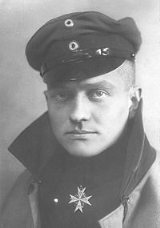
Manfred von Richthofen

 
Manfred Von Richthofen

   Email Print
   Bookmark   Link


Manfred von Richthofen


Manfred Albrecht Freiherr von Richthofen (2 May 1892 – 21 April 1918) was a German fighter pilot
Fighter pilot

A fighter pilot is a Military aviation trained to engage other aircraft and typically pilots a fighter aircraft. Fighter pilots undergo specialized training in aerial warfare and dogfighting ....
 known as the "Red Baron". He was the most successful flying ace
Flying ace

A flying ace or fighter ace is a military aviation credited with shooting down several enemy aircraft during aerial combat. The actual number of air victories required to officially qualify as an "ace" has varied, but is usually considered to be five or more....
 of World War I
World War I

World War I, or the First World War , was a global military conflict which involved the Great powers, organized into two opposing military alliances: the Allies of World War I and the Central Powers....
, being officially credited with 80 confirmed air combat
Aerial warfare

Aerial warfare is the use of military aircraft and other flying machines in warfare, including military airlift of cargo to further the national interests as was demonstrated in the Berlin Airlift....
 victories. Richthofen was a member of an aristocratic
Aristocracy

Aristocracy is a form of government, in which a few of the most prominent citizens rule. This may be a hereditary elite, or it may be by a system of cooption where a council of prominent citizens add leading soldiers, merchants, land owners, priests, and lawyers to their number....
 family with many famous relatives
Richthofen

Richthofen is the surname of a prominent Germany aristocracy family. The most famous member is the flying ace Manfred von Richthofen , also known as the "Red Baron"....
.

a class="link1" onMouseover='showByLink("m308522",this)' onMouseout='hide("m308522")'href="http://www.absoluteastronomy.com/topics/Freiherr">Freiherr
Freiherr

The German language titles Freiherr and Freifrau or Freiin are titles of nobility, used preceding the names of people, or later , before family names....
 (literally "Free Lord") is not a given name but a German aristocratic title
Title

A title is a Prefix or Suffix added to a person's name to signify either veneration, an official position or a professional or academic qualification....
, equivalent to a baron
Baron

Baron is a specific title of nobility. The word baron comes from Old French baron, itself from Old High German and latin baro meaning " man, warrior"; it merged with cognate Old English language beorn meaning "nobleman."...
 in other countries and the origin of Richthofen's most famous nickname: "The Red Baron".


Discussion
Ask a question about 'Manfred von Richthofen'
Start a new discussion about 'Manfred von Richthofen'
Answer questions from other users
Full Discussion Forum


Encyclopedia


Manfred Albrecht Freiherr von Richthofen (2 May 1892 – 21 April 1918) was a German fighter pilot
Fighter pilot

A fighter pilot is a Military aviation trained to engage other aircraft and typically pilots a fighter aircraft. Fighter pilots undergo specialized training in aerial warfare and dogfighting ....
 known as the "Red Baron". He was the most successful flying ace
Flying ace

A flying ace or fighter ace is a military aviation credited with shooting down several enemy aircraft during aerial combat. The actual number of air victories required to officially qualify as an "ace" has varied, but is usually considered to be five or more....
 of World War I
World War I

World War I, or the First World War , was a global military conflict which involved the Great powers, organized into two opposing military alliances: the Allies of World War I and the Central Powers....
, being officially credited with 80 confirmed air combat
Aerial warfare

Aerial warfare is the use of military aircraft and other flying machines in warfare, including military airlift of cargo to further the national interests as was demonstrated in the Berlin Airlift....
 victories. Richthofen was a member of an aristocratic
Aristocracy

Aristocracy is a form of government, in which a few of the most prominent citizens rule. This may be a hereditary elite, or it may be by a system of cooption where a council of prominent citizens add leading soldiers, merchants, land owners, priests, and lawyers to their number....
 family with many famous relatives
Richthofen

Richthofen is the surname of a prominent Germany aristocracy family. The most famous member is the flying ace Manfred von Richthofen , also known as the "Red Baron"....
.

Name and nicknames

Freiherr
Freiherr

The German language titles Freiherr and Freifrau or Freiin are titles of nobility, used preceding the names of people, or later , before family names....
 (literally "Free Lord") is not a given name but a German aristocratic title
Title

A title is a Prefix or Suffix added to a person's name to signify either veneration, an official position or a professional or academic qualification....
, equivalent to a baron
Baron

Baron is a specific title of nobility. The word baron comes from Old French baron, itself from Old High German and latin baro meaning " man, warrior"; it merged with cognate Old English language beorn meaning "nobleman."...
 in other countries and the origin of Richthofen's most famous nickname: "The Red Baron". Red was the color of his plane. The German translation of Red Baron is . Richthofen is today known under this nickname even in Germany, although during his lifetime he was more often described in German as Der Rote Kampfflieger, (variously translated as the The Red Battle Flyer or The Red Fighter Pilot). This name was used as the title of Richthofen's 1917 "autobiography."

Richthofen's other nicknames include "Le Diable Rouge" ("Red Devil") or "Le Petit Rouge" ("Little Red") in French, and the "Red Knight" in English.

Early life

Richthofen was born in Kleinburg, near Breslau
Wroclaw

Wroclaw is the chief city of the historical region of Lower Silesia in south-western Poland, situated on the Oder River river. Over the centuries the city has been part of Kingdom of Poland , Bohemia, Austria, Prussia, and Germany....
, Silesia
Silesia

Silesia is a historical region of Central Europe located mostly in present-day Poland, with parts in the Czech Republic and Germany.Silesia is rich in mineral and natural resources, and includes several important industrial areas....
 (now part of the city of Wroclaw, Poland), into a prominent Prussian aristocratic family
Richthofen

Richthofen is the surname of a prominent Germany aristocracy family. The most famous member is the flying ace Manfred von Richthofen , also known as the "Red Baron"....
.

When he was nine years old, Manfred moved with his family to nearby Schweidnitz
Swidnica

Swidnica is a town in south-western Poland. It has a population of 60,317 according to 2006 figures. It lies in Lower Silesian Voivodeship, being the seventh largest town in that Voivodeships of Poland....
(now Swidnica). He enjoyed riding horse
Horse

The horse is a hoofed mammal, a subspecies of one of seven extant species of the family Equidae. The horse has evolution of the horse over the past 45 to 55 million years from a small multi-toed creature into the large, odd-toed ungulate animal of today....
s and hunting as well as gymnastics at school. Manfred excelled at parallel bars and won a number of awards at school. He and his brothers, Lothar
Lothar von Richthofen

Lothar-Siegfried Freiherr von Richthofen was a Germany World War I fighter ace credited with 40 victories during the war. He was younger brother of top-scoring ace Manfred von Richthofen and a cousin of the Luftwaffe Generalfeldmarschall Wolfram von Richthofen....
 and Bolko
Bolko von Richthofen

Bolko von Richthofen was a Germany archaeologist and a relative of the fighter ace Manfred von Richthofen, the "Red Baron". He engaged in a bitter dispute about the ethnicity of the Lusatian culture and Pomeranian culture cultures with the Polish archaeologist J?zef Kostrzewski....
, hunted wild boar, elk, birds and deer.

After being both educated at home and attending a school at Schweidnitz (Swidnica), Manfred began military training when he was 11 years old. After completing cadet training in 1911, he joined a Uhlan
Uhlan

Uhlans were Polish light cavalry armed with lances, sabres and pistols. The title was later used by lancer regiments in the Prussian and Austro-Hungarian Empire armies....
 cavalry
Cavalry

The Cavalry is the second oldest of the Combat Arms, and as soldiers or warriors who fought mounted on horseback in combat, it represents the mobility and offensive power of the armed forces....
 unit, Ulanen-Regiment Kaiser Alexanders des III. von Russland (1. Westpreußisches) Nr. 1 ("1st Uhlan Regiment 'Emperor Alexander III of Russia (1st West Prussia Regiment)' "), and was assigned to the regiment's 3. Eskadron ("Number 3 Squadron
Squadron

A squadron is a small military unit or formation of cavalry, Armoured forces, aircraft , or warships....
").

After World War I broke out, Richthofen served as a cavalry reconnaissance
Reconnaissance

Reconnaissance is a military and medical term denoting exploration conducted to gain information. Militarily, its shorthand Australian, Canadian, and British form is recce , its American usage form is recon ....
 officer on both the Eastern
Eastern Front (World War I)

The Eastern Front was a theatre of war during World War I in Central Europe and, primarily, Eastern Europe. The term is in contrast to the Western Front ....
 and Western Fronts
Western Front (World War I)

Following the outbreak of World War I in 1914, the German Empire army opened the Western Front by first invading Luxembourg and Belgium, then gaining military control of important industrial regions in France....
. However, when traditional cavalry operations became obsolete due to machine gun
Machine gun

A machine gun is a Automatic firearm mounted or portable firearm, usually designed to fire List of rifle cartridgess in quick succession from an Belt or large-capacity Magazine , typically at a rate of several hundred rounds per minute....
s and barbed wire
Barbed wire

Barbed wire, also known as barb wire , is a type of fencing wire constructed with sharp edges or points arranged at intervals along the strand....
, the Uhlans were used as infantry. Disappointed with not being able to participate more often in combat operations, Richthofen applied for a transfer to the Luftstreitkräfte
Luftstreitkräfte

The Deutsche Luftstreitkr?fte, known before 1916 as Die Fliegertruppen des deutschen Kaiserreiches , was the over-land air arm of the Germany military during World War I ....
 (literally: Aerial Combat Forces), the "Imperial German Army Air Service", forerunner of the Luftwaffe
Luftwaffe

is a generic German term for an air force. It is also the official name for two of the four historic German air forces, the Wehrmacht air arm founded in 1933 and disbanded in 1946; and the current Bundeswehr air arm founded in 1956....
. After a while his request was granted and he joined the flying service at the end of May 1915.

Piloting career

Richthofen was initially an observer flying on reconnaissance missions over the Eastern Front
Eastern Front (World War I)

The Eastern Front was a theatre of war during World War I in Central Europe and, primarily, Eastern Europe. The term is in contrast to the Western Front ....
 from June to August 1915, with Fliegerabteilung 69 ("No. 69 Flying Squadron"). On being transferred to the Champagne front, he managed to shoot down a French Farman aircraft with his observer's machine gun, but was not credited with the kill, as it fell behind Allied lines.

He then trained as a pilot in October 1915. In March 1916, he joined Kampfgeschwader 2 ("No. 2 Bomber Geschwader") flying a two-seater Albatros C.III
Albatros C.III

The Albatros C.III was a Germany two-seat general-purpose biplane of the World War I, built by Albatros Flugzeugwerke. The C.III was a refined version of the successful Albatros C.I and was eventually produced in greater numbers than any other Idflieg aircraft designation system Albatros....
. Over Verdun
Verdun

Verdun is a city in the Meuse Departments of France in Lorraine in northeastern France. It is a sub-prefecture of the department.Verdun is the biggest city in Meuse, although it is not the capital, but the slightly smaller Bar-le-Duc....
 on 26 April 1916 he fired on a French Nieuport
Nieuport

Nieuport, later Nieuport-Delage, was a France Fixed-wing aircraft company famous for racers before World War I and fighter aircraft during World War I and between the wars....
 downing it over Fort Douaumont, although once again he gained no official credit. At this time he flew a Fokker Eindecker
Fokker Eindecker

The Fokker Eindecker was a German World War I monoplane single-seat fighter aircraft designed by Netherlands engineer Anthony Fokker. Developed in April 1915, the Eindecker was the first purpose-built German fighter aircraft and the first aircraft to be fitted with synchronizer gear, enabling the pilot to fire a machine gun through t...
 single-seat fighter.

After a further spell flying two seaters on the Eastern Front in August 1916 he met fighter pilot
Fighter pilot

A fighter pilot is a Military aviation trained to engage other aircraft and typically pilots a fighter aircraft. Fighter pilots undergo specialized training in aerial warfare and dogfighting ....
 Oswald Boelcke
Oswald Boelcke

Oswald Boelcke was a Germany flying ace of the First World War and one of the most influential patrol leaders and military tactics of the early years of air combat....
. Boelcke, touring the East looking for candidates for his newly formed fighter unit, selected Richthofen to join a new Jagdstaffel
Jasta

The Jagdstaffeln were specialized fighter aircraft squadrons in the Luftstreitkr?fte during World War I....
 ("fighter squadron"), Jasta 2. Richthofen won his first aerial combat over Cambrai
Cambrai

Cambrai is a Communes of France in the Nord Departments of France in northern France. It is a Subprefectures in France of the department.Cambrai is the seat of Archdiocese of Cambrai whose jurisdiction was immense during the Middle Ages....
, France, on 17 September 1916.

Rotebaron
After his first victory, Richthofen ordered a silver cup engraved with the date of the fight and the type of enemy machine from a jeweller friend in Berlin. He continued this tradition until he had 60 cups, by which time the supply of silver in blockaded Germany was restricted.

Rather than engage in risky tactics like his brother, Lothar (40 victories), Manfred von Richthofen strictly observed a set of flight maxims (commonly referred to as the "Dicta Boelcke
Dicta Boelcke

The Dicta Boelcke is a list of fundamental aerial maneuvers of aerial combat formulated by the first great Germany flying ace of the First World War, Oswald Boelcke....
") to assure the greatest success for both squadron and individual fighter pilots. Contrary to popular imagination, he was not a spectacular or acrobatic pilot, as were others like his brother or the renowned Werner Voss
Werner Voss

Werner Voss was a renowned World War I Germany fighter pilot, flying ace and friend and rival of the renowned Manfred von Richthofen....
. However, in addition to being a fine combat tactician and squadron leader, he was recognized as a superb marksman, and in combat he philosophically viewed his aircraft as merely a platform from which to fire his guns. Typically, as was the case for most squadron leaders, he would dive in to attack from above with the advantage of the sun behind him, and with other Jasta pilots covering his rear and flanks.

On 23 November 1916, Richthofen downed his most renowned adversary, the British ace Major Lanoe Hawker
Lanoe Hawker

Lanoe George Hawker Victoria Cross, Distinguished Service Order was a World War I English fighter pilot. He was the third pilot to receive the Victoria Cross, the highest and most prestigious award for gallantry in the face of the enemy that can be awarded to British and Commonwealth of Nations forces....
 VC
Victoria Cross

The Victoria Cross is the highest military decoration which is, or has been, awarded for valour "in the face of the enemy" to members of the armed forces of various Commonwealth of Nations countries, and previous British Empire territories....
, described by Richthofen himself as "the British Boelcke." The victory came while Richthofen was flying an Albatros D.II
Albatros D.II

The Albatros D.II was a Germany fighter aircraft used during the World War I. After a successful combat career in the early Jasta, it was gradually superseded by the Albatros D.III....
 and Hawker was flying a D.H.2
Airco DH.2

The Airco DH.2 was a single-seat biplane "Pusher configuration" aircraft which operated as a Fighter aircraft during the World War I. It was the second pusher design by Geoffrey de Havilland for Airco, based on his earlier Airco DH.1 two-seater....
. After this engagement, he was convinced he needed a fighter aircraft with more agility, though this implied a loss of speed. He switched to the Albatros D.III
Albatros D.III

The Albatros D.III was a biplane fighter aircraft used by the Imperial Germany Army Air Service and the Austria-Hungary Air Service during the First World War....
 in January 1917, scoring two victories before suffering a crack in the spar of the aircraft's lower wing. After this incident, Richthofen reverted to the Albatros D.II for the next five weeks. Richthofen scored one kill in the D.III on 9 March, but the D.III was temporarily grounded for the rest of the month, so Richthofen switched to the Halberstadt D.II
Halberstadt D.II

The Halberstadt D.II was a biplane fighter aircraft of the Luftstreitkr?fte that served through the period of Allied air superiority in early 1916, but had begun to be superseded in the Jagdstaffeln by the superior Albatros D.I fighters by the autumn of that year....
.

Richthofen returned to the Albatros D.III on 2 April 1917. He scored his next 22 kills in this type before switching to the Albatros D.V
Albatros D.V

The Albatros D.V was a fighter aircraft used by the Luftstreitkr?fte during the World War I. The D.V was the final development of the Albatros D.I family, and the last Albatros fighter to see operational service....
 in late June. Following his return from convalescence in October, Richthofen was flying the celebrated Fokker Dr.I
Fokker Dr.I

The Fokker Dr.I Dreidecker was a World War I fighter aircraft built by Fokker. The Dr.I saw widespread service in the spring of 1918. It became renowned as the aircraft in which Manfred von Richthofen gained his last 20 victories, and in which he was killed on 21 April 1918....
 triplane
Triplane

A triplane is a fixed-wing aircraft equipped with three sets of wings, each roughly the same size and mounted one above the other. Traditionally, vertical wings, elevators, and canard are not included in this count....
, the distinctive three-winged aircraft with which he is most commonly associated, although he probably did not use the type exclusively until after it was reissued with strengthened wings in November. Despite the popular link between Richthofen and the Fokker Dr. I, only 20 of his 80 kills were made in this now-famous triplane. In fact, it was his Albatros D.III that was first painted bright red and in which he first earned his name and reputation.

Richthofen championed the development of the Fokker D.VII
Fokker D.VII

The Fokker D.VII was a Germany World War I fighter aircraft designed by Reinhold Platz of the Fokker-Flugzeugwerke. Germany produced around 1,700 D.VII aircraft in the summer and autumn of 1918....
 with suggestions to overcome the deficiencies of the then current German fighter aircraft. However, he never had an opportunity to fly it in combat as he was killed just days before it entered service.

The Flying Circus


In January 1917, after his 16th confirmed kill, Richthofen received the Pour le Mérite
Pour le Mérite

The Pour le M?rite, known informally during World War I as the Blue Max , was the Kingdom of Prussia's highest military Order until the end of World War I....
 ("The Blue Max"), the highest military honor in Germany at the time. That same month, he assumed command of Jasta 11
Jasta 11

File:Bundesarchiv Bild 183-2004-0430-501, Jagdstaffel 11, Manfred v. Richthofen.jpgRoyal Prussian Jagdstaffel 11 was founded on 28 September 1916 from elements of 4 armee's Keks 1,2 and 3 and mobilized on 11 October as part of the Luftstreitkr?fte's expansion program, forming permanent specialised fighter squadrons, or "Jastas"....
, which ultimately included some of the elite of Germany's pilots, many of whom he trained himself. Several in turn subsequently became leaders of their own squadrons. Ernst Udet (later Colonel-General Udet, b. April 26, 1896 – d. November 17, 1941) was a member of Richthofen's group.

As a practical aid to easy identification in the melee of air combat, Jasta 11's aircraft soon adopted red colourations with various individual markings, with some of Richthofen's own aircraft painted entirely red. This practice soon had its use in German propaganda, even the RFC aircrew dubbing Richthofen "Le Petit Rouge."

Richthofen led his new unit to unparalleled success, peaking during "Bloody April" 1917. In that month alone, he downed 22 British aircraft, raising his official tally to 52. By June, he was the commander of the first of the new larger Jagdgeschwader (wing) formations, leading Jagdgeschwader 1
Jagdgeschwader 1 (World War 1)

The Jagdgeschwader 1 of World War I, was a fighter aircraft unit comprising four Jastas or 'fighter squadrons', originally raised by combining Jastas 4, 6, 10 & 11, on 24 June 1917 with Manfred von Richthofen as commander....
 composed of Jastas 4, 6, 10 and 11. These were highly mobile combined tactical units that could be sent at short notice to different parts of the front as required. In this way, JG1 became "The Flying Circus
Jagdgeschwader 1 (World War 1)

The Jagdgeschwader 1 of World War I, was a fighter aircraft unit comprising four Jastas or 'fighter squadrons', originally raised by combining Jastas 4, 6, 10 & 11, on 24 June 1917 with Manfred von Richthofen as commander....
", its name coming both from the unit's highly mobile nature (including the use of tents), and from its brightly coloured aircraft. By the end of April, the "Flying Circus" also became known as the "Richthofen Circus."

Richthofen was a brilliant tactician, building on Boelcke's tactics. But unlike Boelcke, he led by example and force of will rather than by inspiration. He was often described as distant, unemotional, and rather humourless, though some colleagues contend otherwise.

Incidentally, although he was now performing the duties of a lieutenant colonel, (in modern RAF terms: a wing commander) he remained a captain. The system in the British army would have been for him to have held the rank appropriate to his level of command (if only on a temporary basis) even if he had not been formally promoted. In the German army it was not unusual for a wartime officer to hold a lower rank than his duties implied, German officers being promoted according to a schedule and not by battlefield promotion. For instance, Erwin Rommel
Erwin Rommel

Erwin Johannes Eugen Rommel , was perhaps the most famous Germany Generalfeldmarschall of World War II. He was the commander of the Afrika Korps and became known for the skillful military campaigns he waged on behalf of the Wehrmacht in North Africa....
 commanded an infantry battalion as a captain in 1917 and 1918. It was also not the custom for a son to hold a higher rank than his father, and Richthofen's father was a reserve major.

Richthofen wounded in combat

On July 6th, during combat with a formation of F.E.2d two seat fighters
Royal Aircraft Factory F.E.2

The Royal Aircraft Factory F.E.2 was a two-seat pusher configuration biplane that was operated as a day and night bomber and as a fighter aircraft by the Royal Flying Corps during the World War I....
 of No. 20 Squadron RFC
No. 20 Squadron RAF

No.20 Squadron of the Royal Air Force is the current OCU for the RAF Harrier II, T10 and T12 operating from RAF Wittering. A reserve squadron, it can be called upon for combat duties if necessary....
, Richthofen sustained a serious head wound. He was then forced to land near Wervicq and was grounded for several weeks. The air victory was credited to Captain Donald Cunnell
Donald Cunnell

Donald Charles Cunnell was a United Kingdom World War I flying ace who was killed in action over Belgium....
 of No. 20, who was himself killed a few days later.

Although the Red Baron returned to combat in October 1917, his wound is thought to have caused lasting damage, as he later often suffered from post-flight nausea and headaches, as well as a change in temperament. There is even a theory linking this injury with his eventual death (see relevant section of this article).

Author and hero

It was during his convalescence that Richthofen – probably with the help of a ghostwriter
Ghostwriter

A ghostwriter is a professional writer who is paid to write books, articles, stories, reports, or other content which are officially credited to another person....
 from a German propaganda unit – wrote his "autobiography", Der rote Kampfflieger. A translation by J. Ellis Barker was published in 1918 as The Red Battle Flyer. Although Richthofen died before a revised version could be prepared, he is on record as repudiating the book, stating that it was "too insolent" (or "arrogant") and that he was "no longer that kind of person".

In 1918, Richthofen had become such a legend that it was feared that his death would be a blow to the morale of the German people. Richthofen himself refused to accept a ground job after his wound, stating that the average German soldier had no choice in his duties, and he would therefore continue to fly in combat. Certainly he had become part of a cult of hero-worship, assiduously encouraged by official propaganda. German propaganda circulated various false rumours, including that the British had raised squadrons specially to hunt down Richthofen, and were offering large rewards and an automatic Victoria Cross
Victoria Cross

The Victoria Cross is the highest military decoration which is, or has been, awarded for valour "in the face of the enemy" to members of the armed forces of various Commonwealth of Nations countries, and previous British Empire territories....
 to any Allied pilot who shot him down. Passages from his correspondence indicate he may have at least half believed some of these stories himself.

Death

Mvrichthofenwreckage
Richthofen was killed just after 11 a.m. on April 21st, 1918, while flying over Morlancourt
Morlancourt

Morlancourt is a communes of the Somme d?partement in the Somme d?partement in France in the Picardie region of France....
 Ridge, near the Somme River
Somme River

The Somme is a river in Picardy, northern France. The name Somme comes from a Celtic languages word meaning tranquility. The department Somme was named after this river....
.

At the time, the Baron had been pursuing (at very low altitude) a Sopwith Camel
Sopwith Camel

The Sopwith Camel was a British World War I single-seat fighter aircraft biplane, famous for its manoeuvrability....
 piloted by a novice Canadian pilot, Lieutenant Wilfrid "Wop" May of No. 209 Squadron
No. 209 Squadron RAF

No. 209 Squadron of the Royal Air Force was originally formed from a nucleus of "Naval Eight" on 1 February 1917 as No. 9 Squadron RNAS and saw active service in both World Wars, the Korean War and in Malaya....
, Royal Air Force
Royal Air Force

The Royal Air Force is the United Kingdom's air force, the oldest independent air force in the world. Formed on 1 April 1918, the RAF has taken a significant role in British military history ever since, playing a large part in World War II and in more recent conflicts....
. In turn, the Baron was spotted and briefly attacked by a Camel piloted by a school friend (and flight Commander) of May, Canadian Captain Arthur "Roy" Brown
Roy Brown (pilot)

Captain Arthur Roy Brown Distinguished Service Cross Royal Naval Air Service was a Canada World War I flying ace. The Royal Air Force officially credited Brown with shooting down Manfred von Richthofen, the "Red Baron", although later research has suggested that it is highly unlikely that Brown fired the bullet that caused the death of Von...
, who had to dive steeply at very high speed to intervene, and then had to climb steeply to avoid hitting the ground. Richthofen turned to avoid this attack, and then resumed his pursuit of May.

It was almost certainly during this final stage in Richthofen's pursuit of May that he was hit by a single .303
.303 British

.303 British, or 7.7mmx56R, is a .311 inch calibre rifle and machine gun Cartridge first developed in United Kingdom in the 1880s as a blackpowder round, later adapted to use cordite and then smokeless powder propellant....
 bullet, which caused such severe damage to his heart and lungs that it must have produced a very speedy death. In the last seconds of his life, he managed to make a hasty but controlled landing in a field on a hill near the Bray-Corbie road, just north of the village of Vaux-sur-Somme
Vaux-sur-Somme

Vaux-sur-Somme is a commune in France of the Somme D?partement in France in northern France. It is best known as the death place of flying ace Manfred von Richthofen, better known as the Red Baron, in mysterious circomstances....
, in a sector controlled by the Australian Imperial Force (AIF). One witness, Gunner George Ridgway, stated that when he and other Australian soldiers reached the aircraft, Richthofen was still alive but died moments later. Another eye witness, Sgt Ted Smout
Edward David Smout

Sgt Edward David 'Ted' Smout Order of Australia was a veteran of World War I. Born in Brisbane , he joined the Australian Army Medical Corps at the age of 17, lying about his age to enlist....
 of the Australian Medical Corps
Royal Australian Army Medical Corps

The Royal Australian Army Medical Corps is the branch of the Australian Army responsible for providing medical care to Army personnel. The AAMC was formed in 1903 and has participated in every Australian Army operation....
, reported that Richthofen's last word was "kaputt" ("finished") immediately before he died.

His Fokker was not badly damaged by the landing, but it was soon taken apart by souvenir hunters.

No. 3 Squadron
No. 3 Squadron RAAF

No. 3 Squadron is a Royal Australian Air Force fighter squadron. It was first formed in 1916 and currently operates F/A-18 Hornet aircraft from RAAF Base Williamtown, near Sydney....
, Australian Flying Corps
Royal Australian Air Force

The Royal Australian Air Force is the Air Force branch of the Australian Defence Force. The RAAF began in March 1912 as the Australian Flying Corps and became a fully independent Air Force in March 1921....
, as the nearest Allied air unit, assumed responsibility for the Baron's remains.

Who fired the fatal shot?

After 90 years of controversy and contradictory hypotheses
Hypothesis

A hypothesis consists either of a suggested explanation for an observable phenomenon or of a reasoned proposal predicting a possible causal correlation among multiple phenomena....
, exactly who fired the fatal shot remains uncertain.

The RAF credited Brown with shooting down the Red Baron. However, Richthofen died following an extremely serious and inevitably fatal chest wound from a single bullet, penetrating from the right armpit and resurfacing next to the left nipple. If this was from Brown's guns, Richthofen simply could not have continued his pursuit of May for as long as he did. Brown himself never spoke much about what happened that day, claiming "There is no point in me commenting, as the evidence is already out there".

Experts are now generally agreed that Richthofen was killed by someone on the ground. The wound through his body indicated that it had been caused by a bullet moving in an upward motion, from the right side, and more importantly, that it was probably received some time after Brown's attack.

Many sources, including a 1998 article by Dr. Geoffrey Miller, a physician and historian of military medicine, and also a U.S. Public Broadcasting Service
Public Broadcasting Service

The Public Broadcasting Service is an United States non-profit public broadcasting television service with 354 member TV stations in the United States....
 documentary made in 2003, have suggested that Sergeant Cedric Popkin
Cedric Popkin

Cedric Bassett Popkin is considered the person most likely to have killed Germany flying ace Manfred von Richthofen — also known as the "Red Baron" — on 21 April 1918....
 was the person most likely to have killed Richthofen. Popkin was an anti-aircraft (AA) machine gunner with the Australian 24th Machine Gun Company, and was using a Vickers gun
Vickers machine gun

The Vickers machine gun or Vickers gun is a name primarily used to refer to the Water cooling .303 British machine gun produced by Vickers Limited, originally for the British Army....
. He fired at Richthofen's aircraft on two occasions: first as the Baron was heading straight at his position, and then at long range from the right. Popkin stated — in a 1935 letter, which included a sketch map — to the Australian official war historian, that he believed he had fired the fatal shot as Richthofen approached his position. Such a shot would have been from directly in front of the aircraft and could not have been the one that resulted in the Baron's death. However, Popkin was well placed to fire the fatal shot when Richthofen passed him for a second time on the right.

One source, a 2002 documentary produced by the Discovery Channel
Discovery Channel

The Discovery Channel is an United States satellite and cable TV channel , founded by John Hendricks and distributed by Discovery Communications....
 suggests that Gunner W. J. "Snowy" Evans
Snowy Evans

William John "Snowy" Evans was a Lewis machine gunner with the 53rd Battery, Royal Australian Artillery during World War I. A 2002 documentary produced by Discovery Channel credited him with firing the shot that killed Manfred von Richthofen , near Vaux-sur-Somme, France on April 21, 1918....
, a Lewis machine gunner with the 53rd Battery, 14th Field Artillery Brigade, Royal Australian Artillery is likely to have killed von Richthofen. However, Dr. Miller and the PBS documentary dismiss these theories.

Other sources have suggested that Gunner Robert Buie (also of the 53rd Battery) may have fired the fatal shot. There is now little support for this theory. Nevertheless, in March 2007, the municipality of Hornsby Shire
Hornsby Shire

Hornsby Shire is a vast Local Government Areas in Australia in the Northern region of Sydney, Australia. The estimated population of Hornsby Shire was 155,971 ....
, in Sydney, recognised Buie, a former resident, as the man who shot down Richthofen. The Shire placed a plaque near Buie's former home in the suburb of Brooklyn
Brooklyn, New South Wales

Brooklyn is a small suburb of northern Sydney, in the state of New South Wales, Australia. Brooklyn is located 51 kilometres north of the Sydney central business district, in the Local Government Areas in Australia of Hornsby Shire and is part of the North Shore region....
. Buie, who died in 1964, has never been officially recognised in any other way.

The commanding officer of No. 3 Squadron AFC, Major David Blake
David Valentine Jardine Blake

Major General David Valentine Jardine Blake was a notable member of the Australian Army in both World War I and World war II, rising to the rank of Major General....
 suggested initially that Richthofen had been killed by the crew of one of his squadron's R.E.8
Royal Aircraft Factory R.E.8

The Royal Aircraft Factory R.E.8 was a United Kingdom two-seat biplane reconnaissance and bomber aircraft of the World War I. Intended as a replacement for the vulnerable Royal Aircraft Factory B.E.2, the R.E.8 was much more difficult to fly, and was regarded with great suspicion at first in the Royal Flying Corps....
s, which had also fought Richthofen's unit that afternoon. However, this was quickly disproved, and, following an autopsy
Autopsy

An autopsy, also known as a post-mortem examination, necropsy , autopsia cadaverum, or obduction, is a medical procedure that consists of a thorough examination of a Dead body to determine the cause and manner of death and to evaluate any disease or injury that may be present....
 that he witnessed, Blake became a strong proponent of the view that an AA machine gunner had killed Richthofen.

Theories about Richthofen's last combat

Richthofen was a highly experienced and skilled fighter pilot — fully aware of the risk from ground fire. Furthermore he was fully in accord with his late mentor Boelcke's
Oswald Boelcke

Oswald Boelcke was a Germany flying ace of the First World War and one of the most influential patrol leaders and military tactics of the early years of air combat....
 rules of air fighting
Dicta Boelcke

The Dicta Boelcke is a list of fundamental aerial maneuvers of aerial combat formulated by the first great Germany flying ace of the First World War, Oswald Boelcke....
, which were strongly against taking foolish risks. In view of all this, it is universally accepted that Richthofen's judgement during his last combat was uncharacteristically unsound in several respects. Several theories have been propounded to account for this behaviour - some of which are detailed below.

In 1999, a German medical researcher, Dr. Henning Allmers, published an article in British medical journal The Lancet
The Lancet

The Lancet is a peer-reviewed general medical journal, published weekly by Elsevier, part of Reed Elsevier.One of the world's best-known and most respected general medical journals, with editorial offices in London and New York, The Lancet was founded in 1823 by Thomas Wakley, who named it after the surgical instrument called a lanc...
, suggesting that it was likely brain damage from the head wound suffered by Richthofen in July 1917 (see above) played a part in the Baron's death. This theory was supported by a 2004 paper from researchers at the University of Texas. Richthofen's behaviour after his injury was noted as consistent with brain-injured patients, and such an injury may account for his perceived lack of judgment on his final flight: flying too low over enemy territory and suffering target fixation
Target fixation

Target fixation is a process by which the brain is focused so intently on an observed object that awareness of other obstacles or hazards can diminish....
.

There is also a possibility that Richthofen was suffering from cumulative combat stress
Combat stress reaction

Combat stress reaction, in the past commonly known as shell shock or battle fatigue, is a military term used to categorize a range of behaviours resulting from the stress of battle which decrease the combatant's fighting efficiency....
, which made him fail to observe some of his usual precautions. It is remarkable that one of the leading British air aces, Major Edward "Mick" Mannock
Edward Mannock

Major Edward Corringham Mannock Victoria Cross, Distinguished Service Order, Military Cross was a United Kingdom First World War flying ace. Mannock was probably born in Ireland, but of England and Scotland parentage....
, was also killed by ground fire on 26 July 1918 while crossing the lines at low level, an action against which he had always cautioned his younger pilots. And the most popular of all French air aces, Georges Guynemer
Georges Guynemer

Georges Guynemer was a France national hero during World War I, and a top fighter ace at the time of his death....
, went missing on 11 September 1917, probably while attacking a two-seater without realizing some Fokkers were escorting it.

There is also a suggestion in Franks and Bennett's 2007 book, that on the day of Richthofen's death, the prevailing wind was about 25 mph (40 km/h) easterly, rather than the usual westerly. This meant that Richthofen, heading generally westward at an airspeed of about 100 mph (160 km/h), was travelling over the ground at 125 mph (200 km/h) rather than the more typical ground speed of 75 mph (120 km/h). This was 50 mph (80 km/h) or 60% faster than normal and thus he could easily have strayed over enemy lines without realizing it, especially since he was struggling with one jammed gun and another that was only firing short bursts before needing re-cocking.

An assessment of all these factors must include the circumstances of the time. At the time of Richthofen's death the front was in a highly fluid state, following the initial success of the German offensive of March–April 1918. The Baron may have been acutely aware that the battle he was engaged in was part of Germany's last real chance to win the war — in the face of Allied air superiority, the German air service was having great difficulty in acquiring vital reconnaissance information, such as the positions of batteries, and could do little to prevent Allied squadrons from completing very effective reconnaissance and close support of their armies.

Burial

Richthofen Funeral
In common with most Allied air officers, Major Blake, who was responsible for Richthofen's remains, regarded the Red Baron with great respect, and he organised a full military funeral
Military funeral

A military funeral is a funeral given by a country's military for a veteran, a soldier who died in battle, or another prominent military figure....
, to be conducted by the personnel of No. 3 Squadron AFC.

Richthofen was buried in the cemetery at the village of Bertangles
Bertangles

Bertangles is a communes of the Somme d?partement in the Somme d?partement in France in the Picardie region of France....
, near Amiens
Amiens

Amiens is a city and Communes of France in northern France, north of Paris. It is the capital of the Somme Departments of France in Picardie....
, on 22 April 1918. Six airmen with the rank of Captain — the same rank as Richthofen — served as pallbearers, and a guard of honour from the squadron's other ranks fired a salute. Other Allied squadrons presented memorial wreaths.

Richthofen's aircraft was dismembered by souvenir hunters. Its engine was donated to the Imperial War Museum
Imperial War Museum

The Imperial War Museum is a museum in London, England which documents British and Commonwealth history since 1914, with an emphasis on the causes, course and consequences of conflict....
 in London, where it is still on display. The Royal Canadian Military Institute
Royal Canadian Military Institute

The Royal Canadian Military Institute , located in Toronto, Ontario, is Canada's premier independent institute for the study of military strategy, arts, military science and literature....
 in Toronto, Ontario
Ontario

Ontario is a Provinces and territories of Canada located in the Central Canada part of Canada, the largest by population and second largest, after Quebec, in total area....
 Canada owns the seat in which he died. The Institute also displays a side panel from the aircraft - signed by the pilots of Brown's squadron. The control column of Richthofen's aircraft is displayed at the Australian War Memorial
Australian War Memorial

The Australian War Memorial is Australia's national war memorial to the members of all its Australian Defence Force and supporting organisations who have died or participated in the wars of the Australia....
 Canberra.

In 1925, Manfred von Richthofen's youngest brother, Bolko, recovered the body and took it home. The family's first intention was to lay Manfred's coffin down at the Schweidnitz cemetery, beside the graves of his father (died in 1920) and his brother Lothar
Lothar von Richthofen

Lothar-Siegfried Freiherr von Richthofen was a Germany World War I fighter ace credited with 40 victories during the war. He was younger brother of top-scoring ace Manfred von Richthofen and a cousin of the Luftwaffe Generalfeldmarschall Wolfram von Richthofen....
, who had been killed in a post-war air crash in 1922. But German authorities expressed a wish that the final place of rest for the body be the Invalidenfriedhof Cemetery
Invalidenfriedhof Cemetery

The Invalidenfriedhof Cemetery is one of the oldest cemetery in Berlin. The cemetery was the traditional resting place of the Prussia military, and is regarded as particularly important as a memorial to the German Wars of Liberation of 1813-15....
 in Berlin, where many German military heroes and leaders were buried. The family agreed, and Richthofen's grave remained in Berlin until 1975, when his body was exhumed and buried in his family's tomb at the Südfriedhof in Wiesbaden
Wiesbaden

Wiesbaden is a city in southwestern Germany and the capital of the States of Germany of Hesse. It has about 300,400 inhabitants, plus approximately 35,000 United States citizens ....
.

Number of victories

For decades after World War I, some authors questioned whether Richthofen achieved 80 victories, insisting that his record was exaggerated for propaganda purposes. Some claimed that he took credit for aircraft downed by his squadron or wing. However, in the 1990s, resurgence in Great War scholarship resulted in detailed investigation of many facets of air combat. A study conducted by British historian Norman Franks
Norman Franks

Norman Leslie Robert Franks is an England writer who specialises in aviation books on the pilots and squadrons of World Wars I and II. He published his first book in 1976....
 with two colleagues, published in Under the Guns of the Red Baron in 1998, concluded that at least 73 of Richthofen's claimed victories were accurate, with documented identities of the Allied airmen whom Richthofen had fought and defeated. There were also unconfirmed victories that could put his actual total as high as 100. The highest scoring Allied ace was Frenchman René Fonck, with 75 victories and the highest scoring British Empire
British Empire

The British Empire comprised the dominions, Crown colony, protectorates, League of Nations mandate, and other Dependent territory ruled or administered by the United Kingdom , that had originated with the overseas colonies and trading posts established by England in the late 16th and early 17th centuries....
 fighter pilots were Mick Mannock with 65–73 kills and Canadian Billy Bishop
Billy Bishop

Air Marshal William Avery "Billy" Bishop Victoria Cross, Order of the Bath, Distinguished Service Order, Military Cross, Distinguished Flying Cross , Canadian Efficiency Decoration was a Canada World War I flying ace, officially credited with 72 victories, making him the top Canadian ace, and according to some sources, the top ace of the Br...
, with 72.

It is also significant that while Richthofen's early victories and the establishment of his reputation coincided with a period of German air superiority
Air superiority

Air superiority is the dominance in the air power of one side's air forces over the other side's during a military campaign. It is defined in the NATO Glossary as "That degree of dominance in the air battle of one force over another that permits the conduct of operations by the former and its related land, sea, and air forces at a given time...
, the majority of his successes were achieved against a numerically superior enemy, who were flying fighter aircraft
Fighter aircraft

A fighter aircraft is a military aircraft designed primarily for air-to-air combat with other aircraft, as opposed to a bomber, which is designed primarily to attack ground targets by dropping bombs....
 that were on the whole better than his own.

Tributes and honours

At various times, several different Luftwaffe
Luftwaffe

is a generic German term for an air force. It is also the official name for two of the four historic German air forces, the Wehrmacht air arm founded in 1933 and disbanded in 1946; and the current Bundeswehr air arm founded in 1956....
 Geschwader have been named after the Baron:
  • Jagdgeschwader 132 "Richthofen" (1 April 1936–1 November 1938)
  • Jagdgeschwader 131 "Richthofen" (1 November 1938–1 May 1939)
  • Jagdgeschwader 2 "Richthofen"
    Jagdgeschwader 2

    Jagdgeschwader 2 "Richthofen" was a World War II Luftwaffe Wing . It was named after World War I flying ace Manfred von Richthofen....
     (1 May 1939–7 May 1945)
  • Jagdgeschwader 71 "Richthofen"
    Jagdgeschwader 71

    Jagdgeschwader 71 was West Germany's first operational jet fighter unit, and remains an operational Fighter Wing of the Luftwaffe, the Air Force of the Germany....
     (from 6 June 1959) — the first jet fighter unit established by the post-World War II (German Air Force); its first commander was the most successful ace in history, Erich Hartmann
    Erich Hartmann

    Erich Alfred "Bubi" Hartmann , also nicknamed "Bubi" by allies and "The Black Devil" by his enemies, was a German World War II fighter pilot and is the highest scoring flying ace in the history of Aerial warfare....
    .


A Kriegsmarine
Kriegsmarine

The Kriegsmarine was the name of the German Navy between 1935 and 1945, during the Nazi Germany regime, superseding the Reichsmarine, and the Kaiserliche Marine of World War I....
 (German navy) seaplane tender
Seaplane tender

A seaplane tender is a ship that provides facilities for operating seaplanes. These ships were the first aircraft carriers and appeared just before the World War I....
 launched in 1941 was also named Richthofen.

Decorations and awards

  • Prussian Pour le Mérite Order: 12 January 1917 (in recognition of his 16th aerial victory).
  • Prussian Red Eagle Order, 3rd Class with Crown and Swords: 6 April 1918 (in recognition of his 70th aerial victory).
  • Prussian Royal Hohenzollern House Order, Knight's Cross with Swords: 11 November 1916.
  • Prussian Iron Cross, 1st Class (1914)
  • Prussian Iron Cross, 2nd Class (1914): 12 September 1914.
  • Bavarian Military Merit Order, 4th Class with Swords: 29 April 1917.
  • Saxon Military St. Henry Order, Knight's Cross: 16 April 1917.
  • Württemberg Military Merit Order, Knight's Cross: 13 April 1917.
  • Saxe-Ernestine Ducal House Order, Knight 1st Class with Swords (issued by the Duchy of Saxe-Coburg and Gotha): 9 May 1917.
  • Hesse General Honour Decoration, "for Bravery"
  • Lippe War Honour Cross for Heroic Deeds: 13 October 1917.
  • Schaumburg-Lippe Cross for Faithful Service: 10 October 1917.


  • Bremen Hanseatic Cross: 25 September 1917.
  • Lübeck Hanseatic Cross: 22 September 1917.
  • Austrian Order of the Iron Crown, 3rd Class with War Decoration: 8 August 1917.
  • Austrian Military Merit Cross, 3rd Class with War Decoration
  • Bulgarian Bravery Order, 4th Class (1st Grade): June 1917.
  • Turkish Imtiaz Medal in Silver with Sabres
  • Turkish Liakat Medal in Silver with Sabres
  • Turkish War Medal ("Iron Crescent"): 4 November 1917.
  • German Army Pilot's Badge
  • German Army Observer's Badge
  • Austrian Field Pilot's Badge (Franz Joseph pattern)


See also

  • The Red Baron in popular culture
    The Red Baron in popular culture

    The following is a list of mentions of Manfred von Richthofen, the Red Baron, in popular culture....
  • List of World War I flying aces by number of victories
  • The Red Baron
    The Red Baron (film)

    The Red Baron is a feature film about legendary fighter pilot Manfred von Richthofen....
    , a film released in 2008, which at times seems biographical but is not historically correct and has many fictional elements
  • Flying aces (the article includes specific references to Richthofen)


Bibliography

  • Allmers, Dr. Henning. "Manfred Freiherr von Richthofen's Medical Record: Was the "Red Baron" fit to fly?" Lancet 1999, 354: pp. 502–504.
  • Baker, David. Manfred von Richthofen: The Man and the Aircraft He Flew. McGregor, Minnesota: Voyageur Press, 1991. ISBN 1-87154-706-7.
  • Bodenschatz, Karl
    Karl Bodenschatz

    General Karl-Heinrich Bodenschatz was a Germany military officer who was the adjutant to Manfred von Richthofen in World War I and the liaison officer between Hermann G?ring and Adolf Hitler in World War II....
    . Hunting With Richthofen: Sixteen Months of Battle with J G Freiherr Von Richthofen No. 1. London: Grub Street, 1998. ISBN 1-89869-797-3.
  • Franks, Norman, Hal Giblin and Nigel McCrery. Under the Guns of the Red Baron: Complete Record of Von Richthofen's Victories and Victims. London: Grub Street, 1998. ISBN 1-84067-145-9.
  • Kilduff, Peter. The Red Baron: Beyond the Legend. London: Cassell, 1994. ISBN 0-304-35207-1.
  • O’Connor, Neal W. "The Aviation Awards of the Grand Duchies of Baden and Oldenburg (Foundation of Aviation World War I." Aviation Awards of Imperial Germany in World War I and the Men Who Earned Them – Volume VI. Stratford, Connecticut: Flying Machines Press, 1999. ISBN 0-76431-626-5.
  • Von Richthofen, Manfred. Red Fighter Pilot: The Autobiography of the Red Baron. St Petersburg, Florida: Red and Black Publishers, 2007. ISBN 978-0-9791813-3-7.
  • Wright, Nicolas. The Red Baron. London: Sidgwick & Jackson, 1976. ISBN 0-283-98298-5.
Concerning The Red Baron's Death
  • Day, Mark. The Australian
    The Australian

    The Australian, also referred to as The Oz, is a broadsheet newspaper published in Australia on Monday to Saturday each week since 1964....
     News Corporation, 30 April 2007. Retrieved: 30 April 2007.
  • Franks, Norman and Alan Bennett. The Red Baron's Last Flight. London: Grub Street, 1997. ISBN 1-90494-333-0.
  • Miller, Geoffrey. Sabretache: Journal and Proceedings of the Military History Society of Australia, Vol. XXXIX, No. 2.
  • Titler, Dale. The Day the Red Baron Died. New York: Ballantine Books, 1970. ISBN 0-345-24923-2.


External links

  • of the movie The Red Baron (2007)