
Home      Discussion      Topics      Dictionary      Almanac
Signup       Login
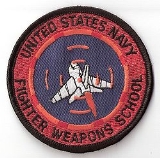
United States Navy Fighter Weapons School

United States Navy Fighter Weapons School

Overview
The United States Navy Strike Fighter Tactics Instructor program (SFTI program), more popularly known as TOPGUN, is the modern-day evolution of the United States Navy Fighter Weapons School which was originally established on March 3, 1969 at the former Naval Air Station Miramar
Marine Corps Air Station Miramar
Marine Corps Air Station Miramar , formerly Naval Air Station Miramar is a United States Marine Corps installation that is home to the 3rd Marine Aircraft Wing, which is the aviation element of the 1st Marine Expeditionary Force...

 in California. The SFTI program carries out the same specialized fighter training as NFWS (Navy Fighter Weapons School) had from 1969 until 1996, when it was merged into the Naval Strike and Air Warfare Center
Naval Strike and Air Warfare Center
The Naval Strike and Air Warfare Center at Naval Air Station Fallon located in the city of Fallon in western Nevada is the center of excellence for naval aviation training and tactics development...

 at NAS Fallon, Nevada.
Discussion
Ask a question about 'United States Navy Fighter Weapons School'
Start a new discussion about 'United States Navy Fighter Weapons School'
Answer questions from other users
Full Discussion Forum
 
Unanswered Questions
Encyclopedia
The United States Navy Strike Fighter Tactics Instructor program (SFTI program), more popularly known as TOPGUN, is the modern-day evolution of the United States Navy Fighter Weapons School which was originally established on March 3, 1969 at the former Naval Air Station Miramar
Marine Corps Air Station Miramar
Marine Corps Air Station Miramar , formerly Naval Air Station Miramar is a United States Marine Corps installation that is home to the 3rd Marine Aircraft Wing, which is the aviation element of the 1st Marine Expeditionary Force...

 in California. The SFTI program carries out the same specialized fighter training as NFWS (Navy Fighter Weapons School) had from 1969 until 1996, when it was merged into the Naval Strike and Air Warfare Center
Naval Strike and Air Warfare Center
The Naval Strike and Air Warfare Center at Naval Air Station Fallon located in the city of Fallon in western Nevada is the center of excellence for naval aviation training and tactics development...

 at NAS Fallon, Nevada.

History


The United States Navy
United States Navy
The United States Navy is the naval warfare service branch of the United States Armed Forces and one of the seven uniformed services of the United States. The U.S. Navy is the largest in the world; its battle fleet tonnage is greater than that of the next 13 largest navies combined. The U.S...

 (USN) Fighter Weapons School was established on March 3, 1969 at NAS Miramar, California at the direction of the Chief of Naval Operations
Chief of Naval Operations
The Chief of Naval Operations is a statutory office held by a four-star admiral in the United States Navy, and is the most senior uniformed officer assigned to serve in the Department of the Navy. The office is a military adviser and deputy to the Secretary of the Navy...

 (CNO).

The school was the end result of a study, published in May 1968, by USN Captain Frank Ault
Frank Ault
Captain Frank Ault, USN was a United States Naval officer. He is best remembered for the classified study he led in 1968 that led to the creation of the Navy Fighter Weapons School, or TOPGUN...

 who, at the direction of the CNO, researched the failings of the US air to air missiles used in aerial combat in the skies over North Vietnam
North Vietnam
The Democratic Republic of Vietnam , was a communist state that ruled the northern half of Vietnam from 1954 until 1976 following the Geneva Conference and laid claim to all of Vietnam from 1945 to 1954 during the First Indochina War, during which they controlled pockets of territory throughout...

. Operation Rolling Thunder
Operation Rolling Thunder
Operation Rolling Thunder was the title of a gradual and sustained US 2nd Air Division , US Navy, and Republic of Vietnam Air Force aerial bombardment campaign conducted against the Democratic Republic of Vietnam from 2 March 1965 until 1 November 1968, during the Vietnam War.The four objectives...

, which lasted from 2 March 1965 to 1 November 1968, resulted in nearly 1,000 US aircraft losses in approximately one million sortie
Sortie
Sortie is a term for deployment or dispatch of one military unit, be it an aircraft, ship, or troops from a strongpoint. The sortie, whether by one or more aircraft or vessels, usually has a specific mission....

s. Operation Rolling Thunder became the Rorschach test
Rorschach test
The Rorschach test is a psychological test in which subjects' perceptions of inkblots are recorded and then analyzed using psychological interpretation, complex algorithms, or both. Some psychologists use this test to examine a person's personality characteristics and emotional functioning...

for both the USN and the US Air Force, and from which they drew nearly opposite conclusions. The USAF concluded that its air losses were primarily due to unobserved MiG attacks from the rear, and was therefore a technology problem. The Air Force focused on upgrades to their F-4 Phantom II
F-4 Phantom II
The McDonnell Douglas F-4 Phantom II is a tandem two-seat, twin-engined, all-weather, long-range supersonic jet interceptor fighter/fighter-bomber originally developed for the United States Navy by McDonnell Aircraft. It first entered service in 1960 with the U.S. Navy. Proving highly adaptable,...

 fleet, such as installing an internal 20mm Vulcan cannon (replacing the gun pod
Gun pod
A gun pod is a detachable pod or pack containing machine guns or automatic cannon and ancillaries, mounted externally on a vehicle such as a military aircraft which may or may not also have its own guns....

s carried under the aircraft's belly), developing improved airborne radar
Radar
Radar is an object-detection system which uses radio waves to determine the range, altitude, direction, or speed of objects. It can be used to detect aircraft, ships, spacecraft, guided missiles, motor vehicles, weather formations, and terrain. The radar dish or antenna transmits pulses of radio...

 systems, and working on solving missile problems that were generally blamed for not properly tracking & destroying target planes.

The Navy, in what became known as the "Ault Report
Ault Report
The "Ault Report", or more formally the Air-to-Air Missile System Capability Review, was a sweeping study of US Navy air-to-air missile performance during the period of 1965 to 1968, conducted by Navy Captain Frank Ault. The study was initiated at the behest of Admiral Tom Moorer, Chief of Naval...

", came to the conclusion that inadequate air-crew training in air combat maneuvering (ACM) skills was the problem.
The conclusions of the "Ault Report" were not news to the F-8 Crusader
F-8 Crusader
The Vought F-8 Crusader was a single-engine, supersonic, carrier-based air superiority jet aircraft built by Vought for the United States Navy and the U.S. Marine Corps, replacing the Vought F7U Cutlass...

 community, who had been lobbying for an ACM training program ever since the commencement of Rolling Thunder in 1965.

The Ault Report recommended establishment of an "Advanced Fighter Weapons School" to revive and disseminate community fighter expertise throughout the fleet. The school was initially formed using many F-8 pilots as instructors, and placed under the control of F-4 Phantom-equipped Replacement Air Group (RAG)
Fleet Replacement Squadron
A Fleet Replacement Squadron , is a unit of the United States Navy and Marine Corps that trains Naval Aviators and Naval Flight Officers on the specific front-line aircraft they have been assigned to fly...

 unit VF-121
VF-121
VF-121 Fighter Squadron 121 of the US Navy and was disestablished on 30 September 1980. VF-121 was originally VF-781, a reserve squadron, established on 2 August 1950.On July 1, 1946, VF-121, The Pacemakers were stationed at NAS Alamitos, CA...

 "Pacemakers." At the time it received relatively scant funding and resources, and built its syllabus from scratch, while borrowing aircraft from its parent unit as well as other units to support the practical aspects of their operations.

Its objective was to develop, refine and teach aerial dogfight tactics and techniques to selected fleet air crews, using the concept of Dissimilar Air Combat Training
Dissimilar air combat training
Dissimilar air combat training was introduced as a formal part of US air combat training after disappointing aerial combat exchange rates in the Vietnam War.Traditionally, pilots would undertake air combat training against similar aircraft...

. DACT uses stand-in aircraft to realistically replicate expected threat aircraft and presently is widely used in air arms the world over. At that time the predominant threat aircraft were the Russian-built transonic MiG-17 'Fresco'
Mikoyan-Gurevich MiG-17
The Mikoyan-Gurevich MiG-17 is a high-subsonic fighter aircraft produced in the USSR from 1952 and operated by numerous air forces in many variants. Most MiG-17 variants cannot carry air-to-air missiles, but shot down many aircraft with its cannons...

 and the supersonic MiG-21 'Fishbed'
Mikoyan-Gurevich MiG-21
The Mikoyan-Gurevich MiG-21 is a supersonic jet fighter aircraft, designed by the Mikoyan-Gurevich Design Bureau in the Soviet Union. It was popularly nicknamed "balalaika", from the aircraft's planform-view resemblance to the Russian stringed musical instrument or ołówek by Polish pilots due to...

.

TOPGUN initially operated the A-4 Skyhawk
A-4 Skyhawk
The Douglas A-4 Skyhawk is a carrier-capable ground-attack aircraft designed for the United States Navy and United States Marine Corps. The delta winged, single-engined Skyhawk was designed and produced by Douglas Aircraft Company, and later McDonnell Douglas. It was originally designated the A4D...

 and borrowed USAF T-38 Talon
T-38 Talon
The Northrop T-38 Talon is a twin-engine supersonic jet trainer. It was the world's first supersonic trainer and is also the most produced. The T-38 remains in service as of 2011 in air forces throughout the world....

s to simulate the flying characteristics of the MiG-17 and MiG-21, respectively. The school also made use of Marine
United States Marine Corps
The United States Marine Corps is a branch of the United States Armed Forces responsible for providing power projection from the sea, using the mobility of the United States Navy to deliver combined-arms task forces rapidly. It is one of seven uniformed services of the United States...

-crewed A-6 Intruder
A-6 Intruder
The Grumman A-6 Intruder was an American, twin jet-engine, mid-wing attack aircraft built by Grumman Aerospace. In service with the U.S. Navy and U.S. Marine Corps between 1963 and 1997, the Intruder was designed as an all-weather medium attack aircraft to replace the piston-engined A-1 Skyraider...

s and USAF F-106
F-106 Delta Dart
The Convair F-106 Delta Dart was the primary all-weather interceptor aircraft for the United States Air Force from the 1960s through the 1980s. Designed as the so-called "Ultimate Interceptor", it has proven to be the last dedicated interceptor in USAF service to date...

 aircraft when available. Later, the T-38 was replaced by the F-5E and F-5F Tiger II
F-5 Freedom Fighter
The Northrop F-5A/B Freedom Fighter and the F-5E/F Tiger II are part of a family of widely-used light supersonic fighter aircraft, designed and built by Northrop...

.

One British writer erroneously claimed that the early school was influenced by a group of a dozen flying instructors from the British
United Kingdom
The United Kingdom of Great Britain and Northern IrelandIn the United Kingdom and Dependencies, other languages have been officially recognised as legitimate autochthonous languages under the European Charter for Regional or Minority Languages...

 Fleet Air Arm
Fleet Air Arm
The Fleet Air Arm is the branch of the British Royal Navy responsible for the operation of naval aircraft. The Fleet Air Arm currently operates the AgustaWestland Merlin, Westland Sea King and Westland Lynx helicopters...

 aboard HMS Ark Royal
HMS Ark Royal (R09)
HMS Ark Royal was an Audacious-class aircraft carrier of the Royal Navy and, when she was decommissioned in 1978, was the Royal Navy's last remaining conventional catapult and arrested-landing aircraft carrier...

, who were graduates of the Royal Navy
Royal Navy
The Royal Navy is the naval warfare service branch of the British Armed Forces. Founded in the 16th century, it is the oldest service branch and is known as the Senior Service...

's intense Air Warfare Instructors School in Lossiemouth
RAF Lossiemouth
RAF Lossiemouth is a Royal Air Force station to the west of the town of Lossiemouth in Moray, Scotland. It is one of the RAF's biggest bases and is currently Britain's main base for Tornado GR4s. From 2013 the Northern QRA force of Typhoon F2 will relocate to Lossiemouth following the closure of...

, Scotland
Scotland
Scotland is a country that is part of the United Kingdom. Occupying the northern third of the island of Great Britain, it shares a border with England to the south and is bounded by the North Sea to the east, the Atlantic Ocean to the north and west, and the North Channel and Irish Sea to the...

. However, an earlier incarnation of TOPGUN, the U.S. Navy Fleet Air Gunnery Units, or FAGU, had provided air combat training for Naval Aviators from the early 1950s until 1960, when a doctrinal shift, brought on by advances in missile, radar and fire control technology, contributed to the belief that the era of the classic dogfight was over, leading to their disestablishment. The pilots who were part of the initial cadre of instructors at TOPGUN had experience as students from FAGU.

Air crews selected to attend the TOPGUN course were chosen from front-line units. Upon graduating, these crews would return to their parent fleet units to relay what they had learned to their fellow squadron mates—in essence becoming instructors themselves.

During the halt in the bombing campaign against North Vietnam (in force from 1968 until the early 1970s), TOPGUN established itself as a center of excellence in fighter doctrine, tactics and training. By the time aerial activity over the North resumed, most Navy squadrons had a TOPGUN graduate. According to the USN, the results were dramatic. The Navy kill-to-loss ratio against the North Vietnamese Air Force (NVAF) MiGs soared from 3.7:1 (1965–1967) to 13:1 (post 1970), while the Air Force, which had not implemented a similar training program, actually had its kill ratio worsen for a time after the resumption of bombing, according to Benjamin Lambeth's The Transformation of American Airpower.

The Air Forces ratio, at one point, dropped to an awful 1:1. Many factors lead to the poor performances of Air Force crews, but most people felt that the concentration on technical issues (guns, radars, etc.) instead of training & tactics lead the pilots to be woefully unprepared for the air-to-air tangles they were facing with the experienced MiG pilots.

The success of the U.S. Navy fighter crews vindicated the fledging DACT school's existence and led to TOPGUN becoming a separate, fully funded command in itself, with its own permanently assigned aviation, staffing, and infrastructural assets. Successful TOPGUN graduates who scored air-to-air kills over North Vietnam and returned to instruct included "Mugs" McKeown and Jack Ensch, and the first U.S. aces
Flying ace
A flying ace or fighter ace is a military aviator credited with shooting down several enemy aircraft during aerial combat. The actual number of aerial victories required to officially qualify as an "ace" has varied, but is usually considered to be five or more...

 of the Vietnam War
Vietnam War
The Vietnam War was a Cold War-era military conflict that occurred in Vietnam, Laos, and Cambodia from 1 November 1955 to the fall of Saigon on 30 April 1975. This war followed the First Indochina War and was fought between North Vietnam, supported by its communist allies, and the government of...

, Randy "Duke" Cunningham
Duke Cunningham
Randall Harold Cunningham , usually known as Randy or Duke, is United States Navy veteran, convicted felon, and former Republican member of the United States House of Representatives from California's 50th Congressional District from 1991 to 2005.Cunningham resigned from the House on November 28,...

 and Willie Driscoll
William P. Driscoll
William "Willy Irish" Driscoll is a former United States Navy Flight Officer who received the Navy Cross during the Vietnam War for his role in an aerial dogfight with North Vietnamese MiGs...

.

It was not until after the war in Vietnam ended that the Air Force initiated a robust DACT program with dedicated aggressor squadrons. The Air Force also initiated a program to replicate an aircrew's first ten combat missions known as Red Flag, and the United States Air Force Weapons School also increased emphasis on DACT.

The 1970s and 1980s brought the introduction of the F-14 Tomcat
F-14 Tomcat
The Grumman F-14 Tomcat is a supersonic, twin-engine, two-seat, variable-sweep wing fighter aircraft. The Tomcat was developed for the United States Navy's Naval Fighter Experimental program following the collapse of the F-111B project...

 and the F/A-18 Hornet
F/A-18 Hornet
The McDonnell Douglas F/A-18 Hornet is a supersonic, all-weather carrier-capable multirole fighter jet, designed to dogfight and attack ground targets . Designed by McDonnell Douglas and Northrop, the F/A-18 was derived from the latter's YF-17 in the 1970s for use by the United States Navy and...

 as the primary Fleet fighter aircraft flown by students, while TOPGUN instructors retained their A-4s and F-5s, but also added the F-16 Fighting Falcon
F-16 Fighting Falcon
The General Dynamics F-16 Fighting Falcon is a multirole jet fighter aircraft originally developed by General Dynamics for the United States Air Force . Designed as an air superiority day fighter, it evolved into a successful all-weather multirole aircraft. Over 4,400 aircraft have been built since...

 to better simulate the threat presented by the Soviet Union
Soviet Union
The Soviet Union , officially the Union of Soviet Socialist Republics , was a constitutionally socialist state that existed in Eurasia between 1922 and 1991....

's new 4th generation MiG-29 'Fulcrum'
Mikoyan MiG-29
The Mikoyan MiG-29 is a fourth-generation jet fighter aircraft designed in the Soviet Union for an air superiority role. Developed in the 1970s by the Mikoyan design bureau, it entered service with the Soviet Air Force in 1983, and remains in use by the Russian Air Force as well as in many other...

 and Su-27 'Flanker'
Sukhoi Su-27
The Sukhoi Su-27 is a twin-engine supermanoeuverable fighter aircraft designed by Sukhoi. It was intended as a direct competitor for the large United States fourth generation fighters, with range, heavy armament, sophisticated avionics and high manoeuvrability...

 fighters. However, hard flying of the specially built F-16N aircraft led to discovery of cracks in the airframe which led to the subsequent retirement of this asset. However, in 2002, the Navy began to receive 14 F-16A and B models from the Aerospace Maintenance and Regeneration Center (AMARC) that were originally intended for Pakistan before being embargoed. These aircraft (which are not designated F-16N/TF-16N) are operated by the Naval Strike and Air Warfare Center (NSAWC) / (TOPGUN) for adversary training and like their F-16N predecessors are painted in exotic schemes.

Largely due to the end of the cold war
Cold War
The Cold War was the continuing state from roughly 1946 to 1991 of political conflict, military tension, proxy wars, and economic competition between the Communist World—primarily the Soviet Union and its satellite states and allies—and the powers of the Western world, primarily the United States...

 in the 1990s, the TOPGUN syllabus was modified to include more emphasis on the air-to-ground strike mission as a result of the expanding multi-mission taskings of the F-14 and F/A-18. In addition, TOPGUN retired their A-4s and F-5s in favor of F-16s and F/A-18s in the Aggressor Squadron. In 1996, the transfer of NAS Miramar to the Marine Corps
United States Marine Corps
The United States Marine Corps is a branch of the United States Armed Forces responsible for providing power projection from the sea, using the mobility of the United States Navy to deliver combined-arms task forces rapidly. It is one of seven uniformed services of the United States...

 was coupled with the incorporation of TOPGUN into the Naval Strike and Air Warfare Center
Naval Strike and Air Warfare Center
The Naval Strike and Air Warfare Center at Naval Air Station Fallon located in the city of Fallon in western Nevada is the center of excellence for naval aviation training and tactics development...

 (NSAWC) at NAS Fallon, Nevada. TOPGUN instructors currently fly the F/A-18A/B/C Hornet and the F-16A/B Falcon (former Pakistani aircraft never delivered due to embargo) that are assigned to NSAWC.

Course


TOPGUN conducts four “Power Projection” classes a year. Each class lasts nine weeks and consists of nine Navy and Marine Corps strike fighter
Strike fighter
In a current military parlance, a strike fighter is a multi-role combat aircraft designed to operate primarily in the air-to-surface attack role while also incorporating certain performance characteristics of a fighter aircraft. As a category, it is distinct from fighter-bombers...

 aircraft—a mix of single-seat F/A-18 Cs and Es, and two-seat F/A-18 Ds and Fs. The TOPGUN course is designed to train already experienced Navy and Marine Corps aircrews at the graduate level (although it is currently not a regionally or nationally accredited educational program) in all aspects of strike-fighter aircraft employment, which includes tactics, hardware, techniques and the current world threat for air-to-air and air-to-ground missions. The course includes eighty hours of lectures and twenty-five flights that pit students against TOPGUN instructors. When a pilot or WSO completes the TOPGUN course he/she will return as a Training Officer carrying the latest tactical doctrine back to their operational squadron, or go directly to an FRS squadron to teach new aircrews. SFTIs can also become instructors themselves at TOPGUN later in their career. Each year, a small number of aircrews do not meet TOPGUN's standards and are dropped from the course.

TOPGUN trains four to six Air Intercept Controllers in each class on advanced command, control, and combat communication skills. They are completely integrated in the course and participate in most of the training missions. These "AIC" students, some of whom are E-2C Hawkeye Naval Flight Officers, go back to their Carrier Air Wings after graduation and are given the responsibility of training all the air controllers and fighters in their Carrier Strike Groups in the art of air intercept control.

TOPGUN also conducts an Adversary Training Course, flying with adversary aircrew from each Navy and Marine Corps adversary squadron. These pilots receive individual instruction in threat simulation, effective threat presentation and adversary tactics. TOPGUN provides academics and flight training to each Carrier Air Wing during their Integrated and Advanced Training Phases (ITP/ATP) at NAS Fallon which are large scale exercises that can involve as many as fifty aircraft. These large scale exercises serve as “dress rehearsals” for future combat scenarios. In addition to training crews, TOPGUN also conducts ground school courses six times a year. The Training Officer Ground School (TOGS) offers graduate level academics to Fleet aviators, adversary instructors and other officers and enlisted personnel.

TOPGUN holds a Strike-Fighter Tactics Refresher Course (also known as "Re-Blue") once a year, usually in the fall, bringing current fleet SFTIs back to Fallon for a 2 day refresher, updating TOPGUN's recommendations.

The TOPGUN course has changed over time. In the 1970s it was four weeks long, in the 1980s five weeks. The final F-4 Phantoms went through the class in March 1985, and the final F-14 Tomcats in October 2003. Programs formerly run by TOPGUN that have been transferred to other commands or discontinued include Fleet Air Superiority Training (FAST) and Hornet Fleet Air Superiority Training (HFAST): coordinated programs of academics and simulators, training fighter pilots and WSOs in Maritime Air Superiority in the carrier group arena.

TOPGUN was made famous in popular culture by the 1986 release of the motion picture Top Gun
Top Gun
Top Gun may refer to:* Top Gun is a 1986 film starring Tom Cruise.**Top Gun , soundtrack to the movie**Top Gun , a number of games based on the movie...

.

Similar schools


The Naval Strike and Air Warfare Center
Naval Strike and Air Warfare Center
The Naval Strike and Air Warfare Center at Naval Air Station Fallon located in the city of Fallon in western Nevada is the center of excellence for naval aviation training and tactics development...

 at NAS Fallon is the Navy center of excellence for Naval strike and air warfare and is commanded by an Admiral. TOPGUN is a department (N7) under NSAWC as are several other formerly independent weapons schools for AEW (TOP DOME), JTAC (run by SEALs), "Strike U" (N5), Airborne Electronic Attack and Maritime Weapons Schools. Additional schools are resident at the Master Jet bases and designated as Type Wing Weapons Schools such as the Strike Fighter Weapons Schools at NAS Lemoore and NAS Oceana. Instructors and curriculum at these schools support the locally based squadrons and conduct unit level training. NSAWC conducts training for both individuals in the case of TOPGUN and provides Air Wing level training. As a designated center of excellence, NSAWC provides standardization for the entire Weapon School community sets standards/criteria for individual qualification.

US Air Force


The United States Air Force
United States Air Force
The United States Air Force is the aerial warfare service branch of the United States Armed Forces and one of the American uniformed services. Initially part of the United States Army, the USAF was formed as a separate branch of the military on September 18, 1947 under the National Security Act of...

 operates a similar training program, called the United States Air Force Weapons School (formerly called the "United States Air Force Fighter Weapons School"), and conducts large-scale tactical training exercises (see Red Flag) at Nellis Air Force Base
Nellis Air Force Base
Nellis Air Force Base is a United States Air Force Base, located approximately northeast of Las Vegas, Nevada. It is under the jurisdiction of Air Combat Command .-Overview:...

, Nevada
Nevada
Nevada is a state in the western, mountain west, and southwestern regions of the United States. With an area of and a population of about 2.7 million, it is the 7th-largest and 35th-most populous state. Over two-thirds of Nevada's people live in the Las Vegas metropolitan area, which contains its...

.

US Marine Corps


The Marine Corps operates Marine Aviation Weapons & Tactics Squadron – One (MAWTS-1) at Marine Corps Air Station Yuma
Marine Corps Air Station Yuma
Marine Corps Air Station Yuma or MCAS Yuma is a United States Marine Corps air station which is the home to multiple squadrons of AV-8B Harrier IIs of the 3rd Marine Aircraft Wing, Marine Aviation Weapons and Tactics Squadron 1 and Marine Fighter Training Squadron 401 , an air combat adversary...

 with an Adversary squadron, VMFT-401
VMFT-401
Marine Fighter Training Squadron 401 is a United States Marine Corps Reserve fighter squadron flying the F-5N Tiger II. Known as the "Snipers", the squadron is the only adversary squadron in the Marine Corps. They are based at Marine Corps Air Station Yuma and fall under the command of the 4th...

, co-located at the base. MAWTS provides training for qualification of individual Weapons & Tactics Instructors (WTI) that return to their squadrons as experts in employment of the aircraft and its weapons systems. MAWTS conducts large scale exercises several times a year called "WTI" evolutions that are similar to Red Flag or NSAWC Air Wing training and involve all aircraft operated by the Marine Corps.

Canada


410 Squadron
No. 410 Squadron RCAF
410 Tactical Fighter Operational Training Squadron, nicknamed the "Cougars", is a Royal Canadian Air Force aircraft squadron currently located at Canada's primary training base for the CF-18 , at Cold Lake, Alberta...

 of the Canadian Forces Air Command
Canadian Forces Air Command
The Royal Canadian Air Force , formerly Canadian Forces Air Command, is one of three environmental commands of the Canadian Forces...

 conducts an annual Fighter Weapons Instructor Course (FWIC) at CFB Cold Lake
CFB Cold Lake
Canadian Forces Base Cold Lake , commonly referred to as CFB Cold Lake, is a Canadian Forces Base located within the City of Cold Lake, Alberta. It is operated as an air force base by the Royal Canadian Air Force and is one of two bases in the country using the CF-18 Hornet fighter/interceptor...

 in Alberta
Alberta
Alberta is a province of Canada. It had an estimated population of 3.7 million in 2010 making it the most populous of Canada's three prairie provinces...

. The course is three months in length and is specific to the CF-18 Hornet
CF-18 Hornet
The McDonnell Douglas CF-18 Hornet is a Royal Canadian Air Force fighter aircraft, based on the American McDonnell Douglas F/A-18 Hornet fighter. In 1980, the F/A-18 was selected as the winner of the New Fighter Aircraft competition, and a production order was awarded...

 aircraft. There are eight students per course.

United Kingdom


The Royal Air Force
Royal Air Force
The Royal Air Force is the aerial warfare service branch of the British Armed Forces. Formed on 1 April 1918, it is the oldest independent air force in the world...

 also has a similar course specific to each aircraft type, known as the QWI
Qualified Weapons Instructor
Qualified Weapons Instructor is a qualification given to graduates of the Royal Air Force or Royal Navy Qualified Weapons Instructor courses...

 (Qualified Weapons Instructor, pronounced Que-Why) Course. It is five months in length.

Greece


The Hellenic Air Force
Hellenic Air Force
The Hellenic Air Force, abbreviated to HAF is the air force of Greece. The mission of the Hellenic Air Force is to guard and protect Greek airspace, provide air assistance and support to the Hellenic Army and the Hellenic Navy, as well as the provision of humanitarian aid in Greece and around the...

 built its own school in 1975. The school was called Tactical Weapons School and is based in Andravida
Andravida
Andravída is a town and a former municipality in Elis, West Greece, Greece. Since the 2011 local government reform it is part of the municipality Andravida-Kyllini, of which it is a municipal unit. Its population is about 4,300. Distance from Patras is around 63 km SW and 33 km NW of...

 Air Base. In 1983 Hellenic Air Force enstablished the KE.A.T. which means in Greek, Air Tactics Centre. Now the Tactical Weapons School is part of the KE.A.T. and are both based in Andravida
Andravida
Andravída is a town and a former municipality in Elis, West Greece, Greece. Since the 2011 local government reform it is part of the municipality Andravida-Kyllini, of which it is a municipal unit. Its population is about 4,300. Distance from Patras is around 63 km SW and 33 km NW of...

 acting as an independent squadron of the Hellenic Air Force
Hellenic Air Force
The Hellenic Air Force, abbreviated to HAF is the air force of Greece. The mission of the Hellenic Air Force is to guard and protect Greek airspace, provide air assistance and support to the Hellenic Army and the Hellenic Navy, as well as the provision of humanitarian aid in Greece and around the...

. Every year the best pilots from all the squadrons of the Hellenic Air Force
Hellenic Air Force
The Hellenic Air Force, abbreviated to HAF is the air force of Greece. The mission of the Hellenic Air Force is to guard and protect Greek airspace, provide air assistance and support to the Hellenic Army and the Hellenic Navy, as well as the provision of humanitarian aid in Greece and around the...

, are trained in KE.A.T. in modern Air To Air Tactics, Air To Ground Tactics, COMAO packages and Electronic Warfare. The pilots which graduating from the KE.A.T. are the best pilots in the Hellenic Air Force
Hellenic Air Force
The Hellenic Air Force, abbreviated to HAF is the air force of Greece. The mission of the Hellenic Air Force is to guard and protect Greek airspace, provide air assistance and support to the Hellenic Army and the Hellenic Navy, as well as the provision of humanitarian aid in Greece and around the...

.

Pakistan


The Pakistan Air Force
Pakistan Air Force
The Pakistan Air Force is the leading air arm of the Pakistan Armed Forces and is primarily tasked with the aerial defence of Pakistan with a secondary role of providing air support to the Pakistan Army and the Pakistan Navy. The PAF also has a tertiary role of providing strategic air transport...

 weapons and tactics school was known as Fighter Leaders School and in 1976 was re-established as the Combat Commanders School (CCS). It is located at PAF Base Mushaf (Sargodha). Students are taught the following:
1. Application of flying tactics.
2. Utilization of weapon systems.
3. Standardization and evaluation of various units.
4. Research and development in the field of tactics and weapons employment.
Two "aggressor" squadrons are assigned to the CCS, the Dashings flying the Mirage III/5 and the Skybolts flying the Chengdu F-7. The PAF's F-16 squadrons also assign aircraft and pilots to the CCS when required during a CCS course.

India


The Indian Air Force
Indian Air Force
The Indian Air Force is the air arm of the Indian armed forces. Its primary responsibility is to secure Indian airspace and to conduct aerial warfare during a conflict...

 also operates a school which is designed to operate on similar lines called the Tactics and Air Combat Development Establishment (TACDE, pronounced Tac-D) based at the Maharajpur Air Force Station in Gwalior, Madhya Pradesh, India.

Netherlands


The Royal Netherlands Air Force has a Fighter Weapons Instructor Training (FWIT) with 323 Tactical Training, Evaluation & Standardisation Squadron (TACTESS) at Leeuwarden Airbase. This training is a multi-national effort with Norway, Denmark, Belgium and Portugal.

Turkey


Turkish Air Force
Turkish Air Force
The Turkish Air Force is the aerial warfare service branch of the Turkish Armed Forces. It ranks 3rd in NATO in terms of fleet size behind the USAF and Royal Air Force with a current inventory of 798 aircraft .-Initial stages:...

 has a similar training program which is given in air-to-air and air-to-ground simulated warfare conditions based on highly developed ACMI (Air Combat Maneuvering Instrumentation) system, named Anatolian Eagle
Anatolian Eagle
Anatolian Eagle is an air force exercise hosted by the Turkish Air Force and held in Konya, Turkey. There are both national and international exercises held, the international exercises usually involving air arms of the USA, other NATO forces and Asian countries.-History:With modernisation of...

. Each year several countries participate into operations including Belgium, France, Germany, Israel, Italy, Jordan, Netherlands, Pakistan, United Arab Emirates, United Kingdom and United States of America.

Located in Konya 3rd. Main Jet Base, the main missions of the program include:
to systematically test and evaluate the fighters’ combat readiness
statuses and to manage the tactical training progress, to build a background and knowledge base in order to make research on tactical aeroneutics, to make research to allow fighter elements of the Turkish Air Force Command to reach the military goals in the shortest time and with minimum resource and effort, to support the definition of operational requirements and supply and R&D activities, to allocate training environment in order to fulfill the requirements of the Turkish Air Force Command, to support the tests of existing/developed/future weapon/aircraft systems.

Argentina


The Argentine Air Force
Argentine Air Force
The Argentine Air Force is the national aviation branch of the Armed Forces of the Argentine Republic. , it had 14,606 military and 6,854 civilian staff.-History:...

 trains its fighter pilots in the CEPAC (Course Combat Airman Standardization) course given at the IV Air Brigade in the town of "El Plumerillo" located in the province of Mendoza. The officers received from the Military Aviation School receive academic instruction and flight training aircraft in the AT-63 Pampa advanced, and then integrate some of the operational squadrons of the Air Force.

Gallery