


Aircraft engine

Encyclopedia
An aircraft engine is the component of the propulsion
system for an aircraft
that generates mechanical power. Aircraft engines are almost always either lightweight piston engines or gas turbine
s. This article is an overview of the basic types of aircraft engines and the design concepts employed in engine development for aircraft.
Aircraft reciprocating (piston) engines are typically designed to run on aviation gasoline
. Avgas has a higher octane rating as compared to automotive gasoline
, allowing the use of higher compression ratio
s, increasing power output and efficiency at higher altitudes. Currently the most common Avgas is 100LL, which refers to the octane rating
(100 octane) and the lead content (LL = low lead).
Avgas is blended with tetra-ethyl lead
(TEL) to achieve these high octane ratings, a practice no longer permitted with road vehicle gasoline. The shrinking supply of TEL, and the possibility of environmental legislation banning its use, has made a search for replacement fuels for general aviation
aircraft a priority for pilot's organizations.
Turbine engines and aircraft diesel engine
s burn various grades of jet fuel
. Jet fuel is a relatively heavy and less volatile petroleum
derivative based on kerosene
, but certified to strict aviation standards, with additional additives.
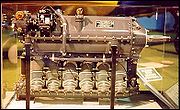
, because the crankcase and crankshaft are long and thus heavy. An in-line engine may be either air-cooled or liquid-cooled, but liquid-cooling is more common because it is difficult to get enough air-flow to cool the rear cylinders directly. Inline engines were common in early aircraft, including the Wright Flyer
, the aircraft that made the first controlled powered flight. However, the inherent disadvantages of the design soon became apparent, and the inline design was abandoned, becoming a rarity in modern aviation.
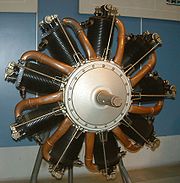 Early in World War I
, when aircraft were first being used for military purposes, it became apparent that existing inline engines were too heavy for the amount of power needed. Aircraft designers needed an engine that was lightweight, powerful, cheap, and easy to manufacture in large quantities. The rotary engine met these goals. Rotary engines have all the cylinders in a circle around the crankcase like a radial engine (see below), but the difference is that the crankshaft is bolted to the airframe, and the propeller is bolted to the engine case. The entire engine rotates with the propeller, providing plenty of airflow for cooling regardless of the aircraft's forward speed. Some of these engines were a two-stroke design, giving them a high specific power
and power-to-weight ratio. Unfortunately, the severe gyroscopic effects
from the heavy rotating engine made the aircraft very difficult to fly. The engines also consumed large amounts of castor oil
, spreading it all over the airframe and creating fumes which were nauseating to the pilots.
Engine designers had always been aware of the many limitations of the rotary engine. When the static style engines became more reliable, gave better specific weights and fuel consumption, the days of the rotary engine were numbered.
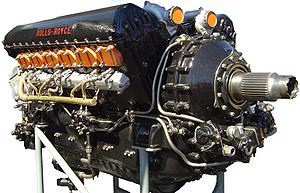
engine, a 27-litre (1649 in3) 60° V12 engine used in, among others, the Spitfires
that played a major role in the Battle of Britain
.
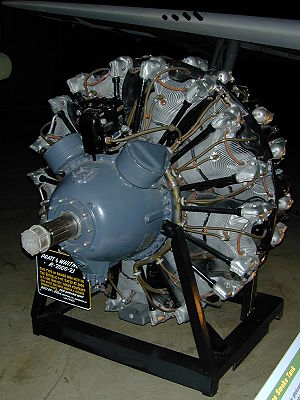 This type of engine has one or more rows of cylinders arranged in a circle around a centrally located crankcase
. Each row must have an odd number of cylinders in order to produce smooth operation. A radial engine has only one crank throw
per row and a relatively small crankcase, resulting in a favorable power-to-weight ratio
. Because the cylinder arrangement exposes a large amount of the engine's heat-radiating surfaces to the air and tends to cancel reciprocating forces, radials tend to cool evenly and run smoothly.
The lower cylinders, which are under the crankcase, may collect oil when the engine has been stopped for an extended period. If this oil is not cleared from the cylinders prior to starting the engine, serious damage due to hydrostatic lock
may occur.
In military aircraft designs, the large frontal area of the engine acted as an extra layer of armor for the pilot. However, the large frontal area also resulted in an aircraft with a blunt and aerodynamically inefficient profile.
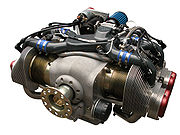 An horizontally opposed engine, also called a flat or boxer engine, has two banks of cylinders on opposite sides of a centrally located crankcase. The engine is either air-cooled or liquid-cooled, but air-cooled versions predominate. Opposed engines are mounted with the crankshaft horizontal in airplanes, but may be mounted with the crankshaft vertical in helicopters. Due to the cylinder layout, reciprocating forces tend to cancel, resulting in a smooth running engine. Unlike a radial engine
, an opposed engine does not experience any problems with hydrostatic lock.
Opposed, air-cooled four- and six-cylinder piston engines are by far the most common engines used in small general aviation
aircraft requiring up to 400 hp per engine. Aircraft which require more than 400 hp per engine tend to be powered by turbine engines
.
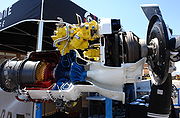 While military fighters require very high speeds, many civil airplanes do not. Yet, civil aircraft designers wanted to benefit from the high power and low maintenance that a gas turbine
engine offered. Thus was born the idea to mate a turbine engine to a traditional propeller. Because gas turbines optimally spin at high speed, a turboprop features a gearbox
to lower the speed of the shaft so that the propeller tips don't reach supersonic speeds. Often the turbines which drive the propeller are separate from the rest of the rotating components so that they are free to rotate at their own best speed (referred to as a free-turbine engine). A turboprop is very efficient when operated within the realm of cruise speeds it was designed for, which is typically 200 to 400 mi/h (320 to 640 km/h).
_250_c20b.jpg) Turboshaft engines are used primarily for helicopter
Turboshaft engines are used primarily for helicopter
s and auxiliary power unit
s. A turboshaft engine is very similar to a turboprop, with a key difference: In a turboprop the propeller is supported by the engine, and the engine is bolted to the airframe
. In a turboshaft, the engine does not provide any direct physical support to the helicopter's rotors. The rotor is connected to a transmission, which itself is bolted to the airframe, and the turboshaft engine simply feeds the transmission via a rotating shaft. The distinction is seen by some as a slim one, as in some cases aircraft companies make both turboprop and turboshaft engines based on the same design.
, which, in conjunction with the pressures acting inside the engine which are maintained and increased by the constriction of the nozzle, pushes the aircraft forward.
The most common jet propulsion engines flown are turbojet, turbofan and rocket. Other types such as pulsejets, ramjets, scramjet
s and Pulse Detonation Engine
s have also flown.
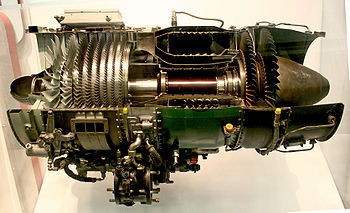 A turbojet is a type of gas turbine
engine that was originally developed for military fighters
during World War II
. A turbojet is the simplest of all aircraft gas turbines. It features a compressor to draw air in and compress it, a combustion section which adds fuel and ignites it, one or more turbines that extract power from the expanding exhaust gases to drive the compressor, and an exhaust nozzle which accelerates the exhaust out the back of the engine to create thrust. When turbojets were introduced, the top speed of fighter aircraft equipped with them was at least 100 miles per hour faster than competing piston-driven aircraft. The relative simplicity of turbojet designs lent them to wartime production. In the years after the war, the drawbacks of the turbojet gradually became apparent. Below about Mach 2, turbojets are very fuel inefficient and create tremendous amounts of noise. The early designs also respond very slowly to power changes, a fact which killed many experienced pilots when they attempted the transition to jets. These drawbacks eventually led to the downfall of the pure turbojet, and only a handful of types are still in production. The last airliner that used turbojets was the Concorde
, whose Mach 2 airspeed permitted the engine to be highly efficient.
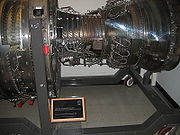 A turbofan engine is much the same as a turbojet, but with an enlarged fan at the front which provides thrust in much the same way as a ducted propeller
, resulting in improved fuel-efficiency. Although the fan creates thrust like a propeller, the surrounding duct frees it from many of the restrictions which limit propeller performance. This operation is a more efficient way to provide thrust than simply using the jet nozzle alone and turbofans are more efficient than propellers in the trans-sonic range of aircraft speeds, and can operate in the supersonic
realm. A turbofan typically has extra turbine stages to turn the fan. Turbofans were the first engines to use multiple spools; concentric shafts which are free to rotate at their own speed; in order to allow the engine to react more quickly to changing power requirements. Turbofans are coarsely split into low-bypass and high-bypass categories. Bypass air flows through the fan, but around the jet core, not mixing with fuel and burning. The ratio of this air to the amount of air flowing through the engine core is the bypass ratio. Low-bypass engines are preferred for military applications such as fighters due to high thrust-to-weight ratio, while high-bypass engines are preferred for civil use for good fuel efficiency and low noise. High-bypass turbofans are usually most efficient when the aircraft is traveling at 500 to 550 miles per hour (800 to 885 km/h), the cruise speed of most large airliners. Low-bypass turbofans can reach supersonic speeds, though normally only when fitted with afterburner
s.
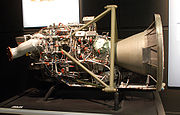 A few aircraft have used rocket engines for main thrust or attitude control, notably the Bell X-1
and North American X-15
.
Rocket engines are not used for most aircraft as the energy and propellant efficiency is very poor except at high speeds, but have been employed for short bursts of speed and takeoff.
Rocket engines are very efficient only at very high speeds, although they are useful because they produce very large amounts of thrust and weigh very little.
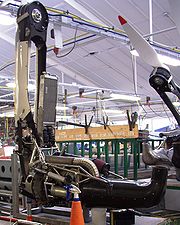 Another promising design for aircraft use was the Wankel rotary engine. The Wankel engine
is about one half the weight and size of a traditional four-stroke cycle
piston engine of equal power output, and much lower in complexity. In an aircraft application, the power-to-weight ratio is very important, making the Wankel engine a good choice. Because the engine is typically constructed with an aluminium housing and a steel rotor, and aluminium expands more than steel when heated, unlike a piston engine, a Wankel engine will not seize when overheated. This is an important safety factor for aeronautical use. Considerable development of these designs started after World War II
, but at the time the aircraft industry favored the use of turbine
engines. It was believed that turbojet or turboprop
engines could power all aircraft, from the largest to smallest designs. The Wankel engine did not find many applications in aircraft, but was used by Mazda
in a popular line of sports cars. Recently, the Wankel engine has been developed for use in motor glider
s where the small size, light weight, and low vibration are especially important.
Wankel engines are becoming increasingly popular in homebuilt experimental aircraft
, due to a number of factors. Most are Mazda 12A and 13B engines, removed from automobiles and converted to aviation use. This is a very cost-effective alternative to certified aircraft engines, providing engines ranging from 100 to 300 hp at a fraction of the cost of traditional engines. These conversions first took place in the early 1970s, and with hundreds or even thousands of these engines mounted on aircraft, as of 10 December 2006 the National Transportation Safety Board
has only seven reports of incidents involving aircraft with Mazda engines, and none of these is of a failure due to design or manufacturing flaws. During the same time frame, they have reports of several thousand reports of broken crankshafts and connecting rods, failed pistons and incidents caused by other components which are not found in the Wankel engines. Rotary engine enthusiasts refer to piston aircraft engines as "Reciprosaurs," and point out that their designs are essentially unchanged since the 1930s, with only minor differences in manufacturing processes and variation in engine displacement.
Peter Garrison, contributing editor for Flying magazine
, has said that "the most promising engine for aviation use is the Mazda rotary." Garrison lost an airplane which he had designed and built (and missed death literally by inches), when a piston-powered plane had engine failure and crashed into Garrison's plane, which was waiting to take off.
is another engine design that has been examined for aviation use. In general diesel engines are more reliable and much better suited to running for long periods of time at medium power settings—this is why they are widely used in trucks for instance. Several attempts to produce diesel aircraft engines were made in the 1930s but, at the time, the alloys were not up to the task of handling the much higher compression ratio
s used in these designs. They generally had poor power-to-weight ratios and were uncommon for that reason but, for example, the Clerget 14F diesel radial engine (1939) has the same power to weight as a gasoline radial. Improvements in diesel technology in automobiles (leading to much better power-weight ratios), the diesel's much better fuel efficiency (particularly compared to the old gasoline designs currently being used in light aircraft) and the high relative taxation of AVGAS compared to Jet A1 in Europe have all seen a revival of interest in the concept. Thielert
Aircraft Engines converted Mercedes diesel automotive engines, certified them for aircraft use, and became an OEM provider to Diamond Aviation for their light twin. Financial problems have plagued Thielert, so Diamond's affiliate—Austro Engine—developed the new AE300 turbodiesel, also based on a Mercedes engine. Competing new diesel engines may bring fuel efficiency and lead-free emissions to small aircraft, representing the biggest change in light aircraft engines in decades. Wilksch Airmotive build 2-stroke diesel engine (same power to weight as a gasoline engine) for experimental aircraft: WAM 100 (100 hp), WAM 120 (120 hp) and WAM 160 (160 hp)
It is thought that this design of engine could permit sufficient performance for antipodal flight at Mach 5
, or even permit a single stage to orbit vehicle to be practical.
, have been designed since the 1960s. Some are used as military drone
s. In France
in late 2007, a conventional light aircraft powered by an 18 kW electric motor using lithium polymer batteries was flown, covering more than 50 kilometres (31.1 mi), the first electric airplane to receive a certificate of airworthiness.
Limited experiments with solar electric propulsion have been performed, notably the manned Solar Challenger
and Solar Impulse
and the unmanned NASA Pathfinder aircraft.
Air propulsion
Air propulsion is the generation of thrust during flight by an aircraft or a creature such as a bird, bat or insect.-Aircraft:An aircraft propulsion system must serve two purposes. First, the thrust from the propulsion system must balance the drag of the airplane when the airplane is cruising...
system for an aircraft
Aircraft
An aircraft is a vehicle that is able to fly by gaining support from the air, or, in general, the atmosphere of a planet. An aircraft counters the force of gravity by using either static lift or by using the dynamic lift of an airfoil, or in a few cases the downward thrust from jet engines.Although...
that generates mechanical power. Aircraft engines are almost always either lightweight piston engines or gas turbine
Gas turbine
A gas turbine, also called a combustion turbine, is a type of internal combustion engine. It has an upstream rotating compressor coupled to a downstream turbine, and a combustion chamber in-between....
s. This article is an overview of the basic types of aircraft engines and the design concepts employed in engine development for aircraft.
History of aircraft engines
- 1848: John StringfellowJohn StringfellowJohn Stringfellow was born in Sheffield, England and is known for his work on the Aerial Steam Carriage with William Samuel Henson....
made a steam engine capable of powering a model, albeit with negligible payload - 1903: Charlie TaylorCharlie TaylorCharles Edward Taylor built the first aircraft engine used by the Wright brothers and was a vital contributor of mechanical skills in the building and maintaining of early Wright engines and airplanes.-Biography:...
built a inlineInline engineInline engine may refer to:* In general use it refers to any type of straight engine;* In aviation use it refers to any non-radial reciprocating cylinder engine: Inline engine ,...
aeroengine for the Wright FlyerWright FlyerThe Wright Flyer was the first powered aircraft, designed and built by the Wright brothers. They flew it four times on December 17, 1903 near the Kill Devil Hills, about four miles south of Kitty Hawk, North Carolina, U.S.The U.S...
(12 horsepower) - 1903: Manly-Balzer engine sets standards for later radial engineRadial engineThe radial engine is a reciprocating type internal combustion engine configuration in which the cylinders point outward from a central crankshaft like the spokes on a wheel...
s - 1906: Léon LevavasseurLéon LevavasseurLéon Levavasseur was a powerplant engineer, aircraft designer and inventor. His innovations included the V8 engine, direct fuel injection, and evaporative engine cooling...
produces a successful water-cooled V8 engineV8 engineA V8 engine is a V engine with eight cylinders mounted on the crankcase in two banks of four cylinders, in most cases set at a right angle to each other but sometimes at a narrower angle, with all eight pistons driving a common crankshaft....
for aircraft use - 1908: René LorinRené LorinRené Lorin , a graduate of the Ecole Centrale Paris, invented the ramjet. In 1908 he patented a subsonic ramjet design.Lorin published the principles of a ramjet in articles in the journal L'Aérophile from 1908 to 1913, expressing the idea that the exhaust from internal combustion engines could be...
patents a design for the ramjet engine - 1908: Gnome OmegaGnome Omega|-See also:-Bibliography:* Lumsden, Alec. British Piston Engines and their Aircraft. Marlborough, Wiltshire: Airlife Publishing, 2003. ISBN 1-85310-294-6....
, the world's first rotary engineRotary engineThe rotary engine was an early type of internal-combustion engine, usually designed with an odd number of cylinders per row in a radial configuration, in which the crankshaft remained stationary and the entire cylinder block rotated around it...
produced in quantity; in 1909, fitted in Farman IIIFarman III|-See also:-Bibliography:*Opdycke, Leonard E French Aeroplanes Before the Great War Atglen, PA: Schiffer 1999 ISBN 0 7643 0752 5-External links:**...
aircraft, won the Grand Prix for the greatest non-stop distance flown - 180 kilometres (111.8 mi) - and set a world record for endurance - 1910: Coandă-1910Coanda-1910The Coandă-1910, designed by Romanian inventor Henri Coandă, was the first full-size attempt at a jet aircraft. Built as a sesquiplane, it featured an experimental aircraft engine which Coandă called the "turbo-propulseur," a centrifugal compressor propulsion system with a multi-bladed rotary fan...
, an unsuccessful ducted fanDucted fanA ducted fan is a propulsion arrangement whereby a fan, which is a type of propeller, is mounted within a cylindrical shroud or duct. The duct reduces losses in thrust from the tip vortices of the fan, and varying the cross-section of the duct allows the designer to advantageously affect the...
powered aircraft - 1914: Auguste Rateau suggests using exhaust-powered compressor – a turbochargerTurbochargerA turbocharger, or turbo , from the Greek "τύρβη" is a centrifugal compressor powered by a turbine that is driven by an engine's exhaust gases. Its benefit lies with the compressor increasing the mass of air entering the engine , thereby resulting in greater performance...
– to improve high-altitude performance; not accepted after the tests - 1918: Sanford Alexander MossSanford Alexander MossSanford Alexander Moss was an aviation engineer, he was the first to use a turbocharger on an aircraft engine.-Biography:...
picks Rateau's idea and creates the first successful turbocharger - 1926: Armstrong Siddeley Jaguar IV (S), the first series-produced supercharged engine for aircraft use;The world's first series-produced cars with superchargers came earlier than aircraft. These were MercedesMercedes (car)Mercedes was a brand of the Daimler-Motoren-Gesellschaft . DMG which began to develop in 1900, after the death of its co-founder, Gottlieb Daimler...
6/25/40 hp and Mercedes 10/40/65 hp, both models introduced in 1921 and used Roots superchargers. two-row radial with a gear-driven centrifugal supercharger - 1930: Frank WhittleFrank WhittleAir Commodore Sir Frank Whittle, OM, KBE, CB, FRS, Hon FRAeS was a British Royal Air Force engineer officer. He is credited with independently inventing the turbojet engine Air Commodore Sir Frank Whittle, OM, KBE, CB, FRS, Hon FRAeS (1 June 1907 – 9 August 1996) was a British Royal Air...
submitted his first patent for turbojet engine - 1938: Heinkel HeS 3Heinkel HeS 3The Heinkel HeS 3 was the world's first operational jet engine to power an aircraft. Designed by Hans von Ohain while working at Heinkel, the engine first flew as the primary power of the Heinkel He 178, piloted by Erich Warsitz on 27 August 1939...
turbojet propels the German He 178 aircraft - 1940: Jendrassik Cs-1Jendrassik Cs-1The Jendrassik Cs-1 was the world's first working turboprop engine. It was designed by Hungarian engineer György Jendrassik in 1937, and was intended to power a Hungarian twin-engine heavy fighter, the RMI-1.-Design and development:...
, the world's first run of the turbopropTurbopropA turboprop engine is a type of turbine engine which drives an aircraft propeller using a reduction gear.The gas turbine is designed specifically for this application, with almost all of its output being used to drive the propeller...
engine - 1944: Messerschmitt Me 163Messerschmitt Me 163The Messerschmitt Me 163 Komet, designed by Alexander Lippisch, was a German rocket-powered fighter aircraft. It is the only rocket-powered fighter aircraft ever to have been operational. Its design was revolutionary, and the Me 163 was capable of performance unrivaled at the time. Messerschmitt...
Komet, the world's first rocket propelled aircraft deployed - 1947: Bell X-1Bell X-1The Bell X-1, originally designated XS-1, was a joint NACA-U.S. Army/US Air Force supersonic research project built by Bell Aircraft. Conceived in 1944 and designed and built over 1945, it eventually reached nearly 1,000 mph in 1948...
rocket propelled aircraft exceeds the speed of sound - 1948: 100 shp 782, the first turboshaftTurboshaftA turboshaft engine is a form of gas turbine which is optimized to produce free turbine shaft power, rather than jet thrust...
engine; in 1950 used to develop the larger 280 shp Turbomeca ArtousteTurbomeca Artouste|-See also:-References:*... - 1949: Leduc 010, the world's first ramjetRamjetA ramjet, sometimes referred to as a stovepipe jet, or an athodyd, is a form of airbreathing jet engine using the engine's forward motion to compress incoming air, without a rotary compressor. Ramjets cannot produce thrust at zero airspeed and thus cannot move an aircraft from a standstill...
-powered aircraft flight - 1950: Rolls-Royce ConwayRolls-Royce ConwayThe Rolls-Royce RB.80 Conway was the first by-pass engine in the world to enter service. Development started at Rolls-Royce in the 1940s, but it was used only briefly in the late 1950s and early 1960s before other turbofan designs were introduced that replaced it. The Conway powered versions of...
, the world's first production turbofanTurbofanThe turbofan is a type of airbreathing jet engine that is widely used for aircraft propulsion. A turbofan combines two types of engines, the turbo portion which is a conventional gas turbine engine, and the fan, a propeller-like ducted fan...
, enters service - 1960s: TF39 high bypass turbofan enters service delivering greater thrust and much better efficiency
- 2002: HyShotHyShotHyShot is a research project of The University of Queensland, Australia Centre for Hypersonics, to demonstrate the possibility of supersonic combustion under flight conditions and compare the results of shock tunnel experiments.- Overview :...
scramjetScramjetA scramjet is a variant of a ramjet airbreathing jet engine in which combustion takes place in supersonic airflow...
flew in dive - 2004: Hyper-X, the first scramjet to maintain altitude
Fuel
All aviation fuel is produced to stringent quality standards to avoid fuel-related engine failures. Aviation standards are much more strict than those for road vehicle fuel because an aircraft engine must meet a strictly defined level of performance under known conditions. These high standards mean that aviation fuel costs much more than fuel used for road vehicles.Aircraft reciprocating (piston) engines are typically designed to run on aviation gasoline
Avgas
Avgas is an aviation fuel used to power piston-engine aircraft. Avgas is distinguished from mogas , which is the everyday gasoline used in cars and some non-commercial light aircraft...
. Avgas has a higher octane rating as compared to automotive gasoline
Gasoline
Gasoline , or petrol , is a toxic, translucent, petroleum-derived liquid that is primarily used as a fuel in internal combustion engines. It consists mostly of organic compounds obtained by the fractional distillation of petroleum, enhanced with a variety of additives. Some gasolines also contain...
, allowing the use of higher compression ratio
Compression ratio
The 'compression ratio' of an internal-combustion engine or external combustion engine is a value that represents the ratio of the volume of its combustion chamber from its largest capacity to its smallest capacity...
s, increasing power output and efficiency at higher altitudes. Currently the most common Avgas is 100LL, which refers to the octane rating
Octane rating
Octane rating or octane number is a standard measure of the anti-knock properties of a motor or aviation fuel. The higher the octane number, the more compression the fuel can withstand before detonating...
(100 octane) and the lead content (LL = low lead).
Avgas is blended with tetra-ethyl lead
Tetra-ethyl lead
Tetraethyllead , abbreviated TEL, is an organolead compound with the formula 4Pb. An inexpensive additive, its addition to gasoline from the 1920's allowed octane ratings and thus engine compression to be boosted significantly, increasing power and fuel economy...
(TEL) to achieve these high octane ratings, a practice no longer permitted with road vehicle gasoline. The shrinking supply of TEL, and the possibility of environmental legislation banning its use, has made a search for replacement fuels for general aviation
General aviation
General aviation is one of the two categories of civil aviation. It refers to all flights other than military and scheduled airline and regular cargo flights, both private and commercial. General aviation flights range from gliders and powered parachutes to large, non-scheduled cargo jet flights...
aircraft a priority for pilot's organizations.
Turbine engines and aircraft diesel engine
Aircraft diesel engine
The aircraft diesel engine or aero diesel has not been widely used as an aircraft engine. Diesel engines were used in airships and were tried in aircraft in the late 1920s and 1930s, but never "caught on" in a major fashion...
s burn various grades of jet fuel
Jet fuel
Jet fuel is a type of aviation fuel designed for use in aircraft powered by gas-turbine engines. It is clear to straw-colored in appearance. The most commonly used fuels for commercial aviation are Jet A and Jet A-1 which are produced to a standardized international specification...
. Jet fuel is a relatively heavy and less volatile petroleum
Petroleum
Petroleum or crude oil is a naturally occurring, flammable liquid consisting of a complex mixture of hydrocarbons of various molecular weights and other liquid organic compounds, that are found in geologic formations beneath the Earth's surface. Petroleum is recovered mostly through oil drilling...
derivative based on kerosene
Kerosene
Kerosene, sometimes spelled kerosine in scientific and industrial usage, also known as paraffin or paraffin oil in the United Kingdom, Hong Kong, Ireland and South Africa, is a combustible hydrocarbon liquid. The name is derived from Greek keros...
, but certified to strict aviation standards, with additional additives.
Shaft engines
In-line engine
This type of engine has cylinders lined up in one row. It typically has an even number of cylinders, but there are instances of three- and five- cylinder engines. The biggest advantage of an inline engine is that it allows the aircraft to be designed with a narrow frontal area for low drag. If the engine crankshaft is located above the cylinders, it is called an inverted inline engine, which allows the propeller to be mounted up high for ground clearance even with short landing gear. The disadvantages of an inline engine include a poor power-to-weight ratioPower-to-weight ratio
Power-to-weight ratio is a calculation commonly applied to engines and mobile power sources to enable the comparison of one unit or design to another. Power-to-weight ratio is a measurement of actual performance of any engine or power sources...
, because the crankcase and crankshaft are long and thus heavy. An in-line engine may be either air-cooled or liquid-cooled, but liquid-cooling is more common because it is difficult to get enough air-flow to cool the rear cylinders directly. Inline engines were common in early aircraft, including the Wright Flyer
Wright Flyer
The Wright Flyer was the first powered aircraft, designed and built by the Wright brothers. They flew it four times on December 17, 1903 near the Kill Devil Hills, about four miles south of Kitty Hawk, North Carolina, U.S.The U.S...
, the aircraft that made the first controlled powered flight. However, the inherent disadvantages of the design soon became apparent, and the inline design was abandoned, becoming a rarity in modern aviation.
Rotary engine
World War I
World War I , which was predominantly called the World War or the Great War from its occurrence until 1939, and the First World War or World War I thereafter, was a major war centred in Europe that began on 28 July 1914 and lasted until 11 November 1918...
, when aircraft were first being used for military purposes, it became apparent that existing inline engines were too heavy for the amount of power needed. Aircraft designers needed an engine that was lightweight, powerful, cheap, and easy to manufacture in large quantities. The rotary engine met these goals. Rotary engines have all the cylinders in a circle around the crankcase like a radial engine (see below), but the difference is that the crankshaft is bolted to the airframe, and the propeller is bolted to the engine case. The entire engine rotates with the propeller, providing plenty of airflow for cooling regardless of the aircraft's forward speed. Some of these engines were a two-stroke design, giving them a high specific power
Specific power
In physics and engineering, surface power density or sometimes simply specific power is power per unit area.-Applications:* The intensity of electromagnetic radiation can be expressed in W/m2...
and power-to-weight ratio. Unfortunately, the severe gyroscopic effects
Gyroscope
A gyroscope is a device for measuring or maintaining orientation, based on the principles of angular momentum. In essence, a mechanical gyroscope is a spinning wheel or disk whose axle is free to take any orientation...
from the heavy rotating engine made the aircraft very difficult to fly. The engines also consumed large amounts of castor oil
Castor oil
Castor oil is a vegetable oil obtained from the castor bean . Castor oil is a colorless to very pale yellow liquid with mild or no odor or taste. Its boiling point is and its density is 961 kg/m3...
, spreading it all over the airframe and creating fumes which were nauseating to the pilots.
Engine designers had always been aware of the many limitations of the rotary engine. When the static style engines became more reliable, gave better specific weights and fuel consumption, the days of the rotary engine were numbered.
V-type engine
Cylinders in this engine are arranged in two in-line banks, tilted 30-60 degrees apart from each other. The vast majority of V engines are water-cooled. The V design provides a higher power-to-weight ratio than an inline engine, while still providing a small frontal area. Perhaps the most famous example of this design is the legendary Rolls-Royce MerlinRolls-Royce Merlin
The Rolls-Royce Merlin is a British liquid-cooled, V-12, piston aero engine, of 27-litre capacity. Rolls-Royce Limited designed and built the engine which was initially known as the PV-12: the PV-12 became known as the Merlin following the company convention of naming its piston aero engines after...
engine, a 27-litre (1649 in3) 60° V12 engine used in, among others, the Spitfires
Supermarine Spitfire
The Supermarine Spitfire is a British single-seat fighter aircraft that was used by the Royal Air Force and many other Allied countries throughout the Second World War. The Spitfire continued to be used as a front line fighter and in secondary roles into the 1950s...
that played a major role in the Battle of Britain
Battle of Britain
The Battle of Britain is the name given to the World War II air campaign waged by the German Air Force against the United Kingdom during the summer and autumn of 1940...
.
Radial engine
Crankcase
In an internal combustion engine of the reciprocating type, the crankcase is the housing for the crankshaft. The enclosure forms the largest cavity in the engine and is located below the cylinder, which in a multicylinder engine are usually integrated into one or several cylinder blocks...
. Each row must have an odd number of cylinders in order to produce smooth operation. A radial engine has only one crank throw
Crankshaft
The crankshaft, sometimes casually abbreviated to crank, is the part of an engine which translates reciprocating linear piston motion into rotation...
per row and a relatively small crankcase, resulting in a favorable power-to-weight ratio
Power-to-weight ratio
Power-to-weight ratio is a calculation commonly applied to engines and mobile power sources to enable the comparison of one unit or design to another. Power-to-weight ratio is a measurement of actual performance of any engine or power sources...
. Because the cylinder arrangement exposes a large amount of the engine's heat-radiating surfaces to the air and tends to cancel reciprocating forces, radials tend to cool evenly and run smoothly.
The lower cylinders, which are under the crankcase, may collect oil when the engine has been stopped for an extended period. If this oil is not cleared from the cylinders prior to starting the engine, serious damage due to hydrostatic lock
Hydrolock
Hydrolock is an abnormal condition of any device which is designed to compress a gas by mechanically restraining it; most commonly the reciprocating internal combustion engine, the case this article refers to unless otherwise noted...
may occur.
In military aircraft designs, the large frontal area of the engine acted as an extra layer of armor for the pilot. However, the large frontal area also resulted in an aircraft with a blunt and aerodynamically inefficient profile.
Horizontally opposed engine
Radial engine
The radial engine is a reciprocating type internal combustion engine configuration in which the cylinders point outward from a central crankshaft like the spokes on a wheel...
, an opposed engine does not experience any problems with hydrostatic lock.
Opposed, air-cooled four- and six-cylinder piston engines are by far the most common engines used in small general aviation
General aviation
General aviation is one of the two categories of civil aviation. It refers to all flights other than military and scheduled airline and regular cargo flights, both private and commercial. General aviation flights range from gliders and powered parachutes to large, non-scheduled cargo jet flights...
aircraft requiring up to 400 hp per engine. Aircraft which require more than 400 hp per engine tend to be powered by turbine engines
Gas turbine
A gas turbine, also called a combustion turbine, is a type of internal combustion engine. It has an upstream rotating compressor coupled to a downstream turbine, and a combustion chamber in-between....
.
Turboprop
Gas turbine
A gas turbine, also called a combustion turbine, is a type of internal combustion engine. It has an upstream rotating compressor coupled to a downstream turbine, and a combustion chamber in-between....
engine offered. Thus was born the idea to mate a turbine engine to a traditional propeller. Because gas turbines optimally spin at high speed, a turboprop features a gearbox
Transmission (mechanics)
A machine consists of a power source and a power transmission system, which provides controlled application of the power. Merriam-Webster defines transmission as: an assembly of parts including the speed-changing gears and the propeller shaft by which the power is transmitted from an engine to a...
to lower the speed of the shaft so that the propeller tips don't reach supersonic speeds. Often the turbines which drive the propeller are separate from the rest of the rotating components so that they are free to rotate at their own best speed (referred to as a free-turbine engine). A turboprop is very efficient when operated within the realm of cruise speeds it was designed for, which is typically 200 to 400 mi/h (320 to 640 km/h).
Turboshaft
Helicopter
A helicopter is a type of rotorcraft in which lift and thrust are supplied by one or more engine-driven rotors. This allows the helicopter to take off and land vertically, to hover, and to fly forwards, backwards, and laterally...
s and auxiliary power unit
Auxiliary power unit
An auxiliary power unit is a device on a vehicle that provides energy for functions other than propulsion. They are commonly found on large aircraft, as well as some large land vehicles.-Function:...
s. A turboshaft engine is very similar to a turboprop, with a key difference: In a turboprop the propeller is supported by the engine, and the engine is bolted to the airframe
Airframe
The airframe of an aircraft is its mechanical structure. It is typically considered to include fuselage, wings and undercarriage and exclude the propulsion system...
. In a turboshaft, the engine does not provide any direct physical support to the helicopter's rotors. The rotor is connected to a transmission, which itself is bolted to the airframe, and the turboshaft engine simply feeds the transmission via a rotating shaft. The distinction is seen by some as a slim one, as in some cases aircraft companies make both turboprop and turboshaft engines based on the same design.
Jet engines
The key part of a jet engine is the exhaust nozzle. This is the part which produces thrust for the jet; the hot airflow from the engine is accelerated when exiting the nozzle, creating thrustThrust
Thrust is a reaction force described quantitatively by Newton's second and third laws. When a system expels or accelerates mass in one direction the accelerated mass will cause a force of equal magnitude but opposite direction on that system....
, which, in conjunction with the pressures acting inside the engine which are maintained and increased by the constriction of the nozzle, pushes the aircraft forward.
The most common jet propulsion engines flown are turbojet, turbofan and rocket. Other types such as pulsejets, ramjets, scramjet
Scramjet
A scramjet is a variant of a ramjet airbreathing jet engine in which combustion takes place in supersonic airflow...
s and Pulse Detonation Engine
Pulse detonation engine
A pulse detonation engine, or "PDE", is a type of propulsion system that uses detonation waves to combust the fuel and oxidizer mixture. The engine is pulsed because the mixture must be renewed in the combustion chamber between each detonation wave initiated by an ignition source. Theoretically, a...
s have also flown.
Turbojet
Gas turbine
A gas turbine, also called a combustion turbine, is a type of internal combustion engine. It has an upstream rotating compressor coupled to a downstream turbine, and a combustion chamber in-between....
engine that was originally developed for military fighters
Fighter aircraft
A fighter aircraft is a military aircraft designed primarily for air-to-air combat with other aircraft, as opposed to a bomber, which is designed primarily to attack ground targets...
during World War II
World War II
World War II, or the Second World War , was a global conflict lasting from 1939 to 1945, involving most of the world's nations—including all of the great powers—eventually forming two opposing military alliances: the Allies and the Axis...
. A turbojet is the simplest of all aircraft gas turbines. It features a compressor to draw air in and compress it, a combustion section which adds fuel and ignites it, one or more turbines that extract power from the expanding exhaust gases to drive the compressor, and an exhaust nozzle which accelerates the exhaust out the back of the engine to create thrust. When turbojets were introduced, the top speed of fighter aircraft equipped with them was at least 100 miles per hour faster than competing piston-driven aircraft. The relative simplicity of turbojet designs lent them to wartime production. In the years after the war, the drawbacks of the turbojet gradually became apparent. Below about Mach 2, turbojets are very fuel inefficient and create tremendous amounts of noise. The early designs also respond very slowly to power changes, a fact which killed many experienced pilots when they attempted the transition to jets. These drawbacks eventually led to the downfall of the pure turbojet, and only a handful of types are still in production. The last airliner that used turbojets was the Concorde
Concorde
Aérospatiale-BAC Concorde was a turbojet-powered supersonic passenger airliner, a supersonic transport . It was a product of an Anglo-French government treaty, combining the manufacturing efforts of Aérospatiale and the British Aircraft Corporation...
, whose Mach 2 airspeed permitted the engine to be highly efficient.
Turbofan
Propeller (aircraft)
Aircraft propellers or airscrews convert rotary motion from piston engines or turboprops to provide propulsive force. They may be fixed or variable pitch. Early aircraft propellers were carved by hand from solid or laminated wood with later propellers being constructed from metal...
, resulting in improved fuel-efficiency. Although the fan creates thrust like a propeller, the surrounding duct frees it from many of the restrictions which limit propeller performance. This operation is a more efficient way to provide thrust than simply using the jet nozzle alone and turbofans are more efficient than propellers in the trans-sonic range of aircraft speeds, and can operate in the supersonic
Supersonic
Supersonic speed is a rate of travel of an object that exceeds the speed of sound . For objects traveling in dry air of a temperature of 20 °C this speed is approximately 343 m/s, 1,125 ft/s, 768 mph or 1,235 km/h. Speeds greater than five times the speed of sound are often...
realm. A turbofan typically has extra turbine stages to turn the fan. Turbofans were the first engines to use multiple spools; concentric shafts which are free to rotate at their own speed; in order to allow the engine to react more quickly to changing power requirements. Turbofans are coarsely split into low-bypass and high-bypass categories. Bypass air flows through the fan, but around the jet core, not mixing with fuel and burning. The ratio of this air to the amount of air flowing through the engine core is the bypass ratio. Low-bypass engines are preferred for military applications such as fighters due to high thrust-to-weight ratio, while high-bypass engines are preferred for civil use for good fuel efficiency and low noise. High-bypass turbofans are usually most efficient when the aircraft is traveling at 500 to 550 miles per hour (800 to 885 km/h), the cruise speed of most large airliners. Low-bypass turbofans can reach supersonic speeds, though normally only when fitted with afterburner
AfterBurner
The AfterBurner is a lighting solution for the Game Boy Advance system that was created by Triton-Labs.Originally, portablemonopoly.net was a website created to petition Nintendo to put some kind of light in their Game Boy Advance system...
s.
Rocket
Bell X-1
The Bell X-1, originally designated XS-1, was a joint NACA-U.S. Army/US Air Force supersonic research project built by Bell Aircraft. Conceived in 1944 and designed and built over 1945, it eventually reached nearly 1,000 mph in 1948...
and North American X-15
North American X-15
The North American X-15 rocket-powered aircraft/spaceplane was part of the X-series of experimental aircraft, initiated with the Bell X-1, that were made for the USAAF/USAF, NACA/NASA, and the USN. The X-15 set speed and altitude records in the early 1960s, reaching the edge of outer space and...
.
Rocket engines are not used for most aircraft as the energy and propellant efficiency is very poor except at high speeds, but have been employed for short bursts of speed and takeoff.
Rocket engines are very efficient only at very high speeds, although they are useful because they produce very large amounts of thrust and weigh very little.
Wankel engine
Wankel engine
The Wankel engine is a type of internal combustion engine using an eccentric rotary design to convert pressure into a rotating motion instead of using reciprocating pistons. Its four-stroke cycle takes place in a space between the inside of an oval-like epitrochoid-shaped housing and a rotor that...
is about one half the weight and size of a traditional four-stroke cycle
Four-stroke cycle
A four-stroke engine, also known as four-cycle, is an internal combustion engine in which the piston completes four separate strokes—intake, compression, power, and exhaust—during two separate revolutions of the engine's crankshaft, and one single thermodynamic cycle.There are two...
piston engine of equal power output, and much lower in complexity. In an aircraft application, the power-to-weight ratio is very important, making the Wankel engine a good choice. Because the engine is typically constructed with an aluminium housing and a steel rotor, and aluminium expands more than steel when heated, unlike a piston engine, a Wankel engine will not seize when overheated. This is an important safety factor for aeronautical use. Considerable development of these designs started after World War II
World War II
World War II, or the Second World War , was a global conflict lasting from 1939 to 1945, involving most of the world's nations—including all of the great powers—eventually forming two opposing military alliances: the Allies and the Axis...
, but at the time the aircraft industry favored the use of turbine
Turbine
A turbine is a rotary engine that extracts energy from a fluid flow and converts it into useful work.The simplest turbines have one moving part, a rotor assembly, which is a shaft or drum with blades attached. Moving fluid acts on the blades, or the blades react to the flow, so that they move and...
engines. It was believed that turbojet or turboprop
Turboprop
A turboprop engine is a type of turbine engine which drives an aircraft propeller using a reduction gear.The gas turbine is designed specifically for this application, with almost all of its output being used to drive the propeller...
engines could power all aircraft, from the largest to smallest designs. The Wankel engine did not find many applications in aircraft, but was used by Mazda
Mazda
is a Japanese automotive manufacturer based in Fuchū, Aki District, Hiroshima Prefecture, Japan.In 2007, Mazda produced almost 1.3 million vehicles for global sales...
in a popular line of sports cars. Recently, the Wankel engine has been developed for use in motor glider
Motor glider
A motor glider is a fixed-wing aircraft that can be flown with or without engine power. The FAI Gliding Commission Sporting Code definition is: A fixed wing aerodyne equipped with a means of propulsion ,...
s where the small size, light weight, and low vibration are especially important.
Wankel engines are becoming increasingly popular in homebuilt experimental aircraft
Experimental aircraft
An experimental aircraft is an aircraft that has not yet been fully proven in flight. Often, this implies that new aerospace technologies are being tested on the aircraft, though the label is more broad....
, due to a number of factors. Most are Mazda 12A and 13B engines, removed from automobiles and converted to aviation use. This is a very cost-effective alternative to certified aircraft engines, providing engines ranging from 100 to 300 hp at a fraction of the cost of traditional engines. These conversions first took place in the early 1970s, and with hundreds or even thousands of these engines mounted on aircraft, as of 10 December 2006 the National Transportation Safety Board
National Transportation Safety Board
The National Transportation Safety Board is an independent U.S. government investigative agency responsible for civil transportation accident investigation. In this role, the NTSB investigates and reports on aviation accidents and incidents, certain types of highway crashes, ship and marine...
has only seven reports of incidents involving aircraft with Mazda engines, and none of these is of a failure due to design or manufacturing flaws. During the same time frame, they have reports of several thousand reports of broken crankshafts and connecting rods, failed pistons and incidents caused by other components which are not found in the Wankel engines. Rotary engine enthusiasts refer to piston aircraft engines as "Reciprosaurs," and point out that their designs are essentially unchanged since the 1930s, with only minor differences in manufacturing processes and variation in engine displacement.
Peter Garrison, contributing editor for Flying magazine
Flying (magazine)
Flying is an aviation magazine published since 1927 . It is read by pilots, aircraft owners, and aviation-oriented executives in business and general aviation markets worldwide....
, has said that "the most promising engine for aviation use is the Mazda rotary." Garrison lost an airplane which he had designed and built (and missed death literally by inches), when a piston-powered plane had engine failure and crashed into Garrison's plane, which was waiting to take off.
Diesel engine
The diesel engineDiesel engine
A diesel engine is an internal combustion engine that uses the heat of compression to initiate ignition to burn the fuel, which is injected into the combustion chamber...
is another engine design that has been examined for aviation use. In general diesel engines are more reliable and much better suited to running for long periods of time at medium power settings—this is why they are widely used in trucks for instance. Several attempts to produce diesel aircraft engines were made in the 1930s but, at the time, the alloys were not up to the task of handling the much higher compression ratio
Compression ratio
The 'compression ratio' of an internal-combustion engine or external combustion engine is a value that represents the ratio of the volume of its combustion chamber from its largest capacity to its smallest capacity...
s used in these designs. They generally had poor power-to-weight ratios and were uncommon for that reason but, for example, the Clerget 14F diesel radial engine (1939) has the same power to weight as a gasoline radial. Improvements in diesel technology in automobiles (leading to much better power-weight ratios), the diesel's much better fuel efficiency (particularly compared to the old gasoline designs currently being used in light aircraft) and the high relative taxation of AVGAS compared to Jet A1 in Europe have all seen a revival of interest in the concept. Thielert
Thielert
Thielert AG is a German financial holding company which has owned engine development and manufacturing companies. It is headquartered in Hamburg. Companies owned were Thielert Aircraft Engines GmbH with sites in Lichtenstein, Saxony and Altenburg, Thuringia and Superior Air Parts, Inc. in Dallas,...
Aircraft Engines converted Mercedes diesel automotive engines, certified them for aircraft use, and became an OEM provider to Diamond Aviation for their light twin. Financial problems have plagued Thielert, so Diamond's affiliate—Austro Engine—developed the new AE300 turbodiesel, also based on a Mercedes engine. Competing new diesel engines may bring fuel efficiency and lead-free emissions to small aircraft, representing the biggest change in light aircraft engines in decades. Wilksch Airmotive build 2-stroke diesel engine (same power to weight as a gasoline engine) for experimental aircraft: WAM 100 (100 hp), WAM 120 (120 hp) and WAM 160 (160 hp)
Precooled jet engines
For very high supersonic/low hypersonic flight speeds inserting a cooling system into the air duct of a hydrogen jet engine permits greater fuel injection at high speed and obviates the need for the duct to be made of refractory or actively cooled materials. This greatly improves the thrust/weight ratio of the engine at high speed.It is thought that this design of engine could permit sufficient performance for antipodal flight at Mach 5
Reaction Engines A2
|-See also:-External links:* *...
, or even permit a single stage to orbit vehicle to be practical.
Electric
About 60 electrically powered aircraft, such as the QinetiQ ZephyrQinetiQ Zephyr
Zephyr is a lightweight solar-powered UAV which was originally designed and built by the QQ1 "Edge of Space" team who were sponsored by the United Kingdom defence firm, Qinetiq. It is of carbon-fibre construction, and uses sunlight to charge a lithium sulphur battery during the day, which powers...
, have been designed since the 1960s. Some are used as military drone
Unmanned aerial vehicle
An unmanned aerial vehicle , also known as a unmanned aircraft system , remotely piloted aircraft or unmanned aircraft, is a machine which functions either by the remote control of a navigator or pilot or autonomously, that is, as a self-directing entity...
s. In France
France
The French Republic , The French Republic , The French Republic , (commonly known as France , is a unitary semi-presidential republic in Western Europe with several overseas territories and islands located on other continents and in the Indian, Pacific, and Atlantic oceans. Metropolitan France...
in late 2007, a conventional light aircraft powered by an 18 kW electric motor using lithium polymer batteries was flown, covering more than 50 kilometres (31.1 mi), the first electric airplane to receive a certificate of airworthiness.
Limited experiments with solar electric propulsion have been performed, notably the manned Solar Challenger
Solar Challenger
|-See also:-External links:*...
and Solar Impulse
Solar Impulse
Solar Impulse is a Swiss long-range solar powered plane project being undertaken at the École Polytechnique Fédérale de Lausanne, by Bertrand Piccard and André Borschberg. The project eventually hopes to succeed in the first circling of the earth with a piloted fixed-wing aircraft using only solar...
and the unmanned NASA Pathfinder aircraft.
See also
- Air safetyAir safetyAir safety is a term encompassing the theory, investigation and categorization of flight failures, and the prevention of such failures through regulation, education and training. It can also be applied in the context of campaigns that inform the public as to the safety of air travel.-United...
- Aircraft engine position numberAircraft engine position numberAircraft engine position number is a method to identify the location of engines on multi-engined aircraft. Aircraft engines are numbered from left to right from the view of the pilot looking forward.-Twin-engined aircraft:* #1 - port - on the left...
- Engine configurationEngine configurationEngine configuration is an engineering term for the layout of the major components of a reciprocating piston internal combustion engine. These components are the cylinders and crankshafts in particular but also, sometimes, the camshaft....
- Hyper engineHyper engineThe hyper engine was a 1930s study project by the United States Army Air Corps to develop a high-performance aircraft engine that would be equal to or better than the aircraft and engines then under development in Europe...
- List of aircraft engines
- Model engineModel engineIn radio-controlled modeling, a model engine is an internal combustion engine used to power a radio-controlled aircraft, radio-controlled car, radio-controlled boat, free flight and control line aircraft, and tether car models also use these engines....
- United States military aero engine designationsUnited States military aero engine designationsThe United States military aero engine designation system was introduced in 1926, originally for piston engines it was expanded in the 1947 to include a separate system for turbine and rocket engines.-Piston engines:...
External links
- Aircraft Engines and Aircraft Engine Theory (includes links to diagrams)
- The Aircraft Engine Historical Society
- Aircraft Engine Efficiency: Comparison of Counter-rotating and Axial Aircraft LP Turbines
- The History of Aircraft Poiver Plants Briefly Reviewed : From the " 7 lb. per h.p" Days to the " 1 lb. per h.p" of To-day