
All Topics  
Aerodynamics


   Email Print
   Bookmark   Link


Aerodynamics


Aerodynamics is a branch of dynamics concerned with studying the motion of air, particularly when it interacts with a moving object. Aerodynamics is a subfield of fluid dynamics
Fluid dynamics

In physics, fluid dynamics is the sub-discipline of fluid mechanics dealing with fluid flow — the natural science of fluids in motion....
 and gas dynamics
Gas dynamics

Gas dynamics is a branch of fluid dynamics concerned with studying the motion of gases....
, with much theory shared between them. Aerodynamics is often used synonymously with gas dynamics, with the difference being that gas dynamics applies to all gases.


Discussion
Ask a question about 'Aerodynamics'
Start a new discussion about 'Aerodynamics'
Answer questions from other users
Full Discussion Forum


Recent Posts


Encyclopedia


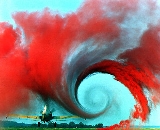
Airplane Vortex Edit
Aerodynamics is a branch of dynamics concerned with studying the motion of air, particularly when it interacts with a moving object. Aerodynamics is a subfield of fluid dynamics
Fluid dynamics

In physics, fluid dynamics is the sub-discipline of fluid mechanics dealing with fluid flow — the natural science of fluids in motion....
 and gas dynamics
Gas dynamics

Gas dynamics is a branch of fluid dynamics concerned with studying the motion of gases....
, with much theory shared between them. Aerodynamics is often used synonymously with gas dynamics, with the difference being that gas dynamics applies to all gases. Understanding the motion of air (often called a flow field) around an object enables the calculation of forces and moments acting on the object. Typical properties calculated for a flow field include velocity
Velocity

In physics, velocity is defined as the Derivative of Position vector. It is a vector physical quantity; both speed and direction are required to define it....
, pressure
Pressure

Pressure is the force per unit area applied to an object in a direction surface normal to the surface. Gauge pressure is the pressure relative to the local atmospheric or ambient pressure....
, density
Density

The density of a material is defined as its mass per unit volume. The symbol of density is ....
 and temperature
Temperature

In physics, temperature is a physical property of a Physical system that underlies the common notions of hot and cold; something that feels hotter generally has the greater temperature....
 as a function of position and time. By defining a control volume
Control volume

In fluid mechanics and thermodynamics, a control volume is a mathematical abstraction employed in the process of creating mathematical models of physical processes....
 around the flow field, equations for the conservation of mass, momentum, and energy can be defined and used to solve for the properties. The use of aerodynamics through mathematical analysis, empirical approximation and wind tunnel experimentation form the scientific basis for heavier-than-air flight.

Aerodynamic problems can be identified in a number of ways. The flow environment defines the first classification criterion. External aerodynamics is the study of flow around solid objects of various shapes. Evaluating the lift
Lift (force)

In the context of a fluid flow relative to a body, the lift force is the Vector #Vector components of the aerodynamic force that is perpendicular to the oncoming flow direction....
 and drag
Drag (physics)

The term drag is widely used in Physics and Engineering and is central to the field of fluid dynamics. "Drag" refers to forces that oppose the motion of a solid object through a fluid ....
 on an airplane
Fixed-wing aircraft

A fixed-wing aircraft is an aircraft capable of heavier-than-air flight whose Lift is generated not by wing motion relative to the aircraft, but by forward motion through the air....
, the shock wave
Shock wave

A shock wave is a type of propagating disturbance. Like an ordinary wave, it carries energy and can propagate through a medium or in some cases in the absence of a material medium, through a field such as the electromagnetic field....
s that form in front of the nose of a rocket
Rocket

A rocket or rocket vehicle is a missile, aircraft or other vehicle which obtains thrust by the Reaction of the rocket to the ejection of fast moving fluid exhaust from a rocket engine....
 or the flow of air over a hard drive head are examples of external aerodynamics. Internal aerodynamics is the study of flow through passages in solid objects. For instance, internal aerodynamics encompasses the study of the airflow through a jet engine
Jet engine

A jet engine is a reaction engine that discharges a fast moving jet of fluid to generate thrust in accordance with Isaac Newton Newton's laws of motion....
 or through an air conditioning
Air conditioning

An air conditioner is an appliance, system, or Mechanism designed to extract heat from an area via a refrigeration cycle. In construction, a complete system of heating, Ventilation , and air conditioning is referred to as "HVAC." Its purpose, in a building or an automobile, is to provide comfort during either hot or cold...
 pipe.

The ratio of the problem's characteristic flow speed to the speed of sound
Speed of sound

Sound is a vibration that travels through an elasticity medium as a wave. The speed of sound describes how much distance such a wave travels in a certain amount of time....
 comprises a second classification of aerodynamic problems. A problem is called subsonic
Subsonic

Subsonic may refer to:*Any speed lower than the speed of sound within a sound propagating medium is called subsonic.**Aircraft flight at airspeeds lower than the speed of sound in air is subsonic flight....
 if all the speeds in the problem are less than the speed of sound, transonic
Transonic

Transonic is an aeronautics term referring to a range of velocities just below and above the speed of sound . It is defined as the range of speeds between the critical mach, when some parts of the airflow over an aircraft become supersonic, and a higher speed, typically near Mach number, when all of the airflow is supersonic....
 if speeds both below and above the speed of sound are present (normally when the characteristic speed is approximately the speed of sound), supersonic
Supersonic

The term supersonic is used to define a speed that is over the speed of sound . At a typical temperature like 21 ?C , the threshold value required for an object to be traveling at a supersonic speed is approximately 344 metre per second, ....
 when the characteristic flow speed is greater than the speed of sound, and hypersonic
Hypersonic

In aerodynamics, hypersonic speeds are speeds that are highly supersonic. Since the 1970s, the term has generally been assumed to refer to speeds of Mach number and above....
 when the flow speed is much greater than the speed of sound. Aerodynamicists disagree over the precise definition of hypersonic flow; minimum Mach number
Mach number

Mach number is the speed of an object moving through air, or any fluid substance, divided by the speed of sound as it is in that substance. It is commonly used to represent an object's speed, when it is travelling at the speed of sound....
s for hypersonic flow range from 3 to 12.

The influence of viscosity
Viscosity

Viscosity is a measure of the Drag of a fluid which is being deformed by either shear stress or extensional stress. In everyday terms , viscosity is "thickness"....
 in the flow dictates a third classification. Some problems involve only negligible viscous effects on the solution, in which case viscosity can be considered to be nonexistent. The approximations to these problems are called inviscid flow
Inviscid flow

In fluid dynamics there are problems that are easily solved by using the simplifying assumption of an ideal fluid that has no viscosity. The flow of a fluid that is assumed to have no viscosity is called inviscid flow....
s. Flows for which viscosity cannot be neglected are called viscous flows.

History

Images and stories of flight have appeared throughout recorded history, such as the story of Icarus
Icarus

Icarus, Ikarus, or Ikaros, is a proper noun with a variety of meanings, most deriving from its use in Greek mythology:* Icarus , the son of Daedalus according to Greek mythology...
 and Daedalus
Daedalus

In Greek mythology, Daedalus was a most skillful artificer, or craftsman, so skillful that he was said to have invented images that seemed to move about....
, the manned kite
Kite

A kite is a flying tethered aircraft that depends upon the tension of a tethering system. The necessary Lift that makes the kite wing fly is generated when air flows over and under the kite's wing, producing low pressure above the wing and high pressure below it....
 flight of Yuan Huangtou
Yuan Huangtou

Yuan Huangtou was the son of emperor Yuan Lang of Eastern Wei. At that time,Gao Yang took control the court of Eastern Wei and set the emperor as puppet....
, and the parachute flight, though possibly a controlled flexible winged flight, of Abbas Ibn Firnas
Abbas Ibn Firnas

Abbas Ibn Firnas , also known as Abbas Qasim Ibn Firnas and ?????? ?? ????? , was an Arabic-speaking Berber people, born in Izn-Rand Onda, al-Andalus , who lived in the Umayyad Caliph of Cordoba in al-Andalus....
. Although observations of some aerodynamic effects like wind resistance (a.k.a. drag
Drag (physics)

The term drag is widely used in Physics and Engineering and is central to the field of fluid dynamics. "Drag" refers to forces that oppose the motion of a solid object through a fluid ....
) were recorded by the likes of Aristotle
Aristotle

Aristotle was a Greeks philosopher, a student of Plato and teacher of Alexander the Great. He wrote on many subjects, including physics, metaphysics, Poetics , theater, music, logic, rhetoric, politics, government, ethics, biology and zoology....
, Avicenna
Avicenna

, known as Abu Ali Sina Balkhi or Ibn Sina and commonly known in English by his Latinized name Avicenna , was a Persian people polymath and the foremost Islamic medicine and Early Islamic philosophy of his time....
, Leonardo da Vinci
Leonardo da Vinci

Leonardo di ser Piero da Vinci was an Italy polymath, being a scientist, mathematician, engineer, inventor, anatomist, Painting, sculptor, architect, botanist, musician and writer....
 and Galileo Galilei
Galileo Galilei

Galileo Galilei was a Grand Duchy of Tuscany physicist, mathematician, astronomer, and philosopher who played a major role in the Scientific Revolution....
, very little effort was made to develop governing laws for understanding the nature of flight prior to the 17th century.

In 1505, Leonardo da Vinci
Leonardo da Vinci

Leonardo di ser Piero da Vinci was an Italy polymath, being a scientist, mathematician, engineer, inventor, anatomist, Painting, sculptor, architect, botanist, musician and writer....
 wrote the Codex on the Flight of Birds
Codex on the Flight of Birds

Codex on the Flight of Birds is a relatively short codex of circa 1505 by Leonardo da Vinci. It comprises 18 folios and measures 21 ? 15 centimetres....
, one of the earliest treatises on aerodynamics. He notes for the first time that the center of gravity of a flying bird does not coincide with its center of pressure
Center of pressure

The center of pressure is the point on a body where the total sum of the aerodynamic pressure field acts, causing a force and no moment about that point....
, and he describes the construction of an ornithopter
Ornithopter

An ornithopter is an aircraft that flight by flapping its wings. Designers seek to imitate the flapping-wing flight of birds, bats, and insects....
, with flapping wings similar to a bird.

Sir Isaac Newton
Isaac Newton

Sir Isaac Newton, Fellow of the Royal Society was an English people physicist, mathematician, Astronomy, Natural philosophy, Alchemy, and Theology and one of the the 100 in human history....
 was the first person to develop a theory of air resistance, making him one of the first aerodynamicists. As part of that theory, Newton believed that drag was due to the dimensions of a body, the density of the fluid, and the velocity raised to the second power
Exponentiation

Exponentiation is a mathematics operation , written 'an', involving two numbers, the base a and the exponent n....
. These beliefs all turned out to be correct for low flow speeds. Newton also developed a law for the drag force on a flat plate inclined towards the direction of the fluid flow. Using F for the drag force, ? for the density, S for the area of the flat plate, V for the flow velocity, and ? for the inclination angle, his law is expressed below.

Unfortunately, this equation is completely incorrect for the calculation of drag (unless the flow speed is hypersonic
Hypersonic

In aerodynamics, hypersonic speeds are speeds that are highly supersonic. Since the 1970s, the term has generally been assumed to refer to speeds of Mach number and above....
). Drag on a flat plate is closer to being linear with the angle of inclination as opposed to acting quadratically. This formula can lead one to believe that flight is more difficult than it actually is, and it may have contributed to a delay in manned flight.

Governableparachute
Sir George Cayley
George Cayley

Sir George Cayley, 6th Baronet , sometimes known as "the father of Aerodynamics", was a prolific English engineer from Brompton, Scarborough, near Scarborough, England in Yorkshire....
 is credited as the first person to separate the forces of lift
Lift (force)

In the context of a fluid flow relative to a body, the lift force is the Vector #Vector components of the aerodynamic force that is perpendicular to the oncoming flow direction....
 and drag which are in effect on any flight vehicle. Cayley believed that the drag on a flying machine must be counteracted by a means of propulsion in order for level flight to occur. Cayley also looked to nature for aerodynamic shapes with low drag. One of the shapes he investigated were the cross-sections of trout
Trout

Trout are a number of species of freshwater fish belonging to the Salmoninae subfamily of the Salmonidae family. Salmon belong to some of the same genera as trout but, unlike most trout, most salmon species spend almost all their lives in salt water....
. This may appear counterintuitive, however, the bodies of fish are shaped to produce very low resistance as they travel through water. Their cross-sections are sometimes very close to that of modern low drag airfoil
Airfoil

An airfoil or aerofoil is the shape of a wing or blade or sail as seen in cross-section.An airfoil-shaped body moved through a fluid produces a force perpendicular to the motion called lift ....
s.

These empirical findings led to a variety of air resistance experiments on various shapes throughout the 18th and 19th centuries. Drag theories were developed by Jean le Rond d'Alembert
Jean le Rond d'Alembert

Jean le Rond d'Alembert was a France mathematician, mechanics, physicist and philosopher. He was also co-editor with Denis Diderot of the Encyclop?die....
, Gustav Kirchhoff
Gustav Kirchhoff

Gustav Robert Kirchhoff was a Germany physicist who contributed to the fundamental understanding of electrical circuits, spectroscopy, and the emission of black-body radiation by heated objects....
, and Lord Rayleigh
John Strutt, 3rd Baron Rayleigh

John William Strutt, 3rd Baron Rayleigh Order of Merit was an England physicist who, with William Ramsay, discovered the element argon, an achievement for which he earned the Nobel Prize for Physics in 1904....
. Equations for fluid flow with friction
Friction

File:Friction alt.svgFriction is the force resisting the relative lateral motion of solid surfaces, fluid layers, or material elements in contact....
 were developed by Claude-Louis Navier
Claude-Louis Navier

Claude-Louis Navier born Claude Louis Marie Henri Navier, was a France engineer and physicist who specialized in mechanics.The Navier-Stokes equations are named after him and George Gabriel Stokes....
 and George Gabriel Stokes
George Gabriel Stokes

Sir George Gabriel Stokes, 1st Baronet Fellow of the Royal Society , was a mathematics and physics, who at University of Cambridge made important contributions to fluid dynamics , optics, and mathematical physics ....
. To simulate fluid flow, many experiments involved immersing objects in streams of water or simply dropping them off the top of a tall building. Towards the end of this time period Gustave Eiffel
Gustave Eiffel

Alexandre Gustave Eiffel was a France structural engineer and architect and a specialist of metallic structures. He is famous for designing the Eiffel Tower, built 1887?1889 for the Exposition Universelle in Paris, France, the Basilica Minore de San Sebastian, the only all-steel basilica in Asia, found in the Philippines, and the armature...
 used his Eiffel Tower
Eiffel Tower

The Eiffel Tower is an Puddle iron tower built on the Champ de Mars beside the Seine River in Paris. The tower has become a global Cultural icon of France and is one of the most recognizable structures in the world....
 to assist in the drop testing of flat plates.

Of course, a more precise way to measure resistance is to place an object within an artificial, uniform stream of air where the velocity is known. The first person to experiment in this fashion was Francis Herbert Wenham
Francis Herbert Wenham

Francis Herbert Wenham was a British marine engineer who studied the problem of manned flight and wrote a perceptive and influential academic paper which he presented to the first meeting of the Royal Aeronautical Society in London in 1866....
, who in doing so constructed the first wind tunnel
Wind tunnel

A wind tunnel is a research tool developed to assist with studying the effects of air moving over or around solid objects.Ways that wind-speed and flow are measured in wind tunnels:...
 in 1871. Wenham was also a member of the first professional organization dedicated to aeronautics, the Royal Aeronautical Society
Royal Aeronautical Society

Founded in 1866 The Royal Aeronautical Society, also known as the RAeS, is a multidisciplinary professional institution dedicated to the entire global aerospace community....
 of Great Britain
Great Britain

Great Britain is an island lying to the northwest of Continental Europe. It is the List of islands by area, and the largest in Europe. With a population of 58.9 million people it is List of islands by population....
. Objects placed in wind tunnel models are almost always smaller than in practice, so a method was needed to relate small scale models to their real-life counterparts. This was achieved with the invention of the dimensionless Reynolds number
Reynolds number

In fluid mechanics and heat transfer, the Reynolds number is a dimensionless number that gives a measure of the ratio of inertial forces to viscosity forces and, consequently, it quantifies the relative importance of these two types of forces for given flow conditions....
 by Osbourne Reynolds. Reynolds also experimented with laminar
Laminar flow

Laminar flow, sometimes known as Streamlines, streaklines and pathlines flow, occurs when a fluid flows in parallel layers, with no disruption between the layers....
 to turbulent
Turbulence

In fluid dynamics, turbulence or turbulent flow is a fluid regime characterized by chaotic, stochastic property changes. This includes low momentum diffusion, high momentum convection, and rapid variation of pressure and velocity in space and time....
 flow transition in 1883.

By the late 19th century, two problems were identified before heavier-than-air flight could be realized. The first was the creation of low-drag, high-lift aerodynamic wings. The second problem was how to determine the power needed for sustained flight. During this time, the groundwork was laid down for modern day fluid dynamics
Fluid dynamics

In physics, fluid dynamics is the sub-discipline of fluid mechanics dealing with fluid flow — the natural science of fluids in motion....
 and aerodynamics, with other less scientifically inclined enthusiasts testing various flying machines with little success.

Wb Wind Tunnel
In 1889, Charles Renard
Charles Renard

Charles Renard , French military engineer, started to work after the Franco-Prussian War of 1870/71 on the design of air ships at the French army aeronautical department....
, a French aeronautical engineer, became the first person to reasonably predict the power needed for sustained flight. Renard and German physicist Hermann von Helmholtz
Hermann von Helmholtz

Hermann Ludwig Ferdinand von Helmholtz was a Germany physician and physicist who made significant contributions to several widely varied areas of modern science....
 explored the wing loading of birds, eventually concluding that humans could not fly under their own power by attaching wings onto their arms. Otto Lilienthal
Otto Lilienthal

Otto Lilienthal was a pioneer of human aviation who became known as the German people Glider King. He was the first person to make repeated successful Unpowered aircrafts....
, following the work of Sir George Cayley, was the first person to become highly successful with glider flights. Lilienthal believed that thin, curved airfoils would produce high lift and low drag.

Octave Chanute
Octave Chanute

Octave Chanute, was a French-born United States railroad engineer and aviation pioneer. He provided the Wright brothers with help and advice, and helped to publicize their flying experiments....
 provided a great service to those interested in aerodynamics and flying machines by publishing a book outlining all of the research conducted around the world up to 1893. With the information contained in that book and the personal assistance of Chanute himself, the Wright brothers
Wright brothers

The Wright brothers, Orville and Wilbur , were two United States who are generally credited with inventing and building the world's first successful fixed-wing aircraft and making the first controlled, powered and sustained heavier-than-air Flight#Mechanical flight, on December 17, 1903....
 had just enough knowledge of aerodynamics to fly the first manned aircraft on December 17, 1903, just in time to beat the efforts of Samuel Pierpont Langley
Samuel Pierpont Langley

Samuel Pierpont Langley was an United States astronomer, physicist, inventor of the bolometer and pioneer of aviation. He graduated from Boston Latin School, was an assistant in the Harvard College Observatory, then became chair of mathematics at the United States Naval Academy....
. The Wright brothers' flight confirmed or disproved a number of aerodynamics theories. Newton's drag force theory was finally proved incorrect. The first flight led to a more organized effort between aviators and scientists, leading the way to modern aerodynamics.

During the time of the first flights, Frederick W. Lanchester, Martin Wilhelm Kutta
Martin Wilhelm Kutta

Martin Wilhelm Kutta was a German mathematician.Kutta was born in Pitschen, Upper Silesia . He attended the University of Wroclaw from 1885 to 1890, and continued his studies in Munich until 1894, where he became the assistant of Walther Franz Anton von Dyck....
, and Nikolai Zhukovsky
Nikolai Zhukovsky

Nikolai Yegorovich Zhukovsky was a Russian scientist, founding father of modern aerodynamics and hydrodynamics.Whereas contemporary scientists scoffed at the idea of human flight, Zhukovsky was the first to undertake the study of airflow....
 independently created theories that connected circulation
Circulation (fluid dynamics)

In fluid dynamics, circulation is the line integral around a closed curve of the fluid velocity. Circulation is normally denoted . If is the fluid velocity and is a unit vector along the closed curve :...
 of a fluid flow to lift. Kutta and Zhukovsky went on to develop a two-dimensional wing theory. Expanding upon the work of Lanchester, Ludwig Prandtl
Ludwig Prandtl

Ludwig Prandtl was a Germany scientist. He was a pioneer of aerodynamics, and developed the mathematical basis for the fundamental principles of subsonic aerodynamics in the 1920s....
 is credited with developing the mathematics behind thin-airfoil and lifting-line theories as well as work with boundary layer
Boundary layer

In physics and fluid mechanics, a boundary layer is that layer of fluid in the immediate vicinity of a bounding surface. In the Earth's atmosphere, the planetary boundary layer is the air layer near the ground affected by diurnal heat, moisture or momentum transfer to or from the surface....
s. Prandtl, a professor at Gottingen University, instructed many students who would play important roles in the development of aerodynamics like Theodore von Kármán
Theodore von Karman

Theodore von K?rm?n was a Hungarian people-United States engineer and physicist who was active primarily in the fields of aeronautics and astronautics....
 and Max Munk
Michael Max Munk

Born in Germany about 1890, M. Max Munk earned doctorates in both physics and mathematics from the University of G?ttingen in 1917. After World War I, NACA brought Munk to the United States....
.

As aircraft began to travel faster, aerodynamicists realized that the density of air began to change as it came into contact with an object, leading to a division of fluid flow into the incompressible and compressible
Compressible flow

In fluid dynamics, a flow is considered to be a compressible flow if the density of the fluid changes with respect to pressure. In general, this is the case where the Mach number of the flow exceeds 0.3....
 regimes. In compressible aerodynamics, density and pressure both change, which is the basis for calculating the speed of sound
Speed of sound

Sound is a vibration that travels through an elasticity medium as a wave. The speed of sound describes how much distance such a wave travels in a certain amount of time....
. Newton was the first to develop a mathematical model for calculating the speed of sound, but it was not correct until Pierre-Simon Laplace
Pierre-Simon Laplace

Pierre-Simon, marquis de Laplace was a France mathematician and astronomer whose work was pivotal to the development of astronomy and statistics....
 accounted for the molecular behavior of gases and introduced the heat capacity ratio
Heat capacity ratio

The heat capacity ratio or adiabatic index or ratio of specific heats, is the ratio of the heat capacity at constant pressure to heat capacity at constant volume ....
. The ratio of the flow speed to the speed of sound was named the Mach number
Mach number

Mach number is the speed of an object moving through air, or any fluid substance, divided by the speed of sound as it is in that substance. It is commonly used to represent an object's speed, when it is travelling at the speed of sound....
 after Ernst Mach
Ernst Mach

Ernst Mach was an Austrians physicist and philosopher and is the namesake for the Mach number and the optical illusion known as Mach bands....
, who was one of the first to investigate the properties of supersonic
Supersonic

The term supersonic is used to define a speed that is over the speed of sound . At a typical temperature like 21 ?C , the threshold value required for an object to be traveling at a supersonic speed is approximately 344 metre per second, ....
 flow which included Schlieren photography
Schlieren photography

Schlieren photography is a visual process that is used to photograph the flow of fluids of varying density. Invented by the Germany physicist August Toepler in 1864 to study supersonic motion, it is widely used in aeronautical engineering to photograph the flow of air around objects....
 techniques to visualize the changes in density. William John Macquorn Rankine
William John Macquorn Rankine

William John Macquorn Rankine Fellow of the Royal Society was a Scottish engineering and physics. He was a founding contributor, with Rudolf Clausius and William Thomson, 1st Baron Kelvin , to the science of thermodynamics....
 and Pierre Henri Hugoniot
Pierre Henri Hugoniot

Pierre-Henri Hugoniot was a France engineer, who formulated the Rankine-Hugoniot equation....
 independently developed the theory for flow properties before and after a shock wave
Shock wave

A shock wave is a type of propagating disturbance. Like an ordinary wave, it carries energy and can propagate through a medium or in some cases in the absence of a material medium, through a field such as the electromagnetic field....
. Jakob Ackeret
Jakob Ackeret

Jakob Ackeret was a Swiss aeronautical engineer. He is widely viewed as one of the foremost aeronautics experts of 20th century....
 led the initial work on calculating the lift and drag on a supersonic airfoil. Theodore von Kármán and Hugh Latimer Dryden
Hugh Latimer Dryden

Dr. Hugh Latimer Dryden was an Aeronautics scientist and civil servant. He served as NASA Deputy Administrator from August 19, 1958 until his death....
 introduced the term transonic
Transonic

Transonic is an aeronautics term referring to a range of velocities just below and above the speed of sound . It is defined as the range of speeds between the critical mach, when some parts of the airflow over an aircraft become supersonic, and a higher speed, typically near Mach number, when all of the airflow is supersonic....
 to describe flow speeds around Mach 1 where drag increases rapidly. Because of the increase in drag approaching Mach 1, aerodynamicists and aviators disagreed on whether manned supersonic flight was achievable.

X 43a (hyper   X) Mach 7 Computational Fluid Dynamic (cfd)
On September 30, 1935 an exclusive conference was held in Rome
Rome

Rome is the capital city of Italy and Lazio, and is Italy's largest and most populous city, with 2,724,347 residents in an urban area of some ....
 with the topic of high velocity flight and the possibility of breaking the sound barrier
Sound barrier

In aerodynamics, the sound barrier usually refers to the point at which an aircraft moves from transonic to supersonic speed. The term came into use during World War II when a number of aircraft started to encounter the effects of compressibility, a grab-bag of unrelated aerodynamic effects....
. Participants included von Kármán, Prandtl, Ackeret, Eastman Jacobs
Eastman Jacobs

Eastman N. Jacobs was a leading aerodynamicist who worked for NACA's Langley Research Center from the 1920s to the 1940s. He was responsible for advancing many fields in aerodynamics, dealing particularly with wind tunnels, airfoils, turbulence, boundary layers, and Schlieren photography....
, Adolf Busemann
Adolf Busemann

Adolph Busemann was a Germany aerospace engineering and influential early pioneer in aerodynamics, specialising in supersonic airflows. He introduced the concept of swept wings, and after immigrating to the United States was instrumental in the development of the area rule and invented the shockwave free Busemann's Biplane....
, Geoffrey Ingram Taylor
Geoffrey Ingram Taylor

Sir Geoffrey Ingram Taylor OM was a physicist, mathematician and expert on fluid dynamics and wave theory. He has been described as "one of the greatest physical scientists of the 20th century"....
, Gaetano Arturo Crocco
Gaetano Arturo Crocco

Gaetano Arturo Crocco was an Italian scientist and aeronautics pioneer, the founder of the Italian Rocket Society, and went on to become Italy's leading space scientist....
, and Enrico Pistolesi. The new research presented was impressive. Ackeret presented a design for a supersonic wind tunnel
Supersonic wind tunnel

A supersonic wind tunnel is a wind tunnel that produces supersonic speeds The Mach number and flow are determined by the nozzle geometry. The Reynolds number is varied changing the density level ....
. Busemann gave perhaps the best presentation on the need for aircraft with swept wing
Swept wing

A swept-wing is a wing planform common on jet aircraft capable of near-sonic or supersonic speeds. The wings are swept back instead of being set at right angles to the fuselage which was common on propeller.driven aircraft and early jets....
s for high speed flight. Eastman Jacobs, working for NACA
NACA

NACA may refer to:*Neighborhood Assistance Corporation of America a non-profit community advocacy and homeownership organization helping victims of predatory mortgages....
, presented his optimized airfoils for high subsonic speeds which led to some of the high performance American aircraft during World War II
World War II

World War II, or the Second World War , was a global military conflict which involved a Participants in World War II, including all of the great powers, organised into two opposing military alliances: the Allies of World War II and the Axis powers....
. Supersonic propulsion was also discussed. The sound barrier was broken using the Bell X-1
Bell X-1

The Bell Aircraft X-1, originally designated XS-1, was a joint National Advisory Committee for Aeronautics-U.S. Army Air Forces/US Air Force supersonic research project and the first aircraft to exceed the speed of sound in controlled, level flight....
 aircraft twelve years later, thanks in part to those individuals.

By the time the sound barrier was broken, much of the subsonic and low supersonic aerodynamics knowledge had matured. The Cold War
Cold War

The Cold War was the continuing state of conflict, tension and competition that existed between a number of world powers, including the United States, the Soviet Union, People's Republic of China, France, United Kingdom and those countries' respective allies from the mid-1940s to the early 1990s....
 fueled an ever evolving line of high performance aircraft. Computational fluid dynamics
Computational fluid dynamics

Computational fluid dynamics is one of the branches of fluid mechanics that uses numerical methods and algorithms to solve and analyze problems that involve fluid flows....
 was started as an effort to solve for flow properties around complex objects and has rapidly grown to the point where entire aircraft can be designed using a computer.

With some exceptions, the knowledge of hypersonic
Hypersonic

In aerodynamics, hypersonic speeds are speeds that are highly supersonic. Since the 1970s, the term has generally been assumed to refer to speeds of Mach number and above....
 aerodynamics has matured between the 1960s and the present decade. Therefore, the goals of an aerodynamicist have shifted from understanding the behavior of fluid flow to understanding how to engineer a vehicle to interact appropriately with the fluid flow. For example, while the behavior of hypersonic flow is understood, building a scramjet
Scramjet

A scramjet is a variation of a ramjet distinguished by supersonic combustion. At higher speeds, it is necessary to combust supersonically to maximize the efficiency of the combustion process....
 aircraft to fly at hypersonic speeds has seen very limited success. Along with building a successful scramjet aircraft, the desire to improve the aerodynamic efficiency of current aircraft and propulsion systems will continue to fuel new research in aerodynamics.

Introductory terminology

  • Lift
    Lift (force)

    In the context of a fluid flow relative to a body, the lift force is the Vector #Vector components of the aerodynamic force that is perpendicular to the oncoming flow direction....
  • Drag
    Drag (physics)

    The term drag is widely used in Physics and Engineering and is central to the field of fluid dynamics. "Drag" refers to forces that oppose the motion of a solid object through a fluid ....
  • Reynolds number
    Reynolds number

    In fluid mechanics and heat transfer, the Reynolds number is a dimensionless number that gives a measure of the ratio of inertial forces to viscosity forces and, consequently, it quantifies the relative importance of these two types of forces for given flow conditions....
  • Mach number
    Mach number

    Mach number is the speed of an object moving through air, or any fluid substance, divided by the speed of sound as it is in that substance. It is commonly used to represent an object's speed, when it is travelling at the speed of sound....


Continuity assumption

Gases are composed of molecule
Molecule

In chemistry, a molecule is defined as a sufficiently stable, electric charge neutral group of at least two atoms in a definite arrangement held together by very strong chemical bonds....
s which collide with one another and solid objects. If density and velocity are taken to be well-defined at infinitely small points, and are assumed to vary continuously from one point to another, the discrete molecular nature of a gas is ignored.

The continuity assumption becomes less valid as a gas becomes more rarefied. In these cases, statistical mechanics
Statistical mechanics

Statistical mechanics is the application of probability theory, which includes Mathematics tools for dealing with large populations, to the field of mechanics, which is concerned with the motion of particles or objects when subjected to a force....
 is a more valid method of solving the problem than continuous aerodynamics. The Knudsen number
Knudsen number

The Knudsen number is a dimensionless number defined as the ratio of the molecular mean free path length to a representative physical length scale ....
 can be used to guide the choice between statistical mechanics and the continuous formulation of aerodynamics.

Laws of Conservation

Aerodynamic problems are often solved using conservation laws as applied to a fluid continuum
Continuum mechanics

Continuum mechanics is a branch of mechanics that deals with the analysis of the kinematics and mechanical behavior of materials modeled as a continuum, e.g., solids and fluids ....
. In many basic problems, three conservation principles are used:
  • Continuity
    Continuity equation

    A continuity equation is a differential equation that describes the conservative transport of some kind of quantity. Since mass, energy, momentum, and other natural quantities are conserved, a vast variety of physics may be described with continuity equations....
    : If a certain mass of fluid enters a volume, it must either exit the volume or change the mass inside the volume.
  • Conservation of Momentum
    Momentum

    In classical mechanics, momentum is the product of the mass and velocity of an object . For more accurate measures of momentum, see the section Momentum#Modern definitions of momentum on this page....
    : Application of Newton's second law of motion to a continuum.
  • Conservation of Energy
    Conservation of energy

    The law of conservation of energy states that the total amount of energy in an isolated system remains constant. A consequence of this law is that energy cannot be created or destroyed....
    : Although energy
    Energy

    In physics, energy is a scalar physical quantity that describes the amount of Work_ that can be performed by a force. Energy is an attribute of objects and systems that is subject to a conservation law....
     can be converted from one form to another, the total energy
    Energy

    In physics, energy is a scalar physical quantity that describes the amount of Work_ that can be performed by a force. Energy is an attribute of objects and systems that is subject to a conservation law....
     in a given system remains constant.


Incompressible aerodynamics

An incompressible flow
Incompressible flow

In fluid mechanics or more generally continuum mechanics, an incompressible flow is solid or fluid flow in which the divergence of velocity is zero....
 is characterized by a constant density despite flowing over surfaces or inside ducts. A flow can be considered incompressible as long as its speed is low. For higher speeds, the flow will begin to compress as it comes into contact with surfaces. The Mach number
Mach number

Mach number is the speed of an object moving through air, or any fluid substance, divided by the speed of sound as it is in that substance. It is commonly used to represent an object's speed, when it is travelling at the speed of sound....
 is used to distinguish between incompressible and compressible flows.

Subsonic flow

Subsonic (or low-speed) aerodynamics is the study of inviscid, incompressible
Compressibility

In thermodynamics and fluid mechanics, compressibility is a Measure of the relative volume change of a fluid or solid as a response to a pressure change....
 and irrotational aerodynamics where the differential equations used are a simplified version of the governing equations of fluid dynamics
Fluid dynamics

In physics, fluid dynamics is the sub-discipline of fluid mechanics dealing with fluid flow — the natural science of fluids in motion....
.. It is a special case of Subsonic aerodynamics.

In solving a subsonic problem, one decision to be made by the aerodynamicist is whether to incorporate the effects of compressibility. Compressibility is a description of the amount of change of density
Density

The density of a material is defined as its mass per unit volume. The symbol of density is ....
 in the problem. When the effects of compressibility on the solution are small, the aerodynamicist may choose to assume that density is constant. The problem is then an incompressible low-speed aerodynamics problem. When the density is allowed to vary, the problem is called a compressible problem. In air, compressibility effects are usually ignored when the Mach number
Mach number

Mach number is the speed of an object moving through air, or any fluid substance, divided by the speed of sound as it is in that substance. It is commonly used to represent an object's speed, when it is travelling at the speed of sound....
 in the flow does not exceed 0.3 (about 335 feet per second or 228 miles per hour or 102 meters per second at 60oF). Above 0.3, the problem should be solved by using compressible aerodynamics.

Compressible aerodynamics

According to the theory of aerodynamics, a flow is considered to be compressible if its change in density
Density

The density of a material is defined as its mass per unit volume. The symbol of density is ....
 with respect to pressure
Pressure

Pressure is the force per unit area applied to an object in a direction surface normal to the surface. Gauge pressure is the pressure relative to the local atmospheric or ambient pressure....
 is non-zero along a streamline
Streamlines, streaklines and pathlines

Fluid flow is described in general by a vector field in three or four dimensions. Pathlines, streamlines, and streaklines are field lines of different vector field descriptions of the flow....
. This means that - unlike incompressible flow - changes in density must be considered. In general, this is the case where the Mach number
Mach number

Mach number is the speed of an object moving through air, or any fluid substance, divided by the speed of sound as it is in that substance. It is commonly used to represent an object's speed, when it is travelling at the speed of sound....
 in part or all of the flow exceeds 0.3. The Mach .3 value is rather arbitrary, but it is used because gas flows with a Mach number below that value demonstrate changes in density with respect to the change in pressure of less than 5%. Furthermore, that maximum 5% density change occurs at the stagnation point of an object immersed in the gas flow and the density changes around the rest of the object will be significantly lower. Transonic, supersonic, and hypersonic flows are all compressible.

Transonic flow

The term Transonic refers to a range of velocities just below and above the local speed of sound
Speed of sound

Sound is a vibration that travels through an elasticity medium as a wave. The speed of sound describes how much distance such a wave travels in a certain amount of time....
 (generally taken as Mach
Mach number

Mach number is the speed of an object moving through air, or any fluid substance, divided by the speed of sound as it is in that substance. It is commonly used to represent an object's speed, when it is travelling at the speed of sound....
 0.8–1.2). It is defined as the range of speeds between the critical Mach number, when some parts of the airflow over an aircraft become supersonic
Supersonic

The term supersonic is used to define a speed that is over the speed of sound . At a typical temperature like 21 ?C , the threshold value required for an object to be traveling at a supersonic speed is approximately 344 metre per second, ....
, and a higher speed, typically near Mach 1.2
Mach number

Mach number is the speed of an object moving through air, or any fluid substance, divided by the speed of sound as it is in that substance. It is commonly used to represent an object's speed, when it is travelling at the speed of sound....
, when all of the airflow is supersonic. Between these speeds some of the airflow is supersonic, and some is not.

Supersonic flow

Supersonic aerodynamic problems are those involving flow speeds greater than the speed of sound. Calculating the lift on the Concorde
Concorde

The A?rospatiale-BAC Concorde aircraft is a supersonic passenger airliner or supersonic transport . It was a product of an Anglo-French government treaty, combining the manufacturing efforts of A?rospatiale and British Aircraft Corporation....
 during cruise can be an example of a supersonic aerodynamic problem.

Supersonic flow behaves very differently from subsonic flow. Fluids react to differences in pressure; pressure changes are how a fluid is "told" to respond to its environment. Therefore, since sound
Sound

Sound is vibration transmitted through a solid, liquid, or gas, composed of frequencies within the range of hearing and of a threshold of hearing to be heard, or the sensation stimulated in organs of hearing by such vibrations....
 is in fact an infinitesimal pressure difference propagating through a fluid, the speed of sound
Speed of sound

Sound is a vibration that travels through an elasticity medium as a wave. The speed of sound describes how much distance such a wave travels in a certain amount of time....
 in that fluid can be considered the fastest speed that "information" can travel in the flow. This difference most obviously manifests itself in the case of a fluid striking an object. In front of that object, the fluid builds up a stagnation pressure
Stagnation pressure

In fluid dynamics, stagnation pressure is the pressure at a stagnation point in a fluid flow, where the kinetic energy is converted into pressure energy....
 as impact with the object brings the moving fluid to rest. In fluid traveling at subsonic speed, this pressure disturbance can propagate upstream, changing the flow pattern ahead of the object and giving the impression that the fluid "knows" the object is there and is avoiding it. However, in a supersonic flow, the pressure disturbance cannot propagate upstream. Thus, when the fluid finally does strike the object, it is forced to change its properties -- temperature
Temperature

In physics, temperature is a physical property of a Physical system that underlies the common notions of hot and cold; something that feels hotter generally has the greater temperature....
, density
Density

The density of a material is defined as its mass per unit volume. The symbol of density is ....
, pressure
Pressure

Pressure is the force per unit area applied to an object in a direction surface normal to the surface. Gauge pressure is the pressure relative to the local atmospheric or ambient pressure....
, and Mach number
Mach number

Mach number is the speed of an object moving through air, or any fluid substance, divided by the speed of sound as it is in that substance. It is commonly used to represent an object's speed, when it is travelling at the speed of sound....
 -- in an extremely violent and irreversible
Reversible process (thermodynamics)

In thermodynamics, a reversible process, or reversible cycle if the process is cyclic, is a process that can be "reversed" by means of infinitesimal changes in some property of the system without loss or dissipation of energy....
 fashion called a shock wave
Shock wave

A shock wave is a type of propagating disturbance. Like an ordinary wave, it carries energy and can propagate through a medium or in some cases in the absence of a material medium, through a field such as the electromagnetic field....
. The presence of shock waves, along with the compressibility effects of high-velocity (see Reynolds number
Reynolds number

In fluid mechanics and heat transfer, the Reynolds number is a dimensionless number that gives a measure of the ratio of inertial forces to viscosity forces and, consequently, it quantifies the relative importance of these two types of forces for given flow conditions....
) fluids, is the central difference between supersonic and subsonic aerodynamics problems.

Hypersonic flow

In aerodynamics, hypersonic speeds are speeds that are highly supersonic. In the 1970s, the term generally came to refer to speeds of Mach 5 (5 times the speed of sound) and above. The hypersonic regime is a subset of the supersonic regime. Hypersonic flow is characterized by high temperature flow behind a shock wave, viscous interaction, and chemical dissociation of gas.

Associated terminology

The incompressible and compressible flow regimes produce many associated phenomena, such as boundary layers and turbulence.

Boundary layers

The concept of a boundary layer
Boundary layer

In physics and fluid mechanics, a boundary layer is that layer of fluid in the immediate vicinity of a bounding surface. In the Earth's atmosphere, the planetary boundary layer is the air layer near the ground affected by diurnal heat, moisture or momentum transfer to or from the surface....
 is important in many aerodynamic problems. The viscosity and fluid friction in the air is approximated as being significant only in this thin layer. This principle makes aerodynamics much more tractable mathematically.

Turbulence

In aerodynamics, turbulence is characterized by chaotic, stochastic property changes in the flow. This includes low momentum diffusion, high momentum convection, and rapid variation of pressure and velocity in space and time. Flow that is not turbulent is called laminar flow.

Aerodynamics in other fields

Aerodynamics is important in a number of applications other than aerospace engineering. It is a significant factor in any type of vehicle design
Automotive engineering

Modern automotive engineering is a branch of vehicle engineering, incorporating elements of Mechanical engineering, Electrical engineering, Electronic engineering, Software engineering and safety engineering as applied to the design, manufacture and operation of motorcycles, automobiles, buses and trucks and their respective engineering subsy...
, including automobile
Automobile

An automobile or motor car is a wheeled motor vehicle for transportation passengers, which also carries its own car engine or motor. Most definitions of the term specify that automobiles are designed to run primarily on roads, to have seating for one to eight people, to typically have four wheels, and to be constructed principally f...
s. It is important in the prediction of forces and moments in sailing
Sailing

Sailing is the art of controlling a boat with large pieces of canvas cloth called sails. By changing the rigging, rudder, and dagger or centre board, a sailor manages the force of the wind on the sails in order to change the direction and speed of a boat....
. It is used in the design of large components such as hard drive heads. Structural engineers
Structural engineering

Structural engineering is a field of engineering dealing with the analysis and design of structures that support or resist structural loads. Structural engineering is usually considered a specialty within civil engineering, but it can also be studied in its own right....
 also use aerodynamics, and particularly aeroelasticity
Aeroelasticity

'Aeroelasticity' is the science which studies the interaction among inertial force, elasticity , and aerodynamic force forces. It was defined by Arthur Collar in 1947 as "the study of the mutual interaction that takes place within the triangle of the inertial, elastic, and aerodynamic forces acting on structural members exposed to an airstrea...
, to calculate wind
WIND

The Global Geospace Science WIND satellite is a NASA science spacecraft launched at 04:31:00 EST on November 1, 1994 from launch pad 17B at Cape Canaveral Air Force Station in Merritt_Island%2C_Florida, Florida aboard a McDonnell Douglas Delta II 7925-10 rocket....
 loads in the design of large buildings and bridge
Bridge

A bridge is a structure built to span a gorge, valley, road, Rail tracks, river, body of water, or any other physical obstacle, for the purpose of providing passage over the obstacle....
s. Urban aerodynamics seeks to help town planners
Urban planning

Urban, city, and town planning is the integration of the disciplines of land use planning and transport planning, to explore a very wide range of aspects of the built and social environments of urbanized municipalities and communities....
 and designers improve comfort in outdoor spaces, create urban microclimates and reduce the effects of urban pollution. The field of environmental aerodynamics studies the ways atmospheric circulation
Atmospheric circulation

Atmospheric circulation is the large-scale movement of air, and the means by which heat is distributed on the surface of the Earth.The large-scale structure of the atmospheric circulation varies from year to year, but the basic structure remains fairly constant....
 and flight mechanics affect ecosystems. The aerodynamics of internal passages is important in heating/ventilation
HVAC

HVAC is an initialism or acronym that stands for "heating, Ventilation , and air conditioning". HVAC is sometimes referred to as climate control and is particularly important in the design of medium to large industrial and office buildings such as skyscrapers and in marine environments such as aquariums, where humidity and tem...
, gas piping
Duct (HVAC)

Ducts are used in HVAC to deliver and remove air. These needed airflows include, for example, supply air, return air, and exhaust air....
, and in automotive engines
Internal combustion engine

The internal combustion engine is an engine in which the combustion of a fuel occurs in a combustion chamber inside and integral to the engine. In an internal combustion engine it is always the expansion of the high temperature and pressure gases that are produced by the combustion which apply force to the movable component of the engine, such as...
 where detailed flow patterns strongly affect the performance of the engine.

See also


Further reading

General Aerodynamics

Subsonic Aerodynamics

Transonic Aerodynamics

Supersonic Aerodynamics

Hypersonic Aerodynamics

History of Aerodynamics

Aerodynamics Related to Engineering

Ground Vehicles

Fixed-Wing Aircraft

Helicopters

Missiles

Model Aircraft

Related Branches of Aerodynamics

Aerothermodynamics

Aeroelasticity

Boundary Layers

Turbulence

External links