

Monoplane

Encyclopedia
Fixed-wing aircraft
A fixed-wing aircraft is an aircraft capable of flight using wings that generate lift due to the vehicle's forward airspeed. Fixed-wing aircraft are distinct from rotary-wing aircraft in which wings rotate about a fixed mast and ornithopters in which lift is generated by flapping wings.A powered...
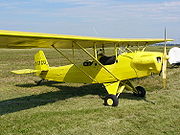
with one main set of wing surfaces, in contrast to a biplane
Biplane
A biplane is a fixed-wing aircraft with two superimposed main wings. The Wright brothers' Wright Flyer used a biplane design, as did most aircraft in the early years of aviation. While a biplane wing structure has a structural advantage, it produces more drag than a similar monoplane wing...
or triplane
Triplane
A triplane is a fixed-wing aircraft equipped with three vertically-stacked wing planes. Tailplanes and canard foreplanes are not normally included in this count, although they may occasionally be.-Design principles:...
. Since the late 1930s it has been the most common form for a fixed wing aircraft.
Types of monoplane
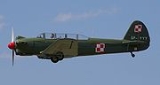
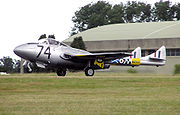
The main distinction between types of monoplane is where the wings attach to the fuselageFuselage
The fuselage is an aircraft's main body section that holds crew and passengers or cargo. In single-engine aircraft it will usually contain an engine, although in some amphibious aircraft the single engine is mounted on a pylon attached to the fuselage which in turn is used as a floating hull...
:
- low-wing, the wing lower surface is level with (or below) the bottom of the fuselage
- mid-wing, the wing is mounted mid-way up the fuselage
- shoulder wingShoulder wingA shoulder wing is a monoplane aircraft wing configuration in which the wing is mounted near the top of the fuselage, but not on the top....
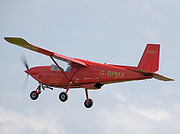
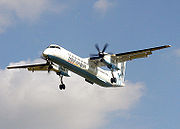
, the wing is mounted above the fuselage middle - high-wing, the wing upper surface is level with or above the top of the fuselage
- parasol-wingParasol wingA parasol wing monoplane is an aircraft design in which the wing is not mounted directly to the fuselage, but rather, the fuselage is supported beneath it by a set of struts, called cabane struts...
, the wing is located above the fuselage and is not directly connected to it, structural support being typically provided by a system of strutStrutA strut is a structural component designed to resist longitudinal compression. Struts provide outwards-facing support in their lengthwise direction, which can be used to keep two other components separate, performing the opposite function of a tie...
s, and, especially in the case of older aircraft, wire bracing.
History
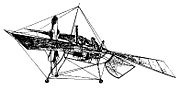
Most of the first attempts of heavier-than-air flying machines were monoplanes. Notably, the Monoplane built in 1874 by Felix du Temple de la CroixFélix du Temple de la Croix
Félix du Temple de la Croix was a French naval officer and an inventor, born into an ancient Normandy family...
, a large aircraft made of aluminium
Aluminium
Aluminium or aluminum is a silvery white member of the boron group of chemical elements. It has the symbol Al, and its atomic number is 13. It is not soluble in water under normal circumstances....
with a wingspan
Wingspan
The wingspan of an airplane or a bird, is the distance from one wingtip to the other wingtip. For example, the Boeing 777 has a wingspan of about ; and a Wandering Albatross caught in 1965 had a wingspan of , the official record for a living bird.The term wingspan, more technically extent, is...
of 13 m (42.7 ft) and a weight of only 80 kg (176 lb) (without the pilot). Several trials were made with the plane in Brest
Brest, France
Brest is a city in the Finistère department in Brittany in northwestern France. Located in a sheltered position not far from the western tip of the Breton peninsula, and the western extremity of metropolitan France, Brest is an important harbour and the second French military port after Toulon...
, France
France
The French Republic , The French Republic , The French Republic , (commonly known as France , is a unitary semi-presidential republic in Western Europe with several overseas territories and islands located on other continents and in the Indian, Pacific, and Atlantic oceans. Metropolitan France...
, and it is generally recognized that it achieved lift off under its own power after a ski-jump run, glided for a short time and returned safely to the ground, possibly making it the first successful powered flight in history, depending on the definition — since the flight was only a few feet high, and was not truly under control.
Other early attempts of flight by a monoplane were carried out in 1884 by Alexander Mozhaysky.
The first successful aircraft were biplanes, but many pioneering aircraft were monoplanes, for instance Blériot XI
Blériot XI
The Blériot XI is the aircraft in which, on 25 July 1909, Louis Blériot made the first flight across the English Channel made in a heavier-than-air aircraft . This achievement is one of the most famous accomplishments of the early years of aviation, and not only won Blériot a lasting place in...
that flew across the English Channel
English Channel
The English Channel , often referred to simply as the Channel, is an arm of the Atlantic Ocean that separates southern England from northern France, and joins the North Sea to the Atlantic. It is about long and varies in width from at its widest to in the Strait of Dover...
in 1909. Throughout 1909-1910 Hubert Latham
Hubert Latham
Arthur Charles Hubert Latham was a French aviation pioneer. He was the first person to attempt to cross the English Channel in an aeroplane...
set multiple altitude records in his Antoinette IV
Antoinette IV
|-See also:* Antoinette III* Antoinette V* Antoinette VI* Antoinette VII* Antoinette military monoplane-References:* World Aircraft Information Files. Brightstar Publishing: London. File 889 Sheet 63.* *...
monoplane, initially achieving 155 m (508.5 ft) then raising it to 1384 m (4,540.7 ft). The Fokker Eindecker
Fokker Eindecker
The Fokker Eindecker was a German World War I monoplane single-seat fighter aircraft designed by Dutch engineer Anthony Fokker. Developed in April 1915, the Eindecker was the first purpose-built German fighter aircraft and the first aircraft to be fitted with synchronizer gear, enabling the pilot...
of 1915 was a successful fighter aircraft
Fighter aircraft
A fighter aircraft is a military aircraft designed primarily for air-to-air combat with other aircraft, as opposed to a bomber, which is designed primarily to attack ground targets...
. The Junkers J 1
Junkers J 1
The Junkers J 1, nicknamed the Blechesel , was the world's first practical all-metal aircraft. Built early in World War I, when aircraft designers relied largely on fabric-covered wooden structures, the Junkers J 1 was a revolutionary development in aircraft design, being built and flown only 12...
was an early German
Germany
Germany , officially the Federal Republic of Germany , is a federal parliamentary republic in Europe. The country consists of 16 states while the capital and largest city is Berlin. Germany covers an area of 357,021 km2 and has a largely temperate seasonal climate...
"technology demonstrator" monoplane, and the world's very first practical all-metal aircraft of any type to fly, with the J 1's first flight occurring in December 1915.
Nonetheless, relatively few monoplane types were built between 1914, and the late 1920s, compared with the number of biplanes. The reasons for this were primarily structural. In the days when wings (whether biplane or monoplane) were thin, lightly built structures, braced by strut
Strut
A strut is a structural component designed to resist longitudinal compression. Struts provide outwards-facing support in their lengthwise direction, which can be used to keep two other components separate, performing the opposite function of a tie...
s, steel wire or cables - the biplane wing formed a strong and fairly rigid lattice truss structure, in which the two wing surfaces were braced against each other. Early monoplane wings, on the other hand, tended to be liable to twist under aerodynamic loads, rendering proper lateral control very difficult. They were also much more liable to breakage in flight.
Once all-metal construction and the cantilever
Cantilever
A cantilever is a beam anchored at only one end. The beam carries the load to the support where it is resisted by moment and shear stress. Cantilever construction allows for overhanging structures without external bracing. Cantilevers can also be constructed with trusses or slabs.This is in...
wing, both having been pioneered by Hugo Junkers
Hugo Junkers
Hugo Junkers was an innovative German engineer, as his many patents in varied areas show...
in 1915, became common after World War I's end, however, the day of the biplane very quickly passed, and the monoplane became the usual configuration for a fixed-wing aircraft. Most military aircraft
Military aircraft
A military aircraft is any fixed-wing or rotary-wing aircraft that is operated by a legal or insurrectionary armed service of any type. Military aircraft can be either combat or non-combat:...
of WW2
World War II
World War II, or the Second World War , was a global conflict lasting from 1939 to 1945, involving most of the world's nations—including all of the great powers—eventually forming two opposing military alliances: the Allies and the Axis...
were monoplanes, as have been virtually all aircraft since.