
All Topics  
Airco DH.2

 
Airco DH.2

   Email Print
   Bookmark   Link


Airco DH.2


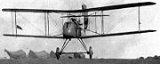
The Airco DH.2 was a single-seat biplane
Biplane

A biplane is a fixed-wing aircraft with two main wings. The Wright brothers Wright Flyer used a biplane design, as did most aircraft in the early years of aviation....
 "pusher
Pusher configuration

An aircraft constructed with a pusher configuration has the engine mounted forward of the propeller - which faces in a rearwards direction - giving an appearance that the aircraft is "pushed" through the air....
" aircraft which operated as a fighter
Fighter aircraft

A fighter aircraft is a military aircraft designed primarily for air-to-air combat with other aircraft, as opposed to a bomber, which is designed primarily to attack ground targets by dropping bombs....
 during the First World War
World War I

World War I, or the First World War , was a global military conflict which involved the Great powers, organized into two opposing military alliances: the Allies of World War I and the Central Powers....
. It was the second pusher design by Geoffrey de Havilland
Geoffrey de Havilland

Captain_ Sir Geoffrey de Havilland, Order of Merit, Order of the British Empire, Air Force Cross , Royal Designers for Industry, Royal Aeronautical Society, was a United Kingdom aviation pioneer and aircraft engineer....
 for Airco
Airco

Aircraft Manufacturing Company - Airco - was established at The Hyde in Hendon, north London, England during 1912 in aviation by George Holt Thomas....
, based on his earlier DH.1
Airco DH.1

The Airco DH.1 was an early military biplane flown by Britain's Royal Flying Corps during World War I....
 two-seater. The DH.2 was the first effectively armed British single-seat fighter and enabled Royal Flying Corps
Royal Flying Corps

The Royal Flying Corps was the over-land air arm of the British military during most of the First World War. During the early part of the war, the RFC's responsibilities were centred on support of the British Army, via artillery cooperation and photographic reconnaissance....
 (RFC) pilots to counter the "Fokker Scourge
Fokker Scourge

The Fokker Scourge was a term coined by the United Kingdom press in the summer of 1915 to describe the then-current ascendency of the Fokker Eindecker monoplane fighters of the Imperial Germany Luftstreitkr?fte over the poorly armed allied reconnaissance types of the period....
" that had given the Germans the advantage in the air in late 1915.


Discussion
Ask a question about 'Airco DH.2'
Start a new discussion about 'Airco DH.2'
Answer questions from other users
Full Discussion Forum


Encyclopedia


The Airco DH.2 was a single-seat biplane
Biplane

A biplane is a fixed-wing aircraft with two main wings. The Wright brothers Wright Flyer used a biplane design, as did most aircraft in the early years of aviation....
 "pusher
Pusher configuration

An aircraft constructed with a pusher configuration has the engine mounted forward of the propeller - which faces in a rearwards direction - giving an appearance that the aircraft is "pushed" through the air....
" aircraft which operated as a fighter
Fighter aircraft

A fighter aircraft is a military aircraft designed primarily for air-to-air combat with other aircraft, as opposed to a bomber, which is designed primarily to attack ground targets by dropping bombs....
 during the First World War
World War I

World War I, or the First World War , was a global military conflict which involved the Great powers, organized into two opposing military alliances: the Allies of World War I and the Central Powers....
. It was the second pusher design by Geoffrey de Havilland
Geoffrey de Havilland

Captain_ Sir Geoffrey de Havilland, Order of Merit, Order of the British Empire, Air Force Cross , Royal Designers for Industry, Royal Aeronautical Society, was a United Kingdom aviation pioneer and aircraft engineer....
 for Airco
Airco

Aircraft Manufacturing Company - Airco - was established at The Hyde in Hendon, north London, England during 1912 in aviation by George Holt Thomas....
, based on his earlier DH.1
Airco DH.1

The Airco DH.1 was an early military biplane flown by Britain's Royal Flying Corps during World War I....
 two-seater. The DH.2 was the first effectively armed British single-seat fighter and enabled Royal Flying Corps
Royal Flying Corps

The Royal Flying Corps was the over-land air arm of the British military during most of the First World War. During the early part of the war, the RFC's responsibilities were centred on support of the British Army, via artillery cooperation and photographic reconnaissance....
 (RFC) pilots to counter the "Fokker Scourge
Fokker Scourge

The Fokker Scourge was a term coined by the United Kingdom press in the summer of 1915 to describe the then-current ascendency of the Fokker Eindecker monoplane fighters of the Imperial Germany Luftstreitkr?fte over the poorly armed allied reconnaissance types of the period....
" that had given the Germans the advantage in the air in late 1915. Until the British developed an interrupter gear
Interrupter gear

Interrupter gear is a term that covers two related technologies.The first is the synchronization gear, which is often incorrectly referred to as "interrupter gear"; this is a triggering device attached to the machine gun armament of a tractor -type fighter aircraft so that it would fire only at certain times....
 to match the German system, pushers such as the DH.2 and the F.E.2b carried the burden of fighting and escort duties.

Design and development


Early air combat over the Western Front
Western Front (World War I)

Following the outbreak of World War I in 1914, the German Empire army opened the Western Front by first invading Luxembourg and Belgium, then gaining military control of important industrial regions in France....
 indicated the need for a single seat fighter with forward firing armament. As no reliable interrupter gear was available to the British, Geoffrey de Havilland designed the DH.2 as a smaller, single seat development of the earlier two seat DH.1 pusher design. The D.H.2 first flew in July 1915.

The D.H.2 was armed with a single Lewis gun
Lewis Gun

The Lewis Gun is a pre-World War I era light machine gun of American design that was perfected and most widely used by the forces of the British Empire....
 which was originally able to be positioned on one of three flexible mountings in the cockpit, with the pilot transferring the gun between mountings in flight at the same time as flying the aircraft. Once pilots learned that the best method of achieving a kill was to aim the aircraft rather than the gun, the machine gun
Machine gun

A machine gun is a Automatic firearm mounted or portable firearm, usually designed to fire List of rifle cartridgess in quick succession from an Belt or large-capacity Magazine , typically at a rate of several hundred rounds per minute....
 was fixed in the forward-facing centre mount, although this was initially banned by higher authorities until a clip which fixed the gun in place but could be released if required was approved.

The majority of D.H.2s were fitted with the 100 hp (75 kW) Gnome Monosoupape
Gnome Monosoupape

The Monosoupape , was an engine design used by Gnome et Rh?ne's later rotary engines, and first introduced in 1913. It used a clever arrangement of internal transfer ports and a single valve to replace a large number of moving parts found on more conventional rotary engines, and made the Monosoupape engines some of the most reliable of the e...
 rotary engine
Rotary engine

The 'rotary engine' was an early type of internal-combustion engine in which the crankshaft remained stationary and the entire cylinder block rotated around it....
 but later models received the 110 hp (82 kW) Le Rhône 9J.

A total of 453 D.H.2s were produced by Airco.

Operational service

Airco Dh2 2
After evaluation at Hendon on 22 June 1915, the first DH.2 arrived in France for operational trials with No. 5 RFC Squadron
No. 5 Squadron RAF

No. 5 Squadron of the Royal Air Force is the operator of the new Raytheon Sentinel Airborne STand-Off Radar aircraft and is based at RAF Waddington....
 but was shot down and its pilot killed (although the DH.2 was recovered and repaired by the Germans). No. 24 Squadron RFC
No. XXIV Squadron RAF

No. 24 Squadron of the Royal Air Force operates the C-130 Hercules from RAF Lyneham in Wiltshire.HistoryThe squadron was founded as No....
, the first squadron
Squadron

A squadron is a small military unit or formation of cavalry, Armoured forces, aircraft , or warships....
 equipped with the DH.2 and the first complete squadron entirely equipped with single-seat fighters in the RFC (or, incidentally, any other flying service), arrived in France
France

France , officially the French Republic , is a country whose Metropolitan France is located in Western Europe and that also comprises various Overseas departments and territories of France....
 in February 1916. The DH.2 ultimately equipped seven fighter squadrons on the Western Front
Western Front (World War I)

Following the outbreak of World War I in 1914, the German Empire army opened the Western Front by first invading Luxembourg and Belgium, then gaining military control of important industrial regions in France....
. The little pusher quickly proved itself more than a match for the Fokker Eindecker
Fokker Eindecker

The Fokker Eindecker was a German World War I monoplane single-seat fighter aircraft designed by Netherlands engineer Anthony Fokker. Developed in April 1915, the Eindecker was the first purpose-built German fighter aircraft and the first aircraft to be fitted with synchronizer gear, enabling the pilot to fire a machine gun through t...
, and was heavily engaged during the Battle of the Somme, 24 Squadron alone engaging in 774 combats and destroying 44 enemy machines. The DH.2 had sensitive controls and at a time when service training for pilots in the RFC was very poor it terrified some pilots, who nickname
Nickname

A nickname is a descriptive name given in place of or in addition to the official name of a person, place or thing. Another class of nickname is the familiar or truncated form of the proper name, such as Bob, Bobby, Rob, Robbie, and Bert for Robert, more properly called a short name....
d it the "Spinning Incinerator", but as familiarity with the type increased, it was recognised as very manoeverable and relatively easy to fly.

The arrival at the front of more powerful German tractor
Tractor configuration

An aircraft constructed with a tractor configuration has the engine mounted with the propeller facing forwards such that the aircraft is "pulled" through the air, as opposed to the pusher configuration in which the propeller faces backwards and the aircraft is "pushed" through the air....
 biplane
Biplane

A biplane is a fixed-wing aircraft with two main wings. The Wright brothers Wright Flyer used a biplane design, as did most aircraft in the early years of aviation....
 fighters such as the Halberstadt D.II
Halberstadt D.II

The Halberstadt D.II was a biplane fighter aircraft of the Luftstreitkr?fte that served through the period of Allied air superiority in early 1916, but had begun to be superseded in the Jagdstaffeln by the superior Albatros D.I fighters by the autumn of that year....
 and the Albatros D.I
Albatros D.I

The Albatros D.I was a Germany fighter aircraft used during World War I. Although its operational career was short, it was the first of the Albatros D types which formed the bulk of the German and Austrian fighter squadrons for the last two years of the war....
, which appeared in September 1916, meant that the DH.2 was outclassed in turn. It remained in first line service in France, however, until No. 24 and No. 32 Squadron RFC
No. 32 (The Royal) Squadron RAF

No. 32 Squadron of the Royal Air Force operates from RAF Northolt, west London, in the Very Important Person and general air transport roles....
 completed re-equipment with Airco DH 5s in June 1917, and a few remained in service on the Macedonian front
Macedonian front (World War I)

The Macedonian Front resulted from an attempt by the Allies of World War I to aid Kingdom of Serbia, in the autumn of 1915, against the Serbian Campaign #1915 of Germany, Austria-Hungary and History of Independent Bulgaria#World War I....
 and in Palestine
Sinai and Palestine Campaign

The Sinai and Palestine Campaign during the Middle Eastern Theatre of World War I was a series of battles which took place on the Sinai Peninsula, Palestine, and Syria between January 28, 1915 and October 28, 1918....
 until late autumn of that year. By this time the type was totally obsolete as a fighter, although it was used as an advanced trainer into 1918.

Distinguished pilots of the DH.2 included Victoria Cross
Victoria Cross

The Victoria Cross is the highest military decoration which is, or has been, awarded for valour "in the face of the enemy" to members of the armed forces of various Commonwealth of Nations countries, and previous British Empire territories....
 winner Lanoe Hawker
Lanoe Hawker

Lanoe George Hawker Victoria Cross, Distinguished Service Order was a World War I English fighter pilot. He was the third pilot to receive the Victoria Cross, the highest and most prestigious award for gallantry in the face of the enemy that can be awarded to British and Commonwealth of Nations forces....
 (eight victories), who was the first commander of No 24 Squadron and ace
Flying ace

A flying ace or fighter ace is a military aviation credited with shooting down several enemy aircraft during aerial combat. The actual number of air victories required to officially qualify as an "ace" has varied, but is usually considered to be five or more....
 Alan Wilkinson (10 victories). The commander of No. 32 Squadron
No. 32 (The Royal) Squadron RAF

No. 32 Squadron of the Royal Air Force operates from RAF Northolt, west London, in the Very Important Person and general air transport roles....
, Lionel Rees
Lionel Rees

Group Captain Lionel Wilmot Brabazon Rees Victoria Cross Order of the British Empire Military Cross Air Force Cross Royal Air Force was a Wales recipient of the Victoria Cross, the highest and most prestigious award for gallantry in the face of the enemy that can be awarded to United Kingdom and Commonwealth of Nations forces....
 won the Victoria Cross flying the D.H.2 for single handedly attacking a formation of 10 German two-seaters on 1 July 1916, destroying two. German ace and tactician Oswald Boelcke
Oswald Boelcke

Oswald Boelcke was a Germany flying ace of the First World War and one of the most influential patrol leaders and military tactics of the early years of air combat....
 was killed during a dogfight
Dogfight

A dogfight or dog fight is aerial combat between fighter aircraft. The term originated during World War I when pilots had to switch off their engines to avoid an aerodynamic stall when turning in the same direction as the aircrafts' torque....
 with 24 Squadron D.H.2s, although it should be noted that this was due to a collision with one of his own wingmen, Erwin Böhme
Erwin Böhme

Erwin B?hme was a Germany pilot during World War I. He was born in Holzminden and became a flying ace during the war, credited with 24 victories and awarded the Pour le M?rite....
.

DH.2s were progressively retired and at war's end no surviving airframes were retained. In 1970, Walter M. Redfern from Seattle, Washington
Washington

Washington is a U.S. state in the Pacific Northwest region of the United States. Washington was carved out of the western part of Washington Territory which had been ceded by Britain in 1846 by the Oregon Treaty as settlement of the Oregon Boundary Dispute....
 built a replica DH.2 powered by a Kinner 125-150 hp engine and subsequently, Redfern sold plans to home builders. Currently a number of the DH.2 replicas are flying worldwide.

Operators

  • Royal Flying Corps
    Royal Flying Corps

    The Royal Flying Corps was the over-land air arm of the British military during most of the First World War. During the early part of the war, the RFC's responsibilities were centred on support of the British Army, via artillery cooperation and photographic reconnaissance....
    • No. 5 Squadron RFC
      No. 5 Squadron RAF

      No. 5 Squadron of the Royal Air Force is the operator of the new Raytheon Sentinel Airborne STand-Off Radar aircraft and is based at RAF Waddington....
    • No. 11 Squadron RFC
    • No. 17 Squadron RFC
    • No. 18 Squadron RFC
      No. 18 Squadron RAF

      No. 18 Squadron of the Royal Air Force operates the CH-47 Chinook RAF Chinook from RAF Odiham. No. 18 Squadron was the first and is currently the largest RAF operator of the Chinook....
    • No. 24 Squadron RFC
    • No. 29 Squadron RFC
      No. 29 Squadron RAF

      No. 29 Squadron of the Royal Air Force was first raised in 1915, and is one of the world's oldest fighter squadrons. The second UK squadron to receive the Eurofighter Typhoon, it is currently the Operational Conversion Unit for the RAF's newest fighter....
    • No. 32 Squadron RFC
    • No. 41 Squadron RFC
      No. 41 Squadron RAF

      No. 41 Squadron of the Royal Air Force is currently the RAF's Fast Jet and Weapons Operational Evaluation Unit, based at RAF Coningsby, Lincolnshire....
    • No. 47 Squadron RFC
      No. 47 Squadron RAF

      No. 47 Squadron of the Royal Air Force operates the C-130 Hercules from RAF Lyneham, Wiltshire....
    • No. 111 Squadron RFC
      No. 111 Squadron RAF

      No. 111 Squadron of the Royal Air Force operates the RAF Tornado F3 from RAF Leuchars, Scotland....


Specifications (DH.2)


See also


Bibliography

  • Bruce, J.M. Warplanes of the First World War - Fighters Volume One. MacDonald & Co., 1965.
  • Goulding, James. Interceptor- RAF Single Seat Multi-Gun Fighters. London: Ian Allen Ltd., 1986. ISBN 0-7110-1583-X.
  • Jackson, A.J. De Havilland Aircraft since 1909. London: Putnam, Third edition, 1987. ISBN 0 85177 802 X.
  • Mason, Francis K. The British Fighter since 1912. Annapolis, Maryland: Naval Institute Press, 1992. ISBN 1-55750-082-7.
  • Sharpe, Michael. Biplanes, Triplanes, an Seaplanes. London, England: Friedman/Fairfax Books , 2000. ISBN 1-58663-300-7.


External links