
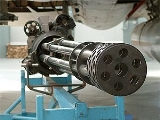
The
M61 Vulcan is a
hydraulicallyHydraulic machines are machinery and tools that use liquid fluid power to do simple work. Heavy equipment is a common example.In this type of machine, hydraulic fluid is transmitted throughout the machine to various hydraulic motors and hydraulic cylinders and which becomes pressurised according to...
or
pneumaticallyPneumatics is a branch of technology, which deals with the study and application of use of pressurized gas to effect mechanical motion.Pneumatic systems are extensively used in industry, where factories are commonly plumbed with compressed air or compressed inert gases...
driven, six-
barreledA gun barrel is the tube, usually metal, through which a controlled explosion or rapid expansion of gases are released in order to propel a projectile out of the end at a high velocity....
, air-cooled, electrically fired
Gatling-styleThe Gatling gun is one of the best known early rapid-fire weapons and a forerunner of the modern machine gun. It is well known for its use by the Union forces during the American Civil War in the 1860s, which was the first time it was employed in combat...
rotary cannonA rotary cannon, or Gatling-type cannon, is a rapid-firing weapon that utilizes multiple barrels in a rotating cluster to provide a sustained rate of fire greater than single-barrelled machine guns or automatic cannons of equivalent caliber...
which fires
20 mmThe 20 mm caliber is a specific size of cannon or autocannon ammunition, commonly the smallest caliber which is unambiguously a cannon and not a heavy machine gun....
rounds at an extremely high rate. The M61 and its derivatives have been the principal cannon armament of
United StatesThe United States of America is a federal constitutional republic comprising fifty states and a federal district...
military
fixed-wing aircraftA fixed-wing aircraft is an aircraft capable of flight using wings that generate lift due to the vehicle's forward airspeed. Fixed-wing aircraft are distinct from rotary-wing aircraft in which wings rotate about a fixed mast and ornithopters in which lift is generated by flapping wings.A powered...
for fifty years. The M61 was originally produced by
General ElectricGeneral Electric Company , or GE, is an American multinational conglomerate corporation incorporated in Schenectady, New York and headquartered in Fairfield, Connecticut, United States...
, and after several mergers and acquisitions is currently produced by
General DynamicsGeneral Dynamics Corporation is a U.S. defense conglomerate formed by mergers and divestitures, and as of 2008 it is the fifth largest defense contractor in the world. Its headquarters are in West Falls Church , unincorporated Fairfax County, Virginia, in the Falls Church area.The company has...
.
Development
At the end of
World War IIWorld War II, or the Second World War , was a global conflict lasting from 1939 to 1945, involving most of the world's nations—including all of the great powers—eventually forming two opposing military alliances: the Allies and the Axis...
, the
United States ArmyThe United States Army is the main branch of the United States Armed Forces responsible for land-based military operations. It is the largest and oldest established branch of the U.S. military, and is one of seven U.S. uniformed services...
began to consider new directions for future
military aircraftA military aircraft is any fixed-wing or rotary-wing aircraft that is operated by a legal or insurrectionary armed service of any type. Military aircraft can be either combat or non-combat:...
guns. The higher speeds of
jet-enginedA jet engine is a reaction engine that discharges a fast moving jet to generate thrust by jet propulsion and in accordance with Newton's laws of motion. This broad definition of jet engines includes turbojets, turbofans, rockets, ramjets, pulse jets...
fighter aircraftA fighter aircraft is a military aircraft designed primarily for air-to-air combat with other aircraft, as opposed to a bomber, which is designed primarily to attack ground targets...
meant that achieving an effective number of hits would be extremely difficult without a much higher volume of fire. While captured German designs (principally the
Mauser MG 213The Mauser MG 213 was a 20 mm aircraft-mounted revolver cannon developed for the Luftwaffe during World War II. It was never put into service, but the principles formed the basis for several post-war developments by the Allies. A 30 mm version was developed as the MG 213C or MK 213 and it was this...
C) showed the potential of the single-barrel
revolver cannonA revolver cannon is a type of autocannon commonly used as an aircraft gun. It uses a cylinder with multiple chambers, like those of a revolver handgun, to speed up the loading-firing-ejection cycle. Some examples are also power-driven, to further speed the loading process, but this is by no means...
, the practical rate of fire of such a design was still limited by ammunition feed and barrel wear concerns. The Army wanted something better, combining extremely high rate of fire with exceptional reliability.
In response to this requirement, the Armament Division of General Electric resurrected an old idea: the multi-barrel Gatling gun. The original Gatling gun had fallen out of favor because of the need for an external power source to rotate the barrel assembly, but the new generation of turbojet-powered fighters offered sufficient
electric powerElectric power is the rate at which electric energy is transferred by an electric circuit. The SI unit of power is the watt.-Circuits:Electric power, like mechanical power, is represented by the letter P in electrical equations...
to operate the gun, and electric operation offered reliability superior to a
gas operatedGas-operation is a system of operation used to provide energy to operate autoloading firearms. In gas-operation, a portion of high pressure gas from the cartridge being fired is used to power a mechanism to extract the spent case and chamber a new cartridge. Energy from the gas is harnessed...
weapon. With multiple barrels, the rate of fire per barrel could be lower than a single-barrel revolver cannon while still giving a superior total rate of fire. The idea of powering a Gatling gun from an external electric power source was not a novel idea at the end of the World War II era, as
Richard Jordan GatlingDr. Richard Jordan Gatling was an American inventor best known for his invention of the Gatling gun, the first successful machine gun.-Life:...
himself did just that in a patent he filed in 1893.
The Army issued General Electric the contract in 1946 for "Project Vulcan", a six-barrel weapon capable of firing 7,200 rounds per minute (rpm). Although European designers were moving towards heavier 30 mm weapons for better hitting power, the U.S. initially concentrated on a powerful .60 caliber (15 mm) cartridge designed for a pre-war anti-tank rifle, expecting that the cartridge's high
muzzle velocityMuzzle velocity is the speed a projectile has at the moment it leaves the muzzle of the gun. Muzzle velocities range from approximately to in black powder muskets , to more than in modern rifles with high-performance cartridges such as the .220 Swift and .204 Ruger, all the way to for tank guns...
would be beneficial for improving hit ratios on high speed targets. The first GE prototypes of the .60 caliber T45 were ground-fired in 1949; it achieved 2,500 rpm, which was increased to 4,000 rpm by 1950. By the early 1950s, the USAF decided that high velocity alone might not be sufficient to ensure target destruction and tested 20 mm and 27 mm alternatives based on the .60 caliber cartridge. These variants of the T45 were known as the T171 and T150 respectively, and were first tested in 1952. Eventually, the 20 x 102 mm cartridge was determined to have the desired balance of projectile and explosive weight and muzzle velocity.
The development of the Lockheed F-104 Starfighter revealed that the T171 Vulcan (later redesignated
M61) suffered problems with its
linked ammunitionA belt or ammunition belt is a device used to retain and feed cartridges into a firearm. Belts and the associated feed systems are typically employed to feed machine guns or other automatic weapons...
, being prone to misfeed and presenting a
foreign object damageForeign Object Debris is a substance, debris or article alien to a vehicle or system which would potentially cause damage.Foreign Object Damage is any damage attributed to a foreign object that can be expressed in physical or economic terms that may or may not degrade the product's required...
(FOD) hazard with discarded links. A linkless ammunition feed system was developed for the upgraded
M61A1, which subsequently became the standard cannon armament of U.S. fighters.
In 1993, General Electric sold its aerospace division, including GE Armament Systems along with the design and production tooling for the M61 and GE's other rotary cannon, to
Martin MariettaMartin Marietta Corporation was an American company founded in 1961 through the merger of The Martin Company and American-Marietta Corporation. The combined company became a leader in chemicals, aerospace, and electronics. In 1995, it merged with Lockheed Corporation to form Lockheed Martin. The...
. After Martin's merger with
LockheedThe Lockheed Corporation was an American aerospace company. Lockheed was founded in 1912 and later merged with Martin Marietta to form Lockheed Martin in 1995.-Origins:...
, the rotary cannon became the responsibility of Lockheed Martin Armament Systems. Lockheed Martin Armament Systems was later acquired by General Dynamics, who currently produce the M61 and its various offspring.
Description
The Vulcan is a Gatling gun: each of the cannon's six barrels fires once in turn during each revolution of the barrel cluster. The multiple barrels provide both a very high rate of fire—around 100 rounds per second—and contribute to long weapon life by minimizing barrel erosion and heat generation. Mean time between jams or failures is in excess of 10,000 rounds, making it an extremely reliable weapon. The success of the Vulcan Project and its subsequent progeny, the very-high-speed Gatling gun, has led to guns of the same configuration being referred to as
Vulcan Cannon, which can sometimes confuse nomenclature on the subject.
Most aircraft versions of the M61 are hydraulically driven and electrically primed. The gun rotor, barrel assembly and ammunition feed system are rotated by a hydraulic drive motor through a system of flexible drive shafts. The round is fired by an electric priming system where an electrical current from a firing lead passes through the firing pin to the primer as each round is rotated into the firing position. The self-powered version, the
GAU-4 (called
M130 in Army service), is gas-operated, tapping gun gas from three of the six barrels to operate the mechanism. The self-powered Vulcan weighs about 10 pounds (4.5 kg) more than its electric counterpart, but requires no external power source to operate.
The initial
M61 used linked,
beltedA belt or ammunition belt is a device used to retain and feed cartridges into a firearm. Belts and the associated feed systems are typically employed to feed machine guns or other automatic weapons...
ammunition, but the ejection of spent links created considerable (and ultimately insuperable) problems. The original weapon was soon replaced by the
M61A1, with a linkless feed system. Depending on the application, the feed system can be either single-ended (ejecting spent cases and unfired rounds) or double-ended (returning casings back to the magazine). A disadvantage of the M61 is that the bulk of the weapon, its feed system, and ammunition drum makes it difficult to fit it into a densely packed airframe. The feed system must be custom-designed for each application, adding 300–400 lb (136.1–181.4 kg) to the complete weapon. Most aircraft installations are double-ended, because the ejection of empty cartridges can cause a foreign-object damage (FOD) hazard for jet engines and because the retention of spent cases assists in maintaining the center of gravity of the aircraft. The first aircraft to carry the M61A1 was the C model of the
F-104The Lockheed F-104 Starfighter is a single-engine, high-performance, supersonic interceptor aircraft originally developed for the United States Air Force by Lockheed. One of the Century Series of aircraft, it served with the USAF from 1958 until 1969, and continued with Air National Guard units...
, starting in 1959.
A lighter version of the Vulcan developed for use on the
F-22 RaptorThe Lockheed Martin/Boeing F-22 Raptor is a single-seat, twin-engine fifth-generation supermaneuverable fighter aircraft that uses stealth technology. It was designed primarily as an air superiority fighter, but has additional capabilities that include ground attack, electronic warfare, and signals...
, the
M61A2, is mechanically the same as the M61A1, but with thinner barrels to reduce overall weight to 202 pounds (91.6 kg). The rotor and housing have also been modified to remove any piece of metal not absolutely needed for operation and replaces some metal components with lighter weight materials. The F/A-18E/F also uses this version.
The Vulcan's rate of fire is typically 6,000 rounds per minute, although some versions (such as that of the
AMX|-See also:-References:NotesBibliography*Braybrook, Roy. "Assessing the AMX". Air International, June 1989, Vol 36 No 6. Bromley, UK:Fine Scroll. ISSN 0306-5634. pp. 267–278....
and the
F-106 Delta DartThe Convair F-106 Delta Dart was the primary all-weather interceptor aircraft for the United States Air Force from the 1960s through the 1980s. Designed as the so-called "Ultimate Interceptor", it has proven to be the last dedicated interceptor in USAF service to date...
) are limited to a lower rate, and others have a selectable rate of fire of either 4,000 or 6,000 rounds per minute. The M61A2's lighter barrels allow a somewhat higher rate of fire up to 6,600 rounds per minute.
Ammunition
Practically no powered rotary cannon is supplied with enough ammunition for a full minute of firing, because of the weight of the ammunition. In order to avoid using the few hundred rounds carried in a matter of a single trigger pull, a burst controller is generally used to limit the number of rounds fired at each trigger pull. Bursts of from 2 or 3 up to 40 or 50 can be selected.
Until the late 1980s the M61 primarily used the M50 series of ammunition in various types, typically firing a 3.5 oz (100 gram) projectile at a
muzzle velocityMuzzle velocity is the speed a projectile has at the moment it leaves the muzzle of the gun. Muzzle velocities range from approximately to in black powder muskets , to more than in modern rifles with high-performance cartridges such as the .220 Swift and .204 Ruger, all the way to for tank guns...
of about 3380 feet per second (1,030.2 m/s). A variety of Armor-Piercing Incendiary (API), High Explosive Incendiary (HEI), and training rounds are available. Around 1988 a new round was introduced, the PGU-28/B, which is now standard for US Navy and USAF aircraft. The PGU-28/B is a "low-drag" round designed to reduce in-flight drag and deceleration, and has a slightly increased muzzle velocity of 3450 feet per second (1,051.6 m/s). It is a semi-armor piercing high explosive incendiary (SAPHEI) round, providing substantial improvements in range, accuracy, and power over the preceding M56A3 HEI round. The PGU-28/B has not been without problems, however. A 2000 USAF safety report noted 24 premature detonation mishaps (causing serious damage in many cases) in 12 years with the SAPHEI round, compared to only two such mishaps in the entire recorded history of the M56 round. The report estimated that the current PGU-28/B had a potential failure rate 80 times higher than USAF standards permit.
The main types of combat rounds and their main characteristics are listed in the table below.
| Designation |
Type |
Projectile Weight [g] |
Bursting charge [g] |
Muzzle Velocity [m/s] |
Description |
| M53 |
API |
? |
4.2 g incendiary |
1030 |
6.3 mm RHA penetration at 0 degree impact angle and 1000 m range. |
| M56A3/A4 |
HEI |
102 |
9 g HE (RDX/wax/Al) and 1.5 g incendiary |
1030 |
Nose fuzed round, no tracer. 2 m effective radius to produce casualties to exposed personnel. Fragmentation hazard out to 20 m. 12.5 mm RHA penetration at 0 degree obliquity at 100m range. |
| PGU-28A/B |
SAPHEI |
102.4 |
10 g |
1050 |
Multi-purpose fuzeless round with an incendiary charge in the nose setting off the HE behind it with a slight delay to maximize lethality against aircraft. No tracer or self-destruct. A zirconium pellet at the bottom of the HE cavity provides additional incendiary effect. |
Applications
The Vulcan was first used in the
F-104 StarfighterThe Lockheed F-104 Starfighter is a single-engine, high-performance, supersonic interceptor aircraft originally developed for the United States Air Force by Lockheed. One of the Century Series of aircraft, it served with the USAF from 1958 until 1969, and continued with Air National Guard units...
. The gun was also used in the
F-105 ThunderchiefThe Republic F-105 Thunderchief, was a supersonic fighter-bomber used by the United States Air Force. The Mach 2 capable F-105 conducted the majority of strike bombing missions during the early years of the Vietnam War; it has the dubious distinction of being the only US aircraft to have been...
in combat against Soviet-designed MiG fighters over
VietnamVietnam – sometimes spelled Viet Nam , officially the Socialist Republic of Vietnam – is the easternmost country on the Indochina Peninsula in Southeast Asia. It is bordered by China to the north, Laos to the northwest, Cambodia to the southwest, and the South China Sea –...
. It was installed in the Air Force's A-7D version of the
A-7 Corsair IIThe Ling-Temco-Vought A-7 Corsair II is a carrier-based subsonic light attack aircraft introduced to replace the United States Navy's Douglas A-4 Skyhawk, initially entering service during the Vietnam War...
where it replaced the Naval versions' standard dual cannon, and subsequently adopted by the Navy on the A-7E and in future fighters. Significantly it was designed into the
F-4E Phantom IIThe McDonnell Douglas F-4 Phantom II is a tandem two-seat, twin-engined, all-weather, long-range supersonic jet interceptor fighter/fighter-bomber originally developed for the United States Navy by McDonnell Aircraft. It first entered service in 1960 with the U.S. Navy. Proving highly adaptable,...
; no previous F-4 had a cannon as it had been believed that missiles had made guns obsolete. Combat experience in Vietnam showed that a gun could be more effective than guided missiles in many combat situations, and that an externally carried gun pod was less effective than an internal gun.
The Vulcan was later fitted into the weapons bay of some
F-106 Delta DartThe Convair F-106 Delta Dart was the primary all-weather interceptor aircraft for the United States Air Force from the 1960s through the 1980s. Designed as the so-called "Ultimate Interceptor", it has proven to be the last dedicated interceptor in USAF service to date...
models and the
F-111 AardvarkThe General Dynamics F-111 "Aardvark" was a medium-range interdictor and tactical strike aircraft that also filled the roles of strategic bomber, reconnaissance, and electronic warfare in its various versions. Developed in the 1960s by General Dynamics, it first entered service in 1967 with the...
. It was also adopted as standard in the teen-series air superiority fighters, the
F-14 TomcatThe Grumman F-14 Tomcat is a supersonic, twin-engine, two-seat, variable-sweep wing fighter aircraft. The Tomcat was developed for the United States Navy's Naval Fighter Experimental program following the collapse of the F-111B project...
, the
F-15 EagleThe McDonnell Douglas F-15 Eagle is a twin-engine, all-weather tactical fighter designed by McDonnell Douglas to gain and maintain air superiority in aerial combat. It is considered among the most successful modern fighters with over 100 aerial combat victories with no losses in dogfights...
,
F-16 Fighting FalconThe General Dynamics F-16 Fighting Falcon is a multirole jet fighter aircraft originally developed by General Dynamics for the United States Air Force . Designed as an air superiority day fighter, it evolved into a successful all-weather multirole aircraft. Over 4,400 aircraft have been built since...
and
F/A-18 HornetThe McDonnell Douglas F/A-18 Hornet is a supersonic, all-weather carrier-capable multirole fighter jet, designed to dogfight and attack ground targets . Designed by McDonnell Douglas and Northrop, the F/A-18 was derived from the latter's YF-17 in the 1970s for use by the United States Navy and...
. Other aircraft include the
ItalianItaly , officially the Italian Republic languages]] under the European Charter for Regional or Minority Languages. In each of these, Italy's official name is as follows:;;;;;;;;), is a unitary parliamentary republic in South-Central Europe. To the north it borders France, Switzerland, Austria and...
/
BrazilBrazil , officially the Federative Republic of Brazil , is the largest country in South America. It is the world's fifth largest country, both by geographical area and by population with over 192 million people...
ian
AMX International AMX|-See also:-References:NotesBibliography*Braybrook, Roy. "Assessing the AMX". Air International, June 1989, Vol 36 No 6. Bromley, UK:Fine Scroll. ISSN 0306-5634. pp. 267–278....
(on Italian aircraft only), and the
F-22 RaptorThe Lockheed Martin/Boeing F-22 Raptor is a single-seat, twin-engine fifth-generation supermaneuverable fighter aircraft that uses stealth technology. It was designed primarily as an air superiority fighter, but has additional capabilities that include ground attack, electronic warfare, and signals...
. It was fitted in a side-firing installation on the
AC-119|-See also:-References:NotesBibliography* Hobson, Chris. "Vietnam Air Losses, USAF/USN/USMC, Fixed-Wing Aircraft Losses in Southeast Asia, 1961-1973." North Branch, Minnesota: Specialty Press, 2001. ISBN 1-85780-1156....
, some marks of the
AC-130The Lockheed AC-130 gunship is a heavily-armed ground-attack aircraft variant of the C-130 Hercules transport plane. The basic airframe is manufactured by Lockheed, while Boeing is responsible for the conversion into a gunship and for aircraft support...
gunshipThe term "gunship" is used in several contexts, all sharing the general idea of a light craft armed with heavy guns.-In Navy:In the Navy, the term originally appeared in the mid-19th century as a less-common synonym for gunboat.-In military aviation:...
s, and was used in the tail turrets of both the
Convair B-58 HustlerThe Convair B-58 Hustler was the first operational supersonic jet bomber capable of Mach 2 flight. The aircraft was designed by Convair engineer Robert H. Widmer and developed for the United States Air Force for service in the Strategic Air Command during the 1960s...
and
Boeing B-52H StratofortressThe Boeing B-52 Stratofortress is a long-range, subsonic, jet-powered strategic bomber operated by the United States Air Force since the 1950s. The B-52 was designed and built by Boeing, who have continued to provide maintainence and upgrades to the aircraft in service...
bomberA bomber is a military aircraft designed to attack ground and sea targets, by dropping bombs on them, or – in recent years – by launching cruise missiles at them.-Classifications of bombers:...
s. Japan's
Mitsubishi F-1 carried one internally mounted JM61A1 Vulcan with 750 rounds.
Two
gun podA gun pod is a detachable pod or pack containing machine guns or automatic cannon and ancillaries, mounted externally on a vehicle such as a military aircraft which may or may not also have its own guns....
versions, the
SUU-16/AThe idea of the gun pod as a concept largely came into its prime during and period following World War II. So-called "package gun" installations on US medium and light bombers, such as the B-25 Mitchell and A-26 Invader, were probably the first such attempts by the United States military...
(also designated M12 by the US Army) and improved
SUU-23/AThe idea of the gun pod as a concept largely came into its prime during and period following World War II. So-called "package gun" installations on US medium and light bombers, such as the B-25 Mitchell and A-26 Invader, were probably the first such attempts by the United States military...
(US Army M25), were developed in the 1960s, often used on gunless versions of the F-4. The SUU-16/A uses the electric M61A1 with a ram-air turbine to power the motor. This proved to cause serious
aerodynamic dragIn fluid dynamics, drag refers to forces which act on a solid object in the direction of the relative fluid flow velocity...
at higher speeds, while speeds under 400 miles per hour (643.7 km/h) did not provide enough air flow for maximum rate of fire. The subsequent SUU-23/A uses the
GAU-4/A self-powered Vulcan, with an electric inertia starter to bring it up to speed. Both
podsA gun pod is a detachable pod or pack containing machine guns or automatic cannon and ancillaries, mounted externally on a vehicle such as a military aircraft which may or may not also have its own guns....
ejected empty cases and unfired rounds rather than retaining them. Both pods contained 1,200 rounds of ammunition, with a loaded weight of 1615 pounds (732.6 kg) and 1720 pounds (780.2 kg) respectively. During service in the
Vietnam WarThe Vietnam War was a Cold War-era military conflict that occurred in Vietnam, Laos, and Cambodia from 1 November 1955 to the fall of Saigon on 30 April 1975. This war followed the First Indochina War and was fought between North Vietnam, supported by its communist allies, and the government of...
the pods proved to be relatively inaccurate: the pylon mounting was not rigid enough to prevent deflection when firing, and repeated use would misalign the pod on its pylon, making matters worse.
A variant with much shorter barrels, designated the
M195 was also developed for use on the M35 Armament Subsystem for use on the
AH-1G CobraThe Bell AH-1 Cobra is a two-bladed, single engine attack helicopter manufactured by Bell Helicopter. It shares a common engine, transmission and rotor system with the older UH-1 Iroquois...
helicopterA helicopter is a type of rotorcraft in which lift and thrust are supplied by one or more engine-driven rotors. This allows the helicopter to take off and land vertically, to hover, and to fly forwards, backwards, and laterally...
. This variant fed from ammunition boxes fitted to the landing skid and was developed to provide the AH-1 helicopter with a longer-range suppressive fire system before the adoption of the M97 Universal Turret mounting the
M197The M197 electric cannon is a three-barreled electric Gatling gun developed primarily for use by United States Army helicopter gunships.Development of the M197 began in 1967 after experience in the Vietnam War revealed the inadequacy of the 7.62 mm Minigun for gunship use...
cannon.
The M61 is also the basis of the US Navy
Mk 15 PhalanxThe Phalanx CIWS is an anti-ship missile defense system. It is a close-in weapon system and was designed and manufactured by the General Dynamics Corporation, Pomona Division...
CIWS system and the
M163 VADSThe M163 Vulcan Air Defense System is a self-propelled anti-aircraft gun that was used by the United States Army. The M168 gun is a variant of the General Dynamics 20 mm M61 Vulcan rotary cannon, the standard cannon in most US combat aircraft since the 1960s, mounted on either an armored...
Vulcan Air Defense System (the
M168 variant is used).
See also
- M167 VADS
- M197 Gatling gun
The M197 electric cannon is a three-barreled electric Gatling gun developed primarily for use by United States Army helicopter gunships.Development of the M197 began in 1967 after experience in the Vietnam War revealed the inadequacy of the 7.62 mm Minigun for gunship use...
- XM301 Cannon
- M134 Minigun
The Minigun is a 7.62 mm, multi-barrel heavy machine gun with a high rate of fire , employing Gatling-style rotating barrels with an external power source...
- GAU-8 Avenger
The General Electric GAU-8/A Avenger is a 30 mm, hydraulically-driven seven-barrel Gatling-type rotary cannon that is mounted on the United States Air Force's Fairchild Republic A-10 Thunderbolt II. It is among the largest, heaviest and most powerful aircraft cannons in the United States military...
- GAU-12 Equalizer
The General Dynamics GAU-12/U Equalizer is a five-barrel 25 mm Gatling gun-style rotary cannon. The GAU-12/U is used by the United States, Italy and Spain, which mount the weapon in their fighter jets such as the AV-8B Harrier II, airborne gunships such as the Lockheed AC-130, and land-based...
- GSh-6-23
The Gryazev-Shipunov GSh-6-23 is a powerful, fast-firing six-barreled 23 mm Gatling gun used by some modern Soviet/Russian military aircraft....
(the closest Soviet/CISThe Commonwealth of Independent States is a regional organization whose participating countries are former Soviet Republics, formed during the breakup of the Soviet Union....
equivalent of the M61, used on a variety of Russian fighters)
- GSh-30-1 (another Soviet/CIS
The Commonwealth of Independent States is a regional organization whose participating countries are former Soviet Republics, formed during the breakup of the Soviet Union....
cannon, used in Su-27 FlankerThe Sukhoi Su-27 is a twin-engine supermanoeuverable fighter aircraft designed by Sukhoi. It was intended as a direct competitor for the large United States fourth generation fighters, with range, heavy armament, sophisticated avionics and high manoeuvrability...
and MiG-29 FulcrumThe Mikoyan MiG-29 is a fourth-generation jet fighter aircraft designed in the Soviet Union for an air superiority role. Developed in the 1970s by the Mikoyan design bureau, it entered service with the Soviet Air Force in 1983, and remains in use by the Russian Air Force as well as in many other...
fighters)
- Gryazev-Shipunov GSh-6-30
The Gryazev-Shipunov GSh-6-30 is a Russian 30 mm cannon used by Soviet and later CIS military aircraft.The GSh-6-30, designed in the early 1970s and entering service in 1975, is a six-barreled Gatling gun similar in design to the Gryazev-Shipunov GSh-6-23. It was based on the naval AO-18 used in...
(another Soviet/CISThe Commonwealth of Independent States is a regional organization whose participating countries are former Soviet Republics, formed during the breakup of the Soviet Union....
cannon, used in the Mikoyan MiG-27The Mikoyan MiG-27 is a variable-geometry ground-attack aircraft, originally built by the Mikoyan design bureau in the Soviet Union and later license-produced in India by Hindustan Aeronautics as the Bahadur . It is based on the Mikoyan-Gurevich MiG-23 fighter aircraft, but optimized for...
fighter)
- Gryazev-Shipunov GSh-30-2
The Gryazev-Shipunov GSh-30-2 or GSh-2-30 is a powerful dual-barrel autocannon developed for use on certain Soviet military aircraft....
(another Soviet/CISThe Commonwealth of Independent States is a regional organization whose participating countries are former Soviet Republics, formed during the breakup of the Soviet Union....
cannon)
- Shipunov 2A42
The 30 mm automatic cannon 2A42, also known as the Shipunov 2A42, is a Soviet/Russian 30 mm automatic cannon. It is built by the Tulamashzavod Joint Stock Company.-Design:...
(another Soviet/CISThe Commonwealth of Independent States is a regional organization whose participating countries are former Soviet Republics, formed during the breakup of the Soviet Union....
cannon)
External links