
All Topics  
Biplane

 
Biplane

   Email Print
   Bookmark   Link


Biplane


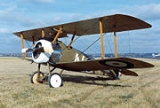
A biplane is a fixed-wing aircraft
Fixed-wing aircraft

A fixed-wing aircraft is an aircraft capable of heavier-than-air flight whose Lift is generated not by wing motion relative to the aircraft, but by forward motion through the air....
 with two main wing
Wing

A wing is a surface used to produce Lift for flight through the Earth's atmosphere or another gaseous or fluid medium. The wing shape is usually an airfoil....
s. The Wright brothers'
Wright brothers

The Wright brothers, Orville and Wilbur , were two United States who are generally credited with inventing and building the world's first successful fixed-wing aircraft and making the first controlled, powered and sustained heavier-than-air Flight#Mechanical flight, on December 17, 1903....
 Wright Flyer
Wright Flyer

The Wright Flyer was the first powered aircraft designed and built by the Wright brothers. The flight of the Wright Flyer is recognized by the F?d?ration A?ronautique Internationale, the standard setting and record-keeping body for aeronautics and astronautics, as "the first sustained and controlled heavier-than-air powered flight"....
 used a biplane design, as did most aircraft in the early years of aviation
Aviation

File:Norwegian military Bell 412SP helicopters.jpgAviation refers to activities involving man-made flying devices , including the people, organizations, and regulatory bodies involved with them....
. While a biplane wing structure has a structural advantage, it produces more drag than a similar monoplane
Monoplane

A monoplane is an aircraft with one main set of wing surfaces, in contrast to a biplane or triplane. Since the late 1930s it has been the "ordinary" form for a fixed wing aircraft....
 wing.


Discussion
Ask a question about 'Biplane'
Start a new discussion about 'Biplane'
Answer questions from other users
Full Discussion Forum


Recent Posts


Encyclopedia


Stearman
A biplane is a fixed-wing aircraft
Fixed-wing aircraft

A fixed-wing aircraft is an aircraft capable of heavier-than-air flight whose Lift is generated not by wing motion relative to the aircraft, but by forward motion through the air....
 with two main wing
Wing

A wing is a surface used to produce Lift for flight through the Earth's atmosphere or another gaseous or fluid medium. The wing shape is usually an airfoil....
s. The Wright brothers'
Wright brothers

The Wright brothers, Orville and Wilbur , were two United States who are generally credited with inventing and building the world's first successful fixed-wing aircraft and making the first controlled, powered and sustained heavier-than-air Flight#Mechanical flight, on December 17, 1903....
 Wright Flyer
Wright Flyer

The Wright Flyer was the first powered aircraft designed and built by the Wright brothers. The flight of the Wright Flyer is recognized by the F?d?ration A?ronautique Internationale, the standard setting and record-keeping body for aeronautics and astronautics, as "the first sustained and controlled heavier-than-air powered flight"....
 used a biplane design, as did most aircraft in the early years of aviation
Aviation

File:Norwegian military Bell 412SP helicopters.jpgAviation refers to activities involving man-made flying devices , including the people, organizations, and regulatory bodies involved with them....
. While a biplane wing structure has a structural advantage, it produces more drag than a similar monoplane
Monoplane

A monoplane is an aircraft with one main set of wing surfaces, in contrast to a biplane or triplane. Since the late 1930s it has been the "ordinary" form for a fixed wing aircraft....
 wing. Improved structural techniques and materials, as first pioneered by Hugo Junkers
Hugo Junkers

Hugo Junkers was an innovative Germany engineer, as his many patents in varied areas show.The name Junkers & Co is mainly known in connection with aircraft, which were produced under this name for the Luftwaffe during World War II....
 in 1915, and the need for greater speed, made the biplane configuration obsolete for most purposes by the late 1930s.

The term is also occasionally used in biology
Biology

Biology is a branch of the natural sciences concerned with the study of living organisms and their interaction with each other and their environment ....
, to describe the wing
Wing

A wing is a surface used to produce Lift for flight through the Earth's atmosphere or another gaseous or fluid medium. The wing shape is usually an airfoil....
s of some flying animals
Flying and gliding animals

A number of animals have evolution aerial locomotion, either by powered flight or by gliding . Flying and gliding animals have evolved separately many times, without any single ancestor....
.

Aviation


Overview


In a biplane aircraft, two wings are placed one above the other. Both provide a portion of the lift, although they are not able to produce twice as much lift as a single wing of similar planform
Planform

A planform or plan view is a vertical orthographic projection of an object on a horizontal plane, like a map.In aviation, a planform is the shape and layout of an fixed-wing aircraft's wing and fuselage....
. This is because a wing's effect is imposed on a circular cylinder of air as the craft moves forward. In the case of the biplane, the upper and the lower are working on nearly the same portion of the atmosphere. In a wing of aspect ratio
Aspect ratio

The aspect ratio of a shape is the ratio of its longer dimension to its shorter dimension. It may be applied to two characteristic dimensions of a three-dimensional shape, such as the ratio of the longest and shortest axis, or for symmetrical objects that are described by just two measurements, such as the length and diameter of a rod....
 6, and a wing separation distance of one chord
Chord (aircraft)

In reference to aircraft, chord refers to the distance between the leading edge and trailing edge of a wing, horizontal stabilizer or vertical stabilizer, measured in the direction of the normal airflow....
 length, the biplane configuration can produce about 20 percent more lift than a single wing of the same planform.

In the biplane configuration, the lower wing is often attached to the fuselage
Fuselage

The fuselage is an aircraft's main body section that holds crew and passengers or cargo. In single-engine aircraft it will usually contain an engine, although in some amphibious aircraft the single engine is mounted on a hardpoint attached to the fuselage which in turn is used as a floating Hull ....
, while the upper wing is raised above, although other combinations have occurred. Almost all biplanes also have a third horizontal surface, the tailplane
Tailplane

A tailplane, also known as horizontal Stabilizer , is a small lift surface located behind the main lifting surfaces of a fixed-wing aircraft as well as other non-fixed wing aircraft such as helicopters and gyroplanes....
, to control the pitch, or angle of attack
Angle of attack

Angle of attack is a term used in aerodynamics to describe the angle between the chord of an airfoil and the vector representing the relative motion between the airfoil and the air....
 of the aircraft (although there have been a few exceptions). Either or both of the main wings can support flaps or aileron
Aileron

For the band with a similar name, see The AileronsAilerons are hinged control surfaces attached to the trailing edge of the wing of a fixed-wing aircraft....
s to assist lateral and speed control; usually the ailerons are mounted on the upper wing, and flaps (if used) on the lower wing. Often there is bracing between the upper and lower wings, in the form of wires (tension members) and slender strut
Strut

A strut is a structural component designed to resist longitudinal Physical compression. Struts provide outwards-facing support in their lengthwise direction, which can be used to keep two other components separate, performing the opposite function of a tie ....
s (compression members) positioned symmetrically on either side of the fuselage.

Variations on the biplane include the sesquiplane, where one wing (usually the lower) is significantly smaller than the other, either in span, chord, or both. Sometimes the lower wing is only large enough to support the bracing struts for the upper wing. The name means "one-and-a-half wings".

Another (aerodynamically quite distinct) variation is the tandem wing
Tandem wing

A tandem wing aircraft usually involves two full-sized wings, both of which are full airfoils. Sometimes an aircraft of this configuration can look like a variation on the biplane, but is in fact very different....
 which is an aircraft with one wing in front of the other (e.g. a wing in the nose and a wing in the tail). This is not usually considered a biplane, as the two wings are not one above the other.

Advantages and disadvantages

Rutan Quickie Q2
Handley Page H
Aircraft built with two main wings (or three in a triplane
Triplane

A triplane is a fixed-wing aircraft equipped with three sets of wings, each roughly the same size and mounted one above the other. Traditionally, vertical wings, elevators, and canard are not included in this count....
) can usually lift up to 20% more than can a similarly sized monoplane
Monoplane

A monoplane is an aircraft with one main set of wing surfaces, in contrast to a biplane or triplane. Since the late 1930s it has been the "ordinary" form for a fixed wing aircraft....
 of similar wingspan
Wingspan

The wingspan of an fixed-wing aircraft or a bird, is the distance from the left wingtip to the right wingtip. For example, the Boeing 777 has a wingspan of about 60 m ....
, which tends to afford greater maneuverability
Aerobatics

File:Sarang 2.jpgAerobatics is the demonstration of flight maneuvers for training, recreation or entertainment.Many aerobatic maneuvers involve rotation of the aircraft about its longtitudinal axis or the pitch axis ....
. The struts and wire bracing of a typical biplane form a box girder
Box girder

A box or tubular girder is a girder that forms an enclosed tube with multiple walls, rather than an I-beam. Originally constructed of riveted wrought iron, they are now found in rolled or welded steel, aluminium extrusions or Reinforced concrete....
 that permits a light but very strong wing structure.

On the other hand there are many disadvantages to the configuration. Each wing negatively interferes with the aerodynamics of the other. For a given wing area the biplane produces more drag
Drag (physics)

The term drag is widely used in Physics and Engineering and is central to the field of fluid dynamics. "Drag" refers to forces that oppose the motion of a solid object through a fluid ....
 and less lift
Lift (force)

In the context of a fluid flow relative to a body, the lift force is the Vector #Vector components of the aerodynamic force that is perpendicular to the oncoming flow direction....
 than a monoplane, but this effect can be reduced by placing one wing forward of the other.

Most biplanes were either designed with the wings positioned directly "one-above-the-other", as first done with the Wright's 1903 Flyer I, or with the upper wing positioned with its leading edge ahead of the lower wing, in a "positive stagger" format. Some examples of biplanes with the lower wing's leading edge ahead of the upper wing, called "negative stagger", were the Airco DH.5
Airco DH.5

The Airco DH.5 was a United Kingdom World War I single-seat fighter aircraft specifically designed to replace the obsolete Airco DH.2. The DH.5 was one of the first British fighter designs to include the improved George Constantinescu interrupter gear to allow a forward-firing machine gun to fire through the propeller arc more effectively tha...
, Sopwith Dolphin
Sopwith Dolphin

The Sopwith 5F.1 Dolphin was a United Kingdom fighter aircraft manufactured by the Sopwith Aviation Company. It was used by the Royal Flying Corps and its successor, the Royal Air Force, during the World War I....
, and the Beechcraft Staggerwing
Beechcraft Staggerwing

The Beechcraft Model 17 Staggerwing is an United States biplane with an atypical negative Stagger ....
. Excessive amounts of stagger distort the box girder effect of the wing - and this tends to reduce the structural benefits of the biplane layout.

In ultralight aircraft


Larry Mauro created the Easy Riser biplane ultralight. Mauro also made a version powered with solar cells driving an electric motor for successful flight. Mauro's Easy Riser was used by the man who became known as "Father Goose", Bill Lishman
Bill Lishman

Bill Lishman is a Canadian inventor, artist, and ultralight aircraft enthusiast....
.

History


Most successful early aircraft were biplanes, in spite of considerable experimentation with monoplanes. For a period (~ 1914 to 1925), almost all aircraft were biplanes.

In the early days of aviation all wing structures were strengthened by external bracing wires and struts. Effective lateral control (whether using wing warping
Wing warping

Wing warping was an early system for lateral control of an Fixed-wing aircraft. The technique, used and patented by the Wright brothers, consisted of a system of pulleys and cables to twist the trailing edges of the wings in opposite directions....
 or ailerons) requires a wing that is rigid enough to minimize unintended wing warping, and the unwanted lateral rolling that results. The structure of a biplane wing (having the characteristics of a box girder
Box girder

A box or tubular girder is a girder that forms an enclosed tube with multiple walls, rather than an I-beam. Originally constructed of riveted wrought iron, they are now found in rolled or welded steel, aluminium extrusions or Reinforced concrete....
) provided this almost by default, whereas the design of a sufficiently rigid externally braced monoplane wing was highly problematic.

The long-term answer to the problem was a cantilever
Cantilever

A cantilever is a Beam supported on only one end. The beam carries the load to the support where it is resisted by Moment and shear stress. Cantilever construction allows for overhanging structures without external bracing....
 wing – having sufficient stiffness to dispense with external bracing. Such wings were already being designed, pioneered by Hugo Junkers
Hugo Junkers

Hugo Junkers was an innovative Germany engineer, as his many patents in varied areas show.The name Junkers & Co is mainly known in connection with aircraft, which were produced under this name for the Luftwaffe during World War II....
, and used in Germany during the last year of the First World War; and following research in the post war years by the National Advisory Committee for Aeronautics
National Advisory Committee for Aeronautics

The National Advisory Committee for Aeronautics was a United States federal agency founded on March 3, 1915 to undertake, promote, and institutionalize aeronautical research....
 and similar European bodies, as well as the concurrent development of aluminum alloys, cantilever monoplane wings were becoming the norm for most applications by the early nineteen thirties; and the era of the biplane was almost over.

Modern biplane designs now exist only in specialist niche roles and markets such as aerobatics
Aerobatics

File:Sarang 2.jpgAerobatics is the demonstration of flight maneuvers for training, recreation or entertainment.Many aerobatic maneuvers involve rotation of the aircraft about its longtitudinal axis or the pitch axis ....
 and agricultural aircraft
Agricultural aircraft

An agricultural aircraft is an aircraft that has been built or converted for agricultural use - usually aerial application of pesticides or fertiliser ; in these roles they are referred to as "crop dusters" or "top dressers"....
.

The vast majority of biplane designs have been fitted with reciprocating engine
Reciprocating engine

A reciprocating engine, also often known as a piston engine, is a heat engine that uses one or more Reciprocating motion pistons to convert pressure into a Circular motion....
s of comparatively low power; exceptions include the Antonov An-3
Antonov An-3

The Antonov An-3 is a Soviet/Ukrainian agricultural aircraft. It is essentially a turboprop-powered development of the Antonov An-2 designed to upgrade or replace it....
 and WSK-Mielec M-15 Belphegor
WSK-Mielec M-15 Belphegor

The Mielec M-15 was a jet aircraft agricultural aircraft, manufactured by PZL Mielec in Poland for the USSR agricultural aviation. It was the only jet biplane and only jet agricultural plane in the world....
, fitted with turboprop
Turboprop

A turboprop engine is a type of aircraft engine that uses a gas turbine to drive a propeller. The gas turbine is designed specifically for this application, with almost all of its output being used to drive the propeller....
 and turbofan
Turbofan

A turbofan is a type of aircraft engine consisting of a ducted fan which is powered by a gas turbine. Part of the airstream from the ducted fan passes through the gas turbine core, providing oxygen to burn fuel to create power....
 engines, respectively. Some older biplane designs, such as the Grumman Ag Cat
Grumman Ag Cat

The Grumman G-164 Ag Cat is a single-engine biplane agricultural aircraft, developed by Grumman in the 1950s....
 and the aforementioned An-2 (in the form of the An-3) are available in upgraded versions with turboprop engines.

Famous biplanes include the Polikarpov Po-2
Polikarpov Po-2

The Polikarpov U-2 or Po-2 served as a general-purpose Soviet Union biplane, nicknamed Kukuruznik , NATO reporting name of "Mule". The reliable, uncomplicated and forgiving aircraft served as a trainer and crop-duster....
, Sopwith Camel
Sopwith Camel

The Sopwith Camel was a British World War I single-seat fighter aircraft biplane, famous for its manoeuvrability....
, Avro Tutor, Antonov An-2
Antonov An-2

The Antonov An-2 also nicknamed Annushka; is an extremely durable, light, single-engine biplane which first flew in 31 August 1947 and was the first plane designed by Antonov....
, Beechcraft Staggerwing
Beechcraft Staggerwing

The Beechcraft Model 17 Staggerwing is an United States biplane with an atypical negative Stagger ....
, Boeing Stearman
Boeing Stearman

The Stearman Model 75 is a biplane, of which at least 9,783 were built in the United States during the 1930s and 1940s as a military trainer aircraft....
, Bristol Bulldog
Bristol Bulldog

The Bristol Bulldog was a United Kingdom Royal Air Force single-seat biplane Fighter aircraft designed during the 1920s by the Bristol Aeroplane Company, with over four hundred Bulldogs produced, that arguably became the most famous aircraft during the RAF's inter-war period....
, Curtiss JN-4
Curtiss JN-4

The Curtiss JN-4 "Jenny" is a series of biplane aircraft built by the Curtiss Aeroplane Company of Hammondsport, New York, later the Curtiss Aeroplane and Motor Company....
, de Havilland Tiger Moth
De Havilland Tiger Moth

The de Havilland DH 82 Tiger Moth is a List of years in aviation biplane designed by Geoffrey de Havilland and was operated by the Royal Air Force and others as a primary trainer ....
, Fairey Swordfish
Fairey Swordfish

The Fairey Swordfish was a torpedo bomber built by the Fairey Aviation and used by the Fleet Air Arm of the Royal Navy during World War II. Affectionately known as the Stringbag by its crews, it was outdated by 1939, but achieved some spectacular successes during the war, notably the destruction of the Regia Marina in the Battle of Taran...
, Hawker Hart
Hawker Hart

The Hawker Hart was a United Kingdom two-seater biplane light-bomber of the Royal Air Force , which had a prominent role during the RAF's inter-war period....
, Pitts Special
Pitts Special

The Pitts Special is a light aerobatics biplane designed by Curtis Pitts. It has accumulated many competition wins since its first flight in 1944....
 and the Wright Flyer
Wright Flyer

The Wright Flyer was the first powered aircraft designed and built by the Wright brothers. The flight of the Wright Flyer is recognized by the F?d?ration A?ronautique Internationale, the standard setting and record-keeping body for aeronautics and astronautics, as "the first sustained and controlled heavier-than-air powered flight"....
. The Stearman is particularly associated with stunt flying with wing-walkers. Famous sesquiplanes include the Nieuport 17
Nieuport 17

The Nieuport 17 was a French biplane fighter aircraft of World War I, manufactured by the Nieuport company....
 and Albatros D.III
Albatros D.III

The Albatros D.III was a biplane fighter aircraft used by the Imperial Germany Army Air Service and the Austria-Hungary Air Service during the First World War....
.

In avian evolution


It has been suggested the feathered dinosaur Microraptor
Microraptor

Microraptor is a genus of small, dromaeosaurid dinosaur. About two dozen well-preserved fossil specimens have been recovered from Liaoning, China....
 glided, and perhaps even flew, on four wings which were held in a biplane-like arrangement. This was made possible by the presence of flight feathers on both the forelimbs and hindlimbs of Microraptor, and it has been suggested the earliest flying ancestors of birds may have possessed this morphology, with the monoplane arrangement of modern birds evolving later.

See also

  • Monoplane
    Monoplane

    A monoplane is an aircraft with one main set of wing surfaces, in contrast to a biplane or triplane. Since the late 1930s it has been the "ordinary" form for a fixed wing aircraft....
  • Triplane
    Triplane

    A triplane is a fixed-wing aircraft equipped with three sets of wings, each roughly the same size and mounted one above the other. Traditionally, vertical wings, elevators, and canard are not included in this count....
  • Tandem wing
    Tandem wing

    A tandem wing aircraft usually involves two full-sized wings, both of which are full airfoils. Sometimes an aircraft of this configuration can look like a variation on the biplane, but is in fact very different....


External links

  • Historical Collection of
  • Jacqui Hayes: COSMOS magazine
  • Octave Chanute biplane hang glider: