

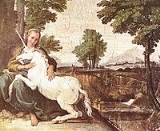
Unicorn

Encyclopedia
The unicorn is a legendary animal from European folklore that resembles a white horse with a large, pointed, spiraling horn projecting from its forehead, and sometimes a goat's beard. First mentioned by the ancient Greeks
, it became the most important imaginary animal of the middle ages
and Renaissance
when it was commonly described as an extremely wild woodland
creature, a symbol of purity and grace, which could only be captured by a virgin. In the encyclopedias its horn was said to have the power to render poisoned water potable and to heal sickness. Until the 19th century, belief in unicorns was widespread among historians, alchemists, writers, poets, naturalists, physicians, and theologians.
 Unicorns are not found in Greek mythology
, but rather in accounts of natural history
, for Greek writers of natural history were convinced of the reality of the unicorn, which they located in India
, a distant and fabulous realm for them. The earliest description is from Ctesias
who described them as wild ass
es, fleet of foot, having a horn a cubit
and a half in length and colored white, red and black. Aristotle
must be following Ctesias when he mentions two one-horned animals, the oryx
(a kind of antelope
) and the so-called "Indian ass". Strabo
says that in the Caucasus
there were one-horned horses with stag-like heads.
Pliny the Elder
mentions the oryx and an Indian ox
(perhaps a rhinoceros
) as one-horned beasts, as well as "a very fierce animal called the monoceros which has the head of the stag
, the feet of the elephant
, and the tail of the boar
, while the rest of the body is like that of the horse; it makes a deep lowing noise, and has a single black horn, which projects from the middle of its forehead, two cubits in length." In On the Nature of Animals (Περὶ Ζῴων Ἰδιότητος, De natura animalium), Aelian
, quoting Ctesias, adds that India produces also a one-horned horse (iii. 41; iv. 52), and says (xvi. 20) that the monoceros was sometimes called cartazonos , which may be a form of the Arabic karkadann
, meaning "rhinoceros
".
Cosmas Indicopleustes
, a merchant of Alexandria
, who lived in the 6th century, and made a voyage to India
, and subsequently wrote works on cosmography
, gives a figure of the unicorn, not, as he says, from actual sight of it, but reproduced from four figures of it in brass contained in the palace of the King of Ethiopia
. He states, from report, that "it is impossible to take this ferocious beast alive; and that all its strength lies in its horn. When it finds itself pursued and in danger of capture, it throws itself from a precipice, and turns so aptly in falling, that it receives all the shock upon the horn, and so escapes safe and sound."
A one-horned animal (which may be just a bull
in profile) is found on some seals
from the Indus Valley Civilization
. Seals with such a design are thought to be a mark of high social rank.
 An animal called the re’em
is mentioned in several places in the Hebrew Bible
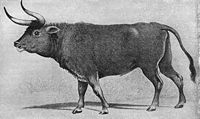
, often as a metaphor representing strength. "The allusions to the re'em as a wild, un-tamable animal of great strength and agility, with mighty horn or horns (Job xxxix. 9–12; Ps. xxii. 21, xxix. 6; Num. xxiii. 22, xxiv. 8; Deut. xxxiii. 17; comp. Ps. xcii. 11), best fit the aurochs
(Bos primigenius). This view is supported by the Assyrian rimu, which is often used as a metaphor of strength, and is depicted as a powerful, fierce, wild mountain bull with large horns." This animal was often depicted in ancient Mesopotamia
n art in profile, with only one horn visible.
The translators of the Authorized King James Version of the Bible
(1611) followed the Greek Septuagint (monokeros) and the Latin Vulgate
(unicornis) and employed unicorn to translate re'em, providing a recognizable animal that was proverbial for its un-tamable nature. The American Standard Version
translates this term "wild ox" in each case.
The classical Jewish understanding of bible did not identify the Re'em animal as the unicorn. Instead, the Tahash animal (Exodus 25, 26, 35, 36 and 39; Numbers 4; and Ezekiel 16:10) was thought to be a kosher unicorn with a coat of many colors that only existed in biblical times.
, a creature in Chinese mythology
, is sometimes called "the Chinese unicorn", it is a hybrid animal that looks less unicorn than chimera
, with the body of a deer, the head of a lion, green scales
and a long forwardly-curved horn. The Japanese
version (kirin) more closely resembles the Western unicorn, even though it is based on the Chinese qilin. The Quẻ Ly of Vietnam
ese myth, similarly sometimes mistranslated "unicorn" is a symbol of wealth and prosperity that made its first appearance during the Duong Dynasty, about 600 CE, to Emperor Duong Cao To, after a military victory which resulted in his conquest of Tây Nguyên
.
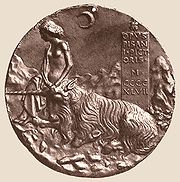
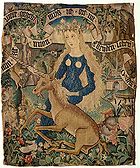 Medieval
knowledge of the fabulous beast stemmed from biblical and ancient sources, and the creature was variously represented as a kind of wild ass
, goat
, or horse
.
The predecessor of the medieval bestiary
, compiled in Late Antiquity
and known as Physiologus (Φυσιολόγος), popularized an elaborate allegory
in which a unicorn, trapped by a maiden (representing the Virgin Mary
), stood for the Incarnation
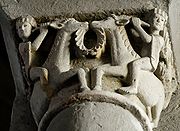
. As soon as the unicorn sees her, it lays its head on her lap and falls asleep. This became a basic emblematic tag that underlies medieval notions of the unicorn, justifying its appearance in every form of religious art.
Interpretations of the unicorn myth focus on the medieval lore of beguiled lovers, whereas some religious writers interpret the unicorn and its death as the Passion of Christ
. The myths refer to a beast with one horn that can only be tamed by a virgin
; subsequently, some writers translated this into an allegory for Christ's relationship with the Virgin Mary.
The unicorn also figured in courtly terms
: for some 13th century French
authors such as Thibaut of Champagne
and Richard de Fournival
, the lover is attracted to his lady as the unicorn is to the virgin. With the rise of humanism
, the unicorn also acquired more orthodox secular meanings, emblematic of chaste love and faithful marriage. It plays this role in Petrarch
's Triumph of Chastity, and on the reverse of Piero della Francesca
's portrait of Battista Strozzi, paired with that of her husband Federico da Montefeltro
(painted c 1472-74), Bianca's triumphal car is drawn by a pair of unicorns.
The royal throne of Denmark
was made of "unicorn horns" – almost certainly narwhal
tusks. The same material was used for ceremonial cups because the unicorn's horn continued to be believed to neutralize poison, following classical authors.
The unicorn, tamable only by a virgin woman, was well established in medieval lore by the time Marco Polo
described them as "scarcely smaller than elephants. They have the hair of a buffalo and feet like an elephant's. They have a single large black horn in the middle of the forehead... They have a head like a wild boar's… They spend their time by preference wallowing in mud
and slime. They are very ugly brutes to look at. They are not at all such as we describe them when we relate that they let themselves be captured by virgins, but clean contrary to our notions." It is clear that Marco Polo was describing a rhinoceros. In German
, since the 16th century, Einhorn ("one-horn") has become a descriptor of the various species of rhinoceros.
determined in 1638 that the alleged alicorns were the tusks of narwhals.
Such beliefs were examined wittily and at length in 1646 by Sir Thomas Browne
in his Pseudodoxia Epidemica
. Sir Thomas did not use the term 'alicorn' and only said 'unicorn horn' though.
False alicorn powder, made from the tusks of narwhal
s or horns of various animals, has been sold in Europe for medicinal purposes as late as 1741. The alicorn was thought to cure many diseases and have the ability to detect poisons, and many physicians would make "cures" and sell them. Cups were made from alicorn for kings and given as a gift; these were usually made of ivory
or walrus
ivory. Entire horns were very precious in the Middle Ages and were often really the tusks of narwhals. People who feared poisoning sometimes drank from goblets made of "unicorn horn". Alleged aphrodisiac
qualities and other purported medicinal virtues also drove up the cost of "unicorn" products such as milk
, hide, and offal
. Unicorns were also said to be able to determine whether or not a woman was a virgin; in some tales, they could only be mounted by virgins.
_001.jpg)
 One traditional method of hunting unicorns involved entrapment by a virgin.
In one of his notebooks Leonardo da Vinci
wrote:
The famous late Gothic
series of seven tapestry
hangings The Hunt of the Unicorn
are a high point in Europe
an tapestry manufacture, combining both secular and religious themes. The tapestries now hang in the Cloisters
division of the Metropolitan Museum of Art
in New York City
. In the series, richly dressed noblemen
, accompanied by huntsmen and hounds, pursue a unicorn against mille-fleur
backgrounds or settings of buildings and gardens. They bring the animal to bay with the help of a maiden who traps it with her charms, appear to kill it, and bring it back to a castle; in the last and most famous panel, "The Unicorn in Captivity," the unicorn is shown alive again and happy, chained to a pomegranate
tree surrounded by a fence, in a field of flowers. Scholars conjecture that the red stains on its flanks are not blood but rather the juice from pomegranates, which were a symbol of fertility. However, the true meaning of the mysterious resurrected Unicorn in the last panel is unclear. The series was woven about 1500 in the Low Countries
, probably Brussels
or Liège, for an unknown patron. A set of six engraving
s on the same theme, treated rather differently, were engraved by the French artist Jean Duvet
in the 1540s.
Another famous set of six tapestries of Dame à la licorne
("Lady with the unicorn") in the Musée de Cluny
, Paris
, were also woven in the Southern Netherlands
before 1500, and show the five senses (the gateways to temptation) and finally Love ("A mon seul desir" the legend reads), with unicorns featured in each piece.
Facsimiles of the unicorn tapestries are currently being woven for permanent display in Stirling Castle
, Scotland
, to take the place of a set recorded in the castle in a 16th century inventory
.
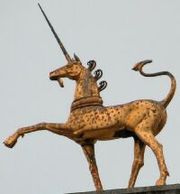
, a unicorn is depicted as a horse with a goat's cloven hooves and beard, a lion's tail, and a slender, spiral horn on its forehead.
Whether because it was an emblem of the Incarnation or of the fearsome animal passions of raw nature, the unicorn was not widely used in early heraldry, but became popular from the 15th century. Though sometimes shown collared, which may perhaps be taken in some cases as an indication that it has been tamed or tempered, it is more usually shown collared with a broken chain attached, showing that it has broken free from its bondage and cannot be taken again.
It is probably best known from the royal coats of arms of Scotland
and the United Kingdom
: two unicorns support
the Scottish arms
; a lion and a unicorn support the UK arms, representing the 1707 Union
of England
(whose traditional heraldic symbol is the lion) and Scotland. As a result of its heraldic use, two gold coins were issued in Scotland known as the unicorn
and half-unicorn, both with a unicorn on the obverse. The arms of the Worshipful Society of Apothecaries
in London
has two golden unicorn supporters (although, as emblazoned on its homepage, they have horses', not lions', tails).
about the unicorn. These have taken various forms, interpreted in a scientific, rather than a wonder-filled manner, to accord with modern perceptions of reality.
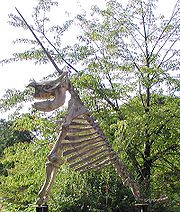 Among numerous finds of prehistoric
bones found at Unicorn Cave
in Germany
's Harz Mountains
, some were selected and reconstructed by the mayor of Magdeburg
, Otto Von Guericke
, as a unicorn in 1663 (illustration, right). Guericke's so-called unicorn had only two legs, and was constructed from fossil
bones of a woolly rhinoceros
and a mammoth
, with the horn of a narwhal
. The skeleton was examined by Gottfried Leibniz
, who had previously doubted the existence of the unicorn, but was convinced by it.
Baron Georges Cuvier
maintained that, as the unicorn was cloven-hoofed, it must therefore have a cloven skull (making the growth of a single horn impossible); as if to disprove this, Dr. W. Franklin Dove, a University of Maine
professor, artificially fused the horn buds of a calf
together, creating the external appearance of a one-horned bull.
and Mohenjo-Daro
, major sites of the Indus Valley Civilization
, were small stone seal
s inscribed with elegant depictions of animals, including a unicorn-like figure, and marked with Indus script writing which still baffles scholars. These seals are dated back to 2500 B.C.
These figures have also been interpreted as aurochs
, the extinct ancestor of domestic cattle, a type of large wild cattle which inhabited Europe, Asia and North Africa, or derivatives of aurochs. It is suggested that as the animal is always shown in profile, only one of the two horns is seen.
, a huge Eurasia
n rhinoceros native to the steppe
s, south of the range of the woolly rhinoceros of Ice Age Europe. Elasmotherium looked little like a horse, but it had a large single horn in its forehead. It became extinct about the same time as the rest of the glacial age megafauna
.
However, according to the Nordisk familjebok
(Nordic Familybook) and science writer Willy Ley
the animal may have survived long enough to be remembered in the legends of the Evenk
people of Russia
as a huge black bull with a single horn in the forehead.
In support of this claim, it has been noted that the 13th century traveller Marco Polo claimed to have seen a unicorn in Java
, but his description makes it clear to the modern reader that he actually saw a Javan Rhinoceros
.
Antiquities researcher Timothy Zell
also produced artificial unicorns dubbed "the Living Unicorn", remodelling the "horn buds" of goat kids in such a way that their horns grew together into a single one. Zell theorized that this process might have been used in the past to create court curiosities and natural herd leaders, because the goat was able to use this long straight horn effectively as a weapon and a tool. Medieval art
often depicts unicorns as small, with cloven hooves and beards, sometimes resembling goats more than horses with horns. This process is possible only with animals that naturally have horns. For a time, a few of these unicorns travelled with the Ringling Brothers Circus
.
 The unicorn horns often found in cabinets of curiosities
and other contexts in Medieval and Renaissance
Europe, were very often examples of the distinctive straight spiral single tusk of the narwhal
(Monodon monoceros), an Arctic
cetacea
n, as Danish
zoologist Ole Worm
established in 1638. They were brought south as a very valuable trade, and sold as horns from the legendary unicorn; being of ivory
, they passed the various tests intended to spot fake unicorn horns. As these 'horns' were considered to have magic
powers, Vikings and other northern traders were able to sell them for many times their weight in gold
. Elizabeth I of England
kept a "unicorn horn" in her cabinet of curiosities, brought back by Arctic
explorer Martin Frobisher
on his return from Labrador
in 1577. The usual depiction of the spiral unicorn horn in art, derives from these.
The truth of the tusk's origin developed gradually during the Age of Exploration, as explorers and naturalists began to visit regions themselves. In 1555, Olaus Magnus
published a drawing of a fish-like creature with a "horn" on its forehead.
 The oryx
is an antelope
with two long, thin horns projecting from its forehead. Some have suggested that seen from the side and from a distance, the oryx looks something like a horse with a single horn (although the 'horn' projects backward, not forward as in the classic unicorn). Conceivably, travellers in Arabia
could have derived the tale of the unicorn from these animals. However, classical authors seem to distinguish clearly between oryxes and unicorns. The Peregrinatio in terram sanctam, published in 1486, was the first printed illustrated travel-book, describing a pilgrimage
to Jerusalem, and thence to Egypt
by way of Mount Sinai
. It featured many large woodcut
s by Erhard Reuwich
, who went on the trip, mostly detailed and accurate views of cities. The book also contained pictures of animals seen on the journey, including a crocodile
, camel
, and unicorn—presumably an oryx, which they could easily have seen on their route.
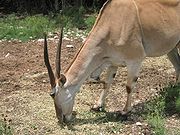 In Southern Africa
, the eland
has somewhat mystical or spiritual connotations, perhaps at least partly because this very large antelope will defend itself against lions and is able to kill these fearsome predators. Eland are very frequently depicted in the rock art
of the region, which implies that they were viewed as having a strong connection to the other world, and in several languages the word for eland and for dance is the same; significant because shamans used dance as their means of drawing power from the other world. Eland fat was used when mixing the pigments for these pictographs, and in the preparation of many medicines.
This special regard for the eland may well have been picked up by early travellers. There is a purported unicorn horn in the castle of the chief of the Clan MacLeod
in Scotland, which has been identified as that of an eland.
in Italy
with a single horn. Single-horned deer are not uncommon; however, the placement of the horn in the middle is very unusual. Fulvio Fraticelli, scientific director of Rome's zoo, has said "Generally, the horn is on one side (of the head) rather than being at the center. This looks like a complex case." Fraticelli also acknowledges that the placement of the horn could have been the result of some type of trauma in the life of the deer.
According to Gilberto Tozzi, director of the Center of Natural Science in Prato, “this single-horn deer is conscious to its uniqueness and does not come out a lot, always hiding.”
Ancient Greece
Ancient Greece is a civilization belonging to a period of Greek history that lasted from the Archaic period of the 8th to 6th centuries BC to the end of antiquity. Immediately following this period was the beginning of the Early Middle Ages and the Byzantine era. Included in Ancient Greece is the...
, it became the most important imaginary animal of the middle ages
Middle Ages
The Middle Ages is a periodization of European history from the 5th century to the 15th century. The Middle Ages follows the fall of the Western Roman Empire in 476 and precedes the Early Modern Era. It is the middle period of a three-period division of Western history: Classic, Medieval and Modern...
and Renaissance
Renaissance
The Renaissance was a cultural movement that spanned roughly the 14th to the 17th century, beginning in Italy in the Late Middle Ages and later spreading to the rest of Europe. The term is also used more loosely to refer to the historical era, but since the changes of the Renaissance were not...
when it was commonly described as an extremely wild woodland
Forest
A forest, also referred to as a wood or the woods, is an area with a high density of trees. As with cities, depending where you are in the world, what is considered a forest may vary significantly in size and have various classification according to how and what of the forest is composed...
creature, a symbol of purity and grace, which could only be captured by a virgin. In the encyclopedias its horn was said to have the power to render poisoned water potable and to heal sickness. Until the 19th century, belief in unicorns was widespread among historians, alchemists, writers, poets, naturalists, physicians, and theologians.
Unicorns in antiquity
Greek mythology
Greek mythology is the body of myths and legends belonging to the ancient Greeks, concerning their gods and heroes, the nature of the world, and the origins and significance of their own cult and ritual practices. They were a part of religion in ancient Greece...
, but rather in accounts of natural history
Natural history
Natural history is the scientific research of plants or animals, leaning more towards observational rather than experimental methods of study, and encompasses more research published in magazines than in academic journals. Grouped among the natural sciences, natural history is the systematic study...
, for Greek writers of natural history were convinced of the reality of the unicorn, which they located in India
India
India , officially the Republic of India , is a country in South Asia. It is the seventh-largest country by geographical area, the second-most populous country with over 1.2 billion people, and the most populous democracy in the world...
, a distant and fabulous realm for them. The earliest description is from Ctesias
Ctesias
Ctesias of Cnidus was a Greek physician and historian from Cnidus in Caria. Ctesias, who lived in the 5th century BC, was physician to Artaxerxes Mnemon, whom he accompanied in 401 BC on his expedition against his brother Cyrus the Younger....
who described them as wild ass
Onager
The Onager is a large member of the genus Equus of the family Equidae native to the deserts of Syria, Iran, Pakistan, India, Israel and Tibet...
es, fleet of foot, having a horn a cubit
Cubit
The cubit is a traditional unit of length, based on the length of the forearm. Cubits of various lengths were employed in many parts of the world in Antiquity, in the Middle Ages and into Early Modern Times....
and a half in length and colored white, red and black. Aristotle
Aristotle
Aristotle was a Greek philosopher and polymath, a student of Plato and teacher of Alexander the Great. His writings cover many subjects, including physics, metaphysics, poetry, theater, music, logic, rhetoric, linguistics, politics, government, ethics, biology, and zoology...
must be following Ctesias when he mentions two one-horned animals, the oryx
Oryx
Oryx is one of four large antelope species of the genus Oryx. Three of the species are native to arid parts of Africa, with a fourth native to the Arabian Peninsula. Their pelage is pale with contrasing dark markings in the face and on the legs, and their long horns are almost straight...
(a kind of antelope
Antelope
Antelope is a term referring to many even-toed ungulate species indigenous to various regions in Africa and Eurasia. Antelopes comprise a miscellaneous group within the family Bovidae, encompassing those old-world species that are neither cattle, sheep, buffalo, bison, nor goats...
) and the so-called "Indian ass". Strabo
Strabo
Strabo, also written Strabon was a Greek historian, geographer and philosopher.-Life:Strabo was born to an affluent family from Amaseia in Pontus , a city which he said was situated the approximate equivalent of 75 km from the Black Sea...
says that in the Caucasus
Caucasus
The Caucasus, also Caucas or Caucasia , is a geopolitical region at the border of Europe and Asia, and situated between the Black and the Caspian sea...
there were one-horned horses with stag-like heads.
Pliny the Elder
Pliny the Elder
Gaius Plinius Secundus , better known as Pliny the Elder, was a Roman author, naturalist, and natural philosopher, as well as naval and army commander of the early Roman Empire, and personal friend of the emperor Vespasian...
mentions the oryx and an Indian ox
Ox
An ox , also known as a bullock in Australia, New Zealand and India, is a bovine trained as a draft animal. Oxen are commonly castrated adult male cattle; castration makes the animals more tractable...
(perhaps a rhinoceros
Rhinoceros
Rhinoceros , also known as rhino, is a group of five extant species of odd-toed ungulates in the family Rhinocerotidae. Two of these species are native to Africa and three to southern Asia....
) as one-horned beasts, as well as "a very fierce animal called the monoceros which has the head of the stag
Deer
Deer are the ruminant mammals forming the family Cervidae. Species in the Cervidae family include white-tailed deer, elk, moose, red deer, reindeer, fallow deer, roe deer and chital. Male deer of all species and female reindeer grow and shed new antlers each year...
, the feet of the elephant
Elephant
Elephants are large land mammals in two extant genera of the family Elephantidae: Elephas and Loxodonta, with the third genus Mammuthus extinct...
, and the tail of the boar
Boar
Wild boar, also wild pig, is a species of the pig genus Sus, part of the biological family Suidae. The species includes many subspecies. It is the wild ancestor of the domestic pig, an animal with which it freely hybridises...
, while the rest of the body is like that of the horse; it makes a deep lowing noise, and has a single black horn, which projects from the middle of its forehead, two cubits in length." In On the Nature of Animals (Περὶ Ζῴων Ἰδιότητος, De natura animalium), Aelian
Claudius Aelianus
Claudius Aelianus , often seen as just Aelian, born at Praeneste, was a Roman author and teacher of rhetoric who flourished under Septimius Severus and probably outlived Elagabalus, who died in 222...
, quoting Ctesias, adds that India produces also a one-horned horse (iii. 41; iv. 52), and says (xvi. 20) that the monoceros was sometimes called cartazonos , which may be a form of the Arabic karkadann
Karkadann
The Karkadann was a mythical creature said to live on the grassy plains of India, Persia, and North Africa. Referred to by Elmer Suhr as the "Persian version of the unicorn," its mention by Muslim writers may depend on earlier Greek texts and may have an origin in an account from the Mahabharata...
, meaning "rhinoceros
Rhinoceros
Rhinoceros , also known as rhino, is a group of five extant species of odd-toed ungulates in the family Rhinocerotidae. Two of these species are native to Africa and three to southern Asia....
".
Cosmas Indicopleustes
Cosmas Indicopleustes
Cosmas Indicopleustes was an Alexandrian merchant and later hermit, probably of Nestorian tendencies. He was a 6th-century traveller, who made several voyages to India during the reign of emperor Justinian...
, a merchant of Alexandria
Alexandria
Alexandria is the second-largest city of Egypt, with a population of 4.1 million, extending about along the coast of the Mediterranean Sea in the north central part of the country; it is also the largest city lying directly on the Mediterranean coast. It is Egypt's largest seaport, serving...
, who lived in the 6th century, and made a voyage to India
India
India , officially the Republic of India , is a country in South Asia. It is the seventh-largest country by geographical area, the second-most populous country with over 1.2 billion people, and the most populous democracy in the world...
, and subsequently wrote works on cosmography
Cosmography
Cosmography is the science that maps the general features of the universe, describing both heaven and Earth...
, gives a figure of the unicorn, not, as he says, from actual sight of it, but reproduced from four figures of it in brass contained in the palace of the King of Ethiopia
Ethiopia
Ethiopia , officially known as the Federal Democratic Republic of Ethiopia, is a country located in the Horn of Africa. It is the second-most populous nation in Africa, with over 82 million inhabitants, and the tenth-largest by area, occupying 1,100,000 km2...
. He states, from report, that "it is impossible to take this ferocious beast alive; and that all its strength lies in its horn. When it finds itself pursued and in danger of capture, it throws itself from a precipice, and turns so aptly in falling, that it receives all the shock upon the horn, and so escapes safe and sound."
A one-horned animal (which may be just a bull
Bull
Bull usually refers to an uncastrated adult male bovine.Bull may also refer to:-Entertainment:* Bull , an original show on the TNT Network* "Bull" , an episode of television series CSI: Crime Scene Investigation...
in profile) is found on some seals
Seal (device)
A seal can be a figure impressed in wax, clay, or some other medium, or embossed on paper, with the purpose of authenticating a document ; but the term can also mean the device for making such impressions, being essentially a mould with the mirror image of the design carved in sunken- relief or...
from the Indus Valley Civilization
Indus Valley Civilization
The Indus Valley Civilization was a Bronze Age civilization that was located in the northwestern region of the Indian subcontinent, consisting of what is now mainly modern-day Pakistan and northwest India...
. Seals with such a design are thought to be a mark of high social rank.
Biblical
Re’em
Re'em', also called Reëm , a beast mentioned nine times in the Bible and translated as "unicorn" in the Authorized King James Version, has been suggested by some modern Bible scholars, such as Johann Ulrich Duerst, to be based on the Akkadian cognate rimu, as Bos primigenius, the aurochs,...
is mentioned in several places in the Hebrew Bible
Hebrew Bible
The Hebrew Bible is a term used by biblical scholars outside of Judaism to refer to the Tanakh , a canonical collection of Jewish texts, and the common textual antecedent of the several canonical editions of the Christian Old Testament...
, often as a metaphor representing strength. "The allusions to the re'em as a wild, un-tamable animal of great strength and agility, with mighty horn or horns (Job xxxix. 9–12; Ps. xxii. 21, xxix. 6; Num. xxiii. 22, xxiv. 8; Deut. xxxiii. 17; comp. Ps. xcii. 11), best fit the aurochs
Aurochs
The aurochs , the ancestor of domestic cattle, were a type of large wild cattle which inhabited Europe, Asia and North Africa, but is now extinct; it survived in Europe until 1627....
(Bos primigenius). This view is supported by the Assyrian rimu, which is often used as a metaphor of strength, and is depicted as a powerful, fierce, wild mountain bull with large horns." This animal was often depicted in ancient Mesopotamia
Mesopotamia
Mesopotamia is a toponym for the area of the Tigris–Euphrates river system, largely corresponding to modern-day Iraq, northeastern Syria, southeastern Turkey and southwestern Iran.Widely considered to be the cradle of civilization, Bronze Age Mesopotamia included Sumer and the...
n art in profile, with only one horn visible.
The translators of the Authorized King James Version of the Bible
Bible
The Bible refers to any one of the collections of the primary religious texts of Judaism and Christianity. There is no common version of the Bible, as the individual books , their contents and their order vary among denominations...
(1611) followed the Greek Septuagint (monokeros) and the Latin Vulgate
Vulgate
The Vulgate is a late 4th-century Latin translation of the Bible. It was largely the work of St. Jerome, who was commissioned by Pope Damasus I in 382 to make a revision of the old Latin translations...
(unicornis) and employed unicorn to translate re'em, providing a recognizable animal that was proverbial for its un-tamable nature. The American Standard Version
American Standard Version
The Revised Version, Standard American Edition of the Bible, more commonly known as the American Standard Version , is a version of the Bible that was released in 1901...
translates this term "wild ox" in each case.
- "God brought them out of Egypt; he hath as it were the strength of an unicorn."—
- "God brought him forth out of Egypt; he hath as it were the strength of an unicorn."—
- "His glory is like the firstling of his bullock, and his horns are like the horns of unicorns: with them he shall push the people together to the ends of the earth."—
- "Will the unicorn be willing to serve thee, or abide by thy crib? Canst thou bind the unicorn with his band in the furrow? or will he harrow the valleys after thee? Wilt thou trust him, because his strength is great? or wilt thou leave thy labour to him? Wilt thou believe him, that he will bring home thy seed, and gather it into thy barn?"—
- "Save me from the lion's mouth; for thou hast heard me from the horns of unicorns."—
- "He maketh them [the cedars of Lebanon] also to skip like a calf; Lebanon and Sirion like a young unicorn."—
- "But my horn shalt thou exalt like the horn of the unicorn: I shall be anointed with fresh oil."—
- "And the unicorns shall come down with them, and the bullocks with their bulls; and their land shall be soaked with blood, and their dust made fat with fatness."—
The classical Jewish understanding of bible did not identify the Re'em animal as the unicorn. Instead, the Tahash animal (Exodus 25, 26, 35, 36 and 39; Numbers 4; and Ezekiel 16:10) was thought to be a kosher unicorn with a coat of many colors that only existed in biblical times.
Qilin
Though the qilinQilin
The Qilin is a mythical hooved Chinese chimerical creature known throughout various East Asian cultures, and is said to appear with the imminent arrival or passing of a wise sage or an illustrious ruler. It is a good omen that brings rui . It is often depicted with what looks like fire all over...
, a creature in Chinese mythology
Chinese mythology
Chinese mythology is a collection of cultural history, folktales, and religions that have been passed down in oral or written tradition. These include creation myths and legends and myths concerning the founding of Chinese culture and the Chinese state...
, is sometimes called "the Chinese unicorn", it is a hybrid animal that looks less unicorn than chimera
Chimera (mythology)
The Chimera or Chimaera was, according to Greek mythology, a monstrous fire-breathing female creature of Lycia in Asia Minor, composed of the parts of multiple animals: upon the body of a lioness with a tail that ended in a snake's head, the head of a goat arose on her back at the center of her...
, with the body of a deer, the head of a lion, green scales
Scale (zoology)
In most biological nomenclature, a scale is a small rigid plate that grows out of an animal's skin to provide protection. In lepidopteran species, scales are plates on the surface of the insect wing, and provide coloration...
and a long forwardly-curved horn. The Japanese
Japanese mythology
Japanese mythology is a system of beliefs that embraces Shinto and Buddhist traditions as well as agriculturally based folk religion. The Shinto pantheon comprises innumerable kami...
version (kirin) more closely resembles the Western unicorn, even though it is based on the Chinese qilin. The Quẻ Ly of Vietnam
Vietnam
Vietnam – sometimes spelled Viet Nam , officially the Socialist Republic of Vietnam – is the easternmost country on the Indochina Peninsula in Southeast Asia. It is bordered by China to the north, Laos to the northwest, Cambodia to the southwest, and the South China Sea –...
ese myth, similarly sometimes mistranslated "unicorn" is a symbol of wealth and prosperity that made its first appearance during the Duong Dynasty, about 600 CE, to Emperor Duong Cao To, after a military victory which resulted in his conquest of Tây Nguyên
Tây Nguyên
Tây Nguyên, translated as Western Highlands and sometimes also called Central Highlands, is one of the regions of Vietnam. It contains the provinces of Đắk Lắk, Đắk Nông, Gia Lai, Kon Tum, Lâm Đồng....
.
Middle Ages and Renaissance
Middle Ages
The Middle Ages is a periodization of European history from the 5th century to the 15th century. The Middle Ages follows the fall of the Western Roman Empire in 476 and precedes the Early Modern Era. It is the middle period of a three-period division of Western history: Classic, Medieval and Modern...
knowledge of the fabulous beast stemmed from biblical and ancient sources, and the creature was variously represented as a kind of wild ass
Onager
The Onager is a large member of the genus Equus of the family Equidae native to the deserts of Syria, Iran, Pakistan, India, Israel and Tibet...
, goat
Goat
The domestic goat is a subspecies of goat domesticated from the wild goat of southwest Asia and Eastern Europe. The goat is a member of the Bovidae family and is closely related to the sheep as both are in the goat-antelope subfamily Caprinae. There are over three hundred distinct breeds of...
, or horse
Horse
The horse is one of two extant subspecies of Equus ferus, or the wild horse. It is a single-hooved mammal belonging to the taxonomic family Equidae. The horse has evolved over the past 45 to 55 million years from a small multi-toed creature into the large, single-toed animal of today...
.
The predecessor of the medieval bestiary
Bestiary
A bestiary, or Bestiarum vocabulum is a compendium of beasts. Bestiaries were made popular in the Middle Ages in illustrated volumes that described various animals, birds and even rocks. The natural history and illustration of each beast was usually accompanied by a moral lesson...
, compiled in Late Antiquity
Late Antiquity
Late Antiquity is a periodization used by historians to describe the time of transition from Classical Antiquity to the Middle Ages, in both mainland Europe and the Mediterranean world. Precise boundaries for the period are a matter of debate, but noted historian of the period Peter Brown proposed...
and known as Physiologus (Φυσιολόγος), popularized an elaborate allegory
Allegory
Allegory is a demonstrative form of representation explaining meaning other than the words that are spoken. Allegory communicates its message by means of symbolic figures, actions or symbolic representation...
in which a unicorn, trapped by a maiden (representing the Virgin Mary
Mary (mother of Jesus)
Mary , commonly referred to as "Saint Mary", "Mother Mary", the "Virgin Mary", the "Blessed Virgin Mary", or "Mary, Mother of God", was a Jewish woman of Nazareth in Galilee...
), stood for the Incarnation
Incarnation
Incarnation literally means embodied in flesh or taking on flesh. It refers to the conception and birth of a sentient creature who is the material manifestation of an entity, god or force whose original nature is immaterial....
. As soon as the unicorn sees her, it lays its head on her lap and falls asleep. This became a basic emblematic tag that underlies medieval notions of the unicorn, justifying its appearance in every form of religious art.
Sacred art
Sacred art is imagery intended to uplift the mind to the spiritual. Sacred art involves the ritual and cultic practices and practical and operative aspects of the path of the spiritual realization within the bosom of the tradition in question....
Interpretations of the unicorn myth focus on the medieval lore of beguiled lovers, whereas some religious writers interpret the unicorn and its death as the Passion of Christ
Passion (Christianity)
The Passion is the Christian theological term used for the events and suffering – physical, spiritual, and mental – of Jesus in the hours before and including his trial and execution by crucifixion...
. The myths refer to a beast with one horn that can only be tamed by a virgin
Virginity
Virginity refers to the state of a person who has never engaged in sexual intercourse. There are cultural and religious traditions which place special value and significance on this state, especially in the case of unmarried females, associated with notions of personal purity, honor and worth...
; subsequently, some writers translated this into an allegory for Christ's relationship with the Virgin Mary.
The unicorn also figured in courtly terms
Courtly love
Courtly love was a medieval European conception of nobly and chivalrously expressing love and admiration. Generally, courtly love was secret and between members of the nobility. It was also generally not practiced between husband and wife....
: for some 13th century French
France
The French Republic , The French Republic , The French Republic , (commonly known as France , is a unitary semi-presidential republic in Western Europe with several overseas territories and islands located on other continents and in the Indian, Pacific, and Atlantic oceans. Metropolitan France...
authors such as Thibaut of Champagne
Theobald I of Navarre
Theobald I , called the Troubadour, the Chansonnier, and the Posthumous, was Count of Champagne from birth and King of Navarre from 1234...
and Richard de Fournival
Richard de Fournival
Richard de Fournival or Richart de Fornival was a medieval philosopher and trouvère perhaps best known for the Bestiaire d'amour .-Life:...
, the lover is attracted to his lady as the unicorn is to the virgin. With the rise of humanism
Renaissance humanism
Renaissance humanism was an activity of cultural and educational reform engaged by scholars, writers, and civic leaders who are today known as Renaissance humanists. It developed during the fourteenth and the beginning of the fifteenth centuries, and was a response to the challenge of Mediæval...
, the unicorn also acquired more orthodox secular meanings, emblematic of chaste love and faithful marriage. It plays this role in Petrarch
Petrarch
Francesco Petrarca , known in English as Petrarch, was an Italian scholar, poet and one of the earliest humanists. Petrarch is often called the "Father of Humanism"...
's Triumph of Chastity, and on the reverse of Piero della Francesca
Piero della Francesca
Piero della Francesca was a painter of the Early Renaissance. As testified by Giorgio Vasari in his Lives of the Artists, to contemporaries he was also known as a mathematician and geometer. Nowadays Piero della Francesca is chiefly appreciated for his art. His painting was characterized by its...
's portrait of Battista Strozzi, paired with that of her husband Federico da Montefeltro
Federico da Montefeltro
Federico da Montefeltro, also known as Federico III da Montefeltro , was one of the most successful condottieri of the Italian Renaissance, and lord of Urbino from 1444 until his death...
(painted c 1472-74), Bianca's triumphal car is drawn by a pair of unicorns.
The royal throne of Denmark
Denmark
Denmark is a Scandinavian country in Northern Europe. The countries of Denmark and Greenland, as well as the Faroe Islands, constitute the Kingdom of Denmark . It is the southernmost of the Nordic countries, southwest of Sweden and south of Norway, and bordered to the south by Germany. Denmark...
was made of "unicorn horns" – almost certainly narwhal
Narwhal
The narwhal, Monodon monoceros, is a medium-sized toothed whale that lives year-round in the Arctic. One of two living species of whale in the Monodontidae family, along with the beluga whale, the narwhal males are distinguished by a characteristic long, straight, helical tusk extending from their...
tusks. The same material was used for ceremonial cups because the unicorn's horn continued to be believed to neutralize poison, following classical authors.
The unicorn, tamable only by a virgin woman, was well established in medieval lore by the time Marco Polo
Marco Polo
Marco Polo was a Venetian merchant traveler from the Venetian Republic whose travels are recorded in Il Milione, a book which did much to introduce Europeans to Central Asia and China. He learned about trading whilst his father and uncle, Niccolò and Maffeo, travelled through Asia and apparently...
described them as "scarcely smaller than elephants. They have the hair of a buffalo and feet like an elephant's. They have a single large black horn in the middle of the forehead... They have a head like a wild boar's… They spend their time by preference wallowing in mud
Mud
Mud is a mixture of water and some combination of soil, silt, and clay. Ancient mud deposits harden over geological time to form sedimentary rock such as shale or mudstone . When geological deposits of mud are formed in estuaries the resultant layers are termed bay muds...
and slime. They are very ugly brutes to look at. They are not at all such as we describe them when we relate that they let themselves be captured by virgins, but clean contrary to our notions." It is clear that Marco Polo was describing a rhinoceros. In German
German language
German is a West Germanic language, related to and classified alongside English and Dutch. With an estimated 90 – 98 million native speakers, German is one of the world's major languages and is the most widely-spoken first language in the European Union....
, since the 16th century, Einhorn ("one-horn") has become a descriptor of the various species of rhinoceros.
Alicorn
The horn itself and the substance it was made of was called alicorn, and it was believed that the horn holds magical and medicinal properties. The Danish physician Ole WormOle Worm
Ole Worm , who often went by the Latinized form of his name Olaus Wormius, was a Danish physician and antiquary.-Life:...
determined in 1638 that the alleged alicorns were the tusks of narwhals.
Such beliefs were examined wittily and at length in 1646 by Sir Thomas Browne
Thomas Browne
Sir Thomas Browne was an English author of varied works which reveal his wide learning in diverse fields including medicine, religion, science and the esoteric....
in his Pseudodoxia Epidemica
Pseudodoxia Epidemica
Pseudodoxia Epidemica or Enquries into very many received tenets and commonly presumed truths, also known simply as Pseudodoxia Epidemica or Vulgar Errors, is a work by Thomas Browne refuting the common errors and superstitions of his age. It first appeared in 1646 and went through five subsequent...
. Sir Thomas did not use the term 'alicorn' and only said 'unicorn horn' though.
False alicorn powder, made from the tusks of narwhal
Narwhal
The narwhal, Monodon monoceros, is a medium-sized toothed whale that lives year-round in the Arctic. One of two living species of whale in the Monodontidae family, along with the beluga whale, the narwhal males are distinguished by a characteristic long, straight, helical tusk extending from their...
s or horns of various animals, has been sold in Europe for medicinal purposes as late as 1741. The alicorn was thought to cure many diseases and have the ability to detect poisons, and many physicians would make "cures" and sell them. Cups were made from alicorn for kings and given as a gift; these were usually made of ivory
Ivory
Ivory is a term for dentine, which constitutes the bulk of the teeth and tusks of animals, when used as a material for art or manufacturing. Ivory has been important since ancient times for making a range of items, from ivory carvings to false teeth, fans, dominoes, joint tubes, piano keys and...
or walrus
Walrus
The walrus is a large flippered marine mammal with a discontinuous circumpolar distribution in the Arctic Ocean and sub-Arctic seas of the Northern Hemisphere. The walrus is the only living species in the Odobenidae family and Odobenus genus. It is subdivided into three subspecies: the Atlantic...
ivory. Entire horns were very precious in the Middle Ages and were often really the tusks of narwhals. People who feared poisoning sometimes drank from goblets made of "unicorn horn". Alleged aphrodisiac
Aphrodisiac
An aphrodisiac is a substance that increases sexual desire. The name comes from Aphrodite, the Greek goddess of sexuality and love. Throughout history, many foods, drinks, and behaviors have had a reputation for making sex more attainable and/or pleasurable...
qualities and other purported medicinal virtues also drove up the cost of "unicorn" products such as milk
Milk
Milk is a white liquid produced by the mammary glands of mammals. It is the primary source of nutrition for young mammals before they are able to digest other types of food. Early-lactation milk contains colostrum, which carries the mother's antibodies to the baby and can reduce the risk of many...
, hide, and offal
Offal
Offal , also called, especially in the United States, variety meats or organ meats, refers to the internal organs and entrails of a butchered animal. The word does not refer to a particular list of edible organs, which varies by culture and region, but includes most internal organs other than...
. Unicorns were also said to be able to determine whether or not a woman was a virgin; in some tales, they could only be mounted by virgins.
The hunt of the unicorn
In one of his notebooks Leonardo da Vinci
Leonardo da Vinci
Leonardo di ser Piero da Vinci was an Italian Renaissance polymath: painter, sculptor, architect, musician, scientist, mathematician, engineer, inventor, anatomist, geologist, cartographer, botanist and writer whose genius, perhaps more than that of any other figure, epitomized the Renaissance...
wrote:
The unicorn, through its intemperance and not knowing how to control itself, for the love it bears to fair maidens forgets its ferocity and wildness; and laying aside all fear it will go up to a seated damsel and go to sleep in her lap, and thus the hunters take it.
The famous late Gothic
Gothic art
Gothic art was a Medieval art movement that developed in France out of Romanesque art in the mid-12th century, led by the concurrent development of Gothic architecture. It spread to all of Western Europe, but took over art more completely north of the Alps, never quite effacing more classical...
series of seven tapestry
Tapestry
Tapestry is a form of textile art, traditionally woven on a vertical loom, however it can also be woven on a floor loom as well. It is composed of two sets of interlaced threads, those running parallel to the length and those parallel to the width ; the warp threads are set up under tension on a...
hangings The Hunt of the Unicorn
The Hunt of the Unicorn
The Hunt of the Unicorn, often referred to as the Unicorn Tapestries, is a series of seven tapestries dating from 1495–1505. The tapestries show a group of noblemen and hunters in pursuit of a unicorn. It is believed the tapestries were made in the Southern Netherlands.-Production:The...
are a high point in Europe
Europe
Europe is, by convention, one of the world's seven continents. Comprising the westernmost peninsula of Eurasia, Europe is generally 'divided' from Asia to its east by the watershed divides of the Ural and Caucasus Mountains, the Ural River, the Caspian and Black Seas, and the waterways connecting...
an tapestry manufacture, combining both secular and religious themes. The tapestries now hang in the Cloisters
The Cloisters
The Cloisters is a museum located in Fort Tryon Park, New York City. The building, which is a branch of the Metropolitan Museum of Art, was reconstructed in the 1930s from the architectural elements of several European medieval abbeys...
division of the Metropolitan Museum of Art
Metropolitan Museum of Art
The Metropolitan Museum of Art is a renowned art museum in New York City. Its permanent collection contains more than two million works, divided into nineteen curatorial departments. The main building, located on the eastern edge of Central Park along Manhattan's Museum Mile, is one of the...
in New York City
New York City
New York is the most populous city in the United States and the center of the New York Metropolitan Area, one of the most populous metropolitan areas in the world. New York exerts a significant impact upon global commerce, finance, media, art, fashion, research, technology, education, and...
. In the series, richly dressed noblemen
Nobility
Nobility is a social class which possesses more acknowledged privileges or eminence than members of most other classes in a society, membership therein typically being hereditary. The privileges associated with nobility may constitute substantial advantages over or relative to non-nobles, or may be...
, accompanied by huntsmen and hounds, pursue a unicorn against mille-fleur
Mille-fleur
Mille-fleurs , also in English millefleur or mille-fleur literally means "thousand flowers" and refers to a background made of many small flowers and plants...
backgrounds or settings of buildings and gardens. They bring the animal to bay with the help of a maiden who traps it with her charms, appear to kill it, and bring it back to a castle; in the last and most famous panel, "The Unicorn in Captivity," the unicorn is shown alive again and happy, chained to a pomegranate
Pomegranate
The pomegranate , Punica granatum, is a fruit-bearing deciduous shrub or small tree growing between five and eight meters tall.Native to the area of modern day Iran, the pomegranate has been cultivated in the Caucasus since ancient times. From there it spread to Asian areas such as the Caucasus as...
tree surrounded by a fence, in a field of flowers. Scholars conjecture that the red stains on its flanks are not blood but rather the juice from pomegranates, which were a symbol of fertility. However, the true meaning of the mysterious resurrected Unicorn in the last panel is unclear. The series was woven about 1500 in the Low Countries
Low Countries
The Low Countries are the historical lands around the low-lying delta of the Rhine, Scheldt, and Meuse rivers, including the modern countries of Belgium, the Netherlands, Luxembourg and parts of northern France and western Germany....
, probably Brussels
Brussels
Brussels , officially the Brussels Region or Brussels-Capital Region , is the capital of Belgium and the de facto capital of the European Union...
or Liège, for an unknown patron. A set of six engraving
Engraving
Engraving is the practice of incising a design on to a hard, usually flat surface, by cutting grooves into it. The result may be a decorated object in itself, as when silver, gold, steel, or glass are engraved, or may provide an intaglio printing plate, of copper or another metal, for printing...
s on the same theme, treated rather differently, were engraved by the French artist Jean Duvet
Jean Duvet
Jean Duvet was a French Renaissance goldsmith and engraver, now best known for his engravings. He was the first significant French printmaker. He had a highly personal style, often compared to that of William Blake, with very crowded plates, a certain naive quality, and intense religious feeling...
in the 1540s.
Another famous set of six tapestries of Dame à la licorne
The Lady and the Unicorn
The Lady and the Unicorn is the modern title given to a series of six tapestries woven in Flanders of wool and silk, from designs drawn in Paris in the late fifteenth century, The suite, on display in the Musée du Moyen-Âge, is often considered one of the greatest works of art of the Middle...
("Lady with the unicorn") in the Musée de Cluny
Musée de Cluny
The Musée de Cluny , officially known as Musée National du Moyen Âge , is a museum in Paris, France...
, Paris
Paris
Paris is the capital and largest city in France, situated on the river Seine, in northern France, at the heart of the Île-de-France region...
, were also woven in the Southern Netherlands
Southern Netherlands
Southern Netherlands were a part of the Low Countries controlled by Spain , Austria and annexed by France...
before 1500, and show the five senses (the gateways to temptation) and finally Love ("A mon seul desir" the legend reads), with unicorns featured in each piece.
Facsimiles of the unicorn tapestries are currently being woven for permanent display in Stirling Castle
Stirling Castle
Stirling Castle, located in Stirling, is one of the largest and most important castles, both historically and architecturally, in Scotland. The castle sits atop Castle Hill, an intrusive crag, which forms part of the Stirling Sill geological formation. It is surrounded on three sides by steep...
, Scotland
Scotland
Scotland is a country that is part of the United Kingdom. Occupying the northern third of the island of Great Britain, it shares a border with England to the south and is bounded by the North Sea to the east, the Atlantic Ocean to the north and west, and the North Channel and Irish Sea to the...
, to take the place of a set recorded in the castle in a 16th century inventory
Scottish Royal tapestry collection
The Scottish royal tapestry collection was a group of tapestry hangings assembled to decorate the palaces of sixteenth century kings and queens of Scotland....
.
Heraldry
In heraldryHeraldry
Heraldry is the profession, study, or art of creating, granting, and blazoning arms and ruling on questions of rank or protocol, as exercised by an officer of arms. Heraldry comes from Anglo-Norman herald, from the Germanic compound harja-waldaz, "army commander"...
, a unicorn is depicted as a horse with a goat's cloven hooves and beard, a lion's tail, and a slender, spiral horn on its forehead.
Whether because it was an emblem of the Incarnation or of the fearsome animal passions of raw nature, the unicorn was not widely used in early heraldry, but became popular from the 15th century. Though sometimes shown collared, which may perhaps be taken in some cases as an indication that it has been tamed or tempered, it is more usually shown collared with a broken chain attached, showing that it has broken free from its bondage and cannot be taken again.
It is probably best known from the royal coats of arms of Scotland
Kingdom of Scotland
The Kingdom of Scotland was a Sovereign state in North-West Europe that existed from 843 until 1707. It occupied the northern third of the island of Great Britain and shared a land border to the south with the Kingdom of England...
and the United Kingdom
United Kingdom
The United Kingdom of Great Britain and Northern IrelandIn the United Kingdom and Dependencies, other languages have been officially recognised as legitimate autochthonous languages under the European Charter for Regional or Minority Languages...
: two unicorns support
Supporters
In heraldry, supporters are figures usually placed on either side of the shield and depicted holding it up. These figures may be real or imaginary animals, human figures, and in rare cases plants or inanimate objects...
the Scottish arms
Royal coat of arms of Scotland
The royal coat of arms of Scotland was the official coat of arms of the monarchs of Scotland, and was used as the official coat of arms of the Kingdom of Scotland until the Acts of Union of 1707...
; a lion and a unicorn support the UK arms, representing the 1707 Union
Acts of Union 1707
The Acts of Union were two Parliamentary Acts - the Union with Scotland Act passed in 1706 by the Parliament of England, and the Union with England Act passed in 1707 by the Parliament of Scotland - which put into effect the terms of the Treaty of Union that had been agreed on 22 July 1706,...
of England
England
England is a country that is part of the United Kingdom. It shares land borders with Scotland to the north and Wales to the west; the Irish Sea is to the north west, the Celtic Sea to the south west, with the North Sea to the east and the English Channel to the south separating it from continental...
(whose traditional heraldic symbol is the lion) and Scotland. As a result of its heraldic use, two gold coins were issued in Scotland known as the unicorn
Unicorn (coin)
The unicorn was a gold coin that formed part of Scottish coinage between 1484 and 1525. It was initially issued under the reign of James III with a value of 18 shillings Scots, but rising gold prices during the reign of James V caused its value to increase first to 20 shillings, and then 22. The...
and half-unicorn, both with a unicorn on the obverse. The arms of the Worshipful Society of Apothecaries
Worshipful Society of Apothecaries
The Worshipful Society of Apothecaries of London is one of the Livery Companies of the City of London. Originally, apothecaries were members of the Grocers' Company and before this members of the Guild of Pepperers formed in London in 1180...
in London
London
London is the capital city of :England and the :United Kingdom, the largest metropolitan area in the United Kingdom, and the largest urban zone in the European Union by most measures. Located on the River Thames, London has been a major settlement for two millennia, its history going back to its...
has two golden unicorn supporters (although, as emblazoned on its homepage, they have horses', not lions', tails).
Origins
Hunts for an actual animal as the basis of the unicorn myth, accepting the conception of writers in Antiquity that it really existed somewhere at the edge of the known earth, have added a further layer of mythologizingMythology
The term mythology can refer either to the study of myths, or to a body or collection of myths. As examples, comparative mythology is the study of connections between myths from different cultures, whereas Greek mythology is the body of myths from ancient Greece...
about the unicorn. These have taken various forms, interpreted in a scientific, rather than a wonder-filled manner, to accord with modern perceptions of reality.
Fabricated evidence
Prehistory
Prehistory is the span of time before recorded history. Prehistory can refer to the period of human existence before the availability of those written records with which recorded history begins. More broadly, it refers to all the time preceding human existence and the invention of writing...
bones found at Unicorn Cave
Unicorn Cave
The Unicorn Cave is the largest show cave in the West Harz, about 1½ kilometres northwest of Scharzfeld in the borough of Herzberg am Harz in central Germany. It is a karst cave set in Zechstein dolomite rock.- History :...
in Germany
Germany
Germany , officially the Federal Republic of Germany , is a federal parliamentary republic in Europe. The country consists of 16 states while the capital and largest city is Berlin. Germany covers an area of 357,021 km2 and has a largely temperate seasonal climate...
's Harz Mountains
Harz
The Harz is the highest mountain range in northern Germany and its rugged terrain extends across parts of Lower Saxony, Saxony-Anhalt and Thuringia. The name Harz derives from the Middle High German word Hardt or Hart , latinized as Hercynia. The legendary Brocken is the highest summit in the Harz...
, some were selected and reconstructed by the mayor of Magdeburg
Magdeburg
Magdeburg , is the largest city and the capital city of the Bundesland of Saxony-Anhalt, Germany. Magdeburg is situated on the Elbe River and was one of the most important medieval cities of Europe....
, Otto Von Guericke
Otto von Guericke
Otto von Guericke was a German scientist, inventor, and politician...
, as a unicorn in 1663 (illustration, right). Guericke's so-called unicorn had only two legs, and was constructed from fossil
Fossil
Fossils are the preserved remains or traces of animals , plants, and other organisms from the remote past...
bones of a woolly rhinoceros
Woolly Rhinoceros
The woolly rhinoceros is an extinct species of rhinoceros that was common throughout Europe and Asia during the Pleistocene epoch and survived the last glacial period. The genus name Coelodonta means "cavity tooth"...
and a mammoth
Mammoth
A mammoth is any species of the extinct genus Mammuthus. These proboscideans are members of Elephantidae, the family of elephants and mammoths, and close relatives of modern elephants. They were often equipped with long curved tusks and, in northern species, a covering of long hair...
, with the horn of a narwhal
Narwhal
The narwhal, Monodon monoceros, is a medium-sized toothed whale that lives year-round in the Arctic. One of two living species of whale in the Monodontidae family, along with the beluga whale, the narwhal males are distinguished by a characteristic long, straight, helical tusk extending from their...
. The skeleton was examined by Gottfried Leibniz
Gottfried Leibniz
Gottfried Wilhelm Leibniz was a German philosopher and mathematician. He wrote in different languages, primarily in Latin , French and German ....
, who had previously doubted the existence of the unicorn, but was convinced by it.
Baron Georges Cuvier
Georges Cuvier
Georges Chrétien Léopold Dagobert Cuvier or Jean Léopold Nicolas Frédéric Cuvier , known as Georges Cuvier, was a French naturalist and zoologist...
maintained that, as the unicorn was cloven-hoofed, it must therefore have a cloven skull (making the growth of a single horn impossible); as if to disprove this, Dr. W. Franklin Dove, a University of Maine
University of Maine
The University of Maine is a public research university located in Orono, Maine, United States. The university was established in 1865 as a land grant college and is referred to as the flagship university of the University of Maine System...
professor, artificially fused the horn buds of a calf
Calf
Calves are the young of domestic cattle. Calves are reared to become adult cattle, or are slaughtered for their meat, called veal.-Terminology:...
together, creating the external appearance of a one-horned bull.
Unicorn seals of the Indus Valley Civilization
The first objects unearthed from HarappaHarappa
Harappa is an archaeological site in Punjab, northeast Pakistan, about west of Sahiwal. The site takes its name from a modern village located near the former course of the Ravi River. The current village of Harappa is from the ancient site. Although modern Harappa has a train station left from...
and Mohenjo-Daro
Mohenjo-daro
Mohenjo-daro is an archeological site situated in what is now the province of Sindh, Pakistan. Built around 2600 BC, it was one of the largest settlements of the ancient Indus Valley Civilization, and one of the world's earliest major urban settlements, existing at the same time as the...
, major sites of the Indus Valley Civilization
Indus Valley Civilization
The Indus Valley Civilization was a Bronze Age civilization that was located in the northwestern region of the Indian subcontinent, consisting of what is now mainly modern-day Pakistan and northwest India...
, were small stone seal
Seal (device)
A seal can be a figure impressed in wax, clay, or some other medium, or embossed on paper, with the purpose of authenticating a document ; but the term can also mean the device for making such impressions, being essentially a mould with the mirror image of the design carved in sunken- relief or...
s inscribed with elegant depictions of animals, including a unicorn-like figure, and marked with Indus script writing which still baffles scholars. These seals are dated back to 2500 B.C.
These figures have also been interpreted as aurochs
Aurochs
The aurochs , the ancestor of domestic cattle, were a type of large wild cattle which inhabited Europe, Asia and North Africa, but is now extinct; it survived in Europe until 1627....
, the extinct ancestor of domestic cattle, a type of large wild cattle which inhabited Europe, Asia and North Africa, or derivatives of aurochs. It is suggested that as the animal is always shown in profile, only one of the two horns is seen.
Elasmotherium or rhinoceros
One suggestion is that the unicorn is based on the extinct animal ElasmotheriumElasmotherium
Elasmotherium is an extinct genus of giant rhinoceros endemic to Eurasia during the Late Pliocene through the Pleistocene, documented from 2.6 mya to as late as 50,000 years ago, possibly later, in the Late Pleistocene, an approximate span of slightly less than 2.6 million years. Three species...
, a huge Eurasia
Eurasia
Eurasia is a continent or supercontinent comprising the traditional continents of Europe and Asia ; covering about 52,990,000 km2 or about 10.6% of the Earth's surface located primarily in the eastern and northern hemispheres...
n rhinoceros native to the steppe
Steppe
In physical geography, steppe is an ecoregion, in the montane grasslands and shrublands and temperate grasslands, savannas, and shrublands biomes, characterized by grassland plains without trees apart from those near rivers and lakes...
s, south of the range of the woolly rhinoceros of Ice Age Europe. Elasmotherium looked little like a horse, but it had a large single horn in its forehead. It became extinct about the same time as the rest of the glacial age megafauna
Megafauna
In terrestrial zoology, megafauna are "giant", "very large" or "large" animals. The most common thresholds used are or...
.
However, according to the Nordisk familjebok
Nordisk familjebok
Nordisk familjebok is a Swedish encyclopedia, published between 1876 and 1957.- History :The first edition was published in 20 volumes between 1876 and 1899. The first edition is known as the "Iðunn edition" because of the picture of Iðunn on the cover...
(Nordic Familybook) and science writer Willy Ley
Willy Ley
Willy Ley was a German-American science writer and space advocate who helped popularize rocketry and spaceflight in both Germany and the United States. The crater Ley on the far side of the Moon is named in his honor.-Life:...
the animal may have survived long enough to be remembered in the legends of the Evenk
Evenks
The Evenks are a Tungusic people of Northern Asia. In Russia, the Evenks are recognized as one of the Indigenous peoples of the Russian North, with a population of 35,527...
people of Russia
Russia
Russia or , officially known as both Russia and the Russian Federation , is a country in northern Eurasia. It is a federal semi-presidential republic, comprising 83 federal subjects...
as a huge black bull with a single horn in the forehead.
In support of this claim, it has been noted that the 13th century traveller Marco Polo claimed to have seen a unicorn in Java
Java
Java is an island of Indonesia. With a population of 135 million , it is the world's most populous island, and one of the most densely populated regions in the world. It is home to 60% of Indonesia's population. The Indonesian capital city, Jakarta, is in west Java...
, but his description makes it clear to the modern reader that he actually saw a Javan Rhinoceros
Javan Rhinoceros
The Javan Rhinoceros or Lesser One-horned Rhinoceros is a member of the family Rhinocerotidae and one of five extant rhinoceroses...
.
Single-horned goat
The connection that is sometimes made with a single-horned goat derives from the vision of Daniel:
And as I was considering, behold, a he-goat came from the west over the face of the whole earth, and touched not the ground: and the goat had a notable horn between his eyes.
Antiquities researcher Timothy Zell
Oberon Zell-Ravenheart
Oberon Zell-Ravenheart is a co-founder of the Church of All Worlds, as well as a writer and speaker on the subject of Neopaganism. He completed a Bachelor of Arts degree in psychology from Westminster College in Fulton, Missouri in 1965...
also produced artificial unicorns dubbed "the Living Unicorn", remodelling the "horn buds" of goat kids in such a way that their horns grew together into a single one. Zell theorized that this process might have been used in the past to create court curiosities and natural herd leaders, because the goat was able to use this long straight horn effectively as a weapon and a tool. Medieval art
Medieval art
The medieval art of the Western world covers a vast scope of time and place, over 1000 years of art history in Europe, and at times the Middle East and North Africa...
often depicts unicorns as small, with cloven hooves and beards, sometimes resembling goats more than horses with horns. This process is possible only with animals that naturally have horns. For a time, a few of these unicorns travelled with the Ringling Brothers Circus
Ringling Brothers Circus
The Ringling Brothers Circus was a circus founded in the United States in 1884 by five of the seven Ringling Brothers: Albert , August , Otto , Alfred T. , Charles , John , and Henry...
.
The narwhal
Cabinet of curiosities
A cabinet of curiosities was an encyclopedic collection in Renaissance Europe of types of objects whose categorical boundaries were yet to be defined. They were also known by various names such as Cabinet of Wonder, and in German Kunstkammer or Wunderkammer...
and other contexts in Medieval and Renaissance
Renaissance
The Renaissance was a cultural movement that spanned roughly the 14th to the 17th century, beginning in Italy in the Late Middle Ages and later spreading to the rest of Europe. The term is also used more loosely to refer to the historical era, but since the changes of the Renaissance were not...
Europe, were very often examples of the distinctive straight spiral single tusk of the narwhal
Narwhal
The narwhal, Monodon monoceros, is a medium-sized toothed whale that lives year-round in the Arctic. One of two living species of whale in the Monodontidae family, along with the beluga whale, the narwhal males are distinguished by a characteristic long, straight, helical tusk extending from their...
(Monodon monoceros), an Arctic
Arctic Ocean
The Arctic Ocean, located in the Northern Hemisphere and mostly in the Arctic north polar region, is the smallest and shallowest of the world's five major oceanic divisions...
cetacea
Cetacea
The order Cetacea includes the marine mammals commonly known as whales, dolphins, and porpoises. Cetus is Latin and is used in biological names to mean "whale"; its original meaning, "large sea animal", was more general. It comes from Ancient Greek , meaning "whale" or "any huge fish or sea...
n, as Danish
Denmark
Denmark is a Scandinavian country in Northern Europe. The countries of Denmark and Greenland, as well as the Faroe Islands, constitute the Kingdom of Denmark . It is the southernmost of the Nordic countries, southwest of Sweden and south of Norway, and bordered to the south by Germany. Denmark...
zoologist Ole Worm
Ole Worm
Ole Worm , who often went by the Latinized form of his name Olaus Wormius, was a Danish physician and antiquary.-Life:...
established in 1638. They were brought south as a very valuable trade, and sold as horns from the legendary unicorn; being of ivory
Ivory
Ivory is a term for dentine, which constitutes the bulk of the teeth and tusks of animals, when used as a material for art or manufacturing. Ivory has been important since ancient times for making a range of items, from ivory carvings to false teeth, fans, dominoes, joint tubes, piano keys and...
, they passed the various tests intended to spot fake unicorn horns. As these 'horns' were considered to have magic
Magic (paranormal)
Magic is the claimed art of manipulating aspects of reality either by supernatural means or through knowledge of occult laws unknown to science. It is in contrast to science, in that science does not accept anything not subject to either direct or indirect observation, and subject to logical...
powers, Vikings and other northern traders were able to sell them for many times their weight in gold
Gold
Gold is a chemical element with the symbol Au and an atomic number of 79. Gold is a dense, soft, shiny, malleable and ductile metal. Pure gold has a bright yellow color and luster traditionally considered attractive, which it maintains without oxidizing in air or water. Chemically, gold is a...
. Elizabeth I of England
Elizabeth I of England
Elizabeth I was queen regnant of England and Ireland from 17 November 1558 until her death. Sometimes called The Virgin Queen, Gloriana, or Good Queen Bess, Elizabeth was the fifth and last monarch of the Tudor dynasty...
kept a "unicorn horn" in her cabinet of curiosities, brought back by Arctic
Arctic
The Arctic is a region located at the northern-most part of the Earth. The Arctic consists of the Arctic Ocean and parts of Canada, Russia, Greenland, the United States, Norway, Sweden, Finland, and Iceland. The Arctic region consists of a vast, ice-covered ocean, surrounded by treeless permafrost...
explorer Martin Frobisher
Martin Frobisher
Sir Martin Frobisher was an English seaman who made three voyages to the New World to look for the Northwest Passage...
on his return from Labrador
Labrador
Labrador is the distinct, northerly region of the Canadian province of Newfoundland and Labrador. It comprises the mainland portion of the province, separated from the island of Newfoundland by the Strait of Belle Isle...
in 1577. The usual depiction of the spiral unicorn horn in art, derives from these.
The truth of the tusk's origin developed gradually during the Age of Exploration, as explorers and naturalists began to visit regions themselves. In 1555, Olaus Magnus
Olaus Magnus
Olaus Magnus was a Swedish ecclesiastic and writer, who did pioneering work for the interest of Nordic people. He was reported as born in October 1490 in Östergötland, and died on August 1, 1557. Magnus, Latin for the Swedish Stor “great”, is a Latin family name taken personally, and not a...
published a drawing of a fish-like creature with a "horn" on its forehead.
The oryx
Oryx
Oryx is one of four large antelope species of the genus Oryx. Three of the species are native to arid parts of Africa, with a fourth native to the Arabian Peninsula. Their pelage is pale with contrasing dark markings in the face and on the legs, and their long horns are almost straight...
is an antelope
Antelope
Antelope is a term referring to many even-toed ungulate species indigenous to various regions in Africa and Eurasia. Antelopes comprise a miscellaneous group within the family Bovidae, encompassing those old-world species that are neither cattle, sheep, buffalo, bison, nor goats...
with two long, thin horns projecting from its forehead. Some have suggested that seen from the side and from a distance, the oryx looks something like a horse with a single horn (although the 'horn' projects backward, not forward as in the classic unicorn). Conceivably, travellers in Arabia
Arabian Peninsula
The Arabian Peninsula is a land mass situated north-east of Africa. Also known as Arabia or the Arabian subcontinent, it is the world's largest peninsula and covers 3,237,500 km2...
could have derived the tale of the unicorn from these animals. However, classical authors seem to distinguish clearly between oryxes and unicorns. The Peregrinatio in terram sanctam, published in 1486, was the first printed illustrated travel-book, describing a pilgrimage
Pilgrimage
A pilgrimage is a journey or search of great moral or spiritual significance. Typically, it is a journey to a shrine or other location of importance to a person's beliefs and faith...
to Jerusalem, and thence to Egypt
Egypt
Egypt , officially the Arab Republic of Egypt, Arabic: , is a country mainly in North Africa, with the Sinai Peninsula forming a land bridge in Southwest Asia. Egypt is thus a transcontinental country, and a major power in Africa, the Mediterranean Basin, the Middle East and the Muslim world...
by way of Mount Sinai
Mount Sinai
Mount Sinai , also known as Mount Horeb, Mount Musa, Gabal Musa , Jabal Musa meaning "Moses' Mountain", is a mountain near Saint Catherine in the Sinai Peninsula of Egypt. A mountain called Mount Sinai is mentioned many times in the Book of Exodus in the Torah and the Bible as well as the Quran...
. It featured many large woodcut
Woodcut
Woodcut—occasionally known as xylography—is a relief printing artistic technique in printmaking in which an image is carved into the surface of a block of wood, with the printing parts remaining level with the surface while the non-printing parts are removed, typically with gouges...
s by Erhard Reuwich
Erhard Reuwich
Erhard Reuwich was a Dutch artist, as a designer of woodcuts, and a printer, who came from Utrecht but then worked in Mainz. His dates and places of birth and death are unknown, but he was active in the 1480s....
, who went on the trip, mostly detailed and accurate views of cities. The book also contained pictures of animals seen on the journey, including a crocodile
Crocodile
A crocodile is any species belonging to the family Crocodylidae . The term can also be used more loosely to include all extant members of the order Crocodilia: i.e...
, camel
Camel
A camel is an even-toed ungulate within the genus Camelus, bearing distinctive fatty deposits known as humps on its back. There are two species of camels: the dromedary or Arabian camel has a single hump, and the bactrian has two humps. Dromedaries are native to the dry desert areas of West Asia,...
, and unicorn—presumably an oryx, which they could easily have seen on their route.
The eland
Southern Africa
Southern Africa is the southernmost region of the African continent, variably defined by geography or geopolitics. Within the region are numerous territories, including the Republic of South Africa ; nowadays, the simpler term South Africa is generally reserved for the country in English.-UN...
, the eland
Common Eland
The common eland , also known as the southern eland or eland antelope, is a savannah and plains antelope found in East and Southern Africa. It is the largest antelope in the African continent...
has somewhat mystical or spiritual connotations, perhaps at least partly because this very large antelope will defend itself against lions and is able to kill these fearsome predators. Eland are very frequently depicted in the rock art
Rock art
Rock art is a term used in archaeology for any human-made markings made on natural stone. They can be divided into:*Petroglyphs - carvings into stone surfaces*Pictographs - rock and cave paintings...
of the region, which implies that they were viewed as having a strong connection to the other world, and in several languages the word for eland and for dance is the same; significant because shamans used dance as their means of drawing power from the other world. Eland fat was used when mixing the pigments for these pictographs, and in the preparation of many medicines.
This special regard for the eland may well have been picked up by early travellers. There is a purported unicorn horn in the castle of the chief of the Clan MacLeod
Clan MacLeod
Clan MacLeod is a Highland Scottish clan associated with the Isle of Skye. There are two main branches of the clan: the Macleods of Harris and Dunvegan, whose chief is Macleod of Macleod, are known in Gaelic as Sìol Tormoid ; the Macleods of Lewis, whose chief is Macleod of The Lewes, are known in...
in Scotland, which has been identified as that of an eland.
Genetic disorders of horned animals
A new possibility for the inspiration of the unicorn came in 2008 with the discovery of a roe deerRoe Deer
The European Roe Deer , also known as the Western Roe Deer, chevreuil or just Roe Deer, is a Eurasian species of deer. It is relatively small, reddish and grey-brown, and well-adapted to cold environments. Roe Deer are widespread in Western Europe, from the Mediterranean to Scandinavia, and from...
in Italy
Italy
Italy , officially the Italian Republic languages]] under the European Charter for Regional or Minority Languages. In each of these, Italy's official name is as follows:;;;;;;;;), is a unitary parliamentary republic in South-Central Europe. To the north it borders France, Switzerland, Austria and...
with a single horn. Single-horned deer are not uncommon; however, the placement of the horn in the middle is very unusual. Fulvio Fraticelli, scientific director of Rome's zoo, has said "Generally, the horn is on one side (of the head) rather than being at the center. This looks like a complex case." Fraticelli also acknowledges that the placement of the horn could have been the result of some type of trauma in the life of the deer.
According to Gilberto Tozzi, director of the Center of Natural Science in Prato, “this single-horn deer is conscious to its uniqueness and does not come out a lot, always hiding.”
See also
- Anggitay (mythology)AnggitayAnggitay is a creature with an upper body of a female human and of a horse from waist down.They were the Philippine counterpart for the centauride, the female centaurs. They are also believed to be the female counterpart of Tikbalang....
- CamahuetoCamahuetoThe Camahueto from the Mythology of Chiloé has the form of a calf or bull, with a small horn on its forehead, similar to a unicorn.-Legends:The horn is the most valuable part of the animal, which machis use to plant small pieces in the earth from which other camahuetos will grow...
(mythological bull-unicorn) - Ethereal creature
- IndrikIndrikIn Russian folklore, the Indrik-Beast is a fabulous beast, the king of all animals, who lives on a mountain known as "The Holy Mountain" where no other foot may tread. When it stirs, the Earth trembles...
(Russian folklore) - Invisible Pink UnicornInvisible Pink UnicornThe Invisible Pink Unicorn is the goddess of a parody religion used to satirize theistic beliefs, taking the form of a unicorn that is paradoxically both invisible and pink...
(a modern satirical religious symbol) - Medieval BestiaryBestiaryA bestiary, or Bestiarum vocabulum is a compendium of beasts. Bestiaries were made popular in the Middle Ages in illustrated volumes that described various animals, birds and even rocks. The natural history and illustration of each beast was usually accompanied by a moral lesson...
- MonocerosMonocerosMonoceros is a faint constellation on the celestial equator. Its name is Greek for unicorn. Its definition is attributed to the 17th-century Dutch cartographer Petrus Plancius. It is bordered by Orion to the west, Gemini to the north, Canis Major to the south and Hydra to the east...
(constellation) - Monocerus (mythology)MonocerusThe monocerus is a legendary animal with only one horn. It derives from the Greek word Μονόκερος, a compound word from μόνος which means one and κέρας which means horn. Although the name has been applied to a variety of genuine and mythological animals, it is usually applied to the unicorn or...
- OkapiOkapiThe okapi , Okapia johnstoni, is a giraffid artiodactyl mammal native to the Ituri Rainforest, located in the northeast of the Democratic Republic of the Congo, in Central Africa...
(real animal known as "African unicorn") - QilinQilinThe Qilin is a mythical hooved Chinese chimerical creature known throughout various East Asian cultures, and is said to appear with the imminent arrival or passing of a wise sage or an illustrious ruler. It is a good omen that brings rui . It is often depicted with what looks like fire all over...
(unicorn-like creature in Chinese mythology) - ShadhavarShadhavarShadhahvar is a type of carnivorous unicorn in Persian folklore which resembles a gazelle with a single hollow horn. Graceful and a little melancholy, the animal stands approximately six feet tall at the shoulder, but is very thin. Dark patches mark its face, dripping down from its eyes which gives...
(unicorn-like creature in Persian folklore) - Sin-you (mythology)Sin-youThe Sin-you, is a mythical Chinese chimerical creature known throughout various East Asian cultures, and is often compared to the Qilin....
- White horse (mythology)White horse (mythology)White horses have a special significance in the mythologies of cultures around the world. They are often associated with the sun chariot, with warrior-heroes, with fertility , or with an end-of-time saviour, but other interpretations exist as well...
Sources
- Beer, Rüdiger Robert, Unicorn: Myth and Reality (1977). (Editions: ISBN 0-88405-583-3; ISBN 0-904069-15-X; ISBN 0-442-80583-7.)
- Encyclopædia Britannica, 1911: "Unicorn"
- Gotfredsen, Lise, The Unicorn (1999). (Editions: ISBN 0-7892-0595-5; ISBN 1-86046-267-7.)
- Shepard, Odell. The Lore of the Unicorn. Readtext on-line! (London, Unwin and Allen, 1930) ISBN 978-1437508536
- Lavers, Chris The Natural History of Unicorns (Granta, 2009) ISBN 978-1847080622
- Gotfredsen, Lise The Unicorn (New York: Abbeville Press, 1999) ISBN 978-1860462672