


Olaus Magnus

Encyclopedia
Olaus Magnus was a Swedish
ecclesiastic and writer
, who did pioneering work for the interest of Nordic
people. He was reported as born in October 1490 in Östergötland
, and died on August 1, 1557. Magnus, Latin
for the Swedish
Stor “great”, is a Latin family name taken personally, and not a personal epithet. His real surname was Månsson; son of Måns.
 Born in Skeninge in October 1490. Like his elder brother, Sweden's last catholic archbishop Johannes Magnus
, he obtained several ecclesiastical preferments. Among them a canon
ry at Uppsala
and Linköping, and the archdeacon
ry of Strängnäs
. He was furthermore employed on various diplomatic services after his mission to Rome in 1524, on behalf of Gustav I of Sweden
(Vasa), to procure the appointment of Olaus Magnus' brother, Johannes Magnus as archbishop of Uppsala
. He remained abroad dealing with foreign affairs and is known to have sent home a document that contained agreed trade-relations with the Netherlands. On the success of the reformation
in Sweden, his attachment to the Catholic church led him to stay abroad for good where accompanied his brother in Poland. They were both exiled and Magnus' Swedish belongings were confiscated in 1530.
Settling in Rome
in 1537, he acted as his brother's secretary. At the death of the brother in 1544, Pope Paul III
issued him as his brother's successor as Archbishop of Uppsala
; admittedly nothing more than a title, as Sweden was not Catholic anymore and Olaus was banned. In 1545, Pope Paul III
sent him to the council of Trent
where he attended meetings until 1549. Later, he became canon of St. Lambert's Cathedral
in Liège. King Sigismund I of Poland
offered him a canonry at Poznań
and he spent the remainder of his life with the monastery of St Brigitta
in Rome, where he subsisted on a pension assigned him by the Pope. He died the 1st of August 1558 at the age of 67.
and history
which long remained for the rest of Europe the authority on Swedish matters. This text on dark winters, violent currents and beasts of the sea rightly amazed the rest of Europe, who didn't know Sweden had sea monsters. It was translated into Italian (1565), German (1567), English (1658) and Dutch (1665), and not until 1909 into Swedish. Abridgments of the work appeared also at Antwerp (1558 and 1562), Paris (1561), Amsterdam (1586), Frankfort (1618) and Leiden (1652). It is still today a valuable repertory of much curious information in regard to Scandinavian customs and folklore.
A translation of the Latin title page goes:
"Olaus Magnus Gothus', the Upsala Archbishops', history of the nordic people's different manners and camps, also about the wonderful differences in customs, holy practices, superstitions, bodily exercises, government and food keeping; further on war, buildings and wonderful aids; further on metals and different kinds of animals, that live in these neighbourhoods (...)".
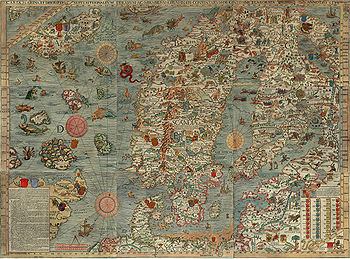 Following the death of his brother, he also let publish historical works that the brother had written. Olaus had already earlier written Carta marina
et Descriptio septemtrionalium terrarum ac mirabilium rerum in eis contentarum, diligentissime elaborata Anno Domini 1539 Veneciis liberalitate Reverendissimi Domini Ieronimi Quirini, which translates as "A Marine map and Description of the Northern Lands and of their Marvels, most carefully drawn up at Venice in the year 1539 through the generous assistance of the Most Honourable Lord and Patriarch Hieronymo Quirino" (Lynam 1949, 3).
The Italian title translates to "A little book, that more closely explains a map of the Nordic cold, beyond the Germanic sea located country, which presents its extremely peculiar, priorly known neither to Greeks or Latins, wonders of nature."
It included a map of Northern Europe with a map of Scandinavia
, which was rediscovered by Oscar Brenner in 1886 in the Munchen state library and shown to be the most accurate depiction of its time. The map is referred to as "carta marina", and consists of 9 parts, and is remarkably large: 125 cm tall and 170 cm wide.
Present day oceanographers rediscovered Olaus Magnus' eye for detail (disregarding the sea monsters) and a series of scientific publications followed on Olaus' truthful depiction of currents between Iceland and the Faroe Islands.
Sweden
Sweden , officially the Kingdom of Sweden , is a Nordic country on the Scandinavian Peninsula in Northern Europe. Sweden borders with Norway and Finland and is connected to Denmark by a bridge-tunnel across the Öresund....
ecclesiastic and writer
Writer
A writer is a person who produces literature, such as novels, short stories, plays, screenplays, poetry, or other literary art. Skilled writers are able to use language to portray ideas and images....
, who did pioneering work for the interest of Nordic
Nordic countries
The Nordic countries make up a region in Northern Europe and the North Atlantic which consists of Denmark, Finland, Iceland, Norway and Sweden and their associated territories, the Faroe Islands, Greenland and Åland...
people. He was reported as born in October 1490 in Östergötland
Östergötland
Östergötland, English exonym: East Gothland, is one of the traditional provinces of Sweden in the south of Sweden. It borders Småland, Västergötland, Närke, Södermanland, and the Baltic Sea. In older English literature, one might also encounter the Latinized version, Ostrogothia...
, and died on August 1, 1557. Magnus, Latin
Latin
Latin is an Italic language originally spoken in Latium and Ancient Rome. It, along with most European languages, is a descendant of the ancient Proto-Indo-European language. Although it is considered a dead language, a number of scholars and members of the Christian clergy speak it fluently, and...
for the Swedish
Swedish language
Swedish is a North Germanic language, spoken by approximately 10 million people, predominantly in Sweden and parts of Finland, especially along its coast and on the Åland islands. It is largely mutually intelligible with Norwegian and Danish...
Stor “great”, is a Latin family name taken personally, and not a personal epithet. His real surname was Månsson; son of Måns.
Biography
Johannes Magnus
Johannes Magnus was the last functioning Catholic Archbishop in Sweden, and also a theologian, genealogist, and historian.-Life:Johannes Magnus was born in Linköping, son of the burgess Måns Pedersson and his wife Kristina...
, he obtained several ecclesiastical preferments. Among them a canon
Canon (priest)
A canon is a priest or minister who is a member of certain bodies of the Christian clergy subject to an ecclesiastical rule ....
ry at Uppsala
Uppsala
- Economy :Today Uppsala is well established in medical research and recognized for its leading position in biotechnology.*Abbott Medical Optics *GE Healthcare*Pfizer *Phadia, an offshoot of Pharmacia*Fresenius*Q-Med...
and Linköping, and the archdeacon
Archdeacon
An archdeacon is a senior clergy position in Anglicanism, Syrian Malabar Nasrani, Chaldean Catholic, and some other Christian denominations, above that of most clergy and below a bishop. In the High Middle Ages it was the most senior diocesan position below a bishop in the Roman Catholic Church...
ry of Strängnäs
Strängnäs
Strängnäs is a locality and the seat of Strängnäs Municipality, Södermanland County, Sweden with 12,296 inhabitants in 2005. It is located by Lake Mälaren and is the episcopal see of the Diocese of Strängnäs, a former Roman Catholic and present Lutheran Diocese, with the Strängnäs Cathedral, built...
. He was furthermore employed on various diplomatic services after his mission to Rome in 1524, on behalf of Gustav I of Sweden
Gustav I of Sweden
Gustav I of Sweden, born Gustav Eriksson of the Vasa noble family and later known simply as Gustav Vasa , was King of Sweden from 1523 until his death....
(Vasa), to procure the appointment of Olaus Magnus' brother, Johannes Magnus as archbishop of Uppsala
Archbishop of Uppsala
The Archbishop of Uppsala has been the primate in Sweden in an unbroken succession since 1164, first during the Catholic era, and from the 1530s and onward under the Lutheran church.- Historical overview :...
. He remained abroad dealing with foreign affairs and is known to have sent home a document that contained agreed trade-relations with the Netherlands. On the success of the reformation
Protestant Reformation
The Protestant Reformation was a 16th-century split within Western Christianity initiated by Martin Luther, John Calvin and other early Protestants. The efforts of the self-described "reformers", who objected to the doctrines, rituals and ecclesiastical structure of the Roman Catholic Church, led...
in Sweden, his attachment to the Catholic church led him to stay abroad for good where accompanied his brother in Poland. They were both exiled and Magnus' Swedish belongings were confiscated in 1530.
Settling in Rome
Rome
Rome is the capital of Italy and the country's largest and most populated city and comune, with over 2.7 million residents in . The city is located in the central-western portion of the Italian Peninsula, on the Tiber River within the Lazio region of Italy.Rome's history spans two and a half...
in 1537, he acted as his brother's secretary. At the death of the brother in 1544, Pope Paul III
Pope Paul III
Pope Paul III , born Alessandro Farnese, was Pope of the Roman Catholic Church from 1534 to his death in 1549. He came to the papal throne in an era following the sack of Rome in 1527 and rife with uncertainties in the Catholic Church following the Protestant Reformation...
issued him as his brother's successor as Archbishop of Uppsala
Archbishop of Uppsala
The Archbishop of Uppsala has been the primate in Sweden in an unbroken succession since 1164, first during the Catholic era, and from the 1530s and onward under the Lutheran church.- Historical overview :...
; admittedly nothing more than a title, as Sweden was not Catholic anymore and Olaus was banned. In 1545, Pope Paul III
Pope Paul III
Pope Paul III , born Alessandro Farnese, was Pope of the Roman Catholic Church from 1534 to his death in 1549. He came to the papal throne in an era following the sack of Rome in 1527 and rife with uncertainties in the Catholic Church following the Protestant Reformation...
sent him to the council of Trent
Council of Trent
The Council of Trent was the 16th-century Ecumenical Council of the Roman Catholic Church. It is considered to be one of the Church's most important councils. It convened in Trent between December 13, 1545, and December 4, 1563 in twenty-five sessions for three periods...
where he attended meetings until 1549. Later, he became canon of St. Lambert's Cathedral
St. Lambert's Cathedral, Liège
St. Lambert's Cathedral, Liège was the cathedral of Liège, Belgium, until 1794, when its destruction began...
in Liège. King Sigismund I of Poland
Sigismund I the Old
Sigismund I of Poland , of the Jagiellon dynasty, reigned as King of Poland and also as the Grand Duke of Lithuania from 1506 until 1548...
offered him a canonry at Poznań
Poznan
Poznań is a city on the Warta river in west-central Poland, with a population of 556,022 in June 2009. It is among the oldest cities in Poland, and was one of the most important centres in the early Polish state, whose first rulers were buried at Poznań's cathedral. It is sometimes claimed to be...
and he spent the remainder of his life with the monastery of St Brigitta
Bridgettines
The Bridgettine or Birgittine Order is a monastic religious order of Augustinian nuns, Religious Sisters and monks founded by Saint Birgitta of Sweden in approximately 1350, and approved by Pope Urban V in 1370...
in Rome, where he subsisted on a pension assigned him by the Pope. He died the 1st of August 1558 at the age of 67.
Works
He is best remembered as the author of the famous Historia de Gentibus Septentrionalibus (History of the Northern Peoples), printed in Rome 1555, a patriotic work of folkloreFolklore
Folklore consists of legends, music, oral history, proverbs, jokes, popular beliefs, fairy tales and customs that are the traditions of a culture, subculture, or group. It is also the set of practices through which those expressive genres are shared. The study of folklore is sometimes called...
and history
History
History is the discovery, collection, organization, and presentation of information about past events. History can also mean the period of time after writing was invented. Scholars who write about history are called historians...
which long remained for the rest of Europe the authority on Swedish matters. This text on dark winters, violent currents and beasts of the sea rightly amazed the rest of Europe, who didn't know Sweden had sea monsters. It was translated into Italian (1565), German (1567), English (1658) and Dutch (1665), and not until 1909 into Swedish. Abridgments of the work appeared also at Antwerp (1558 and 1562), Paris (1561), Amsterdam (1586), Frankfort (1618) and Leiden (1652). It is still today a valuable repertory of much curious information in regard to Scandinavian customs and folklore.
A translation of the Latin title page goes:
"Olaus Magnus Gothus', the Upsala Archbishops', history of the nordic people's different manners and camps, also about the wonderful differences in customs, holy practices, superstitions, bodily exercises, government and food keeping; further on war, buildings and wonderful aids; further on metals and different kinds of animals, that live in these neighbourhoods (...)".
Carta marina
The Carta marina , created by Olaus Magnus in the 16th century, is the earliest map of the Nordic countries that gives details and placenames...
et Descriptio septemtrionalium terrarum ac mirabilium rerum in eis contentarum, diligentissime elaborata Anno Domini 1539 Veneciis liberalitate Reverendissimi Domini Ieronimi Quirini, which translates as "A Marine map and Description of the Northern Lands and of their Marvels, most carefully drawn up at Venice in the year 1539 through the generous assistance of the Most Honourable Lord and Patriarch Hieronymo Quirino" (Lynam 1949, 3).
The Italian title translates to "A little book, that more closely explains a map of the Nordic cold, beyond the Germanic sea located country, which presents its extremely peculiar, priorly known neither to Greeks or Latins, wonders of nature."
It included a map of Northern Europe with a map of Scandinavia
Scandinavia
Scandinavia is a cultural, historical and ethno-linguistic region in northern Europe that includes the three kingdoms of Denmark, Norway and Sweden, characterized by their common ethno-cultural heritage and language. Modern Norway and Sweden proper are situated on the Scandinavian Peninsula,...
, which was rediscovered by Oscar Brenner in 1886 in the Munchen state library and shown to be the most accurate depiction of its time. The map is referred to as "carta marina", and consists of 9 parts, and is remarkably large: 125 cm tall and 170 cm wide.
Present day oceanographers rediscovered Olaus Magnus' eye for detail (disregarding the sea monsters) and a series of scientific publications followed on Olaus' truthful depiction of currents between Iceland and the Faroe Islands.