

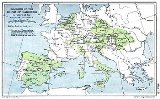
Southern Netherlands

Encyclopedia
Southern Netherlands were a part of the Low Countries
controlled by Spain
(Spanish Netherlands, , 1579–1713), Austria
(Austrian Netherlands, , , 1713–94) and annexed by France
(1794–1815). This region comprised most of modern Belgium
(except for three Lower-Rhenish
territories: the Prince-Bishopric of Liège, the Imperial Abbey of Stavelot-Malmedy and the County of Bouillon) and Luxembourg
(including the homonym
ous present Belgian province
), and in addition some parts of the Netherlands
(namely the Duchy of Limburg
now split in a Dutch
and Belgian
part) as well as, until 1678, most of the present Nord-Pas-de-Calais region in northern France. Unlike French Burgundy and the republican Northern Netherlands, these allodial
states kept access to the Burgundian Circle
of the Holy Roman Empire
until its end.
class. It was the merchant economy
which made them wealthy and the Spanish attempts at increasing taxation, to finance the Habsburg wars1, was a major factor in their proud defence of ancient privileges. This together with resistance to the religious intolerance of the Catholic Spanish monarchy
led to a general rebellion of the Netherlands against Spanish rule in the 1570s. Although the northern seven provinces, led by Holland and Zeeland
, established their independence as the United Provinces
after 1581, the southern Netherlands were reconquered by the Spanish general Alexander Farnese, Duke of Parma
. The Southern Netherlands passed to the Austrian Habsburgs after the War of the Spanish Succession
in the early 18th century. Under Austrian rule, the provinces' defence of their ancient privileges proved as troublesome to the reforming Emperor Joseph II, Holy Roman Emperor
as it had to his ancestor Philip II
two centuries before, leading to a major rebellion in 1789–1790. The Austrian Netherlands were ultimately lost to the French Revolutionary armies
, and annexed to France. Following the war, Austria's loss of the territories was confirmed, and they were joined with the northern Netherlands as a single kingdom under the House of Orange at the 1815 Congress of Vienna
.
The Congress first joined the Southern Netherlands to the United Kingdom of the Netherlands
under the House of Orange-Nassau
, but with the south-eastern third of Luxembourg Province made into the autonomous Grand Duchy of Luxembourg
, because it was claimed by both the Netherlands and Prussia
.
In 1830 the predominantly Roman Catholic southern half became independent as the Kingdom of Belgium
(the northern half being predominantly Calvinist
). The autonomy of Luxembourg was recognised in 1839, but an instrument to that effect was not signed until 1867. The King of the Netherlands was Grand Duke of Luxembourg until 1890, when William III
was succeeded by his daughter, Wilhelmina of the Netherlands
– but Luxembourg still followed the Salic law
at the time, which forbade a woman to rule in her own right, so the union of the Dutch and Luxembourger crowns then ended. The north-western two-thirds of the original Luxembourg remains a province of Belgium. The flags of the Grand Duchy of Luxembourg ( ) and of the Kingdom of the Netherlands
( ) are still distinguished only in the tint
of their colours (although the former is not derived from the latter).
controlled by Spain
from the sixteenth to the eighteenth century, inherited from the Dukes of Burgundy. Although the territory of the Duchy of Burgundy itself remained in the hands of France, the Habsburgs remained in control of the title of Duke of Burgundy and the other parts of the Burgundian inheritance, notably the Low Countries and the Free County of Burgundy in the Holy Roman Empire. They often used the term Burgundy to refer to it (e.g. in the name of the Imperial Circle it was grouped into), until the late 18th century, when the Austrian Netherlands were lost to French Republic.
When part of the Netherlands separated from Spanish rule and became the United Provinces
in 1581 the remainder of the area became known as the Spanish Netherlands and was still under the control of Spain
. This region comprised modern Belgium
, Luxembourg
as well as part of northern France.
The Spanish Netherlands originally consisted of the whole of the
The capital was Brussels
in Brabant.
In the early seventeenth century, there was a flourishing court at Brussels
, which was under the government of King Philip III's
half-sister Archduchess Isabella
and her husband, Archduke Albert of Austria. Among the artists who emerged from the court of the "Archdukes", as they were known, was Peter Paul Rubens. Under the Archdukes, the Spanish Netherlands actually had formal independence from Spain, but always remained unofficially within the Spanish sphere of influence, and with Albert's death in 1621 they returned to formal Spanish control, although the childless Isabella remained on as Governor until her death in 1633.
The failing wars intended to regain the 'heretical' Northern Netherlands meant significant loss of (still mainly Catholic) territories in the north, which was consolidated in the 1648 Westphalian peace, and given the peculiar, inferior status of Generality Lands
(jointly ruled by the United Republic, not admitted as member provinces) : Zeeuws-Vlaanderen
(south of the river Scheldt
), the present Dutch province of Noord-Brabant and Maastricht
(in the present Dutch province of Limburg).
In the wars between the French and the Spanish in the seventeenth century, the territory of the Spanish Netherlands was repeatedly invaded, with portions seized by France. The French annexed Artois
and Cambrai
by the Treaty of the Pyrenees
of 1659, and Dunkirk was ceded to the English. By the Treaties of Aix-la-Chapelle
(ending the War of Devolution
in 1668) and Nijmegen (ending the Franco-Dutch War
in 1678), further territory up to the current Franco-Belgian border was ceded, including most of Walloon Flanders
(around the city of Lille
), as well as much of Hainault
(including Valenciennes
). Later, in the War of the Reunions
and the Nine Years' War, France annexed other parts of the region.
 Under the Treaty of Utrecht
(1713), following the War of the Spanish Succession
, what was left of the Spanish Netherlands was ceded to Austria and thus became known as the Austrian Netherlands. However, the Austrians themselves generally had little interest in the region (aside from a short-lived attempt by Emperor Charles VI
to compete with British and Dutch trade through the Ostend Company
), and the fortresses along the border (the Barrier Fortresses
) were, by treaty, garrisoned with Dutch troops. The area had, in fact, been given to Austria largely at British and Dutch insistence, as these powers feared potential French domination of the region.
Throughout the latter part of the eighteenth century, the principal foreign policy goal of the Habsburg rulers was to exchange the Austrian Netherlands for Bavaria
, which would round out Habsburg possessions in southern Germany. In the 1757 Treaty of Versailles
, Austria agreed to the creation of an independent state in the Southern Netherlands ruled by Philip, Duke of Parma
and garrisoned by French troops in exchange for French help in recovering Silesia
. However the agreement was later revoked by the Third Treaty of Versailles and Austrian rule continued.
In 1784 Joseph II, Holy Roman Emperor
did take up the long-standing grudge of Antwerp, whose once-flourishing trade was destroyed by the permanent closing of the Scheldt
, and demanded that the Dutch Republic
open the river to navigation. However, the Emperor's stance was far from militant, and he called off hostilities after the so-called Kettle War
, known by that name because its only "casualty" was a kettle. Though Joseph did secure in the 1785 Treaty of Fontainebleau
that the Southern Netherlands would be compensated by the Dutch Republic for the continued closing the Scheldt, this achievement failed to gain him much popularity.
The Austrian Netherlands rebelled against Austria in 1788 as a result of Joseph II's
centralizing policies. The different provinces established the United States of Belgium
(January 1790). Austrian imperial power was restored by Joseph's brother and successor, Leopold II
by the end of 1790.
, in 1794 the entire region (including territories that were never under Habsburg rule, like the Bishopric of Liège
) was overrun by France ending the existence of this territory as Spanish/Austrian Netherlands. This was resisted by the Flamingant
movement organized by Roman Catholic clergy
. It became an integral part of France, and was divided into départements:
Austria confirmed the loss of its territories by the Treaty of Campo Formio
, in 1797.
After the defeat of Napoleon in 1815 the region was given to the United Kingdom of the Netherlands
, but after the Belgian Revolution
of 1830 it separated to become the independent state of Belgium
.
Low Countries
The Low Countries are the historical lands around the low-lying delta of the Rhine, Scheldt, and Meuse rivers, including the modern countries of Belgium, the Netherlands, Luxembourg and parts of northern France and western Germany....
controlled by Spain
Spain
Spain , officially the Kingdom of Spain languages]] under the European Charter for Regional or Minority Languages. In each of these, Spain's official name is as follows:;;;;;;), is a country and member state of the European Union located in southwestern Europe on the Iberian Peninsula...
(Spanish Netherlands, , 1579–1713), Austria
Austria
Austria , officially the Republic of Austria , is a landlocked country of roughly 8.4 million people in Central Europe. It is bordered by the Czech Republic and Germany to the north, Slovakia and Hungary to the east, Slovenia and Italy to the south, and Switzerland and Liechtenstein to the...
(Austrian Netherlands, , , 1713–94) and annexed by France
France
The French Republic , The French Republic , The French Republic , (commonly known as France , is a unitary semi-presidential republic in Western Europe with several overseas territories and islands located on other continents and in the Indian, Pacific, and Atlantic oceans. Metropolitan France...
(1794–1815). This region comprised most of modern Belgium
Belgium
Belgium , officially the Kingdom of Belgium, is a federal state in Western Europe. It is a founding member of the European Union and hosts the EU's headquarters, and those of several other major international organisations such as NATO.Belgium is also a member of, or affiliated to, many...
(except for three Lower-Rhenish
Lower Rhenish-Westphalian Circle
The Lower Rhenish–Westphalian Circle was an Imperial Circle of the Holy Roman Empire. It comprised territories of the former Duchy of Lower Lorraine, Frisia and the Westphalian part of the former Duchy of Saxony....
territories: the Prince-Bishopric of Liège, the Imperial Abbey of Stavelot-Malmedy and the County of Bouillon) and Luxembourg
Luxembourg
Luxembourg , officially the Grand Duchy of Luxembourg , is a landlocked country in western Europe, bordered by Belgium, France, and Germany. It has two principal regions: the Oesling in the North as part of the Ardennes massif, and the Gutland in the south...
(including the homonym
Homonym
In linguistics, a homonym is, in the strict sense, one of a group of words that often but not necessarily share the same spelling and the same pronunciation but have different meanings...
ous present Belgian province
Luxembourg (Belgium)
Luxembourg is the southernmost province of Wallonia and of Belgium. It borders on the Grand Duchy of Luxembourg, France, and the Belgian provinces of Namur and Liège. Its capital is Arlon, in the south-east of the province.It has an area of 4,443 km², making it the largest Belgian province...
), and in addition some parts of the Netherlands
Netherlands
The Netherlands is a constituent country of the Kingdom of the Netherlands, located mainly in North-West Europe and with several islands in the Caribbean. Mainland Netherlands borders the North Sea to the north and west, Belgium to the south, and Germany to the east, and shares maritime borders...
(namely the Duchy of Limburg
Duchy of Limburg
The Duchy of Limburg, situated in the Low Countries between the river Meuse and the city of Aachen, was a state of the Holy Roman Empire. Its territory is now divided between the Belgian provinces of Liège and Limburg , the Dutch province of Limburg , and a small part of North Rhine-Westphalia in...
now split in a Dutch
Limburg (Netherlands)
Limburg is the southernmost of the twelve provinces of the Netherlands. It is located in the southeastern part of the country and bordered by the province of Gelderland to the north, Germany to the east, Belgium to the south and part of the west, andthe Dutch province of North Brabant partly to...
and Belgian
Limburg (Belgium)
Limburg is the easternmost province of modern Flanders, which is one of the three main political and cultural sub-divisions of modern Belgium. It is located west of the river Meuse . It borders on the Dutch provinces of North Brabant and Limburg and the Belgian provinces of Liège, Flemish Brabant...
part) as well as, until 1678, most of the present Nord-Pas-de-Calais region in northern France. Unlike French Burgundy and the republican Northern Netherlands, these allodial
Allodial title
Allodial title constitutes ownership of real property that is independent of any superior landlord, but it should not be confused with anarchy as the owner of allodial land is not independent of his sovereign...
states kept access to the Burgundian Circle
Burgundian Circle
The Burgundian Circle was an Imperial Circle of the Holy Roman Empire created in 1512 and significantly enlarged in 1548. In addition to the Free County of Burgundy , the circle roughly covered the Low Countries, i.e...
of the Holy Roman Empire
Holy Roman Empire
The Holy Roman Empire was a realm that existed from 962 to 1806 in Central Europe.It was ruled by the Holy Roman Emperor. Its character changed during the Middle Ages and the Early Modern period, when the power of the emperor gradually weakened in favour of the princes...
until its end.
Place in the broader Netherlands
As they were very wealthy, the Netherlands in general were a jewel in the ever debt-burdened Habsburg crown, but unlike others of the Habsburg dominions, they were led by a merchantMerchant
A merchant is a businessperson who trades in commodities that were produced by others, in order to earn a profit.Merchants can be one of two types:# A wholesale merchant operates in the chain between producer and retail merchant...
class. It was the merchant economy
Merchant capitalism
Merchant capitalism is a term used by economic historians to refer to the earliest phase in the development of capitalism as an economic and social system. Early forms of merchant capitalism were developed in the medieval Islamic world from the 9th century, and in medieval Europe from the 12th...
which made them wealthy and the Spanish attempts at increasing taxation, to finance the Habsburg wars1, was a major factor in their proud defence of ancient privileges. This together with resistance to the religious intolerance of the Catholic Spanish monarchy
Monarchy
A monarchy is a form of government in which the office of head of state is usually held until death or abdication and is often hereditary and includes a royal house. In some cases, the monarch is elected...
led to a general rebellion of the Netherlands against Spanish rule in the 1570s. Although the northern seven provinces, led by Holland and Zeeland
Zeeland
Zeeland , also called Zealand in English, is the westernmost province of the Netherlands. The province, located in the south-west of the country, consists of a number of islands and a strip bordering Belgium. Its capital is Middelburg. With a population of about 380,000, its area is about...
, established their independence as the United Provinces
Dutch Republic
The Dutch Republic — officially known as the Republic of the Seven United Netherlands , the Republic of the United Netherlands, or the Republic of the Seven United Provinces — was a republic in Europe existing from 1581 to 1795, preceding the Batavian Republic and ultimately...
after 1581, the southern Netherlands were reconquered by the Spanish general Alexander Farnese, Duke of Parma
Alexander Farnese, Duke of Parma
Alexander Farnese was Duke of Parma and Piacenza from 1586 to 1592, and Governor of the Spanish Netherlands from 1578 to 1592.-Biography:...
. The Southern Netherlands passed to the Austrian Habsburgs after the War of the Spanish Succession
War of the Spanish Succession
The War of the Spanish Succession was fought among several European powers, including a divided Spain, over the possible unification of the Kingdoms of Spain and France under one Bourbon monarch. As France and Spain were among the most powerful states of Europe, such a unification would have...
in the early 18th century. Under Austrian rule, the provinces' defence of their ancient privileges proved as troublesome to the reforming Emperor Joseph II, Holy Roman Emperor
Joseph II, Holy Roman Emperor
Joseph II was Holy Roman Emperor from 1765 to 1790 and ruler of the Habsburg lands from 1780 to 1790. He was the eldest son of Empress Maria Theresa and her husband, Francis I...
as it had to his ancestor Philip II
Philip II of Spain
Philip II was King of Spain, Portugal, Naples, Sicily, and, while married to Mary I, King of England and Ireland. He was lord of the Seventeen Provinces from 1556 until 1581, holding various titles for the individual territories such as duke or count....
two centuries before, leading to a major rebellion in 1789–1790. The Austrian Netherlands were ultimately lost to the French Revolutionary armies
French Revolutionary Wars
The French Revolutionary Wars were a series of major conflicts, from 1792 until 1802, fought between the French Revolutionary government and several European states...
, and annexed to France. Following the war, Austria's loss of the territories was confirmed, and they were joined with the northern Netherlands as a single kingdom under the House of Orange at the 1815 Congress of Vienna
Congress of Vienna
The Congress of Vienna was a conference of ambassadors of European states chaired by Klemens Wenzel von Metternich, and held in Vienna from September, 1814 to June, 1815. The objective of the Congress was to settle the many issues arising from the French Revolutionary Wars, the Napoleonic Wars,...
.
The Congress first joined the Southern Netherlands to the United Kingdom of the Netherlands
United Kingdom of the Netherlands
United Kingdom of the Netherlands is the unofficial name used to refer to Kingdom of the Netherlands during the period after it was first created from part of the First French Empire and before the new kingdom of Belgium split out in 1830...
under the House of Orange-Nassau
House of Orange-Nassau
The House of Orange-Nassau , a branch of the European House of Nassau, has played a central role in the political life of the Netherlands — and at times in Europe — since William I of Orange organized the Dutch revolt against Spanish rule, which after the Eighty Years' War...
, but with the south-eastern third of Luxembourg Province made into the autonomous Grand Duchy of Luxembourg
Luxembourg
Luxembourg , officially the Grand Duchy of Luxembourg , is a landlocked country in western Europe, bordered by Belgium, France, and Germany. It has two principal regions: the Oesling in the North as part of the Ardennes massif, and the Gutland in the south...
, because it was claimed by both the Netherlands and Prussia
Prussia
Prussia was a German kingdom and historic state originating out of the Duchy of Prussia and the Margraviate of Brandenburg. For centuries, the House of Hohenzollern ruled Prussia, successfully expanding its size by way of an unusually well-organized and effective army. Prussia shaped the history...
.
In 1830 the predominantly Roman Catholic southern half became independent as the Kingdom of Belgium
Belgium
Belgium , officially the Kingdom of Belgium, is a federal state in Western Europe. It is a founding member of the European Union and hosts the EU's headquarters, and those of several other major international organisations such as NATO.Belgium is also a member of, or affiliated to, many...
(the northern half being predominantly Calvinist
Calvinism
Calvinism is a Protestant theological system and an approach to the Christian life...
). The autonomy of Luxembourg was recognised in 1839, but an instrument to that effect was not signed until 1867. The King of the Netherlands was Grand Duke of Luxembourg until 1890, when William III
William III of the Netherlands
William III was from 1849 King of the Netherlands and Grand Duke of Luxembourg until his death and the Duke of Limburg until the abolition of the Duchy in 1866.-Early life:William was born in Brussels as son of William II of the Netherlands and...
was succeeded by his daughter, Wilhelmina of the Netherlands
Wilhelmina of the Netherlands
Wilhelmina was Queen regnant of the Kingdom of the Netherlands from 1890 to 1948. She ruled the Netherlands for fifty-eight years, longer than any other Dutch monarch. Her reign saw World War I and World War II, the economic crisis of 1933, and the decline of the Netherlands as a major colonial...
– but Luxembourg still followed the Salic law
Salic law
Salic law was a body of traditional law codified for governing the Salian Franks in the early Middle Ages during the reign of King Clovis I in the 6th century...
at the time, which forbade a woman to rule in her own right, so the union of the Dutch and Luxembourger crowns then ended. The north-western two-thirds of the original Luxembourg remains a province of Belgium. The flags of the Grand Duchy of Luxembourg (
) and of the Kingdom of the NetherlandsKingdom of the Netherlands
The Kingdom of the Netherlands is a sovereign state and constitutional monarchy with territory in Western Europe and in the Caribbean. The four parts of the Kingdom—Aruba, Curaçao, the Netherlands, and Sint Maarten—are referred to as "countries", and participate on a basis of equality...
(
) are still distinguished only in the tintTint
In color theory, a tint is the mixture of a color with white.Tint may also refer to:* Tint control, an adjustment to correct for phase error in the picture color on a NTSC television set* Tint , an album by Merzbow...
of their colours (although the former is not derived from the latter).
Spanish Netherlands
The Spanish Netherlands (Dutch: Spaanse Nederlanden, Spanish: Países Bajos españoles) was a portion of the Low CountriesLow Countries
The Low Countries are the historical lands around the low-lying delta of the Rhine, Scheldt, and Meuse rivers, including the modern countries of Belgium, the Netherlands, Luxembourg and parts of northern France and western Germany....
controlled by Spain
Spanish Empire
The Spanish Empire comprised territories and colonies administered directly by Spain in Europe, in America, Africa, Asia and Oceania. It originated during the Age of Exploration and was therefore one of the first global empires. At the time of Habsburgs, Spain reached the peak of its world power....
from the sixteenth to the eighteenth century, inherited from the Dukes of Burgundy. Although the territory of the Duchy of Burgundy itself remained in the hands of France, the Habsburgs remained in control of the title of Duke of Burgundy and the other parts of the Burgundian inheritance, notably the Low Countries and the Free County of Burgundy in the Holy Roman Empire. They often used the term Burgundy to refer to it (e.g. in the name of the Imperial Circle it was grouped into), until the late 18th century, when the Austrian Netherlands were lost to French Republic.
When part of the Netherlands separated from Spanish rule and became the United Provinces
Dutch Republic
The Dutch Republic — officially known as the Republic of the Seven United Netherlands , the Republic of the United Netherlands, or the Republic of the Seven United Provinces — was a republic in Europe existing from 1581 to 1795, preceding the Batavian Republic and ultimately...
in 1581 the remainder of the area became known as the Spanish Netherlands and was still under the control of Spain
Spain
Spain , officially the Kingdom of Spain languages]] under the European Charter for Regional or Minority Languages. In each of these, Spain's official name is as follows:;;;;;;), is a country and member state of the European Union located in southwestern Europe on the Iberian Peninsula...
. This region comprised modern Belgium
Belgium
Belgium , officially the Kingdom of Belgium, is a federal state in Western Europe. It is a founding member of the European Union and hosts the EU's headquarters, and those of several other major international organisations such as NATO.Belgium is also a member of, or affiliated to, many...
, Luxembourg
Luxembourg
Luxembourg , officially the Grand Duchy of Luxembourg , is a landlocked country in western Europe, bordered by Belgium, France, and Germany. It has two principal regions: the Oesling in the North as part of the Ardennes massif, and the Gutland in the south...
as well as part of northern France.
The Spanish Netherlands originally consisted of the whole of the
- county of FlandersCounty of FlandersThe County of Flanders was one of the territories constituting the Low Countries. The county existed from 862 to 1795. It was one of the original secular fiefs of France and for centuries was one of the most affluent regions in Europe....
, including French- and Walloon FlandersWalloon FlandersWalloon Flanders is part of the County of Flanders.Walloon Flanders usually means the same territory, the bailiwick of Douai and the castelleny of Lille, but in two different periods :In the Spanish Low Countries, it was the part of Romance Flanders which signed the Union of Arras on January 6,... - county of ArtoisCounty of ArtoisThe County of Artois was an historic province of the Kingdom of France, held by the Dukes of Burgundy from 1384 until 1477/82, and a state of the Holy Roman Empire from 1493 until 1659....
- city of TournaiTournaiTournai is a Walloon city and municipality of Belgium located 85 kilometres southwest of Brussels, on the river Scheldt, in the province of Hainaut....
- CambraiCambraiCambrai is a commune in the Nord department in northern France. It is a sub-prefecture of the department.Cambrai is the seat of an archdiocese whose jurisdiction was immense during the Middle Ages. The territory of the Bishopric of Cambrai, roughly coinciding with the shire of Brabant, included...
(roughly the département Nord and the northern half of Pas-de-Calais in modern France) - duchy of Luxembourg
- duchy of LimburgDuchy of LimburgThe Duchy of Limburg, situated in the Low Countries between the river Meuse and the city of Aachen, was a state of the Holy Roman Empire. Its territory is now divided between the Belgian provinces of Liège and Limburg , the Dutch province of Limburg , and a small part of North Rhine-Westphalia in...
- county of HainautCounty of HainautThe County of Hainaut was a historical region in the Low Countries with its capital at Mons . In English sources it is often given the archaic spelling Hainault....
- county of Namur
- heerlijkheidHeerlijkheidA heerlijkheid was the basic administrative and judicial unit in rural areas in Dutch-speaking lands before 1800. It originated in the feudal subdivision of government authority in the Middle Ages. The closest English equivalents of the word are "seigniory" and "manor"...
2 of MechelenMechelenMechelen Footnote: Mechelen became known in English as 'Mechlin' from which the adjective 'Mechlinian' is derived...
(officially a county since 1490) - duchy of BrabantDuchy of BrabantThe Duchy of Brabant was a historical region in the Low Countries. Its territory consisted essentially of the three modern-day Belgian provinces of Flemish Brabant, Walloon Brabant and Antwerp, the Brussels-Capital Region and most of the present-day Dutch province of North Brabant.The Flag of...
- the Upper QuarterUpper GueldersUpper Guelders or Spanish Guelders was one of the four quarters in the Imperial Duchy of Guelders. In the Dutch Revolt, it was the only quarter that did not secede from the Habsburg Monarchy to become part of the Seven United Netherlands, but remained under Spanish rule during the Eighty Years'...
(Bovenkwartier) of the duchy of GueldersGueldersGuelders or Gueldres is the name of a historical county, later duchy of the Holy Roman Empire, located in the Low Countries.-Geography:...
(around VenloVenloVenlo is a municipality and a city in the southeastern Netherlands, next to the German border. It is situated in the province of Limburg.In 2001, the municipalities of Belfeld and Tegelen were merged into the municipality of Venlo. Tegelen was originally part of the Duchy of Jülich centuries ago,...
and RoermondRoermondRoermond is a city, a municipality, and a diocese in the southeastern part of the Netherlands.The city of Roermond is a historically important town, on the lower Roer at the east bank of the Meuse river. It received city rights in 1231...
, in the present province of Dutch LimburgLimburg (Netherlands)Limburg is the southernmost of the twelve provinces of the Netherlands. It is located in the southeastern part of the country and bordered by the province of Gelderland to the north, Germany to the east, Belgium to the south and part of the west, andthe Dutch province of North Brabant partly to...
, and the town of GeldernGeldernGeldern ) is a city in the northwest of the federal state North Rhine-Westphalia, Germany. It is part of the district of Cleves, which is part of the Düsseldorfadministrative region.-Location:...
in the present German district KleveKleve (district)Kleve or Kreis Kleve is a Kreis in northwestern North Rhine-Westphalia, Germany...
)
The capital was Brussels
Brussels
Brussels , officially the Brussels Region or Brussels-Capital Region , is the capital of Belgium and the de facto capital of the European Union...
in Brabant.
In the early seventeenth century, there was a flourishing court at Brussels
Brussels
Brussels , officially the Brussels Region or Brussels-Capital Region , is the capital of Belgium and the de facto capital of the European Union...
, which was under the government of King Philip III's
Philip III of Spain
Philip III , also known as Philip the Pious, was the King of Spain and King of Portugal and the Algarves, where he ruled as Philip II , from 1598 until his death...
half-sister Archduchess Isabella
Infanta Isabella Clara Eugenia of Spain
Isabella Clara Eugenia of Austria was sovereign of the Spanish Netherlands in the Low Countries and the north of modern France, together with her husband Albert. In some sources, she is referred to as Clara Isabella Eugenia...
and her husband, Archduke Albert of Austria. Among the artists who emerged from the court of the "Archdukes", as they were known, was Peter Paul Rubens. Under the Archdukes, the Spanish Netherlands actually had formal independence from Spain, but always remained unofficially within the Spanish sphere of influence, and with Albert's death in 1621 they returned to formal Spanish control, although the childless Isabella remained on as Governor until her death in 1633.
The failing wars intended to regain the 'heretical' Northern Netherlands meant significant loss of (still mainly Catholic) territories in the north, which was consolidated in the 1648 Westphalian peace, and given the peculiar, inferior status of Generality Lands
Generality Lands
The Generality Lands, Lands of the Generality or Common Lands were about one fifth of the territories of the United Provinces of the Netherlands, that were directly governed by the States-General...
(jointly ruled by the United Republic, not admitted as member provinces) : Zeeuws-Vlaanderen
Zeeuws-Vlaanderen
Zeelandic Flanders is the southernmost region of the province of Zeeland in south-western Netherlands. It lies south of the Western Scheldt that separates the region from the remainder of Zeeland to the north...
(south of the river Scheldt
Scheldt
The Scheldt is a 350 km long river in northern France, western Belgium and the southwestern part of the Netherlands...
), the present Dutch province of Noord-Brabant and Maastricht
Maastricht
Maastricht is situated on both sides of the Meuse river in the south-eastern part of the Netherlands, on the Belgian border and near the German border...
(in the present Dutch province of Limburg).
In the wars between the French and the Spanish in the seventeenth century, the territory of the Spanish Netherlands was repeatedly invaded, with portions seized by France. The French annexed Artois
Artois
Artois is a former province of northern France. Its territory has an area of around 4000 km² and a population of about one million. Its principal cities are Arras , Saint-Omer, Lens and Béthune.-Location:...
and Cambrai
Cambrai
Cambrai is a commune in the Nord department in northern France. It is a sub-prefecture of the department.Cambrai is the seat of an archdiocese whose jurisdiction was immense during the Middle Ages. The territory of the Bishopric of Cambrai, roughly coinciding with the shire of Brabant, included...
by the Treaty of the Pyrenees
Treaty of the Pyrenees
The Treaty of the Pyrenees was signed to end the 1635 to 1659 war between France and Spain, a war that was initially a part of the wider Thirty Years' War. It was signed on Pheasant Island, a river island on the border between the two countries...
of 1659, and Dunkirk was ceded to the English. By the Treaties of Aix-la-Chapelle
Treaty of Aix-la-Chapelle (1668)
The Treaty of Aix-la-Chapelle or Treaty of Aachen was signed on May 2, 1668 in Aachen. It ended the war of Devolution between France and Spain. It was mediated by the Triple Alliance of England, the Dutch Republic and Sweden at the first Congress of Aix-la-Chapelle...
(ending the War of Devolution
War of Devolution
The War of Devolution saw Louis XIV's French armies overrun the Habsburg-controlled Spanish Netherlands and the Franche-Comté, but forced to give most of it back by a Triple Alliance of England, Sweden, and the Dutch Republic in the Treaty of Aix-la-Chapelle.-Background:Louis's claims to the...
in 1668) and Nijmegen (ending the Franco-Dutch War
Franco-Dutch War
The Franco-Dutch War, often called simply the Dutch War was a war fought by France, Sweden, the Bishopric of Münster, the Archbishopric of Cologne and England against the United Netherlands, which were later joined by the Austrian Habsburg lands, Brandenburg and Spain to form a quadruple alliance...
in 1678), further territory up to the current Franco-Belgian border was ceded, including most of Walloon Flanders
Walloon Flanders
Walloon Flanders is part of the County of Flanders.Walloon Flanders usually means the same territory, the bailiwick of Douai and the castelleny of Lille, but in two different periods :In the Spanish Low Countries, it was the part of Romance Flanders which signed the Union of Arras on January 6,...
(around the city of Lille
Lille
Lille is a city in northern France . It is the principal city of the Lille Métropole, the fourth-largest metropolitan area in the country behind those of Paris, Lyon and Marseille. Lille is situated on the Deûle River, near France's border with Belgium...
), as well as much of Hainault
County of Hainaut
The County of Hainaut was a historical region in the Low Countries with its capital at Mons . In English sources it is often given the archaic spelling Hainault....
(including Valenciennes
Valenciennes
Valenciennes is a commune in the Nord department in northern France.It lies on the Scheldt river. Although the city and region had seen a steady decline between 1975 and 1990, it has since rebounded...
). Later, in the War of the Reunions
War of the Reunions
The War of the Reunions was a short conflict between France and Spain and its allies. It was fueled by the long-running desire of Louis XIV to conquer new lands, many of them comprising part of the Spanish Netherlands, along France's northern and eastern borders...
and the Nine Years' War, France annexed other parts of the region.
Austrian Netherlands
Treaty of Utrecht
The Treaty of Utrecht, which established the Peace of Utrecht, comprises a series of individual peace treaties, rather than a single document, signed by the belligerents in the War of Spanish Succession, in the Dutch city of Utrecht in March and April 1713...
(1713), following the War of the Spanish Succession
War of the Spanish Succession
The War of the Spanish Succession was fought among several European powers, including a divided Spain, over the possible unification of the Kingdoms of Spain and France under one Bourbon monarch. As France and Spain were among the most powerful states of Europe, such a unification would have...
, what was left of the Spanish Netherlands was ceded to Austria and thus became known as the Austrian Netherlands. However, the Austrians themselves generally had little interest in the region (aside from a short-lived attempt by Emperor Charles VI
Charles VI, Holy Roman Emperor
Charles VI was the penultimate Habsburg sovereign of the Habsburg Empire. He succeeded his elder brother, Joseph I, as Holy Roman Emperor, King of Bohemia , Hungary and Croatia , Archduke of Austria, etc., in 1711...
to compete with British and Dutch trade through the Ostend Company
Ostend Company
The Imperial Ostend Company was an Austrian private trading company established in 1717 to trade with the East and West Indies. For a few years it provided strong competition to the traditional colonial trading companies...
), and the fortresses along the border (the Barrier Fortresses
Barrier Treaty
The "Barrier Treaties" were the names of three agreements signed and ratified during or immediately after the War of Spanish Succession.-First:...
) were, by treaty, garrisoned with Dutch troops. The area had, in fact, been given to Austria largely at British and Dutch insistence, as these powers feared potential French domination of the region.
Throughout the latter part of the eighteenth century, the principal foreign policy goal of the Habsburg rulers was to exchange the Austrian Netherlands for Bavaria
Bavaria
Bavaria, formally the Free State of Bavaria is a state of Germany, located in the southeast of Germany. With an area of , it is the largest state by area, forming almost 20% of the total land area of Germany...
, which would round out Habsburg possessions in southern Germany. In the 1757 Treaty of Versailles
Treaty of Versailles (1757)
The Treaty of Versailles was a diplomatic agreement signed between Austria and France at Versailles Palace on 1 May 1757 during the Seven Years' War. The agreement expanded on the First Treaty of Versailles from the previous year which had established the Franco-Austrian Alliance...
, Austria agreed to the creation of an independent state in the Southern Netherlands ruled by Philip, Duke of Parma
Philip, Duke of Parma
Philip of Spain was Duke of Parma from 1748 to 1765. He founded the House of Bourbon-Parma , a cadet line of the Spanish branch of the dynasty...
and garrisoned by French troops in exchange for French help in recovering Silesia
Silesia
Silesia is a historical region of Central Europe located mostly in Poland, with smaller parts also in the Czech Republic, and Germany.Silesia is rich in mineral and natural resources, and includes several important industrial areas. Silesia's largest city and historical capital is Wrocław...
. However the agreement was later revoked by the Third Treaty of Versailles and Austrian rule continued.
In 1784 Joseph II, Holy Roman Emperor
Joseph II, Holy Roman Emperor
Joseph II was Holy Roman Emperor from 1765 to 1790 and ruler of the Habsburg lands from 1780 to 1790. He was the eldest son of Empress Maria Theresa and her husband, Francis I...
did take up the long-standing grudge of Antwerp, whose once-flourishing trade was destroyed by the permanent closing of the Scheldt
Scheldt
The Scheldt is a 350 km long river in northern France, western Belgium and the southwestern part of the Netherlands...
, and demanded that the Dutch Republic
Dutch Republic
The Dutch Republic — officially known as the Republic of the Seven United Netherlands , the Republic of the United Netherlands, or the Republic of the Seven United Provinces — was a republic in Europe existing from 1581 to 1795, preceding the Batavian Republic and ultimately...
open the river to navigation. However, the Emperor's stance was far from militant, and he called off hostilities after the so-called Kettle War
Kettle War
The Kettle War is the nickname given to a short war or incident between the troops of the Republic of the Seven Netherlands and the Holy Roman Empire that began on 8 October 1784...
, known by that name because its only "casualty" was a kettle. Though Joseph did secure in the 1785 Treaty of Fontainebleau
Treaty of Fontainebleau (1785)
The Treaty of Fontainebleau was signed on November 8, 1785 in Fontainebleau between Holy Roman Emperor Joseph II, ruler of the Habsburg Monarchy, and the States-General of the United Provinces. Based on the terms of the accord, the United Provinces was permitted to maintain sovereignty over the...
that the Southern Netherlands would be compensated by the Dutch Republic for the continued closing the Scheldt, this achievement failed to gain him much popularity.
The Austrian Netherlands rebelled against Austria in 1788 as a result of Joseph II's
Joseph II, Holy Roman Emperor
Joseph II was Holy Roman Emperor from 1765 to 1790 and ruler of the Habsburg lands from 1780 to 1790. He was the eldest son of Empress Maria Theresa and her husband, Francis I...
centralizing policies. The different provinces established the United States of Belgium
United States of Belgium
The United States of Belgium, part of Brabant.In October, he invaded Brabant and captured Turnhout, defeating the Austrians in the Battle of Turnhout on October 27. Ghent was taken on November 13, and on November 17 the imperial regents Albert of Saxony and Archduchess Maria Christina fled Brussels...
(January 1790). Austrian imperial power was restored by Joseph's brother and successor, Leopold II
Leopold II, Holy Roman Emperor
Leopold II , born Peter Leopold Joseph Anton Joachim Pius Gotthard, was Holy Roman Emperor and King of Hungary and Bohemia from 1790 to 1792, Archduke of Austria and Grand Duke of Tuscany from 1765 to 1790. He was a son of Emperor Francis I and his wife, Empress Maria Theresa...
by the end of 1790.
French annexation
After the French RevolutionFrench Revolution
The French Revolution , sometimes distinguished as the 'Great French Revolution' , was a period of radical social and political upheaval in France and Europe. The absolute monarchy that had ruled France for centuries collapsed in three years...
, in 1794 the entire region (including territories that were never under Habsburg rule, like the Bishopric of Liège
Bishopric of Liège
The Bishopric of Liège or Prince-Bishopric of Liège was a state of the Holy Roman Empire in the Low Countries in present Belgium. It acquired its status as a prince-bishopric between 980 and 985 when Bishop Notger, who had been the bishop of Liege since 972, acquired the status of Prince-Bishop...
) was overrun by France ending the existence of this territory as Spanish/Austrian Netherlands. This was resisted by the Flamingant
Flamingant
The Dutch and French word flamingant refers to all activists of the Flemish movement and was initially used as a pejorative term by Belgicists to indicate nationalist Flemish people. It may be derived from Flamins, the Walloon word for Flemings. The word can be equally used as an adjective or...
movement organized by Roman Catholic clergy
Clergy
Clergy is the generic term used to describe the formal religious leadership within a given religion. A clergyman, churchman or cleric is a member of the clergy, especially one who is a priest, preacher, pastor, or other religious professional....
. It became an integral part of France, and was divided into départements:
- Deux-NèthesDeux-NèthesDeux-Nèthes is the name of a département of the First French Empire in present Belgium and the Netherlands. It is named after two branches of the river Nete. The southern part of its territory corresponds more or less with the present Belgian province Antwerp....
- Dyle
- Escaut
- ForêtsForêtsForêts was a département of the French First Republic, and later the First French Empire, in present Belgium, Luxembourg and Germany. Its name, meaning 'forests', comes from the Ardennes forests. It was formed on 24 October 1795, after the Southern Netherlands had been annexed by France on 1...
- Jemmape
- Lys
- Meuse-InférieureMeuse-InférieureMeuse-Inférieure is the name of a département of the First French Empire in present Belgium, Netherlands and Germany. It is named after the river Meuse. Its capital was Maastricht....
- Ourthe
- Roer
- Sambre-et-MeuseSambre-et-MeuseSambre-et-Meuse was the name of a département of the First French Empire in present Belgium. It was named after the rivers Sambre and Meuse. Its capital was Namur....
Austria confirmed the loss of its territories by the Treaty of Campo Formio
Treaty of Campo Formio
The Treaty of Campo Formio was signed on 18 October 1797 by Napoleon Bonaparte and Count Philipp von Cobenzl as representatives of revolutionary France and the Austrian monarchy...
, in 1797.
After the defeat of Napoleon in 1815 the region was given to the United Kingdom of the Netherlands
United Kingdom of the Netherlands
United Kingdom of the Netherlands is the unofficial name used to refer to Kingdom of the Netherlands during the period after it was first created from part of the First French Empire and before the new kingdom of Belgium split out in 1830...
, but after the Belgian Revolution
Belgian Revolution
The Belgian Revolution was the conflict which led to the secession of the Southern provinces from the United Kingdom of the Netherlands and established an independent Kingdom of Belgium....
of 1830 it separated to become the independent state of Belgium
Belgium
Belgium , officially the Kingdom of Belgium, is a federal state in Western Europe. It is a founding member of the European Union and hosts the EU's headquarters, and those of several other major international organisations such as NATO.Belgium is also a member of, or affiliated to, many...
.
See also
- List of Governors of the Habsburg Netherlands
- List of plenipotentiaries of Austrian Netherlands
- Seventeen ProvincesSeventeen ProvincesThe Seventeen Provinces were a personal union of states in the Low Countries in the 15th century and 16th century, roughly covering the current Netherlands, Belgium, Luxembourg, a good part of the North of France , and a small part of Western Germany.The Seventeen Provinces were originally held by...
- Union of AtrechtUnion of AtrechtThe Union of Arras was an accord signed on 6 January 1579 in Arras , under which the southern states of the Netherlands, today in Wallonia and the Nord-Pas-de-Calais régions in France and Belgium, expressed their loyalty to the Spanish king Philip II and recognized his Governor-General, Don Juan...
(Including map, 1579) - Spanish ArmadaSpanish ArmadaThis article refers to the Battle of Gravelines, for the modern navy of Spain, see Spanish NavyThe Spanish Armada was the Spanish fleet that sailed against England under the command of the Duke of Medina Sidonia in 1588, with the intention of overthrowing Elizabeth I of England to stop English...
Footnote
- Note 1: The example of these expensive wars which is best known to English-speaking people is that of the Spanish ArmadaSpanish ArmadaThis article refers to the Battle of Gravelines, for the modern navy of Spain, see Spanish NavyThe Spanish Armada was the Spanish fleet that sailed against England under the command of the Duke of Medina Sidonia in 1588, with the intention of overthrowing Elizabeth I of England to stop English...
. However, that came in 1588, a little after the Dutch had become exasperated to the extent of signing the Union of UtrechtUnion of UtrechtThe Union of Utrecht was a treaty signed on 23 January 1579 in Utrecht, the Netherlands, unifying the northern provinces of the Netherlands, until then under the control of Habsburg Spain....
in 1579. - Note 2: A seignorySeignoryIn English law, Seignory or seigniory , the lordship remaining to a grantor after the grant of an estate in fee simple....
comes closest to the concept of a heerlijkheidHeerlijkheidA heerlijkheid was the basic administrative and judicial unit in rural areas in Dutch-speaking lands before 1800. It originated in the feudal subdivision of government authority in the Middle Ages. The closest English equivalents of the word are "seigniory" and "manor"...
; there is no equivalent in English for the Dutch-language term. In its earliest history, Mechelen was a heerlijkheid of the Bishopric (later Prince-Bishopric) of Liège that excercised its rights through the ChapterChapter (religion)Chapter designates certain corporate ecclesiastical bodies in the Roman Catholic, Anglican and Nordic Lutheran churches....
of Saint Rumbold though at the same time the Lords of Berthout and later the Dukes of Brabant also excercised or claimed separate feudal rights.