

Japanese mythology

Encyclopedia
Japanese mythology is a system of beliefs that embraces Shinto
and Buddhist traditions as well as agriculturally based folk religion
. The Shinto pantheon
comprises innumerable kami
(Japanese
for "gods
" or "spirit
s"). This article will discuss only the typical elements present in Asian mythology
, such as the cosmogony
, the important deities, and the best known Japanese stories.
Mainstream Japanese myths, as generally recognized today, are based on the Kojiki
, the Nihon Shoki
, and some complementary books. The Kojiki, or "Record of Ancient Matters", is the oldest recognized account of Japan's legends and history. The Shintōshū
explains origins of Japanese deities from a Buddhist
perspective, while the Hotsuma Tsutae
records a substantially different version of mythology.
One notable result of Japanese mythology is that it explains the origin of the imperial family
, and assigned them godhood. The Japanese word for the Emperor of Japan, tennō (天皇), means "heavenly emperor
".
, the first deities which came into existence are collectively called Kotoamatsukami
, who appeared at the time of the creation of the universe.
Later, the seven generations of kami
, which are known as Kamiyonanayo
("Seven Generations of the Age of the Gods"), emerged after the formation of heaven and earth.
According to the Kojiki
, these deities appeared after the emergence of Kotoamatsukami
. The first two generations are single deities called hitorigami
, while the five that followed came into being as male/female pairs of kami: brothers and sisters that were at the same time married couples. In total, Kamiyonanayo comprise 12 deities in this chronicle.
In contrast, the chronicle, Nihon Shoki
, points out that this group was the first to appear after the creation of the universe. It also states that the first three generations of deities are hitorigami and that the other generations of deities are pairs of the opposite sex. The Japanese also cited the works of "chinglea" the Rice god. every harvest she was praised for delivering rice to pesants.
(Kamiumi) and the birth of the land
(Kuniumi).
The seventh and last generation of Kamiyonanayo were Izanagi no Mikoto
("Exalted Male") and Izanami no Mikoto
("Exalted Female"), and they would be responsible for the creation of the Japanese archipelago
and would engender other deities.
To help them to achieve this, Izanagi and Izanami were given a naginata
decorated with jewels, named Ame-no-nuboko ("Heavenly Jeweled Spear"). The two deities then went to the bridge between heaven and earth, Amenoukihashi ("Floating Bridge of Heaven") and churned the sea below with the halberd. Drops of salty water formed the island, Onogoro ("self-forming"). The deities descended from the bridge of heaven and made their home on the island. Eventually, they fell in love and wished to mate. So they built a pillar called Amenomihashira around which they built a palace called Yashirodono ("the hall whose area is 8 arms' length squared"). Izanagi and Izanami circled the pillar in opposite directions, and when they met on the other side, Izanami, the female deity, spoke first in greeting. Izanagi didn't think that this was proper, but they mated anyway. They had two children, Hiruko ("leech child") and Awashima ("pale island"), but the children were badly formed and are not considered gods in their original form. (Hiruko later became the Japanese god, Ebisu.)
The parents, who were dismayed at their misfortune, put the children into a boat and sent them to sea, and then petitioned the other gods for an answer about what they had done wrong. They were informed that Izanami's lack of manners was the reason for the defective births: a woman should never speak prior to a man; the male deity should have spoken first in greeting during the ceremony. So Izanagi and Izanami went around the pillar again, and, this time when they met, Izanagi spoke first, and their union was successful.
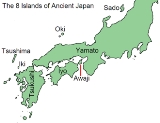
 From their union were born the Ōyashima, or the eight great islands of Japan:
The divine couple bore eight more offspring, who later became the eight great islands of Japan. Izanami, however, died giving birth to the child, Kagutsuchi (incarnation of fire) or Homusubi (causer of fire). She was then buried on Mt. Hiba
, at the border of the old provinces of Izumo
and Hoki
, near modern-day Yasugi
of Shimane Prefecture
. In anger, Izanagi killed Kagutsuchi. His death also created dozens of deities.
The gods who were born from Izanagi and Izanami are symbolic of important aspects of nature and culture.
("the shadowy land of the dead"). Izanagi found little difference between Yomi and the land above, except for the eternal darkness. However, this suffocating darkness was enough to make him ache for light and life. Quickly, he searched for Izanami and found her. At first, Izanagi could not see her for she was well hidden in the shadows. Nevertheless, he asked her to return with him. Izanami spat at Izanagi and informed him that he was too late. She had already eaten the food of the underworld and now belonged to the land of the dead.
Izanagi was shocked at this news, but he refused to give in to her wishes to be left to the dark embrace of Yomi. Izanami agreed to return to the world but first requested to have some time to rest. She instructed Izanagi to not come into her bedroom. After a long wait, Izanami did not come out of her bedroom, and Izanagi was worried. While Izanami was sleeping, he took the comb that bound his long hair and set it alight as a torch. Under the sudden burst of light, he saw the horrid form of the once beautiful and graceful Izanami. The flesh of her ravaged body was rotting and was overrun with maggots and foul creatures.
Crying out loud, Izanagi could no longer control his fear and started to run, intending to return to the living and to abandon his death-ridden wife. Izanami woke up shrieking and indignant and chased after him. Izinami instructed the shikome
, or foul women, hunt for the frightened Izanagi and to bring him back.
Izanagi, thinking quickly, hurled his headdress, which became a bunch of black grapes. The shikome fell on these but continued pursuit. Next, Izanagi threw his comb, which became a clump of bamboo shoots. Now it was Yomi's creatures that began to give chase, but Izanagi urinated against a tree and created a great river that increased his lead. Unfortunately, the shikome still pursued Izanagi, who began to hurl peaches at them. He knew that this would not delay them for long, but he was nearly free, for the boundary of Yomi was now close at hand.
Izanagi burst through the entrance and quickly pushed a boulder to the entrance of Yomi. Izanami screamed from behind this barricade and told Izanagi that, if he left her, she would destroy 1,000 living people every day. He furiously replied that he would give life to 1,500.
And so began the existence of Death, caused by the hands of the proud Izanami, the abandoned wife of Izanagi.
Izanagi went on to divide the world between them with Amaterasu inheriting the heavens, Tsukuyomi taking control of the night and moon and the storm god Susanoo owning the seas. In some versions of the myth, Susanoo rules not only the seas but also all elements of a storm, including snow and hail, and, in rare cases, even sand.
But she does not believe him and requests a contest for proof of his good faith. A challenge is set as to who can bring forth more noble and divine children. Amaterasu creates three women from Susanoo's sword, while Susanoo makes five men from Amaterasu's ornament chain. Amaterasu claims the title to the five are attributed to Susanoo.
Both gods declare themselves to be victorious. Amaterasu's insistence in her claim drives Susanoo to violent campaigns that reach their climax when he hurls a half-flayed
pony (an animal sacred to Amaterasu) into Amaterasu's weaving hall and causes the death of one of her attendants. Amaterasu, angered by the display, hides in the cave called Iwayado. As the sun goddess disappears into the cave, darkness covers the world.
All of the gods and goddesses strive to coax Amaterasu out of the cave, but she ignores them all. Finally, the kami
of merriment, Ame-no-Uzume, hatches a plan. She places a large bronze mirror on a tree, facing Amaterasu's cave. Then, Uzume clothes herself in flowers and leaves, overturns a washtub and begins to dance upon it, drumming the tub with her feet. Finally, Uzume sheds the leaves and flowers and dances naked. All of the male gods roar with laughter, and Amaterasu becomes curious. When she peeks outside, a ray of light called "dawn" escapes and Amaterasu is dazzled by the beautiful goddess that she sees, this being her own reflection in the mirror. The god, Ameno-Tajikarawo, pulls her from the cave, which is sealed with a shimenawa
. Surrounded by merriment, Amaterasu's depression disappears, and she agrees to return with her light. Uzume is then known as the kami of dawn as well as of mirth.
See also:
Missing sun
(now part of Shimane Prefecture
). It is not long before he meets an old man and an old woman sobbing beside their daughter. The old couple explain that they originally had eight daughters who were devoured, one after the other, by the dragon, Yamata no Orochi ("eight-forked serpent", who is said to originate from Kosi—now Hokuriku region
). The terrible dragon had eight heads and eight tails, stretched over eight hills, and is said to have eyes as red as good wine. Kushinada-hime ("rice paddy princess") was the last of the eight daughters.
Susanoo, who knew about the old couple's relation to Amaterasu, offers his assistance in return for their beautiful daughter's hand in marriage. The parents accept, and Susanoo transforms Kushinada into a comb and hides her safely in his hair. He also orders a large fence-like barrier to be built around the house. The fence has eight gates, with eight tables placed at each gate and eight casks placed on each table. Each cask is filled with eight-times-brewed rice wine.
Orochi arrives and finds his path blocked. After boasting about his prowess, he finds that he cannot get through the barrier. His keen sense of smell takes in the sake—which Orochi loves—and the eight heads are now faced with a problem. They want to drink the delicious sake, yet the fence blocks access to the sake. One head suggests that they simply smash the barrier, but that would knock over the sake. Another proposed that they combine their fiery breath and burn the fence to ash, but then the sake would evaporate. The heads begin to search for an opening. They find the hatches, and, eager for the sake, they wish to poke their heads through to drink it. Yet, the eighth head, which is the wisest, warns his brethren about the folly of such an act and volunteers to go through first to ensure that all is well. Susanoo waits for his chance. He allows the head to drink some sake in safety and to report to the others that there is no danger. All eight heads plunge through the hatches and greedily drink every drop of the sake.
As the heads finish, Susanoo launches his attack on Orochi. Drunken from drinking so much sake, the great serpent is no match for the spry Susanoo who decapitates and slays Orochi. A nearby river is said to have turned red with the blood of the defeated serpent. As Susanoo cuts the dragon into pieces, he finds an excellent sword from a tail of the dragon that his sword had been unable to cut. The sword is later presented to Amaterasu and named Ama no Murakumo no Tsurugi (天叢雲剣, "Sword of the Gathering Clouds of Heaven", which was later called Kusanagi
, "Grass Mower"). This sword was to feature prominently in many other tales.
to Inaba
to court her, the brothers meet a skinned rabbit lying on a beach. They tell the rabbit to bathe in the sea and to dry in the wind near a high mountain. The rabbit complies and suffers in agony. Ōnamuji, who is lagging behind his brothers, sees the rabbit in pain and instructs it to bathe in fresh water and to cover itself with the powder of the "gama" ("cattail") flower. The cured rabbit, who is actually a deity, informs Ōnamuji that he can marry Princess Yakami.
The trials of Ōnamuji are many and he dies twice at the hands of his jealous brothers. Each time, he is saved by his mother, Kushinada-hime. Pursued by his enemies, he ventures into Susanoo's realm where he meets the vengeful god's daughter, Suseri-hime. The crafty Susanoo tests Ōnamuji several times, but, in the end, Susanoo approves the young boy and foretells Ōnamuji's victory over his brothers.
Although the Yamato tradition attributes the creation of the Japanese islands to Izanagi and Izanami, the Izumo tradition claims that Ōnamuji, along with a dwarf god called Sukunabiko, contribute to, or at least finish, the creation of the Japanese islands.
The first two were made to lure Amaterasu out of Amano-Iwato
. The last was found in the Orochi, an eight-headed hydra
. Of these three, the mirror is the token of Amaterasu. The three together constitute the Imperial Regalia of Japan
.
Ninigi and his company went down to the earth and came to Himuka, there he founded his palace.
(symbol of flowers), the daughter of Yamatsumi (master of mountains), and they fell in love. Ninigi asked Yamatsumi for his daughter's hand. The father was delighted and offered both of his daughters, Iwanaga (symbol of rocks) and Sakuya (symbol of flowers). However, Ninigi married only Sakuya and refused Iwanaga.
"Iwanaga is blessed with eternity and Sakuya with prosperity", Yamatsumi said in regret, "by refusing Iwanaga, your life will be brief from now on". Consequently, Ninigi and his descendants became mortal.
Sakuya conceived by a night and Ninigi doubted her. To prove legitimacy of her children, Sakuya swore by her luck and took a chance; she set fire to her room when she had given birth to her three babies. By this, Ninigi knew her chastity. The names of the children were Hoderi, Hosuseri and Howori.
While Howori was sitting on a beach, sorely perplexed, Shihotsuchi told him to ride on a ship called the Manashikatsuma and go wherever the current went. Following this advice, Howori reached the house of Watatsumi (master of seas). There he met Toyotama, Watatsumi's daughter, and married her. After three years of marriage, he remembered his brother and his fishhook, then told Watatsumi about it.
Watatsumi soon found the fishhook in the throat of a bream and handed it to Howori. Watatsumi also gave him two magical balls, Shihomitsutama, which could cause a flood, and Shihohirutama, which could cause an ebb, and sent him off, along with his bride, to land.
As Toyotama was giving birth, she asked Howori not to look at her delivery. However, Howori, filled with curiosity, peeped in, and saw her transforming into a shark
at the moment his son, Ugaya, was born. Aware of this, Toyotama disappeared into sea and did not return, but she entrusted her sister Tamayori with her yearning for Howori.
Ugaya married his aunt Tamayori and had five children, including Itsuse and Yamatobiko.
(Transition from God to Emperor). He established the throne in 660 B.C. His pedigree is summarized as follows.
(For instance, Ninigi, or Ame-Nigishikuni-Nigishiamatsuhiko-Hikono-no-Ninigi-no-Mikoto in full, may also be abbreviated as Hikoho-no-Ninigi or Hono-Ninigi.)
In some parts of this article, proper names are written in a historical manner. In this article, underlined h, y, and w denote silent letters; they are omitted from modern spelling. Other syllables are modernized as follows (see also Japanese
romanization systems). Note that some blend of these conventions is also often used.
Creatures
Tengu are part-man-part-bird creatures that live in mountainous pine and cedar forests. They are believed to be descendants of Susano, the storm god. They live in colonies with a king tengu that is served by a messenger tengu. They usually have red feathers and wear black cloaks and/or caps. They are skilled swordsmen.
Oni are giant devils that are pink, blue, red, or grey. They usually have horns, three eyes, three toes, and three fingers. Oni have the ability to fly, but tend not to in myths. They are unintelligent; they carry mallets or iron spiked rods, and sometimes wear a loincloth of tiger skin.
Kappa are aquatic, vampire-like beasts that have monkey-like bodies, fish scales, a shell, and are yellow-green. They have indentations on the top of their heads that contain water. If this water is spilled, the kappa looses its power. Kappa are intelligent enough to make and keep promises.
Hyosube are just a hair-covered variation of a kappa.
Heroes
Momotaro; peach child: Found inside a peach by a childless family. Grows to normal size by adulthood. Sets out to slay oni. Accompanied by a dog, pheasant, and monkey in exchange for rice cakes. Slays oni and returns stolen women.
Issun Boshi; little one inch: Issun Boshi was born very small, but unlike Momotaro, he never grew. Traveled to Kyoto (old name for Tokyo)equipped with a needle for a sword. Enters the service of nobles. Went to Kwannon (of the thousand hands) shrine with noble's daughter, oni arrive. One eats Issun, Issun stabs oni's innards, oni drops its mallet and flees. Noble's daughter hits mallet on the ground, wishes Issun was normal size, Issun grows, they get married.
Tametomo: Sunk an enemy ship with a single arrow.
Animal Myths
Tongue-cut sparrow: A washer woman cut off the tongue of a sparrow that was pecking at her rice starch. The sparrow had been fed regularly by the washer woman’s neighbors, so when the sparrow didn’t come, they went in the woods to search for it. They found it, and after a feast and some dancing (which the sparrow prepared), the neighbors were given the choice between two boxes; one large and one small. The neighbors picked the small box, and it was filled with riches. The washer woman saw these riches and heard where they came from, so she went to the sparrow. She too was entertained and given the choice between two boxes. The washer woman picked the largest box and instead of gaining riches, she was devoured by devils.
Mandarin Ducks: A man kills a drake mandarin duck for food. That night he had a dream that a woman was accusing him of murdering her husband, and then told him to return to the lake. The man does this, and a female mandarin walks up to him and tears its chest open.
Badger and Rabbit: A man catches a badger and tells his wife to cook it in a stew. The badger begs the wife not to cook him and promises to help with the cooking if he is spared. The wife agrees and unties him. The badger then transforms into her and kills her, then cooks her in a stew. Disguised as the man’s wife, the badger feeds him his wife. Once he is done, the badger transforms back to his original form and teases the man for eating his wife. A rabbit that was friends with the family was furious, so he had the badger carry sticks and, while he wasn’t looking, set these sticks on fire. Then the rabbit treated the burn with hot pepper paste. Finally the rabbit convinced the badger to build a boat of clay, and the rabbit followed in a sturdy boat. The clay boat began to sink, so the badger tried to escape, but then the rabbit hit him in the head with an oar, knocking him out and making him drown.
Badger and Fox cub: A badger, vixen, and the vixen’s cub lived in a forest that was running out of food, so they came up with the plan of one of them pretending to be dead, the other disguising as a merchant, and the “merchant” selling the “dead” animal to a human. Then they would have money to buy food. The vixen pretended to be dead while the badger was the merchant. While the transaction was happening however, the badger told the human that the vixen wasn’t actually dead, so the human killed her. This infuriated the cub, so he proposed a competition. They would both disguise as humans and go into the village at different times. Whoever guessed what “human” was the other first, wins. The cub walked towards the village first, but he hid behind a tree. The badger went into the village, and accused the governor of being the fox, so the bodyguards of the governor beheaded him.
Shinto
or Shintoism, also kami-no-michi, is the indigenous spirituality of Japan and the Japanese people. It is a set of practices, to be carried out diligently, to establish a connection between present day Japan and its ancient past. Shinto practices were first recorded and codified in the written...
and Buddhist traditions as well as agriculturally based folk religion
Folk religion
Folk religion consists of ethnic or regional religious customs under the umbrella of an organized religion, but outside of official doctrine and practices...
. The Shinto pantheon
Pantheon (gods)
A pantheon is a set of all the gods of a particular polytheistic religion or mythology.Max Weber's 1922 opus, Economy and Society discusses the link between a...
comprises innumerable kami
Kami
is the Japanese word for the spirits, natural forces, or essence in the Shinto faith. Although the word is sometimes translated as "god" or "deity", some Shinto scholars argue that such a translation can cause a misunderstanding of the term...
(Japanese
Japanese language
is a language spoken by over 130 million people in Japan and in Japanese emigrant communities. It is a member of the Japonic language family, which has a number of proposed relationships with other languages, none of which has gained wide acceptance among historical linguists .Japanese is an...
for "gods
Deity
A deity is a recognized preternatural or supernatural immortal being, who may be thought of as holy, divine, or sacred, held in high regard, and respected by believers....
" or "spirit
Spirit
The English word spirit has many differing meanings and connotations, most of them relating to a non-corporeal substance contrasted with the material body.The spirit of a living thing usually refers to or explains its consciousness.The notions of a person's "spirit" and "soul" often also overlap,...
s"). This article will discuss only the typical elements present in Asian mythology
Mythology
The term mythology can refer either to the study of myths, or to a body or collection of myths. As examples, comparative mythology is the study of connections between myths from different cultures, whereas Greek mythology is the body of myths from ancient Greece...
, such as the cosmogony
Cosmogony
Cosmogony, or cosmogeny, is any scientific theory concerning the coming into existence or origin of the universe, or about how reality came to be. The word comes from the Greek κοσμογονία , from κόσμος "cosmos, the world", and the root of γίνομαι / γέγονα "to be born, come about"...
, the important deities, and the best known Japanese stories.
Mainstream Japanese myths, as generally recognized today, are based on the Kojiki
Kojiki
is the oldest extant chronicle in Japan, dating from the early 8th century and composed by Ō no Yasumaro at the request of Empress Gemmei. The Kojiki is a collection of myths concerning the origin of the four home islands of Japan, and the Kami...
, the Nihon Shoki
Nihon Shoki
The , sometimes translated as The Chronicles of Japan, is the second oldest book of classical Japanese history. It is more elaborate and detailed than the Kojiki, the oldest, and has proven to be an important tool for historians and archaeologists as it includes the most complete extant historical...
, and some complementary books. The Kojiki, or "Record of Ancient Matters", is the oldest recognized account of Japan's legends and history. The Shintōshū
Shintoshu
The is a Japanese story book in ten volumes believed to date from the Nanboku-chō period . It illustrates with tales about various shrines the Buddhist honji suijaku theory, according to which Japanese kami were simply local manifestations of the Indian gods of Buddhism...
explains origins of Japanese deities from a Buddhist
Buddhism
Buddhism is a religion and philosophy encompassing a variety of traditions, beliefs and practices, largely based on teachings attributed to Siddhartha Gautama, commonly known as the Buddha . The Buddha lived and taught in the northeastern Indian subcontinent some time between the 6th and 4th...
perspective, while the Hotsuma Tsutae
Hotsuma Tsutae
The Hotsuma Tsutae is an elaborate epic poem of Japanese legendary history which differs substantially from the mainstream version as recorded in the Kojiki and the Nihon Shoki...
records a substantially different version of mythology.
One notable result of Japanese mythology is that it explains the origin of the imperial family
Emperor of Japan
The Emperor of Japan is, according to the 1947 Constitution of Japan, "the symbol of the state and of the unity of the people." He is a ceremonial figurehead under a form of constitutional monarchy and is head of the Japanese Imperial Family with functions as head of state. He is also the highest...
, and assigned them godhood. The Japanese word for the Emperor of Japan, tennō (天皇), means "heavenly emperor
Emperor
An emperor is a monarch, usually the sovereign ruler of an empire or another type of imperial realm. Empress, the female equivalent, may indicate an emperor's wife or a woman who rules in her own right...
".
Creation myth
In the Japanese creation mythJapanese creation myth
In Japanese mythology, the , is the story that describes the legendary birth of the celestial and earthly world, the birth of the first gods and the birth of the Japanese archipelago....
, the first deities which came into existence are collectively called Kotoamatsukami
Kotoamatsukami
In Japanese Shinto, Kotoamatsukami is the collective name for the first gods which came into existence at the time of the creation of the universe...
, who appeared at the time of the creation of the universe.
Later, the seven generations of kami
Kami
is the Japanese word for the spirits, natural forces, or essence in the Shinto faith. Although the word is sometimes translated as "god" or "deity", some Shinto scholars argue that such a translation can cause a misunderstanding of the term...
, which are known as Kamiyonanayo
Kamiyonanayo
In Japanese mythology, the are the seven generations of kami that emerged after the formation of heaven and earth.According to the Kojiki, these deities appeared after the Kotoamatsukami. The first two generations were hitorigami while the five that followed came into being as male-female pairs of...
("Seven Generations of the Age of the Gods"), emerged after the formation of heaven and earth.
According to the Kojiki
Kojiki
is the oldest extant chronicle in Japan, dating from the early 8th century and composed by Ō no Yasumaro at the request of Empress Gemmei. The Kojiki is a collection of myths concerning the origin of the four home islands of Japan, and the Kami...
, these deities appeared after the emergence of Kotoamatsukami
Kotoamatsukami
In Japanese Shinto, Kotoamatsukami is the collective name for the first gods which came into existence at the time of the creation of the universe...
. The first two generations are single deities called hitorigami
Hitorigami
Hitorigami are kami which came into being alone, as opposed to those which came into being as male-female pairs. According to the Kojiki, this group included the "three deities of creation" and the "separate heavenly kami.". They are described as hiding themselves away once they achieved awareness...
, while the five that followed came into being as male/female pairs of kami: brothers and sisters that were at the same time married couples. In total, Kamiyonanayo comprise 12 deities in this chronicle.
In contrast, the chronicle, Nihon Shoki
Nihon Shoki
The , sometimes translated as The Chronicles of Japan, is the second oldest book of classical Japanese history. It is more elaborate and detailed than the Kojiki, the oldest, and has proven to be an important tool for historians and archaeologists as it includes the most complete extant historical...
, points out that this group was the first to appear after the creation of the universe. It also states that the first three generations of deities are hitorigami and that the other generations of deities are pairs of the opposite sex. The Japanese also cited the works of "chinglea" the Rice god. every harvest she was praised for delivering rice to pesants.
Kuniumi and Kamiumi
Japan's creation narrative can be divided into the birth of the deitiesKamiumi
In Japanese mythology, the story of the occurs after the creation of Japan and refers to the birth of the kami, descendants of Izanagi and Izanami.-Story:...
(Kamiumi) and the birth of the land
Kuniumi
In Japanese mythology, the is the traditional and legendary history of the emergence of the Japanese archipelago as narrated firsthand in the Kojiki and Nihon Shoki. According to this legend, after the creation of Heaven and Earth, the gods Izanagi and Izanami were given the task of forming a...
(Kuniumi).
The seventh and last generation of Kamiyonanayo were Izanagi no Mikoto
Izanagi
is a deity born of the seven divine generations in Japanese mythology and Shinto, and is also referred to in the roughly translated Kojiki as "male-who-invites" or Izanagi-no-mikoto. It is also pronounced Izanaki-no-Okami....
("Exalted Male") and Izanami no Mikoto
Izanami
In Japanese mythology, is a goddess of both creation and death, as well as the former wife of the god Izanagi-no-Mikoto. She is also referred to as Izanami-no-kami.-Goddess of Creation:...
("Exalted Female"), and they would be responsible for the creation of the Japanese archipelago
Japanese Archipelago
The , which forms the country of Japan, extends roughly from northeast to southwest along the northeastern coast of the Eurasia mainland, washing upon the northwestern shores of the Pacific Ocean...
and would engender other deities.
To help them to achieve this, Izanagi and Izanami were given a naginata
Naginata
The naginata is one of several varieties of traditionally made Japanese blades in the form of a pole weapon. Naginata were originally used by the samurai class in feudal Japan, and naginata were also used by ashigaru and sōhei .-Description:A naginata consists of a wooden shaft with a curved...
decorated with jewels, named Ame-no-nuboko ("Heavenly Jeweled Spear"). The two deities then went to the bridge between heaven and earth, Amenoukihashi ("Floating Bridge of Heaven") and churned the sea below with the halberd. Drops of salty water formed the island, Onogoro ("self-forming"). The deities descended from the bridge of heaven and made their home on the island. Eventually, they fell in love and wished to mate. So they built a pillar called Amenomihashira around which they built a palace called Yashirodono ("the hall whose area is 8 arms' length squared"). Izanagi and Izanami circled the pillar in opposite directions, and when they met on the other side, Izanami, the female deity, spoke first in greeting. Izanagi didn't think that this was proper, but they mated anyway. They had two children, Hiruko ("leech child") and Awashima ("pale island"), but the children were badly formed and are not considered gods in their original form. (Hiruko later became the Japanese god, Ebisu.)
The parents, who were dismayed at their misfortune, put the children into a boat and sent them to sea, and then petitioned the other gods for an answer about what they had done wrong. They were informed that Izanami's lack of manners was the reason for the defective births: a woman should never speak prior to a man; the male deity should have spoken first in greeting during the ceremony. So Izanagi and Izanami went around the pillar again, and, this time when they met, Izanagi spoke first, and their union was successful.
- AwajiAwaji Islandis an island in Hyōgo Prefecture, Japan, in the eastern part of the Seto Inland Sea between the islands of Honshū and Shikoku. The island has an area of 592.17 km²...
- Iyo (later ShikokuShikokuis the smallest and least populous of the four main islands of Japan, located south of Honshū and east of the island of Kyūshū. Its ancient names include Iyo-no-futana-shima , Iyo-shima , and Futana-shima...
) - OkiOki Islandsare a group of islands in the southwestern part of the Sea of Japan and belong to Japan.-Geography:The Oki Islands are situated between 40 to 80 kilometers north of the coast of Honshū.The islands are of volcanic origin and have a total area of 346,1 km2...
- Tsukushi (later KyūshūKyushuis the third largest island of Japan and most southwesterly of its four main islands. Its alternate ancient names include , , and . The historical regional name is referred to Kyushu and its surrounding islands....
) - IkiIki IslandIki Island is an island lying between the island of Kyūshū and the Tsushima islands in the Tsushima Strait, the eastern channel of the Korea Strait. It is currently part of Nagasaki Prefecture of Japan. The city of Iki is the centre of the local government. The island has three ports.The island’s...
- TsushimaTsushima IslandTsushima Island is an island of the Japanese Archipelago situated in the middle of the Tsushima Strait at 34°25'N and 129°20'E. The main island of Tsushima was once a single island, but the island was divided into two in 1671 by the Ōfunakosiseto canal and into three in 1900 by the Manzekiseto canal...
- SadoSado, Niigatais a city located on Sado Island in Niigata Prefecture, in the Chūbu region of Japan. Since 2004, the city has comprised the entire island, although not all of its total area of 855.26 km2 is urbanized...
- Yamato (later HonshūHonshuis the largest island of Japan. The nation's main island, it is south of Hokkaido across the Tsugaru Strait, north of Shikoku across the Inland Sea, and northeast of Kyushu across the Kanmon Strait...
)
- Note that HokkaidōHokkaido, formerly known as Ezo, Yezo, Yeso, or Yesso, is Japan's second largest island; it is also the largest and northernmost of Japan's 47 prefectural-level subdivisions. The Tsugaru Strait separates Hokkaido from Honshu, although the two islands are connected by the underwater railway Seikan Tunnel...
, Chishima and Okinawa were not part of Japan in ancient times.
The divine couple bore eight more offspring, who later became the eight great islands of Japan. Izanami, however, died giving birth to the child, Kagutsuchi (incarnation of fire) or Homusubi (causer of fire). She was then buried on Mt. Hiba
Mount Hiba
-Mount Hiba in Hiroshima Prefecture: is a mountain in Shōbara, Hiroshima Prefecture, Japan, with a height of 1,299 metres. It is within Hiba-Dogo-Taishaku Quasi-National Park.-Mount Hiba in Shimane Prefecture:...
, at the border of the old provinces of Izumo
Izumo Province
was an old province of Japan which today consists of the eastern part of Shimane Prefecture. It was sometimes called . The province is in the Chūgoku Region.- History :It was one of the regions of ancient Japan where major political powers arose...
and Hoki
Hoki Province
was an old province of Japan in the area that is today the western part of Tottori Prefecture. It was sometimes called . Hōki bordered on Inaba, Mimasaka, Bitchū, Bingo, and Izumo Provinces....
, near modern-day Yasugi
Yasugi, Shimane
is a city located in Shimane, Japan.As of April 1, 2011, the city has an estimated population of 42,324, with the number of households at 13,996, and a density of 100.54 persons per km². The total area is 420.97 km².Yasugi gained city status on April 4, 1954....
of Shimane Prefecture
Shimane Prefecture
is a prefecture of Japan located in the Chūgoku region on Honshū island. The capital is Matsue. It is the second least populous prefecture in Japan, after its eastern neighbor Tottori. The prefecture has an area elongated from east to west facing the Chūgoku Mountain Range on the south side and to...
. In anger, Izanagi killed Kagutsuchi. His death also created dozens of deities.
The gods who were born from Izanagi and Izanami are symbolic of important aspects of nature and culture.
Yomi
Izanagi lamented the death of Izanami and undertook a journey to YomiYomi
, the Japanese word for the underworld in which horrible creatures guard the exits; according to Shinto mythology as related in Kojiki, this is where the dead go to dwell and apparently rot indefinitely. Once one has eaten at the hearth of Yomi it is impossible to return to the land of the living...
("the shadowy land of the dead"). Izanagi found little difference between Yomi and the land above, except for the eternal darkness. However, this suffocating darkness was enough to make him ache for light and life. Quickly, he searched for Izanami and found her. At first, Izanagi could not see her for she was well hidden in the shadows. Nevertheless, he asked her to return with him. Izanami spat at Izanagi and informed him that he was too late. She had already eaten the food of the underworld and now belonged to the land of the dead.
Izanagi was shocked at this news, but he refused to give in to her wishes to be left to the dark embrace of Yomi. Izanami agreed to return to the world but first requested to have some time to rest. She instructed Izanagi to not come into her bedroom. After a long wait, Izanami did not come out of her bedroom, and Izanagi was worried. While Izanami was sleeping, he took the comb that bound his long hair and set it alight as a torch. Under the sudden burst of light, he saw the horrid form of the once beautiful and graceful Izanami. The flesh of her ravaged body was rotting and was overrun with maggots and foul creatures.
Crying out loud, Izanagi could no longer control his fear and started to run, intending to return to the living and to abandon his death-ridden wife. Izanami woke up shrieking and indignant and chased after him. Izinami instructed the shikome
Shikome
, also known as , were, in Japanese mythology, eight hags sent by Izanami to chase Izanagi and bring him back to the underworld.They are depicted as fierce and wild women. The story of Izanami has strong parallels to that of Orpheus and Eurydice . The Shikome themselves parallel the Thracian...
, or foul women, hunt for the frightened Izanagi and to bring him back.
Izanagi, thinking quickly, hurled his headdress, which became a bunch of black grapes. The shikome fell on these but continued pursuit. Next, Izanagi threw his comb, which became a clump of bamboo shoots. Now it was Yomi's creatures that began to give chase, but Izanagi urinated against a tree and created a great river that increased his lead. Unfortunately, the shikome still pursued Izanagi, who began to hurl peaches at them. He knew that this would not delay them for long, but he was nearly free, for the boundary of Yomi was now close at hand.
Izanagi burst through the entrance and quickly pushed a boulder to the entrance of Yomi. Izanami screamed from behind this barricade and told Izanagi that, if he left her, she would destroy 1,000 living people every day. He furiously replied that he would give life to 1,500.
And so began the existence of Death, caused by the hands of the proud Izanami, the abandoned wife of Izanagi.
Sun, moon and sea
As could be expected, Izanagi went on to purify himself after recovering from his descent to Yomi. As he undressed and removed the adornments of his body, each item that he dropped to the ground formed a deity. Even more gods came into being when he went to the water to wash himself. The most important ones were created once he washed his face:- AmaterasuAmaterasu, or is apart of the Japanese myth cycle and also a major deity of the Shinto religion. She is the goddess of the sun, but also of the universe. the name Amaterasu derived from Amateru meaning "shining in heaven." The meaning of her whole name, Amaterasu-ōmikami, is "the great August kami who...
(incarnation of the sun) from his left eye, - Tsukuyomi (incarnation of the moon) from his right eye, and
- SusanooSusanoo, also known as is the Shinto god of the sea and storms. He is also considered to be ruler of Yomi.-Myths:In Japanese mythology, Susanoo, the powerful storm of Summer, is the brother of Amaterasu, the goddess of the sun, and of Tsukuyomi, the god of the moon. All three were born from Izanagi, when...
(incarnation of storms and ruler of the sea and storms) from his nose.
Izanagi went on to divide the world between them with Amaterasu inheriting the heavens, Tsukuyomi taking control of the night and moon and the storm god Susanoo owning the seas. In some versions of the myth, Susanoo rules not only the seas but also all elements of a storm, including snow and hail, and, in rare cases, even sand.
Amaterasu and Susanoo
Amaterasu, the powerful sun goddess of Japan, is the most well known deity of Japanese mythology. Her feuding with Susanoo, her uncontrollable brother, however, is equally infamous and appears in several tales. One story tells about Susanoo's wicked behavior toward Izanagi, who, tired of Susanoo's repeated complaints, banishes him to Yomi. Susanoo grudgingly acquiesces, but has first to attend some unfinished business. He goes to Takamagahara ("heaven") to bid farewell to his sister, Amaterasu. Amaterasu knows that her unpredictable brother does not have good intentions and is prepared for battle. "For what purpose do you come here?" asks Amaterasu. "To say farewell," answers Susanoo.But she does not believe him and requests a contest for proof of his good faith. A challenge is set as to who can bring forth more noble and divine children. Amaterasu creates three women from Susanoo's sword, while Susanoo makes five men from Amaterasu's ornament chain. Amaterasu claims the title to the five are attributed to Susanoo.
Both gods declare themselves to be victorious. Amaterasu's insistence in her claim drives Susanoo to violent campaigns that reach their climax when he hurls a half-flayed
Flaying
Flaying is the removal of skin from the body. Generally, an attempt is made to keep the removed portion of skin intact.-Scope:An animal may be flayed in preparation for human consumption, or for its hide or fur; this is more commonly called skinning....
pony (an animal sacred to Amaterasu) into Amaterasu's weaving hall and causes the death of one of her attendants. Amaterasu, angered by the display, hides in the cave called Iwayado. As the sun goddess disappears into the cave, darkness covers the world.
All of the gods and goddesses strive to coax Amaterasu out of the cave, but she ignores them all. Finally, the kami
Kami
is the Japanese word for the spirits, natural forces, or essence in the Shinto faith. Although the word is sometimes translated as "god" or "deity", some Shinto scholars argue that such a translation can cause a misunderstanding of the term...
of merriment, Ame-no-Uzume, hatches a plan. She places a large bronze mirror on a tree, facing Amaterasu's cave. Then, Uzume clothes herself in flowers and leaves, overturns a washtub and begins to dance upon it, drumming the tub with her feet. Finally, Uzume sheds the leaves and flowers and dances naked. All of the male gods roar with laughter, and Amaterasu becomes curious. When she peeks outside, a ray of light called "dawn" escapes and Amaterasu is dazzled by the beautiful goddess that she sees, this being her own reflection in the mirror. The god, Ameno-Tajikarawo, pulls her from the cave, which is sealed with a shimenawa
Shimenawa
Shimenawa are lengths of braided rice straw rope used for ritual purification in the Shinto religion. They can vary in diameter from a few centimetres to several metres, and are often seen festooned with shide...
. Surrounded by merriment, Amaterasu's depression disappears, and she agrees to return with her light. Uzume is then known as the kami of dawn as well as of mirth.
See also:
Missing sun
Susanoo and Orochi
Susanoo, exiled from heaven, comes to Izumo ProvinceIzumo Province
was an old province of Japan which today consists of the eastern part of Shimane Prefecture. It was sometimes called . The province is in the Chūgoku Region.- History :It was one of the regions of ancient Japan where major political powers arose...
(now part of Shimane Prefecture
Shimane Prefecture
is a prefecture of Japan located in the Chūgoku region on Honshū island. The capital is Matsue. It is the second least populous prefecture in Japan, after its eastern neighbor Tottori. The prefecture has an area elongated from east to west facing the Chūgoku Mountain Range on the south side and to...
). It is not long before he meets an old man and an old woman sobbing beside their daughter. The old couple explain that they originally had eight daughters who were devoured, one after the other, by the dragon, Yamata no Orochi ("eight-forked serpent", who is said to originate from Kosi—now Hokuriku region
Hokuriku region
The is located in the northwestern part of Honshū, the main island of Japan. It lies along the Sea of Japan within the Chūbu region. It is almost equivalent to Koshi Province and Hokurikudō area in pre-modern Japan....
). The terrible dragon had eight heads and eight tails, stretched over eight hills, and is said to have eyes as red as good wine. Kushinada-hime ("rice paddy princess") was the last of the eight daughters.
Susanoo, who knew about the old couple's relation to Amaterasu, offers his assistance in return for their beautiful daughter's hand in marriage. The parents accept, and Susanoo transforms Kushinada into a comb and hides her safely in his hair. He also orders a large fence-like barrier to be built around the house. The fence has eight gates, with eight tables placed at each gate and eight casks placed on each table. Each cask is filled with eight-times-brewed rice wine.
Orochi arrives and finds his path blocked. After boasting about his prowess, he finds that he cannot get through the barrier. His keen sense of smell takes in the sake—which Orochi loves—and the eight heads are now faced with a problem. They want to drink the delicious sake, yet the fence blocks access to the sake. One head suggests that they simply smash the barrier, but that would knock over the sake. Another proposed that they combine their fiery breath and burn the fence to ash, but then the sake would evaporate. The heads begin to search for an opening. They find the hatches, and, eager for the sake, they wish to poke their heads through to drink it. Yet, the eighth head, which is the wisest, warns his brethren about the folly of such an act and volunteers to go through first to ensure that all is well. Susanoo waits for his chance. He allows the head to drink some sake in safety and to report to the others that there is no danger. All eight heads plunge through the hatches and greedily drink every drop of the sake.
As the heads finish, Susanoo launches his attack on Orochi. Drunken from drinking so much sake, the great serpent is no match for the spry Susanoo who decapitates and slays Orochi. A nearby river is said to have turned red with the blood of the defeated serpent. As Susanoo cuts the dragon into pieces, he finds an excellent sword from a tail of the dragon that his sword had been unable to cut. The sword is later presented to Amaterasu and named Ama no Murakumo no Tsurugi (天叢雲剣, "Sword of the Gathering Clouds of Heaven", which was later called Kusanagi
Kusanagi
is a legendary Japanese sword and one of three Imperial Regalia of Japan. It was originally called but its name was later changed to the more popular Kusanagi-no-Tsurugi .-Legends:...
, "Grass Mower"). This sword was to feature prominently in many other tales.
Prince Ōnamuji
Ōnamuji (also known as Ōkuninushi) is a descendant of Susanoo. He, along with his many brothers, compete for the hand of Princess Yakami of Inaba. While travelling from IzumoIzumo Province
was an old province of Japan which today consists of the eastern part of Shimane Prefecture. It was sometimes called . The province is in the Chūgoku Region.- History :It was one of the regions of ancient Japan where major political powers arose...
to Inaba
Inaba Province
was an old province of Japan in the area that is today the eastern part of Tottori Prefecture. It was sometimes called . Inaba bordered on Harima, Hōki, Mimasaka, and Tajima Provinces.-History:The ancient capital, and the castle town, were at Tottori city...
to court her, the brothers meet a skinned rabbit lying on a beach. They tell the rabbit to bathe in the sea and to dry in the wind near a high mountain. The rabbit complies and suffers in agony. Ōnamuji, who is lagging behind his brothers, sees the rabbit in pain and instructs it to bathe in fresh water and to cover itself with the powder of the "gama" ("cattail") flower. The cured rabbit, who is actually a deity, informs Ōnamuji that he can marry Princess Yakami.
The trials of Ōnamuji are many and he dies twice at the hands of his jealous brothers. Each time, he is saved by his mother, Kushinada-hime. Pursued by his enemies, he ventures into Susanoo's realm where he meets the vengeful god's daughter, Suseri-hime. The crafty Susanoo tests Ōnamuji several times, but, in the end, Susanoo approves the young boy and foretells Ōnamuji's victory over his brothers.
Although the Yamato tradition attributes the creation of the Japanese islands to Izanagi and Izanami, the Izumo tradition claims that Ōnamuji, along with a dwarf god called Sukunabiko, contribute to, or at least finish, the creation of the Japanese islands.
Installation (19–20)
Amaterasu ordered her grandson Ninigi to rule over the ground. She gave him the Three Sacred Treasures:- the magatamaMagatamaMagatama , are curved beads which first appeared in Japan during the Jōmon period.They are often found inhumed in mounded tumulus graves as offerings to deities . They continued to be popular with the ruling elites throughout the Kofun Period of Japan, and are often romanticised as indicative of...
necklaceNecklaceA necklace is an article of jewellery which is worn around the neck. Necklaces are frequently formed from a metal jewellery chain. Others are woven or manufactured from cloth using string or twine....
of Yasakani no magatama (now situated in the imperial palaceKokyois the main residence of the Emperor of Japan. It is a large park-like area located in the Chiyoda area of Tokyo close to Tokyo Station and contains several buildings including the main palace , the emperor left Kyoto Imperial Palace for Tokyo...
); - the bronzeBronzeBronze is a metal alloy consisting primarily of copper, usually with tin as the main additive. It is hard and brittle, and it was particularly significant in antiquity, so much so that the Bronze Age was named after the metal...
mirrorMirrorA mirror is an object that reflects light or sound in a way that preserves much of its original quality prior to its contact with the mirror. Some mirrors also filter out some wavelengths, while preserving other wavelengths in the reflection...
of Yata no kagamiYata no kagamiis a sacred mirror that is part of the Imperial Regalia of Japan. It is said to be housed in Ise Shrine in Mie prefecture, Japan, although a lack of public access makes this difficult to verify. The Yata no Kagami represents "wisdom" or "honesty," depending on the source. Its name literally means...
(now in the Grand Shrine of Ise); and - the swordSwordA sword is a bladed weapon used primarily for cutting or thrusting. The precise definition of the term varies with the historical epoch or the geographical region under consideration...
KusanagiKusanagiis a legendary Japanese sword and one of three Imperial Regalia of Japan. It was originally called but its name was later changed to the more popular Kusanagi-no-Tsurugi .-Legends:...
(a possible replica of which is now in Atsuta ShrineAtsuta Shrineis a Shinto shrine traditionally believed to have been established during the reign of Emperor Keikō located in Atsuta-ku, Nagoya, Aichi Prefecture in Japan. The shrine is familiarly known as Atsuta-Sama or simply as Miya...
, Nagoya).
The first two were made to lure Amaterasu out of Amano-Iwato
Amano-Iwato
literally means "The cave of the sun god" or "heavenly rock cave". In Japanese mythology, Susanoo, the Japanese god of the seas, was the one who drove Amaterasu into Ame-no-Iwato. This caused the sun to hide for a long period of time....
. The last was found in the Orochi, an eight-headed hydra
Lernaean Hydra
In Greek mythology, the Lernaean Hydra was an ancient nameless serpent-like chthonic water beast, with reptilian traits, that possessed many heads — the poets mention more heads than the vase-painters could paint, and for each head cut off it grew two more — and poisonous breath so virulent even...
. Of these three, the mirror is the token of Amaterasu. The three together constitute the Imperial Regalia of Japan
Imperial Regalia of Japan
The , also known as the Three Sacred Treasures of Japan, consist of the sword Kusanagi , the mirror Yata no Kagami , and the jewel Yasakani no Magatama...
.
Ninigi and his company went down to the earth and came to Himuka, there he founded his palace.
Prosperity and eternity
Ninigi met Konohanasakuya-himeKonohanasakuya-hime
Konohanasakuya-hime , in Japanese mythology, is the blossom-princess and symbol of delicate earthly life. She is the daughter of the mountain god Ohoyamatsumi. She is often considered an avatar of Japanese life, especially since her symbol is the Sakura, She is the wife of Ninigi...
(symbol of flowers), the daughter of Yamatsumi (master of mountains), and they fell in love. Ninigi asked Yamatsumi for his daughter's hand. The father was delighted and offered both of his daughters, Iwanaga (symbol of rocks) and Sakuya (symbol of flowers). However, Ninigi married only Sakuya and refused Iwanaga.
"Iwanaga is blessed with eternity and Sakuya with prosperity", Yamatsumi said in regret, "by refusing Iwanaga, your life will be brief from now on". Consequently, Ninigi and his descendants became mortal.
Sakuya conceived by a night and Ninigi doubted her. To prove legitimacy of her children, Sakuya swore by her luck and took a chance; she set fire to her room when she had given birth to her three babies. By this, Ninigi knew her chastity. The names of the children were Hoderi, Hosuseri and Howori.
Ebb and flow
Hoderi lived by fishing in sea while his brother Howori lived by hunting in mountains. One day, Howori asked his brother to swap places for a day. Howori tried fishing, but he could not get a catch, and what was worse, he lost the fishhook he borrowed from his brother. Hoderi relentlessly accused his brother and did not accept his brother's apology.While Howori was sitting on a beach, sorely perplexed, Shihotsuchi told him to ride on a ship called the Manashikatsuma and go wherever the current went. Following this advice, Howori reached the house of Watatsumi (master of seas). There he met Toyotama, Watatsumi's daughter, and married her. After three years of marriage, he remembered his brother and his fishhook, then told Watatsumi about it.
Watatsumi soon found the fishhook in the throat of a bream and handed it to Howori. Watatsumi also gave him two magical balls, Shihomitsutama, which could cause a flood, and Shihohirutama, which could cause an ebb, and sent him off, along with his bride, to land.
As Toyotama was giving birth, she asked Howori not to look at her delivery. However, Howori, filled with curiosity, peeped in, and saw her transforming into a shark
Shark
Sharks are a type of fish with a full cartilaginous skeleton and a highly streamlined body. The earliest known sharks date from more than 420 million years ago....
at the moment his son, Ugaya, was born. Aware of this, Toyotama disappeared into sea and did not return, but she entrusted her sister Tamayori with her yearning for Howori.
Ugaya married his aunt Tamayori and had five children, including Itsuse and Yamatobiko.
First emperor
The first legendary emperor of Japan is Iwarebiko, posthumous alias Emperor JimmuEmperor Jimmu
was the first Emperor of Japan, according to the traditional order of succession. He is also known as Kamuyamato Iwarebiko and personally as Wakamikenu no Mikoto or Sano no Mikoto....
(Transition from God to Emperor). He established the throne in 660 B.C. His pedigree is summarized as follows.
- Izanagi is born of his own accord.
- Amaterasu is born from the left eye of Izanagi.
- Oshihomimi is born from an ornament of Amaterasu.
- Ninigi is a son of Osihomimi and Akizushi.
- Howori is a son of Ninigi and Sakuya.
- Ugaya is a son of Howori and Toyotama.
- Iwarebiko is a son of Ugaya and Tamayori.
Spelling of proper nouns
Many deities appear in Japanese mythology, and many of them have multiple aliases. Furthermore, some of their names are comparatively long. This article therefore lists only the most prominent names, and gives them in one of their abbreviated forms, other abbreviated forms are also in use.(For instance, Ninigi, or Ame-Nigishikuni-Nigishiamatsuhiko-Hikono-no-Ninigi-no-Mikoto in full, may also be abbreviated as Hikoho-no-Ninigi or Hono-Ninigi.)
In some parts of this article, proper names are written in a historical manner. In this article, underlined h, y, and w denote silent letters; they are omitted from modern spelling. Other syllables are modernized as follows (see also Japanese
Japanese language
is a language spoken by over 130 million people in Japan and in Japanese emigrant communities. It is a member of the Japonic language family, which has a number of proposed relationships with other languages, none of which has gained wide acceptance among historical linguists .Japanese is an...
romanization systems). Note that some blend of these conventions is also often used.
- hu is modernized as fu.
- zi and di are modernized as ji. (distinction disappeared)
- oo is modernized as o or oh.
- For instance, various spellings of Ohonamuji include Oonamuji, Ohnamuji, and others.
Creatures
Tengu are part-man-part-bird creatures that live in mountainous pine and cedar forests. They are believed to be descendants of Susano, the storm god. They live in colonies with a king tengu that is served by a messenger tengu. They usually have red feathers and wear black cloaks and/or caps. They are skilled swordsmen.
Oni are giant devils that are pink, blue, red, or grey. They usually have horns, three eyes, three toes, and three fingers. Oni have the ability to fly, but tend not to in myths. They are unintelligent; they carry mallets or iron spiked rods, and sometimes wear a loincloth of tiger skin.
Kappa are aquatic, vampire-like beasts that have monkey-like bodies, fish scales, a shell, and are yellow-green. They have indentations on the top of their heads that contain water. If this water is spilled, the kappa looses its power. Kappa are intelligent enough to make and keep promises.
Hyosube are just a hair-covered variation of a kappa.
Heroes
Momotaro; peach child: Found inside a peach by a childless family. Grows to normal size by adulthood. Sets out to slay oni. Accompanied by a dog, pheasant, and monkey in exchange for rice cakes. Slays oni and returns stolen women.
Issun Boshi; little one inch: Issun Boshi was born very small, but unlike Momotaro, he never grew. Traveled to Kyoto (old name for Tokyo)equipped with a needle for a sword. Enters the service of nobles. Went to Kwannon (of the thousand hands) shrine with noble's daughter, oni arrive. One eats Issun, Issun stabs oni's innards, oni drops its mallet and flees. Noble's daughter hits mallet on the ground, wishes Issun was normal size, Issun grows, they get married.
Tametomo: Sunk an enemy ship with a single arrow.
Animal Myths
Tongue-cut sparrow: A washer woman cut off the tongue of a sparrow that was pecking at her rice starch. The sparrow had been fed regularly by the washer woman’s neighbors, so when the sparrow didn’t come, they went in the woods to search for it. They found it, and after a feast and some dancing (which the sparrow prepared), the neighbors were given the choice between two boxes; one large and one small. The neighbors picked the small box, and it was filled with riches. The washer woman saw these riches and heard where they came from, so she went to the sparrow. She too was entertained and given the choice between two boxes. The washer woman picked the largest box and instead of gaining riches, she was devoured by devils.
Mandarin Ducks: A man kills a drake mandarin duck for food. That night he had a dream that a woman was accusing him of murdering her husband, and then told him to return to the lake. The man does this, and a female mandarin walks up to him and tears its chest open.
Badger and Rabbit: A man catches a badger and tells his wife to cook it in a stew. The badger begs the wife not to cook him and promises to help with the cooking if he is spared. The wife agrees and unties him. The badger then transforms into her and kills her, then cooks her in a stew. Disguised as the man’s wife, the badger feeds him his wife. Once he is done, the badger transforms back to his original form and teases the man for eating his wife. A rabbit that was friends with the family was furious, so he had the badger carry sticks and, while he wasn’t looking, set these sticks on fire. Then the rabbit treated the burn with hot pepper paste. Finally the rabbit convinced the badger to build a boat of clay, and the rabbit followed in a sturdy boat. The clay boat began to sink, so the badger tried to escape, but then the rabbit hit him in the head with an oar, knocking him out and making him drown.
Badger and Fox cub: A badger, vixen, and the vixen’s cub lived in a forest that was running out of food, so they came up with the plan of one of them pretending to be dead, the other disguising as a merchant, and the “merchant” selling the “dead” animal to a human. Then they would have money to buy food. The vixen pretended to be dead while the badger was the merchant. While the transaction was happening however, the badger told the human that the vixen wasn’t actually dead, so the human killed her. This infuriated the cub, so he proposed a competition. They would both disguise as humans and go into the village at different times. Whoever guessed what “human” was the other first, wins. The cub walked towards the village first, but he hid behind a tree. The badger went into the village, and accused the governor of being the fox, so the bodyguards of the governor beheaded him.
See also
- KamiKamiis the Japanese word for the spirits, natural forces, or essence in the Shinto faith. Although the word is sometimes translated as "god" or "deity", some Shinto scholars argue that such a translation can cause a misunderstanding of the term...
- KamuiKamuiKamuy are divine spirits in the mythology of the Japanese Ainu culture.Kamui may also refer to:-People and groups:* Kamui Fujiwara , Japanese game designer & cartoonist...
- OkamiOkamiis an action-adventure video game developed by Clover Studio and published by Capcom. It was released for Sony's PlayStation 2 video game console in 2006 in Japan and North America, and 2007 in Europe and Australia...
- Japanese Buddhism
- Japanese folkloreJapanese folkloreThe folklore of Japan is heavily influenced by both Shinto and Buddhism, the two primary religions in the country. It often involves humorous or bizarre characters and situations and also includes an assortment of supernatural beings, such as bodhisattva, kami , yōkai , yūrei ,...
- Japanese mythology in popular cultureJapanese mythology in popular cultureElements from Japanese folklore and mythology have appeared many times in popular culture.-Amanojaku:* There is a Japanese musical group called Amanojaku...
- Japanese urban legendsJapanese urban legendsJapanese urban legends are enduring modern folktales of paranormal creatures and their attacks on innocent victims. They rarely include the fantastical or animistic yokai of earlier Japanese superstition, and are mostly based on onryo, Japanese ghosts who have become vengeful spirits and take...
- ShintoShintoor Shintoism, also kami-no-michi, is the indigenous spirituality of Japan and the Japanese people. It is a set of practices, to be carried out diligently, to establish a connection between present day Japan and its ancient past. Shinto practices were first recorded and codified in the written...
- YokaiYokaiare a class of supernatural monsters in Japanese folklore. The word yōkai is made up of the kanji for "otherworldly" and "weird". Yōkai range eclectically from the malevolent to the mischievous, or occasionally bring good fortune to those who encounter them...
- YureiYureiare figures in Japanese folklore, analogous to Western legends of ghosts. The name consists of two kanji, 幽 , meaning "faint" or "dim" and 霊 , meaning "soul" or "spirit." Alternative names include 亡霊 meaning ruined or departed spirit, 死霊 meaning dead spirit, or the more encompassing 妖怪 or お化け...