

Forest

Encyclopedia
Earth
Earth is the third planet from the Sun, and the densest and fifth-largest of the eight planets in the Solar System. It is also the largest of the Solar System's four terrestrial planets...
's surface (or 30% of total land area), though they once covered much more (about 50% of total land area), in many different regions and function as habitat
Habitat (ecology)
A habitat is an ecological or environmental area that is inhabited by a particular species of animal, plant or other type of organism...
s for organisms, hydrologic flow
Water cycle
The water cycle, also known as the hydrologic cycle or H2O cycle, describes the continuous movement of water on, above and below the surface of the Earth. Water can change states among liquid, vapor, and solid at various places in the water cycle...
modulators, and soil
Soil
Soil is a natural body consisting of layers of mineral constituents of variable thicknesses, which differ from the parent materials in their morphological, physical, chemical, and mineralogical characteristics...
conservers, constituting one of the most important aspects of the biosphere
Biosphere
The biosphere is the global sum of all ecosystems. It can also be called the zone of life on Earth, a closed and self-regulating system...
. Although forests are classified primarily by trees, the concept of a forest ecosystem
Ecosystem
An ecosystem is a biological environment consisting of all the organisms living in a particular area, as well as all the nonliving , physical components of the environment with which the organisms interact, such as air, soil, water and sunlight....
includes additional species (such as smaller plants, fungi
Fungus
A fungus is a member of a large group of eukaryotic organisms that includes microorganisms such as yeasts and molds , as well as the more familiar mushrooms. These organisms are classified as a kingdom, Fungi, which is separate from plants, animals, and bacteria...
, bacteria, and animals) as well as physical and chemical processes such as energy flow and nutrient cycling.
A typical forest is composed of the overstory (canopy or upper tree layer) and the understory
Understory
Understory is the term for the area of a forest which grows at the lowest height level below the forest canopy. Plants in the understory consist of a mixture of seedlings and saplings of canopy trees together with understory shrubs and herbs...
. The understory is further subdivided into the shrub layer, herb layer, and sometimes also a moss layer. In some complex forests, there is also a well-defined lower tree layer.
Forests are central to all human life because they provide a diverse range of resources, they store carbon, aid in regulating our climate, purify water and mitigate natural hazards such as floods. Forests also contain roughly 90% of the world terrestrial biodiversity.
Etymology
The word "forest" comes from Middle EnglishMiddle English
Middle English is the stage in the history of the English language during the High and Late Middle Ages, or roughly during the four centuries between the late 11th and the late 15th century....
forest, from Old French
Old French
Old French was the Romance dialect continuum spoken in territories that span roughly the northern half of modern France and parts of modern Belgium and Switzerland from the 9th century to the 14th century...
forest (also forès) "forest, vast expanse covered by trees", believed to be a borrowing (probably via Frankish
Old Frankish
Old Frankish is an extinct West Germanic language, once spoken by the Franks. It is the parent language of the Franconian languages, of which Dutch and Afrikaans are the most known descendants...
or Old High German
Old High German
The term Old High German refers to the earliest stage of the German language and it conventionally covers the period from around 500 to 1050. Coherent written texts do not appear until the second half of the 8th century, and some treat the period before 750 as 'prehistoric' and date the start of...
) of the Medieval Latin
Medieval Latin
Medieval Latin was the form of Latin used in the Middle Ages, primarily as a medium of scholarly exchange and as the liturgical language of the medieval Roman Catholic Church, but also as a language of science, literature, law, and administration. Despite the clerical origin of many of its authors,...
word foresta "open wood". Foresta was first used by Carolingian
Carolingian
The Carolingian dynasty was a Frankish noble family with origins in the Arnulfing and Pippinid clans of the 7th century AD. The name "Carolingian", Medieval Latin karolingi, an altered form of an unattested Old High German *karling, kerling The Carolingian dynasty (known variously as the...
scribes in the Capitularies of Charlemagne
Charlemagne
Charlemagne was King of the Franks from 768 and Emperor of the Romans from 800 to his death in 814. He expanded the Frankish kingdom into an empire that incorporated much of Western and Central Europe. During his reign, he conquered Italy and was crowned by Pope Leo III on 25 December 800...
to refer specifically to the king's royal hunting grounds. The term was not endemic to Romance languages (e.g. native words for "forest" in the Romance languages evolved out of the Latin
Latin
Latin is an Italic language originally spoken in Latium and Ancient Rome. It, along with most European languages, is a descendant of the ancient Proto-Indo-European language. Although it is considered a dead language, a number of scholars and members of the Christian clergy speak it fluently, and...
word silva "forest, wood"; cf. Italian, Spanish, Portuguese selva; Romanian silvă; Old French selve); and cognates in Romance languages, such as Italian foresta, Spanish and Portuguese floresta, etc. are all ultimately borrowings of the French word.
The exact origin of Medieval Latin foresta is obscure. Some authorities claim the word derives from the Late Latin
Late Latin
Late Latin is the scholarly name for the written Latin of Late Antiquity. The English dictionary definition of Late Latin dates this period from the 3rd to the 6th centuries AD extending in Spain to the 7th. This somewhat ambiguously defined period fits between Classical Latin and Medieval Latin...
phrase forestam silvam, meaning "the outer wood"; others claim the term is a latinisation of the Frankish
Old Frankish
Old Frankish is an extinct West Germanic language, once spoken by the Franks. It is the parent language of the Franconian languages, of which Dutch and Afrikaans are the most known descendants...
word *forhist "forest, wooded country", assimilated to forestam silvam (a common practise among Frankish scribes). Frankish *forhist is attested by Old High German
Old High German
The term Old High German refers to the earliest stage of the German language and it conventionally covers the period from around 500 to 1050. Coherent written texts do not appear until the second half of the 8th century, and some treat the period before 750 as 'prehistoric' and date the start of...
forst "forest", Middle Low German
Middle Low German
Middle Low German is a language that is the descendant of Old Saxon and is the ancestor of modern Low German. It served as the international lingua franca of the Hanseatic League...
vorst "forest", Old English fyrhþ "forest, woodland, game preserve, hunting ground", and Old Norse
Old Norse
Old Norse is a North Germanic language that was spoken by inhabitants of Scandinavia and inhabitants of their overseas settlements during the Viking Age, until about 1300....
fýri "coniferous forest", all of which derive from Proto-Germanic *furχísa-, *furχíþja- "a fir-wood, coniferous forest", from Proto-Indo-European
Proto-Indo-European language
The Proto-Indo-European language is the reconstructed common ancestor of the Indo-European languages, spoken by the Proto-Indo-Europeans...
*perkwu- "a coniferous or mountain forest, wooded height".
Uses of the word "forest" in English to denote any uninhabited area of non-enclosure are now considered archaic. The word was introduced by the Norman rulers of England
Norman conquest of England
The Norman conquest of England began on 28 September 1066 with the invasion of England by William, Duke of Normandy. William became known as William the Conqueror after his victory at the Battle of Hastings on 14 October 1066, defeating King Harold II of England...
as a legal term (appearing in Latin texts like the Magna Carta
Magna Carta
Magna Carta is an English charter, originally issued in the year 1215 and reissued later in the 13th century in modified versions, which included the most direct challenges to the monarch's authority to date. The charter first passed into law in 1225...
) denoting an uncultivated area legally
Law
Law is a system of rules and guidelines which are enforced through social institutions to govern behavior, wherever possible. It shapes politics, economics and society in numerous ways and serves as a social mediator of relations between people. Contract law regulates everything from buying a bus...
set aside for hunting
Hunting
Hunting is the practice of pursuing any living thing, usually wildlife, for food, recreation, or trade. In present-day use, the term refers to lawful hunting, as distinguished from poaching, which is the killing, trapping or capture of the hunted species contrary to applicable law...
by feudal
Feudalism
Feudalism was a set of legal and military customs in medieval Europe that flourished between the 9th and 15th centuries, which, broadly defined, was a system for ordering society around relationships derived from the holding of land in exchange for service or labour.Although derived from the...
nobility
Nobility
Nobility is a social class which possesses more acknowledged privileges or eminence than members of most other classes in a society, membership therein typically being hereditary. The privileges associated with nobility may constitute substantial advantages over or relative to non-nobles, or may be...
(see Royal Forest
Royal forest
A royal forest is an area of land with different meanings in England, Wales and Scotland; the term forest does not mean forest as it is understood today, as an area of densely wooded land...
). These hunting forests were not necessarily wooded much, if at all. However, as hunting forests did often include considerable areas of woodland, the word "forest" eventually came to mean wooded land more generally. By the start of the fourteenth century the word appeared in English texts, indicating all three senses: the most common one, the legal term and the archaic usage.
Other terms used to mean "an area with a high density of trees" are wood, woodland, wold, weald, holt, frith and firth. Unlike forest, these are all derived from Old English and were not borrowed from another language. Some classifications now reserve the term woodland for an area with more open space between trees and distinguish among woodlands, open forests, and closed forests based on crown cover.
Distribution

The latitudes 10° north and south of the Equator
Equator
An equator is the intersection of a sphere's surface with the plane perpendicular to the sphere's axis of rotation and containing the sphere's center of mass....
are mostly covered in tropical rainforest
Tropical rainforest
A tropical rainforest is an ecosystem type that occurs roughly within the latitudes 28 degrees north or south of the equator . This ecosystem experiences high average temperatures and a significant amount of rainfall...
, and the latitudes between 53°N
53rd parallel north
The 53rd parallel north is a circle of latitude that is 53 degrees north of the Earth's equatorial plane. It crosses Europe, Asia, the Pacific Ocean, North America, and the Atlantic Ocean....
and 67°N
67th parallel north
The 67th parallel north is a circle of latitude that is 67 degrees north of the Earth's equatorial plane, about 50km north of the Arctic Circle. It crosses the Atlantic Ocean, Europe, Asia and North America....
have boreal forest. As a general rule, forests dominated by angiosperms (broadleaf forests) are more species-rich than those dominated by gymnosperms (conifer, montane, or needleleaf forests), although exceptions exist.
Forests sometimes contain many tree species only within a small area (as in tropical rain
Tropical rainforest
A tropical rainforest is an ecosystem type that occurs roughly within the latitudes 28 degrees north or south of the equator . This ecosystem experiences high average temperatures and a significant amount of rainfall...
and temperate deciduous forests), or relatively few species over large areas (e.g., taiga
Taiga
Taiga , also known as the boreal forest, is a biome characterized by coniferous forests.Taiga is the world's largest terrestrial biome. In North America it covers most of inland Canada and Alaska as well as parts of the extreme northern continental United States and is known as the Northwoods...
and arid montane
Montane
In biogeography, montane is the highland area located below the subalpine zone. Montane regions generally have cooler temperatures and often have higher rainfall than the adjacent lowland regions, and are frequently home to distinct communities of plants and animals.The term "montane" means "of the...
coniferous forests). Forests are often home to many animal and plant species, and biomass
Biomass (ecology)
Biomass, in ecology, is the mass of living biological organisms in a given area or ecosystem at a given time. Biomass can refer to species biomass, which is the mass of one or more species, or to community biomass, which is the mass of all species in the community. It can include microorganisms,...
per unit area is high compared to other vegetation
Vegetation
Vegetation is a general term for the plant life of a region; it refers to the ground cover provided by plants. It is a general term, without specific reference to particular taxa, life forms, structure, spatial extent, or any other specific botanical or geographic characteristics. It is broader...
communities. Much of this biomass occurs below ground in the root systems and as partially decomposed plant detritus
Detritus
Detritus is a biological term used to describe dead or waste organic material.Detritus may also refer to:* Detritus , a geological term used to describe the particles of rock produced by weathering...
. The woody component of a forest contains lignin
Lignin
Lignin or lignen is a complex chemical compound most commonly derived from wood, and an integral part of the secondary cell walls of plants and some algae. The term was introduced in 1819 by de Candolle and is derived from the Latin word lignum, meaning wood...
, which is relatively slow to decompose compared with other organic materials such as cellulose
Cellulose
Cellulose is an organic compound with the formula , a polysaccharide consisting of a linear chain of several hundred to over ten thousand β linked D-glucose units....
or carbohydrate.
Forests are differentiated from woodland
Woodland
Ecologically, a woodland is a low-density forest forming open habitats with plenty of sunlight and limited shade. Woodlands may support an understory of shrubs and herbaceous plants including grasses. Woodland may form a transition to shrubland under drier conditions or during early stages of...
s by the extent of canopy coverage: in a forest, the branches and the foliage of separate trees often meet or interlock, although there can be gaps of varying sizes within an area referred to as forest. A woodland has a more continuously open canopy, with trees spaced farther apart, which allows more sunlight to penetrate to the ground between them (also see: savanna
Savanna
A savanna, or savannah, is a grassland ecosystem characterized by the trees being sufficiently small or widely spaced so that the canopy does not close. The open canopy allows sufficient light to reach the ground to support an unbroken herbaceous layer consisting primarily of C4 grasses.Some...
).
Among the major forested biome
Biome
Biomes are climatically and geographically defined as similar climatic conditions on the Earth, such as communities of plants, animals, and soil organisms, and are often referred to as ecosystems. Some parts of the earth have more or less the same kind of abiotic and biotic factors spread over a...
s are:
- rain forest (tropical and temperate)
- taigaTaigaTaiga , also known as the boreal forest, is a biome characterized by coniferous forests.Taiga is the world's largest terrestrial biome. In North America it covers most of inland Canada and Alaska as well as parts of the extreme northern continental United States and is known as the Northwoods...
- temperate hardwood forest
- tropical dry forestTropical and subtropical dry broadleaf forestsThe tropical and subtropical dry broadleaf forest biome, also known as tropical dry forest, is located at tropical and subtropical latitudes. Though these forests occur in climates that are warm year-round, and may receive several hundred centimeters of rain per year, they have long dry seasons...
Classification
Evergreen
In botany, an evergreen plant is a plant that has leaves in all seasons. This contrasts with deciduous plants, which completely lose their foliage during the winter or dry season.There are many different kinds of evergreen plants, both trees and shrubs...
or deciduous
Deciduous
Deciduous means "falling off at maturity" or "tending to fall off", and is typically used in reference to trees or shrubs that lose their leaves seasonally, and to the shedding of other plant structures such as petals after flowering or fruit when ripe...
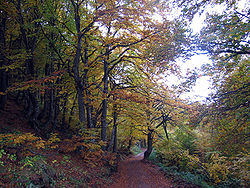
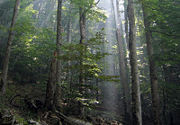
). Another distinction is whether the forests are composed predominantly of broadleaf trees, coniferous (needle-leaved) trees, or mixed.
- Boreal forests occupy the subarcticSubarcticThe Subarctic is a region in the Northern Hemisphere immediately south of the true Arctic and covering much of Alaska, Canada, the north of Scandinavia, Siberia, and northern Mongolia...
zone and are generally evergreen and coniferous. - TemperateTemperateIn geography, temperate or tepid latitudes of the globe lie between the tropics and the polar circles. The changes in these regions between summer and winter are generally relatively moderate, rather than extreme hot or cold...
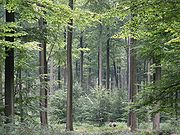
zones support both broadleaf deciduous forests (e.g., temperate deciduous forestTemperate broadleaf and mixed forestsMixed forests are a temperate and humid biome. The typical structure of these forests includes four layers. The uppermost layer is the canopy composed of tall mature trees ranging from 33 to 66 m high. Below the canopy is the three-layered, shade-tolerant understory that is roughly 9 to...
) and evergreen coniferous forests (e.g., temperate coniferous forestsTemperate coniferous forestsTemperate coniferous forest is a terrestrial biome found in temperate regions of the world with warm summers and cool winters and adequate rainfall to sustain a forest. In most temperate coniferous forests, evergreen conifers predominate, while some are a mix of conifers and broadleaf evergreen...
and temperate rainforests). Warm temperate zones support broadleaf evergreen forests, including laurel forestLaurel forestLaurel forest is a subtropical or mild temperate forest, found in areas with high humidity and relatively stable and mild temperatures. They are characterized by tree species with evergreen, glossy, enlongated leaves, known as laurophyll or lauroide...
s. - Tropical and subtropical forests include tropical and subtropical moist forestsTropical and subtropical moist broadleaf forestsTropical and subtropical moist broadleaf forests , also known as tropical moist forests, are a tropical and subtropical forest biome....
, tropical and subtropical dry forestsTropical and subtropical dry broadleaf forestsThe tropical and subtropical dry broadleaf forest biome, also known as tropical dry forest, is located at tropical and subtropical latitudes. Though these forests occur in climates that are warm year-round, and may receive several hundred centimeters of rain per year, they have long dry seasons...
, and tropical and subtropical coniferous forestsTropical and subtropical coniferous forestsTropical and subtropical coniferous forests are a forest biome. They are located in regions of semi-humid climate at tropical and subtropical latitudes. Most tropical and subtropical coniferous forest ecoregions are found in the Nearctic and Neotropic ecozones, from Mexico to Nicaragua and on the...
. - PhysiognomyPhysiognomyPhysiognomy is the assessment of a person's character or personality from their outer appearance, especially the face...
classifies forests based on their overall physical structure or developmental stage (e.g. old growth vs. second growthSecondary forestA secondary forest is a forest or woodland area which has re-grown after a major disturbance such as fire, insect infestation, timber harvest or windthrow, until a long enough period has passed so that the effects of the disturbance are no longer evident...
). - Forests can also be classified more specifically based on the climate and the dominant tree species present, resulting in numerous different forest types (e.g., ponderosa pine/Douglas-fir forest).
A number of global forest classification systems have been proposed, but none has gained universal acceptance. UNEP-WCMC's forest category classification system is a simplification of other more complex systems (e.g. UNESCO
UNESCO
The United Nations Educational, Scientific and Cultural Organization is a specialized agency of the United Nations...
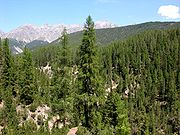
's forest and woodland 'subformations'). This system divides the world's forests into 26 major types, which reflect climatic zones as well as the principal types of trees. These 26 major types can be reclassified into 6 broader categories: temperate needleleaf; temperate broadleaf and mixed; tropical moist; tropical dry; sparse trees and parkland; and forest plantations. Each category is described as a separate section below.
Temperate needleleaf
Temperate needleleaf forests mostly occupy the higher latitude regions of the northern hemisphereNorthern Hemisphere
The Northern Hemisphere is the half of a planet that is north of its equator—the word hemisphere literally means “half sphere”. It is also that half of the celestial sphere north of the celestial equator...
, as well as high altitude
Altitude
Altitude or height is defined based on the context in which it is used . As a general definition, altitude is a distance measurement, usually in the vertical or "up" direction, between a reference datum and a point or object. The reference datum also often varies according to the context...
zones and some warm temperate areas, especially on nutrient-poor or otherwise unfavourable soils. These forests are composed entirely, or nearly so, of coniferous species (Coniferophyta). In the Northern Hemisphere pines Pinus, spruces Picea, larches Larix, silver firs Abies, Douglas firs Pseudotsuga and hemlocks Tsuga
Tsuga
Tsuga is a genus of conifers in the family Pinaceae. The common name hemlock is derived from a perceived similarity in the smell of its crushed foliage to that of the unrelated plant poison hemlock....
, make up the canopy, but other taxa are also important. In the Southern Hemisphere
Southern Hemisphere
The Southern Hemisphere is the part of Earth that lies south of the equator. The word hemisphere literally means 'half ball' or "half sphere"...
, most coniferous trees (members of the Araucariaceae
Araucariaceae
Araucariaceae, commonly referred to as araucarians, is a very ancient family of coniferous trees. It achieved its maximum diversity in the Jurassic and Cretaceous periods, when it was distributed almost worldwide...
and Podocarpaceae
Podocarpaceae
Podocarpaceae is a large family of mainly Southern Hemisphere conifers, comprising about 156 species of evergreen trees and shrubs. It contains 19 genera if Phyllocladus is included and if Manoao and Sundacarpus are recognized....
) occur in mixtures with broadleaf species that are classed as broadleaf and mixed forests.
Temperate broadleaf and mixed
Temperate broadleaf and mixed forestsTemperate broadleaf and mixed forests
Mixed forests are a temperate and humid biome. The typical structure of these forests includes four layers. The uppermost layer is the canopy composed of tall mature trees ranging from 33 to 66 m high. Below the canopy is the three-layered, shade-tolerant understory that is roughly 9 to...
include a substantial component of trees in the Anthophyta
Anthophyta
The anthophytes were thought to be a clade comprising plants bearing flower-like structures. The group contained the angiosperms - the extant flowering plants - as well as the Gnetales and the extinct Bennettitales....
. They are generally characteristic of the warmer temperate latitudes, but extend to cool temperate ones, particularly in the southern hemisphere. They include such forest types as the mixed deciduous forests of the United States
United States
The United States of America is a federal constitutional republic comprising fifty states and a federal district...
and their counterparts in China
China
Chinese civilization may refer to:* China for more general discussion of the country.* Chinese culture* Greater China, the transnational community of ethnic Chinese.* History of China* Sinosphere, the area historically affected by Chinese culture...
and Japan
Japan
Japan is an island nation in East Asia. Located in the Pacific Ocean, it lies to the east of the Sea of Japan, China, North Korea, South Korea and Russia, stretching from the Sea of Okhotsk in the north to the East China Sea and Taiwan in the south...
, the broadleaf evergreen rainforest
Rainforest
Rainforests are forests characterized by high rainfall, with definitions based on a minimum normal annual rainfall of 1750-2000 mm...
s of Japan, Chile
Chile
Chile ,officially the Republic of Chile , is a country in South America occupying a long, narrow coastal strip between the Andes mountains to the east and the Pacific Ocean to the west. It borders Peru to the north, Bolivia to the northeast, Argentina to the east, and the Drake Passage in the far...
and Tasmania
Tasmania
Tasmania is an Australian island and state. It is south of the continent, separated by Bass Strait. The state includes the island of Tasmania—the 26th largest island in the world—and the surrounding islands. The state has a population of 507,626 , of whom almost half reside in the greater Hobart...
, the sclerophyllous forests of Australia
Australia
Australia , officially the Commonwealth of Australia, is a country in the Southern Hemisphere comprising the mainland of the Australian continent, the island of Tasmania, and numerous smaller islands in the Indian and Pacific Oceans. It is the world's sixth-largest country by total area...
, central Chile, the Mediterranean and California
California
California is a state located on the West Coast of the United States. It is by far the most populous U.S. state, and the third-largest by land area...
, and the southern beech Nothofagus
Nothofagus
Nothofagus, also known as the southern beeches, is a genus of 35 species of trees and shrubs native to the temperate oceanic to tropical Southern Hemisphere in southern South America and Australasia...
forests of Chile and New Zealand
New Zealand
New Zealand is an island country in the south-western Pacific Ocean comprising two main landmasses and numerous smaller islands. The country is situated some east of Australia across the Tasman Sea, and roughly south of the Pacific island nations of New Caledonia, Fiji, and Tonga...
.
Tropical moist
Tropical moist forestsTropical and subtropical moist broadleaf forests
Tropical and subtropical moist broadleaf forests , also known as tropical moist forests, are a tropical and subtropical forest biome....
include many different forest types. The best known and most extensive are the lowland evergreen broadleaf rainforests include, for example: the seasonally inundated várzea and igapó forests and the terra firma forests of the Amazon Basin
Amazon Basin
The Amazon Basin is the part of South America drained by the Amazon River and its tributaries that drains an area of about , or roughly 40 percent of South America. The basin is located in the countries of Bolivia, Brazil, Colombia, Ecuador, Guyana, Peru, and Venezuela...
; the peat swamp forest
Peat swamp forest
Peat swamp forests are tropical moist forests where waterlogged soils prevent dead leaves and wood from fully decomposing, which over time creates a thick layer of acidic peat...
s and moist dipterocarp forests of Southeast Asia
Southeast Asia
Southeast Asia, South-East Asia, South East Asia or Southeastern Asia is a subregion of Asia, consisting of the countries that are geographically south of China, east of India, west of New Guinea and north of Australia. The region lies on the intersection of geological plates, with heavy seismic...
; and the high forests
High forest (woodland)
High forest is a term for a woodland or forest with a well-developed natural structure. It is used in both ecology and woodland management, particularly in contrast with even-aged woodland types such as coppice and planted woodland....
of the Congo Basin
Congo Basin
The Congo Basin is the sedimentary basin that is the drainage of the Congo River of west equatorial Africa. The basin begins in the highlands of the East African Rift system with input from the Chambeshi River, the Uele and Ubangi Rivers in the upper reaches and the Lualaba River draining wetlands...
. The forests of tropical mountains are also included in this broad category, generally divided into upper and lower montane
Montane
In biogeography, montane is the highland area located below the subalpine zone. Montane regions generally have cooler temperatures and often have higher rainfall than the adjacent lowland regions, and are frequently home to distinct communities of plants and animals.The term "montane" means "of the...
formations on the basis of their physiognomy, which varies with altitude. The montane forests include cloud forest
Cloud forest
A cloud forest, also called a fog forest, is a generally tropical or subtropical evergreen montane moist forest characterized by a persistent, frequent or seasonal low-level cloud cover, usually at the canopy level. Cloud forests often exhibit an abundance of mosses covering the ground and...
, those forests at middle to high altitude, which derive a significant part of their water budget from cloud, and support a rich abundance of vascular
Vascular tissue
Vascular tissue is a complex conducting tissue, formed of more than one cell type, found in vascular plants. The primary components of vascular tissue are the xylem and phloem. These two tissues transport fluid and nutrients internally. There are also two meristems associated with vascular tissue:...
and nonvascular epiphyte
Epiphyte
An epiphyte is a plant that grows upon another plant non-parasitically or sometimes upon some other object , derives its moisture and nutrients from the air and rain and sometimes from debris accumulating around it, and is found in the temperate zone and in the...
s. Mangrove
Mangrove
Mangroves are various kinds of trees up to medium height and shrubs that grow in saline coastal sediment habitats in the tropics and subtropics – mainly between latitudes N and S...
forests also fall within this broad category, as do most of the tropical coniferous forests of Central America.
Tropical dry
Tropical dry forestsTropical and subtropical dry broadleaf forests
The tropical and subtropical dry broadleaf forest biome, also known as tropical dry forest, is located at tropical and subtropical latitudes. Though these forests occur in climates that are warm year-round, and may receive several hundred centimeters of rain per year, they have long dry seasons...
are characteristic of areas in the tropics affected by seasonal drought
Drought
A drought is an extended period of months or years when a region notes a deficiency in its water supply. Generally, this occurs when a region receives consistently below average precipitation. It can have a substantial impact on the ecosystem and agriculture of the affected region...
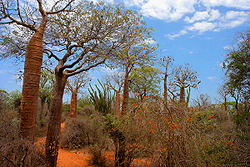
. The seasonality of rainfall is usually reflected in the deciduousness of the forest canopy, with most trees being leafless for several months of the year. However, under some conditions, e.g. less fertile soils or less predictable drought regimes, the proportion of evergreen species increases and the forests are characterised as "sclerophyllous". Thorn forest
Deserts and xeric shrublands
Deserts and xeric shrublands is a biome characterized by, relating to, or requiring only a small amount of moisture.-Definition and occurrence:...
, a dense forest of low stature with a high frequency of thorny or spiny species, is found where drought is prolonged, and especially where grazing animals are plentiful. On very poor soils, and especially where fire is a recurrent phenomenon, woody savanna
Savanna
A savanna, or savannah, is a grassland ecosystem characterized by the trees being sufficiently small or widely spaced so that the canopy does not close. The open canopy allows sufficient light to reach the ground to support an unbroken herbaceous layer consisting primarily of C4 grasses.Some...
s develop (see 'sparse trees and parkland').
Sparse trees and parkland
Ecosystem
An ecosystem is a biological environment consisting of all the organisms living in a particular area, as well as all the nonliving , physical components of the environment with which the organisms interact, such as air, soil, water and sunlight....
s occur are in the boreal
Boreal ecosystem
The term boreal is usually applied to ecosystems localized in subarctic and subantarctic zones, although Austral is also used for the latter....
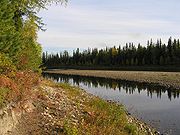
region and in the seasonally dry tropics. At high latitudes, north of the main zone of boreal forest or taiga, growing conditions are not adequate to maintain a continuous closed forest cover, so tree cover is both sparse and discontinuous. This vegetation is variously called open taiga
Taiga
Taiga , also known as the boreal forest, is a biome characterized by coniferous forests.Taiga is the world's largest terrestrial biome. In North America it covers most of inland Canada and Alaska as well as parts of the extreme northern continental United States and is known as the Northwoods...
, open lichen
Lichen
Lichens are composite organisms consisting of a symbiotic organism composed of a fungus with a photosynthetic partner , usually either a green alga or cyanobacterium...
woodland, and forest tundra. It is species-poor, has high bryophyte
Bryophyte
Bryophyte is a traditional name used to refer to all embryophytes that do not have true vascular tissue and are therefore called 'non-vascular plants'. Some bryophytes do have specialized tissues for the transport of water; however since these do not contain lignin, they are not considered to be...
cover, and is frequently affected by fire.
Forest plantations
Forest plantations, generally intended for the production of timberTimber
Timber may refer to:* Timber, a term common in the United Kingdom and Australia for wood materials * Timber, Oregon, an unincorporated community in the U.S...
and pulpwood
Pulpwood
Pulpwood refers to timber with the principal use of making wood pulp for paper production.-Applications:* Trees raised specifically for pulp production account for 16% of world pulp production, old growth forests 9% and second- and third- and more generation forests account for the balance...
increase the total area of forest worldwide. Commonly mono-specific and/or composed of introduced tree species, these ecosystems are not generally important as habitat for native biodiversity. However, they can be managed in ways that enhance their biodiversity protection functions and they are important providers of ecosystem services such as maintaining nutrient capital, protecting watershed
Drainage basin
A drainage basin is an extent or an area of land where surface water from rain and melting snow or ice converges to a single point, usually the exit of the basin, where the waters join another waterbody, such as a river, lake, reservoir, estuary, wetland, sea, or ocean...
s and soil structure as well as storing carbon. They may also play an important role in alleviating pressure on natural forests for timber and fuelwood production.
Forest categories
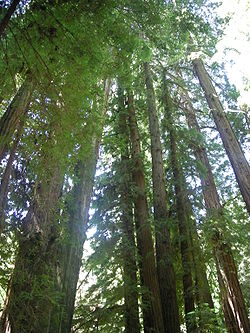
Temperate and boreal forest types
- Evergreen needleleaf forest - Natural forest with > 30% canopy cover, in which the canopy is predominantly (> 75%) needleleaf and evergreen.
- Deciduous needleleaf forests - Natural forests with > 30% canopy cover, in which the canopy is predominantly (> 75%) needleleaf and deciduous.
- Mixed broadleaf/needleleaf forest - Natural forest with > 30% canopy cover, in which the canopy is composed of a more or less even mixture of needleleaf and broadleaf crowns (between 50:50% and 25:75%).
- Broadleaf evergreen forest - Natural forests with > 30% canopy cover, the canopy being > 75% evergreen and broadleaf.
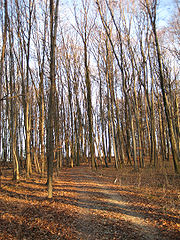
- Deciduous broadleaf forest - Natural forests with > 30% canopy cover, in which > 75% of the canopy is deciduous and broadleaves predominate (> 75% of canopy cover).
- Freshwater swamp forest - Natural forests with > 30% canopy cover, composed of trees with any mixture of leaf type and seasonality, but in which the predominant environmental characteristic is a waterlogged soil.
- Sclerophyllous dry forest - Natural forest with > 30% canopy cover, in which the canopy is mainly composed of sclerophyllous broadleaves and is > 75% evergreen.
- Disturbed natural forest - Any forest type above that has in its interior significant areas of disturbance by people, including clearing, felling for wood extraction, anthropogenic fires, road construction, etc.
- Sparse trees and parkland - Natural forests in which the tree canopy cover is between 10-30%, such as in the steppeSteppeIn physical geography, steppe is an ecoregion, in the montane grasslands and shrublands and temperate grasslands, savannas, and shrublands biomes, characterized by grassland plains without trees apart from those near rivers and lakes...
regions of the world. Trees of any type (e.g., needleleaf, broadleaf, palmsArecaceaeArecaceae or Palmae , are a family of flowering plants, the only family in the monocot order Arecales. There are roughly 202 currently known genera with around 2600 species, most of which are restricted to tropical, subtropical, and warm temperate climates...
). - Exotic species plantation - Intensively managed forests with > 30% canopy cover, which have been planted by people with species not naturally occurring in that country.
- Native species plantation - Intensively managed forests with > 30% canopy cover, which have been planted by people with species that occur naturally in that country.
-
* Unspecified forest plantation - Forest plantations showing extent only with no further information about their type, This data currently only refers to the UkraineUkraineUkraine is a country in Eastern Europe. It has an area of 603,628 km², making it the second largest contiguous country on the European continent, after Russia...
. -
* Unclassified forest data - Forest data showing forest extent only with no further information about their type.
Those marked
Tropical forest types
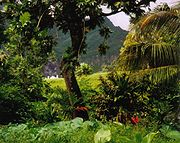
- Lowland evergreen broadleaf rain forest - Natural forests with > 30% canopy cover, below 1200 m (3,937 ft) altitude that display little or no seasonality, the canopy being >75% evergreen broadleaf.
- Lower montane forest - Natural forests with > 30% canopy cover, between 1200–1800 m altitude, with any seasonality regime and leaf type mixture.
- Upper montane forest - Natural forests with > 30% canopy cover, above 1800 m (5,906 ft) altitude, with any seasonality regime and leaf type mixture.
- Freshwater swamp forestFreshwater swamp forestFreshwater swamp forests, or flooded forests, are forests which are inundated with freshwater, either permanently or seasonally. They normally occur along the lower reaches of rivers and around freshwater lakes...
- Natural forests with > 30% canopy cover, below 1200 m (3,937 ft) altitude, composed of trees with any mixture of leaf type and seasonality, but in which the predominant environmental characteristic is a waterlogged soil. - Semi-evergreen moist broadleaf forest - Natural forests with > 30% canopy cover, below 1200 m (3,937 ft) altitude in which between 50-75% of the canopy is evergreen, > 75% are broadleaves, and the trees display seasonality of flowerFlowerA flower, sometimes known as a bloom or blossom, is the reproductive structure found in flowering plants . The biological function of a flower is to effect reproduction, usually by providing a mechanism for the union of sperm with eggs...
ing and fruitFruitIn broad terms, a fruit is a structure of a plant that contains its seeds.The term has different meanings dependent on context. In non-technical usage, such as food preparation, fruit normally means the fleshy seed-associated structures of certain plants that are sweet and edible in the raw state,...
ing. - Mixed broadleaf/needleleaf forest - Natural forests with > 30% canopy cover, below 1200 m (3,937 ft) altitude, in which the canopy is composed of a more or less even mixture of needleleaf and broadleaf crowns (between 50:50% and 25:75%).
- Needleleaf forest - Natural forest with > 30% canopy cover, below 1200 m (3,937 ft) altitude, in which the canopy is predominantly (> 75%) needleleaf.
- MangroveMangroveMangroves are various kinds of trees up to medium height and shrubs that grow in saline coastal sediment habitats in the tropics and subtropics – mainly between latitudes N and S...
s - Natural forests with > 30% canopy cover, composed of species of mangrove tree, generally along coasts in or near brackish or seawaterSeawaterSeawater is water from a sea or ocean. On average, seawater in the world's oceans has a salinity of about 3.5% . This means that every kilogram of seawater has approximately of dissolved salts . The average density of seawater at the ocean surface is 1.025 g/ml...
. - Disturbed natural forest - Any forest type above that has in its interior significant areas of disturbance by people, including clearing, felling for wood extraction, anthropogenic fires, road construction, etc.
- Deciduous/semi-deciduous broadleaf forest - Natural forests with > 30% canopy cover, below 1200 m (3,937 ft) altitude in which between 50-100% of the canopy is deciduous and broadleaves predominate (> 75% of canopy cover).
- Sclerophyllous dry forest - Natural forests with > 30% canopy cover, below 1200 m (3,937 ft) altitude, in which the canopy is mainly composed of sclerophyllous broadleaves and is > 75% evergreen.
- Thorn forest - Natural forests with > 30% canopy cover, below 1200 m (3,937 ft) altitude, in which the canopy is mainly composed of deciduous trees with thorns and succulent phanerophytes with thorns may be frequent.
- Sparse trees and parkland - Natural forests in which the tree canopy cover is between 10-30%, such as in the savannah regions of the world. Trees of any type (e.g., needleleaf, broadleaf, palms).
- Exotic species plantation - Intensively managed forests with > 30% canopy cover, which have been planted by people with species not naturally occurring in that country.
- Native species plantation - Intensively managed forests with > 30% canopy cover, which have been planted by people with species that occur naturally in that country.
Forest loss and management
Main articles: ForestryForestry
Forestry is the interdisciplinary profession embracing the science, art, and craft of creating, managing, using, and conserving forests and associated resources in a sustainable manner to meet desired goals, needs, and values for human benefit. Forestry is practiced in plantations and natural stands...
, Logging
Logging
Logging is the cutting, skidding, on-site processing, and loading of trees or logs onto trucks.In forestry, the term logging is sometimes used in a narrow sense concerning the logistics of moving wood from the stump to somewhere outside the forest, usually a sawmill or a lumber yard...
and Deforestation
Deforestation
Deforestation is the removal of a forest or stand of trees where the land is thereafter converted to a nonforest use. Examples of deforestation include conversion of forestland to farms, ranches, or urban use....
Forest ecology
Forest ecology is the scientific study of the interrelated patterns, processes, flora, fauna and ecosystems in forests. The management of forests is known as forestry, silviculture, and forest management...
, while the management of forests is often referred to as forestry
Forestry
Forestry is the interdisciplinary profession embracing the science, art, and craft of creating, managing, using, and conserving forests and associated resources in a sustainable manner to meet desired goals, needs, and values for human benefit. Forestry is practiced in plantations and natural stands...
. Forest management
Forest management
200px|thumb|right|[[Sustainable development|Sustainable]] forest management carried out by [[Complejo Forestal y Maderero Panguipulli|Complejo Panguipulli]] has contributed to the preservation of the forested landscape around [[Neltume]], a sawmill town in Chile...
has changed considerably over the last few centuries, with rapid changes from the 1980s onwards culminating in a practice now referred to as sustainable forest management
Sustainable forest management
Sustainable forest management is the management of forests according to the principles of sustainable development. Sustainable forest management uses very broad social, economic and environmental goals...
. Forest ecologists concentrate on forest patterns and processes, usually with the aim of elucidating cause and effect relationships. Foresters who practice sustainable forest management
Sustainable forest management
Sustainable forest management is the management of forests according to the principles of sustainable development. Sustainable forest management uses very broad social, economic and environmental goals...
focus on the integration of ecological, social and economic values, often in consultation with local communities and other stakeholders.
Anthropogenic factors that can affect forests include logging
Logging
Logging is the cutting, skidding, on-site processing, and loading of trees or logs onto trucks.In forestry, the term logging is sometimes used in a narrow sense concerning the logistics of moving wood from the stump to somewhere outside the forest, usually a sawmill or a lumber yard...
, urban sprawl
Urban sprawl
Urban sprawl, also known as suburban sprawl, is a multifaceted concept, which includes the spreading outwards of a city and its suburbs to its outskirts to low-density and auto-dependent development on rural land, high segregation of uses Urban sprawl, also known as suburban sprawl, is a...
, human-caused forest fires, acid rain
Acid rain
Acid rain is a rain or any other form of precipitation that is unusually acidic, meaning that it possesses elevated levels of hydrogen ions . It can have harmful effects on plants, aquatic animals, and infrastructure. Acid rain is caused by emissions of carbon dioxide, sulfur dioxide and nitrogen...
, invasive species
Invasive species
"Invasive species", or invasive exotics, is a nomenclature term and categorization phrase used for flora and fauna, and for specific restoration-preservation processes in native habitats, with several definitions....
, and the slash and burn
Slash and burn
Slash-and-burn is an agricultural technique which involves cutting and burning of forests or woodlands to create fields. It is subsistence agriculture that typically uses little technology or other tools. It is typically part of shifting cultivation agriculture, and of transhumance livestock...
practices of swidden agriculture or shifting cultivation
Shifting cultivation
Shifting cultivation is an agricultural system in which plots of land are cultivated temporarily, then abandoned. This system often involves clearing of a piece of land followed by several years of wood harvesting or farming, until the soil loses fertility...
. The loss and re-growth of forest leads to a distinction between two broad types of forest, primary or old-growth forest and secondary forest
Secondary forest
A secondary forest is a forest or woodland area which has re-grown after a major disturbance such as fire, insect infestation, timber harvest or windthrow, until a long enough period has passed so that the effects of the disturbance are no longer evident...
. There are also many natural factors that can cause changes in forests over time including forest fires, insects, diseases, weather, competition between species, etc. In 1997, the World Resources Institute recorded that only 20% of the world's original forests remained in large intact tracts of undisturbed forest. More than 75% of these intact forests lie in three countries - the Boreal forests of Russia and Canada and the rainforest of Brazil. In 2006 this information on intact forests was updated using latest available satellite imagery.
Canada
Canada
Canada is a North American country consisting of ten provinces and three territories. Located in the northern part of the continent, it extends from the Atlantic Ocean in the east to the Pacific Ocean in the west, and northward into the Arctic Ocean...
has about 4020000 square kilometres (1,552,130.7 sq mi) of forest land. More than 90% of forest land is publicly owned and about 50% of the total forest area is allocated for harvesting. These allocated areas are managed using the principles of sustainable forest management
Sustainable forest management
Sustainable forest management is the management of forests according to the principles of sustainable development. Sustainable forest management uses very broad social, economic and environmental goals...
, which includes extensive consultation with local stakeholders. About eight percent of Canada’s forest is legally protected from resource development (Global Forest Watch Canada)(Natural Resources Canada). Much more forest land — about 40 percent of the total forest land base — is subject to varying degrees of protection through processes such as integrated land use planning
Land use planning
Land-use planning is the term used for a branch of public policy encompassing various disciplines which seek to order and regulate land use in an efficient and ethical way, thus preventing land-use conflicts. Governments use land-use planning to manage the development of land within their...
or defined management areas such as certified forests (Natural Resources Canada).
These maps represent only virgin forest lost. Some regrowth has occurred but not to the age, size or extent of 1620 due to population increases and food cultivation. From William B. Greeley's, The Relation of Geography to Timber Supply, Economic Geography, 1925, vol. 1, p. 1-11. Source of "Today" map: compiled by George Draffan from roadless area map in The Big Outside: A Descriptive Inventory of the Big Wilderness Areas of the United States, by Dave Foreman and Howie Wolke (Harmony Books, 1992).'
By December 2006, over 1,237,000 square kilometers of forest land in Canada (about half the global total) had been certified as being sustainably managed (Canadian Sustainable Forestry Certification Coalition). Clearcutting
Clearcutting
Clearcutting, or clearfelling, is a controversial forestry/logging practice in which most or all trees in an area are uniformly cut down. Clearcutting, along with shelterwood and seed tree harvests, is used by foresters to create certain types of forest ecosystems and to promote select species that...
, first used in the latter half of the 20th century, is less expensive, but devastating to the environment and companies are required by law to ensure that harvested areas are adequately regenerated. Most Canadian provinces have regulations limiting the size of clearcuts, although some older clearcuts can range upwards of 110 square kilometres (27,181.6 acre) in size which were cut over several years. China instituted a ban on logging, beginning in 1998, due to the destruction caused by clearcutting. Selective cutting avoids the erosion, and flooding, that result from clearcutting.
In the United States
United States
The United States of America is a federal constitutional republic comprising fifty states and a federal district...
, most forests have historically been affected by humans to some degree, though in recent years improved forestry practices has helped regulate or moderate large scale or severe impacts. However, the United States Forest Service
United States Forest Service
The United States Forest Service is an agency of the United States Department of Agriculture that administers the nation's 155 national forests and 20 national grasslands, which encompass...
estimates a net loss of about 2 million hectares (4,942,000 acres) between 1997 and 2020; this estimate includes conversion of forest land to other uses, including urban and suburban development, as well as afforestation and natural reversion of abandoned crop and pasture land to forest. However, in many areas of the United States, the area of forest is stable or increasing, particularly in many northern states. The opposite problem from flooding has plagued national forests, with loggers complaining that a lack of thinning and proper forest management has resulted in large forest fires.
Old-growth forest contains mainly natural patterns of biodiversity in established seral patterns, and they contain mainly species native to the region and habitat. The natural formations and processes have not been affected by humans with a frequency or intensity to change the natural structure and components of the habitat. Secondary forest
Secondary forest
A secondary forest is a forest or woodland area which has re-grown after a major disturbance such as fire, insect infestation, timber harvest or windthrow, until a long enough period has passed so that the effects of the disturbance are no longer evident...
contains significant elements of species which were originally from other regions or habitats.
Smaller areas of woodland
Woodland
Ecologically, a woodland is a low-density forest forming open habitats with plenty of sunlight and limited shade. Woodlands may support an understory of shrubs and herbaceous plants including grasses. Woodland may form a transition to shrubland under drier conditions or during early stages of...
in cities may be managed as Urban forestry
Urban forestry
Urban forestry is the careful care and management of urban forests, i.e., tree populations in urban settings for the purpose of improving the urban environment. Urban forestry advocates the role of trees as a critical part of the urban infrastructure...
, sometimes within public parks. These are often created for human benefits; Attention Restoration Theory
Attention Restoration Theory
Attention Restoration Theory asserts that people can concentrate better after spending time in nature, or even looking at scenes of nature. Natural environments abound with "soft fascinations" which a person can reflect upon in "effortless attention", such as clouds moving across the sky, leaves...
argues that spending time in nature reduces stress and improves health, while forest schools and kindergartens help young people to develop social as well as scientific skills in forests. These typically need to be close to where the children live, for practical logistics.
See also
- AgroforestryAgroforestryAgroforestry is an integrated approach of using the interactive benefits from combining trees and shrubs with crops and/or livestock.It combines agricultural and forestry technologies to create more diverse, productive, profitable, healthy and sustainable land-use systems.-Definitions:According to...
- Ancient WoodlandAncient woodlandAncient woodland is a term used in the United Kingdom to refer specifically to woodland that has existed continuously since 1600 or before in England and Wales . Before those dates, planting of new woodland was uncommon, so a wood present in 1600 was likely to have developed naturally...
, an official classification of ancient forest in the United KingdomUnited KingdomThe United Kingdom of Great Britain and Northern IrelandIn the United Kingdom and Dependencies, other languages have been officially recognised as legitimate autochthonous languages under the European Charter for Regional or Minority Languages...
. - BiomassBiomassBiomass, as a renewable energy source, is biological material from living, or recently living organisms. As an energy source, biomass can either be used directly, or converted into other energy products such as biofuel....
- Biomass (ecology)Biomass (ecology)Biomass, in ecology, is the mass of living biological organisms in a given area or ecosystem at a given time. Biomass can refer to species biomass, which is the mass of one or more species, or to community biomass, which is the mass of all species in the community. It can include microorganisms,...
- Bioproduct
- BiosphereBiosphereThe biosphere is the global sum of all ecosystems. It can also be called the zone of life on Earth, a closed and self-regulating system...
- Boreal forest
- Canopy (biology)
- Close to nature forestryClose to nature forestryClose to nature forestry is a theory and practice that takes the forest as an ecosystem and manages it as such. It is based in reduced human intervention, that should be directed to accelerate the processes that nature would do by itself more slowly. It aims at overcoming the divorce between...
- Cloud forestCloud forestA cloud forest, also called a fog forest, is a generally tropical or subtropical evergreen montane moist forest characterized by a persistent, frequent or seasonal low-level cloud cover, usually at the canopy level. Cloud forests often exhibit an abundance of mosses covering the ground and...
- Chase (land)Chase (land)In the United Kingdom a chase is a type of common land used for hunting to which there are no specifically designated officers and laws, but there are reserved hunting rights for one or more persons. Similarly, a Royal Chase is a type of Crown Estate by the same description, but where certain...
- DeforestationDeforestationDeforestation is the removal of a forest or stand of trees where the land is thereafter converted to a nonforest use. Examples of deforestation include conversion of forestland to farms, ranches, or urban use....
- DendrometryDendrometryDendrometry is the branch of botany that is concerned with the measurement of the various dimensions of trees, such as their diameter, size, shape, age, overall volume, thickness of the bark, etc., as well as the statistical properties of tree stands, including measures of central tendency and...
- Ecological successionEcological successionEcological succession, is the phenomenon or process by which a community progressively transforms itself until a stable community is formed. It is a fundamental concept in ecology, and refers to more or less predictable and orderly changes in the composition or structure of an ecological community...
- Forest managementForest management200px|thumb|right|[[Sustainable development|Sustainable]] forest management carried out by [[Complejo Forestal y Maderero Panguipulli|Complejo Panguipulli]] has contributed to the preservation of the forested landscape around [[Neltume]], a sawmill town in Chile...
- Forest migrationForest migrationForest migration is the movement of large seed plant dominated communities in geographical space over time.The emphasis of forest migration is placed on the movement of the tree communities that make up the forest community. Though an individual tree is permanently fixed in a location, tree...
- Forest pathologyForest pathologyForest pathology is the research of both biotic and abiotic maladies affecting the health of the forest or tree, primarily fungal pathogens and their insect vectors. It is a subfield of forestry and plant pathology.-Publications:...
- Intact forest landscapeIntact forest landscapeAn Intact Forest Landscape—IFL is an unbroken natural landscape of a forest ecosystem and its habitat—plant community components, in a current extant forest zone...
- Jungle (terrain)
- Kelp forestKelp forestKelp forests are underwater areas with a high density of kelp. They are recognized as one of the most productive and dynamic ecosystems on Earth. Smaller areas of anchored kelp are called kelp beds....
(A forest made mostly if not entirely of KelpKelpKelps are large seaweeds belonging to the brown algae in the order Laminariales. There are about 30 different genera....
; an underwater forest) - Natural environmentNatural environmentThe natural environment encompasses all living and non-living things occurring naturally on Earth or some region thereof. It is an environment that encompasses the interaction of all living species....
- Natural landscapeNatural landscapeA natural landscape is a landscape that is unaffected by human activity. A natural landscape is intact when all living and nonliving elements are free to move and change. The nonliving elements distinguish a natural landscape from a wilderness. A wilderness includes areas within which natural...
- Old-growth forest (ancient forest, virgin forest, primary forest)
- PermaforestryPermaforestryPermaforestry is an approach to the wildcrafting and harvesting of the forest biomass that uses cultivation to improve the natural harmonious systems...
- Plantation
- Primeval forest, a term often used interchangeably with old growth forest
- RainforestRainforestRainforests are forests characterized by high rainfall, with definitions based on a minimum normal annual rainfall of 1750-2000 mm...
- Red forestRed ForestThe Red Forest , formerly the Worm Wood Forest, refers to the trees in the 10 km² surrounding the Chernobyl Nuclear Power Plant. The name 'Red Forest' comes from the ginger-brown colour of the pine trees after they died following the absorption of high levels of radiation from the Chernobyl...
- REDD-plus
- Rocky MountainsRocky MountainsThe Rocky Mountains are a major mountain range in western North America. The Rocky Mountains stretch more than from the northernmost part of British Columbia, in western Canada, to New Mexico, in the southwestern United States...
- SilvicultureSilvicultureSilviculture is the practice of controlling the establishment, growth, composition, health, and quality of forests to meet diverse needs and values. The name comes from the Latin silvi- + culture...
- SubalpineSubalpineThe subalpine zone is the biotic zone immediately below tree line around the world. Species that occur in this zone depend on the location of the zone on the Earth, for example, Snow Gum in Australia, or Subalpine Larch, Mountain Hemlock and Subalpine Fir in western North America.Trees in the...
forest - TaigaTaigaTaiga , also known as the boreal forest, is a biome characterized by coniferous forests.Taiga is the world's largest terrestrial biome. In North America it covers most of inland Canada and Alaska as well as parts of the extreme northern continental United States and is known as the Northwoods...
, a biome characterized by coniferous forests - Temperate broadleaf and mixed forestsTemperate broadleaf and mixed forestsMixed forests are a temperate and humid biome. The typical structure of these forests includes four layers. The uppermost layer is the canopy composed of tall mature trees ranging from 33 to 66 m high. Below the canopy is the three-layered, shade-tolerant understory that is roughly 9 to...
- Temperate coniferous forestsTemperate coniferous forestsTemperate coniferous forest is a terrestrial biome found in temperate regions of the world with warm summers and cool winters and adequate rainfall to sustain a forest. In most temperate coniferous forests, evergreen conifers predominate, while some are a mix of conifers and broadleaf evergreen...
- Tree allometryTree allometryTree allometry establishes quantitative relations between some key characteristic dimensions of trees and other properties...
- Tree farmTree farmA tree farm is a privately owned forest managed for timber production. The term tree farm is also used to refer to plantations and to tree nurseries.-American Tree Farm System:...
- Tropical rainforestTropical rainforestA tropical rainforest is an ecosystem type that occurs roughly within the latitudes 28 degrees north or south of the equator . This ecosystem experiences high average temperatures and a significant amount of rainfall...
- Tropical and subtropical coniferous forestsTropical and subtropical coniferous forestsTropical and subtropical coniferous forests are a forest biome. They are located in regions of semi-humid climate at tropical and subtropical latitudes. Most tropical and subtropical coniferous forest ecoregions are found in the Nearctic and Neotropic ecozones, from Mexico to Nicaragua and on the...
- Tropical and subtropical moist broadleaf forestsTropical and subtropical moist broadleaf forestsTropical and subtropical moist broadleaf forests , also known as tropical moist forests, are a tropical and subtropical forest biome....
- WildcraftingWildcraftingWildcrafting is the practice of harvesting plants from their natural, or "wild" habitat, for food or medicinal purposes. It applies to uncultivated plants wherever they may be found, and is not necessarily limited to wilderness areas...
- Woodland management
External links
- Forests in danger
- Roadmap to Recovery: The World's Last Intact Forest Landscapes
- Global Forest Resources Assessment 2005 by the FAOFãoFão is a town in Esposende Municipality in Portugal....
- CoolForests.org - Conservation Cools the Planet
- Google - public data "Forest area (sq. km)"