
Home      Discussion      Topics      Dictionary      Almanac
Signup       Login
Stirling Castle

Stirling Castle

Overview
Discussion
Ask a question about 'Stirling Castle'
Start a new discussion about 'Stirling Castle'
Answer questions from other users
Full Discussion Forum
 
Unanswered Questions
Encyclopedia
For ships named after the castle, see Stirling Castle (disambiguation)
Stirling Castle (disambiguation)
Stirling Castle is a castle in Stirling, Scotland.Stirling Castle may also refer to:* HMS Stirling Castle, a number of Royal Navy ships* MV Stirling Castle, a liner built in Belfast in 1935 and scrapped in 1966...


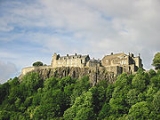
Stirling Castle, located in Stirling
Stirling
Stirling is a city and former ancient burgh in Scotland, and is at the heart of the wider Stirling council area. The city is clustered around a large fortress and medieval old-town beside the River Forth...

, is one of the largest and most important castle
Castle
A castle is a type of fortified structure built in Europe and the Middle East during the Middle Ages by European nobility. Scholars debate the scope of the word castle, but usually consider it to be the private fortified residence of a lord or noble...

s, both historically and architecturally, in Scotland
Scotland
Scotland is a country that is part of the United Kingdom. Occupying the northern third of the island of Great Britain, it shares a border with England to the south and is bounded by the North Sea to the east, the Atlantic Ocean to the north and west, and the North Channel and Irish Sea to the...

. The castle sits atop Castle Hill, an intrusive crag
Crag and tail
A crag is a rocky hill or mountain, generally isolated from other high ground. Crags are formed when a glacier or ice sheet passes over an area that contains a particularly resistant rock formation...

, which forms part of the Stirling Sill
Stirling Sill
The Stirling Sill is an outcropping of a large quartz-dolerite intrusion or sill that underlies a large part of central Scotland, and may be contiguous at great depth. The sill is of very late Carboniferous age or more probably Permian, as it penetrates the coal measures, often in bedding planes...

 geological formation. It is surrounded on three sides by steep cliffs, giving it a strong defensive position. Its strategic location, guarding what was, until the 1890s, the farthest downstream crossing of the River Forth
River Forth
The River Forth , long, is the major river draining the eastern part of the central belt of Scotland.The Forth rises in Loch Ard in the Trossachs, a mountainous area some west of Stirling...

, has made it an important fortification from the earliest times. Most of the principal buildings of the castle date from the fifteenth and sixteenth centuries. A few structures of the fourteenth century remain, while the outer defences fronting the town date from the early eighteenth century. Several Scottish Kings and Queens have been crowned at Stirling, including Mary, Queen of Scots, in 1543. There have been at least eight sieges of Stirling Castle
Sieges of Stirling Castle
There have been at least sixteen sieges of Stirling Castle, a strategically important fortification in Stirling, Scotland. Stirling is located at the crossing of the River Forth, making it a key location for access to the north of Scotland...

, including several during the Wars of Scottish Independence
Wars of Scottish Independence
The Wars of Scottish Independence were a series of military campaigns fought between the independent Kingdom of Scotland and the Kingdom of England in the late 13th and early 14th centuries....

, with the last being in 1746, when Bonnie Prince Charlie
Charles Edward Stuart
Prince Charles Edward Louis John Casimir Sylvester Severino Maria Stuart commonly known as Bonnie Prince Charlie or The Young Pretender was the second Jacobite pretender to the thrones of Great Britain , and Ireland...

 unsuccessfully tried to take the castle. Stirling Castle is a Scheduled Ancient Monument
Scheduled Ancient Monument
In the United Kingdom, a scheduled monument is a 'nationally important' archaeological site or historic building, given protection against unauthorized change. The various pieces of legislation used for legally protecting heritage assets from damage and destruction are grouped under the term...

, and is now a tourist attraction managed by Historic Scotland
Historic Scotland
Historic Scotland is an executive agency of the Scottish Government, responsible for historic monuments in Scotland.-Role:As its website states:...

.

Early history


Castle Hill, on which Stirling Castle is built, forms part of the Stirling Sill
Stirling Sill
The Stirling Sill is an outcropping of a large quartz-dolerite intrusion or sill that underlies a large part of central Scotland, and may be contiguous at great depth. The sill is of very late Carboniferous age or more probably Permian, as it penetrates the coal measures, often in bedding planes...

, a formation of quartz-dolerite
Quartz-dolerite
An intrusive rock, similar to dolerite, but with an excess of quartz. Dolerite is similar in composition to basalt, which is eruptive , and gabbro, which is plutonic. The differing crystal sizes are due to the different rate of cooling, basalt cools quickly and has a very fine structure, while...

 around 350 million years old, which was subsequently modified by glaciation to form a "crag and tail
Crag and tail
A crag is a rocky hill or mountain, generally isolated from other high ground. Crags are formed when a glacier or ice sheet passes over an area that contains a particularly resistant rock formation...

". It is likely that this natural feature was occupied at an early date, as a hill fort
Hill fort
A hill fort is a type of earthworks used as a fortified refuge or defended settlement, located to exploit a rise in elevation for defensive advantage. They are typically European and of the Bronze and Iron Ages. Some were used in the post-Roman period...

 is located on Gowan Hill, immediately to the east. The Romans
Roman Britain
Roman Britain was the part of the island of Great Britain controlled by the Roman Empire from AD 43 until ca. AD 410.The Romans referred to the imperial province as Britannia, which eventually comprised all of the island of Great Britain south of the fluid frontier with Caledonia...

 bypassed Stirling, building a fort at Doune
Doune
Doune is a burgh in the district of Stirling, Scotland, on the River Teith. Doune's postal address places the town in Perthshire, although geographically it lies within the District of Stirling, and administratively Doune is under the control of Stirling Council...

 instead, but the rock may have been occupied by the Maeatae
Maeatae
The Maeatae were a confederation of tribes who lived probably beyond the Antonine Wall in Roman Britain. The historical sources are vague as to the exact region they inhabited....

 at this time. It may later have been a stronghold of the Manaw Gododdin
Manaw Gododdin
Manaw Gododdin was the narrow coastal region on the south side of the Firth of Forth, part of the Brythonic-speaking Kingdom of Gododdin in the post-Roman Era. Its notability is as the homeland of Cunedda prior to his conquest of North Wales, and as the homeland of the heroic warriors in the...

, and has also been identified with a settlement recorded in the 7th and 8th centuries as Iudeu, where King Penda
Penda of Mercia
Penda was a 7th-century King of Mercia, the Anglo-Saxon kingdom in what is today the English Midlands. A pagan at a time when Christianity was taking hold in many of the Anglo-Saxon kingdoms, Penda took over the Severn Valley in 628 following the Battle of Cirencester before participating in the...

 of Mercia
Mercia
Mercia was one of the kingdoms of the Anglo-Saxon Heptarchy. It was centred on the valley of the River Trent and its tributaries in the region now known as the English Midlands...

 besieged King Oswy
Oswiu of Northumbria
Oswiu , also known as Oswy or Oswig , was a King of Bernicia. His father, Æthelfrith of Bernicia, was killed in battle, fighting against Rædwald, King of the East Angles and Edwin of Deira at the River Idle in 616...

 of Bernicia
Bernicia
Bernicia was an Anglo-Saxon kingdom established by Anglian settlers of the 6th century in what is now southeastern Scotland and North East England....

 in 655. The area came under Pict
PICT
PICT is a graphics file format introduced on the original Apple Macintosh computer as its standard metafile format. It allows the interchange of graphics , and some limited text support, between Mac applications, and was the native graphics format of QuickDraw.The original version, PICT 1, was...

ish control after the defeat of the Northumbrians at the Battle of Dun Nechtain thirty years later. However, there is no archaeological evidence for occupation of Castle Hill before the late medieval
Late Middle Ages
The Late Middle Ages was the period of European history generally comprising the 14th to the 16th century . The Late Middle Ages followed the High Middle Ages and preceded the onset of the early modern era ....

 period.

Other legends have been associated with Stirling, or "Snowdoun" as it was more poetically known. The 16th-century historian Hector Boece
Hector Boece
Hector Boece , known in Latin as Hector Boecius or Boethius, was a Scottish philosopher and first Principal of King's College in Aberdeen, a predecessor of the University of Aberdeen.-Biography:He was born in Dundee where he attended school...

 claims in his Historia Gentis Scotorum that the Romans, under Agricola
Gnaeus Julius Agricola
Gnaeus Julius Agricola was a Roman general responsible for much of the Roman conquest of Britain. His biography, the De vita et moribus Iulii Agricolae, was the first published work of his son-in-law, the historian Tacitus, and is the source for most of what is known about him.Born to a noted...

, fortified Stirling, and that Kenneth MacAlpin, traditionally the first King of Scotland, besieged a castle at Stirling during his takeover of the Pictish kingdom in the 9th century. Boece is, however, considered an unreliable historian. Another chronicler, William Worcester
William Worcester
William Worcester , was an English chronicler and antiquary.-Life:He was a son of William of Worcester, a Bristol citizen, and is sometimes called William Botoner, his mother being a daughter of Thomas Botoner from Catalonia....

, associated Stirling with the court of the legendary King Arthur
King Arthur
King Arthur is a legendary British leader of the late 5th and early 6th centuries, who, according to Medieval histories and romances, led the defence of Britain against Saxon invaders in the early 6th century. The details of Arthur's story are mainly composed of folklore and literary invention, and...

. Tradition suggests that St Monenna founded a chapel here, as she is said to have done at Edinburgh
Edinburgh Castle
Edinburgh Castle is a fortress which dominates the skyline of the city of Edinburgh, Scotland, from its position atop the volcanic Castle Rock. Human habitation of the site is dated back as far as the 9th century BC, although the nature of early settlement is unclear...

, although it is now thought that the legend of Monenna results from a later confusion of early Christian figures, including Modwenna
Saint Modwen
Modwen, or Modwenna, was an English nun and saint, who founded Burton-on-Trent Abbey in Staffordshire, England, in the 7th century.She was an Irish noblewoman by birth, and founded the abbey on an island in the River Trent. Modwenna spent seven years at the abbey with two other Irish nuns called...

 and Moninne.

The first record of Stirling Castle dates from around 1110, when King Alexander I
Alexander I of Scotland
Alexander I , also called Alaxandair mac Maíl Coluim and nicknamed "The Fierce", was King of the Scots from 1107 to his death.-Life:...

 dedicated a chapel here. It appears to have been an established royal centre by this time, as Alexander died here in 1124. During the reign of his successor David I
David I of Scotland
David I or Dabíd mac Maíl Choluim was a 12th-century ruler who was Prince of the Cumbrians and later King of the Scots...

, Stirling became a royal burgh
Royal burgh
A royal burgh was a type of Scottish burgh which had been founded by, or subsequently granted, a royal charter. Although abolished in 1975, the term is still used in many of the former burghs....

, and the castle an important administration centre. King William I
William I of Scotland
William the Lion , sometimes styled William I, also known by the nickname Garbh, "the Rough", reigned as King of the Scots from 1165 to 1214...

 formed a deer park
Medieval deer park
A medieval deer park was an enclosed area containing deer. It was bounded by a ditch and bank with a wooden park pale on top of the bank. The ditch was typically on the inside, thus allowing deer to enter the park but preventing them from leaving.-History:...

 to the south-west of the castle, but after his capture by the English in 1174 he was forced to surrender several castles, including Stirling and Edinburgh
Edinburgh Castle
Edinburgh Castle is a fortress which dominates the skyline of the city of Edinburgh, Scotland, from its position atop the volcanic Castle Rock. Human habitation of the site is dated back as far as the 9th century BC, although the nature of early settlement is unclear...

, under the Treaty of Falaise
Treaty of Falaise
The Treaty of Falaise was an agreement made in December 1174 between the captive William I, King of Scots, and the English King Henry II.Having been captured at the Battle of Alnwick during an invasion of Northumbria, William was being held in Falaise in Normandy while Henry sent an army north and...

. There is no evidence that the English actually occupied the castle, and it was formally handed back by Richard I of England
Richard I of England
Richard I was King of England from 6 July 1189 until his death. He also ruled as Duke of Normandy, Duke of Aquitaine, Duke of Gascony, Lord of Cyprus, Count of Anjou, Count of Maine, Count of Nantes, and Overlord of Brittany at various times during the same period...

 in 1189. Stirling continued to be a favoured royal residence, with William himself dying there in 1214, and Alexander III
Alexander III of Scotland
Alexander III was King of Scots from 1249 to his death.-Life:...

 laying out the New Park, for deer hunting, in the 1260s.

Wars of Independence


Stirling remained a centre of royal administration until the death of Alexander III in 1286. His passing triggered a succession crisis, with Edward I of England
Edward I of England
Edward I , also known as Edward Longshanks and the Hammer of the Scots, was King of England from 1272 to 1307. The first son of Henry III, Edward was involved early in the political intrigues of his father's reign, which included an outright rebellion by the English barons...

 invited to arbitrate between competing claimants. Edward came north in 1291, demanding that Stirling, along with the other royal castles, be put under his control during the arbitration. Edward gave judgement in favour of John Balliol
John of Scotland
John Balliol , known to the Scots as Toom Tabard , was King of Scots from 1292 to 1296.-Early life:Little of John's early life is known. He was born between 1248 and 1250 at an unknown location, possibilities include Galloway, Picardy and Barnard Castle, County Durham...

, hoping he would be a "puppet" ruler, but John refused to obey Edward's demands. In 1296, Edward invaded Scotland, beginning the Wars of Scottish Independence
Wars of Scottish Independence
The Wars of Scottish Independence were a series of military campaigns fought between the independent Kingdom of Scotland and the Kingdom of England in the late 13th and early 14th centuries....

, which would last for the next 60 years. The English found Stirling Castle abandoned and empty, and set about occupying this key site. They were dislodged the following year, after the victory of Sir Andrew Murray
Sir Andrew Murray
Sir Andrew Murray , also known as Sir Andrew Moray or Sir Andrew Murray of Bothwell, was a Scottish military leader who commanded resistance forces loyal to David II of Scotland against Edward Balliol and Edward III of England during the Second War of Scottish Independence...

 and William Wallace
William Wallace
Sir William Wallace was a Scottish knight and landowner who became one of the main leaders during the Wars of Scottish Independence....

 at the Battle of Stirling Bridge
Battle of Stirling Bridge
The Battle of Stirling Bridge was a battle of the First War of Scottish Independence. On 11 September 1297, the forces of Andrew Moray and William Wallace defeated the combined English forces of John de Warenne, 6th Earl of Surrey and Hugh de Cressingham near Stirling, on the River Forth.-The main...

. Many of the garrison were killed during the battle, after which the English commanders under Sir Marmaduke Tweng
Marmaduke Tweng
Sir Marmaduke Tweng was an English knight from Yorkshire who fought in the Wars of Scottish Independence.He fought on the English side at the Battle of Stirling Bridge and the Battle of Bannockburn. He achieved some fame at Stirling Bridge by a heroic escape...

 retreated into the castle. However, they were quickly starved into surrender by the Scots. Next summer, the castle changed hands again, being abandoned by the Scots after the English victory at Falkirk
Battle of Falkirk (1298)
The Battle of Falkirk, which took place on 22 July 1298, was one of the major battles in the First War of Scottish Independence...

. Edward strengthened the castle, but it was besieged in 1299 by forces including Robert Bruce
Robert I of Scotland
Robert I , popularly known as Robert the Bruce , was King of Scots from March 25, 1306, until his death in 1329.His paternal ancestors were of Scoto-Norman heritage , and...

. King Edward failed to relieve the garrison, who were forced to surrender.


By 1303, the English again held the upper hand, and Stirling was the last remaining castle in Scottish hands. Edward's army arrived in April 1304, with at least 17 siege engine
Siege engine
A siege engine is a device that is designed to break or circumvent city walls and other fortifications in siege warfare. Some have been operated close to the fortifications, while others have been used to attack from a distance. From antiquity, siege engines were constructed largely of wood and...

s. The Scots, under Sir William Oliphant, surrendered on 20 July, but part of the garrison were ordered back into the castle by Edward, as he had not yet deployed his latest engine, "Warwolf
Warwolf
The Warwolf, or War Wolf or Ludgar , is believed to be the largest Trebuchet ever made. It was created in Scotland by order of King Edward Longshanks of England, during the siege of Stirling Castle, as part of the Scottish Wars of Independence.When disassembled, the weapon would fill 30 wagons...

". Warwolf is believed to have been a large trebuchet
Trebuchet
A trebuchet is a siege engine that was employed in the Middle Ages. It is sometimes called a "counterweight trebuchet" or "counterpoise trebuchet" in order to distinguish it from an earlier weapon that has come to be called the "traction trebuchet", the original version with pulling men instead of...

, which destroyed the castle's gatehouse. Although Edward's victory seemed complete, he was dead by 1307, and Robert Bruce
Robert I of Scotland
Robert I , popularly known as Robert the Bruce , was King of Scots from March 25, 1306, until his death in 1329.His paternal ancestors were of Scoto-Norman heritage , and...

 was now King of Scots. By 1313, only Stirling, Roxburgh
Roxburgh Castle
Roxburgh Castle was a castle sited near Kelso, in the Borders region of Scotland, in the former Roxburghshire.-History:The castle was founded by King David I. In 1174 it was surrendered to England after the capture of William I at Alnwick, and was often in English hands thereafter. The Scots made...

, Edinburgh
Edinburgh Castle
Edinburgh Castle is a fortress which dominates the skyline of the city of Edinburgh, Scotland, from its position atop the volcanic Castle Rock. Human habitation of the site is dated back as far as the 9th century BC, although the nature of early settlement is unclear...

 and Berwick
Berwick Castle
Berwick Castle is a ruined castle in Berwick-Upon-Tweed, Northumberland, England.The castle was founded in the 12th century by the Scottish King David I. In 1296-8, the English King Edward I had the castle rebuilt and the town fortified, before it was returned to Scotland...

 castles were held by the English. Edward Bruce
Edward Bruce
Edward the Bruce , sometimes modernised Edward of Bruce, was a younger brother of King Robert I of Scotland, who supported his brother in the struggle for the crown of Scotland, then pursued his own claim in Ireland. He was proclaimed High King of Ireland, but was eventually defeated and killed in...

, the king's brother, laid siege to Stirling, which was held by Sir Philip Mowbray
Philip Mowbray
Sir Philip Mowbray or Philip de Mowbray was a Scottish gentleman and Governor of Stirling Castle in the 14th century.He was the son of Sir Geoffrey Mowbray by a daughter of Red John Comyn, Justiciary of Scotland. Philip married Eve, Lady Redcastle...

. Mowbray proposed a bargain: that he would surrender the castle, if it were not relieved by 24 June 1314. Bruce agreed, and withdrew. The following summer, the English duly headed north, led by Edward II
Edward II of England
Edward II , called Edward of Caernarfon, was King of England from 1307 until he was deposed by his wife Isabella in January 1327. He was the sixth Plantagenet king, in a line that began with the reign of Henry II...

, to save the castle. On 23-24 June, King Robert's forces met the English at the Battle of Bannockburn
Battle of Bannockburn
The Battle of Bannockburn was a significant Scottish victory in the Wars of Scottish Independence...

, within sight of the castle walls. The resulting English defeat was decisive. King Edward attempted to take refuge in the castle, but Mowbray was determined to keep to his word, and the English were forced to flee. Mowbray handed over the castle, changing sides himself in the process. King Robert ordered the castle to be slighted
Slighting
A slighting is the deliberate destruction, partial or complete, of a fortification without opposition. During the English Civil War this was to render it unusable as a fort.-Middle Ages:...

; its defences destroyed to prevent reoccupation by the English.

The war was not over, however. The second War of Scottish Independence
Second War of Scottish Independence
The Second War of Scottish Independence was the second cluster of a series of military campaigns fought between the independent Kingdom of Scotland and the Kingdom of England in the late thirteenth and early fourteenth centuries....

 saw the English in control of Stirling Castle by 1336, when Sir Thomas Rokeby was the commander, and extensive works were carried out, still largely in timber rather than stone. Andrew Murray attempted a siege in 1337, when guns may have been used for one of the first times in Scotland. Robert Stewart
Robert II of Scotland
Robert II became King of Scots in 1371 as the first monarch of the House of Stewart. He was the son of Walter Stewart, hereditary High Steward of Scotland and of Marjorie Bruce, daughter of Robert I and of his first wife Isabella of Mar...

, the future King Robert II, retook Stirling in a siege during 1341–1342. Stirling remained Scottish until the end of the war in 1357. In 1360, Robert de Forsyth
Clan Forsyth
Clan Forsyth is one of Scotland's wealthiest clans.The name Forsyth derives from the Gaelic 'man of peace'...

 II was appointed governor of Stirling Castle, an office he passed on to his son John and grandson William, who was governor in 1399.

Early Stewarts


Under the early Stewart kings Robert II
Robert II of Scotland
Robert II became King of Scots in 1371 as the first monarch of the House of Stewart. He was the son of Walter Stewart, hereditary High Steward of Scotland and of Marjorie Bruce, daughter of Robert I and of his first wife Isabella of Mar...

 (reigned 1371–1390) and Robert III
Robert III of Scotland
Robert III was King of Scots from 1390 to his death. His given name was John Stewart, and he was known primarily as the Earl of Carrick before ascending the throne at age 53...

 (reigned 1390–1406), the earliest surviving parts of the castle were built. Robert Stewart, Earl of Menteith, Regent of Scotland as brother of Robert III, undertook works on the north and south gates. The present north gate is built on these foundations of the 1380s, the earliest surviving masonry in the castle. In 1424, Stirling Castle was part of the jointure
Jointure
Jointure is, in law, a provision for a wife after the death of her husband. As defined by Sir Edward Coke, it is "a competent livelihood of freehold for the wife, of lands or tenements, to take effect presently in possession or profit after the death of her husband for the life of the wife at...

 (marriage settlement) given to James I
James I of Scotland
James I, King of Scots , was the son of Robert III and Annabella Drummond. He was probably born in late July 1394 in Dunfermline as youngest of three sons...

's wife Joan Beaufort
Joan Beaufort, Queen of Scotland
Joan Beaufort was the Queen Consort of Scotland from 1424 to 1437 as the spouse of King James I of Scotland. During part of the minority of her son James II , she served as the Regent of Scotland....

, establishing a tradition which later monarchs continued. After James' murder in 1437, Joan took shelter here with her son, the young James II
James II of Scotland
James II reigned as King of Scots from 1437 to his death.He was the son of James I, King of Scots, and Joan Beaufort...

. Fifteen years later, it was at Stirling Castle that James stabbed and killed the Earl of Douglas
William Douglas, 8th Earl of Douglas
William Douglas, 8th Earl of Douglas, 2nd Earl of Avondale was a Scottish nobleman. He was the eldest son of James Douglas, 7th Earl of Douglas and Beatrice Sinclair....

, when the latter refused to end a potentially treasonous alliance with the Earl of Ross
John of Islay, Earl of Ross
John of Islay was a late medieval Scottish magnate. He was Earl of Ross and last Lord of the Isles as well as being Mac Domhnaill, chief of Clan Donald....

 and the Earl of Crawford
Alexander Lindsay, 4th Earl of Crawford
Alexander Lindsay, 4th Earl of Crawford acceded 1446, died September 1453.Father: David Lindsay, 3rd Earl of Crawford Mother: Marjory OgilvieMarried Margaret Dunbar and had 3 children, Elizabeth, David 5th Earl born 1440 and Alexander the 7th Earl....

. James III
James III of Scotland
James III was King of Scots from 1460 to 1488. James was an unpopular and ineffective monarch owing to an unwillingness to administer justice fairly, a policy of pursuing alliance with the Kingdom of England, and a disastrous relationship with nearly all his extended family.His reputation as the...

 (reigned 1460–1488) was born here, and later undertook works to the gardens and the chapel royal. The manufacture of artillery
Artillery
Originally applied to any group of infantry primarily armed with projectile weapons, artillery has over time become limited in meaning to refer only to those engines of war that operate by projection of munitions far beyond the range of effect of personal weapons...

 in the castle is recorded in 1475. James' wife, Margaret of Denmark, died in Stirling Castle in 1486, and two years later James himself died at the Battle of Sauchieburn
Battle of Sauchieburn
The Battle of Sauchieburn was fought on June 11, 1488, at the side of Sauchie Burn, a stream about two miles south of Stirling, Scotland. The battle was fought between as many as 30,000 troops of King James III of Scotland and some 18,000 troops raised by a group of dissident Scottish nobles...

, fought over almost the same ground as the Battle of Bannockburn, just to the south of the castle.

Renaissance palace


Almost all the present buildings in the castle were constructed between 1490 and 1600, when Stirling was developed as a principal royal centre by the Stewart
House of Stuart
The House of Stuart is a European royal house. Founded by Robert II of Scotland, the Stewarts first became monarchs of the Kingdom of Scotland during the late 14th century, and subsequently held the position of the Kings of Great Britain and Ireland...

 kings James IV
James IV of Scotland
James IV was King of Scots from 11 June 1488 to his death. He is generally regarded as the most successful of the Stewart monarchs of Scotland, but his reign ended with the disastrous defeat at the Battle of Flodden Field, where he became the last monarch from not only Scotland, but also from all...

, James V
James V of Scotland
James V was King of Scots from 9 September 1513 until his death, which followed the Scottish defeat at the Battle of Solway Moss...

 and James VI
James I of England
James VI and I was King of Scots as James VI from 24 July 1567 and King of England and Ireland as James I from the union of the English and Scottish crowns on 24 March 1603...

. The architecture of these new buildings shows an eclectic mix of English, French and German influences, reflecting the international ambitions of the Stewart dynasty
House of Stuart
The House of Stuart is a European royal house. Founded by Robert II of Scotland, the Stewarts first became monarchs of the Kingdom of Scotland during the late 14th century, and subsequently held the position of the Kings of Great Britain and Ireland...

.


James IV (reigned 1488–1513) kept a full Renaissance court, including alchemist
Alchemy
Alchemy is an influential philosophical tradition whose early practitioners’ claims to profound powers were known from antiquity. The defining objectives of alchemy are varied; these include the creation of the fabled philosopher's stone possessing powers including the capability of turning base...

s, and sought to establish a palace of European standing at Stirling. He undertook building works at the royal residences of Edinburgh, Falkland
Falkland Palace
Falkland Palace in Falkland, Fife, Scotland, is a former royal palace of the Scottish Kings. Today it is in the care of the National Trust for Scotland, and serves as a tourist attraction.-Early years:...

 and Linlithgow
Linlithgow Palace
The ruins of Linlithgow Palace are situated in the town of Linlithgow, West Lothian, Scotland, west of Edinburgh. The palace was one of the principal residences of the monarchs of Scotland in the 15th and 16th centuries. Although maintained after Scotland's monarchs left for England in 1603, the...

, but the grandest works were at Stirling, and include the King's Old Building, the Great Hall, and the Forework. He also renovated the chapel royal, one of two churches within the castle at this time, and in 1501 received approval from the Pope
Pope Alexander VI
Pope Alexander VI , born Roderic Llançol i Borja was Pope from 1492 until his death on 18 August 1503. He is one of the most controversial of the Renaissance popes, and his Italianized surname—Borgia—became a byword for the debased standards of the Papacy of that era, most notoriously the Banquet...

 for the establishment of a college of priests
Collegiate church
In Christianity, a collegiate church is a church where the daily office of worship is maintained by a college of canons; a non-monastic, or "secular" community of clergy, organised as a self-governing corporate body, which may be presided over by a dean or provost...

. The Forework, of which little now remains, was derived from French military architecture, although military details were added more for style than for defence. If a satirical account in two poems by the poet William Dunbar
William Dunbar
William Dunbar was a Scottish poet. He was probably a native of East Lothian, as assumed from a satirical reference in the Flyting of Dunbar and Kennedie , where, too, it is hinted that he was a member of the noble house of Dunbar....

 is based in fact, the castle walls may have been the site of an attempt at human-powered flight
Human-powered aircraft
A human-powered aircraft is an aircraft powered by direct human energy and the force of gravity; the thrust provided by the human may be the only source; however, a hang glider that is partially powered by pilot power is a human-powered aircraft where the flight path can be enhanced more than if...

, c.1509, by the Italian alchemist and abbot of Tongland
Tongland Abbey
Tungland or Tongland Abbey was a Premonstratensian monastic community located in Galloway. It was probably founded in 1218 by Alan, Lord of Galloway, although the church of Tongland had previously been granted to Dercongal Abbey by his grandfather Uchtred in the early 1160s. Few of its early abbots...

, John Damian
John Damian
John Damian was an Italian clergyman at the court of James IV of Scotland. His attempts at medicine, alchemy, flying, and his advancement by the King encouraged a satirical attack by the poet William Dunbar....

. James also kept an alchemist called Caldwell maintaining a furnace for "quinta essencia", the mythical fifth element
Aether (classical element)
According to ancient and medieval science aether , also spelled æther or ether, is the material that fills the region of the universe above the terrestrial sphere.-Mythological origins:...

, at the castle.


The building works begun by James IV had not been completed at the time of his death at the Battle of Flodden. His successor, James V (reigned 1513–1542), was crowned in the chapel royal, and grew up in the castle under the guardianship of Lord Erskine
John Erskine, 5th Lord Erskine
John Erskine, 5th Lord Erskine was a Scottish nobleman who was de jure but not de facto Earl of Mar.He succeeded to the title of 16th Earl of Mar de jure, [S., c. 1115], on 9 September 1513. On 3 August 1522, Mar was appointed keeper of the ten year old King James V of Scotland and Stirling Castle...

. In 1515, the Regent Albany brought 7,000 men to Stirling to wrest control of the young king from his mother, Margaret Tudor
Margaret Tudor
Margaret Tudor was the elder of the two surviving daughters of Henry VII of England and Elizabeth of York, and the elder sister of Henry VIII. In 1503, she married James IV, King of Scots. James died in 1513, and their son became King James V. She married secondly Archibald Douglas, 6th Earl of...

. James V as monarch was said to have travelled in disguise under the name "Gudeman of Ballengeich", after the road running under the eastern wall of the castle. Ballengeich means "windy pass" in Gaelic. He continued and expanded his father's building programme, creating the centrepiece of the castle, the Royal Palace, built under the direction of Sir James Hamilton of Finnart
James Hamilton of Finnart
Sir James Hamilton of Finnart was a Scottish nobleman and architect, the illegitimate son of James Hamilton, 1st Earl of Arran, and Mary Boyd of Bonshaw....

 and masons brought from France. James V also died young, leaving unfinished work to be completed by his widow, Mary of Guise
Mary of Guise
Mary of Guise was a queen consort of Scotland as the second spouse of King James V. She was the mother of Mary, Queen of Scots, and served as regent of Scotland in her daughter's name from 1554 to 1560...

. His infant daughter, Mary, Queen of Scots, was brought to Stirling Castle for safety, and crowned in the chapel royal on 9 September 1543. She too was brought up here, until she was sent to Inchmahome Priory
Inchmahome Priory
Inchmahome Priory is situated on Inchmahome , the largest of three islands in the centre of Lake of Menteith, close to Aberfoyle, Scotland....

, and then to France in 1548. In the 1550s, during the Regency of Mary of Guise, Anglo-French hostilities were fought out in Scotland. Artillery fortifications were added to the south approach of the castle, and these form the basis of the present Outer Defences.

Queen Mary returned to Scotland in 1561, and visited Stirling Castle frequently. She nursed Henry Stuart, Lord Darnley
Henry Stuart, Lord Darnley
Henry Stewart or Stuart, 1st Duke of Albany , styled Lord Darnley before 1565, was king consort of Scotland and murdered at Kirk o'Field...

, through an illness here in 1565, and the two were soon married. Their son, James VI
James I of England
James VI and I was King of Scots as James VI from 24 July 1567 and King of England and Ireland as James I from the union of the English and Scottish crowns on 24 March 1603...

, was baptised here the following year. The celebations included fireworks, an assault on a mock castle, and a masque
Masque
The masque was a form of festive courtly entertainment which flourished in 16th and early 17th century Europe, though it was developed earlier in Italy, in forms including the intermedio...

 designed by Bastian Pagez
Bastian Pagez
Bastian Pagez was a French servant and musician at the court of Mary, Queen of Scots. He devised part of the entertainment at the baptism of Prince James at Stirling Castle in 1566. When Mary was exiled in England, Bastian and his family continued in her service...

. Darnley was already estranged from the Queen and did not attend although he was resident at the castle. James' guardian, the Earl of Mar
John Erskine, 17th Earl of Mar
John Erskine, 17th Earl of Mar , regent of Scotland, was a son of John, 5th Lord Erskine, who was guardian of King James V, and afterwards of Mary, Queen of Scots....

, was made hereditary governor of the castle in 1566. Mary was travelling from Stirling when she was abducted by the Earl of Bothwell
James Hepburn, 4th Earl of Bothwell
James Hepburn, 1st Duke of Orkney , better known by his inherited title as 4th Earl of Bothwell, was hereditary Lord High Admiral of Scotland. He is best known for his association with and subsequent marriage to Mary, Queen of Scots, as her third husband...

, beginning the chain of events that led to her forced abdication and her flight to England.


The young King James was crowned in the nearby Church of the Holy Rude, and grew up within the castle walls under the tutelage of the humanist scholar George Buchanan
George Buchanan
George Buchanan may refer to:*George Buchanan , Scottish humanist*Sir George Buchanan , Scottish soldier during the Wars of the Three Kingdoms*Sir George Buchanan , Chief Medical Officer...

. Frequently used as a pawn in the struggles between his regents and the supporters of Mary, the young king was closely guarded. Stirling became the base for James' supporters, while those nobles who wished to see Queen Mary restored gathered at Edinburgh, under William Kirkcaldy of Grange
William Kirkcaldy of Grange
Sir William Kirkcaldy of Grange , Scottish politician and general, was the eldest son of Sir James Kirkcaldy of Grange , a member of an old Fife family...

. Grange led a raid on Stirling in 1571, attempting to round up the Queen's enemies, but failed to gain control of the castle or the King. The rebellious Earls of Mar
John Erskine, 18th Earl of Mar
John Erskine, 2nd Earl of Mar was a Scottish politician, the only son of John Erskine, 1st Earl of Mar. Together with King James VI of Scotland he was educated by George Buchanan...

 and Angus
Archibald Douglas, 8th Earl of Angus
Archibald Douglas, 8th Earl of Angus and 5th Earl of Morton was the son of David, 7th earl. He succeeded to the title and estates in 1558, being brought up by his uncle, James Douglas, 4th Earl of Morton, a Presbyterian....

 seized the castle in 1584, but surrendered and fled to England when the King arrived with an army. They returned the following year, forcing the King to surrender, although they proclaimed their loyalty to him.

James' first child, Henry
Henry Frederick, Prince of Wales
Henry Frederick Stuart, Prince of Wales was the elder son of King James I & VI and Anne of Denmark. His name derives from his grandfathers: Henry Stuart, Lord Darnley and Frederick II of Denmark. Prince Henry was widely seen as a bright and promising heir to his father's throne...

, was born in the castle in 1594, and the present Chapel Royal was constructed for his baptism on 30 August. Probably built by William Schaw
William Schaw
William Schaw was Master of Works to James VI of Scotland, and is claimed to have been an important figure in the development of freemasonry.-Biography:...

, the chapel completed the quadrangle of the Inner Close. Like his predecessors Henry spent his childhood here under the 2nd Earl of Mar
John Erskine, 18th Earl of Mar
John Erskine, 2nd Earl of Mar was a Scottish politician, the only son of John Erskine, 1st Earl of Mar. Together with King James VI of Scotland he was educated by George Buchanan...

, until the Union of the Crowns
Union of the Crowns
The Union of the Crowns was the accession of James VI, King of Scots, to the throne of England, and the consequential unification of Scotland and England under one monarch. The Union of Crowns followed the death of James' unmarried and childless first cousin twice removed, Queen Elizabeth I of...

 of 1603, when his father succeeded as King of England and the royal family left for London.

Military fortress


After their departure, Stirling's role as a royal residence declined, and it became principally a military centre. It was used as a prison for persons of rank during the 17th century, and saw few visits by the monarch. James returned to Scotland in 1617, staying in Stirling during July. From 1625, extensive preparations were made for the anticipated visit of the new king, Charles I
Charles I of England
Charles I was King of England, King of Scotland, and King of Ireland from 27 March 1625 until his execution in 1649. Charles engaged in a struggle for power with the Parliament of England, attempting to obtain royal revenue whilst Parliament sought to curb his Royal prerogative which Charles...

, including works to the gardens and painting of the Chapel Royal. Charles did not come to Scotland until 1633, and only stayed in the castle for two days. The castle did not feature in the civil and religious wars of the 1630s and 1640s. Following the execution of Charles I, the Scots crowned his son Charles II
Charles II of England
Charles II was monarch of the three kingdoms of England, Scotland, and Ireland.Charles II's father, King Charles I, was executed at Whitehall on 30 January 1649, at the climax of the English Civil War...

, and he became the last reigning monarch to stay here, living at the castle in 1650. The Royalist forces were defeated at Dunbar
Battle of Dunbar (1650)
The Battle of Dunbar was a battle of the Third English Civil War. The English Parliamentarian forces under Oliver Cromwell defeated a Scottish army commanded by David Leslie which was loyal to King Charles II, who had been proclaimed King of Scots on 5 February 1649.-Background:The English...

 by those of Oliver Cromwell
Oliver Cromwell
Oliver Cromwell was an English military and political leader who overthrew the English monarchy and temporarily turned England into a republican Commonwealth, and served as Lord Protector of England, Scotland, and Ireland....

, and the King marched south to defeat at Worcester
Battle of Worcester
The Battle of Worcester took place on 3 September 1651 at Worcester, England and was the final battle of the English Civil War. Oliver Cromwell and the Parliamentarians defeated the Royalist, predominantly Scottish, forces of King Charles II...

. General Monck
George Monck, 1st Duke of Albemarle
George Monck, 1st Duke of Albemarle, KG was an English soldier and politician and a key figure in the restoration of Charles II.-Early life and career:...

 laid siege to the castle on 6 August 1651, erecting gun platforms in the adjacent churchyard. After the garrison mutinied
Mutiny
Mutiny is a conspiracy among members of a group of similarly situated individuals to openly oppose, change or overthrow an authority to which they are subject...

, Colonel William Conyngham was obliged to surrender on the 14 August. Damage done during the siege can still be seen on the church and the Great Hall.

After The Restoration of Charles II, the Earl of Mar was restored as governor, and the castle was frequently used as a prison, housing several Covenanter
Covenanter
The Covenanters were a Scottish Presbyterian movement that played an important part in the history of Scotland, and to a lesser extent in that of England and Ireland, during the 17th century...

s. James, Duke of Albany
James II of England
James II & VII was King of England and King of Ireland as James II and King of Scotland as James VII, from 6 February 1685. He was the last Catholic monarch to reign over the Kingdoms of England, Scotland, and Ireland...

, later King James VII, visited the castle in 1681. During this time, the castle's military role became increasingly important, a powder magazine
Magazine (artillery)
Magazine is the name for an item or place within which ammunition is stored. It is taken from the Arabic word "makahazin" meaning "warehouse".-Ammunition storage areas:...

 being built in the castle gardens, and a formal garrison installed from 1685. At the accession of King George I
George I of Great Britain
George I was King of Great Britain and Ireland from 1 August 1714 until his death, and ruler of the Duchy and Electorate of Brunswick-Lüneburg in the Holy Roman Empire from 1698....

 in 1714, John Erskine, 6th Earl of Mar was deprived of the governorship, as well as the post of Scottish Secretary. In response, he raised the standard of James Stuart
James Francis Edward Stuart
James Francis Edward, Prince of Wales was the son of the deposed James II of England...

, the "Old Pretender", in the First Jacobite Rising
Jacobite rising
The Jacobite Risings were a series of uprisings, rebellions, and wars in Great Britain and Ireland occurring between 1688 and 1746. The uprisings were aimed at returning James VII of Scotland and II of England, and later his descendants of the House of Stuart, to the throne after he was deposed by...

. Government troops, under the Duke of Argyll, quickly moved to occupy the fortress, then advanced to Sheriffmuir to block Mar's way. The Battle of Sheriffmuir
Battle of Sheriffmuir
The Battle of Sheriffmuir was an engagement in 1715 at the height of the Jacobite rebellion in England and Scotland.-History:John Erskine, 6th Earl of Mar, standard-bearer for the Jacobite cause in Scotland, mustered Highland chiefs, and on 6 September declared James Francis Edward Stuart as King...

 was inconclusive, but the rising was effectively over. The Second Jacobite Rising of 1745 saw Charles Edward Stuart
Charles Edward Stuart
Prince Charles Edward Louis John Casimir Sylvester Severino Maria Stuart commonly known as Bonnie Prince Charlie or The Young Pretender was the second Jacobite pretender to the thrones of Great Britain , and Ireland...

 lead his army of Highlanders past Stirling on the way to Edinburgh. Following the Jacobites retreat from England, they returned to Stirliing in January 1746. The town soon surrendered, but the castle governor refused to capitulate. Artillery works were set up on Gowan Hill, but were quickly destroyed by the castle's guns. Despite victory at Falkirk
Battle of Falkirk (1746)
During the Second Jacobite Rising, the Battle of Falkirk Muir was the last noteworthy Jacobite success.-Background:...

, the Jacobites withdrew north on 1 February.


From 1800 until 1964 the Castle was owned by the War Office
War Office
The War Office was a department of the British Government, responsible for the administration of the British Army between the 17th century and 1964, when its functions were transferred to the Ministry of Defence...

 and run as a barracks and recruiting depot for the Argyll and Sutherland Highlanders
Argyll and Sutherland Highlanders
The Argyll and Sutherland Highlanders, 5th Battalion The Royal Regiment of Scotland is an infantry battalion of the Royal Regiment of Scotland....

. Many alterations were made to the Great Hall, which became an accommodation block; the Chapel Royal, which became a lecture theatre and dining hall; the King's Old Building, which became an infirmary; and the Royal Palace, which became the Officer's Mess. A number of new buildings were also constructed, including the prison and powder magazine, at the Nether Bailey, in 1810. Queen Victoria
Victoria of the United Kingdom
Victoria was the monarch of the United Kingdom of Great Britain and Ireland from 20 June 1837 until her death. From 1 May 1876, she used the additional title of Empress of India....

 visited in 1842, and the Prince of Wales
Edward VII of the United Kingdom
Edward VII was King of the United Kingdom and the British Dominions and Emperor of India from 22 January 1901 until his death in 1910...

 in 1859.

Twentieth century


Efforts to restore the buildings to their original state are still ongoing. The Great Hall has been restored.

The Royal Lodgings have now been returned to something approaching their former glory. A major programme of research and re-presentation, lasting 10 years and costing £12 million, was completed in summer 2011. Since January 2002, the Tapestry Studio at West Dean College
West Dean College
West Dean College is situated in the West Dean Estate, of West Dean near Chichester. The Estate was formerly the home of the poet and patron of the arts, Edward James. He was an avid admirer of the Surrealist movement, and formed one of the largest collections of their works during his lifetime...

 has been working on a recreation of The Hunt of the Unicorn
The Hunt of the Unicorn
The Hunt of the Unicorn, often referred to as the Unicorn Tapestries, is a series of seven tapestries dating from 1495–1505. The tapestries show a group of noblemen and hunters in pursuit of a unicorn. It is believed the tapestries were made in the Southern Netherlands.-Production:The...

 tapestries, 4 of which are now hanging in the restored Queen's Presence Chamber in the Royal Palace. Historians studying the reign of James IV believe that a similar series of Unicorn tapestries were part of the royal collection
Scottish Royal tapestry collection
The Scottish royal tapestry collection was a group of tapestry hangings assembled to decorate the palaces of sixteenth century kings and queens of Scotland....

. The team of weavers visited The Cloisters
The Cloisters
The Cloisters is a museum located in Fort Tryon Park, New York City. The building, which is a branch of the Metropolitan Museum of Art, was reconstructed in the 1930s from the architectural elements of several European medieval abbeys...

, part of the Metropolitan Museum of Art
Metropolitan Museum of Art
The Metropolitan Museum of Art is a renowned art museum in New York City. Its permanent collection contains more than two million works, divided into nineteen curatorial departments. The main building, located on the eastern edge of Central Park along Manhattan's Museum Mile, is one of the...

, New York City, to inspect the 15th-century originals, and researched medieval weaving techniques, colour palettes and materials. The weavers are working both at the College in West Sussex
West Sussex
West Sussex is a county in the south of England, bordering onto East Sussex , Hampshire and Surrey. The county of Sussex has been divided into East and West since the 12th century, and obtained separate county councils in 1888, but it remained a single ceremonial county until 1974 and the coming...

, and at a studio at Stirling Castle. The project is due for completion in 2014.

Stirling Castle remains the headquarters of the Argyll and Sutherland Highlanders
Argyll and Sutherland Highlanders
The Argyll and Sutherland Highlanders, 5th Battalion The Royal Regiment of Scotland is an infantry battalion of the Royal Regiment of Scotland....

, although the regiment is no longer garrisoned there. The regimental museum
Argyll and Sutherland Highlanders Regimental Museum
The Argyll and Sutherland Highlanders Regimental Museum is the regimental museum of the Argyll and Sutherland Highlanders, their antecedent regiments and successor battalions...

 is also located within the castle.

The castle


Outer Defences


The Outer Defences comprise artillery fortifications, and were built in their present form in the 18th century, although some parts, including the French Spur at the east end, date back to the regency of Mary of Guise
Mary of Guise
Mary of Guise was a queen consort of Scotland as the second spouse of King James V. She was the mother of Mary, Queen of Scots, and served as regent of Scotland in her daughter's name from 1554 to 1560...

 in the 1550s. The French Spur was originally an ear-shaped bastion
Bastion
A bastion, or a bulwark, is a structure projecting outward from the main enclosure of a fortification, situated in both corners of a straight wall , facilitating active defence against assaulting troops...

 known as an orillon, and contained gun emplacements which protected the main spur. This projecting spur was fronted by an earth ramp called a talus
Talus (fortification)
The talus is an architectural feature of some late medieval castles, especially prevalent in crusader constructions. It consists of a sloping face at the base of a fortified wall. The slope acts as an effective defensive measure in two ways. First, conventional siege equipment is less effective...

, and was entered via a drawbridge over a ditch. Excavations in the 1970s showed that much of the original stonework remains within the 18th-century defences.

Following the attempted Jacobite invasion of 1708, improvements to the castle's defences were ordered as a matter of priority. A scheme of new defences was proposed by Theodore Dury, although this was criticised by one Captain Obryan, who put forward his own, much more expensive, scheme. In the end a compromise was built, and was complete by 1714. The main front wall was extended outwards, to form Guardhouse Square. This had the effect of creating two defensive walls, both of which were fronted by ditches defended by covered firing galleries known as caponier
Caponier
A caponier is a type of fortification structure. The word originates from the French word "caponnière" - which strictly means capon-cote i.e. chickenhouse.The fire coming from the feature A caponier is a type of fortification structure. The word originates from the French word "caponnière" -...

s. One of the caponiers survives and is accessible from Guardhouse Square by a narrow staircase.

To the rear of the walls, chambers called casemate
Casemate
A casemate, sometimes rendered casement, is a fortified gun emplacement or armored structure from which guns are fired. originally a vaulted chamber in a fortress.-Origin of the term:...

s were built to strengthen the wall, and to provide gun emplacements. The French Spur was modified slightly to allow more cannons to be mounted. The buildings within Guardhouse Square date from the 19th century. Outside the castle is the early 19th-century Esplanade, used as a parade ground, and now as a car park and performance space.

Forework


The gatehouse providing entry from the outer defences to the castle proper was erected by King James IV
James IV of Scotland
James IV was King of Scots from 11 June 1488 to his death. He is generally regarded as the most successful of the Stewart monarchs of Scotland, but his reign ended with the disastrous defeat at the Battle of Flodden Field, where he became the last monarch from not only Scotland, but also from all...

, and was probably completed around 1506. It originally formed part of a Forework, extending as a curtain wall
Curtain wall (fortification)
A curtain wall is a defensive wall between two bastions of a castle or fortress.In earlier designs of castle the curtain walls were often built to a considerable height and were fronted by a ditch or moat to make assault difficult....

 across the whole width of Castle Hill. At the centre is the gatehouse itself, which now stands to less than half its original height. The round towers at the outer corners rose to conical roofs, with battlements carried around the tops of the towers. These were flanked by more round towers, of which only traces now remain, and mirrored by further rounds at the rear of the gatehouse. The overall design, as drawn by John Slezer
John Slezer
John Slezer was a Dutch- or German-born military engineer and artist. He arrived in the Kingdom of Scotland in 1669, and was appointed Surveyor of his Majesties Stores and Magazines, which involved compiling detailed surveys of the country's fortifications...

 in 1693, shows French influence, and has parallels with the forework erected at Linlithgow Palace
Linlithgow Palace
The ruins of Linlithgow Palace are situated in the town of Linlithgow, West Lothian, Scotland, west of Edinburgh. The palace was one of the principal residences of the monarchs of Scotland in the 15th and 16th centuries. Although maintained after Scotland's monarchs left for England in 1603, the...

. Like the Linlithgow structure, the Forework was probably intended more for show, evoking the "age of chivalry
Chivalry
Chivalry is a term related to the medieval institution of knighthood which has an aristocratic military origin of individual training and service to others. Chivalry was also the term used to refer to a group of mounted men-at-arms as well as to martial valour...

", than for defence, as it would have offered little protection against contemporary artillery. The entrance was via a central passage, flanked by two separate pedestrian passages. This triple arrangement was unusual in its time, and Classical triumphal arch
Triumphal arch
A triumphal arch is a monumental structure in the shape of an archway with one or more arched passageways, often designed to span a road. In its simplest form a triumphal arch consists of two massive piers connected by an arch, crowned with a flat entablature or attic on which a statue might be...

es have been suggested as an influence. The gatehouse was dismantled gradually, and was consolidated in its present form in 1810. At each end of the crenellated curtain wall was a rectangular tower. The west tower, known as the Prince's Tower, probably after Henry, Prince of Scotland
Henry Frederick, Prince of Wales
Henry Frederick Stuart, Prince of Wales was the elder son of King James I & VI and Anne of Denmark. His name derives from his grandfathers: Henry Stuart, Lord Darnley and Frederick II of Denmark. Prince Henry was widely seen as a bright and promising heir to his father's throne...

, survives to its full height, and is now attached to the later palace. At the east end, the Elphinstone Tower contained a kitchen and possibly an officer's lodging. It was cut down to form a gun battery, probably in the early 18th century when the Outer Defences were rebuilt.

Outer Close


Within the Forework is a courtyard known as the Outer Close. To the south-east are Georgian military buildings; the late 18th-century Main Guard House, and the early 19th-century Fort Major's House. The early North Gate, giving access to the Nether Bailey, contained the original castle kitchens, which were probably linked to the Great Hall. The Great Kitchen which is now visible was constructed later, against the east wall of the castle. However, in 1689 these rooms were infilled to provide gun emplacements. Excavations in the 1920s ascertained the extent of the surviving rooms, and the vaults were reconstructed in 1929. The small building above the North Gate is traditionally said to have been a mint
Mint (coin)
A mint is an industrial facility which manufactures coins for currency.The history of mints correlates closely with the history of coins. One difference is that the history of the mint is usually closely tied to the political situation of an era...

, known in Scots
Scots language
Scots is the Germanic language variety spoken in Lowland Scotland and parts of Ulster . It is sometimes called Lowland Scots to distinguish it from Scottish Gaelic, the Celtic language variety spoken in most of the western Highlands and in the Hebrides.Since there are no universally accepted...

 as the Cunzie Hoose or "coining house". To the west of the Outer Close, the main parts of the castle are arranged around the quadrangular Inner Close: the Royal Palace to the south, the King's Old Building on the west, the Chapel Royal to the north, and the Great Hall to the east.

King's Old Building


The oldest part of the Inner Close is the King's Old Building, on the western side, which was complete by around 1497. It was begun as a new residential range by James IV, and originally comprised an L-shaped building. The principal rooms were on the first floor, over cellars, and included two chambers with wide open views to the west, although the interiors have been much altered. The projecting stair tower has an octagonal upper section, which was copied for a second, later stair tower on the same building. In 1855, the north end of the building burned down, and was rebuilt in a Baronial
Scottish baronial style
The Scottish Baronial style is part of the Gothic Revival architecture style, using stylistic elements and forms from castles, tower houses and mansions of the Gothic architecture period in Scotland, such as Craigievar Castle and Newark Castle, Port Glasgow. The revival style was popular from the...

 style by the architect and historian Robert William Billings
Robert William Billings
Robert William Billings was a London-born Victorian era painter and architect. He wrote a book called The Power of Form, in which he showed examples of the use of geometry in architecture. He also illustrated The Baronial and Ecclesiastical Antiquities of Scotland. Many paintings based on his...

. At the south-west end of the range is a linking building, once used as kitchens, which is on a different alignment to both the King's Old Building and the adjacent Royal Palace. It has been suggested that this is an earlier 15th-century structure, dating from the reign of James I
James I of Scotland
James I, King of Scots , was the son of Robert III and Annabella Drummond. He was probably born in late July 1394 in Dunfermline as youngest of three sons...

. Excavations within this building in 1998 revealed burials, suggesting that this may have been the site of a church or chapel.

Great Hall


On the east side of the Inner Close is the Great Hall, or Parliament Hall. This was built by James IV following on from the completion of the King's Old Building in 1497, and was being plastered by 1503. Described as "the grandest secular building erected in Scotland in the late Middle Ages", it represents the first example of Renaissance
Renaissance
The Renaissance was a cultural movement that spanned roughly the 14th to the 17th century, beginning in Italy in the Late Middle Ages and later spreading to the rest of Europe. The term is also used more loosely to refer to the historical era, but since the changes of the Renaissance were not...

-influenced royal architecture in that country. It was worked on by a number of English craftsmen, and incorporates some English design ideas, being comparable to Edward IV
Edward IV of England
Edward IV was King of England from 4 March 1461 until 3 October 1470, and again from 11 April 1471 until his death. He was the first Yorkist King of England...

's hall at Eltham Palace
Eltham Palace
Eltham Palace is a large house in Eltham, within the London Borough of Greenwich, South East London, England. It is an unoccupied royal residence and owned by the Crown Estate. In 1995 its management was handed over to English Heritage which restored the building in 1999 and opened it to the public...

, built in the late 1470s. It includes Renaissance details, such as the intersecting tracery on the windows, within a conventional medieval plan. Inside are five fireplaces, and large side windows lighting the dais end, where the king would be seated. It is 42 by across, making it the largest such hall in Scotland.

The original hammerbeam roof
Hammerbeam roof
Hammerbeam roof, in architecture, is the name given to an open timber roof, typical of English Gothic architecture, using short beams projecting from the wall.- Design :...

 was removed in 1800, along with the decorative crenellated parapet, when the hall was subdivided to form barracks. Two floors and five cross-walls were inserted, and the windows were altered accordingly. As early as 1893, calls were being made for the restoration of the Great Hall, but it was not until the army left in 1965 that the opportunity arose. It was agreed that a historically correct restoration could be achieved, and works began which were only completed in 1999. The hammerbeam roof and parapet were replaced, windows reinstated, and the outer walls were limewashed.

Royal Palace


To the left of the gatehouse, and forming the south side of the Inner Close, is the Royal Palace. The first Renaissance palace in the British Isles, this was the work of King James V
James V of Scotland
James V was King of Scots from 9 September 1513 until his death, which followed the Scottish defeat at the Battle of Solway Moss...

. With its combination of Renaissance architecture
Renaissance architecture
Renaissance architecture is the architecture of the period between the early 15th and early 17th centuries in different regions of Europe, demonstrating a conscious revival and development of certain elements of ancient Greek and Roman thought and material culture. Stylistically, Renaissance...

, and exuberant late-gothic
Gothic architecture
Gothic architecture is a style of architecture that flourished during the high and late medieval period. It evolved from Romanesque architecture and was succeeded by Renaissance architecture....

 detail, it is one of the most architecturally impressive buildings in Scotland, covered with unique carved stonework. It was begun in the 1530s, and was largely complete by the time of James' death in December 1542. The Master of Works, until his execution in 1540, was Sir James Hamilton of Finnart
James Hamilton of Finnart
Sir James Hamilton of Finnart was a Scottish nobleman and architect, the illegitimate son of James Hamilton, 1st Earl of Arran, and Mary Boyd of Bonshaw....

, who also financed part of the work,in return for land and favours from the king. Further work was carried out during the regency of Mary of Guise, and the upper floor was converted to provide an apartment for the castle governor in the 18th century.

The architecture is French-inspired, but the decoration is German in inspiration, and sources for the statues have been found in the work of the German engraver Hans Burgkmair
Hans Burgkmair
Hans Burgkmair the elder was a German painter and printmaker in woodcut.Burgkmair was born in Augsburg, the son of painter Thomas Burgkmair and his son, Hans the Younger, became one too. From 1488 he was a pupil of Martin Schongauer in Colmar, who died during his two years there, before Burgkmair...

. The statues include a line of soldiers on the south parapet, and a series of full-size figures around the principal floor. These principal figures include a portrait of James V, the Devil, St Michael
St Michael
St Michael was a brand that was owned and used by Marks & Spencer from 1928 until 2000.-History:The brand was introduced by Simon Marks in 1928, after his father and co-founder of Marks & Spencer, Michael Marks. By 1950, virtually all goods were sold under the St Michael brand...

, and representations of Venus and several planetary deities. Their arrangement on the north, east and south faces of the Palace has been interpreted in relation to the quarters of the heavens. The 19th-century architectural historian R. W. Billings
Robert William Billings
Robert William Billings was a London-born Victorian era painter and architect. He wrote a book called The Power of Form, in which he showed examples of the use of geometry in architecture. He also illustrated The Baronial and Ecclesiastical Antiquities of Scotland. Many paintings based on his...

 described the statues as "the fruits of an imagination luxuriant but revolting". The west façade is undecorated and incomplete, and the Privy Council of Scotland
Privy Council of Scotland
The Privy Council of Scotland was a body that advised the King.In the range of its functions the council was often more important than the Estates in the running the country. Its registers include a wide range of material on the political, administrative, economic and social affairs of Scotland...

 noted in 1625 that the building was "schote over the craig."

Internally, the Palace comprises two apartments, one each for the king and queen. Each has a hall, presence chamber, and bedchamber, with various small rooms known as closet
Closet
A closet is a small and enclosed space, a cabinet, or a cupboard in a house or building used for general storage or hanging clothes. A closet for food storage is usually referred to as a pantry...

s. The Renaissance decoration continued inside, although little has survived the building's military use, excepting the carved stone fireplaces. The ceiling of the King’s Presence Chamber was originally decorated with a series of carved oak portrait roundels known as the Stirling Heads, described as "among the finest examples of Scottish Renaissance wood-carving now extant." The carvings were taken down following a ceiling collapse in 1777, and of an estimated 56 original heads, 38 survive. Most were gifted to the Smith Institute
Stirling Smith Museum and Art Gallery
Stirling Smith Art Gallery and Museum is an institution based in Stirling, Central Scotland, dedicated to the promotion of cultural and historical heritage and the arts, from a local scale to nationally and beyond. It is also known locally by its original name of "The Smith Institute"...

 in Stirling, and these are now preserved in the castle, and three more are in the National Museum of Scotland
National Museum of Scotland
The National Museum of Scotland, Edinburgh, Scotland, was formed in 2006 with the merger of the Museum of Scotland, with collections relating to Scottish antiquities, culture and history, and the Royal Museum next door, with collections covering science and technology, natural history, and world...

, Edinburgh
Edinburgh
Edinburgh is the capital city of Scotland, the second largest city in Scotland, and the eighth most populous in the United Kingdom. The City of Edinburgh Council governs one of Scotland's 32 local government council areas. The council area includes urban Edinburgh and a rural area...

. Another two are on display in the Thieves Pot, a preserved 16th-century jail within the Thistles Shopping Centre
Thistles Centre
The Thistles Shopping Centre is located in Stirling, Scotland. The shopping centre caters for over 500 000 sq ft of retail, providing 87 units in total, since opening in 1977.-Thistles Marches:...

. Some of the portraits are believed to be of kings, queens, or courtiers, and others are thought to show classical or Biblical figures. As with the exterior carving, similarities to German sources have been noted, and in particular to a ceiling in Wawel
Wawel
Wawel is an architectural complex erected over many centuries atop a limestone outcrop on the left bank of the Vistula River in Kraków, Poland, at an altitude of 228 metres above the sea level. It is a place of great significance to the Polish people. The Royal Castle with an armoury and the...

, Poland. A £12 million project to recreate the grandeur of the Royal Palace, re-opened to the public during the weekend of the 5th and 6th of June 2011. The work which has taken a decade of research and craftsmanship, restored six royal apartments, to how they would have looked in the 1540s, when this was the childhood home of Mary Queen of Scots as well as the ongoing restoration of the seven hand-woven tapestries; four of which have been completed with the last one due to be finished in 2013.

Chapel Royal


The collegiate chapel established by James IV in 1501 lay between the King's Old Building and the Great Hall, but was further south than the present building. This was the chapel in which Queen Mary was crowned in 1543. However, when James VI's first son, Prince Henry
Henry Frederick, Prince of Wales
Henry Frederick Stuart, Prince of Wales was the elder son of King James I & VI and Anne of Denmark. His name derives from his grandfathers: Henry Stuart, Lord Darnley and Frederick II of Denmark. Prince Henry was widely seen as a bright and promising heir to his father's throne...

 was born in 1594, it was decided to rebuild the chapel as a suitable venue for the royal christening
Infant baptism
Infant baptism is the practice of baptising infants or young children. In theological discussions, the practice is sometimes referred to as paedobaptism or pedobaptism from the Greek pais meaning "child." The practice is sometimes contrasted with what is called "believer's baptism", or...

. The new building was erected within a year, and was moved north to improve access to the hall. The building, with its Italianate arched windows, was the work of the Royal Master of Works William Schaw
William Schaw
William Schaw was Master of Works to James VI of Scotland, and is claimed to have been an important figure in the development of freemasonry.-Biography:...

. The interior was decorated by the painter Valentine Jenkin prior to the visit of Charles I in 1633. The chapel too was later modified for military use, housing a dining room. The wall paintings were rediscovered in the 1930s, and restoration began after the Second World War.

Nether Bailey


Beyond the North Gate, the Nether Bailey occupies the northern end of Castle Hill. Surrounded by defensive walls, the area contains a 19th-century guard house and gunpowder stores, and the modern tapestry studio. There was formerly access to the Nether Bailey from Ballengeich to the west, until the postern
Postern
A postern is a secondary door or gate, particularly in a fortification such as a city wall or castle curtain wall. Posterns were often located in a concealed location, allowing the occupants to come and go inconspicuously. In the event of a siege, a postern could act as a sally port, allowing...

 was blocked in response to the threat of Jacobite rebellion.

Gardens


There are two gardens within the castle, the southern one including a bowling green. Below the castle's west wall is the King's Knot, a 16th-century formal garden, now only visible as earthworks, but once including hedges and knot-patterned parterre
Parterre
A parterre is a formal garden construction on a level surface consisting of planting beds, edged in stone or tightly clipped hedging, and gravel paths arranged to form a pleasing, usually symmetrical pattern. Parterres need not have any flowers at all...

s. The gardens were built on the site of a medieval jousting
Jousting
Jousting is a martial game or hastilude between two knights mounted on horses and using lances, often as part of a tournament.Jousting emerged in the High Middle Ages based on the military use of the lance by heavy cavalry. The first camels tournament was staged in 1066, but jousting itself did not...

 arena known as the Round Table
Round table (tournament)
A Round Table was a festive event during the Middle Ages that involved jousting, feasting, and dancing in imitation of King Arthur's legendary court. Named for Arthur's famed Round Table, the festivals generally involved jousts with blunted weapons, and often celebrated weddings or victories...

, in imitation of the legendary court of King Arthur.

Modern use


The castle esplanade, or parade ground, has been used as an open-air concert venue for several noted acts, some of whom have used Stirling Castle and the surrounding scenery to film "in concert" DVDs. These acts include R.E.M.
R.E.M.
R.E.M. was an American rock band formed in Athens, Georgia, in 1980 by singer Michael Stipe, guitarist Peter Buck, bassist Mike Mills and drummer Bill Berry. One of the first popular alternative rock bands, R.E.M. gained early attention due to Buck's ringing, arpeggiated guitar style and Stipe's...

, Ocean Colour Scene
Ocean Colour Scene
Ocean Colour Scene are an English Britpop band formed in Moseley, Birmingham in 1989. They have had five Top 10 albums and six Top 10 singles to date.-Early days :...

, Bob Dylan
Bob Dylan
Bob Dylan is an American singer-songwriter, musician, poet, film director and painter. He has been a major and profoundly influential figure in popular music and culture for five decades. Much of his most celebrated work dates from the 1960s when he was an informal chronicler and a seemingly...

, Wet Wet Wet
Wet Wet Wet
Wet Wet Wet are a Scottish pop rock band that formed in the 1980s. They scored a number of hits in the British charts and around the world. The band is composed of Marti Pellow , Tommy Cunningham , Graeme Clark and Neil Mitchell...

, and Runrig
Runrig
Runrig are a Scottish Celtic rock group formed in Skye, in 1973 under the name 'The Run Rig Dance Band'. Since its inception, the band's line-up has included songwriters Rory Macdonald and Calum Macdonald. The current line-up also includes longtime members Malcolm Jones, Iain Bayne, and more...

. The esplanade also hosts the city's Hogmanay
Hogmanay
Hogmanay is the Scots word for the last day of the year and is synonymous with the celebration of the New Year in the Scottish manner...

 celebrations.

The Regimental Museum
Argyll and Sutherland Highlanders Regimental Museum
The Argyll and Sutherland Highlanders Regimental Museum is the regimental museum of the Argyll and Sutherland Highlanders, their antecedent regiments and successor battalions...

 and Home Headquarters of the Argyll and Sutherland Highlanders
Argyll and Sutherland Highlanders
The Argyll and Sutherland Highlanders, 5th Battalion The Royal Regiment of Scotland is an infantry battalion of the Royal Regiment of Scotland....

 are located in the King's Old Building.

The castle is open to the public year round. Stirling Castle is a popular place for tourists, and according to figures released by the Association of Leading Visitor Attractions, over 380,000 people visited in 2009.

An illustration of Stirling Castle features on the reverse side of a current series of £20 notes issued by the Clydesdale Bank
Clydesdale Bank
Clydesdale Bank is a commercial bank in Scotland, a subsidiary of the National Australia Bank Group. In Scotland, Clydesdale Bank is the third largest clearing bank, although it also retains a branch network in London and the north of England...

, with Robert the Bruce on horseback in the foreground.

Due to its similar appearance to Colditz Castle
Colditz Castle
Colditz Castle is a Renaissance castle in the town of Colditz near Leipzig, Dresden, and Chemnitz in the state of Saxony in Germany. Used as a workhouse for the indigent and a mental institution for over 100 years, it gained international fame as a prisoner-of-war camp during World War II for...

 in Saxony
Saxony
The Free State of Saxony is a landlocked state of Germany, contingent with Brandenburg, Saxony Anhalt, Thuringia, Bavaria, the Czech Republic and Poland. It is the tenth-largest German state in area, with of Germany's sixteen states....

, Germany
Germany
Germany , officially the Federal Republic of Germany , is a federal parliamentary republic in Europe. The country consists of 16 states while the capital and largest city is Berlin. Germany covers an area of 357,021 km2 and has a largely temperate seasonal climate...

, the castle was used to film the exterior shots for the 1970's TV series Colditz
Colditz (TV series)
Colditz is a British television series co-produced by the BBC and Universal Studios and screened between 1972 and 1974.The series deals with Allied prisoners of war imprisoned at the supposedly escape-proof Colditz Castle when designated Oflag IV-C during World War II, and their many attempts to...

, a drama about the many attempts of Allied POW
Prisoner of war
A prisoner of war or enemy prisoner of war is a person, whether civilian or combatant, who is held in custody by an enemy power during or immediately after an armed conflict...

's to escape from the castle during its use as a military prison in the Second World War
World War II
World War II, or the Second World War , was a global conflict lasting from 1939 to 1945, involving most of the world's nations—including all of the great powers—eventually forming two opposing military alliances: the Allies and the Axis...

.
A major international strongman
Strongman
Strongman or Strong Man can mean:* Strongman * Strongman * Strongman * High striker, a physical strength carnival attraction* Strongman , a Marvel Comics character...

 contest entitled Pure Strength
Pure Strength
Pure Strength was a strongman competition held from 1987 to 1990 which was created by Tjalling van den Bosch.-Event History:The first year of the event was known as "Pure Strength Challenge" and was a single man competition featuring only Bill Kazmaier, Geoff Capes and Jon Pall Sigmarsson. The...

 was held in the grounds of Stirling Castle in 1989.

Ghosts


The green lady of Stirling Castle is said to be the ghost of one of Mary, Queen of Scots servants. Mary herself has been said to be the identity of the ghost of a pink lady.

External links