

Woolly Rhinoceros

Encyclopedia
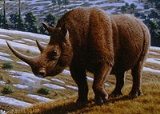
The woolly rhinoceros (Coelodonta antiquitatis) is an extinct species of rhinoceros
that was common throughout Europe
and Asia
during the Pleistocene
epoch
and survived the last glacial period. The genus name Coelodonta means "cavity tooth". The woolly rhinoceros was a member of the Pleistocene megafauna
.
Recently, the oldest known woolly rhinoceros fossil was discovered from 3.6 million years in the Himalayas on the cold Tibetan Plateau
, suggesting it existed there during a period of general climate warmth around the earth. It is believed that they migrated from there to northern Asia
and Europe
when the Ice Age began.
, the anterior horn being 2 feet in length, with a smaller horn between its eyes. It had thick, long fur
, small ears, short, thick legs, and a stocky body. Cave paintings suggest a wide dark band between the front and hind legs, but it is not universal and identification of rhinoceros as woolly rhinoceros is uncertain. The woolly rhinoceros used its horns for defensive purposes and to attract mates.
As the last and most derived member of the Pleistocene
rhinoceros lineage
, the woolly rhinoceros was supremely well adapted to its environment. Stocky limbs and thick woolly pelage made it well suited to the steppe-tundra environment prevalent across the Palearctic ecozone during the Pleistocene glaciation
s. Its geographical range expanded and contracted with the alternating cold and warm cycles, forcing populations to migrate as glaciers receded. Like the vast majority of rhinoceroses, the body plan of the woolly rhinoceros adhered to the conservative morphology
, like the first rhinoceroses seen in the late Eocene. A close relative, the Elasmotherium
had a more southern range.
and browsing
modes of life to be plausible. The palaeodiet of the woolly rhinoceros has been reconstructed using several lines of evidence. Climatic reconstructions indicate the preferred environment to have been cold and arid steppe-tundra, with large herbivores forming an important part of the feedback
cycle. Pollen analysis
shows a prevalence of grasses and sedge
s within a more complicated vegetation mosaic.
A strain vector biomechanical
investigation of the skull
, mandible
and teeth
of a well-preserved last cold stage individual recovered from Whitemoor Haye
, Staffordshire
, revealed musculature
and dental characteristics that support a grazing feeding preference. In particular, the enlargement of the temporalis
and neck muscles is consistent with that required to resist the large tugging forces generated when taking large mouthfuls of fodder
from the ground. The presence of a large diastema
supports this theory.
Comparisons with extant perissodactyls confirm that Coelodonta was a hindgut
fermentor with a single stomach, and as such would have grazed upon cellulose
-rich, protein
-poor fodder. This method of digestion would have required a large throughput of food and thus links the large mouthful size to the low nutritive content of the chosen grasses and sedges.
, like the woolly rhinoceros, became extinct around the same time period. Human and Neanderthal
hunting
is often cited as one cause. Other theories for the cause of the extinctions are climate change associated with the receding Ice age
and the hyperdisease hypothesis.
Its shape was known only from prehistoric cave drawings until a completely preserved specimen (missing only the fur and hooves) was discovered in a tar pit
in Starunia
, Poland
. The specimen, an adult female, is now on display in the Polish Academy of Sciences
' Museum of Natural History in Kraków
. The woolly rhinoceros roamed much of Northern Europe
and was common in the then cold, arid desert that is southern England
and the North Sea
today. During Greenland Stadial 2 (the Last Glacial Maximum
) the North Sea did not exist as sea levels were up to 125 metres (410.1 ft) lower than today.
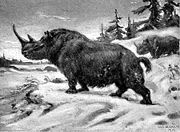 The woolly rhinoceros co-existed with woolly mammoth
s and several other extinct larger mammals.
Recent radiocarbon dating
indicates that populations survived as recently as 8,000 B.C.
in western Siberia
. However, the accuracy of this date is uncertain as several radiocarbon plateaus exist around this time. The extinction does not coincide with the end of the last ice age but does coincide however, with a minor yet severe climatic reversal that lasted for about 1,000–1,250 years, the Younger Dryas
(GS1 - Greenland Stadial 1), characterized by glacial readvances and severe cooling globally, a brief interlude in the continuing warming subsequent to the termination of the last major ice age (GS2), thought to have been due to a shutdown of the thermohaline circulation
in the ocean due to huge influxes of cold fresh water from the preceding sustained glacial melting during the warmer Interstadial (GI1 - Greenland Interstadial 1 - ca. 16,000 - 11,450 14C years B.P.).
Rhinoceros
Rhinoceros , also known as rhino, is a group of five extant species of odd-toed ungulates in the family Rhinocerotidae. Two of these species are native to Africa and three to southern Asia....
that was common throughout Europe
Europe
Europe is, by convention, one of the world's seven continents. Comprising the westernmost peninsula of Eurasia, Europe is generally 'divided' from Asia to its east by the watershed divides of the Ural and Caucasus Mountains, the Ural River, the Caspian and Black Seas, and the waterways connecting...
and Asia
Asia
Asia is the world's largest and most populous continent, located primarily in the eastern and northern hemispheres. It covers 8.7% of the Earth's total surface area and with approximately 3.879 billion people, it hosts 60% of the world's current human population...
during the Pleistocene
Pleistocene
The Pleistocene is the epoch from 2,588,000 to 11,700 years BP that spans the world's recent period of repeated glaciations. The name pleistocene is derived from the Greek and ....
epoch
Epoch (geology)
An epoch is a subdivision of the geologic timescale based on rock layering. In order, the higher subdivisions are periods, eras and eons. We are currently living in the Holocene epoch...
and survived the last glacial period. The genus name Coelodonta means "cavity tooth". The woolly rhinoceros was a member of the Pleistocene megafauna
Pleistocene megafauna
Pleistocene megafauna is the set of species of large animals — mammals, birds and reptiles — that lived on Earth during the Pleistocene epoch and became extinct in a Quaternary extinction event. These species appear to have died off as humans expanded out of Africa and southern Asia,...
.
Recently, the oldest known woolly rhinoceros fossil was discovered from 3.6 million years in the Himalayas on the cold Tibetan Plateau
Tibetan Plateau
The Tibetan Plateau , also known as the Qinghai–Tibetan Plateau is a vast, elevated plateau in Central Asia covering most of the Tibet Autonomous Region and Qinghai, in addition to smaller portions of western Sichuan, southwestern Gansu, and northern Yunnan in Western China and Ladakh in...
, suggesting it existed there during a period of general climate warmth around the earth. It is believed that they migrated from there to northern Asia
Asia
Asia is the world's largest and most populous continent, located primarily in the eastern and northern hemispheres. It covers 8.7% of the Earth's total surface area and with approximately 3.879 billion people, it hosts 60% of the world's current human population...
and Europe
Europe
Europe is, by convention, one of the world's seven continents. Comprising the westernmost peninsula of Eurasia, Europe is generally 'divided' from Asia to its east by the watershed divides of the Ural and Caucasus Mountains, the Ural River, the Caspian and Black Seas, and the waterways connecting...
when the Ice Age began.
Appearance
The external appearance of woolly rhinos is known from mummified individuals from Siberia as well as cave paintings. An adult woolly rhinoceros was 3 to 3.8 metres (10 to 12.5 feet) in length, and 2 to 3 tons on average, but they could probably grow to 4.3 - 4.4 meters (over 14 feet) at the largest. The woolly rhinoceros could grow up to be 2 meters tall. Two horns on the skull were made of keratinKeratin
Keratin refers to a family of fibrous structural proteins. Keratin is the key of structural material making up the outer layer of human skin. It is also the key structural component of hair and nails...
, the anterior horn being 2 feet in length, with a smaller horn between its eyes. It had thick, long fur
Fur
Fur is a synonym for hair, used more in reference to non-human animals, usually mammals; particularly those with extensives body hair coverage. The term is sometimes used to refer to the body hair of an animal as a complete coat, also known as the "pelage". Fur is also used to refer to animal...
, small ears, short, thick legs, and a stocky body. Cave paintings suggest a wide dark band between the front and hind legs, but it is not universal and identification of rhinoceros as woolly rhinoceros is uncertain. The woolly rhinoceros used its horns for defensive purposes and to attract mates.
As the last and most derived member of the Pleistocene
Pleistocene
The Pleistocene is the epoch from 2,588,000 to 11,700 years BP that spans the world's recent period of repeated glaciations. The name pleistocene is derived from the Greek and ....
rhinoceros lineage
Lineage (evolution)
An evolutionary lineage is a sequence of species, that form a line of descent, each new species the direct result of speciation from an immediate ancestral species. Lineages are subsets of the evolutionary tree of life. Lineages are often determined by the techniques of molecular systematics.-...
, the woolly rhinoceros was supremely well adapted to its environment. Stocky limbs and thick woolly pelage made it well suited to the steppe-tundra environment prevalent across the Palearctic ecozone during the Pleistocene glaciation
Glacier
A glacier is a large persistent body of ice that forms where the accumulation of snow exceeds its ablation over many years, often centuries. At least 0.1 km² in area and 50 m thick, but often much larger, a glacier slowly deforms and flows due to stresses induced by its weight...
s. Its geographical range expanded and contracted with the alternating cold and warm cycles, forcing populations to migrate as glaciers receded. Like the vast majority of rhinoceroses, the body plan of the woolly rhinoceros adhered to the conservative morphology
Morphology (biology)
In biology, morphology is a branch of bioscience dealing with the study of the form and structure of organisms and their specific structural features....
, like the first rhinoceroses seen in the late Eocene. A close relative, the Elasmotherium
Elasmotherium
Elasmotherium is an extinct genus of giant rhinoceros endemic to Eurasia during the Late Pliocene through the Pleistocene, documented from 2.6 mya to as late as 50,000 years ago, possibly later, in the Late Pleistocene, an approximate span of slightly less than 2.6 million years. Three species...
had a more southern range.
Diet
Controversy has long surrounded the precise dietary preference of Coelodonta as past investigations have found both grazingGrazing
Grazing generally describes a type of feeding, in which a herbivore feeds on plants , and also on other multicellular autotrophs...
and browsing
Browsing (predation)
Browsing is a type of herbivory in which an herbivore feeds on leaves, soft shoots, or fruits of high growing, generally woody, plants such as shrubs. This is contrasted with grazing, usually associated with animals feeding on grass or other low vegetation...
modes of life to be plausible. The palaeodiet of the woolly rhinoceros has been reconstructed using several lines of evidence. Climatic reconstructions indicate the preferred environment to have been cold and arid steppe-tundra, with large herbivores forming an important part of the feedback
Feedback
Feedback describes the situation when output from an event or phenomenon in the past will influence an occurrence or occurrences of the same Feedback describes the situation when output from (or information about the result of) an event or phenomenon in the past will influence an occurrence or...
cycle. Pollen analysis
Pollen analysis
Analysis of the distribution of pollen grains of various species contained in surface layer deposits, especially peat bogs and lake sediments, from which a record of past climate may be inferred. Because the lake sediments accumulate over time, a core of the mud will show that the mud at the bottom...
shows a prevalence of grasses and sedge
Cyperaceae
Cyperaceae are a family of monocotyledonous graminoid flowering plants known as sedges, which superficially resemble grasses or rushes. The family is large, with some 5,500 species described in about 109 genera. These species are widely distributed, with the centers of diversity for the group...
s within a more complicated vegetation mosaic.
A strain vector biomechanical
Biomechanics
Biomechanics is the application of mechanical principles to biological systems, such as humans, animals, plants, organs, and cells. Perhaps one of the best definitions was provided by Herbert Hatze in 1974: "Biomechanics is the study of the structure and function of biological systems by means of...
investigation of the skull
Skull
The skull is a bony structure in the head of many animals that supports the structures of the face and forms a cavity for the brain.The skull is composed of two parts: the cranium and the mandible. A skull without a mandible is only a cranium. Animals that have skulls are called craniates...
, mandible
Mandible
The mandible pronunciation or inferior maxillary bone forms the lower jaw and holds the lower teeth in place...
and teeth
Tooth
Teeth are small, calcified, whitish structures found in the jaws of many vertebrates that are used to break down food. Some animals, particularly carnivores, also use teeth for hunting or for defensive purposes. The roots of teeth are embedded in the Mandible bone or the Maxillary bone and are...
of a well-preserved last cold stage individual recovered from Whitemoor Haye
Whitemoor Haye
Whitemoor Haye is a mainly agricultural area in the floodplain of the River Tame, near Alrewas in Staffordshire, England.It is very popular with birdwatchers, as several rare species are either resident or seasonal visitors, notably Corn Bunting....
, Staffordshire
Staffordshire
Staffordshire is a landlocked county in the West Midlands region of England. For Eurostat purposes, the county is a NUTS 3 region and is one of four counties or unitary districts that comprise the "Shropshire and Staffordshire" NUTS 2 region. Part of the National Forest lies within its borders...
, revealed musculature
Muscle
Muscle is a contractile tissue of animals and is derived from the mesodermal layer of embryonic germ cells. Muscle cells contain contractile filaments that move past each other and change the size of the cell. They are classified as skeletal, cardiac, or smooth muscles. Their function is to...
and dental characteristics that support a grazing feeding preference. In particular, the enlargement of the temporalis
Temporalis muscle
The temporal muscle is one of the muscles of mastication.-Structure:It arises from the temporal fossa and the deep part of temporal fascia...
and neck muscles is consistent with that required to resist the large tugging forces generated when taking large mouthfuls of fodder
Fodder
Fodder or animal feed is any agricultural foodstuff used specifically to feed domesticated livestock such as cattle, goats, sheep, horses, chickens and pigs. Most animal feed is from plants but some is of animal origin...
from the ground. The presence of a large diastema
Dentistry
Dentistry is the branch of medicine that is involved in the study, diagnosis, prevention, and treatment of diseases, disorders and conditions of the oral cavity, maxillofacial area and the adjacent and associated structures and their impact on the human body. Dentistry is widely considered...
supports this theory.
Comparisons with extant perissodactyls confirm that Coelodonta was a hindgut
Hindgut
The hindgut is the posterior part of the alimentary canal. In mammals, it includes the distal third of the transverse colon and the splenic flexure, the descending colon, sigmoid colon and rectum.-Blood flow:...
fermentor with a single stomach, and as such would have grazed upon cellulose
Cellulose
Cellulose is an organic compound with the formula , a polysaccharide consisting of a linear chain of several hundred to over ten thousand β linked D-glucose units....
-rich, protein
Protein
Proteins are biochemical compounds consisting of one or more polypeptides typically folded into a globular or fibrous form, facilitating a biological function. A polypeptide is a single linear polymer chain of amino acids bonded together by peptide bonds between the carboxyl and amino groups of...
-poor fodder. This method of digestion would have required a large throughput of food and thus links the large mouthful size to the low nutritive content of the chosen grasses and sedges.
Extinction
Many species of Pleistocene megafaunaMegafauna
In terrestrial zoology, megafauna are "giant", "very large" or "large" animals. The most common thresholds used are or...
, like the woolly rhinoceros, became extinct around the same time period. Human and Neanderthal
Neanderthal
The Neanderthal is an extinct member of the Homo genus known from Pleistocene specimens found in Europe and parts of western and central Asia...
hunting
Hunting
Hunting is the practice of pursuing any living thing, usually wildlife, for food, recreation, or trade. In present-day use, the term refers to lawful hunting, as distinguished from poaching, which is the killing, trapping or capture of the hunted species contrary to applicable law...
is often cited as one cause. Other theories for the cause of the extinctions are climate change associated with the receding Ice age
Ice age
An ice age or, more precisely, glacial age, is a generic geological period of long-term reduction in the temperature of the Earth's surface and atmosphere, resulting in the presence or expansion of continental ice sheets, polar ice sheets and alpine glaciers...
and the hyperdisease hypothesis.
Its shape was known only from prehistoric cave drawings until a completely preserved specimen (missing only the fur and hooves) was discovered in a tar pit
Tar pit
A tar pit, or more accurately known as an asphalt pit or asphalt lake, is a geological occurrence where subterranean bitumen leaks to the surface, creating a large area of natural asphalt.-Known tar pits:...
in Starunia
Starunia
Starunya or Starunia is a village in the Bohorodchany Raion, Ivano-Frankivsk Oblast, Ukraine....
, Poland
Poland
Poland , officially the Republic of Poland , is a country in Central Europe bordered by Germany to the west; the Czech Republic and Slovakia to the south; Ukraine, Belarus and Lithuania to the east; and the Baltic Sea and Kaliningrad Oblast, a Russian exclave, to the north...
. The specimen, an adult female, is now on display in the Polish Academy of Sciences
Polish Academy of Sciences
The Polish Academy of Sciences, headquartered in Warsaw, is one of two Polish institutions having the nature of an academy of sciences.-History:...
' Museum of Natural History in Kraków
Kraków
Kraków also Krakow, or Cracow , is the second largest and one of the oldest cities in Poland. Situated on the Vistula River in the Lesser Poland region, the city dates back to the 7th century. Kraków has traditionally been one of the leading centres of Polish academic, cultural, and artistic life...
. The woolly rhinoceros roamed much of Northern Europe
Northern Europe
Northern Europe is the northern part or region of Europe. Northern Europe typically refers to the seven countries in the northern part of the European subcontinent which includes Denmark, Estonia, Latvia, Lithuania, Norway, Finland and Sweden...
and was common in the then cold, arid desert that is southern England
Southern England
Southern England, the South and the South of England are imprecise terms used to refer to the southern counties of England bordering the English Midlands. It has a number of different interpretations of its geographic extents. The South is considered by many to be a cultural region with a distinct...
and the North Sea
North Sea
In the southwest, beyond the Straits of Dover, the North Sea becomes the English Channel connecting to the Atlantic Ocean. In the east, it connects to the Baltic Sea via the Skagerrak and Kattegat, narrow straits that separate Denmark from Norway and Sweden respectively...
today. During Greenland Stadial 2 (the Last Glacial Maximum
Last Glacial Maximum
The Last Glacial Maximum refers to a period in the Earth's climate history when ice sheets were at their maximum extension, between 26,500 and 19,000–20,000 years ago, marking the peak of the last glacial period. During this time, vast ice sheets covered much of North America, northern Europe and...
) the North Sea did not exist as sea levels were up to 125 metres (410.1 ft) lower than today.
Woolly mammoth
The woolly mammoth , also called the tundra mammoth, is a species of mammoth. This animal is known from bones and frozen carcasses from northern North America and northern Eurasia with the best preserved carcasses in Siberia...
s and several other extinct larger mammals.
Recent radiocarbon dating
Radiocarbon dating
Radiocarbon dating is a radiometric dating method that uses the naturally occurring radioisotope carbon-14 to estimate the age of carbon-bearing materials up to about 58,000 to 62,000 years. Raw, i.e. uncalibrated, radiocarbon ages are usually reported in radiocarbon years "Before Present" ,...
indicates that populations survived as recently as 8,000 B.C.
8th millennium BC
In the 8th millennium BC, agriculture became widely practised in the Fertile Crescent and Anatolia.Pottery became widespread and animal husbandry spread to Africa and Eurasia. World population was approximately 5 million.-Events:*c. 8000 BC—The last glacial period ends.*c...
in western Siberia
Siberia
Siberia is an extensive region constituting almost all of Northern Asia. Comprising the central and eastern portion of the Russian Federation, it was part of the Soviet Union from its beginning, as its predecessor states, the Tsardom of Russia and the Russian Empire, conquered it during the 16th...
. However, the accuracy of this date is uncertain as several radiocarbon plateaus exist around this time. The extinction does not coincide with the end of the last ice age but does coincide however, with a minor yet severe climatic reversal that lasted for about 1,000–1,250 years, the Younger Dryas
Younger Dryas
The Younger Dryas stadial, also referred to as the Big Freeze, was a geologically brief period of cold climatic conditions and drought between approximately 12.8 and 11.5 ka BP, or 12,800 and 11,500 years before present...
(GS1 - Greenland Stadial 1), characterized by glacial readvances and severe cooling globally, a brief interlude in the continuing warming subsequent to the termination of the last major ice age (GS2), thought to have been due to a shutdown of the thermohaline circulation
Thermohaline circulation
The term thermohaline circulation refers to a part of the large-scale ocean circulation that is driven by global density gradients created by surface heat and freshwater fluxes....
in the ocean due to huge influxes of cold fresh water from the preceding sustained glacial melting during the warmer Interstadial (GI1 - Greenland Interstadial 1 - ca. 16,000 - 11,450 14C years B.P.).