


Incarnation

Encyclopedia
Incarnation literally means embodied in flesh or taking on flesh. It refers to the conception and birth of a sentient
creature (generally a human) who is the material manifestation of an entity
, god
or force whose original nature is immaterial.
In its religious context the word is used to mean the descent from Heaven
of a god, or divine being in human form on Earth.
s of Ancient Egypt
were sometimes said to be incarnations of the gods Horus
and Ra
.
, God is described as a single, imperishable God, the creator of all things, including all the creatures and forces in the universe. The connection between God and the world is that of the creator to his creation. God is understood to be independent of his creation, and that creation is dependent and contingent on God. God, however, is not seen to be incarnated into this world and is not seen to be part of creation as he cannot be divided and does not descend to the condition of his creatures. Instead, in the Bahá'í understanding
, the world of creation emanates from God, in that all things have been realized by him and have attained to existence. The Bahá'í concept of the intermediary between God
and human
ity is expressed in the term Manifestation of God
, which are a series of personages, such as Jesus
and Bahá'u'lláh
, who reflect the attributes of the divine into the human world for the progress and advancement of human morals and civilization. In expressing God's intent, these Manifestations are seen to establish religion
in the world. The Manifestations of God are also not seen as an incarnation of God, but are instead understood to be like a perfect mirror reflecting the attributes of God onto this material world.
 In the teaching of the Buddha
sentient beings incarnate due to the psychological factors of ignorance
, craving
and clinging
which results in the phenomenon of becoming
and rebirth
. To be born human is considered a great privilege because unlike other mammals even a person of average intelligence with sufficient effort and proper guidance can walk the path of dharma
and become liberated
from the cycle of rebirth
. The motive force in the process of material incarnation and becoming (popularly known as 'life') is attachment to and identification with matter. This ignorance gives rise to the volitional factors which are called sankharas
. These sankharas through the infinite possibilities of worldly desires propel the human being through the pattern of repeated birth and death until the dawning of wisdom (awakening) brings about the desire for liberation.
According to Buddha's teaching the soul (as that structure of sankharas that gives rise to incarnation and animates the body during 'life') is not a fixed entity but in a state of constant flux - being modified over time by actions of body, speech and mind. The constant transmutation and interdependence of phenomena mean that nothing can be said in terms of ultimate truth
to have a fixed identity. This is the doctrine of anatta
, the no-self doctrine applying to all phenomena (see Three marks of existence
).
Liberation in Buddhism is achieved when the stock of accumulated sankharas buried in the unconscious
have been dissolved through the practise of the Noble Eightfold Path
, a path leading to the experience called enlightenment
(Bodhi
in Sanskrit
and Pali
). At enlightenment all the causes for future rebirth have been deleted and the sage abides in a state of being called deathlessnes (Amaravati
or Amrta). Such a one - called an arahant or Buddha
is no longer destined for reincarnation after death.
In Tibetan Buddhism
, an enlightened spiritual teacher (lama
) may choose to reincarnate after death in order to continue to help people. Such a teacher is called a tulku
.
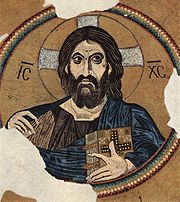
The Incarnation of Christ
is a central Christian doctrine that God became flesh, assumed a human nature, and became a man in the form of Jesus Christ, the Son of God and the second person of the Trinity. This foundational Christian position holds that the divine nature of the Son of God was perfectly united with human nature in one divine Person, Jesus
, making him both truly God and truly man. The theological term for this is hypostatic union
: the Second Person of the Holy Trinity, God the Son, became flesh when he was miraculously conceived in the womb of the Virgin Mary. Biblical passages traditionally referenced in connection with the doctrine of the Incarnation include and .
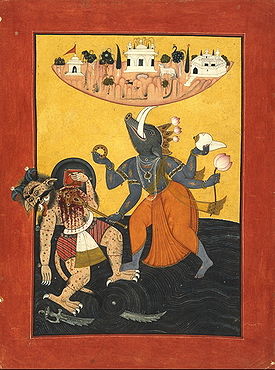 In Hinduism, incarnation generally refers to an Avatar
of Vishnu
, the preserver in the Trimurti
. Collectively, the 10 avatars of Vishnu are known as the dashavatara. Ganesha
and Shiva
also have avatars.
completely rejects the doctrine of the incarnation of God in any form, as the concept is defined as Shirk
. In mainstream Islam God is one and "neither begets nor is begotten". Islam specifically rejects the Christian idea of Jesus as a divine incarnation, but rather Jesus is seen as a prophet (nabī
) and messenger (rasūl
) of God. The Qur'anic text itself seems to fully reject this concept according to mainstream interpretations. Sunnism is the most prominent sect to hold this belief.
of Syria encompass Muhammad, Allah and Ali in a trinity
based from Christianity..
is the leader of the Ismaili
s and is believed that only he can fully understand and interpret the Quran. The Shia Imami Ismaili Muslims take the Aga Khan as an Imam (spiritual leader). In the Shia tariqah
the Light Of God (Noor) has always been present. The Islamic prophet Muhammed had this Noor. There is a Hadith stating that Muhammad said "Ali and I are from the same Noor". Aga Khan is the direct descendant of Muhammad through Imam Ali and Bibi Fatima. The Noor has been passed down since there needs to be a guide present at all times to interpret the Quran and give guidance according to the time..
, Wallace Fard Muhammad
, is believed by followers to be an incarnation of God, also considered to be the Messiah
of Christianity and Mahdi
of Islam.
totally rejects any doctrine of an incarnation of God and absolutely rejects any concept of an incarnation of God in any form. Jews especially rejected vehemently - even under penalty of death or threats of torture - the Christian idea of Jesus as a divine incarnation of God, and neither see Jesus as a Prophet
nor Messiah
.
However, some Hasidim believe in a somewhat similar concept. Rabbi Menachem Mendel Schneerson
, a prominent Hasidic leader, said that the Rebbe
is God's essence itself put into a body of a Tzaddik. . While many other Jews find this idea highly controversial, panentheism
, i.e. considering everything and everyone as manifestations of God, is the accepted mainstream Hasidic and Kabbalistic doctrine.
The Kabbalah
has an idea of gilgul
(reincarnation) as part of the soul's journey to achieve perfection.
views Haile Selassie I as God incarnate, who has come the second time as a deliverer
.
Sentience
Sentience is the ability to feel, perceive or be conscious, or to have subjective experiences. Eighteenth century philosophers used the concept to distinguish the ability to think from the ability to feel . In modern western philosophy, sentience is the ability to have sensations or experiences...
creature (generally a human) who is the material manifestation of an entity
Entity
An entity is something that has a distinct, separate existence, although it need not be a material existence. In particular, abstractions and legal fictions are usually regarded as entities. In general, there is also no presumption that an entity is animate.An entity could be viewed as a set...
, god
God
God is the English name given to a singular being in theistic and deistic religions who is either the sole deity in monotheism, or a single deity in polytheism....
or force whose original nature is immaterial.
In its religious context the word is used to mean the descent from Heaven
Heaven
Heaven, the Heavens or Seven Heavens, is a common religious cosmological or metaphysical term for the physical or transcendent place from which heavenly beings originate, are enthroned or inhabit...
of a god, or divine being in human form on Earth.
Ancient Egypt
The PharaohPharaoh
Pharaoh is a title used in many modern discussions of the ancient Egyptian rulers of all periods. The title originates in the term "pr-aa" which means "great house" and describes the royal palace...
s of Ancient Egypt
Ancient Egypt
Ancient Egypt was an ancient civilization of Northeastern Africa, concentrated along the lower reaches of the Nile River in what is now the modern country of Egypt. Egyptian civilization coalesced around 3150 BC with the political unification of Upper and Lower Egypt under the first pharaoh...
were sometimes said to be incarnations of the gods Horus
Horus
Horus is one of the oldest and most significant deities in the Ancient Egyptian religion, who was worshipped from at least the late Predynastic period through to Greco-Roman times. Different forms of Horus are recorded in history and these are treated as distinct gods by Egyptologists...
and Ra
Ra
Ra is the ancient Egyptian sun god. By the Fifth Dynasty he had become a major deity in ancient Egyptian religion, identified primarily with the mid-day sun...
.
Bahá'í
In the Bahá'í FaithBahá'í Faith
The Bahá'í Faith is a monotheistic religion founded by Bahá'u'lláh in 19th-century Persia, emphasizing the spiritual unity of all humankind. There are an estimated five to six million Bahá'ís around the world in more than 200 countries and territories....
, God is described as a single, imperishable God, the creator of all things, including all the creatures and forces in the universe. The connection between God and the world is that of the creator to his creation. God is understood to be independent of his creation, and that creation is dependent and contingent on God. God, however, is not seen to be incarnated into this world and is not seen to be part of creation as he cannot be divided and does not descend to the condition of his creatures. Instead, in the Bahá'í understanding
Bahá'í teachings
The Bahá'í teachings represent a considerable number of theological, social, and spiritual ideas that were established in the Bahá'í Faith by Bahá'u'lláh, the founder of the religion, and clarified by successive leaders including `Abdu'l-Bahá, Bahá'u'lláh's son, and Shoghi Effendi, `Abdu'l-Bahá's...
, the world of creation emanates from God, in that all things have been realized by him and have attained to existence. The Bahá'í concept of the intermediary between God
God
God is the English name given to a singular being in theistic and deistic religions who is either the sole deity in monotheism, or a single deity in polytheism....
and human
Human
Humans are the only living species in the Homo genus...
ity is expressed in the term Manifestation of God
Manifestation of God
The Manifestation of God is a concept in the Bahá'í Faith that refers to what are commonly called prophets. The Manifestations of God are a series of personages who reflect the attributes of the divine into the human world for the progress and advancement of human morals and civilization...
, which are a series of personages, such as Jesus
Jesus
Jesus of Nazareth , commonly referred to as Jesus Christ or simply as Jesus or Christ, is the central figure of Christianity...
and Bahá'u'lláh
Bahá'u'lláh
Bahá'u'lláh , born ' , was the founder of the Bahá'í Faith. He claimed to be the prophetic fulfilment of Bábism, a 19th-century outgrowth of Shí‘ism, but in a broader sense claimed to be a messenger from God referring to the fulfilment of the eschatological expectations of Islam, Christianity, and...
, who reflect the attributes of the divine into the human world for the progress and advancement of human morals and civilization. In expressing God's intent, these Manifestations are seen to establish religion
Religion
Religion is a collection of cultural systems, belief systems, and worldviews that establishes symbols that relate humanity to spirituality and, sometimes, to moral values. Many religions have narratives, symbols, traditions and sacred histories that are intended to give meaning to life or to...
in the world. The Manifestations of God are also not seen as an incarnation of God, but are instead understood to be like a perfect mirror reflecting the attributes of God onto this material world.
Buddhism
Gautama Buddha
Siddhārtha Gautama was a spiritual teacher from the Indian subcontinent, on whose teachings Buddhism was founded. In most Buddhist traditions, he is regarded as the Supreme Buddha Siddhārtha Gautama (Sanskrit: सिद्धार्थ गौतम; Pali: Siddhattha Gotama) was a spiritual teacher from the Indian...
sentient beings incarnate due to the psychological factors of ignorance
Avidya (Buddhism)
Avidyā or avijjā means "ignorance" or "delusion" and is the opposite of 'vidyā' and 'rig pa'...
, craving
Tanha
' or ' literally means "thirst," and is a synonym for "desire" or "craving," traditionally juxtaposed with upekkha .Synonyms:*愛 Cn: ài; Vi: ái...
and clinging
Upadana
Upādāna is a word used in both Buddhism and Hinduism.*In Buddhism, upādāna is a critical link in the arising of suffering.*In Hinduism, upādāna is the material manifestation of Brahman.-Buddhism:...
which results in the phenomenon of becoming
Bhava
The term bhāva is often translated as feeling, emotion, mood, devotional state of mind. In Buddhist thought, bhāva denotes the continuity of life and death, including reincarnation, and the maturation arising therefrom...
and rebirth
Rebirth (Buddhism)
Rebirth in Buddhism is the doctrine that the evolving consciousness or stream of consciousness upon death , becomes one of the contributing causes for the arising of a new aggregation...
. To be born human is considered a great privilege because unlike other mammals even a person of average intelligence with sufficient effort and proper guidance can walk the path of dharma
Dharma (Buddhism)
Dhamma or Dharma in Buddhism can have the following meanings:* The state of Nature as it is * The Laws of Nature considered collectively....
and become liberated
Moksha
Within Indian religions, moksha or mukti , literally "release" , is the liberation from samsara and the concomitant suffering involved in being subject to the cycle of repeated death and reincarnation or rebirth.-Origins:It is highly probable that the concept of moksha was first developed in...
from the cycle of rebirth
Samsara (Buddhism)
or sangsara is a Sanskrit and Pāli term, which translates as "continuous movement" or "continuous flowing" and, in Buddhism, refers to the concept of a cycle of birth , and consequent decay and death , in which all beings in the universe participate, and which can only be escaped through...
. The motive force in the process of material incarnation and becoming (popularly known as 'life') is attachment to and identification with matter. This ignorance gives rise to the volitional factors which are called sankharas
Sankhara
' or ' is a term figuring prominently in the teaching of the Buddha. The word means "that which has been put together" and "that which puts together". In the first sense, refers to conditioned phenomena generally but specifically to all mental "dispositions"...
. These sankharas through the infinite possibilities of worldly desires propel the human being through the pattern of repeated birth and death until the dawning of wisdom (awakening) brings about the desire for liberation.
According to Buddha's teaching the soul (as that structure of sankharas that gives rise to incarnation and animates the body during 'life') is not a fixed entity but in a state of constant flux - being modified over time by actions of body, speech and mind. The constant transmutation and interdependence of phenomena mean that nothing can be said in terms of ultimate truth
Two truths doctrine
The Buddhist doctrine of the two truths differentiates between two levels of truth in Buddhist discourse: a "relative" or commonsense truth , and an "ultimate" or absolute, spiritual truth...
to have a fixed identity. This is the doctrine of anatta
Anatta
In Buddhism, anattā or anātman refers to the notion of "not-self." In the early texts, the Buddha commonly uses the word in the context of teaching that all things perceived by the senses are not really "I" or "mine," and for this reason one should not cling to them.In the same vein, the Pali...
, the no-self doctrine applying to all phenomena (see Three marks of existence
Three marks of existence
The Three marks of existence, within Buddhism, are three characteristics shared by all sentient beings, namely: impermanence ; suffering or unsatisfactoriness ; non-self .According to Buddhist tradition, a full understanding of these three can bring an end to suffering...
).
Liberation in Buddhism is achieved when the stock of accumulated sankharas buried in the unconscious
Unconscious mind
The unconscious mind is a term coined by the 18th century German romantic philosopher Friedrich Schelling and later introduced into English by the poet and essayist Samuel Taylor Coleridge...
have been dissolved through the practise of the Noble Eightfold Path
Noble Eightfold Path
The Noble Eightfold Path , is one of the principal teachings of the Buddha, who described it as the way leading to the cessation of suffering and the achievement of self-awakening. It is used to develop insight into the true nature of phenomena and to eradicate greed, hatred, and delusion...
, a path leading to the experience called enlightenment
Enlightenment in Buddhism
The English term enlightenment has commonly been used in the western world to translate several Sanskrit, Pali, Chinese and Japanese terms and concepts, especially bodhi, prajna, kensho, satori and buddhahood.-Insight:...
(Bodhi
Bodhi
Bodhi is both a Pāli and Sanskrit word traditionally translated into English with the word "enlightenment", but which means awakened. In Buddhism it is the knowledge possessed by a Buddha into the nature of things...
in Sanskrit
Sanskrit
Sanskrit , is a historical Indo-Aryan language and the primary liturgical language of Hinduism, Jainism and Buddhism.Buddhism: besides Pali, see Buddhist Hybrid Sanskrit Today, it is listed as one of the 22 scheduled languages of India and is an official language of the state of Uttarakhand...
and Pali
Páli
- External links :* *...
). At enlightenment all the causes for future rebirth have been deleted and the sage abides in a state of being called deathlessnes (Amaravati
Nirvana
Nirvāṇa ; ) is a central concept in Indian religions. In sramanic thought, it is the state of being free from suffering. In Hindu philosophy, it is the union with the Supreme being through moksha...
or Amrta). Such a one - called an arahant or Buddha
Buddhahood
In Buddhism, buddhahood is the state of perfect enlightenment attained by a buddha .In Buddhism, the term buddha usually refers to one who has become enlightened...
is no longer destined for reincarnation after death.
In Tibetan Buddhism
Tibetan Buddhism
Tibetan Buddhism is the body of Buddhist religious doctrine and institutions characteristic of Tibet and certain regions of the Himalayas, including northern Nepal, Bhutan, and India . It is the state religion of Bhutan...
, an enlightened spiritual teacher (lama
Lama
Lama is a title for a Tibetan teacher of the Dharma. The name is similar to the Sanskrit term guru .Historically, the term was used for venerated spiritual masters or heads of monasteries...
) may choose to reincarnate after death in order to continue to help people. Such a teacher is called a tulku
Tulku
In Tibetan Buddhism, a tulku is a particular high-ranking lama, of whom the Dalai Lama is one, who can choose the manner of his rebirth. Normally the lama would be reincarnated as a human, and of the same sex as his predecessor. In contrast to a tulku, all other sentient beings including other...
.
Christianity
The Incarnation of Christ
Christ
Christ is the English term for the Greek meaning "the anointed one". It is a translation of the Hebrew , usually transliterated into English as Messiah or Mashiach...
is a central Christian doctrine that God became flesh, assumed a human nature, and became a man in the form of Jesus Christ, the Son of God and the second person of the Trinity. This foundational Christian position holds that the divine nature of the Son of God was perfectly united with human nature in one divine Person, Jesus
Jesus
Jesus of Nazareth , commonly referred to as Jesus Christ or simply as Jesus or Christ, is the central figure of Christianity...
, making him both truly God and truly man. The theological term for this is hypostatic union
Hypostatic union
Hypostatic union is a technical term in Christian theology employed in mainstream Christology to describe the union of Christ's humanity and divinity in one hypostasis.The First Council of Ephesus recognised this doctrine and affirmed its importance, stating that the...
: the Second Person of the Holy Trinity, God the Son, became flesh when he was miraculously conceived in the womb of the Virgin Mary. Biblical passages traditionally referenced in connection with the doctrine of the Incarnation include and .
Hinduism
Avatar
In Hinduism, an avatar is a deliberate descent of a deity to earth, or a descent of the Supreme Being and is mostly translated into English as "incarnation," but more accurately as "appearance" or "manifestation"....
of Vishnu
Vishnu
Vishnu is the Supreme god in the Vaishnavite tradition of Hinduism. Smarta followers of Adi Shankara, among others, venerate Vishnu as one of the five primary forms of God....
, the preserver in the Trimurti
Trimurti
The Trimurti is a concept in Hinduism "in which the cosmic functions of creation, maintenance, and destruction are personified by the forms of Brahmā the creator, Vishnu the maintainer or preserver, and Śhiva the destroyer or transformer," These three deities have been called "the Hindu triad" or...
. Collectively, the 10 avatars of Vishnu are known as the dashavatara. Ganesha
Ganesha
Ganesha , also spelled Ganesa or Ganesh, also known as Ganapati , Vinayaka , and Pillaiyar , is one of the deities best-known and most widely worshipped in the Hindu pantheon. His image is found throughout India and Nepal. Hindu sects worship him regardless of affiliations...
and Shiva
Shiva
Shiva is a major Hindu deity, and is the destroyer god or transformer among the Trimurti, the Hindu Trinity of the primary aspects of the divine. God Shiva is a yogi who has notice of everything that happens in the world and is the main aspect of life. Yet one with great power lives a life of a...
also have avatars.
Mainstream Islam
Mainstream IslamIslam
Islam . The most common are and . : Arabic pronunciation varies regionally. The first vowel ranges from ~~. The second vowel ranges from ~~~...
completely rejects the doctrine of the incarnation of God in any form, as the concept is defined as Shirk
Shirk
Shirk may refer to:* "Shirk", to avoid work or other responsibilities* Shirk , in Islam, the sin of idolatry or associating beings or things with Allah* "Shirk break", a synonym for coffee break*Susan Shirk, US academic...
. In mainstream Islam God is one and "neither begets nor is begotten". Islam specifically rejects the Christian idea of Jesus as a divine incarnation, but rather Jesus is seen as a prophet (nabī
Nabi
Nabi may refer to:* Prophets of Islam, humans who, in the Islamic faith, have been chosen as prophets by God**Nabi * Butterfly in the Korean language** Nabi , a 2001 South Korean film** The Korean language title of Mr...
) and messenger (rasūl
Rasul
In Islam, an Apostle or Messenger is a prophet sent by God.According to the Qur'an, God sent many prophets to mankind. The five universally acknowledged messengers in Islam are Abraham, Moses, David, Jesus and Muhammad, as each is believed to have been sent with a scripture...
) of God. The Qur'anic text itself seems to fully reject this concept according to mainstream interpretations. Sunnism is the most prominent sect to hold this belief.
Shiite sects
There are some hadiths which tell that Muhammad and his successors carry a divine succession from God. Although not all Shiites claim this view, a rare few think that Imam Ali, believed to be the real caliph after Muhammad, was an incarnation of God and also he is the god(ali). . This view is vigorously rejected by Sunnis and other shias.. The only conflict source between sunnis and shias is believing that imam ali be the real caliph after Muhammad in the view of shias and the acceptance of 12 "imam's" "welayah". However, some Muslims called "wahabi" say some tales about shias incarnation thought for making division between shias and sunnis that they call brothers in quran. They also accuse shias of worshiping metals and woods. But shias only use them as "tabarrok" just like "hazrate zahra"(Muhammad's daughter) that she use "tabarrok" first. In shias philosophy, tabarrok is for showing your love to "ahle beit" and requesting "shafa'at" from them because they believe that ahle beyt where the best God created and they use this method to have better connection to Allah or they use this method it when they do sins and want to request "maghferat" from God they believe its easier to go from this method.Alawis
The AlawiAlawi
The Alawis, also known as Alawites, Nusayris and Ansaris are a prominent mystical and syncretic religious group centred in Syria who are a branch of Shia Islam.-Etymology:...
of Syria encompass Muhammad, Allah and Ali in a trinity
Trinity
The Christian doctrine of the Trinity defines God as three divine persons : the Father, the Son , and the Holy Spirit. The three persons are distinct yet coexist in unity, and are co-equal, co-eternal and consubstantial . Put another way, the three persons of the Trinity are of one being...
based from Christianity..
Ismailism
The Aga KhanAga Khan
Aga Khan is the hereditary title of the Imam of the largest branch of the Ismā'īlī followers of the Shī‘a faith. They affirm the Imamat of the descendants of Ismail ibn Jafar, eldest son of Imam Ja'far al-Sadiq, while the larger Twelver branch of Shi`ism follows Ismail's younger brother Musa...
is the leader of the Ismaili
Ismaili
' is a branch of Shia Islam. It is the second largest branch of Shia Islam, after the Twelvers...
s and is believed that only he can fully understand and interpret the Quran. The Shia Imami Ismaili Muslims take the Aga Khan as an Imam (spiritual leader). In the Shia tariqah
Tariqah
A tariqa is an Islamic religious order. In Sufism one starts with Islamic law, the exoteric or mundane practice of Islam and then is initiated onto the mystical path of a tariqa. Through spiritual practices and guidance of a tariqa the aspirant seeks ḥaqīqah - ultimate truth.-Meaning:A tariqa is a...
the Light Of God (Noor) has always been present. The Islamic prophet Muhammed had this Noor. There is a Hadith stating that Muhammad said "Ali and I are from the same Noor". Aga Khan is the direct descendant of Muhammad through Imam Ali and Bibi Fatima. The Noor has been passed down since there needs to be a guide present at all times to interpret the Quran and give guidance according to the time..
Nation of Islam
The founder of the US-based black nationalist Nation of IslamNation of Islam
The Nation of Islam is a mainly African-American new religious movement founded in Detroit, Michigan by Wallace D. Fard Muhammad in July 1930 to improve the spiritual, mental, social, and economic condition of African-Americans in the United States of America. The movement teaches black pride and...
, Wallace Fard Muhammad
Wallace Fard Muhammad
Wallace Fard Muhammad was a minister and founder of the Nation of Islam. He established the Nation of Islam's first mosque in Detroit, Michigan in 1930, and ministered his distinctive religion there for three years, before mysteriously disappearing in June 1934. He was succeeded by his follower...
, is believed by followers to be an incarnation of God, also considered to be the Messiah
Messiah
A messiah is a redeemer figure expected or foretold in one form or another by a religion. Slightly more widely, a messiah is any redeemer figure. Messianic beliefs or theories generally relate to eschatological improvement of the state of humanity or the world, in other words the World to...
of Christianity and Mahdi
Mahdi
In Islamic eschatology, the Mahdi is the prophesied redeemer of Islam who will stay on Earth for seven, nine or nineteen years- before the Day of Judgment and, alongside Jesus, will rid the world of wrongdoing, injustice and tyranny.In Shia Islam, the belief in the Mahdi is a "central religious...
of Islam.
Judaism
Mainstream JudaismJudaism
Judaism ) is the "religion, philosophy, and way of life" of the Jewish people...
totally rejects any doctrine of an incarnation of God and absolutely rejects any concept of an incarnation of God in any form. Jews especially rejected vehemently - even under penalty of death or threats of torture - the Christian idea of Jesus as a divine incarnation of God, and neither see Jesus as a Prophet
Prophet
In religion, a prophet, from the Greek word προφήτης profitis meaning "foreteller", is an individual who is claimed to have been contacted by the supernatural or the divine, and serves as an intermediary with humanity, delivering this newfound knowledge from the supernatural entity to other people...
nor Messiah
Messiah
A messiah is a redeemer figure expected or foretold in one form or another by a religion. Slightly more widely, a messiah is any redeemer figure. Messianic beliefs or theories generally relate to eschatological improvement of the state of humanity or the world, in other words the World to...
.
However, some Hasidim believe in a somewhat similar concept. Rabbi Menachem Mendel Schneerson
Menachem Mendel Schneerson
Menachem Mendel Schneerson , known as the Lubavitcher Rebbe or just the Rebbe among his followers, was a prominent Hasidic rabbi who was the seventh and last Rebbe of the Chabad-Lubavitch movement. He was fifth in a direct paternal line to the third Chabad-Lubavitch Rebbe, Menachem Mendel...
, a prominent Hasidic leader, said that the Rebbe
Rebbe
Rebbe , which means master, teacher, or mentor, is a Yiddish word derived from the Hebrew word Rabbi. It often refers to the leader of a Hasidic Jewish movement...
is God's essence itself put into a body of a Tzaddik. . While many other Jews find this idea highly controversial, panentheism
Panentheism
Panentheism is a belief system which posits that God exists, interpenetrates every part of nature and timelessly extends beyond it...
, i.e. considering everything and everyone as manifestations of God, is the accepted mainstream Hasidic and Kabbalistic doctrine.
The Kabbalah
Kabbalah
Kabbalah/Kabala is a discipline and school of thought concerned with the esoteric aspect of Rabbinic Judaism. It was systematized in 11th-13th century Hachmei Provence and Spain, and again after the Expulsion from Spain, in 16th century Ottoman Palestine...
has an idea of gilgul
Gilgul
Gilgul/Gilgul neshamot/Gilgulei Ha Neshamot describes a Kabbalistic concept of reincarnation. In Hebrew, the word gilgul means "cycle" and neshamot is the plural for "souls." Souls are seen to "cycle" through "lives" or "incarnations", being attached to different human bodies over time...
(reincarnation) as part of the soul's journey to achieve perfection.
Rastafari
The Rastafari movementRastafari movement
The Rastafari movement or Rasta is a new religious movement that arose in the 1930s in Jamaica, which at the time was a country with a predominantly Christian culture where 98% of the people were the black descendants of slaves. Its adherents worship Haile Selassie I, Emperor of Ethiopia , as God...
views Haile Selassie I as God incarnate, who has come the second time as a deliverer
Messiah
A messiah is a redeemer figure expected or foretold in one form or another by a religion. Slightly more widely, a messiah is any redeemer figure. Messianic beliefs or theories generally relate to eschatological improvement of the state of humanity or the world, in other words the World to...
.