
All Topics  
Ivory

 
Ivory

   Email Print
   Bookmark   Link


Ivory


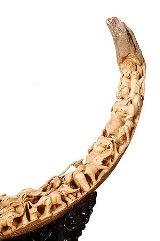
Ivory is formed from dentine and constitutes the bulk of the teeth and tusk
Tusk

Tusks are unusually long teeth, usually but not always in pairs, that protrude well beyond the mouth of certain mammal species. They are most commonly canine tooth, as with warthogs, boar , and walruses, or, in the case of elephants and narwhals, elongated incisors....
s of animals such as the elephant
Elephant

Elephants are large land mammals of the order Proboscidea and the family Elephantidae. There are three living species: the African Bush Elephant, the African Forest Elephant and the Asian Elephant ....
, hippopotamus
Hippopotamus

The hippopotamus or hippo is a large, mostly herbivore African mammal, one of only two Extant taxon species in the scientific classification Hippopotamidae ....
, walrus
Walrus

The walrus is a large pinniped marine mammal with a discontinuous circumpolar distribution in the Arctic Ocean and sub-Arctic seas of the Northern Hemisphere....
, mammoth
Mammoth

A mammoth is any species of the extinct genus Mammuthus. These proboscideans are members of the Elephantidae and close relatives of modern elephants....
 and narwhal
Narwhal

The narwhal is a medium-sized toothed whale that lives year-round in the Arctic. One of two species of whale in the Monodontidae family , along with the Beluga whale, the narwhal males are distinguished by a characteristic long, straight, helical tusk extending from their upper left jaw....
.

The word "ivory" was traditionally applied to the tusks of elephants; the word is ultimately from Ancient Egyptian
Egyptian language

Egyptian is a branch of the Afro-Asiatic languages language family along with the Chadic languages, Berber languages, Semitic languages, Cushitic languages and possibly Omotic languages languages....
 âb, âbu "elephant".

Ivory has availed itself to many ornamental and practical uses. Prior to the introduction of plastics, it was used for billiard ball
Billiard ball

Billiard balls are used in cue sports, such as carom billiards, pocket billiards, and snooker. The number, type, diameter, color, and pattern of the balls differ depending upon the specific game being played....
s, piano
Piano

The piano is a musical instrument played by means of a keyboard instrument. Widely used in Western music for solo performance, ensemble use, chamber music, and accompaniment, the piano is also very popular as an aid to musical composition and rehearsal....
 keys, Scottish bagpipes
Bagpipes

Bagpipes are a class of musical instrument, aerophones using enclosed reed fed from a constant reservoir of air in the form of a bag. Though the Scottish Great Highland Bagpipe and Irish uilleann pipes have the greatest international visibility, bagpipes have historically been found throughout Europe, and into Northern Africa, the Persian...
, buttons and a wide range of ornamental items. Synthetic substitutes for ivory have been developed.


Discussion
Ask a question about 'Ivory'
Start a new discussion about 'Ivory'
Answer questions from other users
Full Discussion Forum


Recent Posts


Encyclopedia


Ivory is formed from dentine and constitutes the bulk of the teeth and tusk
Tusk

Tusks are unusually long teeth, usually but not always in pairs, that protrude well beyond the mouth of certain mammal species. They are most commonly canine tooth, as with warthogs, boar , and walruses, or, in the case of elephants and narwhals, elongated incisors....
s of animals such as the elephant
Elephant

Elephants are large land mammals of the order Proboscidea and the family Elephantidae. There are three living species: the African Bush Elephant, the African Forest Elephant and the Asian Elephant ....
, hippopotamus
Hippopotamus

The hippopotamus or hippo is a large, mostly herbivore African mammal, one of only two Extant taxon species in the scientific classification Hippopotamidae ....
, walrus
Walrus

The walrus is a large pinniped marine mammal with a discontinuous circumpolar distribution in the Arctic Ocean and sub-Arctic seas of the Northern Hemisphere....
, mammoth
Mammoth

A mammoth is any species of the extinct genus Mammuthus. These proboscideans are members of the Elephantidae and close relatives of modern elephants....
 and narwhal
Narwhal

The narwhal is a medium-sized toothed whale that lives year-round in the Arctic. One of two species of whale in the Monodontidae family , along with the Beluga whale, the narwhal males are distinguished by a characteristic long, straight, helical tusk extending from their upper left jaw....
.

The word "ivory" was traditionally applied to the tusks of elephants; the word is ultimately from Ancient Egyptian
Egyptian language

Egyptian is a branch of the Afro-Asiatic languages language family along with the Chadic languages, Berber languages, Semitic languages, Cushitic languages and possibly Omotic languages languages....
 âb, âbu "elephant".

Ivory has availed itself to many ornamental and practical uses. Prior to the introduction of plastics, it was used for billiard ball
Billiard ball

Billiard balls are used in cue sports, such as carom billiards, pocket billiards, and snooker. The number, type, diameter, color, and pattern of the balls differ depending upon the specific game being played....
s, piano
Piano

The piano is a musical instrument played by means of a keyboard instrument. Widely used in Western music for solo performance, ensemble use, chamber music, and accompaniment, the piano is also very popular as an aid to musical composition and rehearsal....
 keys, Scottish bagpipes
Bagpipes

Bagpipes are a class of musical instrument, aerophones using enclosed reed fed from a constant reservoir of air in the form of a bag. Though the Scottish Great Highland Bagpipe and Irish uilleann pipes have the greatest international visibility, bagpipes have historically been found throughout Europe, and into Northern Africa, the Persian...
, buttons and a wide range of ornamental items. Synthetic substitutes for ivory have been developed. Plastics have been viewed by piano purists as an inferior ivory substitute on piano keys, although other recently developed materials more closely resemble the feel of real ivory.

Structure


The chemical structure of the teeth and tusks of mammals is the same regardless of the species of origin. The trade in certain teeth and tusks other than elephant is well established and widespread, therefore "ivory" can correctly be used to describe any mammalian teeth or tusks of commercial interest which is large enough to be carved or scrimshaw
Scrimshaw

Scrimshaw is the name given to handiwork created by whalings made from the byproducts of harvesting marine mammals. It is most commonly made out of the bones and tooth of Sperm Whales, the baleen of other whales, and the tusks of walruses....
ed.

Ivory in art

cover of the Codex Aureus of Lorsch
Codex Aureus of Lorsch

The Codex Aureus of Lorsch is an illuminated manuscript Gospel Book written between 778-820, roughly coinciding with the period of Charlemagne's rule over the Frankish Empire....
, c. 810, Carolingian dynasty, Victoria and Albert Museum
Victoria and Albert Museum

The Victoria and Albert Museum in London is the world's largest museum of decorative arts and design, housing a permanent collection of over 4.5 million Object ....
]]

Paleolithic Cro-Magnon
Cro-Magnon

Cro-Magnon is one of the main types of archaic Homo sapiens of the Paleolithic Europe Upper Paleolithic, living approximately 40,000 to 10,000 years ago....
 man, during the late stages of the ice age
Ice age

The general term "ice age" or, more precisely, "glacial age" denotes a geological period of long-term reduction in the temperature of the Earth's surface and atmosphere, resulting in an expansion of continental ice sheets, polar ice sheets and alpine glaciers....
, were the first to carve in ivory (mammoth tusks). Both the Greek
Ancient Greece

The term Ancient Greece refers to the period of History of Greece lasting from the Greek Dark Ages ca. 1100 BC and the Dorian invasion, to 146 BC and the Roman Republic conquest of Greece after the Battle of Corinth ....
 and Roman
Ancient Rome

Ancient Rome was a civilization that grew out of a small agricultural community founded on the Italian Peninsula as early as the 10th century BC....
 civilizations used large quantities of ivory to make high value works of art, precious religious objects, and decorative boxes for costly objects. Ivory was often used to form the white of the eyes of statues.

The Syrian and North African elephant populations were reduced to extinction, probably due to the demand for ivory in the Classical world
Classical antiquity

Classical antiquity is a broad term for a long period of cultural history centered on the Mediterranean Sea, comprising the interlocking civilizations of Ancient Greece and Ancient Rome....
.

The Chinese have long valued ivory for both art and utilitarian objects. Early reference to the Chinese export of ivory is recorded after the Chinese explorer Zhang Qian
Zhang Qian

Zhang Qian was an imperial envoy to the world outside of China in the 2nd century BCE, during the time of the Han Dynasty. He was the first official diplomat to bring back reliable information about Central Asia to the Chinese imperial court, then under Emperor Wu of Han, and played an important pioneering role in the Chinese colonization an...
 ventured to the west to form alliances to enable for the eventual free movement of Chinese goods to the west; as early as the first century BC, ivory was moved along the Northern Silk Road
Northern Silk Road

The Northern Silk Road is a prehistoric trackway in northern China originating in the early capital of Xi'an and extending north of the Taklamakan Desert to reach the ancient monarchys of Parthia, Bactria and eventually Persia and Rome....
 for consumption by western nations. Southeast Asian kingdoms included tusks of the Indian elephant in their annual tribute caravans to China. Chinese craftsmen carved ivory to make everything from images of deities and decorations. With the British trade of opium
Opium

Opium is a narcotic formed from the latex released by lacerating the immature seed pods of Opium poppy . It contains up to 12% morphine, an opiate alkaloid, which is most frequently processed chemically to produce heroin for the illegal drug trade....
, ivory also became a common material for opium pipes.

The Indianized Buddhist cultures of Southeast Asia, including Myanmar (Burma), Thailand, Laos and Cambodia traditionally harvested ivory from their domesticated elephants. Ivory was prized for containers due to its ability to keep an airtight seal. Ivory was also commonly carved into elaborate seals utilized by officials to "sign" documents and decrees by stamping them with their unique official seal.

In Southeast Asian countries where Muslim Malay peoples live, such as Malaysia, Indonesia and the Philippines, ivory was the material of choice for making the handles of magical kris
Kris

The kris or keris is a distinctive, asymmetrical dagger indigenous to Indonesia, Malaysia, Brunei, Southern Thailand and the southern Philippines....
 daggers. In the Philippines, ivory was also used to craft the faces and hands of Catholic icons and images of saints.

Tooth and tusk ivory can be carved into a vast variety of shapes and objects. A small example of modern carved ivory objects are small statuary such as okimono
Okimono

An okimono is a small Japanese carving, similar to, but larger than netsuke. Unlike netsuke, which had a specific purpose, okimono were purely decorative and were displayed in the tokonoma....
, netsuke
Netsuke

Netsuke are miniature sculptures that were invented in 17th century Japan to serve a practical function . Traditional Japanese garment?robes called kosode and kimono?had no pockets, however men who wore them needed a place to store their personal belongings such as pipes, tobacco, money, seals, or medicines....
s, jewelry, flatware handles, furniture inlays, and piano keys. Additionally, warthog
Warthog

The warthog or common warthog is a wild member of the Suidae that lives in Africa. The common name comes from the four large wart-like protrusions found on the head of the warthog, which serve the purpose of defense when males fight....
 tusks, and teeth from sperm whale
Sperm Whale

The Sperm Whale is the largest of all toothed whales and largest living toothed animal. The whale was named after the milky-white waxy substance, spermaceti, found in its head and originally mistaken for sperm or semen....
s, orca
Orca

The Killer Whale or Orca , less commonly, Blackfish or Seawolf, is the largest species of the dolphin family. It is found in all the world's oceans, from the frigid Arctic and Antarctica regions to warm, tropical seas....
s and hippos can also be scrimshawed or superficially carved, thus retaining their morphologically recognizable shapes.

Consumption before plastics


Before plastics were invented, ivory was important for cutlery handles, musical instruments, billiard balls, and many other items. It is estimated that consumption in Great Britain alone in 1831 amounted to the deaths of nearly 4,000 elephants. Ivory can be taken from dead animals — Russians dug up tusks from extinct mammoths — however most ivory came from elephants who were killed for their tusks. Other animals which are now endangered were also preyed upon, for example, hippos, which have very hard white ivory prized for making artificial teeth.

Availability


, c. 1900.]] Owing to the rapid decline in the populations of the animals that produce it, the importation and sale of ivory in many countries is banned or severely restricted. Much of the decline in population is due to poachers
Poaching

Poaching is the illegal hunting, fishing or eating of wild plants or animals contrary to local and international Conservation and wildlife management laws....
 during and before the 1980s. Since the worldwide ivory trade ban by CITES (the Convention for International Trade in Endangered Species) in 1989 there have been ups and downs in elephant populations, and ivory trade as bans have been placed and lifted. Many African countries including Zimbabwe
Zimbabwe

Zimbabwe , is a landlocked country located in the southern part of the continent of Africa, between the Zambezi and Limpopo River rivers. It is bordered by South Africa to the south, Botswana to the southwest, Zambia to the northwest and Mozambique to the east....
, Namibia and Botswana claim that ivory trade is necessary—both to stimulate their economies and reduce elephant populations which are allegedly harming the environment. A 1999 study done by Oxford University found that less than one percent of the five-hundred million US dollars ivory sales generated ever reach Africans; most of it goes to middlemen and vendors. However, in 2002 the United Nations
United Nations

The United Nations is an international organization whose stated aims are to facilitate cooperation in international law, international security, economic development, Social change, human rights and achieving world peace....
 partially lifted the ban on ivory trade, allowing a few countries to export certain amounts of ivory. The effectiveness of the policy is in question, in light of the study preceding the ban, and an updated study would be needed to evaluate the current state of the ivory trade.

In 2007 eBay, under pressure from the International Fund for Animal Welfare, made the decision to ban all international sales of elephant ivory products. The IFAW found that up to 90% of the elephant ivory transactions on Ebay violated their own wildlife policies and could potentially be illegal. In October, 2008, eBay expanded the ban, disallowing any sales of ivory on eBay starting in 2009.

Ivory auction has been concluded with many tons of ivory sold to bidders from China and Japan. This is the first time in nearly 10 years that international trade in elephant ivory has been sanctioned by the UN-backed Convention on International Trade in Endangered Species (CITES).

Kenya
Kenya

The Republic of Kenya is a country in East Africa. It is bordered by Ethiopia to the north, Somalia to the northeast, Tanzania to the south, Uganda to the west, and Sudan to the northwest, with the Indian Ocean running along the southeast border....
, which saw its elephant populations plummet in the decade preceding the 1989 ban, claims that legalizing ivory trade anywhere in Africa will endanger elephants everywhere in Africa as poachers would attempt to launder their illegal ivory with legal stockpiles.

The 2006 Zakouma elephant slaughter
2006 Zakouma elephant slaughter

The 2006 Zakouma elephant slaughter refers to a series of poaching Wiktionary:massacre of African elephants in the vicinity of Zakouma National Park in southeastern Chad....
 in Chad
Chad

Chad , officially known as the Republic of Chad, is a landlocked country in central Africa. It is bordered by Libya to the north, Sudan to the east, the Central African Republic to the south, Cameroon and Nigeria to the southwest, and Niger to the west....
 is one of a long series of massacres which have eliminated some ninety-six percent of the original 300,000 African elephant population
Population

File:Population density.pngIn biology, a population is the collection of inter-breeding organisms of a particular species; in sociology, a collection of human beings....
 of Chad in only four decades.

Trade in the ivory from the tusks of dead mammoth
Mammoth

A mammoth is any species of the extinct genus Mammuthus. These proboscideans are members of the Elephantidae and close relatives of modern elephants....
s has occurred for 300 years and continues to be legal. Mammoth ivory is used today to make handcrafted knives and similar implements.

The demand for ivory is primarily from the Japanese hanko
Seal (Chinese)

A Seal, in an East Asian context, is a general name for printing Seal and impressions thereof that are used in lieu of signatures in personal documents, office paperwork, contracts, art, or any item requiring acknowledgment or authorship....
 industry. Hankos are small seals used for signing documents. Traditionally, these hankos were also made from other material. Ivory hankos were introduced only in the last century.

A species of hard nut is gaining popularity as a replacement for ivory, although its size limits its usability. It is sometimes called vegetable ivory, or tagua, and is the seed
Seed

A seed is a small Plant embryogenesis plant enclosed in a covering called the seed coat, usually with some Food storage. It is the product of the ripened ovule of gymnosperm and angiosperm plants which occurs after fertilization and some growth within the mother plant....
 endosperm
Endosperm

Endosperm is the tissue produced in the seeds of most flowering plants around the time of fertilization. It surrounds the embryo and provides nutrition in the form of starch, though it can also contain Vegetable oils and protein....
 of the ivory nut palm commonly found in coastal rainforest
Rainforest

Rainforests are forests characterized by high rainfall, with definitions setting minimum normal annual rainfall between 1750?2000 mm . The monsoon trough, alternately known as the intertropical convergence zone, plays a significant role in creating Earth's tropical rain forests....
s of Ecuador
Ecuador

Ecuador , officially the , literally, "Republic of the equator") is a representative democratic republic in South America, bordered by Colombia on the north, by Peru on the east and south, and by the Pacific Ocean to the west....
, Peru
Peru

Peru , officially the Republic of Peru , is a country in western South America. It is bordered on the north by Ecuador and Colombia, on the east by Brazil, on the southeast by Bolivia, on the south by Chile, and on the west by the Pacific Ocean....
 and Colombia
Colombia

Colombia , officially the Republic of Colombia , is a country in north-western South America. Colombia is bordered to the east by Venezuela and Brazil; to the south by Ecuador and Peru; to the north by the Caribbean Sea; to the north west by Panama; and to the west by the Pacific Ocean....
.

On July 15, 2008, the United Nations
United Nations

The United Nations is an international organization whose stated aims are to facilitate cooperation in international law, international security, economic development, Social change, human rights and achieving world peace....
 panel overseeing the CITES convention granted China and Japan permission to import elephant ivory from African government stockpiles in a one-time auction. The auction will comprise approximately 44 tons from Botswana, 9 tons from Namibia, 51 tons from South Africa, and 4 tons from Zimbabwe. The Chinese government in 2003 acknowledged that it had lost track of 121 tons of ivory between 1991 and 2002.

See also


  • Ivory carving
    Ivory carving

    Ivory carving is the ornamentation of ivory by using sharp cutting tools, either mechanically or manually.Humans have ornamentally carved ivory since prehistoric times, and much of the prehistoric work reveals information about the use of tools during the carving's time period....
  • Vegetable ivory
  • Walrus ivory
    Walrus ivory

    Walrus tusk ivory comes from two modified upper canines. The tusks of a Pacific walrus may attain a length of one meter. Walrus teeth are also commercially carved and traded....


External links