
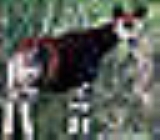
The
okapi Okapia johnstoni, is a giraffid artiodactyl
mammalMammals are members of a class of air-breathing vertebrate animals characterised by the possession of endothermy, hair, three middle ear bones, and mammary glands functional in mothers with young...
native to the
Ituri RainforestThe Ituri Rainforest is a rainforest located in the Ituri region of eastern Democratic Republic of the Congo formerly called Zaire. The forest's name derives from the nearby Ituri River which flows through the rainforest, connecting firstly to the Aruwimi River and finally into the Congo.-...
, located in the northeast of the
Democratic Republic of the CongoThe Democratic Republic of the Congo is a state located in Central Africa. It is the second largest country in Africa by area and the eleventh largest in the world...
, in Central Africa. Although the okapi bears striped markings reminiscent of
zebraZebras are several species of African equids united by their distinctive black and white stripes. Their stripes come in different patterns unique to each individual. They are generally social animals that live in small harems to large herds...
s, it is most closely related to the
giraffeThe giraffe is an African even-toed ungulate mammal, the tallest of all extant land-living animal species, and the largest ruminant...
.
The animal was brought to prominent European attention by speculation on its existence found in popular press reports covering
Henry Morton StanleySir Henry Morton Stanley, GCB, born John Rowlands , was a Welsh journalist and explorer famous for his exploration of Africa and his search for David Livingstone. Upon finding Livingstone, Stanley allegedly uttered the now-famous greeting, "Dr...
's journeys in 1887. Remains of a carcass were later sent to London by the English adventurer and colonial administrator
Harry JohnstonSir Henry "Harry" Hamilton Johnston, GCMG, KCB , was a British explorer, botanist, linguist and colonial administrator, one of the key players in the "Scramble for Africa" that occurred at the end of the 19th century....
and became a media event in 1901. Today there are approximately 10,000–20,000 in the wild and as of 2011, 42 different institutions display them worldwide.
Etymology
The generic epithet
Okapia derives from the
LeseLese, or occasionally Lissi, also known as Efe, is a Central Sudanic language of northeastern Congo. The Lese people live in association with the Efé Pygmies, and share one language....
Karo name
o'api, while the specific epithet (
johnstoni) is in recognition of the explorer Sir Harry Johnston, who organized the expedition that first acquired an okapi specimen for science from the Ituri Forest in the
Democratic Republic of the CongoThe Democratic Republic of the Congo is a state located in Central Africa. It is the second largest country in Africa by area and the eleventh largest in the world...
.
The name "okapi" is a portmanteau of two
Lese words,
oka a verb meaning to cut and
kpi which is a noun referring to the design made on
EféThe Efé are a group of part-time hunter-gatherer people living in the Ituri Rainforest of the Democratic Republic of Congo. In the depths of the forest they do not wear much clothing, using only leaf huts as shelter for their bodies in the intense heat. The Efé are Pygmies, and one of the shortest...
arrows by wrapping the arrow with bark so as to leave stripes when scorched by fire. The stripes on the legs of the okapi resemble these stripes on the arrow shafts. Lese legend says the okapi decorates itself with these stripes, adding to the okapi's great camouflage.
Characteristics and behaviour
Okapis have reddish dark backs, with striking horizontal white stripes on the front and back legs, making them resemble zebras from a distance. These markings possibly help young follow their mothers through the dense rain forest and may also serve as camouflage.
The body shape is similar to that of the giraffe, except that okapis have much shorter necks. Both species have very long (approximately 35 centimetres), flexible, blue tongues that they use to strip leaves and buds from trees.
The tongue of the okapi is also long enough for the animal to wash its eyelids and clean its ears (inside and out). This sticky tongue is pointed and bluish grey in colour like the giraffe's. Male okapis have short, skin-covered horns called
ossiconeOssicones are horn-like protuberances on the heads of giraffes, male okapis, and their extinct relatives, such as Sivatherium, and the climacoceratids, such as Climacoceras. Only giraffids have true ossicones...
s. They have large
earsEARS may refer to:* Electoral software* Electronic Arts, Redwood Shores campus.* Emirates Amateur Radio Society...
, which help them detect their predator, the
leopardThe leopard , Panthera pardus, is a member of the Felidae family and the smallest of the four "big cats" in the genus Panthera, the other three being the tiger, lion, and jaguar. The leopard was once distributed across eastern and southern Asia and Africa, from Siberia to South Africa, but its...
.
Okapis are 1.9 to 2.5 m (6.2 to 8.2 ft) long and stand 1.5 to 2 m (4.9 to 6.6 ft) high at the shoulder. They have a 30 to 42 cm (11.8 to 16.5 in) long tail. Their weight ranges from 200 to 300 kg (440.9 to 661.4 lb).
Okapis are primarily
diurnalDiurnality is a plant or animal behavior characterized by activity during the day and sleeping at night.-In animals:Animals that are not diurnal might be nocturnal or crepuscular . Many animal species are diurnal, including many mammals, insects, reptiles and birds...
, although recent photo captures have challenged this long held assumption. One photograph taken at 02:33 am shows an okapi feeding in the Watalinga forest in the north of the
Virunga National ParkThe Virunga National Park , formerly named Albert National Park, is a 7800 square km National Park that stretches from the Virunga Mountains in the South, to the Rwenzori Mountains in the North, in the eastern Democratic Republic of Congo, bordering Volcanoes National Park in Rwanda and Rwenzori...
in eastern DRC, thus providing evidence that they do not only feed during the daytime. Okapis are essentially solitary, coming together only to breed, with the exception of mothers and offspring. Breeding behaviours include sniffing, circling and licking each other.
Okapis forage along fixed, well-trodden paths through the forest. They have overlapping home ranges of several square kilometres and typically occur at densities of about 0.6 animals per square kilometre (about 1.5 animals per square mile). They are not social animals and prefer to live in large, secluded areas. This has led to problems with the okapi population due to the shrinking size of the land they live on. This lack of territory is caused by human land development and other social reasons.
Okapis have several methods of communicating their territory, including
scent glandScent glands are found in the genital area of most mammals and in various other parts of the body, such as the underarms of humans and the preorbital glands of deer and muskox. They produce a semi-viscous fluid which contains pheromones. These odor-messengers indicate information such as status,...
s on each foot that produce a tar-like substance, as well as urine marking. Males are protective of their territory, but allow females to pass through their domain to forage.
Habitat
Okapis prefer altitudes of 500 to 1,000 m, but may venture above 1,000 m in the eastern
montaneIn biogeography, montane is the highland area located below the subalpine zone. Montane regions generally have cooler temperatures and often have higher rainfall than the adjacent lowland regions, and are frequently home to distinct communities of plants and animals.The term "montane" means "of the...
rainforestRainforests are forests characterized by high rainfall, with definitions based on a minimum normal annual rainfall of 1750-2000 mm...
s. Because there is a considerable amount of rain in these forests, okapis have an oily, velvety coat of fur that repels the water. They develop this coat early in childhood also as a technique of camouflage.
The range of the okapi is limited by high
montaneIn biogeography, montane is the highland area located below the subalpine zone. Montane regions generally have cooler temperatures and often have higher rainfall than the adjacent lowland regions, and are frequently home to distinct communities of plants and animals.The term "montane" means "of the...
forests to the east, swamp forests below 500 m to the west, savannas of the
SahelThe Sahel is the ecoclimatic and biogeographic zone of transition between the Sahara desert in the North and the Sudanian Savannas in the south.It stretches across the North African continent between the Atlantic Ocean and the Red Sea....
/
SudanThe Sudan is the name given to a geographic region to the south of the Sahara, stretching from Western to Eastern Africa. The name derives from the Arabic bilâd as-sûdân or "land of the Blacks"...
to the north, and open woodlands to the south.
Okapis are most common in the
WambaWamba Territory is a part of the Haut-Uele District of the Democratic Republic of the Congo. The administrative center is the town of Wamba.-Mining:...
and Epulu areas.
Diet
Okapis are
herbivoreHerbivores are organisms that are anatomically and physiologically adapted to eat plant-based foods. Herbivory is a form of consumption in which an organism principally eats autotrophs such as plants, algae and photosynthesizing bacteria. More generally, organisms that feed on autotrophs in...
s, eating tree leaves and buds,
grassThe Poaceae is a large and nearly ubiquitous family of flowering plants. Members of this family are commonly called grasses, although the term "grass" is also applied to plants that are not in the Poaceae lineage, including the rushes and sedges...
,
fernA fern is any one of a group of about 12,000 species of plants belonging to the botanical group known as Pteridophyta. Unlike mosses, they have xylem and phloem . They have stems, leaves, and roots like other vascular plants...
s, fruit, and
fungiA fungus is a member of a large group of eukaryotic organisms that includes microorganisms such as yeasts and molds , as well as the more familiar mushrooms. These organisms are classified as a kingdom, Fungi, which is separate from plants, animals, and bacteria...
. Many of the plant species fed upon by the okapi are poisonous to humans.
Examination of okapi
fecesFeces, faeces, or fæces is a waste product from an animal's digestive tract expelled through the anus or cloaca during defecation.-Etymology:...
has revealed that the
charcoalCharcoal is the dark grey residue consisting of carbon, and any remaining ash, obtained by removing water and other volatile constituents from animal and vegetation substances. Charcoal is usually produced by slow pyrolysis, the heating of wood or other substances in the absence of oxygen...
from trees burnt by
lightningLightning is an atmospheric electrostatic discharge accompanied by thunder, which typically occurs during thunderstorms, and sometimes during volcanic eruptions or dust storms...
is consumed as well. Field observations indicate that the okapi's mineral and salt requirements are filled primarily by a
sulfurSulfur or sulphur is the chemical element with atomic number 16. In the periodic table it is represented by the symbol S. It is an abundant, multivalent non-metal. Under normal conditions, sulfur atoms form cyclic octatomic molecules with chemical formula S8. Elemental sulfur is a bright yellow...
ous, slightly salty, reddish clay found near rivers and streams.
History
The okapi was known to the ancient Egyptians; shortly after its discovery by Europeans, an ancient carved image of the animal was discovered in
EgyptEgypt , officially the Arab Republic of Egypt, Arabic: , is a country mainly in North Africa, with the Sinai Peninsula forming a land bridge in Southwest Asia. Egypt is thus a transcontinental country, and a major power in Africa, the Mediterranean Basin, the Middle East and the Muslim world...
. Although the okapi was unknown to the Western world until the 20th century, it was possibly depicted 2,500 years ago on the facade of the
ApadanaThe Apadāna is a collection of biographical stories found in the Khuddaka Nikaya of the Pāli Canon, the scriptures of Theravada Buddhism. It is thought by most scholars to be a late addition to the canon, composed during the 1st and 2nd century BCE...
, at
PersepolisPerspolis was the ceremonial capital of the Achaemenid Empire . Persepolis is situated northeast of the modern city of Shiraz in the Fars Province of modern Iran. In contemporary Persian, the site is known as Takht-e Jamshid...
, as a gift from the Ethiopian procession to the Achaemenid kingdom.
For years, Europeans in Africa had heard of an animal that they came to call the 'African
unicornThe unicorn is a legendary animal from European folklore that resembles a white horse with a large, pointed, spiraling horn projecting from its forehead, and sometimes a goat's beard...
'. In his travelogue of exploring the Congo,
Henry Morton StanleySir Henry Morton Stanley, GCB, born John Rowlands , was a Welsh journalist and explorer famous for his exploration of Africa and his search for David Livingstone. Upon finding Livingstone, Stanley allegedly uttered the now-famous greeting, "Dr...
mentioned a kind of
donkeyThe donkey or ass, Equus africanus asinus, is a domesticated member of the Equidae or horse family. The wild ancestor of the donkey is the African Wild Ass, E...
that the natives called the 'Atti', which scholars later identified as the okapi. Explorers may have seen the fleeting view of the striped backside as the animal fled through the bushes, leading to speculation that the okapi was some sort of rainforest zebra.
When the British governor of
UgandaUganda , officially the Republic of Uganda, is a landlocked country in East Africa. Uganda is also known as the "Pearl of Africa". It is bordered on the east by Kenya, on the north by South Sudan, on the west by the Democratic Republic of the Congo, on the southwest by Rwanda, and on the south by...
, Sir Harry Johnston, discovered some
pygmyPygmy is a term used for various ethnic groups worldwide whose average height is unusually short; anthropologists define pygmy as any group whose adult men grow to less than 150 cm in average height. A member of a slightly taller group is termed "pygmoid." The best known pygmies are the Aka,...
inhabitants of the Congo being abducted by a showman for exhibition, he rescued them and promised to return them to their homes. The grateful pygmies fed Johnston's curiosity about the animal mentioned in Stanley's book. Johnston was puzzled by the okapi tracks the natives showed him; while he had expected to be on the trail of some sort of forest-dwelling horse, the tracks were of some cloven-hoofed beast.
Though Johnston did not see an okapi himself, he did manage to obtain pieces of striped skin and eventually a skull. From this skull, the okapi was correctly classified as a relative of the giraffe; in 1901, the species was formally recognized as
Okapia johnstoni.
The okapi is sometimes referred to as an example of a
living fossilLiving fossil is an informal term for any living species which appears similar to a species otherwise only known from fossils and which has no close living relatives, or a group of organisms which have long fossil records...
.
The okapi was adopted as an emblem by the now defunct International Society of Cryptozoology.
In captivity
As of 2011, there are 154 okapi specimens in zoos on four continents, with the majority of them in North American and European zoos, and two specimens in South Africa and seven specimens in Japan. Immediately after their discovery,
zooA zoological garden, zoological park, menagerie, or zoo is a facility in which animals are confined within enclosures, displayed to the public, and in which they may also be bred....
s around the world attempted to get okapis from the wild. These initial attempts were accompanied by a high
mortality rateMortality rate is a measure of the number of deaths in a population, scaled to the size of that population, per unit time...
due to the rigors and stress of traveling thousands of miles by boat and by train. In more recent years, shipment by airplane has proven more successful.
The first live specimen in Europe arrived in
AntwerpAntwerp Zoo is a zoo in the centre of Antwerp, Belgium, located right next to the Antwerpen-Centraal railway station. It is the oldest animal park in the country, and one of the oldest in the world, established on 21 July 1843.- History :...
in 1918. The first okapi to arrive in North America was at the
Bronx ZooThe Bronx Zoo is located in the Bronx borough of New York City, within Bronx Park. It is the largest metropolitan zoo in the United States, comprising of park lands and naturalistic habitats, through which the Bronx River flows....
, via Antwerp, in 1937. The first okapi born in captivity outside Congo was at the
Antwerp ZooAntwerp Zoo is a zoo in the centre of Antwerp, Belgium, located right next to the Antwerpen-Centraal railway station. It is the oldest animal park in the country, and one of the oldest in the world, established on 21 July 1843.- History :...
,
BelgiumBelgium , officially the Kingdom of Belgium, is a federal state in Western Europe. It is a founding member of the European Union and hosts the EU's headquarters, and those of several other major international organisations such as NATO.Belgium is also a member of, or affiliated to, many...
in 1953. In North America, the first okapi was born at the
Brookfield ZooThe Brookfield Zoo is zoo located in the Chicago suburb of Brookfield, Illinois. The zoo covers an area of and houses around 450 species of animals....
in
IllinoisIllinois is the fifth-most populous state of the United States of America, and is often noted for being a microcosm of the entire country. With Chicago in the northeast, small industrial cities and great agricultural productivity in central and northern Illinois, and natural resources like coal,...
in 1959. Brookfield Zoo records 27 okapi births, followed by Zoo Basel’s 21 births.
The Brookfield Zoo directs the Okapi Species Survival Plan for the
Association of Zoos and AquariumsThe Association of Zoos and Aquariums was founded in 1924 and is a nonprofit organization dedicated to the advancement of zoos and public aquariums in the areas of conservation, education, science, and recreation.The AZA headquarters is located in Silver...
(AZA). The
European Endangered Species ProgrammeThe European Endangered Species Programme or EEP is the most intensive type of population management for a species kept in European Association of Zoos and Aquaria zoos...
(EEP) for the okapi is led by the Antwerp Zoo.
Wild status
Although okapis are not classified as endangered, they are threatened by
habitat destructionHabitat destruction is the process in which natural habitat is rendered functionally unable to support the species present. In this process, the organisms that previously used the site are displaced or destroyed, reducing biodiversity. Habitat destruction by human activity mainly for the purpose of...
and
poachingPoaching is the illegal taking of wild plants or animals contrary to local and international conservation and wildlife management laws. Violations of hunting laws and regulations are normally punishable by law and, collectively, such violations are known as poaching.It may be illegal and in...
. The world population is estimated at 10,000–20,000. Conservation work in the Congo includes the continuing study of okapi behaviour and lifestyle, which led to the creation in 1992 of the
Okapi Wildlife ReserveThe Okapi Wildlife Reserve is a World Heritage Site in the Ituri Forest in the north-east of the Democratic Republic of the Congo, near the borders with Sudan and Uganda...
. The
Congo Civil WarCongo Civil War may refer to:* In the Kingdom of Kongo:**Kongo Civil War * In the Republic of the Congo :**Republic of the Congo Civil War...
threatened both the wildlife and the conservation workers in the reserve.
There is an important captive breeding centre at
Epulu, at the heart of the reserve, which is managed jointly by the Congolese Institute for Nature Conservation (
ICCN) and Gilman International Conservation, which in turn receives support from other organisations including UNESCO, the
Frankfurt Zoological SocietyThe Frankfurt Zoological Society is an independent, non-profit conservation organisation based in Frankfurt am Main, Germany. The society is funded through membership fees, donations, bequests, grants and earnings from its endowment fund.-History:...
and WildlifeDirect as well as from zoos around the world. The Wildlife Conservation Society is also active in the Okapi Wildlife Reserve.
On June 8, 2006, scientists reported that evidence of surviving okapis in Congo's
Virunga National ParkThe Virunga National Park , formerly named Albert National Park, is a 7800 square km National Park that stretches from the Virunga Mountains in the South, to the Rwenzori Mountains in the North, in the eastern Democratic Republic of Congo, bordering Volcanoes National Park in Rwanda and Rwenzori...
had been discovered. This had been the first official okapi sighting in that park since 1959, after nearly half a century. In September 2008, the
Wildlife Conservation SocietyThe Wildlife Conservation Society based at the Bronx Zoo was founded in 1895 as the New York Zoological Society and currently manages some of wild places around the world, with over 500 field conservation projects in 60 countries, and 200 scientists on staff...
reported that one of their camera traps snapped the first photo ever taken of an okapi in Virunga National Park.
In popular culture
In
Restaurant at the End of the Universe by
Douglas AdamsDouglas Noel Adams was an English writer and dramatist. He is best known as the author of The Hitchhiker's Guide to the Galaxy, which started life in 1978 as a BBC radio comedy before developing into a "trilogy" of five books that sold over 15 million copies in his lifetime, a television...
as well as the original radio show of
The Hitchhiker's Guide To The GalaxyThe Hitchhiker's Guide to the Galaxy is a science fiction comedy series created by Douglas Adams. Originally a radio comedy broadcast on BBC Radio 4 in 1978, it was later adapted to other formats, and over several years it gradually became an international multi-media phenomenon...
, there is a line that states that
Arthur DentArthur Philip Dent is a fictional character, the hapless protagonist and anti-hero in the comic science fiction series The Hitchhiker's Guide to the Galaxy by Douglas Adams....
's brother was said to have been "nibbled to death by an Okapi".
The English goth punk band The Damned ended their third album
Machine Gun EtiquetteMachine Gun Etiquette is the third album by the British punk band The Damned, released in November 1979. The album was the group's first since reforming with Dave Vanian on vocals, Captain Sensible on lead guitar, Rat Scabies on drums and Algy Ward on bass...
, which was released originally in 1979 on a vinyl record, with a lead-out groove that contained the sound clip: "nibbled to death by an okapi", from the original HHGTTG radio show - spoken by Peter Jones. The vinyl record was engineered in such a way that when it hit that line, it would loop indefinitely until the listener physically removed the needle from the vinyl record. Of course, this is not possible on the CD or MP3 version of the album, so the original vinyl is a prized collectible to fans of the band and some extreme HHGTTG fans.
Actor / comedian
Michael BigginsMichael Biggins is an American film actor, writer, director, and radio and TV show host best known for performing under the name of Blackout in a wide variety of pranks, prank call recordings, radio and TV shows, films, and original characters created and performed under that performance name...
AKA Blackout on several radio and television shows and interviews including
VH1VH1 or Vh1 is an American cable television network based in New York City. Launched on January 1, 1985 in the old space of Turner Broadcasting's short-lived Cable Music Channel, the original purpose of the channel was to build on the success of MTV by playing music videos, but targeting a slightly...
's I Love the 90s and on his radio & TV show Blackout's Box LIVE, also claims that he 'created' the okapi, and that it is his favorite animal and the "ruler of all universes" - only he originally called it a 'Gazebrahorseraf'. He ends and opens his Blackout's Box LIVE radio and TV show many times with the line, "All Hail the Thrice Great Okapi!" which is a play on the fact that the okapi appears to be a mixture of a giraffe, a horse, and a zebra, and an inside joke to people knowledgeable of
occultThe word occult comes from the Latin word occultus , referring to "knowledge of the hidden". In the medical sense it is used to refer to a structure or process that is hidden, e.g...
magicMagic is the claimed art of manipulating aspects of reality either by supernatural means or through knowledge of occult laws unknown to science. It is in contrast to science, in that science does not accept anything not subject to either direct or indirect observation, and subject to logical...
. In one of the sketches of his improvisational 2010 Christmas Special of his live show he has an okapi puppet dancing with a cheap
Santa ClausSanta Claus is a folklore figure in various cultures who distributes gifts to children, normally on Christmas Eve. Each name is a variation of Saint Nicholas, but refers to Santa Claus...
animatronic. He also has a puppet of Jen, the lead character from
The Dark CrystalThe Dark Crystal is a 1982 British-American fantasy film directed by Jim Henson and Frank Oz. Although marketed as a family film, it was notably darker than previous material created by them. The animatronics used in the film were considered groundbreaking. The primary concept artist was the...
riding a toy okapi that can be seen weekly in the background of his live television show.
External links
News links